The following members of the Elite Team Bald Runner won in the top rankings of last Sunday’s 33rd MILO 42K Elimination Race which started and ended at Luneta Park, Manila:
Rene Desuyo—Overall Champion in the Men’s Category for the 42K Race with a time of 2:33:38 hours. He won a cash prize of P 30,000 and Championship Trophy.
Alley Quisay—2nd Runner-Up in the Men’s Category for the 42K Race with a time of 2:37:00 hours. He won a cash prize of P 10,000 and 3rd Place Trophy.
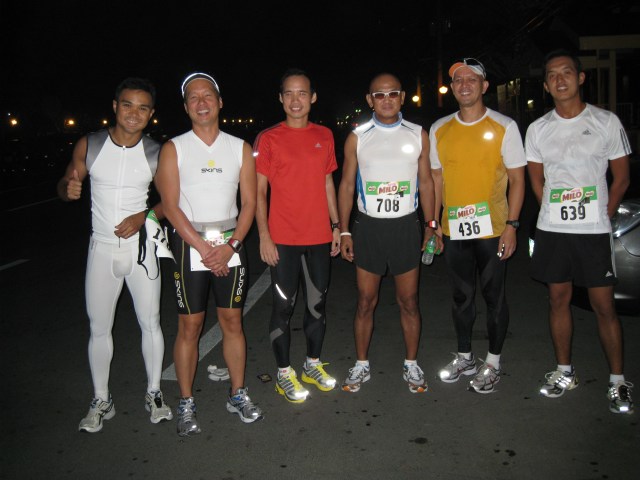
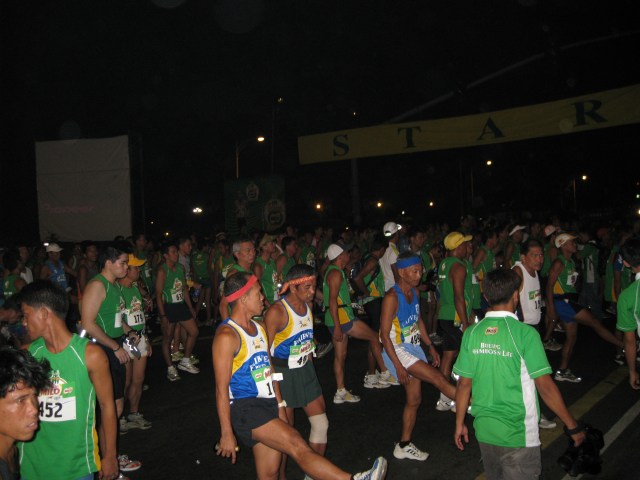
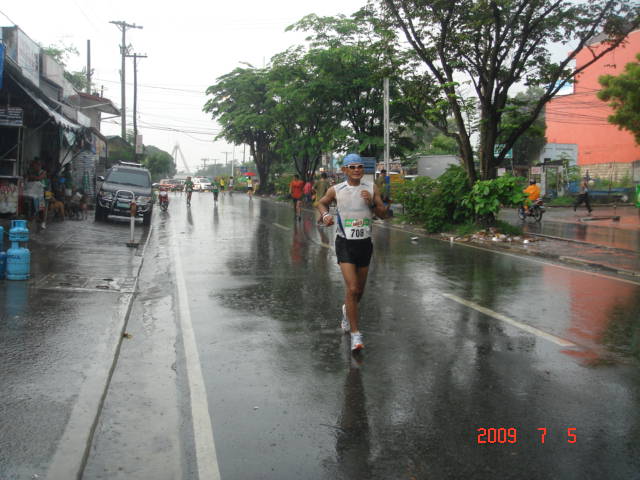
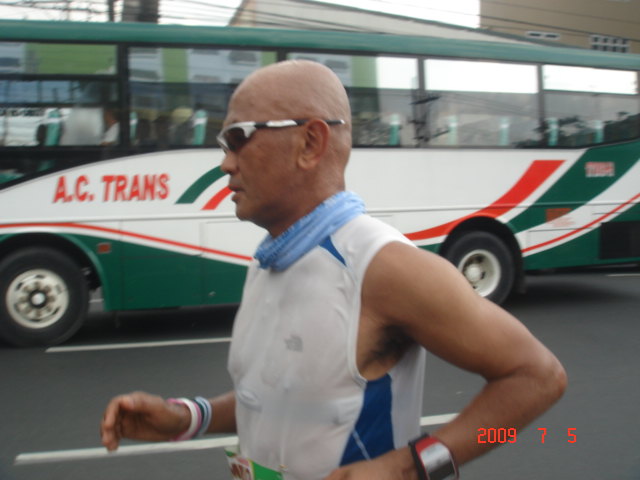
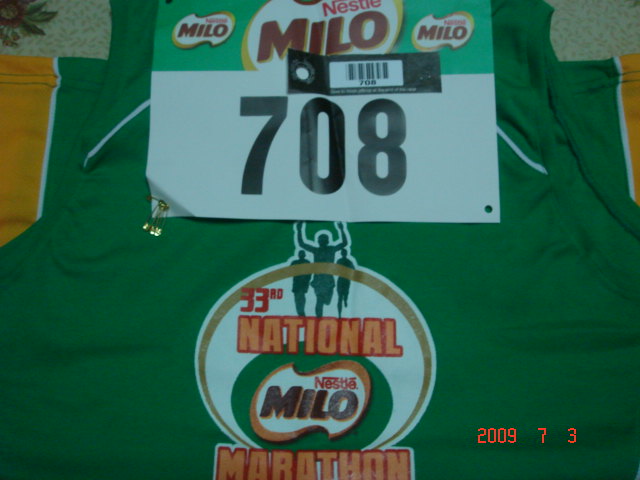
In addition, I am posting the following pictures taken before and during the 33rd MILO 42K Elimination Race:
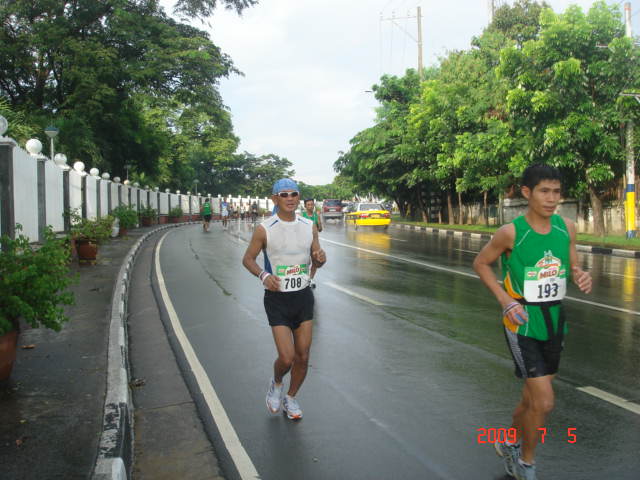
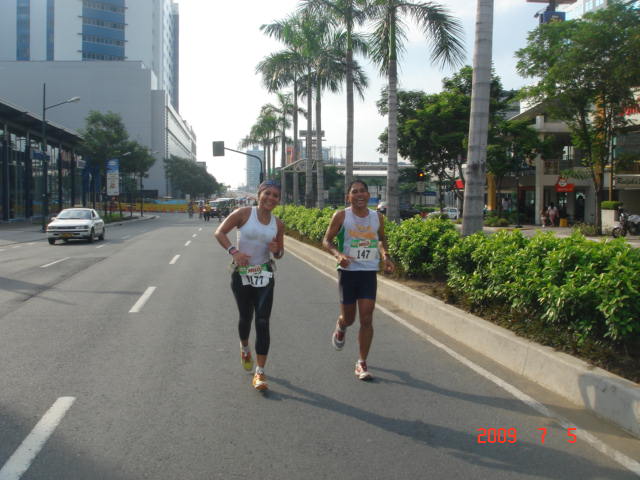
Hardcore Team with Bald RunnerStretching Exercises Before the Start of the RaceStart of The Race
The first time that I heard and read about this particular Ultratrail endurance run was when I got a copy of the book “Ultramarathon Man” by Dean Karnazes which became a Number One Bookseller at one time. Practically, almost one half of the book was devoted to the author’s quest to qualify for the said race, train for it, and finally described how he was able to finish his first 100-mile race in this event. It is very detailed to the point that everything was described on how a first-timer would experience running a 100-mile endurance run. Dean Karnazes joined this particular race for the first time in 1994.
I guess, this book entirely opened the awareness of most of the runners to try and experience what it takes to run an ultra race along the trails of the mountains. Personally, the book also inspired me to try running an ultra distance at the Bulldog 50K last year. And I went further by going to Badwater, California to witness the start of the 2008 Badwater Ultramarathon, meeting and talking to Dean Karnazes and Pam Reed for the first time; taking some pictures of the ultra athletes; and observing how they ran along the first 25 miles of the course.
And because of my readings, observations, and experience about ultra races, the Bataan Death March 102K Ultramarathon Race (BDM 102) became a reality!
You might be wondering why I am posting the results of this particular endurance run. Aside from reading it from Dean K’s book and had inspired me to tread to ultra distance running, it is one of my “dreams” to run at least one 100-mile endurance run in my running career and who knows this dream would come true! Not necessarily qualifying and running for the Western States 100-Mile in the future!
The following is the article/post taken from the Ultrarunning Magazine Online (www.ultrarunning.com)
Koerner, Ortiz Win at Sizzling Western States
Auburn, California, June 28—Hal Koerner successfully defended his championship and Anita Ortiz won her first 100-miler under blistering conditions at the Western States Endurance Run which finished here today. Koerner dueled with Dave Mackey for most of the first 55 miles before pulling away in Volcano Canyon, stretched his lead down an oven-like California Street loop, and won the race by nearly half an hour over a spate of challengers.
Ortiz, a mother of four running her first 100-miler, lead most of the way, holding small leads over Beverly Anderson-Abbs until Devils Thumb (mile 47.8). Ortiz stretched her lead to twenty minutes on the trip through rugged Eldorado Canyon and was never seriously threatened thereafter. Krissy Moehl overtook Anderson-Abbs around mile 83 and finished second. Three-time winner Nikki Kimball struggled most of the day, but toughed it out to take fourth.
The race for second among the men was spectacular, with three runners leaving the Highway 49 aid station (mile 93.3) within seconds of each other and a fourth runner departing four minutes later. Eventually, Tsuyoshi Kaburagi of Japan won the epic battle, nudging Jez Bragg of Great Britain for runner-up honors, with Jasper Halekas of Oakland garnering fourth and Kevin Sullivan of Andover, Massachusetts fifth. All five runners were under 17 hours, the most ever in the 36 years of this event. Kaburagi’s time of 16:52:06 set a new masters course record. Seven-time champion Scott Jurek ran third for much of the first 40 miles, but was 10-20 minutes behind and never really in the mix. Jurek dropped from third to seventh by Devils Thumb aid station (mile 47.8) and dropped out there. Early leader Mackey also dropped, at the Rucky Chucky River Crossing aid station (mile 78.0).
The race was held under extremely hot conditions, with temperatures peaking at 99F on Saturday. For the later finishers, Sunday was even hotter, with Auburn reaching 103F. The heat had a deleterious effect on both times and finishing rate; only 238 of the 399 starters (59.6%) finished the race within the 30-hour time limit.
Men
1. Hal Koerner, 33, Ashland, OR, 16:24:55
2. Tsuyoshi Kaburagi, 40, Takasaki, JPN, 16:52:06
3. Jez Bragg, 28, Warwick, GBR, 16:54:26
4. Jasper Halekas, 33, Oakland, CA, 16:56:26
5. Kevin Sullivan, 38, Andover, MA, 16:59:33
6. Zachariah Miller, 33, Ann Arbor, MI, 17:34:12
7. Leigh Schmitt, 36, Conway, MA, 17:49:37
8. Eric Skaden, 37, Folsom, CA, 18:22:44
9. Mark Lantz, 43, Gold River, CA, 18:45:56
10. Andy Jones-Wilkins, 41, Ketchum, ID, 18:46:52
Race Report: 33rd MILO 42K Eliminations @ Luneta Park/4:25 AM July 5, 2009
Reading a lot of books and blogs of elite athletes influenced me to re-assess my training program after finishing the BDM 102K, BOTAK 42, and the LA Marathon (LAM) in a span of two months. It is said that these elite and competitive athletes adhere to the principle of “periodization” for the marathon and ultramarathon distances and provide a much-needed rest and recovery to their bodies from severe training and competitions. If these athletes/runners who are younger than me by 25 to 30 years had included in their training a period of rest and recovery, how much more for an older runner like me?
After doing a lot of “walkabouts” and “runabouts” in Los Angeles after the LAM, I’ve observed that there was some tightness and pain below my left knee cap and as a result, I immediately decreased my weekly mileage and ultimately embraced the need for a full rest and recovery even if I was already registered for the 33rd MILO 42K Elimination Race. As a warrior, I thought that I could not win every battle where I am going to fight if I am not sure I will not win. However, I thought of going to the battle to try and find out where I need to improve with the thought that if I will loss in this battle, I knew I could win the WAR in the next battle.
And so, at the beginning of the race, my mind was already geared towards the ultimate goal of finishing the race decently and make the MILO Finals goodbye and not included to be a part of my future battles. Last year, I was not able to join the 32nd MILO 42K Eliminations because I was in the United States for my first ultra trail run at Bulldog 50K. But due to my request then to the MILO Race Organizers, I was able to join the MILO Finals with an impressive time of 3:48:32 hours which I think I was then on my “peak period” for the year! It was then that I thought of planning to improve my time with the intention of qualifying for the Boston Marathon as I could make it to the 3:45 hours qualifying time for my age (55-59 years old).
Unfortunately, the BDM 102 and the BOTAK 42K made me a slower runner but I knew I could have a better time at the LAM.
I was already at the vicinity of the former Army & Navy Club (Luneta Park) at 3:40 AM with enough time to pin my race number and do some stretching exercises. Out from nowhere, the Hardcore Team (Jonel, Mari, Jay C, Lester, Kevin, Martin Lorenzo & Odessa) approached me and we had a brief chat and some photo-ops. I saw Jay aka Prometheus Cometh and Vener aka RunUnlimited having their warm-up. In a few minutes, we proceeded to the starting area where the rest of the runners were doing some stretching exercises. Inside the corral, I was able to greet and meet other runner-bloggers, BDM 102K Finishers, and the usual hardcore runners who are always present in almost all the road races in Metro Manila. A certain “Mike” (I am not sure if that’s the name I can recall) from California introduced himself and he gave me the impression that he is in the country to run the MILO 42K as he is also a passionate runner who had finished a lot of marathon races in the US, to include NY & Boston Marathon. He is 55 years old!
As in the rest of past Rudy Biscocho’s races, the race started ahead of the scheduled time and we were off for the race at 4:25AM. The race was totally different from my LAM experience at the few meters from the starting line. A 42K race with about 500 runners as compared to a sea of almost 15,000 runners is a “sign” that I am really back to the reality of running in my own country. However, the advantage is that, I could immediately start my GF 305 without waiting for about 10-15 minutes before crossing the starting line! In Manila, you only miss or wait a few seconds from where you start running before passing the starting line.
For the 1st 10 kilometers, I could still see the backs of Vener and Jay N at a distance and I estimated that I was running at an average pace of 5:45-6:00 minutes per kilometer. But later, Joms Paras, a younger and a fast runner, joined me along my side for almost 3-4 kilometers and I knew that I was already looking for trouble as I was doing a faster pace than what I estimated. Keeping pace with Joms and trying to maintain seeing the backs of Vener & Jay N at the 10K distance was already an invitation for a disaster to happen.
I was very confident to climb those overpass along Roxas Boulevard and was also confident to run up to the Kalayaan Flyover/Overpass without any problems. Well, that was what I thought. As soon as I was about to go down from the Kalayaan Overpass to The Fort area, an early sign of muscle cramps on my left calves started to appear and I had to slow down. I think this was where most of the runners overtook me. At this point, I tried to recall my past running workouts since I finished the LAM. While watching the leading runners going the opposite direction at Fifth Avenue, I tried to “shuffle” and make sure I don’t overstrain my calves while maintaining my running form with the hope of meeting my support crew along Bayani Road for my hard-boiled eggs and oatmeal. I knew I had been religiously taking my GU Roctane since the start of the race, drinking water in every water station, and drinking Gatorade in the provided stations along the way but still I could not figure out why at the early stage of the race I was already experiencing early signs of muscle cramps. I was expecting a sign of cramps at Km 25, not at Km 16!!! Whenever, the pain disappears, I would increase my pace with the hope that I could, at least, improve my finish time.
You could just imagine how desperate I was to spray that cannister of “pain killer” at the “P & G” runner’s booth infront of the Southern Police (PNP) Headquarters along Lawton Avenue!!! The Bald Runner was already dying with cramps and help was not coming!
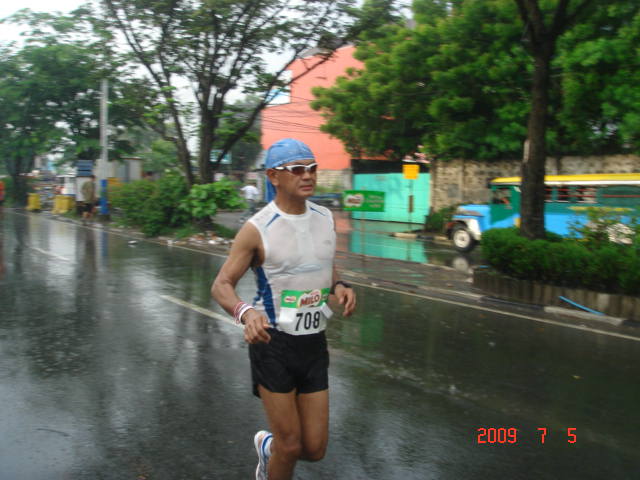
I guess, my “hot temper” (which I did not show to the ladies at the booth) within me acted as my natural “pain killer” which made those cramps disappear while I maintained a slower pace. All of a sudden, I was already approaching the Heritage Park when the rain started. It gave some relief to my hot body but I knew that my pace was not improving at all.
On My Way Towards Heritage Park/C-5 Turn-AroundAlong Bayani Rd After The Rain/Going Back To Lawton Ave
I met my support crew along the Bayani Road on my way back to Lawton Avenue. As planned, I ate one hard-boiled egg and one pack mix of oatmeal with Gatorade drinks.
After this brief stop, it was already a battle between being DNF in this race or continue to struggle up to the finish. Well, I never had a DNF in my running races and never had a DNF in my military career and much more never will have a DNF in the so-called trip called “Life”. I said to myself, DON’T QUIT! And I could still remember what I learned and always hear from my Officers and Soldiers when I was assigned with the Special Operations Command of the Philippine Army, that goes this way, “Mas mabuting mamatay, Huwag lang mapahiya”! (“It is Better To Die than Live in Shame”!)
Along Lawton Avenue & Back To The FortAt 5th Avenue, The Fort"Don't Quit" Running Form!!! (Photo Courtesy Of Harry Tan, Jr aka Mukhang Guilty)
And so, that was the running “mantra” while other faster runners would pass me along the way. I made sure I would drink water in every Water Station; drink Gatorade in cups in every Gatorade Station provided by the Race Organizers; ask hard-boiled eggs on the last 6 kilometers from my support; swallow my GU Roctane every 10 kilometers; and don’t over stride so that my muscle cramps would not appear.
Mesh V aka My Iron Shoes & Coach Titus Overtook Me at Lawton Avenue (Good Luck On Your SFM!)
People at the Support Stations of different running groups who know me would cheer me but I observed that they were not offering something for me. Of course, I did not ask anything from them in the first place but if these people would have the experience on how it feels to run a marathon, maybe, just maybe, one of them might offer a cup of water or cup of Gatorade drinks to me just to show some spirit of “volunteerism” in a marathon race. It is regrettable that this is another great disparity or difference in running the LAM and our local marathon races. On the other hand, I highly appreciated the support of Hardcore Team’s Ivy and Odessa for offering their drinks & food when I really needed them. Thanks, Guys!
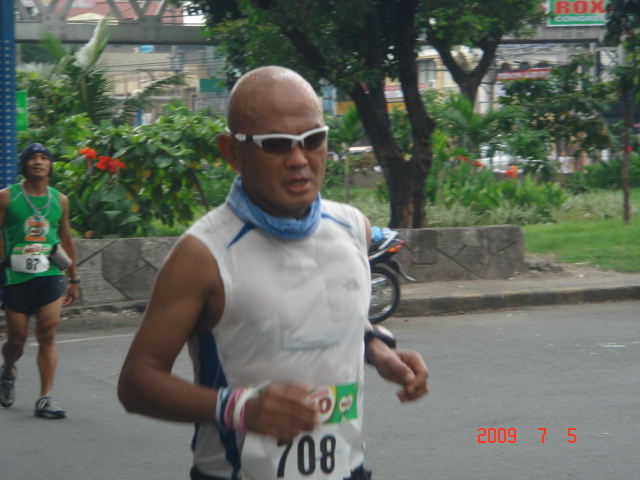
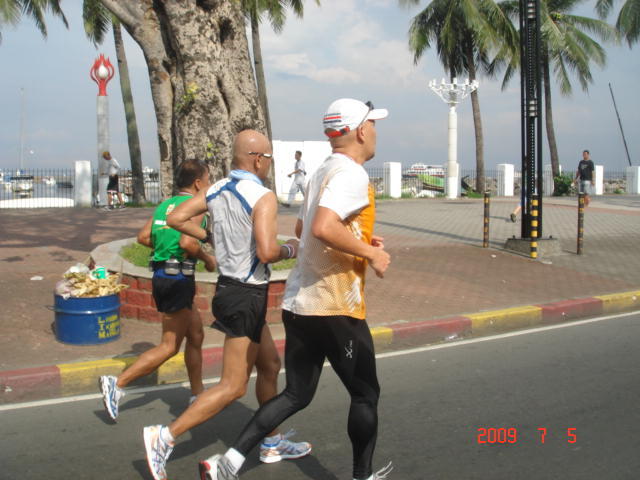
The Face of A "Road Warrior"...In Pain!BDM 102 "Warriors" Along Roxas Blvd (Albert Nama, Jonel, & BR)Another View of These Ultra RunnersOn My Last Kilometer To The Finish Line
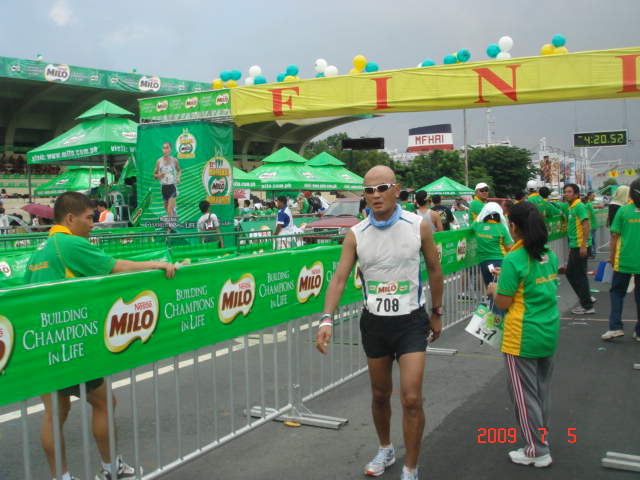
Finally, I finished the race in 4:20:45 hours. Nothing extraordinary and it was a challenging fight with myself. Now, I can proudly say that I am Not Qualified (NQ’d) for the MILO 42K FINALS.
After Passing the Finish Line! Tired & Happy!
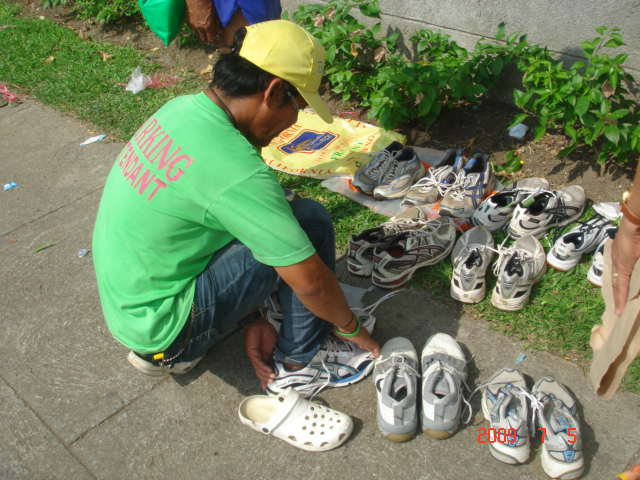
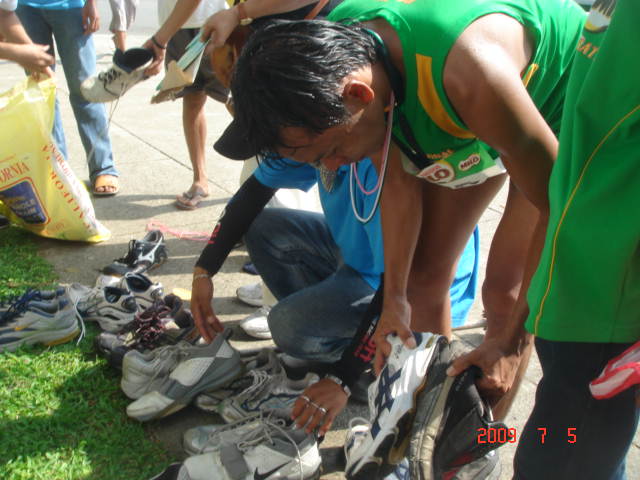
Instead of looking for other runners and congratulating them for their finish, I opted to display my Project Donate A Shoe tarpaulin in a place where other runners would see and my support crew displayed at least 50 pairs of donated shoes. In less than 10 minutes, all the shoes were gone and were received by runners and by even street/park sweepers of Luneta Park with their happy faces. I was happy that these donated shoes would end up to runners and those “poor souls” who needed them most.
Choosing The Right Shoe That FitsNot Only Runners Were Given With ShoesIn A Few Minutes All The Shoes Were Gone!
To all the runners who were qualified for the MILO FINALS, my warmest congratulations to you! I will be cheering you along the route or maybe I will be putting up a “BEER STATION” for all the runners (if Mr Biscocho & MILO will permit it). Anyway, if you have “bandit runners”, I am sure there should be “bandit aid/support stations”. So, watchout for the “BANDIT BEER STATION”!!!
To all the runners who were not qualified, please don’t run as “bandits”! It is better for you to “volunteer” as aid station personnel for the “bandit beer station”. Your reward for being a volunteer will be the remaining bottles and cases of beer which will not be consumed by the passing runners!!! In the first place, you were the ones who committed to donate those cases of cold beer!!
The picture below may not be the exact brand or apperance that the P & G Runners were using during last Sunday’s MILO 42K Elimination Race. However, I would like to show to my readers how this kind of spray looks like. I really don’t know if such spray is already available in the country. If you happen to see one, buy one and try to spray on your cramping legs during your long runs or marathon/ultramarathon race. Good luck!
It is the brand of a piece of cloth being used by ultra trail runners and runners/athletes participating in multi-stage races in the desert and snow.
I bought two of this which are made of High UV ray protection “Coolmax” material and could be used in tropical countries like ours. In the MILO 42K Elimination Race, I used the blue colored Buff for testing in this particular race, thereby, replacing the bandanas and the bandana with crystals to cool off my nape. I used the Buff as depicted in the following pictures:
As a Headband to prevent my sweat flowing to my Eyes!As A Runner's Cap...As A Bandana to Cool Off My Nape
It can be used also as a baclava, ala-ninja cover to the face, a pirate’s cap, ear muff, hairband, wrist wrap and a bonnet. If I am not mistaken, I saw Albert Salazar aka Run2dmoon and Jael Wenceslao of Team Baldrunner-Professional Group wearing this kind of headgear in their marathon races and “runabouts” in Metro Manila.
I bought the said item at REI Store in Monrovia/Arcadia, California for $ 28.95 + tax.
Unfortunately, this Buff did not make me faster in this particular 42K race. But certainly, I look “cool & hip” using it.
Mr James Lafferty, CEO of P & G Philippines immediately contacted me through my cellphone as soon as he read my post in this blog about the incident that happened to me during my run at the MILO 42K Elimination Race last Sunday and he asked me to publish his response about the said incident. He refreshed my memory by telling me that we briefly met in one of the road races in the past. Anyway, I gave him my word that I am going to publish his response immediately as soon as I receive it. And the following is his response:
My name is Jim Lafferty, and I am the “CEO” mentioned in today’s posts concerning volunteers at the Milo Marathon, and the P&G support team. I am presently in the midst of retiring as CEO of P&G Philippines, but I was a participant yesterday in the Milo Marathon with my 18 year old daughter, and have been a driving force in establishing running as a pillar of our corporate fitness program for our employees wellness. And, whilst I am not the world’s most talented runner by any means, I have completed over 25 different international marathons over the years, and my whole family is passionate about running. My wife has also completed 25+ marathons as well as multiple ultramarathons including 2x the Comrades in South Africa. And my 3 eldest children have all competed multiple marathons. I am also a physiologist, prior athletics coach and even today I volunteer coach at Ateneo. So like you sir, marathoning is in our blood!
There has clearly been a great deal of angst concerning the P&G support during the Milo Marathon, so I wanted to provide some perspective to shed further light on the reality of the situation..
As running is a part of our corporate wellness program, we try to make it accessible to everyone, and not make it elitist in any shape or form. This means broad participation across a wide range of skill and experience levels. We had 104 employees running in the Milo marathon, far and away the largest contingent of the race. Nearly 75% of these were first-time marathoners, who were seeking solely to “finish” the race and without any pre-defined time goal.
I have both a moral and fiduciary responsibility to look out for the best interests of my employees, particularly as many of them are beginner marathoners. As such an experienced runner as yourself would know, beginners can have a difficult time to manage fluid intake, particularly if a bit overweight and in humid climates such as Manila. The Milo team does a terrific job with the marathon, yet for beginners it is tough to manage the back half of the race with fluid stops every 5 KMs. If I take the world’s largest marathon, Chicago, which I have run 6 times, and which has a high % of first timers, they have fluid stations every 1.5-2.0 KMs for the express purpose of ensuring adequate fluid intake. And this is a race that is run in October each year in average temperatures of 11 degrees!.
As such, as we choose to support local races in the Philippines, we chose Milo and we worked closely with the Milo folks, over the past 3 years, to gain authorization to place additional aid stations for our beginners. It is not to be “special” or the like—yet simply to ensure our beginners are being cared for as they are not as experienced as the rest of the field. And we do this under the full support and auspices of Milo organizing committee, months in advance.
There is nothing uncommon about teams having their own aid stations or tents at races. None whatsoever and this is NOT a violation of any rules. I was just again in May at Comrades Marathon in South Africa, the world’s oldest, most prestigious, and largest ultramarathon on the planet with 13,000 runners doing the 90 KMs in 12 hours or less. There were 168 different teams competing, and most had their own aid stations along the route. In Chicago Marathon, there are specific aid stations every 20 meters, the Swiss Embassy has their own aid station for “swiss runners”, then the French, then the Chinese. Nearly every nationality and consulate has their own aid station. And this does not even factor in a husband or wife who stands by the side of the road holding a “goody bag” with a special drink or snack for a loved one. This is a common occurrence and no one should be upset at P&G supporting their runners. In fact, as an avid runner and coach, I applaud when people rise at 4 am to go and work a race and help and support people they care about!
I suspect the crux of the issue is, if a non “team” runner approaches a team-specific aid station for help, should they get help? My answer is ABSOLUTELY YES and this was what we deployed to our volunteer staff in the days heading up to the Milo Marathon. And, I believe MANY non-P&G runners yesterday would attest to getting help from our aid crew. However, there were cases where we did not help, such as the cases noted in Baldrunner blog site, and for this, I must apologize as retiring head of P&G and as a fellow runner. Its not right and we made a mistake.
At the end of the day, leadership means accepting responsibility. It is unfair to place any blame on the Milo organizers. I can tell you the team at Nestle are world class, they care about putting on a good event, and they are dedicated to the sport and the country. They only wanted to help a large team from P&G, that’s all, to help expand the allure of running to more people. It is also unfair to blame a young employee, who was only trying to do what they felt was right and protect the interests of their fellow employees. The failure was one of a consistent communication message and I take responsibility for these isolated events. I am truly sorry, and I can assure you that this will not happen again.
I would ask that all of the devotees to the outstanding Baldrunner site please not “throw the baby out with the bathwater” and allow this one incident to sour their views. Yes, in this case we made a mistake and we shall make amends for it in the future. But there is also much to celebrate. A company taking a lead with its employees to promote actively the great sport of running and a healthy lifestyle. Investing in health. And to many, many runners where we did indeed help.
Thank you and keep up the great work.
J.M. Lafferty
CEO, P&G Phils (Ret)
“100 Years from now, it won’t matter what my job title was, how much $ I earned, the size of my house, or if I drove a BMW. Yet, the world may be a different place because I was important in the life of a child”
P.S.
I did not mention “CEO” in my post, however, it was mentioned by one of the commentors in this blog. Eventually, this will make a closure of the said incident with the hope that we should start initiating the act of “volunteerism” to our runners, most especially in marathon and longer distance races.
My sincerest thanks to Mr Lafferty for taking immediate action on the said incident. “Sir, your apology is accepted!”
After running the Los Angeles Marathon last May 25, my experience with the “volunteers” along the route were memorable and worth emulating. I know that Captain Amado Castro, Jr aka Reinier 6666, who participated in the said marathon, was also impressed by the cooperation of the people/residents along the route to help with the needs of the runners—by offering cups filled with water, sports drinks, and even beer; and some would offer massage and food to anybody running in the said marathon. I know that this was the reason why Mr Castro initiated a team-up with Jinoe Gavan and the takbo.ph people to put up an Aid Station as Volunteers to support the 100K and 50K runners of BOTAK 100K Paa-tibayan Race last weekend. Their Aid Station was open to every runner in that race.
In this morning’s MILO Marathon Elimination Race, I have observed a lot of Aid Stations along the way in addition to the usual Water & Gatorade Stations provided by the MILO Race Organizer. However, these Aid Stations were there solely to support the members of their respective running clubs or teams. There is no problem with that but I think, if we “volunteer” to support some runners, we better start supporting every runner in a marathon. Anyway, what is the worth of a small cup of water or sports drinks offered to a runner who is not a member of your running team?
Okey, I have this bad experience this morning during the race. Infront of the Southern Police District (PNP) Headquarters, there was this booth with ladies who were standing infront of a table with Salonpas Spray canisters. Since I have some of these Salonpas Sprays (bought for me by my son, John), I know them at a distance. And the fact that these Salonpas Sprays were used by “volunteers” during the Los Angeles Marathon to runners who were having some muscle cramps on their legs, I knew that these sprays are very effective. At this point (along Lawton Avenue), I was starting to have some cramps and at a distance, it was a relief for me to see these sprays at the said booth. As soon I got to the table, I got hold one of the canisters and while I was about to use it, one of the ladies grabbed the said spray from my hand. Another runner was also trying to get hold of the other canister but another lady grabbed the said spray away from the other runner. I said, “Why don’t you allow us to use your spray?” “Is the spray for every runner?” And one the ladies said that the sprays were reserved for the use of the “P & G” runners. Well, I saw a tarpualin signage on the back of the ladies with the markings, “P & G”. Is this translated to “Procter & Gamble”? The other runner who joined me to the said booth was very angry and I was trying to control my temper, too! The other runner suggested me to publish a post in my blog about the said incident. Well, that was already in my mind before the other runner uttered his suggestion.
So, if any of the “P & G” runners will be reading this post, I am already announcing in this blog that I will be putting up an Aid Station purposely to share my two canisters of Salonpas Spray to every runner in the next Marathon Race. As for the other “volunteers”, can you start offering your “goods” to other runners, too?
The Bald Runner’s “Project Donate A Shoe” Booth will be available at the Start/Finish Area at the vicinity of the Quirino Grandstand this coming Sunday. Donated shoes from Joe Matias of A Runners Circle Running Specialty Store in Los Angeles, California; Ultrarunners Ben Gaetos/Carmela Layson of Los Angeles, California; Mark Robinson of Nottinghamshire, England; and from the members of the Team Bald Runner-Professional Group will be distributed to runners with old, tattered, worn-out and dilapidated running shoes. It should be noted that only runners will be entertained in this activity.
At the same time, donors will be welcomed to visit the booth and the Bald Runner will be there to accept their shoe donations, to include Finisher’s T-Shirts for the Project “Donate A Shirt”.
See you at the Start/Finish Line of the MILO Marathon Eliminations this Sunday! Good luck!
My major road races for this year started with my participation in the 1st BDM 102K Ultramarathon Race last April 5, followed by the BOTAK 42K Paa-tibayan Race last May 10, and lately, my first participation in the Los Angeles Marathon last May 25.
My finish times for the BOTAK 42K and 2009 Los Angeles Marathon were 4:35:10 hours and 4:07:33 hours, respectively. These times were far from my last year’s MILO Marathon Finals time of 3:48:32 hours.
After the Los Angeles Marathon, my training had been reduced to easy runs and tempo runs. My mileage went down and I tried to rest and recover for the month of June after reading accounts of elite athletes on how they train by following the principle of “periodization”.
Although the main objective in my participation to this Sunday’s MILO Marathon Elimination Race is for me to finish with a time of below 4 hours to be able to qualify for the MILO Marathon Finals, it will be a difficult task knowing the humid and hot weather condition in the country. Nevertheless, joining the MILO Marathon Finals in October will not be possible because of conflict in schedule for more important races to join. But at the back of my mind, the target will always be to finish in sub-4 hours in this race.
This Sunday’s Milo Marathon will serve as a “diagnostic test” for another training program and plan for me to run another marathon race before the end of this year.
To all the MILO Marathon runners this Sunday, my Best Wishes & Good Luck to everybody!
To all the “first-timers”, “Don’t Quit”!!!!
Ready To Run A Marathon, Again!!!
Note: Don’t forget to have your deep-muscle massage today!!!
This is how the Kenyans see why they are winning in most of the Marathon and other long distance Races worldwide. This is the very same attitude I want to impart to the elite runners who are under the Team Bald Runner with the hope of improving their performance in long distance running.
I am presently reading the book, “More Fire: How To Run The Kenyan Way” by Toby Tanser which is a continuation of his first book, “Train Hard, Win Easy”, his first book on Kenyan running. In the concluding portion of the book, the author listed 15 ways to adopt a Kenyan Training Method. And here is the list as copied from the book.
1. Injury Prevention—They say the best way to avoid a spear is to stand out of range; this applies to running. Kenyans are excellent at resting up if a possible injury pain is noticed. Do not let that pain get too near you.
2. Simplicity—Kenyan running is very organic, which in itself is the very essence of the sport. Simple methods are executed with imposing intensity. They are focused and concentrated in their running and they could not afford any distractions. It simply means that they have no time for cellphones, Internet browsing, listening to Ipods, or watching the TV or even going to Malls or social parties. They just simply run and train!
3. Group Training—The power of the group never ceases to be underplayed in improving performance.
4. Diet—Try to eat three meals a day. Kenyans rarely eat between meals and seldom have desserts.
5. Don’t look for perfection—Kenyan athletes do not get down or disappointed after a bad performance or session. Being out there and trying, means you are a winner and trains hard again and that is the Kenyan Way.
6. Don’t add up your weekly mileage—Most Kenyans only know their mileage as a need to satisfy Western journalists. The ethic of the focus is to concentrate on the given day.
7. Choose one coach, or training plan, and stick to it. If you chase one chicken, you stand a better chance of catching it than running after two. Kenyans are very good at getting one 12-week program.
8. Block training—The Kenyans use block work with non-active rest periods. Some call this “periodization”. The Kenyans train for a specific race or series of races. After a series of races, the Kenyans then stops running completely. It can be from 2-3 weeks, to one month or more, but the difference is that during this time the athlete does virtually no training; not even cross-training to keep in shape.
9. Don’t push the body when tired—There is always another day.
10. Run off-road—Running on hard surfaces kills the speed and the natural spring of the legs. 90% of their running workouts are done on off-road at an altitude of 2,000 meters.
11. Be optimistic—If you never kick the ball, you will not score a goal. Kenyans are extremely positive individuals.
12. The secret of Kenyan mechanics appears to be in the foot—Kenyans have very strong ankles, with spring-like qualities that allow the body to bound along with an almost jump-like momentum.
13. Kenyans tend to lean toward a lightweight, flexible shoe—If you break your arm, after a month in a cast the arm is weak; hence if the foot is put inside a rigid shoe that does not allow each and every muscle in the foot to work, these muscles become weak.
14. Run to improve running—There is no need to go to the gym or do some cross-training, Kenyans do their running workouts 2-3 times a day.
15. “Nothing comes easy” is another slogan of Kenyan running, but what is achieved by pushing your own limits is life’s richest reward. To collapse out on the roads with blood in your shoes knowing you gave it your best shot is reward beyond words…
I am not telling everybody to follow this list but knowing how these world-class elite athletes train, this list would answer the “why & how” the Kenyans are consistent Champions in long distance running events worldwide.
The Book Bought From Zombie RunnerPicture of Kenyan Runners From the Book On Marathon By Bruce Fordyce
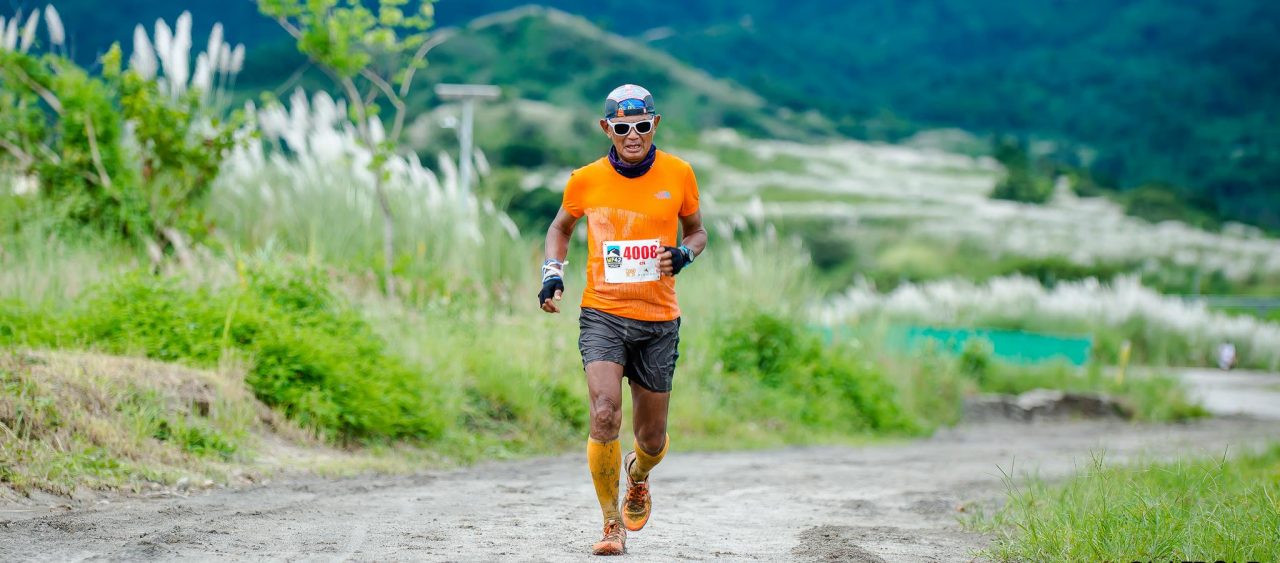











 Bald Runner
You must be logged in to post a comment.