3rd QCIM Half-Marathon


Last year, I finished the 2nd QCIM Marathon in 4:30+ hours and I liked the very challenging route where runners would experience running inside the UP Complex, on the wide and rolling terrain of Commonwealth Avenue and within the La Mesa Dam Area. I did not have much training in preparation for this event as I wanted to experience running through the whole course. You can read my Race Report here.

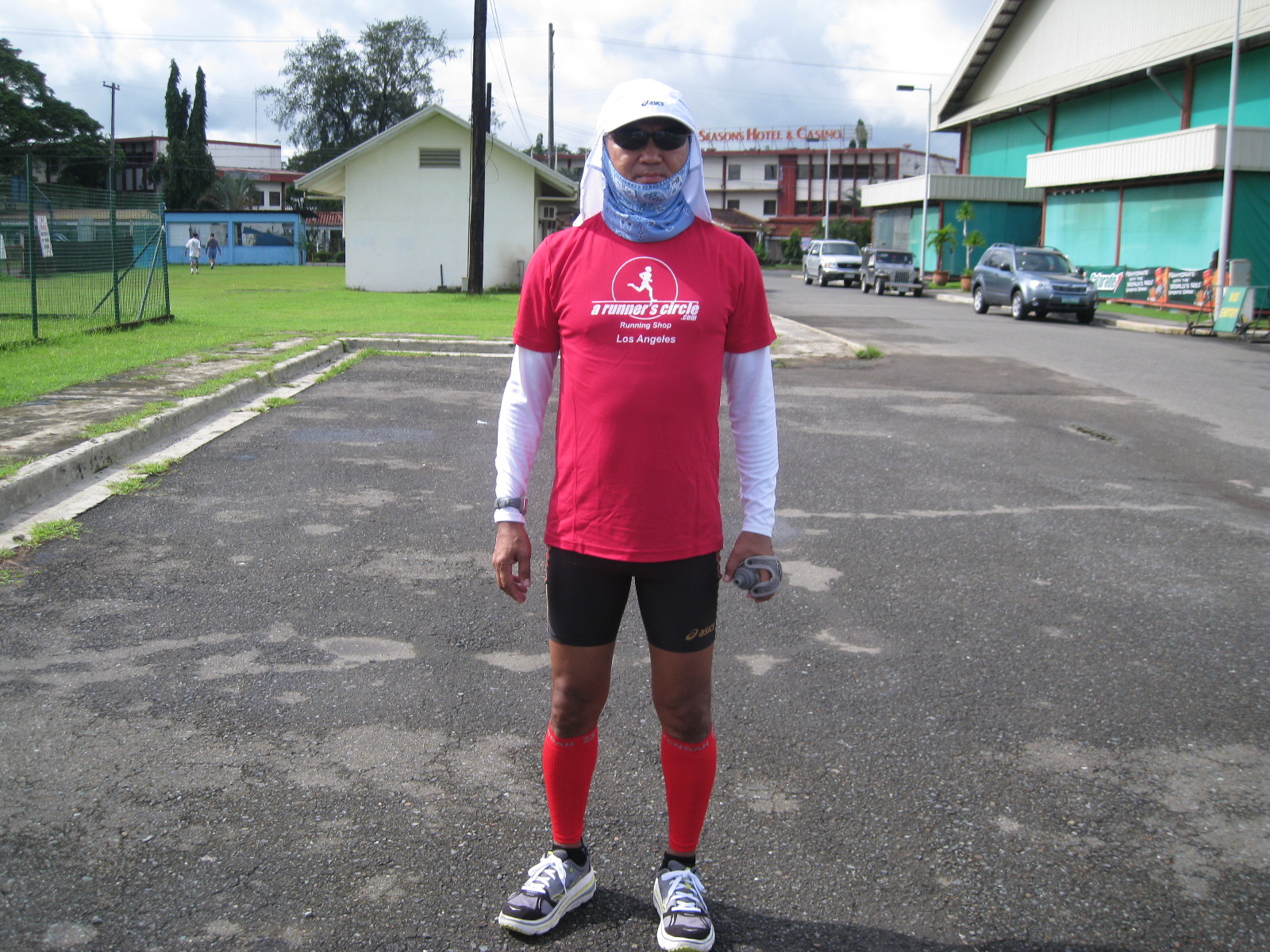
As a QCIM “loyalist”, I really wanted to join the Full Marathon but due to my rest and recovery after joining the 1st Bakersfield Ultra Marathon Madness (BUMM) 32-Mile Trail Run in Bakersfield, California, I had “zero” training for the said distance. Instead, I decided to join the Half-Marathon event. I treated this race as part of my “base endurance” training in preparation for future events in the coming year. This is an event that would “kick start” my incoming season of running. (Note: If you noticed in my pictures that I was wearing a Running Visor, that could be a hint for a serious training to come!)

The race started at 4:30 AM and I focused on my plan to treat this event as a LSD run. I always remind myself at the starting line to stay relaxed as much as possible during the race. My first 5 kilometers were very relaxing as I joined most of the average runners at the back. I was averaging a pace of 7:00+ minutes per kilometer on those first 5 kilometers and I was having fun!

Sometimes I break some time-tested “lessons learned” in running. Whenever, I run the QCIM, I always use newly-bought running shoes and most of the time, these shoes are not categorized as running shoes on paved roads. Last year, I used the New Balance MT 101 trail running shoes and it passed the test on my feet and legs. No soreness, blisters and injury using a light, thin-soled, and almost “zero-drop” trail shoes. Last Sunday, I used the New Balance XC 700 which is considered as a Cross Country Running Shoes. It has some rounded-tipped “spikes” on its sole which one could feel as it is being used for the first time. However, after a few pounding on the ground, the feet would be used to the feeling and it would eventually disappear.
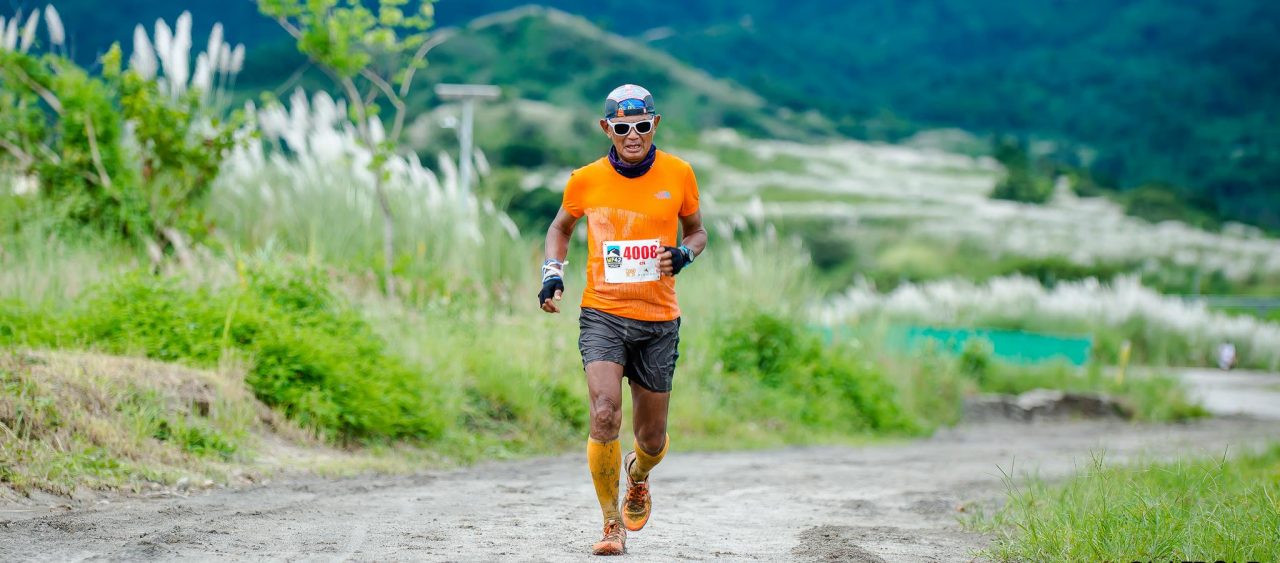
Relaxed and Having Some Fun!

From Km 6 up to the Finish Line, I gradually increased my pace within the 6:20 minutes to 6:50 minutes, average pace per kilometer. I barely took a glance on my GF 305 watch as I was running on how my body feels during the run. Basically, I was having fun and tried to be relaxed as much as possible. My first two swimming lessons had greatly contributed on my ability to run on a more relaxed manner! For the first time, I was surprised to experience the feeling of being relaxed throughout the run. No pressure, no competition, no whining, no “target” time to think of, no cursing on the lack of water cups on the Aid Stations and no “target/s” infront to overtake. The feeling was just like running as if I was alone in a trail and enjoying the views around!
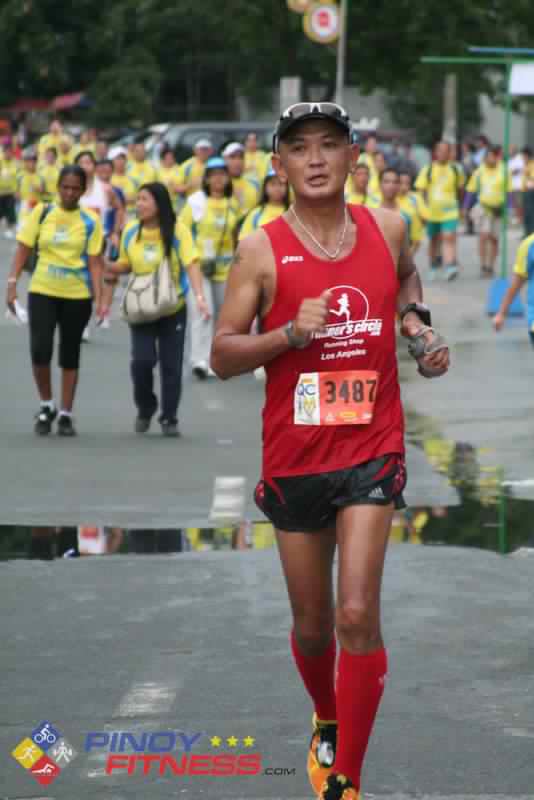
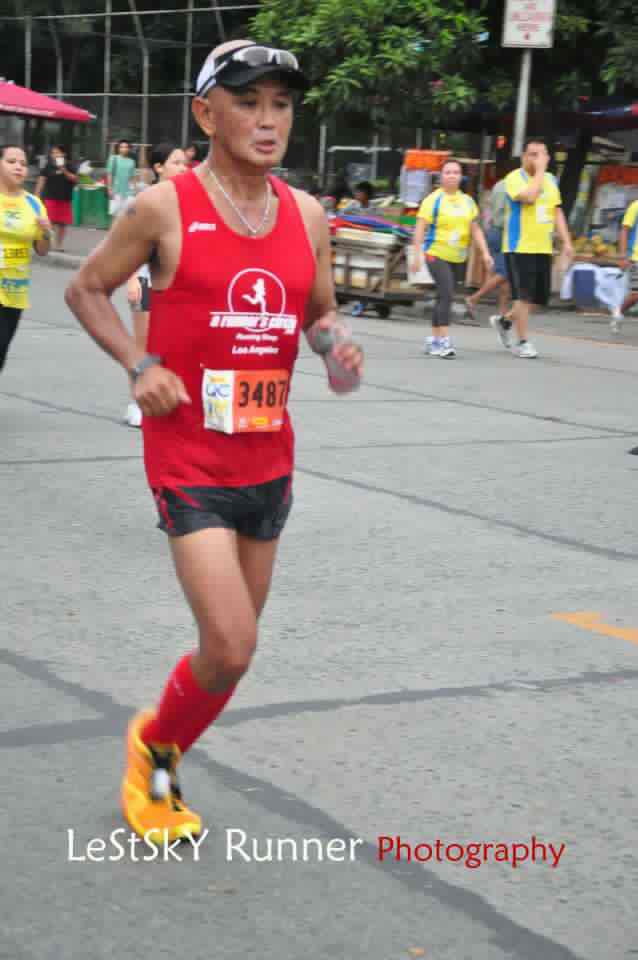
Near The Finish Line

With such experience and relaxed running, I did not know that I was already approaching the Finish Line! Finally, I crossed the Finish Line with an official time of 2:20:50 hours. It could be my slowest Half-Marathon Race but the feeling of running relaxed and following/focusing my race plan was a great experience.
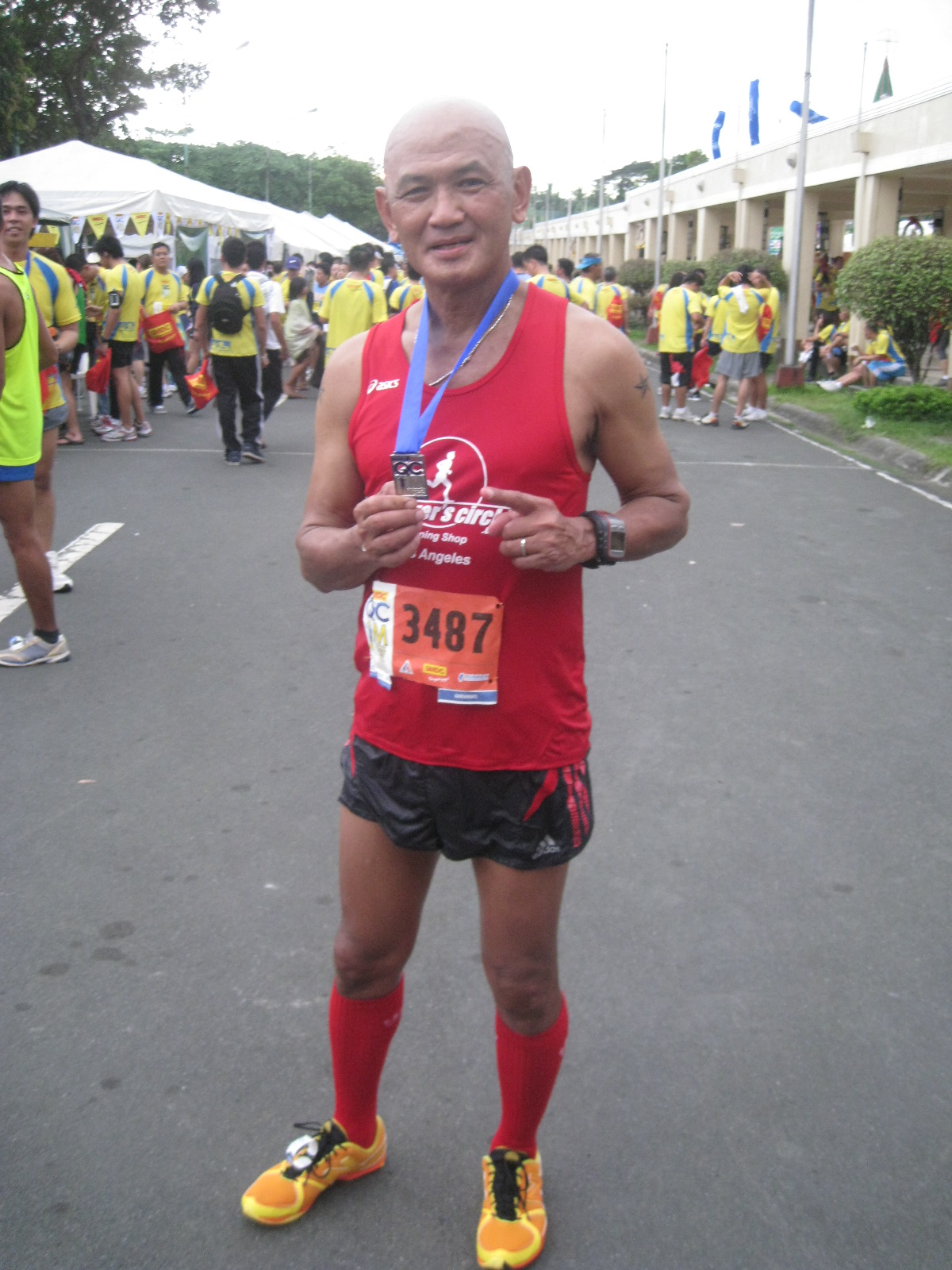
Another Finisher's Medal in Running

Thank you, RUNNEX, SMDC and Quezon City for a successful conduct of the 3rd QCIM Marathon.

Note: Thanks to LeStSky Runner and Pinoy Fitness for the Pictures they posted at Facebook!
Rules Of The Game


In any kind of sport or game, whether it is for casual exercise or for competition, every one should know the “rules of the game”. Most of the competitive sports have a set of Rules and Regulations in order to maintain good order and efficient conduct of a game or an event. Without these rules and regulations, the event will never be called a “sports discipline”.

If a person would like to engage in any kind of sport discipline, the first thing to do is to find out its rules and regulations. The Internet is full of information on this matter and all you need to do is to input/type the topic you want to research on your browser or in Google and everything is there for you to read and download. It is very easy and fast.

By following these rules and regulations, it will be easier for you to appreciate and improve on the sport/game you want to learn or concentrate in. Do not wait for the other practitioners/athletes or opponents to remind or warn you about its rules and regulations. Prevent yourself in an embarassing situation with the pros.

In running, there are rules and regulations that should be followed also. However, they are very easy to comprehend and follow as they all boil down to these words—Common Sense, Fair Play, Honesty, and Courtesy. There are also running events that are very unique from the usual 5K, 10K, 21K or Marathon Races where you have strict duties and responsibilities of support crew and pacers. (Note: There should be no Support Crew and/or Pacers in Marathon/42K Races). Usually, support crew and pacers are included in ultra running events and they have some responsibilities and restrictions on how they would be able to support their runners. If you want to know more of these, you can browse on the rules and regulations of the Badwater Ultramarathon (for Ultra Road Races) and/or the Western States 100-Mile Endurance Run (for Ultra Mountain Trail Runs).

At present, I am now trying to read every word of the Rules and Regulations of a Triathlon Event as published in Triathlon Resources in the Internet. They are very long and very specific but knowing the details would be the first step to really appreciate the sport.

I hope I am on the right direction!

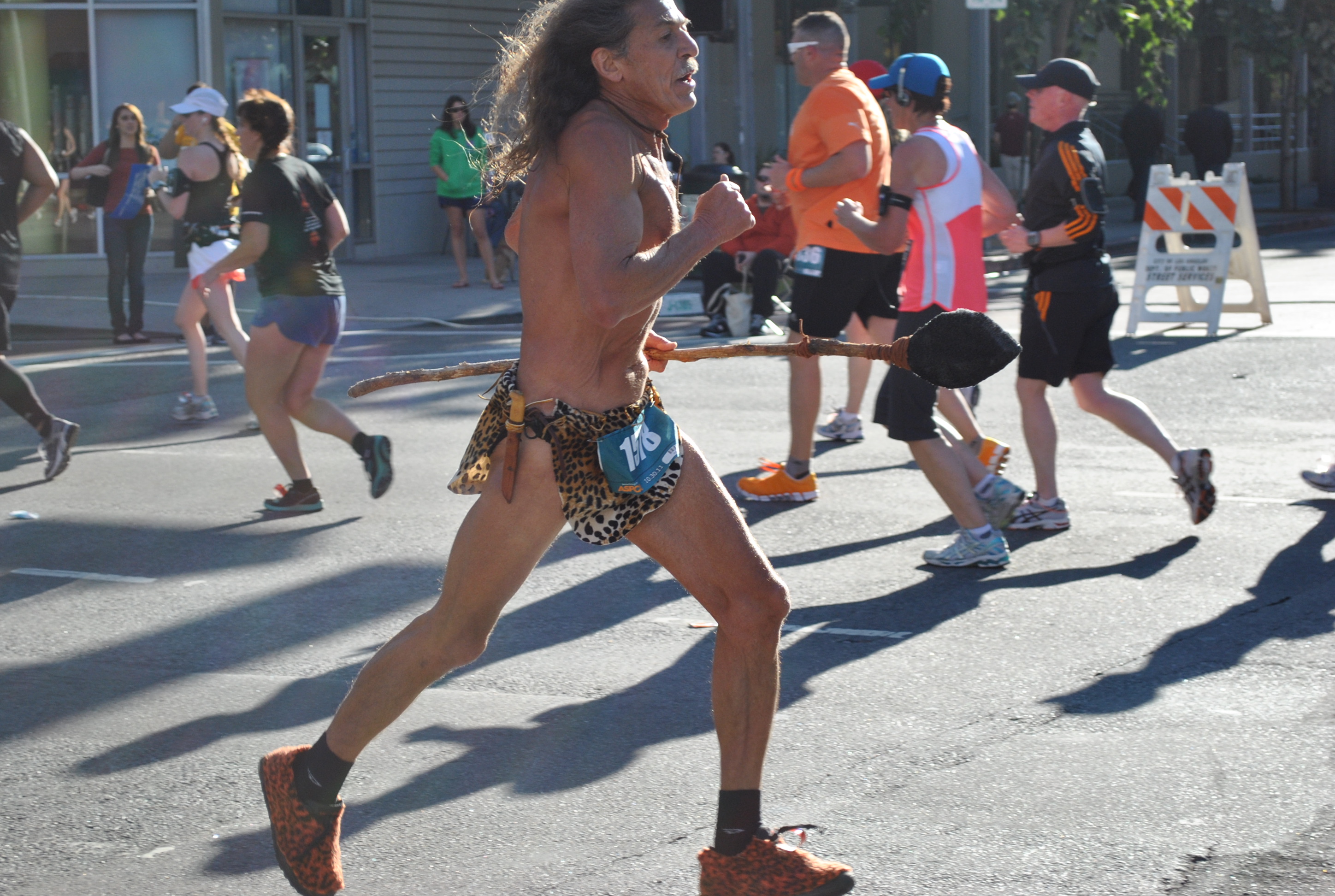
The Running Satorialist #3: The Caveman


Taklang Damulag 100-Mile Trail Endurance Run


It is about time that our local ultrarunners should and may be able to experience what it is like to run a 100-mile trail endurance run. This idea came about during the first quarter of this year as I tried my best to come up with a venue where familiarity and security are the most important factors to be considered. Since Fort Magsaysay of the Philippine Army is the most accessible and visitor-friendly among the military camps outside Metro Manila and for having been stationed and assigned to this camp in my past military carreer, the camp is the best choice for such running event.

Planning had been done since July of this year and the course had been plotted and I had personally ran through the route. Some of the detailed technical data/map are yet to be published in electronic and printed form but I will assure all the participants that the course will be well-marked and guides/marshals will be stationed in critical areas where runners might be lost and might choose or end up in another trail/route.

There will be ample Aid Stations along the route which will be serving hydration needs and solid and hot foods to everybody. However, each runner must be able to bring with them their hydration system during the run. There are portions of the route where sari-sari/convenience stores are located in the centers of populated areas and runners must be able to bring with them some cash. Some portions of the route are accessible to support vehicles, however, there is NO need to bring support vehicle during the race. I will not be strict on the use of support vehicle as long as they will not “shadow” or “pace” with the runner or else the runner will be disqualified. Every runner should be able take advantage of the food and services of the Aid Stations.

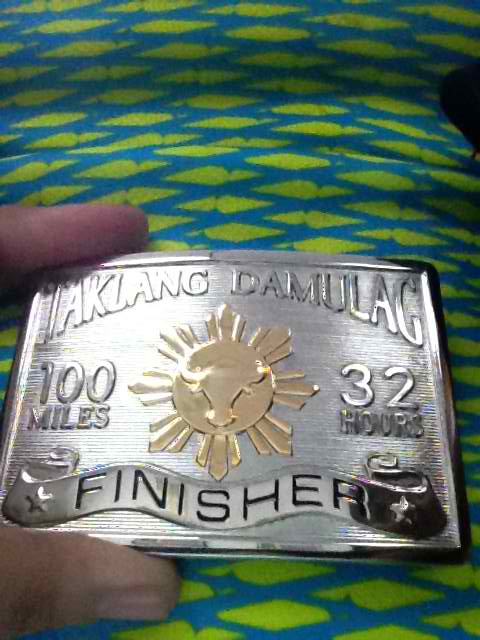
Since this is a “pilot event” and the “first” of its kind in the country, we have prepared finisher’s swags (belt buckle, individual medallion, individual trophy, and Finisher’s Shirt) to only FORTY (40) FINISHERS within the cut-off time of 32 HOURS. If you have officially finished a 50-mile or 100K trail/road race, you are qualified to join this race.

FINAL BUCKLE wil have a SILVER CARABAO HEAD With the GOLD SUN

For the local runners, the registration fee is Six Thousand Pesos (P 6,000). For the foreign runners, the registration fee is One Hundred Fifty US Dollars ( $150). Payments can be made to the A Running Circle Store Manila (ARC); Landbank Account Number 1686-0795-85 in the name of Jovenal Narcise; or during the Briefing Event on December 16, 2011 in Fort Magsaysay, Palayan City. Updates on the Briefing Event will be announced in this blog or at my Facebook Event Wall. Registration starts TODAY. If you have further inquiries, you can send your e-mail at jovie75@hotmail.com or post a message on my Facebook Wall.

The course is an EASY Course which consists of an 80-Kilometer Loop where the runners would run twice. The 80K Loop goes around the periphery of Fort Magsaysay’s Cantonment Area and 50K of that loop will cover 2 loops of up and down the Taklang Damulag and Fernandez Hills. To summarize, runners would run 2 loops of the 80-K Loop and 4 loops of the Taklang Damulag-Fernandez Hills Complex. The course has an estimated total ascent of 17,000+ feet and total descent of 18,000+feet.

The Race starts on or about 5:00 AM (or earlier) of December 17, 2011 infront of the Special Operations Command Headquarters in Fort Magsaysay, Palayan City. The race has a cut-off time of 32 Hours. If a runner can not complete ONE Loop (80K) within 15 Hours, he/she will be declared DNF. PACER (one at a time) is allowed to join the runner on his/her SECOND Loop up to the FINISH Only.

For the Half-Marathon Event, the Registration Fee is One Thousand Five Hundred Pesos (P 1,500). Details of registration and payment of fees are the same with the 100-Mile event.

To refresh the participants, the following were the posts I have published in relation with the planning of the event:

https://baldrunner.com/2011/07/31/record-time-5237-minutes/

https://baldrunner.com/2011/09/08/8-hour-run-td-100-route/

If you finish this running event, you don’t only earn a very distinct “bragging rights” among Pinoy Ultrarunners but also have the rights and privelege to be a PART in the History of Running In The Country.

Good luck and Run Happy!

“30-Minute” Rule


As a “beginner” in running, one should follow what I call as “30-minute” rule. For that matter, those who would like to engage in any endurance sports as “beginners” should follow what I term as the “30-minute” rule. What should be the emphasis in training is the observance to complete 30 minutes doing your workout, whether it is walking, jogging, running, cycling, swimming, biking/cycling, rowing and/or any sports that involve aerobic capability of the body.

Make one’s training to be as “time-based” instead of trying to find out or complete a certain distance. Knowing the distance you have covered after 30 minutes will come later as you progress and be comfortable doing this “time-based” workout. There is no need to be excited on how far you have covered for the period as there will be time to consider the distance and time in your daily training journal.

The “30-minute” workout does not include the warm-up, stretching, and “cool-down” exercises. There is no particular pace during the “30-minute” workout as you do your activity by taking it easy and comfortable.

Your progress in your selected sports will have a faster result if you do this “rule” everyday! Make this rule as part of your daily activities and of course, you need a lot of discipline to do this.

Maybe in 2-3 weeks, you will be surprised that you can already cover the following distances with the corresponding activity:

Walking—1.5 to 2 Kilometers

Jogging—3 Kilometers

Easy Run—3.5 to 4 Kilometers

Cycling—10 Kilometers

Swimming—400-500 meters

Remember, 30 minutes of your time on a daily basis to engage in any aerobic activity is very easy. Think DISCIPLINE!

Good luck!

Running Is Discipline


Depending on your goals why you want to engage in running, the first requisite to be successful in running is to have a discipline.

It is an attitude that plays within the confines of what is in between one’s ears! It’s all in your brain!

Whether you are following a training program to finish a certain distance of a road race or not, discipline plays the greatest role in one’s ability to accomplish and attain such objective.

How does anybody develop a discipline in running? Start with your goal. Make a “personal contract” to this goal. Visit your family doctor to find out if you are healthy to do some endurance activity that affects the functioning of your heart, lungs and other parts of your body. If you have the “go” signal from your doctor, go out from your “comfort zone” and take those “baby steps” towards running.

Make sure to allocate at least 30 minutes out of the 24 hours in a day to keep your body moving. That is only 2% of the whole day and it is a “piece of cake” and a very short time spent as compared from one’s time reading your friends’ status on Facebook. You can start by walking at a leisurely pace in any place until you are comfortable in including short jogs within the span of 30 minutes. If this ritual is done everyday, your body will be able to adapt and you should be able to maintain the momentum.

It is not important on how far you can walk/run in 30 minutes, what is most important is your attitude to go out and have those 30 minutes spent on moving your legs & feet on the ground.

Everyone should be able to include walking/running in one’s activity on a daily basis and if you can do this, it is a very good example on the application of discipline.

Remember, discipline is the key and the most important aspect in any kind of endeavor, sports, and, of course, to running.

Good luck and have fun!

Race Cancelled!


The BDM 160 5-Man Relay Race which is supposed to take place as a replacement for the past BDM “Test Runs” is hereby CANCELLED. This event is supposed to be conducted on December 3-4, 2011 which exclusively open to registered runners for the 2012 BDM Races. Due to requests from new runners of the 2012 BDM 160 and 102 races, I have decided to bring back those yearly “test runs” for recon and adaptation purposes.

Each “test run” will cover a distance of 50 kilometers. Runners have the option to bring their support crew and support vehicle. If a runner has not yet finalized his/her support system, I will allow runners to be self-supported provided they bring along their respective hydration system. Self-supported runners are encouraged to bring some cash as they could easily buy their needs on convenience stores along the route. As in the past, each runner will be provided with Race Bib and their respective finish time will be officially registered/recorded. The registration fee for each runner is Five Hundred Pesos (P 500.00) which will defray the cost in the coordination on matters pertaining to security and medical/ambulance assistance.

Every “test run” has its objective of knowing the course and trying to adapt one’s body to the conditions of the environment. Each “test run” will be conducted on the very same time that participants would  run each segment of the course during the actual race. Having said that, the first “test run” from Km Post #00 to Km Post 50 will be done on night time (from 10:00 PM to 7:00 AM the following day); the second “test run” from Km Post #50 to Km Post 102 will be done from 7:00 AM up to 4:00 PM. And the last “test run” from Km Post #102 to the Finish Line in Capas National Shrine (for BDM 160 runners) will be done from 5:00 PM up to 2:00 AM the following day. Each of these “test runs” will have a cut-off time of NINE HOURS (9 hours).

Since most of the 2012 BDM 160 runners are already “veterans” (except for a few runners), the last “test run” will not be a mandatory one. I urge the new ones on this course to find time to recon the place (last 58K) on their own and ask the finishers last year to guide them or provide extra instructions on the directions.

The Schedule for the “Test Runs” will be the following:

1st Test Run (Km #00-Km #50)—January 14, 2012

2nd Test Run (Km #50-Km #102)—February 11, 2012

By the way, these “test runs” will be open to everybody. If you are not registered for the 2012 BDM Races, you can join and make it as your training run. However, make sure that you are officially registered for the “test run”. We will not allow “bandits” on these “test runs”.

Registration to these “test runs” will be at the “A Runners Circle Store” Manila. However, we will allow “On Site” Registration, provided you are at the Starting Area at least One Hour before the Start Time. If you intend to register on site, please make your slot/s reserved by sending me a message at my e-mail address—jovie75@hotmail.com or send me a Private Message/post a message on my Wall at Facebook. Registration at ARC Store starts on January 2, 2012.

Good luck!

Review: Hoka One One Bondi B


It has been awhile that I posted a shoe review for the past months. So, this new pair of shoes that hit the market early this year is making a lot of “noise” in the Internet among ultra trail runners. This is the reason why I was able to know beforehand about the existence of this “weird-looking” running shoes.

HOKA ONE ONE Bondi B

Two of the top US ultra trail runners, Dave Mackey and Karl Meltzer, had been using this kind of shoes in their runs and races as they are the primary and top endorsers of this shoes even if these shoes were invented and conceptualized by two French ultrarunners. These guys had been winning their races using these shoes. I’ve seen with my own eyes how Dave Mackey ran and glided on those shoes during this year’s MIWOK 100K Trail Run in Marin Headlands which he won easily from other top US ultra runners. Looking at Dave Mackey (with a height of more than 6 feet), the Hoka One One looks like an ordinary trail shoes and it is not noticeable as a clunky & thick soled shoes.

My observation brought an interest to have one of this pair of shoes just to find out what is special in them as each of them carry a higher price as compared with other trail shoes. The initial price was $ 179+ which has almost the same level price with the ASICS’ top end Gel-Kinsei series. However, the price has now gone down to $ 159+ as per my latest research in the Internet.

Last June, a simple question to the ARC Los Angeles owner, Joe Matias, if their store carry such shoes led me to have a new pair of Hoka One One Bondi B. He even posted on Facebook that the Bald Runner is ready to experience a “Time To Fly” with the new pair of shoes with the appropriate pictures. Thanks, Joe!

First thing that I’ve observed when I tried to wear them was that their sizing is one-half size smaller. Which means that if I am size 9 1/2 in my regualr running shoes, I should have ordered size 10 for the Hoka One One. I tried to compensate this little issue by using thinner running socks. Second, I found the shoe string to be bulky as it uses those stiff round-type shoe laces which tend to put more pressure on the top of my feet when I tie my shoes tightly. I changed the shoe laces with those flat and lighter shoe laces and I observed a great improvement on the comfortability of the shoes.

For one month, I’ve used them everyday in my runs along the paved streets and they are very soft to the feet because of the thick and spongy sole. It was very comfortable to run with as I was recovering from my knee injury. The pain on my left knee would go away as soon as I ran with them. The spongy and bouncy feeling as my feet hit the ground is totally different from using my other running shoes.

I tried to use them in my trail runs and the shoes forced me to run at a faster speed and pace on the downhill which I was trying to avoid and minimize because I was still recovering from my knee injury. If only I was not being safety and conservative conscious on my trail workouts, I could have experienced the full potentials of this shoes in my downhill runs which most of the users have liked about using them.

However, I would reveal that the thick sole gave some problems with the way I run. Since I am a “shuffler” who could barely lift my knees during my “push-off” at a higher level, my tendency is to trip with the shoes on the ground. It does not happen all the time but there are times that my rythym would be disturbed. Sometimes, my leading shoes would hit the other one when my legs are showing that they are getting tired and weary.

Shoes More Noticeable With Average-Height Runners

I used them during my WC 200 run lately and they were nice shoes to start with my daily runs but after 30+ kilometers, I have to use the thinner-soled shoes for faster leg turn-overs. I am not saying that these shoes are not light, they are lighter than the ASICS Gel-Kayano & Kinsei but they simply don’t suit to my style of running on paved roads.

My Hoka One One, for the meantime, is being used as my recovery workout shoes and it is still waiting to be used in an ultra trail run or in a road race.

Now, if you ask me if I am recommending this one for you. Of course! Get one pair of this shoe and experience what is like to wear a different one and be a standout from the rest. Just take note of the shoe sizing and the price. I really don’t know yet if they are available in the local running stores. However, I’ll give you a tip. Ask Raul, Perkins, and Mario of ARC Manila if you can have it ordered from Joe Matias of ARC Los Angeles. I know Joe will give you a nice deal on these shoes.

Dream Race


I was surprised when Jael Wenceslao, one of the 1st BDM 160 Finishers, posted a picture on Facebook a portion of one of the pages of the latest edition of the Runners World Magazine Philippine Edition. Since I have not seen the actual page or have with me a copy of the said magazine, my information was based from the status posted by Jael.

BDM Ultramarathon: Dream Race

It appears that a survey was conducted by the Magazine to Pinoy Runners and the result showed that the BDM Ultramarathon ranked with the two most prestigious Marathon Races in the World—Boston & New York City Marathon.

I was overwhelmed with joy and at the same time worried that my vision to make this race as the “Comrades Ultra Marathon” in Asia is coming to reality at a faster pace as compared from my personal conservative expectations. I could not imagine how the race would look like when you have at least 500 runners or more in it. As of now, the race takes its form by increment and maintains to be a road race by invitation only.

As an expression of gratitude and a way of giving back to the community, most especially to all the endurance athletes in the country, I am offering FREE ENTRY to all PINOY FINISHERS of the 2011 KONA IRONMAN to the 2012 Edition of the BDM 102K. In addition, PINOY FINISHERS in the 2011 TNF Ultra Marathon Mont Blanc 100-Mile Run; ultra runners former PNP Director Samuel Tucay (Ret.), Fr. Robert Reyes, Cesar Guarin, Joy Roxas, and Fr Picx Picardal will be invited also for free entry in the said event.

If you think you are considered as one of the TOP 5 Pinoy Runner-Bloggers, please contact me as I might as well give you a FREE ENTRY to the 2012 BDM 102K which will be held on March 3-4, 2012.

Thanks for your support. Let us make BDM Races known throughout the world!

Bataan Death March (BDM) is in the Philippines and not in any other country!

Finish Time Formula For 100K Run


Last April of this year, I was able to read an article in one of the ultrarunning resources in the Internet. I am sorry for not being able to write the particular source of this item.

This is the formula for one’s expected Finish Time in a 100-K road or trail race. I am not sure of the accuracy of this formula but I’ve tried to use this formula after I’ve finished the 1st edition of the Bataan Death March 102 Ultramarathon Race and it seemed to be accurate.

As a reference, there is no harm if you can use this formula in your training/preparation for the BDM 102 or in any running event that covers the said distance. Try it.

100-Km Race Time Finish (in Minutes) = 1,085.6 – 36.26 X (training speed in km/hour) – 1.43 X (weeekly training volume in km/week) + 2.50 X (age in years)

To give an example of this formula, let us assume some data. If your training speed is 6 kilometers per hour, multiply it by 36.26 and the result is 217.56. If your weekly training volume is 70 kilometers per week, multiply it by 1.43 and the result is 100.1. If your age is 60 years old, multiply it by 2.50 and the result is 150. You subtract 217.56 & 100.1 from 1,085.6 and from the result, you have to add 150. The result is 917.94 in minutes. Round it off to 918 and divide it by 60 and the result is 15.3 hours which is translated to 15 hours & 18 minutes.

I hope this simple formula will guide you in your training for your future races in the 100K and beyond distances.

Good luck!