The 15 Keys To Running A Great Sports Federation


I came through a news article/column on the PDI Sports Page stating that Go Teng Kok, simply called as “GTK” and President of the Philippine Amateur Track & Field Association (PATAFA), as “sick and could hardly walk”. And the rest of the article could be seen here: http://sports.inquirer.net/138017/nothings-final-on-patafa-polls.

Whether he (GTK) will step down from his position and later replaced with a new President of the PATAFA, it will be a big challenge on the part of the new leadership to start and realize a better “Vision and Direction” for a Better Performance among our Elite Track and Field Athletes.

For today’s 500-word post in this blog, I am re-blogging an article written and posted by a Coach/Blogger from Canada who is now a part of the Coaching Staff of the United Kingdom’s Sports Excellence/Elite Program. Stuart McMillan, the owner of the McMillan Speed Website, has posted/published the following article in his blog at www.mcmillanspeed.com last April 17, 2013. Whatever is worth in this article, it gives us a great insight, tips, suggestions, and advise on how to “run and manage” a Sports Federation.

These insights are not only true to our Sports Federation on Track and Field or Ultra Marathon but they are also applicable to any of our National Sports Federations/Associations (NSAs). If we want to improve in our Sports Excellence/Elite Program and ultimately, in our Overall Standing in IOC sanctioned Sports Games & International Meets in relation to our other countries, then it would be wise and smart to consider the following article as a reference.

Having made some suggestions to improve our National Sports Federation through this article, I will post a number of few candidates for the position of President of the PATAFA in my future blogs. I hope you will enjoy reading the following article.

The 15 keys to running a great Sports Federation By Stuart McMillan

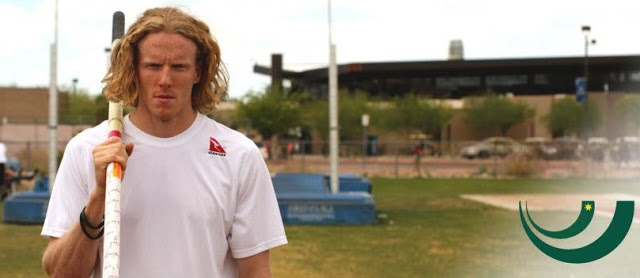
2008 Olympic Champion Steve Hooker at the World Athletics Center in Phoenix, AZ
Last week, I posted a question on Twitter that asked what the primary role of an National Governing Body (NGB) should be?  Is it to drive elite performance?  Is it to encourage grassroots participation?  Development of young athletes?
Through Twitter as well as a few email conversations, a few experienced colleagues came up with the following:
  • provide leadership for the sport through the development and implementation of a vision and strategic plan
  • provide the highest quality services on a timely, consistent and regular basis
  • ensure long-term stability with the continued development and progression of not only their athletes but their coaches and service providers as well.
  • exposure and promotion of participation, especially at the grassroots level
  • provide long-term financial security and viability
  • facilitate progression through access to competition, coaching and training support
Pretty good answers, I think.  But where does elite performance come in?  Very few of those whom I polled actually mentioned it at all!  Surprised me – as if you ask the same question of an athlete, I guarantee that performance will be at the top of the list.
So I did…
I asked a bunch of the folk that I am currently working with down here in Arizona…
…representing six countries’ NGBs, and pretty much all to a man voiced elite performance as the number one priority.    The disconnect occurs when asked if they are getting what they need from their NGBs, few are happy.  Most feel that elite performance has little to do with their NGB’s mandates.  My discussion with Donovan Bailey a couple of weeks ago highlighted his feelings on his former NGB – an opinion I know is shared by many!
“The biggest problem in Canada – and I see it all the time – is someone gets a job, and they spend all their time guarding against their job, and doing stupid things and making dumb decisions, because they’re guarding against their job.  Not for the good of the athletes, not for the sport, and not for the good of the country…”
– Donovan Bailey
So I was curious.  If elite performance is not actually the mandate of an NGB, then what is it?  To find out, I went to a few of these organization’s websites, where clearly their Mission Statements spell out their primary responsibilities as:
  • to drive up performance and raise standards
  • to create, nurture and support World and Olympic champions
  • to enable athletes to achieve sustained competitive excellence
  • to drive competitive excellence
  • to ensure world-level performance
  • to foster competitive achievement
Huh??
So what’s the deal?
NGBs’ mandates are clearly all about elite performance.
Athletes’ goals are clearly all about elite performance.
So why the constant friction between athlete and Federation?
I have fought on both sides of the ‘battle’ – as coach of athletes working external to the system, and within the system for the Federation having to deal with disgruntled athletes who feel they have been hard done by.
I have worked with athletes who have competed for over a dozen Federations.  And I have worked for half a dozen Federations myself – in 3 different countries.  And – as usual – I have some thoughts…
So today I present to you –
The top seven things an NGB can do to win back the respect of its athletes, and in the process perhaps help the athletes in achieving their goals, making it a happy and healthy future for all:
1. Understand the meaning of the word ‘performance’
If you are about performance, then you must understand what performance is about.  If it is your primary mandate, then it’s pretty essential you know what it means.  To aid in building an effective performance pathway, hire a sport science statistician to identify trends, and to do an on-going critical analysis of performance.  Understand what performance means not just in words and mission, but in terms of numbers.  To run a profitable company, you need to have a good accountant – to run a successful sport Federation, you need to understand the numbers and statistics of performance.
“In business, words are words; explanations are explanations, promises are promises, but only performance is reality”.
– Harold Geneen
2. Say what you do and do what you say
The basics. Communicate your vision consistently to your members, athletes, coaches, and support staff.  Clarity and consistency is key.
3. Identify key influential athletes – listen to their concerns
Do not direct your attention to the athletes who complain the most.  All this will do is ensure that the rest of the athletes complain more often, in a constant battle for your attention. Involve your athletes in decision-making processes.  Ask.  Discuss.  Don’t demand. Respect their voices.  Their opinions.  Involving the athletes in the decision-making process promotes ‘ownership’.  Bringing them into the fold makes them feel respected.  Needed.
4. Recognise that all athletes are differentThey all have different needs.  Though you cannot please them all, you need to understand that there is no ‘one size fits all’  in elite performance.  They all require different strategies.  In partnership with them, you must be creative in forming these. Often, your best athletes will decide to work ‘external’ to the Federation.  Often preferring their own ‘support teams’, they choose to seek greater control over their own careers.  This is not a bad thing.  Support them through this process, and be inclusive of their teams.  There is still much you can do for them, and much they expect from you.  Be creative.
5. Be an elitist
It is not wrong to be an elitist.  You operate in elite sport.  Don’t hide from this.  And don’t apologize for it.  You want elite performance?  Then cater to your elite athletes.  Not all athletes have equal rights to their opinions.    And not all athletes deserve to be given elite treatment.  It seems that many of you feel that being ‘elite’ gives one an unfair advantage – that all skills, and all opinions are created equal.  They are not.  Being an elite athlete requires tremendous amounts of dedication, discipline, desire, skill, and effort.  Less dedicated and less talented athletes will cry elitism.  They will say its unfair.  Don’t listen to them.  You wouldn’t want a resident med student operating on your mother’s heart.  You don’t want a lazy, untalented, and undisciplined athlete representing your Federation.
6. You can’t please everyone.  Don’t try to
7. It’s not about you
No one goes to the game to watch the referee.  And no one has ever gone to the Olympics to watch the CEO.  Or the Performance Director.  Or the coach.  Or the Chief Medical Officer.  As former athletes yourselves, I know that this instinct is difficult to suppress.  The ex-athlete narcissist in you still expects a crowd to show up and watch you do your job.  This is no longer your reality.  It is their time, it is your job to do all you can to support their dreams right now. They will be forever grateful if you can help deliver this for them.
…and just in case you thought I was totally anti-Federation:
The top seven things athletes can do to help their Federations to fulfill their goals:
1. Get over yourself
Have you ever heard that winning is a habit?  Well, so is losing.  We all know those athletes who circle the drain in perpetual anxiety and stress – consumed by narcissism and self-preoccupation.  Don’t be that athlete.  Focus on winning habits.   Beconsistent in your character.  Your commitment. Your discipline.
“Some things you have to do every day. Eating seven apples on Saturday night instead of one a day just isn’t going to get the job done.” 
-Jim Rohn
2. Your Federation shares the same goal you have
Believe it or not, they do not want you to fail.  In fact, there is a pretty good chance that they want you to succeed.  And will take almost as much pleasure in your success as you do.
3. Help them change
Often, the leaders of NGBs are former athletes.  Comfortable with what they did when they were competing, they can become complacent – relying on ‘what worked for them’.  But the world changes.  The sports world changes with it.  Systems change.  Technique changes.  Nobody is super-comfortable with change.  Especially when things have worked out well in the past, as is often the way with the leaders of your Federation.    Your Federation does recognize this, but they are driving a very large boat…it takes a while to turn course.  So be patient.  And in the meantime, help your Federation be creative in alternative strategies.
4. Be independent
Do not rely on your Federation.  Over-reliance on anyone takes the control out of your hands.  Do not expect everything from your Federation.  Take responsibility for your own career.  Use the expertise of your Federation as a guide, but do not rely on it.  Use your own experience.  Your own thoughts to determine the exact path you travel.   Do not blame your Federation if things don’t go your way.  It is your life.  It is your career.  Own it.
5. Support your Federation commercially
Your Federation relies on sponsors. Help them. Tweet about them, and thank them whenever possible in public.  It takes very little  time and effort for you to do this, and it goes a long way.  Often times it’s not money that goes into YOUR pockets, but the programs and jobs that sponsor’s money goes to support ensure you have more of what you need.
6. Respect EVERYONE
You know that person in your Federation office you are certain doesn’t do anything and should be canned?  Yeh?  Well, he does do something. They all do something.  They do all the things you don’t know need to happen in order to run a Federation.
7. Remember that a majority of the people involved in your sport do so for exactly zero money
Almost all are volunteers.  Your Board of Directors are volunteers.  They sit on your Board because they care about your sport.  They are almost exclusively well-meaning and successful in their own fields.  They often do not know a lot about the elite performance end of your sport – so teach them.  Educate them.  They would enjoy nothing more than to share a meal with you as you shared stories about life in sport.  They may even pay for the dinner!
And my final advice?  To both athletes and to Federations?
8. Suck it up.  You both want the same thing.  Just figure it out and get along.
*thanks to Matt Jordan, Steve Mesler, and my respondents on Twitter for their input*Canadian strength coach Ian Warner, Sr just made a good point to me – the seven things athletes can do?  We can apply these as coaches working outside of a Federation also (or inside for that matter).  Oftentimes, external coaches can serve to enable their athletes in this ‘fight’ against their Federations.  Don’t be that coach.
Be inclusive. Find ways to work together.
If you enjoyed this post, please
share it on Facebook or Twitter…thanks

Sixth


I reached my sixth year of blogging last October 25, 2013 and I am becoming more lazy to write something about my training, running thoughts, and my running races. It could be that I was too busy and focused with my training and/or conducting my ultra races as the Race Director or had been out of the Metro Manila area for the much-needed and more reliable Internet connection.

On the other hand, Facebook could also be the main culprit as I had more time making my daily status or reading other friends’ experiences on their running adventures and training. I am going back again to my bad habit of using my Facebook Wall and FB Group Pages as my mini-blog, thereby, forgetting my principal responsibility to update my blog. This is the very reason why I was not been able to be productive in writing and posting my stories in this blog. The past year, my sixth year, could be my lowest productive year in this blog and I could see it in my blog summaries that it was my “worst” in terms of the number of posts and the number of “hits”. However, I am still happy and satisfied that my followers are still increasing in number.

Accidentally, I was able to browse something in the Internet that motivated me to write again. I was able to see, at a glance, on a website that says or advocates writing “something” at least 500 words every day, without any edits, and by just simply writing anything and posting it in the Internet. So, here I am trying to remember and recall the things that I have to post for the past months of last year and try my best to write and post a 500-word story/essay on running every day.

My blog has now transformed into an ultra marathon site as I don’t write about much on marathon and lesser distance races except for trail running. The focus and concentration of my posts had been on the ultra marathon races that I have organized and directed from the yearly Bataan Death March Races (BDM 102 & BDM 160) and the PAU Ultra Races in the different parts of the country. Clearly, my blog had become a source of information of those runners who are runner-participants in my ultra races, to include registration procedures, rules and regulations of races, and their official results.

I also had the chance to bring two elite ultra runners to the Vibram Hongkong 100K Trail Ultra on the early part of 2013, with the help and support of Andre Blumberg of Hongkong, and they performed well that they are both qualified for the lottery for the prestigious 2014 Western States 100-Mile Endurance Run. But no matter how good my intention and plans for these two local elite ultra runners, there are still people who try to bring you down and derail your plans. It brought myself into reality that no matter how talented and good our runners are, they have also their weaknesses in terms of their behavior and attitude when they are no longer on the road/trail running in a race.

As I go on with my seventh year as a blogger, this blog will go on and on until my race stops. And that race is called LIFE.

Going Strong To My Seventh Year Of Blogging

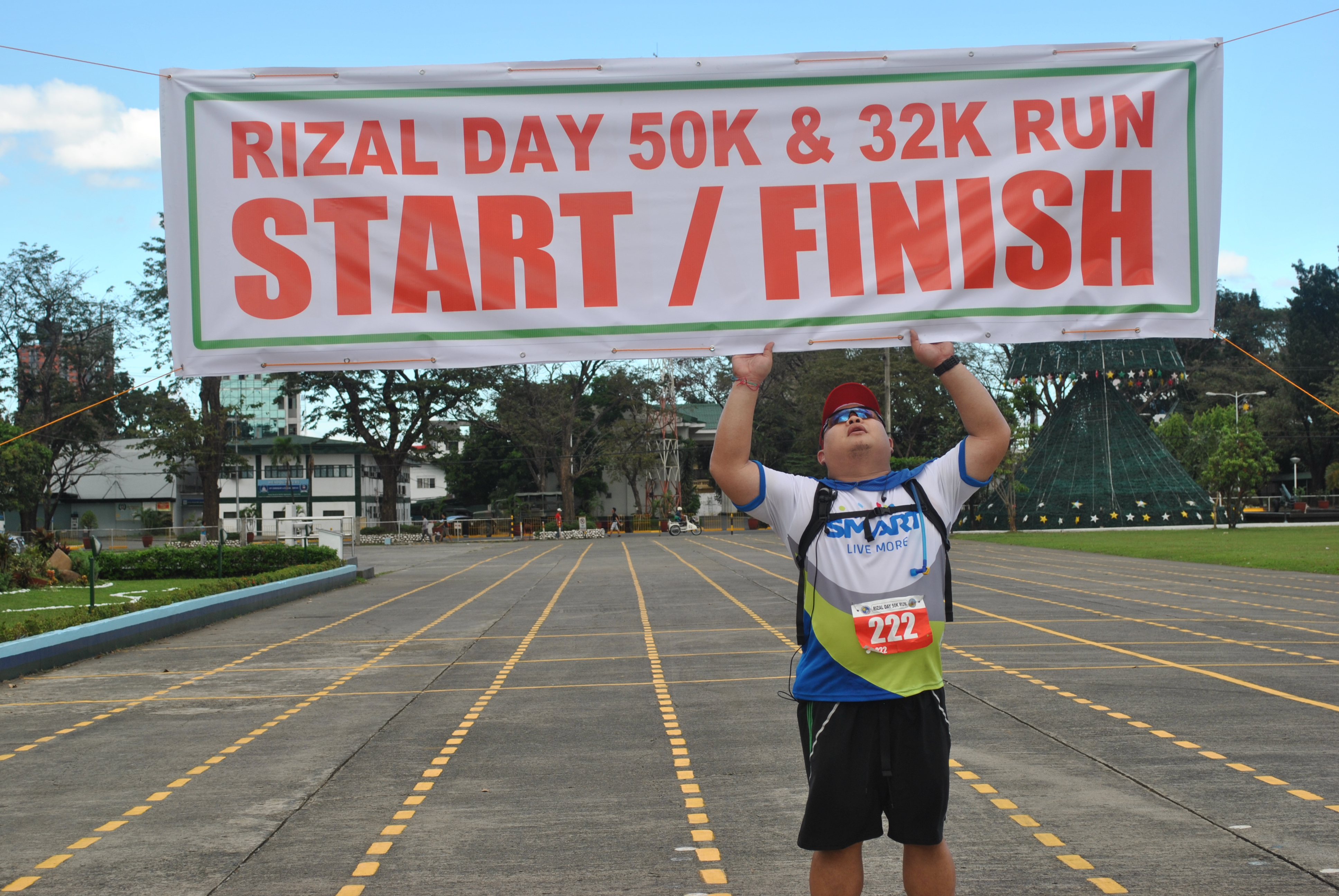
Official Results: 5th RIZAL Day 32K Run & 1st RIZAL Day 50K Ultra Run


Result: 5th RIZAL Day 32K Run 

1 Cris Iblan (Champion, Male) 2:17:51
2 Alfred delos Reyes (1st Runner Up, Male) 2:39:44
3 Simon Pavel Miranda (2nd Runner Up, Male) 2:40:35
4 Junrox Roque 2:46:53
5 Joseph Odhuno 2:51:41
6 Miguelito Capio 2:57:50
7 Jael Wenceslao 2:57:51
8 Roberto delos Santos 2:58:30
9 Allan Roy Martos 2:59:27
10 Jayson Escobar 3:11:14
11 Meshelle Villanueva (Champion, Female) 3:11:32
12 Tommy Tan 3:27:31
13 Jose Cando 3:27:32
14 Rhina Sison (1st Runner Up, Female) 3:35:44
15 Aldrin Pallera 3:36:28
16 Raymond Mendoza 3:36:30
17 Aladdin Cordero 3:40:36
18 Ignatius Gadric Chusenfu 3:41:10
19 Jason Sison 3:43:45
20 Adelio S. Torres 3:45:06
21 Allan Bandiola 3:45:38
22 Candy Balaba (2nd Runner Up, Female) 3:45:44
23 Hermie Saludes 3:48:23
24 Edrick Nicdao 3:52:26
25 Rona Saludes (F) 3:54:17
26 Mike Delarmente 3:55:54
27 Norman Guillon 3:57:16
28 Joe Sibayan 4:01:55
29 Larry Daliwag 4:02:16
30 Abet Ocampo (F) 4:03:42
31 Cookie Wenceslao (F) 4:06:43
32 John Dexter R. Obsequias 4:07:59
33 Francisco “Kotek” Mallillin Jr. 4:08:07
34 Nellie Ogsimer 4:08:17
35 Ipe Macarenas 4:08:59
36 Desmelyn Tomas (F) 4:09:18
37 Royden Malijan 4:09:20
38 Edwin Almario 4:10:00
39 Mcsy Jugo 4:16:30
40 Eliong Hernandez 4:16:36
41 Gladysma Jane Giro (F) 4:17:58
42 Robert P. Ocampo 4:18:06
43 Cherry Rose Betonio (F) 4:18:40
44 Michelle Casal (F) 4:18:44
45 Dodjie Ison 4:18:48
46 Lucky Lapeñe 4:27:23
47 Joanne Mancenido (F) 4:29:36
48 Rodelyn Ventura (F) 4:29:52
49 Joy Ordonia (F) 4:29:53
50 Ryan Jiv A. Zoilo 4:29:55
51 Marian Mera (F) 4:33:35
52 Anna Orace Arbolario (F) 4:33:40
53 Ratna M. Dimaporo (F) 4:34:25
54 Aaron Jonah A. Torres 4:40:35
55 Michael B. Peralta 4:41:35
56 Jonas Olandria 4:41:36
57 Bundi Bayag 4:44:12
58 Darah C. Regis (F) 4:50:48
59 Gerald M.  Regis 4:50:49
60 Mark Capistrano 4:53:07
61 Matthew Rodriguez 5:04:12
62 Mildred P. Jocano (F) 5:22:23
63 Elouise Timbang (F) 5:22:31
64 Jose Marie A. Mercado 5:22:36
65 Karen Ann Fajardo (F) 5:22:43
66 Gerardo P. Gutierrez 5:22:44
67 Erwin Ursua 5:22:56
68 Donald Cunanan 5:23:04
69 Earl Jann Tormes 5:23:24
70 Jennifer Villanueva (F) 5:23:43
71 Iris Abustan Alfonso (F) 5:24:08
72 Alfred de Perio 5:27:55
73 Cachelle De Alba (F) 5:28:19
74 Miguel De Alba 5:28:25
75 Marilou T. Gendrala (F) 5:32:25
76 Maria Norma dela Cruz (F) 5:32:26
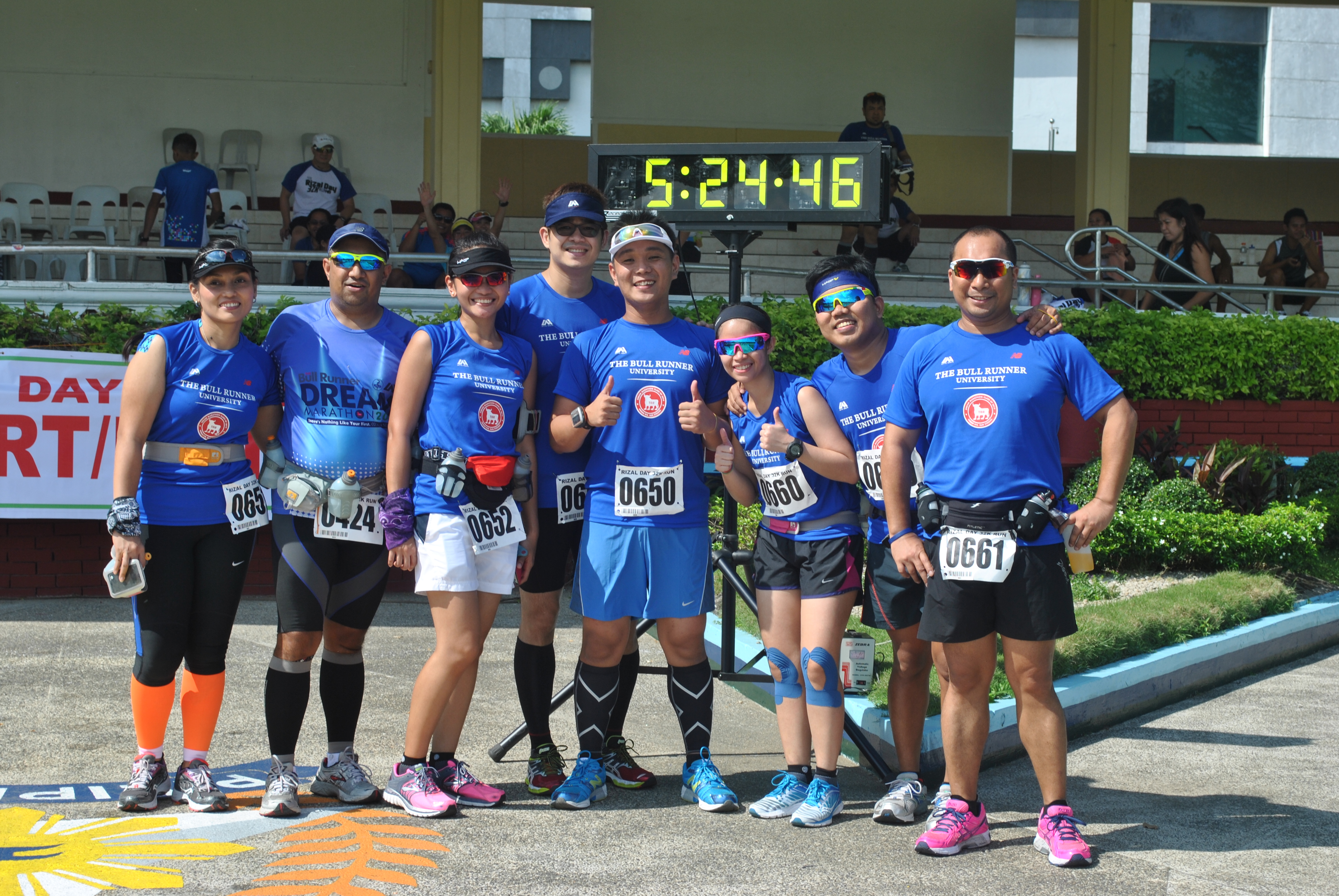
TBR University Runners

—————————————————————————–

Result: 1st RIZAL Day 50K Ultra Run 

1 Randy Dueñas (Champion, Male) 4:22:10
2 Laurencio “Lao”Ogerio (1st Runner Up, Male) 4:45:12
3 Ronnel Go (2nd Runner Up, Male) 4:47:29
4 Regie Boljoran 4:48:47
5 Sandy Alentajan 5:01:39
6 Alfeus delos Santos 5:15:39
7 Paolo Osmeña 5:17:07
8 Javier Olives 5:28:22
9 Maricar Hiponia (Champion, Female) 5:36:00
10 Bobby Go 5:39:34
11 Graciano Santos 5:47:08
12 Marc Conrad Molina 5:49:25
13 Chill Ortegoso 5:49:54
14 Jon Ogsimer 6:04:53
15 Carl Balagot 6:04:59
16 Jon Borbon 6:13:42
17 Kathleen Pinero (1st Runner Up, Female) 6:14:46
18 Tess Leono (2nd Runner Up, Female) 6:25:06
19 Manny Ocampo 6:25:07
20 Mel Severino 6:31:42
21 Mark Chico 6:33:00
22 Bong Bernadez 6:37:00
23 Bong Anastacio 6:39:49
24 Sherwin Monteringen 6:46:56
25 Gerson Yuson 6:47:17
26 Mark Anthony Rodica 6:50:08
27 William Robert Hain 6:50:27
28 Katherine Gaw (F) 6:51:24
29 Carlos Nobleza 6:44:05
30 Bernadette Schleuter (F) 6:55:50
31 Loradel Hanopol (F) 6:58:40
32 Matt Paz de Leon 7:09:10
33 Jinky Yray (F) 7:11:02
34 Luz Tiuseco (F) 7:19:05
35 Mike Tiuseco 7:19:10
36 Adrian Aquino 7:41:01
37 Allenstein Co 7:46:18
38 Ian Yu 8:01:45
The Most Consistent Runner-Finisher!

Congratulations To All The Finisher!

Happy New Year To Everybody!

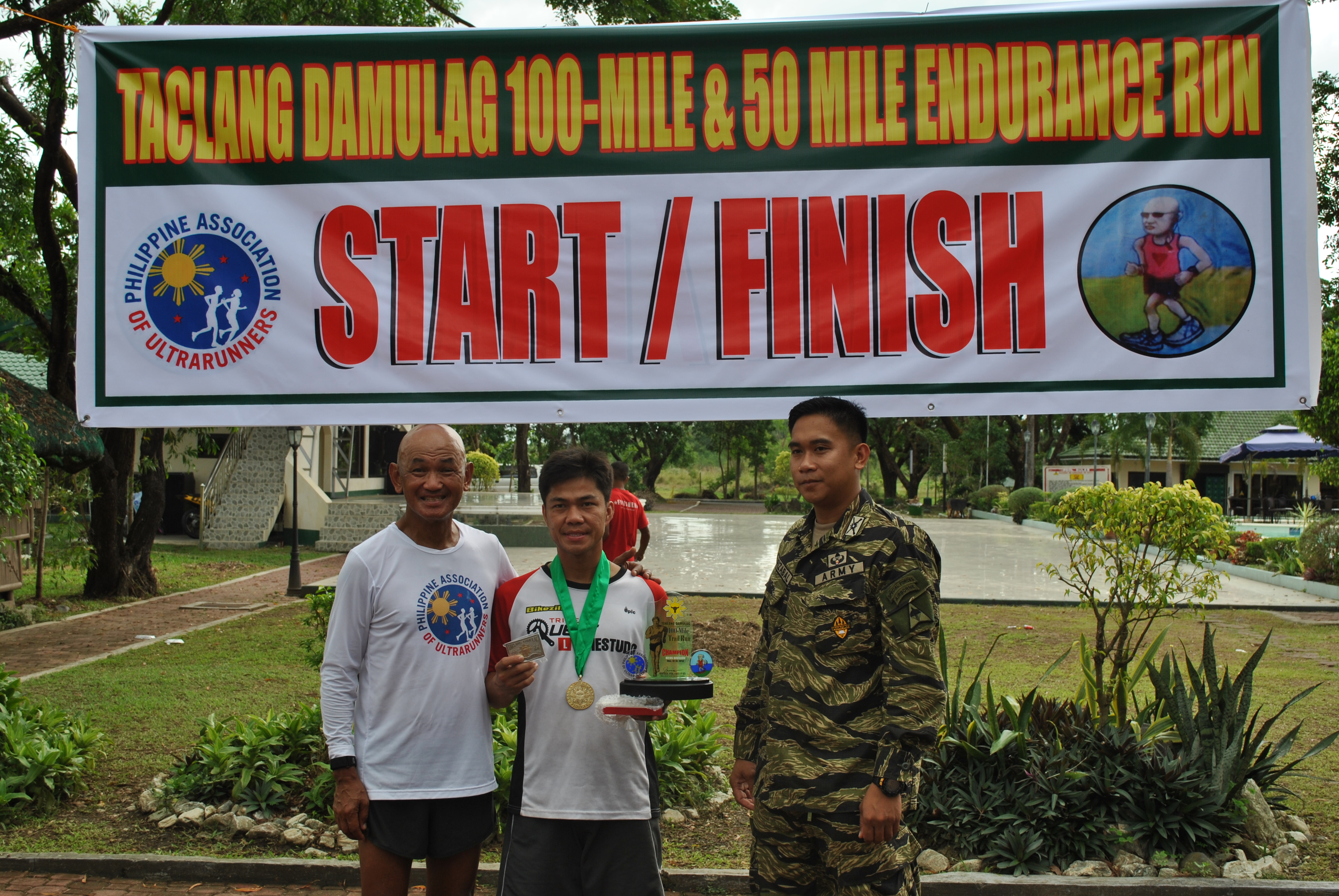
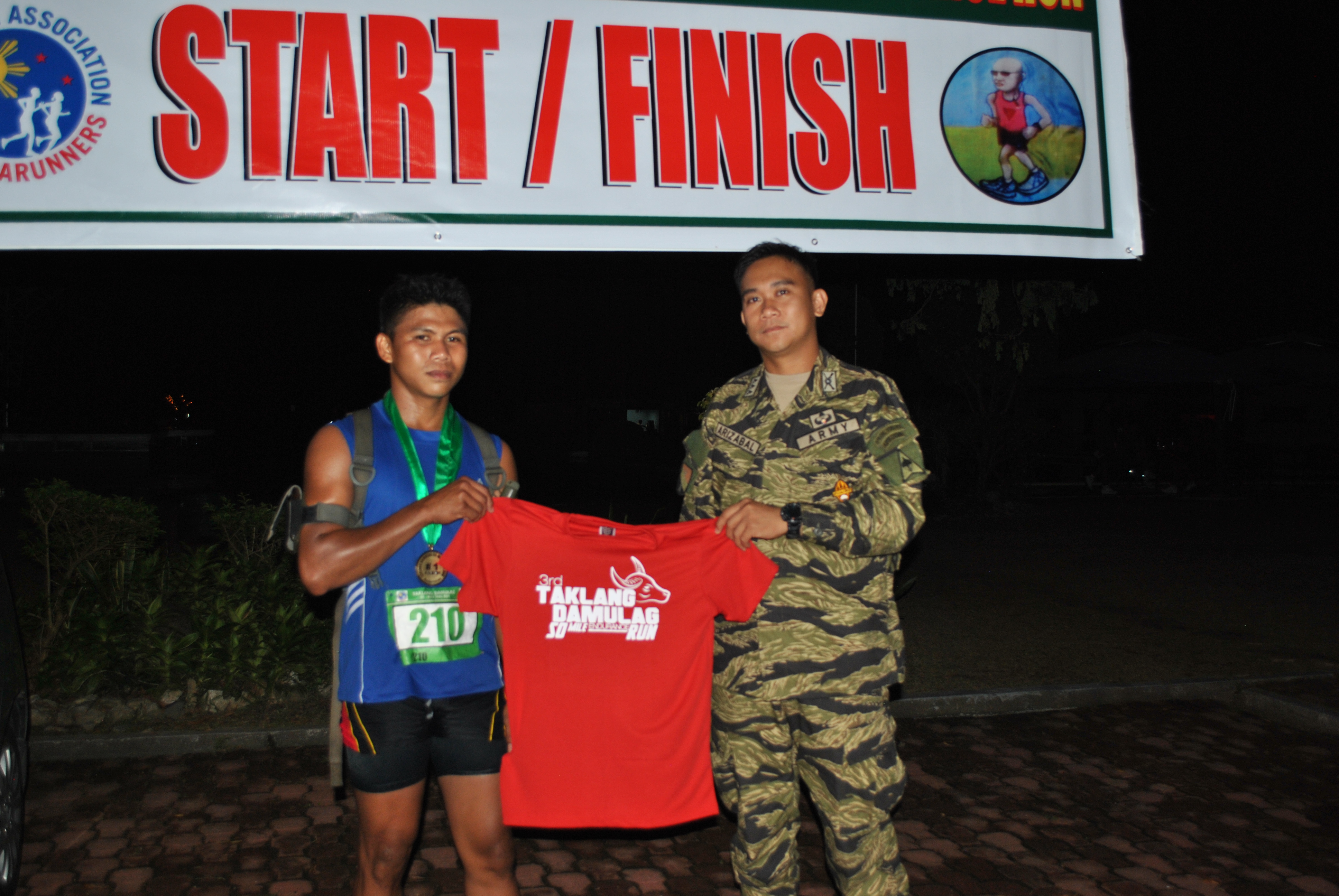
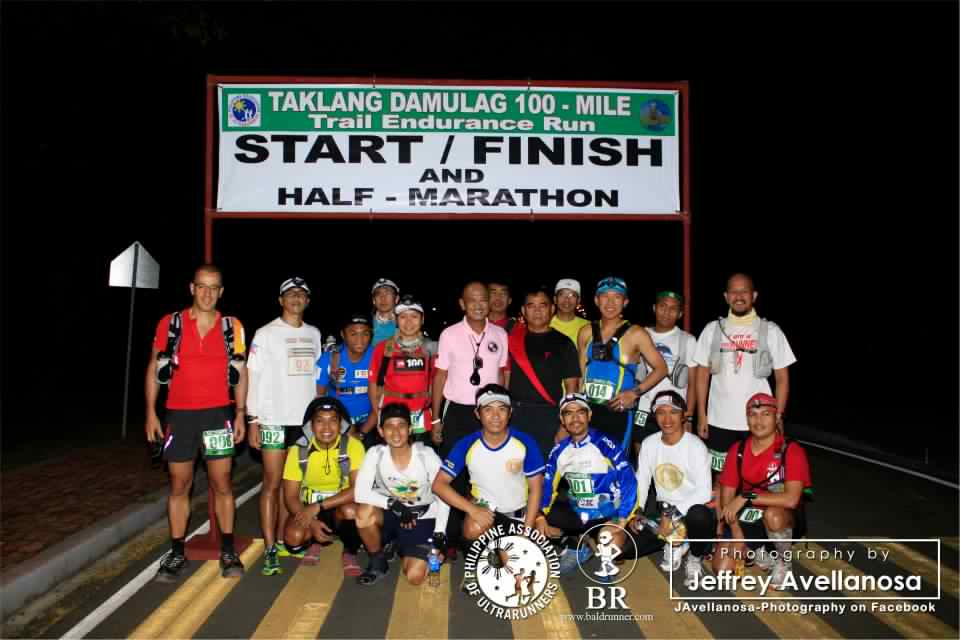
Official Results: 3rd Taklang Damulag 100-Mile & 50-Mile Endurance Runs


3rd Taklang Damulag 100-Mile Endurance Run

5:00 AM Saturday, December 14, 2013 To 1:00 PM Sunday, December 15, 2013 (32 Hours)

SOCOM Headquarters, Fort Magsaysay, Palayan City (Nueva Ecija)

Number of Starters: 28

Number of Finishers: 14

Percentage Rate of Finish: 50%

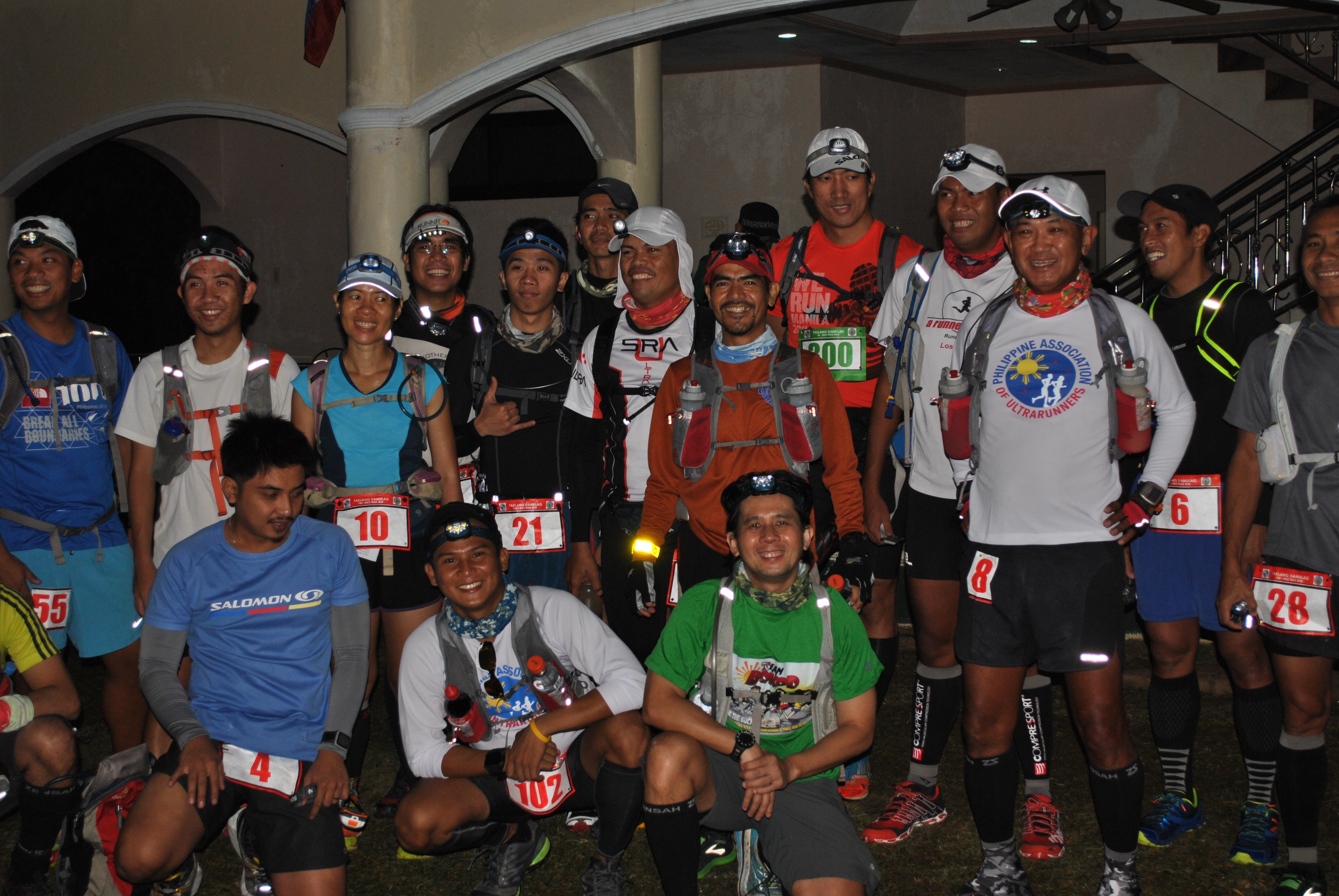
Happy & Excited
Happy & Excited
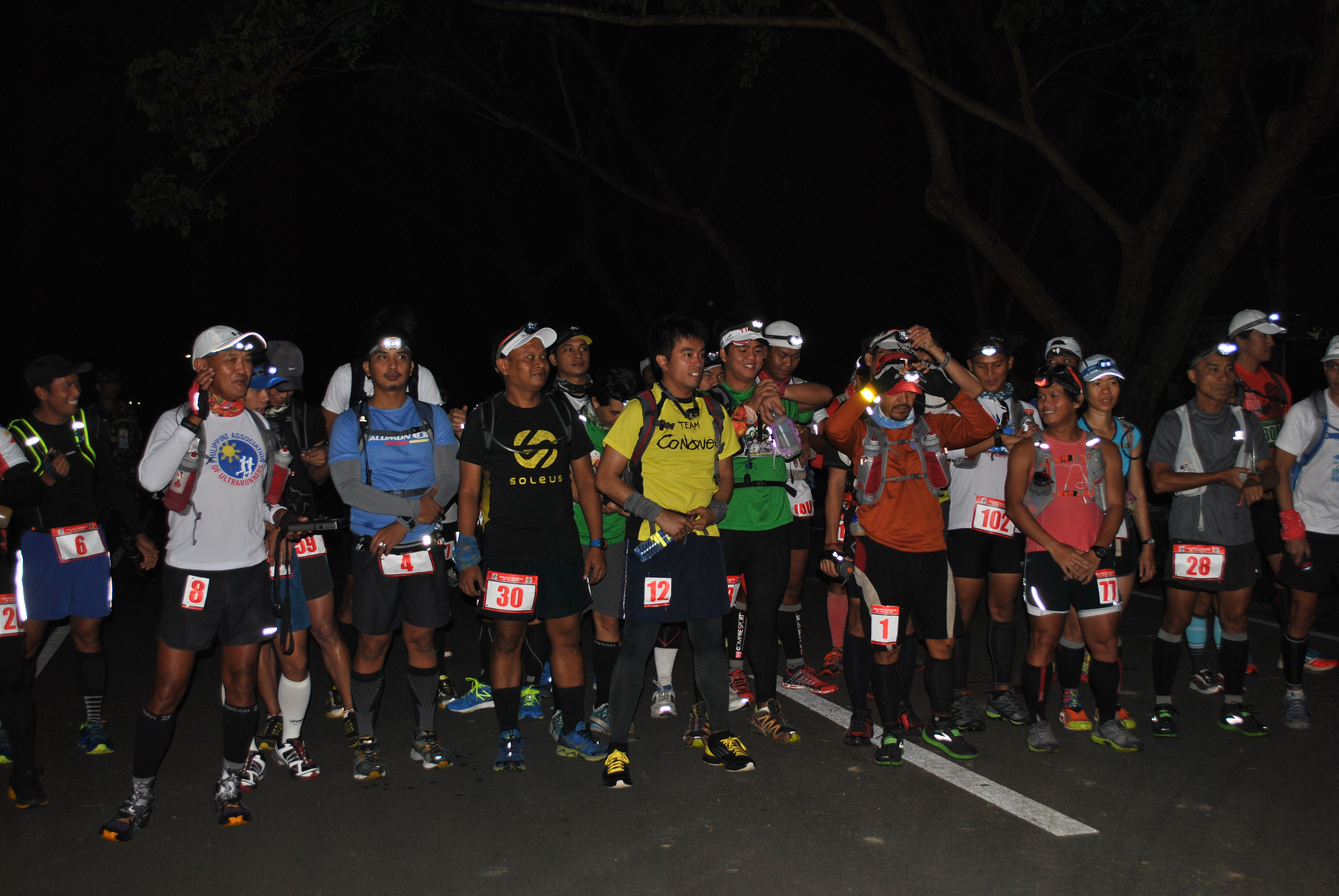
@ The New Starting Line
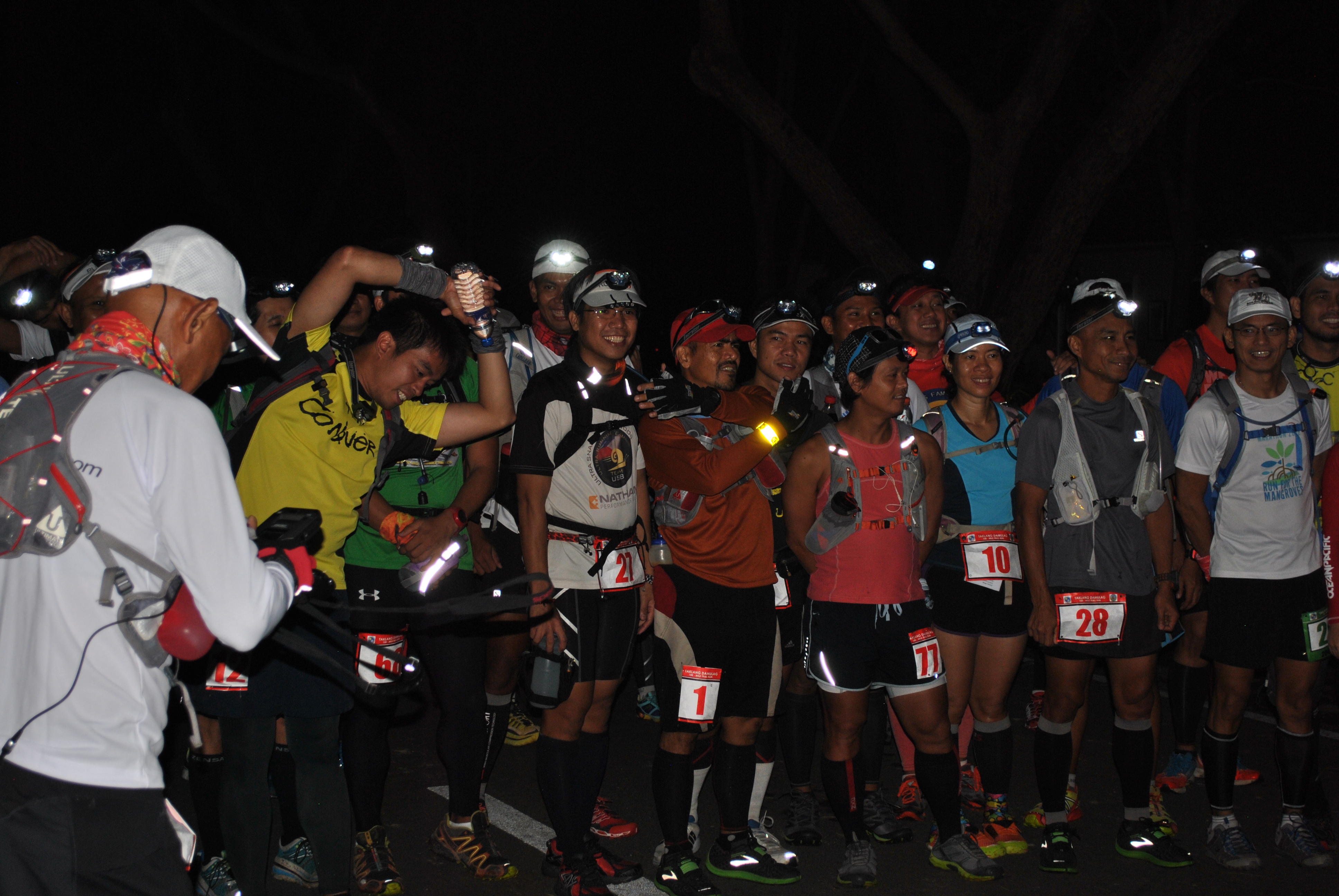
Countdown!
Countdown!

RANK

NAME

TIME (HRS)

1

Wilnar Iglesia (Champion, Course Record)

25:54:47

2

Raffy Gabotero (1st Runner-Up, Course Record)

28:41:52

3

Graciano Santos (2nd Runner-Up)

29:43:33

4

Bong Alindada 

30:14:17

5

Henry Laron

30:25:23

6

Glairold Recella

30:43:43

7

Nicolas De Leon

31:03:19

8

Yob Red

31:31:09

9

Jonel Mendoza

31:37:31

10

Elmar Bob Tolete

31:37:32

11

Ronnel Go

31:41:47

12

Meljohn Tezon

31:44:14

13

Benedict Meneses

31:46:54

14

Fernando Cabanero

31:55:23

Wilnar Iglesia, Champion & Course Record Holder

oooOOOooo

3rd Taklang Damulag 50-Mile Endurance Run

5:00 AM Saturday, December 14, 2013

SOCOM Headquarters, Fort Magsaysay, Palayan City

Number of Starters: 11

Number of Finishers: 9

RANK

NAME

TIME (HRS)

1

Mark Raon (Champion, Course Record)

13:25:28

2

Glen Mercado (1st Runner-Up, Overall)

14:24:25

3

Lady Dianne Palongan (Champion, Lady)

15:10:17

4

Dexter Cruz (2nd Runner-Up, Overall)

15:13:59

5

Michael Dauz

15:48:25

6

Brian Tan Seng

15:56:04

7

Edrick Nicdao

17:47:39

8

Manny Ocampo

17:47:40

9

Tess Leono (1st Runner-Up, Lady)

17:47:41

Mark Raon, Champion, 50-Mile Run

Congratulations To Everybody!

Rules & Regulations: 3rd Taklang Damulag 100-Mile & 50-Mile Endurance Run


Rules & Regulations: Taklang Damulag 100-Mile & 50-Mile Endurance Runs

1. The events are SOLO Races. These races will Start at the same time and place on or about 5:00 AM of Saturday December 14, 2013 at the vicinity of the Special Operations Command Headquarters, Philippine Army in Fort Magsaysay, Palayan City (Nueva Ecija).

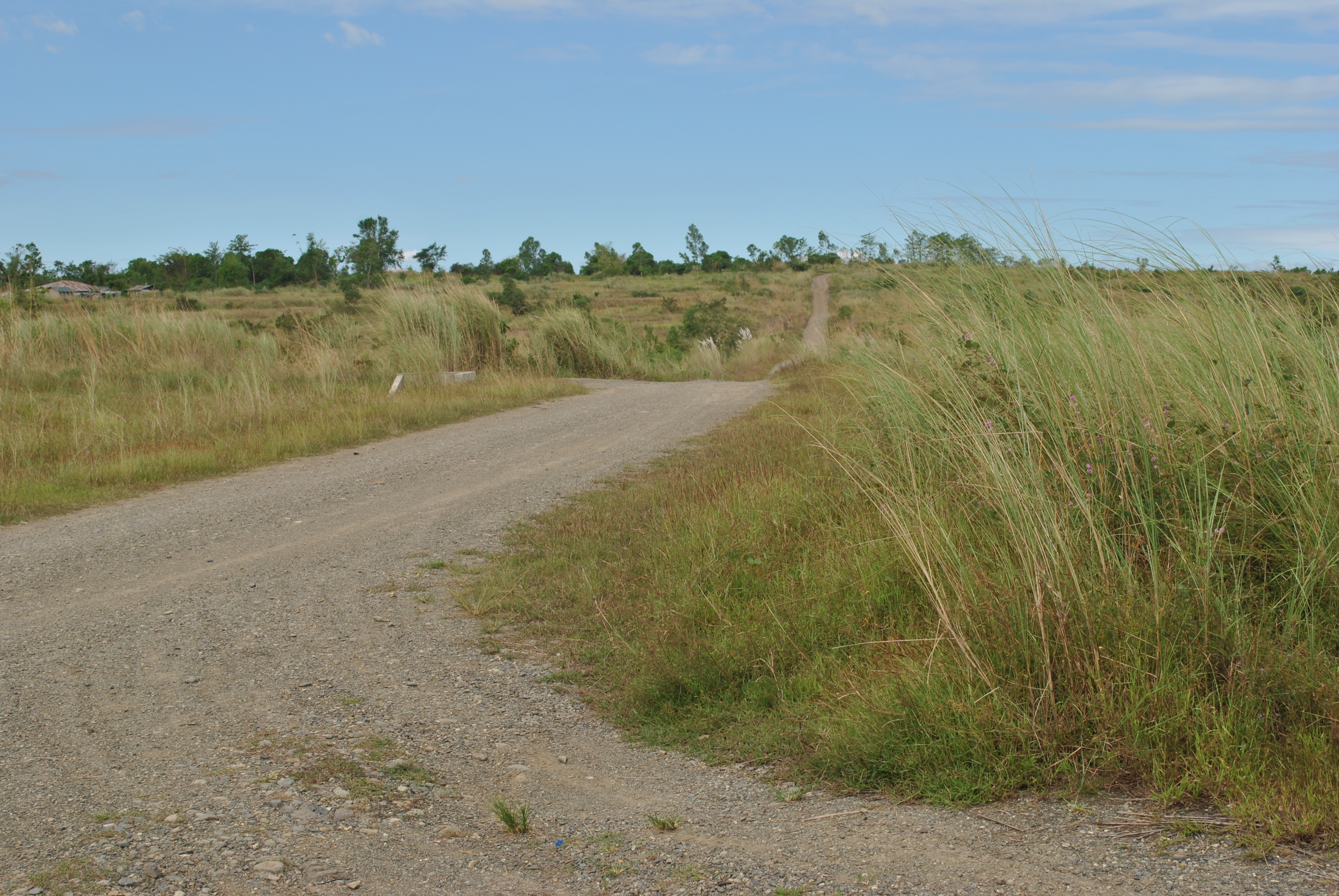
2. The race course is through paved roads, dirt roads and single-track trails. In the 100-Mile course, approximately 110 kilometers are dirt roads and single track trail and almost 57 kilometers are paved/asphalted roads. In the 50-Mile course, almost 55 kilometers are dirt roads and single-track trails and 28 kilometers of paved/asphalted roads.

3. Runners in the 100-Mile Race has to finish Two Big Loops (One Loop is 83K) where each Loop has two Smaller Loops (12K-Loop around Mt Daklang Damulag) within it. Runner has to finish the course within the cut-off time of 32 hours.

4. Runners in the 50-Mile Race has to finish only One Big Loop (with two Smaller Loops around Mt Taklang Damulag). The cut-off time for the 50-Mile race is 16 hours.

5. Intermediate Cut-Off Times For 100-Mile Race:

50K @ Fernandez Hill—-8 Hours/1:00 PM Saturday, December 14, 2013

83K @ Starting Area/SOCOM Headquarters—-15:30 Hours/8:30 PM Saturday, December 14, 2013

133K @ Fernandez Hill—-25 Hours/6:00 AM Sunday, December 15, 2013

167K @ Finish Area/SOCOM Headquarters—-32 Hours/1:00 PM Sunday, December 15, 2013

6. Intermediate Cut-Off Times For 50-Mile Race:

50K @ Fernandez Hill—-8 Hours/1:00 PM Saturday, December 14, 2013

83K/Finish Area/SOCOM Headquarters—-16:00 Hours/9:00 PM Saturday, December 14, 2013

7. Each runner must have the following basic gadgets/mandatory equipment with them:

a. At least 32 ounces of hydration (equivalent to two (2) Simple Hydration Bottles) fluids with them at ALL TIMES.

b. Basic First Aid Kit

c. Cellphone

d. Headlight/Handheld Flashlight

e. Whistle and/or Reflectorized Vest are NOT mandatory. It is enough that runners have reflectorized strips on their hydration pack or apparel.

f. Runners may use trekking poles.

8. Race Bib should be displayed on the FRONT part of the runner. Runner must be able to memorize his/her Race Bib Number.

9. Always run on SINGLE FILE and stay on the farthest LEFT side of the paved roads.

10. Drop Bags are allowed on the following Aid Stations:

a. Sitio Baccao

b. Barangay Palale

c. Barangay Nazareth

d. Fernandez Hill

e. SOCOM Headquarters/Start/Finish

Drop Bags will be collected at 4:00 AM and transported to their respective destination before the Gun Start. Drop Bags should be properly tagged/labeled with the runner’s Last Name, Bib Number & Location of Aid Station.

11. Support Vehicle is NOT allowed to “follow”; to “track”; or “leap frog” their runner along the course. Support Vehicle can ONLY have access to their runner/s at the designated Aid Stations. Support Crew can ONLY offer support to their runner within the vicinity of the Aid Stations.

12. A Pacer is ONLY allowed after the runner has completed the FIRST HALF of the course (83K) in the 100-Mile Race. A runner is only allowed ONE PACER at a time along the course. There will be NO Pacer for the 50-Mile Race.

13. Pacers are NOT allowed to carry any hydration, food, or equipment for the runner. Pacers are there as safety runners for the competing participant.

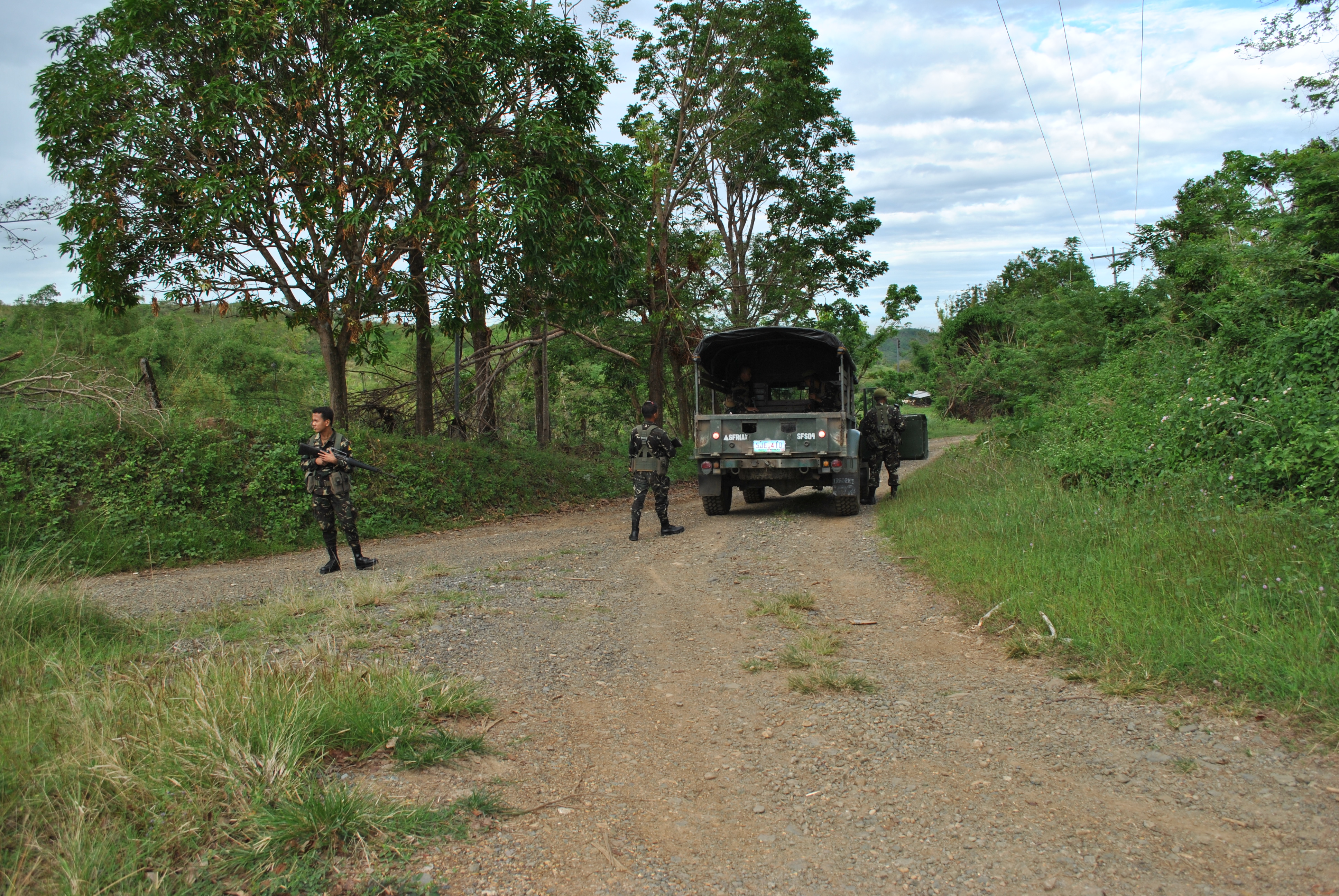
14. There will be Marshals on key intersections along the route. These are soldiers of the Special Forces Regiment of the Philippine Army and some of them will be manning the Aid Stations in Sitio Baccao, Barangay Palale, and Barangay Nazareth. Runners should be ATTENTIVE on these key intersections/Aid Stations on their FIRST LOOP as it is still DAYTIME. There is a possibility that some of these marshals could be sleeping/lying on the ground during nighttime in some of the key intersections in the Taklang Damulag Loop. Try to memorize these intersections!

15. Aside from the visible Marshals stationed on key intersections, there are also “invisible” (or hidden) marshals along the trails/dirt roads to monitor the runners passing along the route. They have a way to identify each runner passing on their respective station. These marshals are there to provide security to the runners.

16. In case of emergency, runner should contact Cellphone # 0918-965-9895 and/or # 0915-753-3834. Runner should state his/her name, location and the nature of emergency.

17. On the accommodation of runners, ONLY registered runners are FREE of charge. 100-Mile Runners are allowed two nights accommodation and the 50-Mile Runners are allowed one night only. Runners have the PRIORITY to be accommodated at the Special Forces Transient Facility and SF Alumni Center, near the SOCOM Headquarters. Three (3) Rooms (good for 4-6 people) had been reserved to be used for other runners and support crew at the 7th Division Army Transient Facility (near the Starting Area of the Fort Magsaysay To Dingalan 60K Ultra Run).

18. NO Bandits are allowed.

19. Runner must be able to provide the Name of their respective Pacer to the Secretariat before the Start of the Race.

20. It is the sole responsibility of the runner to have a thorough knowledge of the course. The course is MORE THAN 100 Miles or 161 Kilometers! This is NOT a valid reason for you to take a SHORTCUT or DETOUR along the course. Fort Magsaysay’s weather is always HOT during daytime. If you have complaints, please feel free to give directly to us your feedback immediately.

21. Maintain the Integrity of the Race.

"Pioneers" Of TD 100
“Pioneers” Of TD 100

Good Luck & Have Fun!

Administrative Announcement: There will be a Race Briefing & Dinner/CLP for the Registered Runners of the TD 100-Mile and TD 50-Mile Races at the SOCOM Headquarters, Fort Magsaysay, Palayan City o/a 6:00 PM of Friday December 13, 2013. Runners will be processed by submitting to the Secretariat/BR’s Staff their individual BPI Deposit Slips (For the Registration & Donation For the Typhoon Yolanda Victims).

Race Route Description: Taklang Damulag 100-Mile/50-Mile Endurance Run


Race Route Description: Taklang Damulag 100-Mile/50-Mile Endurance Run (TD 100/50)

1. The race starts at the vicinity of the Special Operations Command (SOCOM), Fort Magsaysay, Palayan City (Nueva Ecija). The SOCOM Headquarters is located at the Abundo Area Complex inside Fort Magsaysay, the largest Military Camp/Reservation Area of the Philippine Army. The race starts at 5:00 AM of Saturday, December 14, 2013 together with the Taklang Damulag 50-Mile Endurance Run.

2. This is a solo race. The cut-off time for the 100-Mile Race is 32 hours. The cut-off time for the 50-Mile Race is 16 hours.

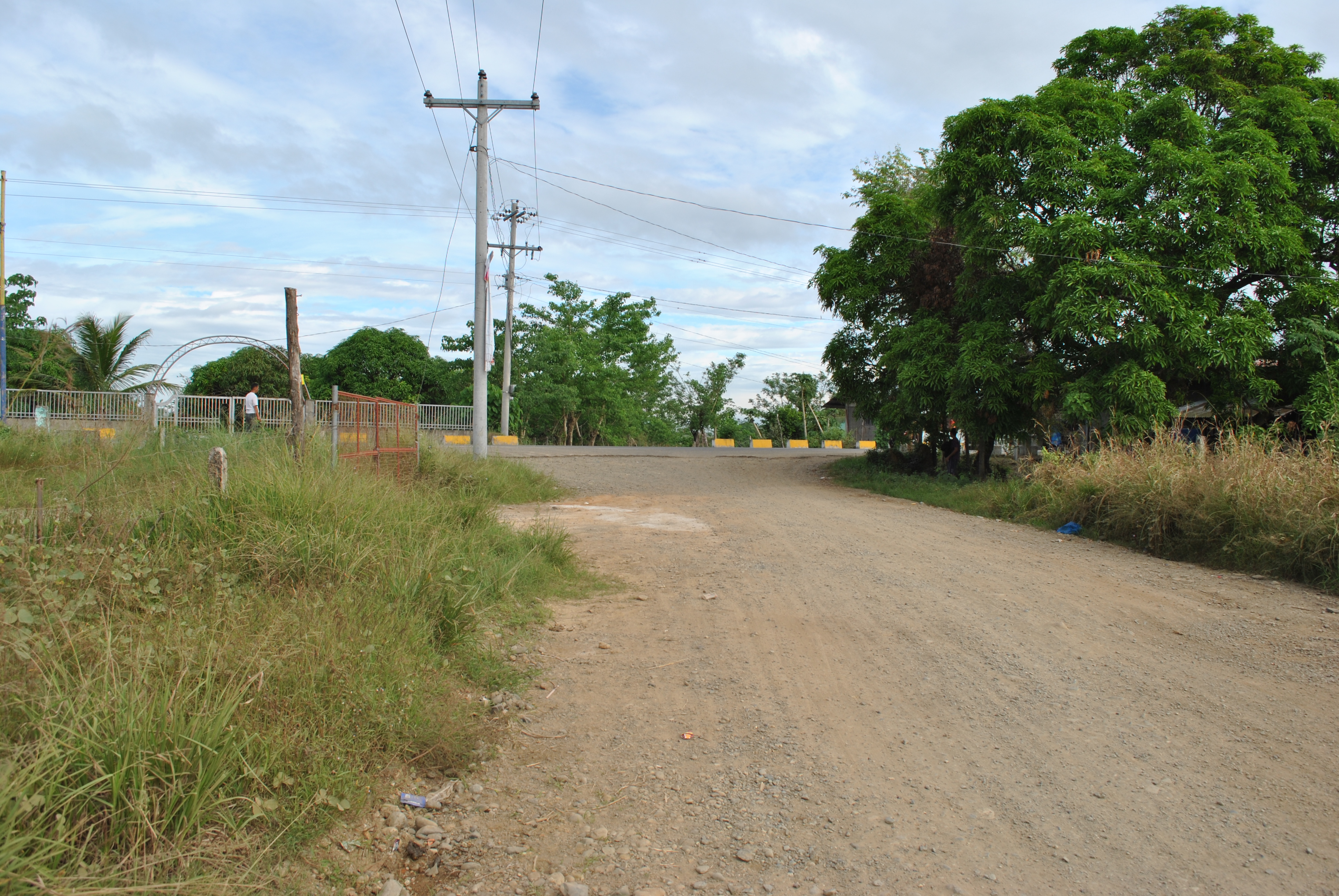
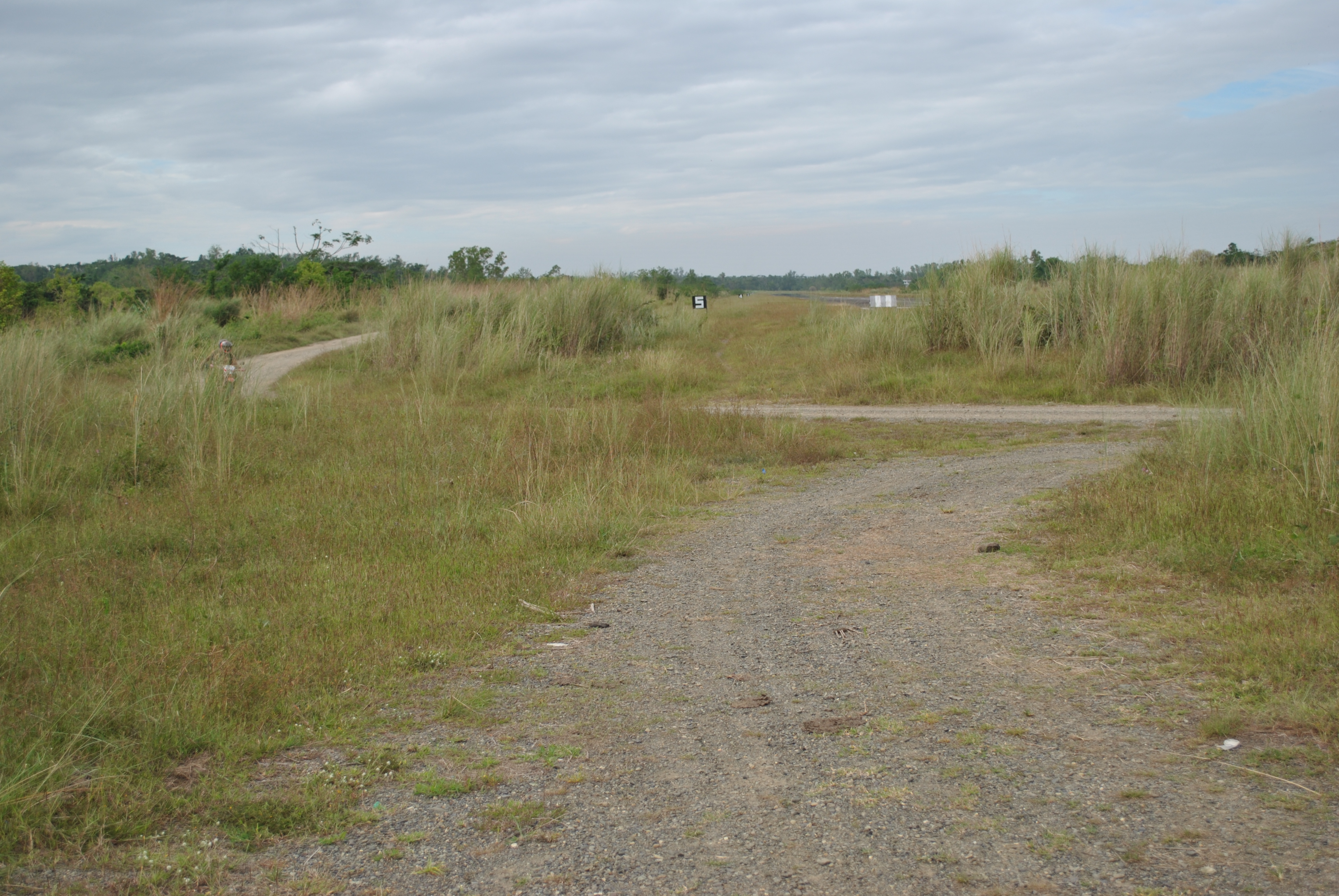
3. From the starting line, runners will proceed towards an east direction to a dirt road which is parallel to the Fort Magsaysay Airstrip. The airstrip is located on the right side of the runners. This dirt road has a lot of potholes and uneven portions. Runners must be able to have their headlights/handheld flashlight on this part of the course since it is still dark at 5:00 AM.

4. After almost 500 meters, runners have to TURN LEFT upon reaching an intersection. It is still a dirt road which leads the runners to the newly-constructed Fort Magsaysay-Laur Road after getting out from the Gate of the Camp. This dirt road goes down and slightly uphill towards the Gate. The distance of this road is about 700-800 meters.

Dirt Road To The Fort Magsaysay-Laur Highway

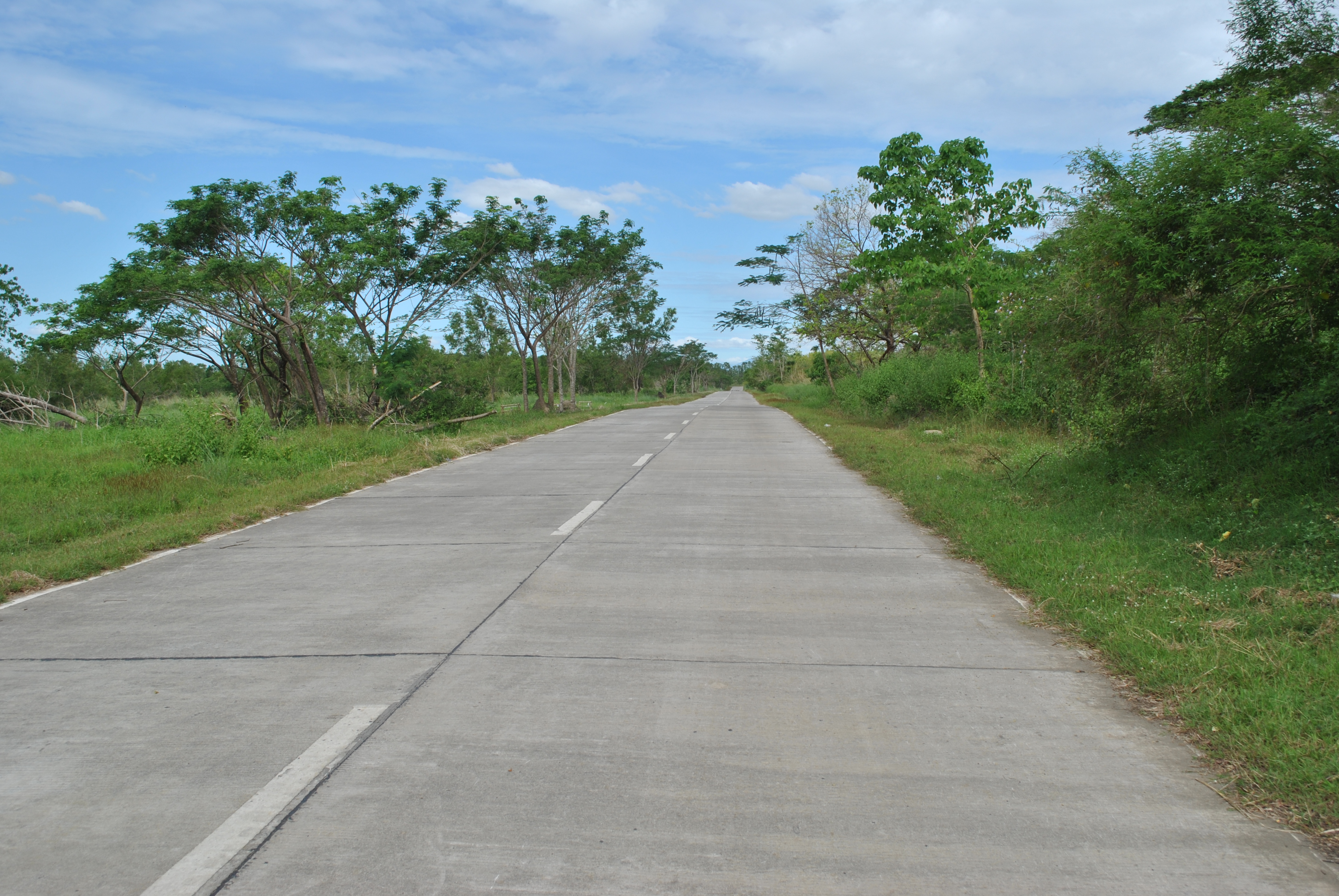
5. Runners shall TURN RIGHT on the paved/cemented Sta Rosa-Fort Magasaysay-Laur Road. This is the same road on the first 3K of the Fort Magsaysay To Dingalan 65K Ultra Marathon Race.

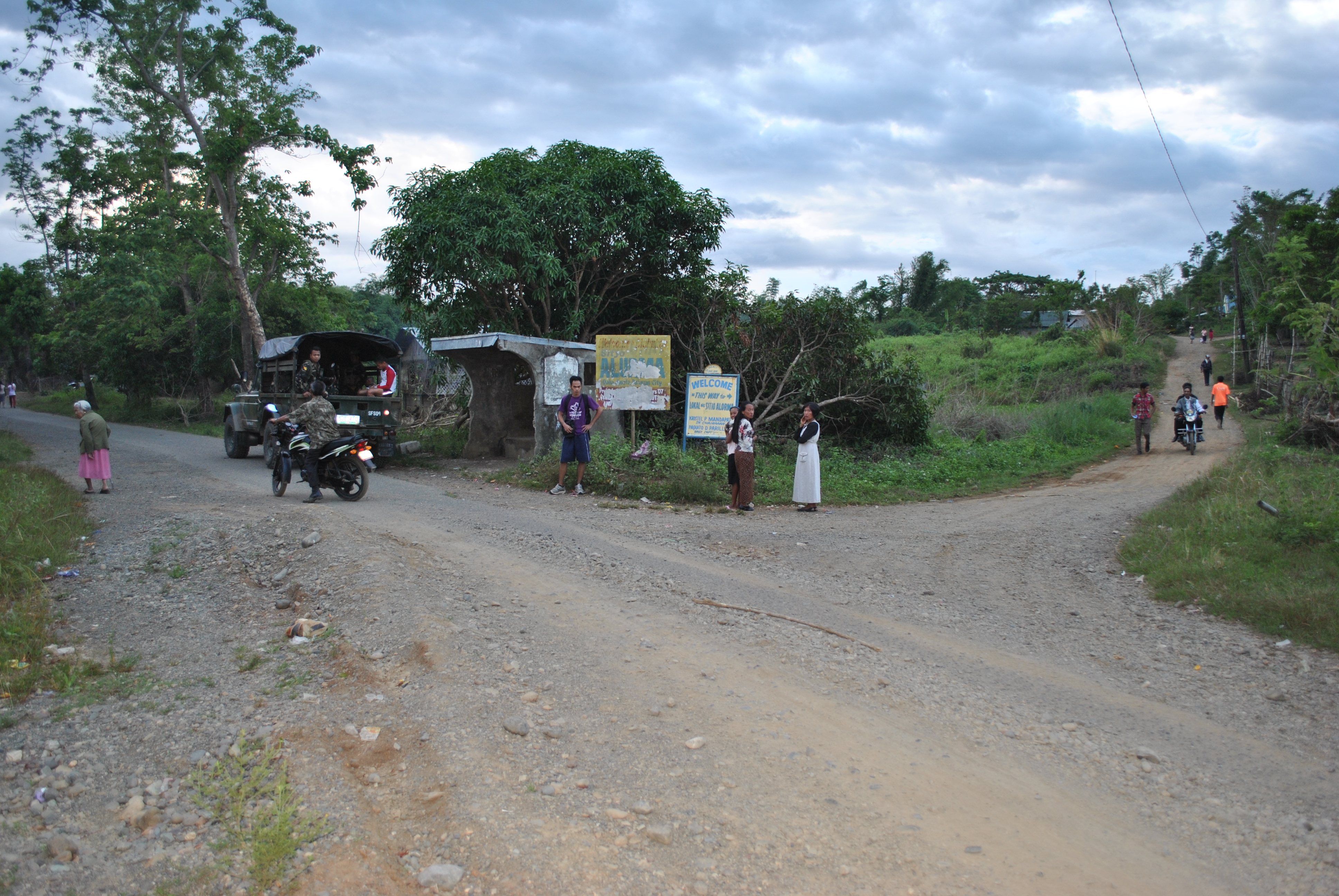
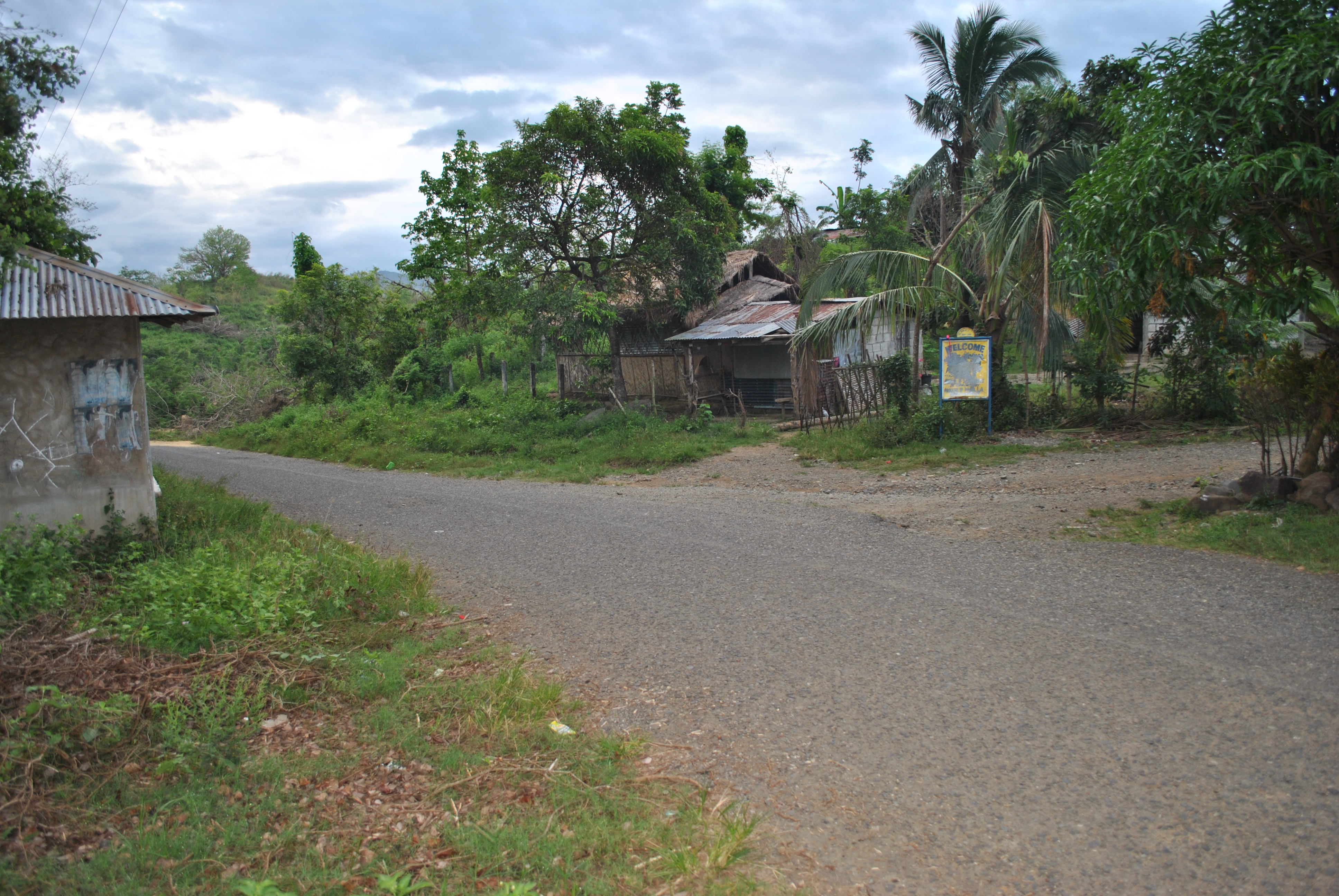
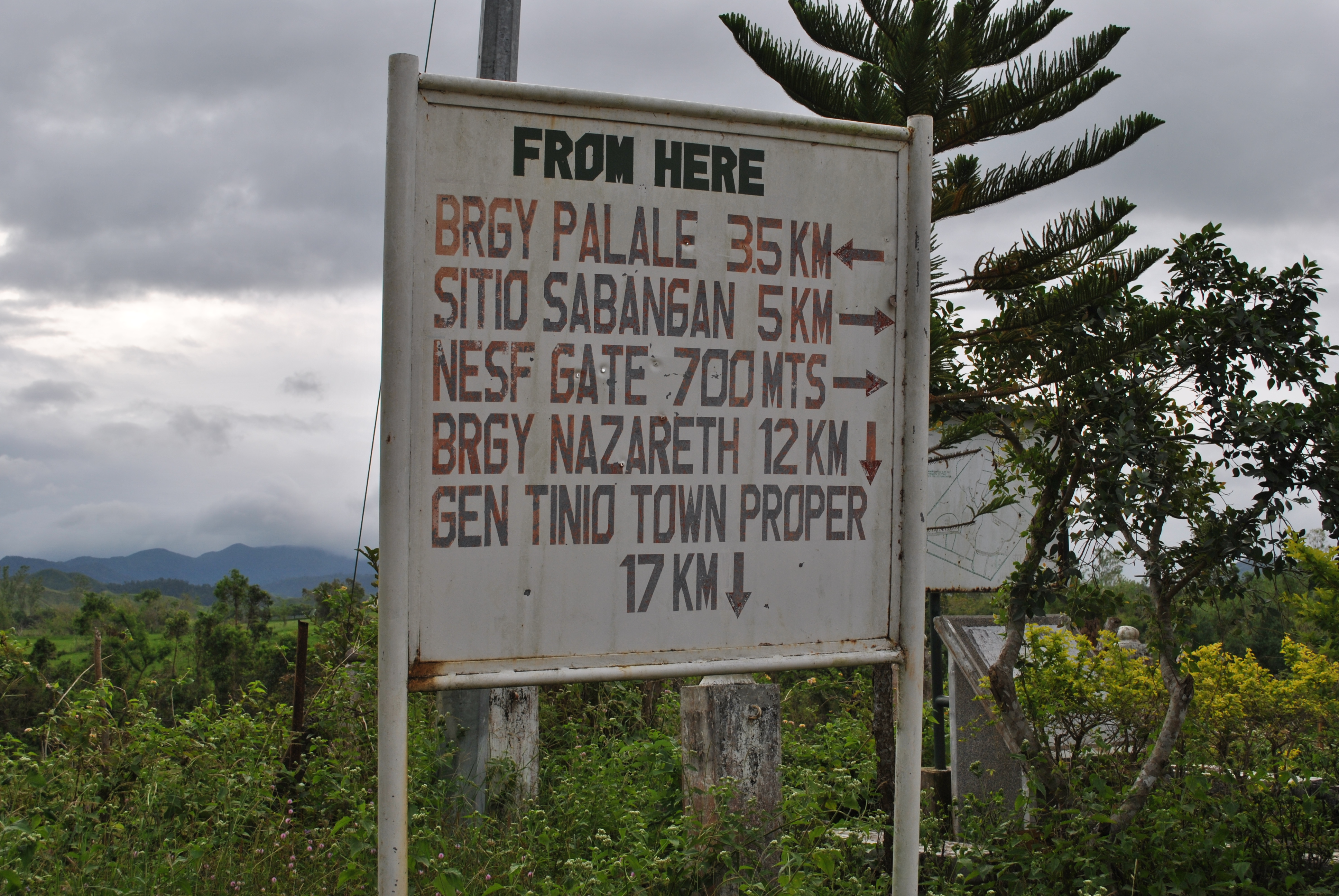
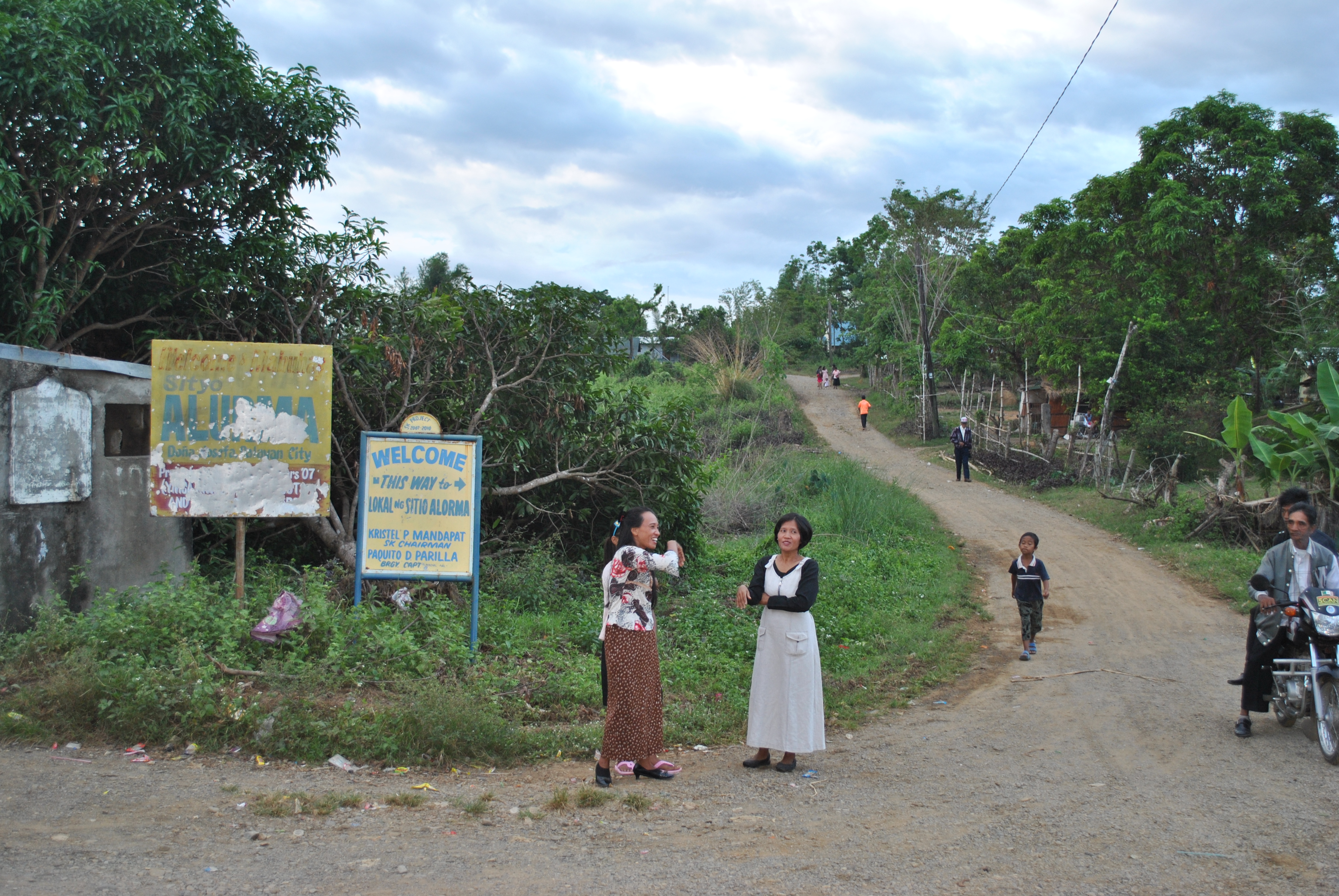
6. There will be an INTERSECTION after running for almost 2 kilometers along the Sta Rosa-Fort Magsaysay-Laur Road. There is a Detachment and Military Checkpoint on this intersection. Runners will have to TURN RIGHT on this intersection which leads to Barangay Dona (Donya) Josefa. Runners will be able to pass on the intersection of Sitio ALORMA and Sitio BACCAO. Runners will have to follow the asphalted road up to Barangay Dona Josefa.

TURN RIGHT Towards Barangay Dona Josefa
INTERSECTION @ Sitio ALORMA (Right Side of the Road)
BRGY BACCAO Intersection (On the Right Side of the Road)
SITIO BACCAO Intersection (On the Right Side of the Road)

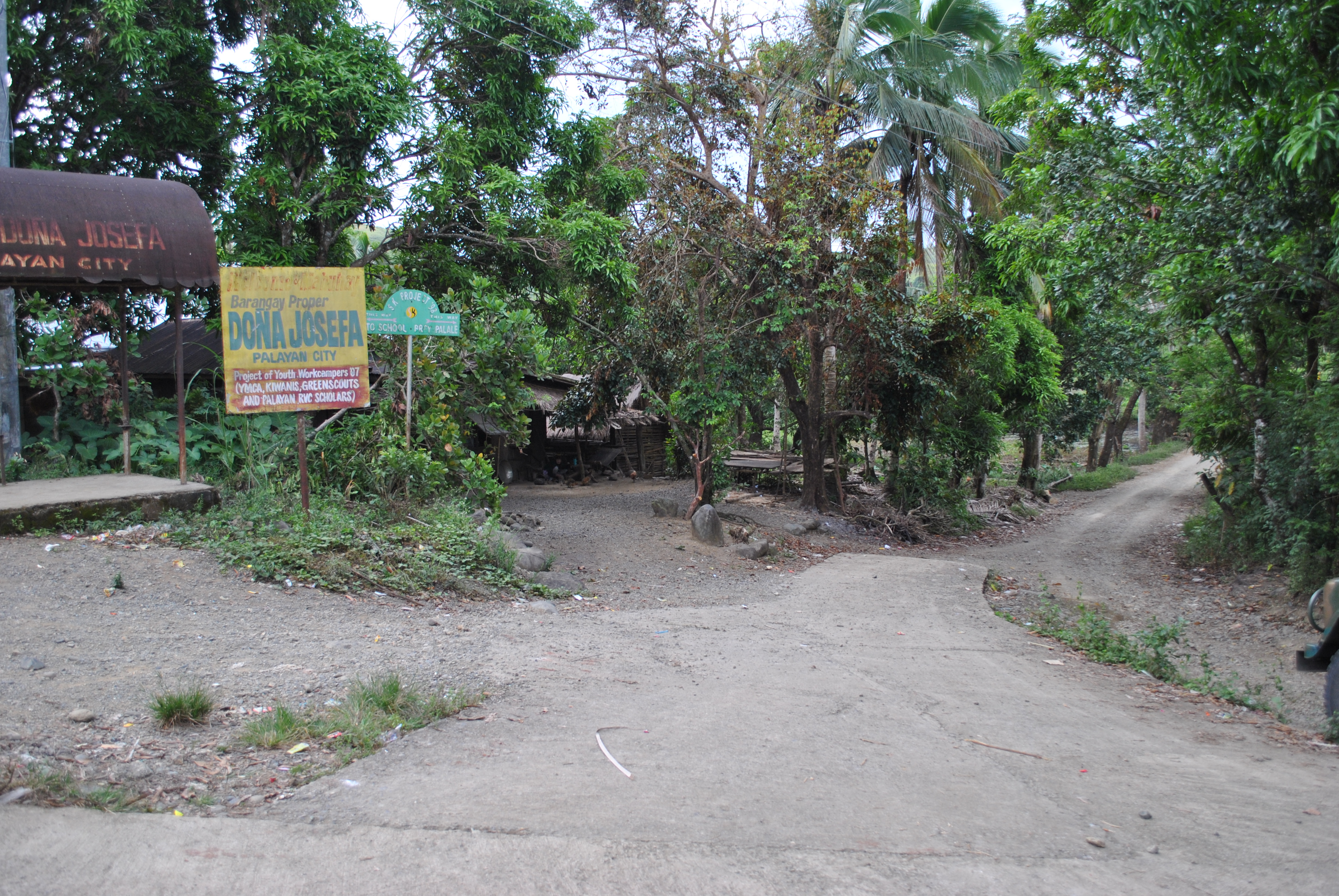
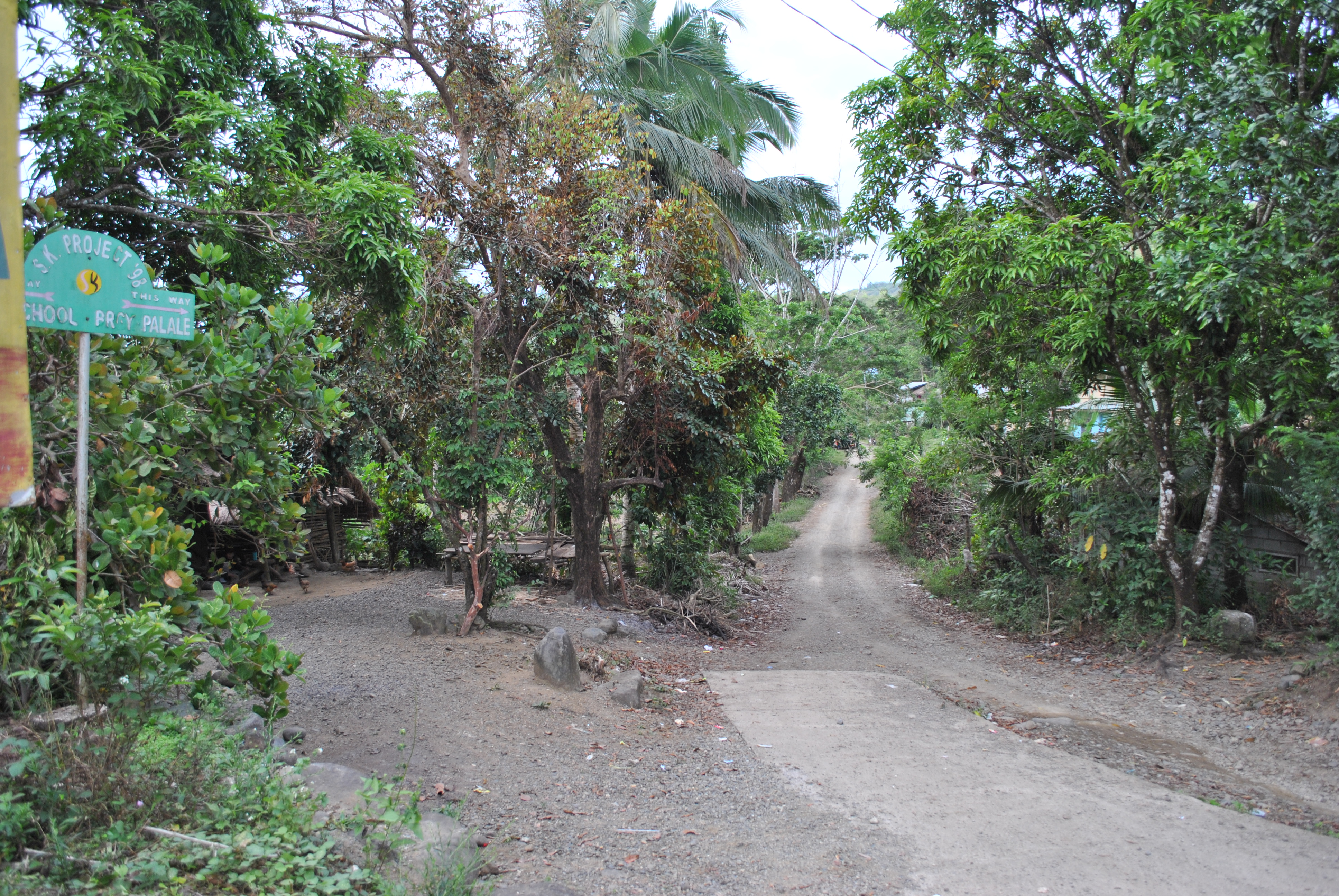
7. Once the runners will reach the center of Barangay Dona Josefa, turn RIGHT and just follow the dirt road. Do NOT take the road towards the LEFT Direction as it ends at the Dona Josefa Elementary School.

@ BARANGAY Dona JOSEFA
TURN RIGHT TO BRGY PALALE

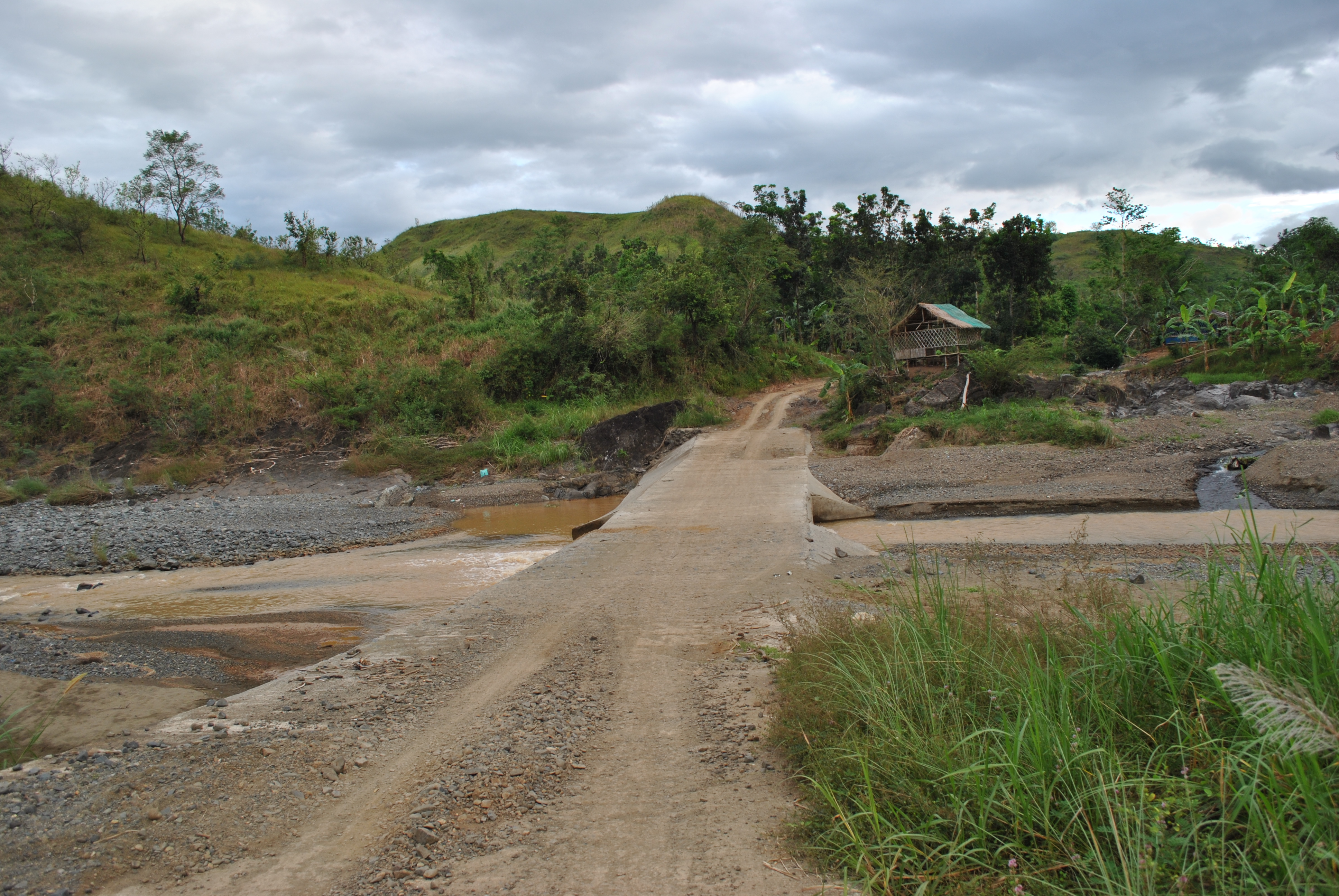
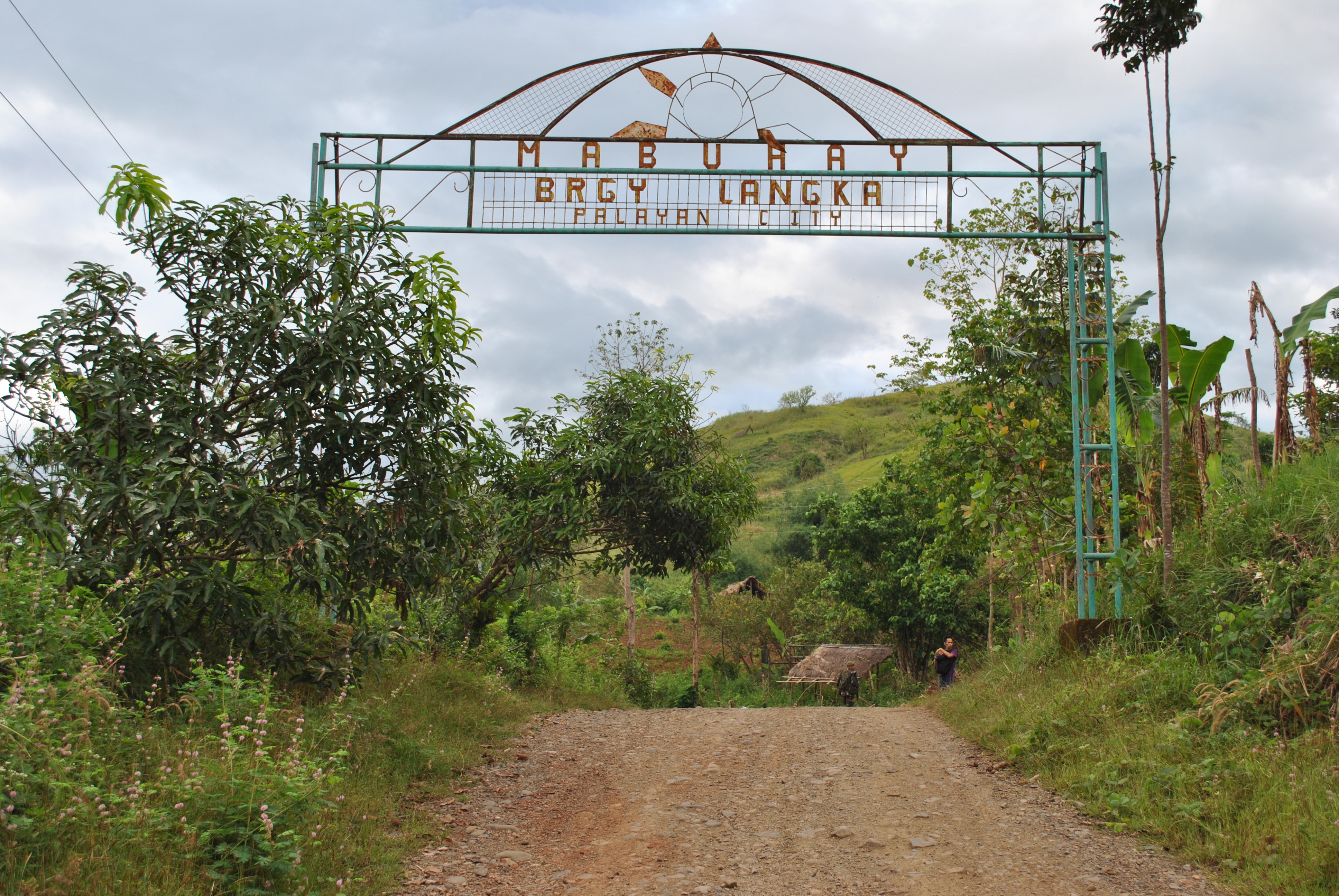
8. Runners will reach the first Spillway and after passing the Spillway, it will be an uphill climb and a steel arc will be seen with the markings “WELCOME TO SITIO LANGKA”.

First Spillway Before Barangay Langka Welcome Arc
Barangay LANGKA Welcome Arc

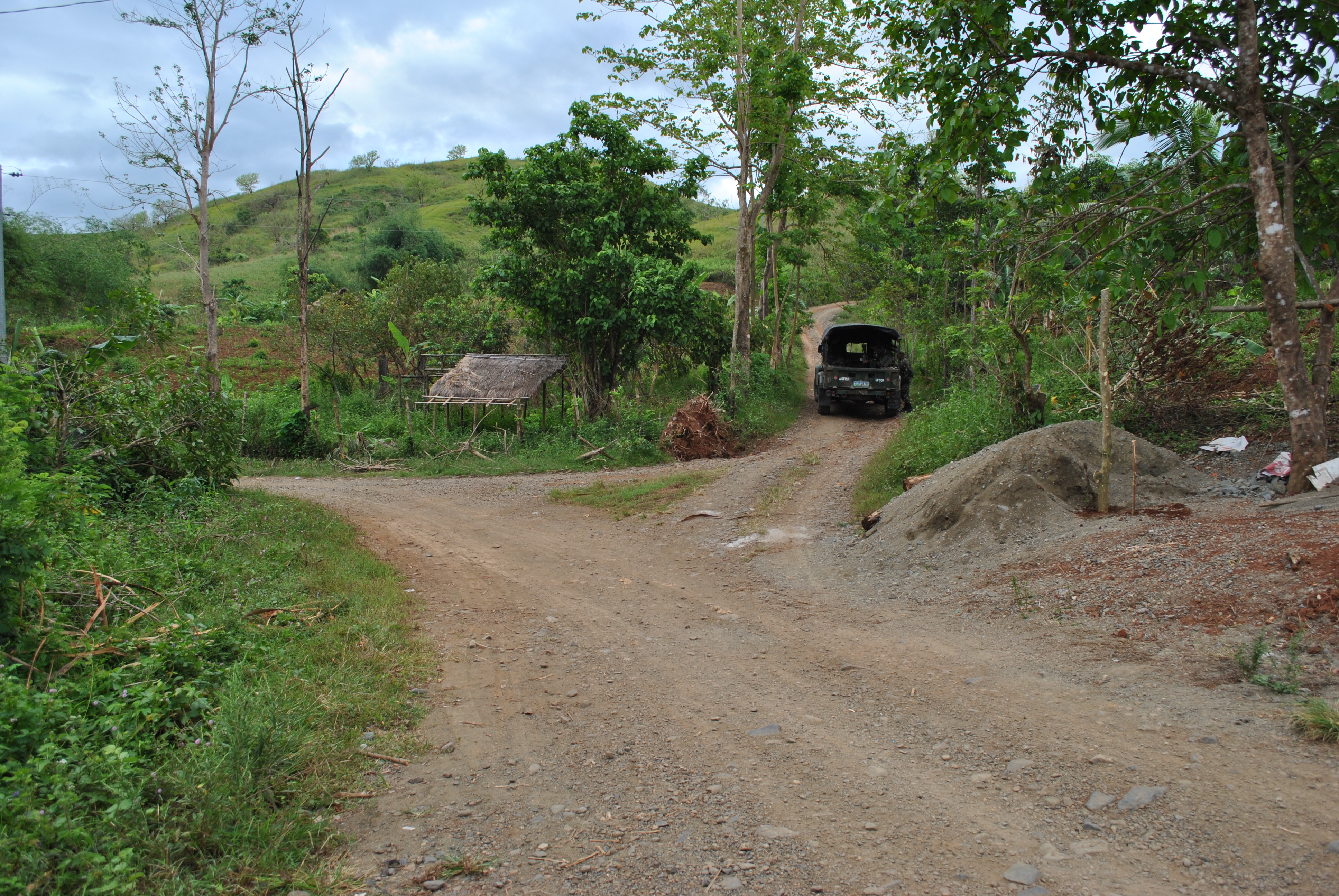
9. After passing the BARANGAY LANGKA Arc, at about 20 meters, there will be a Y-intersection. TURN RIGHT on the Y-intersection and it will be the start of more uphill climbs and descending parts of the route. Ultimately, the runners will be crossing the Palale River.

TURN RIGHT After Brgy LANGKA Arc

10. After crossing the Palale River, runners will be able to reach the center of Barangay Palale after few meters. There will be an Aid Station in this Barangay. There are also sari-sari stores in this area.

PALALE RIVER
PALALE RIVER
Center Of Barangay PALALE
TURN RIGHT on the Right Most Road

11. Runners will take the road on the RIGHT as one leaves the center of the barangay. Runners will be going to the direction of the Provincial Cattle Stock Farm.

Approaching The Provincial Cattle Stock Farm
Take Note Of This Road Markings

12. Once the runners reach the Provincial Cattle Stock Farm, TURN RIGHT on the intersection. This road will lead the runners to Barangay NAZARETH.

TURN RIGHT On This Road Going To Barangay NAZARETH

13. Runners shall reach the intersection of GAPAN-PAPAYA-FORT MAGSAYSAY Road which is a paved/cemented, once they reach the center of Barangay Nazareth. The Aid Station is located at the Barangay Hall of Nazareth. At this intersection, runners have to TURN RIGHT going to a north direction.

Barangay NAZARETH Intersection
TURN RIGHT On This Road

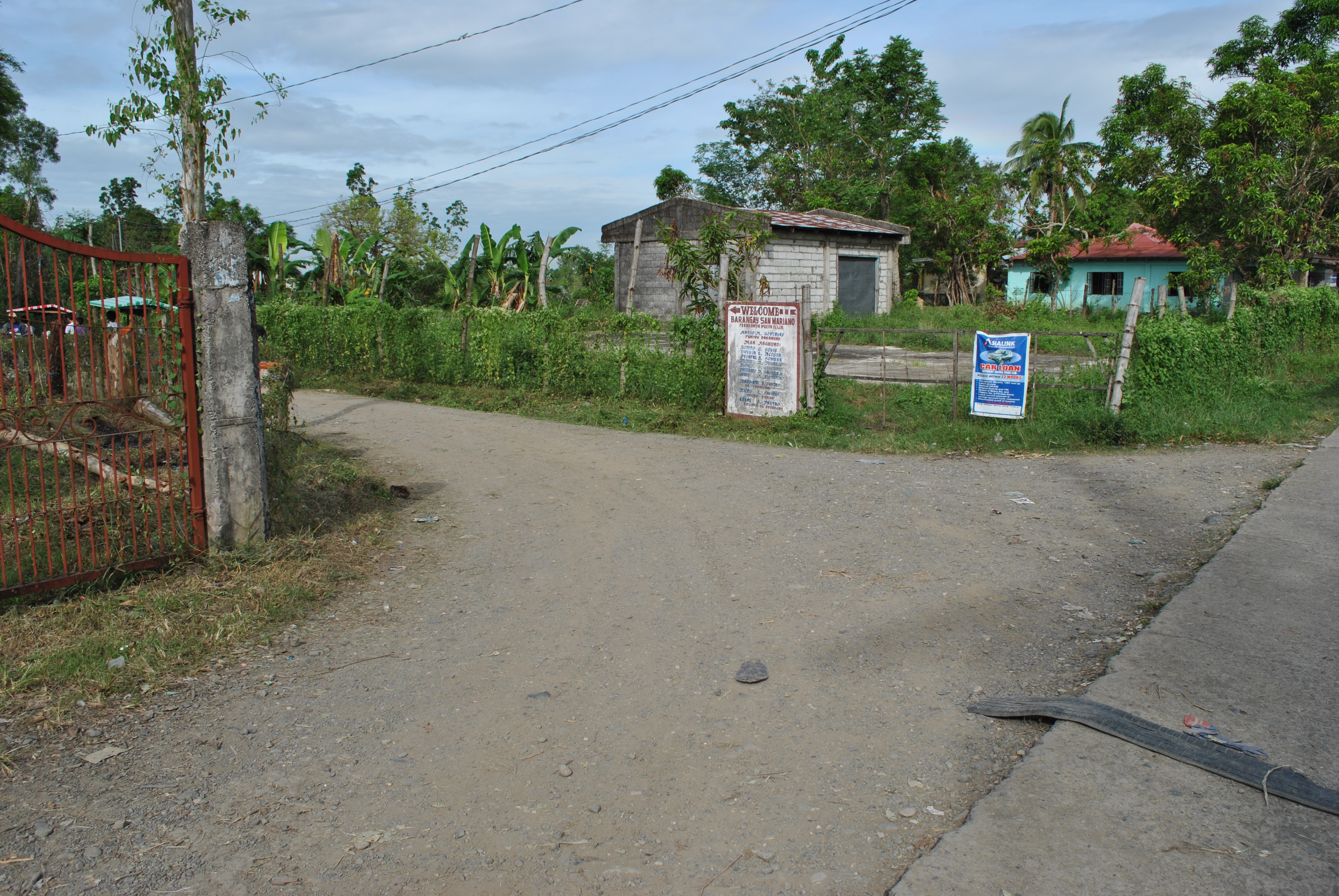
14. After 1.5 Kilometers, runners have to TURN LEFT in an intersection that goes to San Mariano/Purok 9/Barangay Militar. On this dirt road, runners shall always take or turn LEFT on intersections along the way.

TURN LEFT On This Road Towards Barangays San Mariano, Purok #9, Barangay Militar
TURN LEFT To Barangay Mariano/Purok #9/Barangay Militar
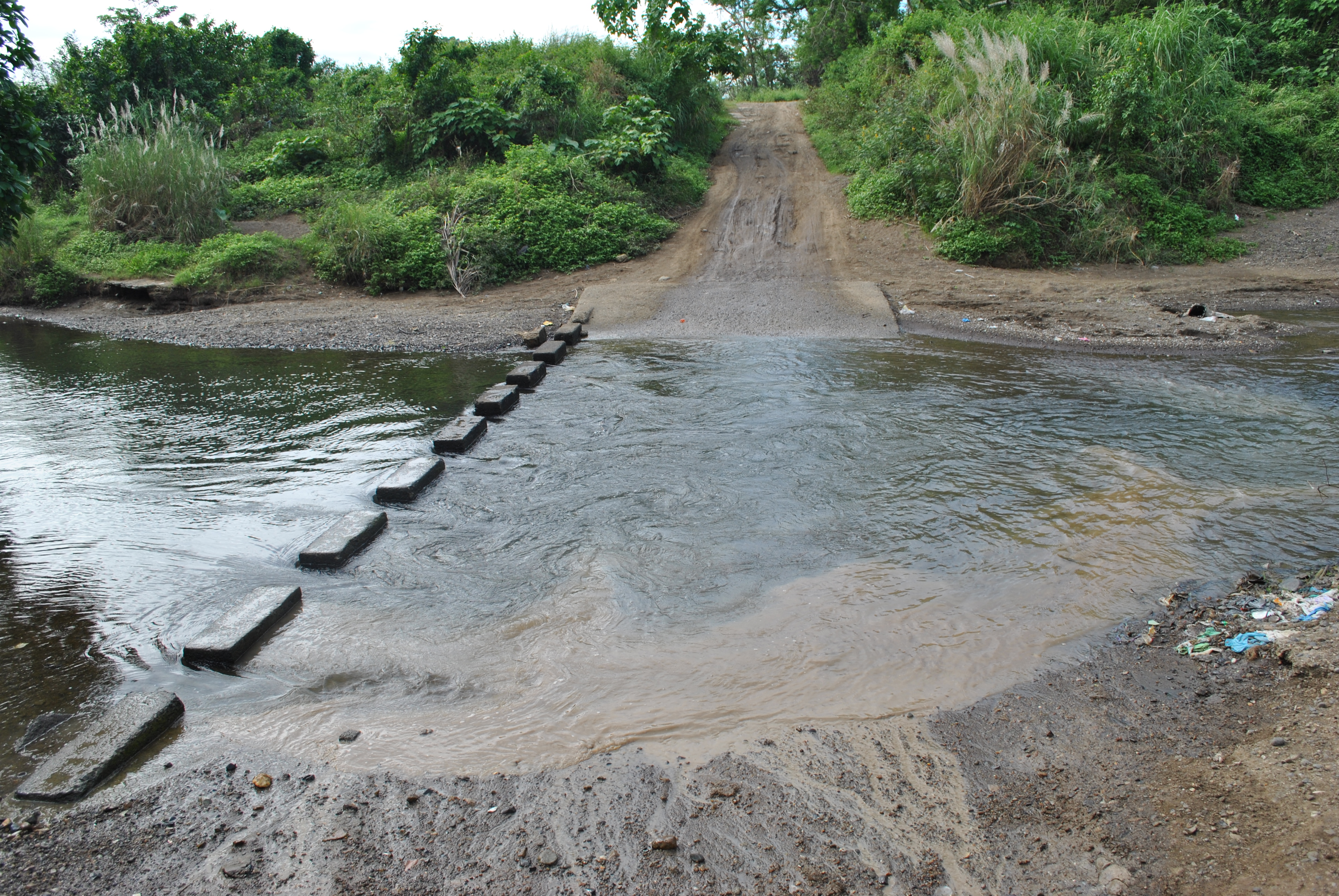
SPILLWAY On The Western Side Of Barangay Militar

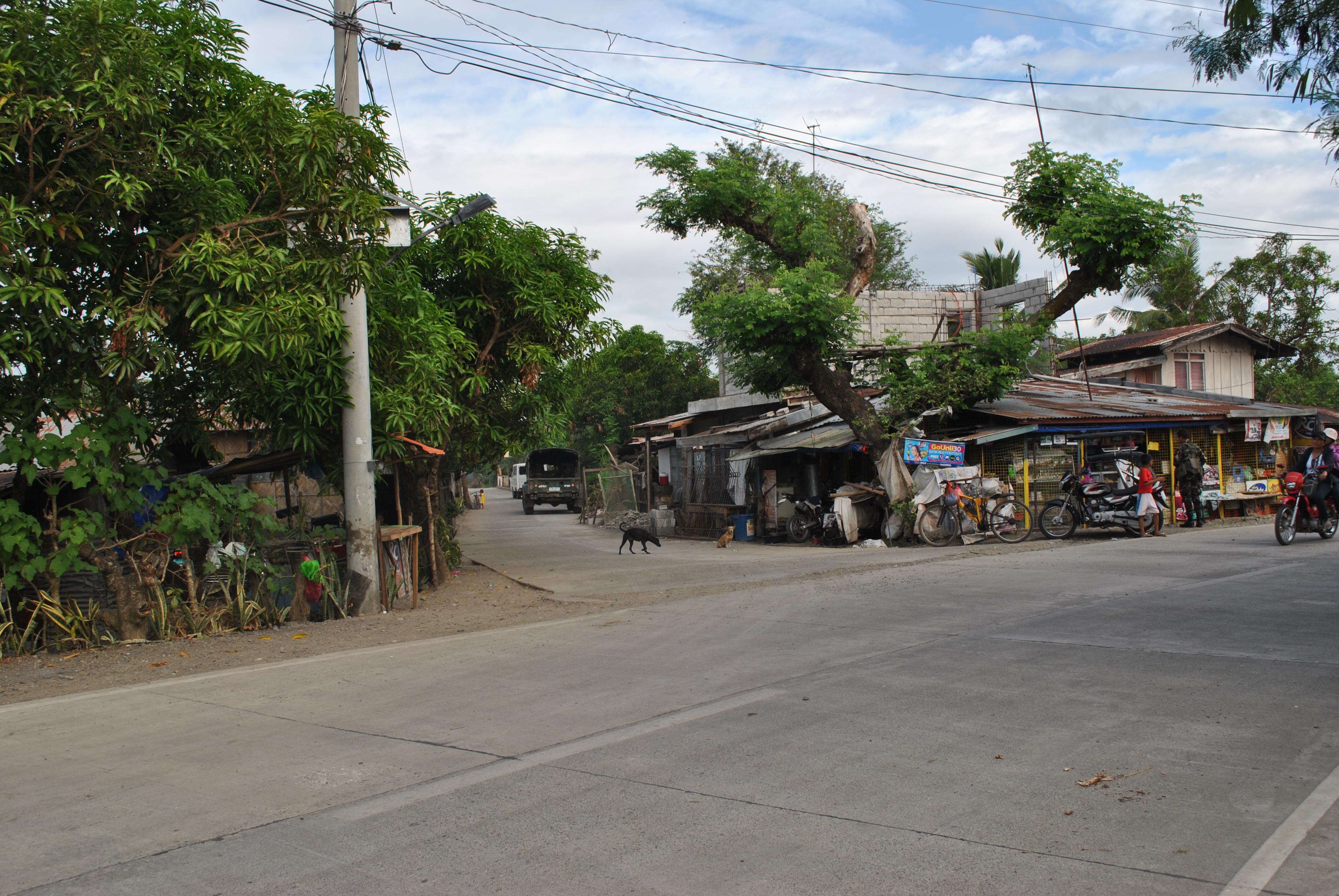
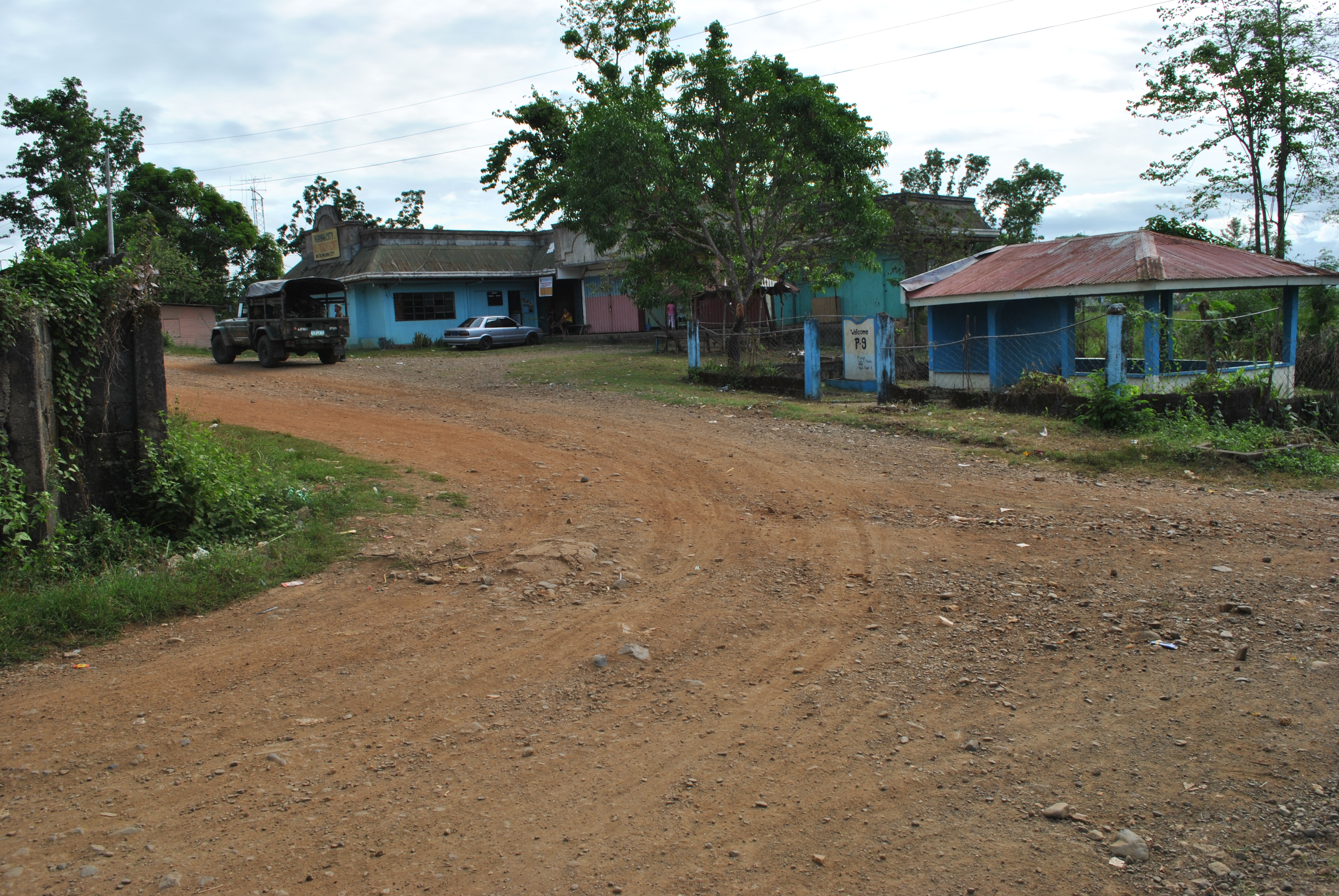
15. Runners must be able to pass/cross an SPILLWAY on western part of Barangay Militar. After an uphill climb from the SPILLWAY, the runners will reach the PUROK #9  . From Purok #9, the runners will be approaching an intersection with the Santa Rosa-Fort Magsaysay-Laur Road/Highway.

S-Curve @ Purok #9
S-Curve @ Purok #9
Approaching The Santa Rosa-Fort Magsaysay-Laur Road/Highway
Approaching The Santa Rosa-Fort Magsaysay-Laur Road/Highway. TURN RIGHT
TURN LEFT Towards Barangay BANGAD On This Intersection

16. After about 1.5 kilometers, runners will reach a busy road intersection (Bangad To Gate 1 Fort Magsaysay Road & Santa Rosa To Laur Road). Runners should TURN LEFT towards Barangay Bangad, Palayan City.

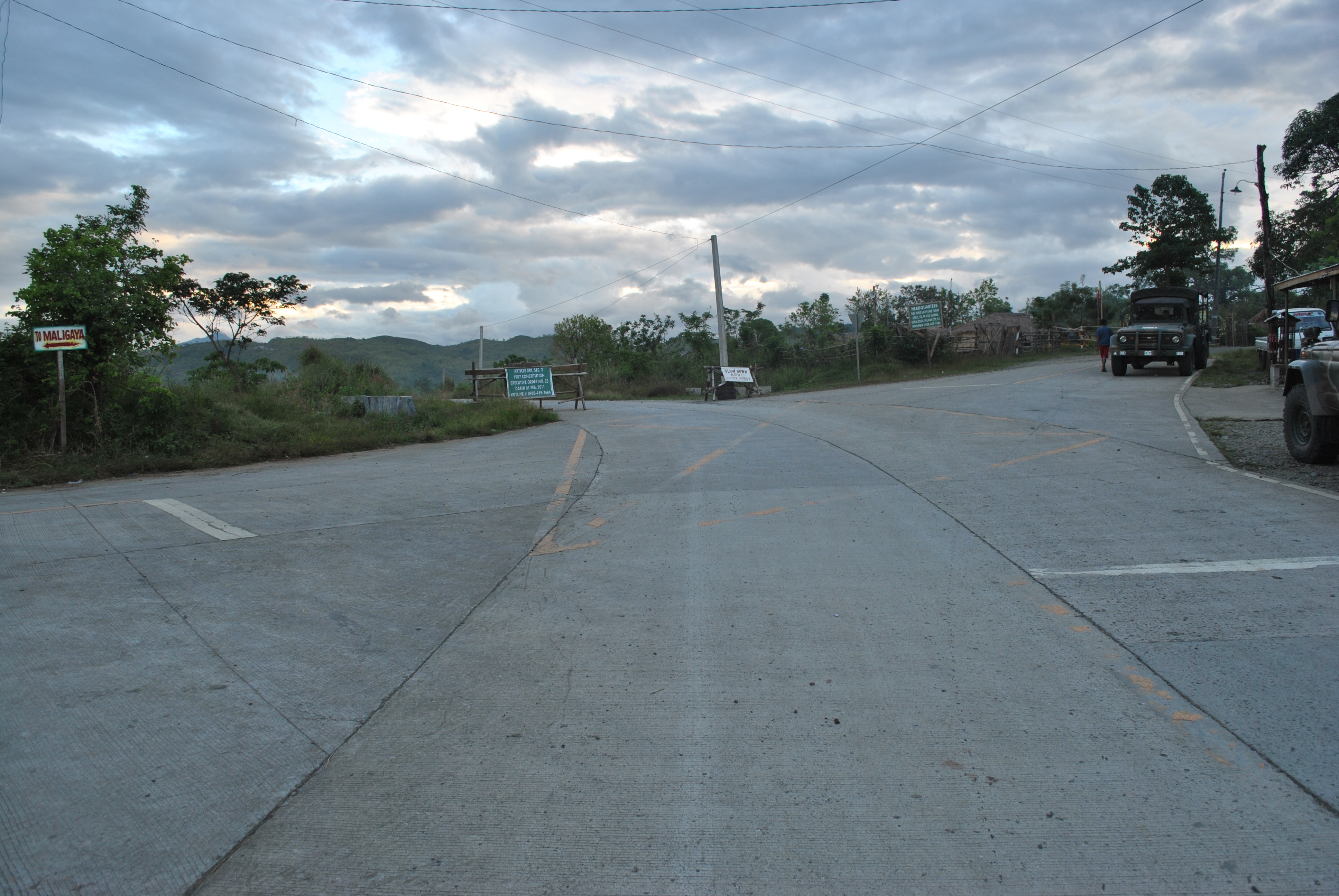
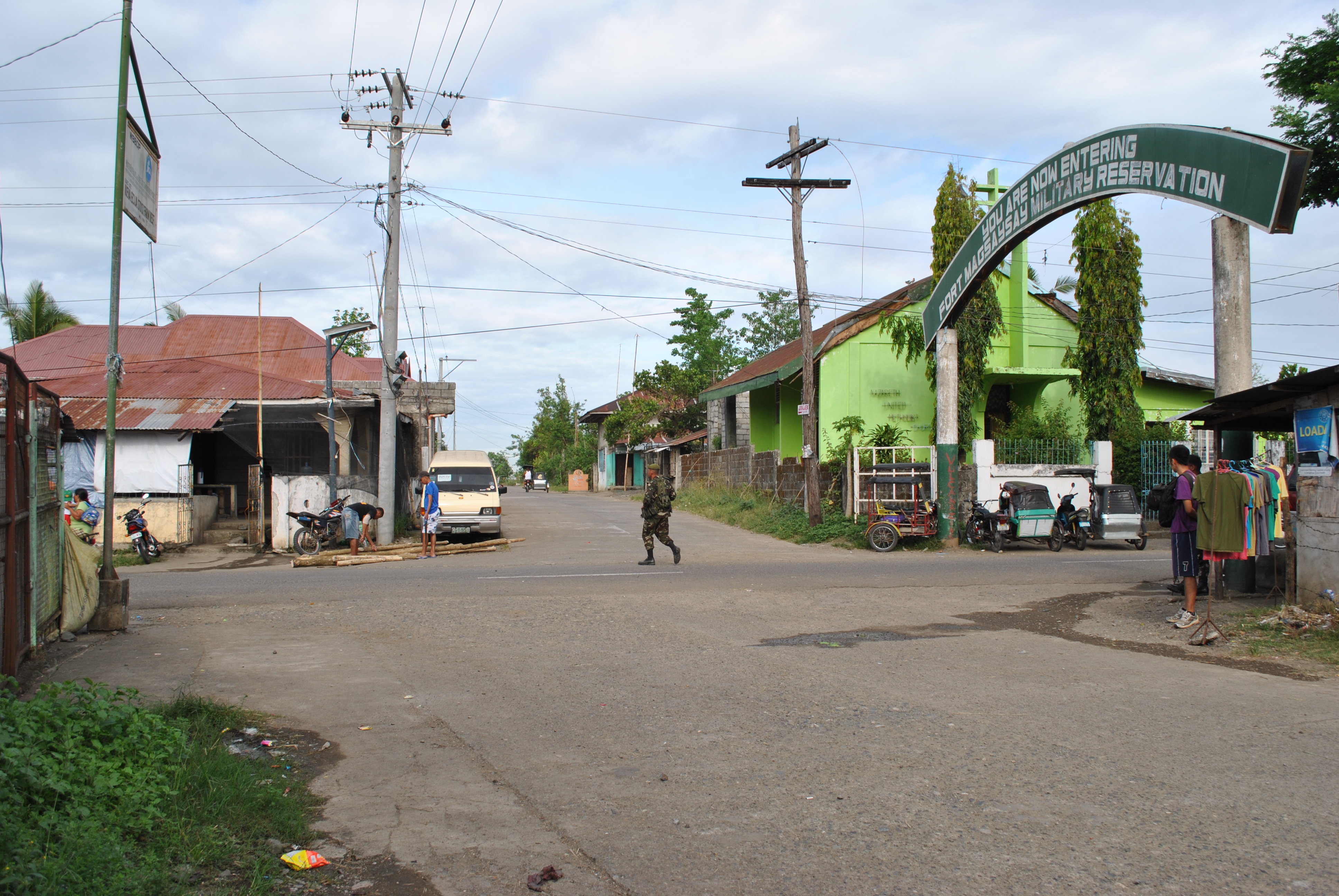
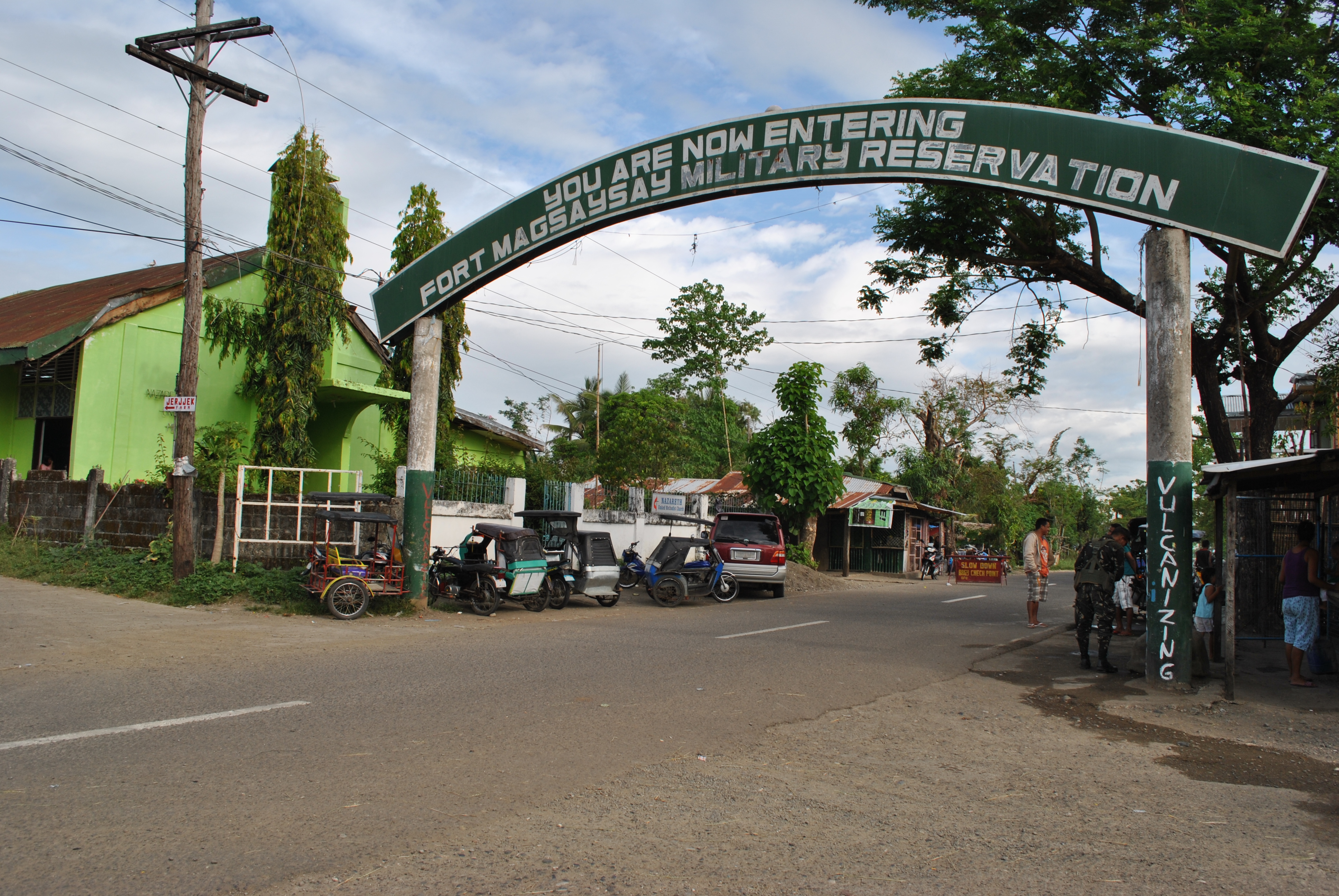
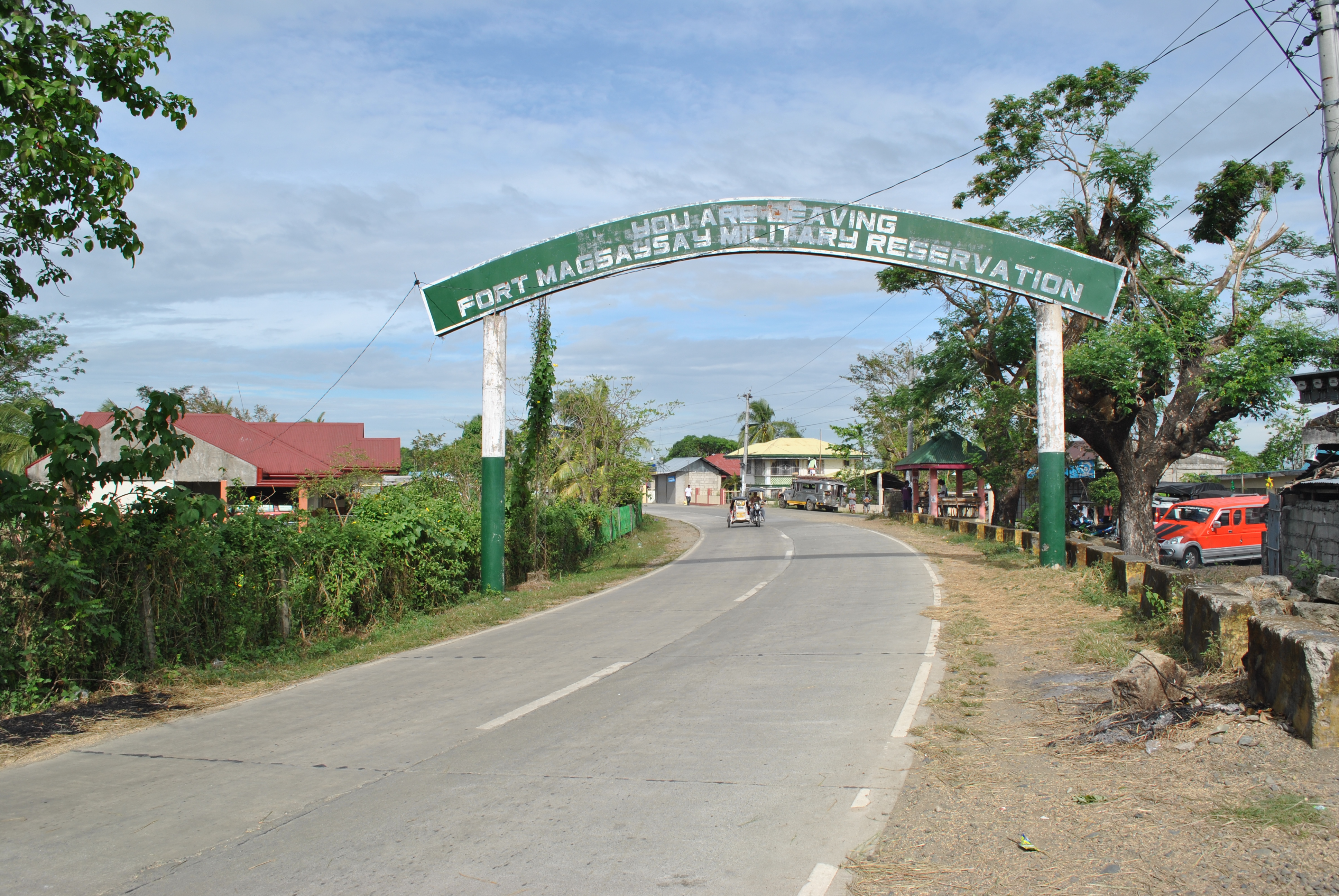
17. After running for 2 kilometers along the Fort Magsaysay-Bangad Road (going North), runners will see a green steel arc with the markings “FORT MAGSAYSAY RESERVATION AREA” and a Waiting Shed on the right side of the road. There is a Y-intersection after passing the Arc and Waiting Shed. Runners shall TURN RIGHT on the road that goes to Barangay MALIGAYA.

Before The Y-Intersection Going Barangay MALIGAYA
Road To Barangay MALIGAYA

18. After runners had passed Barangay MALIGAYA, the road will lead them to the FIRST intersection with a Military Checkpoint & Detachment along the Santa Rosa-Laur Road. Runners shall cross the Paved Road (Santa Rosa-Laur Road) on their way to Barangay Dona Josefa. At this point, runners shall have circumnavigated the outer perimeter of the Camp’s Cantonment Area.

TURN RIGHT @ The Intersection of SITIO ALORMA
TURN RIGHT @ The Intersection of SITIO ALORMA (Going To The Airstrip)
Runners Will Be Reaching This Place From Sitio ALORMA

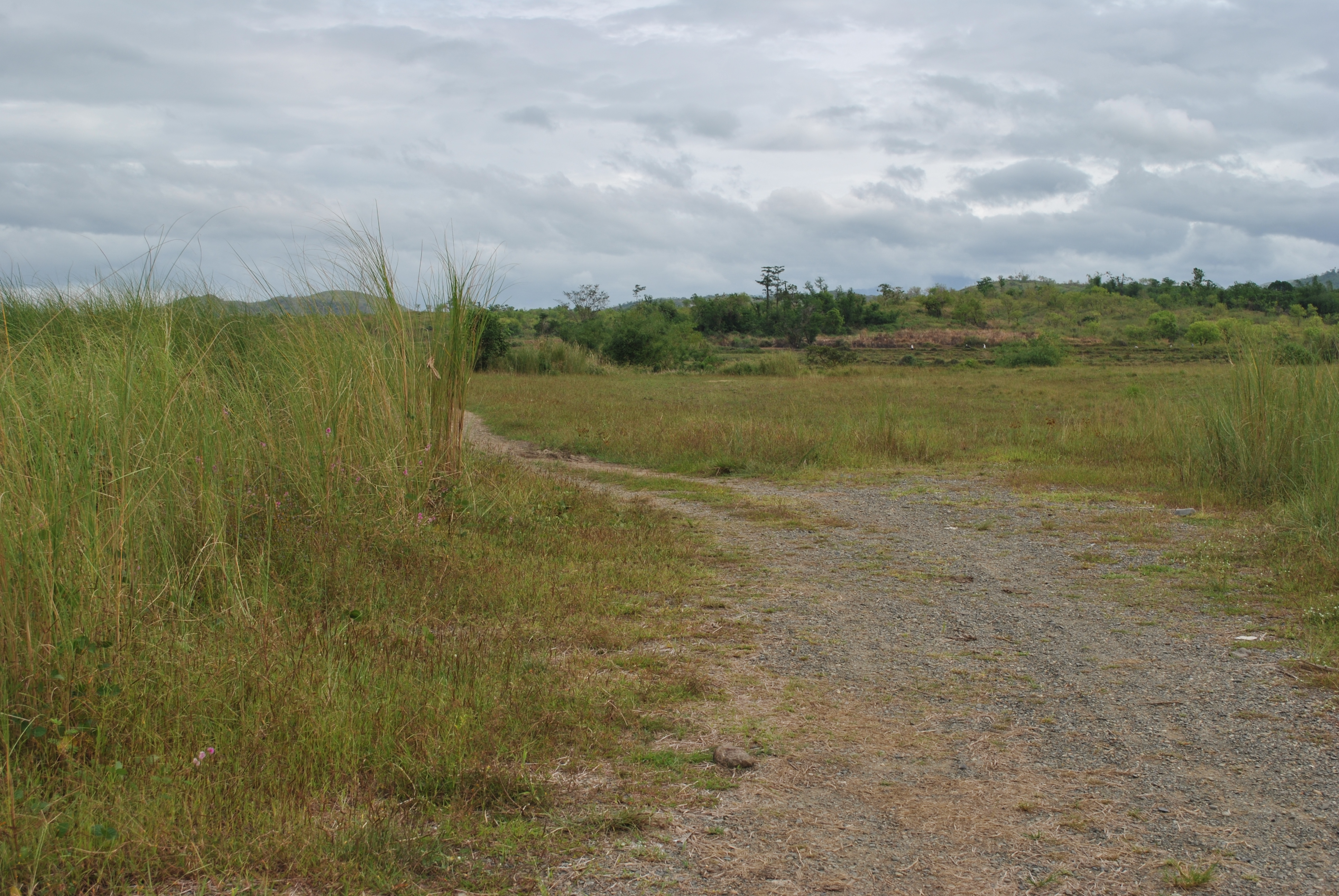
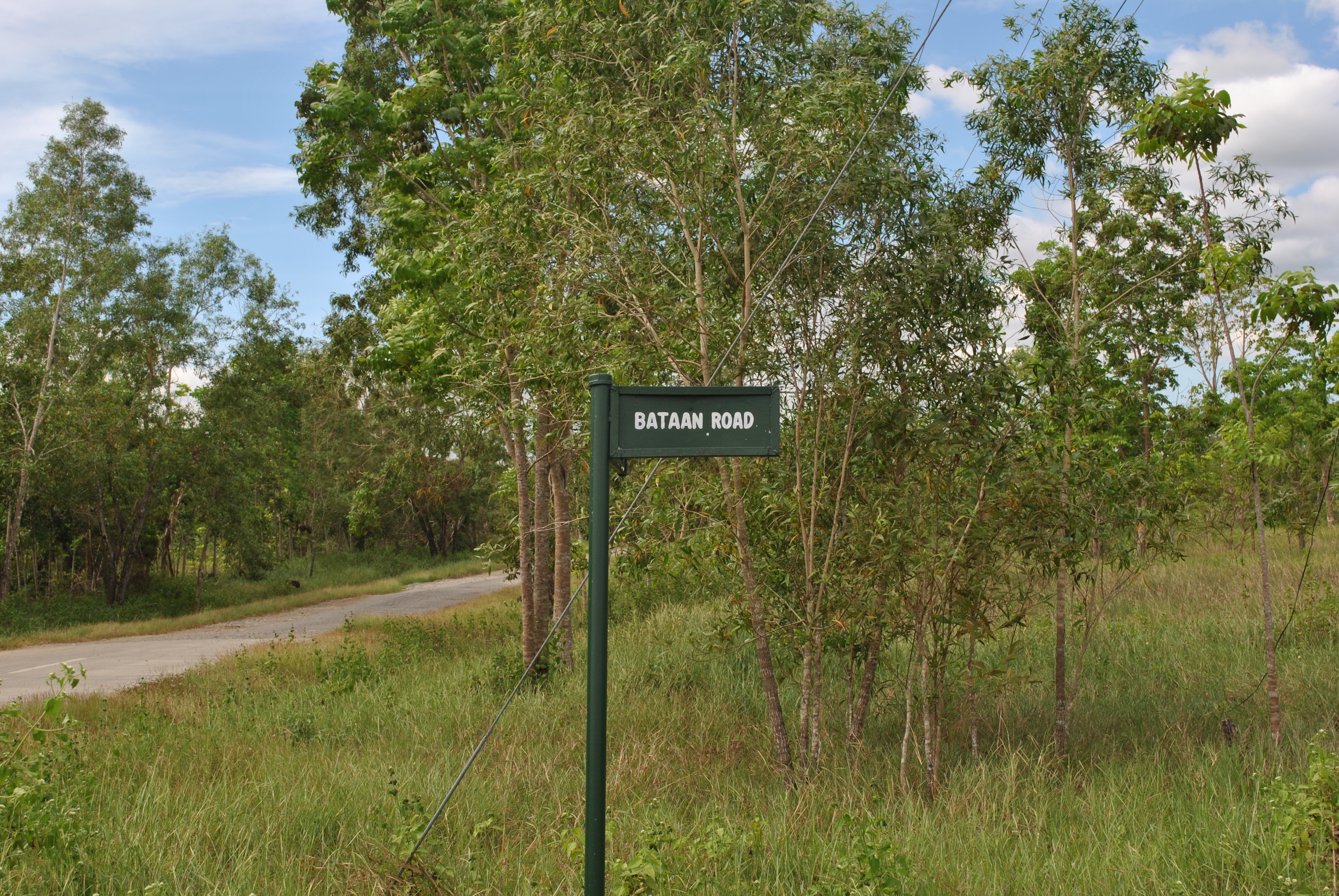
19. Along the Barangay Dona Josefa Road, runner should be ATTENTIVE. The first intersection is at SITIO ALORMA. TURN RIGHT at Sitio ALORMA intersection and go  STRAIGHT uphill. The trail will lead the runners to the end of the airstrip. At the end of the airstrip, there is a Y-intersection. TURN LEFT on the said intersection. The road will lead the runners to BATAAN ROAD and the runners will be going to a SOUTH Direction.

END OF THE AIRSTRIP. Runners Shall TURN LEFT Towards Bataan Road

20. Along BATAAN ROAD, runners will see FIRING RANGES on their LEFT and a GOLF COURSE on their RIGHT. Runners will follow the Bataan Road until they will reach the intersection going to CORDERO DAM.

BATAAN ROAD
BATAAN ROAD
Street Sign/Marker @ Bataan Road

21. Runners have to TURN LEFT on a dirt road that goes to CORDERO DAM. After 2 kilometers, there is a Y-intersection. Runners shall TURN RIGHT on this intersection. This trail will lead the runners to the Special Forces School and then to FERNANDEZ HILL.

22. Fernandez Hill is the location of an Aid Station. Runners will have to pass this Aid Station for six (6) times for the 100-Mile Race and three (3) times for the 50-Mile Race.

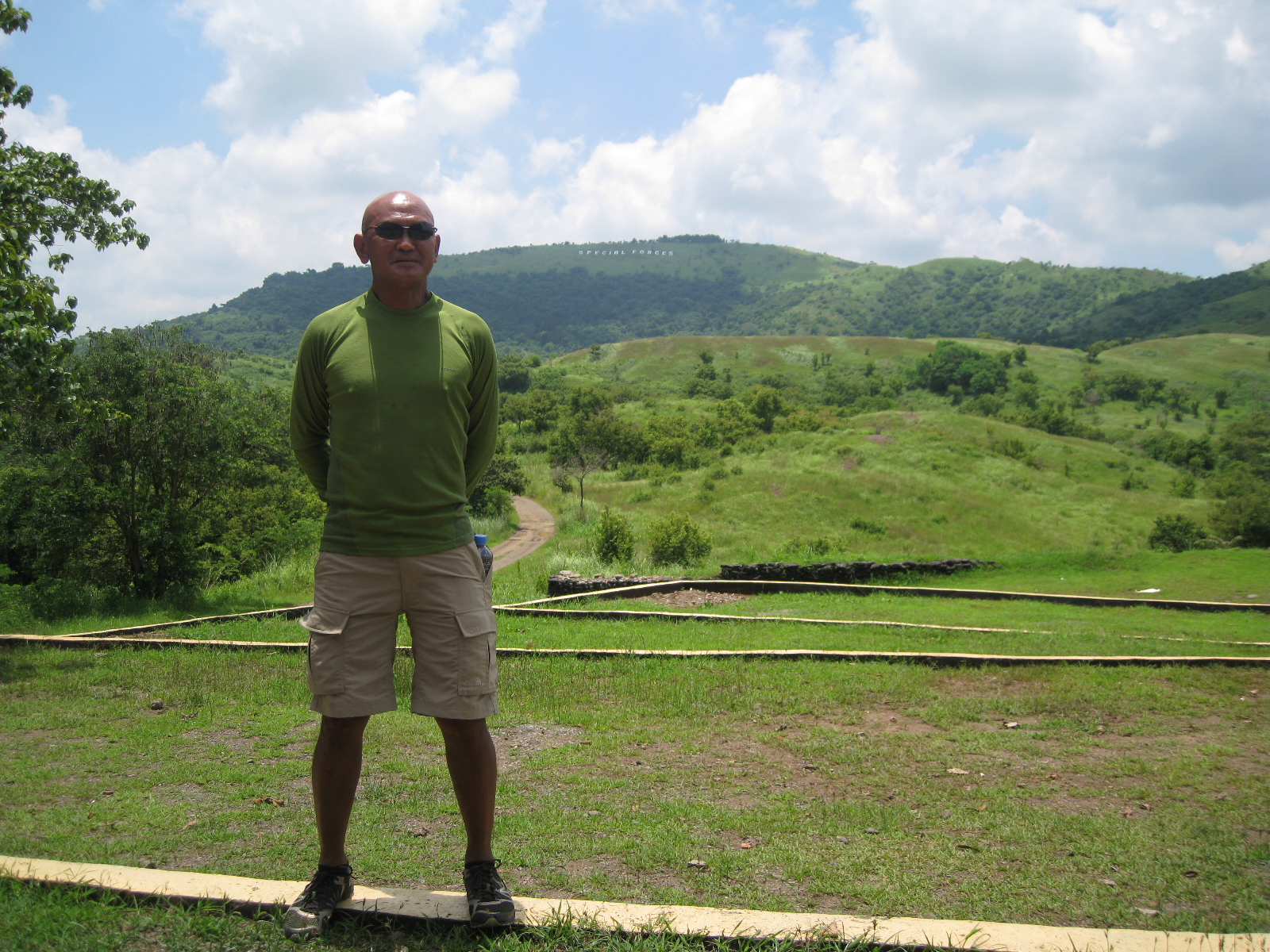
@ Fernandez Hill With Mt Taklang Damulag At The Background

23. From Fernandez Hill, runners will have to proceed to the peak of Mt Taklang Damulag and then descend on its northern part. The descending trail leads to SITIO BACCAO (along the Barangay Dona Josefa To Barangay Palale Road). Upon reaching the asphalted road, runners shall TURN LEFT and proceed to SITIO ALORMA Crossing/Intersection.

Trail Coming From Taklang Damulag To Dona Josefa-Palale Road
24. Runners shall TURN LEFT at Sitio ALORMA intersection (Going To Cordero Dam). After about 20 meters, TURN LEFT on a trail that leads to CORDERO DAM/LAKE. (Going UPHILL will lead the runners to the end of the airstrip. Don’t take this UPHILL dirt road!)
Going South To Brgy Alorma Intersection (400 Meters)
Going South To Brgy Alorma (Going To Cordero Dam) Intersection (400 Meters)
TURN LEFT On This Intersection Going To Cordero Dam
TURN LEFT On This Trail (20 Meters From The Intersection)

25. Once the runners are in CORDERO DAM/LAKE (on the right side of the runners), they will reach a Y-intersection (the same Y-intersection that runners had passed after coming from BATAAN ROAD and upon reaching CORDERO DAM/LAKE). At the intersection, TURN LEFT and the runners will be going to the Special Forces School and then to Fernandez Hill. This completes the 12K inner loop.

26. Runners will have to run along the Taklang Damulag course (12K inner loop) for two times.

27. After finishing two loops, from Fernandez Hill, runner will follow the asphalted road that goes out from the Molave Complex (location of the Special Forces School and Fernandez Hill/Taklang Damulag). Runners must pass the Checkpoint/Gate of the Molave Complex that goes directly to BATAAN ROAD.

28. Runners will be running along BATAAN ROAD on their way back to SOCOM Headquarters/Starting Area. At the dirt road at the end of the airstrip, there will be an intersection (the first intersection on a dirt road after 800 meters from the Starting Line), TURN LEFT on this intersection. The dirt road will lead the runner to the Starting Area/SOCOM Headquarters.

TURN LEFT On This Dirt Road In Going Back To The Starting Area (SOCOM Headquarters)

29. This completes the FIRST HALF of the 100-Mile Course. The LAST HALF of the course will be a repetition of the FIRST HALF.

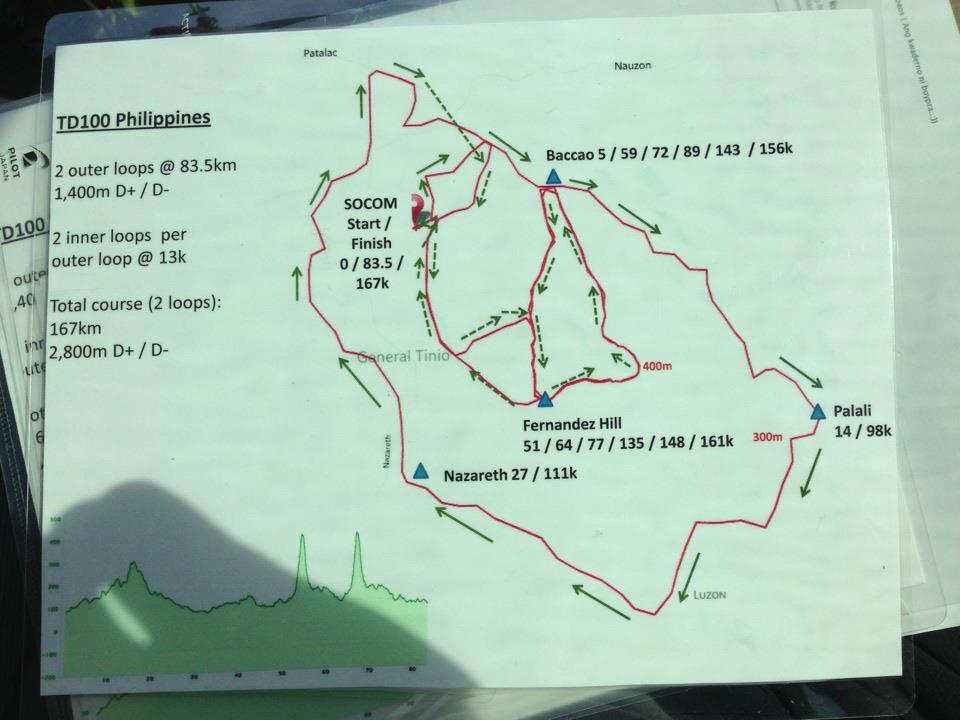
TD 100 Route Map
TD 100 Route Map
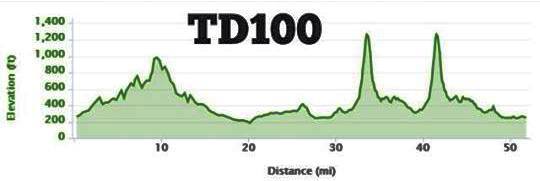
TD 100 Elevation Profile

30. 100-Mile Race Runners must be able to finish the FIRST HALF in 15:30 Hours. Cut-Off Time for the 50-Mile Race Runners is 16 Hours.

31. On the SECOND LOOP, runners must be able to reach FERNANDEZ HILL in 25 hours before starting their last TWO (Small) Loops at Mt. Taklang Damulag.

Good Luck & Have Fun!

Good luck to all the runners!

(Note: Rules & Regulations Will Be Posted Soon!)

Official Result: 6th Tagaytay To Nasugbu 50K Ultra Run


4:00 AM – 1:00 PM Sunday, December 8, 2013

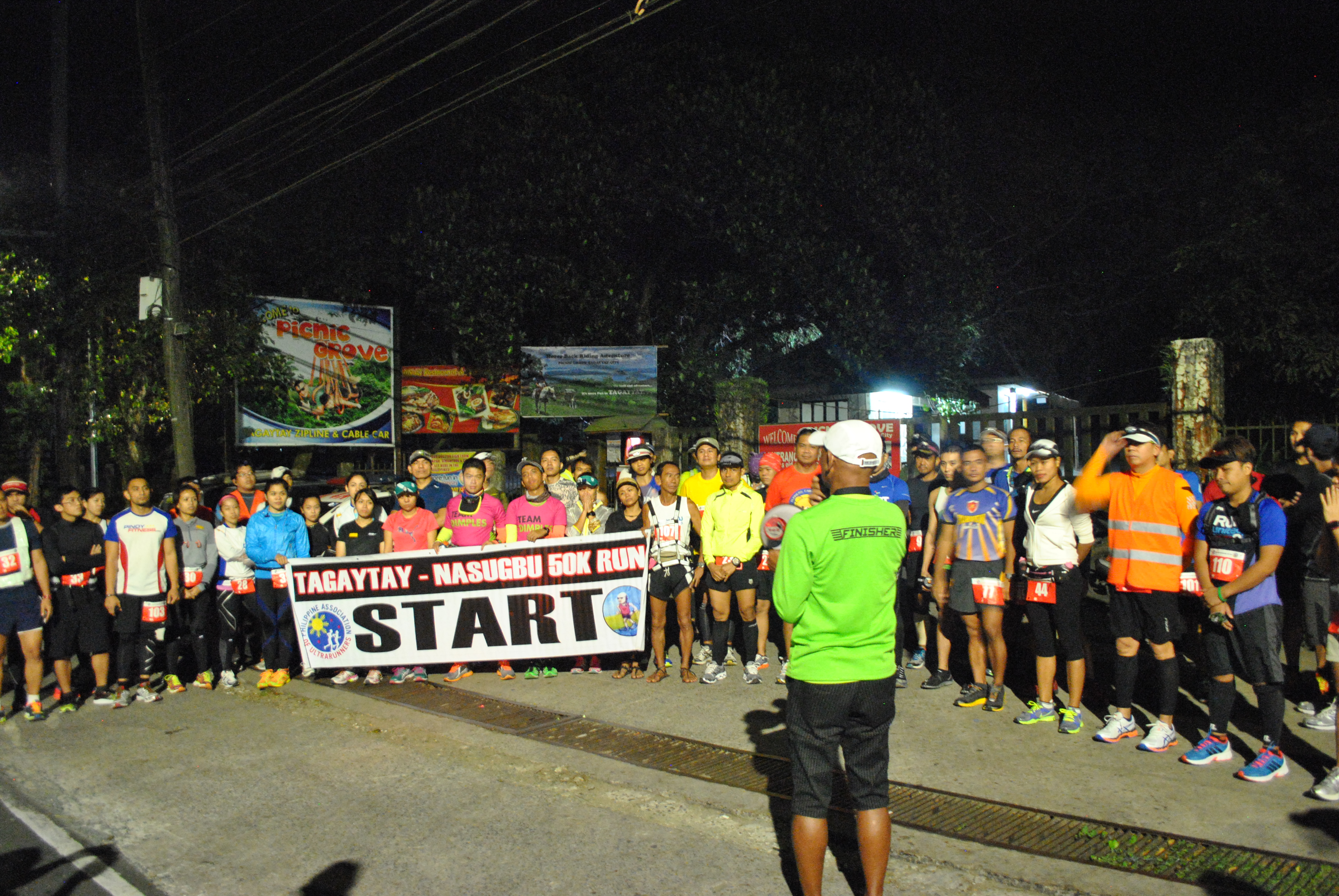
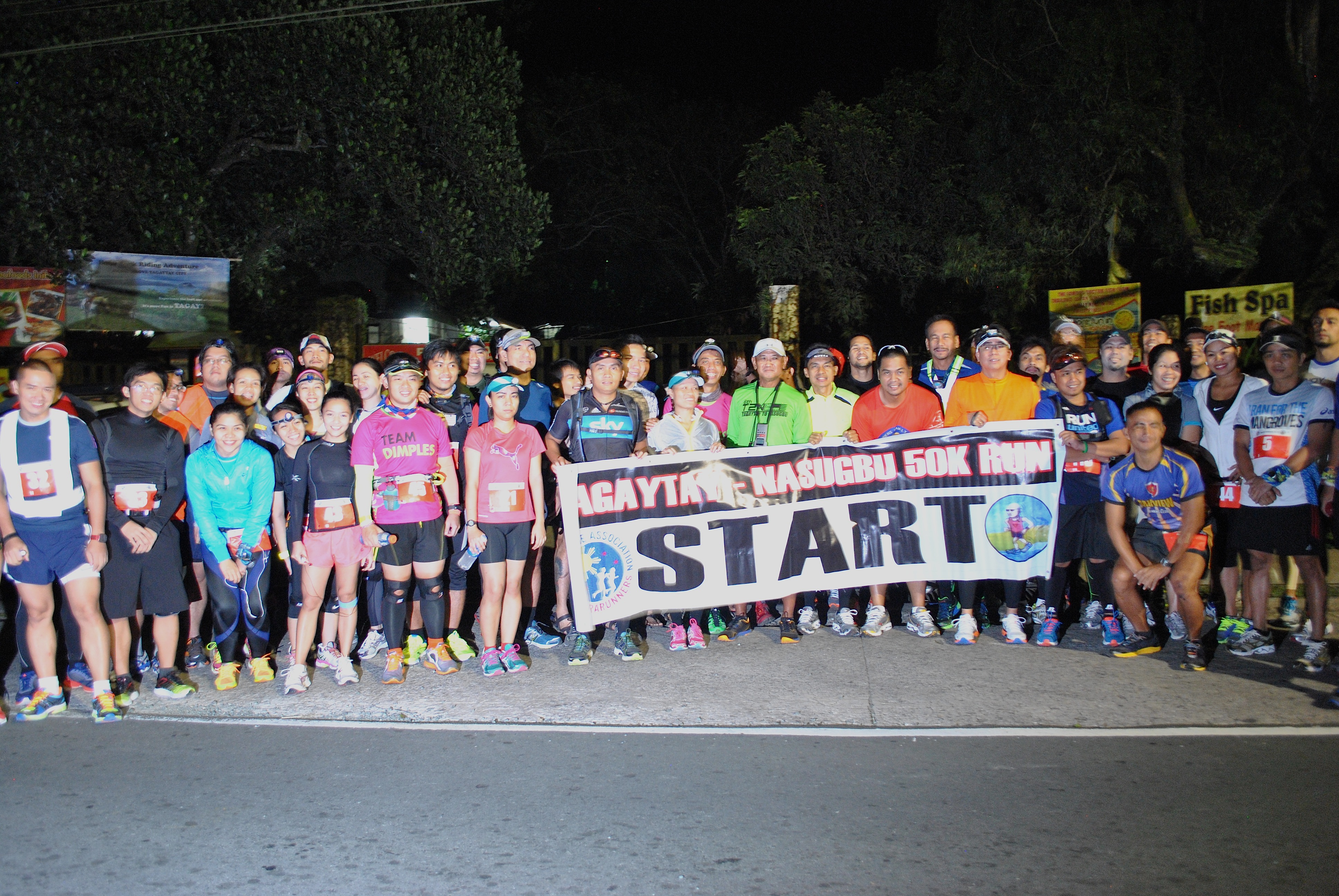
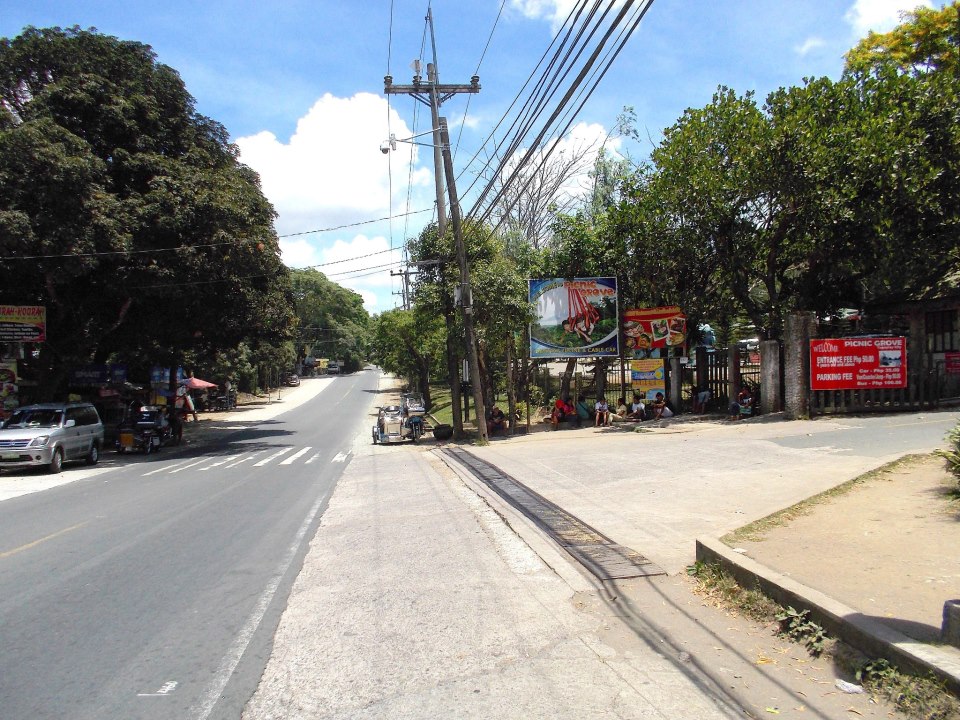
Starting Area: Picnic Grove, Tagaytay City

Finish Area: PETRON Gasoline Station, Nasugbu, Batangas

Number of Starters: 70

Number of Finishers: 69

Cut-Off Time: 9 Hours

Final Briefing Before Countdown
Group Picture Before Gunstart
1 Danin Arenzana (Champion, Overall) 4:00:21
2 Allan M. Dayao   (1st Runner Up, Overall) 4:25:44
3 Junrox Roque     (2nd Runner Up, Overall) 4:27:01
4 Enrique Sundiang 4:50:57
5 Laurencio “Lao” Ogerio 4:56:31
6 Joseph Philip James Morente 4:58:18
7 Mark Romero 5:05:56
8 Joseph Rebolledo 5:06:44
9 Lieza Valerio    (Champion, Female) 5:10:19
10 JoJi Salvador 5:23:40
11 Nina Ferando (1st Runner Up, Female) 5:28:57
12 Mark M. Hernandez 5:30:38
13 Gil Conanan 5:34:31
14 Gia Estrella (2nd Runner Up, Female) 5:44:18
15 Michael Paja 5:53:54
16 Jeffrey Poblete 5:55:07
17 Baly Anne Caluma (F) 5:57:11
18 Carl Balagot 5:57:19
19 Rey Laberinto 5:57:38
20 Mark Sigue 5:59:29
21 Irrol M. Novenario 5:59:43
22 Jonathan Averin 5:59:49
23 Kathleen Fresnido  (F) 6:00:27
24 Jesus Evangelista 6:03:34
25 Januarius Padilla 6:08:43
26 Kelvin dela Torre 6:11:21
27 Aileen Almirante (F) 6:15:12
28 Chill Orbegoso 6:17:37
29 Arnold Dungca 6:18:54
30 Cris De San Juan 6:19:06
31 Ian Francisco 6:19:29
32 Arnold Dagdag 6:20:45
33 April Jane Maisog   (F) 6:25:48
34 Jimmyjon R. Azul 6:37:29
35 Loradez Hanopol    (F) 6:38:03
36 Mark Enrick Hernandez 6:38:05
37 Mark Jaycobe Banatlao 6:40:29
38 Danny Añonuevo 6:47:47
39 Shelley Gayle Acdan   (F) 6:47:54
40 Ipe Macarenan 6:51:53
41 William Robert B. Hain 6:52:47
42 Ivan Peña 6:56:04
43 Jonathan Jan Lapuz 6:56:05
44 Allan Lanzon 6:56:09
45 Joel Baybay 6:58:31
46 Reymar Bawang 6:58:33
47 Adrian Bauto 6:59:41
48 Allan S. Bauto 7:01:15
49 RyannR. Sison 7:02:26
50 Gerson Yuson 7:02:59
51 Bryan Delen 7:03:53
52 Adrian Aquino 7:08:39
53 Jessica C. Tiu Laurel   (F) 7:09:38
54 Marc Adam Batino 7:14:19
55 Melvi Maalin (F) 7:14:55
56 Aureo Pascua 7:34:27
57 Allenstein Co 7:35:54
58 Mark Capistrano 7:35:56
59 Jojo Malolos 7:38:10
60 Katrina Alon-alon (F) 7:44:09
61 Christian Almendrala 7:44:37
62 Fraulein Mariano (F) 7:54:51
63 Michael H. Sastrillo 8:00:02
64 Barney Mamaril 8:06:59
65 Alexander Pineda 8:17:48
66 Anna Kathrina Paloma   (F) 8:19:07
67 E. Albert Abaca III 8:22:48
68 Gladysmay E. Pascua   (F) 8:31:05
69 Michael Pineda 8:51:34
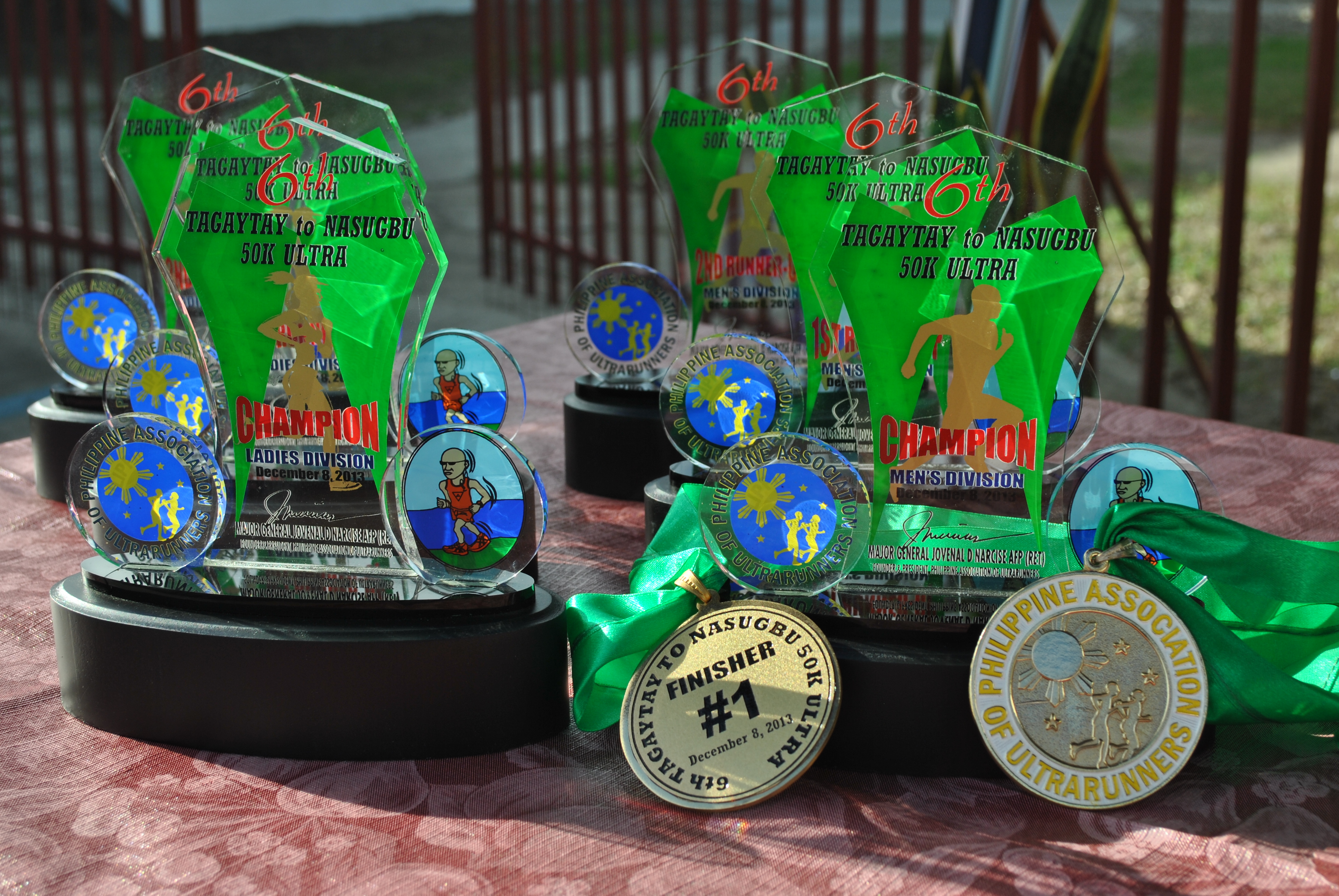
Trophies & Finisher's Medals
Trophies & Finisher’s Medals

Cash Prizes:

Overall Champion—-P 6,000

1st Runner-Up, Overall—-P 4,000

2nd Runner-Up, Overall—-P 2,000

3rd – 10th Places, Overall—-P 1,000 each

Lady Champion—-P 5,000

1st Runner-Up, Lady—-P 3,000

2nd Runner-Up, Lady—-P 2,000

3rd – 10th Places, Ladies—-P 1,000 each

Total Cash Prizes: P 36,000

Congratulations To All The Finishers!

Rules & Regulations For The 6th Tagaytay To Nasugbu (T2N) 50K Ultra Marathon Race


Guidelines/Rules & Regulations For The 6th T2N (Tagaytay to Nasugbu) 50K Ultra Marathon Race

Assembly & Starting Area
  1. This is a solo race. The race will start at 4:00 AM of Sunday, December 8, 2013 in front of the Picnic Grove (near the Development Academy of the Philippines) in Tagaytay City. The Finish Line of the race is at the PETRON Gas Station in Nasugbu, Batangas which is located One Kilometer before the Poblacion.
  2. The route of the race will follow the Highway from Tagaytay City to Nasugbu, Batangas. Runners will have to turn LEFT upon reaching the SHELL Gas Station at the intersection of Nasugbu and the Highway that goes to Matabungkay Beach Resort. Runners will have to run at least 500 meters before they turn-around and finally proceed to reach the Finish Line.
  3. Runners should bring with them their Registration Deposit Slip (BPI Deposit Slip) and submit it to the Secretariat/BR’s Staff before the start of the said race. Runners should be at the Assembly Area not later than 3:00 AM of December 8, 2013 for processing. All runners/starters shall be accounted at the Starting Area before the race will start.
  4. Runners are allowed to have their Support Vehicle & Crew but they are NOT allowed to have Pacers. Due to the absence of any Aid Station along the course, runners may run on “self-support” or “self-contained” making sure that they have an appropriate hydration system with them.
  5. Runners shall ALWAYS run or stay on the farthest LEFT side of the road facing the incoming traffic. Runners are advised to be extra vigilant on vehicles approaching on their FRONT and BACK. Vehicles overtaking other vehicles on your back have the tendency to get more space on the Left Lane of the Road. To be safe, run/stay on the farthest side of shoulder of the road.
  6. Runners shall ALWAYS run or stay on the farthest LEFT Side of the road on SINGLE FILE. We will be strict on this and we will warn any runner violating this rule before we declare DNF or disqualification in the said race.
  7. Support Vehicles must be able to “leap frog” their runners. It means that the Support Vehicle should be waiting for their runner at an appropriate distance ahead of the runner. Runners are NOT allowed to be “shadowed” by their Support Vehicle. Support Vehicle must cruise along the route at the prescribed Speed Limit of the Highway. Support Vehicles are NOT allowed to turn on their Hazard Lights while they are plying on the race course.
  8. Support Vehicles must ALWAYS park on the farthest RIGHT SIDE of the road/highway when waiting for their runner/s. Support Vehicles parked on the LEFT SIDE of the road will be a ground for the runner to be Disqualified.
  9. Runner are NOT allowed to get inside their Support Vehicle during the duration of the race. Support Crew can provide portable/collapsible chair for the runner outside the support vehicle which can be seen by other passing runners.
  10. Runners’ Bib Number should be pinned and displayed in front of the runner’s apparel. Bandits will NOT be allowed to run this event.
  11. Runners are highly encouraged to bring and wear with them their respective hydration system/belt during the race.
  12. Cut-off time of the event is nine (9) hours.

    Race Route & Elevation Profile
    Race Route & Elevation Profile
  13. Ipods, MP3s, and “wires” are allowed. However, users should be attentive and vigilant with their surroundings.
  14. Finishers within the prescribed cut-off time will receive a PAU Finisher’s Medal, Finisher’s Shirt, and Finisher’s Certificate (to be given later). Official result will be posted at www.baldrunner.com.
  15. Cash Prizes shall be awarded to Podium Finishers (Male & Female Categories) to include Trophies to the Top 3 in each of the categories. Cash Prizes shall depend on the number of registered runners. An amount P500.00 from the registration fee of each runner will be pooled as the source of the Cash Awards.
  16. All runners must wear the following mandatory equipment/accessory: headlight and reflectorized vest or shirt with reflectorized strips. It will be still dark during the start of the race and these items are needed for the safety of each of the runner.
  17. Corporate Logos are NOT allowed to be displayed on support vehicles. However, tarpaulins with the name of the running team/group is allowed to be displayed.
  18. Maintain the Integrity of the Race. Runners are “deputized” to report any suspicion of cheating in the race. The RD has the authority to declare disqualification to any runner before, during and after the race.
  19. Runners MUST be able to memorize their Race Bib Number. There will be Marshals who will be asking the runner’s bib number in the different Checkpoints along the route.
  20. In case of emergency or report of a DNF, a runner/support crew can contact Cell Phone # 0918-965-9895 through call or text message stating the runner’s location and nature of emergency/cause of DNF.
  21. Any infraction or violation of these guidelines/rules and regulations shall be dealt with accordingly and the RD shall immediately impose decision on such violation. The RD’s decision is FINAL.
  22. It is the responsibility of the runner to inform his/her support crew and driver about the rules and regulations of this event/race.
  23. The spirit of ultra running where runners are disciplined, honest, and caring /supportive to one another is highly encouraged. Remember to treat the other runners as your FRIENDS and SUPPORT to Finish the Race. The enemy lies within yourself and it is specifically located “in between your ears”.

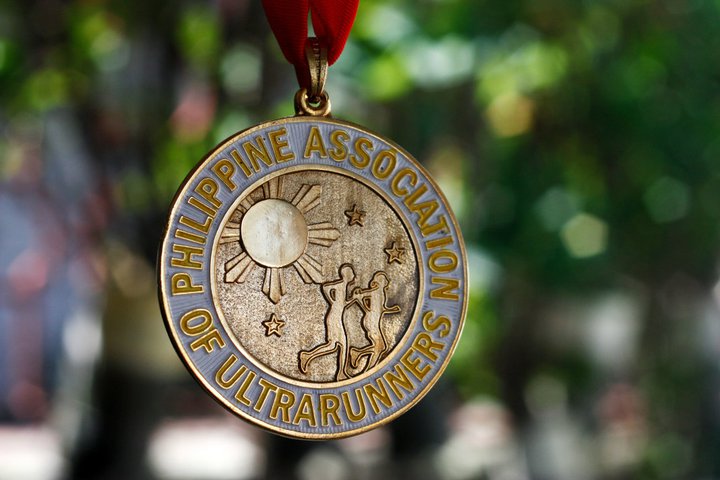
    PAU Finisher's Medal
    PAU Finisher’s Medal

Good luck and See You at The Starting Line.

Race Report On West Coast 200K Ultra Marathon Race By Bobby Go


The 2013 West Coast 200-Km Ultra Marathon Race: A Special Kind Of Hurt By Bobby Go
WC200-1

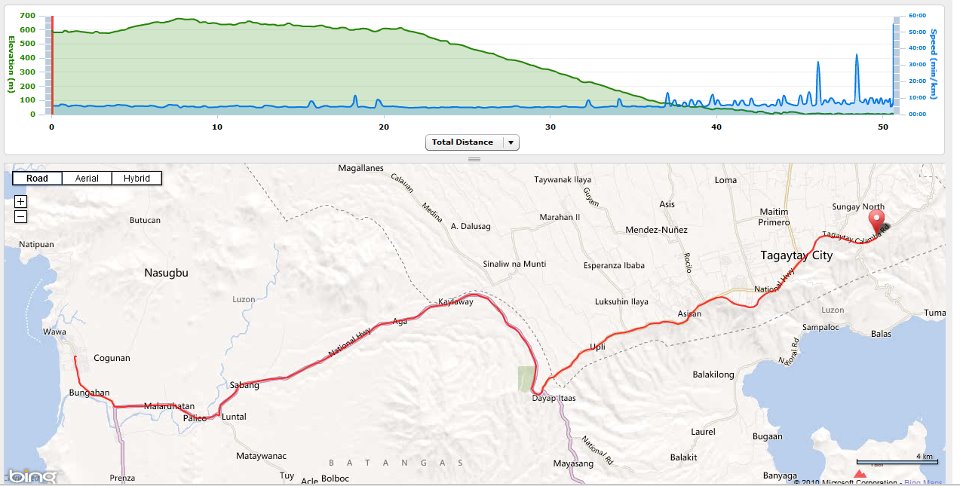
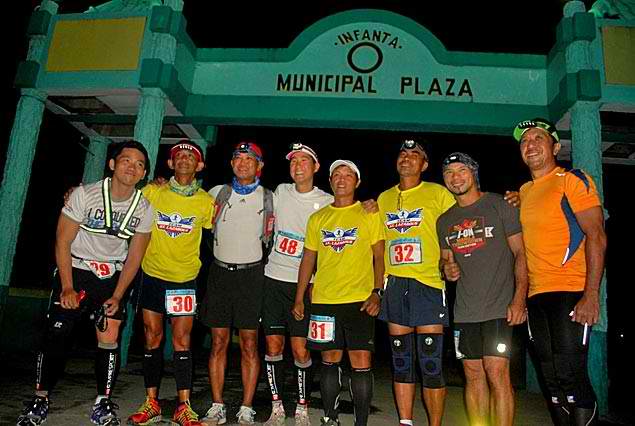
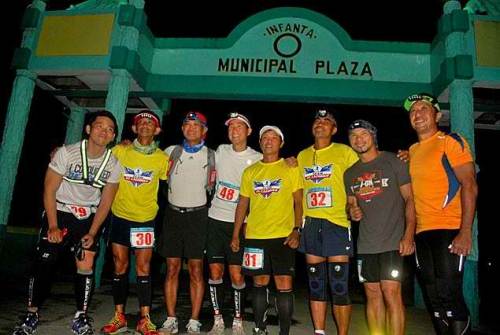
The multi-stage participants of the 2nd West Coast 200Km assemble for a group picture (from left to right): Carlito, Edwin, Race Director Jovie Narcise, Me, Bong, Ruben V, Merwin and Ruben H.

BOOKENDED holidays have become commonplace in the last few years – quite a treat for students and slackers, and for endurance junkies who crave additional training and/or racing days – but obvious productivity killers for companies looking for some momentum. I suppose there’s some pretzel logic in declaring special holidays that give the working class a rest, the retail and tourism industry a boost, and netizens even more time to stream/surf/chat without fear of retribution. Extended weekends are ideal for races that require more preparation or time to conduct or complete.

Enter the ultra marathon.

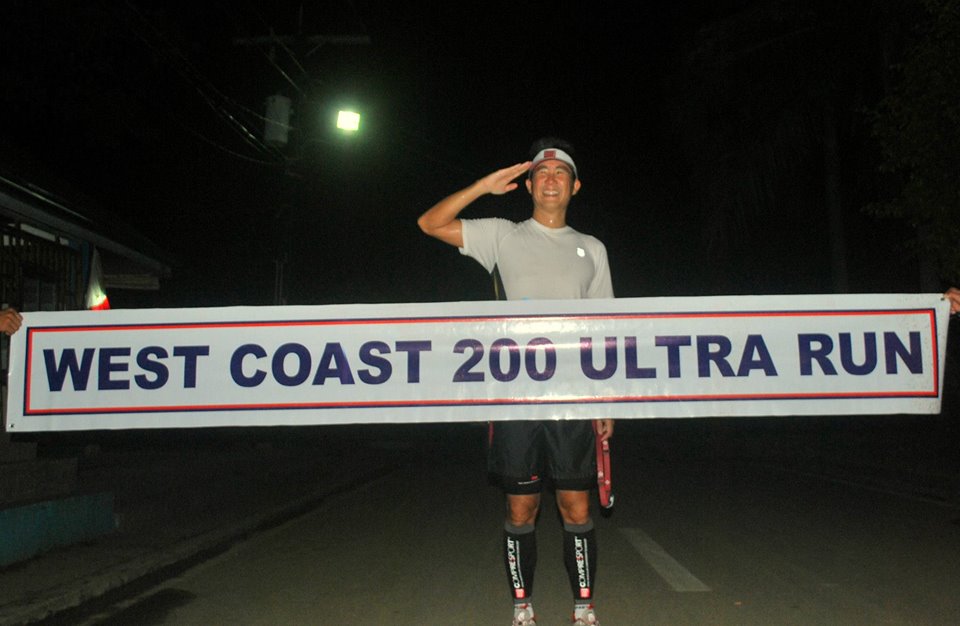
I decided to join the second West Coast 200km Ultra Marathon (WC 200, for short), after completing the Bataan Death March 160km Ultra Marathon in January early this year.  A few friends had joined the previous year’s multi-stage race, and the stories they shared were enough to convince me to hit the road, which spreads the 200-kilometer course over three days; each day with a different cut-off time, and a total cut-off time of 36 hours. This year’s edition of the WC 200 would feature an additional format, the single-stage race, with the same starting date and time as the existing multi-stage race. The single-stage calls for a continuous start-to-finish run with a cut-off of 48 hours.
WC200-2

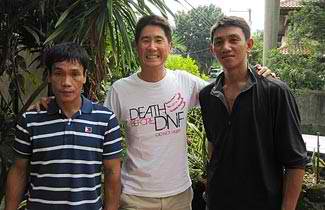
Bobby with his support team, Rey and Jilbert

With a race calendar that hasn’t let up, the challenge lay in physically preparing for a distance that was unlike any I had ever done, but one that I was mentally prepared to do.  Okay, one of two wasn’t so bad when I thought about it; and since my training program included weekends comprised of a long ride (120-140 km) on a Saturday followed by a long run (50-60 km) the following day, I had to admit that was preparation enough. Still, there was THE distance to cover come race day. In the end, my longest run (technically, it wasn’t a run, since I utilized a run-walk strategy that I planned to employ for all three race days) was 50 kilometers done on a hot and humid Sunday morning in October. I felt fine throughout that long slow distance (LSD, to running folk) and practiced my nutrition/hydration plan to make sure I would sustain my energy levels throughout the duration of each run day.

Day One: Subic to Botolan

With a 5 a.m. gun start, there was little chance I was going to get any sleep if I was making the trip from Manila to Subic; so I decided on a relaxed dinner at home with the family and watched some television while waiting for midnight. Two light snacks before leaving and upon reaching Subic, and I was filled, chilled, and ready to toe the start line for another amazing road journey.
WC200-3

What surprised me the most at the beginning of the race was the number of single-stage entrants: there were 44 brave souls who signed up. In sharp contrast, only eight, myself included, were listed for the multi-stage run. Apparently, the number of deranged ultra-runners had grown considerably and this inequitable ratio between single-stagers and multi-stagers was a clear indication. Some of my friends doing the single stage were even trying to convince me to ‘upgrade’ and join them, justifying their choice as less painful since it will be one, continuous expedition into agony instead of three, when compared to the multi-stage.

At gun start, the herd made two loops around the Remy track oval and proceeded onto the road leading to the exit gate.  From there, we followed a gradual climb up the still-dark road leading into town, running against an oncoming traffic of trucks, tricycles, and assorted passenger vehicles with our trusty support vehicles leap-frogging us to agreed points/distances ahead. Daylight began to break just as I reached the bottom of the rolling route, as the rapidly illuminating sky bathed me with more confidence to pick up my pace.

Stay with the (run-walk) plan, I had to remind myself, each time I got passed by a fellow runner during the walk portion of the interval. The temptation to run and not give up the lead was never a factor when I was training — but, of course, since there was no one else running with me. I had/have always viewed this attitude (of not giving up the lead) as ‘more of a guy thing.’ From my personal observation during fun runs, triathlons, duathlons, and marathons, male competitors do not savor the idea of being passed (at least at the beginning of a race) by: a) females; b) fat people; and c) old(er) people. I wasn’t about to fall into this mindset. I had fallen for it in the early years of active competition, until I realized that just trying to keep up with Sheila, Tubby, or Grandpa Moses did nothing but wear me out or make me look really stupid – often, both.

Everything went well, and though I began to experience a little fatigue past Km 50, my spirits were buoyed by the smiles and waves of the friendly town folk, and the urging of the other runners who passed me or whom I passed. At around Km 55, a small support team from the local government handed me an energy drink and a banana, which I gratefully accepted. While engaging them in small talk about the weather, one of the team mentioned that I was probably the sixth overall runner who had reached their station.  Sixth, I asked in a skeptical tone, totally unaware of my place in the standings. Yes, came the reply, we didn’t count any more than five since you arrived. Talk about morale boosters. Learning that I was even among the top 10 that day would have been reward enough, but this was over the top. And I most certainly did not expect it.

I ran-walked with more lightness in my step and strangely, with more ease. My standing would not change anything, and I didn’t bother to ever look behind me to see if anyone was catching up. I ran-walked until I reached the municipal arch of Botolan, just as a gentle rain began to fall (which developed into a heavy downpour as my support team and I rode off in search of our quarters for the night). The race director greeted me with a handshake and recommended I get out of the rain soonest for rest and recovery.

My team of two (Jilbert and Rey) and I found a modest hotel five kilometers away, which featured a three story walk up to reach the reception area, perfect for ultra marathoners who had just run more hours than a normal workday. After a quick check-in at around four in the afternoon, we drove to the nearest fast food place for our first solid meal for the day. We had dinner at yet another quick service joint three hours later and retired for the night, as we would be up roughly eight hours later for another 5 a.m. gun start.

Day Two:  Botolan to Infanta

Waking at half past three from a surprisingly restful sleep, there was more than enough time to do a bit of stretching and loosening up in between bites of my take home siopao and sips of my 3-in-1 coffee. Big breakfasts before runs never work for me, and for another 70 km of running, I chose to ‘eat as needed’ since this has always been my nutrition strategy. We got to the start area to find the other participants sitting around engaged in casual conversation.

After taking a seat on the curb and snacking on a couple of pieces of freshly baked pan de sal, I learned that the lone female runner, Jean, would not be joining the rest of us due to an ankle injury sustained the day before. We were down to seven, and with that feeble number of participants, it made sense (to me, at least) to acquaint myself with everyone with whom I would share the same road. After a short briefing by the race director and a couple of photos, we began our second leg running single file towards a crisp and cool Saturday morning that promised more adventure and surprise than the day before.
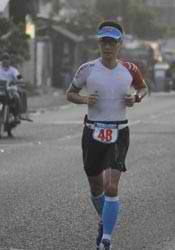
WC200-4

Except for a little soreness here and there, I felt generally good during the first 15 or so kilometers. And just as it had been the previous days, I fell behind from most of the group because of my chosen strategy, but managed to catch up after nearing the 30 km point. However, before even reaching my scheduled extended stop at 35 km, I had to deal with a couple of issues that would plague me throughout the rest of the day: one was a urinary tract problem which carried over from the day before; the other was an impending bout of plantar fasciitis (PF) that was a result (I think) of switching from my preferred minimalist shoes to neutral shoes. I had never experienced PF, and though I’ve always been one to embrace first-time experiences, this didn’t qualify as one I was looking forward to adding to my ‘top 10 list of best experiences in a race.’

So aside from feeling the urge to go every half hour and expelling nothing more than a trickle, the sensation of having my right foot perpetually pinched in a vise with every other step made the rest of the run sheer torture. This second day also brought changes in the weather that went from breezy to sweltering, and shifting from a cloudless, scorching day to one heavy drencher. By the time I tinkled on the side of the road for the nth time, my urine was coffee-colored and this pushed me to reassess my hydration strategy.

Together with Jilbert who diligently took notes on my hydration and nutrition throughout the run, I had judiciously monitored my hydration, making sure that I had generous sips of water, buko, and energy drink every 1.5 to 2 kilometers – so I couldn’t be dehydrated. I wasn’t at all dizzy or disoriented, even under the extreme heat that accompanied me most of the way. Instead of mulling over a change in strategy and telling anyone (including my support, who was in constant contact with the missus via text messaging) about my java-tinted discharge, I remained focused on getting through to the finish despite this minor distraction.

The pain in my right foot continued to hound me and I took more than the planned walking rest breaks in between runs, hoping to ease the pressure on my aching arch. I had lost quite a lot of time with the extended breaks and decided to try something else: make a run for it. I picked up my feet and ran at a faster clip, ignoring the invisible metal jaws that clamped hard on either side of my right foot. I managed to pass two fellow participants, and kept my pace until I felt I had put in enough time to compensate for all the walking that came before. But the unrelenting twinge kept up the pressure and my run ground to a halt as I reached a town center undergoing major roadwork. Here, I pulled to the side and sat myself on a store bench, removed my shoes, and massaged my sore arch, wishing I had the magical hands of a reflexologist who might have the means to alleviate this nagging pain.

By the time I tried to have a wee again, there came a better flow, but this time with a red tinge. Whoa! I am definitely not telling anyone about this. Yet. Let me survive this and I’ll have a good story to tell. My mind insisted that something wasn’t consistent with my conventional knowledge of dehydration, so I kept on. I did take more fluids with each swig of my water bottles, but that was about it. The road still looked straight to me, and I didn’t feel like I was running on clouds, although I wish I did. My next pee stop half an hour later couldn’t have made me happier:  An extended, steady, and clear stream of fluid that could probably fool anyone into drinking it, had I discharged it into a plastic bottle of mineral water. That development perked me up, and left me lighter by a few ounces, as I pushed forward with just the aching arch of my right foot and blisters on both feet to contend with.

One important lesson I learned during this second leg: Never ask for directions involving distance. Sure, you can ask about the nearest gas station or where the police outpost is, since that’s a basic ‘go left at the first corner then turn right when you reach the end of the street’ kind of response that you’re bound to get. But under no circumstance should you ever ask how far they are. I learned that people have such disparate perceptions of distance that one man’s inch is another man’s kilometer. And I learned never to ask this when you think you’re near your destination. The previous day’s experience should have clued me in already – I had asked a couple of people along the course how far the municipal center (read: the finish) was, and the estimates they provided got me believing that I would get to there by the time I finished crooning My Way. Little did I know that I would have to sing all the versions of the song before I reached the arc of the municipal building.

Battered and nearly broken by the agony of the feet, I knew the end of this run day would leave me ruminating whether or not I would survive the third day. Since I chose to bear the plantar pain fest through most of the run, the payback came swiftly when I crossed the finish and got into the support vehicle. My feet and legs were so banged up, I was supremely tempted to actually take a pain killer. Worse, we still had to find a place to stay, and it took us close to an hour to find the only decent hotel for miles. By the time I settled into my room and had taken a cold shower (no hot water here, folks), I seriously considered the possibility of dropping out of the next day’s race if I couldn’t repair myself in time. Even walking up and down the two flights of steps from the lobby to my room was agonizing.

Of course, that bloody urine episode couldn’t be ignored so I did the most sensible thing anyone would have done: I Googled the damn thing.

Hematuria. That’s the medical term for my scarlet seeping. The Mayo Clinic reference page I pulled up cites strenuous exercise as a possible cause, and proposes ‘It’s not quite clear why exercise causes gross hematuria. It may be trauma to the bladder, dehydration or the breakdown of red blood cells that occurs with sustained aerobic exercise. Runners are most often affected, although almost any athlete can develop visible urinary bleeding after an intense workout.’ It also listed urinary tract infection, kidney disease, and cancer as other causes. Just my luck. But I was over that adventure, and had to focus on the task at hand:  rest, repair, recover, and run again.

I had take out barbeque chicken with extra rice for dinner, which seemed to disappear in seconds the moment I plopped down on my bed to eat. What followed was a series of hot compress treatment for my blisters, gliding my foot on the foot roller for my plantar, and intimate quad and hamstring crushing passes over the foam roller. This sequence went on for a while; at least until I felt my dinner was halfway through my digestive tract. Then it was lights out, and the utmost wish that the next day would bring better things, like a brand new pair of legs and feet.

Day Three:  Infanta to Alaminos

I awoke to the sound of my neighbors/co-participants bantering on the porch just outside our second floor corridor. They sounded like they were in much better shape than I was.  My legs were better rested, but my feet still hurt, though not as much. Propping them up on the foam roller and wearing full leg compression while I slept helped push the pooled blood back toward my ticker. I wasn’t perfect, but I was better. Save for breakfast at the hotel dining area, I spent practically the entire day in my room, running through the same hot compress-foot roller-foam roller routine, napping a bit in between, then starting over.  Of course there were the text messages, Face Time, Instagram, and Facebook to keep me company. Two Facebook posts by the race director indicating my position as the race leader at the end of the second day put some pressure on me, though I chose not to think about it. I was exceedingly concerned about whether I would even finish the run.

And as I continued to apply more hot compresses and skim my arch over the foot roller, I felt the blisters shrink to a manageable size, while the vise that gripped the sides of my foot seemed to ease. Lunch was barbeque chicken again, with mandarin oranges for dessert, and a mid-afternoon snack of cup noodles. By late afternoon, my feet, which were my biggest concern, were not as sore. My confidence began to grow as I prepared my race must-haves and laid out my (tadah!) outfit of the day. Dinner was barbeque pork for a change, and I kept it light, knowing I would be eating constantly during the run, as evening runs, without fail, always bring out hunger pangs more often than daytime runs.

‘Bobby, where are you?’ read the text message from the race director (RD). My support and I were still en route to the start area, which was about 5 km away. Jolted by mild panic, I texted back ‘Isn’t gun start at nine yet, sir?’ hoping that I heard correctly the previous days. Turns out there was a footnote to the scheduled gun start:  If all participants are assembled earlier, the race can begin before the pre-announced time. Profuse with apologies toward the RD and my co-participants, I took my place among The Magnificent Seven in a semi-circle huddled around the RD as he gave us final tips and directions on navigating the third and final run. Oh, and he announced as well that I had an eleven minute lead going into this last leg. Mantra for the moment: I will not be pressured.

Minutes before nine o’clock, Edwin, Bong, Ruben V, Carlito, Merwin, Ruben H, and I set out into the enveloping darkness of a nippy Sunday evening, eager to notch this last leg with composure and add a new chapter to our respective endurance race histories. Edwin, Bong, and Ruben V took off faster than you could say ‘Alaminos’ and were not to be seen or heard of until much later. I ‘middled’ it and stayed with my run-walk interval plan, aiming to allay my plantar woes the best I could. The beginning of my run went smoothly, until I got to my third interval, where the road started to climb towards the ebony evening sky. The hurt was back, and there was no denying it would be there for the rest of the fifty or so clicks left to cover. I thought it best to try to ignore the pain and take advantage of the cool weather.

You’re going to be surprised at your pace on the last leg. Jonel, he of the ‘no frills, all thrills’ ultra road and trail races, texted me that prophetic message earlier that day. As I shuffled my way up the dark, desolate road, I secretly hoped that the surprise would be a positive one; that we would all somehow run faster than the previous days even on tired legs and worn-out bodies.

I can’t quite explain what really happened as I crossed somewhere between Km 20 and 21.  Second wind. Being in the zone. Total focus. Perhaps I wanted to finish with aplomb, or maybe my body just finally said “F—k it, if we’re going to finish, we’re going to finish strong.” Whatever it was, the plantar fasciitis that was dogging me since the previous day turned from painful to numb, enabling me to clock my fastest pace — and uphill at that. I’d never seen the course before, and running uphill at night can somehow take the edge off because of two basic factors: one, the cooler ambient temperature, and two, the perceived (or unperceived) degree of the incline. As far as the latter was concerned, I later described the gradient and running up it to my cycling teammates as akin to our bike rides up Amadeo, the Cavite municipality just before Tagaytay city, which features a series of long gradual climbs interspersed with short, rolling hills — except that you did this on foot.
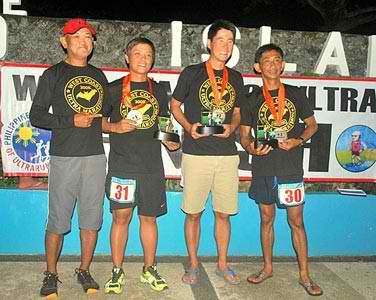
WC200-5

Jilbert and Rey were surprised that I wasn’t stopping as often for hydration and nutrition as the previous days, despite the inclined course; so I told them that the cooperative weather had a lot to do with it. And it did. Aside from the cool temperature, the heavens were filled with stars and littered with wisps of clouds, inspiring enough to make me break into song.  Okay, so I sang Don McClean’s ‘Vincent’ in its entirety at the top of my lungs — but if a tree falls in the forest with no one to hear it, does it make a sound?

Apart from the hostile dogs that seemed to work in packs, calling out to the next group ahead as if to say ‘He’s coming your way. Get him!’ the only other unfriendly critters we met along the course were a couple of drunkards packing wooden clubs (dos for dos, in the vernacular) who had threatened to use Bong for hitting practice. As Rey (Muay Thai practitioner) and Jilbert (trained in hand-to-hand combat) alighted from our support vehicle, Wino No. 1 hastily retreated into the darkness while Wino No. 2 sat meek and unarmed on the side rails. Bong was relieved that the cavalry had arrived, since he had been held up for some time in that spot, unable to pass. Bong and I ran and walked side by side for about three intervals before he excused himself and continued running, quietly disappearing into the night as I continued to walk whenever my watch signaled it was time to recover.

As I reached Km 50, I couldn’t help but look back at the events of the previous days, and how contrasting my thoughts and feelings were at the end of each race day. I had roughly eight more kilometers to go (since the earlier stages featured distances over the declared 70 km/day), and I knew this race was in the bag. I was talking to myself and humming songs, excitedly telling Jilbert and Rey at each hydration stop that the finish line was close and that we could all finally eat a decent meal.

This was my best day. I wish I had the pictures to prove it, because I was practically smiling throughout the run. I was grateful for the opportunity to race such an incredible distance, thankful for having decided to join the race, and thoroughly satisfied at the way things had turned out, difficulties and all.

The thing about these types of races is that even before you’ve reached the finish line, you’re already thinking about the next race (you want to do). I remember dismissing any possibility of doing races with distances exceeding this one. But that was just before I started the WC 200. It’s a totally different story now.

Sometimes, all you need is a leap of faith — and once you take it, there’ll be less than 200 kilometers left to cover.
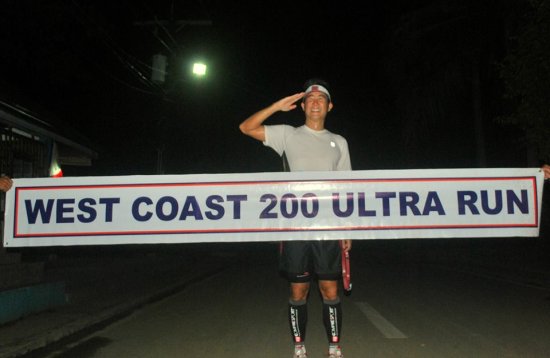
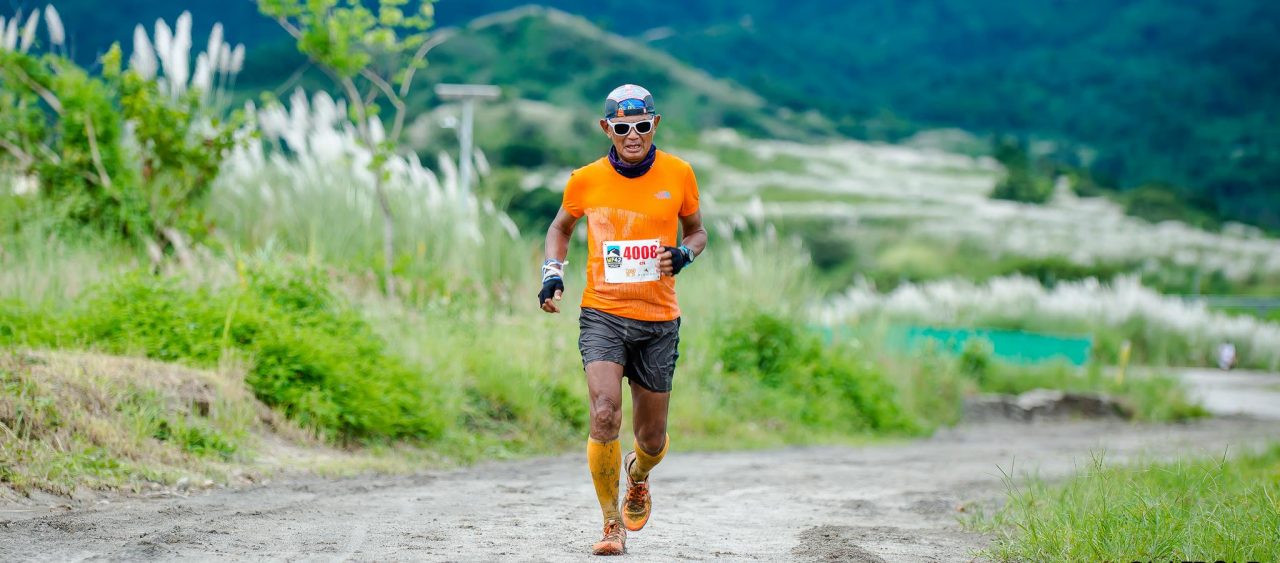
WC200-6

“Purist”


What is the problem with some of the people watching movies in movie theaters? They go to the movies to eat their snacks; tinker with their cellphones; do some conversation and talking with their friends while the movie is playing; or worst, they are there to simply sleep.

In terms of watching movies in movie theaters, I am a “purist”. The bonus for me is that I am free to watch any movies within the city/place where I reside in Metro Manila being a Senior Citizen. I don’t bring any food or drinks inside the theater. I just simply relax on my seat and concentrate my sight and hearing on the screen and enjoy the movie. I guess, this defines what is a “purist” for somebody who would watch a movie.
I am not a camper who goes out to the mountains and spend a day or two on its peak and my understanding is that one goes to the mountain to enjoy the outdoors and spend some time with nature—-breath some clean air; enjoy the challenge of carrying one’s pack/tent and provisions on top of the mountain; dip oneself to a water pool; enjoy the beauty of sunrise, nighttime, and sunset; enjoy the scenery; and to simply enjoy the simplicity of being away from the city. I could say that a camper is “purist” if he or she does all these and simply enjoy the beauty of nature and the serenity of being alone in the mountains.

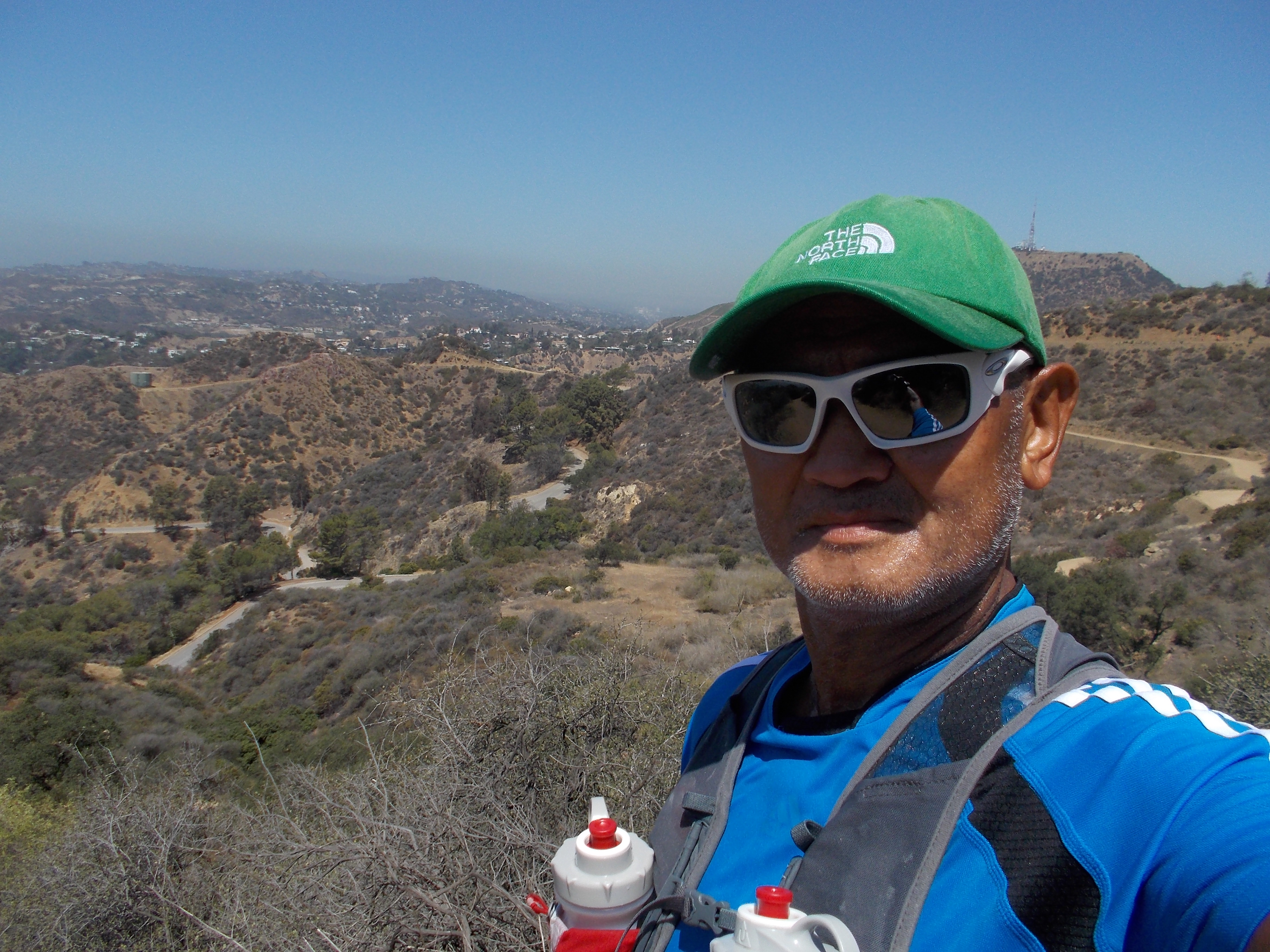
For an ultra trail runner to where I am drifting to be identified, I simply go the nearest mountain and follow its trails by running or hiking. Equipped with reliable trail shoes and hydration vest/bottles, I could run to where the trails would lead me and after one hour of running, I would retrace back to where I’ve started and my running workout for the day is done. I think this is the “purist” way that I can describe in trail running.

I Love The Mountains!