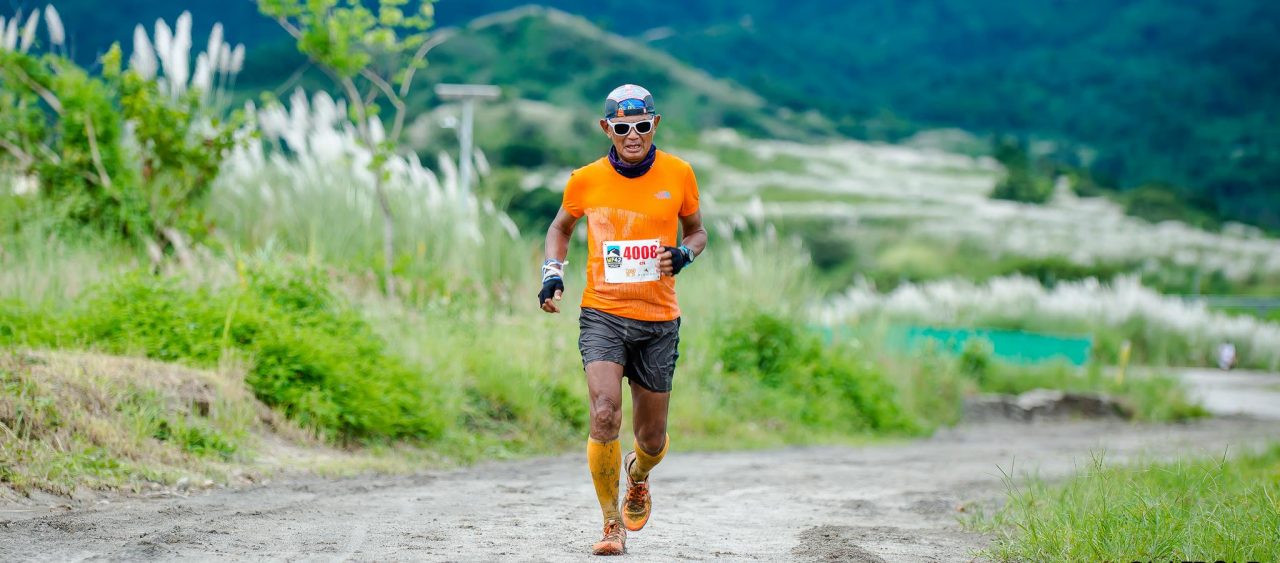
It was only last month, April, that RUNRIO Events had announced the conduct of the Galaxy Manila Marathon 42K where the route runs along the famous EDSA Avenue in Metro Manila on June 12, 2026. It came a surprise to the old and new runners about the course where it became a viral issue on Social Media that a running event will be held on the most congested traffic road in Metro Manila.
Nevertheless, runners immediately registered to join the Full Marathon Event that it eventually reached to a record number of 6,000 plus runners of registered runners.
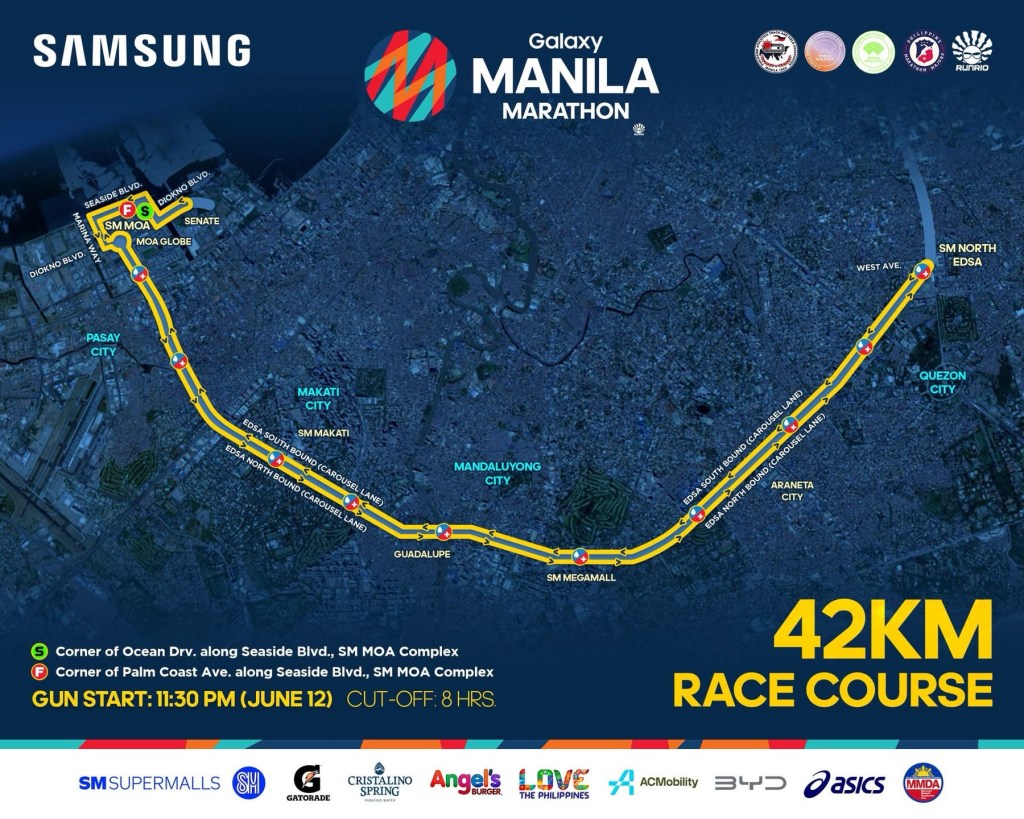
The race course takes the runners from SM Mall Of Asia (MOA) to SM North EDSA and then back to SM MOA. The runners will specifically run along the existing Bus Lane which is the innermost (left) lane along EDSA. Very exciting and promising move to use EDSA as a Marathon Route.
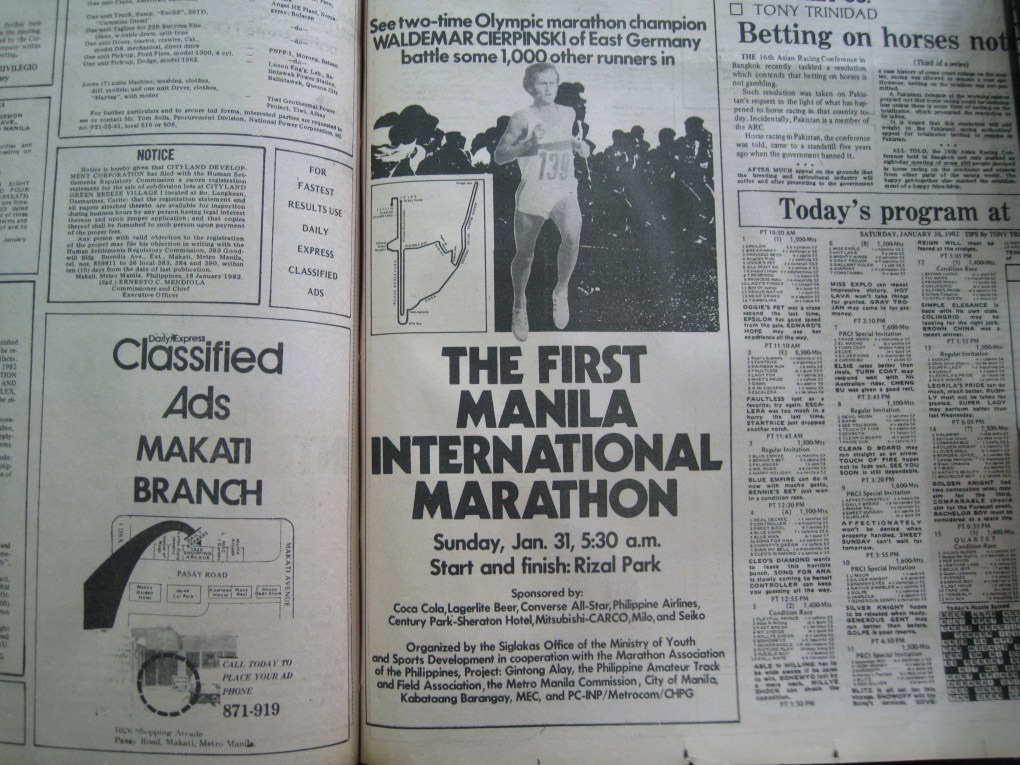
Whoever thought of this route is, I think, a runner who knows the running history in the country! It was in January 31, 1982 during the First Metro Manila International Marathon that EDSA was part of the Marathon Course from Ayala Avenue crossing EDSA to the turn-around point at EDSA crossing Ortigas Avenue and back to the Quirino Grandstand in Luneta Park. (Note: This event was organized then by the Ministry of Youth & Sports Development). Using EDSA as part of a running event had never been repeated since then. After 44 years, it is happening again with a longer and more challenging distance and elevation.
These are my thoughts about the event:
- SM MOA To SM NORTH EDSA: Obviously, when a well-known and one of the richest companies that drives the economy of the whole country puts its hands to a sports event where most of its citizens can participate, anything is possible! The collaboration between SM Malls and Samsung has made this year’s event possible. Samsung of South Korea had been a regular sponsor of the then discontinued Pasig River Heritage Marathon in the late 80s and early 90s contributing at least Five Million Pesos in every year to the Pasig River Rehabilitation Project. The route and the event promote SM Malls and Samsung Galaxy Smart Phones as an advertisement but every runner in this event will be proud to “flex” on Social Media and proud to have ran along EDSA! Who knows when this event will be repeated again?
- Cut-Off-Time: The cut-of-time is 8 hours. For a well-trained average runner to finish a Marathon, he/she could finish in 4-5 hours. For a competitive runner, he/she could finish in less than 4 hours. Finishing a Marathon is not a walk in the park! However, if a walk-jog-walk strategy will be applied, even a “newbie” runner could finish this race. With my age of 74, I think I could finish it within the cut-of-time of 8 hours. My last marathon at the LA Marathon in 2023 without proper training resulted me to finish it in 7:10+ hours with lots of rests and walks due to cramping after running for 12 miles.
- Schedule Of Race: The race starts at 11:00 PM of June 12, Friday (Public Holiday/Philippines Independence Day) and ends at 7:00 AM of June 13, Saturday. During this period, “long weekend”, there will be a reduction and lesser traffic along the route. By the time the last runner reaches the Finish Line, the traffic at EDSA will be starting to build-up which is good and it will be Saturday morning that makes it with lesser traffic. The nighttime period of running will be advantageous to the runners because of the cooler temperature. But the month of June is always the start of the Rainy Season in the country. I predict that there will be some rains and cooler winds during the event.
- Official Holiday: If there is a Public Holiday earlier than June 12, it would be better. However, when the 1982 First Metro Manila International Marathon Race was held on January 31, 1982 with EDSA as part of the course, it was a Sunday and it started at 5:30 AM in the morning and finished at 11:30 AM. Less traffic then but runners were tough with the heat of the sun later in the morning and with a tighter Cut-Of Time! (Note: That is the big difference between the runners then and today’s runners)
- Overpass & Uphill Challenges: I have yet to see a GPX File on the Elevation Profile of the route. Runners nowadays ask for this file from the Race Directors/Organizers. Before, runners don’t ask for this, they just want to finish the race and eventually record their own Personal Best Time. Having personally had run/walked some sections of the route and also had driven my car the whole route, I can visualize the uphills and downhills of the course. The following will be uphill challenges from Start to Finish: (a) Magallanes Overpass; (b) Uphill to Ayala Avenue if runners will not take the Ayala Underpass; (c) Uphill after the Ayala Underpass if runners will be running into the underpass; (d) Uphill climb after Estrella towards Guadalupe; (e) Uphill climb from the Guadalupe bridge to Pioneer Street; (f) Short uphill from the Shaw Avenue Underpass to SM Megamall; (g) Uphill Climb at Ortigas Overpass; (h) Uphill climb at Santolan Overpass; (i) Uphill Climb from Santolan Overpass to P. Tuazon Avenue; (j) Uphill Climb in Cubao’s E. Rodriguez Underpass to Nepa-Q Mart; (k) Kamuning Overpass; (l) and then towards the uphill climb at the Quezon Boulevard Overpass. On the way back, the same uphill climbs will be a lot of challenge to the runners. But runners will rewarded with the same downhills after the uphills.
- This could be the Hardest Marathon Race in the World (?). In the 1st Metro Manila International Marathon on January 31, 1982, Olympic Marathon Gold Medalist (1976 & 1970) Valdemar Cierpinski of East Germany won with a record time of 2:14:27 hours which is up to this time the “All Comers” Best Time in the country’s Marathon Race. No Pinoy Elite Marathon Runner has ever broken this record in any of the local Marathon Events. (Note: Another Blog Post or story will be made on the Pinoy Runners who broke the National Marathon Finish Time in the 2026 Tokyo Marathon). I predict that the Pinoy who will finish first in this event will not be faster than 2:30:00 hours. Well, I will accept bets on this prediction.
I had been making comments and suggestions on Social Media that this is a Run-Walk or Jog-Walk-Jog event for the average and beginner runners which is I think the smartest plan and strategy to finish this race. With the number of uphills along the course, it is advisable to power walk the uphills and then run or jog the downhills. With this strategy, the running muscles will be able to rest and relax while walking. And while walking, take advantage of this time to hydrate and take your gels or fuel food. Even with the presence of Aid Stations, you can still maintain the run-walk-run strategy. Don’t stay long at the Aid Stations. Just grab some water and some food and ingest them while on the move.
I even suggested in my comments that for the whole month of May for runners to incorporate “hill repeats” twice a week in their training and more long runs during the weekends. Take one day as rest/recover day every week.
If not for an international trip commitment which was scheduled in the early months (January-February) of this year with the same schedule of this event, I could easily get a slot to join this event from RUNRIO. I will be monitoring the updates through the Social Media or just wait for the Official Podium Results. So, I just can only wish every runner of this historic event (Marathon along EDSA) to have a good luck and healthy strong finish in this race. This experience will be priceless.
Always remember, start slow on the first half and then slowly speed up on the last half towards the finish line. Cheers!
Hoping and praying that there will be a Second Edition of this event!

