This project was conceived to help and guide the runners who applied to participate in the 2011 Bataan Death March 102K (BDM 102) Ultramarathon Race. The lectures consisted of experiences and tips of past Finishers of the race to include their Support Crew. These lectures were conducted twice a month at the Philippine Army Officers Clubhouse on Friday evenings, from 6:30 to 7:30.
First Lecture: History of BDM & History of the Race
The first lecture was conducted last October 1, 2010 at the Philippine Army Officers Clubhouse by the Race Director/Bald Runner with emphasis on the appreciation of the history and significance of the Bataan Death March as one of the infamous events in the history of warfare, specifically, the Second World War. It is in this event that human lives paid a heavy price on the dastardly acts perpetrated by the conquerors/invaders to the defeated defenders of Bataan. A total of almost 20,000 Filipino soldiers, militias, and American soldiers died on the said Death March from Mariveles, Bataan to San Fernando, Pampanga; “jampacked” like sardines in box carts on a train from San Fernando, Pampanga to Capas, Tarlac; and then ultimately marched/walked for another 11 kilometers until they reached the Camp O’Donnell as their Prisoner’s Concentration Camp. The march and the train trip covered an approximate distance of 151 kilometers. In three weeks, all the surrendered combined forces of the Philippines and the United States were finally brought to their final destination, Prisoners Concentration Camp at Camp O’Donnell.
In the advent on the popularity of ultramarathon races in other countries, I conceived the idea of transforming the Bataan Death March as an ultramarathon race where runners would compete with each other in order to commemorate the heroic deeds and the sacrifices offered by the casualties and survivors in the Bataan Death March in the name of patriotism and defence of the country from invaders. “Bataan Death March” is being used in other countries in marathon and ultramarathon races to commemorate the survivors of such countries but they are done not in the original place where history happened. While the Philippines is not commemorating such historical event as a competitive running event, an opportunity was established and created. Thus, BDM 102 was born as a sacred event to commemorate our past heroes and at the same time, a way to test one’s endurance and explore one’s physical and mental limits through running.
Second Lecture: Experience & “Tips” From A Top Finisher & Support Crew
Gene Olvis, 4th Place Finisher in the 2010 BDM 102 & 31st Finisher in the 2009 BDM 102, shared his training and preparation in his two editions of BDM 102. He shared also his experiences during these two editions of the race. He admitted that he was not 100% prepared on the first edition as he was not aware of any training program for an ultramarathon distance. Everything was an experiment for him to gain experience on the first edition. However, with the advice from a Filipino ultrarunner living in the US, Ben Gaetos, he was able to train properly for the second edition. In his preparation for the second edition, he started “hard” training at least 6 months before race with emphasis on “back-to-back” LSD runs during weekends. He also incorporated his hydration and nutrition strategies on these LSD runs which he followed strictly during race day. His commitment to his training program earned him a 4th Place in this year’s BDM 102. He also advised the audience to eat solid foods during the race which had been tested and eaten during his “back-to-back” LSD runs.
Bea Hernandez, wife of Mark Hernandez (a finisher of 2nd BDM 102) and consistent Support crew to his husband in PAU races, shared her experiences and suggestions on what the support crew has to do to ensure a successful finish to her runner and the runners to be supported. Planning and Preparation are the keys to a coordinated action between the support crew and the runner. Hydration and Nutrition Needs of the runner should be well-organized and properly marked as to what point/Km post these are handed to the runner. At least, two ice chests/coolers are needed for each runner—-one cooler for the hydration needs and one cooler for purely ice cubes/blocks. PATIENCE is the basic and most important virtue of a support crew. In order to fight BOREDOM while waiting for the runner to arrive at the pre-designated point/s, find time to enjoy the company of other support crew and to enjoy the scenery of the route. A digital camera to record/document the views around and the company of friends is a MUST. Lastly, a support crew must be, at least, a runner so that she/he knows the pain and/or “sufferings” of his/her runner. Above all, a good communication between the support crew and the runner produces a successful result in such ultra road race.
Third Lecture: Experiences & “Tips” From A BDM “Veteran” On Apparel & Others; Strengthening Exercises For Ultramarathon Runners.
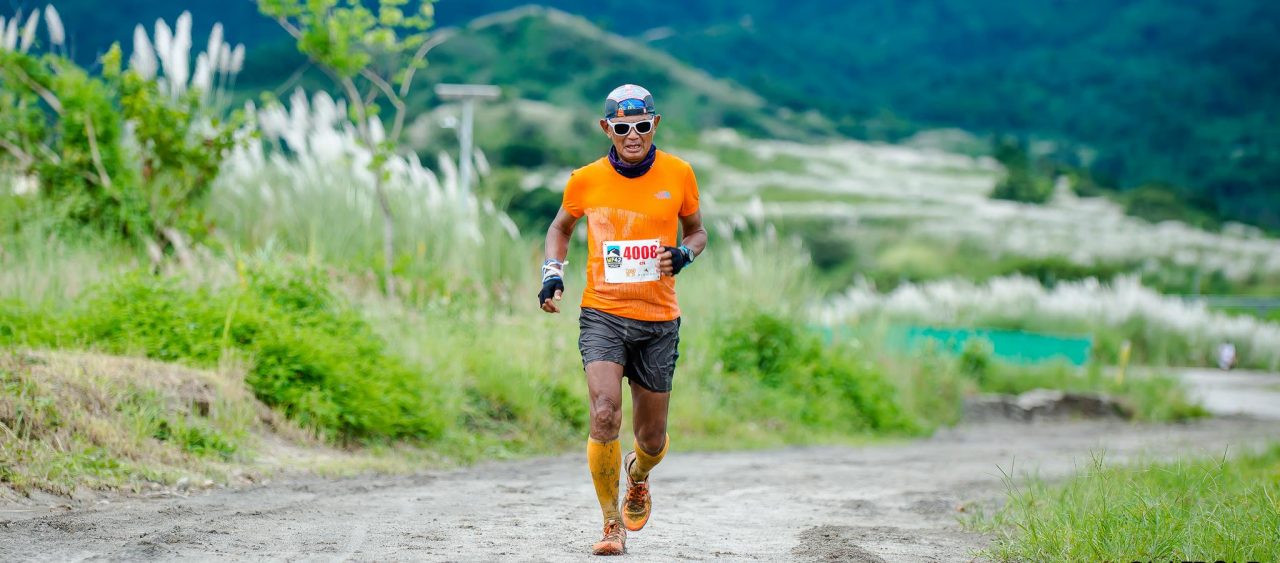
Jonel Mendoza, a “veteran” of BDM 102 and PAU Races, gave a tip on the apparel highly recommended for the BDM 102. He discussed the necessity of wearing a runner’s cap with an extended cape to cover the nape; loose long-sleeved technical shirt; loose running shorts; running socks; and shoes. Highly suggested color of apparel is white as it reflects the heat from the sun, rather than absorb it as all the runners will be exposed to the heat of the sun on extended period, if not, the whole day. Appropriate pictures of runners taken during the BDM Races were presented as examples. What is commendable in Jonel’s presentation is his step-by-step “first-aid” solution for foot blisters and also preventive measures to take to avoid such “problems” during the race. In Jonel’s experience for the past 2 editions of BDM 102, he made a comparison of what had happened during his first finish and his successful and better performance on the 2nd edition. In short, he learned a lot of lessons on his first experience and corrected them with a better preparation and training on the second edition.
Enrico Tocol is also a “veteran” of two BDM 102 Races and being a Professional Physical Trainer of Gold’s Gym, he presented a scientific approach on strengthening program which could highly assist the runner to finish a rigorous ultramarathon race. It is a MUST for an ultrarunner to strengthen his legs, arms, back and core with appropriate exercises with the aid of free weights and weight machines. He even discussed the number of repetitions, number of sets and suggested weight for a runner to lift and do. What I remembered from his lecture was the ability for a runner to lift lighter weights with higher repetitions just enough to strengthen the muscles and not to make them bigger and more “buffed”. He also mentioned the importance of periodization where the ultimate goal is to finish an important race with good results, whether a marathon or ultramarathon race, with the rest of the road races leading to your goal should be used as evaluation/assessment if your training is in the right direction.
Fourth Lecture: Experiences & “Tips” From Me as a Runner and Rules & Regulations of the Race
My lecture was a detailed presentation of my training; experiences & “tips”; nutrition & hydration strategy; and apparel during the 1st BDM 102. My race strategy was to maintain an even pace of 6:30-7:30 minutes per kilometer and incorporate walking breaks when I feel my leg muscles are in pain or about to have muscle cramps. Mental attitude (to finish the race) and positive thinking play a very important role to keep on pushing oneself towards the finish line. The “warrior” attitude came into play for me to finish the race to be considered as a credible “Founder and Race Director” of this ultramarathon race. Most of these detailed experiences were fully documented in my post in this blog after I finished the 1st BDM 102 last April 5, 2009. Rules and Regulations are the same with that of the previous editions, however, I emphasized again on the strict adherence to the Integrity of the Race.
Fifth & Last Lecture: Experiences & “Tips” From Atty Jon Lacanlale On His BDM 102 Races & Successful Finish at The Great North Walk (GNW) 100-Mile Endurance Run in Sydney, Australia last November 13-14, 2010.
The 5th and last BDM 102 lecture will be held this coming Friday (tomorrow), December 3, 2010 at the Philippine Army Officers Clubhouse at 6:30 PM. Applicants & Invited Runners to the BDM 102 and other Ultrarunners are invited to attend this lecture.
See you and Good Luck On Your Training!
 Bald Runner
You must be logged in to post a comment.