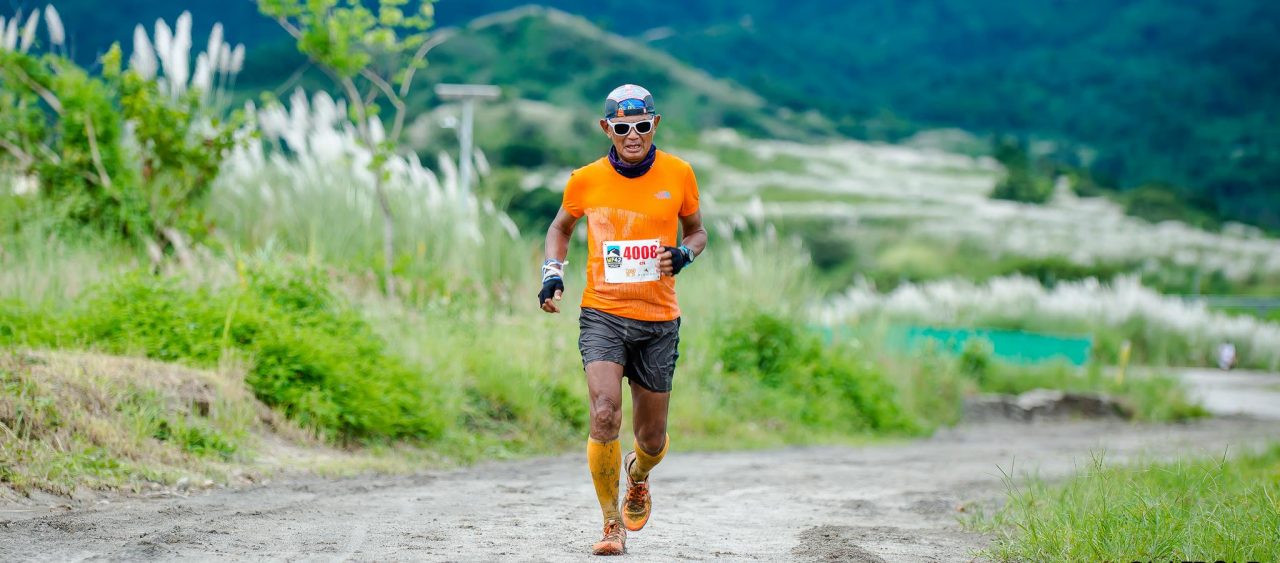
2012 BDM 102: Race Report By Peter Kennedy


Decision to Run

Back in September I wasn’t seeing any improvements in my 5 km/10 km times even though after three years in the Philippines I was fully acclimatised and my mileage was up at the 70 km level per week.  I knew I was leaving the Philippines in March and when I heard about the BDM 102 I thought that it would make a suitable climax to my running in the Philippines.

Race Preparation – Endurance and Speed

I wanted to do my best I could in the race, even though it was my first ever and possibly only ultra-marathon.  So I looked round for both a running coach and a nutrition coach.  I needed coaches who knew how to train someone for top-class ultra-marathon running and in Ige Lopez I found someone who is both an experienced ultra-marathon runner and coach.  He put me on a training schedule in three parts – 7 week build-up towards 100 km/week, 10 weeks of endurance/speed training which peaked at 160 km/week (including warm-up runs), and then one month tapering before the race.  The training was very varied – long slow runs at weekends reaching back-to-back 75/25 km runs, moderate-paced runs up to 21 km, sometimes with hill sessions or fast intervals, aerobic-paced runs on alternate weekdays and one rest day a week.  I was fortunate to avoid any injuries in training.  However if I had experienced the BDM course before the race, I would have realised that I needed to do a lot more hill work (Ige did hint this to me), but work and family commitments would have got in the way.  The highlight of this training was a 3 hours 20 minutes marathon in December.  The lowlight of the training were forgetting to take my hydration pack on one of my trips abroad, which disrupted the nutrition plan for my 60 km training run.

Nutrition

My nutrition coach Harvie de Baron was excited to take on the challenge of helping me with the BDM 102.  He has advised good athletes and those trying to lose weight before, but not someone doing an ultra-marathon who can’t gain weight.  In fact after a few weeks of additional healthy snacks (fruit, sports bars and milk) I gained 2 kilos which converted to additional muscle whilst my fat content remained very low at 5%.  This can be explained by my high metabolic rate, equivalent to that of a 12 year old!  The plan for the race was to get all my calories through liquid rather than food.  I opted for wearing a hydration backpack and taking frequent sips of isotonic drink, with short stops every ten km for an energy gel and extra water.  We slightly increased the concentration of isotonic drink to enable me to get 260 calories/hour.  I could also carry a phone, torch and spare headlamp in the hydration pack and I got used to carrying all this weight on my training runs.  Other key ingredients of the training were a protein recovery drink after all long runs and a weekly massage.

Gear

I decided to race in compression shorts and vest, much as the triathletes do, which avoided any chafing problems.  My GPS watch was essential to my training and the race itself, but I wore a second basic running watch as a backup just in case it failed me.

Life outside running

During the five and half months of ultra marathon training there wasn’t much of a life other than running and sleeping.  Moreover the demands of work as well as the training meant I often didn’t get enough sleep – but not starting work until the afternoon most days allowed me to catch up with sleep after the early morning runs.
The Race itself

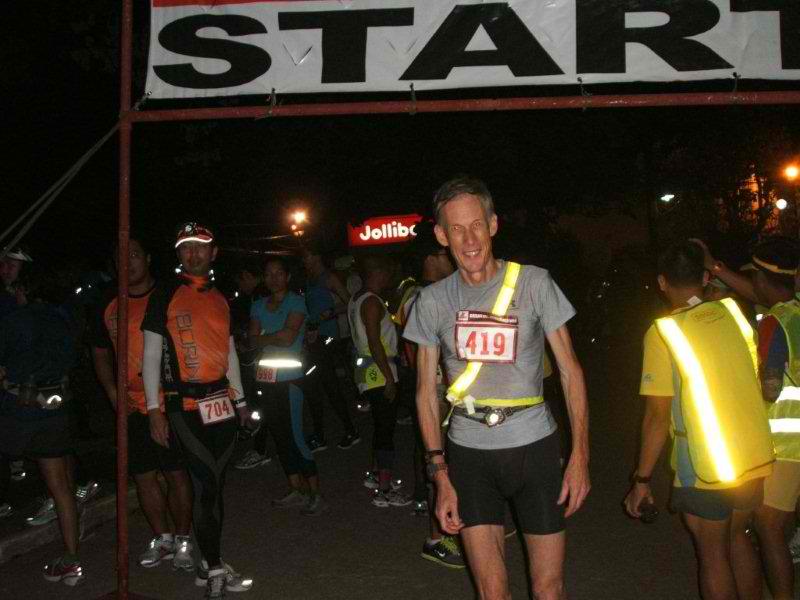
The gun went off promptly at 10:15 pm.  I immediately joined the leading group and was running comfortably at 4:30 mins/km pace!  I knew I had to slow down but somehow I kept up my pace on the long hill and even went into the lead for a few kilometres.  I arrived at my first drink refill stop after 12 km, five minutes ahead of schedule.  I knew then I blown the negative split strategy and it could lead to serious problems before the end of the race.   So after continuing quite fast downhill for the next ten kilometres, I eased back the pace considerably.  I got a bad shock when the 22 km marker for my next drink stop wasn’t in sight after 25 km and I lost five minutes making a phone call to the support team.  Jonnifer Lacanlale, the eventual winner, passed me at this point but I didn’t try to catch him.

All my drink stops every ten kilometres were under three minutes – the time it took me to swap drink packs on my back, and take an energy gel plus water, giving a total of 25 minutes of stops, which is probably less than most runners, even the other fast ones.  At the 42 km drink stop, I vomited due to the volume of liquid I was drinking but I was prepared for this – I just took another drink of water and set off without any delay.
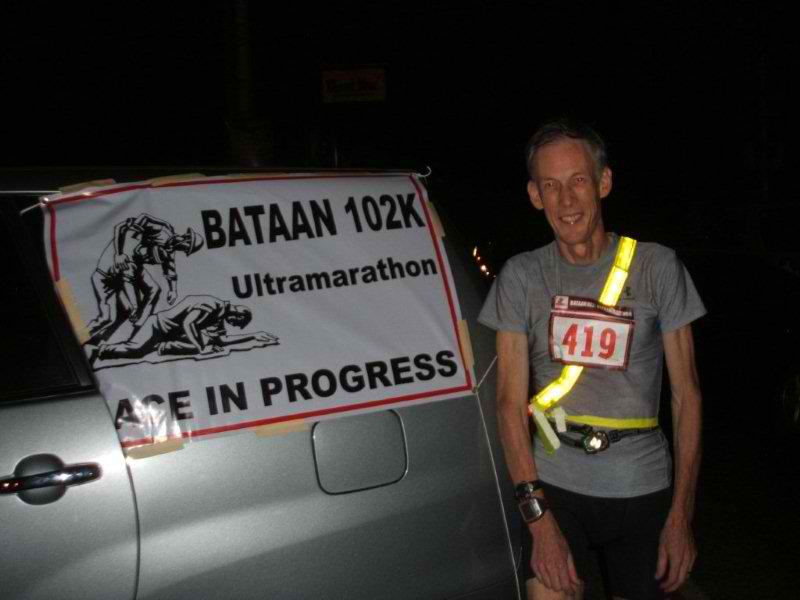
Running in the dark went well – it was not too hot; there was a full moon and there was a wide edge to the road so that I could easily dodge any oncoming trucks/buses that didn’t move out when approaching me.  The only near-miss occurred when a bus coming fast from behind on the wrong side of the road passed within two feet of me but most likely the driver had seen me because of my reflective strips.  This year there were no accidents in the race.

After 52 km I slowed down to below 6 mins/km and thereafter the pace was closer to 6:30 mins/km.  Each ten kilometres seemed never-ending because I could see from my watch how slowly I was running, but I kept focussed.  I had been due to change shoes and socks after 52 or 62 km, but I abandoned this idea since I didn’t feel any problems with my feet, which turned out well since the third place runner was only five minutes behind me at the finish.

After the half-way point, I was followed closely by another runner.  However at 82 kilometres he only walked on whilst I changed drink packs and then when I passed him again he dropped out of sight.  I heard afterwards that he finished in 15 hours which meant that he spent more than 6 hours on those last 15 kilometres which is a horrendous consequence of his going too fast at the beginning.

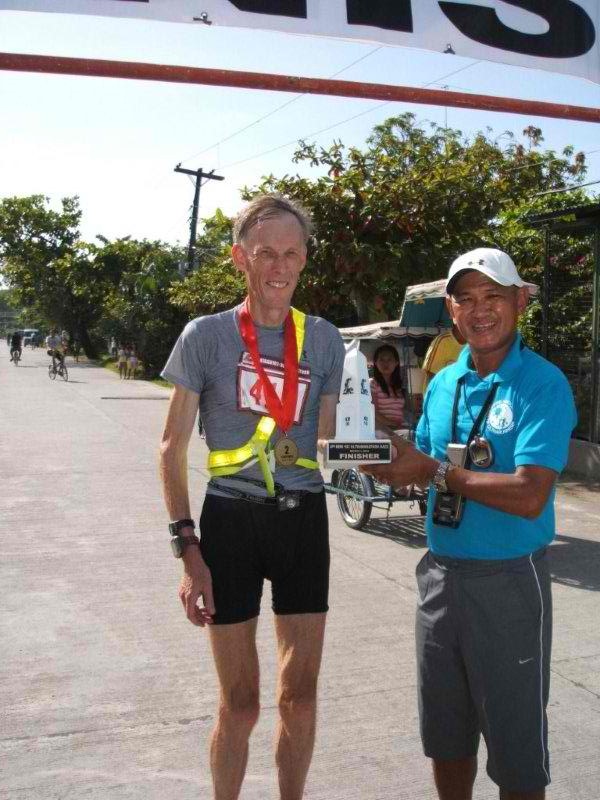
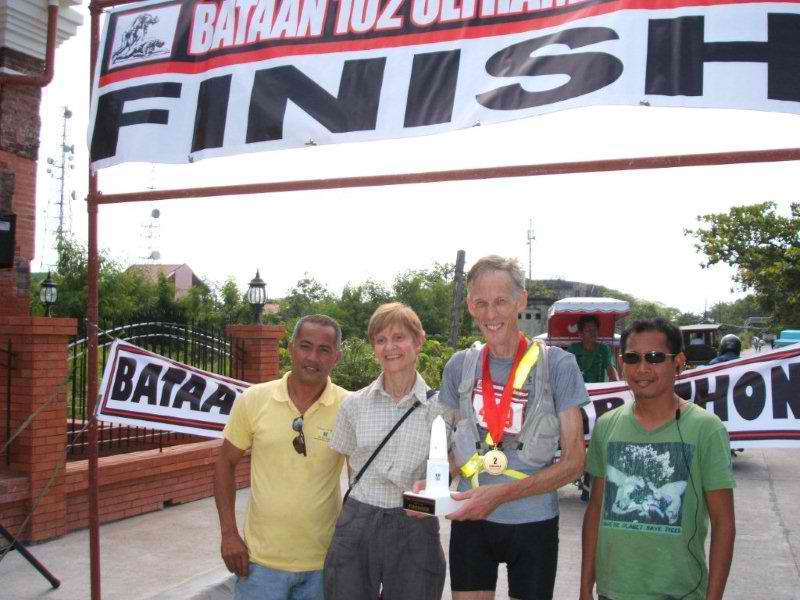
When dawn came I had reached 75 km, but I didn’t notice the heat until the last 10 km when I was running the very long straight road from Guagua to the finish.  At this point I couldn’t see anyone behind me and my final 10 km was done comfortably at 7:06 mins/km pace.  I crossed the finish line at precisely 9 am in a time of 10:44:56, which is an average running pace of 6:02 mins/km, and second place!

So the endurance training was a success but my pacing was a failure.  It was clear from my times in training that I could hope to run at 5:30 mins/km pace for the BDM, which when stops are added, would be a net 5:50 mins/km pace – within the course record.  I was well prepared for this, including many moderate pace runs at 4:30-5:00 mins/km and good practice at running negative splits.  Such times on largely flat roads probably gave me false hopes and the over-confidence in my speed that tapering brings plus the effect of running steeply uphill until 10 km was too much and I failed to follow my own race plan.
My overall liquid consumption was 150 ml/hour less than planned which is understandable in a night-time run.  This meant I only took in 220 calories/hour on average, which probably contributed to my slowing down in the second half of the race.  I didn’t make this risk clear to my support crew and so I never used the contingency plan of taking an energy gel every five kilometres instead of every ten to compensate.

Even if I hadn’t run too quickly at the beginning and everything else had gone according to plan, I am not sure I could have matched Jonnifer’s time without doing as much hill training as he did.

I very much appreciated the efforts of my support crew: my wife, our driver and one extra driver.  They ensured that I never missed them at a stop, checked I was crossing the road safely every time, re-filled my hydration packs in between stops, kept the stops to a minimum time and all this meant that they didn’t get any sleep either.
Reflections afterwards

Why did I do it? Were the long hours of training worthwhile? What’s next?

I run because it is easy to do and I am built for it, even though having the right running gear makes it an expensive sport.  I like the competitive nature of races and the thought of winning is a great spur for me to action.  I like the health benefits it brings – very high fitness level even at the age of 60, with not a day off work through illness in the last 10 years.  With no weight problems I can eat and drink what I like within reason.  Running also gives me extra energy for work which brings its own rewards as well.  So I see myself continuing to run for many years yet, competing against the world’s best runners in my age group.  The change from middle-distance running on the track in England to an ultra-marathon in the Philippines has been very enjoyable and I intend to vary my competitive programme going forward with a different focus some years to others.

I hope this account inspires more people of any age to change their lifestyle to include exercise and good diet and others to extend their running beyond the fun-run level right up to the challenge of doing a fast ultra-marathon.
 (Note: Peter Kennedy of Great Britain finished as the 1st Runner-Up with a time of 10:44:56 hours in the 2012 BDM 102)
Technicality


(Warning: This post is not meant to offend/embarass or question one’s running activity or capability. Whatever is written in this post is a personal opinion/impression of the writer)

When a runner says that he/she will run the entire Island of Luzon, that means, the runner starts in some place and continuously run the course with breaks like resting, eating, and sleeping along the way. After the runner’s break or pit stop, he/she would continue on the course. He/She repeats the process everyday until he/she reaches his/her destination. This is what I understand about what I call “adventure runs” or multi-day stage runs.

However, if a runner started somewhere in Luzon and then makes a “break” on his run by going to Manila to rest and visit his family, friends, and attend to his business or office, and then after a few days, he returns where he stopped and then resume his run, then this is not considered as a continuous run. I think this kind of practice or technicality is not what an ordinary runner would expect as the definition of an “adventure run”. If a runner started in Vigan City (Ilocos Sur) and plans to go around Luzon in a clockwise direction, he/she should be in the direction towards Ilocos Norte, then to the Cagayan Valley Provinces and so on and so forth. The runner does not need to go to Manila by bus, car, or airplane to take a rest for few days and then return again to where he stopped after his/her break somewhere else. An adventure run is a continuous journey from Point A to Point B or from the Starting to the Finish Area!

Let me tell you about my experience. On my first day of the West Coast 200 (Subic Freeport to Alaminos, Pangasinan), I was unluckily bitten by a dog in San Narciso, Zambales, a 40-kilometer distance from where I started. Because I wanted an immediate medical attention from people whom I know, I had to immediately go back to Manila. After 3 weeks of treatment, I continued my adventure run, not from the place where I stopped (San Narciso, Zambales) but from the place I started (Remy Field, Subic Freeport). It’s common sense!

I heard and read from news accounts that a lady Pinoy runner ran across America but at some point along the way, she had some injury and decided to go back to where she started (Los Angeles) for her to be treated and be able to rest. After few weeks, she recovered from her injury and she went back from where she stopped and resumed her run. She declared herself to have ran across America. If I am going to follow my impression and understanding about “adventure runs”, the runner is disqualified for the feat.

My good friend, retired Police Director Sam Tucay and his running buddy priest, had been running along the Maharlika Highway (from Aparri, Cagayan to Jolo, Sulo) for the past months with a commendable advocacy with the PNP and the civilian sector but there are instances that I see them in Metro Manila and I have the belief that they are having their running “breaks” in Metro Manila. This practice is considered as technicality in giving the impression to the public that these two persons have been continously running around the country with the much-needed breaks along the route (but in reality, they are having their running breaks in Metro Manila).

For a runner who declares himself to be running around the globe, he/she should be running from one country to another. Not for the runner to run in one country and then goes back to his home country for a week or two to rest and then fly out to the next adjoining country to continue his run around the globe.

I sincerely salute and respect our local adventure runner, Father Amado “Picx” Picardal, who is a “no-nonsense” and honest runner who had been keeping and posting his daily experiences in his adventure runs in his blog. This is the guy who really deserves to be the best example of an adventure runner. You can browse his running diary in his adventure runs at his blog at www.amadopicardal.blogspot.com.

The bottom line in an adventure run is an strict observance of integrity and transparency!

Please feel free to post your comment/s and impressions about such technicality in adventure runs or multi-day stage runs.

See you at the Starting Line.

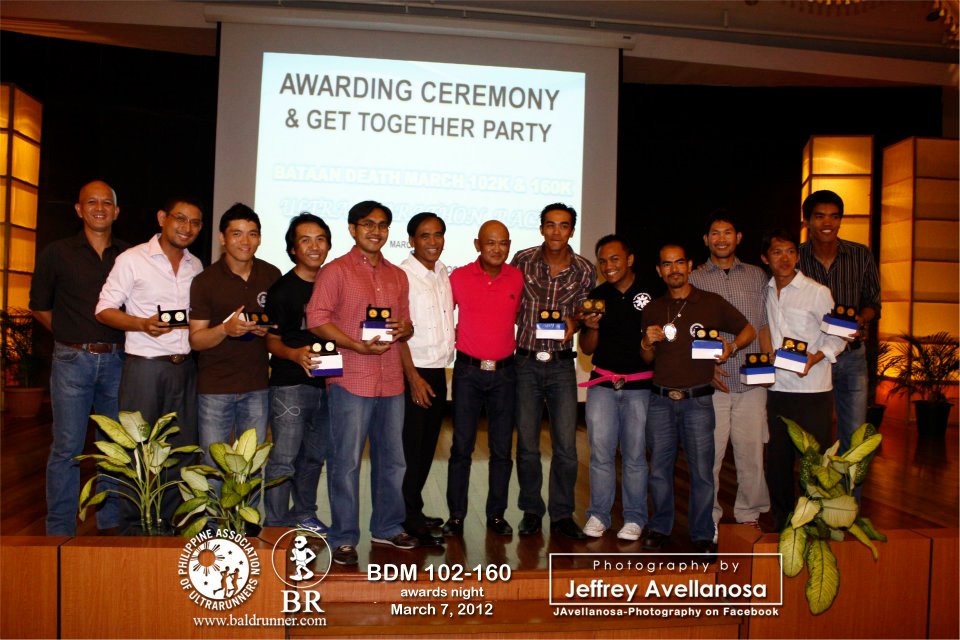
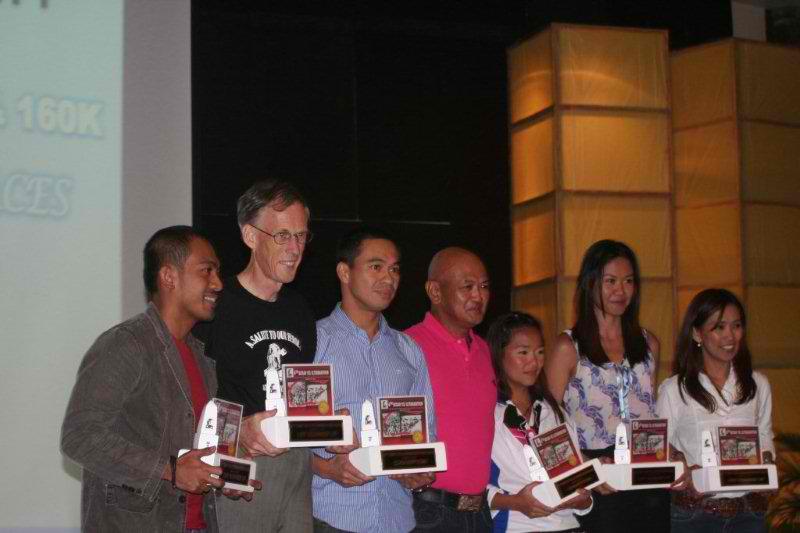
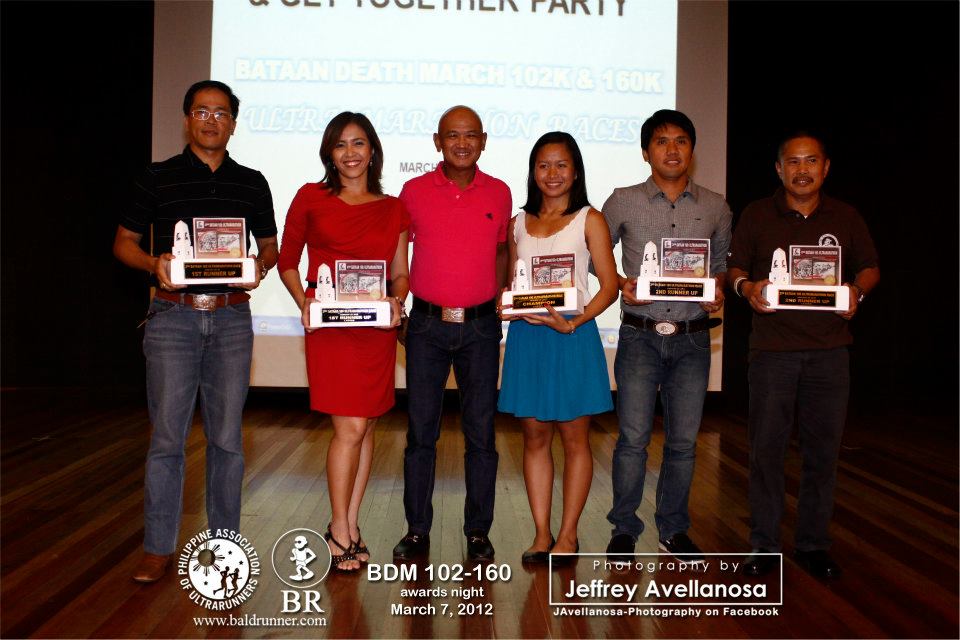
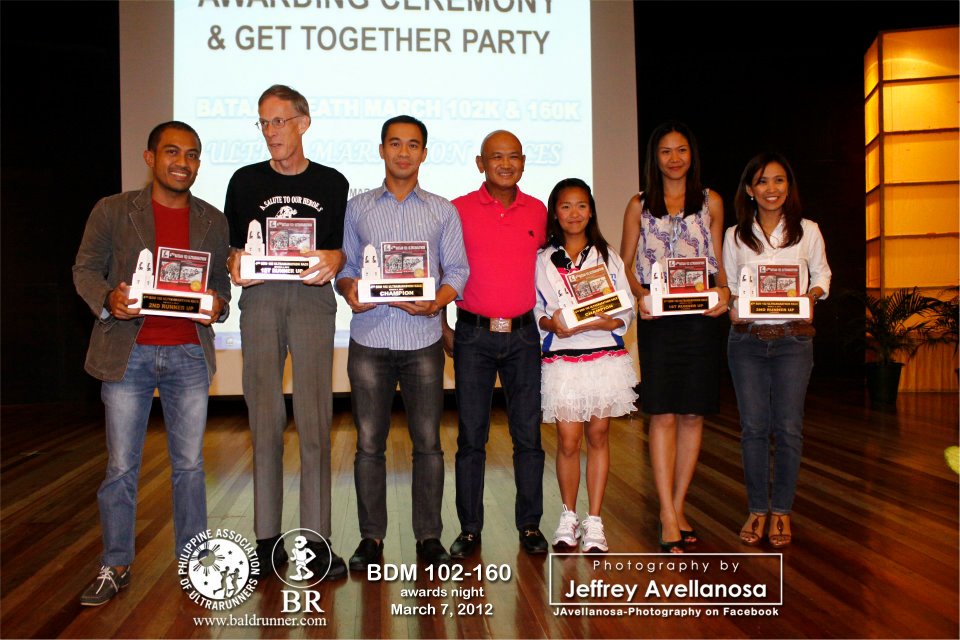
2012 BDM Ultras’ Podium Finishers


2012 BDM 160K Ultra Marathon Podium Finishers


2012 BDM 102K Ultra Marathon Podium Finishers


2012 BDM 160K & 102K Ultra Marathon “Grand Slam” Awardees (Dindo Diaz, not in the picture)

Congratulations, Ultrarunners!

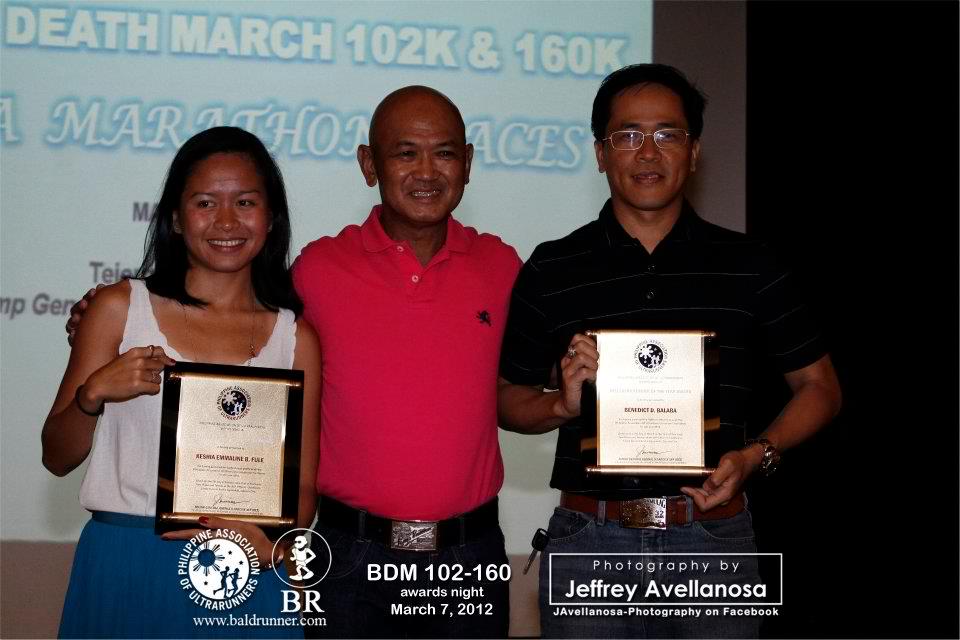
2011 Ultrarunner of the Year Awardees


2011 Philippine Association of Ultrarunners’ (PAU) Runners of the Year Awardees: Dick Balaba & Keshia Fule

WC 200: The Last Day


September 23-24, 2011: From Santa Cruz, Zambales To Alaminos, Pangasinan

After running for two days and having covered a total distance of 140 kilometers, I was already thinking of quitting from my adventure run and tried to pack up my things.

Once I woke up from a cheap hotel in Alaminos, Pangasinan on my third day, I decided to visit the Provincial Governor of Pangasinan in Lingayen, Pangasinan and gave him the Plaque of Appreciattion that I prepared in behalf of his support in the conduct of the PAU Bolinao to Sual 65K Run. After the Plaque of Appreciation was handed to him, I was still thinking if I will continue with my adventure run or not.

At Sual's Zigzag View Before Early Dinner

As I was driving from the Provincial Capitol area, I came to realize that I have to finish the task that I had started. I had a slow ride from Lingayen up to Alaminos, Pangasinan and decided to have my early dinner at the Zigzag View in Sual, Pangasinan. It was in this early dinner that I was able to firmly decide to finish the run and have it done as a “night run” and be able to complete 200 kilometers for 3 days.

After dinner, I drove to Santa Cruz, Zambales, the last town of Zambales before reaching the boundary of Pangasinan and tried to study the terrain and the points/places where I could have my “pit stops”. I arrived at my designated starting point, Town Plaza of Sta. Cruz, before 7:00 PM and was able to rest for two hours before my “jump-off” time at 9:00 PM.

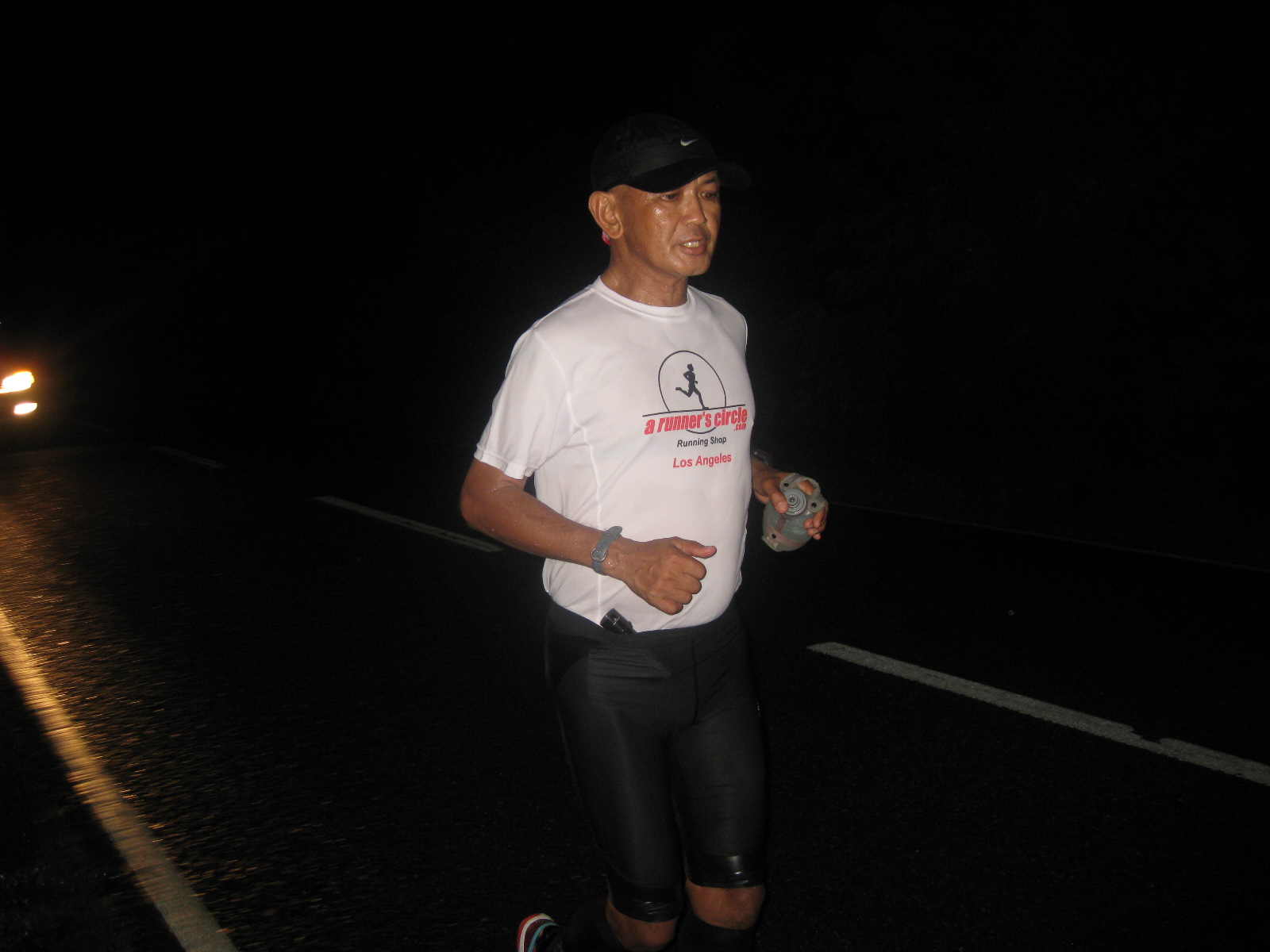
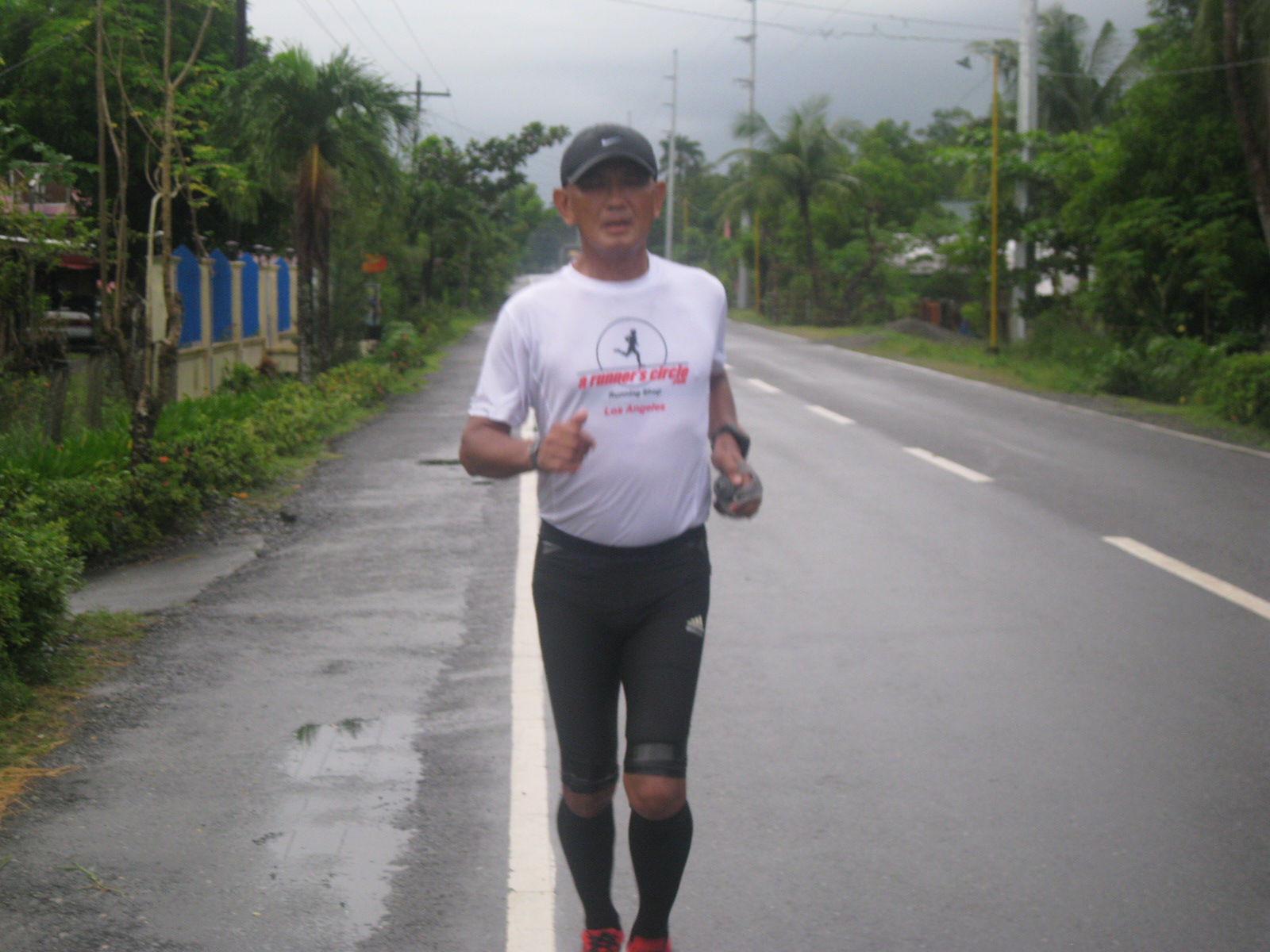
I wore my white ARC Shirt, Adidas Tech Fit Compression Shorts, CWX Compression Calf Sleeves, and Adidas Adizero Shoes and I was ready to go. At exactly 9:00 PM, I started to jog and run leaving the town of Santa Cruz using my headlight and “Surefire” hand-held mini maglight. It was cold and windy as there was a weather disturbance forecast on the said area for the days to come.

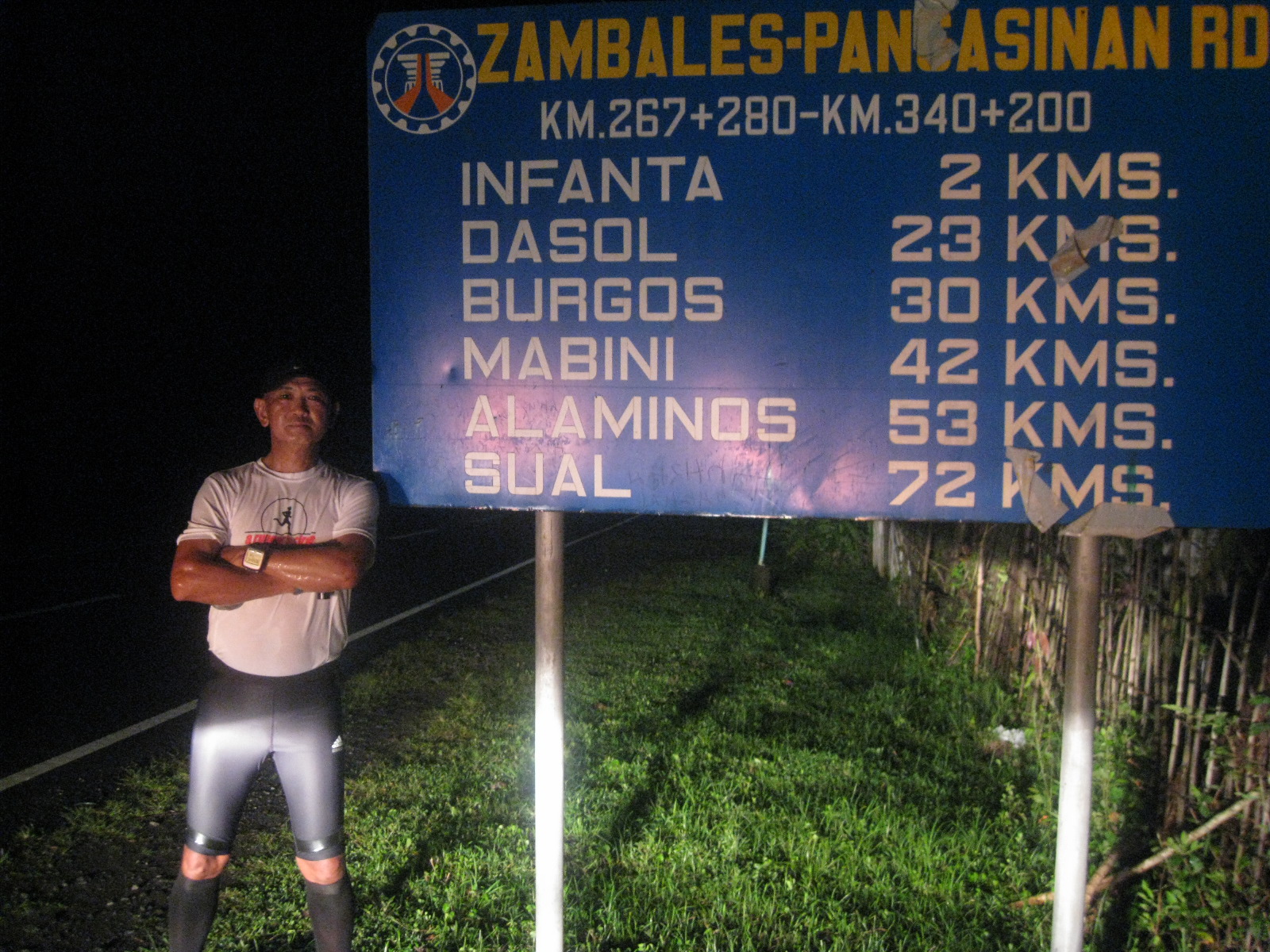
After a few kilometers, I could see the DPWH road markers stating the road distance from my place to the different destination towns along the way up to the end of the Olongapo-Alaminos Highway. I had to stop to have my pictures taken on these markers.

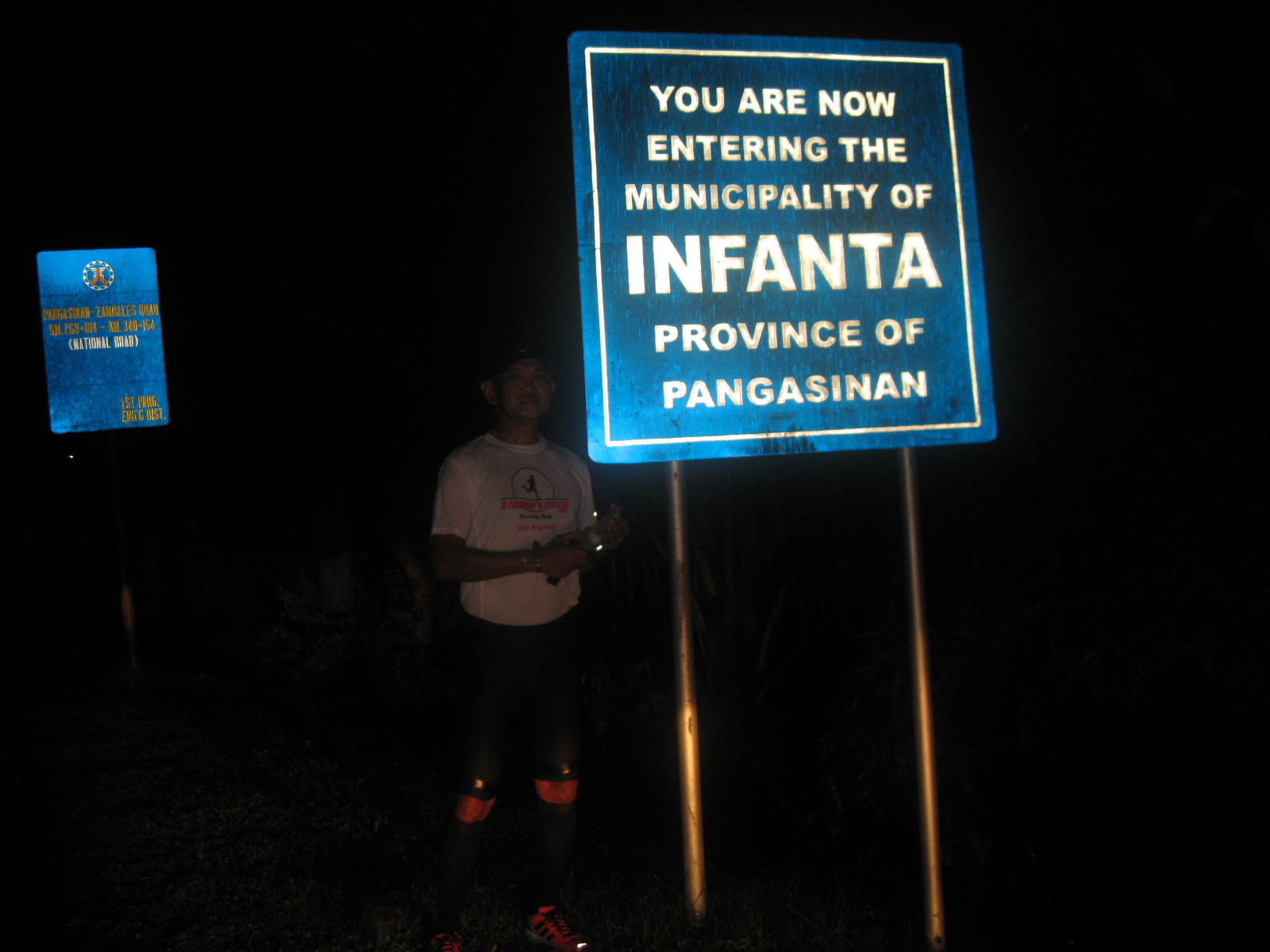
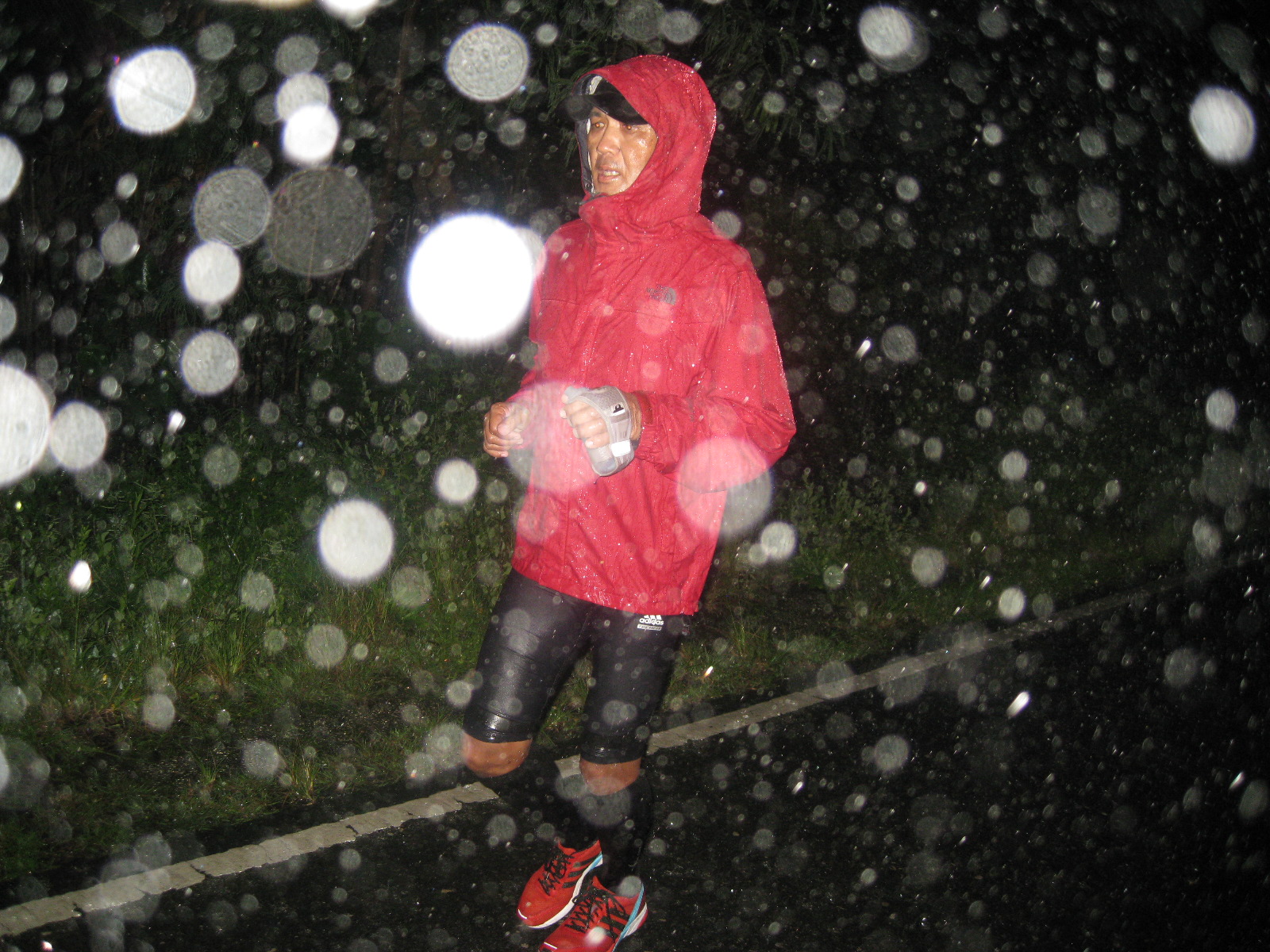
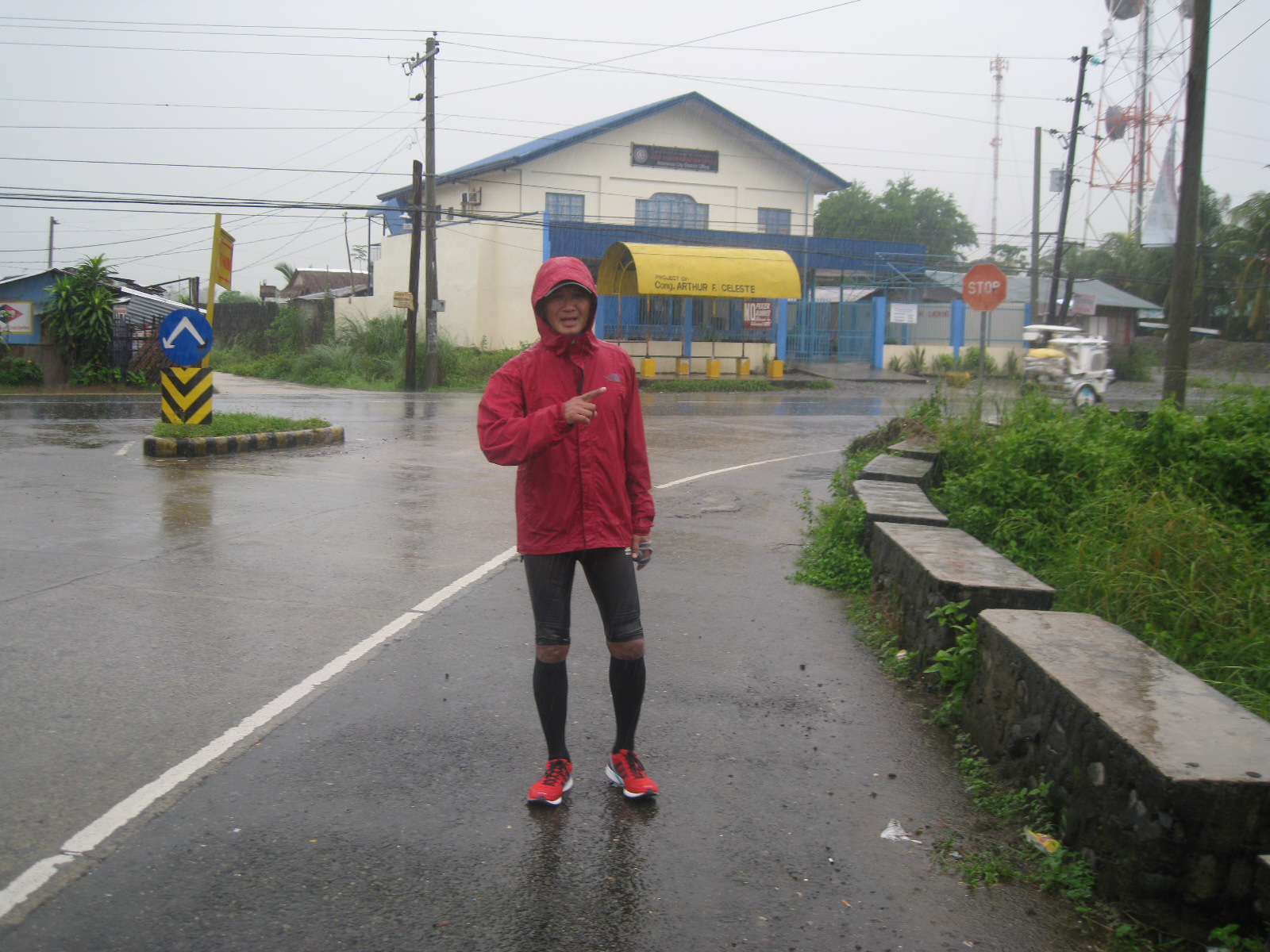
As I continued my run, it started to rain upon reaching the territorial area of the Province of Pangasinan. I had to use my TNF windbreaker to prevent my body from getting cold. There was not much vehicular traffic on the said highway and I was alone on mosts parts of the area. My support vehicle had to tail me in order to provide additional illumination on the road from the headlights of the car.

On this run, my support crew was already an expert in providing me the replenishment for my hydration and nutritional needs that I had to minimize stopping in waiting sheds. I had to take a lot of solid foods like boiled eggs, fruits, peanut butter sandwich, and sometimes energy bars. When there is an inclined road, I had to brisk walk and run again once I reach the peak of the road.

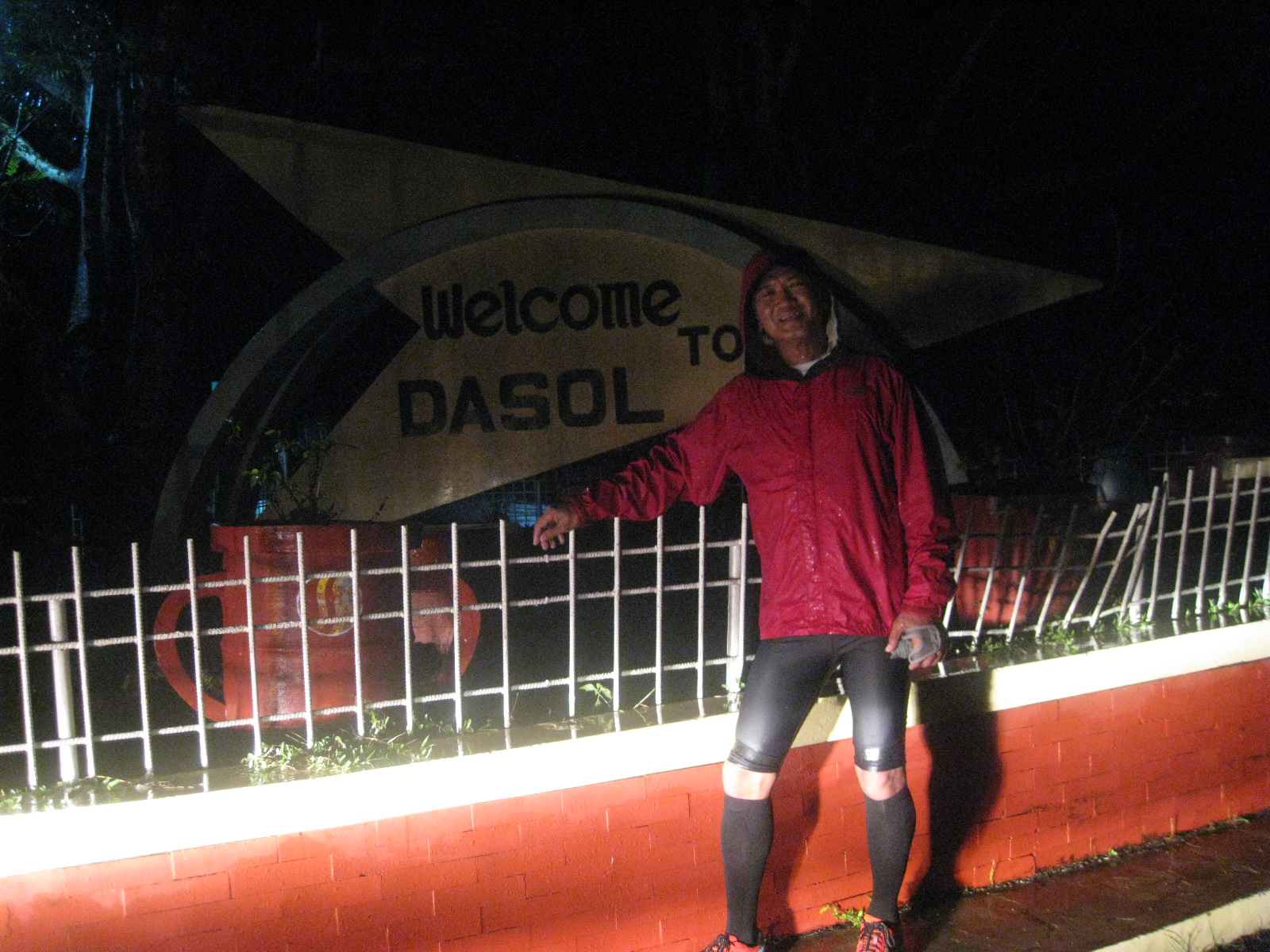
As I ran more on the rolling terrain of Pangasinan, the rain and winds keep on battering me while I tried my best to maintain my running pace. It was really fun running in this kind of weather. I felt I was sweating inside my shirt and my body was warm while the cold wind and rains keep on giving me the cold sensation on my face and my legs. I could not understand why it was too refreshing to run in this kind of condition. So, for the duration of 80% of my run, it was raining hard and I enjoyed every minute of it!

But at daybreak, I need to attend to my “morning call of nature”. Well, it was a nice experience bringing back those old days when I was a young officer patrolling in the mountains and forests where you can do anything to relieve yourself under a tree, a rock, and over a flowing stream of water. But this time, I was surrounded with plants on the shoulder of the highway with strong rains falling over me! I am sure those guava plants that surrounded me will bear a lot of fruits in the years to come!

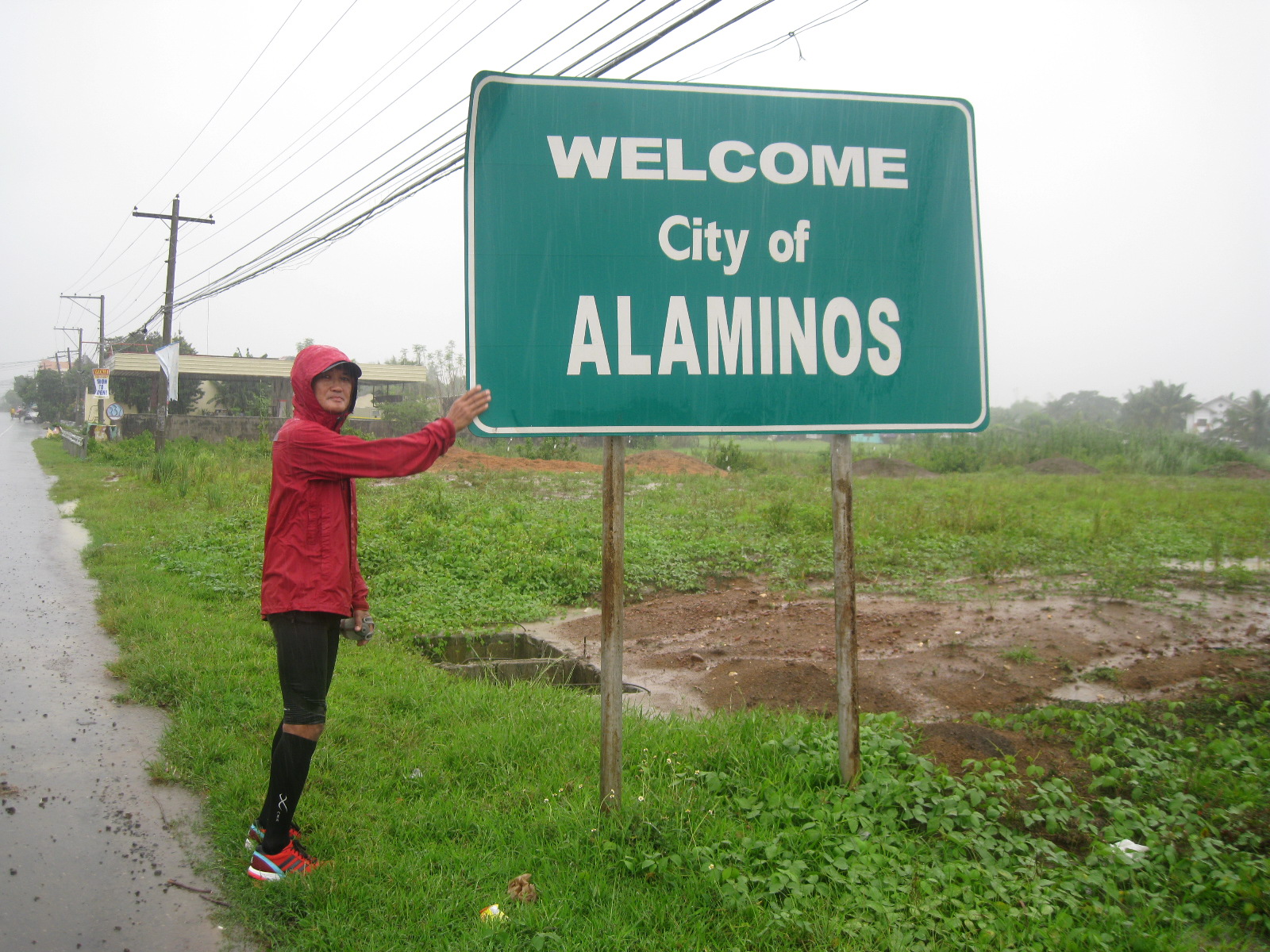
Finally, before 6:00 AM, I could see the buildings and structures of Alaminos, Pangasinan at a distance. More push and jog brought me to run along the Diversion Road until I reached the end of the road that connects to the Alaminos-Sual Highway. My Garmin watch registered a distance of 60.5 Kilometers and was able to cover it in 9:00+ hours.

Another Adventure Run done! I hope those runners who are inspired to experience this kind of activity will have a chance to see the scenery of the West Coast of Luzon from the Subic Freeport to Alaminos, Pangasinan.

In due time, the West Coast 200 as a Multi-Day Stage Run will be presented as one of the PAU/Bald Runner’s Events for this year. As per initial planning, this running event will be “By Invitation Only” with 50 Slots Available on a “First Come, First Serve” basis. Details will be announced on FACEBOOK and on this blogsite soon!

You may read the summary of my daily runs in the Western Coast 200 (WC200) on this link below:

https://baldrunner.com/2011/09/25/nalpasen/

See you on the roads and trails!

Official Result: 2012 BDM 102K Ultra Marathon Race


2012 Bataan Death March (BDM) 102K Ultra Marathon Race

10:15 PM March 3, 2012 To 4:15 PM March 4, 2012

Mariveles, Bataan To San Fernando, Pampanga

Starters: 186

Finishers: 160

RANK N   A   M   E TIME
1 Jonnifer Lacanlale (Champion, CR) 10:00:54
2 Peter Kennedy (1st Runner-Up) 10:44:56
3 Eugene Yasay (2nd Runner-Up) 10:50:09
4 Alfred DeLos Reyes 11:54:47
5 Graciano Santos 12:29:27
6 Rain Ordonez 12:33:29
7 Laurencio Ogerio 12:37:59
8 Junn Besana 12:38:38
9 Junrox Roque 12:43:05
10 Jerome Lagumbay 12:53:34
11 John Paul Baldomar 12:56:25
12 Elmar Tolete 13:06:01
13 Mario Alberto Danguilan 13:09:01
14 Henry Laron 13:11:31
15 Wilfredo Estepa 13:22:52
16 Simon Pavel Miranda 13:23:42
17 Rick Adrian Salay 13:37:08
18 Jerome Bautista 13:51:31
19 Nolan Llanora 13:54:54
20 Roberto Abad 13:56:38
21 Rafael Gabotero 13:59:12
22 Gregorio Maranon 14:01:35
23 Ronie Morimoto 14:01:46
24 Lieza Valerio (Female, Champion) 14:02:12
25 Fernando Dellomos, Jr 14:03:25
26 Alvin Adriano 14:05:35
27 Rolando Nerona 14:06:44
28 Darryl Panado 14:10:00
29 Ma. Aleth Reblora (Female, 2nd) 14:15:40
30 Francisco Delmo 14:19:44
31 Bob Castilla 14:20:51
32 Jose Cando 14:21:06
33 Jonathan Colao 14:35:01
34 Mark Repala 14:35:49
35 Erwin Tolentino 14:38:17
36 Nino Andrelix Navarro 14:39:07
37 Jeffrey Jay Amurao 14:53:39
38 Meljohn Tezon 14:55:02
39 Fernando Sy 14:55:38
40 Camilo Paran 15:05:39
41 Carlos Macasarte 15:06:09
42 Joseph Pineda 15:07:26
43 Jon Las Bruce 15:08:13
44 Catalino Lee Escasinas 15:09:39
45 Randy Rubio 15:09:47
46 Ace York Guerrero 15:13:23
47 Doel Torres 15:13:50
48 Candy Balaba (Female, 3rd Runner) 15:14:02
49 Carlos Delos Santos 15:15:35
50 Max Espinosa 15:19:44
51 Reno Enopia 15:20:56
52 Din Cordero 15:21:20
53 Peter Roy Salingay 15:24:44
54 Jesus Llarena 15:26:57
55 Dennis Chavez 15:34:54
56 Dindo Diaz 15:36:08
57 Emerson Sto Domingo 15:37:55
58 Alberto Castro 15:42:59
59 Marlo Guloy 15:45:31
60 Joey Baladad 15:48:07
61 Ricardo Cabusao 15:48:45
62 Carlito Buenaventura 15:48:59
63 Tomas Miguel Miranda 15:50:37
64 Alain Cuchas Ilagano 15:52:39
65 Ronnel Go 15:54:55
66 Dino Dolina 15:57:03
67 Asher Dolina 15:57:04
68 Angelo Lagumbay 15:59:23
69 Trojan Lorenzo 16:02:32
70 Allan Roy Martos 16:04:30
71 Michael Kent Reaport 16:04:37
72 Miguel Angel De Alba 16:12:00
73 Frederick Quitiquit 16:12:05
74 Jude Palispis 16:14:24
75 Vic Topacio 16:14:39
76 Ruben Silva, Jr 16:17:03
77 John Lao 16:22:28
78 Teodolo Alferez 16:22:32
79 Reylynne Dela Paz (F) 16:23:08
80 Lawrence Arvin Tomas 16:33:54
81 Alvin Rivera 16:34:12
82 Cesar Abarientos 16:37:07
83 Alan Paul Vargas 16:37:12
84 Torii Akimitsu 16:37:17
85 Irene Ong (F) 16:37:38
86 Randy Racho 16:39:12
87 Benedict Muriel 16:44:19
88 Jonathan Manas 16:44:31
89 Brian Tan Seng 16:44:35
90 Jayson Tan 16:47:39
91 Ron Illana 16:50:13
92 Jonel Mendoza 16:53:30
93 Samuel Narcise 16:53:34
94 Lemuel Narcise 16:53:34
95 Marlon Saracho 16:53:36
96 Luedemer Samar 16:53:37
97 Ofelia Lorete (F) 16:53:39
98 Mark Anthony Delumen 16:54:19
99 Jesse Chan 16:56:09
100 Angelo Anillo 16:58:37
101 Emil Hulipas 17:02:33
102 Gerzon Patriana 17:03:04
103 Mary Jane Villamor (F) 17:04:14
104 Raffy Barolo 17:06:05
105 Merwin Torres 17:06:34
106 Calvin John Escandor 17:08:54
107 Jon Michael Tan Flores 17:09:30
108 Erell Villalba 17:10:54
109 Blas Ople Tiangco 17:12:34
110 Ruben Fajardo 17:14:17
111 Ernesto Badong 17:14:23
112 Gabriel Tuason 17:15:10
113 Ronnel Castro 17:15:58
114 Ian Francisco 17:16:19
115 Katrina Perez (F) 17:16:44
116 Carl Balagot 17:17:41
117 Steve Paul Dumlao 17:20:01
118 John Andrew Alcedo 17:20:36
119 Paolo Tambo 17:21:57
120 Jojo Paguia 17:23:06
121 Alexander Jones 17:23:31
122 Bee Yen Soberano 17:23:48
123 Ryan Albert Moral 17:28:58
124 Wesley Orana 17:29:41
125 Caloy Nobleza 17:30:34
126 Marvin Pangan 17:30:40
127 Michael Dauz 17:30:44
128 Japhet Grande 17:30:54
129 Chaps Grande 17:31:02
130 Franklin Ace Panuncio 17:31:27
131 Cris Dela Cruz 17:31:41
132 Julius Cervantes 17:31:48
133 Jason Sison 17:32:29
134 Joseph Ligot 17:33:09
135 Vicky Ras (F) 17:34:05
136 Larry Daliwag 17:34:12
137 Victor Viola 17:35:17
138 Anthony Mark Alindada 17:35:59
139 Florimon Bernardo 17:38:22
140 Jose Arthuro Virata 17:39:01
141 Jorge Richard Guerrero 17:39:06
142 Raymond Canta 17:39:11
143 Leo Tugade 17:39:15
144 Edgar De Jesus 17:41:28
145 Jorell Anthony Paringit 17:43:03
146 Roger Villareal 17:43:42
147 Aldouse Zaguirre 17:43:57
148 Vincent De Lima 17:44:30
149 Theodore Zamora 17:46:17
150 Don Armand Gutierrez 17:48:35
151 Jinky Yray (F) 17:46:39
152 Harold Lorete 17:48:42
153 Robert Jonah Rivera 17:49:26
154 Michael Rheneson Galas 17:49:52
155 Jeje Ajusto 17:52:03
156 Benjo Termulo 17:53:18
157 Marie Ann Ortega (F) 17:54:34
158 Carmeli Anne Ortega (F) 17:56:21
159 Nelson Val Caro 17:57:58
160 Erwin Ordonez 18:00:00

2012 BDM 102: Final Briefing Presentation


The following link is the Final Briefing Presentation for the 2012 BDM 102 which was presented last night at the Officers’ Club, Camp Aguinaldo, Quezon City.

2012 BDM 102 FINAL BRIEFING

As of today, there are 203 “brave warriors” who registered in this prestigious ultra marathon event for this year!

Only 129 registered runners attended the Final Briefing & CLP and were able to receive their Race Bib & Tarp. They have also signed their respective “Assumption of Risk and Statement of Waiver”.

For the rest of the runners who were not able to attend this activity, please read the link and be early at the Assembly Area on Race Day so that we can process and account all the runners prior to the start of the race.

Good luck and See You at the Starting Line!

2012 BDM 102 Rules & Regulations: Update


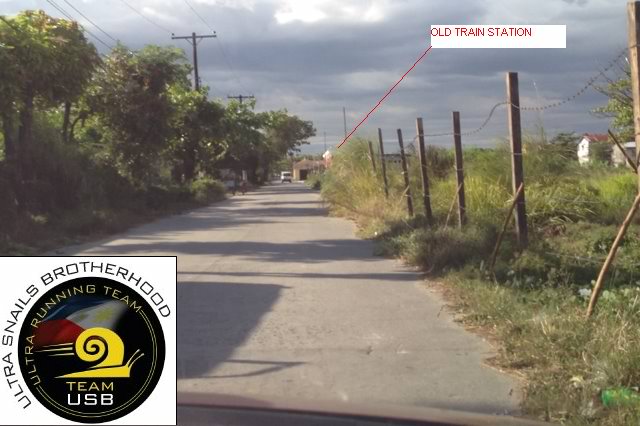
‎2012 BDM 102 Update: NO SUPPORT VEHICLE will be allowed to enter the road leading to the Finish Line/BDM Km Post #102 at the Old Railway Building. Support Vehicles should park on the road infront of the Provincial Capitol of Pampanga. There will be NO exemptions! Runners whose support vehicle will enter this road leading to Purok #6 PNR will be declared DISQUALIFIED/DID NOT FINISH.

Yes, all Support Vehicles are not allowed to enter and park on this road during Race Day!

(Note: Photo courtesy of Lawrence Arvin Tomas of Team USB)

Vibram Hong Kong 100K Race Report—Ryan Sandes Wins Again


(Note: This is an article written by Andre Blumberg of Hongkong and it was posted at www.ultra168.com)
Vibram Hong Kong 100km Race Report – Ryan Sandes wins again
Ryan Sandes takes Vibram Hong Kong 100 title in new course record despite fierce Nepalese assault- Andre Blumberg reports.

The second edition of the Vibram Hong Kong 100 took place 18 – 19 February 2012 and has already established itself as one of the region’s premier ultra events. The HK100 entered the scene only last year and is still the only 100k solo distance race in Hong Kong. Perhaps not surprisingly, and well in line with the global explosion of ultra popularity, the registration rates skyrocketed to over 750, or about four-fold in just one year, and the race sold out almost three months in advance and without any significant advertising.

And the “Picture of the race Award” goes to:

All of the eventual HK100 Top 6 close together here at only 11k into the race

Hong Kong may not be the first place that comes to mind in the context of ultra trail running. However the city has a lot to offer, including four long-distance trails and numerous shorter trails in the various country parks. The HK100 course follows the famous MacLehose trail but with a few modifications to make it even more scenic and interesting. The start is in Pak Tam Chung and the course then stretches through the Sai Kung country park along beaches and mountains to continue into the Central and Western New Territories of Hong Kong to finish with a descend of Tai Mo Shan, Hong Kong’s tallest mountain at 957m. The course has an elevation gain of over 4,500m which includes literally thousands of stairs. When compared to TNF100 Australia in the Blue Mountains, the consensus among those that have run both seems to be that HK100 is a lot harder and less runnable.

Vibram Hong Kong 100 elevation profile – a very back-loaded course

The organisation of the race was once again flawless. Race Directors Janet Ng and Steve Brammer, a lawyer and a banker by trade, are both seasoned ultra runners who have participated in events worldwide. This year Janet will race UTMB whilst Steve and one of his buddies will join the PTL, a 290k, 22k D+ event. So the HK100 truly is an event by runners for runners. It is often the little things that make a race stand out, for example an amazing ratio of less than two participants per every one volunteer along the course and at the aid stations. Two aid stations were operated by kids from a scouting organisation and the vibe and motivation of the kids was absolutely infectious.

The course was well-marked with well-stocked aid stations approximately every 10k. The weather conditions were perfect, temperatures around 10 – 18C and humidity around 65 – 80%, fairly low levels by Hong Kong standards. Participants could enjoy the most stunning views across Hong Kong’s peninsula.

One of the more unique aspects of this race is the very generous cutoff time of 32hrs which is a lot compared to other 100k events; in fact it would more commonly be associated with a 100 miler. The rationale is to enable a broad range of participants from all walks of life to participate, including those that prefer to hike a 100k solo effort. Regardless of the lavish cutoff times, the event still recorded a DNF rate of about 20% which shows just how hard the course really is.

Shortly after the HK100 start

Wu Shan Kuan from China DNFed at 52k after 9:28hrs – he ran barefoot the entire way

This is not to say that the race was slow – nothing could be further from the truth. The field was deep and stacked with talent. Salomon International sent Jen Segger from Canada, Grant Guise from New Zealand and Ryan Sandes (winner of all 4 Deserts races and 2011 winner of the famous Leadville 100) from South Africa. Then there were the top Nepalese mountain runners Aite Tamang, Bed Sunuwar and Sudip Kulung who all finished on the podium at the recent Annapurna 100 in Nepal. China’s top ultra trail runner Yun Yan Qiao 运艳桥 joined as well (2nd at 2009 TNF100 Singapore, 2nd at 2011 TNF100 China and 14th at the 2011 CCC in France).

Nepalese Bed and Aite are the first to reach CP2

Yun Yan Qiao from China reaching CP2 in third position

Ryan Sandes coming into CP2 in fourth position

Most of the notable local Hong Kong ultra runners also participated; including last year’s first and second William Davies and Jeremy Ritcey, respectively. Dan Parr and Eric LaHaie toed the line, both with excellent Racing The Planet event credentials. Unfortunately “Stone” Tsang Siu Keung was unable to join due to injury. On the female side Hong Kong-based Nora Senn and Claire Price signed up, last year’s runner-up in the 100k solo and winner of the 100k duo. Claire finished 4th at the 2011 TNF100 Australia and an outstanding 2nd at the 2011 CCC. Olya Korzh, who did very well in a number of local mountain marathons this season, as well as Xing Ruling 邢如伶 from China (1st in 2009 TNF100 Singapore and China, 1st 2010 Taklamakan 100k) rounded out the top prospects.

Female winner Nora Senn always in good spirits

Female first runner-up Claire Price refueling at CP2

Female second-runner up Jen Segger digging deep on tar at 72k with a floating Matt Meckenstock

Australia was well represented with Andrew Dawson, John Ellis, Keith Mearns and Michael Ormiston, all currently resident in Hong Kong. Richard Mountstephens and Matt Meckenstock came up from Australia specifically to participate in the event.

Having participated in a number of ultras in the Philippines, I was very keen to have some of their talent join the HK100 to get some international exposure and therefore sponsored Raul Lamprea and Jucell Laya. Both are members of the Philippines Army and the Bald Runner Ultra Elite Team, run a 2:40 marathon time and it was the first time for them ever to travel overseas – a great experience with many lessons learned.

Members of the Ultra Elite Team Bald Runner from the Philippines proudly showing their Gold trophies

Come race day the starting area was absolutely buzzing with runners, everyone seemed to be in a great mood and it was truly an international field with 28 countries represented. After a short race briefing the gun went off at 8am and the pace at the front was ferocious. The course only has around 600m of wide road at the start before turning off into single-track for several kilometres, so everyone was keen to speed up in order to not be bogged done there.

I had done the inaugural 2011 HK100 in a time of 13:51 which placed me 10th overall and my target time was 13:30 since I only had about six solid weeks of training in my legs and had completed TNF100 Thailand in 2nd place just two weeks earlier. After the start I was hanging with the lead field for a short while but quickly backed off since the pace was not sustainable for me. I settled into a good rhythm and ran with Keith Mearns for the next two hours or so. I felt pretty good all day apart from the usual minor lows and my two-pack strategy worked well to reduce any unnecessary layover time at the check points. Paper, my girlfriend and crew chief-of-staff, had all the routine worked out based on the prior year and welcomed me at each of the accessible support stations during the first half for bag swaps, some motivational words as well as taking plenty of pictures along the way.

By the time the 52k check-point came around I was ahead of plan by 30 mins and at that time decided to change the target to go sub-13, previously considered an absolute dream time for me. All I had to do from now on was to execute based on my plan and maintain the 30 mins lead. It was pretty rough at times going through a few lows and I had to constantly remind myself to persist with relentless forward progress. I was pleased to see that my ultra experience thus far paid off and I started to take positions by benefiting of the evolving carnage around me, runners that went out too fast for their abilities and then spent too much time at support stations. On the other hand I was not overtaken for several hours, except when Nora Senn stormed past just prior to the 65k mark. Despite trying hard, I was not able to hang with her and had to let her move ahead. Later on coming down from the notorious Needle Hill at around 86k into the race, I was surprised to catch Matt and Jen who was suffering from the concrete surface of the course. After a short chat with them I carried on to hit the 13hrs mark and then brought it home in 12:50, over an hour faster than last year which I was extremely pleased about.

In the meantime, Nora went on to catch Claire and finished in a Senn-sational 12:34 followed by Claire in 12:40 and Jen rounded off the female podium in 13:01.

All smiles on the female podium – Claire Price, Nora Senn and Jen Segger

Sometimes I wish not to race in an event, just so that I am able to follow and witness the lead pack go about their business. This year’s HK100 would have been such an event. The pace was fast from the start and surprisingly not a lot changed in the ranking between early on in the race and the finish after 100k.

The Nepalese runners Aite and Bed took an early lead and managed to hold on until somewhere between CP6 and CP7. At that time Ryan Sandes took the lead and then brought it home in an absolutely astonishing 9:54hrs, almost two hours faster than last year’s record by William Davies. But Ryan was not alone: remarkably, all of the Top 10 finishers broke the course record, including William himself. Aite finished second in 10:17, followed by Bed in 10:26 and Jeremy Ritcey did Hong Kong proud in 4th and a blazing 10:47. Andrew Dawson (12:30), John Ellis (12:34) and Richard Mountstephens (12:40) were the top Aussie finishers. On the Kiwi side we had Grant Guise in 10th place (11:45) as well as Callum Stowell (13:22) and Denis Kelliher (17:56). Full HK100 race results can be found here.

The three Nepalese runners Sudip, Aite and Bed with their support crew

Ryan Sandes clearly has left a mark on this race. Going sub-10 on this course it truly remarkable, especially since the season is only just starting. Ryan didn’t even run all the uphills as you can see in this short video here, but he surely is blazing the downhills – he probably studied Dan’s related Ultra168 article. So – well done, Ryan. For those racing TNF100 Australia in May, brace yourself for the potential of a new course record.

But HK100 was more than just about the top winner. It was an interesting case study in how the ultra world may be changing in future. To have the three Nepalese participants Aite, Bed and Sudip finish in 2nd, 3rd and 8th place is a clear signal that we are only seeing the tip of the iceberg here in Asia when it comes to top performances. There are many untapped “markets”, such as Nepal and the Philippines, with a range of top talent that has yet to hit the international ultra trail event scene.

The difference in background between the Salomon team and the Nepalese team could not be more pronounced. Ryan is a professional ultra runner, has multiple sponsors, access to Salomon R&D for customized kit and accessories, latest training methods and presumably a number of trainers and coaches. Two of the Nepalese runners are in the Army, the third worked as a porter. They get by on very limited means. They have no regular sponsors, no expensive kit. They do have a lot of talent and a certain level of ignorance, innocence, almost purity – and I mean that in the best possible way. While the Salomon team held trail clinics and product demonstrations in the days leading up to the race, the Nepalese walked along the course to prepare for the race.

Despite the vastly different backgrounds, the top three finishers only separates a bit over half an hour with Aite and Bed coming in second and third. I was very fortunate to share dinner with the Nepalese team and their coach Ramesh after the race, and came to the conclusion that despite all the differences in background, financial means, equipment and training methods we all share one thing: a deep passion for ultra trail running.

Feedback from the participants of the HK100 was outstanding across the board. Clearly, the event moved from good to great and it sets a new benchmark for ultra trail races in the region. Well done Janet and Steve – when will registrations open for your eagerly awaited third episode?

Pinoy Runners’ Result @ 2012 HK 100K


Overall N  A  M  E TIME (Hrs)
Position    
98 Raul Lamprea 15:09:34
125 Jucell Laya 15:55:45
171 Kian Vicera 17:45:58
184 Napoleon Dela Torre, Jr 18:13:21
189 Roland Wangwang 18:21:05
261 Joseph Anthony Parcon 19:57:30
288 Marie Anne Constantino 20:26:03
289 Zenon Alejandro Villangco 20:26:04
353 Simon Sandoval 22:25:57
383 Jessie Lou Sulague 23:03:51
414 Carlo Leandro Dino 24:15:13
420 Cheryl Bihag 24:45:38
428 Constante Mendoza, Jr 25:23:53
440 Joel Garganera 25:58:58
444 Alexander Yap 26:13:19
463 Philippe Arenillo 27:48:39

In its first edition last year, 136 runners finished the race out of more than 200 runners who started the race. In this year’s 2nd edition, out of the over 750 registered runners from 28 countries, 511 runners were able to finish the race within the cut-off period of 32 hours. Sixteen (16) of our local Pinoy Runners were able to finish the race despite the cold temperature and lack of familiarity of the trail route. Congratulations to all of them.

For the complete official result of the event, you can visit this link—http://brammar.weebly.com/uploads/6/9/9/4/6994217/2012_results.xls