BDM102 Video By RonaldRei


A video consisting of pictures taken during the 1st Bataan Death March 102K Ultramarathon Race (BDM102) is featured in the blogsite of RonaldRei who participated and finished the said race.

The video can be viewed at http://ronaldrei.multiply.com/video/item/13/BDM102.

Thanks, Ronald.

BDM102 @ Ultrarunning Online!!!


The Bataan Death March 102K Ultramarathon Race (BDM 102) is now officially scheduled as one of the International Ultra Running Events at the Ultrarunning Magazine’s Online edition.

Please check it out at www.ultrarunning.com and browse their Calendar Page.

In addition, I am hoping that the Race Report I’ve submitted to the said magazine on the conduct of the 1st Edition this year will be published soon.

My congratulations and thanks go to the participants, sponsors, running friends/supporters, and staff of the Bald Runner for making this “dream” a “reality”.

Finally, my sincerest appreciation and thanks go to Rick Gaston & Ben Gaetos, my ultrarunner friends in California, for their support and inspiring words.

See you next year in Mariveles, Bataan!!!

Comments From 1st BDM 102


The following are the latest comments sent to me by the Moderator/Administrator of BDM 102 website (www.bataan102.com), Eric Pasion aka Run For Change as a result of the conduct of the 1st BDM 102K Ultramarathon Race:

All of you great athletes have much to be proud of and a job well done to all of you. Last year, April 8-9 2008, myself and my good friend Ariel Lesap from Panay Island marched this same route which took us 2 days. The heat and sun was relentless and how happy we were to put our hands on the 102 km. marker! So it astounds me to see your website ! Not only did you run it, you ran it in hours ! I am 50, but some of your ages are unbelievable ! Younger generations will be inspired by your run ! Thank you for bringing much needed awareness to Bataan and the infamous Death March where so many brave souls perished and still sleep beneath the hallowed ground of Bataan. God Bless you all,….Paul Dillon

Hi,
I am very thrilled to know that there is some kind of a memorial marathon for the Bataan Death March. I would however would like to make a couple of suggestion:

1. Make it a two day walk with a campout somewhere inbetween the start and the finish.
2. Create a foundation to honor the Bataan Death March participants in the Bataan such as erecting some kind of a monument and museum.

My father was a survivor and even before he passed away two years ago, could not discuss the details of the ‘death march’.

If this was made into a two day walk and advertised in the Philippines and the U.S., I’m sure that you will receive quite a number of applicants, including me and my family. I would like to walk my father’s walk and do it in his memory as well as his grandchildren. This can also help the economy of Bataan for it will need hotels and restaurants and maybe tour guides.

This is not to commercialize the horrific experience of those that walked to their death and those that survived but to let us, the living experience what they went through and how they dedicated their lives for Freedom, and what it stands for.

Thank you.
Terry Kelley

Brian Stark: USA Transcontinental Trail Runner


As I mentioned in my previous posts, I’ve been reading the book, “Getting To The Point: In A Dozen Pairs of Shoes” by Brian Stark who did his 5,000-mile solo trail run for 238 days from March to November 2008 along the newly designed American Discovery Trail from Cape Henlopen, Delaware to Point Reyes, California.

Since the activity was a solo run, he did not have any support crew or pacer during the run. He just carried with him a 10-pound pack which included his water hydration system, making sure to run along the trails across America.

What I admire with this guy was that he really prepared for the said run. It took him one year to coordinate with the organizations that maintain the American Discovery Trail; compile at least 500 maps; arranged for logistics drop-off point in selected Post Offices of towns & cities along the way; created his personal website for the event; and saved $ 10,000 cash to finance his trip. He even arranged for his shoe sponsor making sure that a brand-new shoes as replacement would be picked-up in a pre-designated Post Office along the way. Even media outlets (newspapers, radio and TV) were coordinated and informed about his running event.

Brian Stark, in his daily runs along the trails, would be able to finish at least 30-40 miles and then look for a decent place to stay if a trail is located near a town or city at the end of the day. Sometimes, he would sleep in parks, Fire Stations, churches, schools, and in the homes of strangers who are willing to offer dinner & breakfast, bed and shower.

To update his website and reply to messages in his e-mail address, he would go to Public Libraries along the way to use their computer. The following excerpts was taken from a post from the Internet describing the feats of Brian Stark:

After driving back from the Boston Marathon, where his dad had run, Brian Stark, then 7, got out to use the bathroom during a stop for gas somewhere in Pennsylvania. No one took note, not even when Stark ran up and banged on the family van as it pulled away. “When my parents stopped for breakfast 300 miles away, they noticed I was missing,” he says. These days, Stark could have just kept running until he caught up with them. In 1998, he ran 4,800 miles across the country on the American Discovery Trail, which runs along America’s trails and back roads. It began in a sleet storm in Delaware and ended 238 days later at the Golden Gate Bridge — followed by a drive to L.A. and an appearance on “The Price Is Right.” “I won eight stuffed teddy bears and two trips, one to Hawaii, one to Canada,” says Stark, 36, who frequently pulls experiences from his trek while teaching gifted language arts at Corona Foothills Middle School in the Vail School District. And yes, he sometimes jogs to school, all 35 miles. “I have to get up at 1:30 a.m.,” says Stark, who is married and a father to two little girls, ages 2 and 3. He kept a journal while on his run and afterward wrote a book about the experience, “Getting to the Point: In a Dozen Pairs of Shoes.” “I picked out 12 pairs of running shoes and mailed them to 12 post offices 400 miles apart,” says Stark. When he arrived at each post office — each about three weeks apart — a new pair of shoes would be there to replace his worn-out ones. Along the way, local newspapers and TV stations chronicled his trek through their towns and CBS “Sunday Morning” broadcast a brief telephone interview. Sometimes he slept in motels. Other times he slept under bridges, in barns, even in outhouses. More than once, he’d just knock on a door. More often than not, he’d be invited in for a meal, and maybe a bed. Not once, he says, did anyone slam a door in his face. “No one ever threw anything at me, or tried to run me off the road.” Eight policemen, however, did inquire as to what he was doing, the first in Kansas. “I was sitting on a guardrail looking at a map and he pulled up in his squad car. He asked me what I was doing in the middle of Kansas without a car. I said, ‘I’m running to California.’ ” Even though he handed the cop a card explaining his circumstances, “He still checked me out.” Born in Indiana, Stark ran cross-country in middle school, continuing through high school and then at Hanover College in southern Indiana. After graduating in 1995, he rewarded himself with a five-month, 2,000-mile hike from Maine to Georgia along the Appalachian Trail. In Massachusetts, he met a man who hiked nude every Tuesday. Naturally, it was a Tuesday. Even so, Stark continued on. For the next three years, he lived as a caretaker in a primitive cabin in southern Indiana. “There was no running water and the only heat came from a fireplace,” he says. “After that, I thought I needed a break.” The “break,” of course, would be running across the country. “I’d never been west,” he says. A brother dropped him off at the edge of the Atlantic Ocean on the morning of March 8, 1998. It was 43 degrees and sleeting. Stark was carrying a 10-pound backpack filled with a sleeping bag, jacket, water bottle, cheese crackers, credit card, maps and “one Band-Aid, just in case.” As his brother rolled away, he cracked the window and told him to call if he wanted to quit. Stark never did, aiming to get to the Rocky Mountains after most of the snow had melted. He mostly ran and sometimes walked about 10 hours a day, trying to space it about 25 to 35 miles between towns. That proved impossible in Nevada, where the towns were more than 100 miles apart and he had 37 mountain ranges to cross.

In 2001, Stark did the Arizona Trail between Mexico and Utah in 39 days. In 2004, he ran across Iowa.

While reading this book, the following thoughts came to my mind:

1) Did Cesar Guarin of BOTAK come up with a book or a written account of his Run Across America in the 80s? I knew that he is one of the consultants of Joy Rojas and Mat Macabe during their planning preparation for the Takbong Pangarap Run Across America. A running experience as big as Running the Continental USA is worth to be printed in a book.

2) I thought of Joy Rojas and I tried to find out from the Internet if there is any word about the progress of her Takbong Pangarap. Since I could not see any information after she started her run in Eagle Rock, California almost 60 days ago, I posted the question in my Twitter as to where she is right now. Ben Gaetos had the initiative to answer my question by sending an e-mail to Joy Rojas and it led to Mat Macabe’s call to him.

3) Why did Joy Rojas thought of not creating a blog or website on her own instead of relying to the website of www.thepoc.net? After leaving Eagle Rock, California, POC had never updated her running activities. Being a news editor and news writer, she would have known the importance of the Internet in order to “journalize” her daily runs and let her readers know where she is and her daily experiences. In the book, Brian Stark would update his running journal in his website at the end of the day if he had an access to the Internet, if not, he would write his journal in a notebook and later wrote his updates whenever he had an access to the Internet. As compared now and the time when Brian Stark did his run across America’s trails, every town or city has its own public library with a computer, if not, there are so many Internet Cafes in every commercial establishment, even Motels now have Wi-Fi connections in every room with a very minimal additional cost. Access to the Internet right now is very common, cheap, and accessible. I am sure that every house in every big town or city has an Internet connection. Even cellphones nowadays have access to the Internet to include social networking sites like Facebook and Twitter.

4) One of my readers made a comment in my post about Joy Rojas and he/she has doubts about her running adventure to the point that she is suspected to be riding and running along the way. There goes the another “controversy” again! The following is the comment from cutierunner about Joy Rojas’ run from Las Vegas, Nevada to Denver, Colorado:

i too wondered where she was after she reached las vegas on may 23 and then silence until she pops out in denver for the western union shindig on june 23/ is she running or riding part of the way? google maps say that from las vegas to denver is a good 844 miles / from reports she says she takes a break every six days that leaves her with only 25 running days going from the desert to the state with the highest mean elevation in my country/ that’s uphill all the way to Colorado (during a season when flash thunderstorms occur), at 30 miles a day which is more than a marathon a day, she would still be short by 94 miles, so she must do something like 20% more to be statistically in denver by the date/ To set records, it would have been better if she wore one of these tracker gps items available here so that we do not have to rely on the word of her trainer who i hear is her boyfriend anyway and guess whether she is actually running or riding part of the way – also strange is having a crew of one

(Note: In my previous post on the pictures of Joy Rojas, I did not notice if she is wearing a Garmin watch, have you?)

I strongly believe that Joy Rojas could also do ala-Brian Stark running adventure across America if she has the necessary preparations, contacts along the way, and updated information about her daily activities.

5) In one of the Ultrarunning Magazines that Rick Gaston gave me, I read about Dean Karnazes plan to run across America using the American Discovery Trail from San Francisco to the East Coast and it is presently on the “drawing boards”. I guess, this will be fully supported by sponsors, marketing stuffs, and good PR support. What I like about Brian Stark is that he did it on his own without any “gimmicks” or marketing stuffs and even without any crew or support and pacer along the way, most especially while he was running the winding roads and trails of Colorado’s Rocky Mountains reaching an altitude of 12,000 feet above sea level.

6) Brian Stark did not set a deadline for him to finish his run and he did not pressure himself to reach a designated place. He had to take a lot of rest for his body to recover during the early part of his run and as the days and weeks have passed, he became stronger. He would find time to visit museums, tourist attractions, historical places and even enjoy the food distinct to every place he stayed while recovering from his rigorous runs. This a good example of a running adventure where you have enough time to explore the places you are passing through by visiting their tourist attractions, museums, and other historical places. Hence, he was able to write a book with all the pictures and clippings of newspaper accounts on his run.

If you have plans of running a multi-stage/multi-day running adventure, Brian Stark and his book is a good inspiration and source of experiences and a guide to a successful running adventure. I am highly recommending every runner to read this book.
2009 Badwater Ultramarathon


Before participating the 2008 San Francisco Marathon, I purposely went to the United States ahead of time in order to witness the start of the 2008 Badwater Ultramarathon and finally meet in person Dean Karnazes and Pam Reed after reading their respective books about their experiences at the Badwater Ultramarathon.

On this very moment, the 32nd Edition of the race had just started. The popular elite ultrarunners had just passed Furnace Creek after starting the race at 10:00 AM (PST). To review my post last year, please click here

For those who are interested to know the progress of the race, please click their Live Webcast here. You can follow the progress of the race through Facebook and Twitter.

Anf finally, for those who are planning to join the 2nd BDM 102 this coming March 6-7, 2010, please read the rules and regulation of the Badwater Ultramarathon as this will be the basis of the New BDM 102 Rules & Regulations which will be strictly applied in 2010.

I am predicting Jorge Pacheco and Jaime Donaldson to win and defend their titles as Champions in the Mens & Ladies’ Overall Categories with better finish times.

Jaime Donaldson & Jorge Pacheco At The Start of 2009 BW (Photo Courtesy of www.badwater.com)
Jaime Donaldson & Jorge Pacheco At The Start of 2009 BW (Photo Courtesy of http://www.badwater.com)

2009 Western States 100-Mile Endurance Run


The first time that I heard and read about this particular Ultratrail endurance run was when I got a copy of the book “Ultramarathon Man” by Dean Karnazes which became a Number One Bookseller at one time. Practically, almost one half of the book was devoted to the author’s quest to qualify for the said race, train for it, and finally described how he was able to finish his first 100-mile race in this event. It is very detailed to the point that everything was described on how a first-timer would experience running a 100-mile endurance run. Dean Karnazes joined this particular race for the first time in 1994.

I guess, this book entirely opened the awareness of most of the runners to try and experience what it takes to run an ultra race along the trails of the mountains. Personally, the book also inspired me to try running an ultra distance at the Bulldog 50K last year. And I went further by going to Badwater, California to witness the start of the 2008 Badwater Ultramarathon, meeting and talking to Dean Karnazes and Pam Reed for the first time; taking some pictures of the ultra athletes; and observing how they ran along the first 25 miles of the course.

And because of my readings, observations, and experience about ultra races, the Bataan Death March 102K Ultramarathon Race (BDM 102) became a reality!

You might be wondering why I am posting the results of this particular endurance run. Aside from reading it from Dean K’s book and had inspired me to tread to ultra distance running, it is one of my “dreams” to run at least one 100-mile endurance run in my running career and who knows this dream would come true! Not necessarily qualifying and running for the Western States 100-Mile in the future!

The following is the article/post taken from the Ultrarunning Magazine Online (www.ultrarunning.com)

 Koerner, Ortiz Win at Sizzling Western States

Auburn, California, June 28—Hal Koerner successfully defended his championship and Anita Ortiz won her first 100-miler under blistering conditions at the Western States Endurance Run which finished here today. Koerner dueled with Dave Mackey for most of the first 55 miles before pulling away in Volcano Canyon, stretched his lead down an oven-like California Street loop, and won the race by nearly half an hour over a spate of challengers.

Ortiz, a mother of four running her first 100-miler, lead most of the way, holding small leads over Beverly Anderson-Abbs until Devils Thumb (mile 47.8). Ortiz stretched her lead to twenty minutes on the trip through rugged Eldorado Canyon and was never seriously threatened thereafter. Krissy Moehl overtook Anderson-Abbs around mile 83 and finished second. Three-time winner Nikki Kimball struggled most of the day, but toughed it out to take fourth.

The race for second among the men was spectacular, with three runners leaving the Highway 49 aid station (mile 93.3) within seconds of each other and a fourth runner departing four minutes later. Eventually, Tsuyoshi Kaburagi of Japan won the epic battle, nudging Jez Bragg of Great Britain for runner-up honors, with Jasper Halekas of Oakland garnering fourth and Kevin Sullivan of Andover, Massachusetts fifth. All five runners were under 17 hours, the most ever in the 36 years of this event. Kaburagi’s time of 16:52:06 set a new masters course record. Seven-time champion Scott Jurek ran third for much of the first 40 miles, but was 10-20 minutes behind and never really in the mix. Jurek dropped from third to seventh by Devils Thumb aid station (mile 47.8) and dropped out there. Early leader Mackey also dropped, at the Rucky Chucky River Crossing aid station (mile 78.0).

The race was held under extremely hot conditions, with temperatures peaking at 99F on Saturday. For the later finishers, Sunday was even hotter, with Auburn reaching 103F. The heat had a deleterious effect on both times and finishing rate; only 238 of the 399 starters (59.6%) finished the race within the 30-hour time limit.

Men
1. Hal Koerner, 33, Ashland, OR, 16:24:55
2. Tsuyoshi Kaburagi, 40, Takasaki, JPN, 16:52:06
3. Jez Bragg, 28, Warwick, GBR, 16:54:26
4. Jasper Halekas, 33, Oakland, CA, 16:56:26
5. Kevin Sullivan, 38, Andover, MA, 16:59:33
6. Zachariah Miller, 33, Ann Arbor, MI, 17:34:12
7. Leigh Schmitt, 36, Conway, MA, 17:49:37
8. Eric Skaden, 37, Folsom, CA, 18:22:44
9. Mark Lantz, 43, Gold River, CA, 18:45:56
10. Andy Jones-Wilkins, 41, Ketchum, ID, 18:46:52

Women
1. Anita Ortiz, 45, Eagle, CO, 18:24:17
2. Krissy Moehl, 31, Seattle, WA, 19:26:02
3. Beverly Anderson-Abbs, 45, Red Bluff, CA, 19:53:14
4. Nikki Kimball, 38, Bozeman, MT, 20:55:43
5. Caren Spore, 41, Davis, CA, 21:17:22
6. Meghan Arbogast, 48, Corvallis, OR, 21:33:36
7. Elizabeth Vitalis, Livermore, CA, 23:11:31
8. Jamie Frink, 36, Folsom, CA, 23:37:15
9. Jenny Capel, 36, Reno, NV, 23:49:27
10. Connie Gardner, 45, Medina, OH, 25:34:16

For more information about the Western States 100-Mile Endurance Run, visit its website at www.ws100.com.

Miyazato & Semick: Champions in the 23rd IAU 100K World Cup (2009)


I’ve been reading the published prizes of the winners for the BOTAK 100K Paa-tibayan Race which will be conducted this coming Sunday, 28 June 2009 and I was amazed with the list of prizes for the ultramarathon distance races (50K, 100K relay and 100K solo).  With the amount of cash prizes published and the offer for  trips abroad to compete in international ultra distance races, I conclude that  more sponsors are ready to cash-in and support our ultra runners and ultra running events in the country. This is a good sign that finally, ultramarathon is a sports that is being developed and promoted to everybody.

In one of the prizes, I found out that any runner who would finish the 100K solo race below 8:30 hours will be given a free trip and a chance to compete in an ultra running event in the USA or Australia. This is a nice incentive for the top runners of this event. I commend the Race Organizer of this event of thinking and offering this incentive for the winners.

As of the 1st BDM 102K, Eduardo Villanueva, the Champion of this race, finished the event in 9:09:54 hours but it was a 102K distance race. Assuming that his average pace was 5:24 mins/km for the entire race, Ed Villanueva could have finished the 100K distance in 8:49:30 hours. Almost 20 minutes short of the 8:30 hours limit but the BDM102 had a harder course in its 1st half and the weather during the day on the 2nd half was hotter then.

If there is a runner-participant who has a record finish time for the marathon distance of 3:15 hours or lower, he could easily finish the BOTAK 100K solo race within or less than 8:30 hours. If Ed Villanueva is running this event, I hope he could make it below the 8:30 hour limit.

Below is an article of  Nadeem Khan, the Director for Communications of the International Association of Ultrarunners (IAU), published in their website which could be an added information for the ultrarunners and participants of the BOTAK 100K Paa-tibayan Road Race.

Is there anybody interested to participate in the 24th IAU 100K World Cup in Gibraltar in November 2010? Please leave a comment.

Miyazato and Semick win the 23rd IAU 100km World Cup   (Nadeem Khan, 23 Jun)
  Yasukazu Miyazato (JPN) and Kami Semick (USA) won the 23rd IAU 100 km World Cup. The race was held on June 19th – 20th in the beautiful town of Torhout, Belgium one hour away from Brussels. Teams from Japan and USA won the men’s and women’s team divisions respectively. Jonas Buud (SWE) and Irina Vishnevskaya (RUS) won the European Championship. Italy won the men’s team title and Russia won women’s.  On June 19th-20th, Torhout, Belgium was the site of the 23rd IAU 100 km World Cup and European Championship. The race was hosted by the ‘Night At Flanders’, a historic race that celebrated its 30th Anniversary during the festive weekend. There were over 200 athletes participating from 28 countries in the World event and there were a several others contesting the race in the open section. The race was unique in its setting as the run started at 2000 hrs having the runners through the night.


The men’s division was won by Yasukazu Miyazato (JPN) in 6:40:43. He was followed in by Jonas Buud (SWE) and Giorgio Calcaterra (ITA) in a time of 6:41:49 and 6:42:04 respectively.


Miyazato ran a very strong and consistent race running in the front of the pack from the very start. He had a tough run through the third of the race battling with his Japanese team-mate Masakazu Takahashi who finished 5th.


Buud on the other hand, ran a very tactical race, as did Calcaterra coming from behind in the latter stages of the run and making solid ground over the other runners. Calcaterra was the returning champion having won the 22nd edition of this race in Tarquinia last year.


This race also doubled as the European Championship with Buud taking top honours with Calcaterra in 2nd place and Marco Boffo (ITA) taking the bronze medal.


The women’s race was won by Kami Semick (USA). Kami was the top runner coming into this event from last year and lived up to the pre-race hype and expectations. She ran a time of 7:37:23.


She was followed into the finish line by last year’s 4th place finisher Irina Vishnevskaya (RUS) in a time of 7:46:25. 2007 bronze medalist, once again grabbed the 3rd place, Monica Carlin (ITA) came in a time of 7:53:57.


Carlin had the early lead, but about 40 km into the race Kami took the lead and never relinquished it. Vishnevskaya ran another tactical race coming from behind to grab the silver medal.


Vishnevskaya won the gold in the European Championship. Carlin grabbed the silver while Helena Crossan (IRL) got the bronze medal.


In the team competition, Japan won the men’s division followed by Italy in the silver medal spot and France getting the bronze. Italy won the European Championship men’s division. France grabbed the silver medal and they were followed by Spain.


USA won the gold in the women’s team competition followed by Team Russia and Japan. In the European Championship, Russia took the gold in the women’s division followed by Teams from Germany and Italy.


The race was enjoyed by all and running through the night did bring a unique experience to the weekend of festivities. Athletes, Team Managers and Officials are looking forward to the 24th IAU 100km World Cup in Gibraltar in November 2010.


Lessons Learned: 1st BDM 102K


1st Bataan Death March 102K Ultramarathon Race: April 5, 2009 (Mariveles, Bataan to San Fernando, Pampanga)

After reviewing my past posts, I found out that I did not post the usual “Lesson Learned” from my participation in the 1st Bataan Death March 102K Ultramarathon Race. What I posted in my blog immediately days after the conduct of the race was the lessons I’ve learned as the Race Director/Race Organizer of the said Road Race.

In view of the incoming BOTAK 100K Paa-Tagalan Ultra Race this coming Sunday, I am posting this “Lessons Learned” from the BDM 102K to guide the “first-timers” in ultramarathon race with the hope of helping these runners join the ranks of ultra runners in the country.

The following are the lessons learned in the said race:

1) Think always “the end-goal”—Finish The Race. Ultramarathon race is an endurance sports, just like a marathon race but the distance is longer which usually covers the standard distances of 50K, 50 Miles, 100K, or 100 Miles. For a runner who have finished his first marathon race and jumping in to the ultramarathon distance, he knows what to expect and what he has to do to last up to the finish line. As a runner, I always believe that if you run a marathon race, it is a “sin” to walk within the said distance and you can not afford to hit and experience the dreaded “Wall”.  But in ultramarathon distance running, walking during the race is a good strategy in order to conserve your energy and have the enough endurance to finish the race. The “Wall” to me is just a word and it does not hit a well-trained ultra runner. At this advance age of running technology and research, the “Wall” should be removed from the articles and stories of runners. If a runner knows his training, hydration, food, and possesses the right equipment, there is no chance that a runner would experience such. If you are trained for the ultramarathon distance, you should have experienced in your training at least running for about 6-8 hours under the heat of the sun. In my training for the BDM 102K, I had to experience running for a maximum of at least 8-9 hours at my easy pace which is 70% of my total effort. If I can not run, I saw to it that I would walk around Metro Manila during day time for a maximum of another 8 hours just to train the body to be exposed under the heat of the sun.  Remember, speed is not considered and what counts most is a proper & positive attitude for you to finish the race.

2) Don’t ever think of quitting—Most of those runners who quitted after running more than 50, 60, 70 kilometers in the BDM 102 could hardly slept, ate, and focused their minds few days and weeks after the race because they committed the gravest mistake in their running careers—to quit the race! It is easy to say that there will be another ultra running event in the future where you could redeem yourself but the damaged had been done because you are already branded as a “quitter”. Don’t ever, ever, do this…don’t quit. You must remember that ultra running is NOT a battle in between you and the other runners or the course, but it is a battle between you and yourself! So, if you quit in an ultra running race, don’t whine and blame the weather, the race organizer, your shoes, your blisters, your body “issues” and others reasons, but instead, you should be blaming yourself ALONE. In the BDM 102, I prepared for this race not to quit but to finish the race and be an “example” to everybody with the saying/idea, “If I can do it, you can do it, too!”

3) Be prepared and have the necessary “equipment/tools“—Think and prepare for your needed equipment for your hydration system, food support, lighting system. running apparel (to include night running attire), shoes, socks, medicines, salt tablets, and other miscellaneous needs like cash, communication device, & sunblock. The number one mistake that I committed during the BDM 102K was my hard-headedness to use only one running shoes for the whole duration of the race and using only one pair of socks! (I used my ASICS Gel-Kinsei 2, Eddie Bauer Coolmax Running Socks, Patagonia Trail Shorts & BDM 102 Long-sleeved race shirt)Though I did not have any blisters or any foot-related “issues”, using a fresh and dry running shoes and socks every 50 kilometers or 35 kilometers would be highly recommended to ease some numbness or pain on the feet. Wearing a fresh pair of socks and running shoes along the race has a psychological effect. You think that you are just about to start another race if you wear a new set of running shoes and socks. I also consider wearing another fresh set of running apparel once you change your shoes and socks as highly recommendable to ultra runners. In the use of medicines, please refer to my earlier post on the “dirty secrets” of ultra trail running.

4) Recon, recon, & recon the route—The “test run” for the BDM 102, which was conducted almost two months before the day of the race, had greatly helped most of the finishers and participants. Aside from knowing the general terrain of the last 52 kilometers of the course, they also experience what to expect on the weather and the intense heat of the sun during daytime in Bataan and Pampanga. However, I still advised the participants to find time to, at least, conduct a “windshield” tour aboard a vehicle on the the first 50K of the course just for them to know what to expect during the race. Knowing the overall terrain and actual walk-through of the race route will enable the runner to come up with his race, hydration and food intake strategy. This item or lesson learned guidance is always my number 1 advise to runners who are participating their ultramarathon distance races, whether it is road race or mountain trail run…run or walk-through the course!

5) Drink, drink, drink & eat, eat, eat—In one of the ultrarunning books that I have read for the past weeks, ultra running is best described as a running event with lots of food to eat and fluids to drink and lots of miles to finish. I think, it’s true! But the very essence of running an ultramarathon distance is for you to determine the limits of your body’s endurance and capability and after finishing the said race, you will determine and find out of what you are capable of. For you to finish the race, you have to replenish your body sweats and body minerals by drinking water and sports drinks. Your body would be able to use your muscles and you burn some calories in your body. These burned calories should be replaced immediately by eating some solid foods or else you will be exhausted and tired, thereby, making yourself quit from the race or making your pace slower. During the BDM 102, I had to alternately drink water and sports drinks every two kilometers, making sure that my sweating is continous. If my sweating stopped, it was a sign that I need more water to my body. What is good about my body is that I sweat a lot and that is a good barometer if I am fully hydrated or not. Since the course, have an Aid Station every 20 kilometers and at the 50-Km point where solid foods are served, I had to take in a considerable amount of food to provide fuel to my body aside from the GU Roctance Sport Gel I’ve taken every 10 kilometers. These rtiuals of hydration and eating of solid foods along the way helped my a lot to finish the race. By the way, while running, I have to wear my Nathan (Small on The Back) Water Belt and a Hand-held Water Bottle. The Nathan container held my sports drinks while my hand-held container held my water supply. Since there was a “Roving Aid Station” during the race, these containers were easily replenished with their contents along the way in-between Aid Stations. I just hope BOTAK 100K Race Organizers will be deploying these “Roving Aid Stations” during the race. Anyway, since most of the roads will be wide, it is wiser to have your own support vehicle tagging along with you or “leap-frog” along the course. Correct hydration does not only mean drinking water and sports drinks. It also means lowering your body temperature when running under the heat of the sun. Unable to maintain your normal body temperature would result to dizziness, hallucinations, cramps, shortness in breathing, and “heat stroke” or even death to a runner. Maintaining your normal body temperature takes a lot of ingenuity—some runners would pour cold water on their head/runner’s cap regularly, some would place water sponges on their napes and backs, some would use wet bandanas on their wrists and necks, some would regularly pour cold water on their groin area, some would wear two runner’s caps on their head and in between them, they place crushed or tube ice, to provide coolness on their heads and some would simply shower cold water to their body. All of these, I’ve done them in the BDM 102K in order to finish the race. Scott Jurek, at one time in his Badwater Ultramarathon Race where he won, he totally immersed his whole body to a big ice chest filled with ice in order to stabilize his normal body temperature when he started having some “issues” with regards to the effect of high temperature in the desert of Death Valley to his body.

6) If you think you can’t make it & don’t want to quit, then do not cheat!—My experience and observations as a runner-participant during the conduct of the 1st BDM 102K confiirmed reports of cheating of some of the runners. Some took advantage of riding in their support vehicles under the cover of darkness in the early stages of the race and some also missed or lacked with them the correct number of bands as a “sign” that the runners passed on a certain checkpoint which means that they took a ride in their support vehicles on the last few kilometers before the finish line. I could not believe what I’ve observed among these runners whom I considered as “cheaters” in the said race. One case of cheating was for a runner infront of me for about 100 meters in Hermosa, Bataan to just simply “vanished” along the stretch of Dinalupihan-Lubao Highway (where I could see the back of the runner infront of me for about one kilometer) and seeing his back again inside a poblacion, 12 kilometers from the finish line. Another case of cheating during the race was for a certain runner who was checked on the last station as number 29 runner and this runner was able to overtake another runner along the way on the last 9 kilometers to the finish. Instead of this runner finishing # 28, he finally finished # 30 without any runner overtaking him on the last 9 kilometers. Somebody had overtaken this runner by riding in his support vehicle and alighting from his vehicle at least 2-3 kilometers from the finish line. Another case of cheating is with a runner who could hardly cope up with our regular “runabouts” in Metro Manila and even practically did not finish our “test run”. It was a surprise that he was able to develop an aerobic stamina/endurance and strength on his legs for a period of one month before the race for him to finish it. This guy was so Amazing! Some of the runners made also a “shortcut” on the route on the first 50 kilometers and even went to the extent of questioning or correcting the Road Marshals’ instructions to the runners on intersection along the highway. In the end, these “cheaters” did not win any awards but they seem to be legitimate “finishers” of the said race. Why am I telling all these things? Because in any group of 13 people, there is always a “Judas Escariote” who will undermine or betray the very noble intention or mission of the group or activity. No amount of “safeguards” and “ways and means” to deter these cheaters in road races but they are always there taking the risks. If you are reading this post, make sure to be honest with yourself and to others. Please respect the route and the Race Organizers because it took them a lot of time, money, and effort to plan and prepare for a certain road race. In the first place, you run and compete in a road race because you want to enjoy the fun and savor/celebrate the experience. This is just a GAME and this is not a BATTLE where you want to SURVIVE and let the losers DIE on the road! By the way, if you cheat in a road race, whom do you think you are cheating?

Good luck to all the BOTAK 100K Runners and “soon-to-be” ultra runners! Wishing you the best of luck & my prayers will be with you!

Just “shut up & no whining” and by all means finish the race!!!…but please, don’t cheat!

BR’s Running Plans & “Dream” Runs


The following are my running plans and “dream” runs until I am still strong to run:

1) Boston Marathon—They say that you are not an ultimate marathoner or runner if you don’t experience the “Holy Grail” of Marathon Running on Earth. First, I have to look and join for a fast marathon race which is Boston qualifier for me to have a finish time of 3:45 hours in my age category.

2) Manila to Baguio City Run—I made this announcement during the Awarding Ceremony of the 1st BDM 102K Ultramarathon Race. This will be a 3 to 4 -day multi-stage run along the McArthur Highway. There is no registration fee as each runner must have his own support system.

3) Mt Arayat Traverse Run—With the approval of the security forces within the area, this will be a one-day affair. There will be no registration fees. Each runner will have his own support system with him during the run.

4) Mt Tirad Trek & Tirad Pass Run—The run will start infront of the Candon Elementary School in Candon, Ilocos Sur and runners will go to Salcedo, Ilocos Sur up to the peak of Mt Tirad, where General Gregorio del Pilar died, and then back to the starting area. The distance is approximately 80-90 kilometers. No registration fee. Provide your own support.

5) Ilocos Norte Sand Dunes & Beach Run—From as far as the boundary of Ilocos Sur & Ilocos Norte (Badoc, Ilocos Norte) to Pagudpud, Ilocos Norte, running along the sand dunes and the coastal beach of Ilocos Norte. There is no need to participate in the Marathon Des Sables and spend $5,000 for registration fees for each runner. Instead, runners will run the sands of the Ilocos region, from South to North direction and end with a beach party in Pagudpud’s Blue Lagoon. No registration fee. Provide your own support.

6) Fort Magsaysay to Dingalan, Aurora Run—This is entirely a trail run that starts from Fort Magsaysay, Palayan City (Nueva Ecija) to the shores of Dingalan, Aurora with the Pacific Ocean. This trail has been used for the training of the Philippine Army’s Scout Rangers and Special Forces. No registration fee. Provide your own support.

7) A 100-Mile Trail Run in California—I hope this will be the ultimate test in my running career.

Any takers? These running adventures will ultimately make our Metro Manila “runabouts” as part of our past. You can signify your intentions by making your comments. Have fun and we’ll keep on exploring through running!

TNF 100 Clark Philippines CHAMPIONS!


23-24 May 2009 @ Sacobia, Clark, Philippines

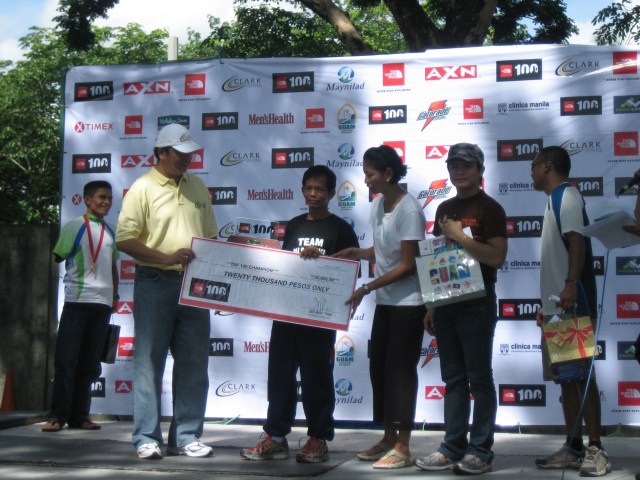
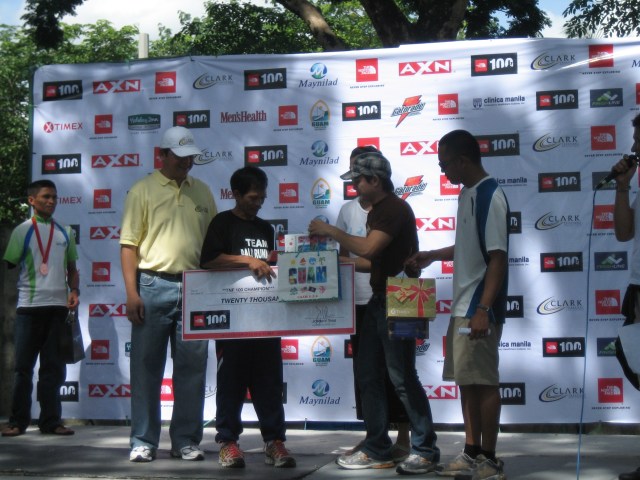
Eduardo Villanueva of Team Bald Runner won as the Overall Champion in the TNF 100K Solo Run at Sacobia, Clark, Philippines.  Ed Villanueva was also the Overall Champion in the 1st Bataan Death March 102K Ultramarathon Race held last April 5, 2009.

Ed Villanueva Receiving The Check Worth P 20,000
Eduardo Villanueva as The Champion in the TNF 100K Clark Solo Run Receiving His Prize & Gifts from TNF

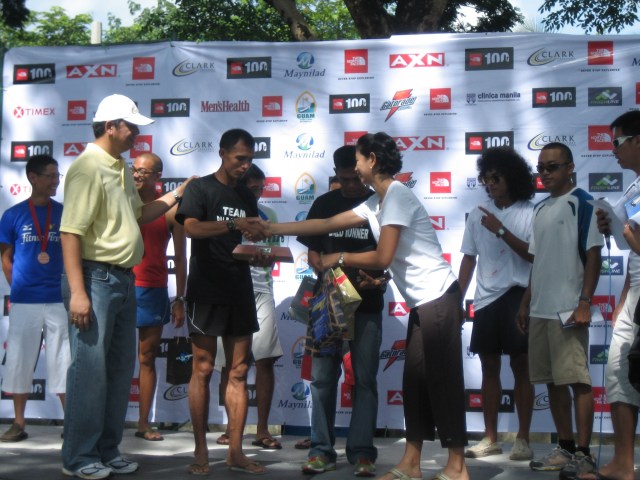
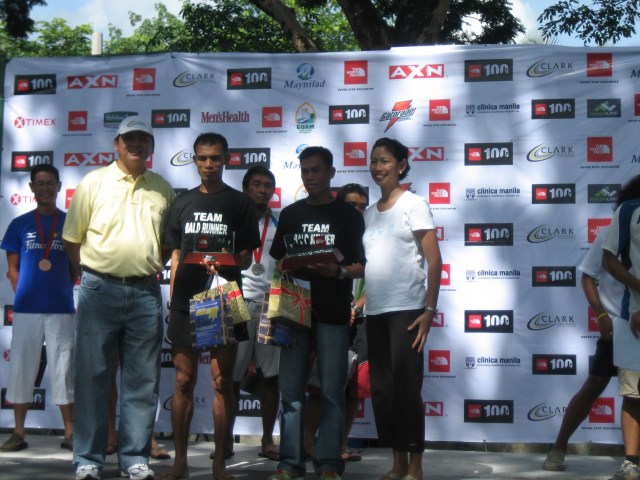
In the 100K Team relay, Cresenciano Sabal and Reynaldo De Los Reyes of Team Bald Runner also won Overall Team Champion in the said event.

Cris Sabal & Rey De Los Reyes Receiving Their Awards & Prizes (On the right is Coach Rio as the RO/RD & Jundel of TNF)
Cris & Rey of Team Bald Runner as Champions in the 100K Relay Race

Ed Villanueva received a cash prize of Twenty Thousand Pesos (P 20,000) and other Gifts from The North Face and other sponsors. The members of the 100K Team Relay also received a cash prize of Seven Thousand Pesos (P 7,000) each and other gifts from The North Face and other sponsors. 

Congratulations!…”Good Job”!!! Mabuhay ang Team Bald Runner!!!