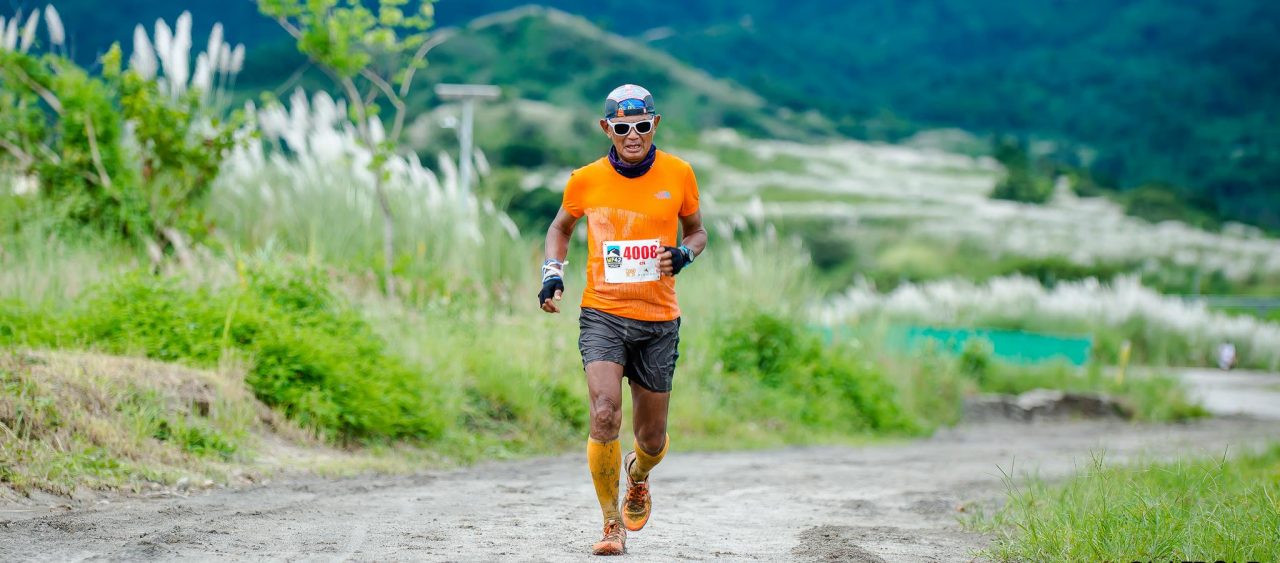
Race Report: 2017 Miyamit Falls 42K Trail Run (4th Edition)


Race Report: 2017 Miyamit Falls 42K Trail Run (4th Edition)

I was one of the “pioneers” of this trail race and I published a Race Report about it. That was four years ago and had been a trail runner for two years when this event was conducted.

I did not have any plans of joining this year’s edition but I thought of exposing my running buddy and training partner for a race, for the first time, which is very near my Playground. It was still within the Registration Period when I sent a message to the Race Director, Atty Jonnifer Lacanlale, of my intention to join in this year’s edition of the event with another runner. He gladly accommodated my request and I informed my training partner (aka Official Kodaker) that I have registered him to compete in a Trail Marathon.

Whatever my training for the day is the same training that we had to do and run together. For the past months and weeks since the middle of June of this year, my training partner was exposed to the training program/schedule that I got from my Professional Coaching Services. If the schedule calls for “hill repeats”, he would do so but with a faster speed/pace than me. If my schedule calls for a “tempo run repeats”, he would stay with me for the first repetition and ask him to just hold my camera and take pictures of me while doing my intense and hard “tempo repeats” in the mountain. If I do my “strides”, he would quicken his pace as he is always positioned behind me in my runs.

Knowing that he has the strength and speed for the race, I taught and advised him on tactics and race strategy during a race. I advised him to position himself on the 3rd or 4th guy from the front, with his eyes on the leading runner on the first half of the race. If he has still the strength and speed on the second half, that is the time to make a move. On a final advise, I told him not to talk or engage in any conversation with those guys in front of him or to anybody. He should be focused on getting in front by all means before reaching the finish line. However, if he can not keep up with the pace of the top runners, I advised him to conserve his energy on the first half (climb to the peak/turn-around) and then go as fast as he can on the downhill going to the Finish Line. And that was what he did! He finished #6 Overall and he was happy. And the Coach is happy, too!
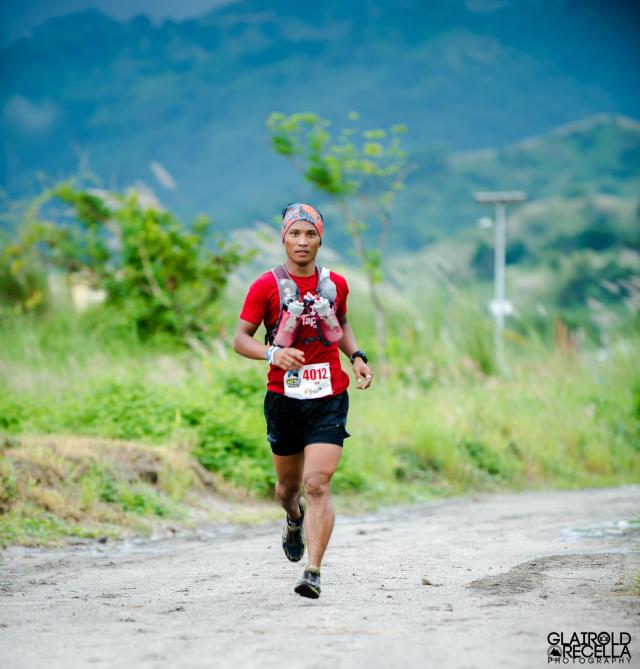
Leo 02
Leo Taruc, My Training Partner & Kodaker (Photo By Glairold Recella)

Four years had passed when I joined the First Edition of this event and I finished #36 out of 115 finishers with a time of 7:58+hours then at the age of 61 years old and two years after I’ve transformed myself from a road runner to a trail runner. It is not bad to condition my mind that I would improve my time in this year’s edition. I announced on my Facebook Wall that I will try to improve my time in this event, even for some few minutes! I was wrong!

At exactly 5:30 AM of Sunday, October 1, the race started at the Alviera Recreational Center in Porac, Pampanga and the runners were combination of those doing the 42K and 26K distances. I call the 42K runners as the “bravest ones” in this event! As for me, running without “trekking poles”, is again my “bravest and dumbest” decision in this race! It should be noted that I finished the CM50 for four times without the aid of trekking poles because I was simply “hard-headed”! I guess, as I become older in this kind of sports of Trail Running, it is already a mandatory on my part to bring trekking poles with me if the event allows the runners to have them as a running gear.

From the Starting Line, I jogged and ran comfortably, making the flat and downhill sections going to Barangay Sapang Uwak (1.5 to 2 kilometers) as my “warm-up” run which is equivalent to my 20-minute of “warm-up” runs during my daily workouts. As I approached the center of the Barangay, I was still running comfortably as the road became steeper. I am glad that we took the original route where almost one kilometer of the steepest portion after the Barangay Hall had been cemented/paved. But the steepness of the road was still brutal to the runners’ legs! A Lady Runner would curse and shout the F-word as I passed her. I really don’t know if she was cursing me or cursing herself or cursing the road! There was no need to look back to see her face or engage in a conversation with her!

There was a lot of new faces in this event and most of them were my first time to see them. I saw some of the “usual suspects” and I know by their names and most of them are “loyalists” to this event. It was also a good observation that I saw a lot of runners wearing the Hoka One One Speedgoat 2 but I was glad I was wearing a different shoes! The color of the my Speedgoat 2 does not match with the color of my Running Kit! Hahaha!
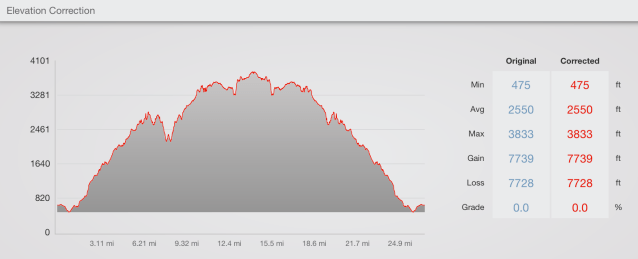
2017 Miyamit 42K Profile
Miyamit Falls 42K Elevation Profile (From Training Peaks)

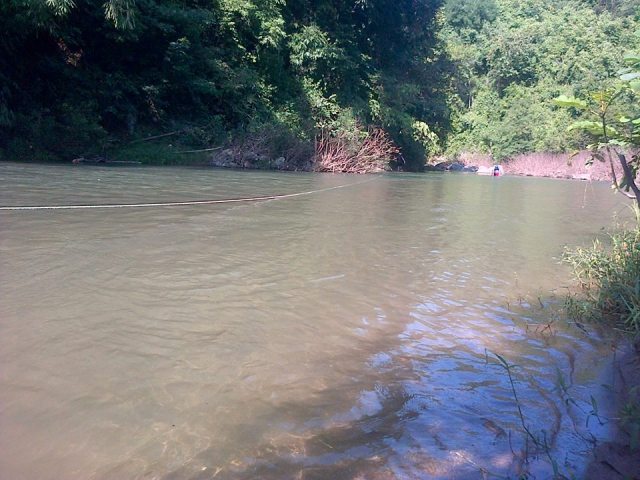
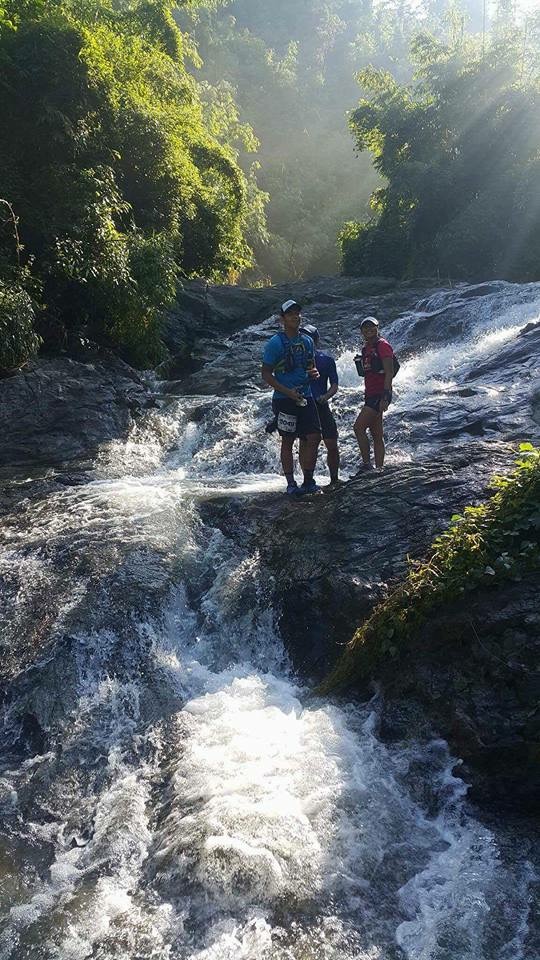
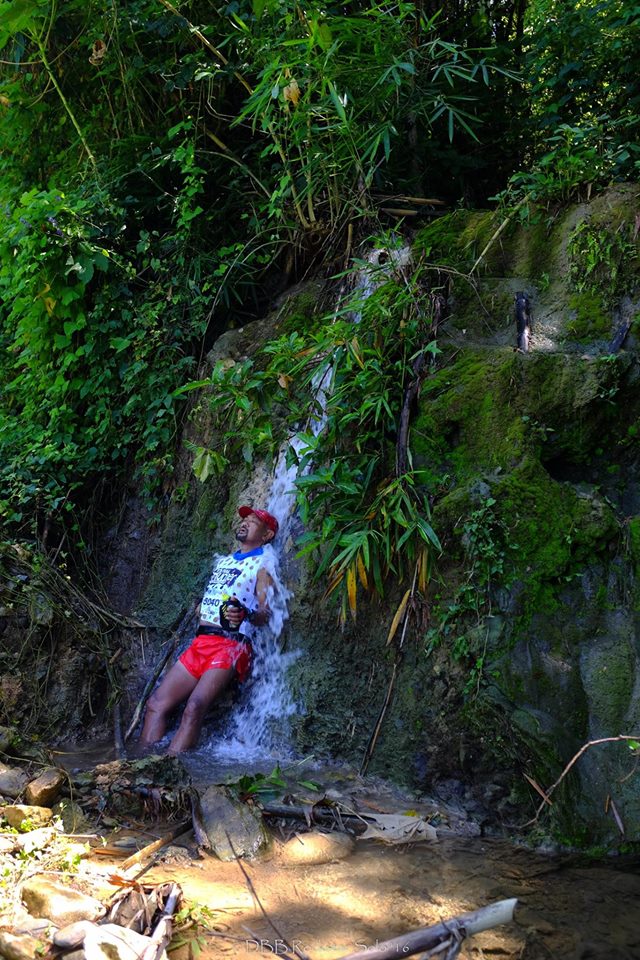
I tried hard to reach the Miyamit Falls within two hours but I failed! I reached the falls at 2:28+hours and went back to AS3 where I filled my hydration bottle before proceeding to the Peak/Turn-around point which is another 10 kilometers! It took me another 2:30+ hours to reach the Peak/Turn-Around point. On my way back to AS3, I have to stop and eat my Pack Meal on a flowing stream where I have to sit on a rock and drink some water. I think I was able to rest for about 20 minutes just to regain my strength and rehydrate my tired body. I even went to extent of pouring cold water from the stream to my head and whole body to cool off and dip my legs to the flowing water. My decision to rest, re-hydrating, taking a dip to the cold water, and eating my packed meal gave me the strength to run all the way to the AS3. It took me another two hours to reach AS3 from the Peak/Turn-Around Point.

I knew already at this point that I could no longer improve my previous time of sub-8 hours! Instead, I took some time to talk with my friend, Joma Sison, who was manning the AS3, and eat some food served at the Aid Station and drank the Sprite soft drinks he reserved for me! Thank you, Joma for being there despite the inclement weather and slippery/muddy road! At this point, I was already raining and my feet would compete with the flowing water on the trail as I ran down towards Barangay Sapang Uwak. I have to stop and refill my hydration bottle for the next two Aid Stations and pour some water to my head and face! There are also sections of the trail that I would run through some deep and shallow muds. And that is part of the fun and challenge in trail running.

From the second to the last Aid Station to the Finish, I knew that my quads will be challenged on those steep downhill road towards Barangay Sapang Uwak and I was prepared for the beating! I continued to run and took some small successive steps on those steep portions of the road until I reached the flatter sections at the center of the Barangay. From the steel bridge, I knew that I have at least 1.5 kilometers to the Finish Line!
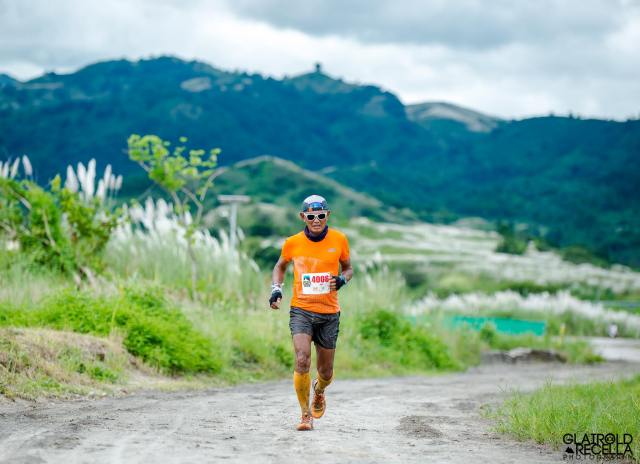
MF 42 06
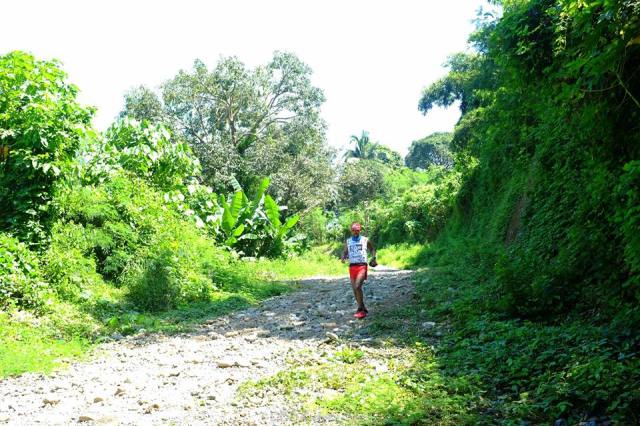
Approaching The Finish Line! (Photo By Glairold Recella)

I finally crossed the Finish Line in 8:58:30 hours, which is One Hour slower than my previous time! My performance is still on passing grade, considering that the cut-off time for the event is 10 hours! Aside from the inclement weather; muddy and slippery condition of the trail; extended rests on the stream; and staying more time in the Aid Stations, I think my age is catching up on me! However, I am happy that I finished this race; served as one of my training runs for a longer race in the future; and being the Oldest Finisher in this Badass Trail Running Event!

I highly recommend this trail running event to everybody but there is a need for a race-specific training schedule and workout for this event. A 3-month trail running schedule/training preparation with lots of elevation gain and downhill running would best prepare anybody to finish this event within the prescribed cut-off time of 10 hours.

Congratulations to Atty Jonnifer Lacanlale and his Team for coming up on this yearly Badass Trail Running Event. It is one of the well-organized trail races that we have in the country today!

Running Gears:

The North Face Orange Shirt; The North Face Cap; The North Face Trail Shorts; AMIHAN Go Lite Race Belt; Taiwan’s Beast Hydration Bottle; The North Face Compression Socks; New Balance Vazee Summit Trail Shoes; Adidas Gloves; 2017 UTMB Buff; San Diego 100-Mile Endurance Run Buff; Miami Sunglass; and IPhone5

Nutrition: XO Coffee Candies; Cloud9 Chocolate; SkyFlakes Condensada; Goya Chocolate Pops; and Meal Pack
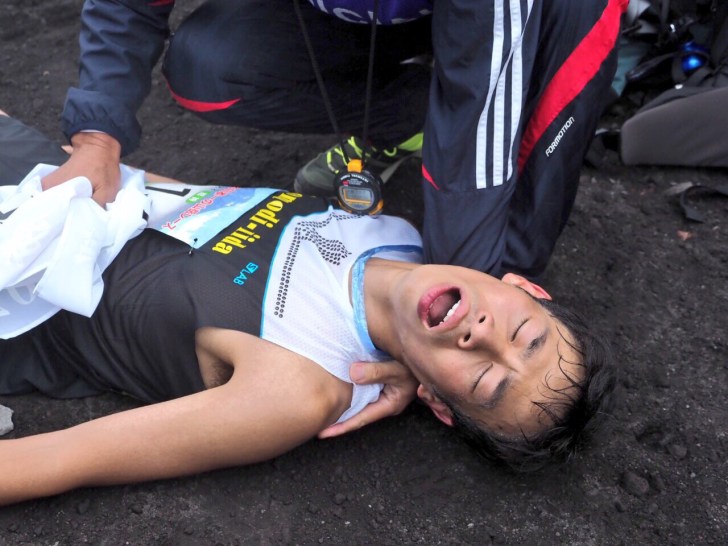
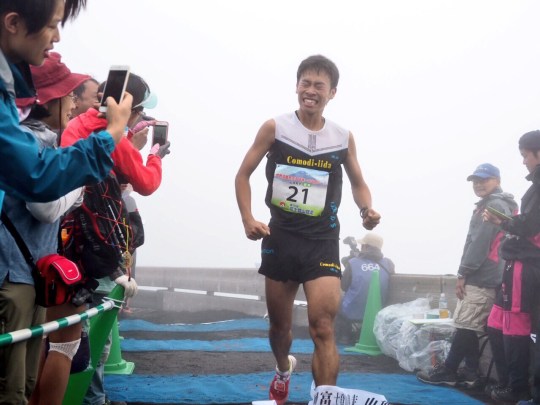
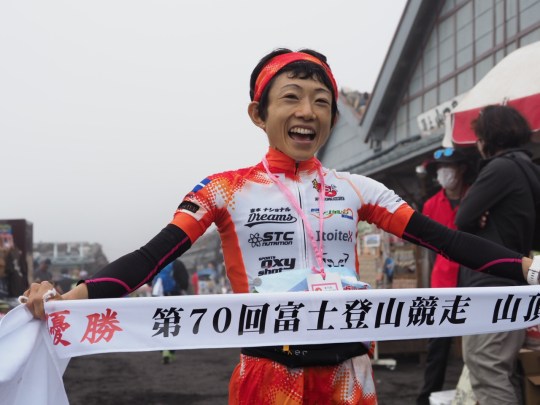
Podium Finishers: 70th Edition of the Mt Fuji Mountain Race (July 28, 2017)


Repost From Japan Running News:

New Champs Crowned as Gorotani and Yoshizumi Win Fuji Mountain Race Titles

Celebrating its 70th running this year, the Fuji Mountain Race took place on Friday, July 28. As in past years, the first 10.8 km from Fujiyoshida City Hall at 770 m elevation to Umagaeshi at 1450 m was a gentle climb on paved roads. From Umageshi runners enter trails, and for the kilometer from Hanagoya at the 7th Station all the way to the 8th Station it becomes a very difficult 40-degree incline climb. After that runners pass through an area of rough volcanic rocks as they approach Mt. Fuji’s summit. Peaking out with a net elevation difference of 3000 m, the 21 km Summit Course continues to gain a reputation as Japan’s premier mountain race. Last year bad weather forced the race to be stopped at Mt. Fuji’s 5th Station, meaning that this year’s race would be the first time in two years that  runners would finish at the peak.

In this year’s 70th running, former Hakone Ekiden uphill Fifth Stage standout Shun Gorotani (Comody Iida) won in 2:31:34, an excellent time just 3:53 off the course record. In the women’s race, world-class Sky Running Vertical Kilometer runner Yuri Yoshizumi won in 3:01:17, the fastest women’s winning time since 1988. Both won in their first attempts at the Summit Course.

Men’s winner Gorotani is just 24. As part of Toyo University‘s ekiden team he ran the Hakone Ekiden twice, finishing an outstanding 3rd on the uphill Fifth Stage in 2016 behind stage winner Daichi Kamino (Aoyama Gakuin University). Gorotani now runs for the Comody Iida corporate ekiden team. Last year he won the Fuji Mountain Race 5th Station short course, breaking the course record by a wide margin. Having qualified for the Summit Course, Gorotani returned to live up to expectations with another superlative win. Taking control of the race early, Gorotani opened up a lead of 14 minutes over 2nd-placer Satoshi Kato, yet another runner-up finish for Kato. Gorotani was misdirected by course marshals very early in the race, but officials judged the error to have had no impact on his result.

Women’s winner Yoshizumi began running as an amateur after she began working full-time, winning the 2013 Hokkaido Marathon in a PB 2:37:56. Changing her focus to trail running in 2015, Yoshizumi won the 2016 Sky Running Japan Series’ Vertical Kilometer Series title. In December last year she won the Sky Running Asian Championships MSIG Lantau Vertical Kilometer, and in May this year she won the Vertical Kilometer World Circuit’s Transvulcania Vertical Kilometer against Europe’s best athletes. Outside of the Vertical Kilometer, she finished 13th in last year’s IAU Trail World Championships Trans Peneda Geres 85 km, competing at the world level from her home base in Osaka. Like Gorotani, she won the Fuji Mountain Race 5th Station Course last year before coming back to win the Summit Course this year, finishing 9th overall.
Source article:
http://dogsorcaravan.com/2017/07/28/fuji-mountain-race-2017-result/
translated by Brett Larner
all photos © 2017 Koichi Iwasa, DogsorCaravan, all rights reserved

2nd Week Of Training: Mt Fuji Mountain Race


June 19-25, 2017

June 19, Monday, was a well-deserved REST Day for me after my weekend “back-to-back” training runs which culminated in a 10.5 mile recon run in Palayan City, Nueva Ecija & Fort Magsaysay. The heat of the sun on those exposed single-track trail put a lot of exhaustion and fatigue to my body system. I usually have a complete rest on this day by eating and having more time to sleep on Sunday and Monday evenings.
This week will be my first full week of training from Monday up to Sunday. On Tuesday, the training schedule was for me to do a 1:30-hour Endurance Run on a trail and I selected my Backyard’s Loop #2 Trail as my course. This course is what I fondly called as the “Brown Mountain” course which is a wide-dirt road and eventually turns into a single-track trail to the foot/peak of Mt Quadrante and Mt Tambong/Mt Maniwalan. I was able to cover a distance of 7.17 miles for 1:31+hours with an average speed of 12:42 minutes per mile. I observed that my run was very comfortable because of the cooler air as I started my run very early in the morning, before the sun rises.
On Wednesday, I had my first “hill repeats” or Interval Training workout. The total time for this workout, to include the warm-up run; hill repeats & rest between interval; and the cool-down run, would result to 1:30 hours. I did my “hill repeats” in a place where the housing subdivision was discontinued and the place was all mine in the early morning as there were no people in the area. It was my first time to feel the shortness of breath and the feeling of being dizzy as if I am going to have a “heart stroke” after I did my 4th repetition. I have to adjust my pace but I tried my best to push harder as I reach the highest elevation/end of my hill repeats in every repetition. I have to bring up my knees higher; swing my arms faster and wider; and breath as hard as I can. The total distance that I covered was 6.78 miles but I felt that I was able to force my heart and lungs to a higher level of exertion than I had before!

2nd Week Mt Fuji Training 00
Endurance Runs @ Backyard’s Loop #2 (Mt Tambo/Maniwalan At The Background)

On Thursday, I had my Recovery Run/Easy Run for one hour where I covered a distance of 5.20 miles. This was done on a paved road where the first half was slightly going uphill and then back to where I started.

On Friday, it was another 1:30-hour Endurance Run which I decided to have at the same course that I did last Tuesday (at my Backyard’s Loop #2). The same as of Tuesday’s run, I have to run up to the mountain for 45-46 minutes and then turn-around towards the starting line for the second-half of my workout. To my surprise, I was ahead or faster by 2:30 minutes when I reached the turn-around point during my run last Tuesday and I just continued my run for more elevation gain for the rest of my time before turning around for my last 45 minutes back to where I started. I was able to cover a distance of 7.63 miles on this workout!

On Saturday, I had my second “hill repeats” session, the same session/workout that I had last Wednesday but the total number of hours for this workout is 2:30 hours. Since it was the schedule of one of my PAU races (Mariveles To Bagac 50K Ultra Run), I have to think of a way where I can insert my training workout while I am supervising this race. Instead of “hill repeats” of going up the hill and then back down the hill, I improvised my “hill repeats” by continuously going up towards the peak or highest point of the course. So, I brought my vehicle to the highest point of the course, parked it, and then I started my warm-up run by going down the mountain for 40 minutes on an easy pace. From the point where I made my turn-around, I returned up to the mountain doing my “hill repeats”. After 1:20 hours, I continued my run and tried to catch up with the runners of my race. After 2:30 hours I was able to cover a distance of 13 miles. Since the road was not as steep as my “hill repeats” on Wednesday, I felt I did not push too hard and felt that I was still strong after the desired number of hours of my workout for the day had elapsed.

On Sunday, the goal was to practice running and hiking on a higher elevation gain for 4 hours which is a good equivalent of “double-traverse” to my Backyard’s Loop #3 (Mt Roosevelt Traverse). It was also a workout to train for my hydration and nutritional needs in longer runs with more elevation gain. I was in the company of PAU runners who just finished in the previous day’s 50K run! We had some rests and “pit stops” along the route but we were able to make it in 5 hours for a total distance of 13.3 miles. It was nice to be back on this course which I missed for the past 4 weeks. We had some delays on our uphill climb due to the growing tall grasses and plants that partly cover the trail. On our way back for our 2nd traverse, the sun was already hot as most of the trail is exposed to the sun. We slowed down due to the heat and I had to submerge myself to a flowing stream, 3 miles before the finish line! We ingested some solid foods and soda drinks at the turn-around point (Mile 6.6).

2nd Week Mt Fuji Training 01
At The Peak Of Mt Roosevelt With PAU Runners

Everyday, I have to force myself to sleep 8-9 hours every night and after my “hill repeats” sessions, I had to take a nap in the afternoon for some rest. My nutrition intake for the week consists of ordinary Filipino foods and fruits.

The following are the totals for this week:

Total Duration (Time): 13:40 Hours

Total Distance: 52.8 Miles/84.48 Kilometers

Total Elevation Gain: 21,795 Feet

Elevation Gain Per Mile: 412.78 Feet

Lace up and go run!

Mt Fuji Mountain Race


The first time that I knew about this iconic Running Event held in Japan was when a group of Filipino runners joined this event 3-4 years ago and it did not create any “noise” or “trending” on the Internet. If I am not mistaken, this is a running event which popular among “Skyrunners” or maybe, among “mountaineers”. I am not even sure if these runners were able to reach the Finish Line (Summit of Mt Fuji) within the prescribed cut-off time of 4:30 hours. To add mystery to this event, nobody is “bragging” or let me say, saying that they have joined or finished this event. It could be that they are not my friends on Facebook or subscribers or readers of this blogsite.

After I have finished the Tarawera 100K Ultramarathon Race in Rotoura, New Zealand, I’ve read a story or article about a New Zealander/Kiwi Runner who won this event who happens to be a Olympic Gold Medalist in middle distance running. The said Olympian also won in one of the past editions of the Jungfrau Marathon Race in Interlaken, Switzerland. Through this Kiwi Runner, I was inspired to have a try on these two running events.

Mt Fuji Website
Photo Of The Official Website Of The Event

Through its Website, I was able to find out the details of this race. This year, 2017, it will be the 70th edition of this race which means that this running event was born 2 years after the defeat of Japan during the World War II. It was a period when the US Armed Forces had ruled over the whole country of Japan. I believe that the US had no influence on the creation or birth of this iconic running event. However, I strongly believe that the Japanese people came up with an activity/event that will boost their morale, thus, a running event to unify the Japanese people to the peak of the highest mountain in their country which they consider as their nation’s symbol & sacred place in addition to the the “rising sun” in their national color.

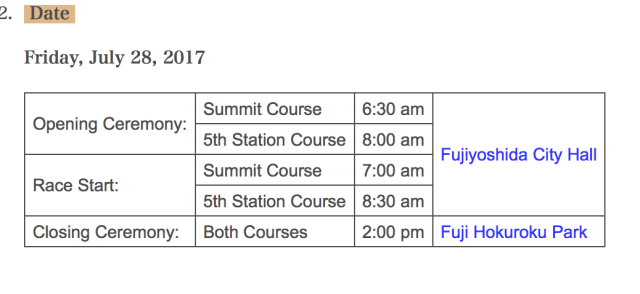
This running event will be held on July 28, 2017 (Friday) and I really don’t understand why this iconic event is being held on a working day and not on a weekend. There is no point in asking such question or concern to the Race Organizer, which is the Mayor of Fujiyoshida, Japan. There must be a good reason for the Japanese why this race is being held on a Friday.

It is specifically mentioned in the Website as to when will be the opening of the Registration Period which is March 21, 2017 at 9:00 PM (Japan Standard Time) up to March 23, 2017 at 9:00 PM (JST). The registration period closes after the desired number of participants is attained but only fifty (50) foreigners are allowed to join this event.

There are two (2) races: The Summit Course which is a 21K race from the City Hall of Fujiyoshida to the Peak of Mt Fuji; and The Fifth Station Course which is a 5K race from Umagaeshi (Km #10) up to the Fifth Station (Km #15) along Mt Fuji’s slope. The Summit Course has a registration fee of 15,000 Yen while the shorter course has a registration fee of 10,000 Yen.

Mt Fuji Mountain Race Schedule
Schedule Of Races

The race starts in an elevation of 770 meters and finishes at an elevation of 3,776 meters which is the elevation of of the peak of Mt Fuji. The cut-off time at the Fifth Station (Km #15) is 2:15 hours and the cut-off time at the Finish Line (Peak) is 4:30 hours.

What is the award if one finishes the Summit Course? A Finisher’s Shirt Only! This is a Finisher’s Shirt that is worth preserving in a nice picture frame!!!

Mt Fuji Mountain Race Cut-Off Times
Cut-Off Times For The Two Events/Courses

Not so fast on thinking that I would be able to finish this race! But first, one has to be quick and fast also in making sure that you are registered to this event!

I was in the United States when the registration period started and I have to wake up at 4:00 AM on March 21, 2017 (JST is +15 hours from the PST) and ring my alarm just to be sure that I would be awake before the opening time and then register immediately once the registration button turns on! At exactly 5:00 AM (PST), the registration button turned on and I immediately registered to the Summit Course Race. It was problematic at first in paying the Registration Fee because all Foreign Runners had to pay through Pay Pal. Since I don’t have any previous Pay Pal account, I had to create one on the spot! After almost 30 minutes creating a Pay Pall account and answering and filling-up some questions online, I was able to get in as one of the participants from the limited number of 50 foreign runners!

I went back to sleep after I have received a confirmation message in my e-mail that I have registered and while I was having my breakfast at 8:00 AM, I was surprised to see that the Registration for the two races was already CLOSED! The registration was supposed to be in 3 days but it closed after 3 hours of registration! I found out later that the Race Organizer usually cap this race up to 5,000 runners to include the 50 foreigners!

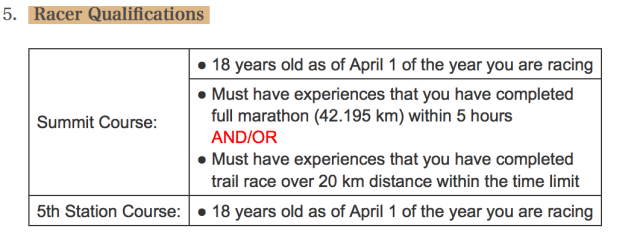
The most significant question that was asked on the registration form is my last 3 Marathon Races with finish times below the 5-hour limit. I mentioned my sub-4 hours MILO Marathon finish; Condura Skyway Marathon Finish (sub-5 hours); and my latest 2017 Los Angeles Marathon (4:24+ hour) a week before.

Mt Fuji Mountain Race Qualification
Qualifications To Join This Event

I was happy that I was able to get in among the 50 foreigners to join this race. And from that day, I started to browse on the Internet on posted stories and blogs of runners who joined this race for the past years. From these of stories of DNFs and successful finishes, I was able to gather some data and information on what to expect during the race. I would gather also suggestions and advise on the things on what to do during training/preparation and the things needed in order to meet the challenges the mountain have to offer to each of the runners.

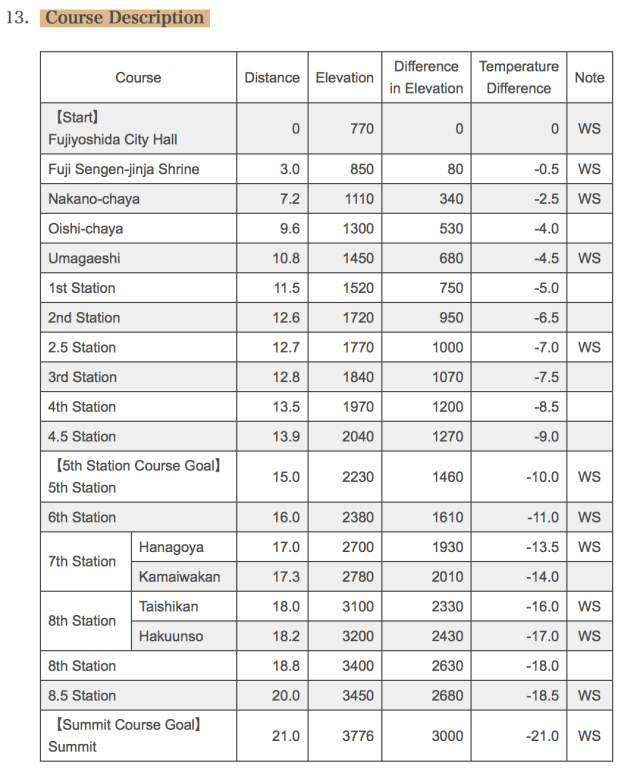
Looking at the tabulated course of the event, I could not imagine how I would be able to finish this event! The only way to find out is to take the challenge and make the necessary training and preparation.

Mt Fuji Course Elevation Profile
Course Description: Mt Fuji Mountain Race

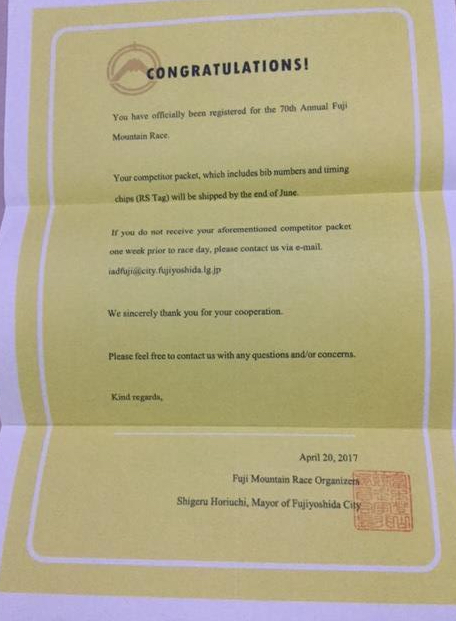
Last week, I was able to receive a Congratulatory Letter from the City Mayor Fujiyoshida for being one of the 50 foreign runners and participants in the 70th edition of the Mt Fuji Mountain Race. The letter was sent through the mail which the Race Organizer started sending to all the participants since last April 2017.

Mt Fuji Letter
Letter Of The City Mayor Of Fujiyoshida

I am on my third week of focused training and I am very positive that I am becoming a stronger and faster mountain runner! Wish me luck!

Lace up and go run!


1st Week of Training: Mt Fuji Mountain Race


June 12-18, 2017

After I have finished the  4th & last Marathon Race of the BR’s Quad Marathon, I did not run for two days, Tuesday & Wednesday, to give rest to my tired body. I simply ate and slept for these two days with some stretching to my legs and body. These two days officially started my training for the Mt Fuji Mountain Race which will be held on July 28, 2017.

Starting on this week, I started to shift/change my training using the time duration of my workout as my goal/objective for every workout, instead of planning to run a certain distance. For the past training cycles, I have been concentrating on the number of miles I have covered every week and it is worth a try to be counting on the number of hours as the priority data for my workouts. Mileage will be secondary data to be considered and recorded.

On Thursday, I had a one hour recovery run on a flat paved road with an Average Pace of 12:09 minutes per mile. My GPS Watch registered a distance of 5.02 miles. It was a very relaxing pace where I would be running and talking with one of my former elite athletes with Team Bald Runner who happens to be a runner-soldier of the Philippine Army. I thought it was an easy and relaxing one hour run but the data in my GPS Watch registered otherwise. It appeared that I was exerting so much effort on the last half of my workout.

On Friday, I made sure to have a slower and more relaxing one hour recovery run where I registered a distance of 4.95 miles and with a slower Average Pace of 12:23 minutes per mile but the workout was done on the streets surrounding Fort Bonifacio with lots of rolling hills. The total elevation gain was 1,816 feet and was able to register an Average BPM of 132. I guess, I was too fast in this workout as a result of my deep-tissue massage the night before this workout.

On Saturday, the schedule was to run 1:30:00 hours on the trails. I had my run in my backyard/Playground’s Loop #1 which is an “out and back” route up to the distance where my GPS Watch registered a time of 46 minutes! This was my first trail run since I’ve finished my Quad Marathons. I call this workout as an “Endurance Run” which I am training for as my regular pace in all my trail running races/events. Having said that, these Endurance Runs will be the “bread and butter” in all my weekly workouts. I was able to finish a distance of 6.43 miles with an Average Pace of 14:14 minutes per mile. The total elevation gain is 2,011 feet with an elevation loss of 1,880 feet. My Average BPM is 150 with a Maximum of 161. I think I was running with a faster pace considering that the course has lots of steep hills.

loop-11.jpg
Saturday Run @ Backyard’s Loop #1

In the afternoon of Saturday, I had some strengthening exercises which I finished in 30 minutes which are geared towards my core!

On Sunday, I was invited by a friend to recon the proposed course of a new trail route where the event will be held later this year. It was supposed to be a 2-3-hour trail run but we finished the run in 5:05:07 hours covering a distance of 10.7 miles with a total elevation gain of 7,336 feet  and a elevation loss of 7,247 feet. We were running the first half of the course until we hiked towards the peak of Mt Mapait which has an elevation of 1,137 feet and power hiked the last half of the course. Due to the exposed nature of the trail from the heat of the sun, we were exhausted and had to make a lot of stops on flowing streams to cool off our bodies. The Average Pace in this workout was 28:26 minutes per mile (to include rests) with an Average BPM of 129.

Palayan 42.jpg
Sunday’s Recon Run & Hike In Palayan City/Fort Magsaysay

For four days, I was able to register 8 hours and 39 minutes duration of run, covering a distance of 27.1 miles. The total elevation gain is 11,176 feet. Which means that for every mile that I covered, I was able to get an elevation of 412 feet!

Week #1 Summary:

Number Of Hours: 8:39 hours

Distance: 27.1 miles

Total Elevation Gain: 11,176 feet

Elevation Gain Per Mile: 412 feet

This is just the beginning of my training cycle and I am happy that I am having fun without any “niggles” or extreme pain on my legs or body. I am hoping that I will be stronger and faster next week!

Lace up and go run!


Training = Stress + Recovery


I really don’t know who started or formulated this formula on training. But in all the books and written publications that I have read, over and over, this formula is being mentioned repeatedly. In my own understanding of this formula is that, for me to keep on progressively and consistently improving on my running, I have to “use it or lose it” the God-given strength and endurance that I have developed through the years and mix it with the necessary rest and recovery so that my body would be stronger and better in my next period of training or running season or be “always ready” for the next race.

For this year, my successful finish at the 2017 Tarawera 100K Ultra Trail Marathon Race last February is a product of focused training since July of last year. After one month of recovery period of easy running and hiking the mountains of Los Angeles National Forest, I finished the 2017 Los Angeles Marathon with an impressive time of 4:24+ hours which surprised me, knowing that I did not have any focused speed training in preparation for this race. I guess, the stressed that I put in in my Tarawera 100K Race plus the rest & recovery that I did to my body prior to the Los Angeles Marathon, greatly helped for my body to breeze along and comfortably finished the event.

After I finished the LA Marathon, I went back to more trail running and hiking in my Playground on my own pace just to keep my body on the move on a daily basis except for Mondays which I consider as my Rest Day within the week. However, the first edition of the Lang-Ay Trail Marathon (42K) was already on my sight as my C-Race for the month of April with the objective/goal of simply finishing the race even if I am the last finisher. True enough, I was the last finisher and one of the “Pioneers” of this event which I consider as the hardest Marathon Trail Race in the country!

For the month of May, I registered for the Beast Trail 50K Run in Taiwan after I read a Race Report from one the runners who was a foreigner attending a conference in Taipei, Taiwan. I was just curious why most of the finishers had clocked in an average of 14-16 hours as finish times. And they had only 5 finishers in the 100K distance with a cut-off time of 30 hours! I trained a lot for the elevation in my Playground but I did not expect that I would face a lot of rock climbing, rope climbing, and rappelling plus the fact that it rained on the later part of the day that brought a very deep slippery mud on the trails. I still have two minutes to spare whether I would proceed to the 50K distance or shorten my race to 40K where I could still receive my Finisher’s Loot and get my UTMB points for the 50K distance. I opted to get the shorter route and took my time to finish the race. I even helped some of the local runners who got lost and asked for direction and another lady runner-participant of the 22K race to whom I helped in climbing those slippery uphill trails. Finally, on the last 4 kilometers, I lend her one of my trekking poles as I saw her trying to look for a branch of a tree/plant along the route to be used as her balance pole! The lady runner thought that I was from Japan! I finished the race in 14+hours just in time for the last bus to depart from the race venue to Taipei which is 1:15 hour ride. I was glad that I did not spend the whole day and night hiking and trekking in the mountains of Taiwan!

The Beast Trail in Taiwan had really put some beating on my body that I was not able to walk straight for two days! It was only after a week of rest & sleep, eating, and a 2-hour deep-tissue massage that made me back to my running and hiking form again!

Two weeks after the Beast Trail in Taiwan, I was one of the runner-participants/”sweeper” of my new running event which is the BR’s Quad Marathons. Though my finish times were slow, I and the rest of the runners are very proud that we all finished the event without any pain or injury. I guess, I would attribute the endurance and strength that I had in this event as a product of the “stress” I put in to my body during my participation in the Beast Trail Race in Taiwan.

Aulo Dam Mt Mapait
Training For The Mt Fuji Mountain Race In Nueva Ecija (Photo By Nel Valero)

After a two-day rest & recovery after the Quad Marathons, I am back again to start my training for the Mt Fuji Mountain Race (21K), A Race To The Peak which will be held on July 28, 2017!

I have six (6) weeks of training before my next race! I am sure there will be more “stress” on this one! Wish me luck! If ever I finish this race (or not), the recovery will come next…and the cycle continues!

However, in between those cycles of races that I join, I always make it a regular habit to have Mondays as my Rest Day. And every month or four weeks of training, the 4th week is my recovery week where I decrease the volume and intensity of my training workouts.

So, what is the message that I am driving at in this post? Keep on “stressing” yourself into something that you love and passionate to do and that you need to recover and find time to rest your body for you to get a better performance and full satisfaction for the work that you invested towards the attainment of your goal. In short, keep on moving forward because training makes us stronger and healthier person!

Lace up and go run!

Mental (Training) Preparation


For a serious marathoner or ultra runner, the physical training in preparation for an event needs a lot of time, effort, dedication, patience, money, and hard work just be able to attain those number of miles, hours of training, and comply to the scheduled training one has to follow. It is already ingrained in us the importance of the following: Long Slow Distance running to develop our endurance; Interval Training and Hill Repeats to develop our power, strength, and speed; Tempo Running to develop a sustained pace for a certain period of time; and Recovery Runs to allow our muscles to recover after a certain more intense workout or after a block of weekly training. And most important of all, Rest, for our muscles and the whole body to recuperate and rebuild as a result of the stress the body had been exposed to.

Even if we think that our physical preparation is perfectly done, there is still a great possibility that we fail to cross the finish line. There are outside factors that will try to challenge our physical training. It could be the weather, the difficulty of the terrain (high altitude), injury, or if not, accidents! But what is most important during the race is how your brain works before and during the race.

Mental attitude during the race is the key to a successful finish in a race and it plays a lot in all my successful finish in the past.

Hiking 02
“Train Heavy, Race Light”

For a runner to have a positive mental attitude during the race, he/she should have done his/her assignment on mental training/preparation before and during his/her physical training preparation for the event. Only few of our elite or average ultra runners who would tell us in their respective blogs on how they mentally prepared themselves to podium finish or simply finish the event. Or maybe, they don’t know about mental attitude as it is already ingrained in their body system without them knowing it.

Here are my suggestions for anybody on how to mentally prepare for a certain running event, either you are a “newbie” runner or a hardcore ultra runner:

  1. Create a Blog——It is now very easy to create a blog or personal website where a runner can use it as a Daily Dairy. Just make sure that all your stories or entries are true and accurate. This is where you describe your physical training and the place where the training is done on a daily basis. In short, this is your Runner’s Logbook where you include what you think about your training for the day and how your body feels before, during and after the workout. Do not fabricate or manufacture your daily entry. If you missed a daily workout, say so! Nowadays, you can have your blog on Facebook! This “diary” will become your reference in your future races. And please don’t think that you will be “sharing” your “secrets” to your readers by showing to the world how you are preparing for your next running event. The key word in the present world of Social Media is “SHARE”. The more you share your experience, the more you inspire others!
  2. Shout It To The World——If you are dreaming a certain event for you to join, announce it to the world. If you are intending to Register to a certain event, announce it to the world through your Social Media accounts. If you have successfully registered to an event, announce it to the world. Announcing your intention to the World is too easy to be done nowadays. You can announce it to your Blog/Website, Facebook, Instagram or Twitter. The key here is that as early as possible, announce to the world that you are participating a certain event and you announce it that you will finish the event. Announcing your participation to a race makes you accountable of the things you would do to finish this race. You are also accountable to your family, relatives and friends.
  3. Make A Bet——As if you are gambling, make a bet on yourself. If you finish the event, you must be able to reward yourself with something that is very significant and reminds you of your accomplishment. It could be something physical (object—-new shoes or new running gear/apparel or a trip to a place where you can rest and relax. If you fail in your event, think of of something that will penalise or punish you! Maybe, you could take a rest or simply do another sports which you hate most! Or maybe, punish yourself by volunteering to a race where you hate the Race Director! The key here is that you should challenge yourself to be the best you could be!
  4. Ask Somebody To Make A Bet——It could be your close friend or Friends on Facebook whom you would challenge to gamble with you. If you win, you get something from them and if you lose, you give something to them. Just simple as that! Challenge your friends to gamble with you!
  5. Ask for Sponsorship and Donations——If you are very good in convincing other people, most specially to your friends, in helping you finance your trip or provide you some of the needed support like water, sports drinks and food, you can ask for sponsorship or donations. In this way, you are adding accountability to your success (or failure) among those who have donated your needs for the race.
  6. Be transparent——Post anything on your Blog those evidence that you are dedicated in your training and in your quest to finish your event. It could be coming from your workout/s on Strava, Dailymile, Training Peaks, or any pictures of you doing your homework for the event.
  7. Read Race Reports of Finishers——Most of the runners abroad have their own blog and most of them are elite runners but most of them are average ultra runners. They would share their experiences and lessons learned during their race. These blogs would provide all the detailed information about the Race. However, do not try to attain their finish time and their split times on the different Checkpoints along the route. What is important is that you can pick-up and learn some details about their attitude and sometimes, their strengths and weaknesses (mistakes) during the race.
  8. Try to Mimic or Train In A Place Similar to the Event’s Course——By studying the Elevation Profile of a certain race, you can easily determine or locate a place where you can do your training. As I said in my previous posts, you have to compute the elevation gain in every 10 kilometres of the race and then find a place where you can train with the same total of elevation gain. If it is not possible, do mountain “repeats” or multi-loop runs in a course where it is hilly or in a rugged terrain. Make sure also to be observant on your time as some of the checkpoints have a very tight cut-off times in some sections of the course.
  9. Do “Brainstorming” Sessions——In the military, we do “brainstorming” sessions during the planning stage of a military operation. We write down the possible scenario that will lead to a successful attainment of the mission/objective and in the same manner, write down the scenario that will lead to the failure of the mission. In running an ultra, you have to do this also. As of this time, you know already your strengths and weaknesses in running an ultra race. Write them down and review them as you recall them in your successes and failures in your past events. Write down also your “time-tested” remedies/solutions when you hit some “issues” along the run. From all these data, you can now write a chronological list of things to do and/or things that you experience in your body in every section of the course or in every certain period of time that you are running in an event. Hopefully, you will create a very long list and while you are reviewing them every day, you will be able to compress them and come up with an outline or a shorter version. Remember that the things on the list are the things that you are EXPECTED to do and the things that your body would react or expect to experience, considering the weather, your pace, and the terrain of the course during the race. If there is a need to have a back-up Plan, then do so! Read these plans as often as possible!
Hiking 04
Do Your Homework Diligently

Since this post is for one’s mental preparation and training before a running event, I leave it at that and more to come on how we can sustain a positive mental attitude during the race. If you have any suggestions, feel free to make a comment/suggestion on this blog.

Thank you!

Race Report: 1st MGM’s DaBoBong (DBB) 50K Mountain Trail Run (Bulacan)


Since I finished the 2nd Zamboanga Mountain 50K Run, I did not run regularly for the next 3 weeks and then resumed my daily training two weeks prior to the conduct of this event. Most of my daily training consisted of road runs where I included “strides” and tempo runs within the middle of each running workout. I made some hill repeats per week and two weekends of long hikes in my mountain trail “playground” which lasted for 5-6 hours every workout. On those two weeks of training, I made it a point to have a full day rest on Mondays and two days rest before the event.

While on training, I was eyeing to join the shorter event which is 25K because I wanted to finish the race in 4 hours; go home to Manila early during the day; and my long runs prior to the race were less than 25K. However, while driving to Doña Remedios Trinidad (DRT), Bulacan, I have finally decided to join the longer distance event which is 50K with the thought of going around the 25K-loop twice. Knowing how organized and loaded with logistics in all the MGM’s events that I’ve joined (I guess, I joined all of them!), I finally decided to join the 50K event as soon I checked-in at the Starting Area.

Sometimes, I need to challenge myself and take the risk as to how far I can go in terms of testing my physical and mental limits as a result of my limited period of training; test my gears/equipment; and test my nutrition and hydration strategies.

While it was still dark (2:45 AM) at the Caribbean Resort in Doña Remedios Trinidad (DRT), Bulacan when we arrived, I could see lots of personal vehicles parked and runners wandering around inside the resort; preparing their gears; and taking their nap while waiting for the event to start. I could see the “usual suspects” or “addict” runners in trail running but I could not see lots of the faster ones. I was wondering if there is another trail running event being held for the weekend or it is a sign that most of them are still recovering from the trail event a week before this one.

drt-08
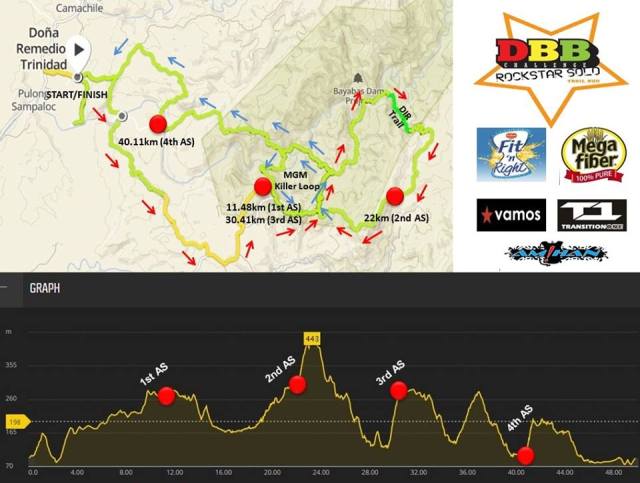
Course Map & Elevation Profile (From Facebook’s Event Page)

Few minutes before the start, the Race Director briefed us about the course/map; elevation profile; and the locations of the Aid Stations/Checkpoints/Marshals. However, the briefing did not specifically mention about the rivers to be crossed; the slippery rocks to be climbed/trekked and the numerous waterfalls to be climbed. From the description of the course, I expected that my shoes will be wet throughout the race so that I decided not to use gaiters and calf sleeves. Instead, I used my light Salomon S-LAB Trail Shoes and the thinnest Drymax socks. I took time to review the map course and asked for some clarifications as we have to pass a certain checkpoint for three times. We were advised that the Marshal in the said checkpoint will write a certain “mark” on our Race Bibs to show or indicate that we have passed the said checkpoint for three times. (Looking at my Race Bib after the event, I saw the numbers 1-2-3 written on my Bib). I made sure that I will not get lost during the race.

drt-04
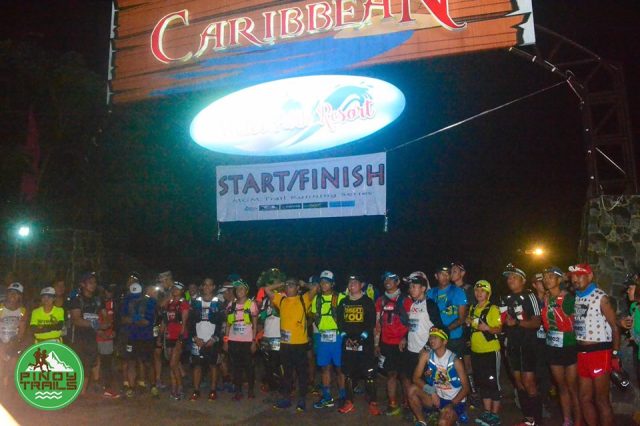
Group Picture Before The 50K Start (Copied From Facebook)

The race started promptly at 4:00 AM for the 50K distance event. I took time to walk the first few meters while I turned on my PETZL Reactik+ Headlight. From the entrance of the Carribean Resort, we turned right into an asphalted road and after a flat portion, it was all uphill where I would hike and run trying to keep up with the pace of the other runners in front of me. But I have to maintain my pace with the thought that I would not like to “bonk” on the last half of the run.

For almost one hour and 45 minutes, I was running and hiking trying to focus on what my headlight’s beam was directed in front of me. I was quite bothered with the Nathan Handheld bottle that was strapped on my left palm that the water inside in it was getting out from its sipping valve as I swing my arms. To keep the water from being wasted, I had to drink the water regularly instead of just ignoring the leak. With this situation, I was always in need of water 2-3 kilometers away from the next Aid Station but I just relaxed with my predicament as I can easily scoop some water to drink on the rivers and waterfalls along the route, this is to include the free-flowing water from hoses in some of the houses in the area and man-made wells along the side of the road.

It was already daybreak when I reached the peak of the first “major” climb of the course and it was relatively downhill and flatter portions of the course. Some of the road was paved but most of it was wide smooth dirt road. I tried to increase my pace even if I would glance on my watch that I was having an average speed of 4.2 miles per hour. To me, this is already a big improvement and I was happy that my training (“strides”/hill repeats/tempo runs) is paying off and getting positive results on my numbers/data from my GPS Watch.

nathan-waist-belt
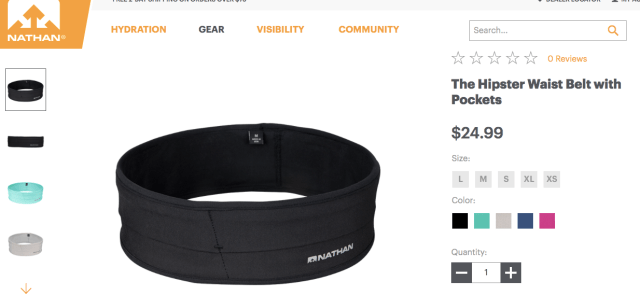
NATHAN Hipster Waist Belt (Medium)

I was regularly ingesting 2 capsules of Salt Sticks every hour and made sure that I have at least two pieces of Coffee Candies inside my mouth. Every 2 hours, I would ingest those packs filled with “Jason Koop’s Bacon & Egg Rice Balls” which I copied from the Ultrarunning Book of Jason Koop. On the major climbs/ascents, I would ingest CLIF Energy Gels (Mocha) with water. All my nutritional needs were stashed inside the pockets of my NATHAN Hipster Waist Stretchable Belt (Size: Medium). I prepared 4 packs (each pack in a ZipLoc) of Jason Koop’s Rice Balls which is equivalent to eight (8) balls. At the Aid Stations, in total, I only ate 4-6 pieces of Jelly Ace, one piece of Hopia, drank two glasses of Ice Cold Coke, and ate 3 slices of native “Biko”/native rice cake. With this regular concern on my hydration and nutritional needs, I did not experience any “bonking” or any cramps on my legs during the run even if it was already hot on my last 10K to the Finish Line.

drt-00
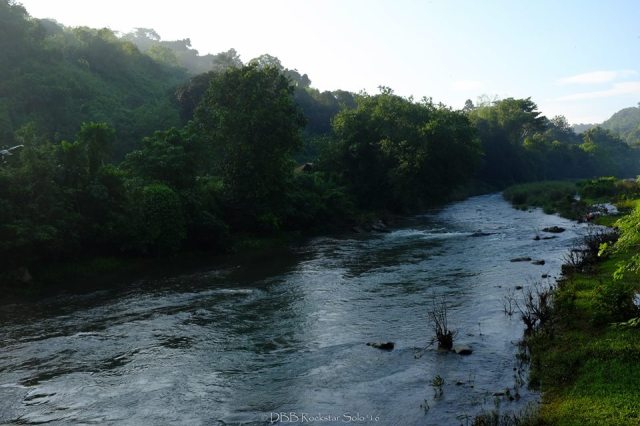
Lots of River Crossing & River Running

For the 50K runners like me, we were treated with so many surprises! I was thinking that we just simply cross a lot of streams and rivers but in reality, we were practically running with and/or against the flow of the water! And these streams and rivers where we have to run have a lot of slippery rocks underneath the water which made my running and hiking unstable. And for the rivers, some are deep up to one’s breast (depending on your height) and most of them have strong current but the current would bring one to a shallower portion of the river.

drt-05
“Killer” (Small) Loop River Crossing For Two Times

For the lots of waterfalls? I thought the route would lead the runners to just simply pass the bottom of the falls but we were wrong! We had to climb the waterfalls and reach the source of the water because that is where the route was! I could not believe it! Aside from climbing these falls up to where the water is coming from, we have to descend from the falls, too! In doing these ascents and descents on raging waterfalls and on the sides of these waterfalls, the rocks where one has to hike were slippery and sometimes you have to take time to select a small notch or crevice on the rocks to place your shoes and fingers to propel you upwards. Practically, were crawling or “rock climbing” on a slippery waterfalls on our way “up or down”. As these waterfalls were inside a forested area, I had to switch on my headlight just to be sure and see where I would hold on those slippery rocks! I am just wondering how those women runners were able to pass through these parts of the route. I highly appreciate their strong will and courage to go through these challenging parts of the course. My snappy salute to you! This “loop” is the most significant part of the course as I have to slow down but I enjoyed the challenge while I was tailing the first women to win this course!

drt-waterfalls
One Of The Waterfalls (Photo By RT Hernandez)

The so-called “small loop” of the course is also challenging but not as hard as the first loop with those river running and waterfalls’ rock climbings. However, the “small loop” has the deepest river crossing and lots of steep uphill climbs but I tried to run the downhill and flatter sections and “power hike” those ascents. One has to go through this “small loop” for two times and this was where the heat of the sun would take its toll to most of the runners. I have to take time to dip my body to the rivers to cool off and drink lots of water on “small wells” along the route.

Finally, I was on my last 15K of the course before the Finish Line. One kilometre from the last Aid Station, a photographer was waiting and ready to take my pictures. I saw some water falling on the side of the road that I have to take time to have my “shower” to bring down my body temperature. The photographer asked for a “selfie” and I acceded to his request. He told me that the next Aid Station (last one) is already near.

drt-01
Last 12K To The Finish Line (Photo By Niche Sio Jensen)
drt-02
Cooling-Off (Photo By Niche Sio Jensen)

The wide trail ended on the banks of a wide river where I could see a rope. I took time to rest and look around and found out that there are markers/ribbons leading me towards a hanging bridge, not knowing that I have to go back to the same river after coming from the last Aid Station and now using the rope to cross the wide river! So, I was treated with “Biko”/native rice cake and ice-cold Coke at the last Aid Station. I engaged some conversation with the volunteers and I sensed that they don’t know me. I found out that this is the first time that we, “outsiders”, were the “first” to run on these trails as most of the forests and lands are not yet exploited by “squatters and illegal upland farmers”. They told me that I could still catch up with the 3 runners ahead of me but I was not sure about their information. I was glad that they provided me with with some positive thoughts!

The paved road from the Aid Station led me to the same river that I’ve crossed using the Hanging Bridge but I have to cross now the river with me holding the rope tied across the river. Next, the markers led me to a single-track trail going up to a mountain where the trail has a lot of slippery rocks and inside a forest. It took me some time to reach the peak and then the dirt and muddy road leading to the Poblacion of DRT, Bulacan. I have to run on the middle portion of this trail as both sides had been depressed and became muddy due to the tire tracks from a truck that goes up to the peak of the mountain. It was a mix of jogging and power hiking as the trail is rolling in terrain and once I was out of the forested area, I could see already the roofs of structures of the town of Doña Remedios Trinidad (DRT), Bulacan. I know that once I hit the paved road, everything will be downhill to the Finish Line.

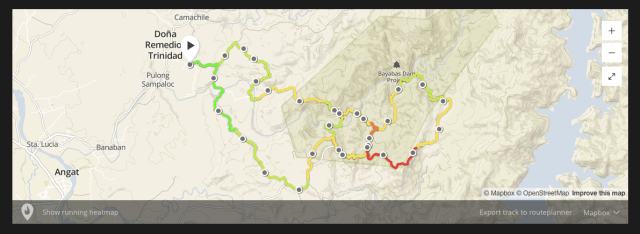
drt-course-map
Course Map By My SUUNTO Ambit 3 Peak Watch
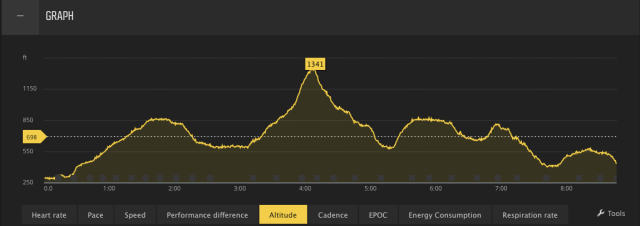
drt-elevation-profile
Elevation Profile From My SUUNTO GPS Watch

I finished the race in 8:45:50 hours. The staff at the Finish Line was expecting me to finish later in the afternoon and they were surprised to see me approaching the resort’s gate/entrance earlier than they have expected.

As a word of advise, don’t bring your iPhone to this event. I did not bring my phone as I did not want to be distracted with the temptation of taking some pictures of the route and I made a good decision. The remaining salt tablets after the last river crossing got melted and the candies became sticky syrup but my rice balls were properly sealed in their ZipLoc that they were dry all the time. If you decide to bring your iPhone, make sure to use a hydration system that have pockets higher than your breast/chest and have them sealed in a waterproof plastic packs.

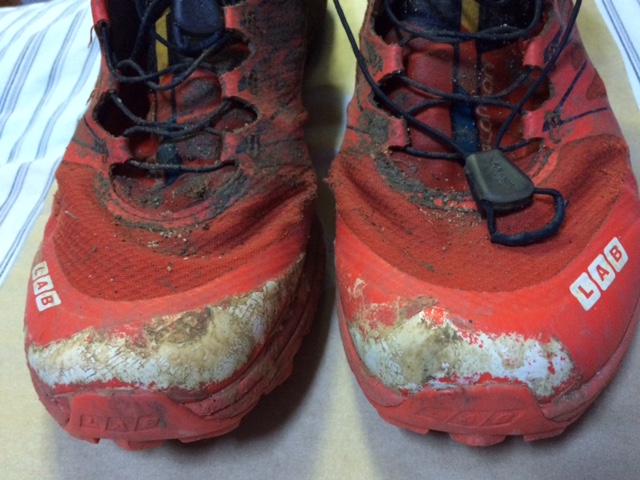
drt-shoes
Self-Explanatory

I highly recommend this event to those who are looking for nice scenery, “laid back” trail running event, well-organised/stocked Aid Stations and well-marked course, and very challenging course.

Congratulations to Dabobong Angeles and his Team for this successful event. Congratulations also to all the Finishers of the 50K & 25K events!

Hike & Run To Mt Baldy (2016)


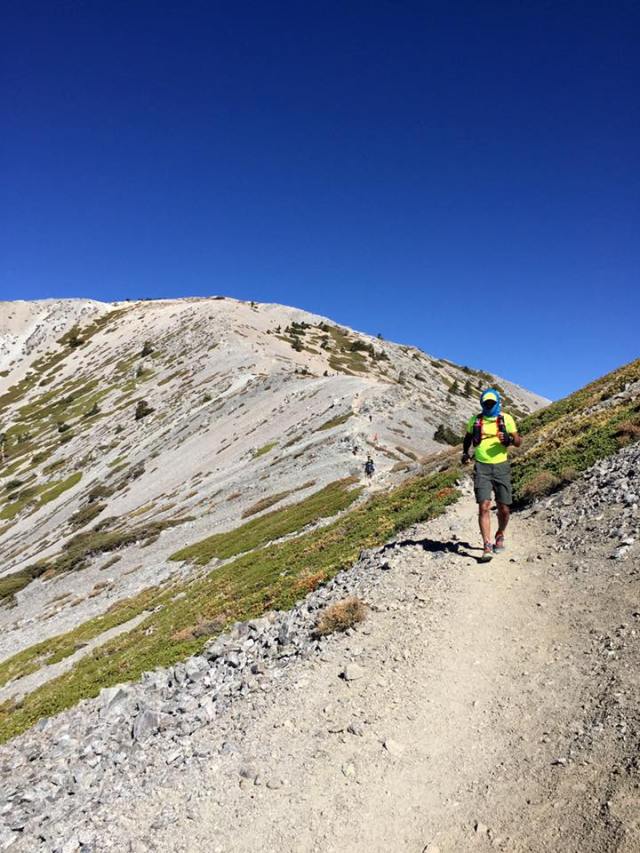
Almost every time I visit and stay in Los Angeles, California, I always make a schedule to trek to the peak of Mt Baldy. I have read a lot of blogs and FB status of running friends in Los Angeles that they would go and hike up to the peak of the said mountain. One of my ultra running friends, Benjamin Gaetos, is a regular visitor of this place and one time, I asked him for directions in going to Mt Baldy. And he generously stated the directions and the things to be required to be able to park ones vehicle near the trailhead. This was 4-5 years ago. From then, I was a regular visitor/hiker to Mt Baldy (Mt San Antonio).

Coming from Downtown, Los Angeles, I would drive to Highway 2 North and enter Highway 134 until it merges to Highway 210 East going to Pasadena up to Azusa/La Verne area. I have to exit at Baseline Road, turn Left at the Stop Light/Intersection and then drive towards Padua Street. At Padua Street, turn Right until I would reach the Mt Baldy Road. Turn right at Mt Baldy Road and go north, passing through the big lawns and nice houses in Claremont, until I would reach Manker Flats. A few yards (along the paved road) above Manker Flats, there is a road on the left with Portalets and within the said vicinity is where anybody could park their personal vehicle. The trailhead is the start of the road called “Mt San Antonio (Baldy) Falls Road”.

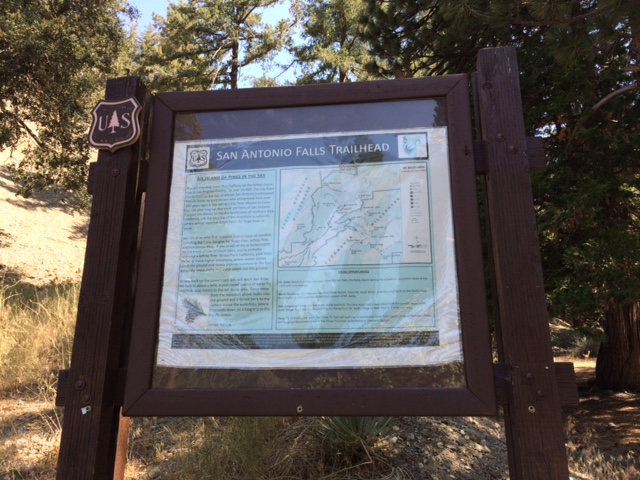
San Antonio Falls Trailhead
San Antonio Falls Trailhead (BR’s Photo)
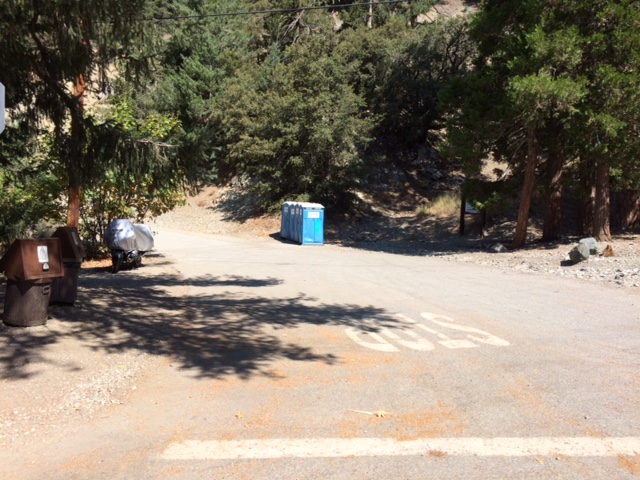
Trailhead
Trailhead With Four (4) Portalets (BR’s Photo)

However, one has to display an “Adventure Pass” on Dashboard of the Vehicle to be able to park in this hiking destination. The “Adventure Pass” can be bought in any of the REI Stores in Los Angeles and some of the Outdoor Stores in the area. It costs $35 which is valid for One Year. One-time Day Pass is also available for the price of $5.

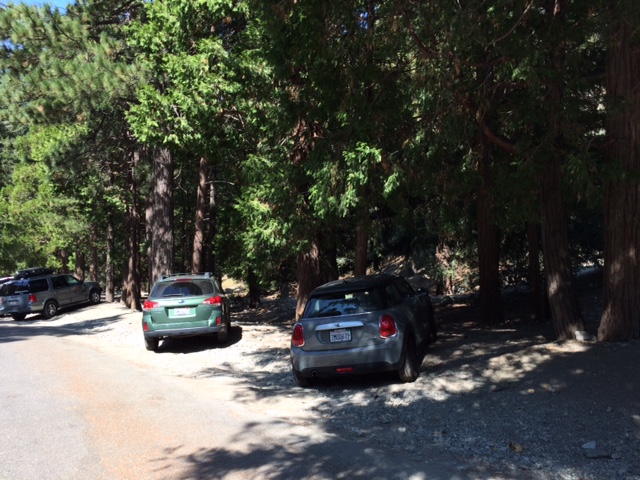
Parking Trailhead
Parking Area (Side Of The Road). Adventure Pass Needed (BR’s Photo)

On my first hike, I would follow the “Fire/Dirt Road” going up to the mountain from the trailhead by following where the Ski Lift would end. At the end of the Ski Lift which has commercial establishments and Public Toilet, I would turn left on another Dirt Road that would lead me to the Devil’s Backbone Trail, Mt Harwood, and to the peak of Mt Baldy. Round Trip distance would be 14 miles and it would take me almost 8 hours for the first time that I hiked to the peak.

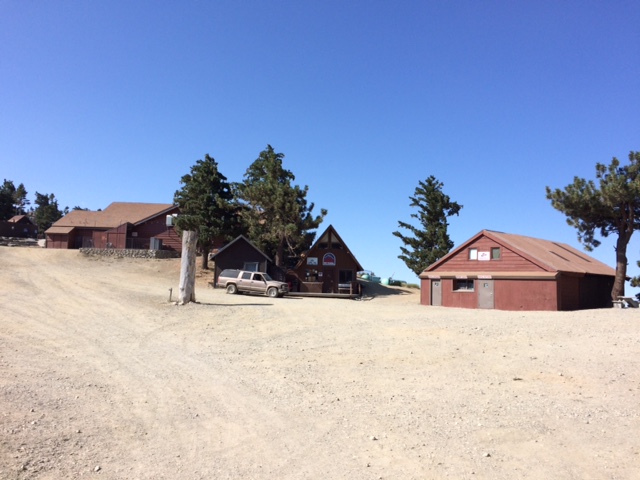
Commercial Establishments
Ski Lift Commercial Establishment/Water Refilling Station (BR’s Photo)

But later on, on my yearly visits, I would be introduced by running friends on some of the shorter distance and steeper trails towards to the peak of the mountain.

For this year’s visit, it will be my 5th visit to “peak bag” the mountain. And I could make it with my 6th “peak bag” before I would leave Los Angeles for Manila.

Rowell Ramos, an ultrarunner from Los Angeles, invited me to join their group, for my 5th hike to the said mountain. For Rowell and his friends, it is their “bread & butter” as they would peak bag the mountain almost every week. Rowell would sometimes hike alone by starting early in the morning and then before 10:00 AM, he is done with his hike.

2016 Mt Baldy 14
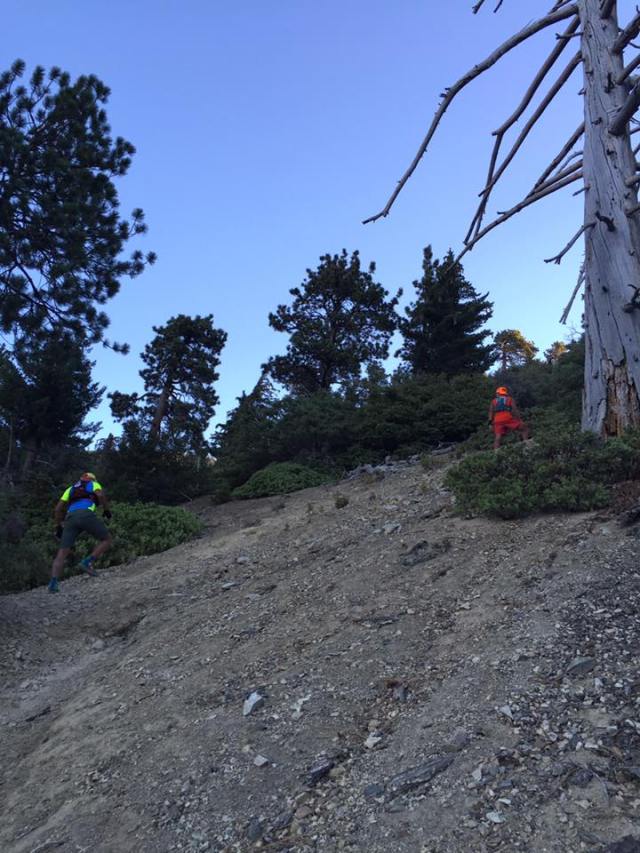
Very Steep Trail & Impossible To Run Or Jog

I joined Rowell, Peachy Poso, and Rico Bagayawa on this hike which was done on the first Saturday of August 2016. We met and assembled at Manker Flats at 6:00 AM and we started to hike as soon as possible. We took the steepest trail leading to Mt Baldy where we veered left after hiking along the Mt Antonio Falls Road for about a mile. But before going to the said mountain, we “peak bagged” Mt Harwood first which is one mile away from Mt Baldy. This “new” trail experience was very challenging as I have to stop along the way for me to adjust slowly to a higher elevation. For the past weeks before this hike, I’ve been running on the road and never had the chance to accumulate vertical distance in preparation for this hike. However, slowly along the way, I was able to adjust my breathing as I positioned myself at the back of the group.

2016 Mt Baldy 18
Brief Rests & Stops To Adjust The Body To Higher Elevation

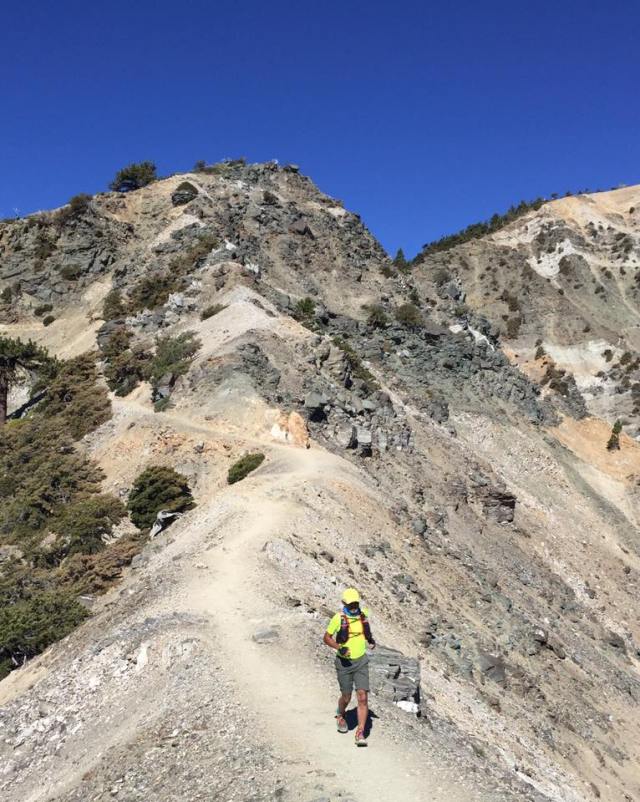
We started to meet the gusty winds from Mt Harwood but the wind temperature was not too cold that I would be able not to use my Windbreaker/Jacket. After a brief stop at the peak of Mt Harwood, we immediately proceeded to Mt Baldy. I was telling to the group that the same intensity of the wind was the same wind that stopped the race in this year’s TransLantau 100 in Hongkong. After a short descent from Mt Harwood, we were on our final assault to the peak of Mt Baldy. After 30 minutes of relentless hike, we finally reached the marker of San Antonio or popularly known as “Mt Baldy”.

2016 Mt Baldy 17
Short Downhill Run From Mt Harwood

It is self-explanatory that the mountain is called as such because it is devoid of any kind of vegetation, except for a few shrubs on the side of the mountain. From a distance, you can see see its peak as whitish in color.

I think we stayed at the peak for about 30 minutes, taking some of our pictures and talking to some of the other hikers who happen to be friends of Peachy Poso. I was able to eat my energy bar and drink some of my water.

2016 Mt Baldy 16
Final Assault To The Peak Of Mt Baldy
2016 Mt Baldy 10
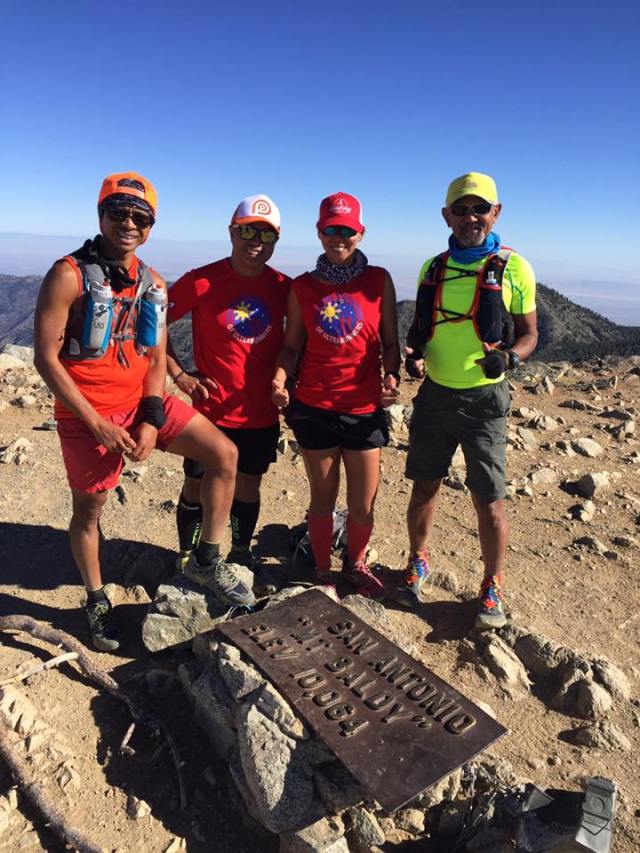
Finally, At The Peak of Mt Baldy (Rico, Rowell, Peachy, & BR)

We were trying to locate where Mt Baden-Powell was located in relation to Mt Baldy as the 2016 Angeles Crest 100-Mile Endurance Run was being held on that day that we were in Mt Baldy. I was supposed to be in that race but because of lack of training, I opted not to join the said race.

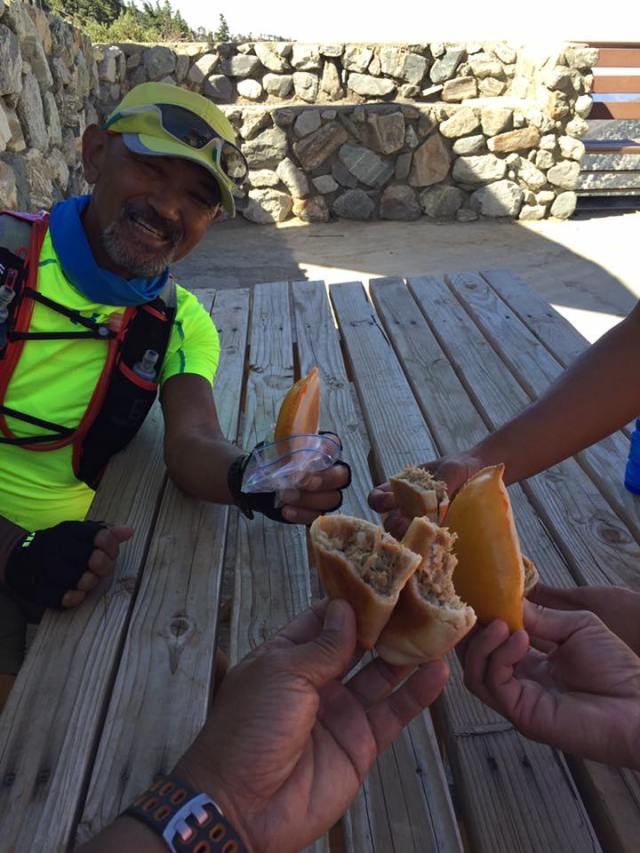
From the peak, we descended via the Devil’s Backbone Trail all the way to the Ski Lift Commercial Area. Since it was all descending trail, we took advantage to run and jog until we reached the commercial establishment. We had some water refill on the public faucet and ate some Empanada brought by Rowell Ramos. After a brief rest, Rowell and Peachy had to continue their trek to the Triple T Peaks which is another 10 miles before reaching the trailhead while Rico and I had to return to the Mt Baldy Falls Road Trailhead which has a distance of 3.5 miles from the Ski Lift Commercial Center.

2016 Mt Baldy 13
Descending Run From Mt Baldy
2016 Mt Baldy 12
Running Along The Devil’s Backbone Trail (Do not look at your sides!)

Rico and I were done before noon time and we parted ways. I was able to hike and run a distance of 10.4 miles with a total elevation of 4,937 feet. The details of my hike & run could be seen here—https://connect.garmin.com/modern/activity/1291507392.

2016 Mt Baldy 15
Filipino Empanada As Trail Food

I promised to be back to this mountain for another solo hike and run before leaving for Manila.

If you happen to be in Los Angeles and would like to hike a mountain, Mount San Antonio (Mt Baldy) is a must!

(Note: Pictures and Empanada Were Provided By Rowell Ramos)

Running Will Make You Poorer, But…


If you are an average runner, “middle or back of the pack” runner or Social Media runner, running will make you poorer but there are intangible benefits that you can get from it.

The following reasons why running will make you poorer:

  1. Running is Addictive——Running is like a “drug” for the mind and the body that the more you are comfortable with it, the more you would challenge yourself to be faster or run longer. Having said that, there are “rippling effects” to such addiction and the next reasons will validate my theory. (Note: Running is an addiction that will NOT lead you to kill, steal, or rape somebody!)
  2. Indecision Which Running Shoes’ Brand You Will Be Loyal To ——Most of running friends are attracted to the color combination and physical appearance of the shoes. Some also would think that the more expensive the shoes are, the better for them to brag to their running friends. There are also runners that would prefer to buy shoes that are being used by International Champions whether they are road marathon elite runners or mountain ultra trail runners. You will be wondering why average/middle of the pack and back of the pack runners are using the brands like Salomon, HOKA ONE ONE, and expensive models of ALTRA or ASICS. It is a “bragging right” to have these shoes in the social media because they are very expensive. Result? You pay and spend more even if a cheap NIKE or New Balance or Merrell or Skechers can do the job you need in a running event.
  3. Looking Good In Ones Running Apparel——I don’t understand why most of the runners are fond of using running tights in running events. I know that these running tights are comfortably used for colder environment and not in my country, Philippines. To some, runners would use “triathlon suits” in a marathon or half-marathon running events and I really admire them to be preparing for their Ironman Race in Kona, Hawaii. And come to think of these apparels, they are more expensive than the ordinary running shorts and running shirts. Aside from being expensive, they are heavier than the regular running apparel and if you are a sweaty guy, they tend to be heavier as they absorb most of ones perspiration.
  4. Compression Accessories Are Expensive——I am not the “compression-runner” type but I sometimes use them in races and in my training. However, after an ultra race, I try to use them for recovery while resting or sleeping after the race. Well, for the other runners, I really don’t know if they get some advantage in terms in muscle cramping prevention during the race or being in fashion with the rest of their running friends. For me, they are just added weight to what I am carrying during an ultra race but one thing that calf sleeves are very useful is that when they absorbed the perspiration coming from my body preventing my socks to be wet in the early part of the race, most specially when the prevailing temperature is warm or hot.
  5. Lots of Hydration Bottles and Systems To Choose From——You might have observed the international elite runners to only carry one hand-held bottles and some would wear a backpack with bottles in front and another bladder full of water on the back. Depending on the weather of the place of the event, the mandatory gears required in the race, and the rate of sweat loss of an individual runner, the runner can decide what to choose from these hydration systems. Most of them are expensive but very functional not unless you settle for a commercial bottled water bought at 7-11 Stores as you recycled hydration bottle.
  6. Nutrition and Sports Fuel Are Also Expensive——If you are an mountain trail or road ultra runner, you know what I really mean. And if you have a support crew, your expenses are multiplied depending the number of support crew or pacer you will need for you to successfully finish the race.
  7. Don’t Join My Races If You Complain About Registration Fees——Yes, Registration Fees are very expensive nowadays. So, if you want to save your money for an A-Race which you think that will increase you value in terms of reputation, prestige, and self-satisfaction, just concentrate on your training——do your LSDs, do some Strength Training, do your Tempo and Intervals Runs to improve your Speed, and improve on your weaknesses, whether on your nutrition or mental attitude during the race.
  8. Ultra Marathon Races Are Expensive, Too!——There are local ultra marathon races that offer lower registration fees than the other races but if these races are tainted with suspicion of cheating, the money you paid for your registration fee and the “swags” you received from finishing the race are worthless!
  9. Joining International Races Is A Fortune——I remember an ultra runner who regularly joins my ultra races who said that he will never join any 100-mile/160K ultra marathon race if there is NO Finisher’s Buckle to be awarded to him even if the registration fee is lower than my races. After so many years, the same guy in now planning to gather and earn points for his UTMB participation in Chamonix, France. UTMB 166K Race (more than 100 miles) does NOT award a Finisher’s Buckle but the mere fact that you are going to Europe means a lot of financial resources needed to be saved and spent.
  10. Accessories In Running Add Up To More Expenses——Cellphones/Camera; GoPro; “Selfie” Sticks; Sunglasses; Buffs; Water Repellant Jacket; Trekking Poles; Emergency First Aid Kit; Medicines; GPS Watches with HR Monitor; & Trucker Caps.
  11. Coaching Services——I know that there are Local Running Coaches who are willing and able to help and guide you to an enjoyable and injury-free running life. I am not sure if they are offering free services but it is your responsibility to pay back something to your coach. If you research in the Internet, there are lots of websites who are offering Coaching Services to any body with a certain fee. Just be ready with your Credit Card.
  12. Gym Membership & Regular Massage——I am one of the few “first” members of a well-known franchise of Gym which is very popular in the world but after 3-4 years, I have to give up such membership because it is becoming more expensive and I just do my own strengthening exercises in the comfort of my house. Sometimes, I would visit a not-so well-known Gym and pay on a daily basis. If you have Gym Membership, then this your Annual/Monthly Fees add up to your expenses. In the same manner that if you need to relax your muscles, a regular massage to your professional muscle therapist will add also to your expenses.
  13. Medical Check-Ups——It is expensive to acquire a Medical Certificate or Clearance if you don’t know any Doctor as most of the more popular local races now require the submission of such before you are considered as a participant. If you are long-time or veteran runner, there is no need for you to go to a Doctor to check on your muscle pains or running-related injury, just simply rest and relax and let your body heal by itself.

But there are bigger benefits if you maintain running despite all these expenses you have to incur. There is a saying that goes like this: “Poor People Invest In Money; But Rich People Invest In Time”. In the end, if you keep on running, you are that “Rich People” who are investing in time——for you to live longer, more healthy, and more happy than anybody else and maybe, still running at the age of 80 or beyond.

Through running, I have been “investing in time” so that I could enjoy my retirement and the pension I am receiving from the government and the “golden eggs” from my investments.

So, you may be broke while you have the love and passion in running but in the end, you will be enjoying a longer life and a healthy lifestyle (free from medical bills and maintenance medicines).

Go out and run!

Rich Runner
Simple Attire But Very Expensive!