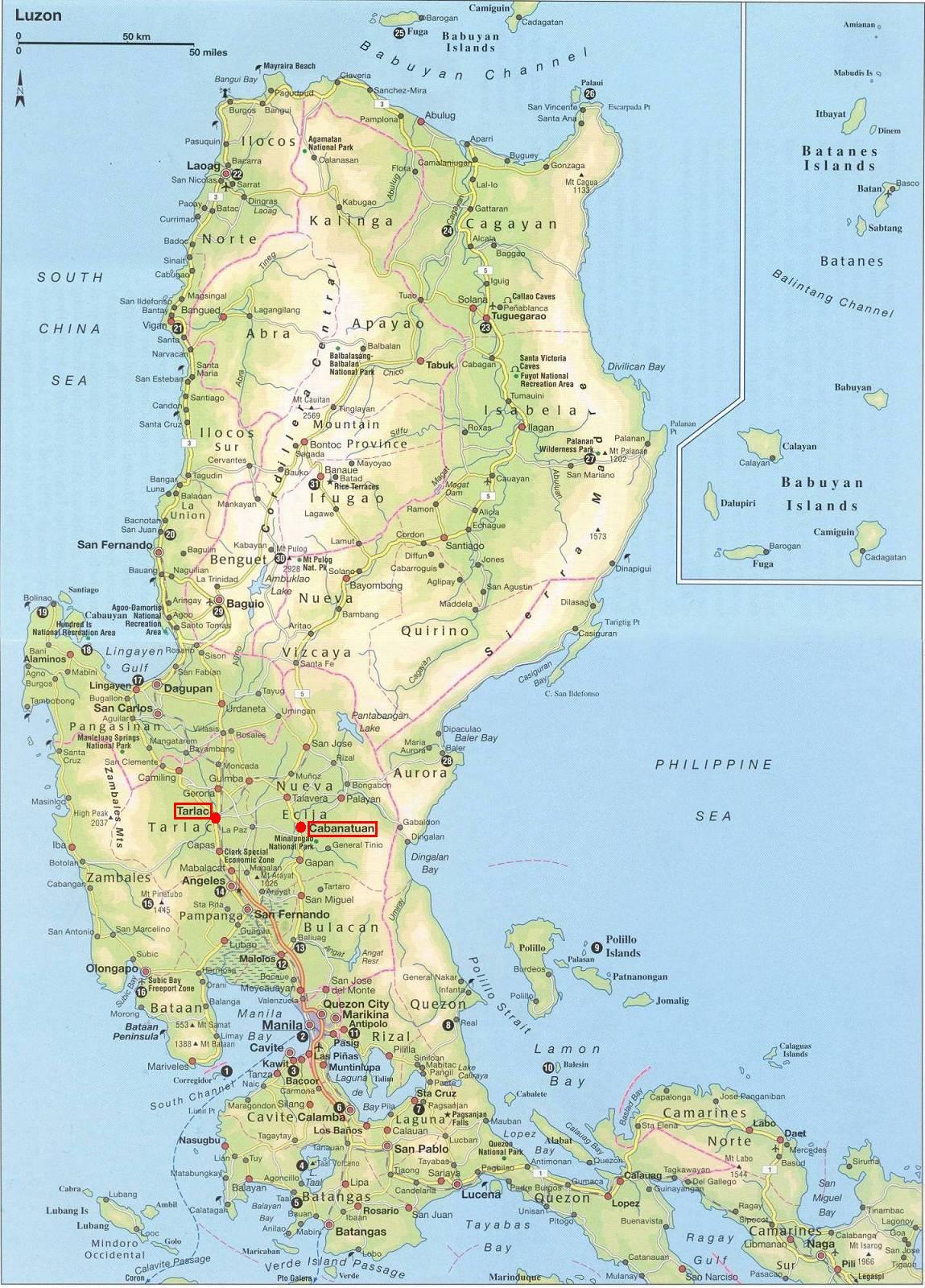
1. Due to military-related activities in Fort Magsaysay scheduled for the weekend, all the Transient Facilities inside the Camp, to include the Special Forces Regiment and SOCOM Transient Facilities are FULL. However, runners who would like to spend Saturday night within the vicinity of Fort Magsaysay, they can avail of the hotels and commercial transient facilities in Santa Rosa-Cabanatuan City area. Most of these hotels are located along the Maharlika Highway. For those who choose to arrive early in the camp and rest inside their respective Support Vehicle, they can park their vehicle at the back of the 7th Infantry Division Headquarters and . Parking of Vehicles in front of the Headquarters Building is strictly prohibited. All the other roads surrounding the Headquarters Area is available for Parking.
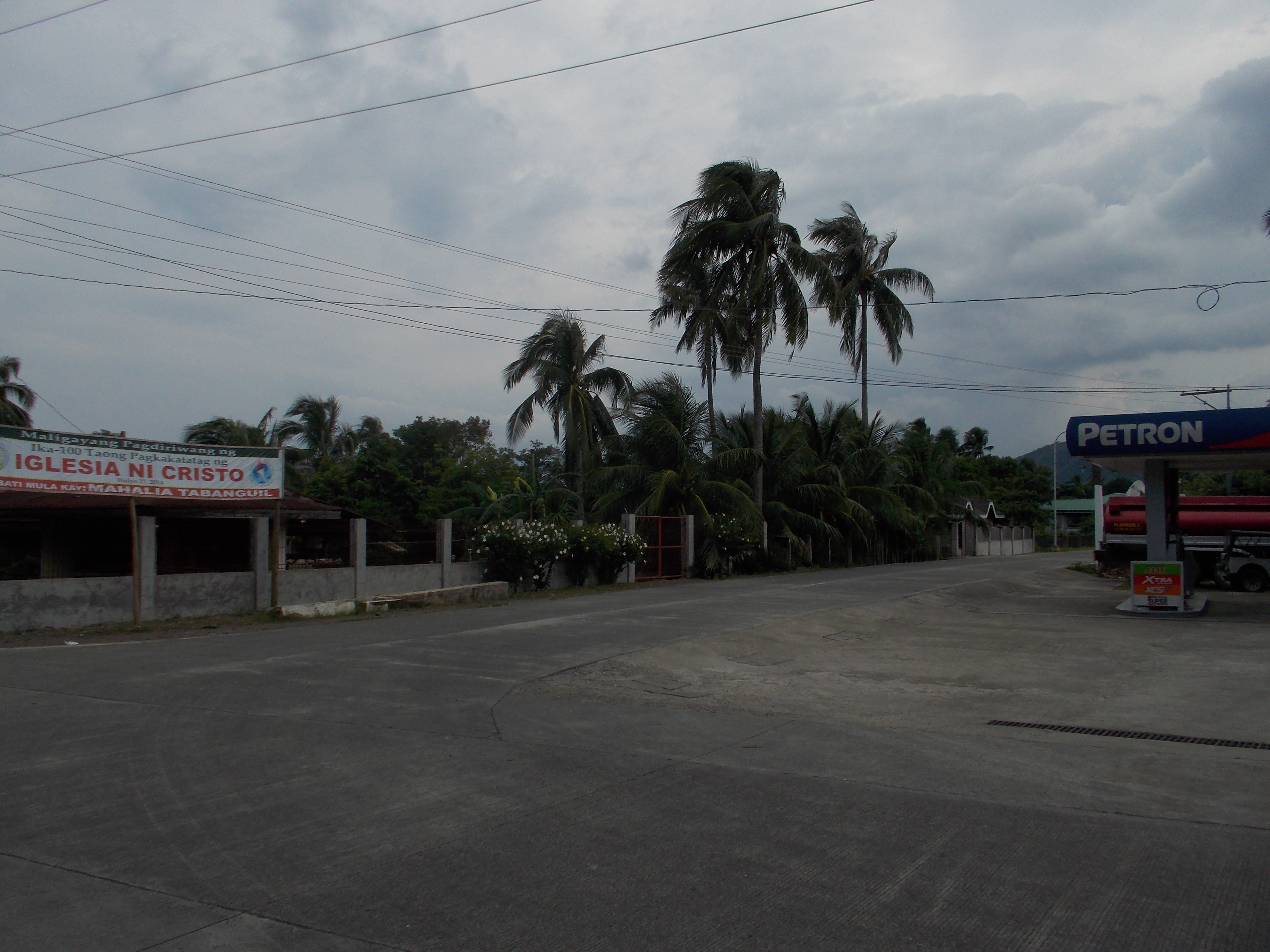
Intersection Philippine Coast Guard/Pier And Umiray Road
2. The race will end on the shore of the Pacific Ocean at Purok Tanguige, Barangay Aplaya, Dingalan, Aurora. From the usual finish line at GINA’s Resort, follow the highway that is descending towards the Poblacion of Dingalan, Aurora. Runners would be able to pass the short section of commercial establishments and follow the road that leads to the Philippine Coast Guard/Dingalan Pier. Runners have to TURN RIGHT once they reach an intersection with a PETRON Gasoline Station on the right and a tarpaulin with an Iglesia Ni Cristo 100th Anniversary hanging across the said Gas Station. The road leads to Barangay Umiray.
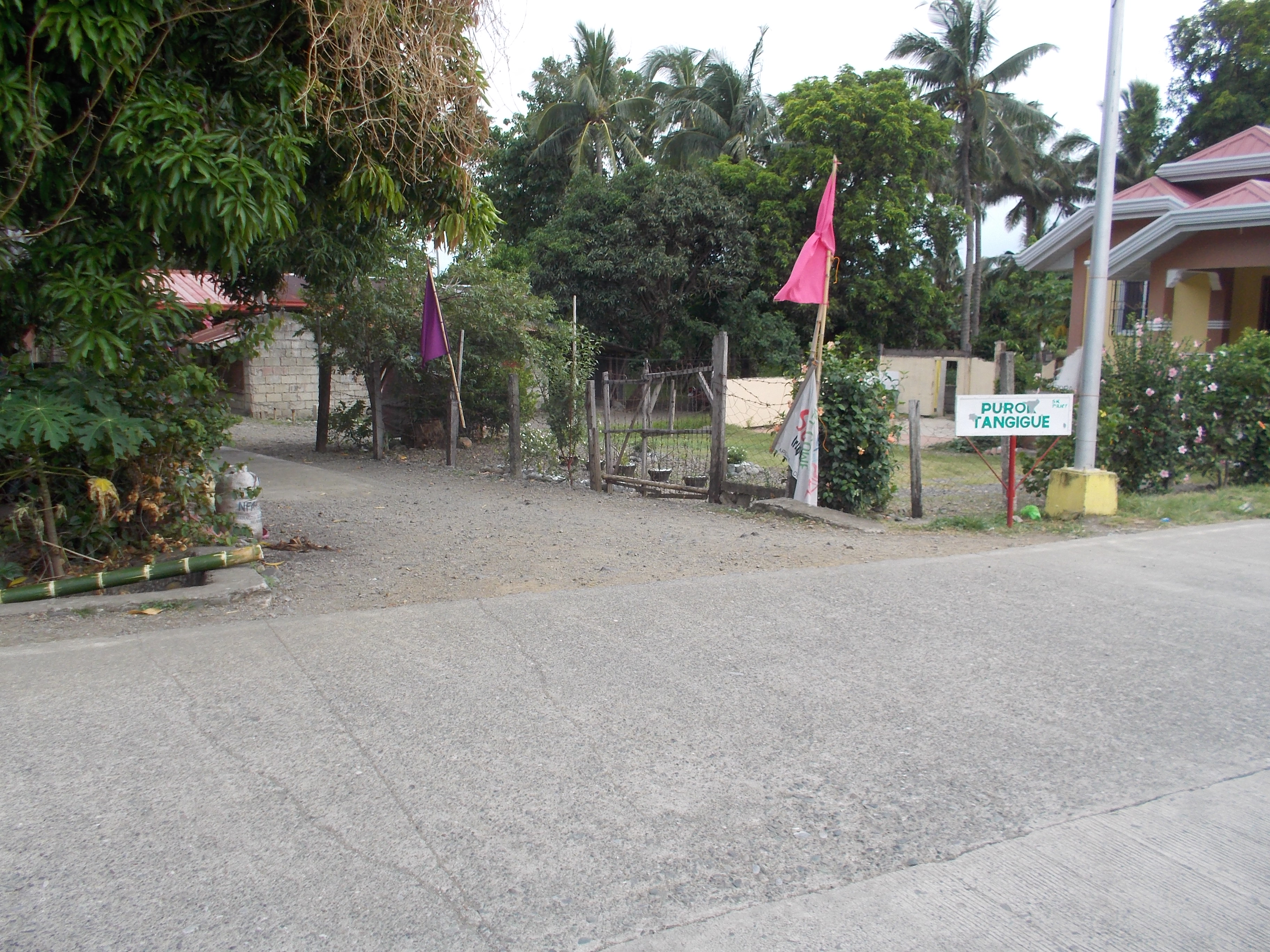
Turn Left On This Alley With The Sign “Purok Tanguige”
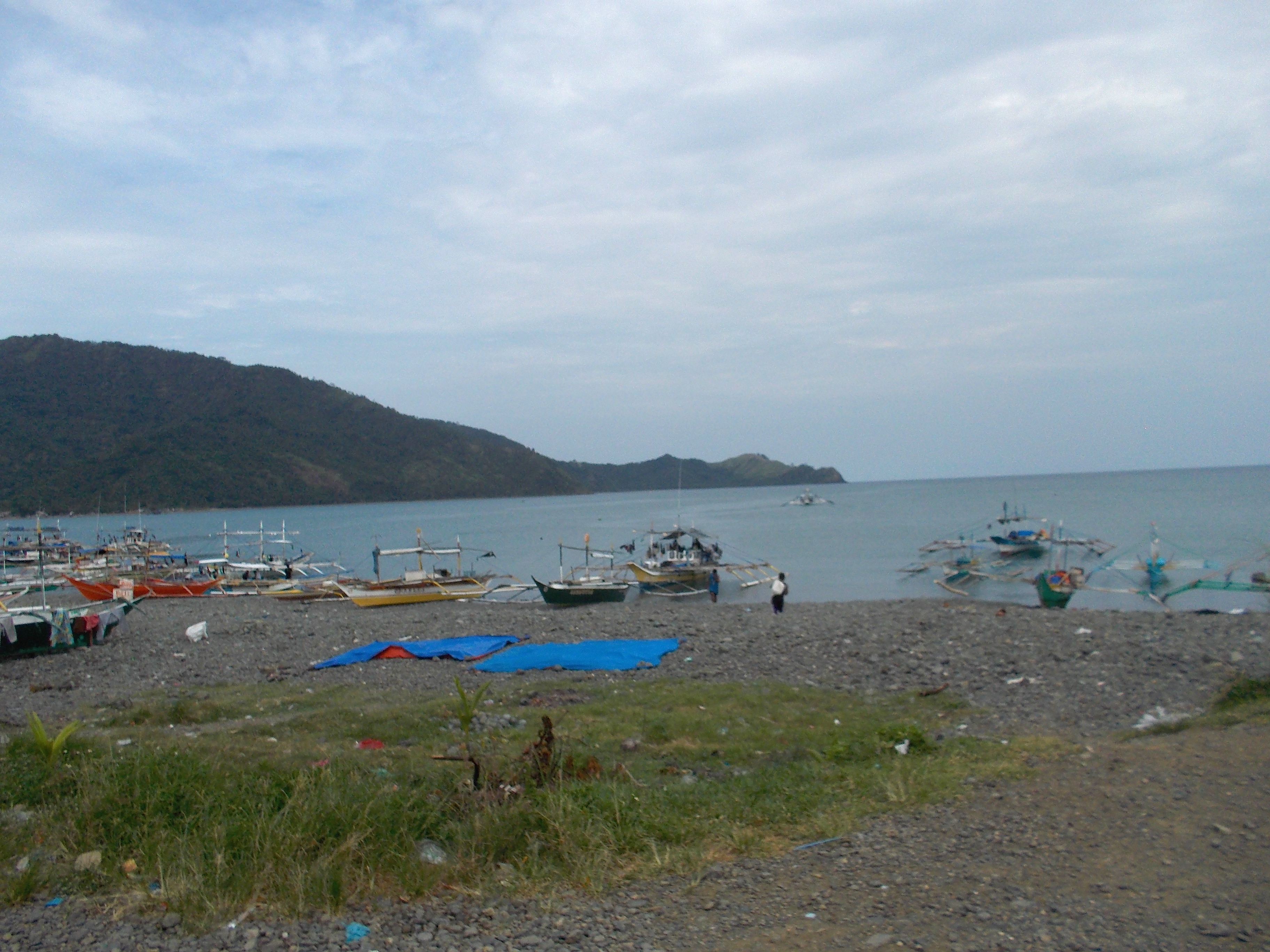
3. From the road leading to Umiray, turn left on an alley which is a paved path, about 400 meters away from the PETRON Gas Station, good for one vehicle which is marked with PUROK TANGUIGE. Runner would see the seashore and the Finish Line will be few meters before the beach. On your right will be the Seaside Restaurant where lunch will be served and for the runners can have their shower.
Pacific Ocean’s Open Water Swimming Pool
4. Warning for those Runners with Support Vehicle. There is a limited parking space along the shore and vicinity of the Seaside Restaurant. Runners should advise their support driver/crew to park along the road leading to Umiray. The road is safe with few vehicles passing in the area and with the Barangay Hall within the vicinity.
5. The 65-Kilometer distance will be short by about 500 meters. As I don’t want each of the runner to make an additional distance along the Umiray Road and somewhere have a U-turn back to Purok Tanguige, this arrangement might result to some confusion, most specially when the runner is thinking of a cold beer waiting for him once he crosses the Finish Line. Just reserve that lacking 500 meters for your open water swim on the shore of the Pacific Ocean once you cross the Finish Line!
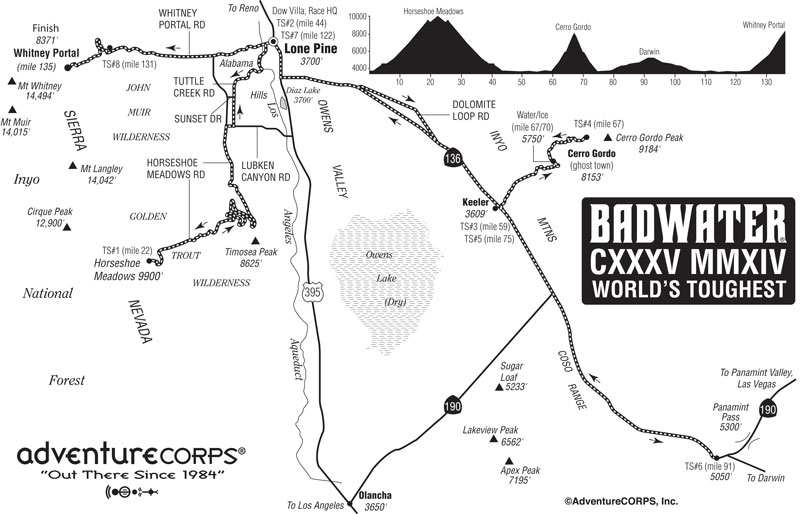
Benjamin Gaetos opened the floodgates for Pinoy Ultra Runners to shine in the prestigious Badwater 135 Ultra Marathon Race which is considered as the “toughest ultra running race in the world” today. As history would place in its proper perspective and understanding, Benjamin Gaetos is already considered as the FIRST and LAST Pinoy Ultra Runner who finished the ORIGINAL Badwater 135 Ultra which starts in Badwater, California (hence, the name Badwater in the title of the race), 280 feet below sea level up to Mt Whitney’s Portal at an elevation of 8,360 feet above sea level in 44:08:07 hours where the cut-off time is 48 hours.
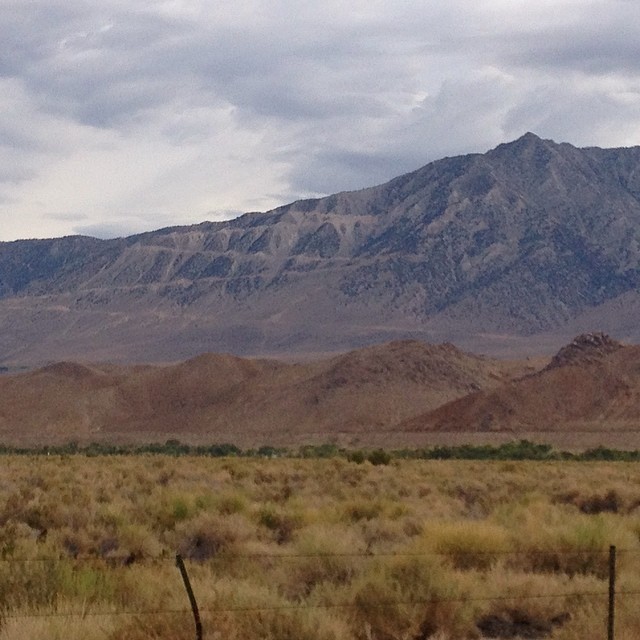
With the latest restrictions and policy from the newly designated Superintendent of the Death Valley Park, the conduct of endurance sports activity is being prohibited and held in abeyance before a thorough study is being published to review on the safety of participants in such events being held in the said area. However, such restriction did not prevent the Race Organizer to conduct the annual event for the ultra runners but instead of starting and passing through the extreme hot environment of the Death Valley Park, the event was held at the adjacent Owens Valley which is equally challenging as the original route with the prevailing summer heat and more gain in elevation. The New Badwater 135 course covers three mountain pass ascents for a total of over 17,000 feet (5,800 meters) of cumulative vertical ascent and 12, 700 feet (4,450 meters) of cumulative descent.
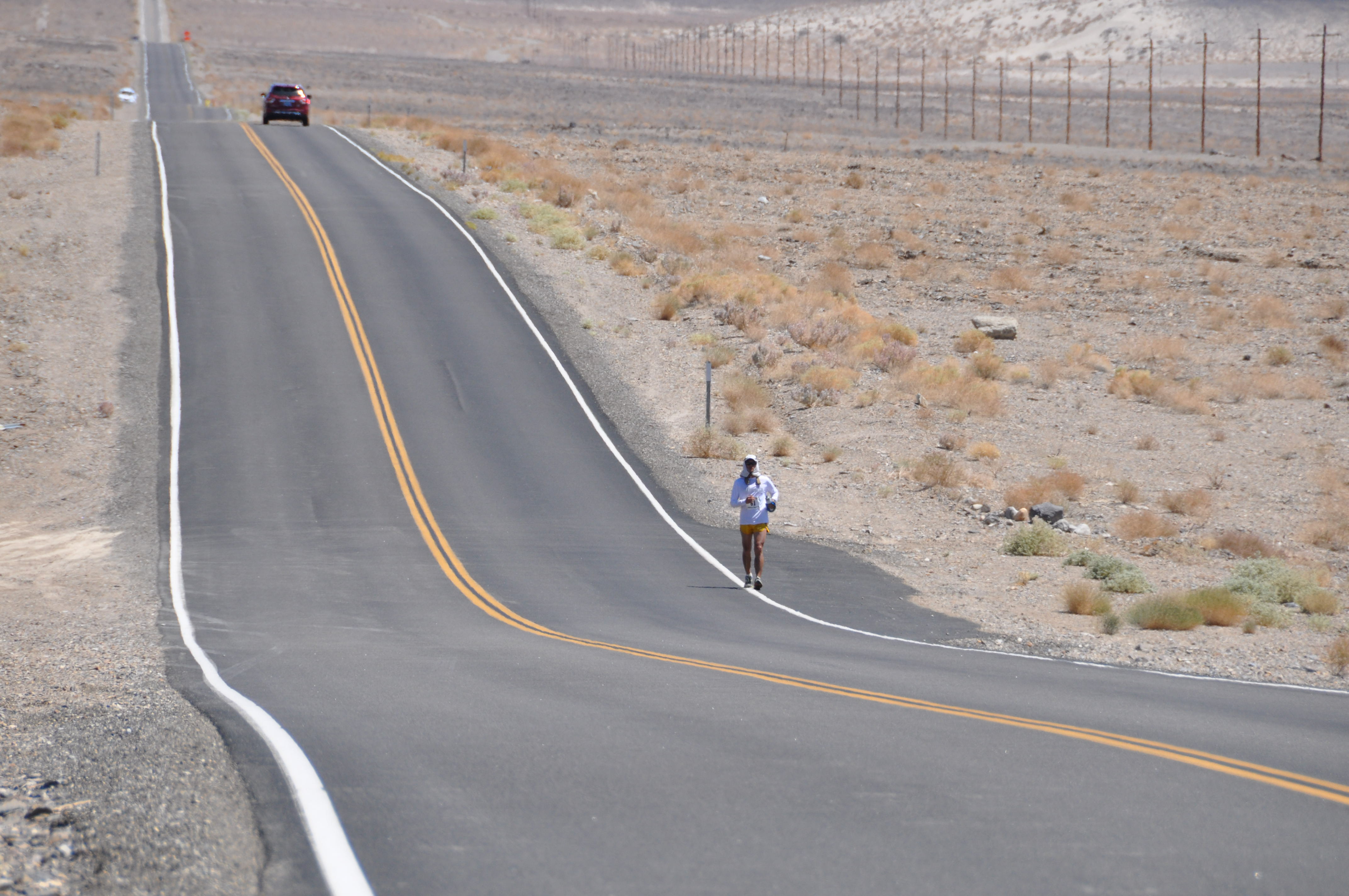
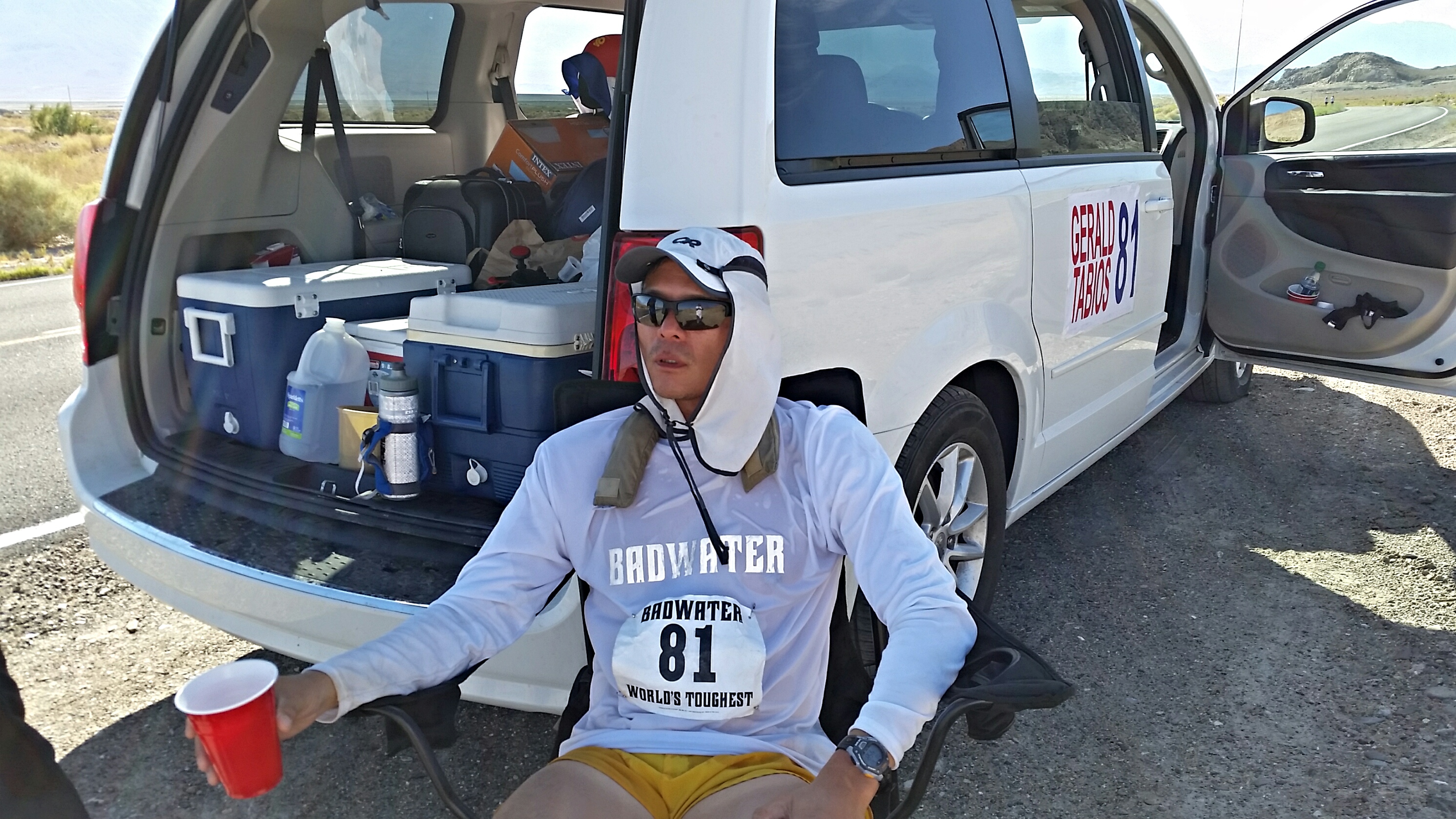
In this year’s New Badwater 135 route, two Filipinos, Gerald Tabios and Tomas Zaide have been qualified and invited by the Race Organizers to join the event. But for me to be more focused on my story, this article will be devoted as a tribute to Gerald Tabios as the FIRST Pinoy Ultra Runner to have finished the New Badwater 135 Ultra Marathon Race.
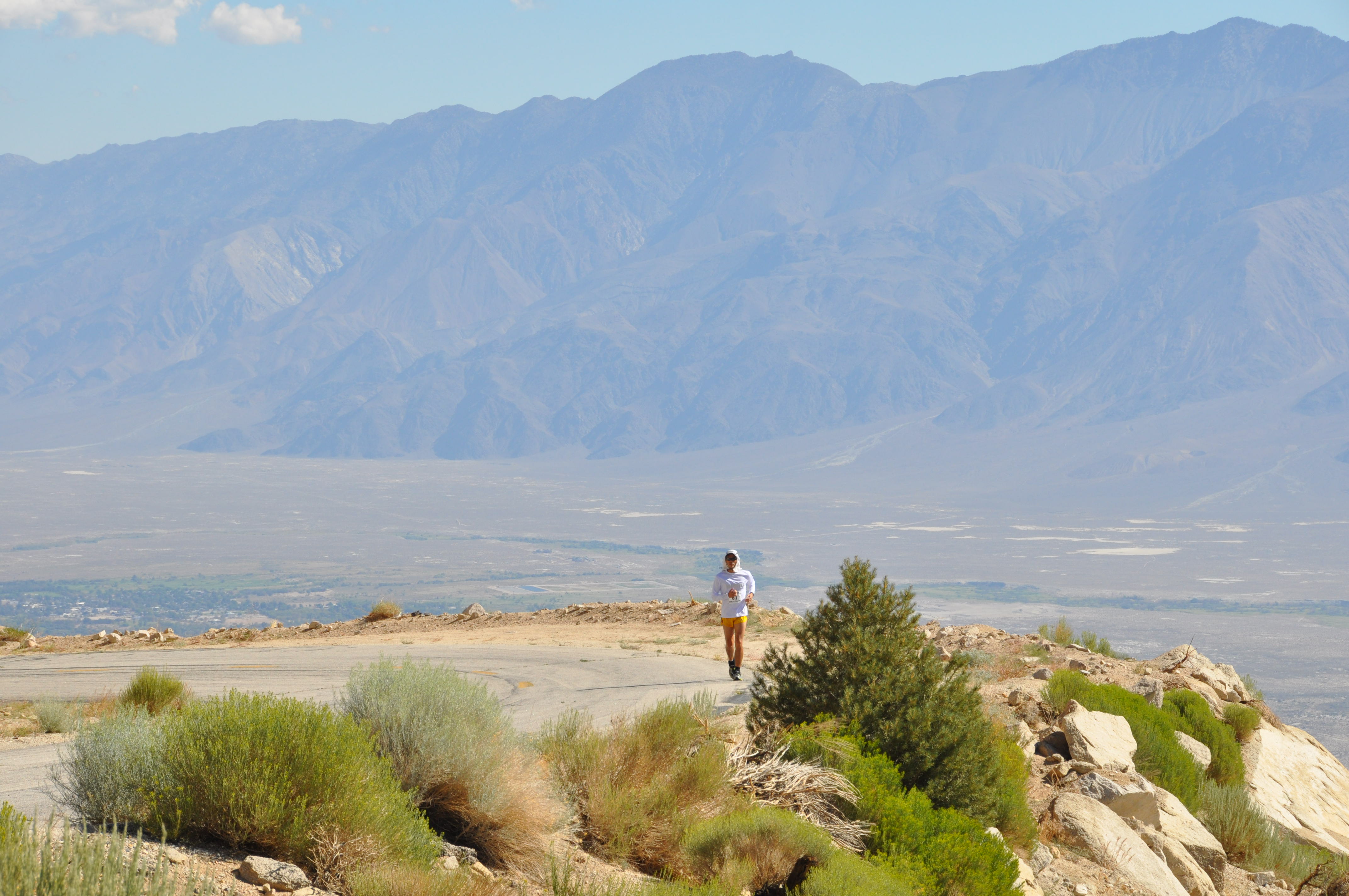
Route Of The New Badwater 135 Ultra MarathonThe First Peak For The Runners: Horseshoe Meadows At 9,900 Feet Above Sea Level (Photo Courtesy Of Michelle Barton)Road Intersection To “Heaven & Hell” (Going To Cerro Gordo, Panamint Springs & Back To Lone Pine And To The Finish Line @ Mt Whitney Portal)
I became aware of Gerald Tabios’ participation in the New Badwater 135 from a news story published in the On Line Edition of the Philippine Daily Inquirer. Surprised that he has no account on Facebook, Twitter or Instagram, I immediately browse his name at UltraSignUp and I was amazed with his ultra race portfolio/resume of his ultra finishes. He had finished a lot of 100-miler races in the Eastern part of the US, particularly in New York City and its suburbs and he placed as a Champion in one of the 100K races in the area and a number of them where he finished in the top 3 podium finishes. Notable of these ultra running accomplishments were the following:
Champion in the 2014 Jack Bristol Lake Waramaug 100K Ultra Race held in New Preston, Connecticut with a time of 9:46:03 hours
2nd Overall Champion in the 2013 Three Days At The Fair Running Event (48 Hours Timed Event) in Augusta, Georgia where he was able to run a distance of 143 miles.
Consistent and 3-Time Finisher of The Great New York City Running Exposition 100-Mile Race with a best time of 21:22:34 hours.
Since his family migrated in New York, USA in 2001, he had his taste of his first Marathon Race finish at the New York City Marathon and since then, he had been a “streaker” of this most popular and the World’s Biggest Marathon Race for the past nine (9) years! Even if he considers himself as a slow marathon runner, he prides himself with an impressive Marathon Finish time of 3:31:32 hours at the Central Park Marathon in New York City. Aside from his numerous ultra events that are listed in the UltraSignUp Website, he had finished a total of 25 Marathon Races.
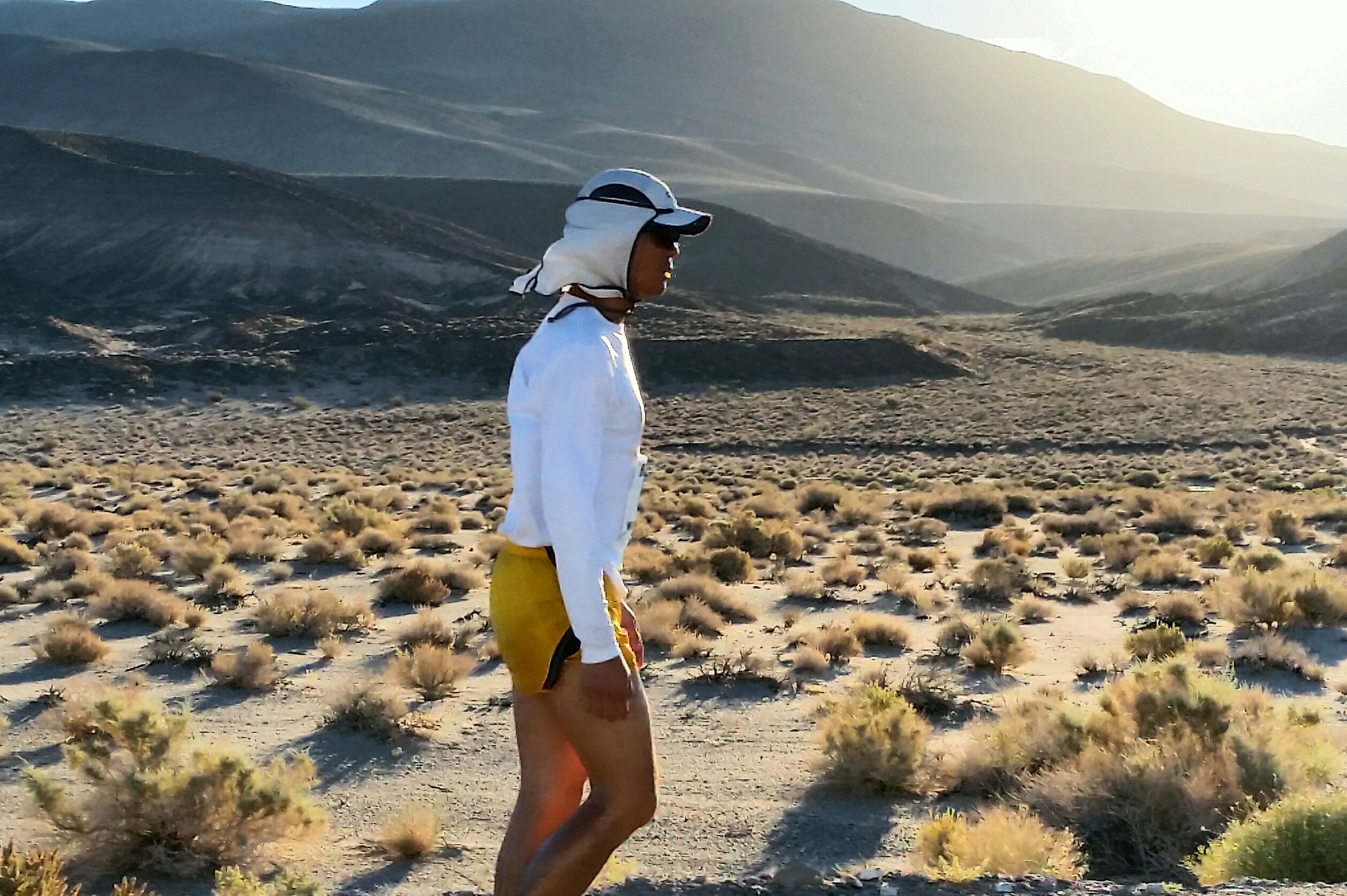
I was impressed with his ultra race results as his age as an ultra runner is still at his prime of 44 years old. Gerald is still starting as an ultra runner for the past 2 years but he has made already a great impression to his peers and to myself as a hardcore ultra runner. I have no doubt then that he will finish the New Badwater 135 even if he is not exposed to hotter environment (as compared to the East Coast’s climate) and he had never set his foot in the extreme heat and gusty winds within the desert mountains of California.
Gerald @ Horseshoe Meadows Road
As an old runner and firm believer of the Arthur Lydiard Way, I believe that there must be something in Gerald’s childhood that greatly contributed in his passion and craving for running events. He was born in Malaybalay City (Bukidnon) on September 12, 1969 but he did not have to walk on mountain trails in order to finish his elementary and high school education as the family house is only a “stone’s throw” to the schools. His interest in running started when he was in high school with his brothers, who happened to be running enthusiasts during the “running boom in the 80’s”, and they would tow him along in public parks and streets in their jogging practices. He could still remember when spending vacation in Manila that his brothers would bring him jogging around a big street block in Quezon City which happens to be where the ABS-CBN Compound is located along the Mother Ignacia Street.
Surprisingly, a local elite runner who hails from Malaybalay, Bukidnon, Ronilo Indapan became his running idol and inspiration. Ronilo Indapan had been a consistent MILO Marathon Finals Qualifier in the 1980’s and he was then the pride of Malaybalay in Long Distance Running as he was sent to Manila with “free trip and accommodation” to and from Manila to join the MILO Marathon Finals. He could be the father of one of my former elite runners who is now a soldier of the Philippine Army, got married to my Secretary/Staff and now living with two children.
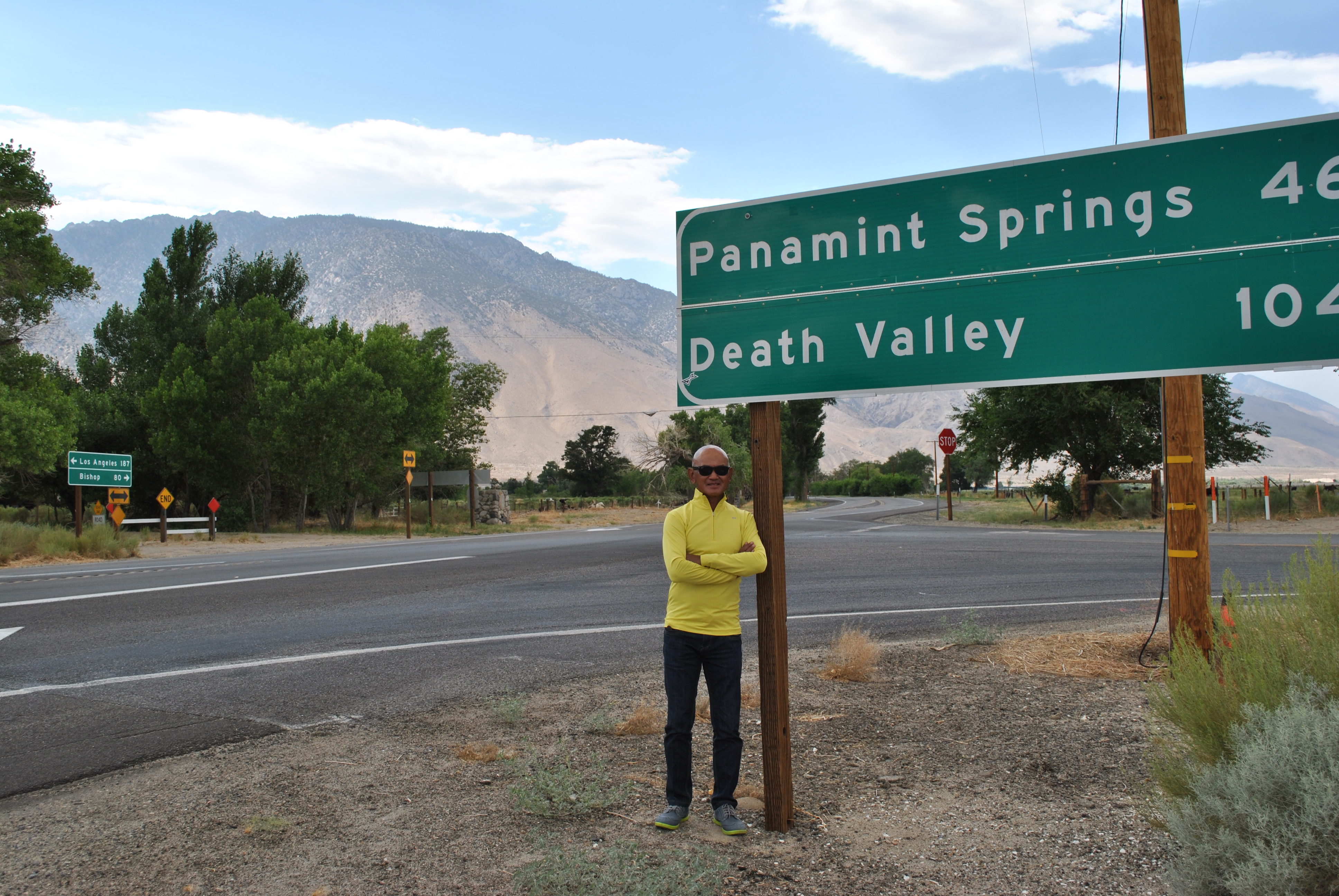
Gerald @ Highway 136 Towards Panamint Springs
With Ronilo Indapan, a local running hero in their place, as his role model and inspiration, and with his brothers’ interest in joining running events, he started to train and join the annual MILO 10K Runs in Cagayan De Oro City from 1994-1997; and progressed to a longer distance event by joining and finishing the The Tri-City International 25K Race in Cebu City in 1995 & 1996. He even mentioned that his brothers would buy him running tops/singlets and shorts made by BOTAK; and ADIDAS Jogging Pants and Sweaters!
Gerald was neither a high school nor a college athlete, he just simply love and have fun in running long distance events. He finished his college education with a Bachelor of Science in Civil Engineering at the Xavier University Ateneo de Cagayan in Cagayan De Oro City.
Twelve years later after he migrated to the USA with lots of Marathon and Ultra Marathon Finishes and most specially when he finished as 2nd Overall Champion in the 2013 Three Days At The Fair 48-Hour Run, he decided to send a letter of request to the Race Organizer of Badwater 135 for him to be included in the List Of Qualified Participants in this year’s edition. And the rest is history.
Rest & Recovery For Gerald During The Race
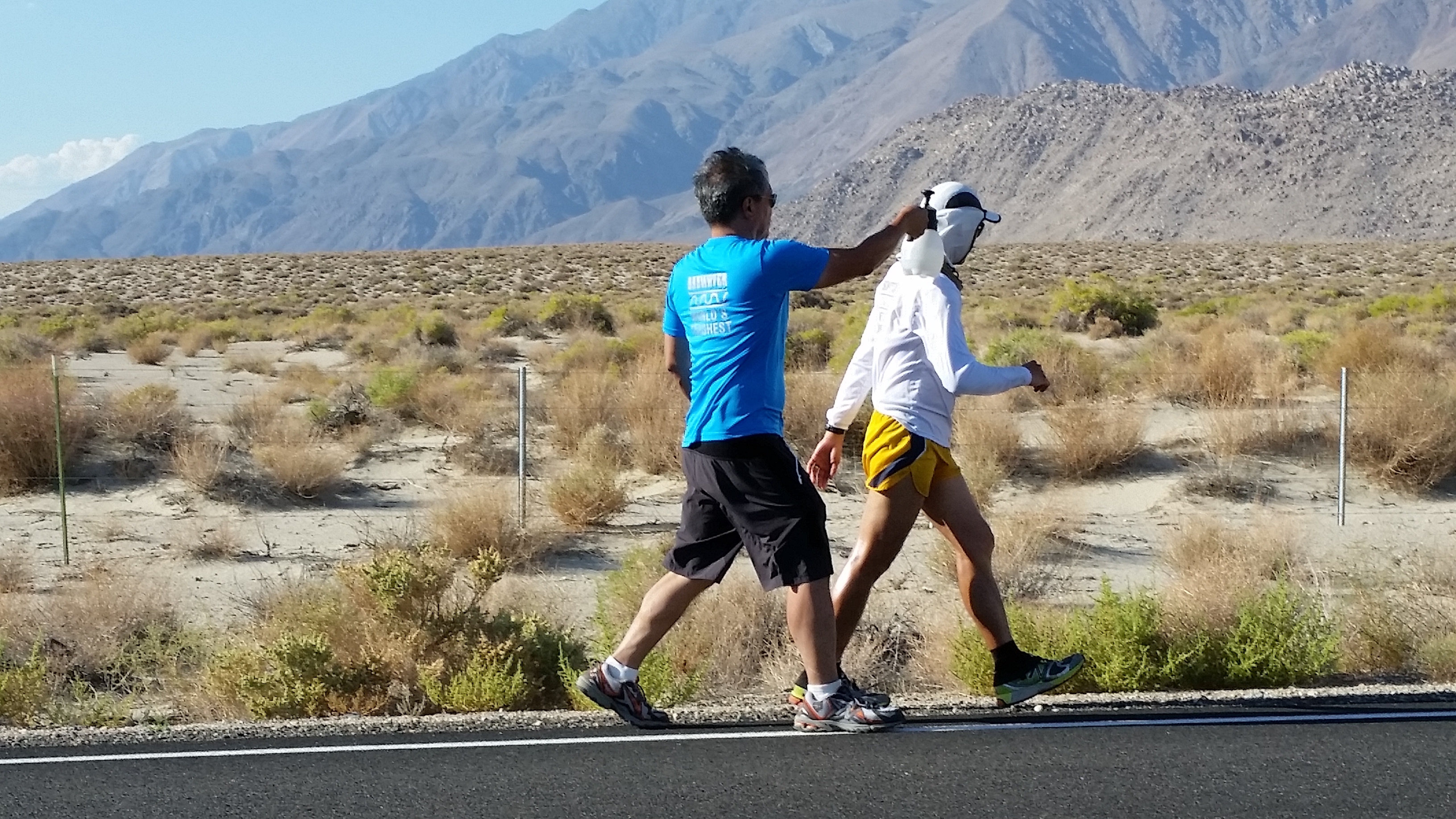
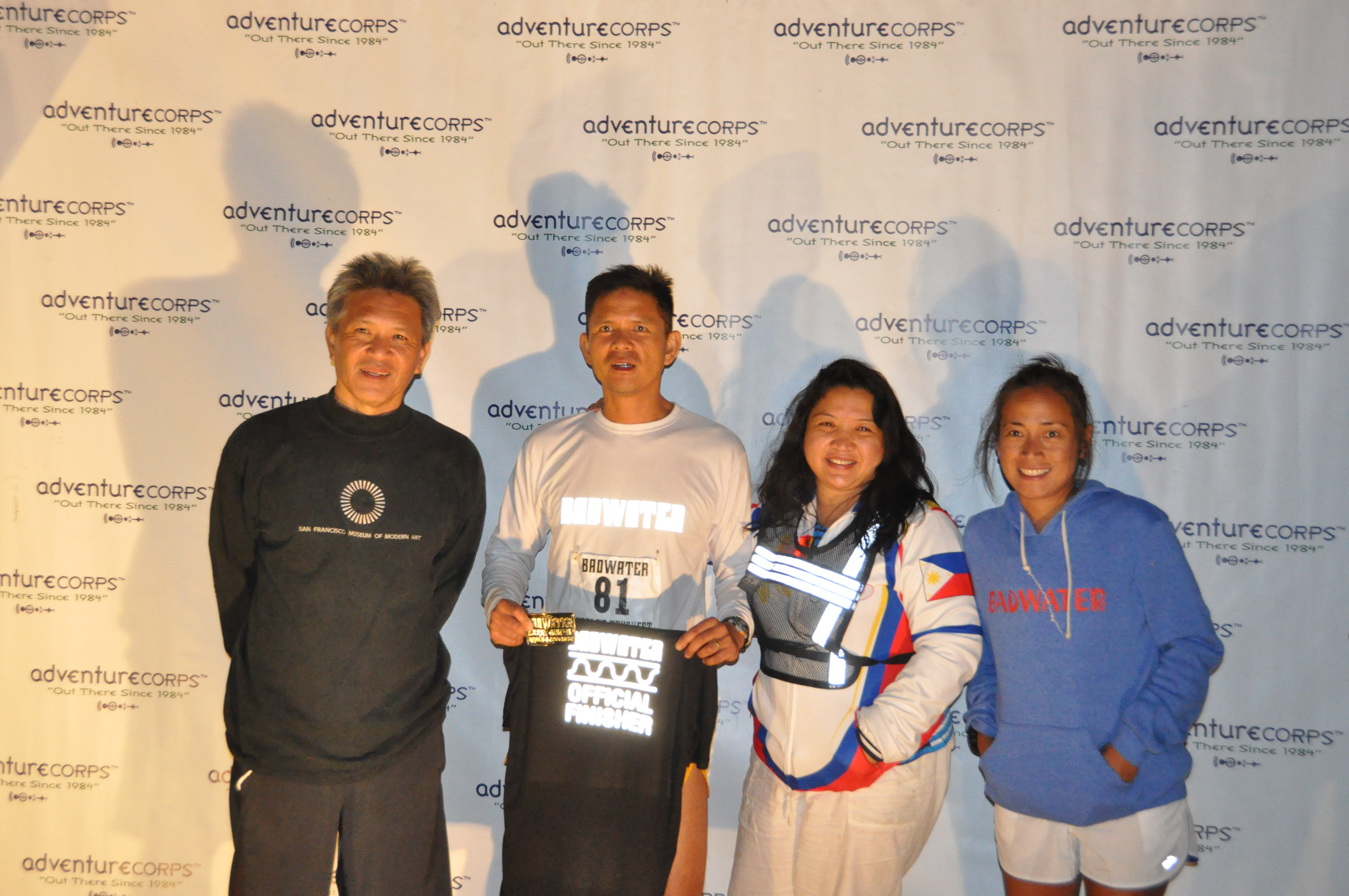
However, his toughness as a 100-Miler and Ultra Podium Finisher is not enough for him to secure an easy race and finish at Badwater 135. With a 48-hour cut-off time to run a distance of 135 miles with extreme heat, gusty winds and additional gain in elevation as compared with the original Badwater route, the presence and time-clock precision of pacing and assistance from his Support Crew is equally half of the effort for an ultra runner to finish this brutal ultra running event. Gerald was ably assisted by the following members of his Support Crew dubbed as the “Team Tabios”—-his wife Donna; Kat Bermudez, a Registered Nurse in New York City; and his brother Glen Tabios, a UP Diliman Professor and Civil Engineering Chairman who flew all the way from Manila. It was unfortunate that friends and relatives of Gerald in New York City came up with a nice Uniform for everybody in the team with the word BADWATER printed on them and they could not wear them during the race as it violates one of the Rules and Regulations of the Race—the word “BADWATER” is a registered trademark of the Race Organizer and nobody is allowed to use it in any form by any of the participants. Violation of any rules or regulations of the event would mean an outright Disqualification from the race.
Brother Glen, Imported From The Philippines, Had Unlimited Water Spray & Cheers To Gerald
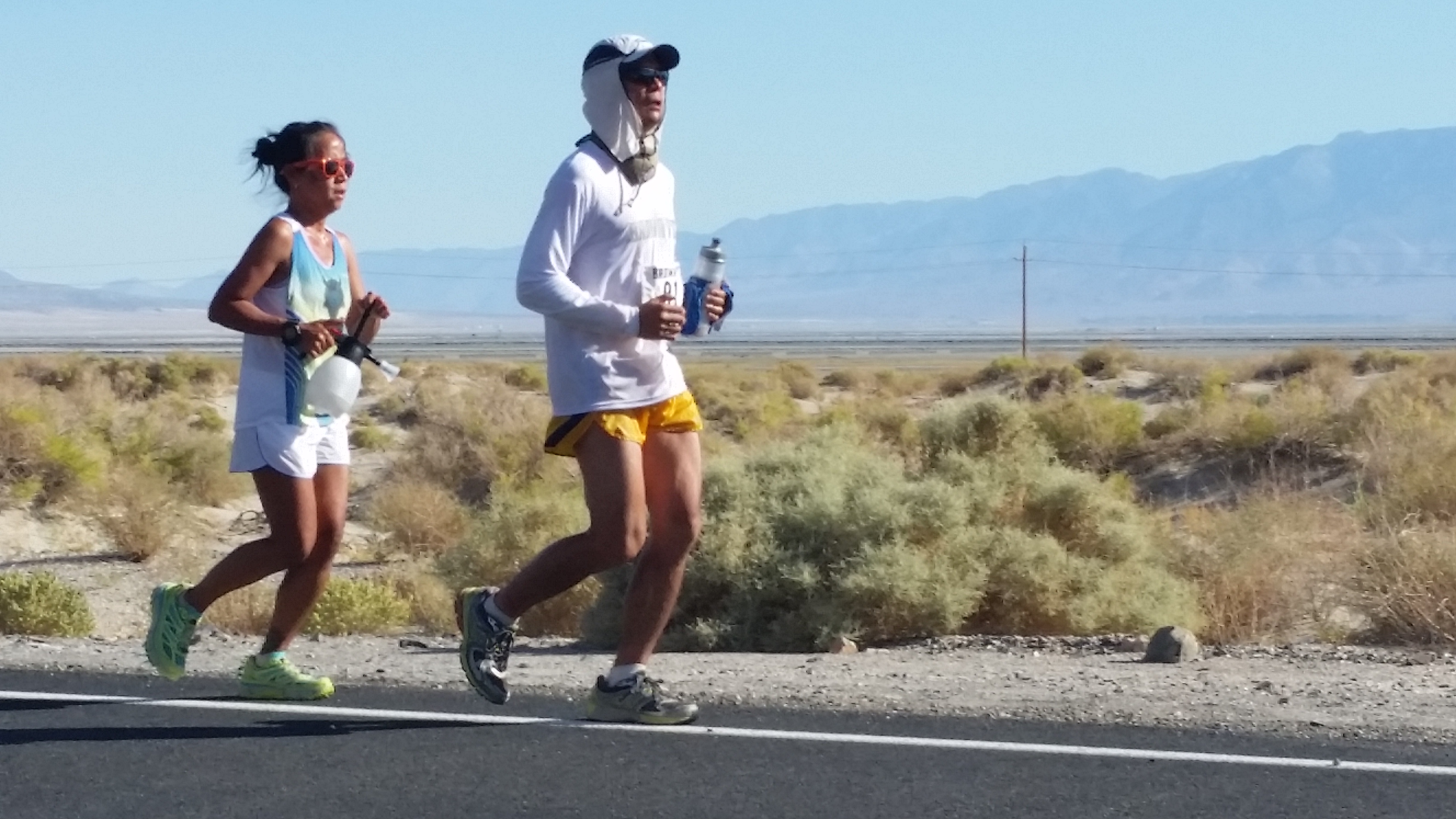
Practically, Gerald and the members of the Team Tabios are “first-timers” in the desert environment of California. Based from the FB Status of Kat Bermudez who happens to be the an ultra runner and wife of a PMA Graduate and former comrade-officer in the Philippine Army, the Team landed in San Francisco coming from New York City. Kat was always complaining about the lack of Parking Spaces in the Windy and By The Sea City of San Francisco! It was too late to suggest to her that the team should have landed in Los Angeles! However, during the event, I never heard Kat from complaining about where to park the Team’s Support Vehicle along the desert of California! It was Kat’s regular FB Status Feeds that gave much information and pictures of Gerald’s “real-time” situation during the race as she later became the Official Pacer of Gerald; Donna, due to her observation on how the elite runners are being supported in Gerald’s past ultra races, she became the overall “conductor of a symphony orchestra” for all the Support Team members to be “playing the same tune” so to speak, and bring Gerald to the finish line strong, safe, and without any injury. Glen, Donna, and Kat did a splendid job as their Principal Runner, Gerald did not have any bouts of cramping, GI issues of “throwing up” of ingested food; dizziness and hallucinations; chafing; blisters; or dehydration. Gerald followed his pace, ate and drank his nutrition and did not mind the pace of the other runners. With patience and determination, Gerald finished the 2014 Badwater 135-Mile Ultra Marathon Race in 44:40:40 hours ranking as #69 out of 97 starters.
Ultra Runner Kat Bermudez As The Pacer Of Gerald
I was expecting Gerald to relate to me a little “drama” if he ever encountered some nasty feelings or pain in any parts of his body or doubts in his mind about the challenges he has to face or had any complaints about the hot weather, gusty winds in the desert and those additional gains in elevation of the new route. He said that he did not have any “drama” or “issues” with his body and the environment during the race. It speaks well of his good training/preparation and firm resolve to finish the race. If you closely observe his running attire and shoes, he did not change them except when he removed his gaiters and changed his wet socks. Would you believe that he used a New Balance 860 V3 shoes which he bought On Sale at Marshall’s for the price of $49.00 and with cotton socks from GAP? I wonder if Gerald has a bloodline to my own tribe which is the Ilocano!
Knowing that he had already recovered from this brutal course, I asked him about his training in preparation for this event. He humbly said that for the past year leading to the event, he was logging 40-50 miles a week where most of his weekday runs were his daily 6-mile runs from his home/apartment in Queens to this work in Manhattan, New York City. On weekends, he starts very early in the morning for his long runs but he makes sure to be back before mid-day and spend most of the remaining time of the day with his wife and kids, a boy and a girl (11 and 7 years old). He proudly said that he works as a Private Family Driver in Manhattan, New York City but remotely managing a small business that he owns in the Philippines. His humility would not show that his family, specially his father, grew up in a family of politicians and entrepreneur in their province.
Team TABIOS: Brother Glen; Wife Donna, & Ultra Runner Friend Kat
Not even money or financial requirements for the event would hinder Gerald’s passion to the sports of ultra running. Gerald’s and his wife’s savings amounting to $3,000 financed his dream to finish the event and it covered for the Registration Fee for the Race ($1,050); RT Ticket for Gerald & Wife ($850); Support Vehicle/Van Rental ($600); Hotel Accommodation in Lone Pine, California For 5 Days ($550); and Food & Miscellaneous Needs ($400). His brother Glen and friend Kat shouldered their own RT plane tickets from Manila and New York City, respectively. Gerald’s relatives and friends residing in Los Angeles, California had also supported the team by lending those much-needed ice cooler/chest for his nutrition/hydration and cold towel/water spray.
Gerald was able to raise the amount of $1,200 for his charity through the US Fund for UNICEF which will ultimately be used in the rehabilitation/rebuiding of the damage structures brought about by Typhoon Haiyan/Yolanda in Leyte and Samar. Gerald is a simple and humble guy with strong legs and a big heart!
When I asked him, “What will be your next adventure in ultra running?” He answered, ” Sir, I hope to run a distance of 180 miles in the next year’s edition of the Three Days At The Fair in May 2015 in Augusta, New Jersey and be able to improve my 143-mile record this year.”
And then, I asked him again, “What keeps you on “going and going” like that Energizer Bunny in the TV Ads?” He replied, “Running is the simplest sports that I know which has only ONE RULE—Do not stop running until you cross the Finish Line!”
But jokingly he added, “It is your fault, Sir BR! When I started regularly reading your blog three years ago, it transformed me to be a “crazy runner” like you!”
We both laughed and I raised my hand and I gave him a snappy salute!
Well done and Congratulations, Gerald! You made our country proud among the toughest and strongest runners in the world!
Carry On, Warrior!
“Do not stop running until you cross the finish line.”
(Note: Photos of Gerald Were Shared Through The Courtesy of Donna Tabios)
Next year will be the 7th edition of the Bataan Death March 102K Ultra Marathon Race (BDM 102) and I firmly believe that this running event opened the awareness of our local runners on the possibility to finish a running event more than the distance of a Marathon Race. Its historical significance and the experience of past finishers had lured a lot of new marathon runner-finishers for them to train and finish the race. And slowly it is becoming more prestigious that you can not call yourself as a “full-blooded” ultra marathoner among the local Filipino runners if you have not finished this race. Better yet, if you consider yourself as a Race Director/Organizer of a local ultra running event.
Almost yearly, the course record of the BDM 102 had been broken by what we consider as our “elite runners” and nothing happens after that for them to be exposed to other ultra running competitions abroad and find out how they would compare themselves to international runners. With the help of ultra running friends and former comrades in the military service, I was able to expose some of these elite runners in three instances but these were the notable results: (1) Alquin Bolivar, an active Philippine Army soldier set a National Record for 100K with a time of 9:04:23 hours and placed #6 among the fast ultra runners of Asia in an IAU-sanctioned Asian 100K Championship Road Race in Jeju, South Korea in 2010 and (2) Marcelo Bautista, a 9:45:59-hour finisher of BDM 102, who placed #15 in the 2013 Hongkong 100K Trail Ultra Race among 1,250 runners coming from different countries with a time of 12:08:42 hours making him a qualifier for the prestigious Western States 100-Mile Endurance Run in California, USA.
Due to different factors and reasons of which I don’t have any control, I could no longer afford to send such “elite” athletes to international ultra running competition. If TNF Philippines could not even afford to send the Champion of its yearly TNF100 to any of the Southeast Asian TNF100 events, how much more for a “pensioner” like me who does not have any profit from having less than 100 runners in my regular ultra races.
There are potential “elite” ultra runners among us who would like to be exposed to international races but I have the observation and personal opinion that they lack two of the most important considerations or attitude which are very paramount for me aside from the fact that they lack the financial resources: Loyalty and Humility.
Loyalty? Do I need to define what is loyalty? Humility? Do I need to define this word also? If you are one of the local ultra runners who know me personally or had been reading my blog since the time I created this, you would know what I am talking about. If you are new in this blog and don’t know me personally, you can always “search” for my rants and random thoughts in my past posts.
So, if you have the influence or the capability to send our elite ultra runners to international competition, you can do also your share in this effort. If you are one of the “Big Shots” in the Government Service or in the Private Corporate World, you can be a great help to these potential elite runners making sure to test them of their “loyalty and humility”.
For those who have the time, money and resources to participate in international races and considered as our “elite” ultra runners, the whole local ultra running community will be behind you to cheer and pray for your safety in your travel and for a competitive resolve to be faster and stronger than the other runners.
This brings me to a more focused observation to our “elite” ultra runners who are competing (not participating) in an international ultra running event. It is assumed that if you are an “elite” ultra runner, you are supposed to compete with the best of the other international runners. There is no doubt that your sole purpose and focus in this race is to be able to finish the race as fast as you could within the confines of your skill, talent, training and mental fortitude. It is assumed also that you have figured out, through your training and preparation, the best race and nutrition strategy for such event. There is NO point of thinking that you are there to simply to FINISH the race event. The ultimate aim of an “elite” ultra runner is to be able to land and place as one of the podium finishers (top 3 or top 10), period!
For the “middle-of-the pack”, their purpose and goal is to be able to pass or overtake as many runners as they can before they cross the finish line. These are the ultra runners who keep on coming back every year to improve their Personal Best or PR times for the event. They find satisfaction to beat a friend or an opponent or a training partner, whether their satisfaction is for bragging rights among other runners or silently praising himself/herself that he/she could improve some more. These are serious runners who always find ways and means for them to be faster, stronger and smarter ultra runners. They keep on improving with the end view of someday joining in one of the international ultra running events as part of their “bucket list” given with a well-balanced family and job/professional career. I can say in my opinion that these are the “Silver Medalists” in the past BDM 102 editions.
The “back-of-the pack” are mostly “whiners”, “fakers” in their training, pressured by their peers to join, old and aging runners who would like to put a tab on their “bucket list” before they fade away (that’s me!), non-believers to accept that they are little heavy in weight and very slow in running and ask a lot of unnecessary TLC in Aid Stations, those who don’t accept that they are injured in their training, and those who always have a laminated printed copy with them of their targeted split time in every kilometer post along the route in order to avoid being cut-off from the race. I call these runners as “hit or miss” ultra runners.
As more ultra running events, whether road or trail, are being organized in the country, there is a possibility of more runners being lured into joining ultra running events and you can easily distinguish them as the “elite”, “middle-of-the pack” or “back-of-the-pack” ultra runners. I just hope that their interest will not end once they finish the BDM 102. As for the elite runners, I am still confident that private individuals and/or corporate brands will be able to support and send them to prestigious international ultra running events, whether they are in Asia/Australia, Europe or in the USA/Canada, in the years to come.
If former President Marcos was able to invite past Boston Marathon Champions and Marathon Olympic Medalist in the past to be as special guest/runner and if MVP can bring a whole NBA Team to the country to play with our National Basketball Team or send our Basketball Team to play tune-up training games to a popular and former NBA Champion Team in the USA, I have the strong belief that our ultra runners will soon be running side by side with elite ultra runners worldwide or for these world’s elite runners to be running in our local ultra races.
I hope and pray that these things will happen before I finally fade away from ultra running as a “back-of-the-pack” runner!
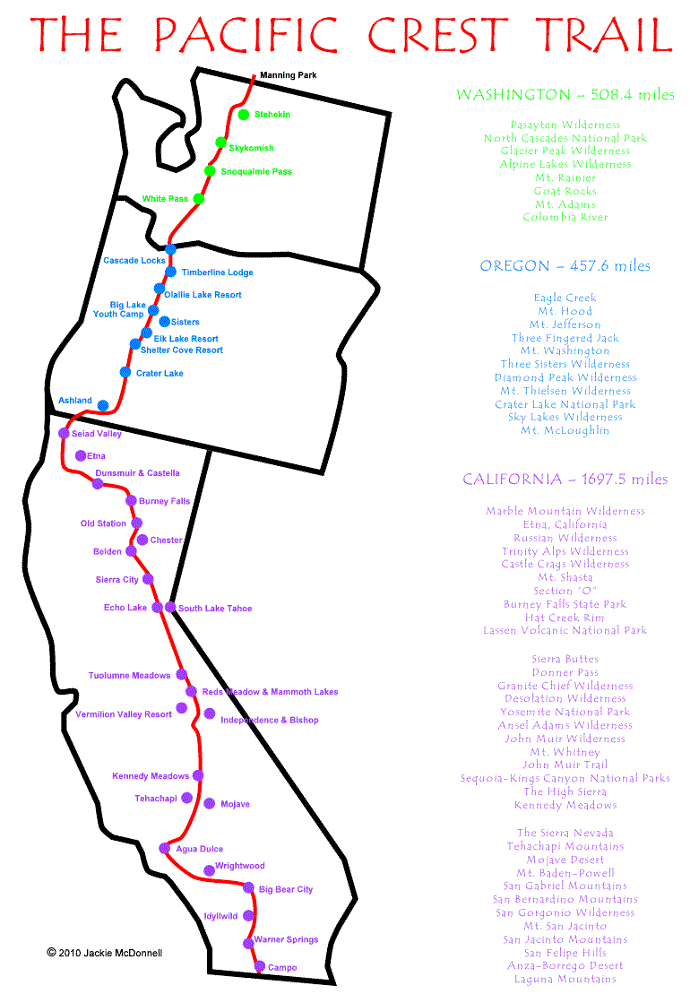
The Pacific Crest Trail is commonly known by its abbreviation, PCT and it is often designated as the Pacific Crest National Scenic Trail. The trail system is located on the Western Portion of the contiguous USA Mainland and it passes through the States of California, Oregon, and Washington. The trail covers a distance of 2,663 miles or 4,286 kilometers from South to North or vice-versa. It is one of the three most popular trail systems in the United States, the other two of which are the Appalachian Trail and Continental Divide Trail.
History on the creation of the trail states that the first proposal for the trail system connecting the States of California, Oregon, and Washington was made in 1926 which could be an exchange of mails and correspondence among early explorers in the area. The actual exploration started sometime in 1930 but there are no available evidence or journal to support this fact. However, in 1932, an oil magnate and explorer, Clinton C Clarke, started promoting the creation of the trail system as evidenced from his correspondence with John Muir and other explorer-environmentalist-outdoorsmen during those time.
Pacific Crest Trail Route
In 1935, Clinton C Clarke organized and spearheaded the conduct of the first meeting among his friends and associates who believe in his vision and objectives. Thus, The Pacific Crest Trail System Conference was formed with the objective to formally establish the route/connect “all the dots”/establish a route map and to lobby or create awareness for the federal government of its existence and to protect the trail system. The Conference consisted of Clarke, the Boy Scouts of America, YMCA, John Muir, Ansel Adams (famous photographer-environmentalist), and other environmentalists. From 1935-1938, YMCA and the Boy Scouts of America did a splendid job of organizing a yearly “Boy Scout Relay” along the trail route where each of the team carried a Log/Journal. The objectives of the “Boy Scout Relays” were to provide an actual ground/activity to practice the skills of scouting; create awareness on the activities of the Boy Scouts; and as a proof that the trail concept of Clinton Clarke is doable. The dedication, passion and commitment of Clinton C Clarke to the Conference and its accomplishments earned him the title of “The Father Of The Pacific Crest Trail”.
In 1939, a year after, the Pacific Crest Trail system appeared on a federal government map for the first time. With the signing of the National Trails System Act by President Lyndon B Johnson in 1968, PCT was designated as one of the National Scenic Trails and protected by the federal government. The Pacific Crest Trail Conference became incorporated in 1977 and later merged with the Pacific Crest Trail Club in 1987.
The Pacific Crest Trail Conference changed its name as the Pacific Crest Trail Association which is the establishment that supervises, manages, and administers the Pacific Crest Trail. So, if you have plans of conducting a “thru-hiking” or “section hiking” along the PCT, it is best to visit their website for you to be guided in terms of permit, maps, schedules, and other details/announcements on the PCT. You can go to: www.pcta.org.
One Of The Trail Markings @ PCT
I became aware of the existence of the Pacific Crest Trail for the first time when I recon the route of the San Diego 100-Mile Endurance Run two years ago as some portions of the first half of the ultra trail would course pass through the actual PCT. As I conquer and “peak bagged” some mountains in the San Gabriel Mountains and mountainous parts of Los Angeles area for the past 2 years, I’ve been seeing the PCT trail markings. However, I came through a published article about the exploits of Scott Williamson who was considered as the first “thru hiker” who did a “yo-yo” hike (South-North-South) on the PCT in a year and it gave me the resolve to read more about the people who were successful in their “thru-hikes” along the PCT!
This interest on the PCT led me to read more stories and journal about the hikers at the PCTA Website, most specially on the blogs of those “thru-hikers” who are on the route and at the same time blogging about their activities/experiences and pictorials on the trail. At this time, I have three (3) published books which I’ve been reading for the past weeks. I am not saying that I am already an expert on the details of the Pacific Crest Trail but it is worth knowing the experiences of those who successfully finished their “thru-hikes”.
In One Of My Trail Running @ PCT
It brings me back to a surprise conversation encounter with the Former President Ferdinand E Marcos during one of his annual Holy Week stay in soon-to-be Malacanang of the North at Paoay Lake, Ilocos Norte in 1979 with the then Commander of the Presidential Security Command (PSC) and Director-General of the National Intelligence and Security Authority (NISA), General Fabian C. Ver. In my recollection, the brief conversation went this way:
General Ver: Sir, this is Lt Narcise, our NISA Station Commander in Ilocos Norte.
President Marcos: Lieutenant, from where are you?
Me: I am a native of Laoag City, Sir!
President Marcos: How is the CPP/NPA situation here?
Me: There is not much of activity except for sightings along the Ilocos Norte-Cagayan boundary, Sir. They don’ t have any mass base or reported training camps in the province, Sir.
President Marcos: Try to locate the “Guerrilla Trail Route” that goes from North to South in the province all the way from Pagudpud to Pangasinan. I am sure the insurgents are using that route in their movements.
Me: Yes, Sir!
End of Conversation
In the late-80s when the CPP/NPA established their mass base and training camps/s in the eastern mountainous parts in the province, they used this trail system in their movements from Cagayan and Kalinga-Apayao to the province of Ilocos Norte and back. The information about the presence of this “Guerrilla Trail Route” in Ilocos Norte was shared to the Scout Rangers of the Philippine Army in their Test Mission Operations which eventually led to the crushing and destruction of the CPP/NPA Provincial Committee and its armed personnel/component. With this debacle on the part of the insurgents, Ilocos Norte was never been attempted as a “refuge” or training base for them.
In 1995 when I was a Battalion Commander of the 60th Infantry Battalion, Philippine Army where my area of operations would cover the province of Ilocos Norte, I deployed a platoon of soldiers to monitor the movements at the said trail system. In a few weeks, it resulted to a bloody armed encounter with the insurgents that cause to the death of three (4) insurgents and capture of numerous firearms and subversive documents. This armed encounter with the insurgents was recorded as the last armed fighting in the province up to the present. In a few months, the province was cleared and I was ordered to transfer my Battalion to the Province of Abra.
At present, it is my plan to revisit the Guerrilla Trail System in Ilocos Norte and formally establish a route map to be shared to everybody. I envision a trail system that would start at the northernmost part of Luzon in the province of Ilocos Norte to the its southernmost tip of the province of Sorsogon. It will be a daunting task and a grand undertaking for me to accomplish with the support of my ultra running friends and my former/active comrades in the Armed Forces of the Philippines and the Philippine National Police.
Initially, I will call this trail system as the “Luzon Ridge Trail” (LRT). The history and establishment of the famous and popular Pacific Crest Trail Association will be the template of this undertaking. The activities on the exploration of this “Luzon Ridge Trail” will be one of the topics of this blog in the days, weeks and months to come. The exploration will start this month in Pagudpud, Ilocos Norte.
However, there is also a plan to start another trail system in Sta. Ana, Cagayan where the route will pass along the Sierra Madre Mountain Range all the way to the southern tip of the province Sorsogon. I might temporarily call this route as the “Pacific Coast Trail”.
This a dream, a plan, and an undertaking that is worth dying for. I can only envision that this undertaking will benefit the whole country.
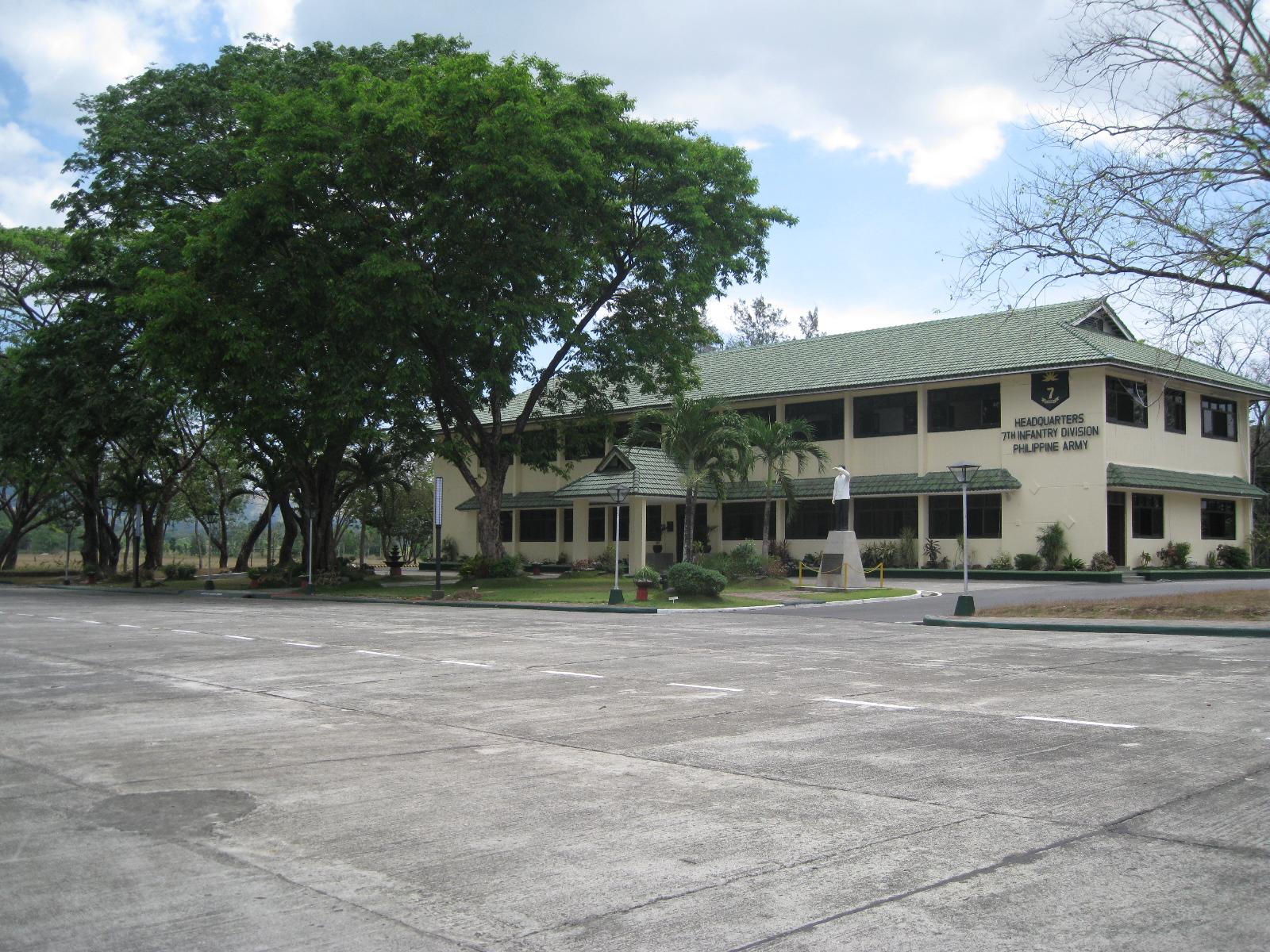
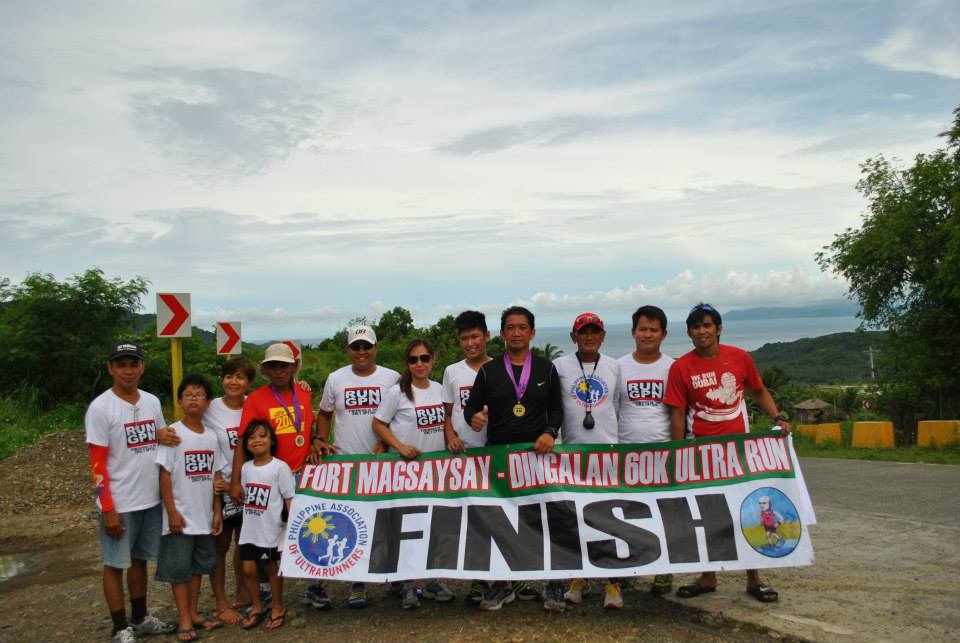
This is the Fourth Edition of this classic PAU Ultra Road Race which starts in front of the Headquarters of the 7th Infantry Division of the Philippine Army inside Fort Magsaysay, Palayan City (Nueva Ecija).
For the past 3 years/editions, the distance was 60 kilometers. However, for this year we will try to add more distance to the event so that the race will finish in one of the available spaces/areas along the coast of Dingalan, Aurora and the Pacific Ocean. Finishers/Runners and their Support Crew will have a chance to dip their tired bodies on the shore/Pacific Ocean. Hopefully, we will be able to complete the distance of 65 Kilometers. Foods will be served to all the Finishers.
Starting Area: Headquarters of the 7th Infantry Division, PA
The race will start at 4:00 AM of August 24, 2014, Sunday, whether there will be only 10 runners. The cut-off time will be 12 hours. Podium Finishers (Top Three For Men & Ladies) will receive individual trophies. All Finishers will receive a Finisher’s T-Shirt; Finisher’s Medal; and a Certificate. Assembly Time and Processing of Runners will start at 3:00 AM on Race Day.
I encourage that all participants should review the rules and regulations of the past editions of this event. Such rules and regulations will be applied to all Road Races being organized by the Bald Runner’s Events/PAU Races. Support Vehicle is not mandatory. Runners who will be on “self-support” mode will be able to take advantage of convenience stores along the route.
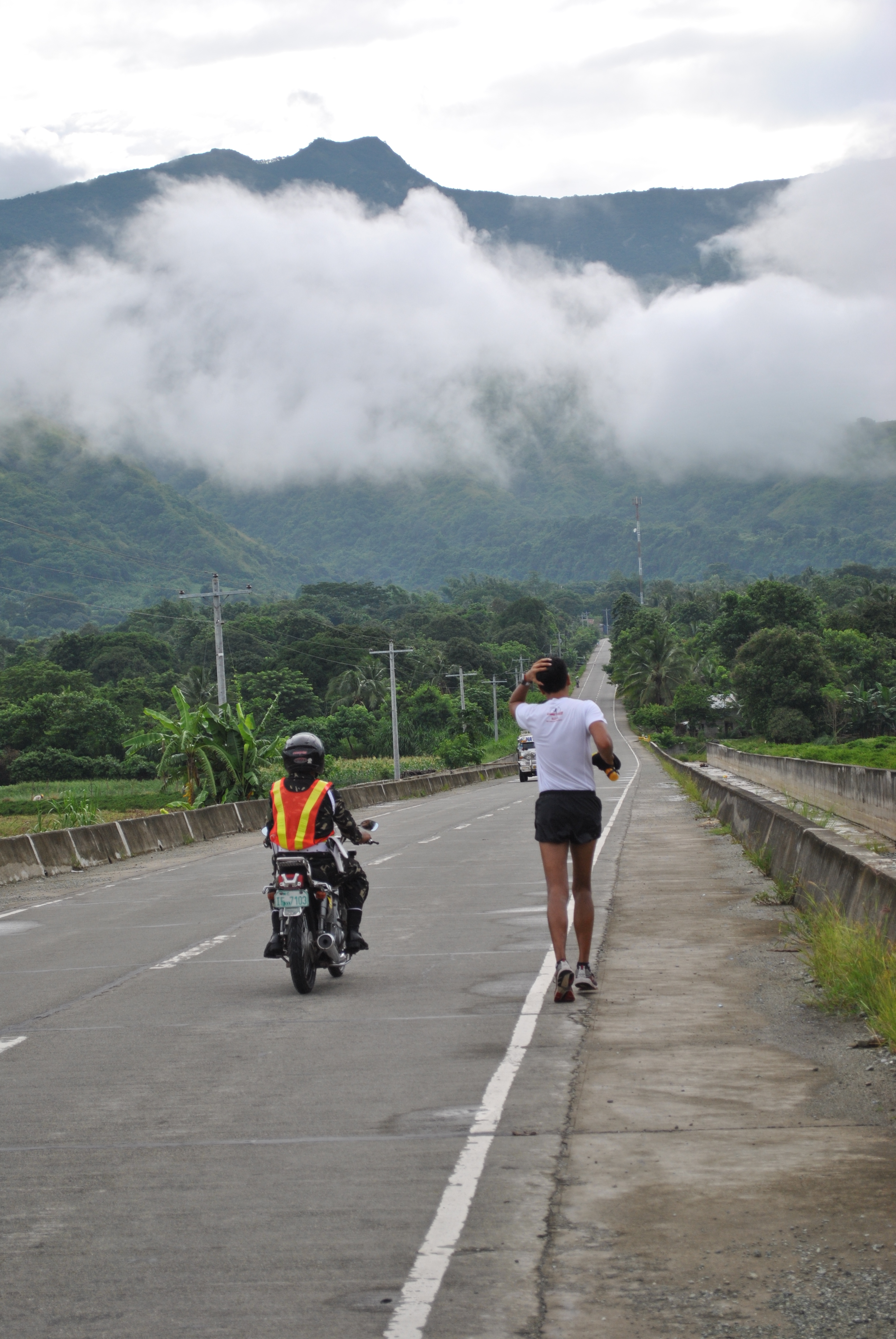
Fort Magsaysay-Laur Highway
If you are new in our races, you have to review the past posts in this blog. If you have any concern or clarification about the conduct or details of the event, you can post a status or comment on the Facebook Event Page of this Ultra Event.
The registration fee is One Thousand Eight Hundred Pesos (P 1,800) per runner. A runner can register by depositing the amount of money to the Bank of the Philippine Island Savings Account #0296-0673-22 in favor of Jovenal Narcise. Please send a photocopy of the Deposit Slip at e-mail address: jovie75@hotmail.com immediately and bring the said Deposit Slip at the Starting Area on Race Day. The Deposit Slip will be used to redeem your Race Packet. Registration is now open and it will end on August 22, 2014, Friday.
This road race is highly recommended to those ultra runners who will have their first taste and experience towards the 2015 Bataan Death March 102K Ultra Marathon Race (BDM 102).
Good luck and see you at the starting line!
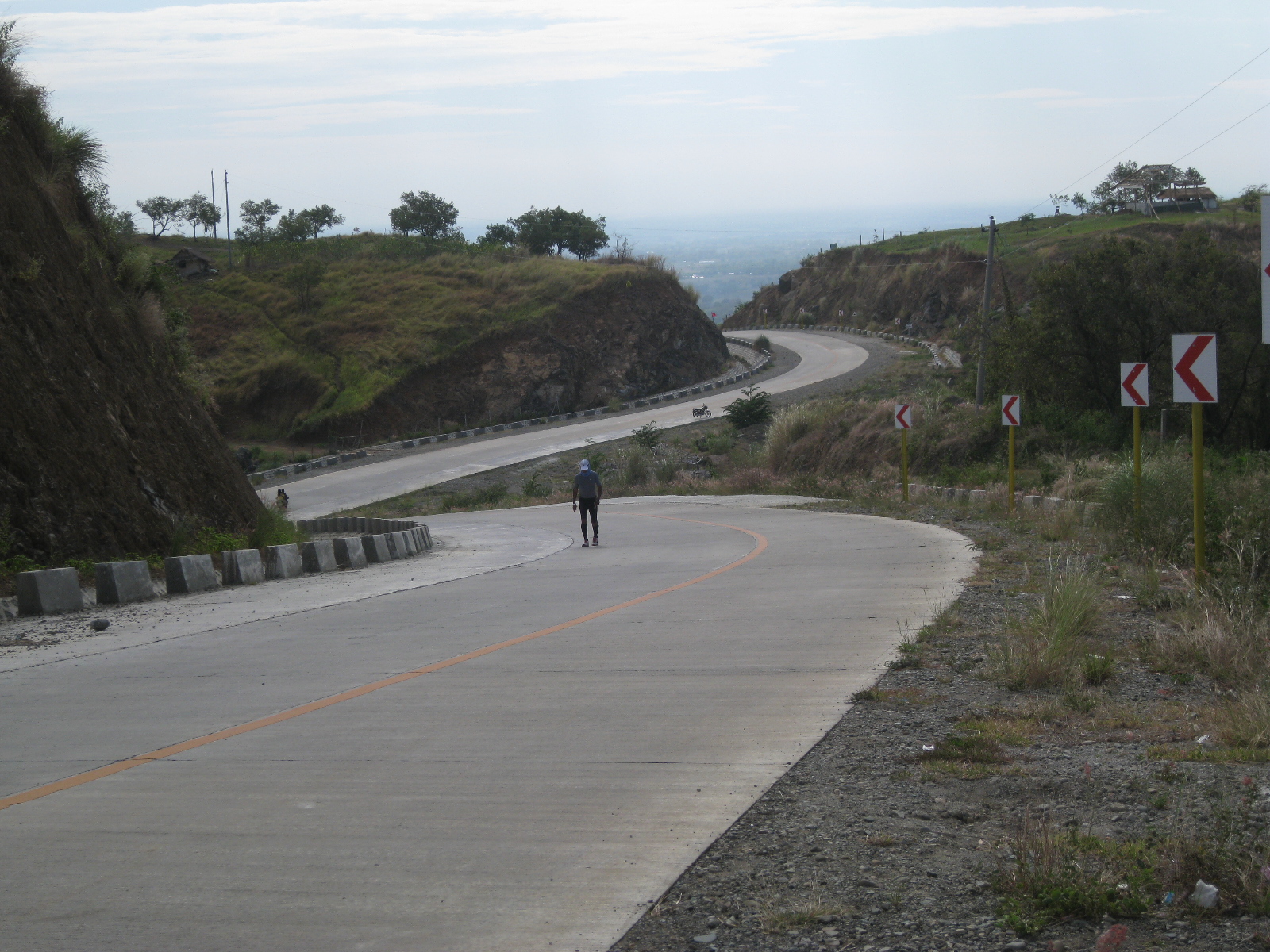
Laur To Gabaldon: To The MountainsFinisher/s and their Support Crew/Team
I am a “late comer” on the use of this item, most specially now that I’ve concentrated my running workouts on the mountain trails. How I wished I have this item as soon as it was available in the market.
For the past years since Foam Rollers were available in the market, I ignored them because I have my own staff/aide who had been giving me almost a daily massage. For a change, I decided to have a try using this foam roller.
I know that there are so many types of foam rollers in the market but I am more interested to have the “original” foam roller. So, I was able to buy one which I think the cheapest in the market.
It is very easy to use. The item has a booklet inside its package and the instructions on how to use are very easy to follow. Basically, you have to use the weight of your body to put pressure on your muscle to the roller foam. Whenever I feel a sore spot in the my muscle, I would spend more time to roll the foam on the said spot until I get a relief or the soreness is diminished.
After reading some posts on the Internet about its use and product review, I came up with the discovery and information that one should refrain from doing so much stretching on the IT Bands. You could “google” such topic on the Internet for more details. You could feel the pain or soreness of the IT Bands if you use the Foam Roller on them but because of the information, I try not to spend so much time “rolling” on my IT Bands.
I concentrate more in using the Foam Roller on my quadriceps, hamstrings, calves and gluteus muscles. Surprisingly, I am addicted in using it whether for my stretching routine or to relieve sore muscles in my legs. I usually use the Foam Roller at least twice a day; after a running workout and before going to bed at night. Thirty minutes per session will be a good and relaxing time for your legs!
It is highly recommended to use the Foam Roller with your Yoga Mat; a carpet; or on the floor. It is guaranteed that your muscles will be happy and relieved every time after your daily “foam rolling” sessions.
My RED Foam Roller
But wait, I have read somewhere that if the Foam Rollers are not available in the market or too expensive in ones budget, a piece of PVC pipe will be a good substitute. Although, I haven’t tried it, it would be nice to experiment on it.
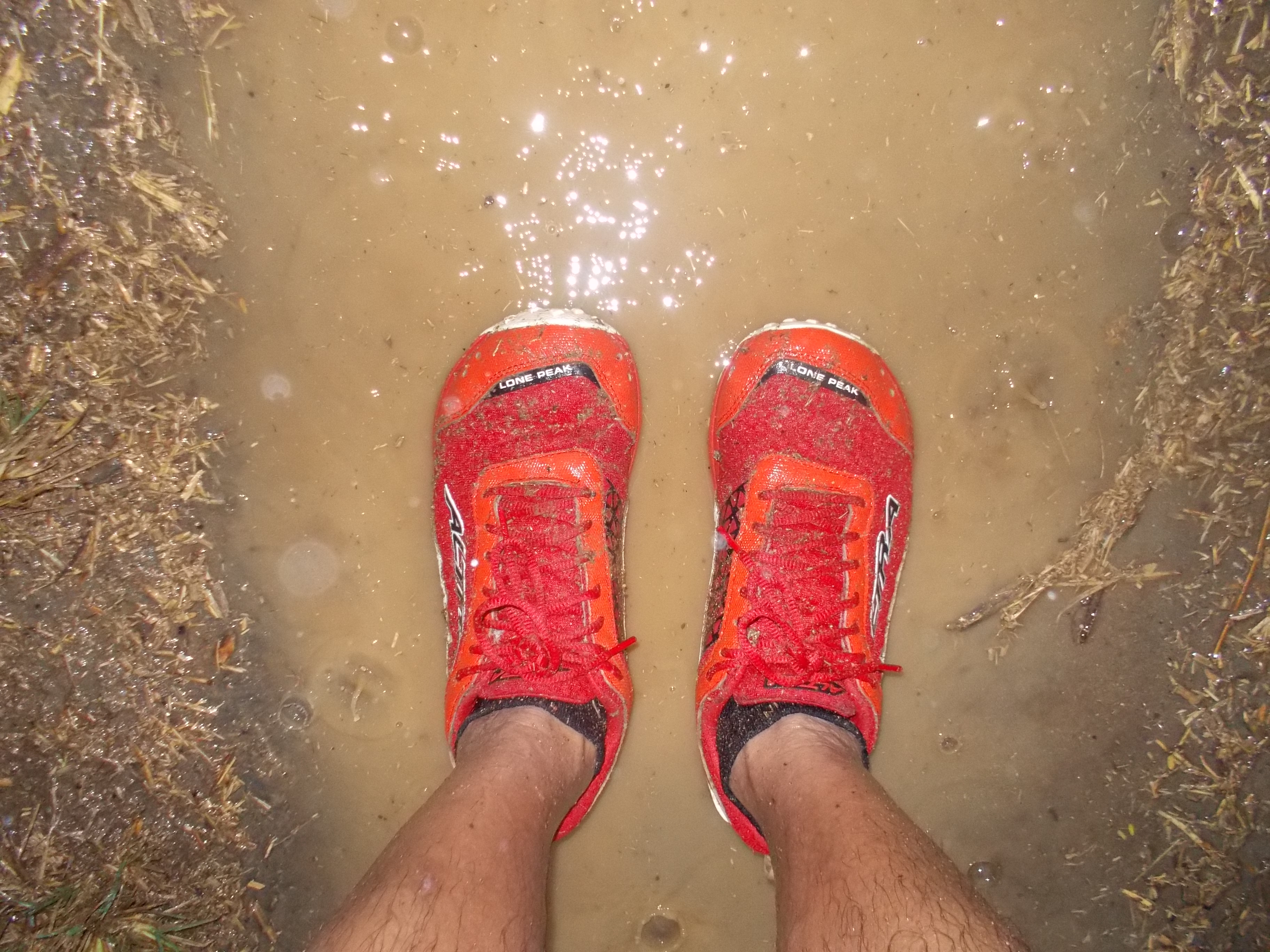
Few months ago, I bought an ALTRA Lone Peak 1.5 trail shoes and after using it on my trail running workouts and putting almost 300 kilometers as mileage, I came up with a Shoe Review which I posted here in this blog. I was satisfied with the shoes with their Zero Drop concept and wider toe box but not so much on its weight when it is wet with my sweat and during my river/creek crossing; its sole traction when running on muddy trails where the sole would gather a lot of mud that would make the shoe heavier to the running legs; and the long period of time for the wet shoes to dry up during its use or when it is being “air dried”.
I concluded in my shoe review that the trail shoes is not suited for the muddy trails in our mountains (Philippines) but best suited for dry trails, loose gravel, rocky and technical as long as the trail is dry! I am not surprised on this because the shoes was conceptualized on what is written on the shoebox of every ALTRA Shoes.
Wet & Soaked ALTRA Lone Peak 1.5
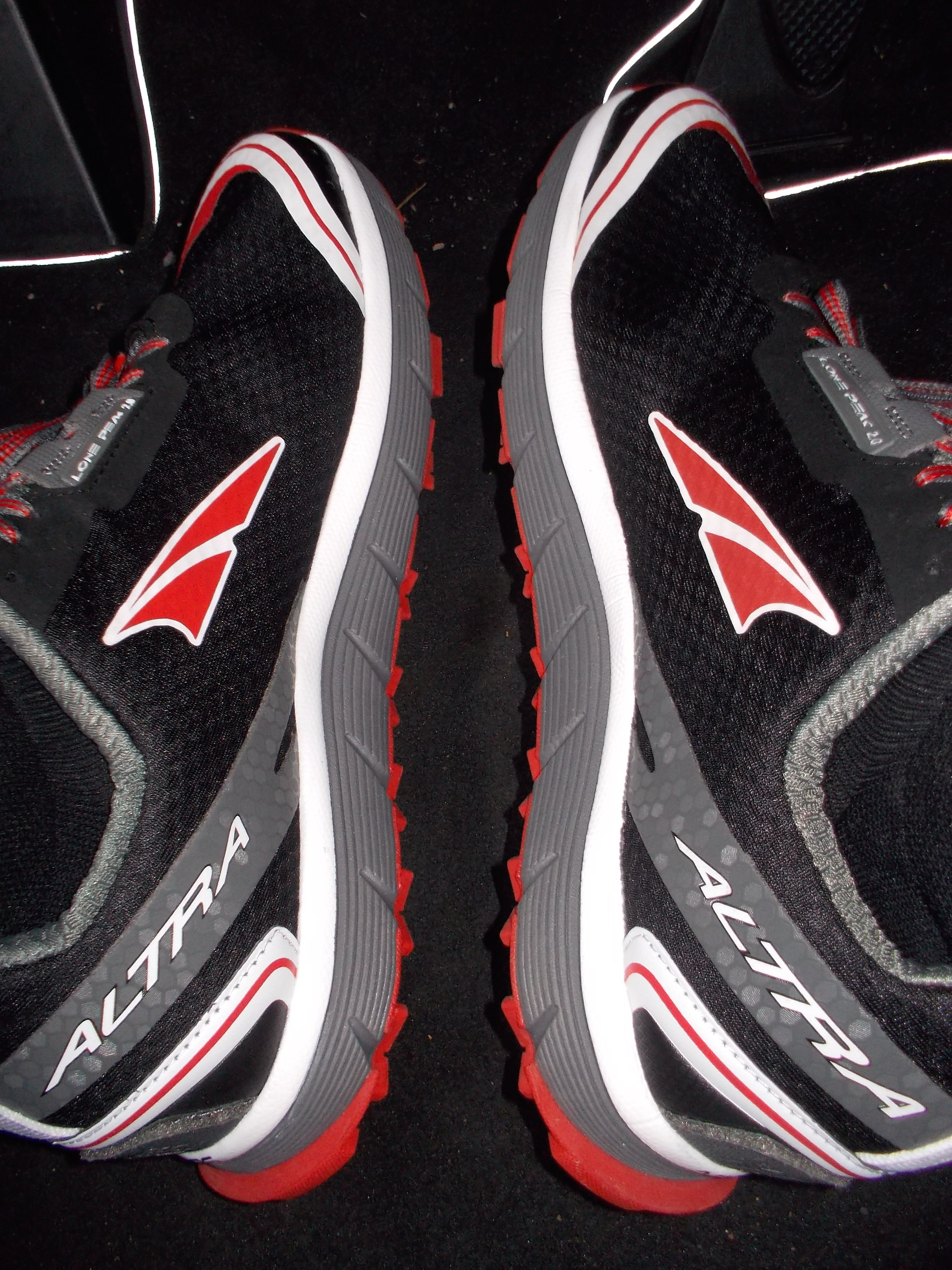
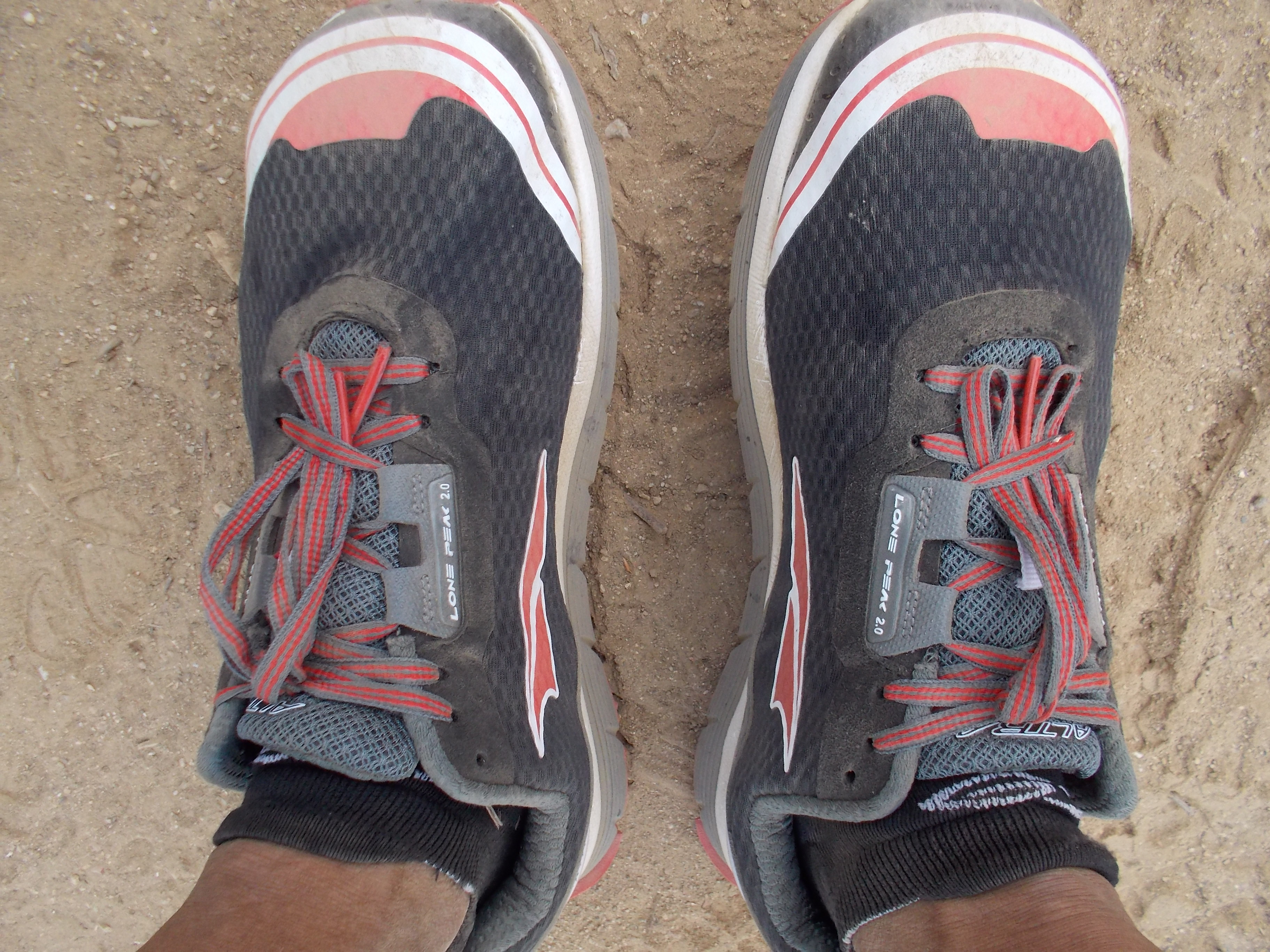
For about a week, I had been running on my new ALTRA Lone Peak 2.0 trail shoes. As soon as the shoes arrived, I immediately used it for my daily stretching and calisthenics. I immediately felt a big improvement on the cushioning of the shoes. This is a big improvement from the Lone Peak 1.5. The shoe lace is replaced with a flat and lighter material, a big improvement from the LP 1.5 heavier and rounded laces. The shoe tongue had been shortened for about half inch. The big ALTRA sign and mountain logo on the outer side had been removed, together with the “black net pattern” and white leather that you can see on the inner side of the shoes. What I don’t understand the reason why ALTRA placed a leather on the #3 and #4 holes for the shoe laces. It could be for aesthetic reason where small prints of the shoe model is written but it is not necessary to sew such where the laces should pass through. The rudder at the back/heel portion of the shoes is still there but it is shortened. The velcro (with cover) for the gaiter is still there. There is a new pattern of lugs on the sole but I still have some reservations on how it would work on muddy trails. The lugs have the same thickness with that of the LP 1.5.
Thicker Sole and Simple Shoe Logo
The big improvement on the cushioning is due to a thicker sole, 3 mm thicker than the LP 1.5 and a thicker insole which is 5 mm. There is no change in the “Uppers” of the new LP 2.0 from its predecessor. It means that the new model has the same problem with its water retention, slower drying time and heavier weight when it is wet.
More Comfortable To The Feet
On the website of ALTRA, the Lone Peak 2.0 has a weight of 11.4 ounces while the Lone Peak 1.5 is 9.9 ounces for shoe size 9. It means that the latest model had sacrificed or made some trade off for its weight by adding more cushioning and comfort for the feet. So, this is the reason why I could hardly noticed the weight of the shoes because of the comfortable feeling every time my foot strikes the ground.
The Same “Uppers” With The Lone Peak 1.5Lugs/Sole Print On The Trail
For almost 100 kilometers as mileage for this new trail shoes, I am satisfied with how it performed on my feet and on the trails. If you ask me why I did not order for the “Yellow Bus”? I have already my yellow La Sportiva Bushido and this is my first time to have a black colored trail shoes. So, the black “Ninja” shoes was ordered as part of my trail running arsenal.
With this kind of trail shoes, the challenge now for me is how to run faster with them on the uphills, downhills, rocky and technical trails, muddy trails, and when they are completely wet from my sweat and after creek and river crossings. With a new 5.6-kilometer loop of ascending and descending trails as my “testing” ground, I hope to compare this shoes with the other trail shoes in my tempo/progression runs.
I highly recommend the new ALTRA Lone Peak 2.0 as your training trail shoes and if you can manage to adapt on it as your racing trail shoes, then go ahead. Your feet will be happy to finish an ultra distance with them!
On the day of my 62nd birthday, US Navy Admiral (Four-Star General) William H. McRaven, Ninth Commander of the US Special Operations Command and a US Navy Seal, delivered a Commencement Speech to almost 8,000 graduating students of the University of Texas at Austin on May 17, 2014. He is an alumnus of the said University and a product of the school’s ROTC Program.
Having been a product of military training and some special operations training with the Philippine Army, I fully appreciate what the Admiral had gone through in his US Navy Seal’s Training.
However, for the benefit of my readers, I would like to relate the ten (10) lessons that the good Admiral had learned from his US Navy Seal training to the sports that I dearly loved at the moment and that I would like to be shared and experienced by other runners, which is Ultra Trail Running.
1. If you want to join and finish a trail ultra, start off by “making your bed”. Start with the “basics” of trail running. Go to the nearest mountain ranges or hilly parts in your place or community and find a trail when you can walk, jog, or run. Try to observe how your body would react to the uphills, downhills, flatter portions of the trail, rocky portions, muddy parts, uneven level of the trail, and the presence of obstacles along your path. Start training for the shorter distance, say 5K of pure trails until you can easily progress to longer distances. In trail races, it is better to start with the shorter distance events and slowly progressing to longer events in matter of months or years, and not of weeks. If you are totally new in trail running, I suggest you have to put in a lot of time running on the trails, like one year, before you are ambitious enough to finish a trail marathon distance (42K). As one has to progress to longer distances, one has to be aware of one’s hydration and nutrition strategy in order to keep ones energy and strength to finish the race. Make sure that you invest on your trail running needs like shoes and hydration system. Ask for some advise from the “experts and masters” of ultra trail running through their blogs or personal meetings/conversations with them. These trail runners are very much willing to share such information to you.
2. If you want to join and finish a trail ultra, find someone to “help you paddle”. It is better to train in trail running with somebody who has the same interest with you. It is either a friend or a group of avid/passionate trail runners. If you are new in a mountain, try to locate the Barangay Hall or the Barangay Captain and tell him about your purpose in going to the mountain or community. You can ask for the services of a Trail Guide within the Barangay who knows the “ins and outs” of the trail systems within the mountain. The services of a Trail Guide is invaluable as it will give you exact and accurate information about water sources and other salient information about the locality/mountain trail system in the area. If you are very serious in trail running and you have the goal to excel in this kind of sports, you can get an exclusive Coach for you who will guide you in your training. Get a Coach who is reliable and friendly. Aside from your Coach, start developing friendly relationships with your future Pacer/s and Support Crew if you intend to join 50-miler or 100K and above trail ultras.
3. If you want to join and finish a trail ultra, measure a person by the size of their heart, not the size of their flippers. Not because you have the physical strength, well-built body, healthy and fool-proof training, you can have the assurance to finish an ultra trail race event. There are things and factors to consider like the reliability and effectiveness of your running equipment; the prevailing weather; accidents along the course; nutrition; injuries and problems with ones feet and hydration strategy. Most of the faster and consistent podium finishers in ultra trail races are smaller (in height and body composition) people. Just look around you in the Starting Line of Ultra Trail Events, most likely, the smaller guys are the ones who dash froward as if the race is a 5K or 10K road race. These guys are usually the persons who have the tenacity to endure pain and fatigue.
4. If you want to join and finish a trail ultra, get over being a sugar cookie and keep moving forward. I call these hardened ultra trail runners as “Dugyots” (Dirty Runners) and they don’t care if their shoes are wet and muddy. They don’t care if they slip and fall on their butts or fall on their faces if they slip along the trails. They don’t care of their unprotected legs are scratched by sharp blades of grasses or tripped by thorny branches of bushes along the trail. They don’t care if their shirts and shorts or compression tights are ripped off by some accidents along the trail. What is more disturbing to these runners when they don’t really care if they are bitten by leeches in the jungle and just allow the blood to flow out of the bites of these leeches. I know of some runners who pee on their running shorts or tights while running and they don’t really care what and how they smell after the race. In trail running, the dirtier you look as you cross the finish line, the better for your picture!
5. If you want to join and finish a trail ultra, don’t be afraid of the circuses. “Circuses” are translated to “DNFs” in ultra trail races. Even the elite runners have their DNFs. So, why would you be afraid to experience your first DNF? Even if you are properly prepared and trained to a certain ultra trail event, “shit happens”. There are things and factors that one don’t have a control or manage to have these things from happening. If you think that your body could no longer tolerate the pain or any incurring “issue” within your body system and it would jeopardize you for finishing the race, you have to decide immediately for you to DNF the race. There is no shame in a DNF and don’t be affected by what the other runners and friends would say in contrary to your decision. It is your body that you have to preserve and you and only you who would have the responsibility to take care of your body, not by other runners or your running friends. Just remember to use the DNF as your “weapon” in your future races.
6. If you want to join and finish a trail ultra, sometime you have to slide down the obstacle head first. There are times that you have to take the “risk” in ultra trail race that you have trained for. It is either on your Race Strategy or on the skills that you have acquired and learned in your training for you to have an edge over your competitors. You know what your body is capable of when something or a challenge is in front of you, it could be a steep uphill climb, or a steep descending part of the course or a very technical trail where one has to be careful in every step, it could be a river/stream crossing, or some kind of rock climbing, or the need to rappel up or down to a mountain peak. However, don’t take the “risk” of joining and expecting to finish an ultra trail event if you don’t have the training/preparation, you’ll be wasting your money and time on this event. Do not take the “risk” also of introducing some thing “new” during the race, most especially on your equipment, nutrition, and apparel.
7. If you want to join and finish a trail ultra, don’t back down from the sharks. What is best in Ultra Running is the attitude of the runners. Runners would help one another in times when one is in need of food, water, or medical attention. But if everything is ideal and equal among runners, each one of the runners are competing with each other! Whether you like or not, you have “friends” or personalities whom you want to beat, pass, or finish faster than them. In your mind, these are your “sharks” in your races—they are your friends but at the same time your competitors! This is true also in Race Directing/Race Organizing. There are “sharks” going around you but if they become offensive to you, you must give them the “worst and hardest shock” of their lives!
8. If you want to join and finish a trail ultra, you must be your very best in the darkest moment. As they say, ultras are exercise of problem solving and adjustments. Pain, Fatigue, Loss of Appetite, and Dehydration are the most common “issues” to ones body in Ultra Running. But the worst “issue” is Hard-headedness! Each of these “issues” has solution and if you apply such solution, you will be at your Best once you comeback to the race. A brief rest or sleep (if you have enough “buffer” time) is the best solution to these “issues”.
9. If you want to join and finish a trail ultra, start singing when you’re up to your neck in mud. As they say, it is the “brain” that takes over when the body is already weak. The fight to finish the race is within the confines of the space between your two ears. This is where your “running mantra” would come in and you should express loudly for you to hear it. Some would use their iPods and MP3s/headphones to hear music; some would “pep talk” themselves with phrases or mantra which are repeated endlessly; some would count their steps; some would pray loudly; some would sing loudly which would make them on a happy mood; or some would think of their inspiration. Hope and Think Positively!
10. If you want to join and finish a trail ultra, don’t ever, ever ring the bell. There is ONLY ONE BELL in my Ultra Races and I, being the Race Director, is the one holding it and the ONLY ONE that is authorized to ring it. At the Starting Line, when it rings, it tells you “Good Luck & Have Fun”. And once I see you approaching the Finish Line, I have to ring the bell that tells you, “Good Job and Congratulations”!
Good Luck and See You In Your Next Ultra Trail Race!
Bald Runner @ Mt Susongdalaga (Playground Charlie)
In November 2013, it was a choice of buying an ALTRA Lone Peak 1.5 and La Sportiva Vertical K and after reading some reviews and technical specifications, I opted to buy the La Sportiva Vertical K. The main thing that I considered without seeing yet the actual shoes is the WEIGHT. In their weight comparison, obviously, the La Sportiva Vertical is far lighter than the ALTRA Lone Peak 1.5.
Brand New, Out Of The Box
In last year’s recon runs and actual race in the TNF 100 (up to Km #53), I used the La Sportiva Helios and I was satisfied with its performance. I never had any incident of slipping on the declines of the trail route and it is a very light shoes. Having experienced an excellent performance of La Sportiva Helios on my preparation in last year’s TNF 100, I decided to have the La Sportiva Vertical K as my race shoe for this yea’s TNF 100 which is a bit lighter than the Helios. (Note: In the actual race of 2014 TNF 100, I used the old La Sportiva Helios instead of the Vertical K).
Last November 2013, after I bought my La Sportiva Vertical K, I’ve read and heard testimonies about the ALTRA Lone Peak 1.5 which are positive, as well as, negative feedback. I forgot all of these things as I got busy with my trail running training and switched/interchanged one trail shoes to another on a daily basis.
Two months ago, I decided to order a pair of ALTRA Lone Peak 1.5 from a local distributor which I believed was “hand-carried” all the way from Singapore. I got a discounted price as a trail runner and a Race Director of local races. This shows that I don’t get a complimentary shoes for Shoe Review or Display on my workout so that my readers have the impression that I favor the use of a particular shoes.
After logging 250+ kilometers after two months of use and a chance to run them during rainy days, I have now a balanced shoe review on the said shoes. I will not be stating those technical specifications that anybody could read on the corporate website in this review. What is important is on how I could feel when I use it and my personal experience whenever I use them.
Wet Shoes After Workout!
The “zero drop” thing was not noticeable when I run since I’ve been fond of using racing flats in my road runs, road races, and oval track workouts. I am basically a mid-foot strike runner and it was just natural for me not to notice the difference of the “zero drop” thing of the shoes.
The best feeling and experience of using the shoes is the wide toe box. My whole feet are relaxed and comfortable, thus, my toes are spread as if I am barefooted or using my “flip-flop” sandals. This a complete change from my experience of using ASICS, New Balance and ADIDAS shoes. However, my New Balance 101 Trail Shoes has the same “toe box” feeling with that of the ALTRA Lone Peak 1.5.
The next best feeling and experience is the comfort and support cushioning of the shoes. From the heel portion up to the front end of the toe box, the support and cushion are perfect and I never had any pain, sore or burning sensation on my feet’s sole even on hot days. Whether I run them on rocks and other technical terrains (loose gravels and trails covered with leaves, twigs and branches), I could not feel these “bumps” on my feet. It has also a good protection when my feet would bump on roots or rocks on the front part of the shoes.
Of course, the RED color is something that is a plus for the shoes. For me, it connotes, speed, being hot, and full of strength!
The third best thing on the shoes are the lugs on the sole on a dry trail, most especially on the steep descending ones. The lugs can prevent you from sliding on powdery and dusty trails. However, it is a different story if the trail is wet and muddy.
On the negative side, the shoes is heavy as compared from my other trail shoes. Since I would sweat a lot in my trail running workouts, my sweat would flow on my legs and to my socks and ultimately, to the shoes! Almost in my runs, the socks and shoes would be wet and it would place an additional weight to my legs. I have also the habit to cool off my body by submerging my body to a pool of water on a creek or river along the route without removing my shoes. And once I continue to run, the shoes could hardly extract the water it absorbed. This will result for the shoes to attract dust/powder of soil dirt from the trail which makes the shoes to become heavier.
After my workout, I would “air-dry” the whole shoes and it would take forever (at least, 2 days/48 hours) to let the shoes to dry without exposing them direct to the sunlight. As compared to my La Sportiva and ASICS Trail Shoes, they would dry up overnight, and that’s 12 hours!
“Mud Trap”
For three times, I’ve used the shoes on a wet and rainy environment. The lugs on the sole are considered as “mud traps”, the mud would stick to the lugs and they are hard to be removed as one continues to run. The additional mud and wetness of the shoes would put more extra effort for the legs to lift the shoes. You have the feeling that your legs are lifting an addition weight of one pound per shoe! What is worse when the mud is trapped on the lugs, you don’t have any assurance anymore from your shoes to help you or prevent you from slipping from the mud. If you are not careful, your butt will have the tendency “to kiss” the ground. Obviously, this will result for you to stall on your speed and simply be deliberate on your steps on the muddy trails. (Note: I think I remember right when one of the runners in last year’s Taklang Damulag 100-Mile Endurance Run complained that the shoes could not handle slippery mud on the trails).
Heavy When Wet
The shoes could be lighter if they use lighter materials for the uppers; use a thinner material for the shoe laces and make them a little shorter; remove the “rudder” at the back of the shoes; and come up with more drainage holes for sweat and water that could be absorbed by the shoes. There is no point also of placing a cover for the velcro at the back portion of the heel, let the velcro be exposed. Reduce the number of lugs on the sole and make sure that they are more aggressive for muddy conditions.
Rainy Days Are Here Again!
The shoes is highly recommended for dry trails, thus, this shoes should be used during dry season/summer. After testing the shoes during the rainy days, I would not bet a good performance on a race where the predicted weather is wet and rainy.
As of the moment, the ALTRA Lone Peak 1.5 is now one of my alternate trail running shoes when my “playground” is dry but they are my favorite trekking/hiking shoes in my regular mountain peak bagging adventures.




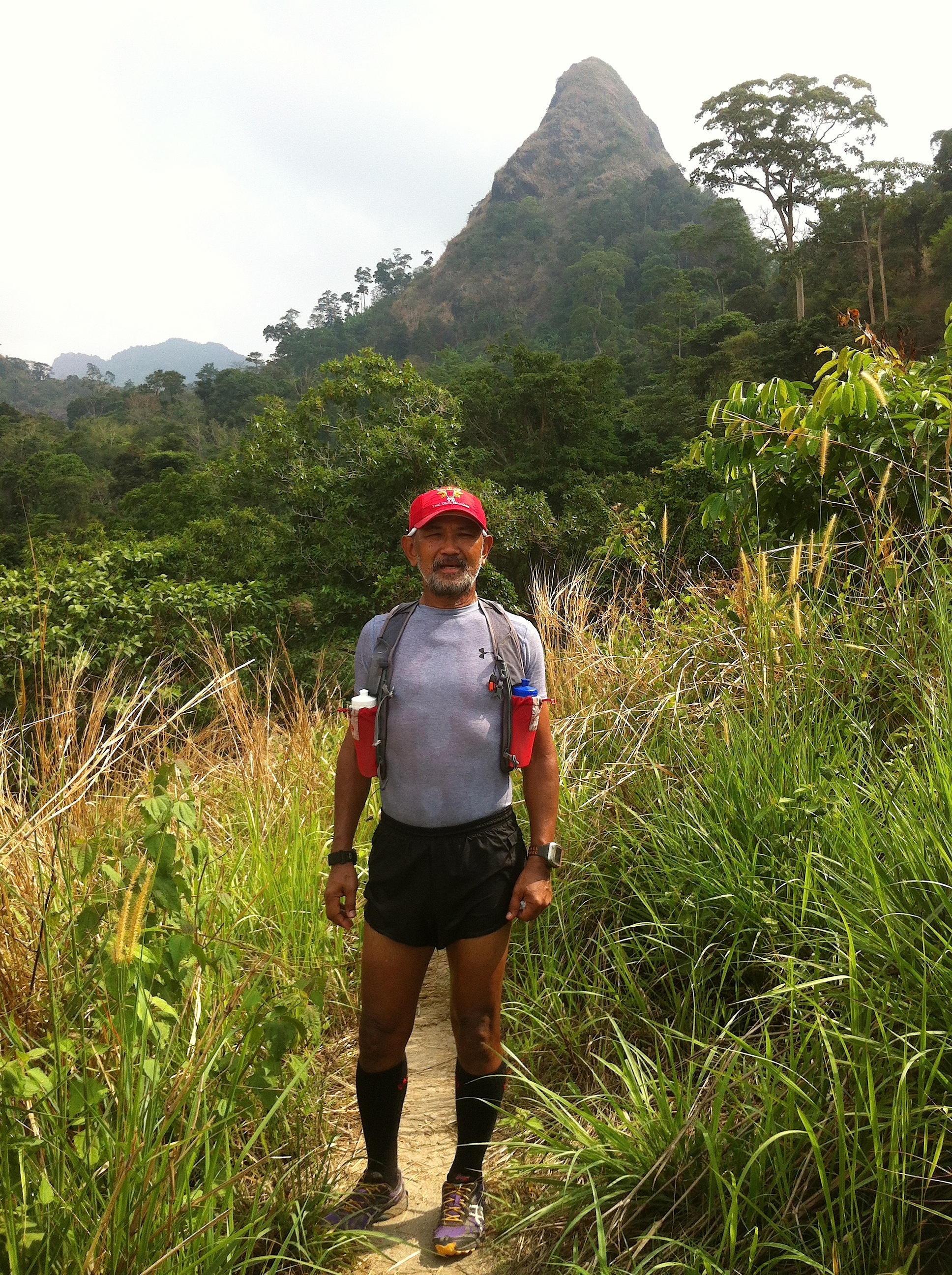


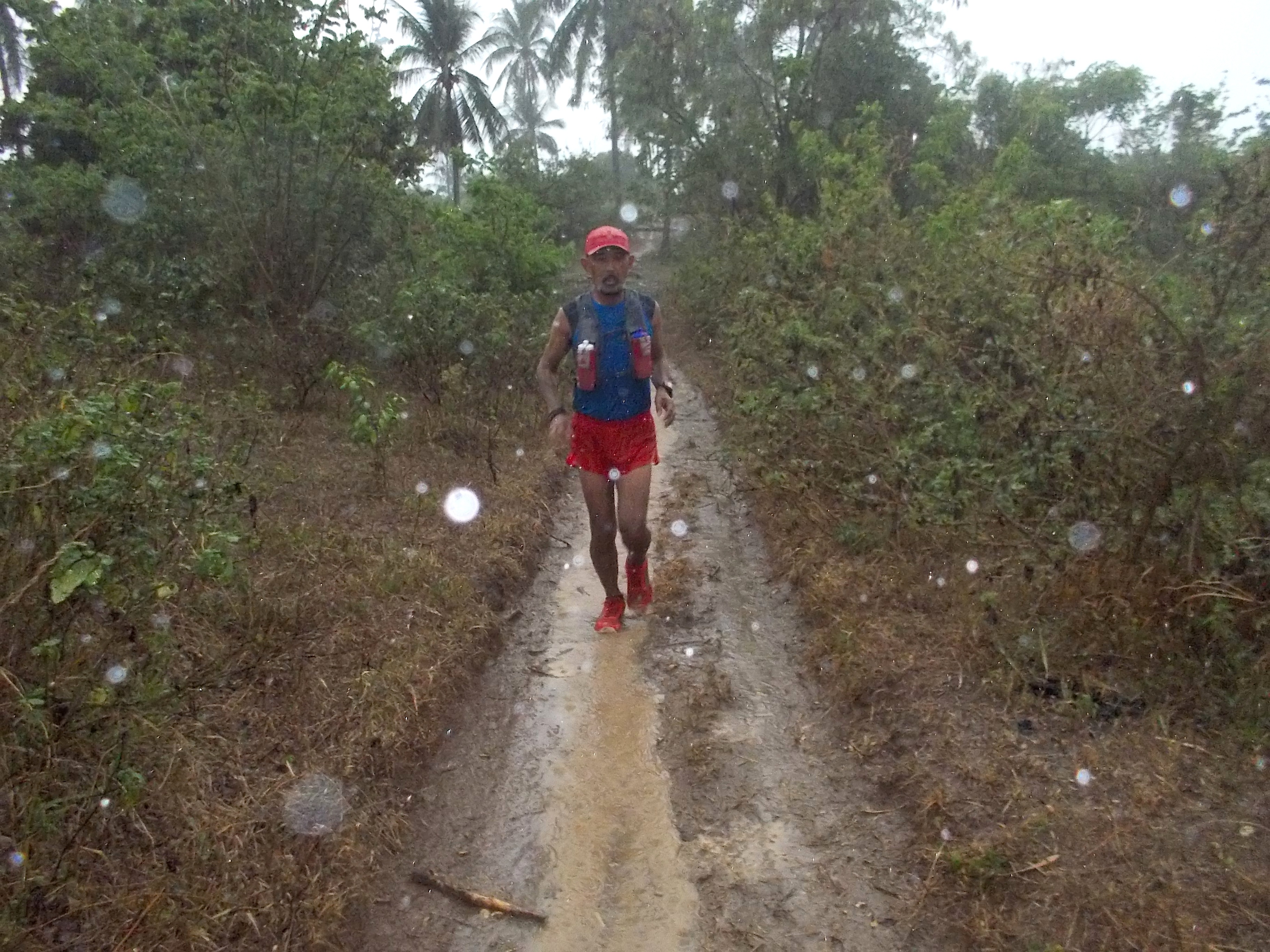
 Bald Runner
You must be logged in to post a comment.