I had the chance and opportunity to have been up close to the runners and crew in this particular edition of this iconic Badwater 135-Mile Ultramarathon Race in 2018. I was surprised to see this documentary film which was posted on You Tube in September 2018 and this is the only time that I learned about the fight for the Podium Places among the Elite Runners. I have seen how close these runners are who composed of what they call, “The Badwater Community”. My participation in this race as a Crew and Pacer will remain memorable as one of my best experiences as an ultramarathon runner.
Who would think that a Local Blogger who exposed this race to the minds of the Local Pinoy Runners through this blog and be able to copy its rules and regulations for his Bataan Death March Ultras and PAU Races, would be able to experience to be in the race and “rub elbows” with the past and present Champions of this race dubbed as the “Toughest Footrace In The World”. This video will explain what it takes to join and finish this race.
I hope you will enjoy watching this video. Thank you!
I have been a loyal user of Salomon Trail Shoes since I started training and joining in trail running events whether they are local or international ones. After I have used a lot of pairs of their S-LAB Sense Trail Shoes, I bought my first pair of Speedcross 4 in one of the local distributors in the Philippines. ROX Philippines at BGC was my first choice of store if I am looking for reliable trail shoes. This is also where I bought all my Salomon S-LAB Sense Trail Shoes. I was lucky when the store have a 9 1/2 size of the Speedcross 4 as most of their stock for sale don’t have half-sizes. I immediately bought the said shoes and brought them to my Playground for a good run. That was almost 3 years ago.
Salomon Speedcross 4, 3 Years Ago
As compared to the S-LAB Sense models, I found the Speedcross 4 to be more padded on the uppers and tongue which gave more comfort to my feet when running. I am also appreciative that the shoe drop or the difference between the stack height of the forefoot area and the heel portion is 10 mm which gave much comfort to my aching Achilles tendon on my right heel. I could run forever in these shoes without any pain on my Achilles tendon on the uphill and downhill runs. The shoe weights a little heavy with 310 grams on each shoe but the weight is given more to give comfort to my feet. The best feature of these shoes is the aggressive grip of the lugs on its sole. The sole lugs are best fitted to our local trail condition where most of the grounds are soft and muddy. They are also stable when running on rocks and roots that I did not have any experience of sliding from them. The quicklace system of the shoes is also very efficient and fast when wearing or removing them during races and training. Once you tighten the shoes with the quicklace system, you can roll the end of the lace and have it tucked inside the pocket at the end of the shoe tongue. The shoe looks slick without the ends of the shoelace dangling outside the shoes. The uppers are also quick to dry whenever they become wet with my sweat or during small stream or river crossing. The only weakness of this particular Salomon Model is the narrow forefoot. It is ok with my feet because they are narrow, too but in longer ultra trail races in the mountains, there is the tendency for my feet to expand that I need to loosen its “quicklace”. I have solved this problem by buying one size bigger and my shoe size now for this particular model is now Size 10.
Salomon Speedcross NowSalomon Speedcross 4 Now!
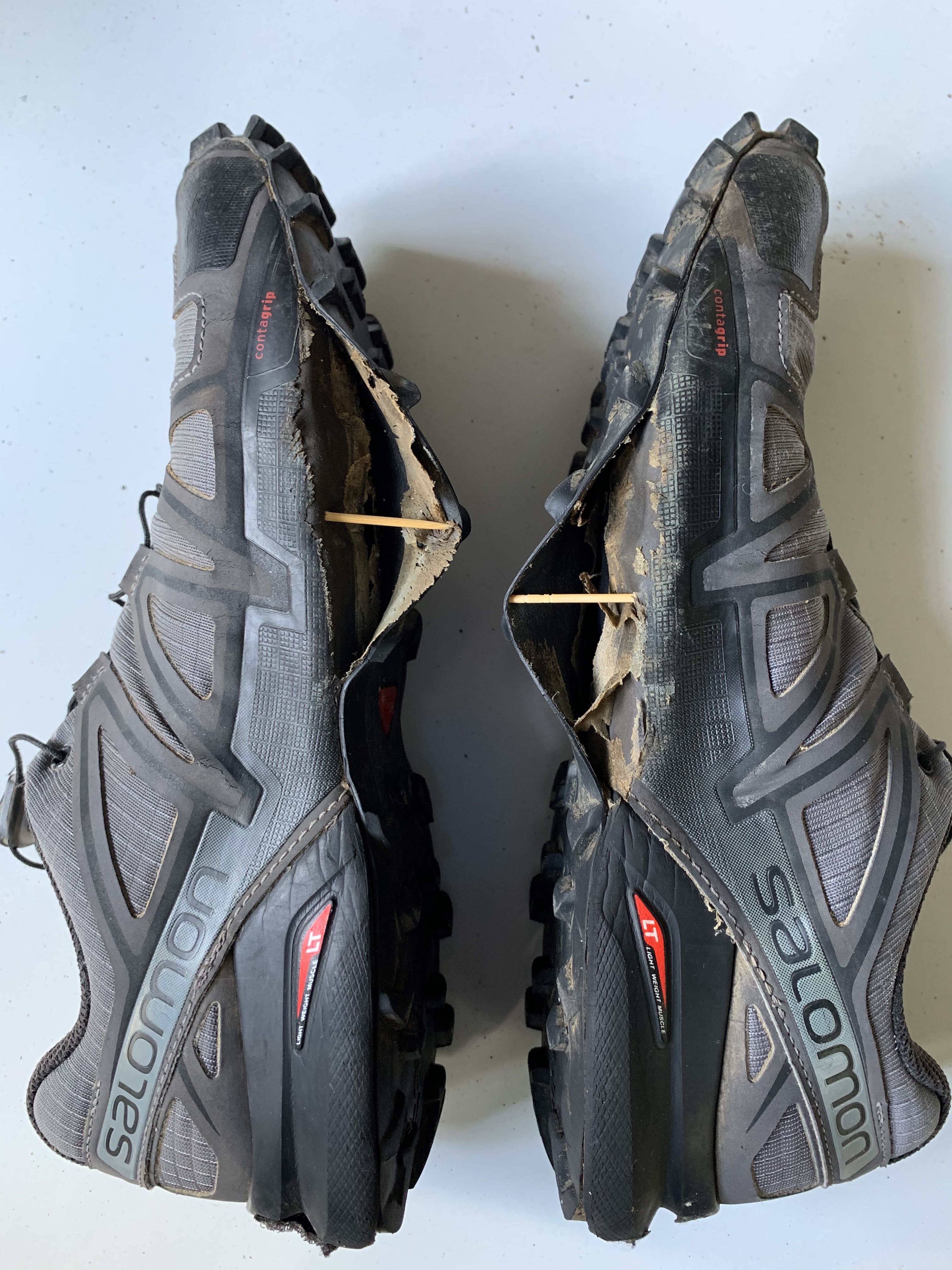
In all my races here and abroad in 2018 and 2019, I have been using the Salomon Speedcross 4 and I am happy with its performance. I am still using them in my training runs but I have observed that the outer sole with the shoe lugs are getting torn apart from the shoes. I guess, the glue that binds the outer sole and the rest of the shoe is already brittle and dry. I could still have some glue in them but I have already bought two pairs of the Salomon Speedcross 5 as its replacement in Sizes 10. Actually, I have used the Speedcross 5 in size 10, in my two latest races: TNF Hongkong 50K last December 2019 and Borneo Ultra Trail Marathon last March this year. I will have a separate Shoe Review on this particular model and will have to compare them with the older Speedcross 4.
I have seen lately on the ads in the Social Media that the Salomon Speedcross 4 shoes are still available On Sale in the local market. Since they are now cheaper, if you haven’t tried them, I suggest you get one pair for your training and for your future trail running events. I guarantee that the price is worth its efficiency and durability. Overall, the Salomon Speedcross 4 is far, the most durable trail shoes in my trail running arsenal and I highly recommended them to beginners, average , and competitive trail runners.
I think I will be using my two pairs of Salomon Speedcross 5 for the next 3-4 years!
In June 2012, I posted a Training Plan for Ultra Distances which I copied from the book of Bryon Powell, “Relentless Forward Progress: A Guide To Running Ultramarathon. In July 2012, I posted another training program for ultra distances but the link on the Internet is no longer available. The training programs that I posted in this blog had been observed to have one of the posts that have been visited more often by my readers and visitors.
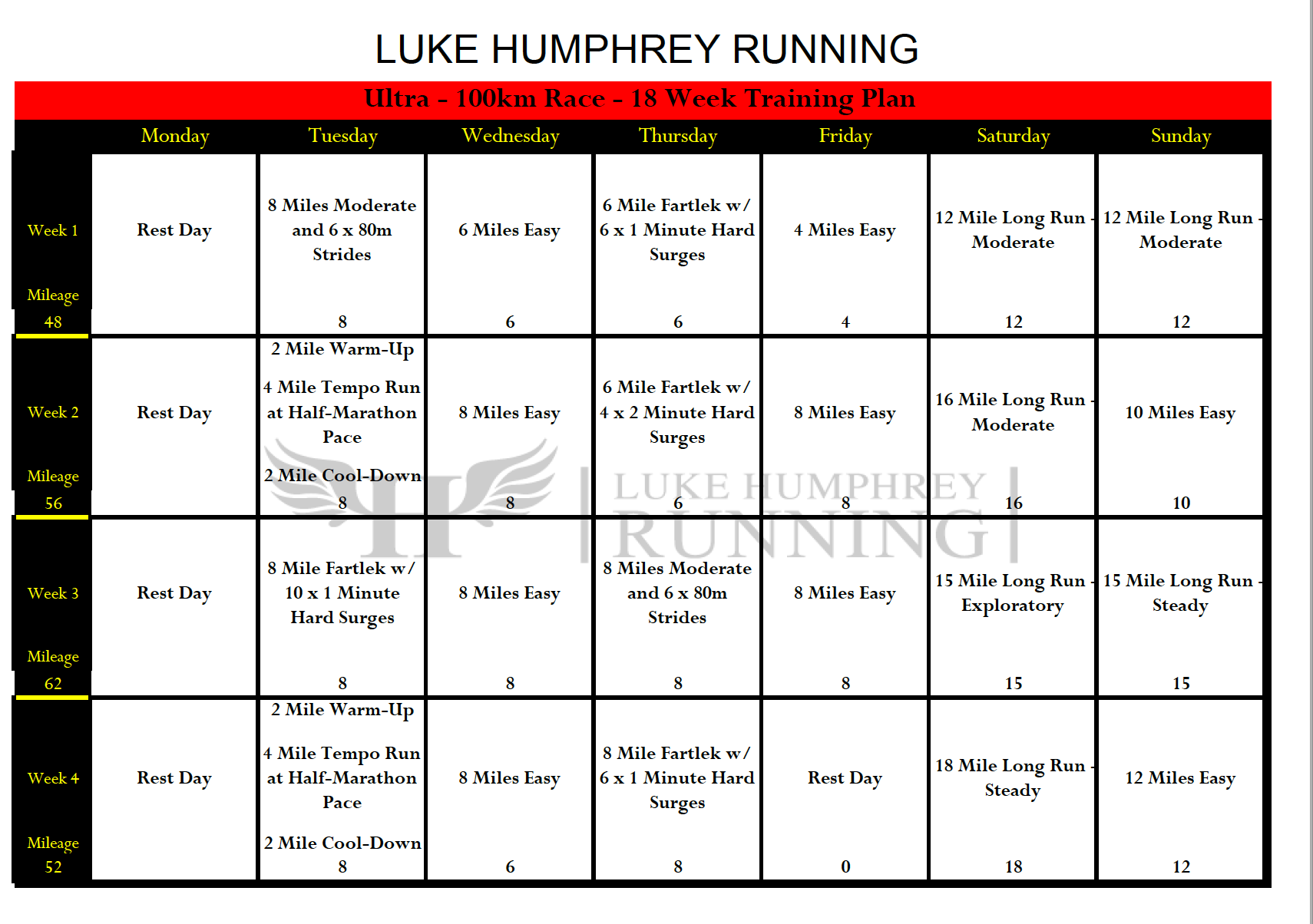
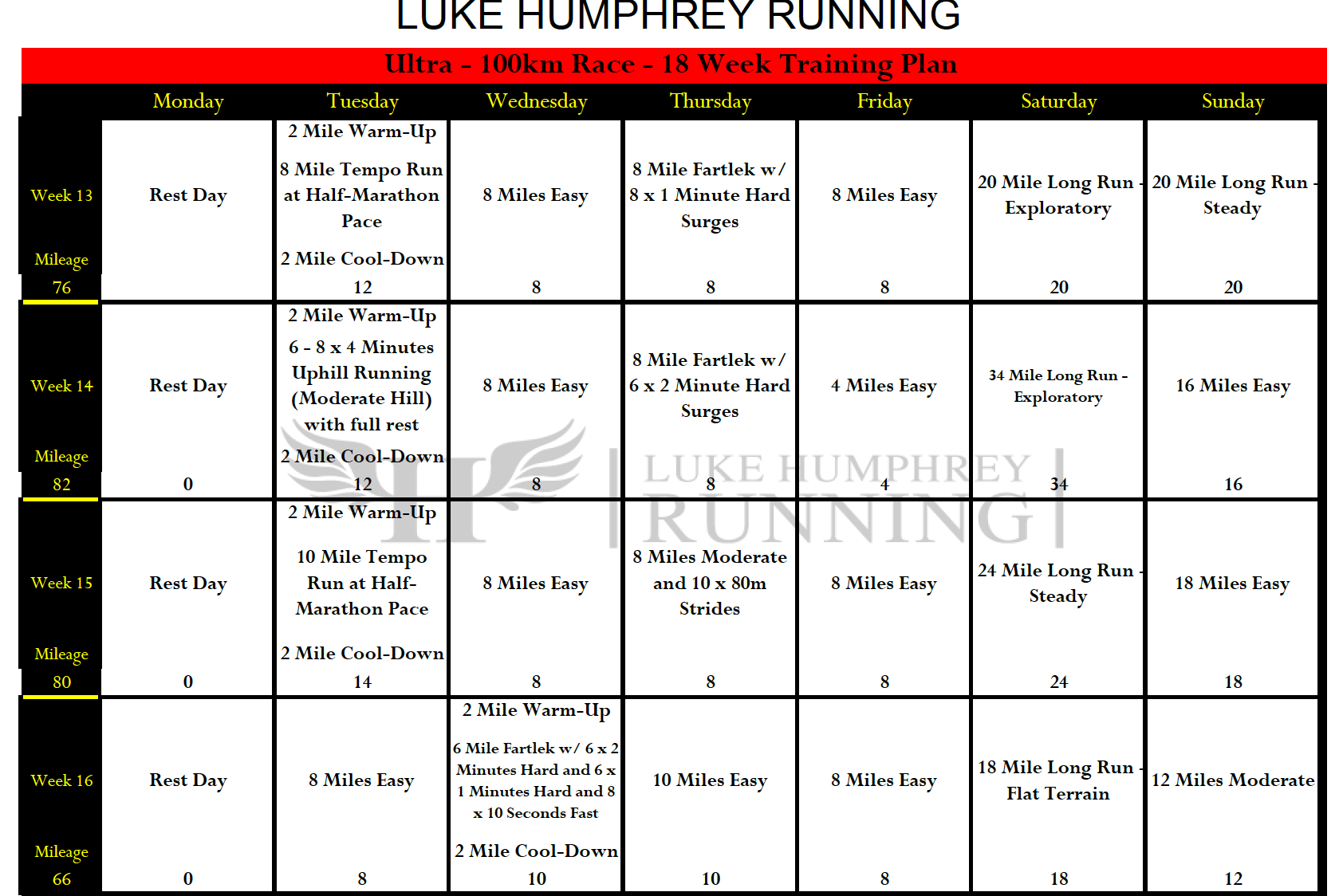
Today, I am posting a training program which, I think, I bought from the Internet and I am glad to share it with you. This Training Program for 100K is from Luke Humprey Running of Hansons Running Project. This is applicable to Road & Trail Running distances/events.
This training program has a duration of 18 weeks and it is very easy to follow and understand. It has more speed and intensity as compared to the training plans I posted 8 years ago. It is more detailed on the description of each workout. It is assumed that you are already an average competitive runner if you want to follow this training plan.
After running for six weeks on MAF training, easy running using my Heart Rate Monitor, following the MAF Formula where my beats per minute range would be from 112 to 122 beats per minute must be maintained while I was on my running workout. As a review, Maximum Aerobic Function (MAF) Formula is 180 minus my age of of 68 plus 10 bpm being a runner of more than 65 years old and had never been “sidelined” from running due to injury. My MAF bpm is 122 and my range of MAF Beats Per Minute during my running workout should be 112 to 122. For the past 6 weeks, I was not supposed to breach the maximum bpm of 122 during my easy/recovery runs. However, with my training schedule being a CTS athlete for the past weeks, I have to follow my training schedule and workout as prescribed by my Coach. However, what I have observed was that I was not fatigued in my tempo runs and I could easily recover after a day of hard training.
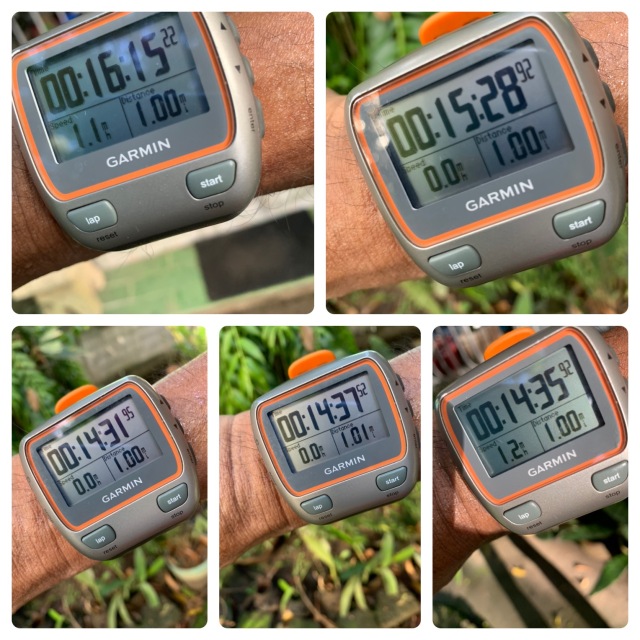
After two days of not running due to the inclement weather in my Playground, I was fully rested during the weekend and I decided to have my first MAF Test today, June 29, 2020. After a short stretching exercises, I started my run with a warm-up for one mile where my Heart Rate steadily increased from 90 beats per minutes to 112 after my first loop in my Backyard. Before I finished my first mile, I was able to reach 119 beats per minute. Once I finished one mile, I went on on my First Mile for my MAF Test. I finished my first mile in 16:15 minutes where I had to walk for a few seconds after my bpm reached to 123 bpm on the last 400 meter of my first mile. After the first mile, I took a picture of my GPS Watch, take a sip of cold water, and walked a few meters until 30 seconds elapsed (this ritual was repeated every time I finish a mile) and started my 2nd mile. The following is the list of my time every mile:
1st Mile——16:15 minutes 4th Mile——14:37 minutes
2nd Mile—–15:28 minutes 5th Mile——14:35 minutes
3rd Mile——14:31 minutes
It was only on the first mile that I breached 122 bpm to 123bpm but it was able to bring it back after a few seconds of hiking. For the rest of the miles, I was able to maintain my average of bpm within 121-122. On my last mile, I was able to maintain the whole mile with an average bpm of 122.
My GPS Watch Results For Every Mile On MAF Test
Although my Backyard Loop is not the ideal venue or location for my MAF Test, I am still satisfied with the result of my test and how my body felt after the workout. My body was very relaxed and not so worn-out or fatigued. In my past MAF Tests few years back, I have been doing them on Oval Track, being faster than my time in my Backyard Loop. With the uneven ground, lots of turns, and single-track trail in my Backyard Loop, I expect that my time would be slower than running in an oval track. On the contrary, I think I am faster now as compared when I had my MAF Test in 2011.
After 4 weeks, I will be doing my second MAF Test with the hope that I will be able to lower the times as compared to the results today. I will continue to apply MAF training in my easy/recovery runs in the coming days and weeks. I know that I will be a better and smarter runner in the next months and years due to this training.
This is a Photo Video that I posted on You Tube with the objective to document the past accomplishments of our local trail runners in international trail running event like the UTMB. This video will be also an instrument for others who will be inspired to join this event in the near future. Thank you for watching.
In the history of the Ultra Trail du Mont Blanc (UTMB), the race started in 2003 but only after eight (8) years (2011) when Ultra Trail Runners from the Philippines started to join this iconic trail ultra which is considered as the “Holy Grail” of Ultra Trail Running In The World. Hereunder is the list of Filipino Runners who finished the race with their Official Finish Time and their year’s edition:
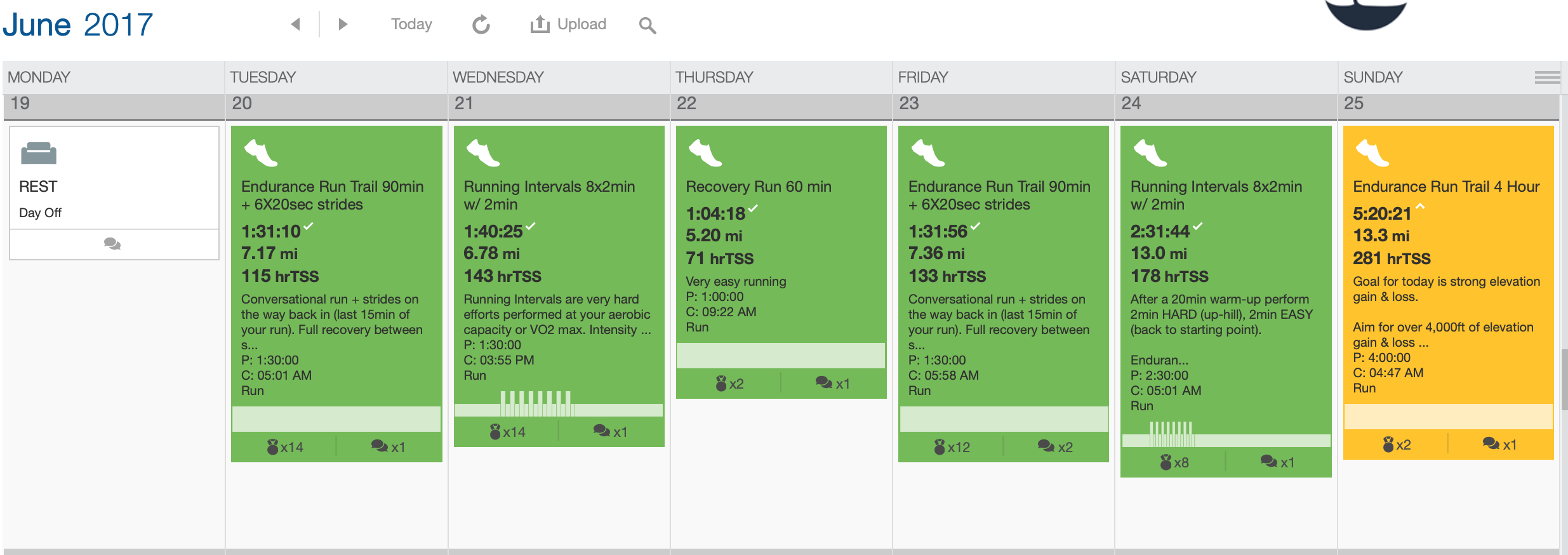
My first two days’ training schedule with CTS were devoted to One Hour Recovery Runs with emphasis on my RPE (Rating of Perceived Exertion) where in a scale of 1-10, my RPE should be 5 which were done on a flat or rolling terrain and I must be able to easily talk when running. On the third day, I was made to do an Endurance Run for 1:30 hours on the trail where the run has an RPE of 6 out of 10. It is described as a conversational run performed at my “all-day pace” and this run will make up the majority of my training volume and its is the most specific running workout to my ultrarunning pace. I did this workout in my Playground Alpha where I was able to attain an elevation gain of 1,200+ feet. It was suggested that I should hike the steep uphills and start practicing or developing my downhill running skills with fast, quick and short strides. I think I was able to cover a distance of 6.4 miles in 90 minutes. On the 4th day, my Coach asked me to do a 2-hour Endurance Run on the trail with strong elevation gain and loss, hike the steeper portions and run the descents and flat areas and I decided to do the workout to reach the peak of Mt Roosevelt and go down immediately where I have started. The 2-hour workout resulted to a 5-hour workout. I had to explain to my Coach where and why I extended my workout and he was kind to accept my explanation. On these first 4 days, my Coach was able to assess my present running situation based from the data that he could read on Training Peaks.
Then came these two weeks of training schedule.
First Full Week Of Training Schedule
Every time I upload my GPS Watch after my daily workout, the color of my daily block data will come up as Green which means that I am within the bounds of the time duration given to me but when it is yellow, it means that I went over the time duration I was supposed to do the workout. When the color of the training block becomes Red, that means that I did not do the training workout for the day. My Coach would know immediately at a glance if I did my daily workout or not by the color of each training block. If you click each training block (daily training workout), a separate page will appear and the details/workout data will be there as regards to your Pace, Speed, Heart Rate, Elevation Gain & Loss, and other Technical stuffs where the Coach would determine the intensity of the workout and your effort.
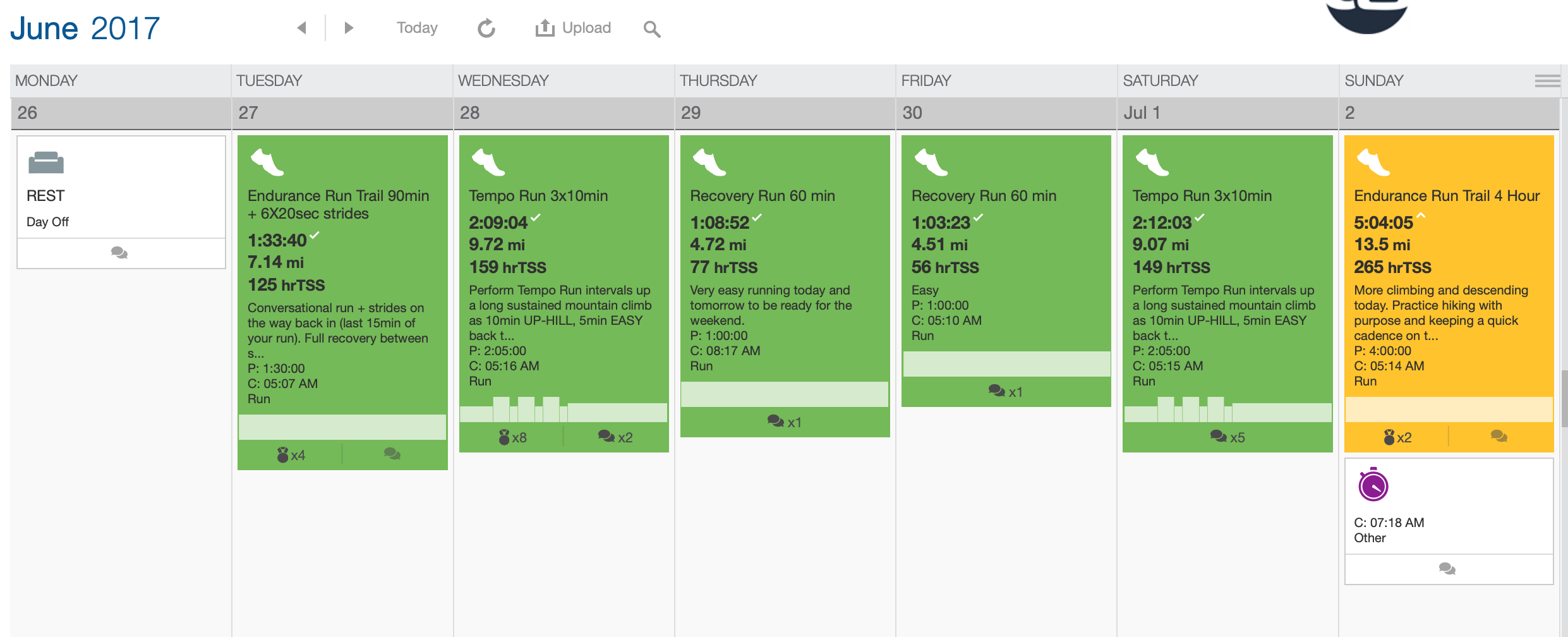
Second Week Of Training Schedule
On these first two weeks of my training with CTS, I was introduced to strides and tempo runs. It was on the next or succeeding weeks that I was introduced to Hill Repeats. These 3 specific workouts gave me the much-needed “kick-ass” to my running career as a Trail Runner. All of my training workouts with CTS were done on the trails in my Playground and depending on the specified workout for the day, I had a lot of choices/options on where I would go. There came to a point that my Training Playgrounds were named from Alpha to Delta. Within the first month with CTS, it was an interplay of strides, tempo runs, hill repeats, recovery runs and endurance runs.
Having posted the details of my two-week training schedule, you can use them as your guide where it indicates where you can schedule your speed runs, recovery runs and long runs within the week. If you are reading this blog, I would assume that you are an average competitive runner and would like to be a faster and stronger runner so that you can qualify for the Boston Marathon. Bottomline. Try to do these workouts on the trail with strong elevation gain or loss and try to assess your improvement in a 20-minute field test run once a month.
On my next blog, I will explain to you the principle involved why CTS starts their athletes first with Speed/Tempo Runs instead of the usual Easy Long Runs based from the traditional Arthur Lydiard’s Approach in Training Long Distance Runners.
Last night when I was about to go to bed, I saw the post of Camille Herron on her Facebook Page that “she is jumping for joy and gratitude that the Badwater 135 got the green light as a “GO” race in two weeks time”. I was surprised about her post because I did not know that she is one of the listed participants for this year’s edition basing from the last update that I saw last week on the website of the event.
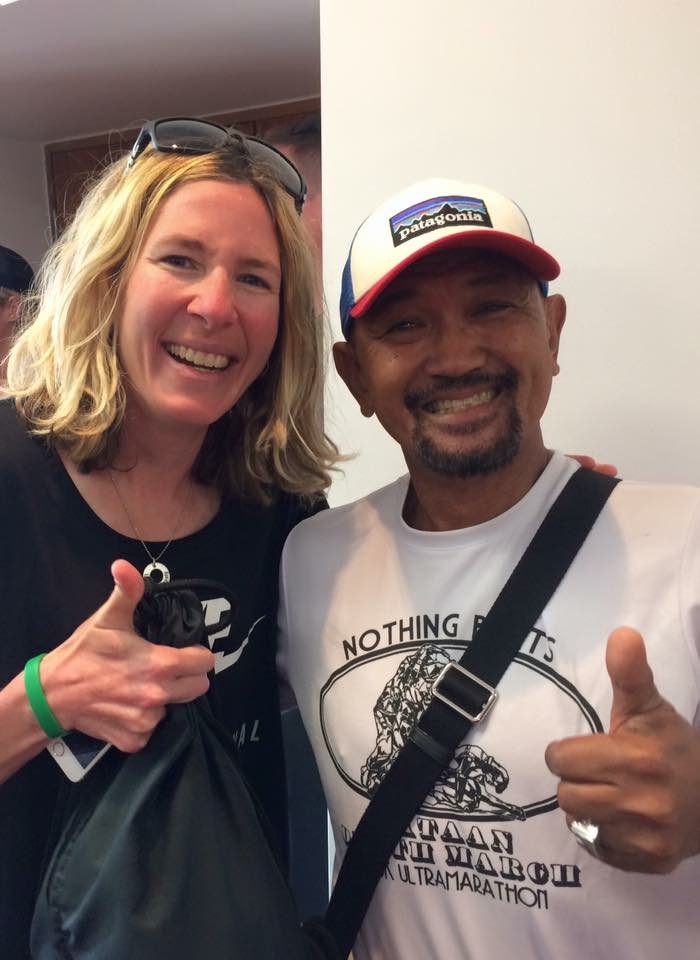
“Selfie” With Camille Herron @ 2017 Tarawera 100K Ultramarathon Race
I personally met Camille Herron during the Racing Briefing for the 2017 Tarawera 100K Ultramarathon Race in February 2017 in Rotorua, New Zealand. She won the Ladies Championship Trophy for that edition. From that simple meeting and “selfie”, we became friends on Facebook and from time to time I would leave a comment on her FB posts since then. I even went to the extent of sending her a copy of the Ultrarunning Magazine (courtesy of Badwater Ben Gaetos) where she was in the Cover Page being the Ultrarunning Magazine’s Ultrarunner Of The Year in 2017 for her autograph. I still have that signed magazine in my collection of Ultrarunning Magazines. Last year, she went back to Rotorua, New Zealand and joined the Inaugural Tarawera 100-Mile Endurance Race and she won again as the Female Champion with a new course record of 17:20:52 hours. On the same year (2017) when she won the Tarawera 100K Ultra Race, after four months, she won Ladies Champion of The Comrades Marathon in South Africa which brought back a US athlete in the Event’s Podium after an absence of 20 years! She is the 3rd US/American to win in this prestigious event.
2017 Ultrarunning Magazine’s Ultrarunner Of The Year
Being the President of the Philippine Association of Ultrarunners which sanctioned National Federation of Ultrarunning of the country with the International Association of Ultrarunners (IAU), I have been monitoring all the IAU World Championships Races where I was always been invited. Camille holds the record for being the FIRST to win all three of the IAU’s 50K, 100K, and 24-Hour World Championships. At present, she holds the following best performances:
50 Miles (Road)—–5:38:41 hours
100 Mile (Road & Trail)—-12:42:40 hours
100 Miles (Track)—-13:25:00 hours
12 Hours (Track)—–92.66 miles (149.12 kilometers)
24 Hours (Track)—–167.842 miles (270.116 kilometers)
She was voted as IAU’s International Athlete Of the Year in 2015, 2018, and 2019. I voted for her as I am one of the members of the IAU Nominating Committee in those years. Her performance in ultrarunning speaks well and she is deserving to get the award, winning over the Europeans and the Japanese women’s runners.
It will be a very exciting competition among the top athletes in this year’s Badwater 135 Ultra. Mike McKnight, a friend of mine also on Facebook, is one of the competitors in this year’s event and I came to know him when he ran solo (as an experiment) in a 100-mile route without taking any solid food where he finished in 18:40 hours. He is also holds the 2019 Course Record and Champion of the 200-Mile Triple Crown in 161:20:10 hours where he broke his own record the previous year by 46 hours. The Triple Crown consists of three 200-mile races: Bigfoot 206-Mile Race; Tahoe 205-Mile Race, and; Moab 238-Mile Race, a total of 650 miles.
Mike McKnight aka dirtymike89 During His Solo 100-Mile With Zero Calories (Picture From Instagram)
Since there are no Men’s and Ladies’ Categories in the history of Badwater 135-Mile Ultramarathon Race, this will a good fight who will be the Champion and First to cross the finish line at Mt Whitney Portal. Good luck to these two fine and very friendly athletes!
I will be posting updates in this blog for this year’s Badwater 135-Mile Ultramarathon Race.
Before we continue with my series on How To Qualify For The Boston Marathon, I would like to mention my first Coach in Ultramarathon before I applied at the CTS Coaching Service. When I started running ultra trail events, Karl Meltzer had been one of my Idols as he would win as Champion, at least, one 100-mile trail ultra race per year. Now, he is considered as the Winningest 100-Mile Ultra Runner In The World. You can check it out in his website here.
From 2014-2016, I have been coached by Karl Meltzer and I subscribed to his Training Plan Only which cost me $ 300.00 every 3 months. It was a very simple arrangement, he asked me for my personal data and then sent me a separate e-mail message for the list and illustrations of strength exercises that I can do as part of my training. Later, he would send me my 3-month training schedule in miles with one day of the week as Rest Day. No specific description of running workout was stated in the number of miles that I have to run daily. However, my weekly mileage would be ranging from 50-55 miles per week as my Average Mileage. When a race is about one month away, he would increase my weekly mileage to 60-65 miles per week. I can still remember that most of my runs were then progressive runs on the trails. All my communications with him were through e-mails. No nutrition advise and no feedback system in my daily workout was discussed. It was purely running on trails with no elevation requirements. He was not very technical and specific in my training program. However, I am not sure if his more advanced and more expensive training program would include nutrition and other feedback system. In fairness to the Coaching/Training I got from him, I became a stronger and faster trail runner.
Karl “Speedgoat” Meltzer Inside A Hypoxico Tent (Picture Taken From Facebook)
In my interview with the Senior Coach of CTS before I started being their athlete, I told him that I was a former “client” of Karl Meltzer’s Coaching for two years and maybe, such information gave him the assurance that I had already the experience of being coached by an elite ultrarunner and he would gauged me on my present condition as an ultrarunner. By the way, a runner being coached by Karl Meltzer is called a “client” while CTS call their subscribed runners as “CTS Athlete”. I think there is a big difference there in terms of impression/opinion on how to describe the “coach to student relationship” in each Coaching Service. Personally, I would prefer being called a CTS Athlete as it impresses other people that you are a member and integral part of their Coaching Service.
When Hoka One One Shoes came up with their Shoe Model with the monicker name “Speedgoat” of Karl Meltzer, I wrote a Shoe Review of the said shoes as I was one of the few who introduced it in the local trail running circuit. That is how I idolize and respect this guy. Actually, if not for the Covid-19 situation, I would have the new Speedgoat right now in my possession and ready for another Shoe Review.
I will continue with my series, How To Qualify For Boston Marathon, tomorrow. Thanks for reading.
I am not trying to force-feed you with the training that I did with CTS as I want to share my story from the time that they accepted my application as one of their CTS athletes. I was just lucky that I was able to contact Jason Koop when he was advertising the publication of his book on Ultrarunning in May 2017 and asked him if CTS accepts a 65-year old runner.
After I applied on line on their Website, I was asked to answer (on line) a questionnaire, asking my personal data, experience and number of years of training, and if I had a recurring running injury. After a few days, one of their Senior Coaches contacted me through e-mail and gave me instructions on how to set up my Premium Training Peaks Platform by giving me my Signing-In data. I think it costs me $70.00 as full time payment for my subscription with Premium Training Peaks. Two of my GPS Watches (SUUNTO Ambit 3 Peak and Garmin Forerunner) were linked to the said Training Site Platform. Everything (data) that my Coach need to knowabout my daily workout are uploaded to the Training Peaks and you can not fake your effort on those data. The Senior Coach had briefed me about the terms being used on the description of each workout and the specific data that are incorporated in the workout. Above all, my workouts were given to me in the number of hours and minutes and not by the number of miles or kilometers that I have to run in each day. My Coach asked me what is my preferred REST Day for the week and I said, I would like it on Mondays.
My Coach would send me my training workout for two weeks and each day I should give my feedback how my body felt in terms of effort from EASY to Very HARD, the rank measurement is from 1 to 10 with Rank 1 as Very Easy and 10 as Very Hard. It is a also a “must” that you send a short message as how you felt during and after the workout. Your feedback description will be gauged in terms of your fitness condition, fatigue, and motivation.However, your feedback will be matched with numerical data captured from your GPS Watch and as seen on Training Peaks. At the end of the week, you can easily see your totals in terms of the total number of hours and the total of miles/kilometers you covered from those hours.On those first days as CTS athlete, I would review the Book on Ultrarunning by Jason Koop making sure to know the description and details of each workout I was given to do.
It is worth mentioning that the Coach would prescribe in each daily workout the following description: (1) the number of hours and minutes of your total workout; (2) each workout is described from its warm-up period (in minutes), main workout (in hours and minutes, depending how long is the period), cool-down period (in Hours/minutes); and (3) the type of terrain where the Coach would suggest you to run, whether it is flat road, trail, or in a course with hilly or steep elevation. The Coach would suggest also your “Total Score Stress” (TSS) where Training Peak would refer it as Running Total Training Stress (rTSS). Depending on what type of workout, the Coach will designate an rTSS score for a specific workout (Easy Run, Endurance Run, Tempo Run, Hill Repeats or Interval). The higher the score, the more the stressful the run. Thus, your workout will be quantified in terms of training stress for a specific running workout. Once I upload my workout from my GPS watch, my rTSS for the workout will be immediately compared with the suggested rTSS from my Coach. Most of the time, my workout rTSS would not surpass or equal my Coach rTSS. But in my feedback, I felt that I am wasted as a result of the workout. Anyway, whether I can equal or not on the required rTTS, my personal observation was that I was running stronger every week.
Jason Koop (Center) & CTS Athletes (Picture From Facebook)
For the first two weeks of training workout, I was given a mix of Endurance Runs, Tempo Runs, and Recovery Runs from the duration of One Hour & Thirty Minutes to Two Hours. In the succeeding weeks, I was introduced with Hill Repeats. After three weeks, I was asked to conduct a “20-minute field test”. It is done by having a 15-minute warm-up run first and then I did my fastest 20-minute run along a flat paved road, and then had a cool-down for 30 minutes. The result of my “20-minute field test” determined my Average Pace for the Tempo Run. The Average Pace would be my target time whenever I do my Tempo Runs. Most of the succeeding weeks will be devoted to Tempo Runs and Hill Repeats! I was surprised that my Tempo Run’s Average Pace would be faster than my usual Tempo Pace. Before, I could not breach less than 9:00 minutes per mile pace with too much fatigue and pain to my legs and body after each workout. But after3 weeks of CTS training, I was able to breach the 9:00-minute barrier and with more regular “test runs”, I was able to record a 8:09 minute per mile paceand then lowered it to 7:30-minute pace. With my age and not-so-perfect running form and short legs, I could not believe how fast I could make those leg turn-overs whenever I do my tempo runs on a flat paved road. Since I was preparing for ultra trail runs in the future, I did not have a chance to run on the oval track. I guess, I could run faster if those “20-minute field test” runs were done on an oval track.
One month before the Javelina Jundred 100-Mile Endurance Race, I was given more time for my Endurance Runs on trails in my Playground and they would last from 4 hours to 6 hours. CTS would not allow their athletes to run more than 6 hours in their Endurance Runs for the basic reason that the runner could not recover in a span of one to two days. CTS wants their athletes to be fresh and feeling stronger after a day of recovery. The training concept on those four months was clear to me as it followed the training concept and principles written in the book of Jason Koop—-assessment of my body on the 1st two weeks, followed by fast runs through tempo runs and hill repeats, and then Endurance Runs on the last weeks leading to the target race.
Bottomline, with those 4 months leading to JJ100, I was not injured, my body was always fresh and recovered on Tuesdays, and felt becoming stronger during my Tuesday runs.
In the next succeeding posts, we will go to the details of my daily workouts.








 Bald Runner
You must be logged in to post a comment.