7:00 PM February 22, 2011 @ AFP Officers’ Clubhouse, Camp General Emilio Aguinaldo
Registered runners for the BDM 102 & 160 are encouraged to attend the Briefing & Carbo Loading Party (CLP) at 7:00 PM on February 22, 2011 at the AFP Officers’ Clubhouse in Camp General Emilio Aguinaldo, Quezon City. Registered runners are FREE for the food to be served. Additional guests have to pay P 150.00 (each person) if they intend to join the CLP.
A Briefing will be presented as a reminder to the Rules and Regulations of the Races. Other details of the races will also be presented.
Race packets and Support Vehicle Tarpaulin will be distributed to the runners who will attend. For those who could not attend this event, they will receive their race packets & tarps on Race Day before Start Time.
For those who have reserved slots, this event will be your last chance to pay your registration fees. And for those who have not yet submitted their medical clearance/doctor’s certificate, please submit them to our staff during the Briefing.
It is too bad that what is available in our Sports Stores, Running Stores and even ASICS Store for models on ASICS running shoes are those which have thick soles and heels. These ASICS shoes are in the category of stability and cushioning shoes which are too heavy for training and for racing.
I am not a runner-blogger who is being sponsored by ASICS to review and/or use their products. I simply love and feel comfortable using ASICS and I buy every pair of ASICS shoes that I use. Since I started running in the early 80s, ASICS had been Number #1 for me. This is what I call LOYALTY.
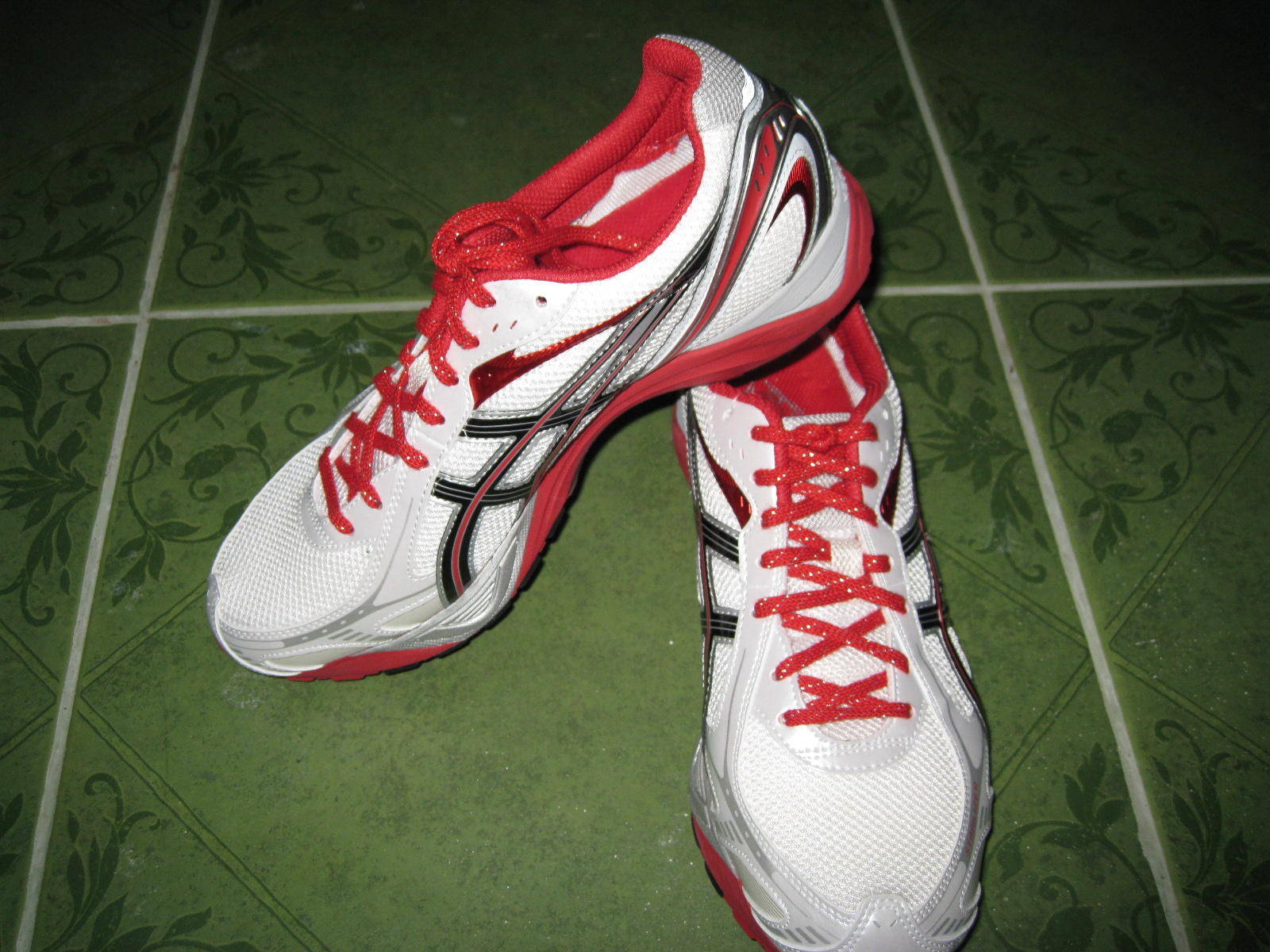
During my trip to Taipeh, Taiwan, I was not able to look for a specific ASICS Store but it was inside the SOGO Department Store where I was able to discover the latest products of ASICS direct and made from Japan. The SOGO Department Store is like our Rustan’s Department Store except that the lady attendants are lined up in front of the store’s gate/main door to greet you and simultaneously bow their heads as you enter the SOGO Department Store. These ladies are well-groomed with their uniform & fashionable hat! I bought my ASICS Gel-LyteRacer on the 10th Floor of the said Department Store located in one of the financial districts in Taipeh.
Nice color combination of Red & White
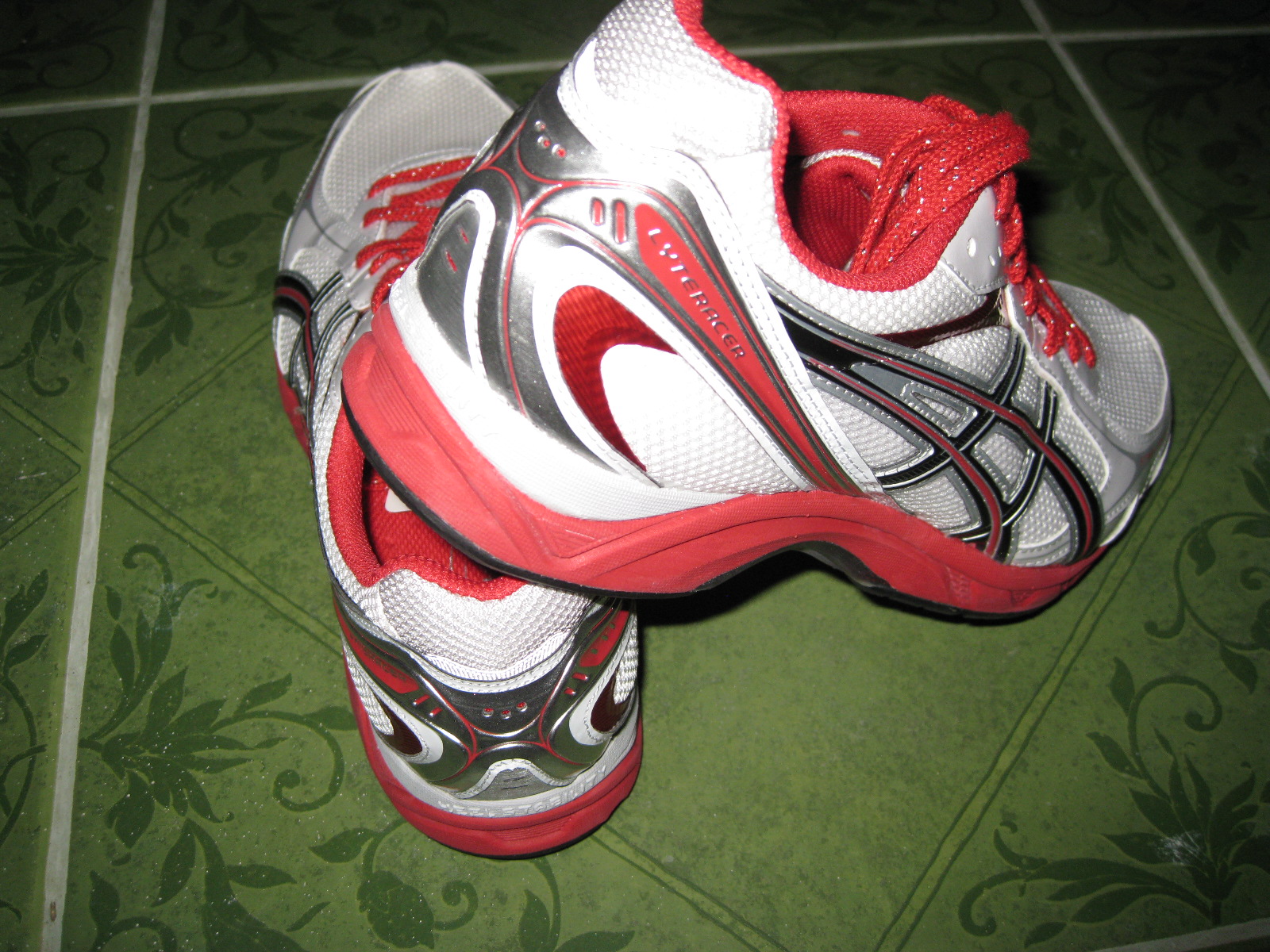
The first time that I used this model was during the 2011 Condura Skyway Marathon without any break-ins. Since I did not train for this Marathon Race, I thought of using the shoes for a long run as its break-in. The shoes provided me with a comfortable pace and without any problems on my feet and legs. I finished the race with a slow time but I did not have any injuries whatsoever. The LyteRacer is considered as a Racing Shoes with Stabilizers on the Heel and Forefoot areas. The shoes are light but a little heavier than my ASICS Gel-HyperSpeed 3. It is fully-cushioned considering that the shoes are racing shoes. It is highly recommended for neutral runners.
I will not mention those technical data about the name of the materials being used for this shoes but the bottom line is that ASICS has the highest quality in terms of comfort and durability of its products. The price in Taiwan Dollar when converted to Peso is very cheap as it sums up to less than Five Thousand Pesos only!
Heel Portion & LyteRacer Name on the Shoes
As of now, I have just breached 100 kilometers as the total distance of usage for these shoes. This is now my preferred shoes whenever I have my LSD workouts.
(Note: This particular model is not available in the USA and in the local market)
The author has written for Outside, Runner’s World, and numerous other publications. He was the Southeastern Conference Mile Champion three times, and the United States Track and Field Federation National Champion in the Steeplechase, and was teammate of Olympians Frank Shorter, Jack Bacheler, and Jeff Galloway on several championship cross-country teams. He is a journalist, practicing lawyer, and had been the Editorial Director of Running Times Magazine. (Note: The author should be as old as Jeff Galloway!)
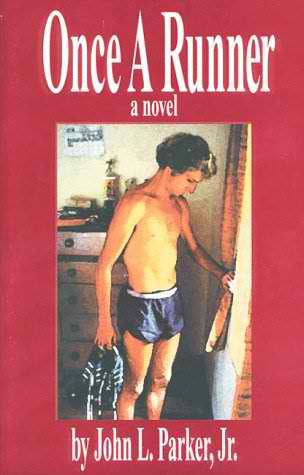
This book was first published in 1978, at least one year after the “Complete Book On Running” by Jim Fixx was published, and it was written as a novel about a mile-runner, Quenton Cassidy while he was studying to earn a College Degree with a time setting in the mid-70s. It was mentioned that the author had sold copies of this book on the back compartment of his car every time he attended road races during weekends and copies of this novel had been circulating from one runner’s hand to another.
Looking at the profile and background of the author, this novel could be easily analyzed as the author’s personal account of his life as a college student and a passionate runner who would like to cross the barrier of sub-4-minute mile during those times.
Elite runners, ultra trail runners, and runner-authors/writers have considered this book as the best book ever written about running. I’ve read this book’s title being mentioned by most of the runner-authors who considered this novel as the best story being written about a runner. They say it’s a “classic”. Others would say that you are not a full-blooded runner if you don’t have a copy or have read this book. It is also being mentioned as part of the Runner’s Etiquette/Rules for a runner to have read this book if he is really a true runner. It is for this reason why I had to buy this book when I had a chance to see one at the Zombie Runner Store in Stanford, California.
I was not frustrated when I found out that the book speaks for itself. It is really the best book for a runner and every runner should be able to read it.
I’ve repeatedly read this novel for three times already. This is always my companion whenever I travel from Manila to other parts of the country when I board the local flights.
Cover Page of Older Publication of the Book (Photo From Wikipedia)
7:00 AM February 12, 2011/From BDM Km Post #50 to BDM Km Post #102
There were 77 runners who started the Test Run from Abucay, Bataan but only 60 runners crossed the Finish Line in San Fernando, Pampanga.
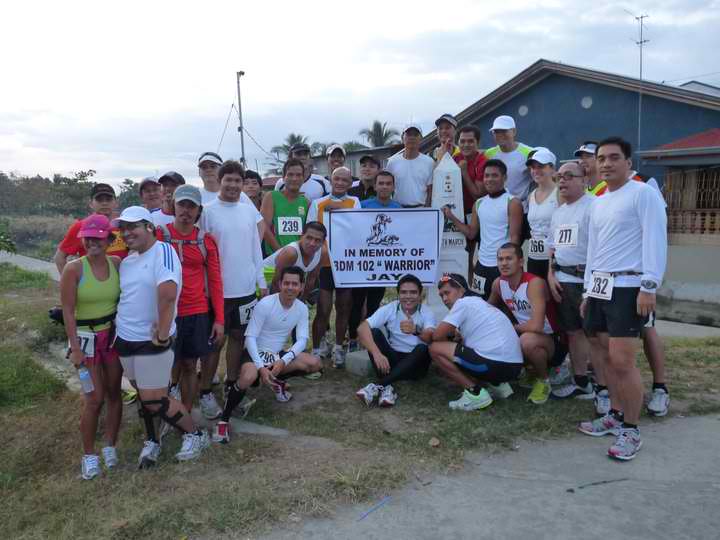
Before the briefing of the run, we had a picture pose taken at the BDM Km Post #50. This run is again dedicated to the memory of our friend and BDM 102 “warrior”, Jay L Cu-Unjieng.
@ BDM Km Post #50 in Abucay, Bataan
NAME
TIME
1
Benedict Balaba
5:19:55
2
Moses Moreno
5:22:18
3
Mac Milan
5:34:38
4
Gene Olvis
5:47:56
5
Nolan Llanora
5:48:40
6
Bobby Go
5:53:10
7
Oliver Templo
6:00:45
8
Camilla Brooks (F)
6:05:10
9
Alfred Delos Reyes
6:05:11
10
Roberto Delos Santos
6:06:06
11
Bong Patrimonio
6:09:03
12
Bob Patrimonio
6:09:03
13
Rayman Delos Angeles
6:09:03
14
Romy Doctolero
6:10:25
15
Tin Ferrera (F)
6:12:14
16
Carlito Buenaventura
6:21:25
17
Jerry Adriano
6:22:20
18
Goerge Dolores
6:23:57
19
Bob Castilla
6:29:06
20
Mark Rodica
6:35:25
21
Christian Oting
6:35:25
22
Simon Miranda
6:35:58
23
Mark Hernandez
6:38:50
24
Fernando Cunanan
6:40:27
25
Francis Velasquez
6:42:30
26
Lito Lopez
6:42:30
27
Mel John Tezon
6:43:12
28
Julian Confesor
6:43:12
29
Ronnel Go
6:45:52
30
Samuel Narcise
6:51:58
31
Yob Red
6:53:00
32
Benedict Meneses
6:56:04
33
Tere Ybanez (F)
6:57:06
34
Emil Hulipas
6:59:10
35
Marlo Guloy
7:00:04
36
Julius Cervantes
7:00:18
37
Nelson Mallillin
7:01:08
38
Allen Gaspar
7:05:20
39
Carl Ocampo
7:06:10
40
Abell Jim Ngo
7:10:10
41
Laarni De Guzman (F)
7:12:04
42
Ferdie Cabiling
7:18:40
43
Paul Pajo
7:28:32
44
Junn Besana
7:28:32
45
Chito Carrion
7:37:02
46
Bong Bernadez
7:37:18
47
Wap Forbes
7:37:19
48
David Buban
7:37:20
49
Rene Miranda
7:44:39
50
Alden Meneses
7:45:00
51
Ramos Christopher Etable
7:46:34
52
Dennis Pacis
7:55:14
53
Ronald Perez
8:09:38
54
Jayson Masayon
8:09:38
55
Leo Tugade
8:10:20
56
Fernando Cabanero
8:10:20
57
Mark Fer Castillo
8:22:50
58
Ed Escalante
9:02:18
59
Ley Gripal
9:08:36
60
Edwin Rara
9:40:48
Good luck to everybody. See you at the Briefing & CLP at the Main Restaurant, AFP Officers’ Clubhouse, Camp General Emilio Aguinaldo, Quezon City at 7:00 PM of February 22, 2011.
February 7, 2011 @ Remy Field Oval Track, Subic Freeport
Time of Start: 5:30 PM
Distance: 7.08 Kilometers
Time: 43:40 minutes
Average Pace: 6:10 minutes per kilometer
Comments: No Pains and my legs are getting stronger. It was a fast pace after running a marathon race. This run was supposed to be a “recovery run”.
Hydration: Consumed One Bottle of Water & One-half bottle of PowerAde
Shoes: ASICS Gel-Kayano 14
oooOOOooo
February 9, 2011 @ Camp Aguinaldo Grounds
Time of Start: 5:35 PM
Distance: 15.06 Kilometers
Time: 1:35:13 Hours
Average Pace: 6:19 minutes per kilometer
Comment: I ran 2 loops of the 7K-loop roads of the camp. I was running at an average pace of 6:15 before the last 2 kilometers. I finally slowed at the last 2 kilometers because of darkness. No pain on the leg muscles. I had to drink water every loop. I consider this as an easy run to find out my average pace.
Hydration: Consumed One Bottle of Water & One Bottle of Gatorade
Shoes: Adidas Adizero Mana
oooOOOooo
February 11, 2011 @ Remy Field Oval Track, Subic Freeport
Time of Start: 8:45 AM
Distance: 33 Laps or 13.4 kilometers
Time: 1:25:15 Hours
Average Pace: 6:20 minutes per kilometer
Comments: It was too hot. It was my weekly “heat training”. The run consisted of 1-mile warm-up run; 6-mile tempo run; and finished with another 1-mile cool-down run. I was able to run half-naked along the oval track.
Shoes: ASICS Gel-Kanbarra 4
oooOOOooo
February 12, 2011 From BDM Km Post #50 (Abucay, Bataan) to BDM Km Post #75 (Lubao, Pampanga)
Time of Start: 7:00 AM
Weather: Overcast with thick clouds. Cooler temperature.
Type of Road: Paved and Dirt Portions of the Side Road
Distance: 25 kilometers
Time: 2:52:00 Hours
Average Pace: 6:52 minutes per kilometer
Comments: I started with a slow pace on the first 5 kilometers @ 7+ minute per km after the BDM test runners left the starting line with 4 minutes as head start. I slowly picked-up the pace and tried to maintain an even pace of 6:30 mins/km. Tried to run more on the dirt portions on the side of the paved road. Due to “pit stops” and walking breaks during the run, my overall average pace slowly descreased. It was not too hot during the run as clouds covered the sun. At 25K, I was “tailing” the top 10 runners during the event. I ate two (2) pieces of hard-boiled eggs and drank water, Gatorade, and ice cold Coke.
Shoes: ASICS Gel-Kanbarra 4
oooOOOooo
February 13, 2011 @ Remy Field Oval Track, Subic Freeport
Time of Start: 10:30 AM
Weather: Sunny & no clouds but windy (winds coming from the south).
Distance: 63 laps @ Lane #1 or 25.2 kilometers (33 laps on counter clockwise & 30 laps on clockwise)
Time: 3:30:00 hours. I had a 5-minute “pit stop” every time I finished 10 laps of the oval
Average Pace: Approximately 7:07 minutes per kilometer
Comments: This is my 1st “back to back” LSD on my 2011 training program. I really wanted a softer ground where I could run the following day after my BDM 25K test run. This is the reason why I ran on the tartan track of Remy Field. I was alone running on that particular time of the day! The wind on the oval track was strong that I did not perspire so much. My running shorts were dry even if I ran half-naked on the last half of my workout. Well, don’t ask me how my mind would “push” my legs to go through all those laps around the oval. Running around the oval for so many times is very “tricky” and a “crazy” activity for others. You should think of things that will motivate you to go on and on! In order not to make my workout not too boring, I incorporated “fartleks”, strides, tempo run, 100-meter and 200-meter interval workouts with the same distance as my recovery runs/jogs. I even included one lap of brisk walking and another lap for backward running! I was supported with an ice chest full of ice cold water, Gatorade, RC Cola, and at least two packs of Nature Valley Bars.
Shoes: ASICS Gel-LyteRacer
oooOOOooo
Total Distance For The Week: 85.74 kilometers or 53.58 miles
Weeks before the arrival of Jeff Galloway to the country, I was invited by Lit Onrubia after he crossed the Finish line at the Rizal Day 32K Run to attend in one of the scheduled lectures. On the other hand, a few days after, Jerome Cartailler, BDM 102 veteran/PAU runner and resident chef of Oakwood Premier also extended his invitation for me to attend a “shorter” version of Jeff Galloway’s Lecture at the said hotel. I learned later that Jeff Galloway stayed at the said hotel during the duration of his stay in Manila.
I opted to join the lecture at the Oakwood Premier as it suited to my schedule for the said weekend. Twenty minutes before the scheduled start of the activity, I was already at the venue with another runner. Jonel Mendoza of FrontRunner Magazine joined later and Lit Onrubia of Chi Running was also there as he acted as the host and moderator of the event.
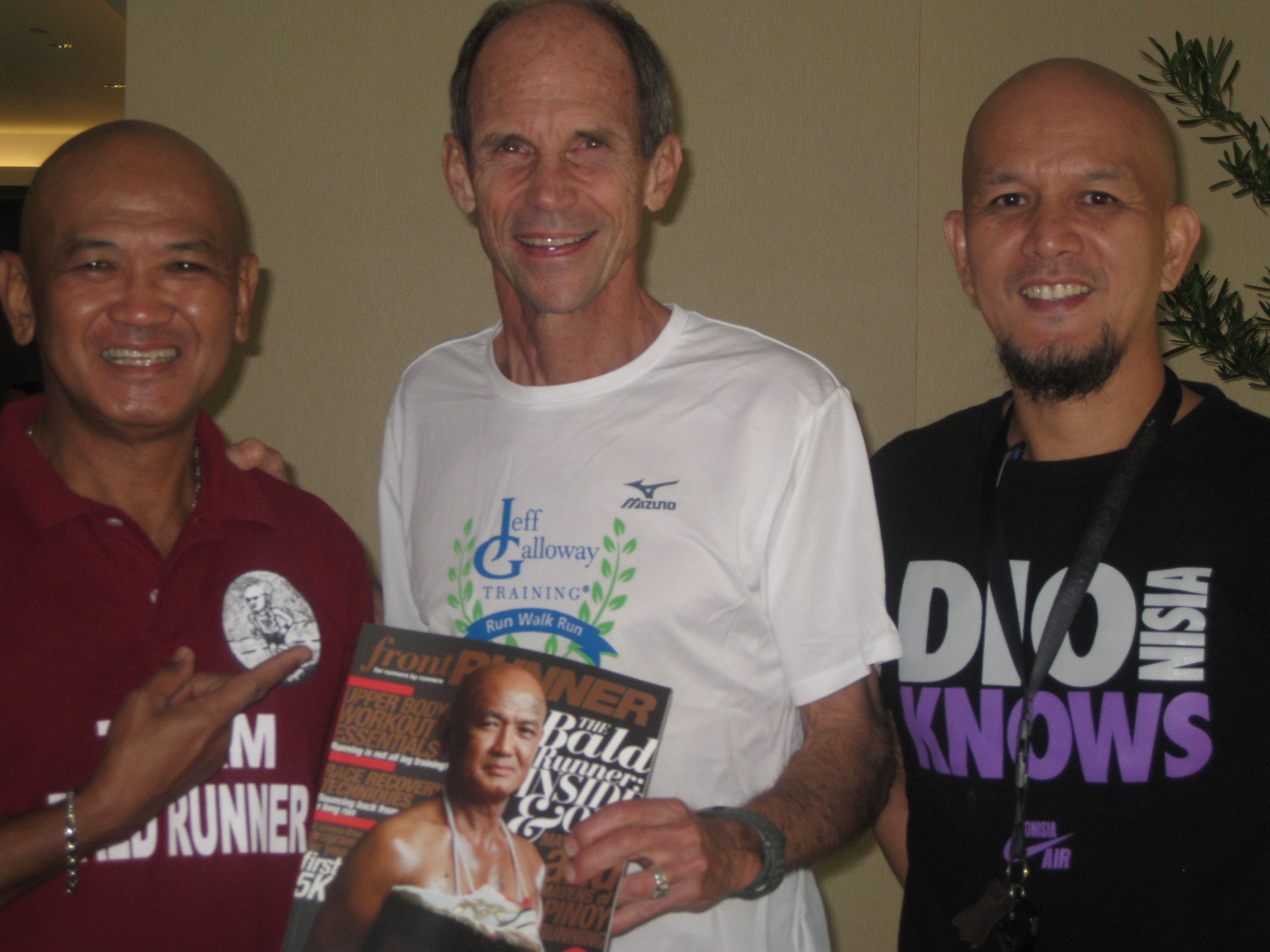
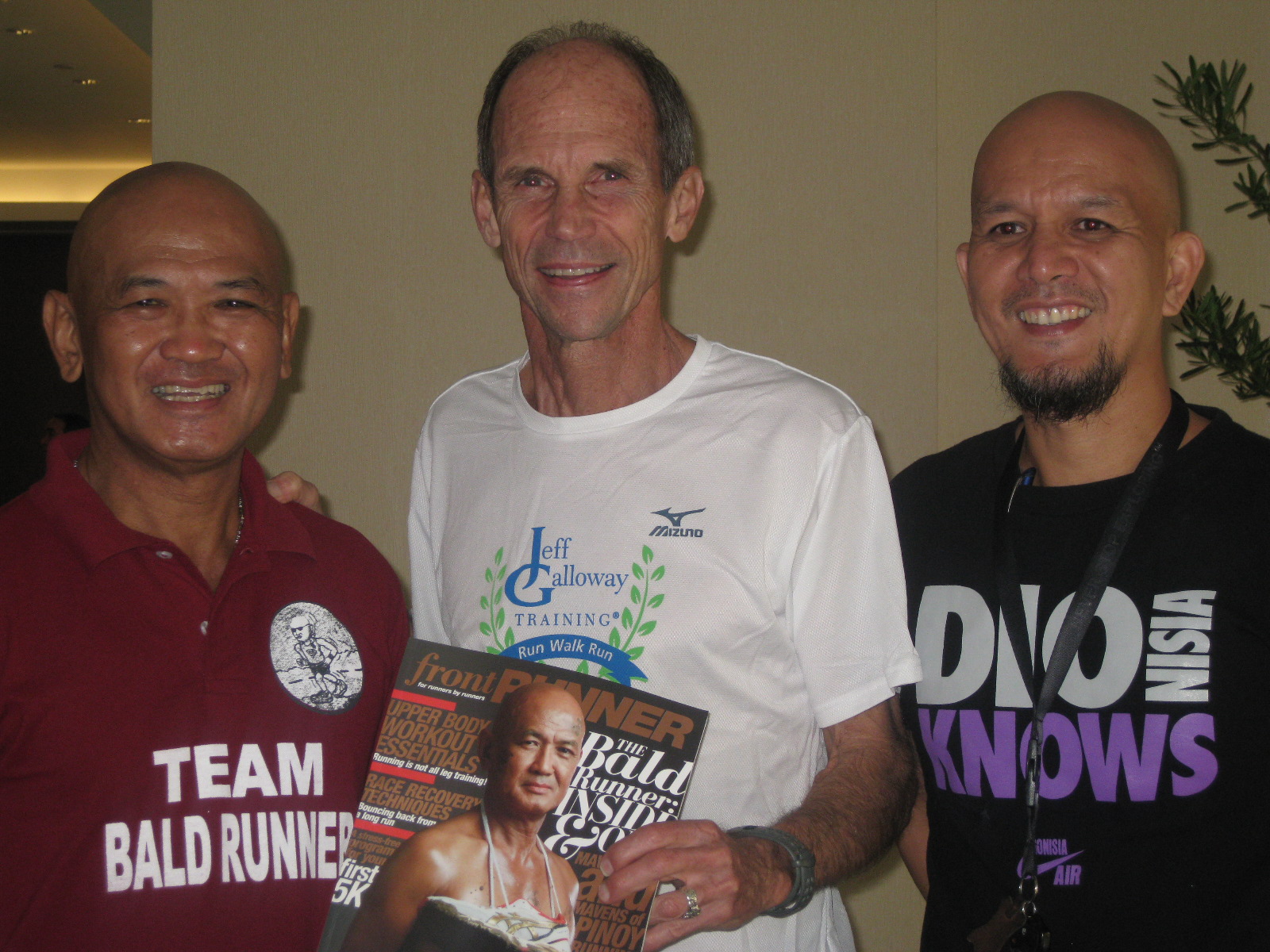
As soon as Jeff Galloway entered the lecture area, Jonel and I approached him and we started a conversation with him. As usual, Jonel was the more articulate and talkative one for the introductions and Jonel “trapped” Jeff Galloway with copies of his FrontRunner Magazine as he gave Jeff lots of them. The “blitzkrieg” approach led to a special pose for picture with the guest lecturer!
Number 1!!! BR, JG, JM
I could sense that Jeff Galloway knew things about me and Jonel (He could have visited my blog or had been well-informed by his Hosts about the running community and the running magazine of Jonel). He started a topic where he informed us about his son, Brennan Galloway, a running film producer who made lots of running films about the famous “minimalist” ultra trail runner, Anton Krupicka. There you go, Jeff knows that we are ultra marathon runners!
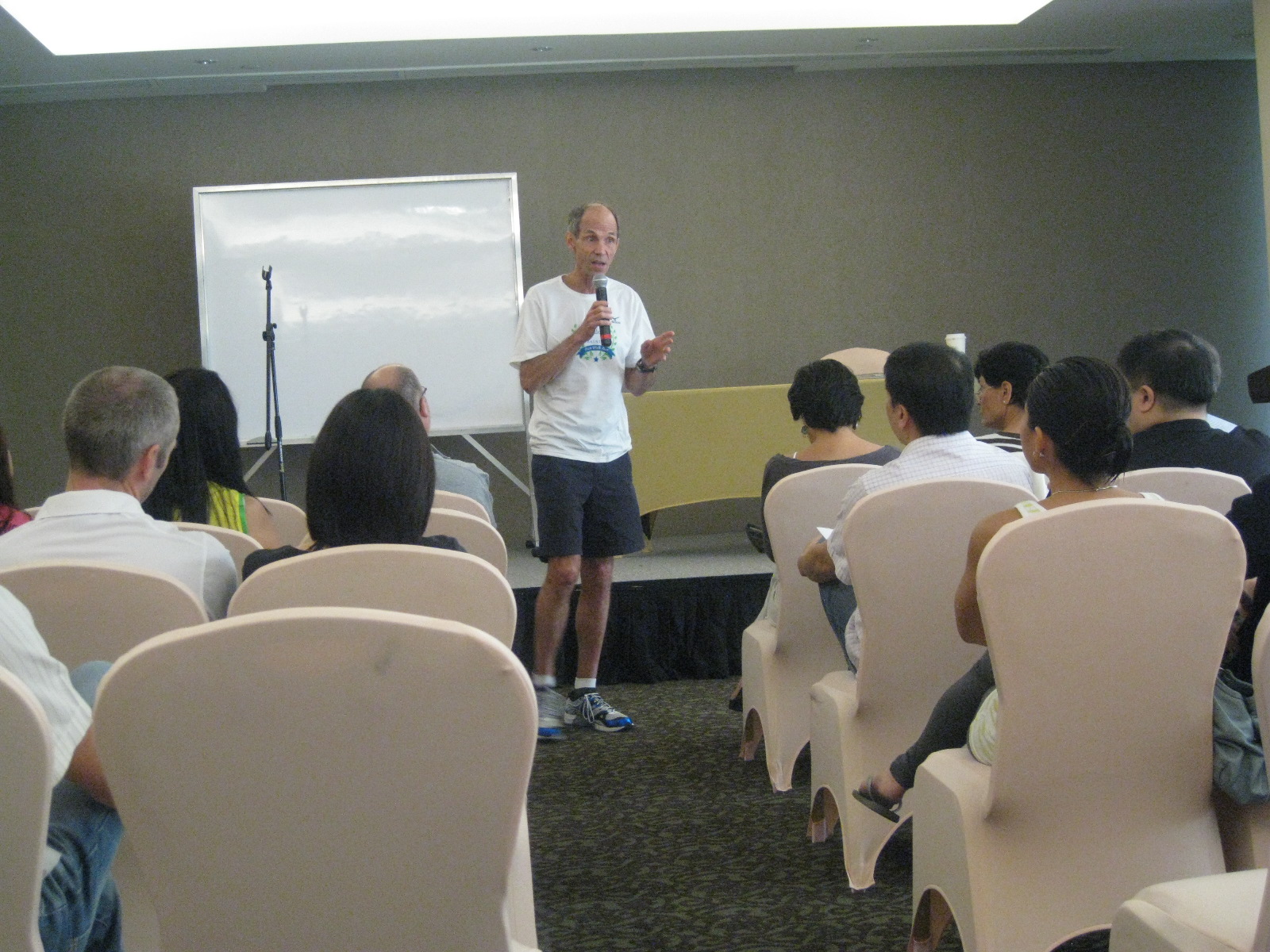
After a few conversations with the guests and Jeff, the lecture started at least 10 minutes late from the schedule which was okey with us as more interested guests were entering the venue. At least, 40 guests were present during the lecture.
Jeff Galloway had been in the country when he was still in the active military service as he was with the US Navy in his younger years. He knows about Subic and Olongapo, of course! He did not mention the particular year when he was here in the country. I could only guess that he was here during the Martial Law years under the administration of former President Marcos. (Note: Dr George Sheehan, a runner, writer and lecturer was also with the US Navy rising to the rank of Navy Captain).
One Hour Lecture Full of Information About Run-Walk Strategy
Jeff Galloway Lecture was geared towards his “The NO PAIN Marathon Program”. Let me quote the brochure which was available for all of us that explains the Jeff Galloway Method of Training:
Minimum workouts needed: 20-30 minutes on Tuesday and Thursday plus a weekend run.
Weekend Run gradually increases to goal distance in gentle increases, followed by short runs.
Walk breaks are inserted into every run, from the beginning, to erase pain and fatigue
Avoid running too fast by using a “magic mile” prediction exercise (MM).
Many surveys have shown that taking walk breaks early and often result in faster finish times.
The “Magic Mile” can predict current potential and set long run pace. You should be able to time yourself for one mile (4 laps around the oval track) about every 3 weeks and the following Run-Walk-Run Strategies should be followed depending on your pace (per km or per mile).
Pace Per Km
Pace Per Mile
Run/Walk Amount
4:58
8:00
4 min/30 sec
5:16
8:30
4 min/45 sec
5:35
9:00
4 min/1 min
6:12
10:00
3 min/1 min
6:50
11:00
2.5 min/1 min
7:27
12:00
2 min/ 1 min
8:04
13:00
1 min/ 1min
8:41
14:00
30 sec/ 30 sec
9:19
15:00
30 sec/ 45 sec
9:56
16:00
20 sec/ 40 sec
10:33
17:00
15 sec/ 45 sec
11:11
18:00
10 sec/ 50 sec
More interesting insights and information were gathered during the “Open Forum” where Jeff Galloway was able to answer questions from the guests. Some of the pointers were the following:
He does not recommend stretching exercises for long distance runners
Extensive Long Slow Distance Run (LSD) every 3 weeks in the Marathon Program
More Long Runs For Endurance rather than Speed runs
“Speed Training” is NOT recommended for the 1st time Marathon runners. They should simply enjoy the experience and have fun
On Core Strengthening, he recommends two (2) workouts: “Arms Swinging with Light Weights” (natural form when running) and Abdominal “Crunches”
Running is controlled by the Brain Function
On running compression tights, no benefits on the performance of a long distance runner. However, there are studies that compression calf sleeves are the most beneficial to runners. He highly recommends such apparel to long distance runners.
Water hydration during the race is the only thing that is needed during a marathon race.
It takes 24-48 hours for the body to absorb the replacement electrolytes from Sports Drinks like Gatorade, PowerAde, Propel, Pocari Sweat, and others.
Carboloading from foods rich in carbohydrate taken a day before the race is beneficial.
On a personal note, I don’t agree with his answers about his view on the unnecessary need of sports drinks and food being ingested during the marathon race. In a country like ours, the heat and humidity make our body metabolism faster and there is a need for sports drinks and food to be taken in somewhere along the marathon distance. He thought that Philippines is like Taiwan, South Korea, Japan or the United States where the temperature is too low that a runner could hardly perspire during a marathon race.
I could follow the Run-Walk-Run Galloway Method in an ultra running event to last and finish the distance but I will never walk in a Marathon Race where my goal is to finish a better PR best time.
Ironically, in my collection of running books, I found out that I don’t have any of the books written by Jeff Galloway.
I seldom endorse a running event other than the BDM and PAU Races. The Taray Pamulinawen is a unique race where you can experience running along the sand dunes on the beaches of South China Sea, the paved roads made to connect the barangays, and the hills and rice field trails of Laoag City. Practically, this is my “playground” whenever I spend my vacation in my hometown which I even extend up to a distance of 20-25 kilometers just to inspect my real property on the hills of Barangay Salet. However, on this particular running event, the race organizers came up with a distance of 16 kilometers or 10 miles to have a glimpse on a particular side of the city.
Due to the 1st BDM 160K Ultra Run on February 26-27, I will be missing this one. But for those who would like to visit Laoag City and the tourist spots of Ilocos Norte, this will be a good reason to have fun and taste the local foods of the province before and after the run!
Those who are interested can register at A Runner’s Circle Specialty Store along Roxas Boulevard (at the Aloha Hotel Building) which opens at 12:00 Noon. Look for Perkins!
The following is the Route Course Description of the race which was sent by Dr Chester Puno, an ultra runner who is one of the organizers of the event:
TARÁY PAMULINAWEN 16K ROUTE DESCRIPTION
The 16km run starts in front of the basketball court of Barangay Talingaan. After about 200mts of concrete, the run turns to Ventura Highway (nothing to do with the song) and dips into the famous sand dunes of Barangay La Paz. This is where the challenge begins. The sand varies in consistency from hard to soft (shoes may get buried). Gaiters are proper if only to minimize sand and pebbles getting inside your trail shoes (But if your feet don’t mind these intrusions, no need to buy/improvise gaiters). Undulations are given. In which case gradients and elevation of the dunes are also inconsistent. Walking poles are allowed. (Although during our test run, nobody brought any, and we still managed to navigate; some of us on all four extremities : ). There are sections where no trail is visible/available and the only guide is a flag. One may take any route towards the flag, if he/she thinks it’s the easiest/fastest way to reach it (the shortest distance between 2 points may not necessarily be the fastest because the terrain is very irregular). On top of the dunes, the scenic view of the sea, sand and the rising sun is best appreciated (for non-competitive runners, it’s the best time to feast your human and mechanical lenses on the beauty of Laoag sand dunes; just be mindful of the 2 ½ hr curfew). There are dried grasses/weeds that dot the dunes in variable heights. Leg abrasions are a possibility; at the least, legs may get itchy from contact. Lower leg protection is suggested (ankle low tights, knee high socks, lower leg sleeves). A water aid station will be available in this stage. The dunes run distance is approximately 3kms, before your feet finally hit concrete in front of the sisters’ convent. (We had to stop at this point, remove our shoes and empty the load of sand within).
The next three kilometers course through the barangay streets of La Paz, Navotas and Dibua. Runners will be greeted by curious barangay folks, a stark contrast from the seemingly empty, unpopulated desert experience. Since these are rural barangays, fields of corn and palay flank the roads. From previous sights of light gray, the eye starts to meet hues of green. At the top of Dibua hill, just before reaching BR’s house, the road turns right into an insconspicuous trailhead. It signals the next stage of the race: 8 kilometers of hills and trails traversing Barangays Dibua, Pila and Vira.
Vegetation gets thicker in this leg of the race. Naturally, the ground becomes uneven and technical at various points. Descents, inclines and gradients are likewise erratic and sporadic. Needless to say, the runner must watch his step. One has to be wary of his/her surroundings as he/she may run smack into low hanging/lying branches and trunks. There are single tracks and double tracks. As these barangays are into farming, an irrigation snakes through the route. A portion of the race requires the runner’s agility as he navigates through wet and muddy fields. (This runner miscalculated and landed straight into mud. Take comfort in the thought that it may at least make you look more hardcore. Think of BR’s picture on the cover of frontRUNNER). Be vigilant as well to cow/carabao dung and horse manure (which I fondly refer to as “teller mines”) that occasionally adorn the paths. The organizers will make arrangements in order to put canine attacks and chases to a minimum. Bovine exposure, however may not be as limited. So far, there has never been any reported snake bites on trailrunners/walkers/bikers in this part of town, although sightings of these crawling creatures (mostly non-crawling since they are often seen dead-flat) are not unheard of. In any case, the runner is advised to take caution, let these wildlife creatures pass in peace and never antagonize them.
As soon as the runner reaches the Marcos Stadium, more popularly called “grounds” by residents, the route is down to its last 2kms of pure concrete, which exposes him to Laoag City proper where cheering city folks will be lining the streets. Now is the time to accelerate and gut it out to make up for time lost enjoying sand and trails. Taráy Pamulinawen will officially finish in front of the festive Laoag City Hall. . . A post-race recovery tour around the city is strongly recommended later in the day.
3:30 AM February 6, 2011 @ The Fort/BHS to Skyway and Back
Plan
After my “muscle tear” injury on my left calf last December 7, I did not have any plans of training and running for another Marathon Race on the early months of the new year that is to include the 2011 Cebu Marathon. The 2011 Condura Skyway Marathon was not on my list of races for the year. I focused myself on my rest, treatment and recovery for the weeks and months ahead.
My attendance to the Fat Ass 2011 in Clark Freeport was a way for me to test and evaluate the extent of my treatment & recovery. I was very conservative during the run as the atmosphere among runners were very relaxed and non-competitive. However, I forced myself to run despite feeling some pain on the injured calf muscle. But my run at the Fat Ass had accelerated my treatment as the pain just completely vanished after 2-3 days of rest and recovery.
Since the Fat Ass Run, my runs were random and did not follow any pattern of a scheduled training program. I just ran if I felt like running. These random runs were limited to at least 1 hour & 10 minutes or 10 kilometers to the maximum. I was happy if I could run 2-3 times a week and I started to maintain an average pace of 7:00 minutes per kilometer. This pace had eventually became my training pace to build-up my endurance.
“Snafu”
As I was busy with my “out-of-town” trips talking and meeting with race organizers in far-flung provinces all over the country; being invited for my Running Lectures; reading a lot of Books on Running for my Book Reviews; and trying my best to update this blog, a little “hump or snafu” just came to my attention when the PR people of Condura Skyway Marathon sent me an email stating of their apology for not including me among the Runner-Bloggers they invited for a Media Release of this event. Well, I got a “free ticket” for this year’s edition of the Condura Skyway Marathon due to this incident.
Decision To Run
I really don’t need so much time to consider the “pros and cons” if I finally decide to run this event. Being a “road warrior”, I consider this as a simple setback in my quest to run an excellent race but I know I could simply finish it if I consider this run as an ordinary LSD workout as a part of my training for more “important battles” ahead. So, I conditioned my mind that this run would be a “walk in the park”—by maintaining a 7:00-minute per kilometer average pace for the run with the hope that I will finish a near 5-hour or sub-5 hour marathon. What is important is to enjoy the race, have fun, be seen to inspire others, and to “engage” any runner whom I will meet along the way. So, the decision was final, run the marathon and look like a “brave warrior”.
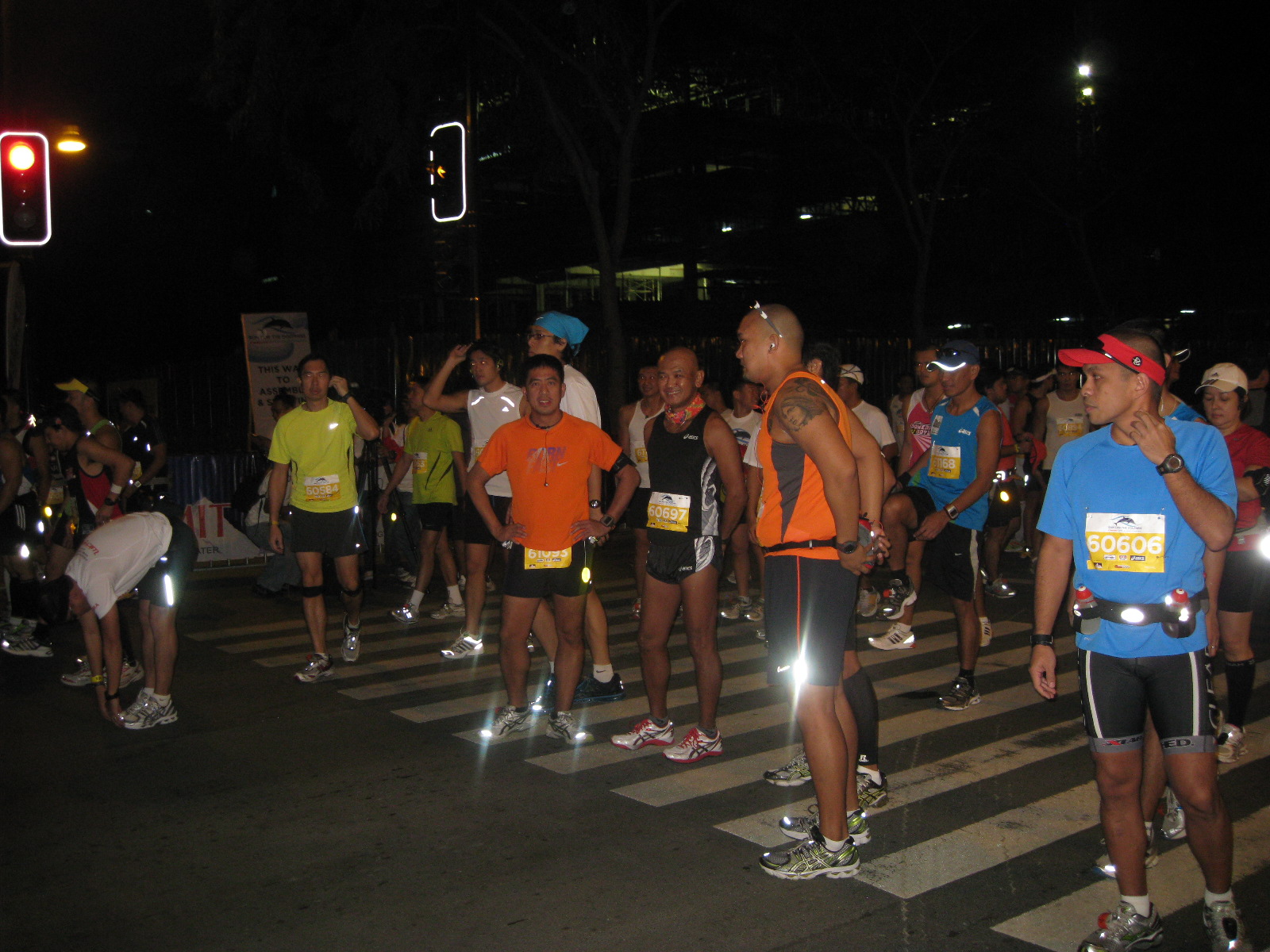
At The Starters Coral, 5 Minutes Before Gun Start
Race Proper
At exactly 3:30 AM, the race started with some fireworks, simple countdown, and the sound of a starting gun. The BHS area was well-lighted and there was no problem on how my feet landed on the streets as I’ve memorized every street of this place. For an increasing 1,200+ runners in the Marathon Race, the group had stretched after running at least 500 meters from the start. If I can remember right, in the 80’s, if you have at least 500 runners in the Marathon Race, such race is already a successful one! Two years ago, if you have 700-800 runners as starters, you can consider the race as a successful event already. Now, I was surprised with the increasing numbers of Marathon Runners in this race, reaching to more than 1,200+. What an improvement! More of the runners are becoming braver and more aggressive and I really like that kind of attitude! I could see new faces; hear different dialects on the conversations of the runners around me; and a lot of “newbies” which I could conclude from the attire and “gadgets” they have in their bodies! I only have one conclusion in this, if these people are bored in marathon races, they can always try to do an ultramarathon distances which PAU can offer, at least, a 50K Road Race!
The race organizer really invested on the safety and control of the runners. Almost all the streets were properly lighted with mobile lights and generators, a far cry from the unlighted streets in my ultra road races. We, the marathon runners, became the Kings & Queens of the Roads in Makati, for the whole duration of the event and it was a good feeling for everybody. It is unfortunate that there were still a lot of drivers who were cursing and blowing their horns as they were put “on hold” along key intersections along the road. I really admire those traffic enforcers who simply ignore and patiently not being irritated with such annoying drivers. As I passed by these traffic enforcers, I always say “Thank You” to them for doing their jobs well.
“Houston, we have a situation”
The problem when I am running in a cold environment (yes, I supposed 3:30 AM in the morning’s temperature is still cold) is that I pee most of the time. In almost all the water station, I have to stop and brisk walk to take my water drinks but I have to pee, too! Damn, I was peeing every time I pass by a water station and every portalet section along the route. You could just imagine the wasted time I’ve spent peeing almost all the time. I think this is the only Marathon Race in the history of my running career where I peed more than 20 times along the route. Well, I made the history of peeing on the asphalted road of the Skyway for three times! Thanks to Condura! How I wished I could have paid for my ticket for this race!
If only this race was an ultra trail run where you seldom see a runner on your back and front, I could have simply peed while I was running! I guess, this is normal among ultra trail runners as I did this thing in some of my practices and races along the trails here and abroad!
"Gallowalking" Towards My Food Pit Stop After Coming From The Skyway
“GalloWalk”
I got this term from ultra runner friend, Ben Gaetos. As a result of my attendance to a One Hour Lecture of Jeff Galloway a day before the Condura Marathon, I decided to have it as a trial or experiment. I am a “purist” in running when I train and compete with myself in road races up to Marathon distance, which means, that I don’t believe that you can improve your PR best time in Marathon Races by simply taking “walk breaks” from the Start up to the Finish.
Since I’ve decided to treat the Marathon Race as a LSD workout, I started to incorporate the Run-Walk-Run Strategy of Mr Jeff Galloway. At the first Water Aid Station, I started to walk once I was approaching the table. I picked up two glasses of water. Walked away from the Table by walking and slowly drank the water. After drinking the water, I had to count at least 30-45 strides (one stride = 2 steps) before resuming again with my run. Sometimes, the walking breaks and counting would reach up 60 strides! I did this ritual religiously every water aid station along the route.
This is not the proper way how to do the Galloway Method as he mentioned in his lecture but I wanted to experiment what was best for me with my present condition by incorporating “walking breaks” on a regular basis during the run. I really felt great doing all these “walking breaks” and “peeing breaks” during the run. The result was not a good PR but I enjoyed the run and the experience. But what is more important is that my run did not affect my “healed” muscle tear! I did not reach any “wall”. There is no “wall” after all. I did not have any muscle cramps or soreness on my leg muscles. And the best part of it, I was able to have my recovery run a day after the Marathon Race for a distance of 7 kilometers with an average pace of 6:10 minutes per kilometer! Yes, it was a fast pace for a recovery run but I did it without any pains or soreness!
Conversations along the Way
Conversations and Greetings are the things that I like when I run in local Marathon Races. Well, you seldom “engage” in a conversation in Marathon Races in the West if you want a nice finish time. But it is a “must” if you are joining an ultra train run as it relieves the “pressure and stress” on the rate of difficulty of the course. Ultra runners have an “unwritten code” that they help each other on the trails in order to finish the race within the prescribed cut-off time. Helping each other means that you have to engage another runner that you run along the trail by talking with each other. An ultra distance of 50K, 50-Mile, 100K or 100-Mile is so boring that you need to “engage” with another runner in order to break the monotony!
In the Condura Marathon, being known in the running community, it gives me the pleasure to engage with the runners by simply waving at them, calling their names, answering and acknowledging their greetings, or simply listening some conversation among the runners.
Some of the examples of conversations were the following:
#1: From a couple of runners that I passed along the Skyway:
Runner: Hey, that is Bald Runner! He is wearing an all-black ASICS apparel
I briefly waved my right hand to them.
The other guy said, BR is wearing a nice ASICS shoes! They are nice and new!
The succeeding conversation became garbled as I distanced myself from them.
#2: From a guy who paced with me just to request something:
Runner #2: Sir, I am a runner from the Visayas and I saw you at the 1st Cebu Ultramarathon Race. You were so strong and consistent during the race.
BR: Thank you! That was a hard course!
Runner #2: Sir, I can still join and register for the 2011 BDM 102?
BR: Are you qualified?
R #2: Yes, Sir! I finished the 1st Cebu 50K Ultramarathon Run.
BR: Ok. Please send me your personal data through my e-mail. You can still register.
Then, I had to pass him for good!
#3: Conversation with a Wife of an Ultra Runner @ Km #20
BR: Angela? Are you running the full Marathon Race? (I was surprised to see her running along with the other Marathon runners. Actually, it was my first time to see her run!)
Angela: Yes! (She was running ahead of me for the past 20 kiometers! And she was maintaining a nice competitive pace)
BR: Where is Paolo? Did he run?
Angela: He did not run and he is sick. He is at home. It seems that he is overtraining himself for the BDM 160.
BR: Ok. He needs some rest and he has to taper on his mileage at this time already.
We ran together for about 5 minutes, pacing each other, until we reached a water station. She went ahead of me as I took my walking breaks after drinking my water.
#4: Conversation with Somebody in the Military
Runner #4: Sir Jovie, Whoooooaaaaa!!!
I answered him back with, Whoooooaaaa!
The conversation was done!
#5: Conversation With A Tall Runner
Runner #5: Sir, BR, would you mind if I ask a personal question to you?
BR: No, what is your question?
Runner #5: Why do you have to wear a bandana tied around your neck every time you run?
BR: It catches my sweat/perspiration from my head and the wet bandana eventually becomes a “coolant” to my nape/neck.
Sometimes, I use it for emergency purposes—as a dust protector to my nose & mouth or simply use it to tie a knot around an injured leg muscle.
Runner #5: I observed you like those with bright colored ones and with flowers printed on them.
BR: Yes, I have all the colors for all the Bandanas available in the market but I don’t have any preferences with regards to color. ( Note: I am not gay, dude!)
#6: From a Runner Wearing Tights
Runner #6: Sir, BR. It seems you are having a good time with this run. You have slowed down with your pace as compared with your past marathon races.
BR: Yes, it is because I am recovering from my muscle tear injury on my left calf muscle.
Runner #6: How many runners will be joining the BDM 160?
BR: I will be happy if there will be 40 runners at the Starting Line this coming February 26, 2011.
Runner #6: Are you preparing to join this BDM 160 as I can see your pace is suited for such an ultra distance? I have the impression that you always join your first edition of your BDM runs. BDM 160 will be in its first edition this year.
BR: No, I will not be joining the BDM 160 as competitor. I have to be a full-time Race Director on this one due to some sensitive issues. And then my answer ended it with a laugh!
#7: From Francis, An Ultra runner from Mindanao (As we met along the Skyway)
Francis: (Running after the Marathon turn-around) Sir, You are really serious with your plan to run 7 minutes per kilometer!!!
BR: (Running towards the Marathon turn-around 2 kilometers away) Yes! This is what I call “Discipline and Patience”!!!
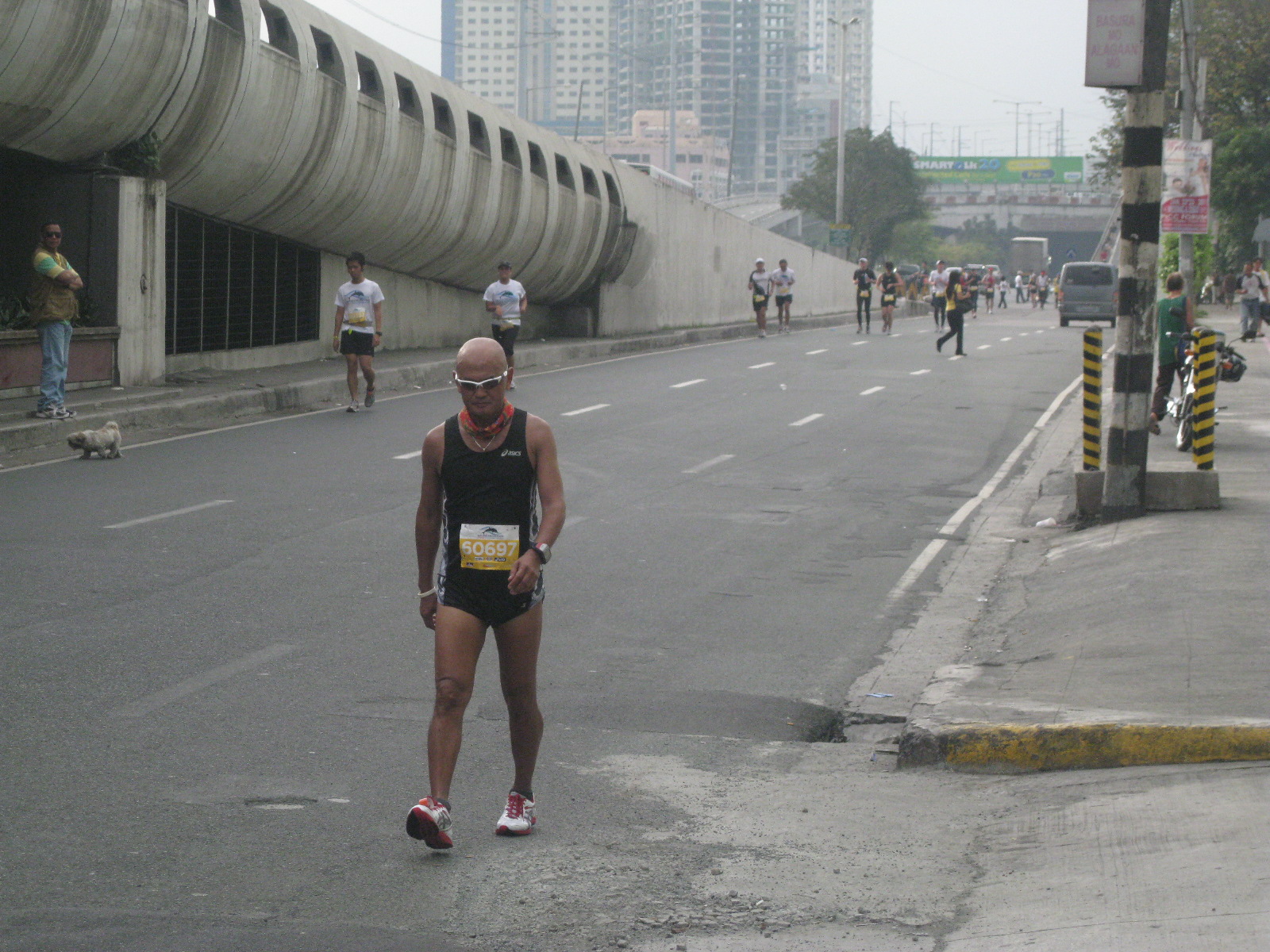
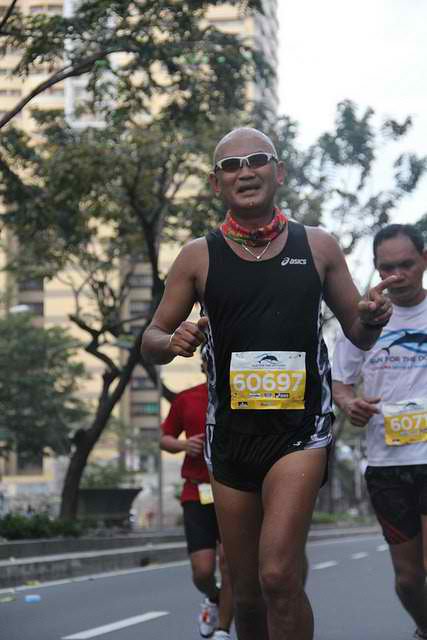
Last 5K To The Finish Line (Photo Courtesy of Francis Chua)
Manage the Pain
The last 2 kilometers of the race was a display of managing and preventing the pain to come out from my calf muscles. The last 2 kilometers was test to increase my pace or not just to be able to finish the race in sub-5 hours. I decided not to speed up just for a simple reason of finishing a desired time. I have to be smarter this time. I want to finish the race without any injuries that will sideline me again for another two months. The better decision is to be able to manage the pain and not doing any “gung-ho” attitude on the last few meters of the race. My calf muscles are still weak due to the rest and recovery for the past two months. I have already incorporated a lot of exercises and drills to my training program just to focus with the strengthening of such muscles. I need patience and a lot of time to do this.
I was able to finish the race without any injuries or any pain or soreness on my legs. The accomplishment in itself is already a victory for me. I have treated the Marathon Race as an LSD workout that my present condition of my body could afford. I did not have any structured training schedule for this race and I ran it through instinct by taking care of my body, listening to my body, and talking to my mind that I have to stick to my race strategy of maintaining an average pace of 7:00 minutes per kilometer. There was no stress and pressure at all to finish this kind of Marathon Race. After all, finishing a Marathon Race is a personal accomplishment where there is no need to compare yourself with the finish times with the other runners.
Taking Care of the Body
In a tropical country like ours, runners need to eat some solid foods and drink some sports drinks like Gatorade/PoweAde/Pocari Sweat, etc. aside from water to replenish electrolytes excreted from the body through our sweat/perspiration. I believe that water alone could not replenish the wasted electrolytes from the body.
Early during the race, I have to eat a Power Bar and had in my palm two GU Gel packets which I ingested from Km 10-21 and then from Km 22-32. On the last 7 kilometers, I had a “pit stop” to eat one serving of oatmeal and a hard-boiled egg. However, on my last 5 Kilometers, a staff from A Runner’s Circle Store gave me a GU Gel Packet which I ingested on the last 4 kilometers of the race. Practically, I was well-fed during the race together with those ripe bananas being served in some of the Aid Stations.
But I expected that there should had been Sports Drinks equally served with the water during the race. I made a feedback to Patrick Concepcion by asking him why they preferred to serve 100 Plus Drinks which is a carbonated sports drinks instead of serving the usual and more common to runners like Gatorade, PoweAde, Pocari Sweat, Propel, and others. He answered me that Summit Water & 100 Plus Drinks were the main sponsors of the race & Gatorade was not a willing Sponsor for the sports drinks support for the runners.
On the Race Route & Race Management
As compared with the last year’s edition, this year’s race route is better and simpler. I hope that this race route will be maintained in the years to come. I consider this route as the most perfect one for a Marathon Race In Metro Manila. It is out and back. The roads are wide and the runners from other distance are not mixed with the other runners.
On Race Management, the road was not full of traffic from the runners. Moreso, with the runners coming from the Half-Marathon and 10-Mile Run Races. The lesser distance runners just came out from nowhere where they met with the Marathon Runners running on the other direction! When all the lesser distance runners left the Skyway towards the Finish Line, it was time for the leading Marathon runners to clear the turn-around point and follow the last runners of the lesser distance runners. Basically, the roads were not jampacked with a lot of runners.
Conclusion
I finished the race in 5 hours 3 minutes & 31 seconds based from GF 305, with an average pace of 7:07 minutes per kilometer. The registered distance in my watch was 42.61 kilometers. I was still strong after I crossed the Finish Line and spent more time standing, talking with the other finishers, and posing for pictures. Without any serious training for this marathon race, I was able to finish it without any pain or issues and of course, after coming out from an “injured” status in running.
For two months without any serious training, I could finish a Marathon Race in 5 hours or less.
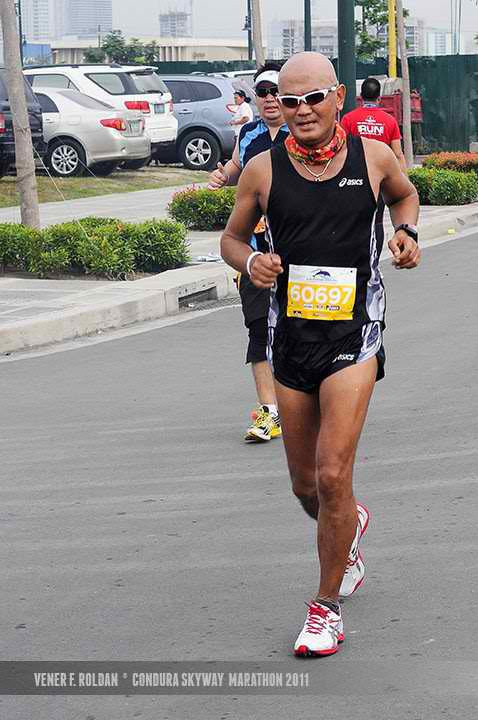
Few Yards To The Finish Line (Photo Courtesy of Vener Roldan)
Attire/Apparel
Bandana by Buff
Sunglass By Oakley
Running Apparel (Shorts & Singlet) By ASICS
Running Shoes: ASICS Gel-Lyte Racer
Socks: DryMax Running Socks
Body Glide
Watch: Garmin Forerunner 305
Sports Bar & Gel: Nature Valley & GU
Lessons Learned & Violations of the “Norms”
Stick to a Plan or Race Strategy and don’t get affected with the situation of other fast runners ahead of you. Do not chase any runner if you are not well-trained for the event. Never underestimate slow runners at the start.
Try to “engage” any runner that starts a conversation with you. Conversation with the other runners relieves stress and pressure during the race.
Run-Walk-Run Strategy works if you are not well-prepared for the event. It will not force you to get injured. However, this strategy works well if you have adjusted to it. Since I consider myself as a “purist” in Marathon Races, running is the best way to improve one’s time is such distance. However, in ultra running, the Run-Walk-Run strategy is a “must” in order to finish within the prescribed cut-off time.
It was my first time to use a brand-new running shoes in a Marathon Race. I was confident that I will not be injured or get re-injured with this decision since ASICS had been my favorite and most comfortable racing shoes.
I did not take any Imodium or Tylenol or Salt Sticks tablets this time and I did not have any “issues” with my stomach and leg muscle cramping.
Even if I have Gatorade drinks ready to be ingested from my support staff, I preferred to take in water only during the whole duration of the race. I wonder if it would have prevented myself from going to the side of the road in order to pee if I have taken Gatorade, in alternately with Water.
Those ripe bananas were great as my food source during the race. 3 GU gel packets, one Nature Valley Sports Bar, one serving of Oatmeal and lots of water were the source of nutrition during the race. I have a faster recovery after the race if I take some food during the race proper.
On this race, I did not ingest any form of “pain killer” tablets, before and during the race.
Congratulations to Condura Durables/Pat & Ton for a well-organized Marathon Race in Metro Manila. More power to you, guys!
See you on the next edition of the Condura Skyway Marathon!
My PAU Races last year had been “notorious” and well-known because of the “surprise” element or factor that the runners had been accustomed to. Whenever I warn the runners that I have a “surprise” bonus for the race, it means that the runners had to run an extra distance more than the announced route distance. It could reach up to a maximum additional distance of 5 kilometers!
However, for this year’s BDM 160K Ultramarathon Race, the “surprise bonus” will be in the form of additional time (not distance) for the prescribed cut-off time. Finally, I’ve decided to set the cut-off time for the BDM 160K into 30 hours! Yes, you read it right! For each runner to claim his much-coveted prize of a Silver Belt Buckle for finishing the race, he/she should be able to cross the finish line in 30 hours or less!
Good luck to all the BDM 160K runners. You will be making history as your names will be immortalized as the Finishers in the 1st 100-Mile Solo Road Race in the country!



You must be logged in to post a comment.