Hereunder is the comment from Brian Stark, the Ultra Trail Runner Across America, from my post about his book and experience in running along the trails across America:
Dear Jovie,
Thank you so much for your kind words and promotion of my story. Many times during that run and even still today, I feel that I was just a messenger for hundreds of strangers to connect and the message is still being delivered today, thanks to you.
Best Wishes and Many Happy Runs,
Brian Stark
The message of Brian Stark is very clear. If you want to endeavor yourself to an event which is worth being known by others and if it is an extraordinary feat for an ordinary individual, you have to document it so that others would be inspired to challenge themselves to do the same. If the reader has no intention of doing the same activity, at least, it would be known that the human body can have the capability to endure pain and fatigue and slowly can adapt to whatever stress being introduced to the body, thus, making one’s body stronger.
In this age of high-technology/Internet and in the advent of “real-time” webcasts & social networking platforms, one’s activity can be known anywhere in the world in a split of a second!
A video consisting of pictures taken during the 1st Bataan Death March 102K Ultramarathon Race (BDM102) is featured in the blogsite of RonaldRei who participated and finished the said race.
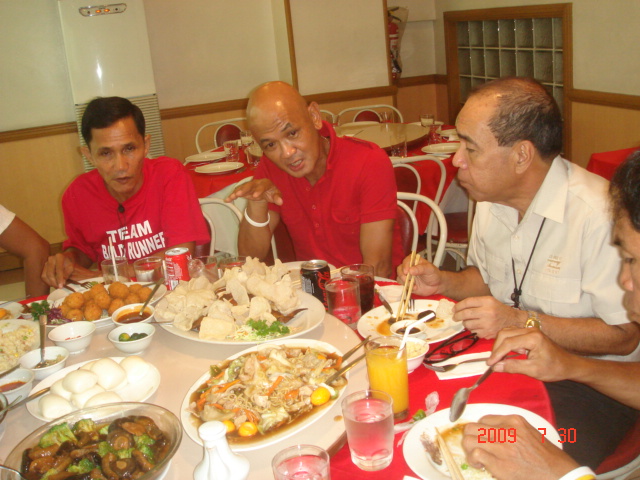
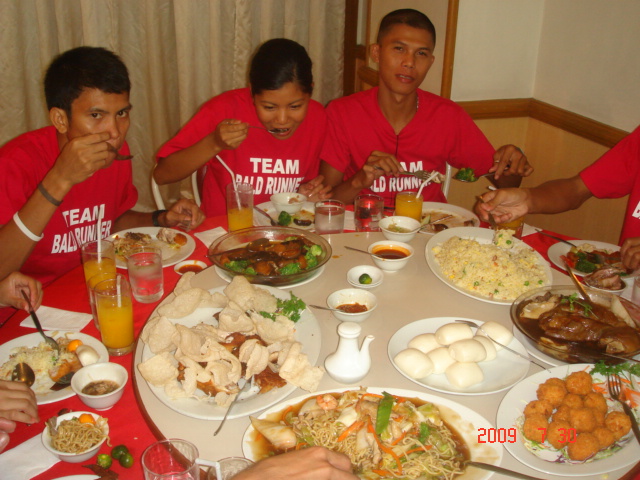
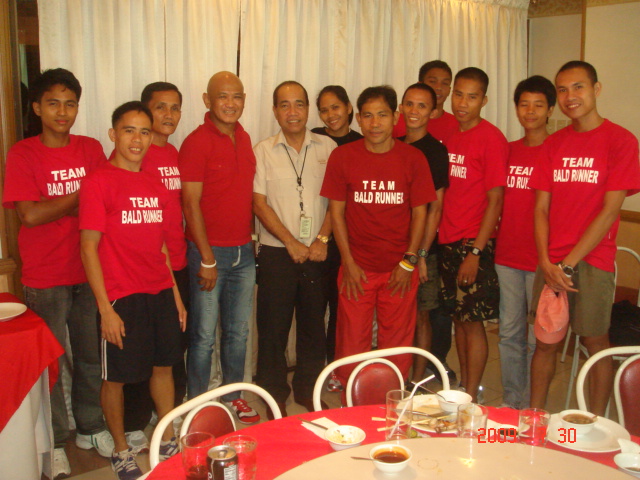
I was taken by surprise when Mr Amado Castro, Jr, popularly known as Reinier6666 among the runner-bloggers, called me on the day after the Ateneo 5K Team Run and asked me if it is possible for him to invite the members of the Elite Team Bald Runner for a lunch at Jade Palace along Shaw Boulevard on Thursday. I immediately approved his request and we had the said lunch on the scheduled date.
Mr Castro had been very supportive to the Elite Team Bald Runner as he sponsored the registration fees of the elite athletes in his racewalking feats in most of the road racing events in Metro Manila and lately, even went to the extent of coming up with a running uniform for the 5K Team runners in the last Run For M.E. held at Ateneo De Manila University Campus.
In the said lunch, we discussed “ideas” and projects/programs that will continuously enhance and promote running and racewalking in the country. I believe these plans will be realized as we are both dedicated to the sports we love.
Coach Rey Antoque, BR, Sir Amado, & Coach Titus SalazarElite Team BR's Carboloading LunchA Group Picture After The Lunch
Thank you very much, Sir Amado. More power and blessings!
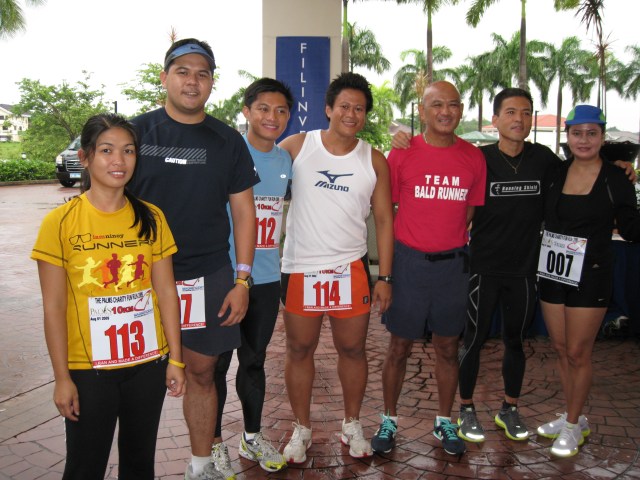
Jim Lafferty, President & CEO of Procter & Gamble Philippines, invited the members of the Elite Team Bald Runner for the Palms Country Club Charity Run last Saturday, August 1, 2009 and have them sponsored for the registration fees and breakfast but all the members were scheduled to have their weekend long run and I had to tell him that they could not join the said race.
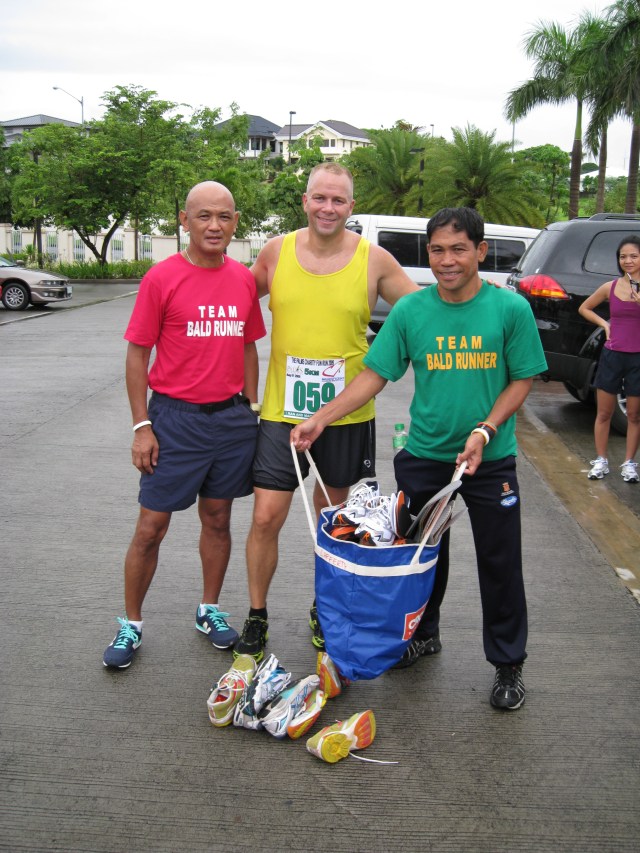
Instead, he invited me and Coach Titus to watch the race, have breakfast at the Clubhouse, and receive almost “new” running shoes for my Project Donate A Shoe.
Coach Titus and I arrived at the Palms Country Club minutes before the start of the race and I was able to meet and talk to Jim and his daughter Kristen; Patrick Concepcion aka Running Shield & wife; Eric Pasion aka Runner For Change; Ian Alacar of BOTAK; Paul Calvin; and Jan Imperio.
S. Cesar, Eric, Jay, Ian, BR, Patrick & Mabu
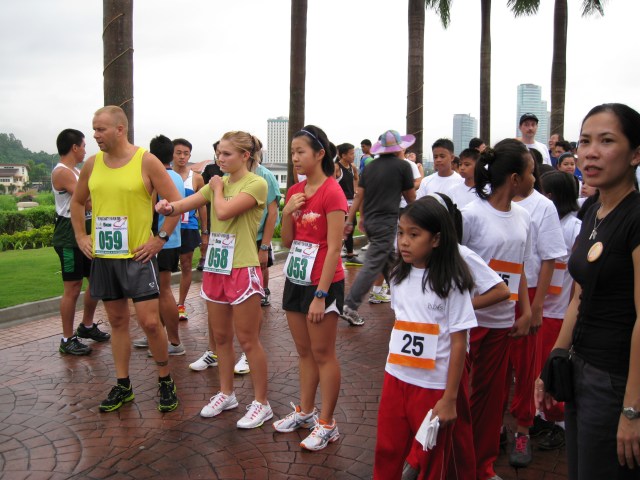
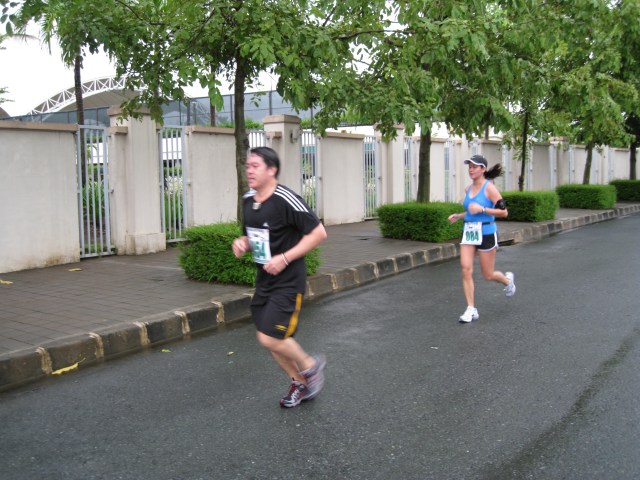
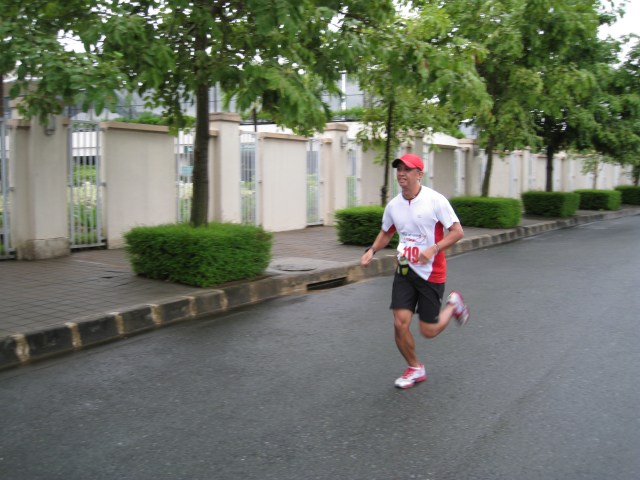
The race consisted of 3K Fun Run, 5K, & 10K distance runs. There were about more than a hundred who joined the race and it was held without any funfare. After the race had started, Coach Titus and I positioned ourselves at the street before the entrance to the Palms Country Club compound and we, eventually, became Race Marshals as we directed all the runners if they need to run another loop or not by looking at the color of their race numbers. I also became the unofficial photographer for the Lafferty family, Patrick, and the other runners.
Before The Start Of The RaceRunners of the 5K RaceJan Imperio of Tm BR-Professional Group Finished 2nd Overall in the 10K Run
The best part of this event was the breakfast invitation. Although I did not run the race and did not feel hungry, the breakfast turned out to be a “heavy” one! But what made the breakfast more significant were the ideas and insights that Mr Lafferty shared on how it takes to be a Champion or Olympian in Athletics and for that matter, in any kind of Sports. The best part of what he said is that, “The best athletes are assholes!!!” (If you want an explanation of this statement, I have to explain it verbally).
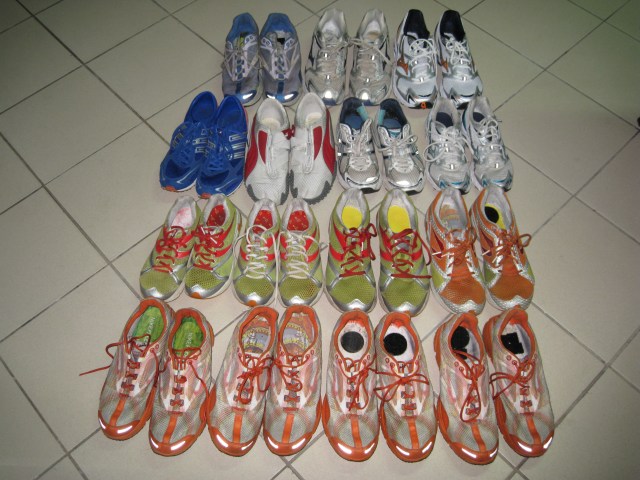
Before leaving the Palms Country Club, Mr Lafferty donated fifteen (15) running shoes which to my surprise turned out to be racing shoes from Newton, Nike Racers (not available in the country), Adidas Racing Flats, Puma and Mizuno Racers. These shoes are destined to be used by Elite athletes!
BR, Jim Lafferty, & Coach Titus With The Donated ShoesAll Shoes Are Racing Flats Which Are Very Light
Have you heard or read about this term in running? If not, then you were not born yet in the 70s and 80s or you were not yet into running during those times.
“Collapse Point” is the point along the marathon race where you hit your “Wall”. This term was made famous by Dr John Wagner of the Honolulu Marathon Association during the 70s where he led the Honolulu Marathon Training Clinic to runners who would like to finish the Honolulu Marathon. Through this Running Clinic, it resulted to a high percentage of finishers in the said Marathon Race.
According to Dr. John Wagner, the following is the simple test to determine your “collapse point”:
1) Calculate/Determine your total mileage (in miles or in kilometers) for Sixty (60) Days prior to Marathon Day.
2) Divide the total by the figure 20.
3) Result gives your approximate “collapse point”.
Examples:
If you have a weekly mileage of 70 kilometers (10K per day), your total mileage for 60 days is 600. Divide 600K with 20, the result is 30K, which is approximately your “collapse point” in a marathon race.
If you have a weekly mileage of 105 kilometers (15K per day), your total mileage for 60 days is 900. Divide 900 with 20, the result is 45K as your “collapse point” which is more than the marathon race distance.
Good luck to those who will be running their first marathon race this coming October and before the year ends!
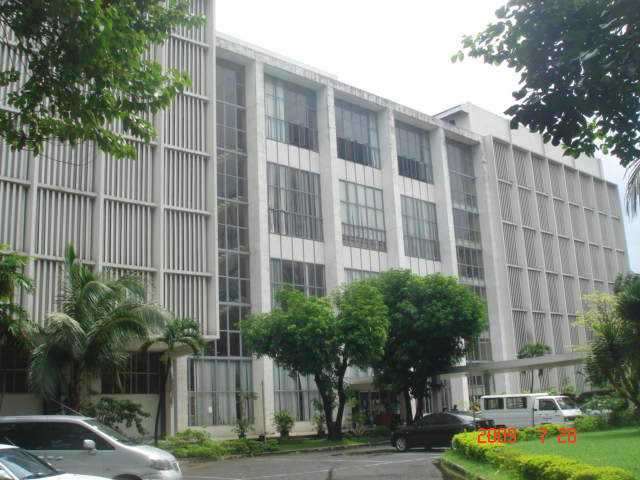
I went to the National Library on the morning of rainy Tuesday but I was not able to get in those research halls/rooms after I lacked the necessay requirements. Anybody who would visit and make a research in the National Library should have a valid Identification Card, one (1) ID Photo, and Fifty Pesos (P 50.00). A Cashier in the Library needs to confirm your Identity through your ID Card and then receives your Fifty Pesos. In return, the Cashier gives you a blank Library Card and an Official Receipt of the money you gave. You should paste your ID Photo to the blank Library Card and write your name on the said card.
The National Library/My 1st time to enter the building
Then, proceed to one of the desktop computers in the lobby and register your Library Card Number, Name, Password, Address, and E-mail address and then click Save. Your Library Card Number which is printed on the back of your Library Card is your Username. From here, you can now proceed to the research areas located at the 2nd-4th Floor of the building. The whole building is not air-conditioned and be prepared to sit yourself where wall electric fans are located.
First, I used the computer to track down if there are any books or publications about local Athletics and Running in the Directory of the National Libray. The result? None!!!
Second option was to find out the old newspapers in the Directory. I was surprised that I was made to proceed to the 4th Floor of the building and I was able to see the sorry/sad state of those book-bound newspapers stacked on open racks and cabinets. Most of them are dusty and not properly arranged by months and years. I thought I would be looking on “microforms” or “microfiches” of newspapers but I was actually reading the actual old copy of newspapers bound by month.
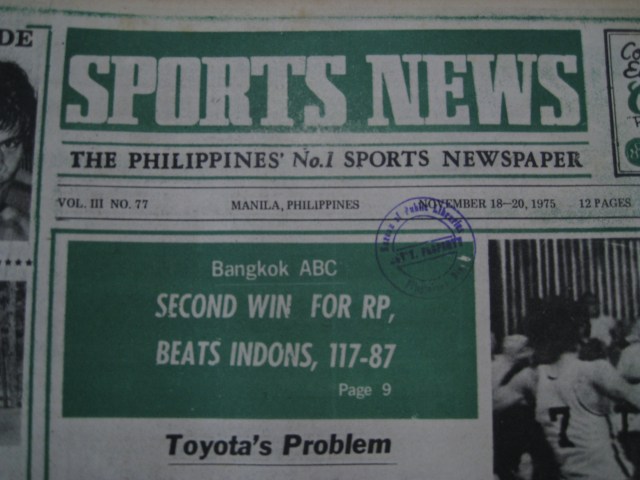
After looking on the different rows of newspaper racks for about 30 minutes, I came upon book-bound copies of “Sports News” which is a weekly broadsheet newspaper on Sports and the following were my discoveries:
1) There was an annual event called “YMCA Walkathon Race Event” which was well-attended by almost 300 walkers and had a Cash Prize of P 200.00 for the winner/champion. In my mind, I recalled a regular group of walkers called “United Nations Walkers Club”.
2) The first provincial annual marathon race was called Negros Marathon which was held in Negros Occidental as sponsored by Governor Roberto Benedicto. It was organized by Monico Puentebella (who is now a Congressman). The most popular runners team in Negros Island was headed by Art Valdez (brother of singer-runner Leo Valdez) and it was called BM-AMC.
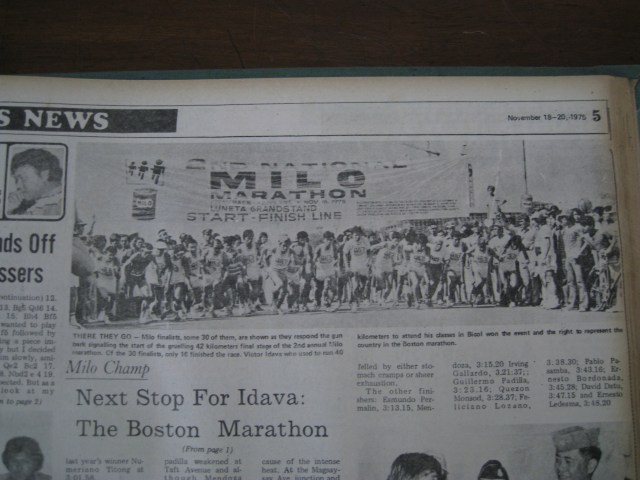
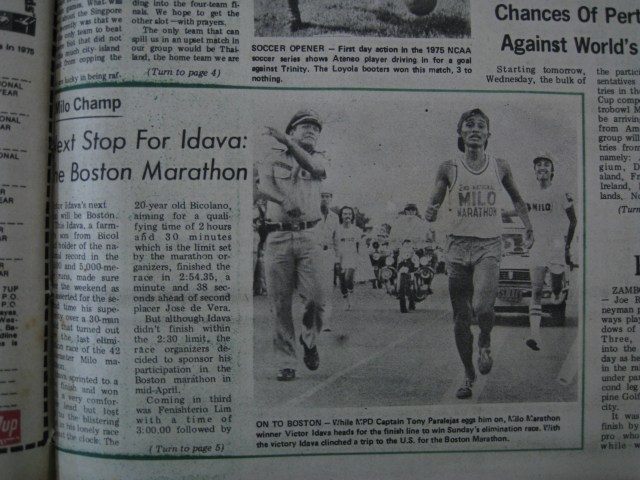
But what gave my full attention during my research was the news coverage of the 2nd MILO Marathon and its elimination race and I have the following information based from the news accounts of “Sports News”:
1) The first MILO Marathon was held in 1974 and the first Champion was Numeriano Titong, a golf caddy. I heard that he is still a golf caddy at the Valley Golf & Country Club.
2) The 2nd MILO Marathon Race Elimination Race was held on November 9, 1975 with the participants coming from all over the country. Registration was made and submitted in the local branches of Manila Bank with the following requirements:
a) Runner should be an amateur.
b) Must not be less than 19 years old.
c) Must be able to submit Medical Certificate from any Physician
d) Submit One (1) Passport size or ID Photo attached to the Registration Form
e) Registration Fee: Two Pesos Only (P 2.00)
The Elimination Race is a 20-kilometer road race that starts at 12:00 Noon along Gen. Aguinaldo Street, infront of the Fiesta Carnival, Cubao, Quezon City and finishes at Luneta Park. The first thirty (30) finishers in this race are qualified to participate in the 2nd MILO Marathon Final Run.
The Marathon Finals is held the next Sunday after the Elimination Race. The Finals starts and ends at the Luneta Park. It starts at 12 Noon from Luneta Park-towards Quiapo-Espana-Quezon Boulevard-turn right at EDSA-towards Cubao-right at Aurora Blvd-Magsaysay Blvd-Legarda-back to Luneta Park.
The Marathon Finals top prize for the Champion is a chance to compete in the Boston Marathon if the finish time is 2:30 hours or less. No Cash Prizes were given to the winners that time.
The Race Organizer was Jun Castro of Intergames Inc. The race was also sponsored by PATAFA.
2nd MILO Run Start PictureVictor Idava Near The Finish Line
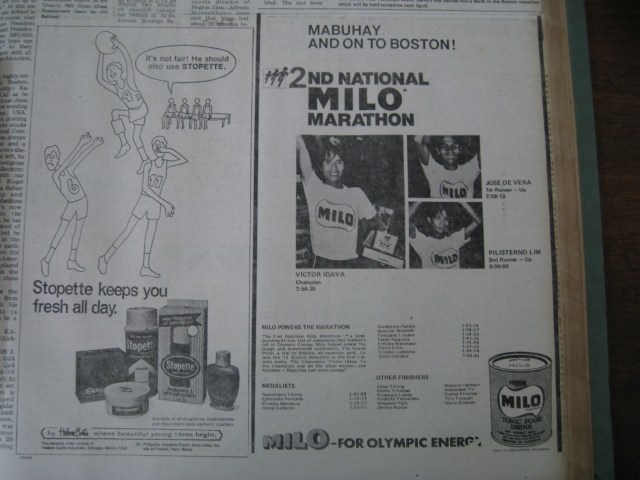
In the 2nd MILO Finals, Victor Idava, 20 years old & farmer’s son from Bicol and a national record holder then in 1,500 & 5,000-meter runs, won First Place/Champion with a time of 2:54:35 hours. He did not qualify the 2:30 hour or less finish time but MILO sent him to participate in the 1976 Boston Marathon. Out of the 30 qualifiers who started the race, 16 finished the race.
MILO Run Finisher's Ads
The following were the results of the 2nd MILO Run:
2nd Place—Jose De Vera—2:56:13 hours
3rd Place—Finishterio Lim—3:00:00 hours
4th Place—Numeriano Titong—3:01:58 hours
"Sports News" Newspaper
I am going back to the National Library soon! I will try to find out information about the Pilipinas International Marathon, PAL Manila International Marathon, and the Alay Sa Pangulo Marathon Race.
Did you know that there were two famous Race Organizers then in the persons of Mr Jose “Jun” Castro, Jr and Minister Elpidio Doroteo of MYSD?
Did you know that there was a National Corporate Competition in Long Distance Running Event where every government and/or corporate offices’ running teams would compete? The winners were sent to Stanford University in Palo Alto, California for the International Corporate Athletics Competition.
By the way, I was a new graduate from the Philippine Military Academy and I was then fighting it out with the MNLF in Maguindanao-Cotabato as a 2nd Lieutenant of the Philippine Army and a Platoon Leader when the 2nd MILO Run was held in Manila.
(Note: Newspaper Pictures Taken From “Sports News”)
The Bataan Death March 102K Ultramarathon Race (BDM 102) is now officially scheduled as one of the International Ultra Running Events at the Ultrarunning Magazine’s Online edition.
In addition, I am hoping that the Race Report I’ve submitted to the said magazine on the conduct of the 1st Edition this year will be published soon.
My congratulations and thanks go to the participants, sponsors, running friends/supporters, and staff of the Bald Runner for making this “dream” a “reality”.
Finally, my sincerest appreciation and thanks go to Rick Gaston & Ben Gaetos, my ultrarunner friends in California, for their support and inspiring words.
This had been my third marathon race for the year and and I joined this race five weeks after participating in the 2009 Los Angeles Marathon. I did not expect a good finish time for this race ( sub-4 hours) as I knew I was not yet fully rested and recovered from my past marathon races and one ultramarathon race (BDM 102) since April of this year.
On hindsight, I could see the following lesson learned which I kept on violating whenever there are major races and there are also good observations that I could maintain as a result of the race:
1) Easy Long Runs—Marathon race is an endurance running sports. A runner must be able to run a minimum of 32 kilometers in his/her long runs. Better yet if he/she could run the full distance of 26 miles/42 kilometers at least 3 weeks before marathon race day. I never had any long run (32K) as far as the said distance 2-3 weeks before the marathon as I concentrated in shorter distance and hill workouts. Those runs were not enough to develop the endurance capability of my leg muscles and this was the reason why I was already having “muscle cramps” before reaching the half-marathon point. As an advise, let your legs experience what it takes to run the distance (42K) no matter what is your pace is, the more time you keep your feet running on the ground, the better for you to survive in a marathon race. Remember, in a marathon race, the race starts on your last 10 kilometers before the finish line!
2) “All Running Shoes Are The Same”—There had been a lot of arguments about the appropriate shoes you should use in running for training and/or racing in a road race. For the “newbies”, they have to take advantage of the running specialty stores that we have right now in Metro Manila which have those “high-tech” stuffs that determine your own gait/stride/foot strike analysis. But for me as an “old” runner, I’ve been a consistent ASICS and New Balance Shoes user. Lately, I’ve been using the lighter racing shoes in my full marathon races and I did not have any problems.
3) Weather Affects One’s Performance—I have observed that running in colder countries improves one’s running performance. If you have plans of running a marathon in colder countries like United States, it is highly recommended to train in our country and allow some time to acclimatize at least one week or few days before race day on the locaton of the race. I am sure you will have a better marathon finish time if you run your race in colder countries.
4) Rest & Recovery—In the book, “Lore of Running” by Dr Tim Noakes, he is recommending to all serious runners to run at least one or two marathon races a year or one marathon race and one ultramarathon race per year which are spaced in between with rest and recovery before training. I guess, I have already violated this recommendation for this year. He also stated in the book that “the more you race frequently, you will never achieve the fastest time your body is capable of”.
5) Finally, I’ve accepted that my best in the marathon race is already past—I would never attain my best time of 3:30+hours when I was in my early 30s. However, my training preparation for my next marathon is geared towards a finish time of 3:45 hours or less. I hope I could make it to the Boston Marathon.
Monday—Had a “runabout” along the streets of Metro Manila for three (3) hours covering a distance of 26 kilometers in the early morning. It was a slow run with an average pace of 6:30-7:00 mpk. I ran continously for the first 15 kilometers and later alternately, running and brisk walking for the remaining distance of my route.
Tuesday—Another 1:45 hours run in the morning along the streets of Metro Manila covering a distance of 17 kilometers.
Wednesday—Speed Training at the ULTRA Oval Track—6 X 400 meters @ 1:38 minutes with 1-minute rest interval. Had 4 laps before and after as warm-up and cool-down run, respectively. After 5-minute rest, I had another 30-minute slow steady run after speed workout. I covered an estimate distance of 12 kilometers.
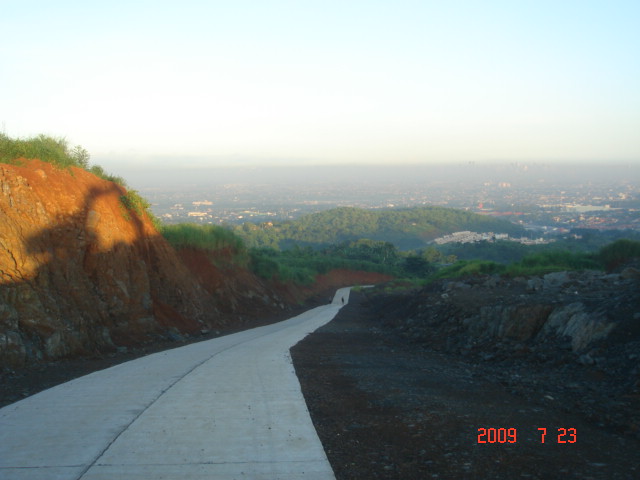
From Antipolo Overlooking Metro Manila
Thursday—Hill Workout in Antipolo in the early morning covering a period of 2 hours, a “group” run with Elite Team Bald Runner. Estimated distance: 16 kilometers
Friday—Tempo Run at ULTRA Oval Track. 20-minute slow run; 30-minute at race pace; and finished with a 20-minute slow run in the afternoon. Distance Covered: 12K
Saturday—Easy long run with a distance of 16K along the streets of Metro Manila in the morning.
Sunday—Run For M.E. 5K Race @ Ateneo de Manila University Campus. It was followed with an easy 5K run.
 Bald Runner
You must be logged in to post a comment.