On Media Launch, or Media Lunch?

22 08 2009

The first time that I attended a “media launching” of a running event was when I was personally invited by Jinoe of takbo.ph for the Kenny Roger’s Urbanite Run. I really enjoyed that scheduled meeting as it was done in the evening at the KR’s branch at SM Megamall and the fact that  most of the invited guests were the “runner-bloggers” and not one from the media sports reporters in daily broadsheets and tabloids. Although I was not impressed with the punctuality of  the presentation or briefing, I had a good time talking and exchanging ideas with the other “runner-bloggers”. It was in this event that I personally reminded the Race Organizers to “beef-up” the security services during the race as preventive measure for car thefts or “breaking-in” of parked cars of the runners. The reasoning that I presented was the fact that we had incidents of thefts during daytime races and there is a greater possibility of “bad things” to happen during nighttime. I am glad that the Race Organizers heeded to my “reminder” and so far, there were no reports of thefts or “break-ins” in parked cars during and after the race.

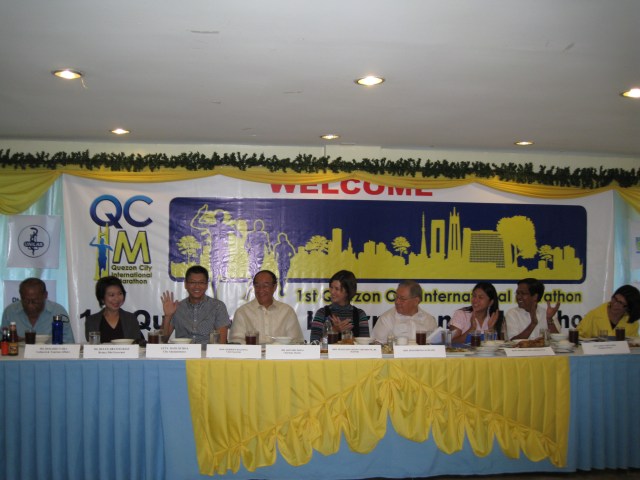
Two weeks ago, I received an e-mail inviting me to attend the media launching of the 1st Quezon City International Marathon. I fondly recalled that this was informally known by runners to be conducted on the first few months of this year. To be exact, it was supposed to be conducted for the month of February but for reasons I don’t know, it was rescheduled indefinitely. It was only when Rene Villarta aka JAZZRUNNER made a post in his blog that this race will push through in October of this year.

The media launching was scheduled at 8:00 AM of 18 August at Max’s Restaurant inside the Quezon City Circle Park and I was at the venue at 7:55 AM. I was the first registered “runner-blogger” and the first one to take a seat in a row of tables prepared for a lunch! Finally, the event started at 9:35 AM which was the time I was scheduled to meet another person within the vicinity of the venue. I was glad the person whom I was supposed to meet joined the event and was seated in my table. So, while I was listening to the speakers of the event, I was also talking to a writer and author of a book who wrote a history of the Bataan Death March. I guess, this is what they call “multi-tasking”.

So, what are the things that I have observed during the launching of the 1st QC International Marathon? To mention a few, the following were my observations:

1) Why do you have to set a “media launching” at 8:00 AM when most of the guests will arrive late and the food prepared was for a lunch? When will we ever learn to be punctual to a scheduled event?

2) This time, there were more media sports reporters than the “runner-bloggers” who attended the event. I can only count, at least, five (5) runner-bloggers as compared to almost 20 reporters & photographers. I think most of the “runner-bloggers” were in their offices or respective work.

3) It is my observation that these media sports reporters have “negative” impression on the capability of the Race Organizer to conduct a Marathon Event as big as this, based from the questions they presented during the Open Forum.

4) Most of the media sports reporters/photographers and other attendees were asking for “freebies” or pack of “freebies” to advertise the event from the Race Event Sponsors. It was nice to see those “personnel & staff” during the event who were wearing those “blue & yellow” 1st QC International Marathon T-shirts as they look to be the Route Marshals for the race. I did not intend to ask “freebies” for this event as I immediately left the place for another meeting after it was adjourned.

Media Launching of the 1st Quezon City International Marathon

Media Launching of the 1st Quezon City International Marathon

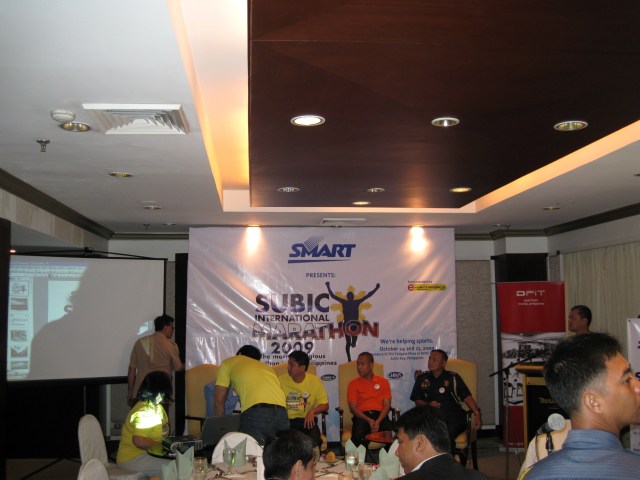
In the afternoon of this day (Tuesday), I received a txt message and an e-mail from the people of SMART inviting me to attend the “media launching” of the 2nd SMART Subic International Marathon (SIM) on the following day at 10:30 AM at Dusit Thani Hotel in Makati City.

I brought the two (2) coaches of the Elite Team Bald Runner with me for the said “media launching”. I was impressed! Arriving at the venue at exactly 10:30 AM, the Boardroom was already filled with lots of media reporters & guests and it seemed I was the one already late for the said event. In a few seconds, the program started and presentations were made about the conduct of the SMART Subic International Marathon.

What were the salient points and my observations during the “media launching” of the SMART Subic International Marathon? Many! And they are the following:

1) Most important, it was my first time to meet Tanya Lara of Philippine Star in person as I was seated next to her!

2) I finally met Chuck Crisanto and his wife, Joyce of Joy Rojas’ Takbong Pangarap’s Run Across America. Although, Chuck Crisanto sent me a very long Comment on this blog about his answer on the allegations from Mat Macabe about his actuations during the early part of Joy’s run, we discussed more about the condition of Joy Rojas during the run. How I wish I could post the Comment of Mr Chuck Crisanto on this blog but I will let him settle everything in the presence of Joy Rojas & Mat Macabe about their respective allegations to one another. I was surprised to see him and his wife here in the country as I know Joy Rojas and Mat Macabe are still running towards New York City. In the end, I had a nice time talking to the couple during our lunch.

3) It was an “eye-opener” for me when Mr Patrick “Pato” Gregorio of SMART SPORTS delivered his message on their Corporate’s “vision & mission” to help in realizing our country’s “first Gold Olympic” Medal and it is through this Marathon Event and other running events that SMART could be a great “catalyzer” and supporter in our Sports Excellence Program. I did not leave the hall not until I was personally introduced to Mr “Pato”. I hope SMART would also involve themselves in a “mass-based” running events just like what MILO is presently doing in order to discover “new talents” in Athletics.

4) The conduct of the SMART SIM is a partnership with the Philippine National Police in their advocacy to reform the police “scalawags” through running. I really appreciate the contributions made by Chief Superintendent Samuel Tucay, who is also a passionate runner, and considered as the driving force in this worthy advocacy of the PNP while he was in the active service, specifically when he was the Chief of the PNP’s Training Command.

5) I was able to meet the people behind the E-ventologists, Inc which is the Race Event Manager/Director of the Marathon Race. I have yet to find out a significant road race event that these people had handled in the past. As I left the Boardroom, one of the personnel of the Race Manager gave me 2 pieces of hand towel as part of the “freebies”.

SMART Subic International Marathon Launching At Dusit Thani Hotel

SMART Subic International Marathon Launching At Dusit Thani Hotel

Since I was not invited during the “media launching” of the Philippine International Marathon for Pasig River, I could not tell what really happened but based from posts I read among bloggers, I’ve gathered some negative feedbacks already like the route of the race (instead of a schematic drawing of the streets, the route was simply a list of streets where the runners will take) and others.

In these media launching or media lunch events as part in the marketing of Marathon or Road Races, the foods were great with lots of “freebies”. But sorry to say, I was not able to eat much and get as many “freebies” I would want. I just hope that such expenses or costs for these PR events will be charged to the different sponsors and not from the runners!

So, starting on the 11th of October up to 8th of November, a span of 4 weeks, our runners have a choice of four (4) Marathon Races, 3 Marathon Races in Metro Manila and 1 Marathon Race in Pampanga to Olongapo/Subic Freeport.

I will post a separate assessment and comparison of these Marathon Races in my future blog entry.

To all the runners, good luck and train well!


Lessons Learned: 33rd MILO 42K Elims

30 07 2009

This had been my third marathon race for the year and and I joined this race five weeks after participating in the 2009 Los Angeles Marathon. I did not expect a good finish time for this race ( sub-4 hours) as I knew I was not yet fully rested and recovered from my past marathon races and one ultramarathon race (BDM 102) since April of this year.

On hindsight,  I could see the following lesson learned which I kept on violating whenever there are major races and there are also good observations that I could maintain as a result of the race:

1) Easy Long Runs—Marathon race is an endurance running sports. A runner must be able to run a minimum of 32 kilometers in his/her long runs. Better yet if he/she could run the full distance of 26 miles/42 kilometers at least 3 weeks before marathon race day. I never had any long run (32K) as far as the said distance 2-3 weeks before the marathon as I concentrated in shorter distance and hill workouts. Those runs were not enough to develop the endurance capability of my leg muscles and this was the reason why I was already having “muscle cramps” before reaching the half-marathon point. As an advise, let your legs experience what it takes to run the distance (42K) no matter what is your pace is, the more time you keep your feet running on the ground, the better for you to survive in a marathon race. Remember, in a marathon race, the race starts on your last 10 kilometers before the finish line!

2) “All Running Shoes Are The Same”—There had been a lot of arguments about the appropriate shoes you should use in running for training and/or racing in a road race. For the “newbies”, they have to take advantage of the running specialty stores that we have right now in Metro Manila which have those “high-tech” stuffs that determine your own gait/stride/foot strike analysis. But for me as an “old” runner, I’ve been a consistent ASICS and New Balance Shoes user. Lately, I’ve been using the lighter racing shoes in my full marathon races and I did not have any problems.

3) Weather Affects One’s Performance—I have observed that running in colder countries improves one’s running performance. If you have plans of running a marathon in colder countries like United States, it is highly recommended to train in our country and allow some time to acclimatize at least one week or few days before race day on the locaton of the race. I am sure you will have a better marathon finish time if you run your race in colder countries.

4) Rest & Recovery—In the book, “Lore of Running” by Dr Tim Noakes, he is recommending to all serious runners to run at least one or two marathon races a year or one marathon race and one ultramarathon race per year which are spaced in between with rest and recovery before training. I guess, I have already violated this recommendation for this year. He also stated in the book that “the more you race frequently, you will never achieve the fastest time your body is capable of”.

5) Finally, I’ve accepted that my best in the marathon race is already past—I would never attain my best time of 3:30+hours when I was in my early 30s. However, my training preparation for my next marathon is geared towards a finish time of 3:45 hours or less. I hope I could make it to the Boston Marathon.


Buff: How To Look “Cool” In A 42K Race

7 07 2009

Buff Headwear @ MILO 42K Elimination Race/July 5, 2009: Part 2

It is the brand of a piece of cloth being used by ultra trail runners and runners/athletes participating in multi-stage races in the desert and snow.

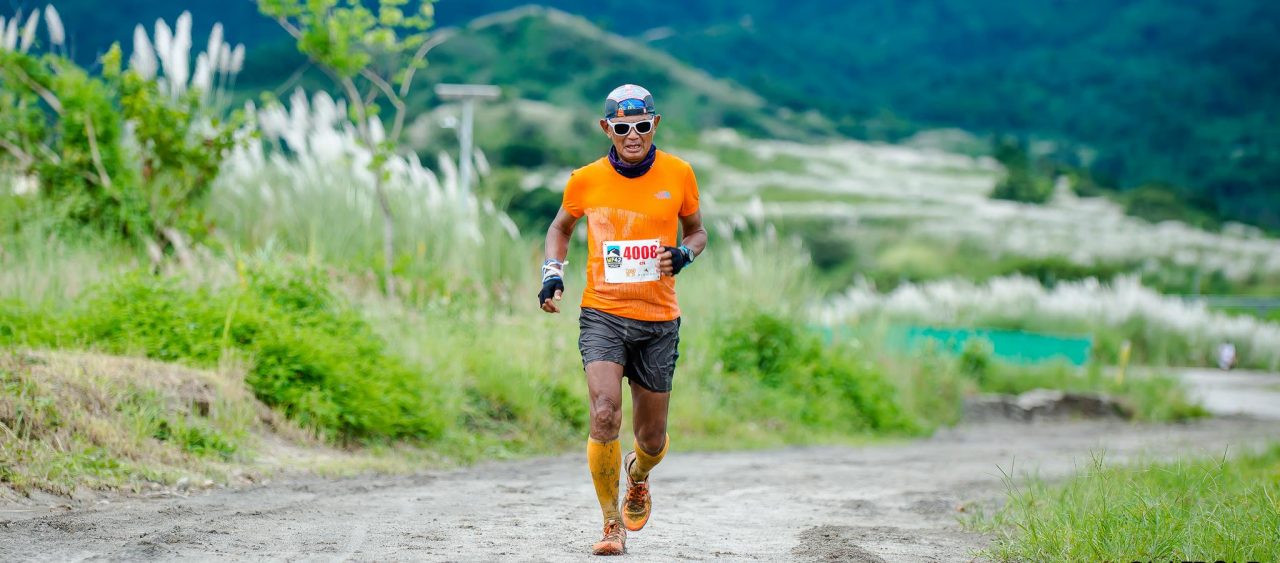
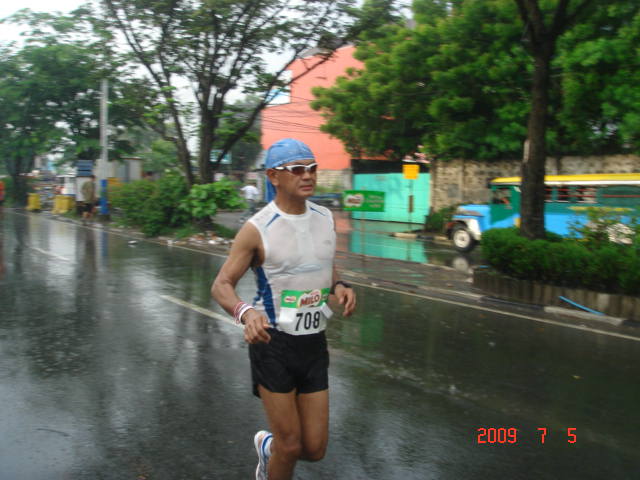
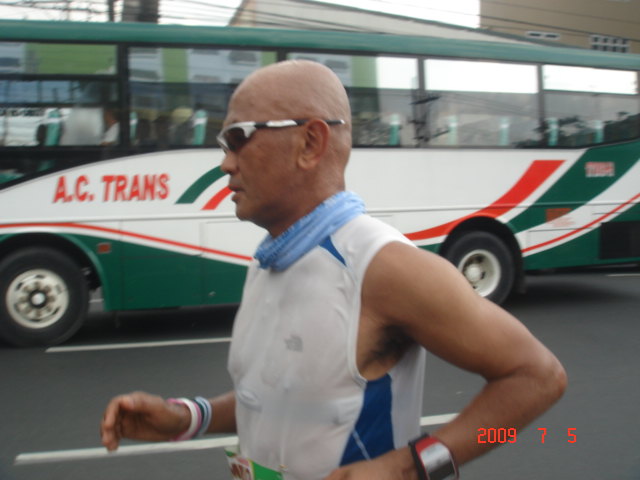
I bought two of this which are made of High UV ray protection “Coolmax” material and could be used in tropical countries like ours. In the MILO 42K Elimination Race, I used the blue colored Buff for testing in this particular race, thereby, replacing the bandanas and the bandana with crystals to cool off my nape. I used the Buff as depicted in the following pictures:

As a Headband to prevent my sweat flowing to my Eyes!

As a Headband to prevent my sweat flowing to my Eyes!

As A Runner's Cap...

As A Runner's Cap...

As A Bandana to Cool Off My Nape

As A Bandana to Cool Off My Nape

It can be used also as a baclava, ala-ninja cover to the face, a pirate’s cap, ear muff, hairband, wrist wrap and a bonnet. If I am not mistaken, I saw Albert Salazar aka Run2dmoon and Jael Wenceslao of Team Baldrunner-Professional Group wearing this kind of headgear in their marathon races and “runabouts” in Metro Manila.

I bought the said item at REI Store in Monrovia/Arcadia, California for $ 28.95 + tax.

Unfortunately, this Buff did not make me faster in this particular 42K race. But certainly, I look “cool & hip” using it.


Tendai “Marathon Monks”

13 06 2009

July Oconer, one of the Finishers and Sponsors of the 1st Bataan Death March 102K Ultramarathon Race, posted the following article in Facebook about the Tendai “Marathon Monks” of Japan. It is a nice reading item to runners and the reason why Japan is one of the top sources of marathon runners in the world.

Tendai Marathon Monks – The Run of A Lifetime

by James Davis – The London Observer

Some of the world’s best athletes gave a very good run for their money in the London Marathon, others picked up their appearance fee and pottered round without threatening to win. The world’s top distance runners are well rewarded – the best earn one million dollars a year – and they reckon to run only two or three marathons a year.

What a comparison that is to a group of men who can claim – though they never do – to be the greatest, toughest, most committed athletes in the world. They run for no other reward than spiritual enlightenment, hoping to help themselves along the path of Buddha towards a personal awakening. They are the so-called ‘marathon monks’ of Mount Hiei, Japan.

The monks, known as Kaihigyo, are spiritual athletes from the Tendai Sect of Buddhism, based at Mount Hiei, which overlooks the ancient capital city of Kyoto.

The ultimate achievement is the completion of the 1,000-day challenge, which must surely be the most demanding physical and mental challenge in the world. Forget ultra-marathons and so-called iron-man events, this endurance challenge surpasses all others.

Only 46 men have completed the 1,000-day challenge since 1885. It takes seven years to complete, as the monks must undergo other Buddhist training in meditation and calligraphy, and perform general duties within the temple.

The first 300 days are basic training, during which the monks run 40km per day for 100 consecutive days. In the fourth and fifth years they run 40km each day for 200 consecutive days. That’s more or less a full marathon every day for more than six months.

The final two years of the 1000-day challenge are even more daunting. In the sixth year they run 60km each day for 100 consecutive days and in the seventh year they run 84km each day for 100 consecutive days. This is the equivalent of running two Olympic marathons back-to-back every day for 100 days.

Author John Stevens, in his book, The Marathon Monks of Mount Hiei describes the running style which dates back over a thousand years. ‘Eyes focused about 100 feet ahead while moving in a steady rhythm, keeping the head level, the shoulders relaxed, the back straight, and the nose aligned with the navel.’

What makes all these distances even more amazing is the manner and the conditions in which the monks run. These runs are usually begun at night and are over mountain paths that are uneven and poorly marked. During the winter months the low temperatures and snow are a great hindrance to the runners. These monks do not wear the latest in footwear and clothing, but run in straw sandals, an all-white outfit and a straw hat. They also run on a diet of vegetables, tofu and miso soup, which modern athletes and nutritionists would deem to be unsuitable for endurance events.

Not only do they wear clothes and shoes unsuited to running, but they have to carry books with directions and mantras to chant, food to offer along the way, candles for illumination, as well as a sheathed knife and a rope, known as the ‘cord of death’. These remind the monk of his duty to take his life if he fails, by hanging or self-disembowelment. The course is littered with unmarked graves, marking the spot where monks have taken their own lives. However, there have been no cases of monks’ suicides since the nineteenth century.

During these long runs the monks must make stops at temples of worship that can number up to 260. This means that the 86km run can take up to 20 hours to complete leaving the monk with very little time for recovery or rest, but as an old saying goes: ‘Ten minutes’ sleep for a marathon monk is worth five hours of ordinary rest.’ They also learn to rest sections of their body while running, such as their arms or shoulders.

And then there is the doiri, where the monk faces seven days without food, water or sleep or rest. During this time the monk will spend his entire day reciting Buddhist chants and mantras – perhaps up to 100,000 each day. The only time the monk will leave the temple is at 2am to walk the 200m to a well and return with water to make an offering. He is not allowed to drink any himself and the 200m walk can take up to two hours in the final days of the fast. During his time spent meditating there are two monks who are in constant attention to ensure that he does not fall asleep.

For several weeks before doiri, the monk will reduce his food intake so his body can cope with the fast. The first day is no problem, but there is some nausea on the second and third days. By the fourth and fifth days the hunger pangs have disappeared, but the monk has become so dehydrated that there is no saliva in his mouth and he will begin to taste blood.

The purpose of doiri is to bring the monk face-to-face with death. During this fast, the monks develop extraordinary powers of sense. They talk of being able to hear the ashes of incense sticks fall to the ground and, perhaps unsurprisingly, of the ability to smell food being prepared miles away.

Physiologists, who have examined the monks after conclusion of the rite, find many of the symptoms of a ‘dead person’. Monks talk of experiencing a feeling of transparency where everything good, bad and neutral leaves their body and existence in itself is revealed in crystal clarity. Relatives of those who undergo this rite of passage talk of the difference that the seven days makes to those who undergo it. One remarked, ‘I always dismissed Buddhism as superstitious nonsense until I saw my brother step out of Myo-o-do [the name of the temple] after doiri. He was really a living Buddha.’

When the Japanese Emperor maintained his court in Kyoto, the monks were afforded a special thanksgiving service in the Imperial Palace after completing their 1,000-day term and the ‘marathon monks’ were the only people who were allowed to wear footwear in the presence of the Emperor.

Even today thousands will turn out to watch a monk nearing completion of a 1,000-day term, as he runs the old course that now passes through Kyoto’s shopping streets and the entertainment district, complete with its bars, restaurants and strip joints. Many turn up hoping to be blessed by these special monks whom they believe have powers to heal.

Japan has the largest number of marathon runners per capita in the world. From the Arctic northern island of Hokkaido to the balmy tropical islands of Okinawa in the Pacific, each and every town will organise a number of long-distance runs and each school will have a strong running club.

There is even a corporate-sponsored running league, whose teams are even allowed to have one foreigner in their team. Jeff Schiebler, a Canadian Olympic runner, is the only non-African foreigner who competes. He described what it is like to run in Japan. ‘It is totally different from anything in North America. They have multimillion-dollar contracts, team chefs, great training facilities. That kind of thing makes Japan a power in long-distance running. They go mad for road races. Kids there grow up wanting to be the next marathon champ.’

Japan’s love of marathon running was epitomised with the incredible outpouring of emotion that followed Naoko Takahashi’s victory in the women’s Olympic marathon in Sydney last year. The race and the prize-giving attracted a massive 84 per cent TV rating as the fresh-faced girl from the mountains of Gifu became the first Japanese woman to win an Olympic gold medal.

She became an overnight superstar and her face was splashed across newspapers, magazines and on talk shows. She even received The People’s Honour (only the third woman ever to do so) from the then prime minister Yoshiro Mori, who said: ‘You have given inspiration and encouragement to youngsters as well as a whole people by crossing the finish line with a refreshing smile.’

Very few runners will cross the finish line in London with a ‘refreshing smile’ after 26 hard miles. Grimaces of exhaustion and relief will be a more common sight. However, after looking back at the 26 miles and a bit, there will be a feeling of great personal pride and achievement in their performance. Many will have achieved personal best times and others will have raised hundreds of pounds for charity. But will many of them be able to say they have gained something spiritually, as with the ‘marathon monks’ of Japan?

No Sweat @ LA Marathon!

26 05 2009

This is just the latest update about my personal time as I finished the XXIV LA Marathon.

I finished with a time of 4:07:33 hours. I placed # 1,902Overall out of 14,185 Finishers. Not bad!

I placed # 1,630 out of the 9,011Male Finishers.

I placed # 47 out of 394 finishers in my age category for 55-59 years old.

Race Report and Pictures to follow. I have to eat and hydrate first.


Manila International Marathon?

7 05 2009

One of the members of the Team Bald Runner-Professional Group had asked me why is it that the Philippines does not have an international marathon race which could be at par with the Standard Chartered Bank-sponsored ASEAN city’s marathon races like Kuala Lumpur, Singapore, Hongkong, Mumbai, Hanoi, Taipeh/Taiwan and other cities around us which are considered as international marathon events?

I answered him that there was a Manila International Marathon during the late 70s and early 80s which was sponsored by the Philippine Air Lines (PAL). I could just surmised that marathon races and running events with international flavor then were supported by the government during the administration of former President Ferdinand Marcos. It was during these times when the government’s sports bodies were held and administered by a single person who was under the direct supervision of the President. It was the time when Michael Keon was the President of the Philippine Olympic Committee, and at the same time the Chairman and Project Director of Project Gintong Alay (the forerunner of the Philippine Sports Commission), and also the President of the Philippine Amateur Track and Field Association, the sports federation for athletics. A single person holding three sports bodies, a long-distance runner and national athlete and a nephew of the President made the difference at that time.  At present, these sports bodies are being held by three different persons whom I think could not even run or jog at least one kilometer. These people are fond of asking sports reporters to “run” after them for sports media realeases with the “envelope” that goes with such pronouncements.

The one who asked me about the Manila International Marathon was surprised when I informed him that the Awarding Ceremonies and Dinner Parties for the Manila International Marathons were held at the Malacanang Palace with no less than the President as the Guest of Honor and Host. Moreso, the prize money for the winners ranged to hundreds of pesos at that time plus the appearance money for the world’s marathon elite athletes.

It was expected that sports and marathon races in the country with the attendance of international elite runners waned after the EDSA Revolution in 1986 because everything that the former administration had done for the improvement of our sports were immediately changed. However, later during the administration of former President Fidel Ramos, the Pasig River Heritage Marathon was born but it did not have any attendance from international elite athletes. And due to the abolition of the Clean and Green Foundation that manages the Pasig River Marathon, the conduct of the race was not sure of being conducted. However,  this yearly marathon is hoped to be revived later part of this year. But the problem is, it will remain as an ordinary local marathon race in the country without any effort of making it as an international running event.

The Subic International Marathon which was held last January 2008 was attended by Kenyan/African runners which gave a flavor of being an international marathon event but it fell short of its aim of being sustained as an annual international marathon event.

So, is there a way we can come up with a Manila Internationa Marathon Race? This is a challenge to those politicians, government sports bodies, and corporate executives who are active in sports like running. Maybe we can ask for those “Presidentiables” who can not even run at least one kilometer but they could easily run for the position of the President of the Republic without any sweat. Maybe, we can ask the Department of Tourism to promote such event as part of sports tourism in the country. Or maybe, ask PAGCOR/PCSO to fund such event. Or maybe, come up with a “pressure” group to ask the President to appropriate a budget from her VAT collections or from the President’s P 300-billion stimulus fund or from her Priority Development Assistance Fund (Please refer in today’s newspapers). But with my personal experience with these people, I am sure they don’t care about this “International Marathon” thing. My best bet is to wait for CONDURA and the Concepcion Family to come up with an international marathon event, maybe, by next year! 

Let me ask this last question…Why do we need to go abroad to run a Marathon Race if we can conduct an international marathon race here in the country? Is it for the “bragging rights” or you just want to spend your hard-earned money or want/need something to write in your running blog or you need something to write about in Society Pages in our daily newspapers or is it for the experience so that you could learn something on how race directors and organizers do to promote a world-class marathon event? Maybe, as a start, we can pool our respective registration fees, travel and accommodation expenses to an international marathon abroad as a “seed” money for planning purposes. Let the first volunteer come forward and leave a comment in this post.

I have the following recommended title for our future Manila International Marathon. Choose which one do you prefer….

Standard Chartered Bank Manila International Marathon?

Banco De Oro Manila International Marathon?

Bank of the Philippine Islands Manila International Marathon?

Globe Manila International Marathon?

Smart Manila International Marathon?

PLDT Manila International Marathon?

Cebu Pacific Manila International Marathon?

PAL Manila International Marathon?

Zest Air Manila International Marathon?

Figaro’s Manila International Marathon?

SM Manila International Marathon?

“Wowowee” Manila International Marathon?

Manny Pacquiao’s Manila International Marathon?

ABS-CBN/TFC Manila International Marathon?

Jollibee Manila International Marathon?

San Miguel Beer Manila International Marathon?

Vicky Belo’s Manila International Marathon?

“Witwoteryuno” Manila International Marathon?

CONDURA Manila International Marathon?

Gawad Kalinga Manila International Marathon?

MMDA’s Manila International Marathon?

Toyota’s Manila International Marathon?

Honda’s Manila International Marathon?

Mini-Stop’s Manila International Marathon?

Ford’s Manila International Marathon?

BENCH Manila International Marathon?

Guys, the challenge to come up with a Manila International Marathon, which will ultimately become our Country’s Pride, is in your hands. I’ve done my part to promote and conduct the 1st Bataan Death March 102K Ultramarathon Race and I did it with the support of “82 new brave warriors” of Bataan, those “angels wearing running shoes” and “supporters” who remain to be silent and don’t want to be identified. And this will be a yearly event to commemorate our heroes.

“There is Unity in Sports”

P.S.

When I joined the 2008 San Francisco Marathon last August, the EMCEE during the race’s awarding ceremony announced that the marathon event was able to raise Five Million Dollars ($ 5M) for the past five years to support the different “causes” and benefits that the City of San Francisco had been actively supporting. Now, you do your own mathematics!


95 Days: Bald Runner’s Top Posts

31 12 2008

The following posts are the top seven (7) ranked stories that got the most number of hits by my readers/visitors:

1) Running Shoes Review: ASICS Gel-Kinsei 2—I posted this article last 24 April 2008 and it got 7,320 views/hits as of the present. I am stil using the said shoe during my “long runs” and “runabouts”  but I have used it only once in a 10K road race. It is the “heaviest” pair of running shoes I am using but it is also the “most comfortable” shoes!

2) Bald Runner—It is the first Page I created with the blog describing me and lately added a list of my road/trail runs & races in it since I created this blog. It got 3,334 hits/view with this page.

3) Road Races—This is the second Page I created where I posted the races I intend to participate/compete. It got 2,961 hits/views.

4) Results: 2008 Women’s Olympic Marathon—I was fascinated to see Constantina Tomescu-Dita of Romania, live on TV, on her last 5 miles to the Finish Line. She is now the oldest Marathon Champion in the history of the Olympic Games at the age of 38 years old. She finished the 2008 Beijing Women’s Olympic Marathon in 2:26:44 hours. This post got 2,238 hits/views.

5) 2008 Olympic Games & Philippine Sports—In this post, I stated that there are thirty-three (33) sports events in the 2008 Beijing Olympic Games and out of these sports events, Athletics (Track & Field) has a total of 47 competitive events or gold medal chances for each country to qualify and compete. Since “Athletics” has the most number of gold medal chances for the country, nobody answered my question as to what Sports Event does the Philippines should concentrate in developing and training our athletes so that we have a greater chance of winning our first Olympic Gold Medal. This post got 1,815 hits/views.

6) My Running Idols in the ’80s—Before the Kenyans and the Ethiopians started winning Marathon Races in the 90s and never been featured in cover pages of Runner’s World Magazine, I had the US, Australian, New Zealand, Japanese, and British marathon runners as my idols, each of whom were featured in cover pages in almost all running magazines in the world. Today, instead of featuring the famous African runners on the cover of runner’s magazines, you could see unknown, beautiful, and American women runners on their covers. This post got 1,505 hits/views.

7) Olympic Games Qualifying Standards For Track & Field Events—I suspect that future Olympic athletes, here and from other countries, click on this post as their source of reference. The elite members of Team Bald Runner are closely checking on the qualifying standards for the 1,500-meter, 3,000 Steeplechase, 5,000-meter, 10,000-meter, Marathon (Men’s & Women’s), and race walking events. This post has 1,486 hits/views.

Once again, I would like to emphasize to my readers that this blog is a journal of my running workouts and races and sharing the knowledge on running from what I read and the experiences I got from other runners. My critique and “lessons learned” from road races will also be maintained. I make posts about my reviews to running attires and running shoes but it doesn’t mean that I advertise them. I never advertise any running apparel or running shoes or any item related to running in this blog. This blog does not announce or advertise future road races in my posts except for ultramarathon races. Takbo.ph and the other Pinoy Runner’s Blogs are posting such road race schedule.

Simply said, this blog is about running seriously—competing with yourself to improve & attain your goal…and competing with the digital clock at the Finish Line…and testing the limits of one’s endurance!

Happy New Year To Everybody!!!


Marathon Finish Time Challenge

11 12 2008

Is there anybody from the Pinoy Runners who ran the Singapore Marathon who was able to beat my MILO National Finals finish time of 3:48:32 hours? Please leave a comment and your Team Bald Runner T-Shirt and 2009 Wall Calendar will be given to you.


To Pinoy Runners In Singapore: Recovery Begins After Crossing The Finish Line

6 12 2008

I am sure you will be doing some of these predictable actions once you cross the finish line of your marathon race:

Crying. You will be crying because of the pain and soreness of your legs; you are crying because that is how you express happiness for finishing the marathon after months of training and your tears are the “tears of joy”; or you are crying because you could have done the race at a faster time; or you are crying because you survived and finished the race.

Drinking anything, from water to sports drinks to beer!

Eating anything you can see after the finish line.

Laughing or Smiling for the Cameras (courtesy of Marathon Photos)

Lying down and taking a nap as if you want to be brought to the hospital immediately

Promise to yourself never run again a marathon distance

Throwing Up

Removing your wet shoes and socks to find out if you have blisters

Exchange stories to your running mates while your sweat is dripping

Text your friends and relatives in the Philippines

Look for running mates and friends for photo-ops with the Finish Line as the background

Go back to the Hotel Room to Post Your Race Report in Your Blog

Go back to your hotel room, take a shower and sleep

Meet with running mates and friends in a restaurant and eat as if it is your last meal.

To have a faster and better recovery, the following are the recommended things to do after crossing the Finish Line:

1) Walk as soon as you cross the Finish Line. Get your medal and/or certificate of finish; grab some bottled water and sports drinks and GU sports gel.

2) Rehydrate immediately by drinking as much water and sports drinks as you can. Your gauge or indicator of how much would you drink is approximately the loss of body weight after the race. If the color of your urine is yellowish, it means you need more water. Continue rehydrating until such time that your urine is almost colorless. Continue moving or walking while rehydrating.

3) Refuel immediately by eating food rich in carbohydrate like bagel, bread, fresh fruits, chocolates, bananas, pretzels, and other foods available after the finish line. You can take also some GU sports gel for your muscle recovery. Continue moving or walking while refueling or eating. Such walking should last from 15-20 minutes.

4) Change your wet running kit to warm clothes to prevent your wet attire from drying with your body.

5) Remove your shoes and socks and check for blisters and toenails. Have your blisters or any foot injury treated immediately by medical personnel at the finish area. Use a more comfortable sandals to relieve your feet from your running shoes. Still keep on moving and walking.

6) Do some stretching to loosen your leg muscles and body. If there is free massage at the finish line area, take advantage of this offer in order to loosen some more of your tired muscles. After stretching and massage, look for your friends and hang around with them and celebrate. You can now txt or call your friends while stretching or talking to your friends. If you plan to meet with your running mates and friends in one of the restaurants to have more refueling and rehydrating, you can do it immediately after your stretching and/or massage

7) Once you reach your hotel room or home, force yourself to have a shower. Experience-wise, a cold shower or bath would be better than a hot shower. Studies show that a cold shower will prevent/control “bleeding caused by micro-tears” in our muscles after heavy workouts/strenuous activities  like running a marathon distance. After a cold shower, wrap your body with the hotel’s bathrobe or wear something that is made of cotton.

8) Elevate your legs if you decide to take a nap or sleep after your shower. While blogging (if you are using your laptop or notebook or blackberry), you can still elevate your legs.

9) After 4-6 hours of sleep or rest, you can do a “shake-out run/shake-out walk” which is a short run/walk that you take the afternoon or evening after a morning race. Run or walk anywhere from 10 to 20 minutes and no more than that.

10) Continue refueling and rehydrating during your dinner. Sleep at least 8 hours on the night after the marathon race. If you have a hard time getting to sleep, get the services of a professional masseur.

11) On the following day after the marathon, jog at least 30 minutes for your “active recovery”. This will accelerate the time of recovery for your tired leg muscles.

12) If you are presently undergoing the “speed training” of Team Bald Runner at the ULTRA Oval Track, report to your coaches for next Tuesday’s speed workout.

Note: If you decide to run your next marathon race in the future and want to improve your finish time, please visit www.teambaldrunner.wordpress.com and register your name, age, and e-mail address in the comments section to become a member of Team Bald Runner and our coaches will provide you with your next marathon training program.


Tips For Pinoys Running The Singapore Marathon

2 12 2008

Tips For Pinoys Running The Singapore/Macau Marathon

1)      Think Positive—After training for so many months, you are going to Singapore for the sole purpose of running the 2008 Standard Chartered Singapore Marathon and your goal is to finish it. Whether it is your first marathon or not, you must come home with you the bragging rights that you have finished the marathon distance, an international marathon race at that. You should think as a “warrior” who have trained; honed his skills; developed a strategy; and have the desire to win the battle. Remember, the enemy here is yourself and the route. Don’t be pressured by the other runners as they might ruin your established and planned strategy and your desire to finish the race..

2)      Stick to Your Race Strategy—If you have trained in your long steady runs for a faster first half than the last half of the full distance you ran, then you are doing a “positive-split” and if you are comfortable doing this kind of strategy, then do it. However, if you are slow starter with a slow pace on the first half and you get faster on the last half of the distance, then go for a “negative-split”. But mostly, I recommend the even-pace strategy basing from my past experience running the marathon distance. Knowing your training “average pace”, you have to stick to such pace, plus or minus 15-30 seconds. The other variation of the even-pace strategy is to be able to divide the marathon distance into segments like every 10 kilometers—making the distance into 4 segments with every segment being designated with a time to finish it. For example, if you are running an average pace of 5:30 mins/km, you should be able to reach the 10-K mark within 55 minutes or less; you should be able to reach the 20-K mark within 1:50:00 hrs, and so forth up to the 40-K mark. If you want to divide the marathon distance to 5K segments, you can do it, too! But be sure to to reach such distance within the time you have planned.

3)      Stick to your training “routine”—You should be able to stick to your training and pre-race “routine” here in the Philippines. We will start with your running kit/apparel. Be sure that you had been using your running kit (shorts, singlet, running shoes, sunglasses, Ipod, visor/cap, etc) during your training and previous road races. Remember, you are going to Singapore to run & finish the marathon, not as a Fashion Model and/or Elite Runner sponsored by a Shoe & Sports Apparel Corporation! It should be a part of your morning pre-race routine to have your BM (Bowel Movement). Drink something “hot”—coffee, tea, milk, or chocolate so that your digestive system will force your waste to come out! I’ve been doing this during my entire life where a BM done once I wake up gives me a “non-stress” day ahead of me. After taking your crap, take a shower to make you cooler and more relaxed. Wear your running kit making sure to put/apply petroleum jelly or Body Glide on your groin area and upper arms (& nipples, for men) where chafings usually occur. If you are staying in a Hotel with a free breakfast, forget your buffet breakfast and stick to your “pre-race routine” or else you will have some problems along the way. You will have the time to eat a lot after the race. This is what I eat for breakfast before marathon races. I usually eat one serving pack of instant Quaker Oatmeal mixed with hot water; one boiled banana or ripe banana; one hard-boiled egg with little salt; and one cup of Ensure. Don’t forget to drink water while on your way to the Starting Area.

4)      Stay “light”—Wear a running kit that is light—light shoes & socks (that is your training or racing shoes & socks you had been using in past road races!) and light shorts & singlet. Leave your water belt behind. You are running in a “First World” country and I am sure the water stations are filled with “clean” water and sports drinks! I suggest you leave also your Ipod, cellphone, and camera in your room or car. These are additional weights to your body while running.

5)      Sports Gel & Sports Bar—With my past experience in ultramarathon, marathon and trail running, I value the presence of sports gel or “GU” and/or sports bar inside my shorts’ pocket. My son and daughter, John & Jovelle, taught me a technique on how to carry at least four (4) pieces of “GU” while running. You can follow the following steps—(1) Punch a hole on the uppermost part of the packet, (2) Insert or tie a rubber band on the hole, and then (3) Insert your hand on the rubber band with the band staying on your wrist. The tied “GU” should either be dangling on your wrist but I suggest you should hold the “GU” with the palm of your hand while running. If you want to drink water, just release the “GU” from your hands and let it dangle on your wrist while you are holding your drinking cup. I usually take in one (1) “GU” (my first) at least 10 minutes before the start. I take my 2nd GU at the 11-K mark; my 3rd GU at the 22-K mark; and my last at the 32-K mark. Eat the only Power Bar on your shorts’ pocket after taking in your last GU. These will give you the much-needed strength on your last 10K of the race. (Note: If you have time, buy “ROCTANE” by GU. It gives more energy than the ordinary GU as this is designed for ultramarathoners. It has more caffeine in it and it costs more!!!)

dsc04731

6)      Water & Sports Drinks—Take a sip or two of water in every water station (without walking while drinking). You should be able to slow down your pace (but still running) when you pick up your water cup and be able to drink the water while running. I know that the Singapore Marathon will have a very long table where water and sports drinks will be available. If the water cup is being handed to you by the volunteers, it would be better to make a signal (look into the eyes of the volunteer) and lift your arm/hand towards the cup. Before reaching the 30-K mark, you should start drinking Gatorade or any sports drinks for the replacement of your electrolytes. Remember, take a sip or two of water in every water station along the route.

7)      Muscle Cramps—If you feel you have the tendency to have muscle cramps on your legs, slow down with your pace and keep on running in a relax manner. If you have muscle cramps during the race, that means you lack the mileage in your training and distance for your long steady runs. It also means that there is tightness in your leg muscles. Make sure that you had your massage at least 2 days before the marathon race. If you could have experienced running at least 42K in your long steady runs or “runabouts” in your marathon preparations, you could have determined or tested if you have the tendency to have muscle cramps. Elite runners are silent and keep this their “secret”—they run at least 50K during their long steady runs! As I said, nobody is preventing you from running the marathon distance during your long runs. “Think out of the box” or better yet, “remove the box” entirely!

8)      “Speed Training” Tips—After two weeks of speed training with the coaches of Team Bald Runner, the voice of Coach Salazar keeps on reminding me his tips which I haven’t encountered in running books and magazines and these are very basic. His constant reminders are—“run along a straight line” ( if a runner gains at least one inch every stride if he/she runs a straight line and if one stride is equivalent to one meter; a runner, at least, gains a distance of 42,165 inches for the whole marathon distance which is equivalent to 1,071 meters, that’s one kilometer, making you faster by more than 5 minutes; stay “light” on your footstrike using your midfoot ( you should be able to minimize the “heavy” sound of your footstrike with the ground while landing on your midfoot); establish and maintain a cadence of your stride ( I usually count 1-20 or up to 50, repeatedly, every 4 steps or simply play in your mind repeatedly, the words “New PR” or “Sub-4 Finish” as your running mantra; and take a direct route on curves and winding roads (your eyes should be set towards the shortest route along the road). There are other “reminders” or terms from Coach Salazar which could be explained better by him like “clawing”, “pawing”, “volting”, “braking action”, and others if you decide to attend our speed training.

9)      Always look forward and maintain a relaxed running form—After running 20-25 kms, I have the tendency to experience some muscle cramps on my core muscles and legs if I try to turn my body/head to look on the runners beside me or on my back who are tailing me. During the Pasig River Heritage Marathon last February 2008, I experienced this situation as I turned my body looking at runners beside me and those on my back. It is hard to visualize how the body would be seen with the body moving forward while my upper torso would be turning to the right or left or even a more than 90 degree-angle turn towards the back while running. If I do these unnecessary movements, muscle cramps would occur. Since then, I see to it that I run without turning my body or my head and maintain a straight-look ahead of me.

To all the runners participating the Singapore Marathon and Macau Marathon, good luck and have a safe trip. I might not be able to watch you on the TV or monitor the webcast of this event on the Internet but I wish you a nice, enjoyable and memorable international marathon race. On this day, I might not be watching the DL Hoya-Pacquioa Fight but I will try to find out if NHK of TV Japan will be featuring a live telecast of the Fukuoka Marathon. By the way, if you have a chance to shop, buy your copy of the book, “Run Faster” by Brad Hudson.


Follow

Get every new post delivered to your Inbox.

Join 1,116 other followers