Things To Be Done After Marathon Race

1.  Cool-down and make your usual stretching exercises slowly as your muscles are still sore.

2.  Drink a lot of water/liquids.

3.  Take a cold shower, not a warm one. Studies had proven that cold shower would make the muscles more relaxed.

4.  Eat carbohydrates and “hot meal” with soup. My favorite after a race/run is a “Mami Noodle Soup with Beef Briskets & Tendons” at Causeway Restaurant (C-5, near Jollibee Green Meadows) coupled with “Lychees w/ Almonds in Sweet Syrup & Ice” as dessert. Don’t forget to bring with you your “support team” to this occassion.

5.  Sleep early at night and take some more time to rest with your sore legs elevated. Remember the word R-I-C-E to treat muscle soreness/injuries—Rest, Ice, Compression (Massage), & Elevate.

6.  Let your muscle sores/pains treat itself. I don’t recommend pain relief medications to solve this problem.

7.  Keep on moving when not in rest or in bed.

8.  Start to take a long walk on the second day after the marathon race.

9.  Evaluate your running performance.

10.  Take a vacation and relax with your family.

11.  Give thanks to the Lord for finishing the race without any injury or problems.

12.  Reward yourself with something…maybe, a new running shoes, a new running attire, Ipod, DVD movie, or something that will remind you on finishing the Marathon Race.

P.S. I should had posted this immediately after the marathon race. Sorry, guys! However, you can still follow my recommendations #5 to #12.               

D-Day: 2008 Pasig River Marathon

24 February 2008

Yesterday morning, I went to Marikina Riverbank to familiarize myself with the route of the Pasig River Marathon. I happened to meet a certain “Robert” who was wearing a runner’s attire and looks like a seasoned runner at the Marikina Riverbank. He happens to be a regular runner of the Pasig River Marathon for the past seven years and we talked for awhile. He noticed that I was coughing while I was talking to him and he tried to tell me that it will be a hard and difficult situation for me to finish the marathon with my condition. I just smiled and he later oriented me with the starting area and the route.

Knowing the route, except for the Mandaluyong-Sta Mesa-Pandacan area, I immediately took some of my medications and was able to rest the whole afternoon of Saturday and slept early at 8:00 PM. I woke up at 2:00 AM, took a shower, shaved, had my last “crap”, ate oatmeal, applied petroleum jelly on my inner thighs/feet/inner part of my upper arms/below my armpits and wore my running attire. At 3:00 AM, I was already on my way to Marikina Riverbank.

The race program started at 3:30 AM and the race started on time at 4:00 AM. Nobody among the runners were paying attention to the remarks/speeches of the VIPs on the stage except for the singing of the National Anthem. In my estimate, there were about 1,500-2,000 runners for the 42K to include members of the Philippine National Police and the Armed Forces of the Philippines.

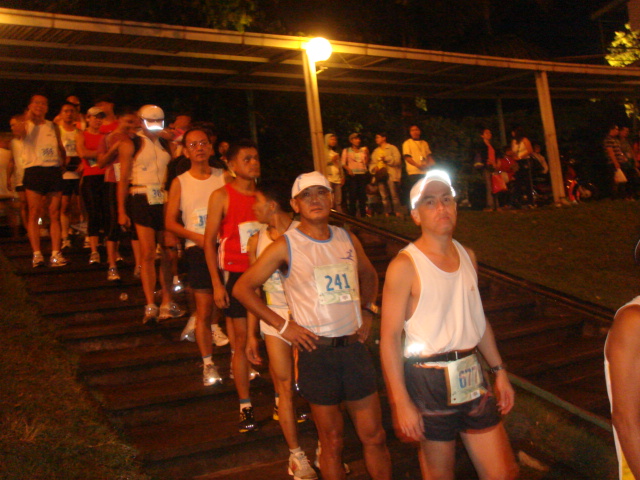
 dsc00487.jpg

Getting in line for the check-in before runners could enter the starting area. It took at least 30 minutes for marshalls to mark all the runners. Runners were lined up while the race program was on-going. 

 dsc00498.jpg

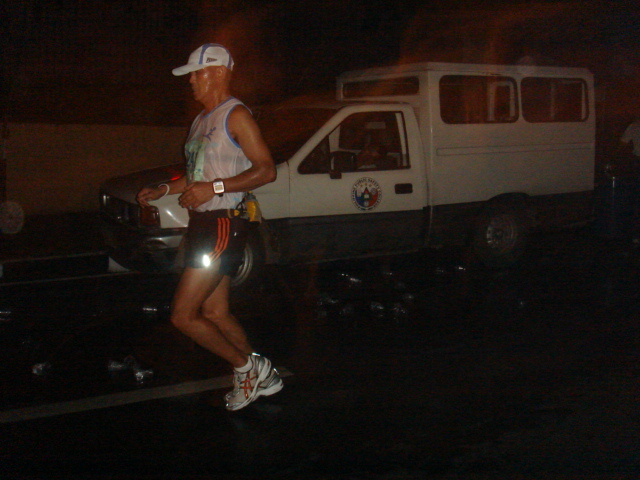
I thought I started very slow on the first 10 kilometers but when I reached the 20 kilometer mark, I was surprised to see that my GF 305 registered a time of 2 hours! I was running too fast, contrary to my final plan of running conservatively. There was no way I could see what was going on with my GF 305 because it was still dark and there was no bright light/lamp post along the route.

dsc00500.jpg

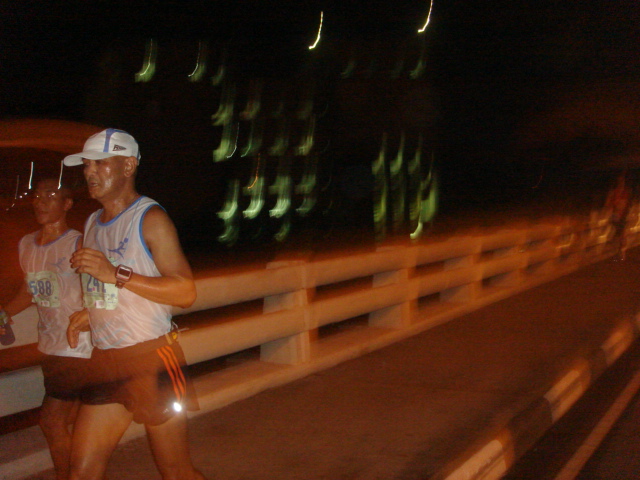
A fast pace at the C-5 Bridge, near Kalayaan Avenue where my staff had a problem getting a better picture of me while it was dark!

dsc00517.jpg

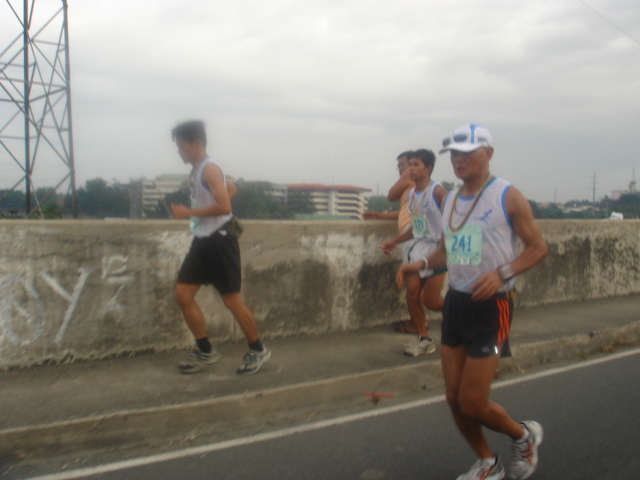
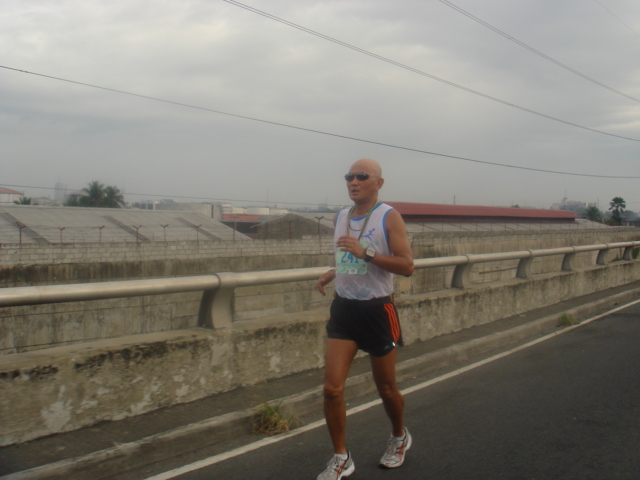
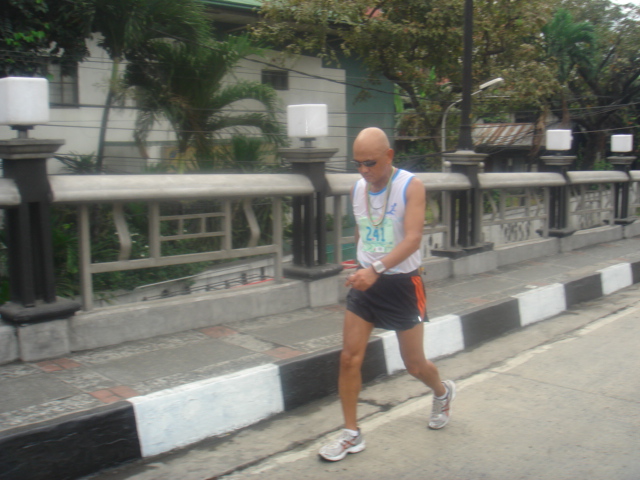
Crossing one of the bridges in Mandaluyong

dsc00525.jpg

I need to “shuffle” and take little steps just to prevent my legs from getting cramps!

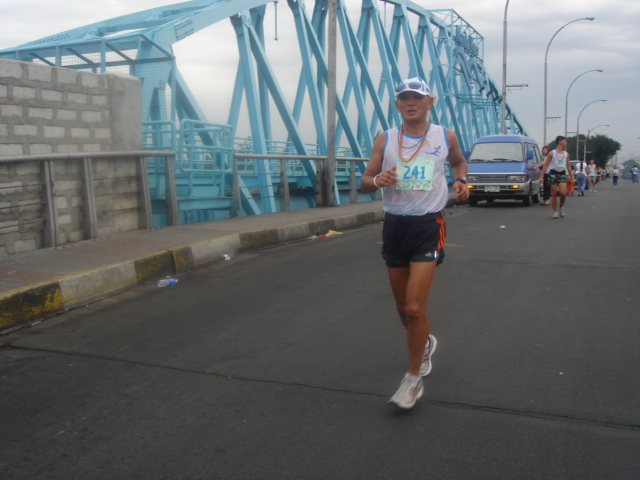
dsc00528.jpg

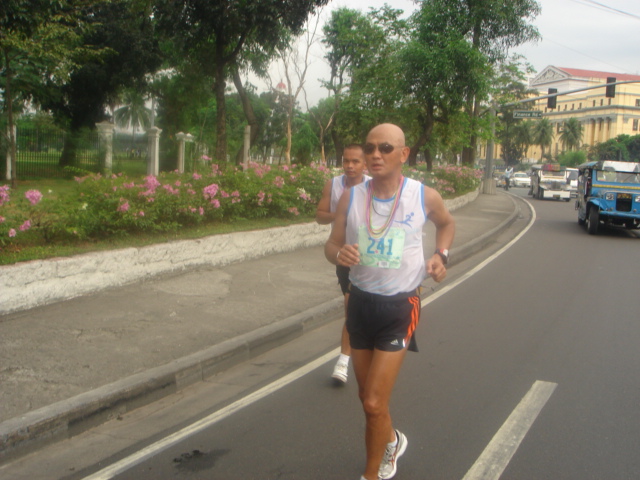
One of my security men recommended me to wear my runner’s cap while passing at the squatters area in Mandaluyong and Sta Mesa for security reasons. Once I was already at the Nagtahan Bridge, I removed my cap and wore my sunglasses!

dsc00531.jpg

And then I had to walk briskly as I was about to experience “cramps” on my both legs (calves & hamstrings). I started to experience muscle cramps at Km # 36!

dsc00536.jpg

At last, I could see Manila Hotel from this point and I knew I could finish the race.

dsc00539.jpg

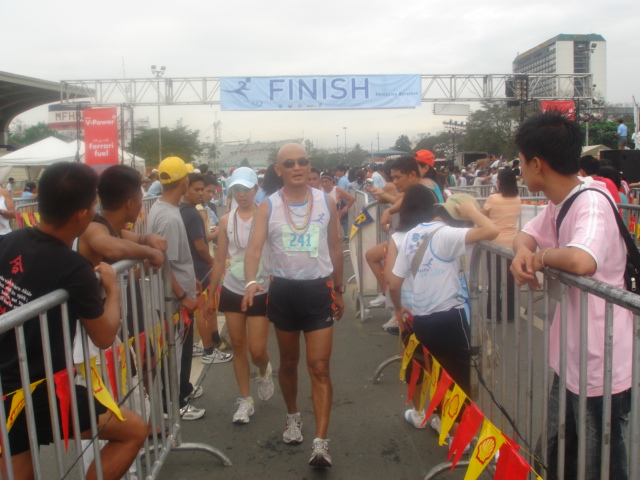
Every runner should smile after passing the finish line. Before passing the Finish Line, I heard some of the runners in the audience shouting “BALD RUNNER”. One of the marshalls at the finish line told me that she is a regular reader of my blog.

dsc00542.jpg

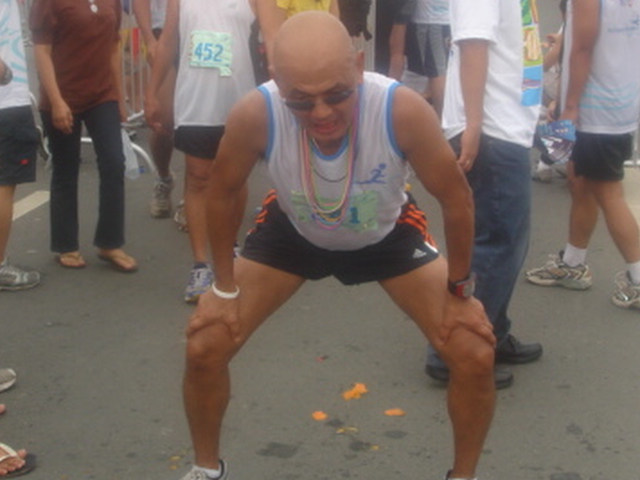
The Bald Runner trying to copy the picture of Lance Armstrong after finishing the 2007 New York Marathon!..Ha! Ha! Ha!

4:49:48 Hours @ 2008 Pasig River Marathon

24 February 2008 (4:00 AM-8:49 AM)

Yes, I finished the 2008 Pasig River Marathon in 4:49:48 hours (unofficial time) without any injury or any problems. Surprisingly, I did not have any coughing along the way, from start to finish!

The following data were taken from my GF 305:

Distance—42.6 kilometers           Average Pace—6:48 minutes/kilometer

Average Speed—8.8 km/hr         Maximum Speed—13.6 km/hr

Average HR—155 bpm                Maximum HR—165 bpm

Calories—3,016                             Total Ascent—1,265 meters

More stories and pictures on my next posts. Guys, I need some rest!

Congratulations to all the 42K runners and finishers!!!

D-3 Day: 2008 Pasig River Marathon

21 February 2008

My short running along the Iloilo City Sports Complex Oval Track where I was exposed to rains made my body weak. On this day, I arrived in Jamindan early in the morning and I started to experience coughing. I did not mind it and I joined my officers, men and civilian employees for our regular taebo and 2-mile run physical conditioning activity which is usually done on Tuesday & Thursday afternons.

The taebo exercises lasted for 35 minutes and I had a 4-mile slow run as my last physical activity before the marathon race. However, my coughing started to be intermittent on the evening. I slept at 10:00 PM hoping that my body needed more rest and let my coughing pass away.

It was a big mistake on my part to have exposed myself to the rains during my oval track run last Wednesday evening. But my coughing will not prevent me from joining and finishing the 2008 Pasig River Heritage Marathon this Sunday morning.

I am wishing myself…Good Luck!

Route: 2008 Pasig River Marathon

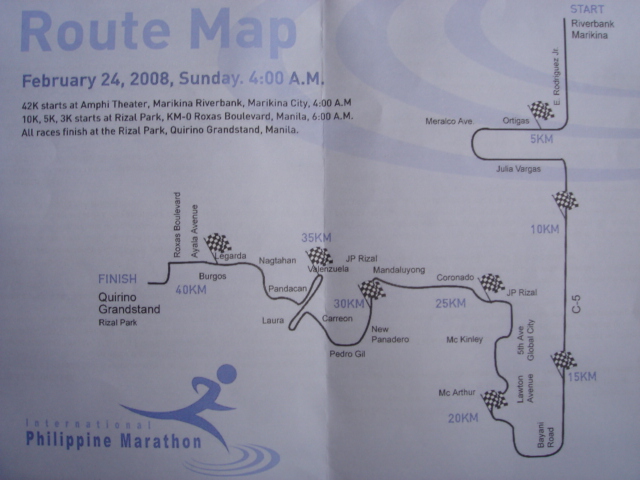
Finally, I got hold of my race packet for the Pasig River Heritage Marathon. But the organizers changed the name of the race into “International Philippine Marathon”. I guess, this is the fourth time that they changed the name of the race and the first time that they changed the route of the race. I hope the picture below will be clear for my co-runners and readers to see.

dsc00484.jpg

I haven’t seen the actual route but I will try to visualize the route as I recall passing through these roads in the past. The race starts at Riverbank Marikina and runners go south along E. Rodriguez Jr. Avenue–right at Ortigas Avenue (uphill)–left at Meralco Avenue–left at Julia Varga (downhill)–right at C-5 (uphill at the Bridge before Kalayaan & at Market!Market! & McKinley Hill)–right at Bayani Road (my “Heritage Mile” & uphill to Gate 3 Ft Bonifacio)–pass by along Phil Army Golf Course–right at Lawton Avenue–passing through The Fort and exit at the old Gate 1 of Fort Bonifacio all the way to JP Rizal Avenue Makati–runners cross the Pasig River along a bridge towards Coronado (I am not sure if this is the bridge that connects Makati Avenue) & JP Rizal Mandaluyong–turn left at New Panadero–right at Pedro Gil–right at Carreon–left towards Plaza Dilao–turn-around & go towards Valenzuela and back along Pandacan, Sta Mesa–right at Laura–right to Nagtahan Bridge (uphill)–left to Legarda–pass along Ayala Avenue–and Finish infront of the Quirino Grandstand.

Approximate Locations of the following Kilometer Markings: 

5K—along Ortigas Avenue

10K—along C-5 (near Toyota)

15K–along C-5 (squatters area)

20K—back of HPA Grandstand along Lawton Avenue

25K—crossing with the street leading to the old Gate 1 of Fort Bonifacio & JP Rizal Makati

30K—New Panadero

35K—Pandacan, Sta Mesa

40K—Legarda

42K—Quirino Grandstand

Tips During the Marathon Race

The following are the tips for runners while running their first marathon race:

1.  Drink plenty of water or fluids. Take at least 2-3 “gulps” of water every 3 -4 kilometers. If you don’t have any water or hydration belt, don’t miss every water station to drink. If the weather is hot and warm, you can pour water over your head or body.

2.   Start at the middle or back of the pack. Run slowly (within your ability and training) and be conservative on your average pace. To be safe, a 3o-second slower time with your average pace for a kilometer or mile is acceptable. But if you feel you can pick-up the pace on the last 10 kilometers, slowly increase your pace and observe any pain that comes out from your legs or body.

3.   Maintain a good running form. “Shuffle” and don’t sprint. Use a short, economical stride, bringing the knees up just enough to move your legs. Use the heel-ball footstrike. Maintain a comfortable breathing rythym. Relax your shoulders and arms. Arms should be swinging not higher than the nipple level and going down on the side of your running shorts. Remember the “talk-test” while running (you should be comfortable talking while running). 

4.   If you are injured or feeling sick or ill—walk! If the symptom remains and the pain increases, ask for medical assistance. Leave the race! Don’t be a hero for continuing, but you will be considered a fool for insisting. Many people had died already in marathon races.

5.   If you have cramps and feel you have reached the “wall”, start to walk and “listen to your body”. Drink more water/liquids, take in your sports gel and walk briskly. It would be better for you to alternate brisk walking and jogging/running and think of finishing the race.

6.   Nobody has ever said that running a marathon is a “walk in the park”. If you have trained properly and don’t feel any sickness and have no injury during the race, then you should be able to finish the marathon race. Running the last 6 miles or 10 kilometers is all “mental or an exercise of positive attitude”. Get the support of other runners around you. Find a group of runners whom you can run with during the race and help one another through period of weakness. Keep moving, take one step at a time, one kilometer marker at a time, and show that “big smile” when you cross the finish line!

7.   Lastly, do not cheat! Don’t be tempted to ride on a vehicle running/passing along the route. Do not make any shortcuts!

Breaking 10K Hits

21 February 2008

Before 10:00 AM this morning, my blog registered 10,000+ hits in barely four (4) months since I started this blog.

I would like to express my thanks and gratitude to my visitors/readers/friends and to the runners who inspired me to tell my stories about running and other physical activities I’ve been into.

My thanks also goes to the members of my family, my son and daughter, who admire my running and physical abilities and to my wife who is always there to give me the “technical” support.

To Matt & Jovelle, thanks for transforming my blog to a website and for “fixing” my notebook.

To John, thanks also for being a good running partner during your visits in the Philippines.


D-4 Day: 2008 Pasig River Heritage Marathon

20 February 2008

At 5:30 AM, I was already on my way to Dauin, Zamboanguita and Siaton, Negros Oriental after staying overnight in Dumaguete City. After one hour, I was able to reach Siaton where one of my Battalions had deployed three days ago after coming from Bohol. I was able to talk to the men of this Battalion and informed them of the prevailing situation in the area and their specific mission in their new place of assignment.

I was informed by my Battalion Commander that the Municipal Mayor of Siaton does not like the Philippine Army to be deployed in his town/municipality. This is an indication that the “insurgents” are in the area and the Mayor is afraid of them. I gave specific instructions to my Battalion Commander on how to deal with the uncooperative Municipal Mayor and maintain his position to stay in the said town.

From Siaton, we have to go back to Dumaguete City and proceeded to Bacolod City, passing through Mabinay, Negros Occidental. We had our lunch in Kabankalan City with their famous Mang Inasal Chicken & Pork Sisig and lots of free rice! Our trip was a slow one and we were able to reach Bacolod City at 2:30 PM and had more time to buy the Negros famous Piaya and Dried Mangoes.

I took the 3:30 PM trip back to Iloilo aboard a fastcraft. At 5:30 PM, I was already at the Iloilo City Sports Complex Oval Track for a short run. I was surprised to see a lot of people playing basketball, volleyball, soccer/football, and runners/joggers on the oval track. Almost all the lanes at the oval track were occupied with people of various ages and sizes (man & women).

The following were the data taken from my GF 305 on every lap it registered:

Lap # 1

Distance—1,750 meters                 Time—9:52 minutes

Average Pace—5:30 mins/km      Calories—127

Average Speed—10.6 kms/hr       Maximum Speed—12.1 kms/hr

Average HR—139 bpm                   Maximum HR—150 bpm

Lap # 2

Distance—448.61 meters              Time—1:47 minutes

Average Pace—3:59 mins/km     Calories—28

Average Speed—15.0 kms/hr      Maximum Speed—16.3 kms/hr

Average HR—156 bpm                  Maximum HR—167 bpm

Lap # 3

Distance—891.03 meters             Time—4:04 minutes

Average Pace—4:34 mins/km     Calories—63

Average Speed—13.1 kms/hr      Maximum Speed—15.2 kms/hr

Average HR—162 bpm                 Maximum HR—167 bpm

Lap # 4

Distance—874.55 meters             Time—3:37 minutes

Average Pace—4:08 mins/km    Calories—60

Average Speed—14.5 kms/hr     Maximum Speed—16.9 kms/hr

Average HR—163 bpm                 Maximum HR—173

Lap # 5

Distance—886.63 meters             Time—4:32 minutes

Average Pace—5:07 mins/km     Calories—64

Average Speed—11.7 km/hr        Maximum Speed—15.2 km/hr

Average HR—160 bpm                 Maximum HR—167 bpm

Aside from the registered laps, I was able to run the following:

2 X 400 meters—Cool-Down Run

4 X 400 meters—Rest/Recovery Run in between laps

Total Distance Covered—7.5 kilometers or 4.68 miles

After dinner, I had my Sauna, Bath & Body Massage (one and a half hours) at Riviera Spa of Iloilo City at a promotional price of Two Hundred Pesos Only (P 200.00)! This is the cheapest Spa service I’ve experienced so far!

I slept at 10:30 PM.
D-5 Day: 2008 Pasig River Heritage Marathon

19 February 2008

For the past two days, I did not have any runs and took my time to rest, relax, and recover from the last long slow distance run I had last Saturday. I stayed two days in Jamindan with no chance of going out of my quarters and office for a brief walking and jogging because of the strong rains for the past days. I contented myself by doing stretching exercises and watching DVD movies of Rambo, First Blood Parts 1 & 2.

At this time, I am in Bacolod City with the Bishop of the Catholic Church, local government officials, members of the Philippine National Police, our soldiers, and the members of the media witnessing the demilitarization/destruction of confiscated, recovered, captured and surrendered firearms which is one of my advocacies in my Command. Hundreds of unregistered/loose firearms will be cut into pieces and burned this morning for the public to see.

From Bacolod City, I’ll be going around the Negros Island to visit my troops under my Command and assess the condition of our troops and their accomplishments. This is to ensure that our operations, programs and activities are being carried out as based from our unit’s mission in the island of Negros. Three hours after I’ve talked to our troops in Canlaon City, an armed encounter ensued in the mountains of Calatrava, Negros Occidental where a number of the insurgents were declared casualties. The location of the encounter was barely 5-6 kilometers away from the place where I visited our troops. As of this time, we got intelligence information that a lot of them were seriously wounded and they need immediate medical attention and supply of blood of different types. There are reports also that this insurgent group has at least five female members. Some of their backpacks and personal belongings were recovered by our troops as they were left behind by their fallen/wounded comrades when they fled to different directions from the encounter site.

I guess, I will not have much time to jog and walk around for the next two days. I will spend more time visiting and talking to my troops in Negros Island. Additionally, this will be the time to reflect on myself and the training preparations I’ve made for the past four months for the Pasig River Heritage Marathon. This is also the time to plan my “strategy” for the race.

I just got an information that my race packet and details of the route has arrived in my quarters. I was informed also that the organizers had changed the route of the marathon. This is what I hate with marathon organizers and executives who are supporting the race (who, most of them are not even runners/marathoners) and who change routes without any explanation at all! The Marathon Race will start in Marikina and ends up at Quirino Grandstand. As compared to the original route of starting from Intramuros area and finishing at The Fort, passing to all the bridges that cross the Pasig River and running along the roads beside the Pasig River. I have yet to see the route map and the actual route before I will make comment on this. I just hope that this race will be a better one than the race I joined in 2006. 

My plan for the Marathon Race? Be conservative with the pacing and make sure that I’ll have an average pacing of 6:00 minutes per kilometer, finishing the first 20 kilometers in 2 hours, 30 kilometers in 3 hours & 5 minutes, 40 kilometers in 4 hours & 10 minutes, and 42.165 kilometers in 4 hours & 30 minutes. Make sure that my “support team” will be giving regular water & energy drink supply & sports gel from Km. 25 up to the finish line.

Things To Do Before The Marathon

The following tips are recommended for the first time runners joining a marathon race. These tips are recommended to be done or followed at least one week and immediately before D-Day of the Marathon.

1.  Eat carbohydrates during the last three or four days before the Marathon.

2.  Get your race packet early and prepare your running attire.

3.  Select your running attire you are going to use for the marathon. Use the running shoes you’ve been using to prepare for this marathon. Wear light shorts and singlet. Your running socks should be comfortable to your feet and it should not cause blisters.

4.  Apply foot powder on your feet to prevent blisters. Apply “baby oil” or virgin coconut oil (VCO) on your crotch and inner thighs; on your upper forearms (below your armpits); and on your nipples to prevent rubbing and chafing with your shorts and singlets.

5.  Apply sunscreen lotion to parts of the body exposed to the sun except for the face. Sunscreen lotion mixed with your sweat will create a problem if it goes to your eyes.

6. Use a runner’s cap and sunglass to protect the face and eyes from sunlight.

7.  Don’t get excited. Stay calm and relaxed. Think of the race as one of your weekend races or long slow distance runs.

8.  Two days, or on the day before the marathon, take a short and easy jog.

9.  Don’t forget your last body massage before D-Day. Experience wise, I prefer to have my massage two days before the race.

10. Full 8-hour sleep is a must on the 2 nights before D-Day. Just to be in the safe side, no sex on these days.

11. Wake up at least 2-3 hours before the race. You should be able to take a shower, take your “crap” for the last time, and take a light meal before leaving the house.

12.  Try to conduct a “reconnaissance” or see the actual route and ride through it. Locate uphill terrain along the route and visualize your “strategy”. I don’t expect that kilometer markings will be available along the route, you should be able to estimate the distance from a certain point through your vehicle’s pedometer.

13.  Wear your hydration/water belt, if you have any. In my experience running full marathons in the Philippines, nobody have ever perfected the location and needs of every water station.

14.  Prepare to bring with you sports “gel” and sports “energy drinks”. If not, request your friends or members of your family to act as your “support team” and position themselves along the route to provide you with water, sports “gel/energy drinks”, food, and the much-needed “cheers and words of encouragements”.

15.  Drink water or any fluids 10-15 minutes before the start of the race.

16.  Stretch, warm-up, walk and jog at least 30 minutes before the start of the race near the starting line.

17.  Be sure that your running equipment (digital watch/Garmin/Polar/Sunto/Ipod) are fully operational and with battery charged.

18.  Come up with your strategy or plan in finishing the marathon race. Listen to your body and from your training workouts, you could determine your goal/objective in finishing the race. Since it is your first time, be contented of finishing the race without any serious injuries and this will serve as your experience to excel some more in your next marathon. Your time of finishing the race is only secondary to your primary aim of finishing the race. 

19.  Always think positive. If there is still enough time before the race, talk to other runners and be friendly to them. Remember, your opponent is yourself and the route, not the other runners.

20.  Remove your fears. Think that you are not the last runner to reach the finish line.

21. Pray and give thanks to the Lord that you had undergone a hard training without any injuries or accidents and for you to be able to join and experience your first Marathon Race of your life.