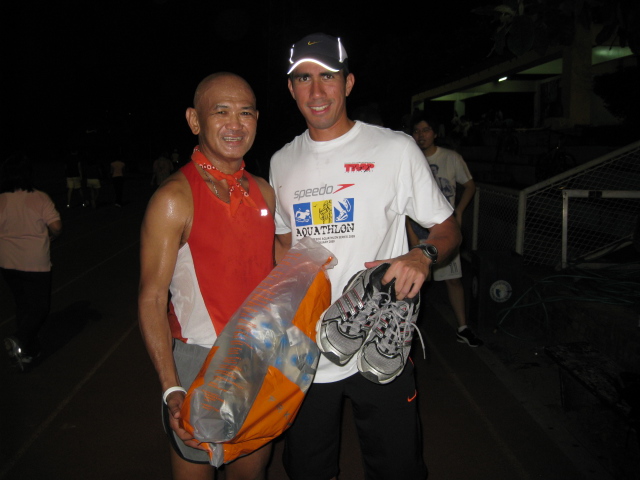
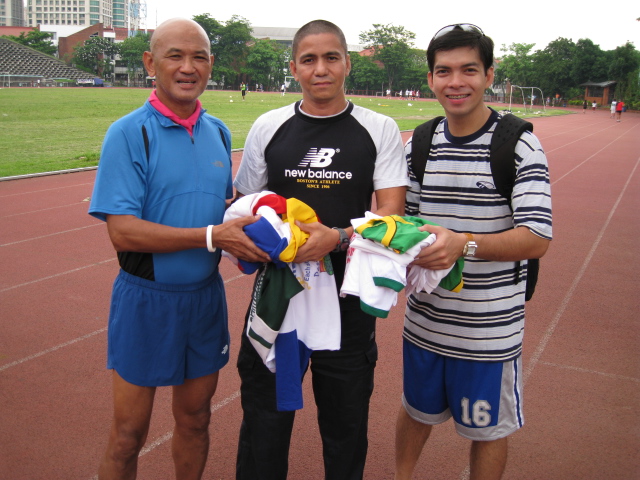
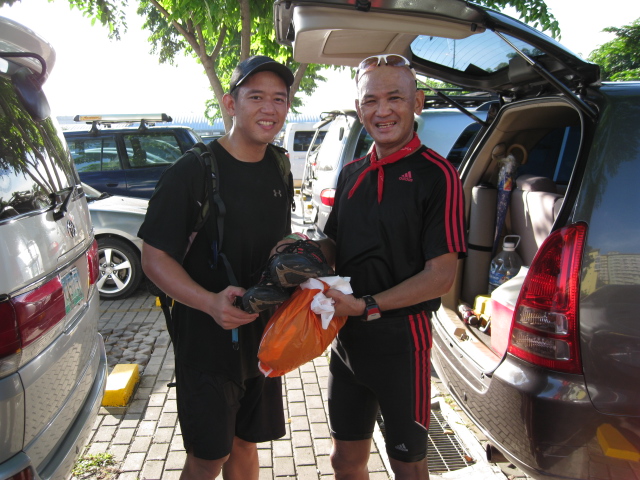
The following “Angels Wearing Running Shoes” had been consistently supporting my “projects” by donating their “old shoes” and their road race “finisher’s t-shirts”. Again, I am featuring them in this blog to acknowledge their effort of “bringing back” something to the sports they love by benefitting the less-fortunate members of the running community. Almost 60 pairs of donated used shoes are awaiting to be distributed for the MILO Manila Eliminations on July 9, 2009 as I wanted these shoes to be distributed at the Luneta Park with a wider cross-section of recipient-runners coming from the neighboring provinces of Metro Manila.
Moreover, the donated “finisher’s t-shirts” had been packed and ready to be sent to the Gawad Kalinga Communities of Laoag City and some municipalities of Cagayan Province.
To all the “Angels Wearing Running Shoes”, thank you very much!
Jody Jacinto of Team BR-Professional Group Donated Four (4) Pairs of ShoesUltrarunners Ronnie aka RunnerForChrist & Dennis Enriquez Donated "Used" Finisher's T-ShirtsUltrarunner Enrico Tocol of Hardcore/Power Runner Group Donated A Shoes and Finisher's T-Shirts
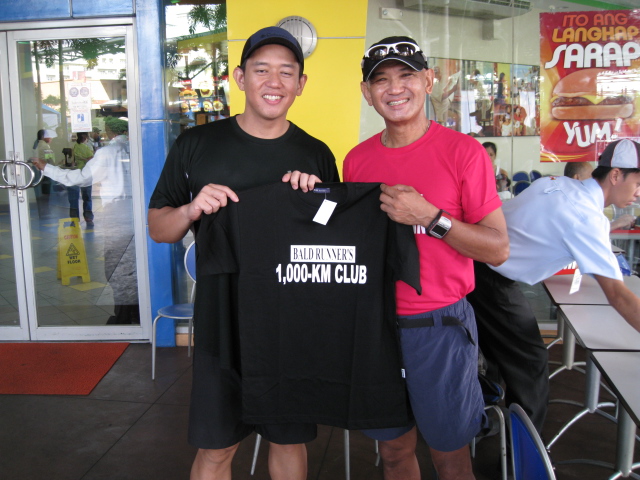
Jayson, one of the latest recipients of the “1,000-Km Club” Finisher’s T-Shirt, also donated one (1) pair of his “used” running shoes.
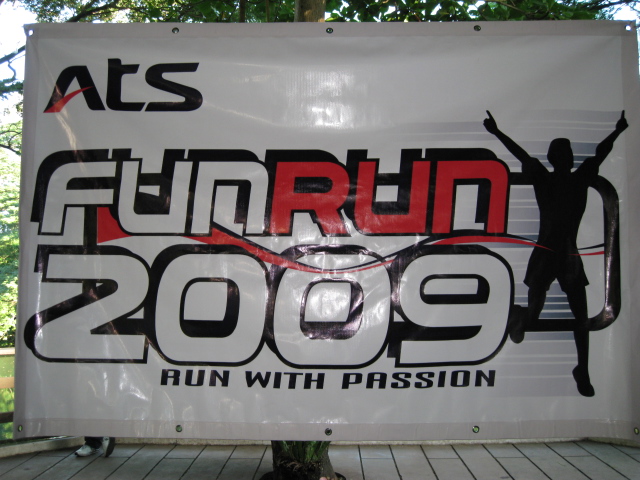
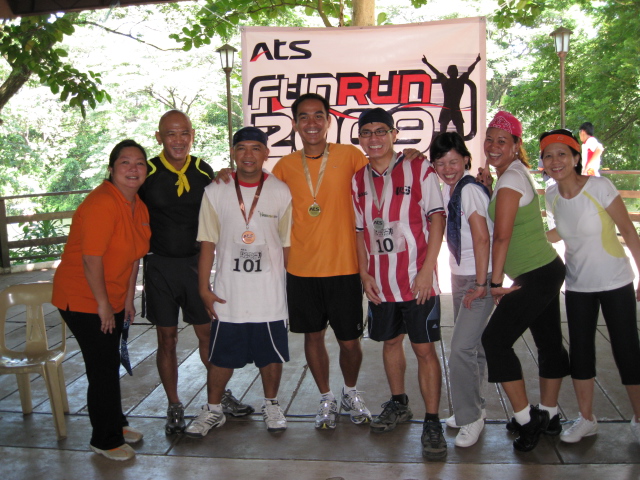
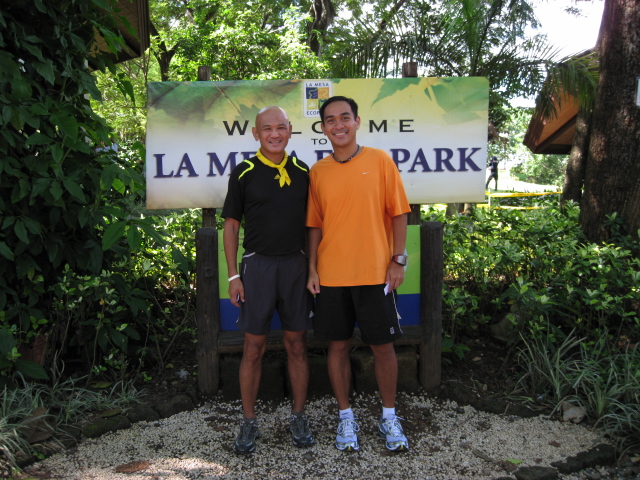
Jinoe Gavan and the people of takbo.ph endorsed me as the Special Guest in the conduct of the Aboitiz Transport System (ATS) 2009 Fun Run which was held at the La Mesa Eco Park last Saturday morning, starting at 6:00 AM of 16 May 2009. After phone calls and exchanges of SMS and e-mail messages, my attendance in the said activity was set through the invitation of Jerome Sese, the HR supervisor of Aboitiz Transport System. I consider that I was a Special Guest of the activity since I was the only one outside the Aboitiz Group who was invited to grace the affair.
Jerome wanted me to speak among the officers, staff, and employees of the Aboitiz Transport System, which is a conglomeration of 3-4 different companies involved in transport, shipping and messenger services, about running and inform/invite them to join the weekly road races in Metro Manila. I was informed also that the HR Group of Aboitiz is conducting such activity as a result of a personnel health audit report among its officers, staff, and employees that shows that most of them have hypertension, arthritis/gout, diabetes, and early signs of overweight. As part of the solution for these illnesses, the HR group deemed it wise to conduct such activity and at the same time provide a “team building” activity for everybody.
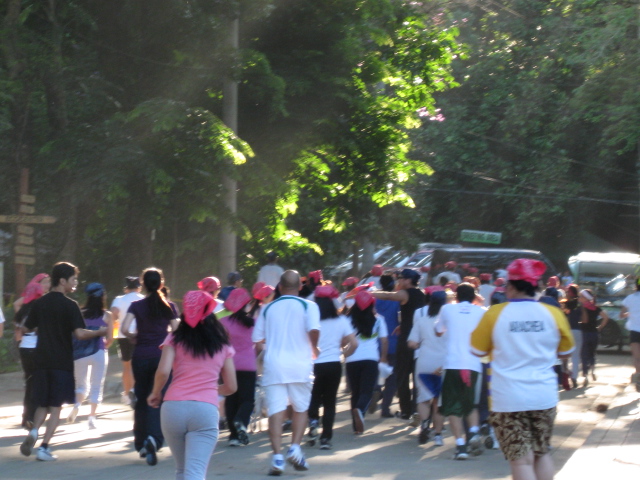
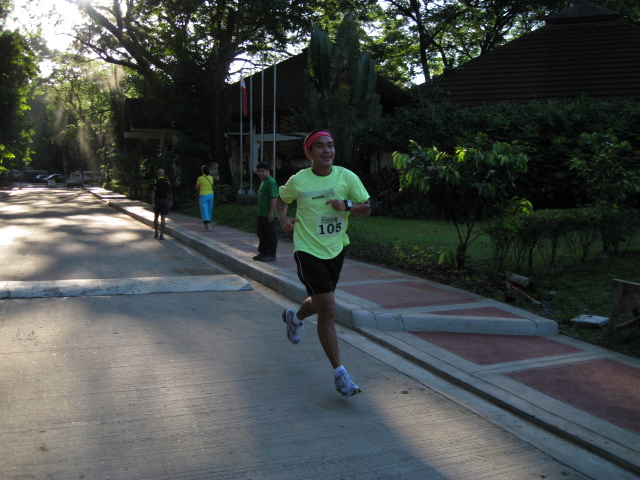
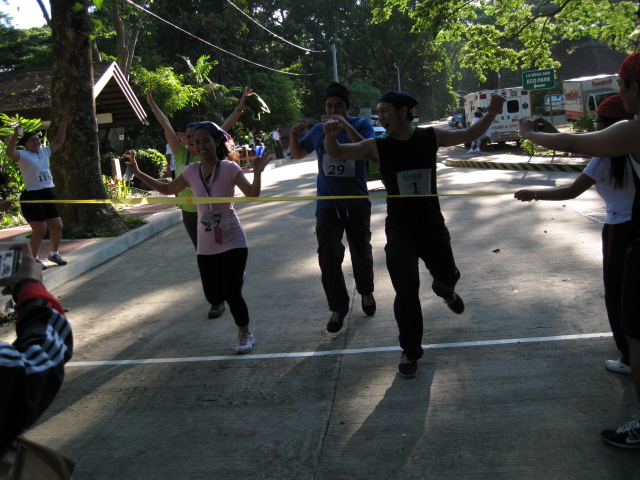
Backdrop of the ActivityStart of the 2-Km Fun RunMelvin Pangan, Winner of the 2-Km Run. He is a "Weekend Warrior" In Road RacesThe Other Runner-Finishers
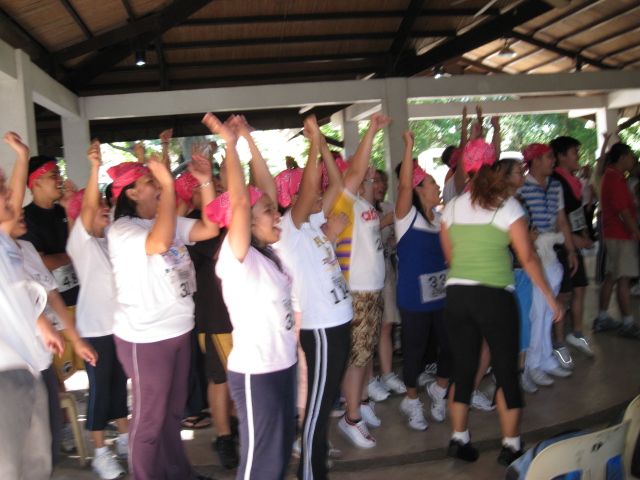
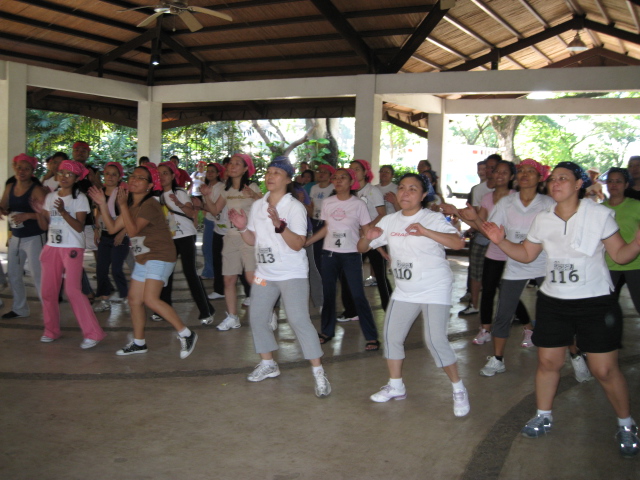
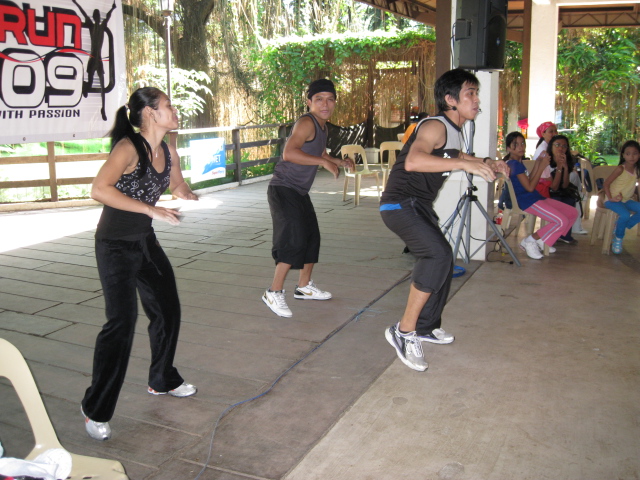
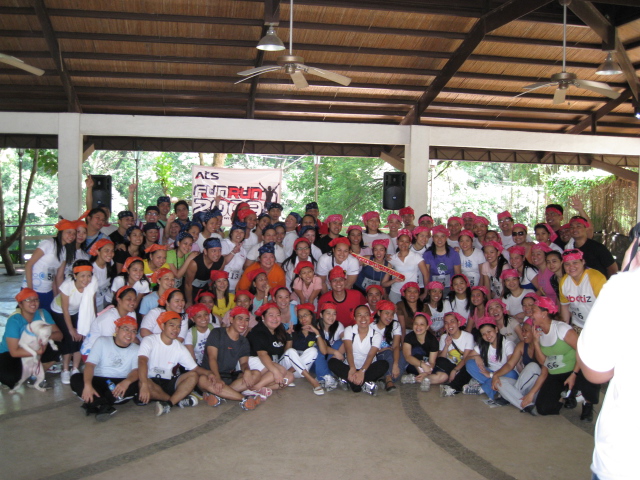
After a short warm-up and stretching exercises, the activity started with a 2-km trail run inside the La Mesa Eco Park. After all the participants finished the fun run, simple breakfast was served consisting of arroz caldo, taho, and fruit juices. Breakfast was followed with a program where the participants were grouped by their respective companies. Cheering and shouting were done by each group through the signal/cue from the Emcee. There was fun and joy among the participants. It was followed by an aerobics/dance exercise led by 3 professional fitness instructors which almost took 30 minutes. This part of the program was very challenging to the participants as most of them sweat it out more than their 2-km fun run.
Cheering Competition Among The Participants30-Minute Dance Exercises Dance Instructors/Instructress Leading the Participants
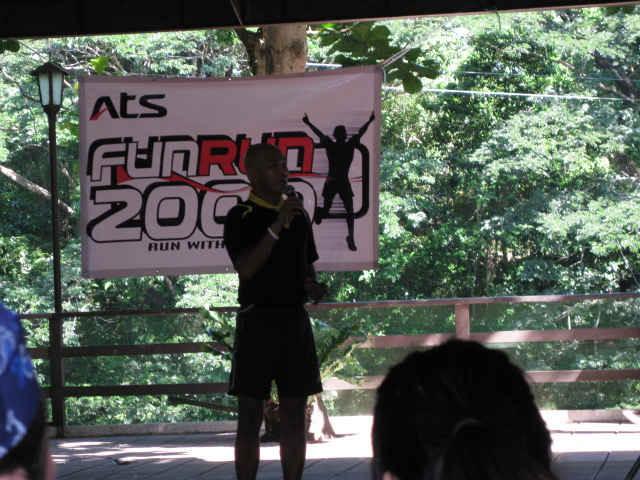
After the dance exercises, I was called for my part to tell everybody about my advocacy to promote running/walking . I told them briefly on the basics of developing and motivating them to be involved in endurance sports like running and brisk-walking. I advised each company to come up with a core group of runners/walkers and I will visit their respective offices to conduct a more detailed running clinic for FREE as soon as they are prepared. For the meantime, I advised them to visit my blogsite to find out more of the projects I’ve been advocating for the past years. I invited them to join the weekly road races in Metro Manila but I told them to start from the shorter distances first before going to the longer ones. It takes time for their body to develop their endurance in order to finish such races without being prone to any injury.
A Brief Talk About Running & Invitation to Conduct Running Clinics
My talk with the group was very brief but I encouraged them to take care of their health and be an example/model to their family in terms of adhering to an active healthy lifestyle in order to prevent them from being inflicted with the so-called “lifestyle illnesses” due to lack of exercise/physical activity. It was followed with the awarding of the top 3 finishers in the 2-km run where I assisted their officers.
Top 3 Winners of the 2-Km Fun RunGroup Picture With Aboitiz Transport System (ATS)With Melvin Pangan, the Winner of the 2-Km Run
After the last messages from their officers, the activity ended at about 9:30 AM. I had a nice time visiting the La Mesa Eco Park for the first time and walk along its trails and get around the different facilities of the park. I highly recommend to everybody to visit this place and enjoy a nice scenery of a nature’s park.
Thanks Jerome, Melvin and to the Officers of the Aboitiz Transport System (ATS) for inviting me in this activity and for their hospitality.
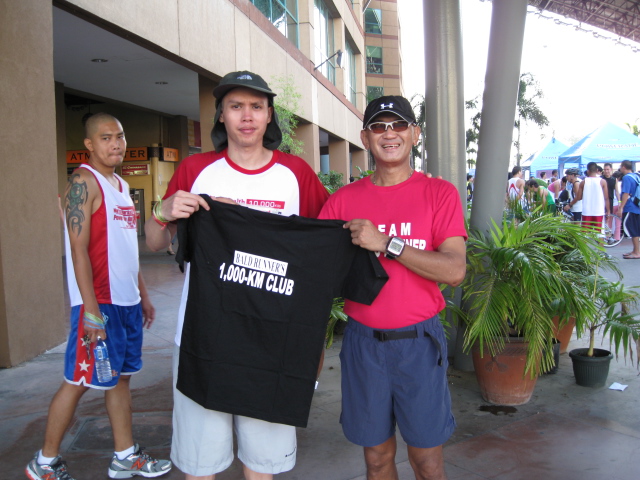
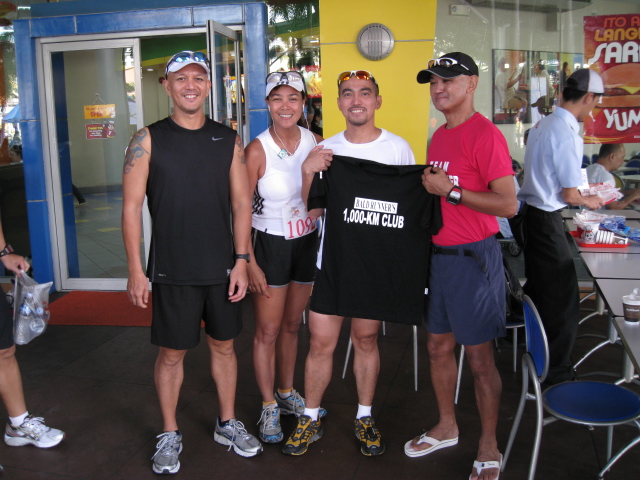
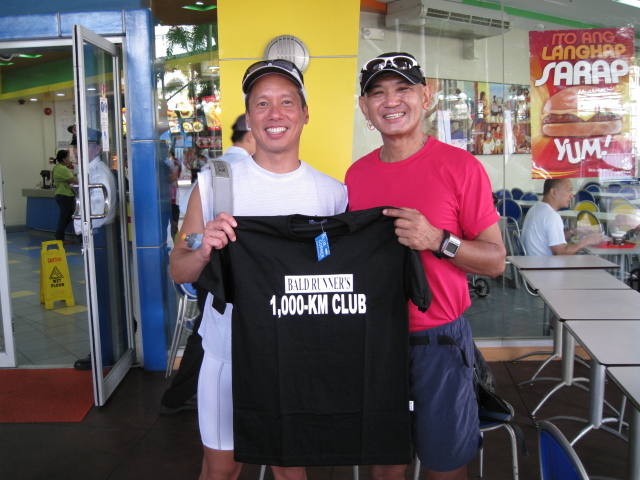
After breakfast at Jollibee Market! Market! yesterday morning, I awarded the Bald Runner’s “1,000-Km Club” Finisher’s T-Shirt to the following:
Jayson from the NIKE Training GroupUltramarathoner Armand Fernando (Witnessed by Jonel & Ivy)Ultramarathoner Enrico Tocol of Hardcore Group/Power RunnersUltramarathoner Jay Lee C-U of Hardcore Group/Power Runners
Ultramarathoner Jose Mari Javier was also awarded a “1,000-Km Club” Finisher’s T-Shirt but his picture was not taken due to a discharged battery of my camera. I am sorry, Mari, we will have your picture re-taken next time.
Market! Market! 10-Mile Run @ Global City/The Fort (5:32 AM 17 May 2009)
It had been my personal practice to visit or hear mass in the church on the first hours of my birthday but I had this practice advanced few days before my birthday by visiting the Lady of Manaoag at the Manaoag Church last Thursday morning. It was an easy and fast trip after my first experience of using the Subic-Clark-Tarlac Expressway all the way to Tarlac City. The trip took us at least one and half hours faster than my usual trip to Manaoag in the past.
Having done the most important task of thanking the Lord for making me strong, healthy and blessed in my running activities and other undertakings, I had my mind focused this Sunday’s Market! Market! 10-Mile Run as I will consider this race as my Birthday Run.
I arrived at the vicinity of Market! Market! at 4:50AM and I saw that the Starting Area was still without any runners. The impression of what I saw on the physical set-up of the Start/Finish area and the presence of marshals made me believed that the race is orderly and well-planned. Instead of looking around for the hardcore runners and Team Bald Runner-Professional Group members, I started to have my warm-up and stretching before I entered the corral for the 10-Mile runners.
Once I entered the corral, I saw the Hardcores/Team Bald Runner-Professional Group and each of them greeted me Happy Birthday! It was surprising to see that the corral was not fully-packed with runners as compared to other road races at the Global City in the past weeks. I could estimate that there were less than two hundred runners for the 10-mile run and the lesser distance race have more number of runners. After 12 minutes, the race started as scheduled at 5:32 AM and the faster runners were ahead of us after the command “Go” was shouted by the Emcee.
Few Meters From The Starting Line
The race started at the Market! Market! and the route goes to the south direction and runners would turn right at the 26th Avenue and then left turn at 5th Avenue. The runners would proceed to Essensa all the way to Lawton Avenue and turn left at Bayani Road up to the usual C-5 turn-around and then back to the Global City but the runners would run along 5th Avenue going south all the way to the Lexus Car Showroom. The runners would run along the road fronting the British School and turn left at the road fronting the International School and then towards the turn-around near the old Gate 1 of Fort Bonifacio. The runners would trace the road back to Market! Market!
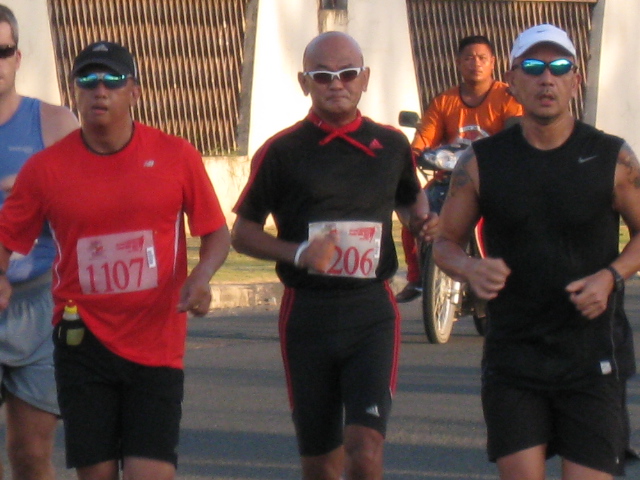
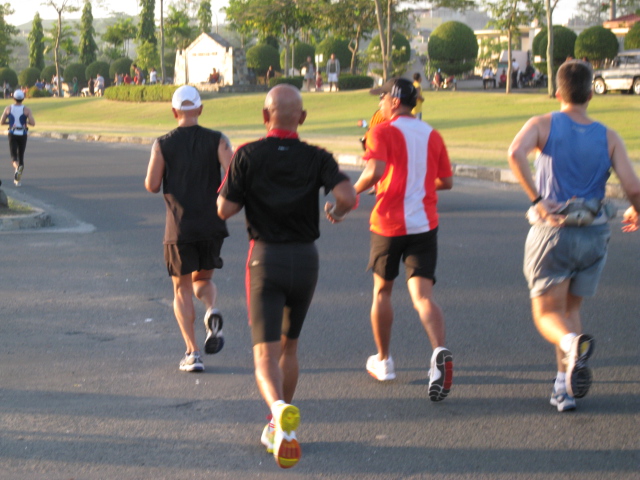
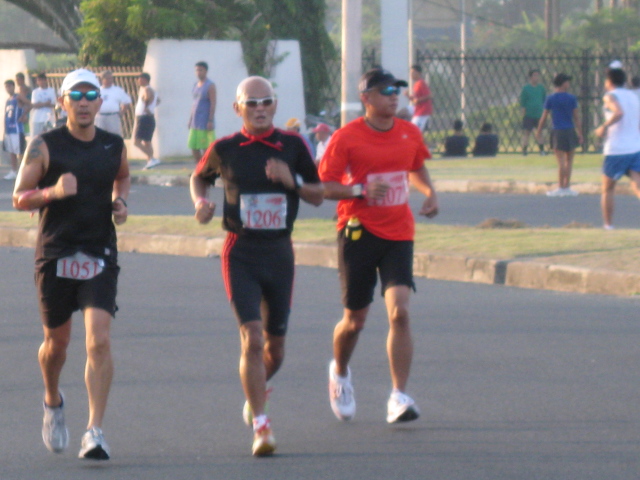
Hardcores In Action (Jan, BR, & Jonel)Back View of the Hardcores
I was running at an average pace of 4:50-5:05 minutes per kilometer from the starting line for about 12 kilometers but I started to slow down on my way to the British School because of fatigue, a slight pain on my right hamstring due to lack of massage for the past weeks and the heat of the sun. It was a big mistake that I’ve never been visiting my masseur for the past three weeks and my leg muscles are getting tighter and firmer. Running the next 3-4 kilometers up to the finish line was very slow despite my efforts to swing my arms and “shuffle” my legs at a faster pace! I could not believe that my average pace for the last 3 kilometers was between 5:25-5:31 minutes per kilometer and I tried my best to finish the race with an average pace of 5:00 minutes per kilometer.
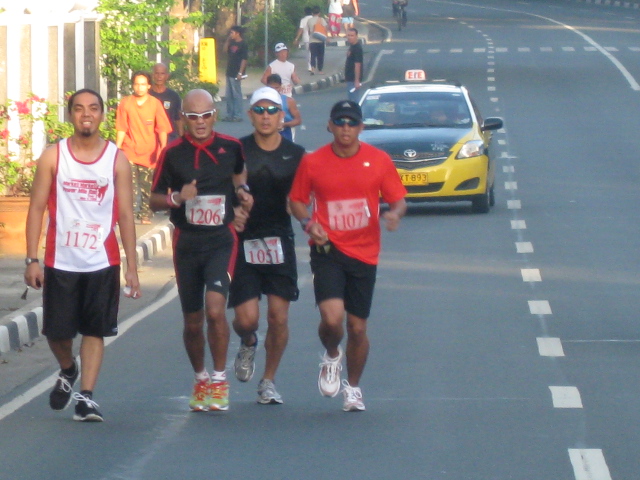
On Our Way Back To Lawton AvenueAt Lawton Avenue towards Global CityWith Ultramarathoner Jonel aka Bugobugo85
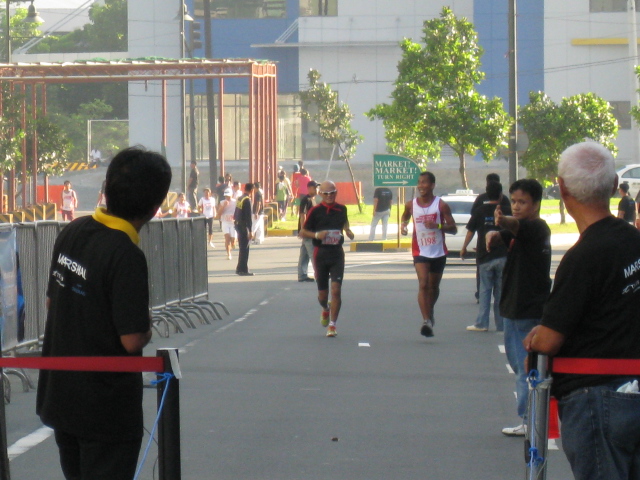
As I approached the finish line, the digital clock on top registered a time of 1:20:58 hours and my GF 305 watch registered a time with additional one second. It’s almost 1:21 hours but I am still happy that my average pace was 5:10 minutes per kilometer with an average HR of 156 bpm.
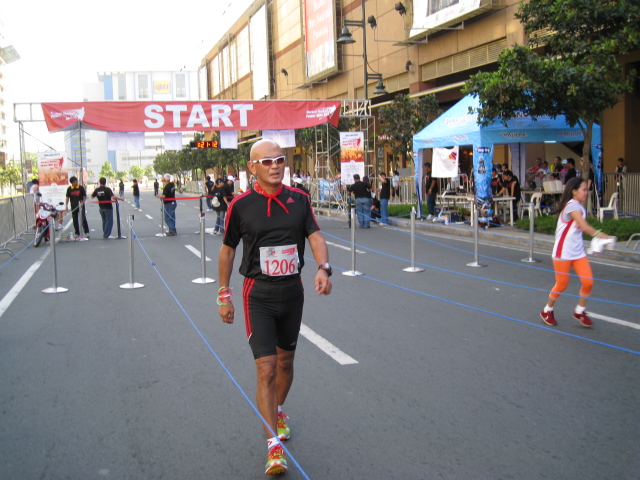
Approaching The Finish LineAfter Passing The Finish Line
This road race was almost perfect. There were lots of water stations with lots of water and water cups. There were lots of road marshals, too who could easily distinguished the 10-mile runners from the lesser-distance runners. It was almost the opposite of what most of the runners experienced in last week’s marathon race in Makati & Taguig Cities. There were lots of directional signs in every turn of the road which every runner could see at a distance but I haven’t seen any kilometer/mile markings along the route. I am sure nobody got lost in this race! But when it comes to the exact measurement of the race distance, it lacked at least 330 meters to make it 10 miles or 16 kilometers.
After changing my wet race outfit, I went back to the Finish Line to look for the Hardcore/Team BR-Professional Group who had some extra more kilometers to run. It was bad luck (sorry, guys) to those who did not run this race because I treated the group with a breakfast at Jollibee. After the breakfast, I awarded the BR’s “1,000-Km Club” to those runners who finished their first 1,000 kilometers from the time they started running. Rico of Power Runners also donated a pair of his running shoes and a number of finisher’s t-shirts. Thanks, Rico!
Guys, this is the 2nd year that I will be missing the TNF 100, however, my spirit will be at the race as the Elite Team Bald Runner will be represented during the said race. Good luck to all the TNF 100 Solo and Relay runners.
As part of the advocacy of the Bald Runner to promote running to everybody, a series of invitations from the different corporate offices in Metro Manila had been attended and running clinics had been conducted to beginners and members of their respective running clubs. The running clinics consist of two parts/sessions—a 1 1/2 to 2-hour lecture in a classroom where the basics, principles and “tips” are presented and discussed to the participants; and the actual practical running & demonstration are done at the ULTRA Oval Track for about another 2 hours.
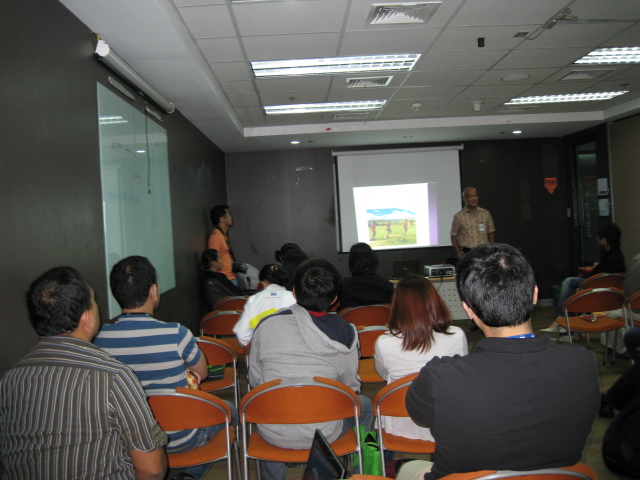
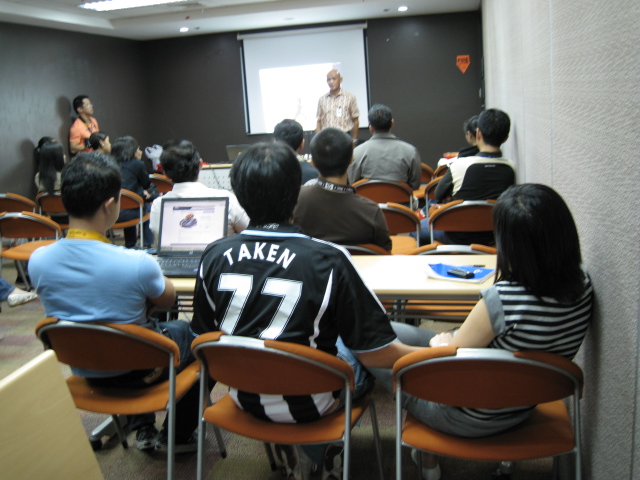
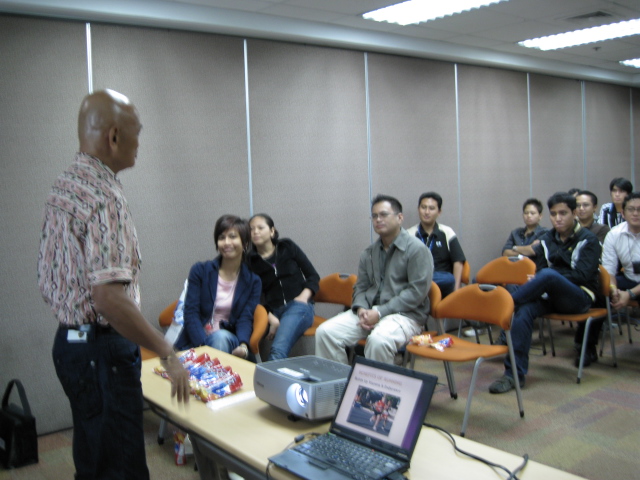
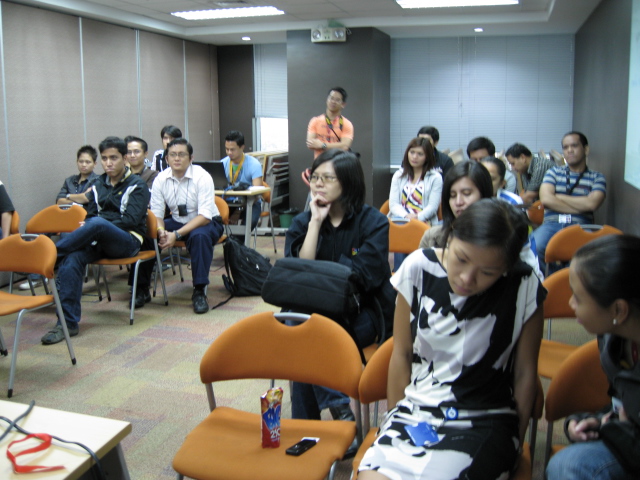
After a month of regular coordination with Celyn, one of the HP employees and one of the Team Bald Runner-Professional Group members who is a regular runner in our ULTRA Oval Track training, the running clinic was conducted last night, Friday, at the 34th Floor of the Robinson’s Summit Center Building along Ayala Avenue, Makati City with the participation of 25-30 employees of Hewlett-Packard Philippines. As what I usually practice in every running clinic, I immediately start the lecture once I enter the designated venue by asking some basic questions to know the extent of competency and level of running fitness of everybody.
Bald Runner & HP Philippine Runners
The lecture deals with the basics, principles, and “tips” in running; and more of my experiences for the past 30+ years that I’ve been running. I emphasized on the “ways and means” for a runner to be free from any injury; their diet & nutrition; the selection of the correct and appropriate running shoes; and appreciation of the phrase, “listen to your body”.
Group 25-30 Runners From HP Philippines
Sometimes, my lecture would be long and more interesting as I always give examples for every principle involved in training to improve in one’s capability to run faster and stronger.
BR's Advocacy To Promote Running...for FREE
One of my favorite runner-writer-philosopher whom I use as an authority on the “tips” of running is Dr George Sheehan. His past writings and experiences had been considered as “precious and timeless” piece of running advise for everybody. His books had been considered as “collector’s item” for every kind of runner. It is unfortunate that up to this time, I am still looking for those books he had written and published. If he is still alive today, he could be the Number #1 runner-blogger in the world.
Part 1 is a Lecture & Part 2 is a Practical Exercise
Duirng the open forum, I found out that some of the participants had been regular runners in road races in Metro Manila. One of the ladies, finished a Marathon Race but she told me that she learned a lot on new “tips” during the lecture and she will surely remember in order to improve her next Marathon Race. Most of the regular runners in the group had just finished their first half-marathon during the Condura Run.
As I promised to them, the second part of the running clinic will be actual running at the oval track which will be done next Friday. Their footstrike, running form, and strides will be analyzed, assessed and corrected. I encouraged everybody to attend the second part as more technical information will be imparted to all the runners.
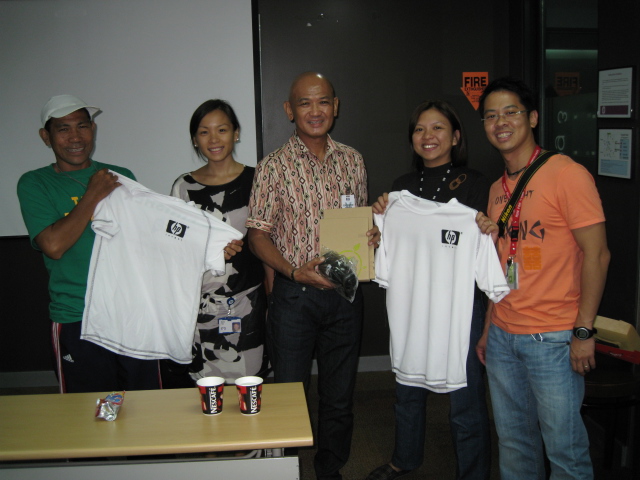
Gifts From The HP Runners (Coach Titus, Elaine, BR, Celyn, & Sherwin)
After a brief open forum, a simple closing ceremony was conducted where Celyn, Sherwin and Elaine gave some gifts to me and Coach Titus as simple token for the services we have rendered to the employees of Hewlett-Packard.
To the HP Runners, thanks for the warm reception and interesting questions during the lecture. The Elite Team Bald Runner and Coach Titus will be happy to receive you during your actual practical running application/demonstration this coming Friday.
This question had been asked repeatedly by Ronnie De Lara aka Runner For Christ and Dennis Enriquez when they saw me at the ULTRA Oval Track last Wednesday afternoon for my running workout. They were surprised to learn that I’ve been back to my running workout after finishing the BOTAK 42K Paa-bilisan last Sunday with a 35-minute active recovery run last Monday, a day after finishing the marathon race.
I seriously told them that I placed a lot of patience, hardwork, determination, and discipline into my legs whenever I am preparing for any race. Such answer led in telling them on how I prepared for my first two marathon races in the early 80s. They were surprised to know that I prepared for a marathon race for almost one year by running almost everyday. My daily runs would consist of “doubles”, 10K run in the morning and another 10K run in the late afternoon, with a constant regular pace without any speed run training in the oval track. My long runs during weekends would cover a distance of at least 20 kilometers. Speed runs would be limited to “fartlek” runs in between electric posts along the road or in between kilometer posts. My preparations/training were done when I was assigned in the Ilocos Region and I was able to strengthen my legs and develop aerobic capability of my lungs and heart. During those days, I did not join any road race in Metro Manila in preparation for the marathon event.
I was then in my early 30’s and my marathon finish times were within 3:30-3:40 hours. How I wish I could bring back those times when I was fast in my finish times and my legs have those strength to run everyday. I also told them of my injuries before but I learned from these injuries to appreciate the need of rest/recovery and be able “listen to my body”.
Ronnie, thank your very much for those donated “finisher’s t-shirts” which you gave to me during our meeting. Good luck on your TNF 100 Sacobia.
This is a notice to those runners who registered or adopted the Bald Runner’s “1,000-Km Club” for them to be motivated to pile up their mileage in their running workouts. If you finished the required number of kilometers, you are entitled to receive a “Finisher’s T-Shirt” from no less than the Bald Runner. There is no need to show me proof of completion because I believe that runners are “honest and honorable” people.
After the Market! Market! 10-Mile Run this Sunday, the Bald Runner will be awarding a limited number of “Finisher’s T-Shirts” to runners who completed the said number of kilometers. The T-shirt will be awarded on a “first come, first serve” basis. (Note: Those who have received their first “1,000-Km” Finisher’s T-Shirts are no longer qualified to receive such T-Shirt for finishing their succeeding 1,000-Km runs.)
After reading the comments of my readers on my previous posts, I am suggesting the following recommendations to guide our runners before they register to join a particular road or trail race:
1. Every runner has the right to know the name of the outfit or the name of the race organizer/race director before he/she files or registers to a particular race. Henceforth, all registration/application form in every road race must carry the name of the Race Organizer for the information of the runner.
2. Groups and/or corporate offices and their marketing outfits must be able to state in their “flyers”, advertisement notices, and PR/media releases as to who and what outfit will be the race organizer. These corporate offices and groups must be able to ask runners or make some research/referrals on the background of race organizers trying to apply as race organizer.
3. Takbo.Ph and other bloggers must be requested to identify as to who is the race organizer every time they post a notice of invitation or information about an incoming race. (Note: This blog/site has never been used to announce or invite runners to join in a particular race. Sorry, guys, your e-mails and comments requesting me to post your invitation in this blog had never been posted because of this personal policy. I don’t advertise.)
4. Every runnner must remember that companies and groups who would like to conduct a road race usually conduct a bidding/selection process where every race organizer is invited to compete. It is the responsibility of the Bids & Awards Committe of the company or group to find out if these Race Organizers have a license from DTI and the necessary documentation of a business entity. We should always remember that the lowest bidder gets the award to be the race organizer of a race. So, if the race organizer and/or the company needs to maximize its profit, he/she has to get sponsors for the prizes and “giveaways” and other support needs for the runners like water supply, water cups, energy drinks, and other “gimmicks”. The race organizer now allocates some money from your registration fee for your medal, certificate, race bib, race shirt, measurement of the route, payment for the marshals/security, medical support and rent for the timing devices and computer system. If the race organizer intends to allow commercial stalls at the start/finish, he has the power to collect fees at his discretion for the rent of the tents/space and they add up to his income/profit. Race Organizing is a “big” business. I am just wondering if they are paying their dues/taxes to the Bureau of Internal Revenue (BIR).
5. If you experienced some “lapses” in the conduct of a race you participated and you find out that the same race organizer is the one who will administer the race you are applying, then, I suggest you save your money and wait for road races to be conducted by the better and well-organized race organizers.
6. For the “newbies” in road races, make a research on the past posts of runner-bloggers about how these race organizers were rated in their respective races or ask from the more experienced runners about these race organizers before joining a road race. I will give you an example. As far as I can recall, for this year, the race organizer of the PSE Bull Run and Men’s Health Run at UP Diliman was the same and in those runs, runners complained of the lack of water and water cups.
7. This is an “eye-opener” to all the runners. Aside from the support system for the runners during the race, we have to consider also the security services to our cars and our personal belongings while we are running. Let me ask you, “Who should be responsible for the security of our cars/vehicles and personal belongings during the race”? In my opinion, it should be the Race Organizer. Kahit gaano kagaling & fully-prepared and isang race organizer kung nananakawan naman ang kanyang customers, ay dapat isang daguk sa kakayahan ang isang race organizer itong pangyayari ng nakawan. New Balance 25K Powerace at Clark Freeport was a very organized race but in the end many runners complained that their personal belongings in their parked vehicles were stolen. The Greenfield City 21K Run was also an organized race few weeks ago but you heard of complaints from runners that they were victims of theft/robbery in their parked vehicles despite the presence of security guards in the parking areas. Road Races conducted at the Global City by well-known and better-equipped road organizers were not spared from these thieves and robbers. But if the Race Organizer will not accept responsibility for the security of our parked vehicles and our personal belongings, then we have to learn from these incidents also.
I admit there is a problem in regulating these race organizers once they are legitimate business outfits because there is lack of policy and system of monitoring the said races by the Department of Trade & Industry (DTI) or from the Sports Federation (PATAFA) that supervises Road Races. Without rules and regulations, the violators will never get sanctioned or punished. Even if there are rules and regulations if there are no formal (written) complaints from the runners filed to DTI or PATAFA, the race organizer will be free to bid again for another race.
So, let us join hands in “punishing” these road organizers who are not improving their support and security systems by not registering to their races. Select the race you are going to participate. In the end, it is your money, decision and personal choice to join such road race and you must take responsibility for your action.
After finishing the marathon race yesterday, I took time to hydrate, eat, and rest/sleep for the rest of the day. I was limping last night and it took me some time to walk straight this morning. I already knew what to do in order to relieve the pain on my legs, hips and lower back area within this day.
I need to have my active recovery run for 30 minutes within the day after the marathon race. At 7:30 PM, I went to the ULTRA Oval Track to have my recovery run. I actually did a 35-minute recovery run at an average pace of 6:40 minutes per kilometer. Surprisingly after doing my post stretching exercises, the pain and stiffness on my left hip and leg muscles had disappeared and I was able to walk without any limp and it was a relief to walk straight and step up on the stairs without any pain on my legs.
Tomorrow, I’ll be doing a 10-15K run at my 85% effort and hope to be back again on my training for my future road and trail races.
Race Report on the BOTAK 42K Paa-bilisan @ The Fort/10 May 2009
By looking at the map route of the Marathon Race, I already predicted that the marathon race will have some problems. And my predictions were right. There was a lack of road marshals, many runners were lost and most of them registered fast finish times for the marathon distance, the race started late, there was a lack of water cups (again!), and you need to really have your personal support team in order to finish a marathon race with better results.
I am sorry, Franco but you need to improve your support system for the runners if you want more runners to join your races. Please don’t give me the reason that you “sub-contracted” the guys who delivered the water supply and water cups for your race. Do I have to do the mathematics again on how much a race organizer would spend for the water cups in all the water stations? Okey, we will do the math again. Assuming you have 600 runners for the marathon distance and there are 20 water stations for the marathon distance, you will have a total requirement for 12,000 water cups. If you buy water cups in Divisoria, it will cost you P 37.00 per 100 pieces. So, that is 120 X P 37.00 = P 4,440. The cost for the water cups is equivalent to the registration fee of 11 runners. The cost might be lesser because not all the 600 runners are running the full marathon distance.
Meeting & Talking To BDM 102 Finishers
1st Marathon Race For The Year
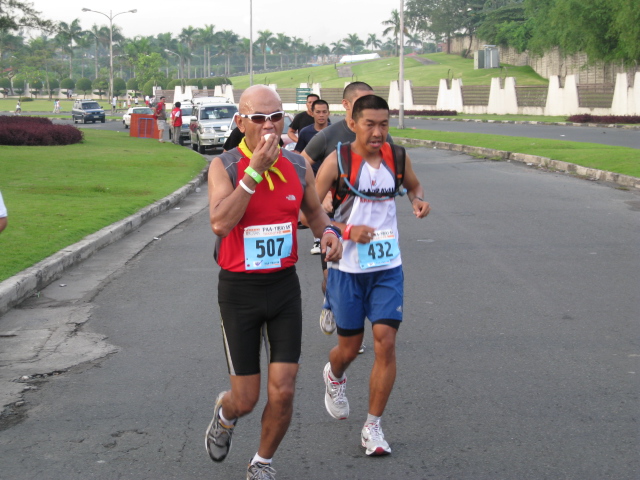
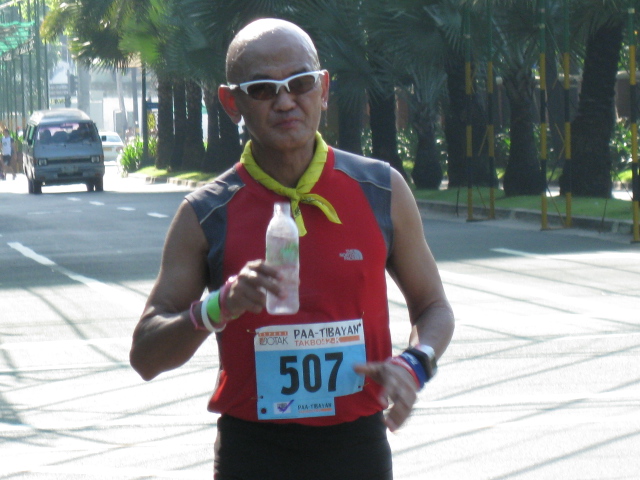
I was happy at the first 10K to see Gatorade drinks in Gatorade cups but it ended there. I never saw and tasted Gatorade drinks in the succeeding water stations. It is also a very pitiful sight to see runners using the covers of those 5-gallon containers as water cups!!! From my support team, I would share my bottled water, Gatorade drinks and even food to the runner on my side. Armand Abalos from Lucban, Quezon and my running “buddy” from Km # 75 to 90 in the BDM 102K was my running “buddy” again for this marathon race and he is really a strong runner.
1st 20K of the RaceEating Hard-Boiled Egg While Running
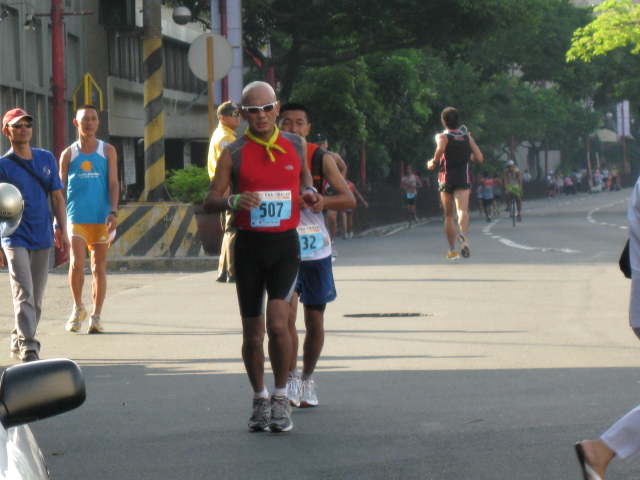
The race lacks the much-needed race marshals as there are more turns (right & left) than the number of kilometers in the race. By following the runners infront of me and the other runners, I admit that I missed the Pasong Tamo (after coming from the Kalayaan Flyover) turn-around as runners should proceed directly to the said turn-around before proceeding the the Powerplant Loop. Due to the absence of road marshal, we turned right towards the direction of Powerplant. In my estimate, we missed at least one kilometer distance. However, at the Finish Line, I heard comments from those GF 305 users that they registered a distance of 43, 44, and 45 kms. Afterall, the distance was longer than a full marathon distance and the turn-around that we missed had compensated for the additional distance. Ha!Ha!Ha! Unfortunately, my GF 305 did not work efficiently as the digital readings kept on “flashing” from the very start of the race. Instead of being “pissed off” with the condition of my GF 305, I just maintained my pace and treated the run as my long run.
At the Gil Puyat/Buendia Avenue (26K)
I did not have any problem about the late start of the race. The marathon race was supposed to start at 4:30AM but it started almost 5:00AM. After the grueling experience with the heat of the sun during the BDM 102K last month, the early heat of the sun for this marathon was never an “issue”. At least, the shaded streets at the Powerplant loop gave comfort to the runners but there were no water stations on sight. However, running along Gil Puyat Avenue, Kalayaan Flyover and at The Fort area before reaching the Finish Line gave problems to the other runners.
With my GF 305 not working, I don’t have any numbers and location points to speak of or write on this post except for those observations I’ve noted during the race.
Drinking Water from the Bottle While Running (No Water Cups!)
The race route is very challenging. The terrain of the route was very hard as it was concentrated in Taguig and Makati. In the history of the US occupation of the country before start of the 20th century, the US Army selected the area called Fort Bonifacio, formerly called as Fort McKinley as their Artillery Camp (where the US Army deployed their artillery guns) because it was the highest point in Manila where they can observe the movements of our “revolutionaries” passing along the Pasig River and easily can pinpoint targets within the populated area of the Old Manila and Manila Bay. So, running in Makati & Taguig entails a lot of challenging rolling terrain. Such race route would never attract a world-record pace for the marathon race.
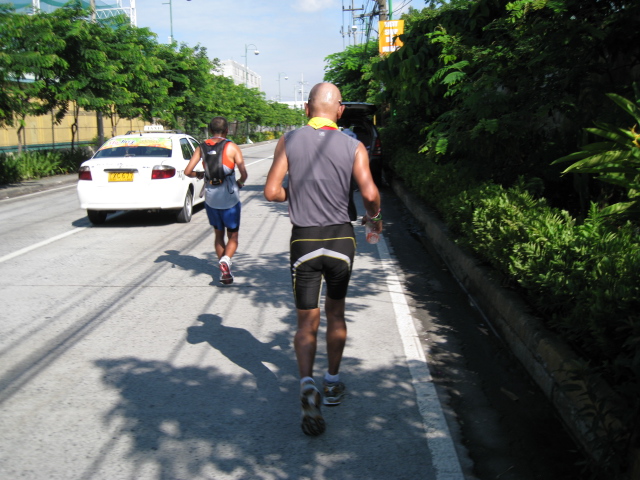
Running Along the Powerplant Loop
Despite constructive criticisms from runner-bloggers about how we “race organize” our road races, it seems that we are not improving, instead, we are going back to the “stone-age” where we have to bring our own water & provisions after paying somebody to support us in our road adventures.
Guys, I don’t blame you why you prefer to go abroad to run a “perfect” marathon race but you must also think that you are paying an equivalent average amount of Five Thousand Pesos or more for the Registration Fee as compared to a measly P 400 to P 500 for a marathon race in our country. Having said that, at least, our race organizers must be able to buy enough water cups for all the runners. We don’t need fresh fruits, gels, power bars, pain relievers and other “gimmicks” (loudspeakers with music) along the race route, just give us potable water and water cups and responsible road marshals. I was laughing when one of the road marshals along C-5 asked me if I am a 42K runner. The road marshals did not know what distance the runners are running even by looking at the color-coded race bibs!
My Running "Buddy", Armand from Lucban, Quezon (BDM 102 Finisher)At the Kalayaan Flyover, 3 Kms from the Finish Line
If there is a positive comment I’ve heard from most of the finishers, it is the fact that this marathon race was a “redemption” race for those runners who participated in last December’s SC Singapore Marathon. They told me that they improved a lot from their finish times and proud that they got new PRs on their marathon finish time in this race.
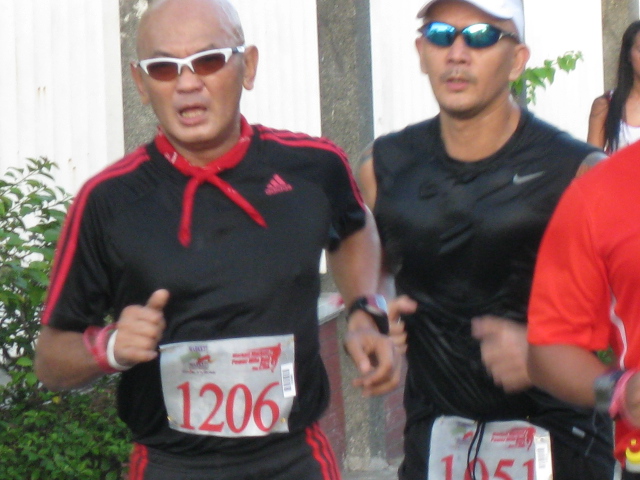
Before I passed the Finish Line, I slowed down to see the digital clock and I registered a Finish Time of 4:35:10 hours. I am not proud of my time as I ran too slow without an operational GF 305. Based from the Race Chart of Running Times Magazine, I had an average pace of 6:30 minutes per kilometer/10:30 minutes per mile. It is my ultramarathon pace! Ha!Ha!Ha!
At The Finish LineMy Prize---A Finisher's Medal, Certificate & A Smile
By the way, next Saturday will be TNF 100 Australia. There are 250+ solo runners for the 100-Km distance. Dean “Karno” Karnazes, the Ultramarathon Man, will be competing in the said race. The next Saturday after TNF 100 Australia, it will be TNF 100 Sacobia, Clark, Philippines. There are 100 solo runners for the 100-Km distance. Dean “Karno” Karnazes will be in the 2009 Los Angeles Marathon Expo for his book signing. Good luck to all TNF 100 Sacobia Solo Runners!!!


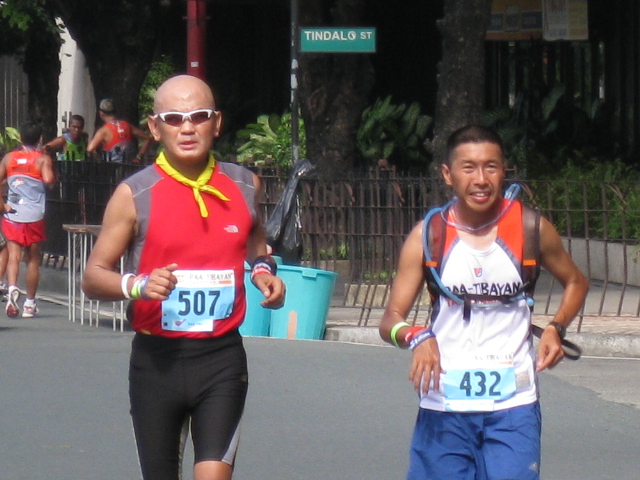
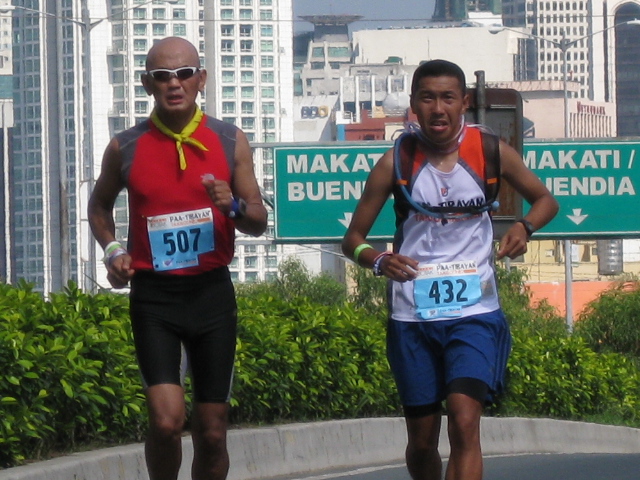
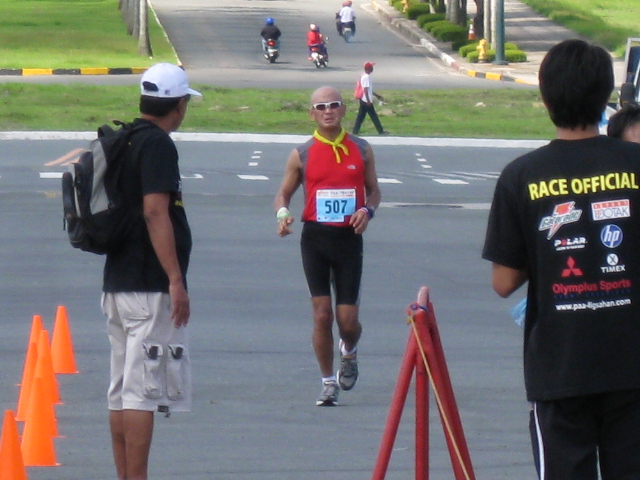

 Bald Runner
You must be logged in to post a comment.