After completely resting for the whole week after the 33rd MILO 42K Elimination Race the other Sunday, I am starting a serious training cycle for a marathon race to be held before the end of the year and ultimately, in preparation for a “possible” experience in an ultramarathon race which will be held on the last week of May 2010.
Monday—A Long Run of 1:30 up to 2 hours
Tuesday—Easy Run of 60 minutes
Wednesday—Tempo Run. Start slowly; after 20 minutes, hold race speed for 30-40 minutes, then end with easy run for 20 minutes.
Thursday—Hill run, Easy Run
Friday—Easy Run of 60 minutes
Saturday—16-20K at Race Pace
Sunday—Rest Day
This training schedule is supposed to be a guide. There is no specific target on my weekly mileage as this week and the following weeks will be part of my endurance phase.
Comparing the abovementioned training schedule from what I’ve actually done for the past days/week, the following was my actual training workout:
Monday—I was able to run for two (2) hours with an average pace of 6:30-6-45 minutes per kilometer. It was a “runabout” along the major streets in Metro Manila. The run was done early in the morning covering a distance of 17K.
Tuesday—It was supposed to be a One Hour Easy Run but it ended as a Run at Race Pace. I finished 12K for one hour at an average pace of 5:02 mins/km. I need to control myself when I run at the ULTRA Oval Track. The run was done at 4:30 PM and had enough time to rest & recover from the long run yesterday.
Wednesday—I had a tempo run. First 20 minutes at a easy pace at an average pace of 5:40 mins/km; followed with a tempo run for 30 minutes at an average pace of 4:55 mins/km; and then finished with an average pace of 5:45 mins/km for 20 minutes.
Thursday—It was supposed to be an easy run along rolling hills at McKinley Hill but opted to do the “stairs” at the ULTRA bleachers after running for 45 minutes. I did 15X on the stairs. It was raining hard.
Friday—I was able to run under the rain for about 35 minutes in the morning. And did “stairs” for another 30 minutes
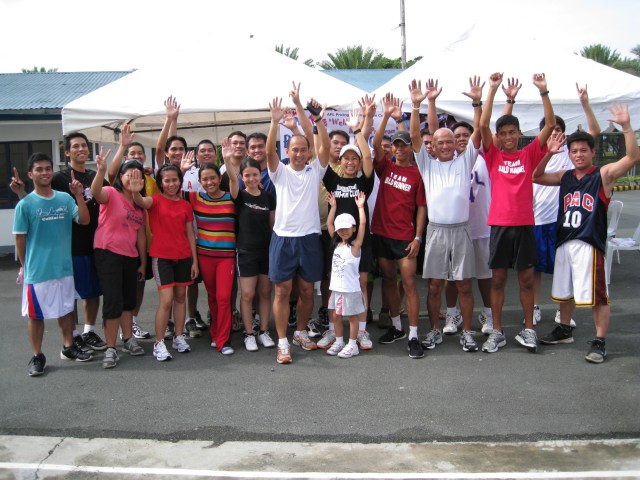
Saturday—Did not have a chance to have a long run at race pace because of a running clinic the Team Bald Runner conducted at the ULTRA Oval Tack. However, I was able to run for a duration of 32 minutes with an average pace of 6:00 mins/km after the said running clinic. Had a massage in the afternoon.
Sunday—Did a long steady run during the GLOBE-ALI RUN FOR HOME with the distance of 21 kms. I finished the race/run in 1:51+ hours with an average pace of 5:15 mins/km. It was a “diagnostic” run and I did not force myself for the speed. However, I need more time to strengthen my legs and build-up again my aerobic endurance by doing more long steady runs in the coming weeks. I had another massage to my legs in the afternoon and slept early in the evening.
Insular Life Corporate Center, Ayala Alabang, Muntinlupa City/10-11 July 2009
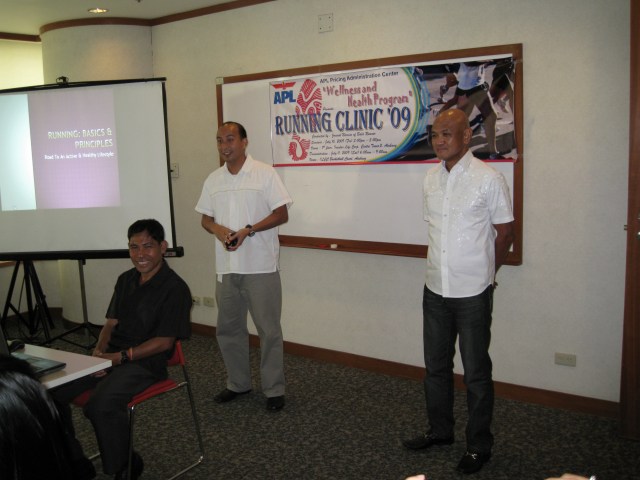
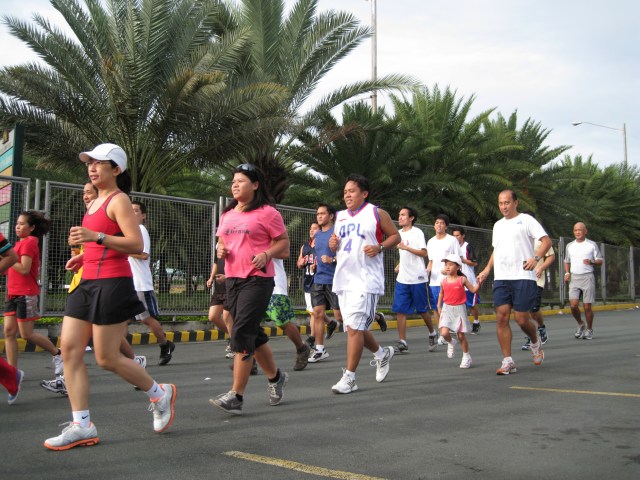
Mr Mark Parco, the Director of the Pricing Administration Center of the American President Lines (APL), invited the Team Bald Runner to conduct a Running Clinic to its staff & subordinates through the efforts of Mr Allan Martin who consistently acted on the details of this activity. After coordination through e-mails, a Running Clinic was conducted to the employees of the said office at the Seminar Room “B”, Tower 1, at the Insular Life Center Building at Filinvest City in Ayala Alabang.
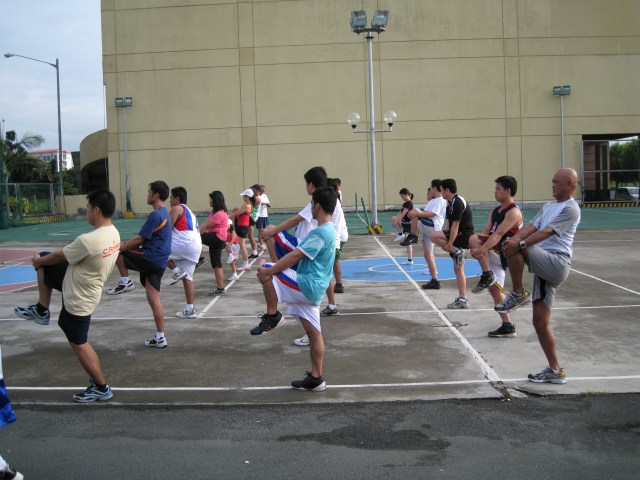
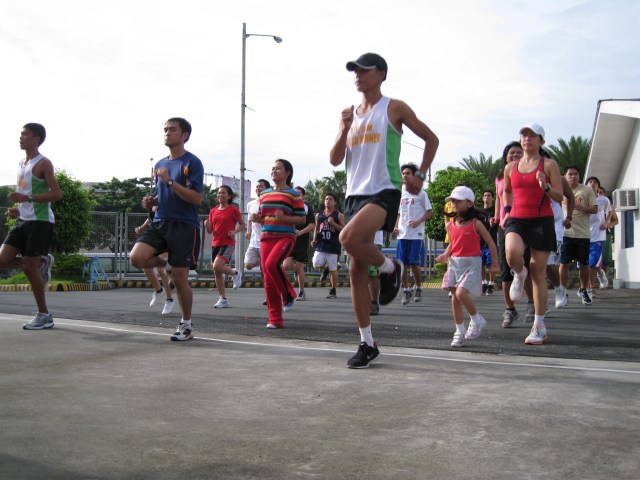
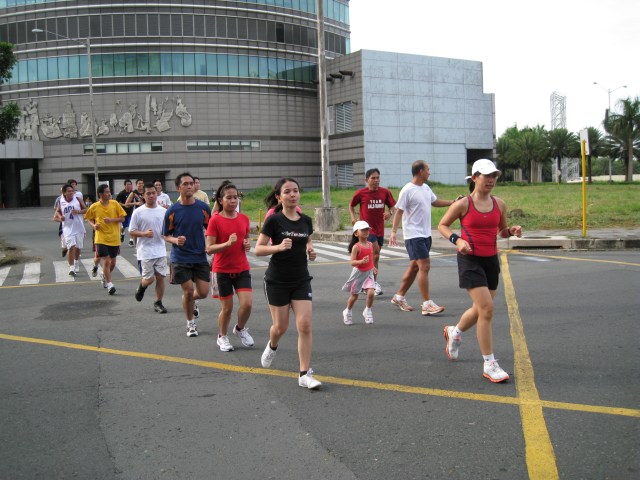
The running clinic was divided into two phases, a lecture and an actual demonstration of running, exercises, and drills to the participants. The lecture on the Basics and Principles of Running was conducted at 3:00-5:00PM last July 10 and the actual demonstration and practical exercises were done the following day at 6:00-9:00 AM, July 11.
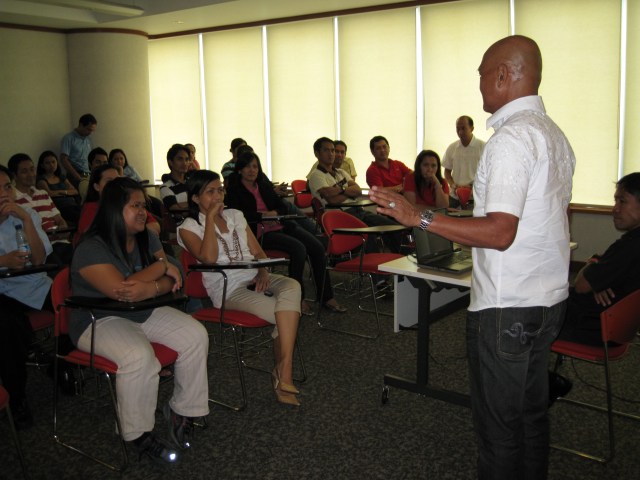
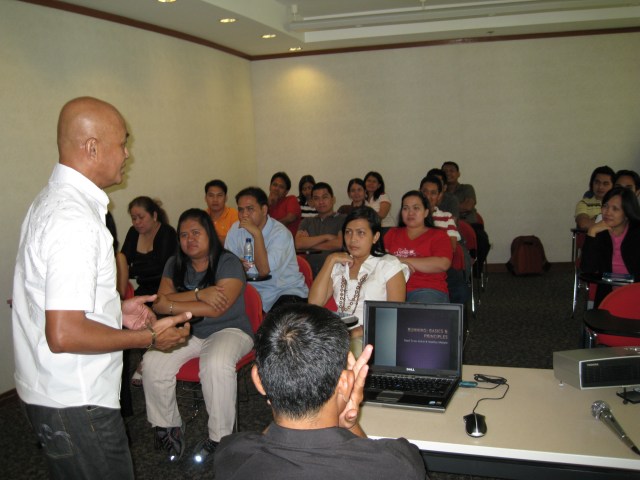
The lecture was attended by almost 40 employees to include Mr Mark Parco and wife, Tiffin, who are competitive runners who are permanent “fixtures” and participants of weekly road races in Metro Manila. The lecture of the Bald Runner was complemented with more explanations and examples from Mr Parco as he was a former Captain of the UP Diliman Track Team. It was a very fruitful lecture to every employee.
Mr Mark Parco, Director of the Office, Introduced Me to the AudienceAround 40 staff & employees attended the lecture.Another View of the Seminar/Lecture Room
On the following day, members of the Elite Team Bald Runner helped in the conduct of the actual demonstration and practical exercises in running. The participants were made to warm-up through jogging, did some stretching exercises, ran along the roads of the Filinvest City, did some running drills, and finally, did a short competition of a shuttle run where the group was divided into three groups. The actual demonstration and practical exercises on running were highly appreciatedby the employees as they requested from their Director the conduct of running activities at least two times a week among them. The Director, in return, voluntarily promised to provide them with a running program for them to finish at least a 5K road race and that he will support their registration fees.
Warm-Up Run with KC, daughter of Mark ParcoProper Stretching ExercisesDrills & Strides Were Done A 2-Km Run Along the Roads of Filinvest CityEverybody Is A Winner!!!
I highly appreciate such heads/directors of offices who are responsive to the needs of their employees for them to be motivated to adhere to physical activities and a healthy active lifestyle. By doing so, I think these employees will be more productive and more focused to their assigned tasks. My congratulations to Mr Mark Paco for being a good example of a corporate head who, aside from being a good “running” example to his wife and kids, he is also a good example to his employees…a true mark of a good leader!
The picture below may not be the exact brand or apperance that the P & G Runners were using during last Sunday’s MILO 42K Elimination Race. However, I would like to show to my readers how this kind of spray looks like. I really don’t know if such spray is already available in the country. If you happen to see one, buy one and try to spray on your cramping legs during your long runs or marathon/ultramarathon race. Good luck!
This is how the Kenyans see why they are winning in most of the Marathon and other long distance Races worldwide. This is the very same attitude I want to impart to the elite runners who are under the Team Bald Runner with the hope of improving their performance in long distance running.
I am presently reading the book, “More Fire: How To Run The Kenyan Way” by Toby Tanser which is a continuation of his first book, “Train Hard, Win Easy”, his first book on Kenyan running. In the concluding portion of the book, the author listed 15 ways to adopt a Kenyan Training Method. And here is the list as copied from the book.
1. Injury Prevention—They say the best way to avoid a spear is to stand out of range; this applies to running. Kenyans are excellent at resting up if a possible injury pain is noticed. Do not let that pain get too near you.
2. Simplicity—Kenyan running is very organic, which in itself is the very essence of the sport. Simple methods are executed with imposing intensity. They are focused and concentrated in their running and they could not afford any distractions. It simply means that they have no time for cellphones, Internet browsing, listening to Ipods, or watching the TV or even going to Malls or social parties. They just simply run and train!
3. Group Training—The power of the group never ceases to be underplayed in improving performance.
4. Diet—Try to eat three meals a day. Kenyans rarely eat between meals and seldom have desserts.
5. Don’t look for perfection—Kenyan athletes do not get down or disappointed after a bad performance or session. Being out there and trying, means you are a winner and trains hard again and that is the Kenyan Way.
6. Don’t add up your weekly mileage—Most Kenyans only know their mileage as a need to satisfy Western journalists. The ethic of the focus is to concentrate on the given day.
7. Choose one coach, or training plan, and stick to it. If you chase one chicken, you stand a better chance of catching it than running after two. Kenyans are very good at getting one 12-week program.
8. Block training—The Kenyans use block work with non-active rest periods. Some call this “periodization”. The Kenyans train for a specific race or series of races. After a series of races, the Kenyans then stops running completely. It can be from 2-3 weeks, to one month or more, but the difference is that during this time the athlete does virtually no training; not even cross-training to keep in shape.
9. Don’t push the body when tired—There is always another day.
10. Run off-road—Running on hard surfaces kills the speed and the natural spring of the legs. 90% of their running workouts are done on off-road at an altitude of 2,000 meters.
11. Be optimistic—If you never kick the ball, you will not score a goal. Kenyans are extremely positive individuals.
12. The secret of Kenyan mechanics appears to be in the foot—Kenyans have very strong ankles, with spring-like qualities that allow the body to bound along with an almost jump-like momentum.
13. Kenyans tend to lean toward a lightweight, flexible shoe—If you break your arm, after a month in a cast the arm is weak; hence if the foot is put inside a rigid shoe that does not allow each and every muscle in the foot to work, these muscles become weak.
14. Run to improve running—There is no need to go to the gym or do some cross-training, Kenyans do their running workouts 2-3 times a day.
15. “Nothing comes easy” is another slogan of Kenyan running, but what is achieved by pushing your own limits is life’s richest reward. To collapse out on the roads with blood in your shoes knowing you gave it your best shot is reward beyond words…
I am not telling everybody to follow this list but knowing how these world-class elite athletes train, this list would answer the “why & how” the Kenyans are consistent Champions in long distance running events worldwide.
The Book Bought From Zombie RunnerPicture of Kenyan Runners From the Book On Marathon By Bruce Fordyce
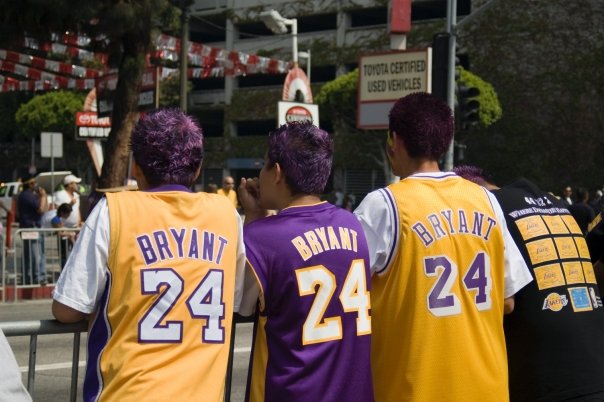
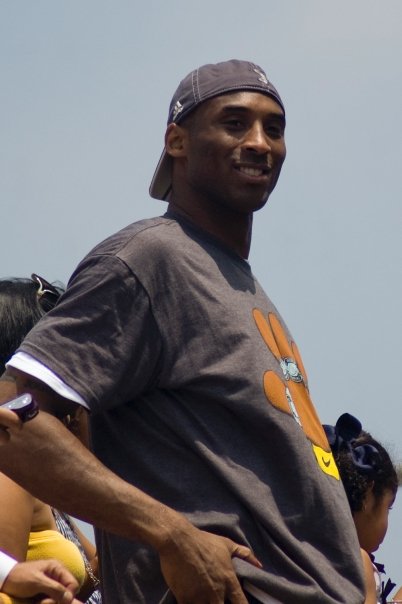
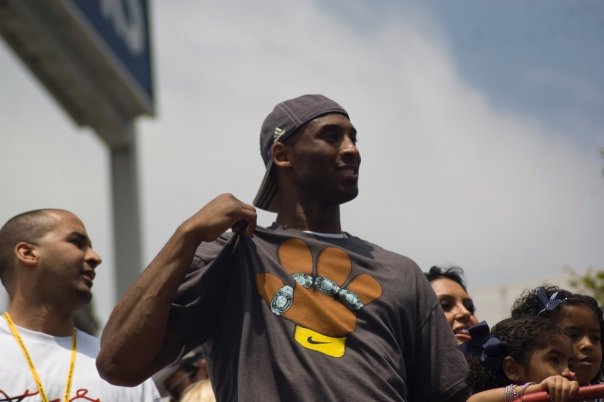
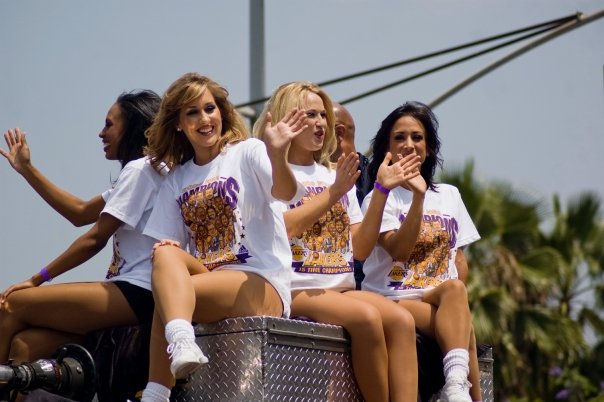
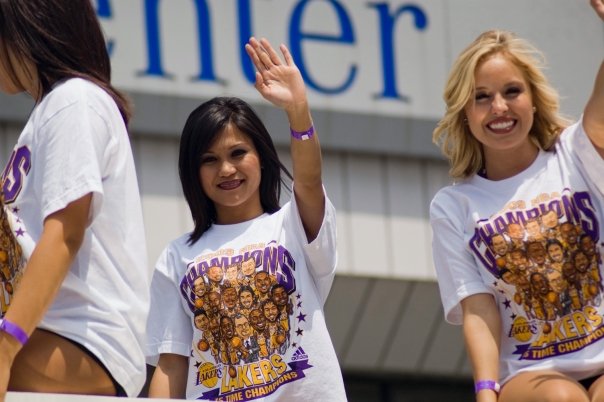
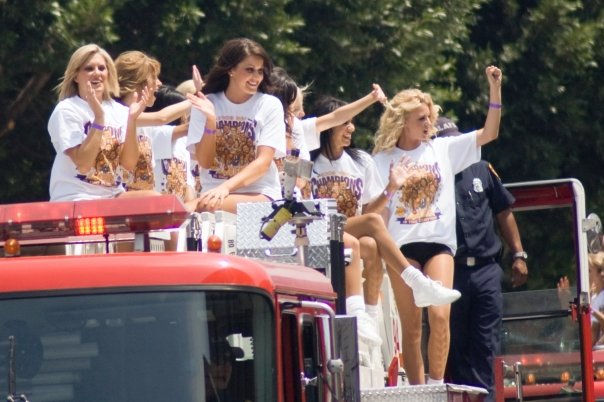
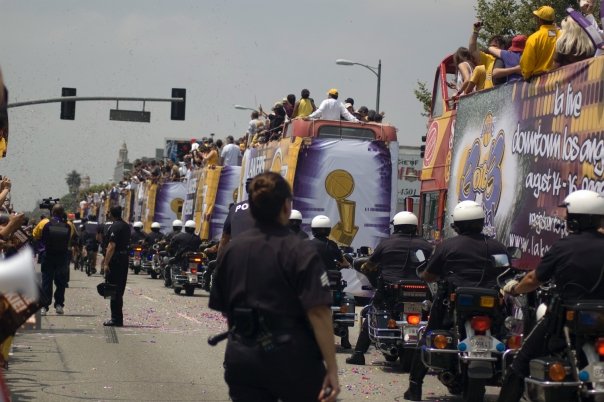
These pictures are dedicated to the Hardcores and Pinoy Fans of the LA Lakers.
Kobe Bryant's FansKobe Bryant, NBA Finals MVPMore NBA Championship Rings To Come!!!LA Lakers Cheerleaders (To The Hardcores, Any Comments?)More Pics of the Lakers CheerleadersMore LA Lakers Cheerleaders2,000 Police Personnel Were Deployed To Secure The Activity
Note: Pictures Posted through the Courtesy of Mr Victor Lazo, a friend of the family. Thanks, Victor!
The following are my running plans and “dream” runs until I am still strong to run:
1) Boston Marathon—They say that you are not an ultimate marathoner or runner if you don’t experience the “Holy Grail” of Marathon Running on Earth. First, I have to look and join for a fast marathon race which is Boston qualifier for me to have a finish time of 3:45 hours in my age category.
2) Manila to Baguio City Run—I made this announcement during the Awarding Ceremony of the 1st BDM 102K Ultramarathon Race. This will be a 3 to 4 -day multi-stage run along the McArthur Highway. There is no registration fee as each runner must have his own support system.
3) Mt Arayat Traverse Run—With the approval of the security forces within the area, this will be a one-day affair. There will be no registration fees. Each runner will have his own support system with him during the run.
4) Mt Tirad Trek & Tirad Pass Run—The run will start infront of the Candon Elementary School in Candon, Ilocos Sur and runners will go to Salcedo, Ilocos Sur up to the peak of Mt Tirad, where General Gregorio del Pilar died, and then back to the starting area. The distance is approximately 80-90 kilometers. No registration fee. Provide your own support.
5) Ilocos Norte Sand Dunes & Beach Run—From as far as the boundary of Ilocos Sur & Ilocos Norte (Badoc, Ilocos Norte) to Pagudpud, Ilocos Norte, running along the sand dunes and the coastal beach of Ilocos Norte. There is no need to participate in the Marathon Des Sables and spend $5,000 for registration fees for each runner. Instead, runners will run the sands of the Ilocos region, from South to North direction and end with a beach party in Pagudpud’s Blue Lagoon. No registration fee. Provide your own support.
6) Fort Magsaysay to Dingalan, Aurora Run—This is entirely a trail run that starts from Fort Magsaysay, Palayan City (Nueva Ecija) to the shores of Dingalan, Aurora with the Pacific Ocean. This trail has been used for the training of the Philippine Army’s Scout Rangers and Special Forces. No registration fee. Provide your own support.
7) A 100-Mile Trail Run in California—I hope this will be the ultimate test in my running career.
Any takers? These running adventures will ultimately make our Metro Manila “runabouts” as part of our past. You can signify your intentions by making your comments. Have fun and we’ll keep on exploring through running!
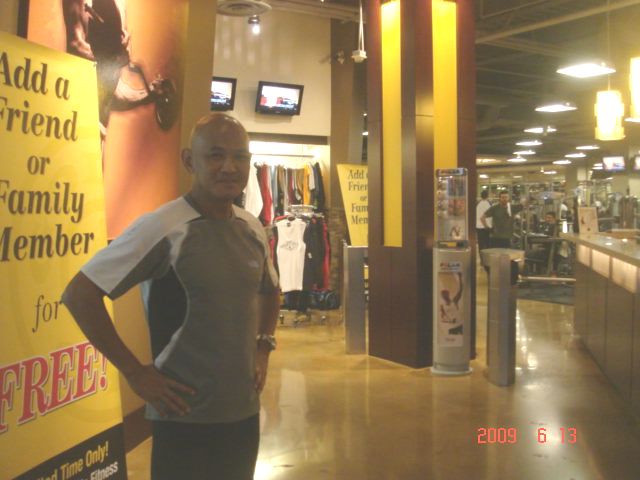
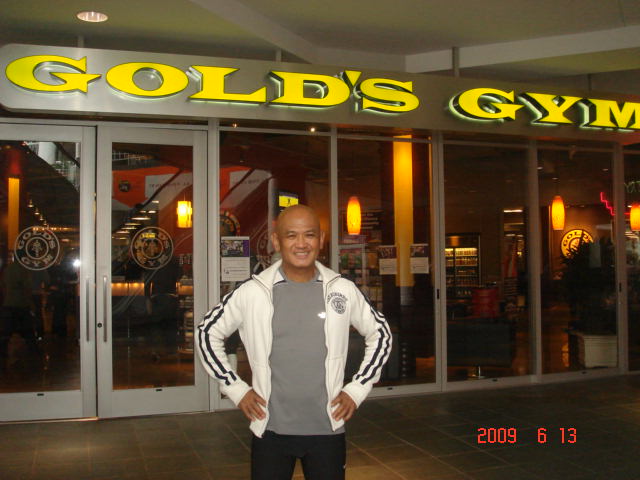
My daughter, Jovelle, brought me to her Pilates Class at the Gold’s Gym at 7th & Figueroa Streets in Downtown Los Angeles at 1:00 PM. The class was held inside one of studio rooms of the Gym where it could accommodate at least 30 people. We entered the room a few seconds before the class started where I was the only male in the group. After taking some yoga mat, roller tube foam, foam blocks and light dumbells from the equipment room of the venue, the class started immediately.
It was my first attendance to a formal Pilates class and it was a new experience for me. There are exercises that seem to be easy but after doing them for more repetitions, I felt that there are muscles on my core and back that are not fully used and stretched.
It was a non-stop transition from one exercise to another and I started to sweat after 15 minutes. I hope I could explain in details the different exercises where you have to use those hard foam blocks, those hard ball weights, and those hard foam tube that you roll on top of your body and arms while making those sit-ups from lying position on your back and other exercises which are mostly on the mat.
Aside from making the core muscles strengthened, the back muscles and spinal bones were also given some exercises to make them in their original alignment and make you sit tall.
I’ve observed that there are some pose that resembles yoga positions but I think Pilates exercises are more intense, though they emphasize also correct breathing cycle through a rythym of inhale and exhale. I like that pose where you lift your back & head & both legs/toes straight up in the air while your straight arms are pumping (and your butt is only the one that touches the mat) while breathing with a rhythm. This exercise really hardens your abdominal muscles!
The ladies, to include my daughter, in the class were very graceful in their movements as if everything to them was so easy but I was there at the edge of the room moaning, breathing heavily and sweating. And I realized that all the ladies, to include the instructress, were all in their 20s, 30s, and I was the only guy who is in his late 50s!!! Ha! Ha! Ha! Well, the instructress noticed me in my predicament and she just made a general statement that “to take it easy if you are new to the Pilates class”! It was nice to hear it and I slowed down with my exercises after hearing her words of warning. (To the Hardcores: Guys, I was surrounded with beautiful ladies!!! Ha! Ha! Ha!)
Due to the smooth transition and continous instruction from the lady instructor, the class and different exercises passed so fast that I wanted to have more of them. The class lasted for one hour. It was a nice experience to attend a formal class in Pilates. I hope I will be able to make Pilates as part of my running exercises. In fact, in my readings from the training of top ultrarunners, they recommend Pilates exercises to strengthen the core muscles and be able to maintain a good running form.
After the Pilates class, I had an additional 30-minute workout with the machines and kettle bells in the gym.
I hope I could attend more of the Pilates classes in the coming days.
If you haven’t tried Pilates, find time to do it in your Gym workouts or better buy those DVDs where you could play and imitate the movements while watching it. This is not a guarantee that it will make you faster in your runs immediately but I am sure it will strengthen those hidden muscles in your core & back which you haven’t exercised before and prevent your body from injuries related to your running and other physical activities.
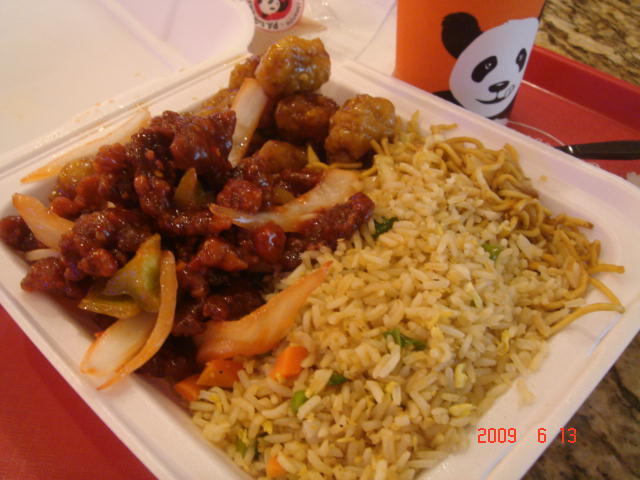
I Was Shy To Ask Permission For A Photo During The Pilates ClassA Pose @ Gold's Gym (7th & Fig) Los AngelesLunch @ Panda Express After Pilates Class ( With Beijing & Orange Chicken)
This is not about the movie which was released in 19997 about the eruption of a volcano in Dante’s Peak, a small town somewhere in the USA. The movie was played by a pair of popular stars in Hollywood—Pierce Brosnan (the former James Bond actor) and Linda Hamilton (Sarah, the lady character in the Terminator movies).
For the past days, I’be been planning to run to the highest peak of Mt Hollywood at Griffith Park, starting from the house as part of my running workout. Finally, yesterday, I went out of the house bringing with me my Nathan Hydration Belt, some cash and identification card. It was 11:40 AM and the sky was covered with thick clouds and there was a 20% chance of rainfall as predicted by the Weather Report. The weather was cool at mid-60s and I wore my TNF long-sleeved technical running shirt.
From the house, I maintained an average pace of 5:45-6:00 mins/km while running along the sidewalk, facing the incoming traffic. The streets from the house to Griffith Park consisted of uphill & downhill terrain but there are times that I had to stop whenever I cross busy intersections. There are designated pedestrian crossing areas on the streets that you have to wait for that pedestrian light (a walking figure in white light) to glow while a blinking red light with a figure of a palm of the hand means that you are not allowed to cross the road yet! It is a simple street light in crossing a street but the people here follow the lights even without the presence of a police. By the way, do you wonder why there are no traffic aides or policemen here in every corner of the streets? The answers are: the traffic lights are there (very efficient) in every crossing and the citizens (drivers & pedestrians) are disciplined in terms of road rules and regulations. In the Philippines, we have those traffic lights, yet, we still have those traffic aides & PNP & Highway Patrol & LTO, but most of us do not follow those pedestrians lights and coss the streets along the pedestrian lanes!!! Very simple rule but it is hard to implement. Your answer is as good as mine.
After running for almost 10 kilometers, I finally reached the foot on the northern part of the mountain at the Griffith Park. I intended not to go to the trails that I’ve been into last year and I started to explore while I was on the road that goes to the Griffith Park’s Golf Course. While running uphill along the asphalted road, I saw an opening of a trail track on my left and I immediately went to it and started to run uphill. Yes, the small trail led me to a wider trail which is a part of those many trail roads/fire roads that snake up to the peak of every ridge at Mt Hollywood.
Even with the coolness of the place, my sweat, coming from the visor of my runner’s cap, started to drip to my legs and shorts and it was continous while my legs were taking shorter strides and my arms were swinging at a moderate frequency. It was a very challenging uphill climb where I had to brisk walk along steeper climbs along the way. I have to practice what I’ve learned in ultra trail running—“brisk walk” on those steep uphill climbs and “fly” on the downhill side in order to preserve my strength for the rest of my running workout.
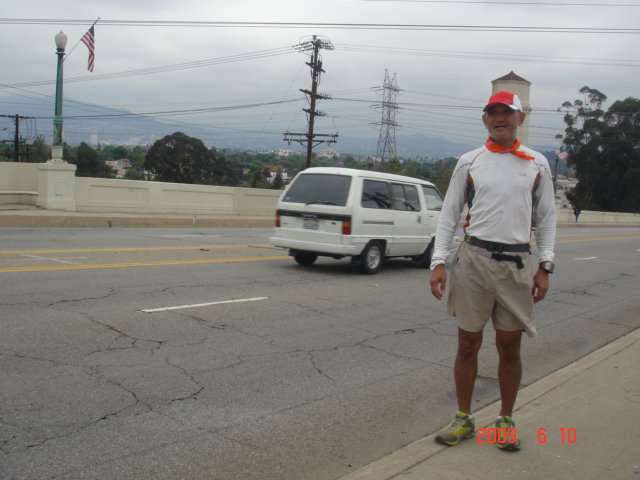
At The Hyperion Bridge where I Had A Picture With My Daughter Running The 1st City of Angels Half-Marathon (The Mountain Range on the Background Was My Destination)My Entry Towards Griffith ParkFinally, I Entered This TrailTrail Running Alone Is Refreshing!
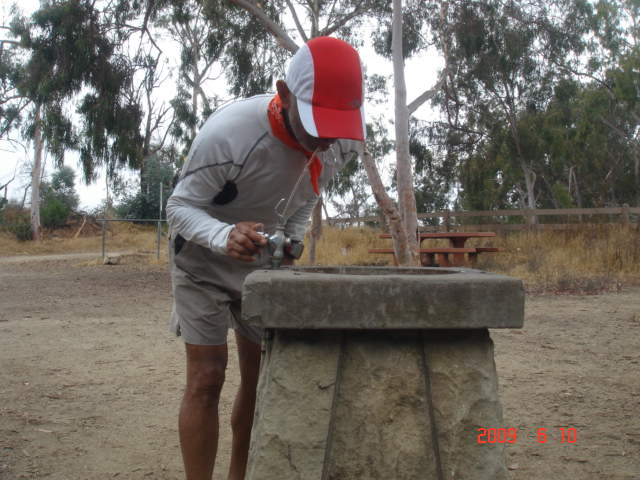
After 15-20 minutes of steady uphill climb, I came up with a water fountain! I walked towards it and drank some water and took some pictures and later I was back on my run. Later, I was running on an asphalted road but it was a short distance. At the end of the asphalted road, I saw some people who are preparing for a buffet lunch in one of the vista places along the route and I realized there was a movie or TV “shooting” in progress within the vicinity. I did not dare to stop but just greeted the people I met along the road.
My First "Aid Station"A Drinking Fountain On The Mountain Park
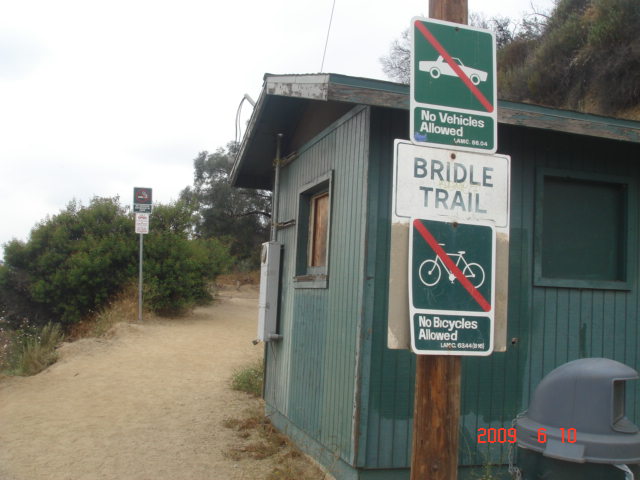
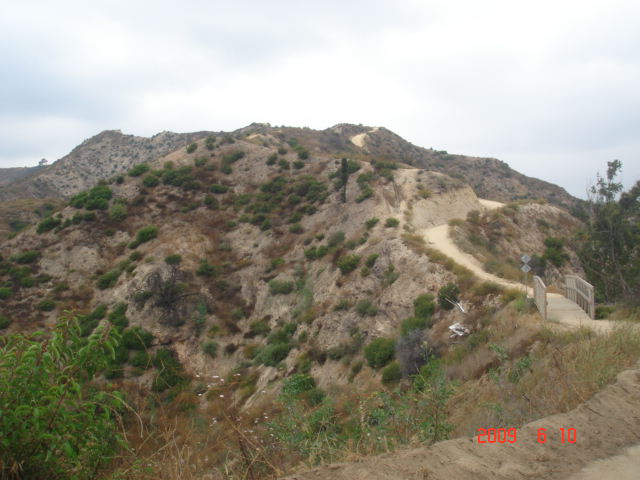
I entered Bridle Trail and that was the start (again!) of another more challenging uphill climb. Every time I reached a high part of the route, I would look up for another target to reach and study the trail that leads to it. That procedure had been repeated until I reached the highest peak of the mountain. I did not realize that the name of the highest peak is Dante’s Peak. It was my daughter who told me of the name as she already reached such place by hiking. I further “googled” it and I was able to see this website.
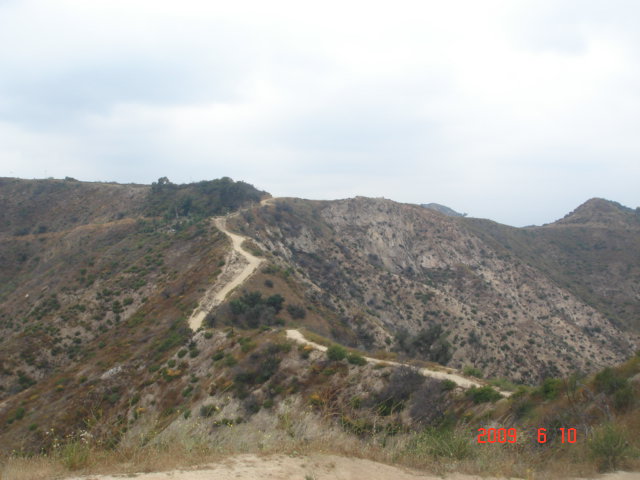
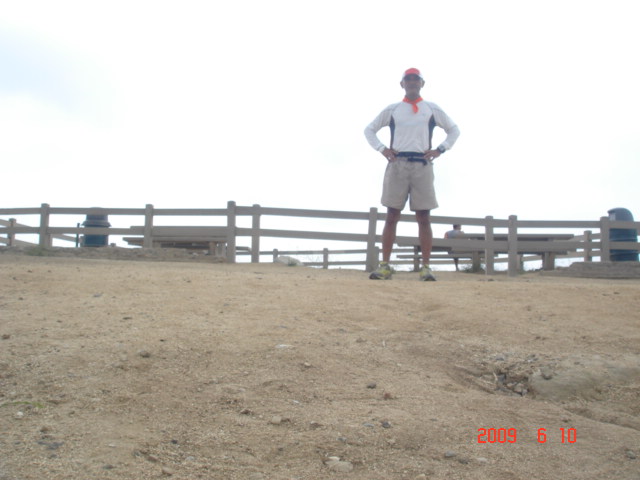
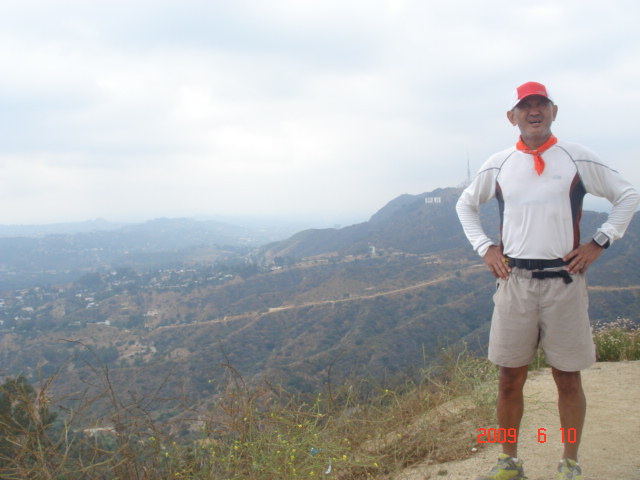
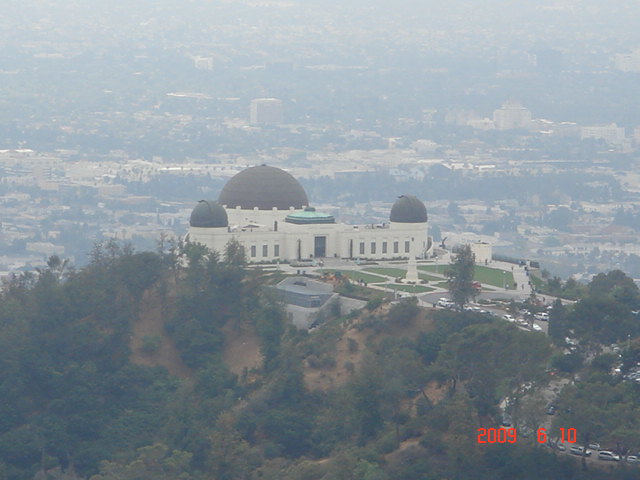
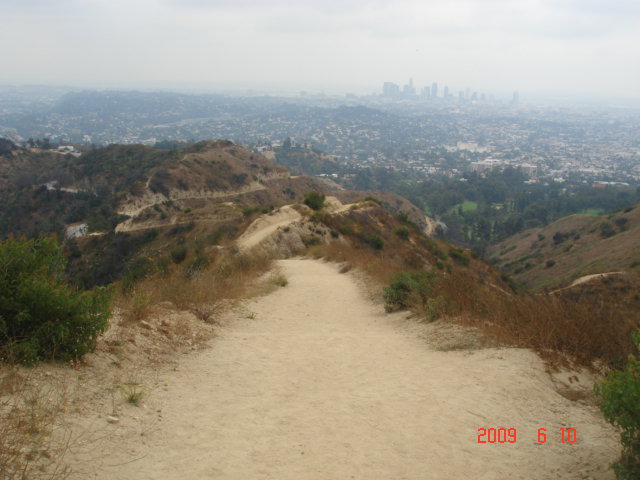
The Entrance To Bridle TrailMore Trails...And More Uphill Climbs...Finally, A Pose at Dante's PeakHOLLYWOOD Sign at The Background (My Right Elbow Pointed To It)A View of the Back of the Griffith Park ObservatoryAhh..Running Downhill
After taking some pictures at the said place, I was thinking of pushing myself to go to the HOLLYWOOD sign but after looking at my GF 305, I was already on the road for more than 2 hours! So, I decided to return here on my next running workout and be able to reach the said sign and retrace the route I’ve taken. So, Dante’s Peak became my turn-around point and I prepared for downhill run!
The traction of my TNF Arnuva 50 BOA trail shoes was very helpful on my downhill run as it gave me the needed traction on those steep portions of the route. My quads started to absorb the weight of my body and I started to feel some “burning” pain and my knees were starting to show some pain, too while trying to gain speed on those downhill runs. It was my mistake not to bring any GU/sports gels on this workout as I started to feel hungry. As I reached the water fountain, I drank more water and “peed” on the forested area. After a few minutes of running along the trails, I finally reached the place where I entered and then slowly jogged on the asphalted road until I reached the Los Feliz entrance of the park.
After running for another 3 kilometers on the streets, I entered Ralph’s Grocery Store and bought some cookies and sports drinks. I ate and drank what I bought while I was “brisk walking” along an uphill climb at Glendale Blvd. Finally, I resumed my running until I reached the house. I was able to run/jog/brisk walk a distance of 30.66 kilometers in 3:40 hours! It was a tiring “runabout” but it was refreshing to be out in the mountains and explore what I want to see.
From the base of the mountain, I thought of coming up with a test or survey on how or what the person/s I met or passed along the trails would react if I greet them or wave my hand to them. I usually greet walkers/hikers or runners along the trail with a simple “Good Morning” or “Good Afternoon” or just simply wave my left or right hand while smiling at them. This simple courtesy was a good lesson that I’ve learned and observed when I had those trail runs at Mt Wilson with my kids last year. I was able to count 24 people whom I met or passed along those trails at Griffith Park. Out of the 24, only 12 of them greeted me back, most of them ladies and couples (husband & wife) who replied “Hi” or “Hello” and they are “white”. I saw some Asians (I really don’t know if they are Chinese or Vietnamese or Thais or Koreans or Japanese) but they did not greet me back. Unfortunately, I did not see any Filipino!
After the run, I had a shower and ate a lot of food. Later, I started to cook for dinner while watching the NBA Finals’ Game #3. As I predicted, the Magic won this time.
I’ll be back for another run to Dante’s Peak and to the HOLLYWOOD sign soon!
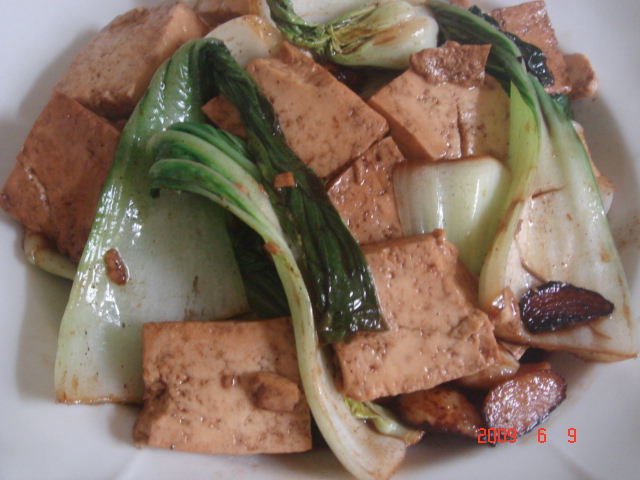
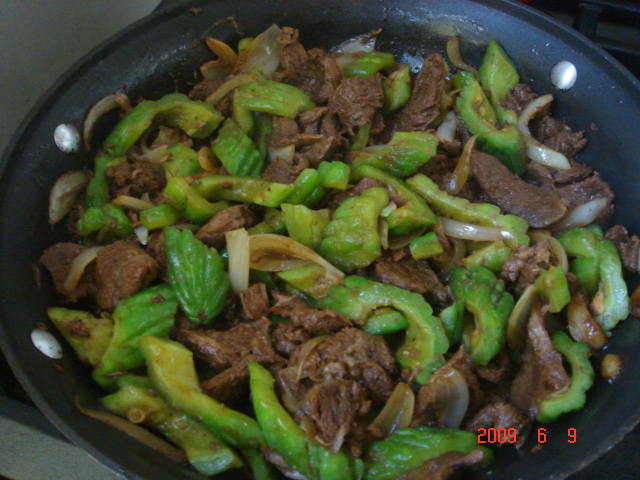
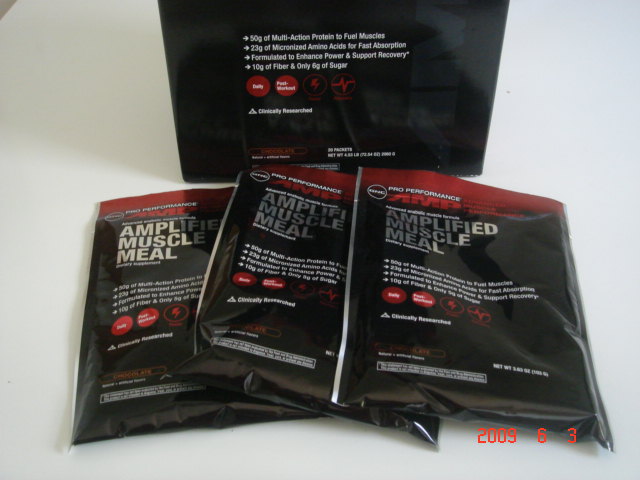
And finally, my food (yes, I cooked them!) and supplement drinks for the past days!!!
Tofu With Bochoy (Pechay)Beef With Ampalaya (Bitter Gourd)My Supplement DrinksOrganic Honey
Last November 20, 2007, I made a post about Yasso 800s. It is a simple formula to guide a runner who is training for a marathon race to predict his finish time. This simple formula (?) to predict one’s finish time came out from the observation and experiences of Mr Bart Yasso who is now the Chief Running Officer of the Runner’s World Magazine as he finished and trained for more than 1,000 endurance sports/races for the past 29 years. However, in my first post about Yasso 800s, I was not able to tell or mention some important details about the said workout.
This post will now fine-tune what I’ve posted almost 21 months ago. Yasso 800s is supposed to be a “speed” running workout done at the oval track. As part of ones preparation for a marathon race, this is supposed to be done at least 5-6 weeks before the marathon race day. Which means that you were able to build-up the much needed “foundation” of mileages/kilometers in order to develop the endurance (strong legs without any injury and aerobic capability to sustain a faster pace) through your easy runs, long runs, tempo runs, speed runs, and hill repeats/workouts.
During the Yasso 800 session, one has to run at least 10 repetitions of 800 meters with 400 meters jog in between repetition. The average time of your 10 repetitions will likely be your time for the marathon race, not in minutes, but in hours. For example: if you have an average of 3:32 minutes for the 10 repetitions you have done running at a distance of 800 meters at the oval track (2 laps around the oval track at Lane #1); most likely, your finish time in the marathon race is 3 hours & 32 minutes! It is very easy, you just convert the minutes into hours. It is mandatory to have at least 10 repetitions of the Yasso 800s in order to be accurate in your prediction for your marathon finish time.
However, according to Mr Bart Yasso, the Yasso 800 is not an accurate or perfect predictor of your marathon finish time time as you need to make some adjustments depending on the terrain of the course and the prevailing weather during race day. In extreme conditions of terrain and hot weather, a runner who has 3-4 marathon finishes on his/her belt, he/she can make adjustment by adding 10 minutes; and for those competitive and experienced marathon runners who have finished more than 5 marathon races, they can add 5 minutes to their average Yasso 800s result.
If you are preparing for the MILO Marathon Eliminations on July 5, you can try this workout and hit the Lane # 1 of the ULTRA Oval Track as soon as possible. Just be sure those “walkers” and slow runners (with their Ipods) at Lane # 1 will not interfere with your Yasso 800s. Good luck!
By the way, this is my training target pace data in preparation for the MILO Marathon:
Easy Run—5:46 mins/km
Long Run—5:46-6:15 mins/km
Tempo Run—4:45 mins/km
Speed Run—4:12 mins/km
Yasso 800s—3:35 mins
So far my training had been going on for the past days since I finished the LA Marathon. We will see how this training will turn out in the coming days to come.
In my earlier posts in 2007, I mentioned about the writings of Dr George Sheehan whom I consider as the Philosopher of Running in the Modern Times. As a tribute to this old runner and prolific writer, I always mention his tips and suggestions to runners whenever I conduct lectures and running clinics to “newbies” in the sports of endurance running. Up to this day, his “tips and suggestions” are still valid which are basically explanation of the basic principles in training for runners.
I also mentioned in my previous posts of my 100% acceptance on the training methods and programs of Arthur Lydiard in running which is a result of years of experimentation and studies on himself. Up to this time, I am still a strong believer and follower of the Lydiard Method of Training in Running.
If you want to know the details of the works and written studies of these two running icons, you can easily “google” their names and you have a lot of manuscripts and books you can read in the Internet. However, these runners/writers thoughts will always boil down to the “basic principles of training for running” and other endurance sports which in my mind are the most important for everybody to remember, whether you are a beginner or a competitive or an elite athlete. The following principles are the most important and basic for everybody:
1) Build-Up Foundation—For you to become a strong and fast runner, you must be able to build-up the much needed foundation because you need to be stable and firm. It is like constructing a house or a building that you need to build a stable foundation first before you construct those rooms, walls, stairs, and others. In running, you must be able to progressively introduce stress to your body system so that you will develop strength on your legs and improve the aerobic capability of your respiratory and blood circulation system. Remember the word, progressively! It takes time for you to develop those strong legs and strong heart & lungs to run a 3K, 5K, or 10K run. It takes patience and perseverance to build-up a stable foundation in running. In my experience, the longer period I build-up my mileage and the more number of my weekly mileage is, the more I am stable and prone-free from any injury. Would you believe that I trained for my first marathon for one year by just building-up those mileages?
2) Consistency—If you want to be a good and competitive runner, you should be consistent in your training. It means that you must at least run every day or maintain a certain level of fitness in running. It means that for a certain level or classification of a runner (beginner, non-competitice, competitive, elite, or national elite), you must maintain a number of average kilometers or miles to be ran for the week. To a leisure/non-competitive runner, he/she must be able to maintain at least a weekly total of 40 kilometers to maintain a certain level of fitness. If you are a competitive runner, the more you have those weekly miles and kilometers to cover. Through consistency in running, you must also remember to apply the “hard-easy” method. It means that you must be able to “listen to your body”. Assuming that you are still building-up your foundation, if you ran 10 kilometers today, make sure you run a lesser number of kilometers the next day or on your next session, and follow this method in your training program. If you are already in the competitive level, do not do your “speed” training in two consecutive days. Let your muscles/body system recover and you will be surprised that your body will adapt to the stress and you will become stronger and faster in your next workout.
3) Specificity of Training—Simply said, if you want to be a stronger and faster runner, you must run! Do not swim, do not bike, do not develop nice muscles at the gym, do not play badminton, or do not play basketball in order to improve your running finishing times. Stretching, yoga, pilates, plyometrics, and other drills are just supplementary means to improve your performance but 99% of your effort must be in running.
Just remember these three (3) basic principles in training for running and you will enjoy the sports we love most!!!
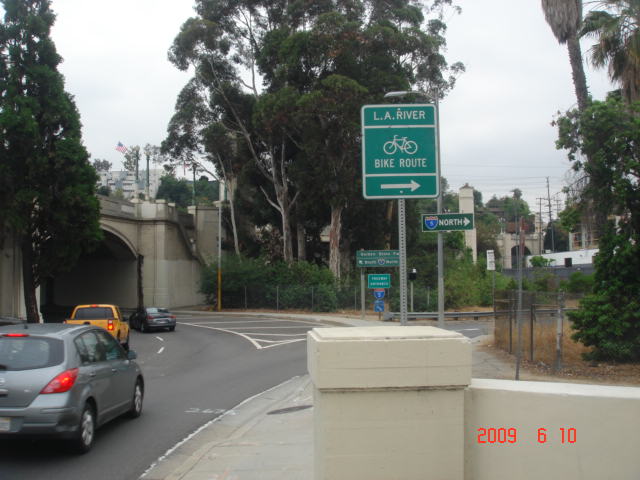
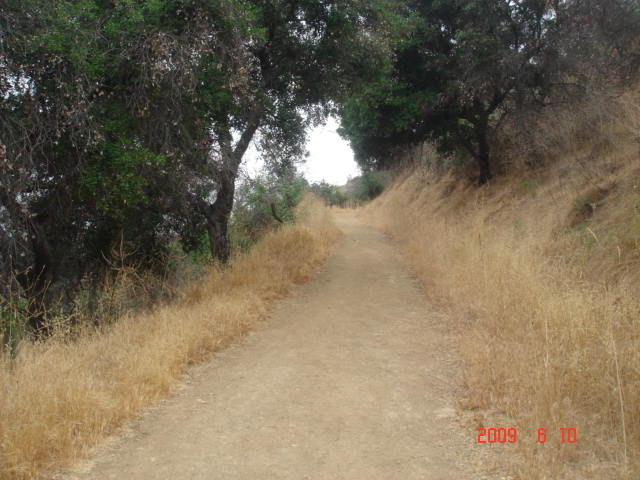
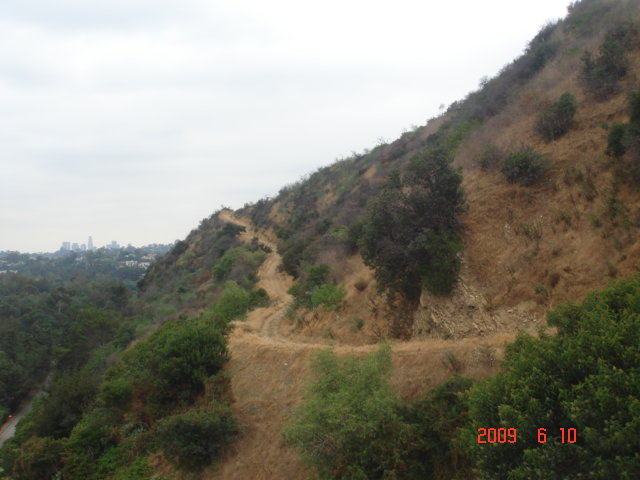
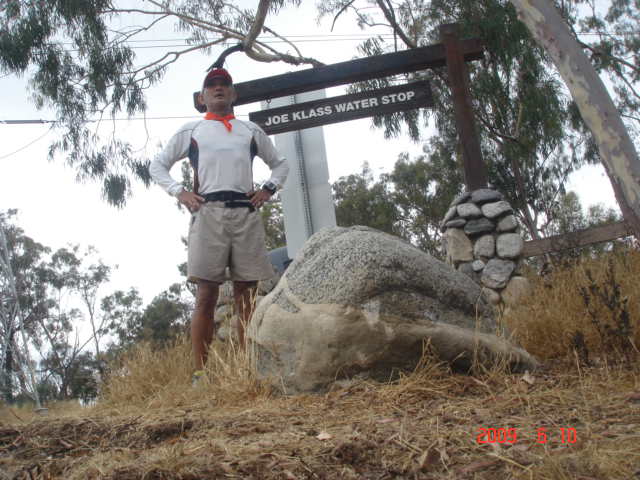
Good luck to all the runners in the Mizuno Infinity Run! My spirit will be with you as I will be contented to have my easy run at the Elysian Park Trails and then move to the Griffith Park Trails and later end up my runs at the Silverlake Reservoir & Echo Lake Park Loops!




 Bald Runner
You must be logged in to post a comment.