Running Lecture @ Wyeth, Phils.


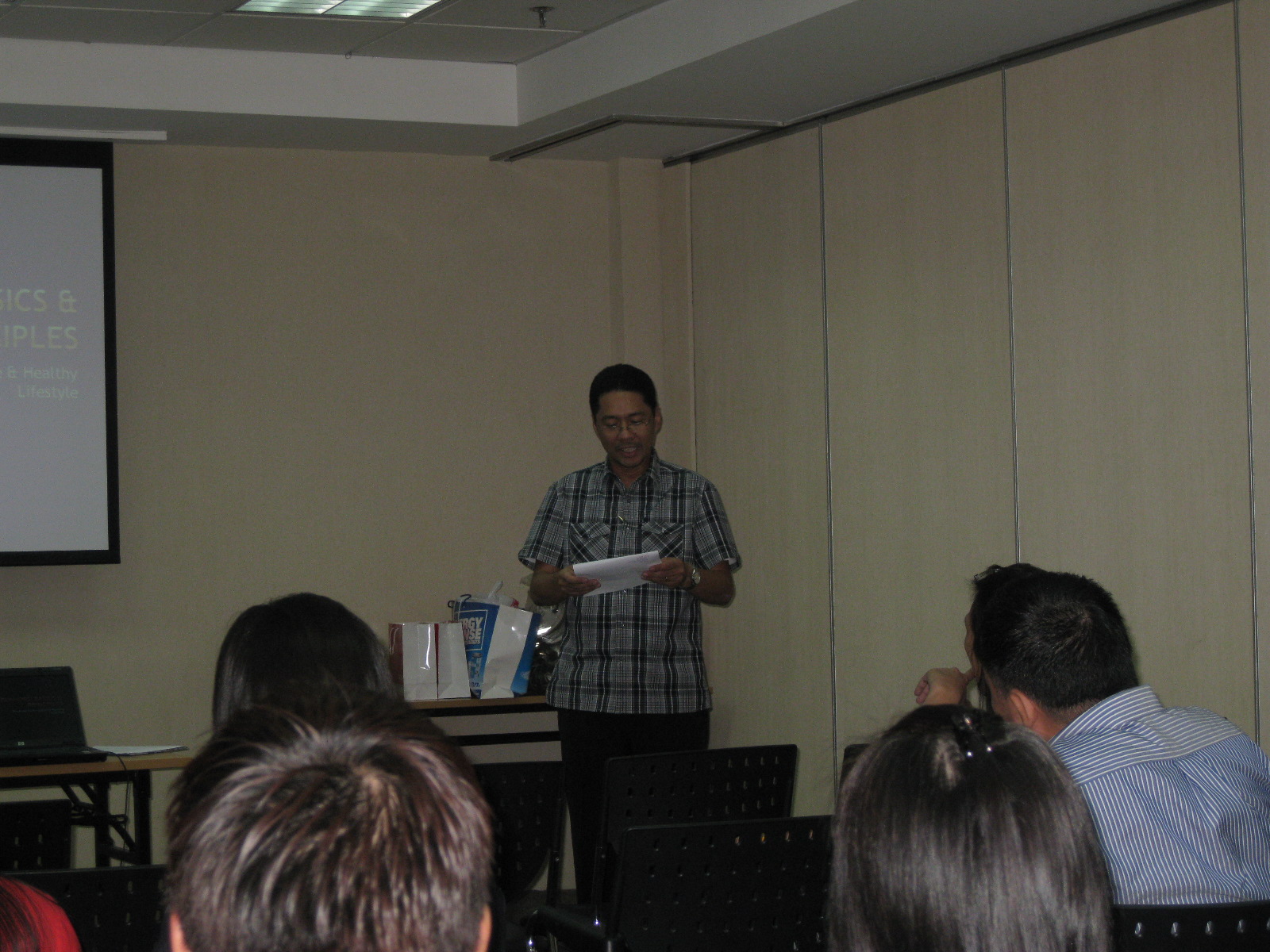
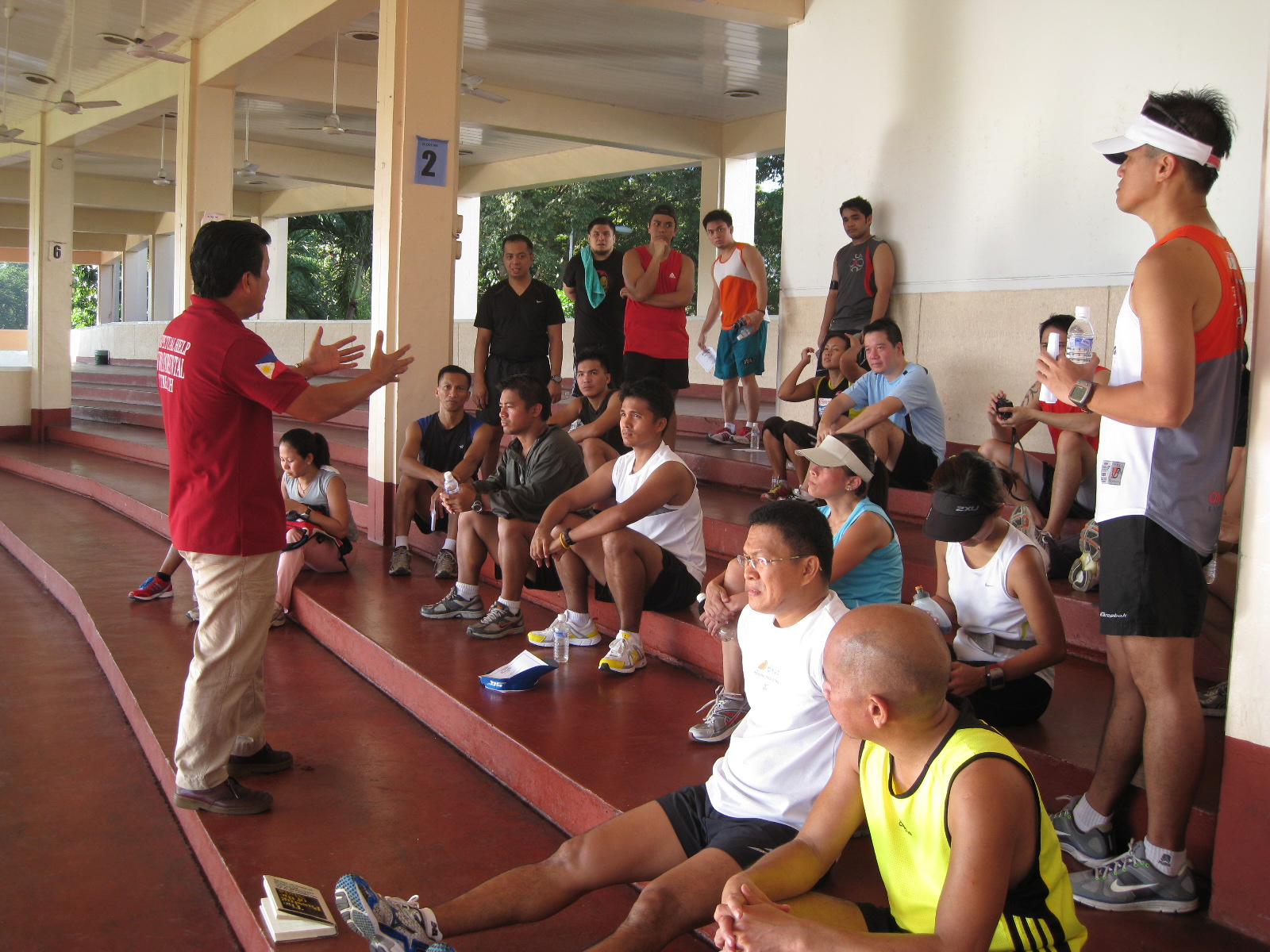
Chito Carreon, a passionate ultrarunner and “veteran” of BDM 102K Ultramarathon Race and one of the executives of Wyeth, Philippines, invited me for a Running Lecture/Clinic to interested officers, staff and employees of the company on the first week of October 2010 at their corporate office in Makati City.

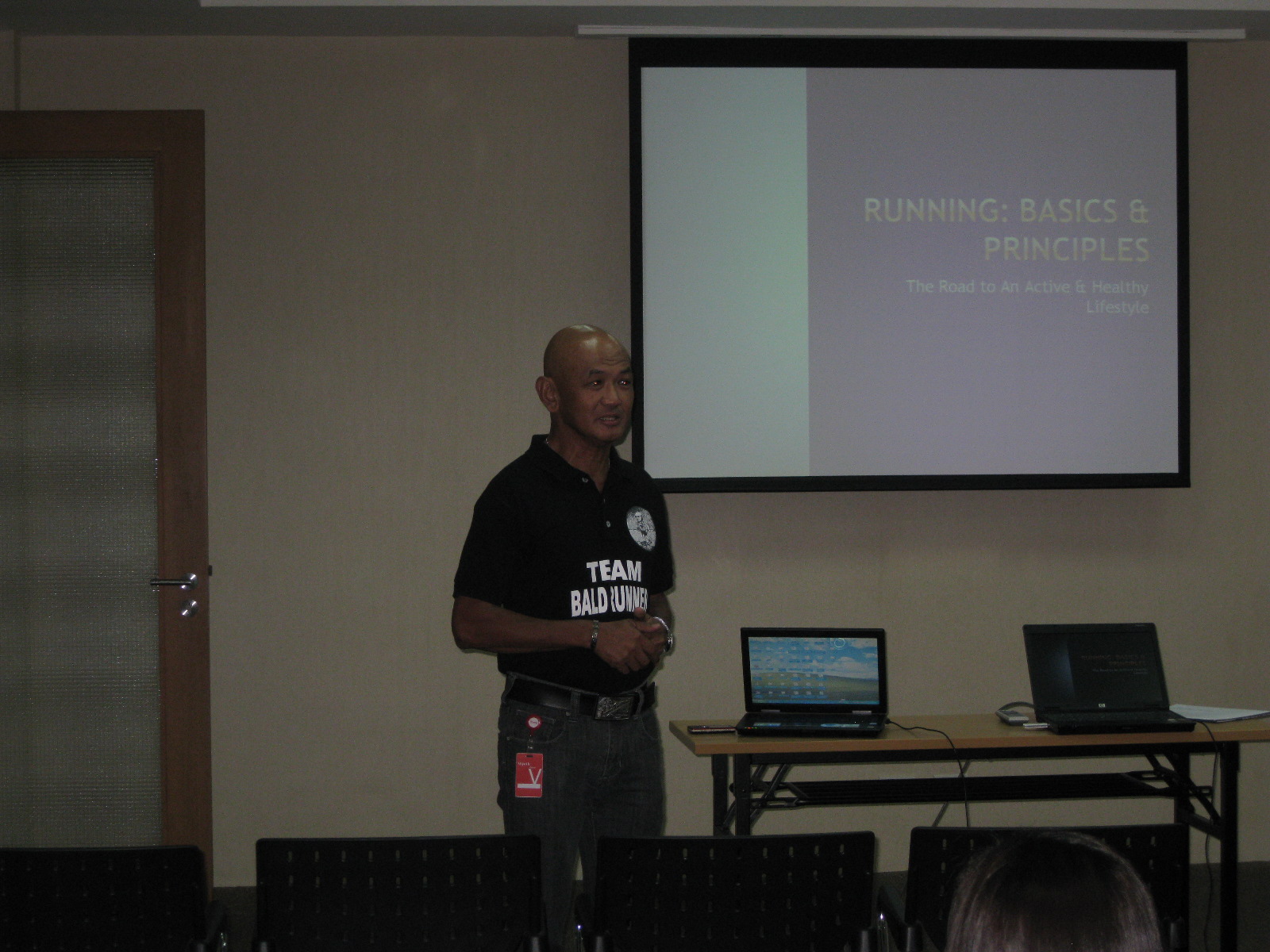
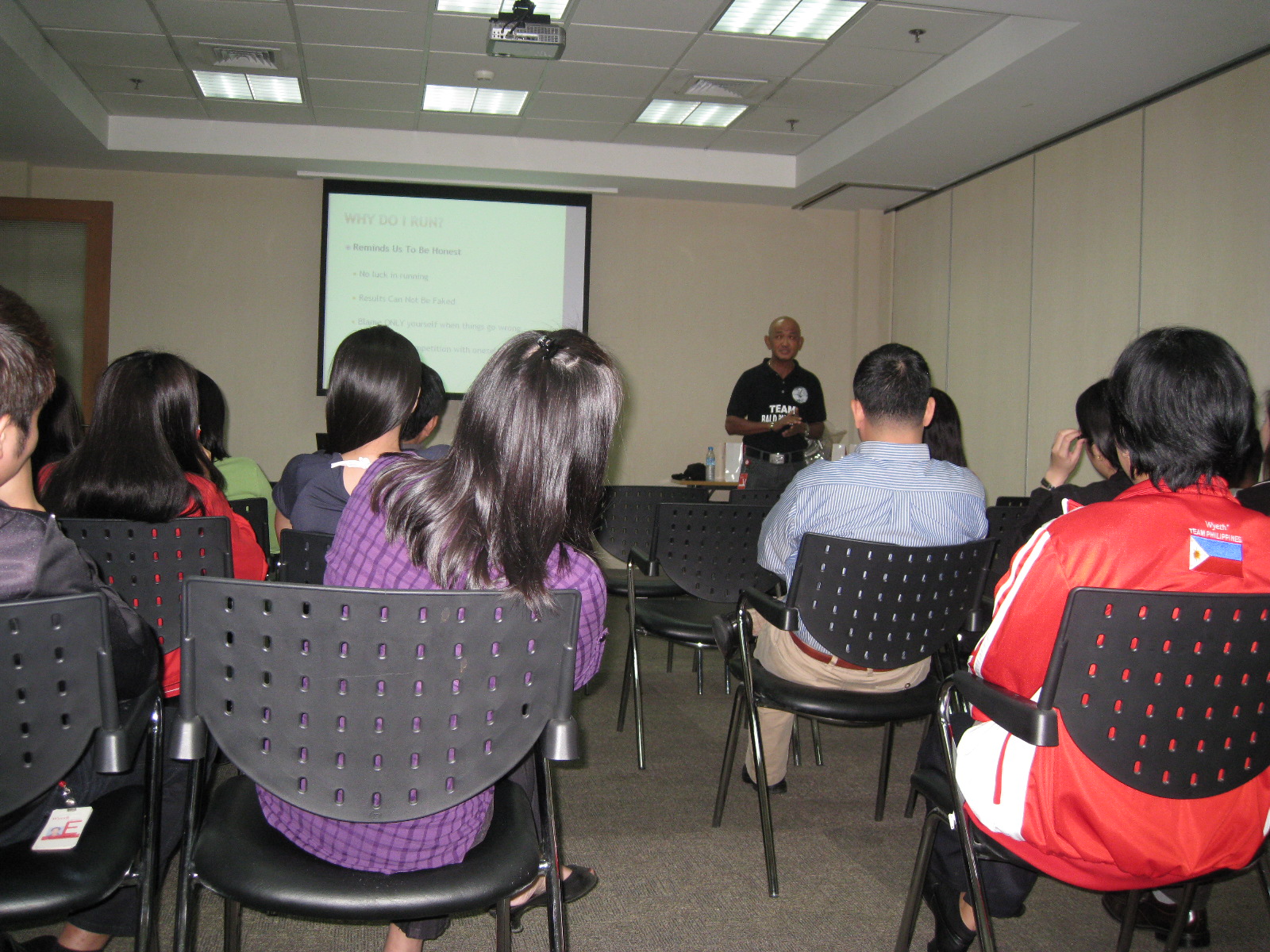
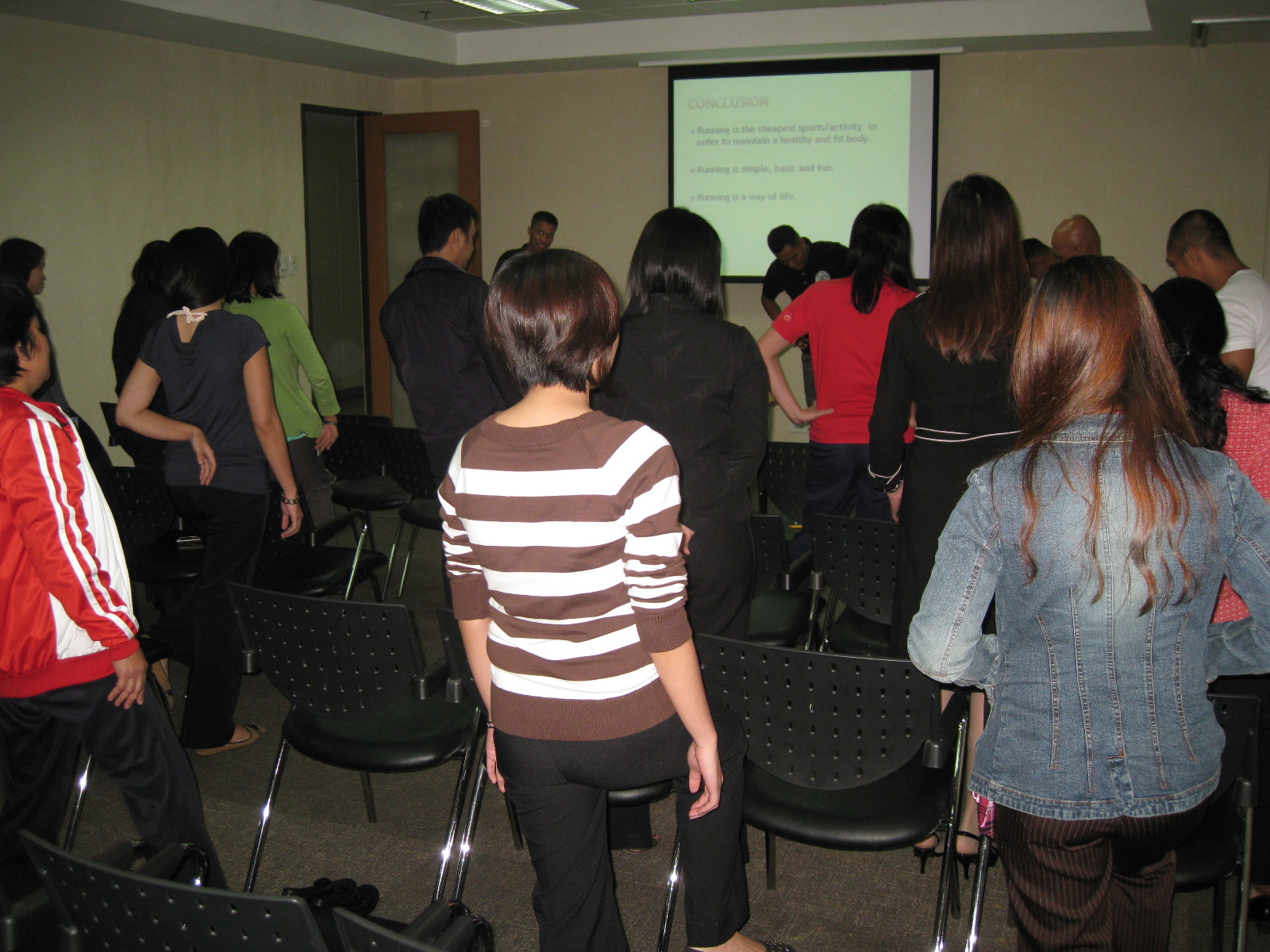
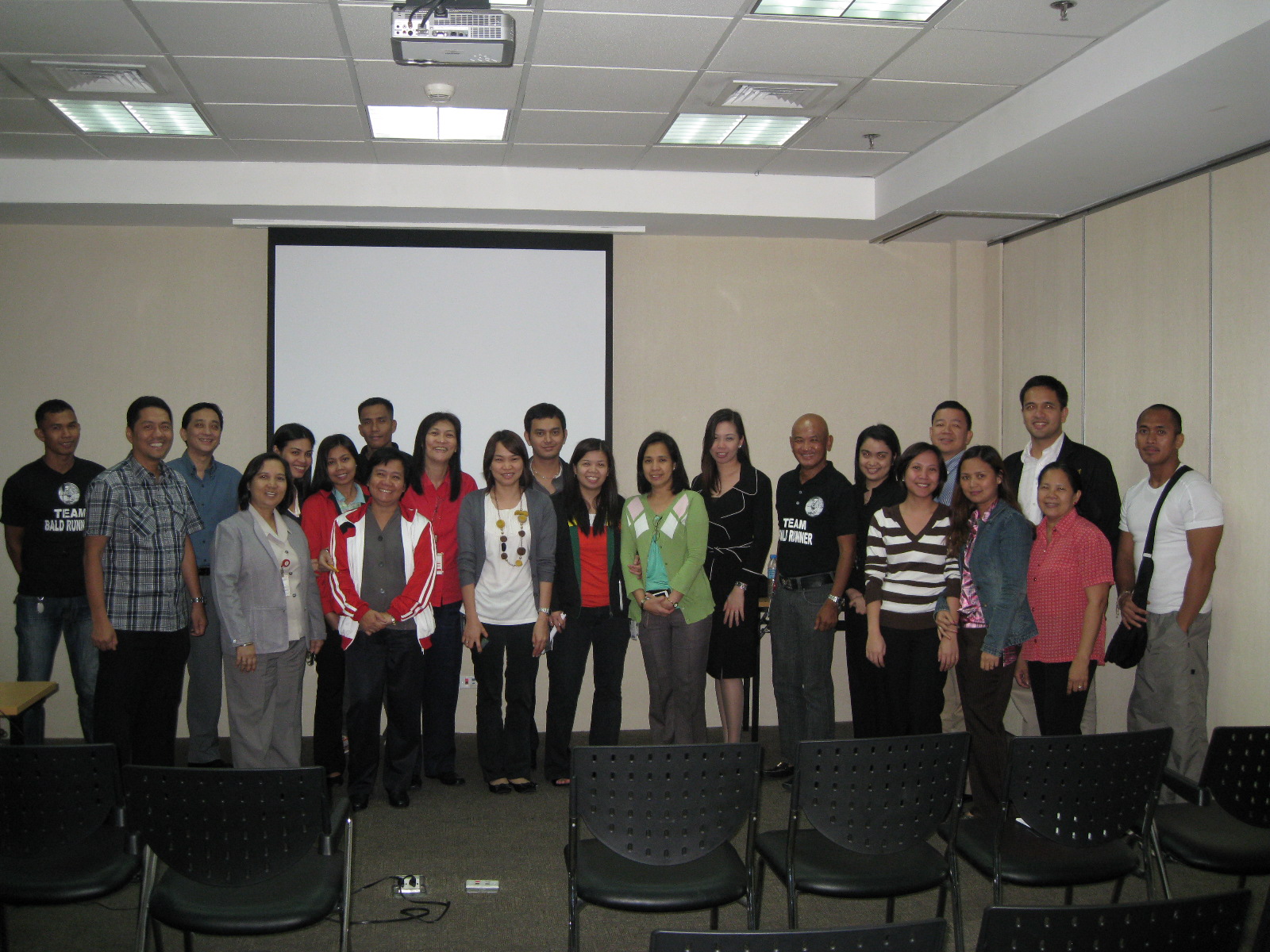
The lecture was conducted at 3:30 PM to 5:30 PM in the presence of almost 30 participants. The activity started with a lecture on the Basics and Principles of Running. After the lecture presentation, the participants were encouraged to join the members of the Elite Team Bald Runner on the practical side of running. Demonstration on the warm-up and stretching exercises which are done before and after running workouts were done by the participants. After the demonstrations, “running drills” were also performed by everybody. An Open Forum was conducted to answer the questions/concerns of the participants.

Mr Carreon was kind and generous to present to the members of the team with gifts, running shoes for my Project Donate A Shoe, vitamins and other products of the company, certificates and “giveaways” before we finally ended the activity. Thanks to Chito Carreon and to Wyeth, Philippines. Such gifts are in the “need-list” of my elite athletes.

Lecture Introduction From Ultrarunner Chito Carreon
BR's Lecture On Running Basics & Principles
"Future" Members of the Wyeth Running Club
Practical Demonstration Of Stretching Exercises
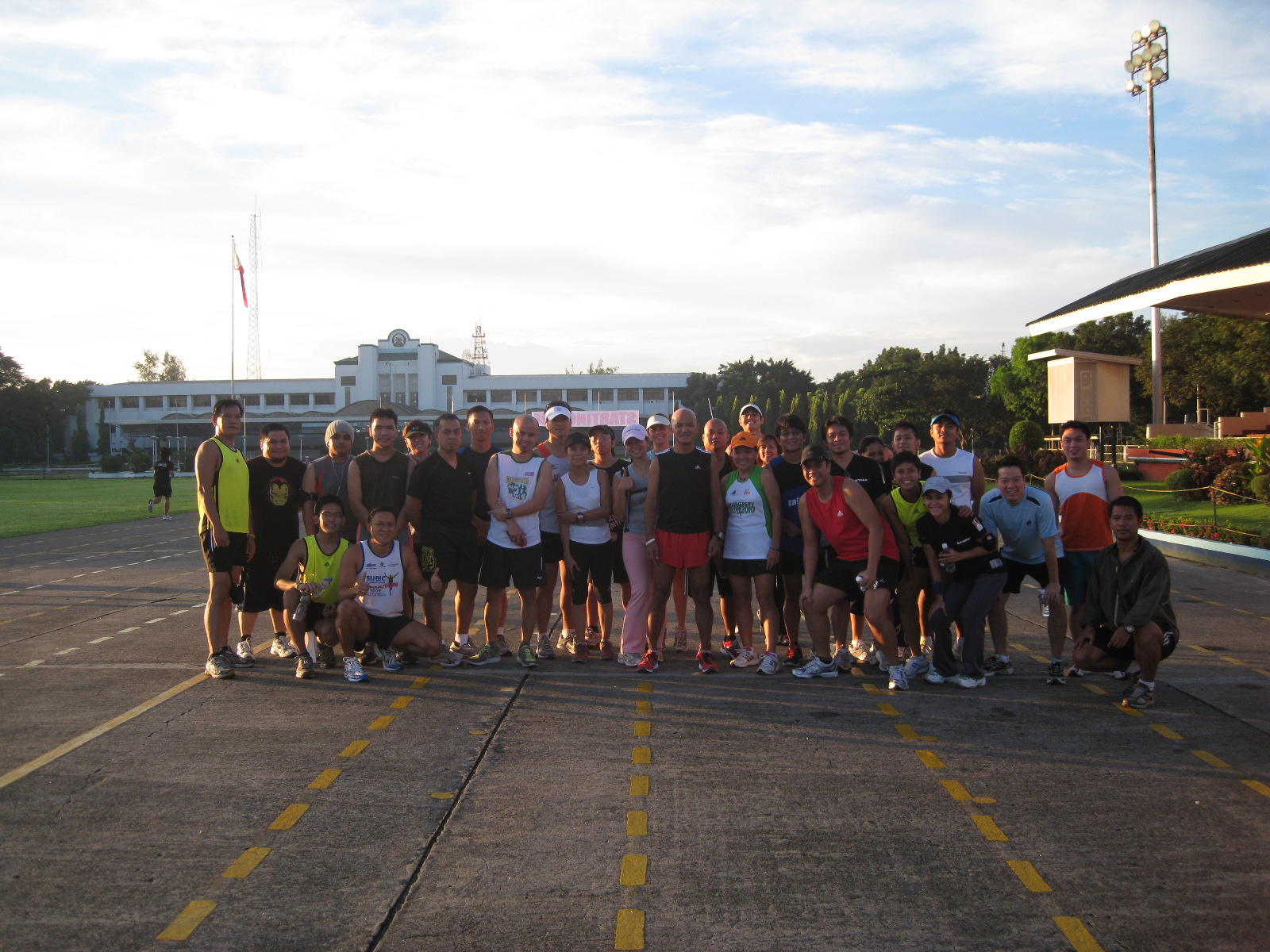
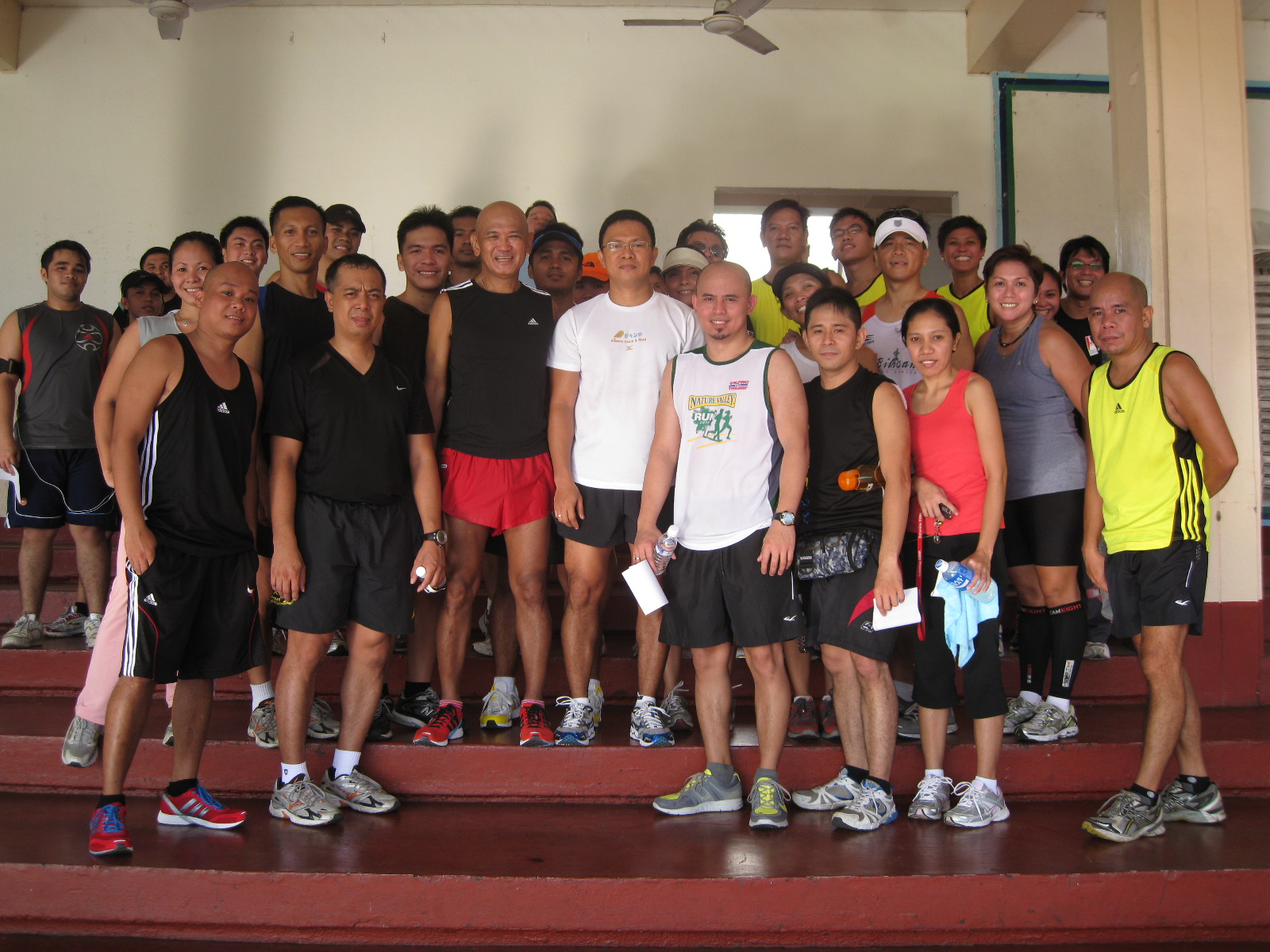
Group Picture After The Lecture/Clinic

UNILAB 32K Run


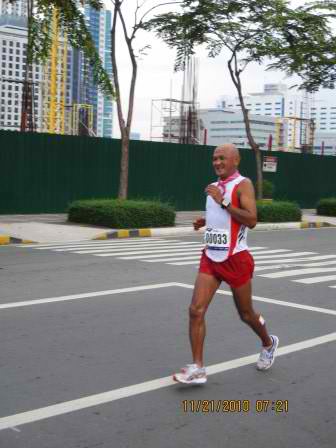
UNILAB 32K @ The Fort/ 4:30 AM November 21, 2010

1. This is my first official 32K Run. I treated this run as my Evaluation Run after trying to put more intensity to my training runs since after a slow finish at the 1st CAMSUR Marathon. The plan was to run an average pace of not slower than 5:30 mins per kilometer  for the whole race. With this plan in mind, I should be able to finish the race in exactly 3 hours with some cushion of 4 minutes for the uphills and slower pace in approaching the Aid/Water Stations.

2. I memorized the target split times for my 10K and half-marathon which I would like to attain during the course of race. I should be able reach the Km #10 mark in 55:56 minutes and then 1:57:59 hours at the half-marathon point (Km #21). I started at a slow pace at 5:45 to 5:49 mins per km on the first 2 kilometers until I was able to pass the Km #3 mark. From there I slowly increased my pace up to 5:35 mpk. I was happy to glance at my watch as I crossed the Km #10 mark in 56 minutes—4 seconds slower from the target split time!

On My Way Back To The Finish Line (Photo Courtesy of Bea Hernandez)

3. Running from Km #10 up to Km #21 was so insignificant that I was not focused to what I’ve been passing along the way. This is the tendency if you are running on a familiar ground for the past 3 years where you are only concerned on your time and on your running form. Translation: Running at the Fort-Kalayaan-Lawton-Bayani is already boring!!! I reached the half-marathon point at 1:56:18 hours and I was almost 2 minutes faster than my target split time for the said distance. From this point, I knew already that I could finish the race better than what I have planned for. I just have to maintain an average pace of 5:30 mpk for the remaining 11 kilometers to have a sub-3-hour finish.

4. From Km 21 point onwards, my watch was registering an average pace of 5:20-5:23 mpk and I felt I was still strong. However, I had to make a 10-second “brisk” walk as I approached the Water Station on my last 2 kilometers before the Finish Line due to an impending “cramps” on my left calf muscle. I was a good decision as the pain slowly disappeared when I started to walk. I regained my running form as I continued my run but I knew I had slowed down a little as I tried to manage the coming of my leg “cramps”. I had to drink lots of sports drinks as I passed on the last few Water Stations.

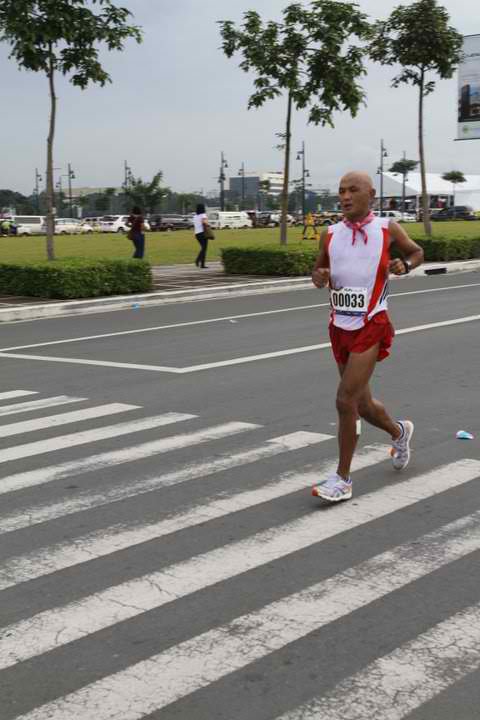
Near The Finish Line (Photo Courtesy of John Jeffrey Avellanosa)

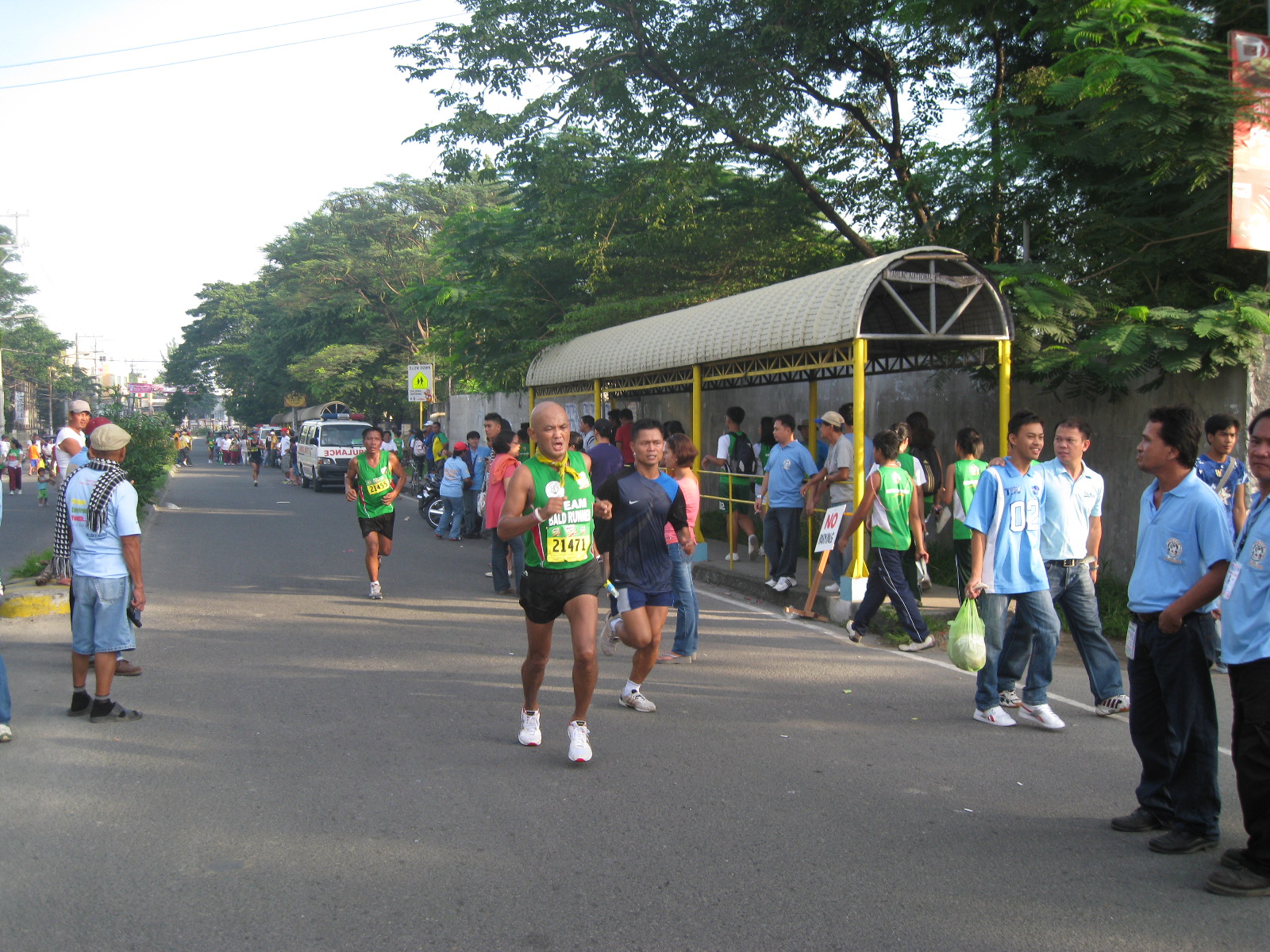
5. Finally, I was able to cross the Finish Line in 2:53:38 hours (based from my GF 305) and was able to register an average pace of 5:25 minutes per kilometer! Mission accomplished! I was satisfied with my performance and I’ve started to bring back my speed in my road races after following the Jack Daniel’s Running Formula. My MILO’s Half-Marathon performance last November 7 with a time of 1:47:45 hours (average pace of 5:07 mpk) would also attest that I am on the right training. 

6.  My fast time was due to the great improvements of Coach Rio’s Race Management in decongesting of runners in narrow parts of the route; efficient marshals & good traffic management; long tables and lots of water cups; bananas; and sports drinks for the runners. Familiarity of the route is also a big factor for a faster time. Above all, the early start of the race, cooler temperature, and the overcast sky contributed much on my better performance in this race. Congrats, Coach Rio for a perfect race!

Food Experiment


Yesterday afternoon, I made an experiment with regards to food/nutrition strategy in my running workouts. The primary purpose was to find out where exactly would I need to replenish my food intake during a half-marathon distance run.

Thirty minutes before my 21K run, I ate one plate of Pancit Canton and drank one glass of water with it. After a short warm-up and stretching exercise, I started my run. It was already dark as I started my run at 6:00 PM. I did my run at the 7K loop inside Camp Aguinaldo. My first two kilometers averaged a pace of 5:47 mins/km until I was able to lower the pace up to 5:30 mins/km until I reached my first water pit stop after completing one loop.

On my second loop, I was still maintaining an average pace of 5:30-5:34 mins/km and I was in my strongest run for the night during the 2nd loop. However, after taking my 2nd water pit stop at the end of the 2nd loop, I started to slow down despite the fact that I was running faster on the downhill portions of the route. I finished my 3-loop run inside the camp in 2 hours & 26 seconds. I just simply ran too slow on my last three kilometers. I ended my run with an average pace of 5:42 mins/km.

After the run, I ate one sports bar and drank the remaining water I had which is about half liter. After some cool down and stretching exercises, I did not feel any soreness on my legs.

With this particular workout, I found out that I could eat a heavy snack at least 30 minutes before starting my workout and I felt strong in my run. If not for the darkness in some portions of the route, I could have increased my pace and have more confidence on the landing of my feet on the ground. Although the roads inside the camp are well-paved, there are portions that are not even or flat.

In addition, there is a need for me to replenish my nutrition and take some food before I hit the 14-Kilometer mark or maybe after running for 12 kilometers. A Sports Bar and/or Sports Gel would be a good source for this but I need to experiment it on my next run. I will try also to bring some fresh fruit/banana and find out if I could still maintain my speed during my running workouts.

With regards to water/hydration, I have already trained my body to sustain my average pace within the duration of at least 30 minutes without taking any water. In some of my running workouts, I did not have any problems with hydration within a distance of 7-10 kilometers. However, my workouts were done early in the morning or early in the evening.

If you are preparing for a race, you have to train your body on matters pertaining on the food you are taking in during the race. Remember that “solid” food is the source of your power and energy needed to finish the race.

Qualified


MILO Half-Marathon/Tarlac City/November 7, 2010

I got qualified for the MILO Marathon FINALS to be held on December 12, 2010.

I registered for the MILO Provincial Qualifying Half-Marathon Race in Tarlac City which was scheduled yesterday, Sunday, November 7, 2010. My plan was to use the MILO Half-Marathon as my Performance Evaluation Test for the training adjustments I’ve made after my 4:39+ hours Marathon Finish at the CAMSUR Marathon last September 24th.

Training Adjustments

After comparing my past marathon times for the past years, I was able to make some conclusions and observations about some flaws in my training since I’ve started doing ultramarathon races. I decided to return to my training workouts during the year 2008 and strictly followed Jack Daniels Running Formula. One of the salient points in my adjustments is to make sure that my “Easy Runs” should have an average pace of 5:45 minutes per kilometer and gradually decreasing it by 3-5 minutes every week until I was able to reach 5:12 mins/km pace few days before race day. Obviously, my tempo runs’ and interval training average paces had been adjusted, too!  My tempo runs would average to 4:55-5:10 mins/km pace through my regular 5K tempo run repeats.

Results

After six weeks of consistent training and being focused to my average pace in my workouts, I was able to finish the MILO Half-Marathon in 1:47:47 hours (unofficial) with an average pace of 5:07 mins/km. I still have 12:13 minutes to spare within my qualifying time of 2 hours for the said distance. I think I am in the right track again with my training to become faster and stronger in my future races. I was satisfied with the result of my Performance Evaluation Test on this race.

Hands On

I was surprised to see that there were a lot of runners in the Tarlac City MILO Qualifying Leg. My ultra running friends were also there to include some of the BDM 102 “veterans”. But what made me amazed and impressed was the presence of MILO/Nestle, Phils Executives/Managers who were directly manning the Start/Finish Area making sure that control and orderliness were being followed. MILO’s Andrew Neri and RACE’s Rudy Biscocho were there to see to it that the schedule of activities was being followed on the dot. At the turn-around point (10.5K), I saw MILO’s Pat Goc-ong who was personally handing out ice-cold Gatorade drinks to every runner that approached him. He even cheered each runner! I could not believe my eyes seeing these top executives of MILO/Nestle, Phils., doing such stuffs to the runners! To MILO/Nestle, Phils., my congratulations for another successful MILO event!

Finally

I have to admit that this is my first time to be a “legitimate” MILO Marathon FINALS qualifier. In the past, I failed to qualify as I joined the Full Marathon Qualifying Races and failed also when I tried to qualify in the Half-Marathon which was held in my hometown, Laoag City in 2008. It was an accomplishment to be finally qualified to the most prestigious marathon race in the country.

Congratulations to all the Qualifiers!

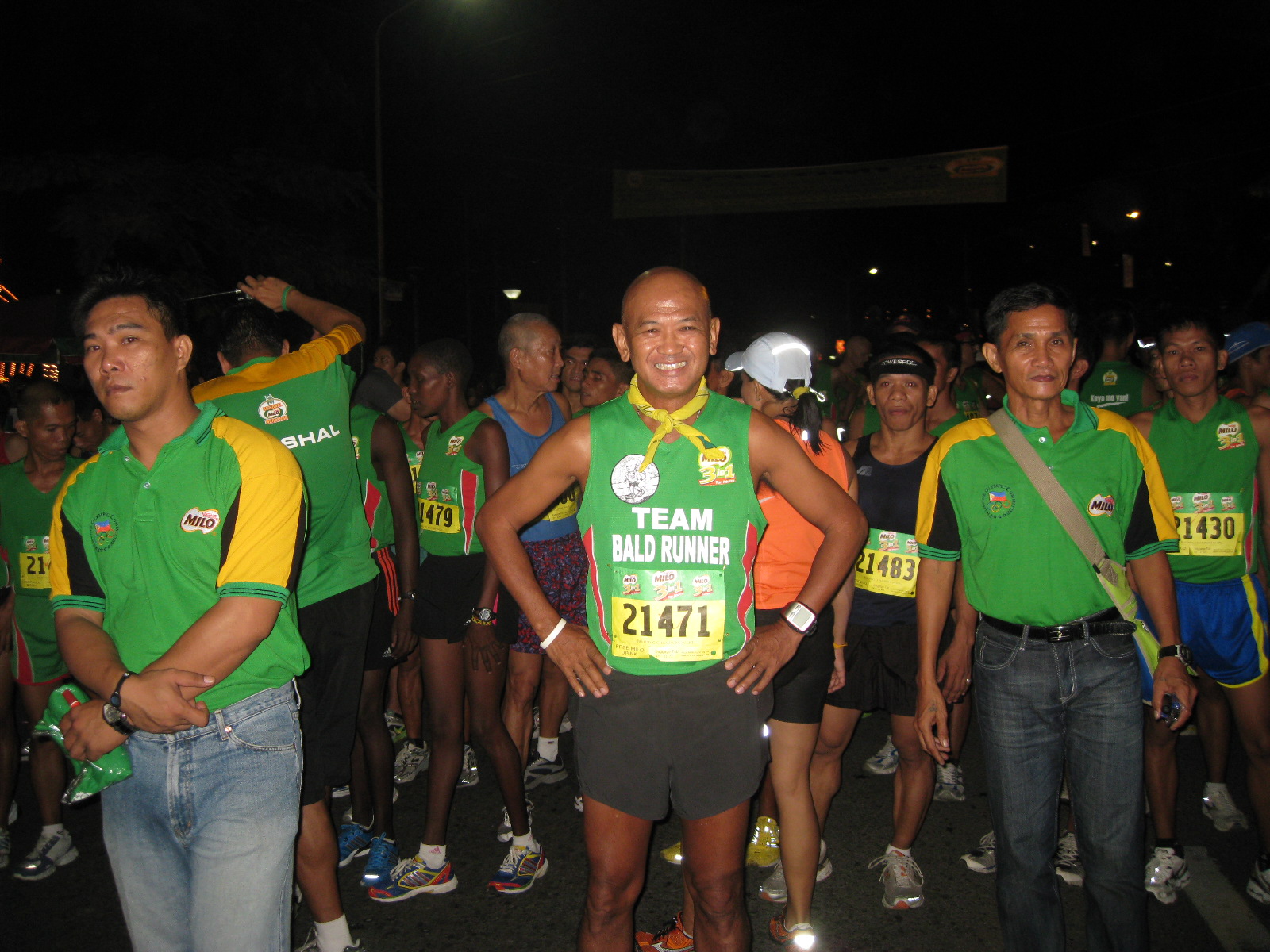
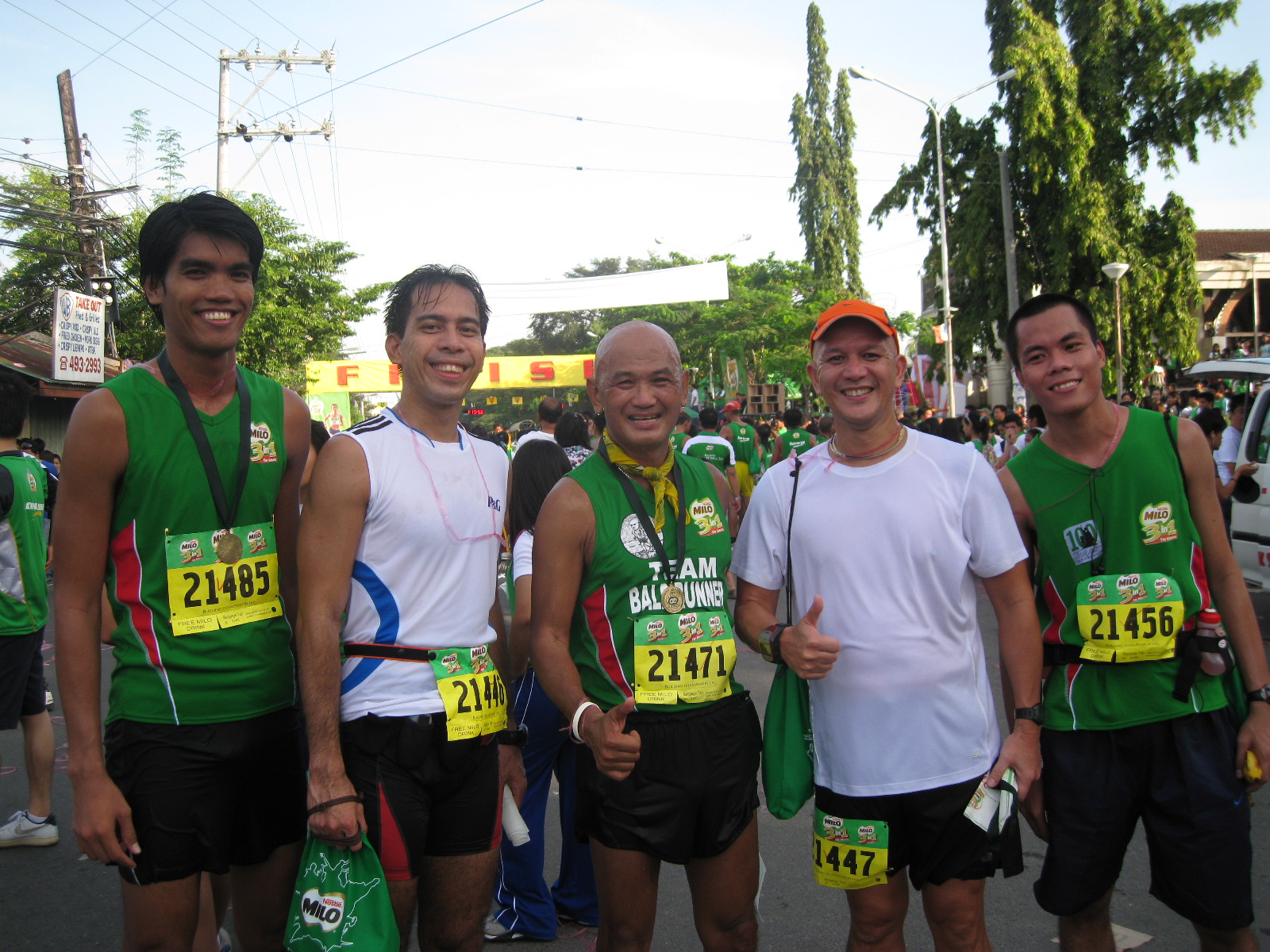
Before The Race With MILO/BR Singlet
Before Reaching The Finish Line
The "Usual Suspects" (The Young & Old Ones)

Mile


Have you ever tried to run a mile on your best effort on an oval track and find out what is your best time?

A mile is a length of a distance which is equivalent to 1,600 meters. It is the English system in measuring a distance. Its counterpart in the Metric System is the Kilometer. A Kilometer is equivalent to 1,000 meters. Obviously, a mile is longer than a kilometer by 600 meters.

In the sports of Athletics, a Mile Run is one of the most popular running events done on an Oval Track. A mile run is equivalent to four (4) laps on an oval track. However, in the Olympic Games and in IAAF sanctioned events, the metric equivalent of the mile run which is the 1,500-meter run is the one which is considered as sport event.

Many books had been written about athletes who have run the mile in less than 4 minutes. But I’ve never read any of these books except for the book, “Lore of Running” by Dr Tim Noakes where all the significant runners who broke the 4-minute barrier in the mile run had been mentioned.

At present, the standing world record for the mile run is 3:43.13 minutes by Hicham El Guerrouj of Morocco on July 7, 1999 in Rome, Italy. For the past 11 years, such record time had never been broken. I am sure some Filipino runners had broken the 4-minute barrier for the mile but I have yet to know the National Record time for such distance by our local runners.

To answer the question that I mentioned above, I have to admit that I’ve been running on the oval track for so many times for the past years but I never thought of trying to set my personal best time on the said distance. Since I’ve set my GF 305 on the metric system, I usually measure the distance I could run in kilometers.

When I was still active in the military service, a 2-mile run was a part of our regular Physical Fitness Test. My best time for the 2-mile run was when I had my military schooling in Fort Benning, Georgia, USA when I timed 12:00 minutes for the said distance. I was then 32 years old. The 2-mile route at the US Infantry School was a flat trail surface. I would safely say that I ran my best one mile in 6 minutes. I wonder what would be my time if I’ve done the 2-mile run on an oval track with a tartan surface during that time.

On my last Physical Fitness Test before I retired from the military service (4 years ago), my time was 14:20 minutes done at the Headquarters Philippine Army Grandstand running/jogging area, which is translated to a 7:10-minute mile.

Three days ago during my 5K tempo run on the oval track, I was able to register a time of 7:40 minutes as I finished my first 4 laps at the oval track. I really don’t consider this as my legitimate best time for the mile because I started with a slow pace on my first lap and started to increase my pace on the 2nd lap and finally maintaining my fastest pace when I was already on my third lap. I wonder how will I perform if start on a racing mode from the very start up to the finish line in a mile run?

I asked my elite athletes if they have timed their best one mile run since they started running and all of them said “Not yet, Sir!”. I am surprised to know that these elite athletes do not mind knowing what their best mile run is. Is this the normal behaviour of our elite runners? Is this an indication that they are not coached and trained properly? No wonder we could not excel in other long distance running events as we could not even excel on the very most basic distance where the training standards in long distance running is based. Coaches would base every training program for his/her athletes from the best time they could finish a mile or 1,500-meter run.

Having said this, I am going back to the “basics” of training the best of my one mile run as part of my aerobic training for the half-marathon, marathon, and ultramarathon training. It’s a crazy thing to do but it is nice to know what your body is capable when you run at your best effort in a 4-lap run on the oval track.

Now, I ask you, “Have you tried running your best one mile run lately?” You can write your comments and I would like to know your best time on the said distance.

Am I Getting Faster & Stronger?


Three years after started blogging religiously about my running workouts, I would like to assess and evaluate myself if I am getting faster or stronger.

Looking back on my past races for the past three years, I could see and feel that I had my fastest times immediately after I’ve retired from the military services. This was due to the fact that I had more time to run and I was focused to improving my best finish time in every race. However, the main factor that was instrumental in my fast times was due to my attendance to our BR “Speed” Training at the ULTRA Oval Track.

I was able to attend at least 3 sessions of “speed” training in every week at the oval track with the close supervision of our coaches. The first session for the week was done on Tuesday evenings. The Tuesday workout consisted of the usual warm-up run of one mile and then stretching exercises. After stretching almost all the muscles involved in running, we were told to do at least six (6) sets of running “drills”. These running drills prepared us to what in store for us for the evening workout.

The main menu of the Tuesday workout was a minimum of eight to ten repetitions (8-10) of 400 meter run with a time of at least 1:42 minutes. We made sure that our last four reps were becoming faster than the average time we had for the first six reps. In between these reps, we had one minute of rest. This rest was followed strictly. After the required number of reps for the day, we were told to do another 30-minute of easy run around the oval after a 3-minute rest from the last 400 meter repetition. After a period of time or months, we were able to finish a maximum of 20 repetitions for the 400-meter run at the peak of our speed training.

On Wednesdays, we do “pyramid” distance speed training. After the usual warm-up, stretching exercises and running drills, we do 3,000-meter, 2,000-meter, 1,000-meter, 2,000-meter, 3,000-meter runs at our 90% effort with 3-minute rests in between distances, in that order. This was followed with a 30-minute easy run.

On Fridays, we do 100% effort of the ¾ distance (75%) of the road race we are going to compete for the weekend or on Sunday. However, the distance we have to race for the weekend should not exceed a half-marathon race.

On weekends, if there are no scheduled road races, we do long slow distance runs, maintaining at least 85% of our effort.

These weekly workouts made me break my PRs every time I joined road races. Results? I was able to  register a 3:48+- hour marathon finish time on the later part of 2008. And later in 2009, I have registered another 3:58+-hour finish at the Subic International Marathon. These best times in my Marathon Races were the results of the consistent attendance to the BR “Speed” Training at the Oval Track.

Since I got “hooked” on ultra running events, I tend to slow down and concentrated more on my easy long runs without thinking or knowing the degree of intensity of my training. Slowly, I forgot about those “speed” training workouts and it never occurred to me to try those 3x a week speed workouts. My specific goal in my ultra running events was to finish the race within the prescribed cut-off time.

Whenever I have plans of joining a full marathon race these year, I only need to run at least three (3) long runs that exceed 32 kilometers within the span of two-month preparation and just do some “Yasso 800s” at the oval track at least 2-3 weeks before the scheduled race and all those intensity-filled running workouts were forgotten. However, I always finish my marathon race with a decent time based from the short and lesser-intensity preparation workouts. This kind of approach to my training and goal in every marathon and ultramarathon events kept me away from any kind of running-related injury.

However, after my finish at the CAMSUR Marathon last September, I started to bring back the time-paced and Jack Daniel’s Formula of Running concept in preparation for an ultra running event which I plan to join in the middle of next year. I have to see again that strip of coupon bond where my “target pace” workout was written as my reference in those BR “Speed” Training workouts. After a few weeks of training, I feel that I am slowly regaining my speed and stamina/endurance. I observed this kind of feeling during the Mt Mayon Trail Run last week. I am back again for my race-specific training workouts.

Running "Half-Naked" at the Oval Track

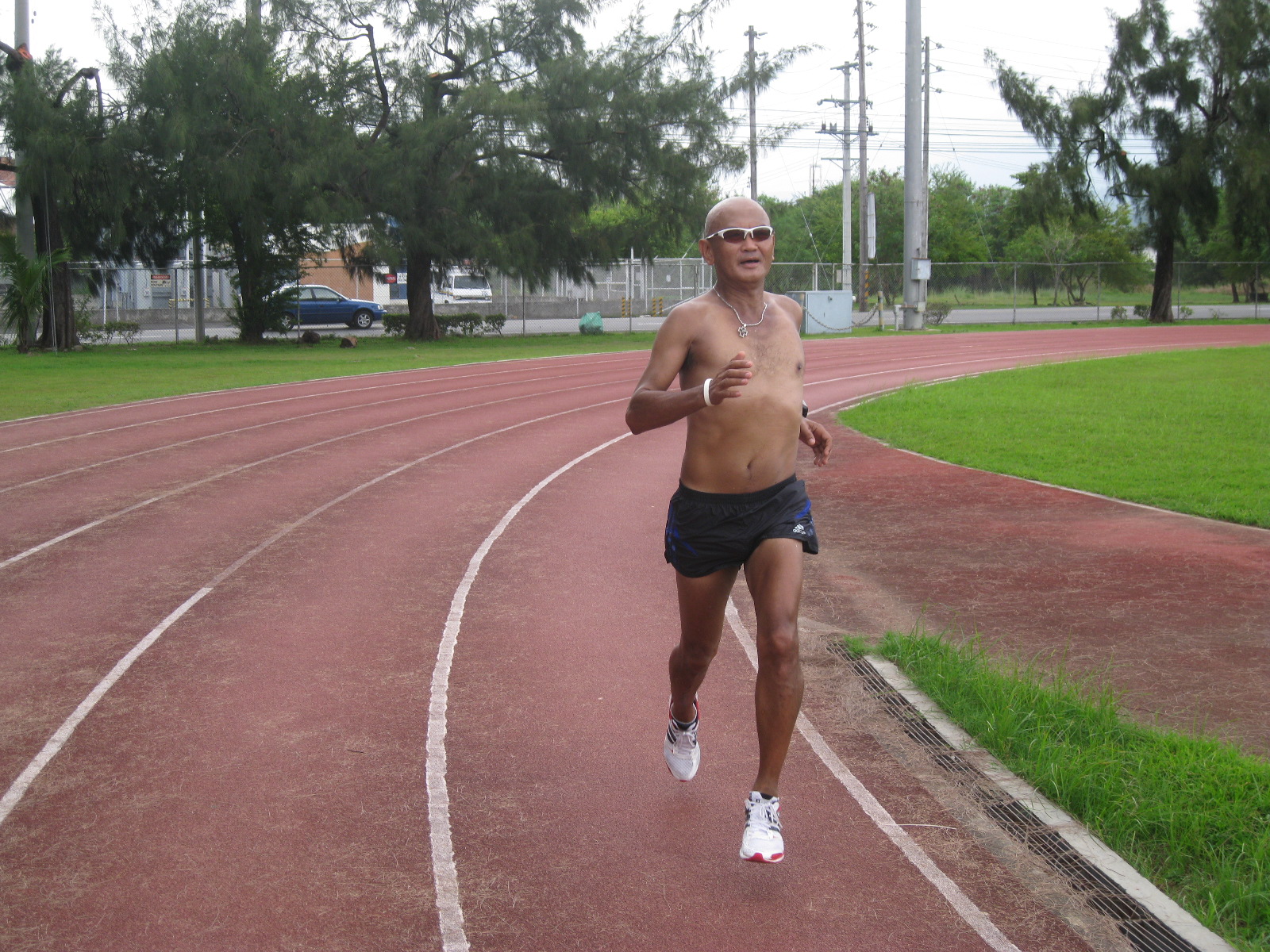
For the past weeks, I’ve been going back to the Oval Track at least 2-3 times a week. The tartan surface is more forgiving to the knees and legs; it is entirely flat; accurately measured; the place has a good air quality; and I could run half-naked under the heat of the sun. I have started eight repetitions of my 400-meter runs two weeks ago and had been doing 3 X 5,000-meter runs as my tempo runs since last week. My target average pace in my 400-meter runs is 1:36-1:40 minutes and my 5K tempo runs has an average pace of 5:00-5:10 mins/km. Most of my speed runs are done at 7:00 AM up to 9:00 AM.

So far, I don’t have any soreness on my legs and I could easily recover. This proves that my leg muscles are becoming stronger due to my past ultra running events and they could withstand the speed training that I am trying to re-introduce to my body system. I may not be faster as compared from the time I was religiously doing and involved in the “BR Speed Training” but I knew that I am stronger this time as I could easily bring back my level of competitive status within a short period of time.

As part of the training, I will be joining again those weekend races as part of my “feedback” or evaluation if I am improving with my finish times. So, if you see me around on these races, you are sure that I will be focused on my strides, my running form, and the goal to be attained for such particular race.

In a few days, I will embark on a multi-day adventure run (again!) for the second time this year. It is my objective to run more kilometers every day and find out how my body recovers from the effort on a day-to-day basis. In my Manila to Baguio Run, I controlled my daily mileage to 50 kilometers. However, with this future plan, I will try to increase the mileage to 60-70 kilometers a day with more intensity (faster pace) this time.

For my age of 58 ½ and after three years of maintaining this blog, I could no longer bring back those finish times when I was in my 30s. But if there is a way I could scientifically measure or translate my finish times as compared when I was younger, I have the suspicion that I am faster and stronger this time.

See you on the roads and trails!

Running "Very Light"

3 Years


Three years ago, on October 25, 2007, I started my 2nd blog in the Internet which was purely about running. My first blog, which was all about my activities as the Division Commander of the Philippine Army covering the Western Visayas area, was created on April 2007. As I started to post my running workouts in the said blog, I received a lot comments from my readers and such interest made me to find out runner-bloggers in the Internet. It appeared that there was only one runner-blogger in the Philippines at that time whose posts were concentrated about running/training for 5K & 10K distances and maintains a schedule of road races, of course, in the Philippines. It was The Bull Runner.

From my first post that was published as the Bald Runner, I started to recall my past training, road races, find out some pictures in my computer, and look for personalities/Icons of running in the past. And this blog evolved as what it is now.

1st Year

Basically, my posts were about my runs in the place where I was assigned as a Division Commander of the Philippine Army. There was a time that I was religiously posted my daily, weekly, and monthly running mileages and activities. The blog became my runner’s diary, so to speak. My preparation for the 2008 Pasig River Heritage Marathon and my comeback to marathon training was the gist of my running workouts. From a runner’s diary and a source of information about running, it evolved as a “critic” of the Road Races being conducted in Metro Manila and running events where I participated. This blog ultimately became a “feedback” mechanism of Road Races.

“Project Donate- A-Shoe” was born. A simple observation of runners at the Pasig River Heritage Marathon gave me the idea to make something happen to help those who are “less-fortunate” runners to change their dilapidated, worn-out/tattered, and old running shoes which they are still using in road races. This project became a success as runners from abroad are still actively contributing to this project and everything was history.

“Project Donate-A-Shirt was also born in tandem with the need to change the old shoes of runners. The families of Gawad Kalinga communities in Laoag City are still continuously receiving donated singlets and finisher’s shirts from runners. Some of the donated jackets & shirts from abroad (courtesy of Rick Gaston & Ben Gaetos) were given to my elite athletes and to other runners with potentials to become elite ones.

Elite Team Bald Runner was created and organized. After 3 years, the team is still intact and strong. Many joined but others got separated after one year. However, this elite team is still intact and train as a group.

BDM 102 as an idea/dream came into being. An experience finishing an ultramarathon trail race in August 2008 and witnessing the start of the 2008 Badwater Ultramarathon Race in Death Valley, California gave me the idea to conduct an ultramarathon race using the historic & world-wide known Bataan Death March route.  

“1,000-Km Club” was born. It is a tool to motivate each runner to accumulate his/her mileage with a goal in mind. BR’s “1,000-Km Club” black shirt is becoming a well-deserved “trophy” for each runner!

2nd Year

BR “Speed” Training at the Philsports ULTRA Oval Track started to attract recreational runners to become competitive ones. Most of the fast runners around had gone through this training. Due to its demand, we started to accept “newbies” ; transformed them to recreational runners; and later, as competitive runners. This “speed” training is still on-going on Tuesdays & Fridays (5:30 PM to 8:00 PM) at the Headquarters Philippine Army Grandstand/Parade Ground and on Wednesdays (same time on Tuesdays & Fridays) at the ULTRA Oval Track.

Designation as Chairman for Road Races of PATAFA. I accepted this designation in order to improve the quality of road races being held in the country but my position, in reality, became as an advisory position to the President of PATAFA.

BR’s Lectures and Clinics started as a pilot project to the Officers, Staff and Employees of Reinier Pacific with the cooperation of its President, Mr Amado Castro, Jr., who is a good friend and supporter of Elite Team Bald Runner. I could no longer count the number of corporate offices, government offices, and running groups where I was invited to conduct such lectures and clinic with the support of the members of the Elite Team Bald Runner.

BDM 102 Ultramarathon Race was a reality with the attendance of 82 “brave warriors” at the Starting Line on the evening of March 6, 2009 with 63 runners crossing the Finish Line within a cut-off time of 18 hours. It was a success and my first test as a Race Director in Ultra Races.

Creation of PAU (Philippine Association of Ultrarunners) as the National Sports Federation on Ultramarathon Races/Events in the country. In a few months, PAU was accepted as the 39th member-federation among the present 50 members of the International Association of Ultrarunners (IAU) and the 6th member in the ASIA Region.

3rd Year

5-Day Multi-Stage Run from Manila to Baguio City. I was able to do this. It was a 240-Km distance but I was able to prove that a runner in this kind of running adventure can “journalize” or inform and update his/her readers through the Internet on a near “real-time” situation.

Invitation to the 1st IAU ASIAN 100K Championship at the Jeju International Ultramarathon Race.  Alquin Bolivar and Frank Indapan of the Elite Team Bald Runner represented PAU and the country in this event. Bolivar was able to place 6th among the 500 participants and was able to set a national record of 9:06:15 hours for the said distance race.

2nd BDM 102 was again a success with more runners participating and finishing the race. More foreign runners participated as compared during its first edition. It is a proof that this ultramarathon event is already an international ultramarathon road race. For the local runners, it is considered as the “Holy Grail” of Running in the country.

PAU Road Races. After my trip and observation in the conduct of ultra road races in South Korea, I aggressively pushed for the conduct of monthly ultra races which started last May of this year. So far, 4 ultra races had been conducted (all the races were done outside Metro Manila) to include one ultra trail race where each race promoted “sports tourism”. More ultra runners had attended these races.

BR’s FREE Fun Runs. This is a new “alternative” way to entice “newbies” and recreational runners to enjoy a free road race, instead of paying high cost of registration fees.

BDM Lectures/Clinic is a pre-emptive tool to prevent casualties in running and at the same time, inform and train interested runners to participate in ultra road races and prepare them to the “gruelling” experiences of finishing the BDM 102.

More Mountain Trail Runs Abroad. I scheduled at least 2 ultra trail runs for me to participate for this year in the United States but I was only able to participate in the PCT’s Headlands 50-Mile Trail Run in Marin Headlands last July 17. The Dick Collin’s Firetrails 50-Mile Run last October 9 would have been my 2nd trail run for the year. Attending these mountain trail runs in the US was a way to learn how the Race Organizers conduct their trail races and find out their difficulty ratings.

4th Year; Future Plans and Beyond

Expand the BDM 102 and implement BDM 151. This will be the ultimate and the “only historic” ultramarathon race that will place the country in the world map of ultra running events.

1st PAU 50K Road Race National Championships and the 1st PAU 50K Mountain Trail Run National Championships.

1st PAU 24-Hour Endurance Run

PAU Road Races in Other Parts of the Country & Promote “Sports Tourism”

Conduct of More Multi-Day Adventure Runs Within the Country

More Running Lectures & Clinics

More Ultra Races Outside The Country

Develop More Elite Ultra Runners for Exposure to IAU-sanctioned Championship Races

Finally, I would like to extend my thanks to those who supported my advocacies in running for the past three years. I hope more of our citizens will be able to appreciate the benefits of running and other related sports. I still firmly believe that, it is through Sports that our Nation will become United and hope that “A Healthy Population is a Strong Nation”

See you on the roads and trails!
How Many Kilometers?


How much is enough? How many kilometers are recommended for me to run in every week in order for me to perform better from my last race? If you are not logging on the distance you have ran for the past week and instead prefer the number of hours, you could ask yourself, what is the number of hours I should run in a week in order to perform better in my road races?

You could only answer this question if you are methodical and thorough in maintaining your runner’s dairy. It should be a Runner’s Diary with Integrity (I hope you know what I mean). Based from your weekly total number of kilometers or hours that you ran, you could analyze if the past mileage for the week had given you more strength, power, and stamina for the next week’s running workout. It means that you could compare between your body feelings from finishing an 80 km per week from 90 km per week or 100 km per week. You should be able to know how it feels to finish an 80, 90, 100, or 110 km per week run.

Am I talking from Mars? In my preparation for a 100K Mountain Trail Run in May next year, as early as now, I am trying to find out if I can still improve my running performance with my prevailing age of 58 years old by “steadily” increasing my weekly mileage with a minimum of 100 kilometers per week. And try to find out how much more can my body endure and sustain by adding more kilometers to my baseline of 100 kilometers.

Two weeks ago, I was able to run 100 kilometers and I felt good. With all the raining since last Monday, I was able to run a total of 26 kilometers and decided to make Wednesday as my rest day. We will see if I can still maintain or sustain to finish a total mileage of 100 kilometers for this week. However, with the continuous rains brought about the tail-end of Super Typhoon “Juan”, I was able to run a total of 70 kilometers to include my run in yesterday’s Mt Mayon 21K Trail Run.

By the way, my average pace for the past weeks was 5:40 minutes per kilometer in my Easy Runs; 5:05 minutes per kilometer in my Tempo Runs and my average Interval training time for my 400-meter lap runs is 1:36 minutes. This is what I call “Intensity Training with Higher Mileage”!

So far, my body is adapting to the stress and I could recover well while adopting the Easy-Hard Principle of training with at least one hour of sleep during daytime and another 7-8 hours during night time. I have at least 2 massage sessions every week.  Nutrition is well-maintained making sure that I eat my replenishment food at least 30 minutes after every workout. I maintain a 40-40-20 diet and drink lots of water.

I will keep you posted with regards as to how much will I be able to maximize my weekly mileage and what is the feeling what is like to be running such mileage.

You can visit my http://www.dailymile.com account for the details.

Maximalist vs. Minimalist


These are the two general philosophies of training volume in running.  By the words alone, they connote opposing description to one another. Minimalist is best described by doing the minimum amount of training in order to achieve one’s objective or goal. While the maximalist would be best described by doing as much volume or amount of training as the body could absorb and sustain in order to improve or attain your goal.

In the late 70s and early 80s, I was greatly influenced by the teachings of Arthur Lydiard which was the proponent for maximalist training philosophy. In my preparation for my 1st marathon race, I exposed myself to endurance runs with a daily menu of 10 kilometers and sometimes “double” the same distance for the day. In my weekend runs, my minimum distance then was 20 kilometers and a maximum run of 30 kilometers.  Seldom did I do interval runs at the Oval Track but I improvised some running “burst” or fartlek sessions in my daily runs. Being young at the age of 30s gave me the strength to recover very fast in my running workouts. With this observation, the maximalist philosophy is more adept to the younger runners and this approach to training has a lot of potentials for the runner to improve greatly in his/her performance.

In the mid and late 90s, articles and personal experiences of older runners (40 years old and above) made way to the different runner’s magazines advocating that there is no need for too many kilometers/miles of running preparation in order to perform well in a road race. Experiments and studies had been made to elite runners as well as to the masters runners. Such studies resulted to almost the same results of performance for the athletes who are exposed to maximalist training philosophy. The minimalist practitioners had made their training more race-specific and with higher intensity of training as they have strictly followed some parameters or time/pace guidelines for a certain kind of running workout. This is where speed training and faster pace of workouts had been incorporated in their weekly training schedules. This kind of approach in training brought the importance of recovery to every runner. In my personal observation, this kind of training approach is highly recommended to runners or athletes who had been exposed to road races and intense training for a minimum of two years as running experience.

At my age of 58+ years old, I could hardly follow the teachings of the maximalist approach to training due to obvious reasons even though I have the time to run almost everyday. But I am still trying my best to find out the maximum of mileage I could do every week most especially now that I am preparing for another ultra mountain trail run next year. On the other hand, minimalist approach with higher intensity of training had given me positive results in my past marathon & ultramarathon races but I still have the feeling that I could still improve from my best PR times that I registered for the past 3 years. I know I could still improve in my future races using this training philosophy. 

Considering “running as an experiment of one”, I could not recommend which one is fitted to your attitude/personality and personal lifestyle if you want to develop your potentials in running. However, you must possess the following qualities in order to improve in your running—discipline, patience, focus, and “warrior” attitude. Your training plans and programs are useless if you do not have these basic qualities.

Minimalist or Maximalist? It’s your choice!

1st FREE Fun Run Report


1. I thought of this idea to conduct FREE Fun Runs for the benefit of the new runners who have the patience to learn the “basics” of running. And at the same time remove from them the burden of paying any registration fee in order to enjoy the benefits of running. It was through this blog that this running event was known as I decided not to request from my good friend, Jinoe & Quennie of takbo.ph, to post this in the List of Races. However, on the day before the event, a certain “boy kuripot” at www.boykuripot.blogspot.com reposted my blog about the FREE Fun Run. Thanks, Boy!

2. Despite having 5-6 scheduled road races in Metro Manila and another Milo Qualifying Race in Batangas City, I decided not to postpone the activity as it was my way of trying to find out the response of my readers to this event. Even with the impending approach of the super-typhoon “Juan”, I made it a point not to be deterred with such development about the weather as I knew the course of the typhoon will not greatly affect Metro Manila on Sunday. I’ve been consistent with my events—it was always been RAIN or SHINE and no posponement/cancellation of event

3. At 5:00 AM of Sunday, a group of cyclists from the AFP, led by the Chief of Staff, AFP, were having their warm-up exercises for their regular “Bike For Peace” activity. This is a physical activity of the Officers and Men of the AFP based in Camp Aguinaldo which is composed of cyclists and they conduct their workout around Metro Manila with the slogan, “Bike For Peace”. After these cyclists left the GHQ Grandstand at 5:40 AM, it was our time to conduct the activities for the FREE Fun Run.

Group of 32 Runners Attended The 1st FREE Fun Run

4. A group of 32 runners joined the 1st FREE Fun Run. It was a combination of runners coming from the ST Microelectronics Running Club from Los Banos, Laguna; AFP Officers and their dependents; some takbo.ph members; new runners; ex-PMA cadets; and “first timers” in Camp Aguinaldo whom I had a chance to talk to. After a short welcome remarks, I led the stretching exercises and we were off on the road for our 8K Fun Run.

5. For the faster runners, it was a tempo run for them. For the “first timers” in Camp Aguinaldo, it was a tour experience for them as they were able to see the different structures and buildings inside the camp. The hilly portion at the back of the camp was a challenge to the new runners. In less than one hour, all the runners were back at the Grandstand and they were given bottled water and their copy of their Certificate of Finish for the run. Everyone had their own post-stretching exercises after they crossed the finish line. A digital clock was displayed at the Grandstand for the runners to see as soon as they cross the Finish Line.

6. I conducted a post-briefing for everybody as I accounted for all the runners. I announced that all FREE Fun Runs will be conducted at Camp Aguinaldo as my request for the use of the Philippine Army’s Grandstand & Parade Ground was disapproved due to activities being held in the said place on Sundays. Well, the “decision makers” at the Philippine Army did not see my “vision” for conducting FREE Fun Runs in their “turf” as I wanted more of their dependents and the involvement of the civilian sector in exposing the youths in 3K or shorter distance runs. I really wanted these runs at Fort Bonifacio to be short, quick, and fast as the whole activity should be finished within an hour. If the runs start at 6:00 AM, the activity should be finished before 7:00 AM.

Jeff Tamayo of POC Delivering A Short Lecture

7. The runners were fortunate to have my friend, Mr Jeff Tamayo, the ASIAN President of the Soft Tennis Sports Federation and member-officer of the Philippine Olympic Committee, who was a part of the Disaster Readiness Display activity in preparation for the incoming Super Typhoon “Juan” being held at the GHQ Parade Ground. He conducted a short lecture to all the runners on Sports Nutrition. The brief and concise lecture of Mr Tamayo was very constructive and helpful to all the runners. Thanks, Jeff for that “on the spot” lecture!  

8. Before 8:00 AM, the activity was terminated after some photo-ops with the runners. To all the runners and supporters, thank you very much and I hope more of our new runners will join these FREE Fun Runs.

Group Picture After The Event