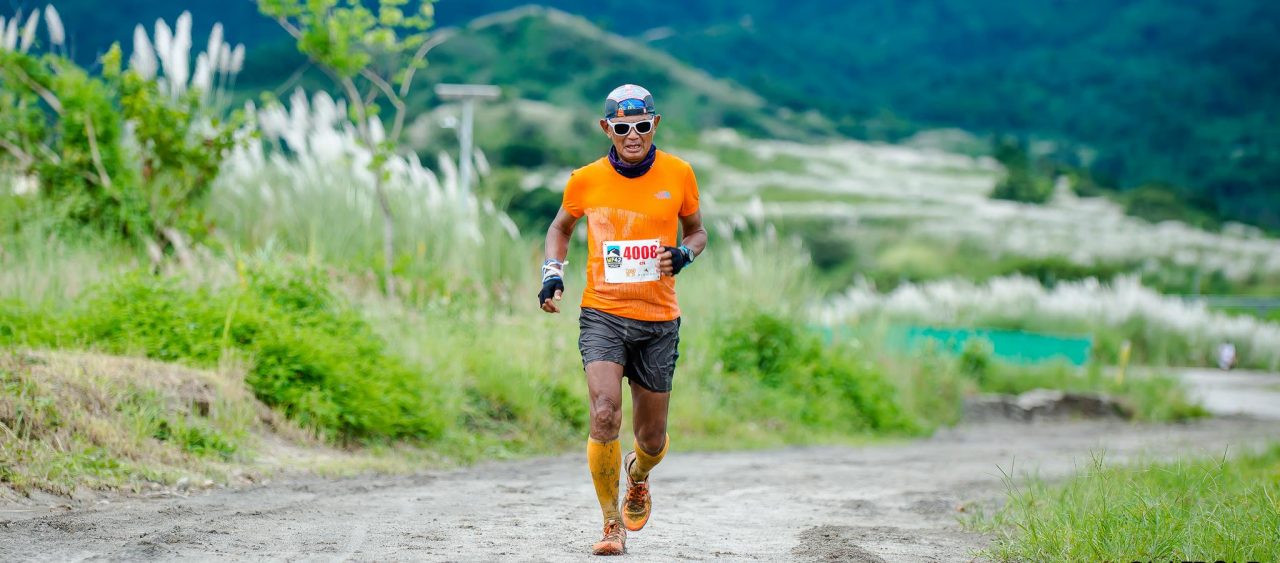
Race Report: 2015 Condura Skyway Marathon (Run For A Hero)


Background

I was expecting that the 2014 edition of this race was to be conducted for the benefit of the victims of Typhoon Yolanda but instead, it was cancelled and the Race Organizer opted to donate a part of their budget for the recovery and rehabilitation of the people of Samar and Leyte.

Many of the runners were frustrated to hear this news and I was one of them.

And my ultra running friends were not also happy about the news. For the past editions/years, the Condura Skyway Marathon had been always and became the post-recovery run for all the participants of my Bataan Death March 160K Ultra Marathon Race as both races are one week apart.
Official Logo Of The Marathon Race

But runners would not have to wait any longer for the good news about the next edition of the Marathon Race. In a few weeks after the actual schedule of the event, the Race Organizer had announced that the 2015 event will be for the benefit of the HERO Foundation. Being a part and former soldier, I was happy to know that this event will benefit the families who were left behind by our fallen heroes who died fighting against the enemies of the State and threats to our peaceful way of life.

Exactly one week before Race Day, elements of the Special Action Force (SAF) of the Philippine National Police encountered in a firefight agains the separatist groups in Mindanao, MILF and BIFF, resulting in the death of forty-four (44) and the wounding of others. This incident became a national issue where the public called for an immediate action for the arrest, apprehension or killing of those who are involved in this dastardly act against our troops.

Thus, in the minds of all the runners, this Marathon Race had become an instant “platform” for them to sympathize with the “Fallen SAF 44 Heroes” and for a united call for the government to give justice where it is due.

Training and Preparation

I did not have any specific training program leading to this race except for the my training program which is in preparation for me for the Trans Lantau 100K Trail Run which will be held in the middle of March of this year. Such training program was so specific that my mileages should be done in the mountains. But with my trips to the different provinces since the start of the New Year, in order to coordinate with my Ultra Races for this year where I am the Organizer and Race Director, my training runs were solely on paved and flat dirt roads.

Instead of having more vertical climbs/gains in my training, I opted to improve on my speed by doing tempo runs on the road and flat dirt roads. I had also the chance to have my rest and recovery in-between runs for a more extended period. And trips outside Metro Manila to Aurora and Albay Provinces became my tapering period a few days before Race Day.

I have also prepared my mind on this race and think of it as a Long Steady Distance (LSD) weekend run with a faster speed while my HR monitor will not breach more than 162 beats per minute.

Since all my runs for the past two years were devoted to trails and with a hoard of new trail shoes in my “trail running arsenal”, I have to choose the lightest shoes for this race and had to try them for a couple of times in my tempo runs. The choices were between the INOV-8 Roclite; SALOMON’s LAB Sense 3; or ALTRA’s Superior 2.0. I selected the Salomon LAB Sense 3 as it is the lightest among the three!
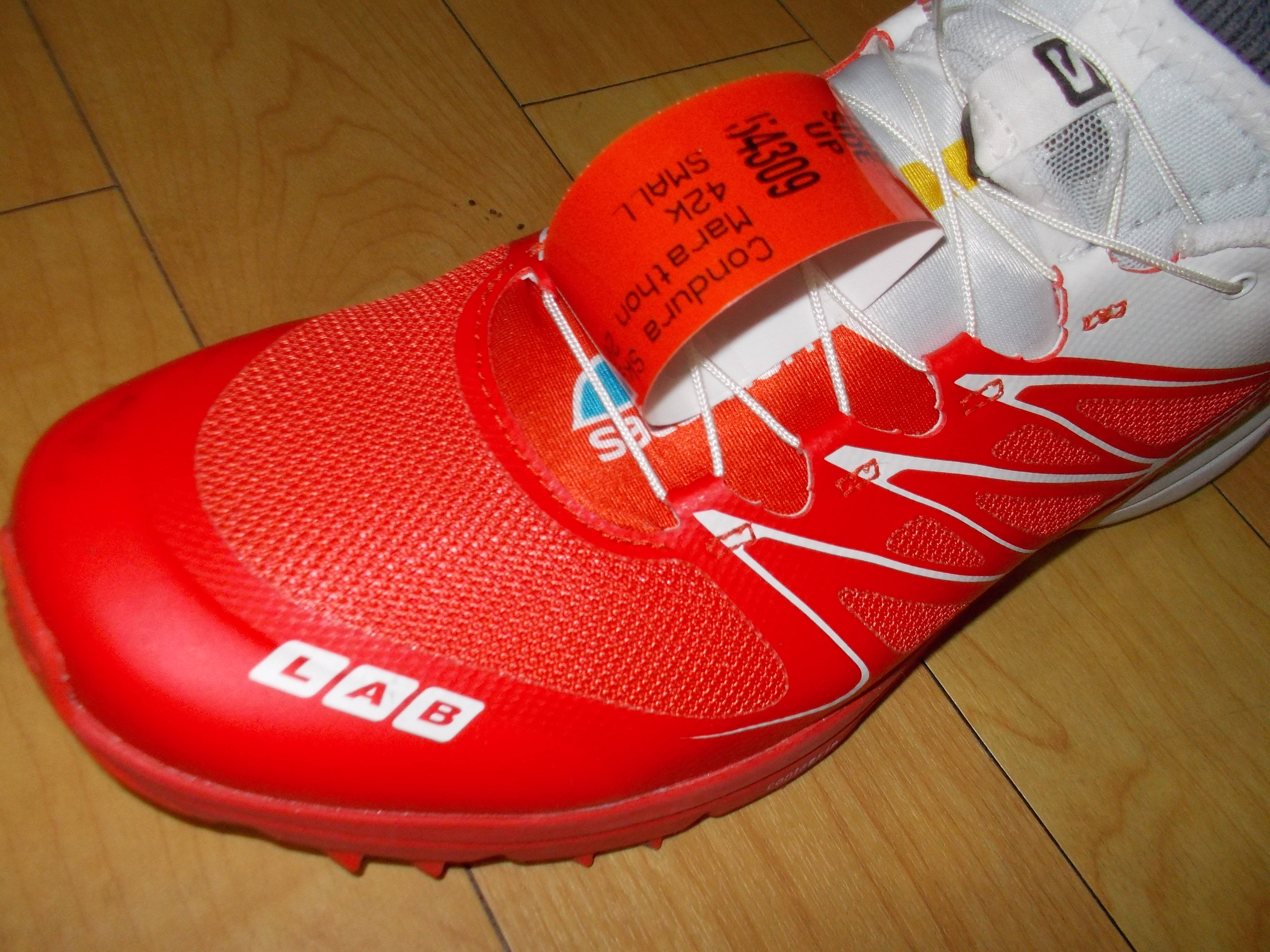
Salomon Ultra Trail Running Shoes

In order to arrest my sweat from reaching my feet and shoes, I prepared my Headsweat (for my head), Buff (for my neck), Long-sleeved PAU Shirt for my body), and Compresport Calf Sleeves, and Drymax Socks.

Race and Nutrition Strategy

Being an “old-school” marathon runner, I consider Marathon Running as a Speed Endurance Event where walking is integrated while drinking my two cups of water as I leave in every Water Station. In-between those Water Stations, one has to run and jog as fast as possible!

Knowing what my body is capable of as an “experienced and old” marathon runner, I opted to use the “negative split” way of racing this event. If I had prepared properly for this race, I had opted to use the “even pace” strategy where my race pace at the beginning is maintained throughout the race. My experience in ultra running and consistent advise from my Coach dictate that my pace at the beginning should be slow and progressing to a faster pace towards the last half of the race up to the Finish Line.

On nutrition, I had a full meal rich in fats and carbohydrates one a half hours before the start of the race; snacks of carbohydrates 30 minutes before the race; one Gel every hour; drink water every Aid Station; last Gel to ingest was a GU Roctane; and a reserve of Stinger Waffle as my “reserve solid” food just in case of emergency.

Race Proper

I’ve been away from the road running crowd for the past two years and it was the members ultra running community and my readers in this blog who approached and greeted me as I joined my co-runners in Wave I. It took us 30 minutes to wait from the time the Wave A runners were released from the Starting Line. Those 30 minutes were devoted to talk to some of the ultra runners within my Wave Group and review in my mind my race & nutrition strategy. As we got nearer to the Starting Line, I had my simple prayer to myself and thought of my Officers and Men who died under my Command during my stint and tour as a Military Officer and lastly, to those of the PNP SAF 44 soldiers.

My slow jog on the first 400 meters was the most memorable part of this race as I saluted every time I would approach a SAF member holding a framed picture of the Fallen SAF 44 who was standing in attention on the left side of the road. Yes, it was a slow jog but saluting 44 times is the best that I could do to honor these men who unselfishly offered their lives in the name of peace and safety for the citizenry and our country.
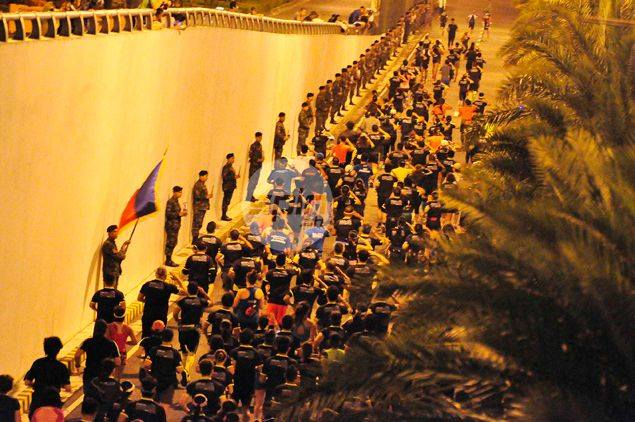
First 400 Meters Of The Course
First 400 Meters Of The Course (Photo By Spin.PH)
Salute To Our Fallen Heroes
Salute To Our Fallen Heroes (Photo By Spin.PH)

I started at the back of the Wave I and waited to make a move on the first uphill climb on the Skyway. I passed a lot of the slow and walking participants on this part. Knowing the whole course’ profile, the first 8-10K is a slightly uphill climb and it worked well with my slow pace as it served as my warm-up. On this first 10K of the course, I would maintain my slow speed of 4.6 miles per hour being aware of my running form; hydrating myself as I would reach the Water Station; and most of all talking to some of the runners and acknowledging their greetings as I passed them.

For about a minute or two, I was able to talk to a couple, Miguel and Cachelle, and kept my pace with theirs. I was happy to see them running together. As with Miguel, I did not see any signs of limping from his gait and strides as he fully recovered from an unfortunate accident while participating in one of my BDM “test runs” two years ago in the Pampanga area. Looking at them together, I knew they would be able to enjoy and finish the race. I will not be surprised to see this couple to be back running in my ultra races soon! I had to beg off from them as I wanted to continue with my own pace as knowing that they are enjoying and having fun with the race.
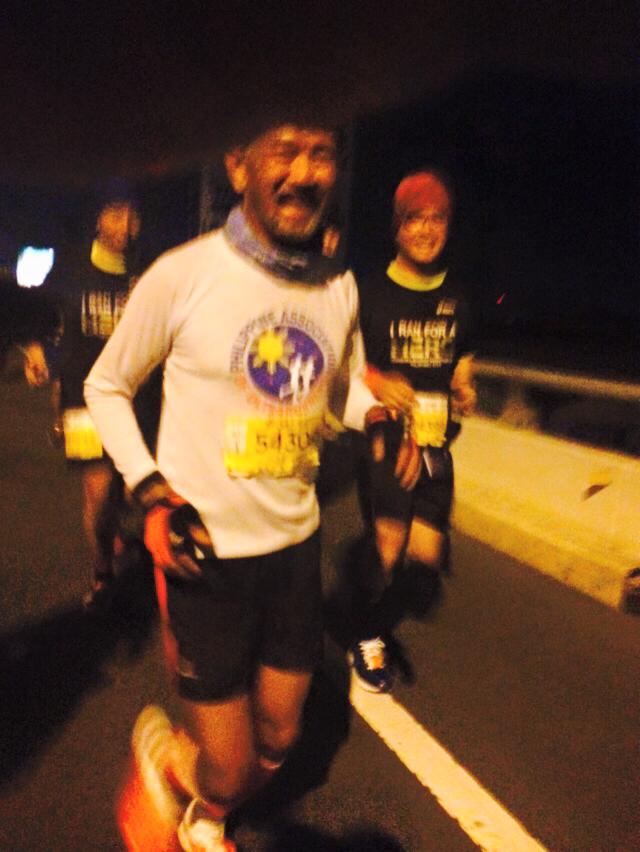
Smiling On The Early Part Of The Race

When I reached the 10-Km mark, I was already enjoying the windy and cool atmosphere of the early morning. I have increased my speed to 5 miles per hour and I was surprised that I was too comfortable with such pace. I ingested my first Gel once I reached my first 40 minutes while I was approaching a Water Station. Two cups of water were enough to bring the gel to my stomach and let it provide the much-needed energy to my machine!

At the 13-mile point, my speed had reached at 5.6 miles per hour and I never let that speed to decrease all the way to the Finish Line. At times, I would reach up to 6.0+ miles per hour on the downhill portions of the course. In my tempo run workouts, I could still run a 10K race with a time of 55+ minutes but forcing myself to this kind of speed in a marathon race without the necessary speed training will be courting for an injury that might jeopardize my training for and participation at the Trans Lantau 100K. There is no point to take a risk on this race.
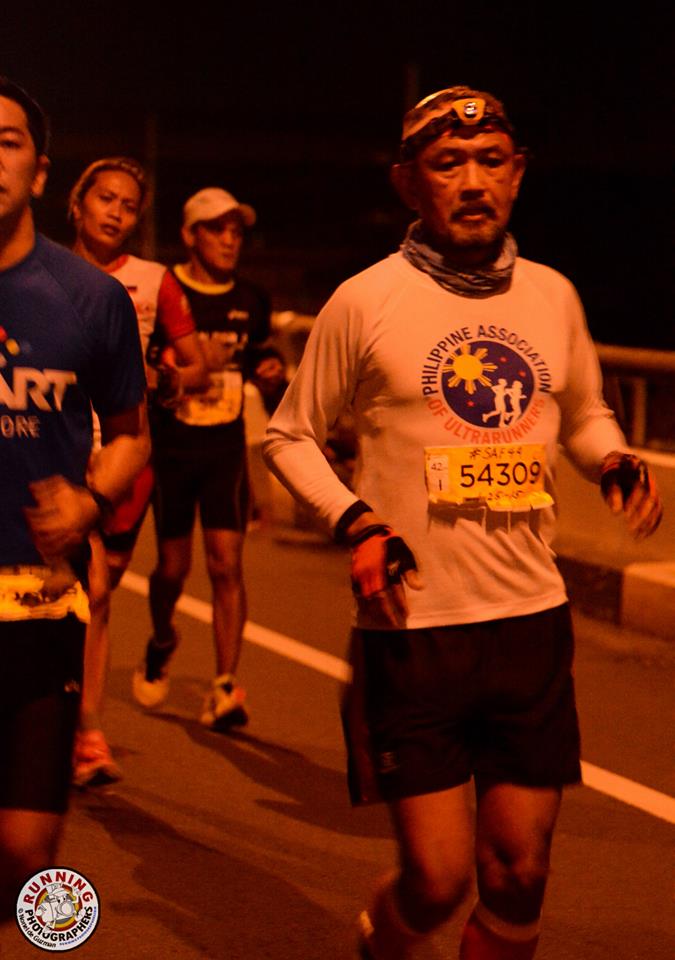
Getting Serious During The Race
Getting Serious During The Race (Photo By Running Photographers)

I kept reminding myself that this race was part of my training for an ultra trail run in the middle of March.
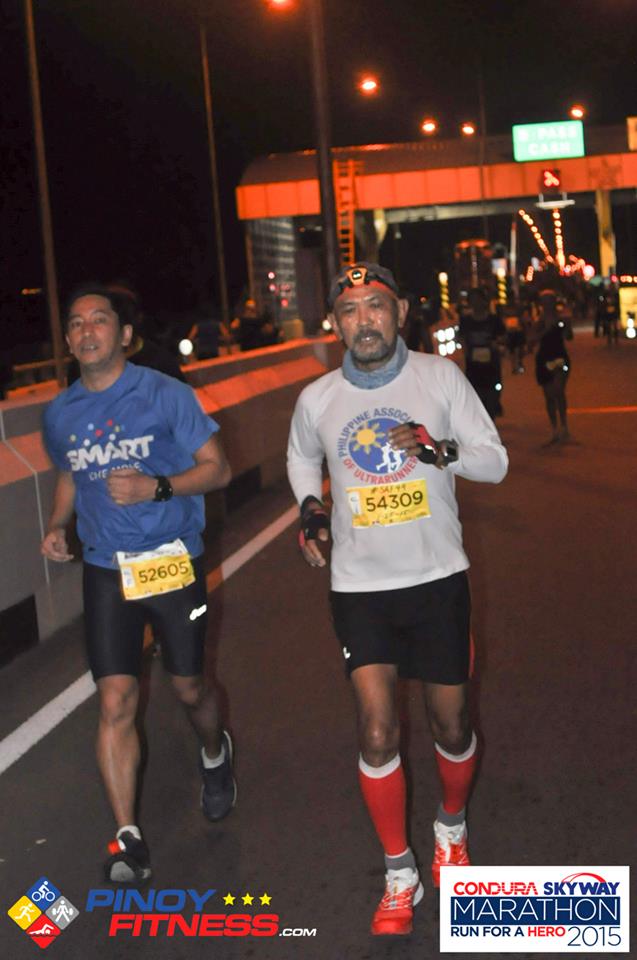
Getting Faster On The Lat Half Of The Course
Getting Faster On The Lat Half Of The Course; From Wave I To Wave F (Photo By Pinoy Fitness.Com)

And my rituals were repeated as I reached nearer to the Finish Line——ingested my Gels every hour after my first Gel at 40-minute mark from the start of the race; reached for two cups of water (only, No Gatorade for the whole race) in every Water Station; would pass other runners at the Water Stations by running up to farthest end of the table and walk quickly & briefly while drinking the water; making sure that my empty cups would land in those garbage bins provided by the Race Organizer; by just waving my hand or simply greeting back to those runners who call my attention or greet me; no unnecessary “chit-chat” to other runners on the last half of the course; by allowing other runners to pace with me or run along with me (without any conversation); and try to pick-up and increase my pace through some quick “surges” on the uphill portions and on the last 10K of the course (all downhill to the Finish Line).

It was still dark when I reached the Finish Line. I finished the race with an Official Time of 4:40:19 hours and ranked #569 out of 5,022 Finishers.

I did not realize that I could still run this fast considering my age of going to 63 years old in 3 months. Maybe with a more focused training in the Marathon distance, I still could run this fast and hopefully, could still have a shot to a Boston Marathon Qualifying Race, the proper and traditional way!

But on second thought, I will remain as a Trail Ultra Runner and consider the Condura Skyway Marathon as my ONLY yearly Road Marathon where I could be in touch with the marathon/road running community in the country.
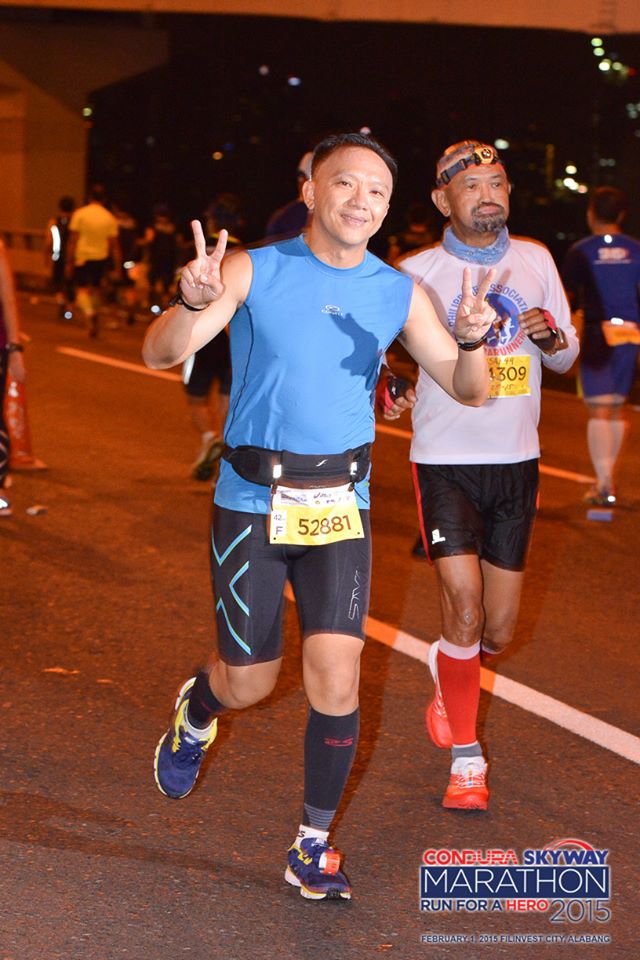
Breathing Hard Through My Mouth
Breathing Hard Through My Mouth (With The Wave F Runners)

Lesson/s Learned

1. Marathon Running is an Art and a Skill. Racing is about You and the Distance. Every runner needs Endurance and Speed to have a very successful finish. One has to compete with oneself and not with any other runner.

2. Marathon Racing is NOT a time to socialize. “Socializing” is done after the race. As compared to Ultra Running, Ultras are races where one has to “socialize” from the start up to the finish and beyond the race itself. Sometimes, Ultras’ “socializing” starts during training and preparation.

"Socializing" Before The Race
“Socializing” Before The Race With An Ultra Friend

3. Proper Nutrition Strategy is the Key to a successful Marathon Finish coupled with proper Hydration technique. Gels are the best immediate source of nutrition in a Marathon Race. Eating a full meal few hours before the race and later, a light snacks few minutes before the race always worked positively in my races.

4. Racing Strategy is dependent on one’s training and preparation. If you are NOT fully-prepared and trained for the event, be contented to aim for a Finish without any injury, and not for any PR or best time for a Marathon Race.

5. No complaints and “whining” in a Marathon Race. Before Gels and Sports Drinks were invented, Marathon Races have ONLY Water as support for all the runners! Try to strive and train for the simplest and most basic way of running a marathon race.

6. Be LIGHT. Wear the lightest running kit and try also to run light with your body. It is not yet late to learn how to run light by using your forefoot or mid foot as you run by feel.

7. Taper Properly. Since the race is done from Midnight to the early morning, runners are practically sleepless on Friday night, considering that the trip to the event area is outside the Metro Manila. It is advisable to have a complete rest and sleep for at least 7-8 hours every night on the last week prior to Race Day.

8. Marathon Race should be a part of an Ultra Race training and preparation in order to improve one’s speed and endurance. I really did not have a focused and dedicated training for this race. This marathon race was part of my weekly ultra training program where it was to be a “back-to-back” long runs where each day would be a 12-mile run. Instead of two days of 12-mile a day run, I did it for one day/one workout with an excess of 2.2 miles. My average total weekly mileage for the past three weeks leading to this race was from 47-50 miles.
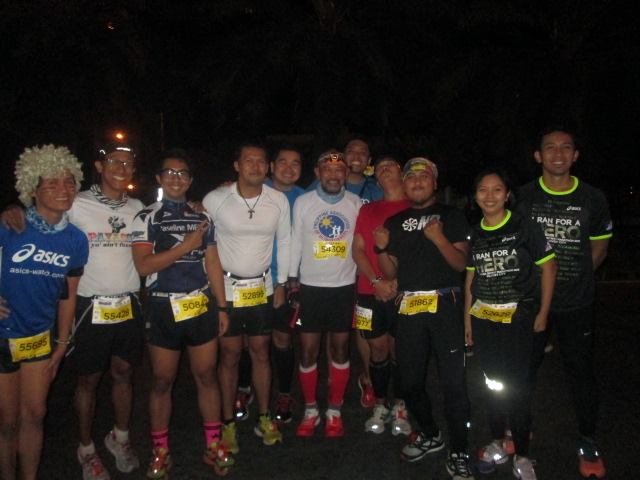
Very Rare Picture With Ultra Runners In A Marathon Race

Running Kit & Accessories

Running Shoes: Salomon S-LAB Sense 3 Ultra Trail Shoes

Sweat Absorbers: Headsweat and Buff

Shirt: PAU Long-Sleeved Shirt By A Perfect White Shirt

Shorts: Salomon Trail Running Shorts (Bermuda)

Calf Sleeves: Compressport

Socks: Drymax (Trail Running Socks)

Cycling Gloves: Specialized

Headlight: Fenix

Nutrition: 2 pcs of VFuel Gels (Fudge Brownie); one GU Gel (Salted Caramel); one GU Gel (Roctane); and 2 pcs of Stinger Waffle (Reserve)

Race Belt: Ultimate Direction SJ Signature Series

Watches/GPS: Garmin 310XT with HR Monitor and TIMEX Watch

Congratulations to Tonton and Raul Patrick Concepcion (Race Organizers); Rio Dela Cruz (Race Director); and to the rest of the Condura Skyway Marathon Team for this well-organized and international-standard marathon race which honors our “present day” heroes in the military and armed services and supports their dependents through the HERO Foundation.
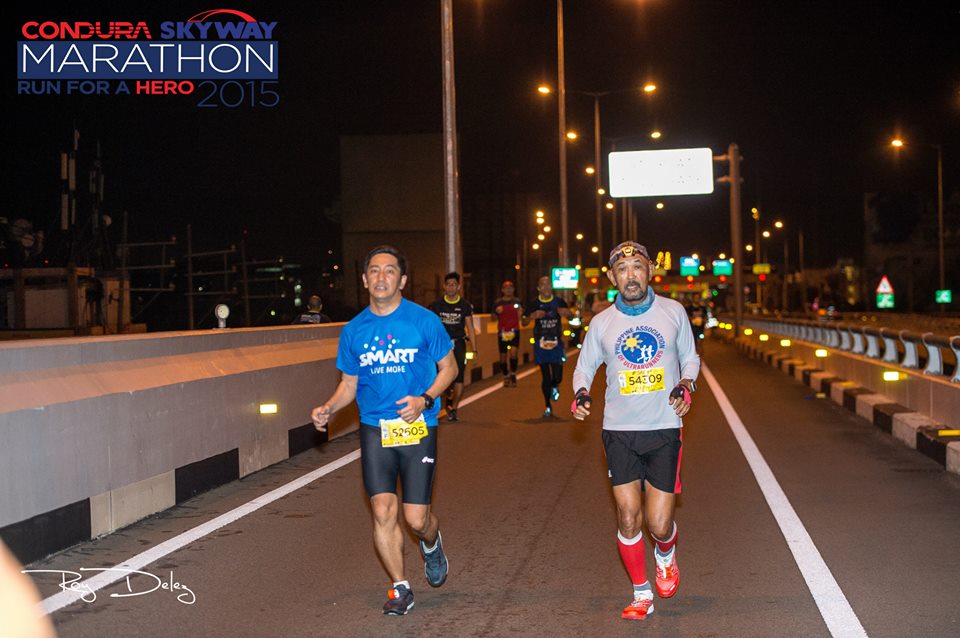
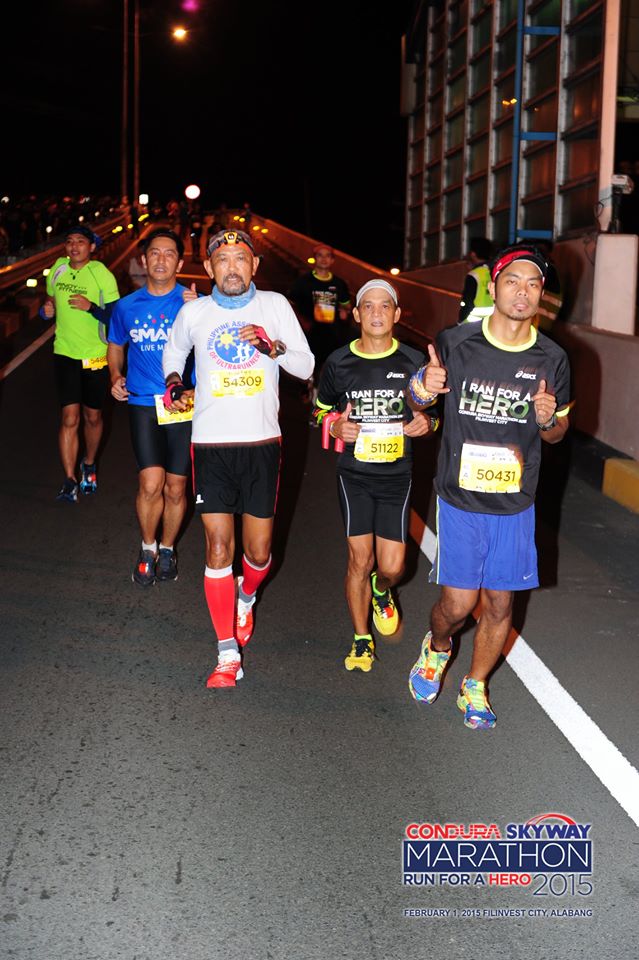
Last Half Of The Course
Approaching The Finish Line

Congratulations also to all the Finishers!

See you next year!

How Much?


It’s been awhile that I was not able to post my thoughts in this blog. Oh, well, I am back!

Let me ask you first this question. “How much is the worth of your International Marathon Race Finisher’s Medal?”

For the past years, there had been a lot of local runners (Pinoy Runners) who would go abroad to join “famous and not-so-famous” Marathon Races. I am not sure of their definite reason or reasons why they have to go abroad to experience such event. I am not against this but I am one of the average runners who highly recommend other runners to experience what it is like to join in any of the International Marathon Races.

I’ve been to International Marathon Races and I liked it, most especially, when I run with my children. Most of my past International Marathon Finishes were done in California, USA where I finished the San Francisco and Los Angeles Marathons. I was a witness and cheerer for my son when he finished the New York Marathon. Basically, I know the feeling what it is like to be in these International Marathon Races. The experience is priceless!

Let me get to the point directly. Once a local runner finishes an International Marathon Race, he/she goes to Facebook and writes a “drama” and tells everybody that he/she successfully finished the race with a picture showing his/her Finisher’s Medal, sometimes stating also, after having failed in three (3) successive lotteries for entry to the race. The runner will be happy to receive a lot of comments on his/her status with the words, “Congratulations”; “Good Job”; “Wow”; “Amazing”; “Where is your next International Marathon Race?”; and others. However, nobody dares to make or write a comment on what was their finish time or how much did they save and spend to join the event.

Nobody would say how much did they spend for the experience and be able to “brag” about it together with their accomplishment. Not one of them would openly discuss how much money they spent just to get that “prestigious” Marathon Finisher’s Medal. Actually, I am also guilty with this but my purpose in joining such International Running Event is for me to visit my family and spend some time with them. My Race Reports in my past International Marathons are well-documented in this blog but I also missed stating how much I spent to join such events. I got a lot of “savings or freebies” joining these Marathon Races because I have our house to stay and a family car that I can drive.

But, for a local runner coming from the Philippines and going to another country without a friend or relative who could be a “host” to him or her, it is a different story.

This Is A Lot Of Money

Theoretically, I can answer such question for these runners who have finished their International Marathon in the United States based from my personal experience and data available in the Internet. First, is the Registration Fee. It would range from $250-$300 depending on the popularity and prestige that go with the event. Second, is the Round Trip Plane Ticket Fare which would range from $1,300-$1,600 depending how far from the Philippines and the “class” that you prefer to be accommodated inside the plane. Third, is the Accommodation which would range from $200-$300 per day stay in a hotel, which is of course, is not a big problem if you have a friend or relative who is hospitable enough to open his house or condominium/apartment for you. Fourth, is the Food and Other Miscellaneous Expenses/Transportation Expenses (Car Rentals) which could range to about $60-$100 a day. Fifth, is your Shopping Money which is geared towards buying a new pair of running shoes, a new electronic/tech gadget, or a new running apparel in the Marathon Expo which are not yet available in the local market. So, if you add up everything, a runner would easily spend a base figure of almost $3,000+ and this amount increases depending on the number of days you will stay in the city where the Marathon Race is being held.

If the Marathon Race is held somewhere in Europe, I think it is a different story. It could be more expensive than what I previously presented on Marathon Races held in the United States.

If you convert such amount of money to our local currency, it is an amount that an ordinary government employee or a corporate employee could hardly save for the whole year. It is for this basic reason why our best elite marathon runners could not afford to join these prestigious International Marathon Races.

On Finisher’s Medals


When I started joining road races in the early 80s, you can only receive a Finisher’s Medal if you finish a FULL Marathon Race. As for the lesser distance races, like 5K, 10K and Half-Marathon/21K, a finisher received then a Finisher’s Certificate and that was it! Joining a road race then was purely very simple and easy—pay your registration fee and you immediately get your race bib, instructions of the race, and a simple drawing/sketch  of the route! Once you cross the finish line, you get your medal and/or Finisher’s Certificate and you go home happy and fulfilled.

It is also in FULL Marathon Race that you get a Finisher’s T-Shirt or Race Singlet. But in the lesser distance races, you seldom get any finisher’s t-shirts.

Only the Podium Finihers (1,2, & 3 runners) received Medals for the lesser distance races. Sometimes, there are prizes, cash or gift certificates, for the winners.

Nowadays, even 3K and 5K runners try to find out if there is a  finisher’s medal before they join/register in a certain road race. Some of the finishers would also demand for a finisher’s medal for these short distance races.

I think we should bring back those days when only FULL Marathon Race Finishers deserve to be given a Finisher’s Medal.

What is the significance of a finisher’s medal in running? It is your badge of accomplishment and your prize/reward for finishing the race.

PAU Events’ Finisher’s Medal

When I was in elementary, high school and college, ONLY the top 3 in the class received Medals and all the rest of the graduates received a rolled piece of paper tied with a ribbon which we call the Diploma. If I relate this observation during my learning days to a road race, it is best to consider also bringing back this tradition to the awarding of the best top 3 runners with medals and the rest of the runners with a “rolled” Finisher’s Certificate.

But for the FULL Marathon Races, it is a must that all Finishers be awarded with Finisher’s Medal and let the Podium Finishers be awarded with appropriate trophies.

If Race Organizers would follow this suggestion (going back to the old days of running), I think runners will have to pay less amount of money for their registration fees.

This will bring my topic to the “economics” of finisher’s medal and the runner’s responsibility to know the details of how they are ordered and where our finisher’s medals are manufactured.

Today, we have 5-digit numbers of runners from all the distances, from Marathon to the short 3K Race, and our Race Organizers would attract more runners by offering finisher’s medals to everybody.

It’s a big money!  But the money to be used to purchase the medal is coming from the registration fee! But there are corporate entities that would subsidize the cost of the medal resulting to a cheaper registration fees from the runner. MILO/Nestle Philippines is noted in this blog as the only corporate entity that subsidizes the cost of its Finisher’s Medals in its yearly nationwide road races.

The size of the medal is directly proportional to the cost of the product. Which means that, the bigger the medal, the more expensive it is. You should be happy that you have the biggest medal for finishing a race. Your money was used to order and buy that item…and you really wanted that medal to show to the world that you have accomplished something which others have yet to do.  It is fine and fair because you earned it by honestly finishing the race.

But for me, I am sad if these Finisher’s Medals are ordered and manufactured from another country. Oh, yes! Most of the Finisher’s Medals nowadays are ordered and manufactured in another country. You might say that the art work is better and the price is cheaper but your money which you paid for the purchase of this medal as part of the registration fee is going to improve the economy of another country. Not for the economy of our country, my friend!

I would not mention “big ticket” road races here in the country that order their Finisher’s Medal in another country which happens to be saturating our markets with consumer goods which are very cheap. And even saturating our markets with fake & cheap versions of any Popular/Signature Brand from jewelries, clothing, accessories, and even tools and equipments. I would say that this country is robbing us with the economy that is supposed to be ours!

If you are patriotic/nationalistic and have that duty to help the economy of our country, and as a paying and registered runner, you have the RIGHT to ask from the Race Organizers where your Finisher’s Medals are ordered and made. You can even ask how much is the production cost for the Finisher’s Medal you are going to receive once you cross the finish line. I am not telling you to refrain from joining such races where the finisher’s medal is made outside the country but I just want you to be aware where your hard-earned money is going to end up to.

By the way, all BR Events’ and PAU Races’ Finisher’s Medals and Buckles are made by Bernal’s Metalcraft & Engravers in Pasig City and Suarez Brothers in Cebu City, respectively.

In my small way, I am helping the economy of our country!

The BIGGEST Finisher’s Medal Exclusively For the Finishers of the 1st WC200

36th MILO Marathon Manila Elims


Last year, I ran the MILO Marathon Manila Eliminations but I DNFd at Km 23 because of my injury on my left knee.

This year, I did not have plans or intention of joining the MILO Marathon Manila Eliminations as I was out of the country when the media launching activity was held. However, my friend, Jonel, informed me through FB that he was able to register me to run the Half-Marathon distance which I thought to be a nice event for me to see the runners and at the same time to be seen by new runners after I’ve been busy going to the mountains and enjoying the beauty of trail running and hiking to the peak of mountains.

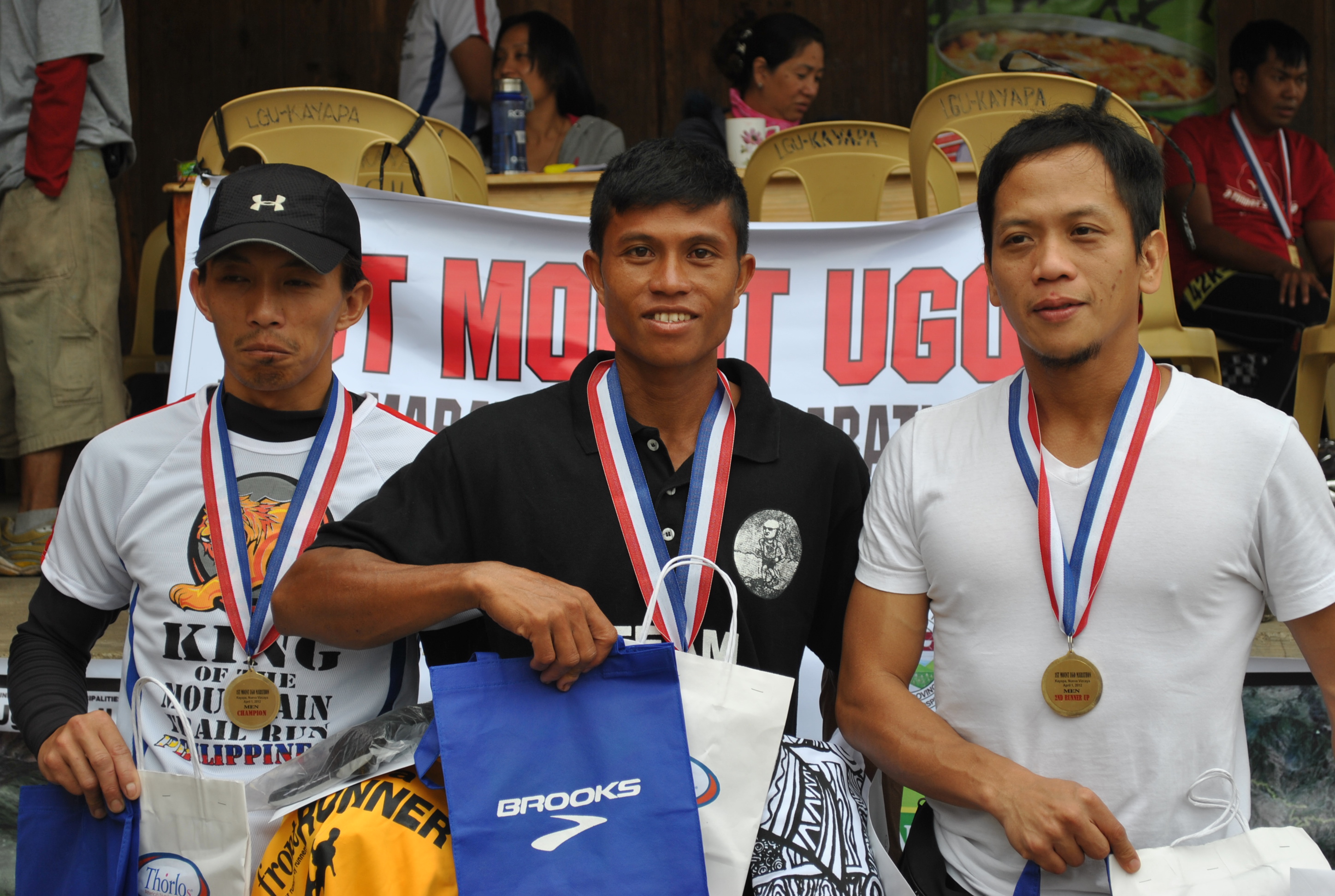
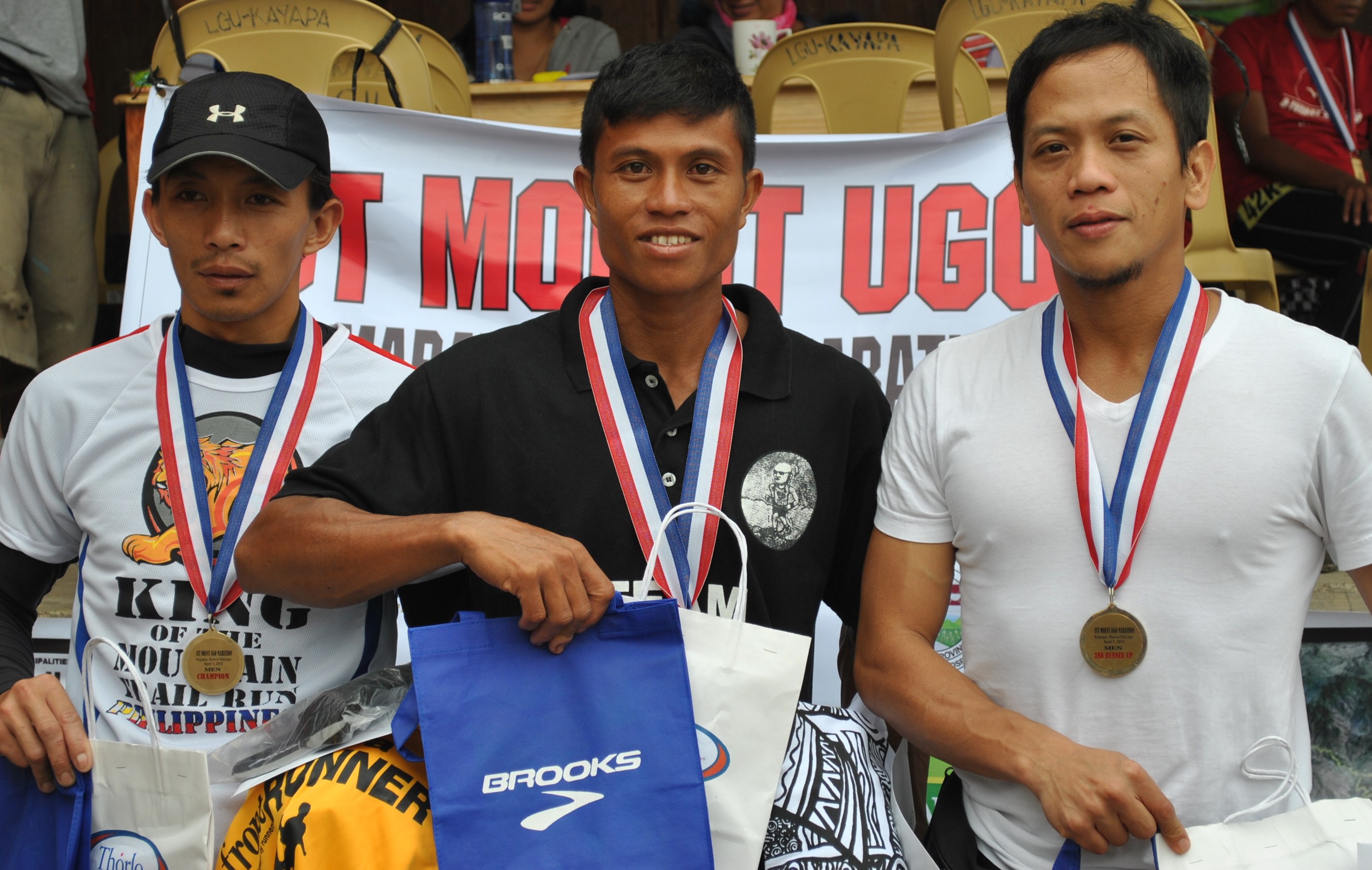
It was also a chance to expose one of my elite runners whom I’ve been training/coaching for ultra trail runs in the province. Danin Arenzana had been with me for 3 years and he has been consistently training for mountain runs. In his debut race at the Mt Ugo Trail Marathon Race (42K) by Jonel of FrontRunner Magazine last April of this year, he placed First Runner-Up, competing with the fast runners of Baguio City. I registered him for the MILO Half-Marathon distance as a test run on flat and paved surface.

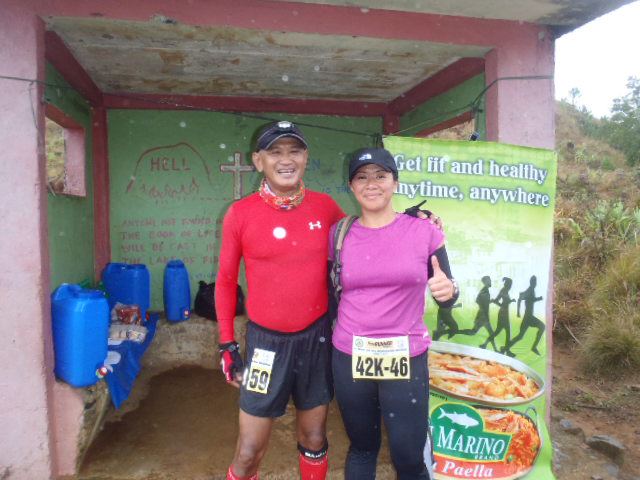
Danin Arenzana At The Center, 2nd Place Overall in the FR Mag’s Mt Ugo Trail (42K) Marathon

As I said, I joined this race to be seen by other runners and also try to look for Marcelo and give him whatever I could receive from friends which they committed to be given to him. After giving some advice to Danin and making sure that he is positioned infront of the starters, I positioned myself at the back of the pack and find out how my body would perform without any structured training program as a preparation for this race.

The day before this race, I finished a 10K race in Fort Magsaysay where I finished in 1:02:15 hours. The course was relatively flat but there are hills to overcome which made the course very challenging. (Note: I will make a separate Race Report on this run). While traveling to Manila, I could feel some pain in my knees but with some massage, full sleep/rest and “voodoo” drinks, I was ready for a half-marathon race the following day.

On Race Day, I was surprised to find out that it took me almost one minute to cross the starting line from the back of the pack. It showed how many runners had registered and started for this race. I was informed that the number of runners had reached to 38,000+ making it the most attended running event in Metro Manila/in the country so far. This makes the MILO Marathon to be consistently called as the “most prestigious running event in the country”.

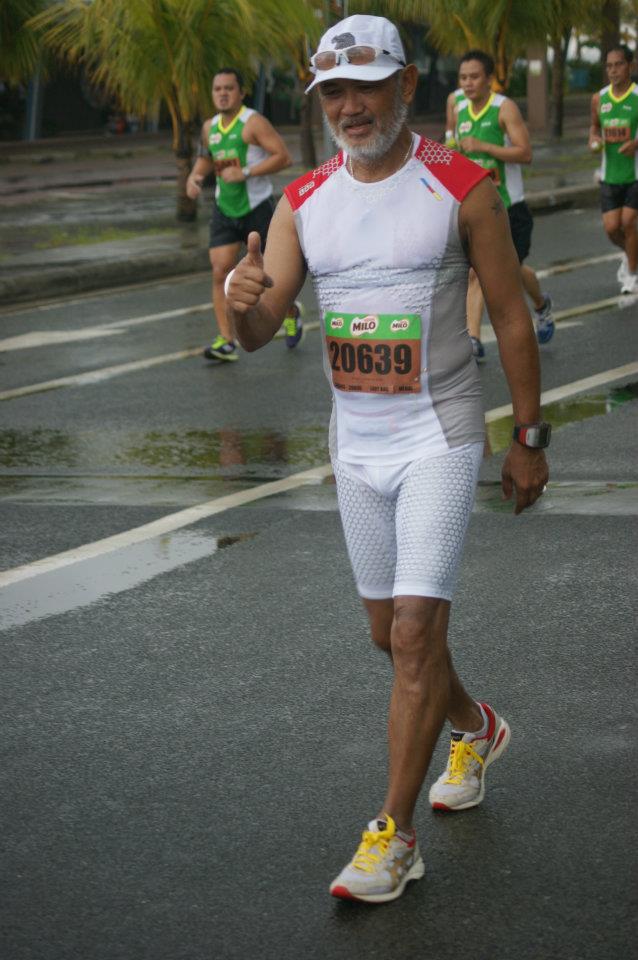
Crazy Old Guy Wearing A Trail Running Attire In A Half-Marathon Race

Well, going back to my performance. I was too slow and I understand that my age is slowly catching up with what is in my mind. My mind would say that I am still fast and strong as if I am 40 years old but my legs and my breathing were saying the reality—that I am already slow and getting older! On the first 10K, I was averaging a pace of 6:15-6:30 minutes per kilometer but on the 2nd half of the race, I began to slow down and had to walk before and after drinking water at the aid stations. My last 5 kilometers were really painful as I would experience some cramps on my calves. I had to walk on the last kilometer of the race.  I would finish the race in 2:25+ hours. My slowest finish time so far for a half-marathon distance!

Walking @ 200 Meters Before The Finish Line

There are no alibis or complaints about my performance. I simply did not prepare for this race. At least, I was able to gauge the level of my running fitness with this race. Which means, I lack the endurance and speed to sustain a consistent pace for the distance. Damn those swimming laps which I’ve done as cross-training to lessen the pain on my knees, hoping that I could improve my swimming endurance coming from a zero and a non-swimmer for the past months and weeks. I guess, I am a land animal and not a runner trying to glide like a fish in the water.

It’s a blessing in disguise that my road races last weekend (10K & 21K) have started again my focused training in running with the hope of joining more road and trail races in the coming months. Running and hiking to the peak of the mountains will still be a part of the training. My knees are still in pain but some adjustments in my training will have to be done for me to be back in consistent training.

Danin, my elite athlete, surprisingly landed #9 overall in the Half-Marathon Race with a time of 1:30+ hours. He performed well and he has the potential to run faster as I advised him to restructure and make some adjustments in his training program. We will see him more in trail running events!

Danin Arenzana Along Roxas Boulevard

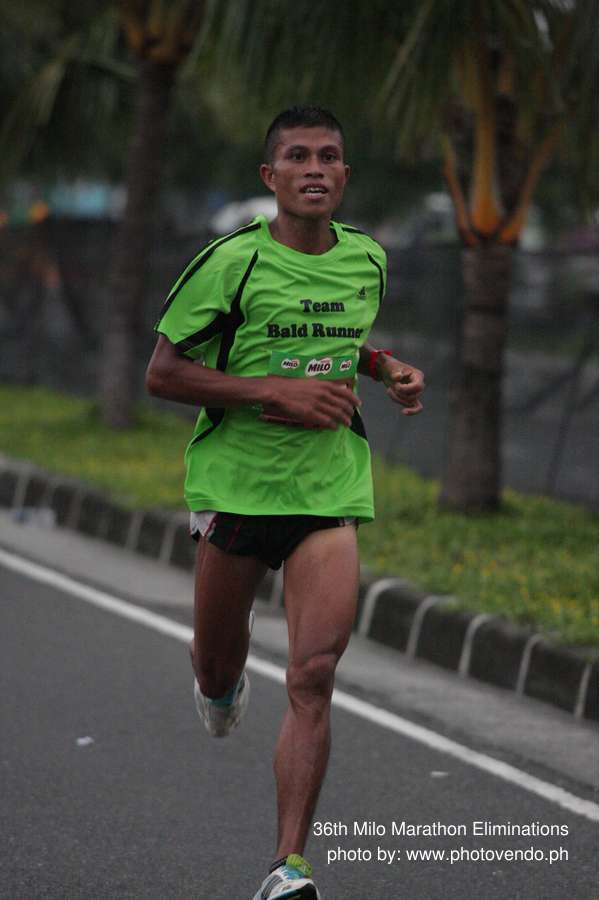
It worthy to note also that my Elite Team Bald Runner/Philippine Army runners, Elmer Sabal and Gerald Sabal placed 2nd and 3rd Overall in the Marathon (42K) Elimination Race, respectively. Elmer finished in 2:45+ hours while Gerald finished in 2:46+ hours. I hope these runners will train some more to be able to win in the MILO Marathon FINALS in December. Danin will run again the Half-Marathon Race in the Finals, hoping to improve his time and ranking.

Congratulations to MILO Philippines and to Coach Rio De La Cruz (RUNRIO) for the successful conduct of this year’s Manila Elimination Race. You did a splendid job! No doubt, this running event will stay consistently as the “most prestigious running event in the country” in the years to come. Plus the fact that you have provided more running shoes to more students and potential runners around the country through your “Donate A Shoe” Program!

See you at the FINALS!

Culture Of Road & Trail Racing


In my “peak bagging” activities throughout the country, I had some observations and information which I would consider as the “culture of road and trail racing” in the countryside. These observations and information gathered could be explained in details through the following topics:

1. No Prize, No Race. In the early times, racing has always a prize for grabbing. It is either money, property, position or any tangible object which one can sell or need in their daily lives. Running feats for faster times had been won by wagers and bets. In the countryside, the best runners don’t run if there are no cash prizes! For obvious reasons, they paid for the registration fee from their savings or had loaned from somebody else. The motivation for winning is to be able to regain what they have paid for and at the same time, earn some money for their basic needs. Bragging rights for them is not for the Finisher’s Shirt or Medals or Loot Bags. They simply need the money!

2. No Sponsor, No Run. Runners with talent and fast finish times always look for sponsors to finance their registration fees. Instead of getting a loan, they would prefer to look for somebody in their community to finance their participation in a race where there is cash prize. It could be their leaders (local government, barangay captain & officials) or somebody who is supportive to their passion/talent. Runners don’t need to pay back the Sponsor just in case he/she does win any of the cash prizes. If they don’t have any sponsor, they would not join any race.

3. Cheating Is Not A Big Deal. Runners in the countryside would finish the race at all costs, even if they cheat! To them, it is natural to cheat because they know that everybody cheats, from their leaders, business-owners, traders, vendors, parents and friends!

4. Running as Talent Is Normal. Most of the best runners were exposed to hardships and manual labor during the early stage of their childhood. Most of them lives in villages in the mountains and they have all the time to ascend and descend the area to look for food, fetch water, and cultivate some lands on a daily basis. Due to their environment and living conditions, they were honed to be endurance athletes since birth. Try to look for one elite runner and conduct an interview about his/her family background and you would know what I mean. And at the same manner, try to look for an elite runner who belongs to the upper class of our society and you will be surprised to find out that you are looking for a “dream”.

5. New Running Kit Is Alien To Them. For obvious reasons, they don’t have any opportunity to use the latest running apparel and shoes due to poverty. Most of their kits are used (second-hand or “ukay-ukay”) and given to them to protect them from the elements. They don’t have any access on the new technology of running in terms of shoes, apparel and accessories. If they have an opportunity to grab a “glossy” runner’s magazine, attention is more focused on the pictures and not on the articles written inside it. I am not sure if they can read or understand English or what is written on those pages.

6. Hydration & Nutrition Are Also Alien To Them.  They drink if they feel thirsty. They eat if they feel hungry. They replenish the basic necessities for their body by feel. They only react to any problem when it is there. They usually drink and eat after finishing the race.

7. There Is NO Shame in DNF. If they think they could not place themselves on the ranking where there is a prize money, they simply stop and declare themselves as DNF and say lots of alibi and complaints. To them, finishing a race where they did not train properly is a punishment! They have to preserve their body from any exhaustion or injury and be “race-ready” again for the next race. In short, they don’t take the “extra mile” to persevere in order to finish the race. It is worthy to note that my Elite Team Bald Runner members are also like this in major races in Metro Manila. However, it took me sometime to change this kind of attitude.

8. Bragging Rights & Recognition. Among their friends, they would brag that they finished a certain race with a certain ranking but the truth is that he cheated along the route by riding a passing motorcycle or a public utility vehicle along the route. But for them, recognition of finishing and receiving an award is translated to the money that they received as a prize! So, if there is a cash prize in a race, the temptation to cheat is always there because it is a part of their training and preparation to finish the race. Very smart, indeed!

9. Race Organizers & Directors Are Businessmen. They organize and direct events for you for a fee! Of course, they should be! It is because they appear to be professional but in the end they will take advantage of you. Not all Race Organizers/Directors are elite runners as most of them are average athletes/runners. Those athletes think that if they finish one or two ultra marathon events, they have already the skills to organize one. Race Organizers try their best to invite runners through ads on the internet, radio and printed materials because for them, more runners means more income aside from the fact that they are being paid for P 85,000 per event, which is the lowest rate outside Metro Manila. But once the gun is fired at the starting line, his work is done!

In short distances up to half-marathon, their time to monitor the runners is up to 2 hours! After 2 hours, they packed up and just leave the last runners to cross the finish line on their own. Sometimes, without marshals, ambulance or water at the aid stations. Once the top 3 runners cross the finish line (Overall and Female Categories), the race is done. The results of the rest of the finishers are immaterial as the results of the race will not be published. Only the top 3 runners are awarded with cash prize and a simple tap on the back of the athletes is enough. The Race Organizer will just say, “see you on the next race!”.

I am writing this post for the simple reason that the nationwide 2012 MILO Marathon Races are about to start. Our best runners in the regions and provinces are now training for this much-awaited event because it is the most prestigious running event in the country and it offers a lot of cash prizes for our runners in the “grassroot” level and a free trip & accommodation in Metro Manila for the MILO Marathon FINALS. This makes me wonder again why there is NO Filipino Corporate Entity (Filipino-Owned) that could match or even start what MILO had been doing to promote running in the “grassroot” level for the past years! I just hope also that our best runners in the regions and provinces would be training properly and not prepare/train to cheat on the said races!

Does it ring a bell if I say that there were cases of cheating in MILO Marathon & Elimination Races in the past editions? Well, that proves my point, there will always be a cheater (or  bandit) if there are cash prizes to be grabbed at the Finish Line.

On the other hand, I hope this kind of culture of road/trail racing in the running community would be removed in due time. There is a need to aware the runners that cheating has no place in running/racing events and it will eventually result to the end of their running carreer as they would be declared permanently “banned for life” in running events.

In life, like running a Marathon or Ultra Marathon Race, the opportunity to cheat is always there easily to be grabbed with or without any material rewards or prizes. Your actions will define the character you are made of and if you will fall to the temptation of cheating, there will always be someone who will see what you have done!

See you at the Starting Line!

Race Report: 1st King Of The Mountain (KOTM) Mt. Ugo Trail Marathon


#3 “Peak Bagging” @ Mt Ugo, Itogon, Benguet via Kayapa, Nueva Vizcaya (2,150 MASL)

4:30 AM April 1, 2012/Kayapa, Nueva Vizcaya

This mountain trail run was the very reason why I started my “peak bagging” feats. On my way to Kayapa, Nueva Vizcaya to recon the route of this marathon race, the road to the Mt Pulag National Park was there nearer from the Ambuklao Dam and the attraction of the said mountain due to its popularity was hard to resist. My trip to the peak of Mt Pulag gave me much confidence to reach the peak of Mt Ugo which is 800 meters lower. And my previous trek to the peak of Mt Natib, two days before race day, gave me a general impression on what to expect in climbing mountains.

If you are climbing to the peak of a mountain, expect a slightly ascending and winding path with so many switchbacks from the base of the mountain or from the trailhead until you reach the base of the peak. The trail is wide and well-maintained where one has to expect more ascending portions than descending ones. From the base of the peak, expect a single-track trail that is very steep on only one side of the peak. I usually call this as the “assault” trail to the peak/summit. Due to steep incline of every step of the trail and the thin oxygen in higher altitudes, one has to experience hardness of breathing and faster heart rate, thus, making one perspire some more. In a race, it is very hard to jog on the steep trail on the side of the peak of the mountain. Walking moderately would be a good option to adopt while on this final assault to the peak.

Depending on the kind or nature of the mountain, every trail is different. If a mountain is a volcano, dormant or active, expect some hardened lava and big rocks as part of the trail. If it is an ordinary mountain, expect a lot of changes on the vegetation or biodiversity of plants in every range of elevation and the trail ground can sometimes be pure earth without any rocks.

I arrived in Kayapa, Nueva Vizcaya after lunch of Saturday, March 31 and my friend, Jonel was at the Municipal Hall & Plaza giving intructions to his staff and at the same time receiving runners who just arrived in the area. Since I gave him the notice weeks ago of my intention to join this event, he designated the only “home stay” facility in the town as my place of accommodation. Kayapa is a small town and there are no commercialized tourist facilities in the area. Just like in Kabayan, Benguet, they have also a “dormitory-type” transient house where the rate is very cheap—P 200.00 per night in double-decked beds. Some of the runners were accommodated in the transient facility of the different barangays of the town. However, there is a big space for campers if runners would decide to pitch their tents infront of the municipal church.

At 4:00 PM, Jonel as the RO/RD of the race event, conducted the race briefing at the Municipal Plaza, infront of the Municipal Hall. It was nice to meet the “usual suspects” in ultra races as well as the local runners from Baguio City and Region 1. I was happy to see runners who came all the way from the Ilocos Provinces, Central Luzon (Region 3) and Metro Manila.

After the briefing, some had their “carboloading” in the local eateries located in the Public Market of the town which is just across the road from the Municipal Hall. It was time to taste the local foods! The pork stew with the local’s native pig is always a winner! And there is also a bonus dish which is the “adobong inasinan na baboy” (preserved salted pork cooked with soy sauce & garlic). The eatery where I ate have also pancit (noodles)!

After dinner, I had a brief talk with some of the runners and everybody was in a relaxed mood. Nobody talked about the race and what to expect during the race. On my end, I told them about my experiences in my new passion of “peak bagging” where Mt Ugo will be my 3rd mountain peak to conquer!

At 9:30 PM, I was already sleeping. However, I was awaken by the movements of the other runners staying in the same place who started to have their shower as early as 1:30 AM. There is no point of forcing myself to sleep some more. I slowly prepared my things and took a shower.

At 4:00 AM, I was already with the rest of the runners at the Starting Line/Municipal Hall which is located across the road from the place I was staying. It was nice to greet more friends and everybody were all smiles. I didn’t see any tense looks or faces among the runners. We were there to enjoy the outdoors and have fun in experiencing the 1st Mountain Trail Marathon in the country.

In a simple ceremony, Jonel led the Invocation/Prayers and I was the one who led the singing of the National Anthem. After a simple welcome and reminders about the critical areas in the race from Jonel, we were ready to go. At the schedule start time, 4:30 AM, the race started with a simple countdown from the count of 10 to 1 & “GO!” from the Race Director.

The first 5 kilometers was an uphill/ascending route along the Benguet-Nueva Vizcaya. I did not run or jog on this part. I just simply brisked walked with the aid of my trekking poles. After 2 kilometers of this winding uphill road, I knew I was one of the last runners of the more than 150 runners who joined the half-marathon and the marathon distances. There was nothing to worry as I knew there will be more ascending portions as the race progresses.

As I reached the trailhead, I started to jog along the unpaved road leading to a narrower trail. It had been raining for the past days and I knew that most of the route will be slippery and muddy on portions with loose soil. I would run on flat and descending portions and then brisk walk on steep inclines. This ritual had been repeated through the race. I would be very careful on portions where there are slippery rocks and muddy portions of the trail. I was very confident on my footings due to the trekking poles I was using.

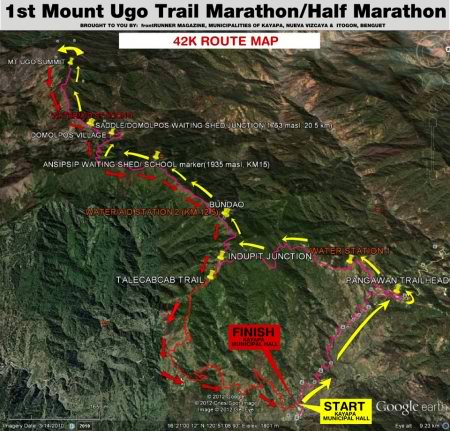
In less than 1 1/2 hours, I was able to reach the turn-around point of those who were participating in the half-marathon at Bundao and I was able to meet the lead runners who were under way to the finish line. I said to myself, the half-marathon distance did not offer much challenge and nice scenery for the runners. I just envy the runners that they are through with the day!

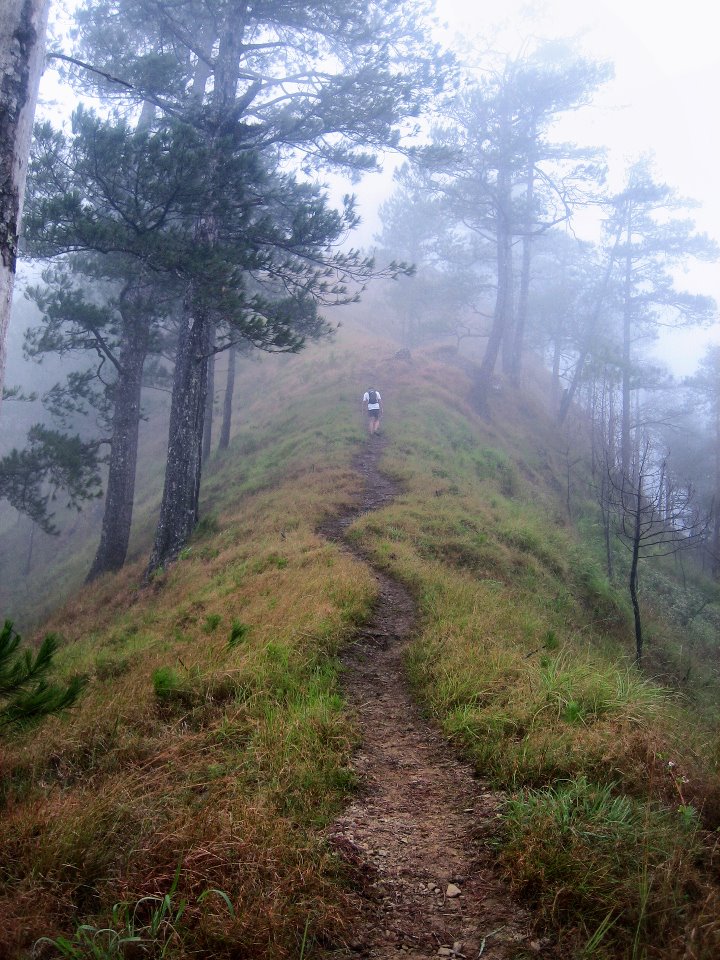
I could say that the trail from Kayapa side is well-maintained and I could see lots of vegetable farms on the sides of the mountains all around. Well, there are animals also that you could meet along the trail. I observed cows and wild/native pig on the sides of the trail.

After almost 17 kilometers, I met incoming runners who were telling me that I was on a wrong trail and I had to retrace myself to the nearest trail intersection. It was good, I was lost for only about 50 meters!

I memorized the word “Domolpos” as the place of the last Aid Station towards the peak of the mountain and it was my target to reach where I could take my first food through my power bars and gels and Gatorade mix. I was with a group of runners (Ed Yonzon, Chito Carreon, Vener Roldan and Gay Baniwas, a lady runner from Baguio who finished 1st Runner-Up in the Ladies Category) when I reached this place. Gay asked me to have a picture with her and later on,  I remained in the Aid Station as they left one by one. I took a pee, ate my energy bar, took a gel, and mixed my Gatorade powder. I guess, I spent almost 3-4 minutes in the process.

When I was back on the trail, I could no longer see the rest of the runners who were with me at the Aid Station. I kept on pushing myself until I saw the back of Gay and I was relieved. Gay became as my “guide’ towards the peak of the mountain. We would have another and more photo-ops along the steepest portions of the “assault” trail towards the peak. I passed her when she stopped to take some more snapshots of the scenery around the trail.

I kept on pushing and digging more of my trekking poles on the steepest parts of the peak and regularly looking for the bright light to appear in between the plants and bushes that cover the peak. If I could see a brighter light source in between the trees and plants ahead of me as I look up to the direction of the “assault” trail, it means that the peak is within my grasps!

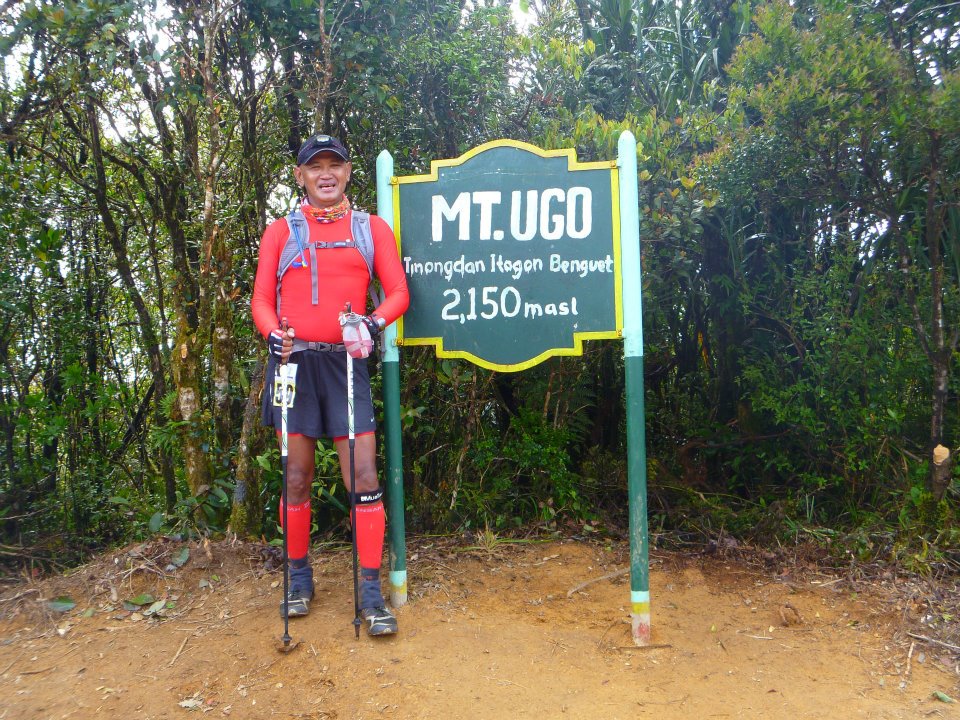
After 4:25 hours, I reached the peak and I was able to meet again Chito, Vener, and Ed Yonzon who just happened to be having their photo-ops near the peak’s marker. I congratulated Koi Lapira for a nice route as he prepared to take a picture of me at the peak marker as a proof that I reached the turn-around point. My GF 305 registered a distance of 23.1 kilometers and an elevation of 2, 165 MASL. After my photo-ops with Koi Lapira, I joined the rest of the runners for another pose.

After my photo-ops with Koi Lapira (the evidence that I reached the turn-around point), I joined the rest of the runners for another picture pose. On our descent to the Domolpos Aid Station, I led the runners at a fast & decent pace.

At the Aid Station, I did the usual ritual—pee, eat, and mix my drinks while the rest of my companion started to resume their run. At the Domolpos Elementary School, I was able to catch up with their tail but I needed to slow down my pace as I approached a very steep trail as I left the school. As I reached the top of the trail, I could no longer see them on the flatter portions until I was able to pass one runner.

When I was about to approach the next Aid Station (Ansipsip), I saw 3 runners who just left the station. I saw Philippe Arenillo, a Pinoy runner, and the French guy whom I met the day before the race running in a single file. I stopped at the Aid Station and drank some Mountain Dew and asked from the Marshall what is my ranking/position among the runners who just passed. The marshal said that I was #30. I became excited as I have some “targets” to follow. However, I was still trying my best to catch up with the group of Chito, Vener and Ed.

Few meters from the Ansipsip Aid Station, I was able to pass the Pinoy runner and the French guy and ultimately joined Philippe. Philippe and I brisked walked and jog together on those descending portions of the route along Telecabcab Trail. I could not speed up on those steep descending trails because I was trying to protect my painful knees! My quads were already burning while the trail was very slippery. More fences to overcome until Philippe asked me for him to go ahead after having a conversation with him for about 2 kilometers.

Philippe became my “target” as I could see him infront of me. Switchback after switchback, I could still see him until I saw another runner who was walking and later overtaken by Philippe. At this moment, I was #28 runner! When I approached the runner, it was Ron Sulapas and I engaged a conversation with him and encouraged him to join me to catch up with Philippe. He joined me in my jog but later after a few minutes he slowed down and I continued my run. I could still see Philippe about 10 meters infront of me but he started to increase his pace until I lost him. I said to myself, #27 finisher would be a good accomplishment already!

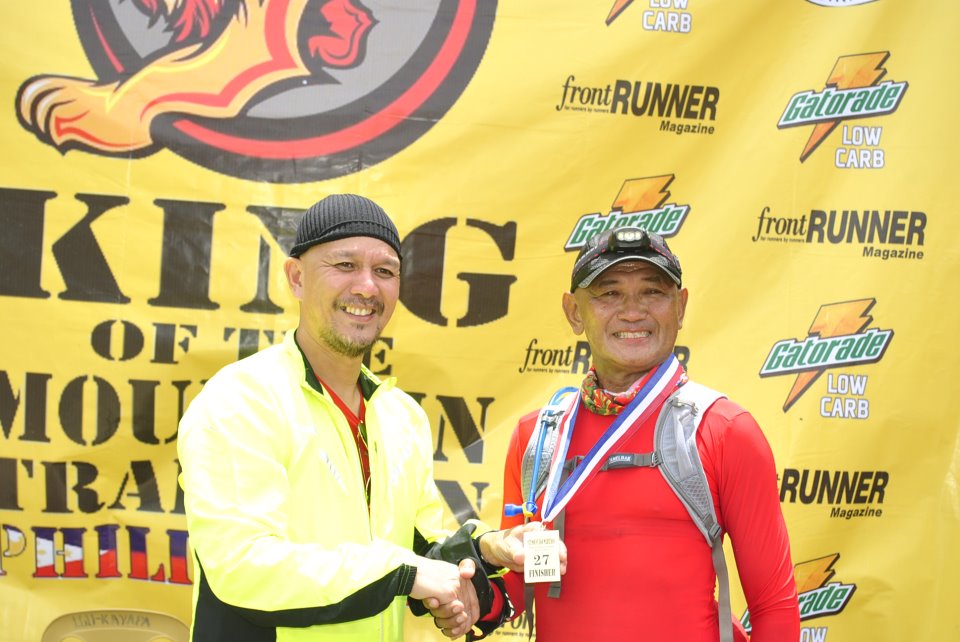
As soon as I reached the last incline of the route/trail, I was back on the main road and the last 50 meters of the race was very fulfilling. I could here the banging of a gong, the ringing of cowbells, and the cheers of those who finished ahead of me from the finish line. I was all smile on those last 50 meters as I carried my trekking poles as if they are my batons! I crossed the finish line in 7:56:57 hours. Officially, I am ranked as #27 out of 69 finishers. Not bad for a 59-year (& 11 months) old runner.

The following were the data downloaded/recorded by my Garmin Forerunner 305:

Distance: 42.06K

Average Pace: 11:20 minutes per kilometer

Average Speed: 5.3 Km/hr

Maximum Speed: 12.5 Km/hr

Average HR: 150 bpm

Max HR: 171 bpm

Total Ascent: 2,751 meters

Total Descent: 2,794 meters

Highest Peak Elevation: 2,169 meters above sea level

Distance From Start to Peak: 23K

If you want to become an all-season trail runner, this is a Marathon Trail Race which you should not miss. I highly recommend this trail run. However, you should find time to make a reservation on your accommodation in the town of Kayapa weeks before the event and if possible, conduct a recon on the said mountain.

Congratulation to Jonel, his FrontRunner Magazine staff, and to all the Finishers for a job well done!

See you on May 26-27, 2012 for the 1st KOTM Mt Ugo Trail Ultra Marathon Race!

(Note: Pictures Courtesy of Jake Manzano, Gay Baniwas, Ed Jonson & Ismael Ilagan)

Podium Finisher @ 1st KOTM Mt. Ugo Trail Marathon


Danin Arenzana of Elite Team Bald Runner placed 1st Runner-Up Overall in the 1st King of the Mountain (KOTM) Mt. Ugo Trail Marathon in Kayapa, Nueva Vizcaya on April 1, 2012.

Despite being “lost’ along the trail route for three times, he was able to catch up and pass some of the lead runners and ultimately, finished the race with a time of 4:56:58 hours. He was the 3rd runner to reach the summit of Mt. Ugo.

This is the first time that Danin finished a full Marathon distance which happens to be also his first official running competition since he joined the Team Bald Runner almost three years ago!

He prepared for only 18 days for this event, concentrating on endurance, strength, and specificity. He goes almost everyday to “Brown” Mountain and its environs. His endurance runs on weekends would reach up to 60 kilometers in one workout on his peak training!

Well, don’t ask who the hell is his COACH!

Danin In Black

Danin and his COACH will be back for the 1st King of the Mountain Ultra Trail Run on May 26-27, 2012!

Congratulations, Danin!

(Note: Danin is on the Middle, wearing the BR’s Black Shirt)

Spectator @ 2011 New York City Marathon


Last January 2, 2012, Monday, the registration for the 2012 New York City Marathon has opened and most of the runners will have to wait for the result of the lottery before the middle of the year. I predict that at this time, many of the local Pinoy runners had already applied for this race despite the costs and resources one have to save and spend just to be able to experience the feeling to join the most popular and well-attended “street party” among runners in the world.

Hopefully, my observations during my experience as one of the spectators of the most popular and most attended Marathon Race In The World would in any way, help or provide positive ideas for them to experience more FUN in joining this event. Race Organizers have also to take note on the different factors why this marathon race keeps on growing and increasing its participants every year.

In the 2010 edition of the race, my daughter Jovelle was able to finish the New York City Marathon and she gained a lot of experience about the place and the event.

In the last year’s edition, my son John Paul was lucky enough to get a slot through lottery and I promised him that I will join him as one of his “chearers” and supporter for the race. It will be also a chance for me to see New York City for the first time!

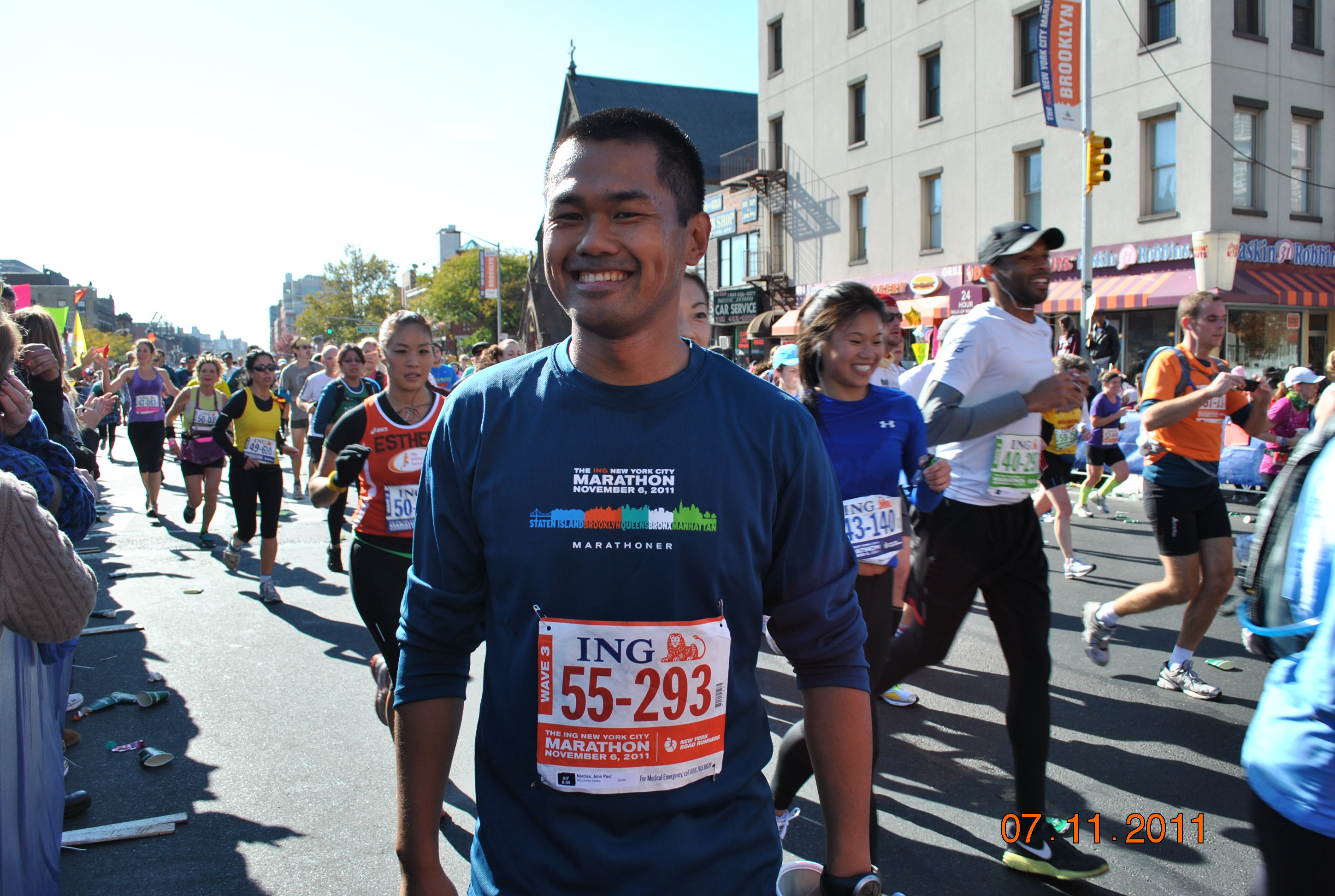
So, the promise was fulfilled when I went with him to New York City for the race together with my wife and John’s girlfriend, Sharon. I cheered him along the portions of the route and took some photos of him up to the Finish Line. My tour along the streets and subway of New York City was very efficient because of the help of my niece, Mariegelle, who is presently residing and working in one of the hospitals in the city as Physical Therapist.

John Paul @ Mile 8 in Atlantic Avenue, Brooklyn

Now I know why the New York City Marathon is the most attended and popular marathon race in the world. Through my almost 5 days stay in the city, I was able to observe a lot of things about the people, the city, and the marathon race itself.

The following are my personal reasons why New York City Marathon is simply the BEST Marathon Race in the World:

1. The City Government of New York and its instrumentalities are totally in support to the event. All of the city’s services and agencies are totally committed for the success of the event. All the government agencies are considered as MAJOR SPONSORS of the event! There is even a competition between the teams of the New York City Police Department and the New York City Fire Department where the top 5 finishers of each team are counted. This tradition of competition event started after the 9/11 incident and last year’s competition was its 1oth year! (Maybe, I have to create also a competition between the AFP and the PNP in the yearly BDM 102 Ultra Race in the years to come!)

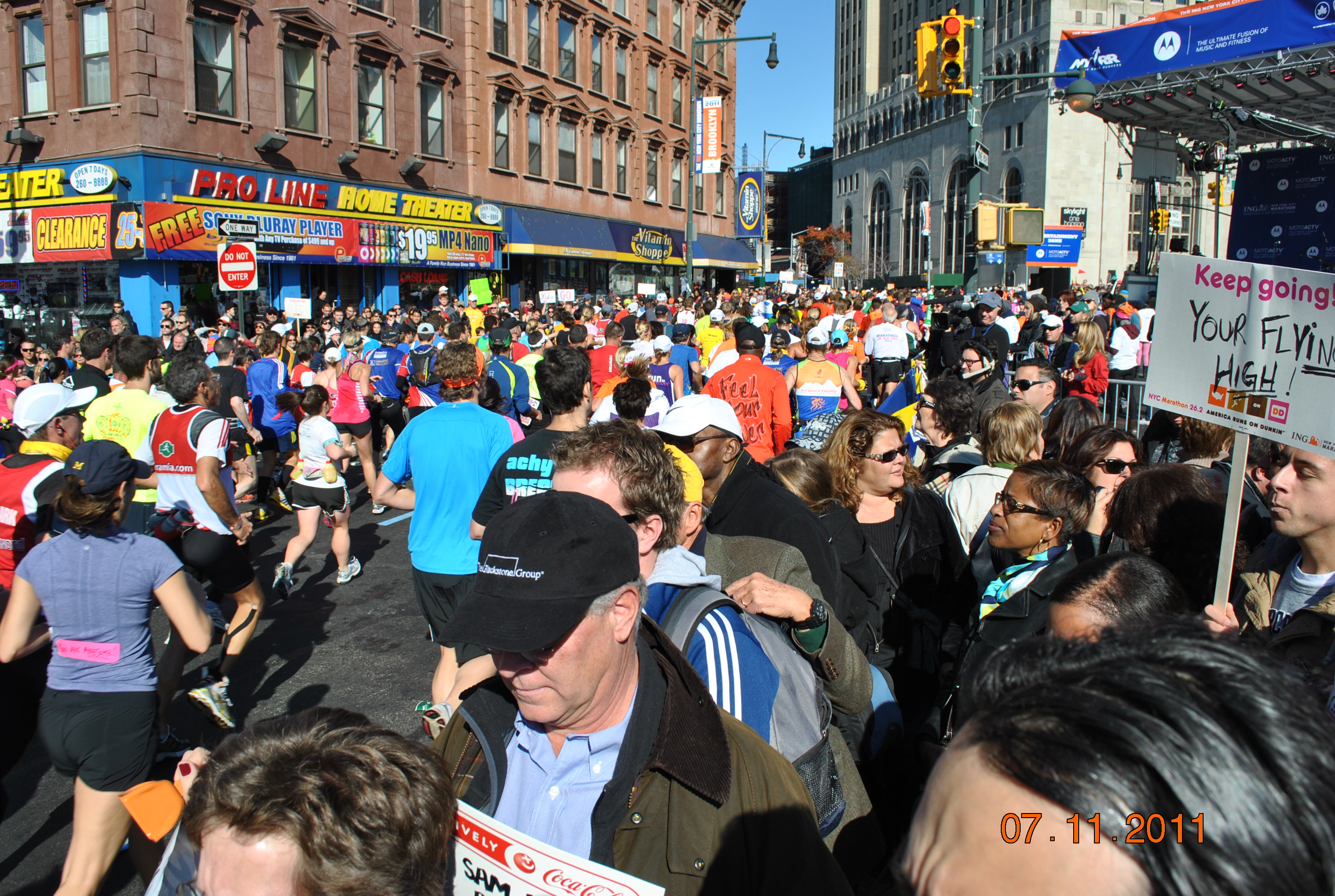
Spectators & Runners @ Mile 8 In Atlantic Avenue, Brooklyn
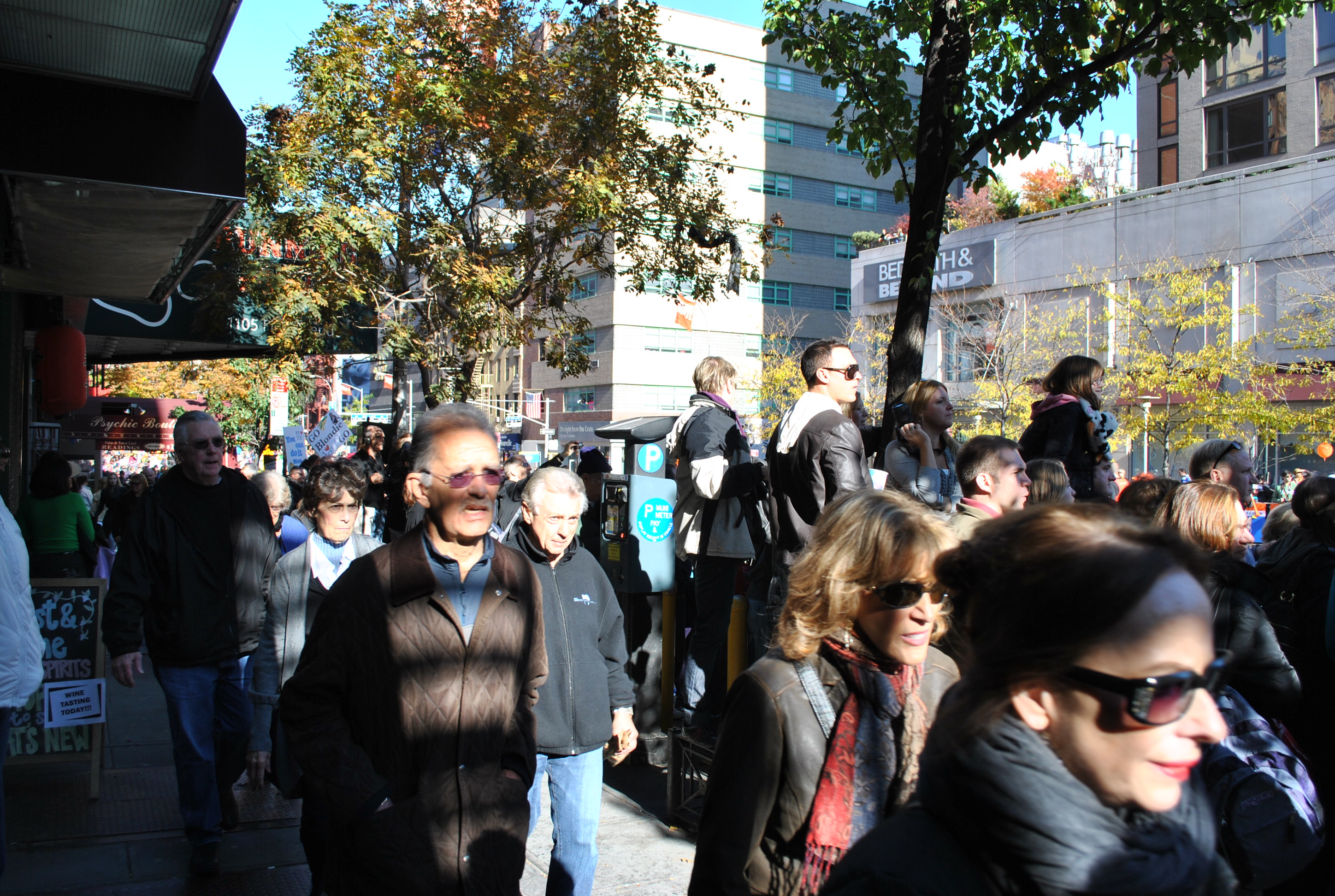
Lots Of Spectators Along The Route @ Mile 16 in Lexington Ave Near The Queensboro Bridge

2. The people of New York City knows that the Marathon Event promotes Sports Tourism. You can just imagine 47,000+ runners plus “cheerers” and family members of runners flock to the city and each of them spend money for food, lodging, transportation, and shopping. I read somewhere that almost 2 Million people were considered as spectators and 315 Million people who watched the TV Live Coverage worldwide. The tremendous amount of income the service establishments would earn out of the visitors of the city because of the marathon race is a big boost to the economy of the place. If a visitor spends at least $500-$1,000 for food, transportation (within the city), amusement and shopping, not including the hotel accommodation, it boils down to million of dollars that is being spent for the duration of the event. (Note: In a report commissioned by the New York City Runners, the 2010 ING New York Marathon generated $ 340 Million for the City of New York in terms of hotel, travel, food, entertaiment, and retail. It also raised $ 30.8 Million for Charities)

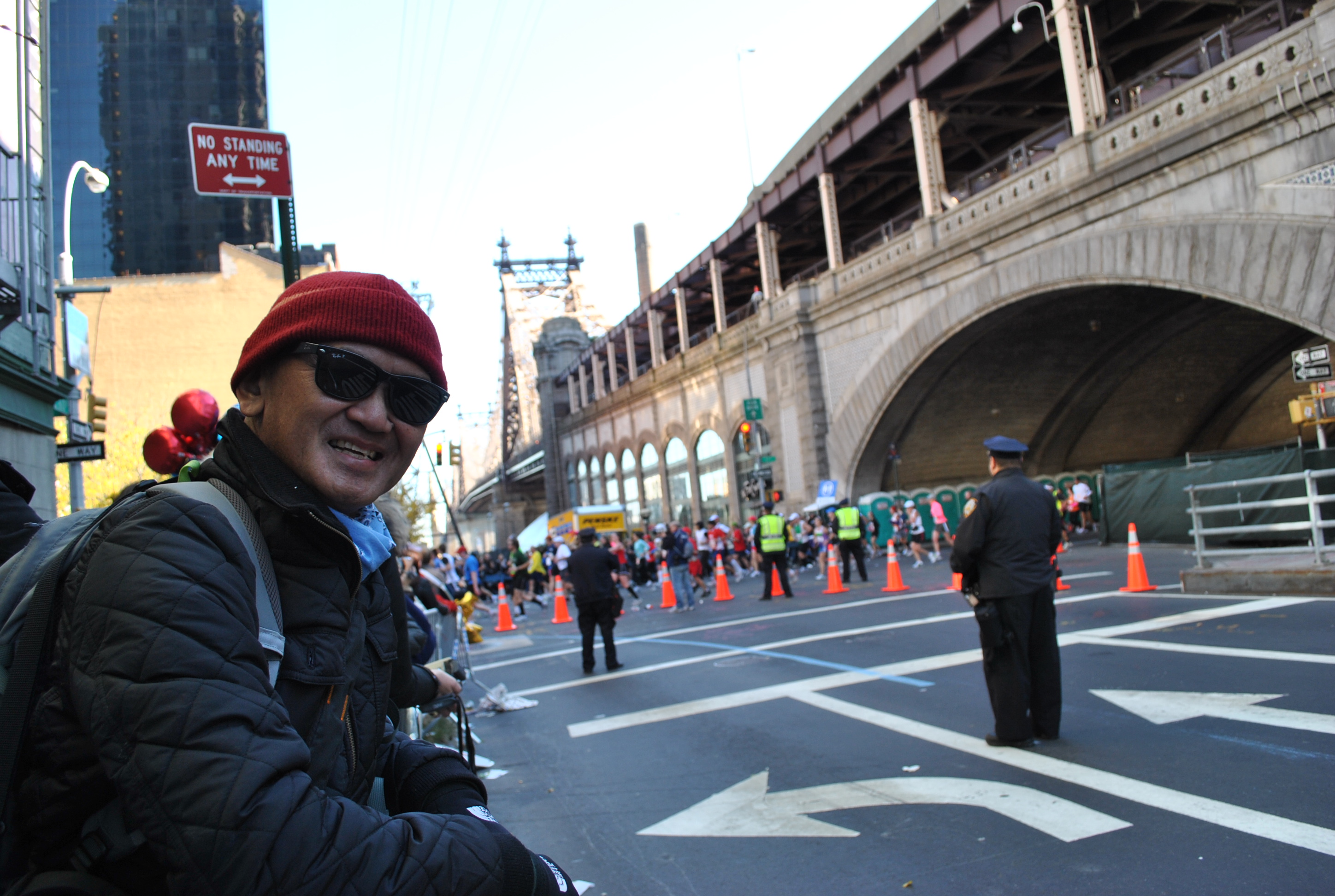
Got A Space But Too Far From The Passing Runners (Take Note of those Potalets) @ Mile 16

3. Almost ALL the Nations in the World are represented in the Event. Looking at the result of the finishers by country, I found out that there were 32 Pinoy Runners who finished the marathon race. However, I have yet to find out the list of these runners and their respective finish times. This shows that we, as Pinoy runners in the said marathon, were not coordinated. There was no “point man” or informal “leader” who could be responsible in collating the list of Pinoy Finishers in this event. How I wish our local Running Magazines would be able to post the list of names of runners and their respective finish times in the 2011 New York Cit Marathon. (Note: I hope Jonel aka FrontRunner Magazine will have the initiative to post this list in his Magazine. Thanks!)

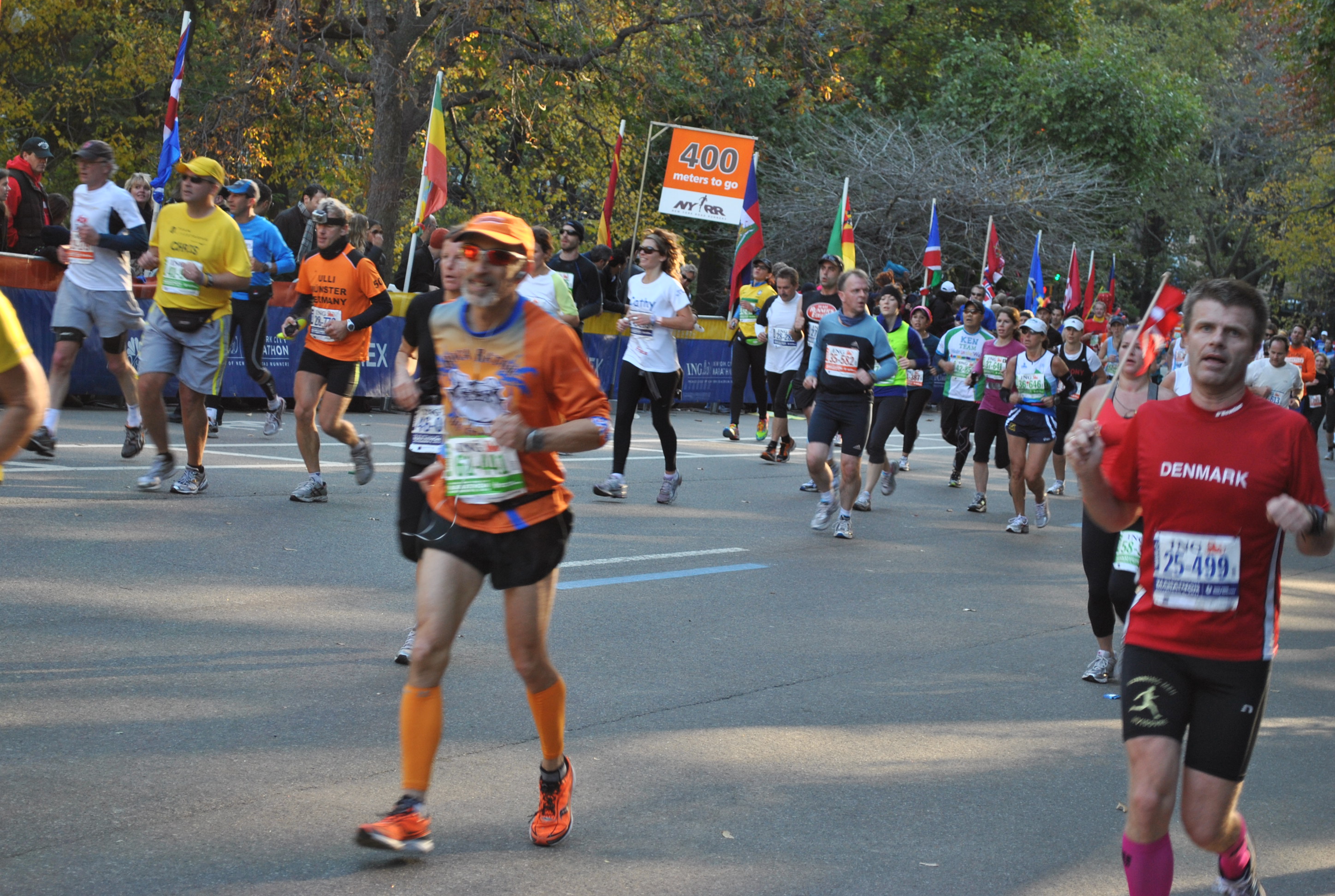
On The Last 400 Yards To The Finish Line @ Central Park
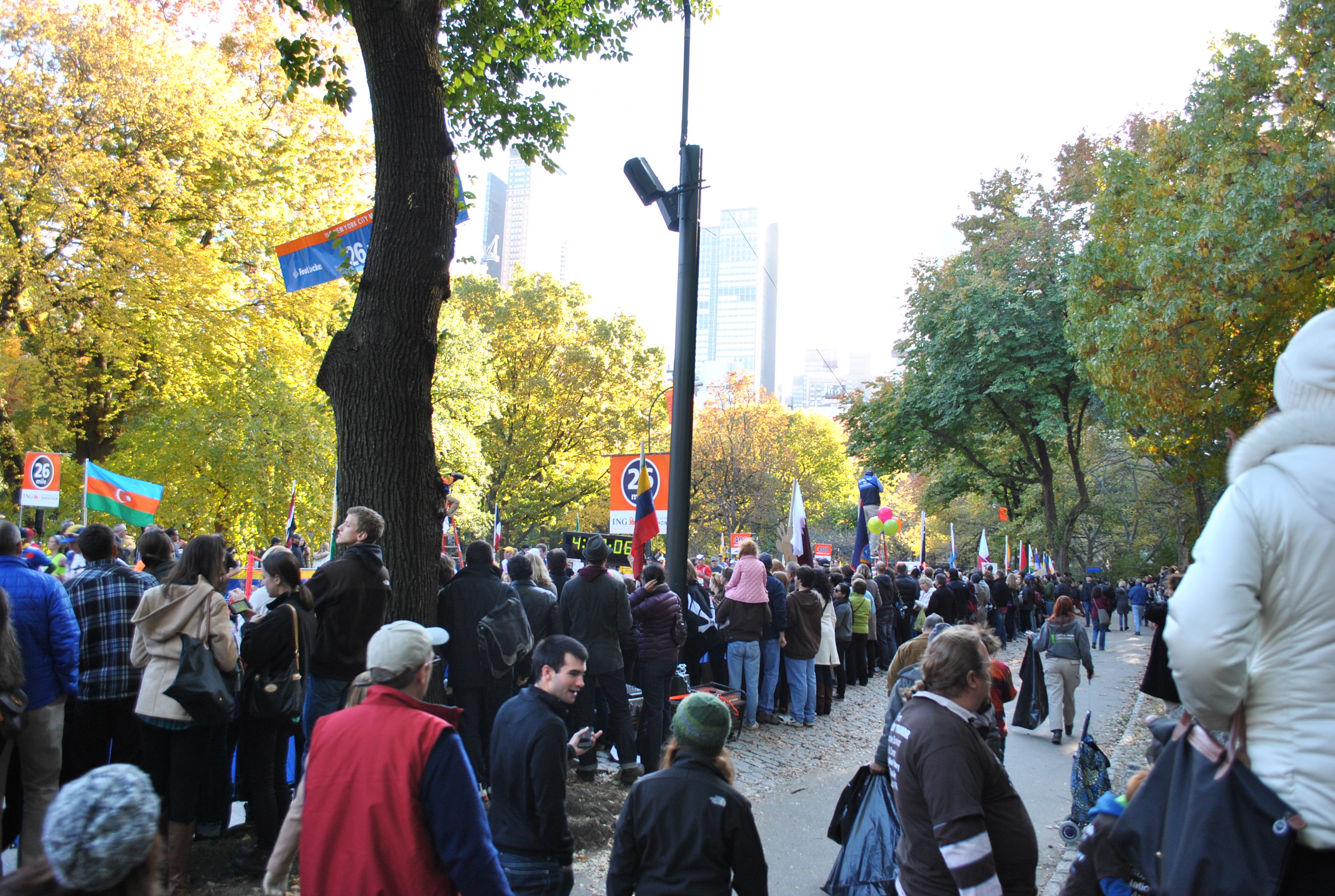
More Spectators Lined Up Near The Finish Line @ Central Park

4. The event has the most expensive registration fee among the world’s marathon races but it is worth the experience. You are paying for a “once in a lifetime” experience as a runner and a Finisher must be proud to have joined it. The Race Organizer, together with the City Government of New York, the populace and the private sector, are fully coordinated and well-oiled to provide a “world-class” marathon race experience. I think there is nothing to rant or complain about the needs of the runners in this event. My son and daughter’s feedbacks were all positive and they really enjoyed the experience of finishing the Marathon Race. (Note: I never heard or read any complaints from Pinoy Runners who Finished about the high cost of registration fee in this Marathon Race).

The following were my observations among the runners from other nations: (1) The French runners stayed in ONE Hotel which happened to be the place where my wife and I stayed and I am sure most of the other countries’ runners have stayed in one hotel for easy coordination and maybe, with a discounted hotel charges. (2) Countries like France, Peru, Brazil, South Korea, Germany, Switzerland, Italy, Japan and others have a distinct uniform with the name of the country written on their upper garments! Some have their national flag colors as their shirts’ color combination. (3) Most of the team from each country arrived at the Finish Line as a Group. I was impressed to see a group of runners from South Korea arriving at the Finish Line in a line formation with their National Flag infront of them and they had a finish time of 4:20+ hours! I guess, the Pinoy runners failed on these things that I’ve mentioned.

@ Madison Square Garden, New York!

Spectators Are Amazing. You won’t believe me if I say that the whole route of the event was full of spectators from Start to Finish cheering the runners as they pass.The number of spectators was simply amazing and uncomprehensible. I could hardly sneak myself on the inner edge of the road because of the thick line of spectators. Noise of cheers and ringing of cowbells filled the air along the route of the race.

So, what makes the New York City Marathon as the best among the best of the Marathon Races of the World? First, it’s the place. The roads and bridges could be very narrow as compared to the newer cities in California but there is something that makes the city very unique. Second, the organization. The City and its instrumentalities together with the private sector and the New York Road Runners Club are united and fully coordinated, it’s a well-oiled machine that has perfected the conduct of a big-time marathon race! Third, the people of New York City. They know how to treat their visitors as more tourists to their city means more “bucks” for the economy. They knew that tourists will keep on coming back to their city. Fourth, 100% Media exposure. No neeed to explain this. The whole TV network of the city had a live coverage of the event and the written media were alive on the event before and after the event. Fifth, Cash Prize for the Elite Runners. Just “google” the topic on how much the cash prize for the winner is and you will be amazed by the numbers.

And what are now the lessons and suggestions we could get from this post?

1. Pinoy Runners who are qualified to run (through lottery and special arrangements with its sponsors) this race should be well-coordinated. Maybe, somebody should be able to unite and be able control the group so that the country is well represented. I hope the local Heads of the Corporate Sponsors of the event should be the one who would coordinate the trip, accommodation, and the itinerary of the whole Pinoy group of runners. Each runner should spend for their respective travel from Manila to New York and back.

2. Coordinate with the Department of Foreign Affairs so that our Consulate in New York would be able to assist in finding a cheap & decent place where our Pinoy Runners will be billeted. Maybe, a Pinoy Restaurant in New York City would cater for the food of the group during their stay in the city. The RP Consulate in New York has all these information and it would be of great help to the runners.

3. One of the local Corporate Sponsors should provide, at least, an upper garment which will serve as the group’s attire during the event. A long-sleeved technical shirt & a RP Jacket for each of the runner is not worth a million pesos for the whole group even if the NAME OF THE CORPORATE SPONSOR will occupy one-half portion of the attire! What is important is that the group shall be identifiable as runners from the PHILIPPINES! (Are you listening, TIMEX; GATORADE; SMART; GLOBE; UNILAB; CONDURA; etc?)

4. C’mon guys, it’s about time to send one or two of our local top marathon runners to this event. Let us stop sponsoring runners who could finish their best time in more than 4 hours! We are not showing our Best of Bests to represent our country in this prestigious Marathon Race. Corporate Sponsors should wake up on this. If you think our elites will no longer return to the country after they have tasted what it is like to be in the United States of America, you are dead wrong! Supposing, you will select one of my Elite Runners to participate in this event, I will volunteer to work out for the approval of their papers to travel abroad (if they are from the active military service) and I will be responsible that they will return to the country after the event.

5. If you have plans of joining this Marathon Race and you don’t have a friend or a relative in New York City, you have to save a lot of money. It will cost you a fortune to experience what it is like to visit the city and run the New York City Marathon. And you should know how to read a MAP; use their Subway transport system; and don’t be shy to ask for directions from people on the streets.

6. If there is a Race Organizer of Marathon Races locally who has the vision to transform one or two of the existing Marathon Races in the country to be like the New York City Marathon, it could be done! However, there is a need to involve EVERYBODY!

Now, if you ask me if I will make an attempt to register and run this prestigious marathon? Not a priority issue this time. I would rather register and attempt for my first 100-mile trail run whose registration fee is far cheaper than the NYC Marathon!

See you at the Starting Line!

Running Is Patience


This is the most important virtue that a runner must have, whether he/she is a beginner, average, or competitive one.

Patience is having more time to wait for things to unfold, as a result of your training program, before being reckless and do things the wrong way. As a result, you will regret for the things you have done. Your actions in running should be deliberate as there are NO “magic bullets” or “quick fix” in the sports we love.

In training, you need patience for you to develop your aerobic endurance and overall, improve on all the aspects of running. It does not take days or weeks to happen, but it would take months and years to develop your maximum potentials in the said sports. There are “ladders and steps” to overcome from one level to another level. Patience means you don’t have to go through a marathon (42K) training without experiencing what it takes to finish a simple 3K run. If you think you are good in 3K distance, you can go to the next step of trying a 5K run and so forth. However, there are training programs that you must follow in order to get the full potentials of your body’s capabilities if you want to excel in the distance you want. If you want to finish a marathon race, you need patience. Believe me if I tell you that I prepared for one year to experience what it takes to finish my first marathon. More patience is needed, if you desire to finish your first ultra marathon race.

Not adhering to patience by trying to do so much too soon in one’s mileage have always been the number one problem among runners. Not following the time-tested 10% rule of increasing one’s mileage on a weekly basis always brings runners to being injured and stale in their improvement. As a result, patience will always be the solution of this problem—patience to let the injury heals itself.

In races, runners would always forget what it takes to be patient. The tendency of most runners is to go out too fast once the gun is fired only to realize that mistake had been done when he/she is “crawling” to reach and cross the finish line. We always don’t have the patience to remember and stick to our race strategy and the training we have done in preparation for the race.

We need also patience in choosing our first running shoes and running attire. We have the tendency to look like the elite runners who are featured in “glossy” international runner’s magazine with the thought that we look “cool” and better runners than others. We have also the tendency to buy what we see for the first time not knowing that there are better fitting shoes with less cost if we waited and had time to look around. It is not the brand, color-combination, and the weight of the shoes that count most, but the proper fit to our feet. As for the running attire, you need patience to find out what is more comfortable for you considering our weather and humidity.

We need also patience in trying to find out what food and drinks that are good and work best for our performance.  Depending on the distance you want to race or run, you can experiment on what nutritional needs for your training, pre-race, during race, and recovery period.

We need patience to find out what races we want to join in the future and patience to prepare for these races.

We need patience to finish what we have started. Because finishing a race is what matters most!

Like life itself, we need patience. There are lots of options but we need to have smart choices and decisions.

In running and in the race called “Life”, always think and remember…PATIENCE.

See you at the Starting Line!

"Running Is Patience" (Photo By Ding Quinto/The Frontrunner Magazine)

35th MILO Finals Half-Marathon


December 11, 2011

I did not qualify for the 35th MILO Finals this time as I did not have the time to qualify in the regional/provincial races. But with the start of my training season for my next year’s running events to attend to, I need to join road races which can serve as my training runs and make them as my guide in my training preparations. Thus, QCIM and MILO Races were part of the training program to build-up my endurance.

At the 3rd Quezon City International Marathon which was held a week before the MILO Finals, I opted to join the Half-Marathon event and I finished it in 2:20:50 hours. It was really a long slow distance run for me to start my training period. I was happy with the result.

After a one-day rest, I started to resume my “30-minute” daily runs; maintain my “30-minute” swimming drills at least 3 times a week; two visits at the gym where I did some light weight lifting (deadlifts, dumdbell exercises, and lunges) and stationary cycling for “30 minutes”. A massage on Friday evening and some brisk walking on Saturday completed my tapering for this event.

As in past MILO Finals, there was a festive mood at the Starting Line and I positioned myself at the farthest back among the Half-Marathon runners. I thought and planned of doing ala-Dean Karnazes style in this run—an LSD run from the back of the pack and slowly gaining some speed along the course with the objective of passing as many runners as I can along the route until the finish line. I have observed this kind of approach in running when I joined the Los Angeles & San Francisco Marathons with Dean Karnazes in the past years.

As soon as the Gun was fired, I started to walk brisky from the back and I was sure I was the last runner. I started to ring my mini-cowbell continuously which brought the attention of the MILO VIPs on the stage. Coach Rio, the Race Director of the Event, approached and greeted me. I thanked him for giving me the complimentary race packet for the event.

It was a very slow start for me as it was still dark and with lots of runners infront of me. As soon as there was natural light, runners would recognize me and I got a lot of greetings. Some runners would recognize me and see me in person for the first time and tried to start some conversation. Others would try to pace with me. Others would make me as their “target”.

At the Km #9, I briefly stopped and walked after I was fed up hearing the sound of dangling keys and coins from one of the runners behind me. The runner asked me why I stopped and I answered him that I could not stand the noise from his noisy keys & coins! When the runner was about 50 meters away infront, I started to run again. At Km #11, I passed the runner and increased my pace. I would never see him again.

On those fly-overs, I would pass more runners! I asked one of the runners who was pacing with me to pass two runners in triathlon suits as we attacked the fly-overs. The other runner nodded and we attacked the fly-overs and I left him halfway on the uphill portion while I overtook the two triathletes. I never saw the runner and two triathletes after that incident.

Believe me, I was having fun during the run. I overtook more runners in the Aid/Water Stations as I would not stop because of the handheld “Sprint” Nathan Bottle on my left hand with my cowbell on my right hand. To add more fun to the run, I would ring my cowbell to most of the ultra runners whom I would meet along the route. I even cheered to the top Pinoy runners using my cowbell. In short, I was running and at the same time cheering everybody with my cowbell!

At The Last Kilometer To The Finish Line

Soon enough, I was nearing the Finish Line. I tried to be relaxed as much as possible after I thought of those previous deaths in running events. One runner died last year in the MILO Finals Half-Marathon; another runner died in the Los Angeles “Rock N Roll” Half-Marathon last October; two runners died in the latest Philadelphia Marathon (one is in his late 20s and the other is a triathlete in his mid-40s); and another runner died in the latest SC Singapore Marathon. All these deaths happened on the last 2 kilometers of the race and/or after crossing the Finish Line. I found out later in my readings that experts would suggest not to “sprint” or do your “extraordinary fastest pace” on the last 800-1,000 meters of the race. Such action might do harm to the heart’s functioning. Don’t pay attention to what the EMCEE is telling to all the runners that “you are almost there” which would trigger you to start sprinting to the Finish Line. Runners should be calm and relaxed as one approaches the finish line!

What could be more relaxing than having a smile, ringing my cowbell, and waving my other arm/palm to the other runners and crowd as I approached and crossed the Finish Line? None! I finished the race in 2:09:25 hours which is a great improvement from my QCIM Half-Marathon result. After I got my medal, swags, and certificate, my day was complete!

Ringing My Cowbell Near The Finish Line

I found out later in the results that I placed #343 overall among the 1,432 runners who finished the race. I could not believe that I was able to overtake/pass 1,089 runners during the race. So far, so good!

So far, MILO Marathon is still the premier marathon race in the country! Congratulations to Nestle, Phils and RunRIO for a job well done!

Note: Thanks to Angelo Lagumbay & Angelo Maravilla for the Pictures