I am not sure if this is the “real” Official Statement of Team MILO/NESTLE, Phils as a result of the death of Remus Fuentes on the July 4th MILO Marathon Manila Elimination Race. One of the BDM “veterans”, Albert Salazar, sent a comment in my previous blog stating the following statement which he indicated as taken in one of the links with MILO Philippines’ Facebook account. In the said link, the following statement had been posted in their PHOTO ALBUM Page. I really don’t know why they have to take a picture of the said statement and have it posted in their Photo Album. They could have simply sent to the e-mail addresses of the runner-bloggers and other interested parties.
I’ve been waiting for this Official Statement as I requested from Team MILO/NESTLE, Inc to send it to my e-mail address in order to give them a chance to explain their side of the incident. Up to this time, I have not yet received such copy in my e-mail address. Anyway, whether the following statement was not signed or not, the fact that it was posted at MILO, Phils Facebook Account, it needs to be posted in this blog in order to get the side of Team MILO/NESTLE, Phils and its Race Organizer. Hoping it is the real one!
After reading this statement and the side of Remus family, the runners who participated in the 21K and the Marathon (42K) Race and my readers will be the judge.
STATEMENT ON MILO MARATHON
We are deeply saddened by the passing away of Mr. Remus Fuentes, a participant of the July 4, 2010 MILO Marathon held in Luneta, Manila.
We reached out to Remus’ family as soon as we were informed. Our deepest sympathy is with his family during this most difficult time.
We assure participants that all the internationally recognized precautions had been taken by the organizer for the Manila leg of the MILO Marathon, specifically:
On hydration stations, according to the International Association of Athletics Federation (lAAF), the rule is, for a race longer than 10 km, refreshment stations shall be provided at approximately every 5 kms along the race route. For mass races in a tropical country like the Philippines, the same IAAF rule recommends to have water stations every 2.5 km, The Manila leg of the MILO Marathon had water stations installed every 2 km along the race path, and in between each water station, there were Gatorade stations to ensure every runner had the opportunity to hydrate as necessary. On average, there was a hydration station around every 1 km of the 21K race path. In total, there were 13 water stations, 10 Gatorade stations, 2 sponging stations, and 1 banana station strategically Iocated throughout the 13.5 km race loop.
On first aid, all MILO Marathons are fully equipped with first aid teams to attend to runners needing assistance. In the Manila race, for instance, there were 7 roving ambulances plying the 13.5 km race loop, 15 medical stations, 5 teams of first aiders on bicycles, and nearly 500 marshals – policemen, traffic aids, and radio communicators – manning various points of the race path. These marshals were equipped to immediately contact first aid stations and ambulances with trained crew and rescue facilities.
Like any vigorous sport, the marathon involves a certain amount of risk, especially for those who participate in longer distance events such as the 21K and the 42k. We would like to remind all runners who plan to participate in the forthcoming MILO Marathons to adequately prepare before the race, ensuring that they are properly conditioned mentally and physically. This includes undergoing the necessary training getting enough rest, properly hydrating, and eating the right food.
Our thoughts and prayers are with the family of Remus Fuentes at this very difficult time.
(Note: Copied from MILO Philippines Facebook’s Photo Album)
I copied the following article from the USATF Rules and Regulations on Road Racing. I hope Race Organizers and Runners should be able to be aware of the following rules and regulations and information about cheating in Road Races. This may be an old version of the rules and regulations due to the absence of RFID timing chips being mentioned in the article. Anyway, this is a very good source of information so that we are more aware and vigilant on the actuations of other runners in a race. Let us continue reporting and exposing these chearers.
VERIFICATION OF PERFORMANCES
Cheating in road races is more common than most people realize. The more attractive the awards or the greater the attention winners receive, the more incentives there are for cheating. Cheating is easier to get away with in a large race vs. a small race where everyone knows everyone else.
Types of Cheating
Cheaters can be highly original and may show considerable imagination. The dumb cheaters are easily caught; the 2:16 marathon by a 60 year old for example. The smart cheaters can be hard to catch. We can only look at a few of the more common types of cheating.
Course Cutting
Course cutting may simply involve the runner ducking down a side street to join the race and “saving” some distance. Out-and- back courses have serious problems in this regard. It is very easy for the out-going runner to join the returning stream of runners.
Course cutting may involve a runner “dropping” out of the race at perhaps 25 km, only to “rejoin” the race at 35 km. The intervening distance is often covered by automobile but runners have been known to use city buses and subways.
It is often rather difficult to distinguish between runners who have taken a legitimate toilet stop from those who are cheating. You may wish to assign monitors to locations on the course where you have porta-johns. The cheater may enter via your porta-john, entering the race as he/she leaves the porta-john, just like any real runner.
One imaginative course cutter was accompanied by his friend riding a bicycle. Every five miles or so, they would trade places AND shirts. He managed to “improve” his time sufficiently to qualify for Boston. Note that he was “checked” thru each checking station along the way! Video-tape could have caught this cheater if the time were taken to check the video-tape that carefully. This was only found out much later when the “story” was related by a runner who observed one of the switches.
Failure to Start at the Start
The easiest way to cut the course is simply skip the first part of the race. How many marathoners just run the last few miles of the race? You’ve seen them, the ones that aren’t sweaty, bouncing along coming into the finish as though they’re out for a stroll.
The dumb cheater doesn’t know when to “enter” the race. This gives you the 2:16 marathon by the 60 year old. The smart cheater figures he/she can run 7 minutes per mile for a couple miles. The runners finishing just under three hours are usually doing 7’s forthe last couple miles. They measure back from the finish, two miles. They wait for 2:45 on their watch and jump in when the time is right. They run their two miles in 14 minutes, finishing in 2:59. They don’t stand out since they are running the same pace as the other finishers. The dumb cheaters are getting passed by runners doing 5:30’s while they are doing 8’s.
Wave starts are highly conducive to cheating and need to be monitored VERY closely. Otherwise, the runner can “improve” by starting with an earlier group. Color-coded and number blocked bib-numbers PLUS lots of monitors help here.
Impersonation
Impersonation may be one person running for another or simply a person misrepresenting his/her age to take advantage of weaker age group competition.
Inadvertent number switching, e.g., husband and wife, occurs quite frequently. When handing out two or more race packets to the same individual, use magic markers to clearly mark the envelopes e.g., “HIS” and “HERS.” Different colored bib-numbers for men and women AND separate finish lines help reduce this problem.
Pre-registered runners may choose, for whatever reason, not to run the race. The temptation is there for a second runner to compete WITHOUT paying an entry fee by “borrowing” the registered runner’s bib-number. The impersonator may simply show up and pick up the bib-number for the runner who is registered and run with that bib- number. You may wish to request identification or signatures from runners as they pick up their registration packets to reduce this problem.
You also may wish to permit reassignment of a bib-number for a minimal fee. In this way, you can preserve the integrity of your coding system for the awards search and the integrity of your race results by correctly identifying the runners.
Course Monitoring
The first step is to identify potential problem areas on your course. If you run the same loop three or more times, you will need to record times for each runner for each loop. If you have an out-and-back course, you will need to record turn-around times for all the runners. If your course has inter-connecting or nearly connecting loops, points of intersection between different streams of runners present intractable problems. Intersecting streams of runners should be AVOIDED. Change your course.
Points where you have spotted potential problems should be monitored. At least one monitor should be assigned simply to record bib-numbers for any runners observed leaving the course in the vicinity. If you record the bib-number and the time the runner was observed leaving the course, knowing the location allows you to check against their finish time (if they finished) to see if they “speeded up” unduly.
The best way to monitor a course is by video-taping at certain check points along the course. Choose a section where the runners are making a right angle turn. As runners make such a turn, they will tend to “line up” so each can run a shorter path around the corner. Station the video-camera outside the corner and film as the runners round the corner, in effect presenting their bib-number to you.
The 1984 San Francisco Marathon video-taped their turn-around point at 30 km. The first 100 finishers were checked. Ten were disqualified for not passing through the check station.
Another way of checking is to use a standard voice tape recorder and read bib-numbers as the runners pass by. If another worker is reading times every 5 or 10 seconds AND the split is a standard distance, e.g., half way in a marathon, you will have split times recorded for many of your runners. This is a nice addition to your race results, plus a good method for verifying performances.
A method you might consider for large race where prize money is awarded to masters runners is to create a “prize money” classification. You might charge a dollar extra to be in this “special” group but allow anyone to enter who wishes. Give this group bib- numbers of a distinctive color that may be easily spotted and distinguished from the normal bib-number. Have a number of teams along the course to spot and record these “special” numbers as they pass by. This will give you a much smaller list when you verify award winning performances.
Start Check-In Procedures
One way to prevent your runners from starting your marathon at the 40 km mark is to have a start check-in and controlled holding area until the starting gun. The Honolulu Marathon checks runners off on master lists as being present at the start. Bar-code scanning as runners enter the starting area is another method used by the New York City Marathon.
The Tucson Marathon has used a dual pull-tag system, one pull- tag is collected when the runners enter the starting area; the other is collected at the finish. One year, eight of 500 “finishers” failed to check in at the start and were disqualified.
Bay-to-Breakers also has a cordoned off starting area that seeded runners may enter but may not leave until the starting gun goes off. As runners enter, a worker with a special color water-proof marker makes a colored check or ÔX’ on the runner’s bib- number to indicate that they were are the start.
Video-Tape the Finish
Video-taping the finish not only provides answers to who- finished-in-what-order questions but also serves to identify runners visually as they finish. Many errors result when runners use another runner’s bib- number. The video-tape usually can tell you if a man ran with a woman’s number or a 25 year old ran with a 60 year old’s number.
Awards and Disqualifications
If you give awards that have commercial value or are cash awards, you should ANNOUNCE the award at the ceremony but MAIL the award after you have had a day or two to check to determine if the performance is valid. One marathon disqualified three award winners. unfortunately, the trophies had already been given out.
If you disqualify a runner, you may expect problems. Some are honest enough to admit they cheated (although dishonest enough in the first place to cheat) and return trophies, etc. Roughly 10% of the cheaters will try to out-bluff you. Even in the face of documented evidence that they cheated, they will still maintain their innocence and will threaten to sue you.
The methods you use to substantiate cheating need to be pretty solid. If you have teams recording bib-numbers, the runner may claim his/her number was covered at the time or the recorders simply missed it because he/she was running in a pack. The same is true for voice tape recording.
Even video-taping can be questioned. If you do not have a built-in record of the time on the video-tape, the runner could argue that the recorder was not operating when he/she passed and therefore you missed him/her. With a time record, you can document the videotape record and, if need be, use it in a court of law.
If you disqualify a runner, BE SURE he/she cheated. If you KNOW the runner cheated, be sure you DISQUALIFY that runner. If no action is taken against cheating, your awards will go to the cheaters and the sport suffers. Remember that the cheater is cheating someone else of something that is rightfully theirs. There is no such things as a “recreational” cheater or “cheat-for-fun” because cheating demeans the entire sport and everyone is the worse for it.
4:08 AM July 4, 2010 Km 0 Roxas Boulevard/President Macapagal Avenue
Brief Background
I did not run the 2008 MILO Marathon Manila Elimination Race but I was able to find a way to join the MILO Marathon FINALS held in November where I registered the fastest time so far after reviving my regular running activities since I retired from the government service. I registered a time of 3:48:32 hours at that time. For that year, it was my third marathon race after finishing the Pasig Marathon in February (4:49+) and the San Francisco Marathon in August (4:36+). I can still recall that I put more mileage in my preparation for this race and lots of “speed” training at the ULTRA Oval Track up to the point that I was able to schedule three (3) “speed” sessions every week. However, since then, I could hardly improve my time with the hope that I would be able to reach the time of 3:45 hours for a Boston Marathon Qualifying Time for my age.
For last year’s MILO Marathon Races, I did not do well as my time was not able to breach below the 4-hour qualifying time. Such performance could be a result for having developed a slower pace to finish ultramarathon races (50-102K) which I joined for last year plus the fact that I was getting one year older! But in last year’s Subic International Marathon, I was able to register a finish time of 3:58+ in the month of October.
For this year, my objective was to qualify for the 4-hour time making my Jeju International 50K Ultramarathon Race last March 27 as the start of my preparation for the Marathon Manila Eliminations. I said to myself that a 10-week preparation for the race would be enough where a gradual increase in mileage towards the last 4-5 weeks before the race shall be attained. As I did not follow a structured training schedule for this race, the guide for my training was to “listen to my body” as I did at least one (1) interval speed run session at the Oval Track; one (1) tempo run; one (1) LSD; and one (1) recovery run almost every week during my strengthening phase. Six weeks before race day, I had my runs to the “Brown Mountain” trails and I was able to increase my weekly mileage up to more than 110 kilometers for two succeeding weeks until I slowly decreased my weekly mileage up to the race day. Aside from proper nutrition and hydration with Gatorade, I had weekly body massage and stretching exercises.
Race Proper
On the day of the race, I woke up 2 hours before the scheduled start time and did the necessary “ritual” that I’ve mastered before in any runnijng event that I competed. Everything was smooth and efficient as I arrived at the race venue at least one hour before the start of the race. After the usual greetings and photo-ops with other runners, friends, and members of the Race Organizers, I was ready to enter the Starting Area.
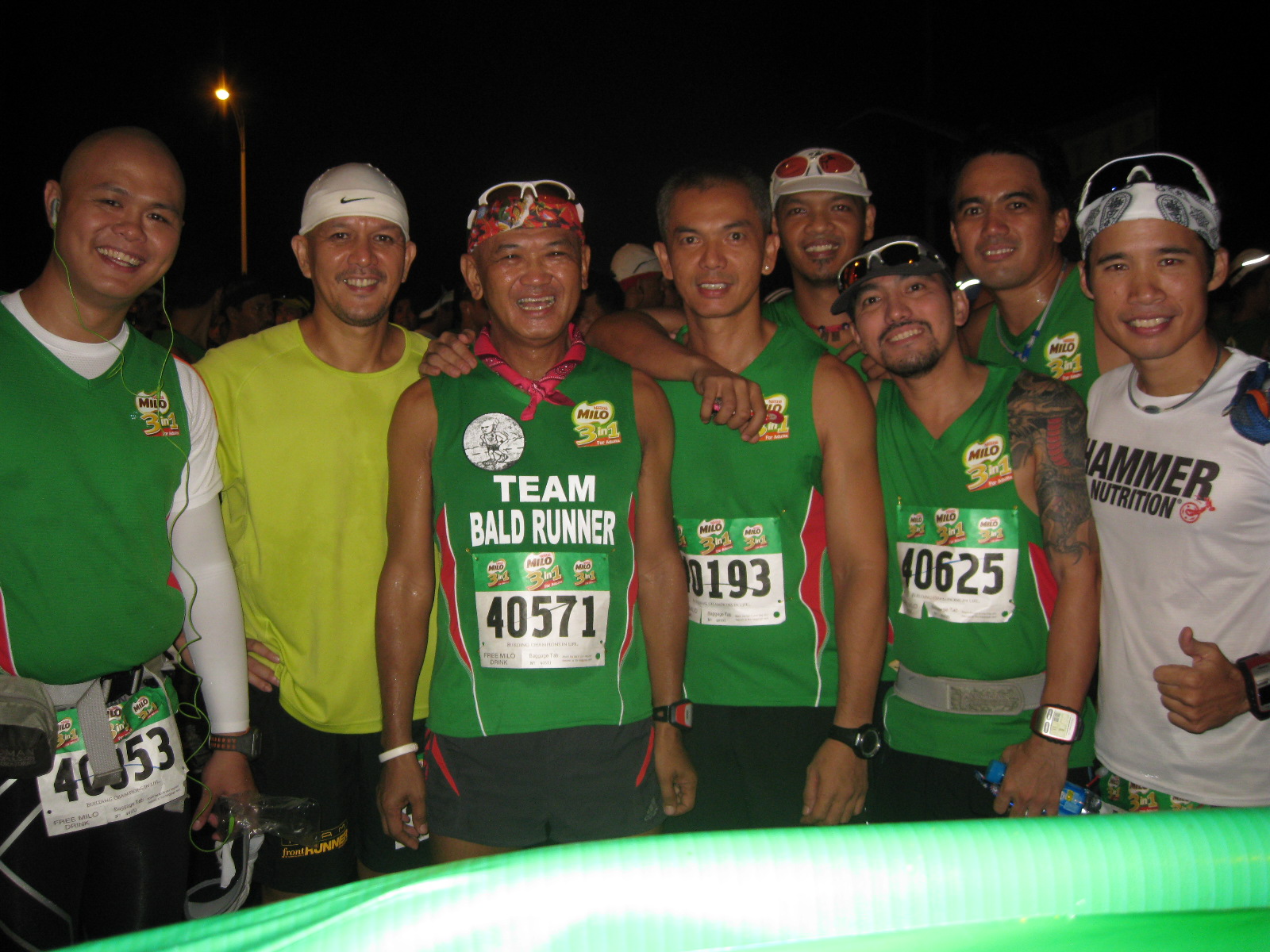
With Team BR-Professionals At The Sound Of the Starting Gun
I observed that I started to perspire a lot without even doing the stretching exercises being performed as part of the opening program. It was a sign of the “heat and humidity” of the day. It was a warning also to hydrate properly during the race. Being a “veteran” runner. I already know the “drill” and not to be “hard-headed” during the race. The key to survival is to be able to drink & hydrate in every Aid/Water/Gatorade Station.
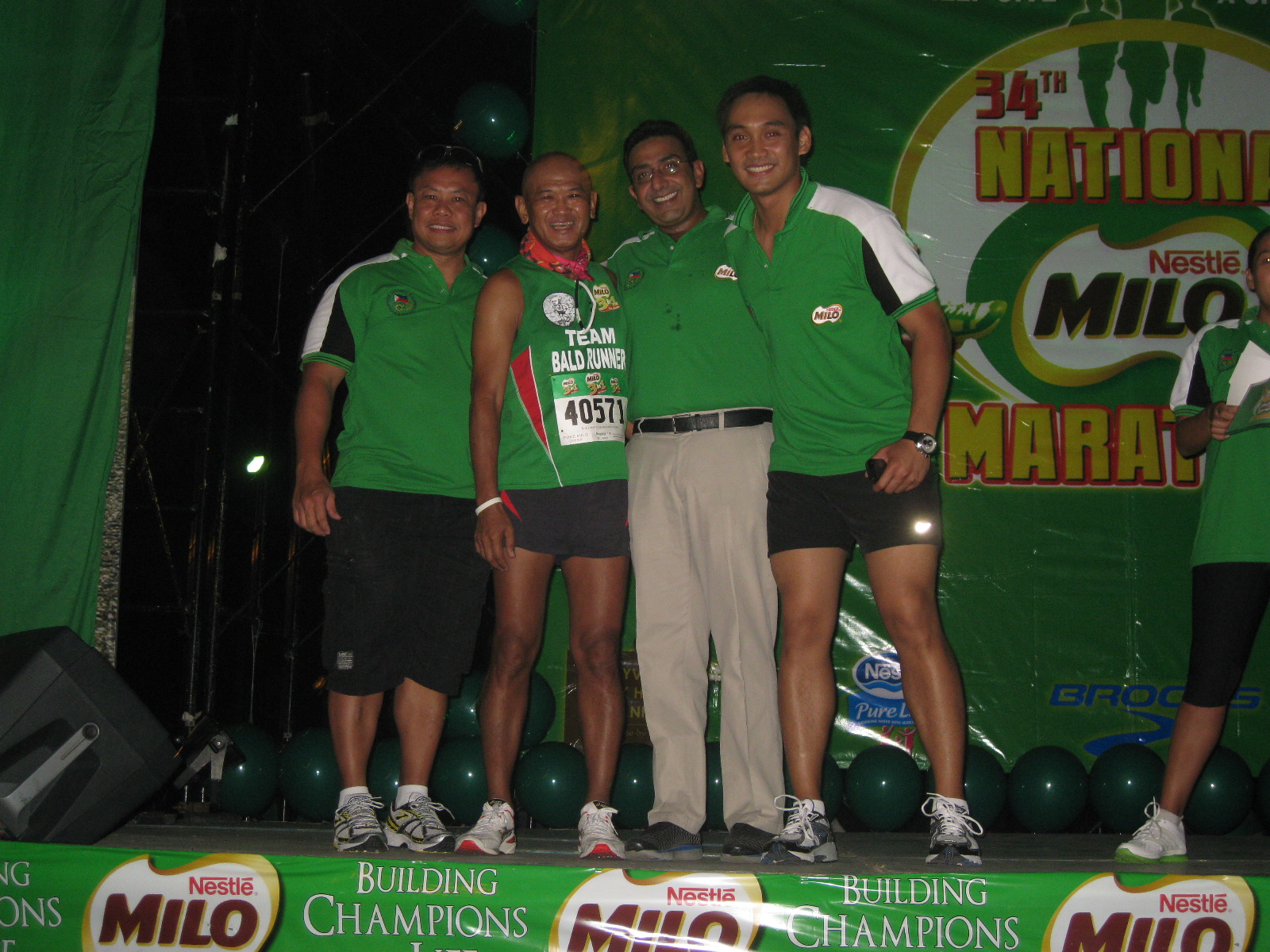
BDM 102 "Veterans" & "Hardcores"With Team MILO/NESTLE at The Stage
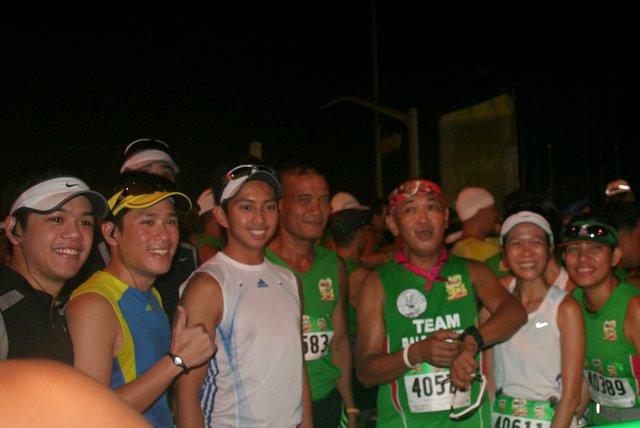
There was a long pause during the opening program where I was able to talk briefly and have photo-ops with other runners and the Team Bald Runner-Professionals (BRP) when all of a sudden the crowd was surprised with the sound of the starting gun without even warning us with a “countdown”! Well, sometimes small or detailed things as practiced are forgotten in major marathon just like this. The crowd’s reaction was to start our run! My GF 305 watch registered the start time at 4:09 AM.
Km 0 to Km 10. The first 3.5K was flat that I was able to register an average pace of 5:56 minutes per km for the first kilometer and I slowly increased my pace up to 5:40 mpk before reaching the 2K mark. Knowing that my support staff had been stationed in critical points along the route to supply me with the needed hydration and solid foods (suman, fruits, boiled eggs, and sports gels) along the route, I purposely passed the first few Aid Stations and continued with my average pace which reached as fast as 5:30 mpk. I was able to finish the 10K distance in 55:26 minutes and I was happy that I was within my goal to finish way faster than the 4:10-hour qualifying time for my age.
Looking Good, Dude!
Km 11 to Km 20. On the second loop, my legs were still strong to pass over the two Flyovers along Roxas Blvd and I was still maintaining an average pace of 5:30 mpk and was confident that I can still make my pace much faster one if I wanted it. At this time, I was regularly provided with water and Gatorade by my Elite runners who acted as my pacers and my staff who prepositioned themselves at the President Macapagal Avenue. Aside from being supplied with cups full of water and Gatorade, I had with me on my closed fists additional water placed in small “ice candy” plastig bags. I think I did not have any problems with my hydration at this point. I also ingested the Sports Gels provided by the Race Organizers every time I was able to complete one loop of the 10K route within the route.
Km 21 to Km 30. As I was about to reach Km 26, I felt a jolting sensation on my right hamstrings and I know that if I maintain my pace of 5:30 mpk, the sensation might lead to some pain and then to muscle cramps. I slowed down from this point and tried to observe and listen to my body if the hamstring issue will disappear. For the next kilometers up to Km 30, my average pace was a “see-saw” where alternately after every kilometer, my pace would register the fastest pace from 6:15 mpk up to the slowest pace of 6:57 mpk up to Km 30. I know, I can still manage the slight pain but it made me slower, hoping that the pain will disappear.
Drink, Drink, & Drink Some More Water & Gatorade!
Km 31 to Km 40. From Km 31 to Km 32, I can still manage to control the pain on my right hamstrings but at the middle of Km 32, I started to feel another pain on both of my quadriceps. These signs made me reduce my pace and ultimately started to do some brief brisk walking just to give comfort to my legs. But I tried to manage to go back to running after 10 seconds of brief walking. At this point, my pacers started to regularly douse me with cold water and told me to take small steps just to be able to lift my feet and knees from the ground. Once I reached the last 6K of the race, I was already struggling and trying to fight the pains on my legs. At Km 39, I already knew that I would not be able to qualify for the MILO Finals as my pace registered an average pace of 7:40 mpk. I asked for ice cold bottle of Coke but it gave me a short “boost” to relieve the pain from my legs.
Struggling To The Finish Line With Michelle Estuar In Good Form
Km 40 to the Finish Line. Despite knowing that I could not qualify for the Finals, I tried my best to increase my pace and I was successful to prevent myself from walking and surrender from thinking of being a failure in this race. I was able to bring back to a faster pace for the last 2 kilometers and reached the Finish Line without any injuries.
I finished the race in 4:25:13 hours (Official Time) with a registered distance in my GF 305 of 42.4 kilometers. My average pace for the entire race was 6:15 minutes per kilometer.
Finally, Near The Finish Line!
Lesson #1: Heat, Humidity, and the Quality of Air
It is already a fact that the hot weather, very humid condition, and the poor quality of air in Metro Manila are the top “nemesis” for long distance runners. I have predicted that the “all-comer” Marathon Record Time set in Metro Manila in 1982 by Waldemar Cierpinski in 2:14:27 hours will never be broken by a Filipino or international runner because of the warmer average of temperature that we have as compared in the 80s and the worst quality of air that we have at present because of our non-implementation of our Clean Air Act and the proliferation of vehicles in the metropolis. Even the visiting Kenyan runners and the elite athletes were not able to breach below 2:30-hour finish time except for the record set by Ed “Vertek” Buenavista few years ago at 2:18+ hours. During last Sunday’s race, one of my elite athletes complained that the weather was too hot that contributed his unusual experience of having muscle cramps on the last 10K of the course.
Lesson #2: Unsual Race Course
I was surprised to learn during the brief presentation of the route before the race started that the marathon runners had to run along the Flyovers at Buendia and EDSA for the “fourth time” before turning around towards the Finish Line. This surprise part of the route was already considered as “punishment” to all the runners. I had no problem running along these Flyovers for three times but the fourth and last time brought so much pain and torture to my cramping legs. Well, that is what we get when the “thinkers/consultants” and Race Organizers of MILO/Nestle, Phils are not seasoned “marathon runners”. If these people would ask my suggestion and feedback about this race, I would tell them to scrap this route and bring back the original one. However, it would be better for them to ask a selected group of seasoned runners to “test run” their planned route before implementing it to the public and find out the necessary feedback. I think this is “doable” in the next editions to come.
Lesson #3: The “Dumb and Stupid” Runners
I thought the 3-loop course and the presence of RFID Timing Chips would eventually eliminate reports and observations of “cheaters” from taking advantage to those who are honest in the race in past editions of the MILO Marathon Race. I was wrong! The result of the Marathon Race had glaringly showed the absence of “complete” split times of almost 42 runners but were able to register their finish times. It shows and proves that these runners made a “shortcut” and did not pass on two different “sensors” along the route. In addition, I’ve seen discrepancies in the recorded split times wherein a slow runner on the first and/or second splits would register a very fast pace on the third and last splits despite the challenging weather (heat & humidity) condition and the lack of hydration supplies on the last 10K of the course. I just hope also that nobody among the runners registered an “improper” birth date to make them older! In my lectures/clinics, I always emphasize to my audience that running develops good values to each and every individual and the most importantly of them is HONESTY.
Lesson #4: Hill Repeats, Not Hill Running
As I reviewed the journals of Arthur Lydiard, he highly recommends Hill Workouts & Repeats as part of the Sharpening Phase of a Marathon Training. Instead of doing Hill “Repeats”, I did Hill Running or running on top of the “Brown Mountain” on a once or twice a week basis. My workout in going to BM further strengthened my legs and my aerobic capability but it did not improve the “survivability” of my running legs on overcoming those repeated runs over the Flyovers along Roxas Boulevard. My mountain running did not duplicate what I really needed to surpass those “speed bumps”. During the last 8K of the race, these “speed bumps” became “speed obstacles” for me to qualify for the Finals.
Lesson #5: Wrong Choice of Race Strategy
In other words, I was overconfident in this race. I opted for the even-pace strategy with an overall average pace of 5:55 mpk but I registered a faster pace at 5:30-5:40 mpk up to the point that I reached Km 30. I’ve observed that I gave so much pressure to myself when I adopted this kind of race strategy and never taking into consideration the effects of the weather and the realiability of support from the Aid Stations. This kind of race strategy had worked well with me in my Marathon/Ultra Races in the USA and in South Korea. I am sure that the colder weather had greatly helped me well to finish with better times.
In my past good marathon races here in the country, I adopted the “negative-split” race strategy where almost half of the race was done with an easy and slow pace and later slowly increasing my pace on the last half of the race. I applied this strategy in this year’s Condura Marathon, last year’s Subic International Marathon and in the 2008 MILO Marathon Finals. I guess, I’ll have to stick to this kind of race strategy in my future marathon & ultra races.
Lesson #6: Remember the term “Collapse Point”
I discussed the term “Collapse Point” in one of my past posts. It is the point or distance along the marathon course where you hit your “Wall”. To determine your “collapse point”, you have to find out the total of mileage (in miles or kilometers) for the past 60 days prior to race day and divide it with 20. The result is your approximate “collapse” point. In my case, I was able to run a total of 646 kilometers, 60 days before D-Day. After I divided it with 20, the result is 32.3-kilometer point. This was the approximate point where I started to slow down, breaching past the 7:00-mpk pace as my average pace. After this point, I started to “brisk walk” and my goal to qualify for the Finals started to collapse! It shows that my total mileage before the race was inadequate and lacking.
Lesson #7: Age Factor
As I am getting older, I need all the “tricks” in maintaining a competitive level in running. Balance and Moderation are the keys to an injury-free condition for me to be always ready to train to a marathon or ultra race wherein I can compete within my age category or even to the younger age categories. Running will always be an “experiment of one” and there is no such thing as “miracle pill” to make a person into a fast and strong runner within a limited period of time.
Lesson #8: Ultrarunners’ View of a Marathon Race
Eversince I started to join and run ultramarathon races, I’ve considered a Marathon Race as a part of my training in order to find out my endurance level. Do you remember that I started my Manila to Baguio City Multi-Day (5-Day) Run after a day of rest from finishing the Condura Marathon last February of this year? Do you remember that I participated in my first 50K Ultratrail Run at Bulldog Trail Race in Calabasas, California barely two weeks after my San Francisco Marathon? I survived and finished such ultra runs because of my preparations for the Marathon Races that I joined prior to such events. An ultra runner friend of mine would jokingly say that a marathon race is considered as his “tempo run” workout for an ultra running event. And I believe him. In addition, it is not acceptable ( in a blunt term, it’s a shame) when a runner walks in a marathon race, but when a ultrarunner walks in a race, it’s the “smartest” move he can depend on in order to finish the race! After finishing this Sunday’s MILO Marathon Race, I can say that I have the endurance to finish another ultramarathon race/event in the future!
To all the Marathon & Ultra Runners, see you at PAU’s “P2P 65K” and CAMSUR Marathon!!!
Yes, I did not qualify for the 34th MILO Marathon Finals to be held on December 12 of this year. I am trying my best to recall what happened during the race and still making an assessment about my training and preparation for this marathon race. Hopefully, get some lessons to share during the race and in my training.
I finished the race in 4:25:12 hours (unofficial) based from my GF 305. I could be a “veteran” runner but I was not happy of what I’ve accomplished. But I am still proud that I was able to finish this race without any injury. This is my 19th Marathon Race and so far, I’ve have not yet experienced any DNF in my career as a runner.
I will be posting my Race Report about this race in my incoming post with more details. I had my 30-minute recovery run this morning and I am ready for my next race, after a brief “rest & recovery” period from intense training. Actually, my training and preparation for my next race started in yesterday’s MILO Marathon Elimination Race! Wish me luck!
For the meantime, I would like to express my congratulations to all the Qualifiers and Finishers. You did well and you have shown the courage and determination of a “warrior”. To Team MILO and the Race Organizer, you did great for the race with the hope that nobody got seriously injured or hospitalized due to the heat exhaustion. I salute you for making this marathon race as the most challenging one, so far! You maintained your reputation as “the most prestigious marathon race” in the country. Additionally, your “Help Give Shoes” advocacy is a success!
To my readers, those who prayed for my safety and for those who cheered & supported me along the way, my sincerest thanks to all of you! After all, I am a mortal just like everyone else. The battle cry for next year’s MILO Marathon Race…BOUNCE BACK!!!
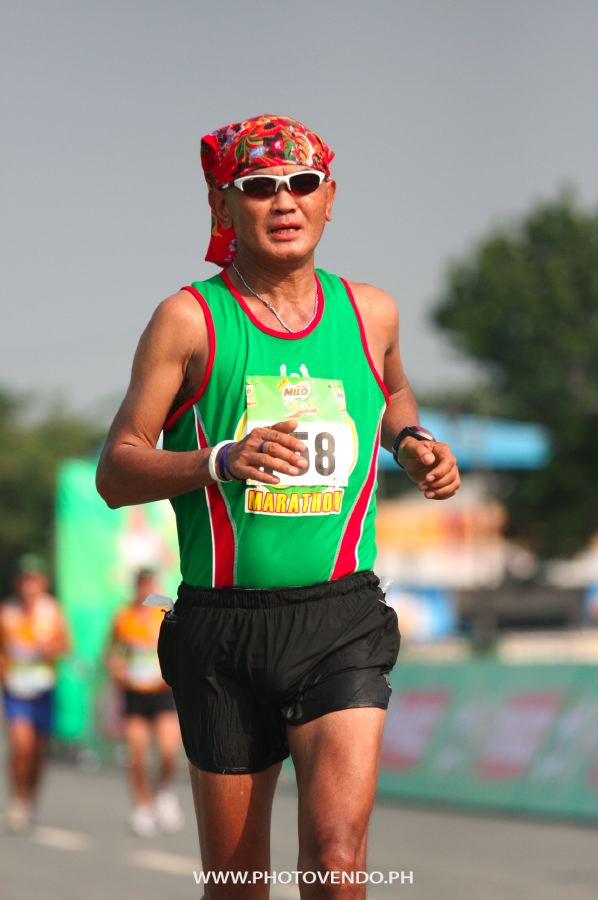
Thanks to Ben Chan of Photovendo for the following pictures:
Up to Km 30 Point
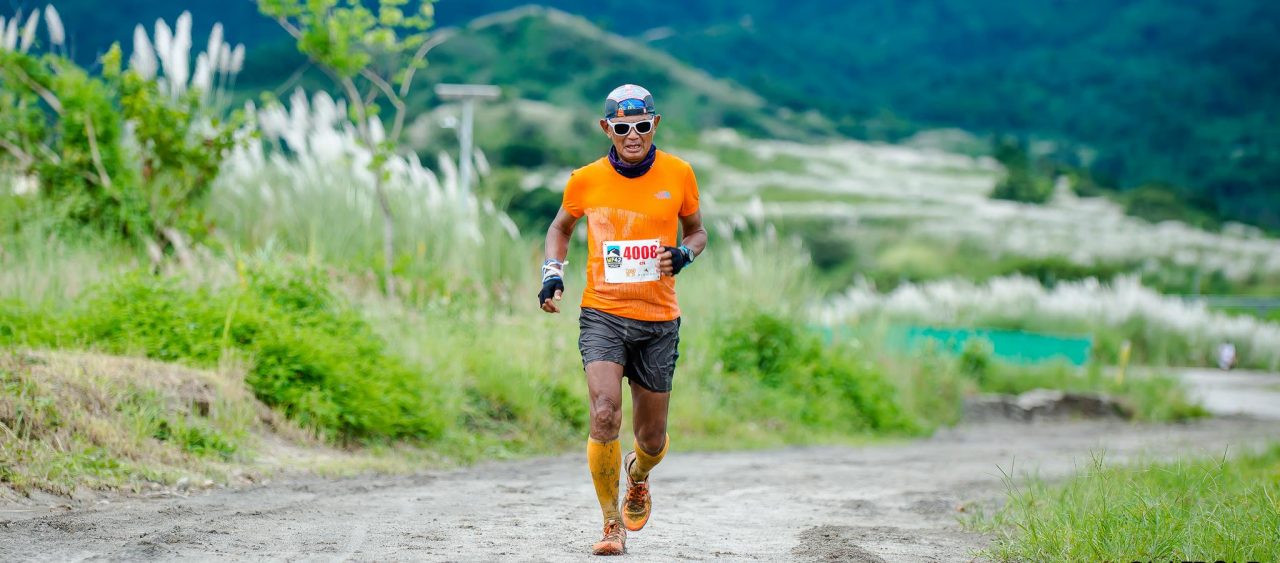
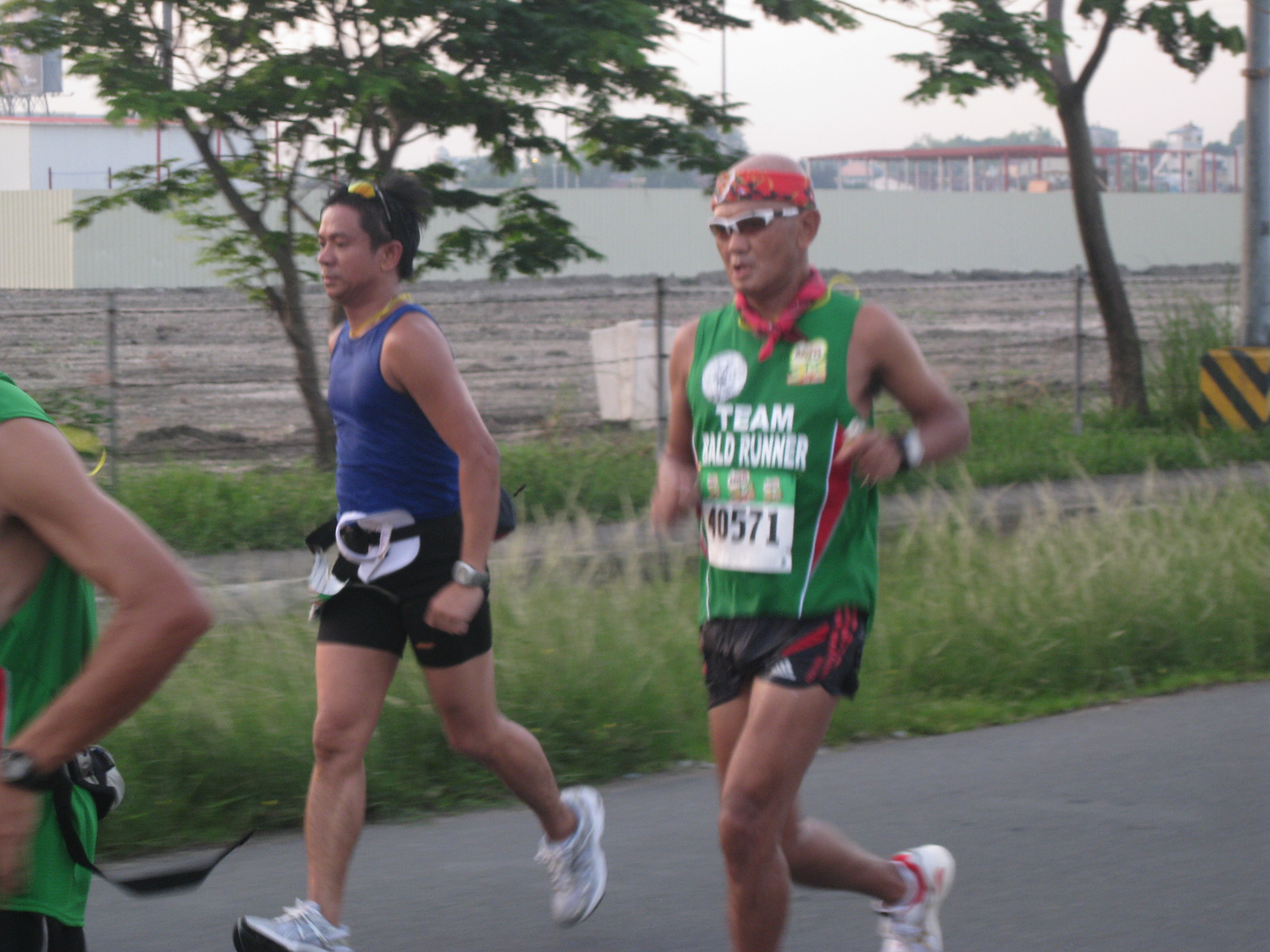
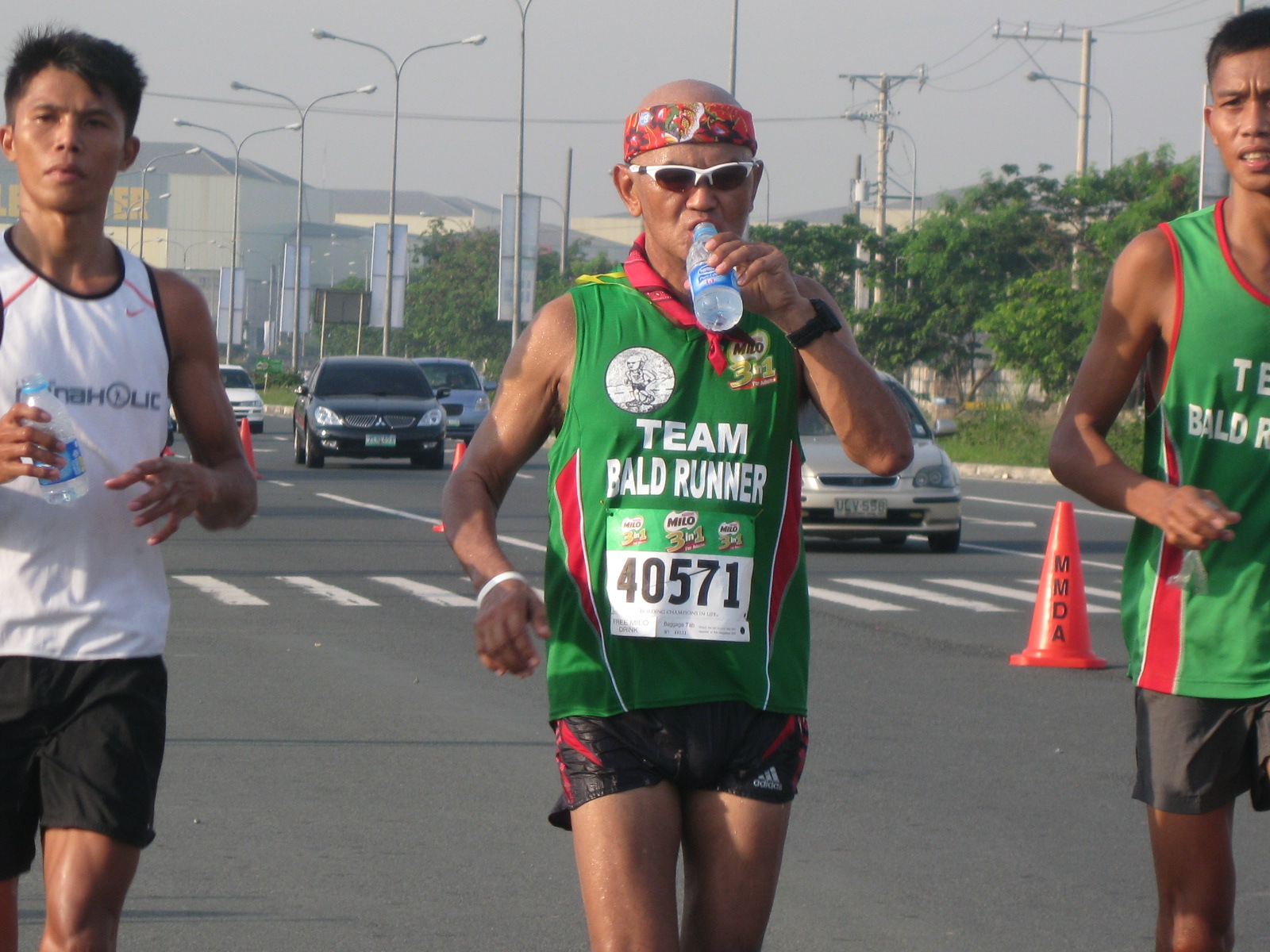
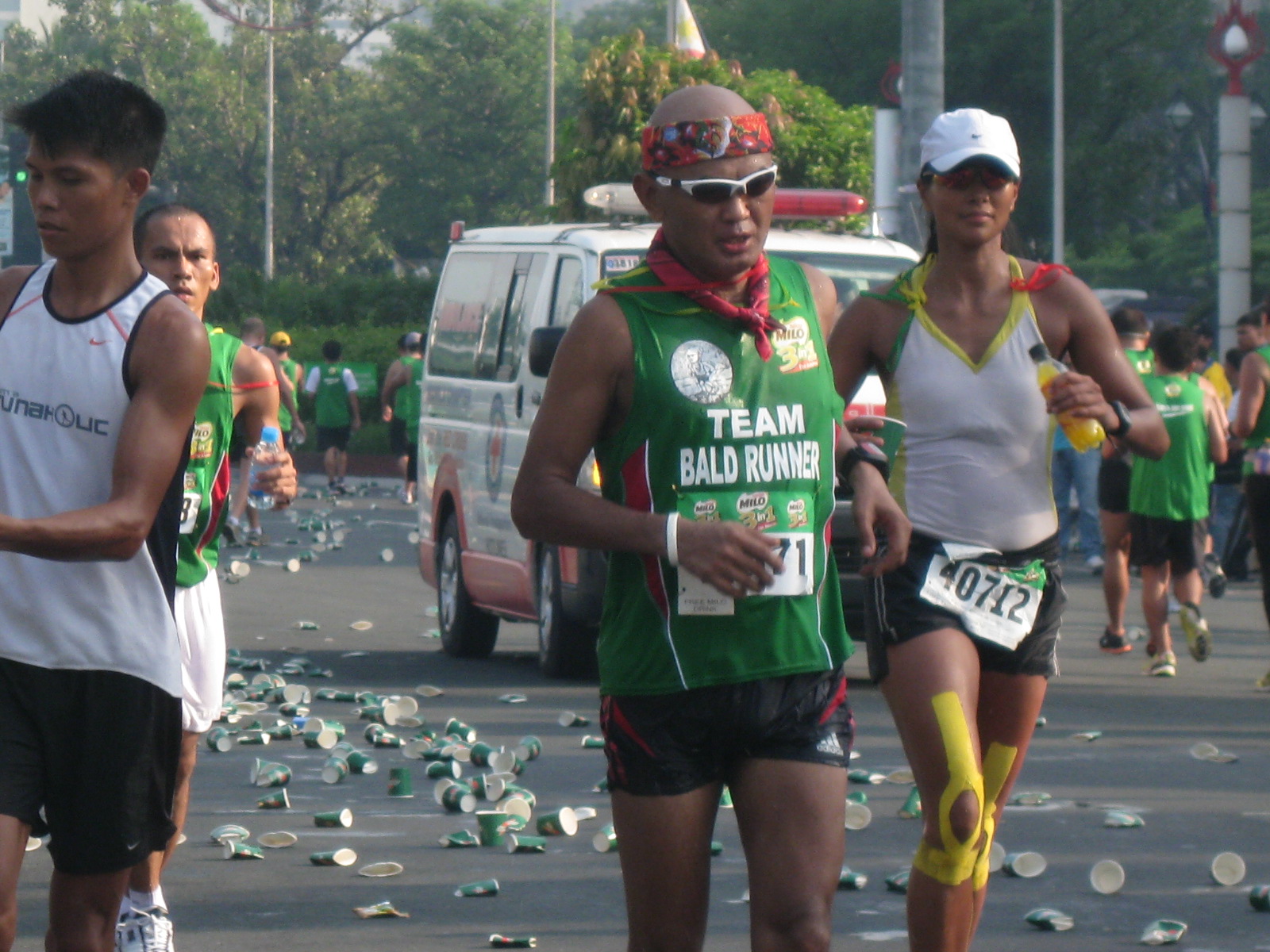
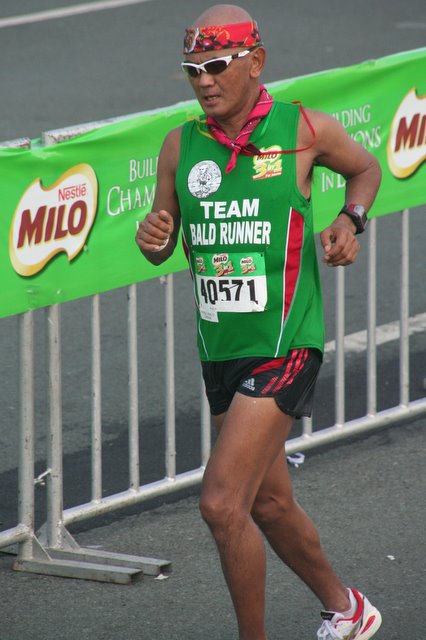
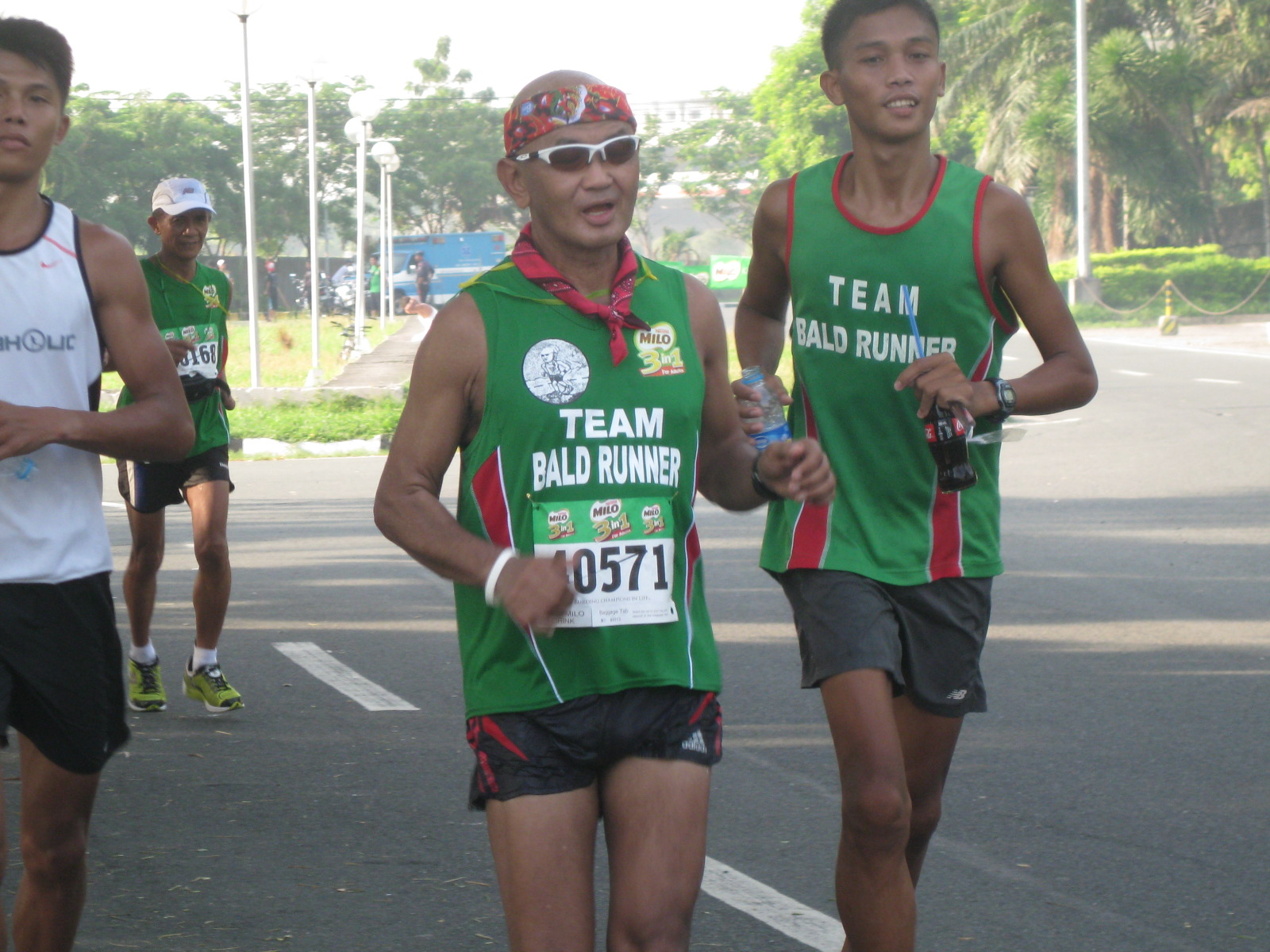
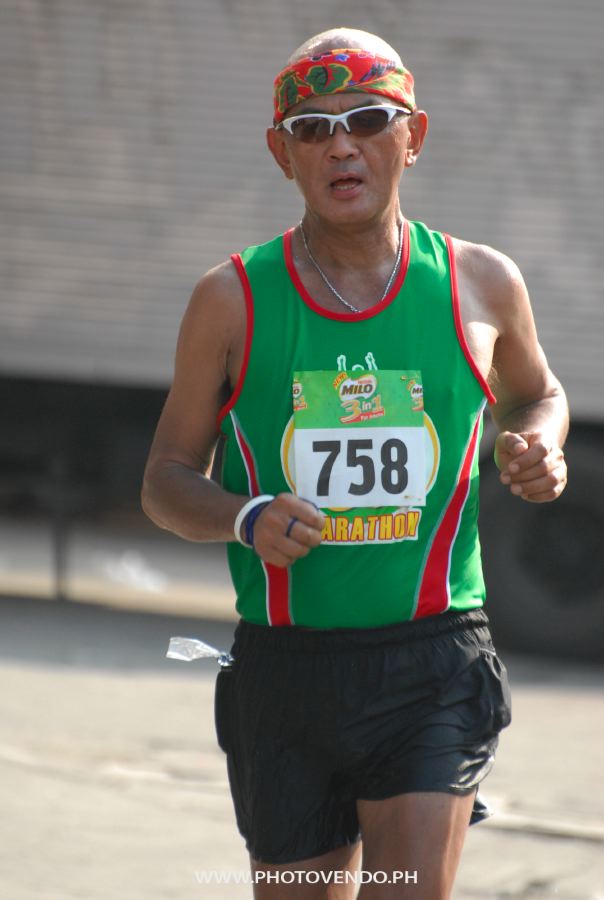
Instead of my usual bandana, I was using a “Buff” bandana on my head to absorb my sweat from my head and keep my eyes & face from the dripping sweat. As I passed the Water Stations, I usually grab two cups of water—one cup for drinking and another cup for dousing water on my head. The wet/damp “Buff” bandana also served as my head “coolant” most especially when the sun’s heat brought higher temperature during the race.
The race bib’s size was too big that I had to fold it on both ends to make it better looking with the MILO singlet. I had been consistently pinning my race bib on my breast and never been using some “race belts” and either pinning my race bib on my running shorts. Why? That’s is the proper way I know that even world elite athletes in international competitions would do to display their race numbers.
The MILO singlet was nice and I did not experience any “chafing” on my arms, nipples, or any part of my upper torso. You must have noticed the “ice candy” plastic bag filled with water on the side pocket of my running shorts! These are my “hydration containers” in marathon races! Yes, my running shorts from The North Face is now my favorite running shorts for the marathon distance because it has side and back pockets. One side pocket can accommodate two pieces of Sports Gel packets. I usually carry 4 Sports Gel packets during marathon races and this running shorts fits well with my needs. As for the back pockets, I used them as my “thrash bag”. Each side pocket could also accommodate at least two “ice candy” bags filled with water. I started using this TNF running shorts during the 2009 Los Angeles Marathon and I used it again during the MILO Marathon Eliminations.
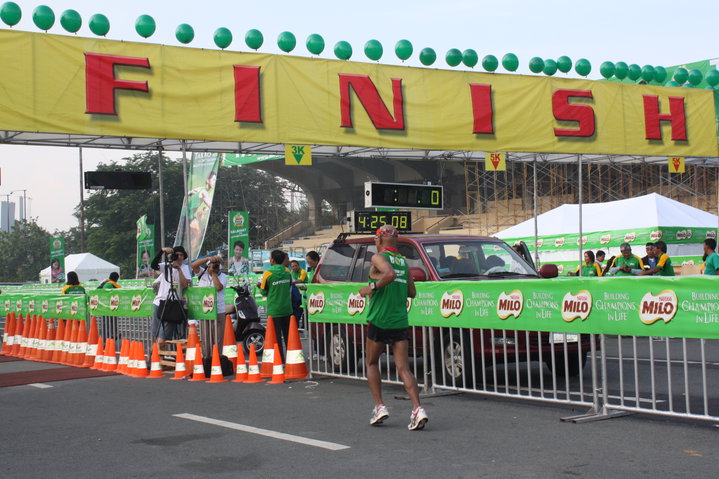
On My Last Turn Before The Finish Line
I was using ASICS-Gel Hyper Speed 3 Racing Flat shoes with Drymax Socks and I found comfort and blister-free with the shoes and socks!
Last 20 Meters To The Finish Line
On my last 8K as the sun’s heat was too much to bear, I adjusted the way I wore the “Buff” bandana in order to cover my head and at the same time my nape. I usually tie around my wrist the blue-colored string given in one of the turn-around points instead of wearing it as a necklace! Lastly, the “ONE” White Wrist Band is always there on my right wrist as my “symbol” for my part or contribution in the worldwide advocacy to “make poverty a history”.
Thanks to the Finish Line of Coach Rio De La Cruz & Vince Mendoza for the Timing Chip & for the fast publication of the following RunPix Results:
Gun Time: 4:03:55 hours
Net Time: 4:03:43 hours
Finisher #92 out of 125 Finishers. I wonder what happened to the other 112 runner-qualifiers for the Final Race! They must have DNFed!
Finisher #82 out of 112 Finishers in the Male Category.
Average Pace: 5:47 minutes per kilometer or 9:18 minutes per mile.
Time of Finish & Average Pace:
From 0K to 9.8K—-57:32 minutes @ 5:52 minutes per kilometer
From 9.8K to 25K—-1:30:08 hours @ 5:56 minutes per kilometer
From 25K to 35K—-54:51 minutes @ 5:29 minutes per kilometer
From 35K to Finish—41:12 minutes @ 5:44 minutes per kilometer
So far, so good, this was my 4th Marathon Race for the year. Not bad for a 57-year old Bald Runner!
5:30 AM January 31, 1982/Start & Finish @ Quirino Grandstand, Luneta Park
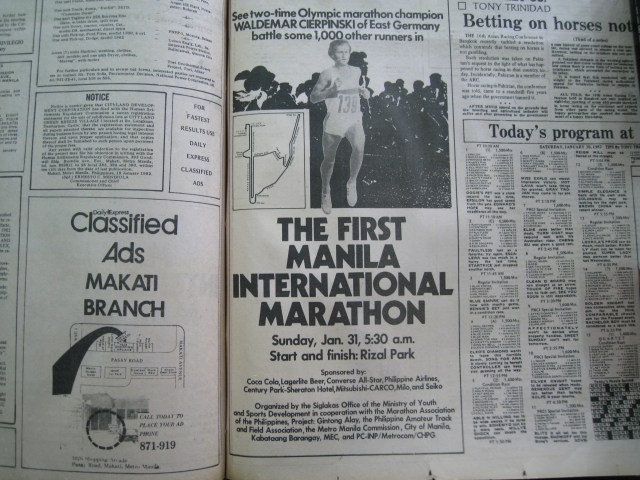
The 1st Metro Manila International Marathon was held under the auspices of the SIGLAKAS, a mass-based Sports Program of Minister Elpidio Dorotheo of the Ministry of Youth and Sports Development, and the Marathon Association of the Philippines. Coca-Cola and Lagerlite Beer were the major corporate sponsors of the said marathon race.
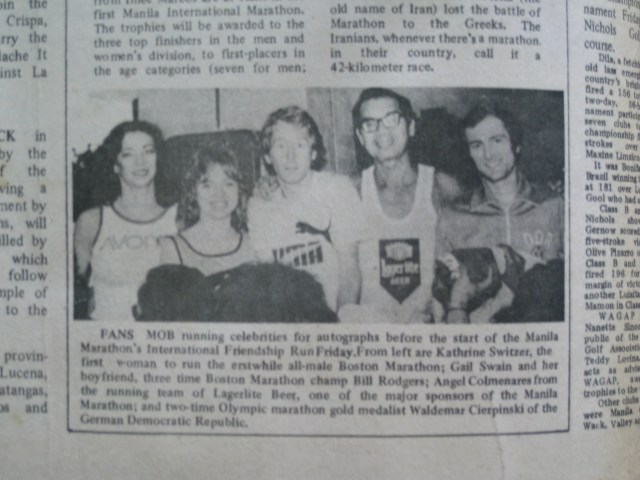
A Marathon Exposition was held at the Century Park-Sheraton Hotel where famous Marathon Champions Bill Rodgers and Katherine Switzer were invited to speak and deliver lectures to the running community. Dr John Wagner of the Honolulu Marathon Association was also one of the invited speakers. The Expo was officially opened and sponsored then by Miss Imee Marcose as the Kabataang Barangay (KB) National Chairman. The said Expo was conducted two days before the date of the Marathon Race. On the morning of the day before the opening of the said Expo, a short run from Luneta Park to Malacanang Palace dubbed as “International Friendship Run” was held in the presence of Bill Rodgers, Katherine Switzer, Waldemar Cierpinski, Peng Jiazheng of People’s Republic of China, Minister Dorotheo, and other Sports Officials. The said run culminated with a breakfast at the Palace with then President Ferdinand Marcos.
This Marathon Race was a well-planned event that the prevailing ratio of the Runners and the Officials/Marshals and Aid-Station Volunteers was 1:1. With 1,000 runners in the said race, there were also 1,000 Officials/Marshals & Volunteers who were involved in making this race a success.
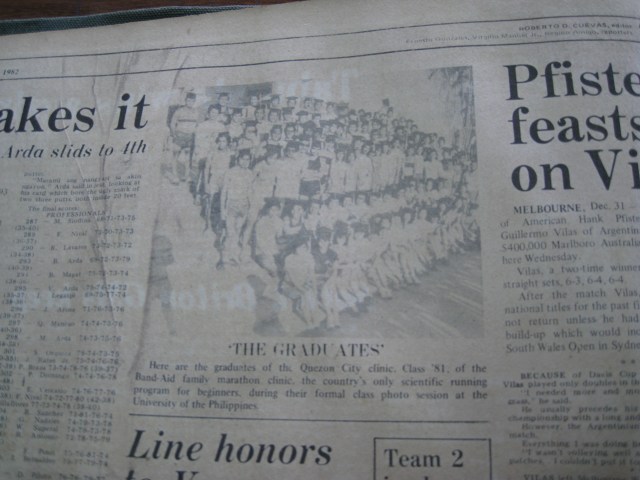
This race was well attended by graduates of a 9-month Scientific Fun Run Clinic sponsored by San Miguel Corporation (SMC). The running clinic was held every Monday, Wednesday & Friday at 5:30-7:30 PM at the periphery of Ugarte Football Field in Ayala and Long Run sessions at the Quezon Circle on Sundays. A Lagerlite Beer Running Club headed by Angel Colmenares was also one of the famous/active corporate running teams fielding 41 marathon runners in the said event.
The top 3 runners of the (Men’s & Women’s Categories) received Presidential Trophies and the top 200 runners were awarded the Presidential SIGLAKAS Medals. The awarding ceremony of the Winners was done at the Malacanang Palace at 3:00 PM on the same day of the race with no less than the President as the Guest of Honor. At the finish line, every runner received a Finisher’s Medal, Singlet, Finisher’s Certificate, and every runner drank lots of Free Coke and Lagerlite Beer!
Waldemar Cierpinski of East Germany, two-time Olympic Gold Medalist in Marathon (1976 & 1980), won the 1st Metro Manila International Marathon with a record time of 2:14:27 hours which up to this time is the “all-comers” record time in a Marathon Race in the country. Cierpinski adapted to the weather and humidity of Metro Manila by arriving in the country three (3) weeks before the race. I think this was the primary reason why Cierpinski was smiling and running at a steady pace when I met him going back to the finish line at the Guadalupe Area (infront of the Loyola Memorial Park) as I was going to the Ortigas turn-around (infront of the Robinson’s Galleria).
The second runner who arrived at the Finish Line was a certain Ricardo Carillo, a Filipino runner with a time of 2:35+ hours.
The race route was very simple then as it started at Quirino Grandstand and went all the way along Roxas Boulevard up to the Paranaque Coastal Road and back; turn right at Buendia Blvd; right at Ayala Avenue; left at EDSA until the turn-around point at crossing Ortigas Ave & EDSA and retrace the same route back to the Quirino Grandstand with runners immediately turning right a Roxas Blvd at the end of Buendia Ave. Runners had to go at the underpass of Shaw Boulevard and at that time one lane of EDSA was devoted to the runners.
1st Metro MIM Newspaper Ads With The Picture of Cierpinski
(Fm Left to Right) Katherine Switzer, Gail Swain, Bill Rodgers, Angel Colmenares, & Waldemar Cierpinski
“The Graduates” of the Quezon City’s Class ’81 of the Johnsons & Johnsons “Band-Aid” Family Marathon Clinic @ UP Diliman
What are the things we learned from our past road races during the early 80s when the first “running fever” hit the country? In my opinion, the following are some of the “pointers” and my personal assessment of the road races then:
1. First, the National Government, through the MYSD, was the overall race organizer of this Marathon Race with the direct involvement of the President of the country down to the MMDA and different cities in Metro Manila.
2. If a road race was a Full Marathon, then, it was solely a Marathon Race. There were no other lesser-distance road races on the sides.
3. There was full support from the private sector due to the presence of different corporate running clubs and their sponsorships.
4. World-known Marathon Champions were invited with the proper Exposition and Lectures from them and from sports & medical experts and this was indicative of a well-prepared Marathon Race. It also means that money were spent to invite such “international stars” in running. No Cash Prizes were published for the winners.
5. The 1:1 ratio of the runners and the officials/marshals & volunteers was really a “big” task then to make sure that the runners were safe and secured. The volunteers then were well-trained and prepared.
6. If my memory is still right, the registration fee then was One Hundred Pesos (P 100.00) and the runners were well-supported with hydration and fresh fruits in Aid/Water Stations along the route.
7. Runners did not have any complaints about registration as every applicant got his/her race packet upon registration. There were no complaints on route distance accuracy; race results; and traffic during those days. I wonder how the SIGLAKAS and the Marathon Association of the Philippines did to make our road races then without any problems! I guess, the people behind these races were then well-trained, coordinated, and matured, in short, they were “professionals” & experts in their field.
8. Marathon Races and other Running Events were given “preferential” and favorable exposure through news stories in Sports Pages in Daily Newspapers then, up to the point of relating dramatic stories of top competitors and predictions who will win the race. At this time, except for the annual MILO Marathon Eliminations and FINALS, all the other running events are featured in the Lifestyle Section/Pages of our Daily Newspapers (days and weeks after the race). For almost two years of being a runner-blogger, I have yet to see a picture of a Top Finisher/Champion of a Road Race running towards and crossing the Finish Line Tape in the Lifestyle or Sports Section in any of the broadsheets!!!
9. Running Clinics which were sponsored by Corporate Offices had a training period of Nine (9) Months in preparation for the runners’ first Full Marathon Race. These running clinics were supervised by trained coaches and conducted at least, three times a week. These running clinics were fully advertised in the local newspapers. Experts on sports injuries, nutrition, and past Marathon Champions were invited to speak before the runners. I was not able to join these clinics before as I was assigned in the Ilocos region, however, I trained for my first marathon race for almost one year, running at least 10 kilometers everyday and 20-30 kilometers in my weekend long runs.
(Note: Photos Taken From the Philippine Daily Express dtd 31 January 1982)
I went to the National Library on the morning of rainy Tuesday but I was not able to get in those research halls/rooms after I lacked the necessay requirements. Anybody who would visit and make a research in the National Library should have a valid Identification Card, one (1) ID Photo, and Fifty Pesos (P 50.00). A Cashier in the Library needs to confirm your Identity through your ID Card and then receives your Fifty Pesos. In return, the Cashier gives you a blank Library Card and an Official Receipt of the money you gave. You should paste your ID Photo to the blank Library Card and write your name on the said card.
The National Library/My 1st time to enter the building
Then, proceed to one of the desktop computers in the lobby and register your Library Card Number, Name, Password, Address, and E-mail address and then click Save. Your Library Card Number which is printed on the back of your Library Card is your Username. From here, you can now proceed to the research areas located at the 2nd-4th Floor of the building. The whole building is not air-conditioned and be prepared to sit yourself where wall electric fans are located.
First, I used the computer to track down if there are any books or publications about local Athletics and Running in the Directory of the National Libray. The result? None!!!
Second option was to find out the old newspapers in the Directory. I was surprised that I was made to proceed to the 4th Floor of the building and I was able to see the sorry/sad state of those book-bound newspapers stacked on open racks and cabinets. Most of them are dusty and not properly arranged by months and years. I thought I would be looking on “microforms” or “microfiches” of newspapers but I was actually reading the actual old copy of newspapers bound by month.
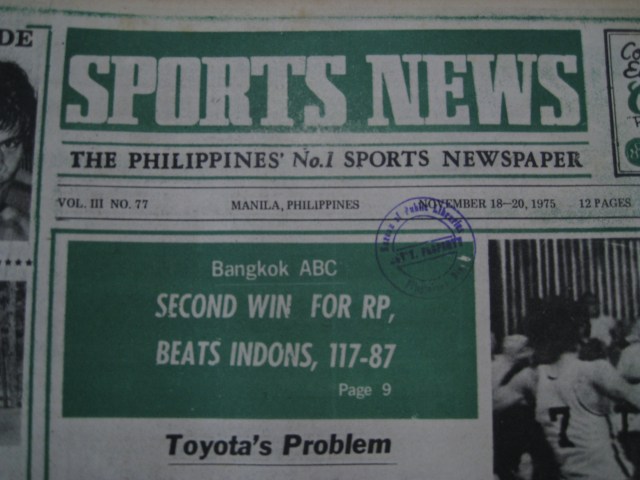
After looking on the different rows of newspaper racks for about 30 minutes, I came upon book-bound copies of “Sports News” which is a weekly broadsheet newspaper on Sports and the following were my discoveries:
1) There was an annual event called “YMCA Walkathon Race Event” which was well-attended by almost 300 walkers and had a Cash Prize of P 200.00 for the winner/champion. In my mind, I recalled a regular group of walkers called “United Nations Walkers Club”.
2) The first provincial annual marathon race was called Negros Marathon which was held in Negros Occidental as sponsored by Governor Roberto Benedicto. It was organized by Monico Puentebella (who is now a Congressman). The most popular runners team in Negros Island was headed by Art Valdez (brother of singer-runner Leo Valdez) and it was called BM-AMC.
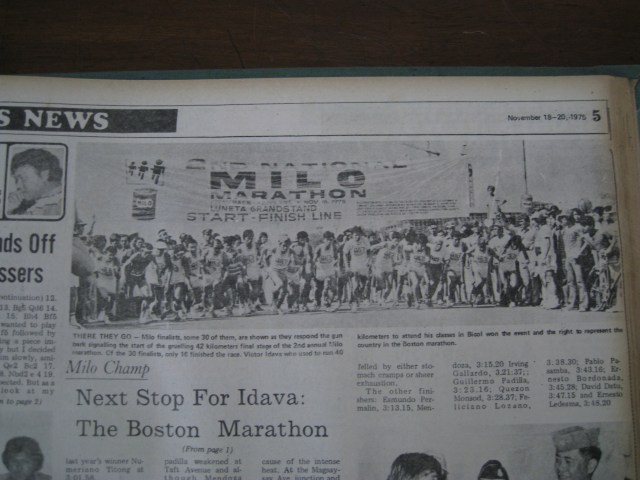
But what gave my full attention during my research was the news coverage of the 2nd MILO Marathon and its elimination race and I have the following information based from the news accounts of “Sports News”:
1) The first MILO Marathon was held in 1974 and the first Champion was Numeriano Titong, a golf caddy. I heard that he is still a golf caddy at the Valley Golf & Country Club.
2) The 2nd MILO Marathon Race Elimination Race was held on November 9, 1975 with the participants coming from all over the country. Registration was made and submitted in the local branches of Manila Bank with the following requirements:
a) Runner should be an amateur.
b) Must not be less than 19 years old.
c) Must be able to submit Medical Certificate from any Physician
d) Submit One (1) Passport size or ID Photo attached to the Registration Form
e) Registration Fee: Two Pesos Only (P 2.00)
The Elimination Race is a 20-kilometer road race that starts at 12:00 Noon along Gen. Aguinaldo Street, infront of the Fiesta Carnival, Cubao, Quezon City and finishes at Luneta Park. The first thirty (30) finishers in this race are qualified to participate in the 2nd MILO Marathon Final Run.
The Marathon Finals is held the next Sunday after the Elimination Race. The Finals starts and ends at the Luneta Park. It starts at 12 Noon from Luneta Park-towards Quiapo-Espana-Quezon Boulevard-turn right at EDSA-towards Cubao-right at Aurora Blvd-Magsaysay Blvd-Legarda-back to Luneta Park.
The Marathon Finals top prize for the Champion is a chance to compete in the Boston Marathon if the finish time is 2:30 hours or less. No Cash Prizes were given to the winners that time.
The Race Organizer was Jun Castro of Intergames Inc. The race was also sponsored by PATAFA.
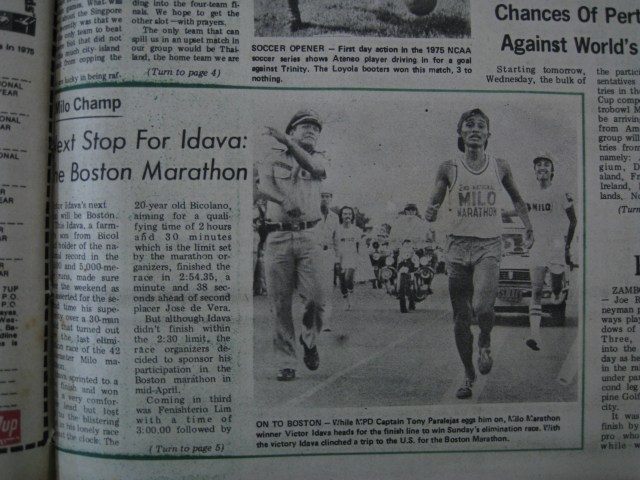
2nd MILO Run Start PictureVictor Idava Near The Finish Line
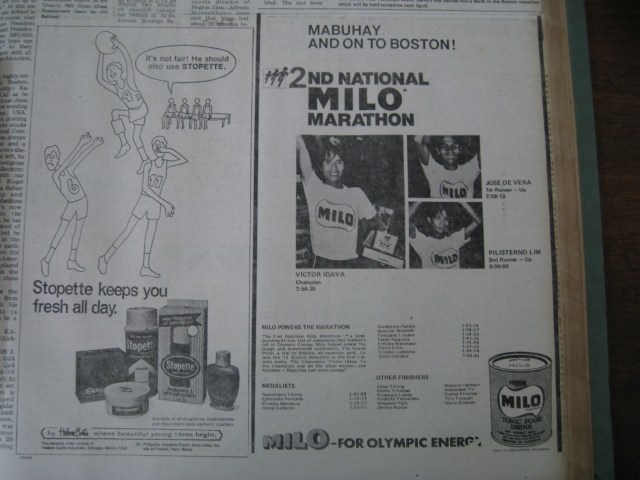
In the 2nd MILO Finals, Victor Idava, 20 years old & farmer’s son from Bicol and a national record holder then in 1,500 & 5,000-meter runs, won First Place/Champion with a time of 2:54:35 hours. He did not qualify the 2:30 hour or less finish time but MILO sent him to participate in the 1976 Boston Marathon. Out of the 30 qualifiers who started the race, 16 finished the race.
MILO Run Finisher's Ads
The following were the results of the 2nd MILO Run:
2nd Place—Jose De Vera—2:56:13 hours
3rd Place—Finishterio Lim—3:00:00 hours
4th Place—Numeriano Titong—3:01:58 hours
"Sports News" Newspaper
I am going back to the National Library soon! I will try to find out information about the Pilipinas International Marathon, PAL Manila International Marathon, and the Alay Sa Pangulo Marathon Race.
Did you know that there were two famous Race Organizers then in the persons of Mr Jose “Jun” Castro, Jr and Minister Elpidio Doroteo of MYSD?
Did you know that there was a National Corporate Competition in Long Distance Running Event where every government and/or corporate offices’ running teams would compete? The winners were sent to Stanford University in Palo Alto, California for the International Corporate Athletics Competition.
By the way, I was a new graduate from the Philippine Military Academy and I was then fighting it out with the MNLF in Maguindanao-Cotabato as a 2nd Lieutenant of the Philippine Army and a Platoon Leader when the 2nd MILO Run was held in Manila.
(Note: Newspaper Pictures Taken From “Sports News”)
Due to the forest fires at the Los Angeles National Forest last November, the Inaugural Pasadena Marathon was cancelled and later postponed to March 22, 2009 after the Los Angeles Marathon was re-scheduled to May 25, 2009.
My son, John, started to train for the Pasadena Marathon when he had his visit in the country last 20 January 2009 and Coach Ferdie was able to give him his training schedule for the said marathon.
This morning, I received an e-mail from my daughter, Jovelle, and informed me about their performance. I was surprised that John got injured during the race as it was raining. He was able to finish the marathon but had to walk with limp up to the finish line. He finished in 5:37:49 hours. On the other hand, my daughter, Jovelle, opted to run the Half-Marathon and she was happy to inform me that she improved her time when we ran together during the 2006 Inaugural City of Angels Half-Marathon. She got a time in the Pasadena Marathon in 2:11:49 hours.
To my running kids, congratulations for being a part of the historic Pasadena Marathon and for finishing your respective race despite the injury of John.
The following are the details of their performance for the race:
Marathon
Runner Details
Bib: 1511 Name: John Paul Narcise Gender: M
Age: 30
Hometown: Los Angeles, CA
Race Results
Overall: 1132 out of 1486
Men: 809 out of 985
M 30-34: 100 out of 118
Age/Grade: 36.98% Place: 1337
Finish: 5:37:49 Pace: 12:54
Tag Time: 5:37:49
Gun Time: 6:05:07
Half Marathon
Runner Details
Bib: 4636 Name: Jovelle Narcise Gender: F
Age: 29
Hometown: Los Angeles, CA
Race Results
Overall: 1048 out of 2890
Women: 360 out of 1609
F 25-29: 72 out of 237
Age/Grade: 49.95% Place: 1127
Finish: 2:11:49 Pace: 10:04
Tag Time: 2:11:49
Gun Time: 2:39:08
Samuel Wanjiru of Kenya won the Gold Medal in the 2008 Men’s Olympic Marathon with an Olympic Record time of 2:06:32 hours. This is the first time for Kenya to win the Gold Medal in the Men’s Olympic Marathon.
Jaouad Gharib of Morocco won the Silver Medal in the 2008 Men’s Olympic Marathon with also an Olympic Record time of 2:07:16 hours.
Tregay Kebede of Ethiopia won the Bronze Medal in the 2008 Men’s Olympic Marathon in 2:10:00 hours.
I was not able to watch the start of the 2008 Women’s Olympic Marathon yesterday as I was with my family outside the Los Angeles area. However, I was able to catch up with the last five (5) miles of the race on TV.
As usual, an unseeded and not-so popular woman marathon runner to win in the 2008 Beijing Olympics, Constantina Tomescu-Dita from Romania, a 38-year old mother to a 13-year old son, won the 2008 Women’s Olympic Marathon in 2:26:44 hours. Her latest achievements before the 2008 Olympic Games were the following: she won the bronze medal at the 2005 World Championship Women’s Marathon; Women’s Champion in the 2004 Chicago Marathon; and 3rd placer in the 2007 London Marathon (Women’s Category).
She is now considered as the oldest Marathon Champion in the history of the Olympic Games.
The following is the complete results of the 2008 Women’s Olympic Marathon.
 Bald Runner
You must be logged in to post a comment.