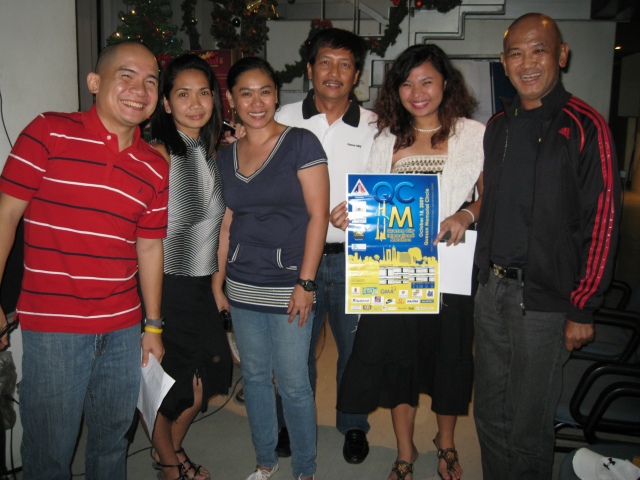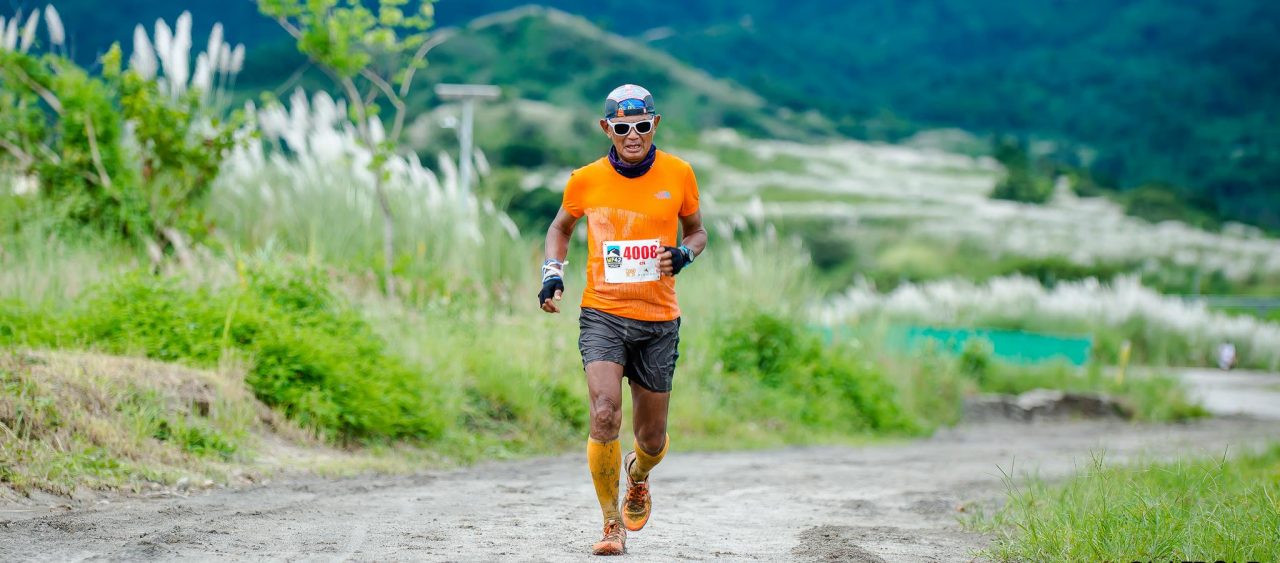
“Pacer & Support Crew” @ 1st QCIM


5:00 AM October 18 2009; Quezon City Circle @ 1st Quezon City International Marathon (1st QCIM)

Weeks before the conduct of this race, I was requested by the Race Organizers to have the members of the Elite Team Bald Runner as “Official Pacers” for beginners/”newbies” for the Marathon Race participants. Since almost all the members of my Elite Team will be running the said race and the Mt Mayon Trail Race, I could not provide any of my runners for the said task. Actually, I did not have any plans of joining this Marathon Race after my scheduled run with the 33rd MILO Marathon FINALS and my participation in the SMART Subic International Marathon (SIM). I really wanted to rest and recover after the MILO Race and plan to have a faster pace for the SMART SIM.

My plans changed completely when my daughter arrived from Los Angeles, California for an 11-day vacation in the country. She wanted to experience a road race in Metro Manila which is a longer race that her brother, John Paul, had experienced last January of this year. Knowing that her brother finished the Resolution 10K Run last January at MOA-PICC Grounds, she wanted to have a longer distance than what her bother experienced. So, I immediately registered her and myself for the QCIM Half-Marathon Race.

I knew that running with my daughter will entail some adjustments with my running style, plans & strategy. First, I accept that I will be the official Pacer and Support Crew for my daughter aside from being the “bodyguard” to her during the run. Second, from a race pace speed, my pace would be a 50% of my total effort as my daughter’s best time for the half-marathon is 2:11+ hours but I was ready that we will go slower than this time because of her lack of mileage training and her lack of adjustments with the weather and humidity here in Metro Manila.
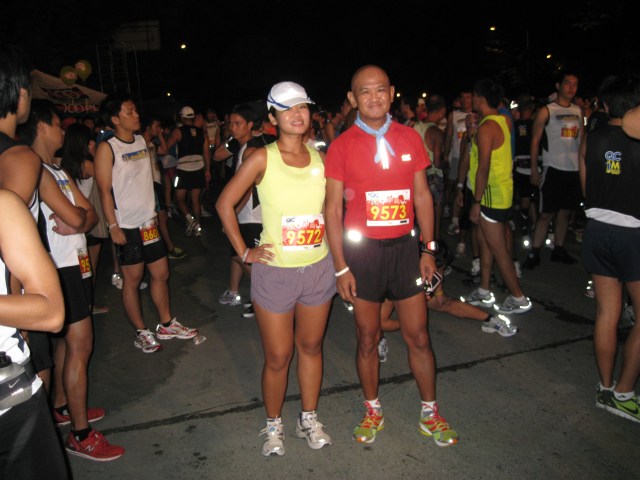
A Pose At The Staring Line
A Pose At The Starting Line

My daughter arrived in Manila on the early morning  of Tuesday, 5 days before the race, and I think we had only 2-3 occassions where we had a running workout together along the Bonifacio High Street Loop; Lawton Avenue to C-5 turn-around point and McKinley Hill Loop run before the Half-Marathon Race day. During our runs, I’ve observed that she was sweating heavily and running out of breath due to the temperature and humidity despite our slow and comfortable pace. We did some runs in the morning and in the late afternoon towards evening. However, in our last running workout, she was able to run a longer distance and she could maintain a steady pace despite the warm temperature. While we had our workouts, we talked about our plans & race strategy for the Half-Marathon, to include our hydration and nutrition plans for the race. 
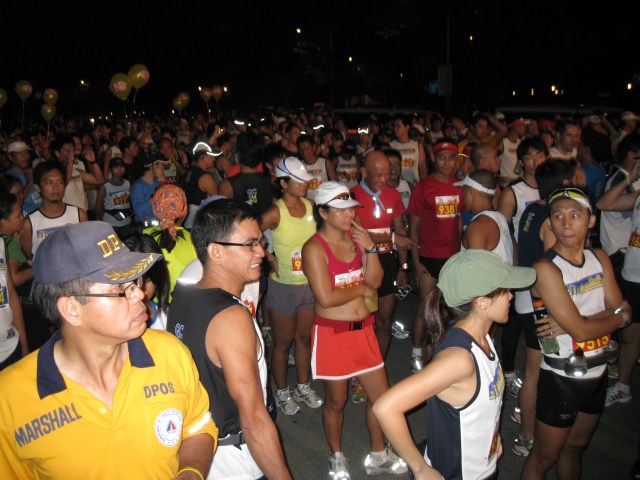
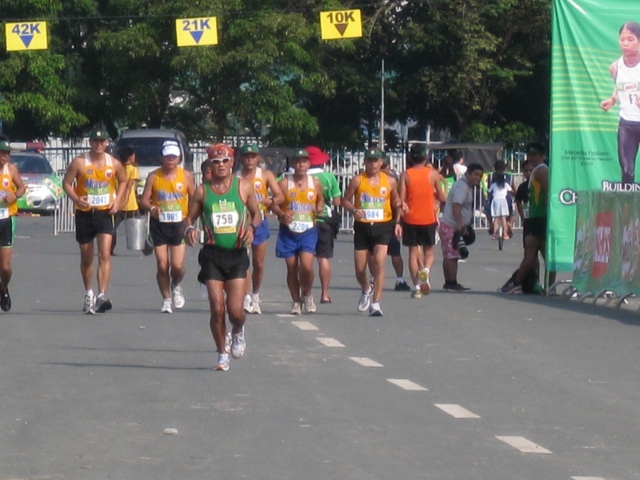
The Crowd & Runners of the Half-Marathon Race

 At 4:50 AM of October 18, we were already one block away from the Starting Area as we decided to alight from our vehicle on the first road block towards the Quezon Circle. As we were walking, I saw Kim Ong asking us if we need a ride and we said that we just walk towards the assembly area as our warm-up for the race. Once we reached and entered the coral area for the runners, I was approached by Mr Disini, President of the RUNNEX & Councilor Doray Delarmente and I introduced my daughter to them. I met and greeted more runners while a group stretching session was being conducted to the runners. My daughter and I settled at the middle of the pack and waited for the starting gun to sound off. At exactly 5:30 AM, the starting gun went off and we started jogging.

It was still dark when we proceeded to the UP Academic Oval and I became the “tourist guide” to my daughter telling her about those weekly road races being held at the UP Diliman Campus. We had a slow and comfortable pace as I chat to my daughter trying to determine if she can cope up with the pace. I made sure that she was the one dictating the pace and sometimes prod her to increase her pace. As we approached the Commonwealth Avenue, the surroundings was becoming brighter and that we could see a lot of runners for the 10K & 5K running along the said avenue. After turning right to Commonwealth Avenue, I was surprised to see the vast expanse of the road entirely for the runners only. It was a different sight to behold while at the left side of the road was full of vehicles not to be moving at all.
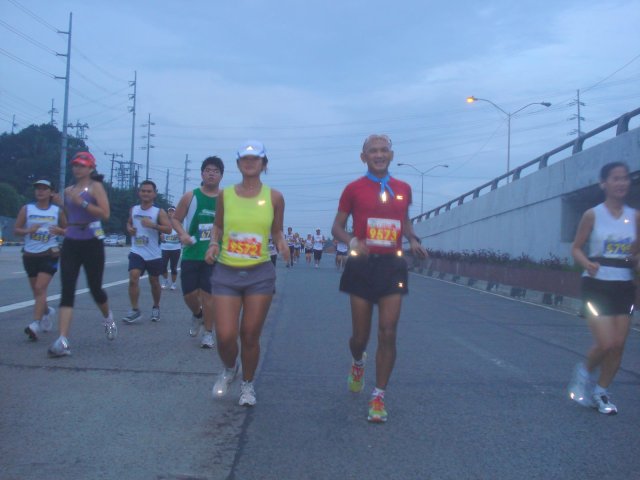
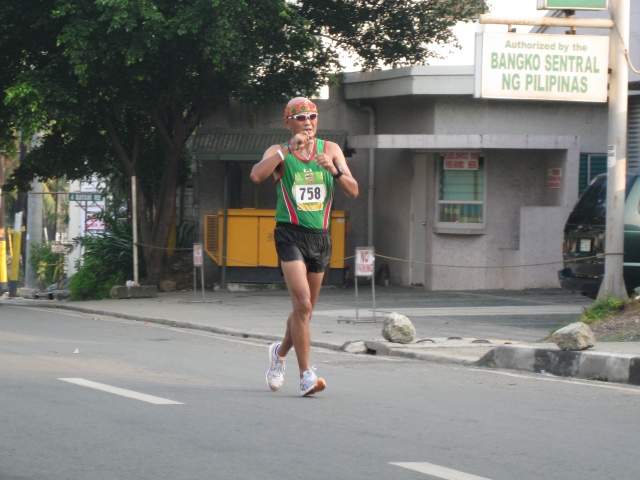
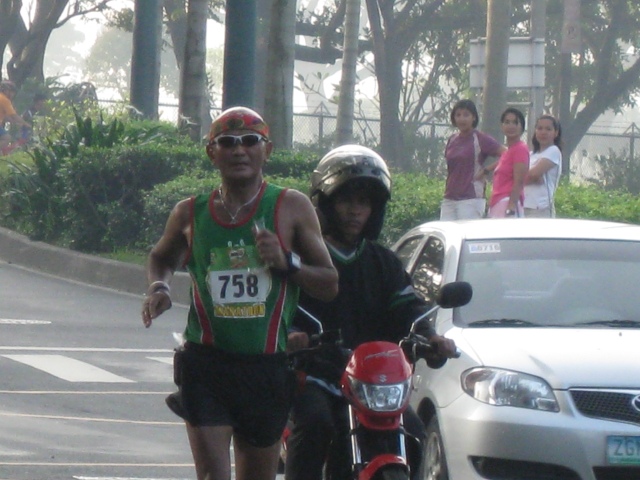
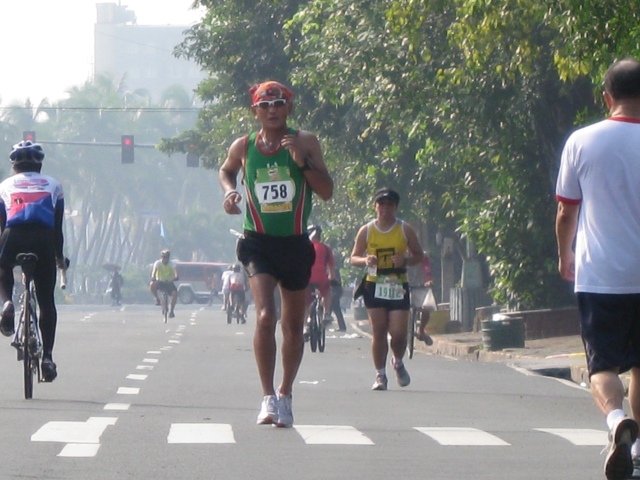
Mark Parco Took This Picture Before The Halfway

 I ran conservatively in terms of my pace and the way my foot strike the ground. I knew that the cemented road was hard to the feet and the legs and I tried to be light on my pace as much as possible. Many runners would overtake us along the way and I would greet them and smile at them. More of the faster runners who had reached the turn-around point on the road that goes to the Batasan Pambansa would greet me during the race. We just maintained a comfortable pace of 7:30-7:45 minutes per kilometer.

We did not have any problems with our hydration from the Water Stations. I am sorry to say that the tables were still small and that  it could only accommodate a number of water cups eventhough the Race Organizers placed a lot of Water station tables along the way. I made it a point to increase my pace whenever I could see a water station way ahead of us and pick-up at least two cups for the two of us. This ritual had been repeated every time there was a Water Station that we passed.

While we were running, we had to briefly stop and take some pictures to my daughter as she was happy to see the students cheering the runners and those bands along the way. She was happy to have made some pose as her remembrance in joining this 1st QCIM Half-Marathon. I had observed that my daughter was enjoying the experience along the Commonwealth Avenue with all those cheering and bands but she became more silent and serious when we finally entered North Avenue and back towards the Finish Line. The heat and the humidity was taking its toil to us as we maintained our pace along this road. I was surprised to see illegal settlers on government lots near the Veterans Memorial Hospital with the SM North EDSA as the background. It had been years that I was able to pass along this road. I hope that something will be done to get rid of these illegal settlers in government lots reserved for government offices & institutions.

While running, it was my duty to carry the GU Roctane/Energy Gels for my daughter as I wore my Fuel Belt with Pouch. She was able to finish at least three pieces of GU Sports Gel. What was good was that we did not have any problems with the supply of water and water cups on the Water Stations along the way. I did not hear any complaints from my co-half-marathon finishers about the lack of water along the route as compared to the complaints I heard and read on the runners who finished the marathon race. 
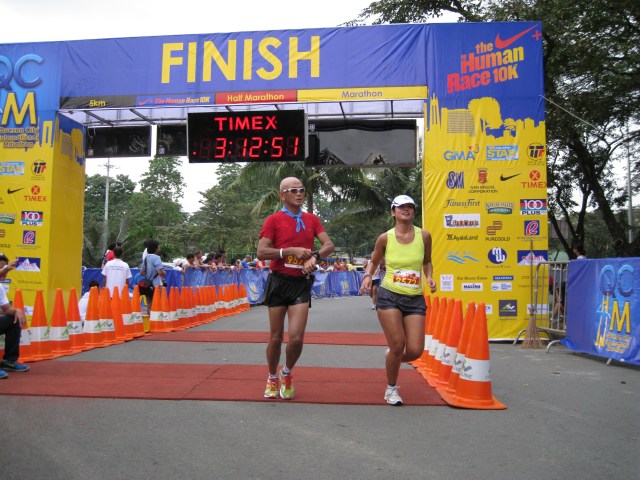
Passing The Finish Line After 2:42+ Hours

 The presence of kilometer markings along the way made comfort to us runners most especially on the last 4 kilometers. The overcast sky made the slower runners like us to be covered by the intense heat of the sun and finished the race without any problems related to heat injuries.

My daughter and I finished the Half-Marathon race in 2:42:29 hours based from GF 305 with an average pace of 7:37 minutes per kilometer. The distance registered 21.35 kilometers. After passing the Finish Line, we got our respective Finisher’s Medal and Certificate. After some photo-ops inside the Quezon Circle, we started to proceed back to our vehicle and changed our wet running apparel. Although my daughter was too tired after finishing the race despite of lack of mileage, she managed to smile and happy that she was able to finish her 1st International Road Race which is a Half-Marathon. She told me that she ran the said race as a “bragging rights” to her brother, John and officemetes/clients & friends.
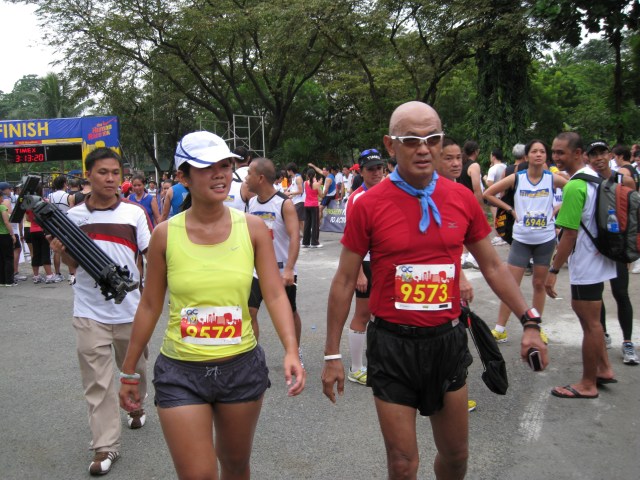
Walking Towards The Awarding Of Finisher's Medals

As an assessment on the conduct of the 1st QCIM, I firmly believe that we could bring back the glory and exposure of running during the late 70s and the whole of 80s when the national government and the local government entities were at the forefront and directly involved in the conduct of road races as big as an International Marathon Race. It can be done! The participation of the Kenyan runners was also a commendable effort on the part of the Race Event Management to make the event truly an international race.

There were so many complaints about the lack of water and water station along the marathon route but this could be improved in the next edition of the race with the hope that this event will be continued and sustained in the years to come. I just hope that the Race Organizer/s have the courage to explain and answer the concerns of the runners during the race through their websites and/or blogs of affected runners.

Congratulations to the City Government of Quezon City, Race Organizers, RUNNEX, and to all the Finishers of the Race who most of them came from the different cities of the country.

Happy 2nd Year Anniversary!!!


25 October 2009

I started this running blog last 25 October 2007 while I was the Commanding General of the 3rd Infantry Division of the Philippine Army based in Camp Macario Peralta, Jr in Jamindan, Capiz. I was not new in blogging as I had a blog at Blogger where I posted my daily activities as the Commander of Philippine Army troops covering the islands of Western Visayas consisting of Panay, Negros, Guimaras, Cebu, and Bohol Islands with a strength of almost 10,000 troops and para-military personnel under my Command. My daily entries in my blog as the Commander was my “initiative” to link my Command with the members of the media who are based in key cities of the Islands. There was no need for the media practitioners to travel all the way to my camp in order to get information or interviews with me on the prevailing situation in my area of responsibility. Everybody could access me through the Internet.

As I started to run again and prepare myself to be competitive in marathon races, I tried to browse in the Internet and I was able to discover the blogsite of The Bull Runner and it gave me the idea to start a blog which devoted to my running experiences in the past, my running workouts, my insights about runnikng and sports, reading references about running, and my training plans in preparation for a race. And everything is history as it evolved into what it is today.

It is worthy to mention that after two years of blogging, I was able to publish 845 Posts and have received 4,132 Comments. The Total Views to this blog turned out to be 414,181 with an Average Daily Views of 811. Runners around the world had reached and visited this blog giving them a glimpse on the running activities and situation in the country, my advocacies, my projects & programs, as well as my adventure runs in the United States and my “dreams” and aspirations to make running as a source of pride for the country.

I hope I was able to share my past, present and future activities in running with this blog. If ever this blog was able to inspire and influence my readers to adhere to running as a means to achieve a healthy and active lifestyle, I hope that they would be able to inspire others also, whether within the family & relatives, among friends, among officemates, and to other people.

Let us be united in bringing the sports of running down to the “grassroots” for us to have a healthy and strong nation!

To all my visitors and readers, my deepest gratitude for making this blog a part of your daily life!

First Running Picture In This Blog
Finishing The 2009 Adidas KOTR On My 2nd Year Blogging Anniversary

Running Is Like Eating My Dinner


For the month of October 2009, running and finishing road races (marathon & half-marathon) is like eating my formal dinner in a fine restaurant.

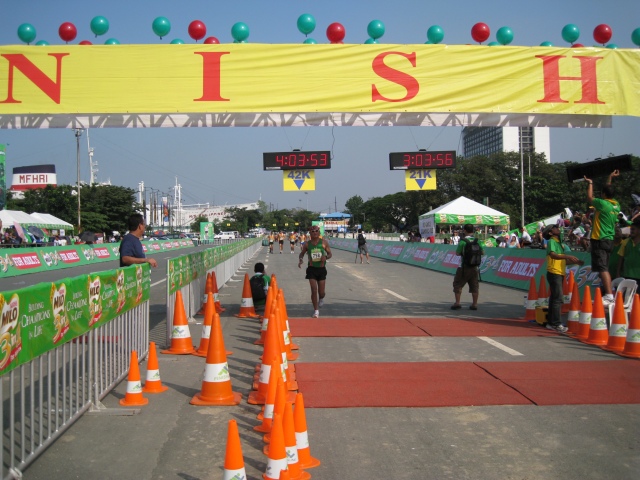
The 33rd MILO Marathon Finals last October 11 was for my Starters/Appetizer! I finished the race in 4:03:55 hours.

The Quezon City International Marathon Half-Marathon on October 18 was for  my Salad & Hot Soup! I finished the race as a “pacer & support crew” to my daughter, Jovelle with a time of 2:42+ hours

The SMART Subic International Marathon was the Main Course/Entree. The race started at 4:30 PM yesterday and I finished the race in sub-4 hours as planned with a time of 3:58:09 hours!

The ADIDAS King of the Road Half-Marathon Race early this morning was the Fruit Salad/Dessert. With barely 3 hours of sleep after coming from Subic Freeport, I finished this race in 2:01:08 hours!

The incoming Pasig River International Marathon on November 8 would be my Hot Coffee before I end my dinner!

To those who have finished the past races for this month and were able to attain their goals, my congratulations to you! And for those who will be running the New York Marathon, Pasig River International Marathon, SC Singapore International Marathon, and other Boston Marathon qualifying races in the United States, I wish you the best and injury-free finish!

See you on the road!

See You At Subic!


The SMART Subic International Marathon tomorrow afternoon will be my 5th Marathon Race for the year. After finishing the 33rd MILO Marathon Finals with a time 0f 4:03+ hours two weeks ago and completing the 1st QCIM Half-Marathon with a slow pace, finishing in 2:42+ hours, I think the Subic International Marathon will be a race to go for a faster time.

I plan to finish the race in sub-4 hours and find out if I can have chances in competing in a Boston Qualifier Race in the future.

I was requested by the Race Event Organizer to lead the runners in reciting an Oath of Sportmanship before the start of the Marathon Race. It is a good and commendable idea to remind every runner that they should run honestly and maintain the integrity of the race. I don’t want to elaborate on this issue as there are runners who could not understand what it means to be honest in road races.

To all the runners, rest well today and tonight and we will see each other at the Starting Line tomorrow afternoon. Good Luck!

Note: It should be noted that darkness starts at 5:30 PM. In the absence of street lights along the course and illumination provided by the Race Organizer, it is advisable to be ready with your head lamp or mini-maglite flashlight, just in case.

A Comment From Coolrunner1009


Mr Coolrunner1009 posted this comment on the article/story, “Who Listens To RUNRADIO”. I am posting his comment so that all my readers would be able to read it and you can make a rejoinder or comment on this post.

“Thank you BR for your suggestions. I discovered the joy of running in the 1979 and was also a witness to the running boom that swept across the country like wildfire for more than a decade. From my recollection, running at that time had a wider grassroots base because both the government and private sectors were at the forefront in showcasing the Filipino athlete’s (or runner should I say) talent. There were even FREE races like the Kabataan Barangay’s People’s Run (circa 1980?) where I finished my first 5K. Who could forget the Siglakas and Band Aid Marathon clinics then? The athletes who gave our country much pride then – Lydia de Vega, Isidro del Prado, Jimmy dela Torre, Elma Muros, to name a few, all came from our society’s grassroots.

The way I see it now, the renaissance that we are now witnessing has not yet reached down and deep to the lower strata of society which must be teeming with vast but untapped potential. While the middle and upper classes could definitely produce great runners, the grassroots, by mere function of demographics must be the reservoir of our future champions.

I agree that the use of the lingua franca as well as the involvement of less privileged but outstanding athletes e.g. Bertek in promoting running could make much of a difference. While I appreciate NU 107 in doing its best to promote running, there are inherent constraints because this station couldn’t stray too far from its English-literate, upper to middle class target audience. However, should not do much harm if the folks at Run Radio would use Taglish at least, in this metropolis where Pilipino is the lingua franca. Other sectors (AM stations, gov’t agencies, NGOs, etc.) should follow suit in reaching down and deep to socio-eoconomic classes C&D. A multilingual and multisectoral approach by the key players (or promoters) should enhance their effectiveness in reaching a broader audience. Me impression kasi na ‘burgis’ at ‘pa-cute’ kung palaging English na lang ang gamit. Ang telenovela nga, isinasa-Tagalog para lamang maakit ang mga masang manood. The ratings will tell you the rest of the story.

Lastly, I find it PATAFA’S decision to ban runners from the national pool legal but not moral. It’s a pity that our best runners are living a hand-to-mouth existence. I also lament the fact that registration fees at major races, which range from Php 350-500, would cost the common tao more than a day’s wage. It’s difficult for a breadwinner who is passionate with running to justify spending such an amount for a race at the expense of hungry mouths in his/her hungry family. I cannot imagine how many of our less fortunate fellow runners who belong to the minimum wage earner have been running with guilt in their consciences just to experience the euphoria of competing in a road race. I don’t know if socialized registration fees for races would work. What do you think BR?

More power to you BR for your advocacy! Although your expressions occasionally tend to draw strong criticisms from other sectors, it is always necessary to comfort the afflicted and to afflict the comfortable for the sake of raising the bar on running.”

I really like this kind of comment from my readers who had experienced what was like during the “running boom” in the late 70s and the whole decade of the 80s. I still remember that there were so many running activities then—fun runs, running clinics, relay runs, corporate running competitions where the champion team was sent to Stanford University for the International Corporate Running Competition. Through my personal experience and research, the government was at the forefront in organizing road races—whether to celebrate a national event or historical event or in major road race competitions. The Ministry of Youth and Sports Development (MYSD) under Minister Doretheo who was also an athlete himself and he could muster the cooperation of the city governments in Metro Manila, PC-METROCOM, Philippine Highway Patrol, PATAFA, volunteers, PATAFA, and private corporate sponsors. The country was still then under Martial Law!

I just wished that the concept of Project Gintong Alay during those times will be fully appreciated by the present sports authorities. As I said before, as long as we have different personalities holding these key sports instituions in the country, the perceived “sports politics” and “finger-pointing” syndrome will always be there and our athletes are the ones being jeopardized. And as long as we have “fat-bellied” & “very, very, very old” sports commissioners/officials/sports federation leaders who could not even experience what it takes to run a 3-Km distance, then our sports excellence program will not reach a higher level of accomplishment. No amount of being trained and very good in PR, marketing, and “savvy” in management, what we need is a good leadership who can set an example and transparent to our athletes and to the public.

Socialized Registration Fees? Depending on the cause or advocacy of the road race, it could be done. But the problem is, how can you distinguish the Class A from B from C & from D? What are parameters if you want to consider a runner to be at the Elite, Middle, or Poor Class of the society? This is a very tedious work for the Race Organizer. The runners will complain if you require them to bring their ITR or SAL to find out if they belong to a certain category according to their income & property. Actually, if we have a supportive government and corporate sponsors, we can have a road race that could be free from registration fees!

It is true that some of my posts and expressions are very “abrasive” to some group of runners and/or race organizers and even to sports authorities and government elective officials. Running is a way of life for me, for the hardcores, and to most of us who want to enjoy the “intangible” benefits of running. Others would make running to make a living with the hope and greed to enrich themselves. Others would run because it is the “in” thing nowadays and they want to be identified with this group and that group. Others would use running to help others which is to me is a crap and cheap reason to earn more money. Others would run because they are “celebrities” and they voluntarily or get paid/rewarded to endorse some running-related products. Others would want exposure to the public for some personal or political reasons. The reasons are so many. But for me, if you want to help in running, we have to go to the “grassroots” and encourage the less-priveleged ones to run and get the best from them. Train, educate, feed, ingrain to them good values and lead them to a better life by transforming them to be the best runners. Who knows, this could be the solution for the country’s problem why we could not even earn a Gold Medal in the Olympic Games. For a population of 90 Million, I believe there is somebody out there who would be a future star in Athletics that will make us proud in the Olympics. All is needed is for somebody to discover him/her, rear, guide, feed, educate, train, and lead him/her to be the best runner.

At least, I am doing my part by coming up with the Elite Team Bald Runner Distance Project for the past 15 months, without the support of the government, from PATAFA, or from any corporate entity except from a few friends of Bald Runner who really believe in this advocacy. It is better doing something to solve the problem (even if it will take years to produce a result) rather than not doing anything at all. I hate to hear and read from cheap talks and cheap posts in blogs and in media releases about pronouncements on how to solve such problem. I’ve been reading and hearing their plans & pronouncements to improve our sports excellence program for the past years but nothing happened to elevate the level of excellence of our athlete’s performance. It is very frustrating to observe that our “sports excellence” is up to the level of the ASEAN Games. No amount of promising hefty amount of rewards for medal winners (in the Olympic Games or in any International Games) if the training & service support of our athletes are not adequate and lacking. I firmly believe that it is better to “front-load” these cash rewards for the training of the athletes rather than dangling them as rewards to be attained.

Let me enjoin everybody then to help and support the Elite Team Bald Runner Distance Project as this is our hope in Long Distance Excellence in the country. My deepest thanks to Coolrunner for the comment he posted in this blog and I hope one of these days I would be able to personally meet him in one of the future road races.

See you on this weekend’s road races!

Team BR Defends Mt Mayon Trail Run Honors


While the Quezon City International Marathon was on-going yesterday morning, another trail run race outside Metro Manila was being conducted in Legazpi City (Albay) and this was the 2nd edition of the Mt Mayon Trail Run.

Members of the Elite Team Bald Runner had to defend the title as the King of  Mt Mayon Trail as Elmer Sabal won the Championship in the Trail Run during its first edition last year with a Cash Prize of P 30,000. I was able to join this race last year and it was a well-organized race under the leadership of Yves Yu aka Be Cool Runner and the Team JC International of Legazpi City. Although it was short of few kilometers from the announced 21K distance, the course was very challenging with rope climbing on rocks, running/crossing a wide river, steep inclines, narrow & slippery trails, and running on the lahar rocks (big & small) along the slopes of Mt Mayon.

For the 2nd edition, the race organizer added more distance and challenges to make it as a 21K run. My team had reported that one of the additional challenges was running inside a tunnel! The race organizer in Legazpi City is full of ideas and challenges for the runners.

Alcuin Bolivar of  Elite Team Bald Runner won as Champion in the 21K Trail Run with a Cash Prize of $ 2,000 + Trophy and Gerald Sabal won the 1st Runner-Up in the 21K Trail Run with a prize of $ 1,000. Johnny Espana won 5th Place. Corazon Salcedo won 2nd Runner-Up in the 21K Ladies Category while Raul Lamprea won 1st Runner-Up in the 5K Race. Overall, the Elite Team Bald Runner was able to defend its title as the King of Mayon and bring home the Cash Prizes for the event.

I would like to thank the support staff of Team Bald Runner for their untiring assistance to our athletes; to Mesh Villanueva aka My Iron Shoes and family for their support in providing the accommodation of my team; to Yves Yu aka Be Cool Runner & Team JCI Legazpi City; and to the Race Organizer & Sponsors of this race.

Who Listens to RUN RADIO?


Run Radio Logo (Courtesy of www.runradio.wordpress.com)
Run Radio Logo (Courtesy of http://www.runradio.wordpress.com)

I DO!!! I listen to RUN Radio regularly since it started airing on the last Friday of July this year. I heard about this project/program at least a month before it was launched from no less than its Executive Producer, Ms Marga Deona.

The RUN RADIO is being hosted by Jaymie Pizarro aka The Bull Runner & publisher of TBR Magazine and Jay Nacino aka Prometheus Cometh. The program is regularly aired at FM Radio NU107 every 9:00PM to 10:00PM on Fridays.

It was funny that I had to look for my National/Panasonic transistor radio (battery-operated only) which I bought in 1995 before I was designated as the Battalion Commander of the 60th Infantry Battalion of the Philippine Army based in Ilocos Norte and later transfered to Ilocos Sur and then to Abra. I missed the first 10 minutes of the initial airing because I found out that the batteries were not working and had to buy a new set.

Well, the first airing was not perfect as expected but it was a learning experience for the announcers, producer/director, and guests. But in the later editions, the program had improved and it had served its purpose as the radio program for runners. But I never encountered or read any post from any of the running blogs discussing on their observations about RUN RADIO, other than the presence of a dedicated website for the said program where anybody could browse and hear its past editions.

However, I have the following observations and/or questions to be answered. Let these questions serve as “guides” for the people behind this program.

1) Who are the target audience? Having a Radio Program on the FM Radio limits the projection or signal reception to a limited area. I really do not know if FM NU107’s signal is being transmitted nationwide. When I was on my way back from Calamba, Laguna after a Running Clinic in one Friday evening, I tried to get the reception of the said radio station while we were on traffic but I was not able to get any signal. I missed the said program where Senator Pia Cayetano was the guest. If the target audience is for the people of Metro Manila, then fine! How I wish the runners in the provinces would also benefit from this running program. How about looking for an AM radio station with Nationawide Coverage that could air such program so that more people would listen to it? I am sure the runners in Cebu City, Laoag City, Baguio City, Davao City and other runners in key cities in the country would be happy to interact in the said program. With the presence of a dedicated website, anybody who has an access to the Internet would listen to the past editions of the radio program.

2) Why Do the Announcers Have to Speak In English? I believe that running is a “mass-based” sports and for us to promote running to everybody, the running program’s messages/information should be delivered in a dialect/language that could be understood by everybody or majority of the people. Why not speak in Tagalog or “Taglish”? This is the reason why popular & famous TV and Radio news programs and other informative programs are delivered in Tagalog, in order to reach more audience to the “grassroots” level. If we want to encourage more runners, then we have to communicate easily to them through the local dialect. With the presence of technical and scientific terms in running like, “fartlek”; glucose; calories; stride frequency; footstrike; names of running-related injuries; pronation; supination; parts and types of running shoes, and others, I think there is no need to look for translations for these terms in the Tagalog dialect. Speaking in “Taglish” with these terms is acceptable.

3) Is there anybody trying to find out the History of Running in the country? Research, research, and research. How I wish that somebody should be doing the research about the history of running in the country and reminding the younger audience about how running was conducted during those days. My blog would be a good source for such information and I really don’t have the intention of being a guest or resource person in this program as I would like to give way to more popular and authorities/experts in running as guests like the President of PATAFA, our Race Organizers, our past athletes/runners who gave glory & pride to the country (the likes of Lydia De Vega, Elma Murros, Isidro Del Prado, Roy Vence, Rey Antoque, and other past Champions of prestigious Marathon Races) in past International Games.  It would be nice to invite Mr Rudy Biscocho for him to share to us the history of running in the country, too. (Note: After saying “No” or looking for alibis for me to be excused as guest for the radio program, Marga had consistently talked to me and invited me whenever I met her in my workouts and during races. Finally, I was out of reasons not to visit the station. Thus, I was the guest on last week’s 10th edition of the program).

4) Why don’t they try to  invite the Running Clubs in the 70’s and 80’s who have survived through the years? The RUNNEX, CAMANAVA, Sta Rosa (Laguna) Runners and RUNCPI Running Clubs or maybe, the HING’s Running Club are the “old ones” whose experiences in the past years in running are good source of running information due to their experiences and exposures in road races in the past.

5) Why is it that this program does not give any critique to previous road race/s for the week? There should be a way to give feedback on previous road races for the weekend, whether positive or negative, so that Road Organizers or Events Managers would be able to improve the way they conduct their road races. It is in this forum that runners would be able to expose “problems/concerns” during the said race and for the Race Organizer to have also an air time to explain his/her side. Writing a post on blogs in order to criticize or give feedback is not enough as the Race Organizer do not have a chance or opportunity to explain his/her side. At this point, it would be a nice suggestion for Ian Alacar, the takbo.ph people, and the Rotary group to be the next guests for them to explain to the runner-listeners about their side on the last race’s problems/concerns ( like the short distances, limited parking areas, thefts in parking areas, etc.).

6) Did you know that the MILO Marathon Finals in the 90’s were broadcasted “LIVE” on DZFM SPORTS RADIO 738 AM BAND? How I wish the RUN RADIO could have this capability in the future.

7) How much do the sponsors pay for the one-hour air time on the said FM Station? I observed that the announcers kept on repeating Advertisements of this and that running store and business facility during the program.

8) Why is RUNRadio selective in promoting road races? I hope that all road races published at takbo.ph and/or at philrunners.com would be advertised or announced during the airing of the radio program. It would be good if the Race Organizer of each running event would be invited to talk about their race in the said program. Whether it is MILO Marathon or Pasig River Marathon, everybody must be equally treated to announce their Road Race.

9) Invite Sports Editors of our daily newspapers and appeal to them to reserve a space for a Running News & Photo Section in their Sports Section. We should not be reading about the conduct of a road race in the Lifestyle Section of the newspapers. Sports writers/reporters who cover running events & road races should also be invited to this program. At least, these newspapers are widely distributed throughout the country.

I know this post will raise “eyebrows” again and hope to receive comments from my readers who have different views from what I’ve written. But at the end of the day, we are all runners who would like to spread the benefits of running and be able to enjoy and have fun in this sports that we love.

I’ve written the abovementioned post a few days after the conduct of the ROTARun last month but I did not publish it due to other stories.

Well, I finally had a chance to be the guest in last Friday’s edition (October 9, 2009) with the condition that the interaction will be in Tagalog or Taglish and the “script”/guide questions be given to me thru my e-mail at least two days before the day of interview. And so, Marga did a wonderful job of sending me the list of questions in Tagalog and I immediately answered them with sentence outline as my “guide” during the interview.

Minutes before my interview started, Marga, the Executive Producer of the Program and I had a serious conversation about my suggestions & feedbacks about the program. I mentioned to her the items that I discussed in this post plus my “honest-to-goodness” impression about the program. I emphasized to her that running is a “mass-based” sports that even the “poorest” class of our society should be able to do and this is where the future elite runners come from. I have the impression that “Run Radio” is a running program for the elite class of the society and this is the reason why I suggested to Marga to invite runners in the past and ordinary people and persons who run as part of their daily lives. 

For the details of my interview with the Run Radio, please visit the blogsite at www.runradio.wordpress.com.

Overall, this is a commendable project/program where our running community could interact and share information with one another. My congratulations to Marga, Vimz, Jaymie, Jay, and Bards for their unselfish acts of promoting running in the country. Keep up the good work!

(Note: Please provide a chair for the older runner-guests in this program. Runners have strong legs but they could not withstand their legs standing for a long period of time. If you invite Mr Amado Castro, Jr, Kim Ong, Rudy Biscocho, Victor Ting or Norio Tanaka, I think they need a chair)

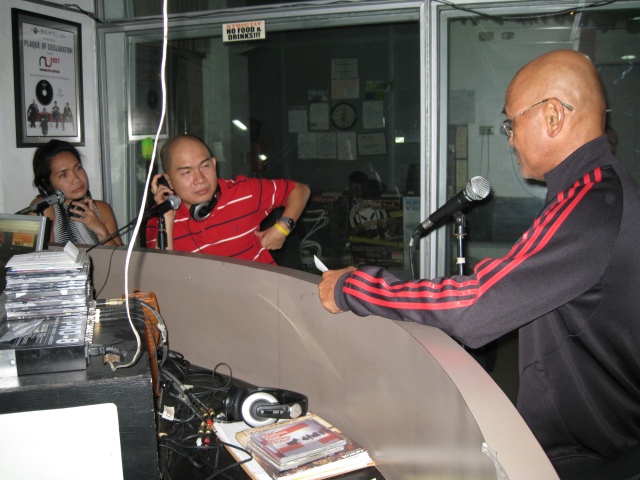
BR, Jay & Bards During the Program
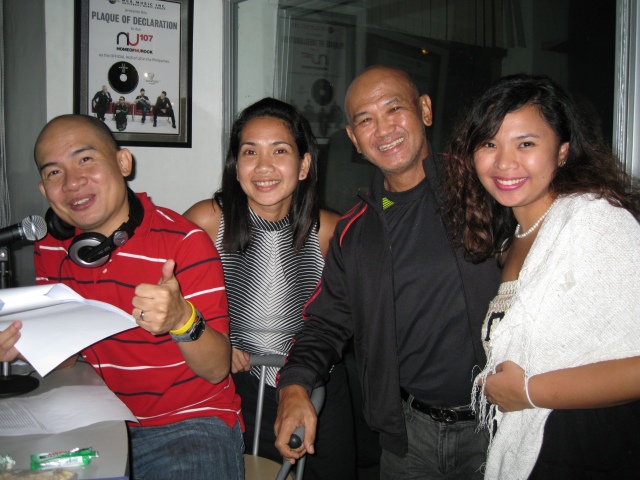
Run Radio & QCIM Guest (Ron)
These Guys (Jay, Bards, & Marga) Are Great!!!

33rd MILO Finals Pictures & Results


Thanks to Ben Chan of Photovendo for the following pictures:

Up to Km 30 Point
Up to Km 30 Point
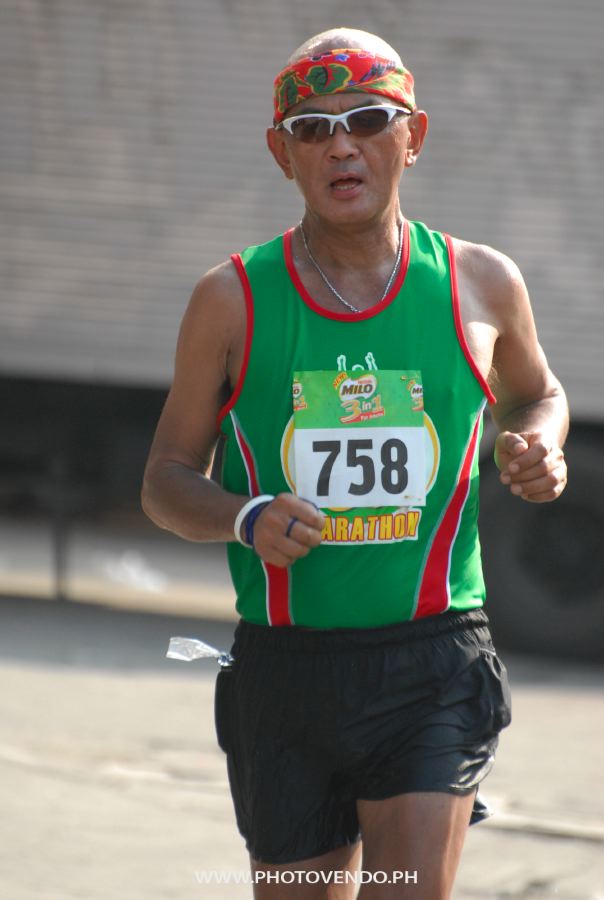
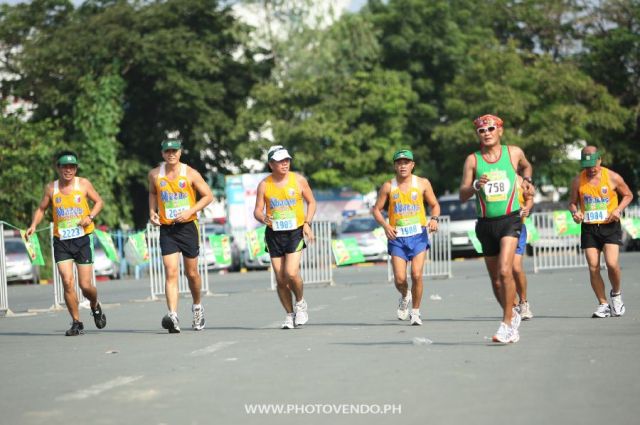
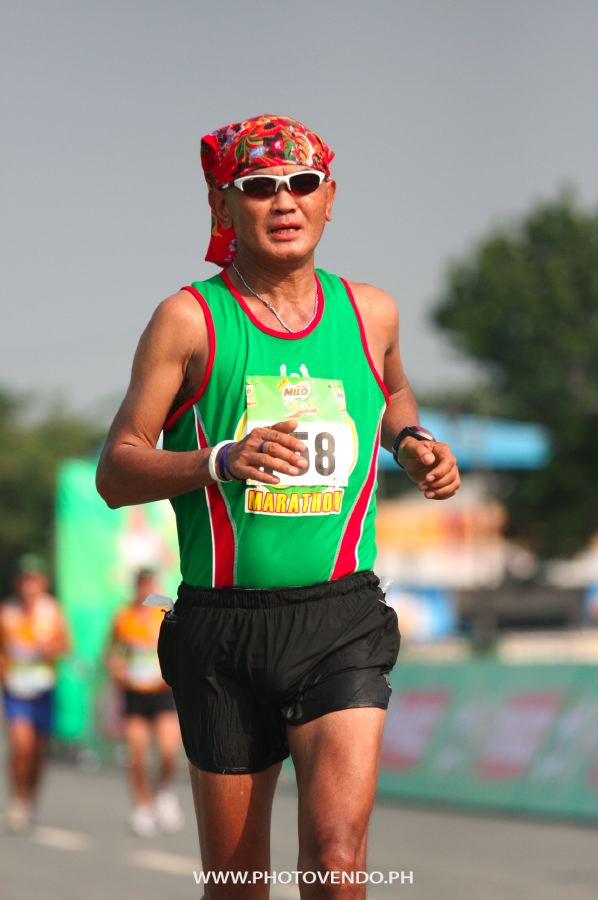
Instead of my usual bandana, I was using a “Buff” bandana on my head to absorb my sweat from my head and keep my eyes & face from the dripping sweat. As I passed the Water Stations, I usually grab two cups of water—one cup for drinking and another cup for dousing water on my head. The wet/damp “Buff” bandana also served as my head “coolant” most especially when the sun’s heat brought higher temperature during the race.
The race bib’s size was too big that I had to fold it on both ends to make it better looking with the MILO singlet. I had been consistently pinning my race bib on my breast and never been using some “race belts” and either pinning my race bib on my running shorts. Why? That’s is the proper way I know that even world elite athletes in international competitions would do to display their race numbers.
The MILO singlet was nice and I did not experience any “chafing” on my arms, nipples, or any part of my upper torso. You must have noticed the “ice candy” plastic bag filled with water on the side pocket of my running shorts! These are my “hydration containers” in marathon races! Yes, my running shorts from The North Face is now my favorite running shorts for the marathon distance because it has side and back pockets. One side pocket can accommodate two pieces of Sports Gel packets. I usually carry 4 Sports Gel packets during marathon races and this running shorts fits well with my needs. As for the back pockets, I used them as my “thrash bag”. Each side pocket could also accommodate at least two “ice candy” bags filled with water. I started using this TNF running shorts during the 2009 Los Angeles Marathon and I used it again during the MILO Marathon Eliminations.
On My Last Turn Before The Finish Line
I was using ASICS-Gel Hyper Speed 3 Racing Flat shoes with Drymax Socks and I found comfort and blister-free with the shoes and socks!
Last 20 Meters To The Finish Line
On my last 8K as the sun’s heat was too much to bear, I adjusted the way I wore the “Buff” bandana in order to cover my head and at the same time my nape. I usually tie around my wrist the blue-colored string given in one of the turn-around points instead of wearing it as a necklace! Lastly, the “ONE” White Wrist Band is always there on my right wrist as my “symbol” for my part or  contribution in the worldwide advocacy to “make poverty a history”.

Thanks to the Finish Line of Coach Rio De La Cruz & Vince Mendoza for the Timing Chip & for the fast publication of  the following RunPix Results:

Gun Time: 4:03:55 hours

Net Time:  4:03:43 hours

Finisher #92 out of 125 Finishers. I wonder what happened to the other 112 runner-qualifiers for the Final Race! They must have DNFed!

Finisher #82 out of 112 Finishers in the Male Category.

Average Pace: 5:47 minutes per kilometer or 9:18 minutes per mile.

Time of Finish & Average Pace:

From 0K to 9.8K—-57:32 minutes @ 5:52 minutes per kilometer

From 9.8K to 25K—-1:30:08 hours @ 5:56 minutes per kilometer

From 25K to 35K—-54:51 minutes @ 5:29 minutes per kilometer

From 35K to Finish—41:12 minutes @ 5:44 minutes per kilometer

So far, so good, this was my 4th Marathon Race for the year. Not bad for a 57-year old Bald Runner!

See you on the next Marathon Race!!!

“I need the money…I need to buy vitamins”


“Yes, I’m a candidate for ejection from the Philippine team,” said the four-time champion Martes, the youngest Milo winner at 21 years old in 1999. “I’ll just talk to them and explain. I need the money. I’m having laser therapy for my old injuries and I need to buy vitamins.” (Note: Copied from news report at www.inquirer.net)

These were the exact words from the mouth of Christabel Martes, Lady Champion of the 33rd MILO Marathon FINALS held last Sunday, for her reason why she ran and finished the race despite an strict memorandum from PATAFA (Philippine Amateur Track & Field Assosiation) that National Pool Athletes are restricted from running more than a distance of 10K competitive Road Races at least 3 months before an International Games/Competition Meet. The reason for this memo is to make sure that our National Athletes do not divert themselves to their training program in order for them to “peak” during the competition period/date and at the same time, prevent them from becoming injured.

In the reaction of the PATAFA officials, as published in the news, Martes will be definitely removed from the list of National Athletes slated to be included in this coming Southeast Asian Games which will be held on the first week of December 2009 in Laos. For winning a cash prize of Seventy-Five Thousand Pesos (P 75,000)  or equivalent to $ 1,595.00 in the MILO Marathon FINALS, her chance of winning the Gold Medal in Marathon in the ASEAN Games is gone!

 Money versus Pride For the Country? Present Reality of our Athletes versus Present Situation of our Sports Excellence Program?

Now, let us try to discuss the present condition of our National Athletes basing from the title of this post/comments from Christabel Martes.

It appears that our National Athletes are not properly or adequately supported by our Sports Federation or the Philippine Sports Commission (PSC). As per PSC’s guidance, for an Athlete who won Medal/s (Gold, Silver, or Bronze) in the previous ASEAN Games and other International Competition Events and presently training to compete in an International Games, he/she receives a monthly support of   Fifteen Thousand Pesos (P 15,000)  or $ 320.00 inclusive of food, vitamins, training needs, and stipend. While on training, with the guidance of their coach, they are left on their own and stay/live in Sports Facilities being managed by PSC. It is also concluded that the athletes had to deal with their own injuries and have to get the services of professionals to cure them for a considerable fee. Which means that our Sports Support Services (Sports Medicine, Nutrition, Sports Psychology, etc) are lacking! In short, 15K Pesos is nothing if we want our athletes to be “world-class”. The same amount of money is equivalent to a ONE-DAY MEAL for Michael Phelps, I guess!

For a potential medal placer and a “newbie” in the National Pool of Athletes, he/she receives a monthly stipend of Six Thousand Pesos (P 6,000) or $ 128.00. This is translated to P 200.00 per day meal for the athlete and he/she could not even buy vitamins and sports drinks for his hydration & electrolyte resplenishment needs during his training. And if he/she wants to compete in weekend road races, he/she is selective as to where he/she will compete because the registration fee will be deducted from this amount of money. But our athletes are “brave warriors” because they have to risk in investing their training money to weekend road races that have Cash as Major Prizes for the Top Finishers! If they loss and don’t get any cash prize, the more that they will train harder but their training money is now draining and they are forced to spend their money to their barest needs. In essence, our athletes are on “survival” mode!

This situation is not only applicable to our runners but to all our athletes in other sports!

Now, you know already why our runners in our National Pool of Athletes are only good for our local Road Races with Cash Prizes, not for the ASEAN Games, not for the ASIAN Games, and never for the OLYMPIC Games!

33rd MILO Marathon Finals: “We Are All Warriors”!


4:29 AM 11 October 2009 @ Luneta Park

In last year’s MILO Marathon Finals, I was able to peak for my marathon training and I was able to register a finish time of 3:48:32 hours. I was not able to join the Marathon elimination run last year but I was able to make some arrangements with the Race Director for me to join the Finals, hence, I was able to participate in the said race.

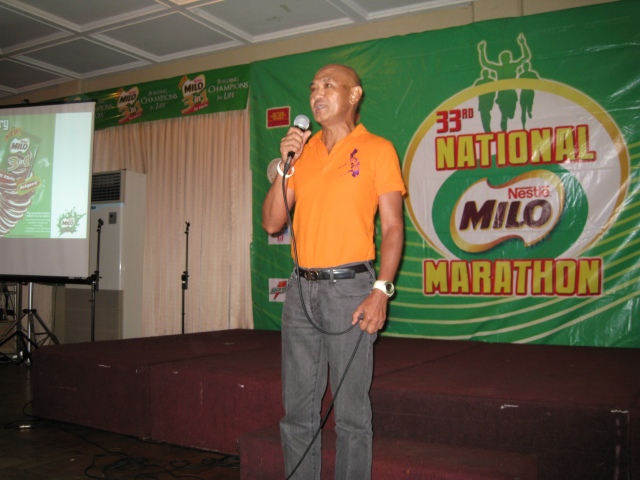
This year, I was able to participate in the MILO Marathon Eliminations but I was not able to qualify because I finished the race in 4:20:45 hours. This was due to the fact that I participated in the 2009 Los Angeles Marathon five weeks in between two marathon races. However, with the popularity of this running blog, I was able to make some arrangements (again!) to run the FINALS as a “guest runner”. But I have to “pay back” for such request as I was requested by the Race Organizer, my friend, Mr Rudy Biscocho to deliver an inspirational message to the Finalists of the Marathon Race during its Carbo-loading Party last Thursday evening at North Greenhills Clubhouse.  The gist of my Inspirational Message speaks well of the title of this post.

Inspirational Talk @ MILO Carbo-Loading Party

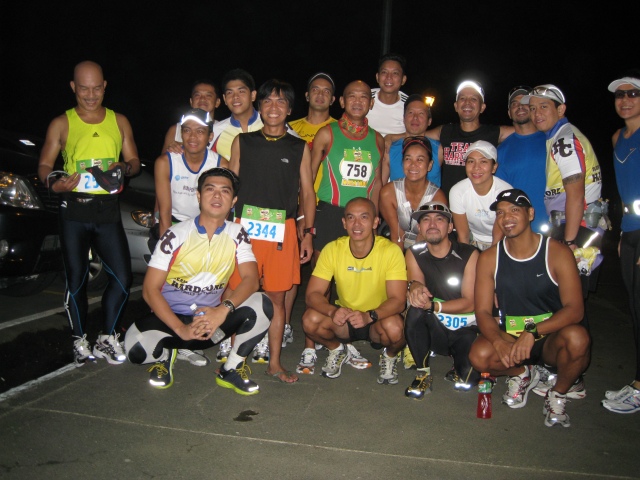
I arrived at the Luneta Park at 4:00 AM and I immediately set my GF 305 and made a slow jog in order to warm-up. After a few minutes, I joined the members Team Hardcore and Finishers of 1st BDM 102. We had “photo-ops” and brief chat with one another. From there, we proceeded to the Starting Line. At the Starting Line, I was able to meet the other runners and Executives of NESTLE/MILO who are joining the 42K Race.

Group Picture With Team Hardcore & 1st BDM 102 Finishers

At exactly 4:29 AM, the starting gun went off and I placed myself at the back of the runners. I planned to run with an easy even pace for the whole race and I was hoping to have an extra strength at the last 10 kilometers to have a finish time of less than 4 hours.

After running through this course for so many times, I was already confident to finish the race right from the very start and did not mind about the terrain of the route. The thing that kept me worried was at what point or distance where I will encounter my first “muscle cramps”? Three weeks before this race, I did a 40K long steady run as part of my preparation for this race and I never had any cramps during this workout. As compared during the last Elimination Race, I had my muscle cramps at Km #16 and it affected my finish time.

@ Bayani Road
@ Bayani Road

I finished the 1st 10K in 56:15 minutes and I was confident that I could meet my objective for this race. After running 20K, I was still within my planned finish time but I started to slow down while I was on my way back to the Finish Line. The heat of the sun and the humidity made me slower but I was able to maintain a sub-6-minute per kilometer pace on the last 10K. It was only at Km # 36 that I checked on my GF 305 and my time registered at 3:22+ hours. I started to panick and tried to increase my pace. At this point, I knew I could make it but every time I increased my pace, my legs would act otherwise and they became heavier. I did not feel any cramps but I could not simply lift my knees higher and drive my arms faster.

@Lawton Avenue-Essensa Area ( See the Background!)
@ Roxas Boulevard/2K to the Finish Line

Along the last 3K before the Finish Line, I was distracted by a number of cyclists who were going on counter-flow right where the exact direction of my run. I could not understand why these cyclists would meet head-on with the runners while the road is too wide for them on my right side. I had to shout at these cyclists and told them to clear the path for the runners. I even dared one of them to collide with me! But, on the last few feet, they had to avoid me. It was a better option for them to avoid me rather than the cyclist falling to the ground.

@The Luneta Near The Finish Line

Except for this negative observation/experience during the race, the MILO Marathon Finals have improved a lot. At last, I was able to see long tables filled with lots of water cups up to the last water station before the Finish Line. There were lots of route marshals and Traffic Enforcers of each City were properly briefed on what they have to do in order to give way for the runners and at the same time decongest the traffic brought about by the Marathon Race. The presence of Reinier Pacific & Takbo.ph Volunteers and Aid Station at Gil Puyat Avenue (Buendia) was very helpful to all the runners which offered chopped fresh fruits (apples & oranges) and efficascent oil spray for the muscles. My sincerest thanks to Mr Amado Castro, Jr for having the initiative to bring to the country what he had observed and experienced when he “racewalked” the 2009 Los Angeles Marathon last May. How I wish that those “more influential” runners who have experienced running Marathon Races in other countries would also take the initiative to offer support to runners in Marathon Races. “Mayayabang kayong sabihin sa mga “media releases” ninyo na natapos ninyong tumakbo ng Marathon Races sa Europe at America, pero wala naman kayong ginagawa para tulungan kaming mga mahihirap na mananakbo para pagandahin natin ang Marathon Races dito sa Pilipinas”.

Not only the presence of abundant water stations, MILO’s Race Organizer made good in making it standard to have “Gatorade Stations” along the route which were located in between the Water Stations. I also appreciate the presence of a Fruit Stand/Station at the corner of Lawton Avenue and Bayani Road.

Gone are those Maynilad Water Lorry Trucks that we always see parked beside the Water Stations! Instead, I was able to see lots of Nestle Bottled Water containers and I assumed that we were drinking bottled water during the race as briefed by the Executives of MILO during the Carbo-Loading Party. This was a nice improvement!

So far, the most commendable innovation in this edition of MILO Marathon Finals is the RFID Timing Chip! I was happy to see the “sad faces” of identified consistent cheaters of this marathon race as I met them near the turn-around points along the route. However, I got an information that one of the top 15 finishers in the 42K race was “caught” cheating (by making the race as a relay run of two runners).

IMG_2714

I finished the race in 4:03:54 hours (based from my GF 305), a few minutes from my target finish time of sub-4 hours! I did not encounter any muscle cramps during the run and I was fully satisfied with my performance. My average pace was 5:44 minutes per kilometer with an average HR of 152 bpm. However, I don’t complain this time that my GF 305 registered a distance of 42.46 kilometers.

Congratulations to Mr Rudy Biscocho, to the NESTLE, Philippines and to the Volunteers for a “world-class” marathon race in the country. MILO Marathon Race proved it once again that it is the most prestigious and well-represented marathon race in the country today. I just hope that NESTLE/MILO would bring back those times when the Champion/s of the Marathon Finals were sent to Marathon Races in key cities in the United States/Europe. Who knows another Manny Pacquiao or Efren “Bata” Reyes would emerge as Marathon Champion in one of these International Marathon Races. This is a dream but it could be done!

See you at the Starting Line in the next Marathon Race for this month of October!