180 Formula


Click on the link below on the article by Dr Phil Maffetone on his Maximum Aerobic Function (MAF) which is a detailed explanation on his training philosophy following one’s Heart Rate and the use of a Heart Rate Monitor.

Want_Speed_Slow_Down_2007

Lately, one of my “friends” from Facebook who had been a triathlete for 17 years had called my attention when he read one of my posts that I am presently training using the Heart Rate Monitor. After his retirement from triathlon, he is pursuing his first ultra marathon run this coming December as he thinks that ultra running is “deeper” and more challenging than his past triathlon feats. I am sure this guy is a “purist” IRONMAN and one of the bests in the 90s or in his younger years. He even predicted that if I continued my plans to get into triathlon in the mid-80s, I could be a sure podium winner in my age category. (Note: I could be fighting it out with my brother Retired General Samuel and Retired Colonel Brigilio Balaba of the Philippine Constabulary for the top honors for our age group).

In one of his e-mails, he shared to me the following updated version of the MAF’s 180 Formula.

Here is the formula:

1. Take 180

2. Subtract your age

3. Take this number and correct it by the following:

-If you do not workout, subtract another 5 beats.

-If you workout only 1-2 days a week, only subtract 2 or 3 beats.

-If you workout 3-4 times a week keep the number where it is.

-If you workout 5-6 times a week keep the number where it is.

-If you workout 7 or more times a week and have done so for over a year, add 5 beats to the number.

-If you are over about 55 years old or younger than about 25 years old, add another 5 beats to whatever number you now have.

-If you are about 60 years old or older OR if you are about 20 years old or younger, add an additional 5 beats to the corrected number you now  have.

You now have your maximum aerobic heart rate, which again is the maximum heart rate that you can workout at and still burn  mostly fat for fuel. Now go out and do ALL of your cardiovascular  training at or below this heart rate and see how your pace improves.  After just a few weeks you should start to see a dramatic improvement in the speed you can go at these lower heart rates.

The details of his e-mail is properly explained in the link below:

http://www.markallenonline.com/maoArticles.aspx?AID=2

Based from the updated version, my Maximum Aerobic Function’s Heart Rate is supposed to be 126 beats per minute (180-59 = 121 + 5 for being above 55 years old). However, since I’ve started with my first MAF Test with a Maximum Aerobic Heart Rate of 121 beats per minute, I will maintain 121 bpm as my training’s MAF heart rate.

Good luck to my ultra running “friends” and BDM “veterans” who will be competing on this weekend’s CAMSUR Cobra Ironman 70.3 Triathlon Competition. Take it “easy” on the swimming event. Make sure to get a “spot” for the KONA IRONMAN this coming October in Hawaii, USA!!! Have fun and be the best to yourself!

For those who have started to train for the 1st Taklang Damulag 100-Mile Endurance Run and for the yearly BDM Races, I highly recommend you to try the Maffetone’s Training on the use of Heart Rate Monitor/MAF Test.

“Two-Week Test”


The “Two-Week Test” is one of the salient parts of Dr Phil Maffetone’s training for endurance athletes. It is something to do with one’s ability to balance the presence of carbohydrates in the body with the other nutrients like protein and fats.

According to Dr Maffetone, there are signs and symptoms that you have more carbohydrates stored in the body when you are overweight, easily exhausted in simple exercises, and sleepy after every meal. There are more signs and symptoms stated in his books and articles but these are the things that I tried to experiment and be able to improve as my reasons in trying this “test”.

This is not a diet program but a simple test that will last for two weeks. This is a test of discipline, patience, focus and determination. All you have to do is to refrain from taking any drinks and food with SUGAR for 14 days. This is to include fresh fruits and some vegetables. Of course, coffee with sugar & cream is a no-no! Not even alcoholic drinks,beer, sodas, and Gatorade/Energy Drinks. It also means not eating rice during your meal. Forget your “hot pandesal”, pancakes, doughnuts, bagels, chips, cookies, oatmeal, ice cream, chocolates and cakes!

It is a challenge but it is worth trying if you want to improve on your training and endurance races.

As a start, you have to record your weight before you start this test and come up with a journal or daily diary. You have to record also what you observe to your body for signs of too much carbohydrate in the body like: easily exhausted in simple exercises; high rate of heart pulse/hear beat; easily irritated; moody; feeling too-stressed all the time; feeling sleepy after meal; and lack of focus.

As soon as you start with the test, put in your journal the things that you observe in your body; your daily weight; morning pulse rate; and the food/s you ingested. Be sure to maintain your journal on a daily basis. Just remember NOT to eat any kind of carbohydrate foods! If you feel hungry, just eat anything that is rich in protein and healthy fats!

During my test, I ate lots of eggs, omelettes, fish, meat (pork & beef), and other seafood. I could hardly count the number of egg trays that I consumed during the duration of the test. In one of the birthday parties I was invited, I finished more than one-half order of “Crispy Pata” and one order of Squid Platter Steak and broiled Tilapia without any rice! On ordinary days, I ate lots of pork barbecue, fried chicken, native chicken tinola, pork adobo, longganiza, fish (Salmon, Tilapia, Bangus and Lapu-Lapu), shrimps & prawns (from Pangasinan)  and our ever famous, “Laoag Bagnet”.

I just finished my “Two-Week Test” last Sunday. And here are the results:

  1. I was able to reduce my weight by 12 pounds. I was 150 pounds when I started the test and last Sunday’s weighing on the scale resulted to 138 pounds!  Since Dr Maffetone advises its athlete to take the “two-week test” during the aerobic phase when observing his MAF (Maximum Aerobic Function) by following his 180 Formula of HR Monitor, the body tends to use its fats during workouts. So, in my experience, I was able to burn some of my body fats while doing my HR Monitor workouts. Thus, I was able to reduce my weight within a limited number of days!
  2.  I did not feel any exhaustion, soreness, and pain during and the days after the last MILO Marathon Elimination. I did not even experience any muscle cramps even if my longest run before the MILO Marathon was only 16 kilometers. Although I ran only 32 kilometers in the MILO Marathon by following the MAF Heart Rate of 132 beats per minute, it was surprising that I was able to run the distance without taking any solid food before and during the run. Moreso, I did not have any “carbo-loading” to speak of, days before the run.
  3. Before I started following Dr Maffetone’s training, my tendency is to be sleepy after my breakfast in the morning, with or without any runs before breakfast. What is worse is that I always go for a nap after my lunch almost every day. As a result of the “two-week test”, I am now fully awake and don’t feel sleepy at all after breakfast and lunch.

If you think this is a “big” challenge to undertake, I think it’s not. If you have some signs and symptoms like I had before I did this
test, then it is worth trying it. However, if you want to have better results on your training and in your endurance races, I think this is best “test” that I can recommend to everybody!

Good luck! Think DISCIPLINE!!!

Result: 1st BR’s Barefoot 3.2K (2-Mile) Run


1st Bald Runner’s Barefoot 3.2K (2-Mile) Run

Philippine Army Grandstand & Parade Ground

4:30 PM August 6, 2011

RANK NAME TIME
1 Jonathan Ronquillo 13:00
2 Eric Talagtag 13:32
3 Jun Javier 13:33
4 Randy Rubio 13:35
5 Joven Gementiza 13:57
6 Ryan Moral 14:18
7 Tomas Soliven 14:25
8 Frederick Quitiquit 14:27
9 Graciano Santos 14:36
10 Elmar Tolete 14:44
11 Raffy Cabotero 15:09
12 Ranel Espinosa 15:17
13 Timothy Taburico 15:19
14 Erwin Ordonez 15:41
15 Ronaldo Salupas 15:48
16 John Fabreag 16:20
17 Rodel Montejo 16:35
18 Roberto Delos Santos 16:48
19 Jeje Ajusto 16:56
20 Ronnel Go 17:01
21 Jayson Bustamante 17:05
22 Michael Santos 17:10
23 Mike Logico 17:12
24 Jojo Pauly 17:15
25 Pancho Samonte, Jr. 17:30
26 Felix Cordero 17:31
27 Russel Ranay 17:57
28 Emmanuel Del Valle 18:17
29 Mark Alano 18:24
30 Aileen Mamat (F) 18:55
31 Pam Basilio (F) 18:58
32 Harold Lorete 19:13
33 Maxel Flores 19:23
34 Daves Espiya 19:26
35 Jun Oro 19:27
36 Mark Gallardo 19:44
37 William Jalimao 19:54
38 Paul Pajo 19:55
39 Dave Drilon 19:59
40 JP De La Paz 20:19
41 Aquiz Minlay 20:24
42 James Rafalle 20:26
43 Dennis Quepe 20:29
44 Marc Philip Ellazo 20:42
45 Gerald Austria 20:44
46 Jonathan Nava 21:20
47 Nancy Brazil (F) 21:27
48 Carlo Araa 21:29
49 Genesis Senorin (F) 21:31
50 Tina Deray (F) 21:32
51 Glo Labao (F) 21:33
52 Teresa Nabutas (F) 21:44
53 Celso De Leon 21:45
54 Wesley Orana 21:47
55 Jimmy Ong 21:49
56 Adrian Cardenas 21:53
57 Roselle Dadal (F) 21:57
58 Lavern Macuja (F) 21:59
59 Roberto Labaniego 22:02
60 Millette Rances (F) 22:29
61 Michelle Garcia (F) 22:33
62 Lester Abrenica 22:35
63 Rexie June Saldivar (F) 22:40
64 Melanie Racoma (F) 23:00
65 Joey Divino 23:31
66 Francis Chua 23:37
67 Annie Ranay (F) 23:48
68 Lolit Barbin (F) 23:53
69 Dianne Alano (F) 23:54
70 Faye Ortega (F) 23:55
71 Irhys Piacos (F) 23:56
72 Aileen Piacos (F) 12:04
73 Pamela Mangampo (F) 24:11
74 Lea Aspili (F) 24:14.22
75 Ma. Vanessa Flores (F) 24:14.76
76 Violeta Flores (F) 24:46
77 Lina Odo (F) 24:52
78 Mackis Primalte (F) 26:20
79 Gary Chua 26:27
80 Beth Rosal (F) 26:31
81 Francis Coles 26:32
82 Michael Galas 27:41
83 Jeans Cequina (F) 28:18
84 Jet Paiso 28:28
85 Christopher Montaos 28:45
86 Malou Ajusto (F) 31:27
87 Odie Cacho (F) 31:31
88 Roden Cardeno 31:45

Maffetone’s Training


If you ask any of the local triathletes if they know such “Maffetone’s Training” and if they tell you, NO, it’s either they are ignorant or they don’t want to share their training “secret” to you. If an average or competitive triathlete does not know about this kind of training, I guess, he/she is not training properly to develop what the training calls, “aerobic speed”! In the truer sense of the word, the “holistic approach in endurance training and racing”

I bought the Kindle version of the Dr. Phil Maffetone’s “The Big Book On Endurance Training and Racing” two months ago and started to follow his Training by adhering to the 180 Formula as my Maximum Aerobic Function by monitoring my Heart Rate. With a purchase of the simplest and most basic HR Monitor watch, I started to follow such training for the past weeks. 180 Formula would simply mean subtracting your age to 180 as your maximum aerobic heart rate during your aerobic phase workouts.

On my first week of the training, I could hardly bring down my HR to 121 beats per minute while on a slow jog. I started with 142 beats per minute on the first days of my 1st week and then gradually bringing it down to 138 bpm. Later, I could easily jog at an HR rate of 135 bpm. During the Takbo Runfest 16K and MILO Marathon Eliminations, I was able to bring my average HR to 130-132 beats per minute. This is the very reason why I am always on the tail end in the past road races. Actually, I was trying to “cheat” on the 180 Formula as my desired training HR could had been 121 beats per minute which translated to a brisk walking activity.

But on my 1st MAF Test on an oval track lately, I was able to constantly follow the desired Maximum Heart Rate of 121 beats per minute throughout the workout. And the results follow what the Maffetone Training intends to advocate. We will see what will be the result on my 2nd MAF Test after 3-4 weeks.

It is also surprising to most of the runners (in these past road races) that they observed me to be using some “wires”. Yes, I renewed my love to music during my workouts and road races by sporting an Ipod Shuffle which is light and easy to clip! Maffetone’s training includes music and some form of cadence and beats through selected kinds of music as part of one’s playlist.

What are the initial observations and benefits I got from this kind of training? First of all, I can have a workout that lasts for hours and hours without any pain or sorenes. After running for almost 5 hours at the MILO, I could walk straight and without any limp after the race, moreso, on the following day there were no pains on my legs. On the nutrition side, by following a “no carbo”diet one week before the MILO run, I did not feel hungry during the duration of the run and maintained my constant hydration through water and my Gatorade G2 mix. I did not mind getting and eating those ripe bananas in the Aid Stations. The best result? I did not have any kind of muscle cramps on any part of my legs and body! I was amazed and surprised about such result. No “bonking” and no “wall” to speak of even if my past training long runs would last for only 2 1/2 hours with an average HR of 130-132 beats per minute!

Last week, I discovered that Dr Phil Maffetone has a website which is very informative and updated as compared to the book I purchased. I am going to share his website to my readers with the hope that they will be able to follow the training and its philosophy with patience and positive attitude.

The following is the website: http://philmaffetone.com. For those who are joining the 1st BR Barefoot Run, it would be an interesting one for them to read his article “GAIT–Why Every Runner Is Different, and How You can Go Faster……, and other related running articles.

To my ultra running friends, I suggest you take a look at this training and try it. Patience and Positive attitude play a great role if you want to adhere to this kind of training philosophy.

Enjoy and have fun reading the articles and essays of Dr Phil Maffetone. Happy weekend!

The Effects Of Running Shoes


I came across this article while I was browsing the Internet when I was in the US. I am reposting this article for the benefit of my regular readers with the hope that other runners would be able to read it, too! It is very long but very informative.

As I said in my previous post, I am not endorsing minimalist or barefoot running. I am not a barefoot runner but I do such workout as part of my strengthening and recovery program. This article is a good read for everybody.

As you can see, this article had been written and published in August 22, 2006, almost 5 years old and earlier published than the book, “Born To Run” by Christopher McDougall.

Happy reading!

August 22, 2006

ATHLETIC FOOTWEAR AND RUNNING INJURIES

Essay on the harmful effects of modern running shoes.

      (  Written a number of years ago, this piece was published in part in the German ultra magazine Spiridon.)
PART 1 – INTRODUCTION   AND  HISTORY

Look, if anyone displayed brand-loyalty, it was me.  I LOVED my NIKE  AIR MAX  Triax™ runners.  I wouldn’t buy anything else.  Why?  Because they felt good.  I liked the cushioning.  I liked the ride.  I also felt they protected me from the hard road by interposing a layer of air between the sole of my foot and the pavement.   So why was I sidelined with a heel injury for over two months?  I listened to the manufacturer and changed my runners every 400 miles.  Come to think of it, why do I see so many runners with lower extremity injuries in my office?  The traditional answer to these questions has always been overuse often compounded by an underlying mechanical abnormality such as over-pronation or flat-feet.

The treatment, along with modification of training, physiotherapy, stretching etc. has always included a close look at the runner’s footwear, often with recommendations about motion control, stability, cushioning, orthotics or custom molded insoles.  A growing body of literature in the field of sports medicine, however, is causing a bit of a stir…no, call it PANIC in the running world.  Everything you and I always believed about running shoes and running injuries may be wrong!    Here’s the scoop:  The modern running shoe itself may be the major cause of running injuries!  Stated another way, the modern running shoe, presently thought of a protective device, should be reclassified as a “health hazard”.  (NIKE, please tell me it ain’t so!!!)

Now relax, get back on your chair and take a deep breath.   We’ll take this one step at a time and since we’re going to be talking about shoes and feet, I may as well start at the beginning…the very beginning.  Until quite recently in our history, most humans lived out their lives unshod.  S.F.Stewart in his “Footgear – It’s History, Uses and Abuses” states that “…all writers who have reported their observations of barefoot peoples agree that the untrammeled feet of natural men are free from the disabilities commonly noted among shod people – hallux valgus, bunions, hammer toe and painful feet.”  So why was footgear developed?  One of the earliest examples of footgear known to us takes the form of sagebrush bark sandals found in caves and rock shelters near Fort Rock, Oregon under a layer of volcanic ash dating back 10,000 years.  The foot surface is smooth and they were held on by bast straps over the instep.  Similar sandals were used throughout the volcanic cordilleras of Meso and South America and the volcanic islands of the South Pacific.  The early Polynesians used sandals to cross old lava flows and when fishing on the razor-sharp coral.  It seems, therefore, that the prime function of the earliest sandals was protection of the sole.

Although the early Pharaohs are all represented as barefoot, by the first millennium BC sandals in Egypt were common in court and were worn by soldiers.   In Mesopotamian kingdoms sandals were evidently a status symbol with the king known to have worn a wedged sandal in contrast to his flat-soled courtiers.  Very thick-soled low boots are known to have been worn by Greek tragedians to increase their height.  Comedians wore socks or soccus – hence the expression “high tragedy and low comedy”.  Thus, the secondary function of footgear appears to have been symbolic.

From the time of the Greeks, footgear gradually evolved to meet both symbolic and functional needs.  For example, tradition tells us that about the beginning of the present millennium Count Fulk of Anjou introduced long pointed toes to cover up some deformity of his feet, and courtiers quickly adopted the fashion.  The Mongols, who on horseback ravaged the Middle East between Damascus and Moscow from the 12th-14th centuries, are credited for the introduction of the block heel presumably developed to better grip the stirrup plate.  But in the French court of Louis XIV, the rugged Mongolian heel underwent a radical cosmetic transformation eventually leading to the ultimate idiotic expression of modern fashion – the stiletto heel.

European peasants wore clogs carved from a block of wood.  Mass production seems to have begun prior to the 14th century, for Edward II in 1342 decreed that shoes should be sized.  Their length was measured in barleycorns, 3 to an inch.  This is still the basis of shoe measurements, 1/3 inch to a size in length.  We start sizing from a baseline of 3″ in children and 7″ in adults.  Widths vary with length; in a given size the widths vary by 1 1/2 inch.  Unpaired shoes were introduced in England in the 15th century when gout became common and these shoes had broad square toes to relieve pressure.  The most recent innovation seems to have been the hard box toe to preserve the appearance of the shoe.

Now, let’s focus-in on the running shoe.  It seems that the earliest sports shoes were developed in the 1830’s by the Liverpool rubber company owned by John Boyd Dunlop.  Although they were first called sand shoes because they were worn on the beach by the Victorian middle classes, they eventually became known as plimsolls because the lines formed by the rubber and canvas bond looked similar to the Plimsoll line on a ship’s hull.  In 1933, Dunlop launched its Green Flash range of trainers.   Adi Dassler (and his brother Rudolf) started making sports shoes in Herzogenaurach, Germany in 1920 and in 1936 Jesse Owens wore a pair of them when he won four Olympic gold medals in Berlin.  ADIDAS (Adi Dassler) was formed in 1948 with the now famous three stripes logo developing from three support leather bands used to bolster the sides.  By the 1956 Olympics, dozens of competitors were wearing ADIDAS shoes.  Rudolf Dassler broke away to form PUMA.  Amidst the first rumblings of the jogging-boom, NIKE (after the Greek goddess of victory) was launched by American Phil Knight, a former track star at the University of Oregon, and his waffle-making coach Bill Bowerman in 1971(Surely you remember the NIKE Waffle Trainer!).  The NIKE  ‘Swoosh’ is arguably the most successful logo in the world and was conceived for Phil Knight by a local Oregon graphic design student, Carolyn Davidson, for a total fee of $35.  (But don’t worry about the graphic designer.  In September 1983, NIKE presented Carolyn Davidson with a rather substantial share package as a way of saying “Thank-you.”)  ASICS (acronym for Animus Sanus In Corpore Sano, Latin for A Sound Mind In A Sound Body) first introduced its shoes in North America in 1977 while REEBOCK (named after a species of an African gazelle) entered the US Market in 1979 as the running shoe was slowly transforming into a fashion item.  1987 was declared the Year of the Running Shoe by the clothing industry, the same year NIKE launched the ‘cross-trainer’ and it’s flagship running-shoe, the Air Max. After 16 years of research, NIKE introduced its SHOX line of runners in 2000, arguably the first athletic shoe on springs (foam)!

PART 2 – SHOES AND INJURIES

For the last fifteen years or so, buying a pair of runners has always been accompanied by a warm fuzzy feeling inside, a feeling that comes from the certain knowledge that you’re investing in a high-tech device purpose-designed to protect you from injury and improve your performance.  You can just see all those smart dedicated NIKE mechanical engineers hard at work developing and testing newer and better space-age materials to shield you from the terrible pounding you submit yourself to in order to “Just do it!’  Gel, air, channels, honeycomb, microspheres, super-light materials, foam springs and soon…yes, you guessed it, micro-chips in the soles of your shoes (better than diamonds, I suppose).   New round laces and ribbon eyelets result in that custom-fitted feel supplemented by molded sorbothane insoles or special orthotics from your local prosthetist and you’re ready to tackle any distance.

Now here’s the catch.  If all this high-tech stuff is supposed to be preventing running injuries by shielding us from impact, why is it that two out of every three runners are sidelined every year because of a running injury?  Why is it that since the great jogging boom of the mid-seventies, there has been no decrease in the incidence (some authors say there has been an increase) of running injures in spite of yearly ‘improvements’ in running-shoe technology?  Why is my office filled with runners who have injured knees (26% of running injuries), tibias (13%), Achilles tendons (6%) and plantar fascias (5%)?  The cause of all these injuries is quite evident: cumulative micro-trauma caused by repetitive impact experienced during running.  The heel of a runner upon striking the ground generates a force that can equal 2.5 times body weight at the foot and as much as 7 times body weight at the hip.  Repeat this 1000 times per mile and it’s easy to appreciate the stress the old bones are under.  Add to this the hardness of urban roadways compared to naturally deposited surfaces and eventually, something gives, inflammation sets in and pain results…and you end up working at the finish-line pulling bar-codes off finishers.  Now, where’s our high-tech shoe in all this?  With all the improvements in recent years, you’d think we’d be seeing a marked decrease in running injuries.  Just keep reading.

It wasn’t till the mid-eighties that some researchers smelled something rotten in the athletic footwear world and it wasn’t just dirty socks.  Footwear manufacturers were well aware that impact was the cause of running injuries and reasoned that the way to attenuate impact was to interpose a soft impact-absorbing midsole between the foot and the ground.  The first major problem was the method used by essentially all the footwear development labs to test the impact absorption of footwear mid-soles.  Dr. Benno Nigg from the University of Calgary showed that machine testing of these materials by dropping a 5-kg object onto the shoe-sole and measuring the impact on a pressure-plate did not accurately predict human impact with the same materials.  In fact the correlation turned out to be inverse, that is when you drop a 5-kg ball on materials of increasing softness, you measure decreasing impact.  However, when the impact from a running human is measured, the result is the reverse, and the impact increases with softer materials! WHOOPS! (You’ll find out why later.)

Next problem.  In 1989, Dr. B. Marti published a paper which still makes the throats of footwear executives go dry.  He studied 5,038 runners who participated in a 16km race and had them fill out an extensive questionnaire about their running in the year preceding the race.  Here’s what he found: The incidence of injuries in runners using shoes costing more than $95 was more that twice as great as in runners using shoes costing less than $40. (Note that this result includes correction for other influencing factors such as training mileage and history of previous injury.)  In other words, the fancier (high-tech, advanced) the shoe, the more dangerous it is!  Now a study of over 5,000 runners is not something to thumb your nose at and you would think the shoe manufacturers would have taken some notice.  Not on your life.   Yearly athletic shoe sales were in the billions of dollars and this was no time to fiddle with a successful product.   In any case, it is felt by many observers that by the mid-eighties researchers, in-house or independent, had effectively been forced out of the loop of new product development and that research and development was now exclusively in the hands of the marketing people.  Athletic shoes had become a fashion item and were designed as such, as they are to this day.

The big question: Why are super shock-absorbing athletic shoes causing more running injuries?   Dr. Steven Robbins from the Centre for Studies in Aging at McGill University in Montreal is the man who came up with the answer.  Dr. Robbins pointed out that the human lower extremity is not a delicate, rigid, passive structure requiring ‘packaging’ to protect it from impact.  This becomes blatantly obvious when one observes the nearly complete absence of foot disorders in unshod populations.  People who go around barefoot just don’t get plantar fasciitis or any of the other lower extremity injuries so common in shod populations.  The lower extremity, he points out, is a rugged, flexible, active, well designed (teleologically) structure.  Wire this structure to a spinal cord and a brain and what you’ve got is a system fully capable of handling the impacts of running.  So, how does this system work exactly and why do modern running shoes screw it up?

Allow me for a moment to compare the human locomotor apparatus to a modern luxury car.  The bones of the foot, leg, thigh and pelvis act as the frame, linked by joints and all held together by fairly inelastic ligaments and fascia.  The bones and joints are surrounded by contracting muscles which act as the suspension system.  This is especially evident in the arch of the foot which is formed by both the passive, rigid plantar fascia as well as the active, flexible intrinsic muscles.  The bones and muscles are covered by fat and skin within which reside receptors or sensors that send information to both the peripheral computer (the spinal cord) and the central computer (the brain).  The skin on the sole of the foot (glabrous skin) is very well suited to its function possessing about 600% of the toughness of hairy skin (the skin everywhere else on our bodies except our palms).  The receptors in the foot are specially designed to sense both impact (vertical force) and shear (horizontal force).  Add to this information streaming in from pain receptors as well as joint position receptors throughout the lower extremity and you’ve got a Hummer! (Got carried away a little…sorry.)

During barefoot running, the ball of the foot strikes the ground first and immediately starts sending signals to the spinal cord and brain about the magnitude of impact and shear, getting most of its clues about this from the skin contact with the surface irregularities of the ground.  Take away this contact by adding a cushioned substance and you immediately fool the system into underestimating the impact. Add a raised heel and the shod runner is forced to land on it. Strap the cushioning on tightly with the aid of a sophisticated lacing system and you block out shear as well, throwing the shock-absorption system even further into the dark.  The system responds by landing harder in an attempt to compress the cushion and ‘feel’ the ground.  The weight is then transferred to the outside edge of the foot, completely by-passing the skin of the arch.  The heel then touches down and the weight is transferred to the ball again with final push-off through the toes.  While the weight is being transferred, the arch carries out its function as the suspension system of the foot and flattens under the active control of the intrinsic muscles. The ankle, knee and hip joints flex to absorb impact in response to information flowing in from the foot.  The cushioned midsole of the modern running shoe robs the system of important sensory information necessary for ankle, knee and hip response to impact.  The arch support (or orthotic) in modern running shoes not only prevents the arch suspension system from absorbing energy by preventing flattening but eventually leads to intrinsic muscle atrophy and complete loss of active muscular control of the arch leaving only the inelastic plantar fascia as a checkrein to flattening.   The barefoot runner’s ‘foot position awareness sense’ which relies heavily on sensory input from the sole of the foot minimizes his risk of sustaining an ankle sprain on uneven ground.  The shod runner is at marked increased risk of ankle sprains because his ‘foot position awareness sense’ is handicapped by the paucity of sensations coming from his soles.  The barefoot runner is constantly alert scanning the ground before him for irregularities and dangers that might cause him injury.  The barefoot runner is a cautious runner and actively changes his landing strategy to prevent injury.  He treads lightly.   The shod runner is bombarded by convincing advertising stating or implying that the shoe he is wearing will protect him well over any terrain and he becomes a careless runner.  He is heavy footed.  Finally, certain diseases in humans can cause a gradual destruction of the sensory nerve endings in the foot (and elsewhere) resulting in a significant increase in lower extremity injuries.  Diabetes and tertiary syphilis are two.  Extremities so affected are termed ‘neuropathic’.  The shod runner, because of his sensory deprivation and high risk of injury may be termed as having ‘pseudo-neuropathic’ feet, a term coined by Robbins.

The conclusion that shoes are the primary cause of running injuries is strongly supported by the scientific literature.  I’ve already mentioned Marti’s work showing more than twice the incidence of running injuries with expensive shoes compared with cheap ones.  Rao and Joseph (1992) examined 2300 Indian children between the ages of 4 and 13 and found that the incidence of flat feet was more than three times greater in those children who used footwear than in those who did not leading them to conclude that shoe-wearing in early childhood is detrimental to the development of a normal arch.  In 1988, Hamill and Bates showed that as running shoes lose their cushioning through wear and tear, subjects improve foot control on testing and presumably decrease their risk of injury, i.e. shoes get better with age.  Robbins and Gouw showed in 1991 that modern athletic footwear creates a perceptual illusion in subjects whereby they consistently underestimate impact.  Simply adding surface irregularities on the insoles (to simulate barefoot like conditions) markedly improves subjects’ estimates of impact.  Robbins and others (1994) studied the balance ability of men walking along a beam wearing shoes with soles of varying thickness and hardness.  Results confirmed that the thinner and harder the soles, the better the balance. In one of their most elegant and widely publicized studies, Robbins and Waked (1997) examined the effect of advertising on landing impact.   They asked subjects to step down barefoot ten times onto four pressure measuring platforms, the first one being bare and the other three covered by identical shoe sole material made to look different by different colored cloth.  The subjects were given different messages for each of the covered plates: the message for the first covered plate suggested superior impact absorption and protection (deceptive message), the second suggested poor impact absorption and high injury risk (warning message) and the third suggested unknown impact absorption and safety (neutral message).  Results showed that subjects landed with the highest impact when given the deceptive and neutral messages and with the lowest impact when given the warning message or with the bare plate.  The authors conclude that running injury rates are greatest in users of the most expensive shoes because advertising has deceived these users into believing that the shoes provide a superior level of safety thereby inducing an attenuation of impact moderating behavior, increasing impact and injury.  The authors add that deceptive advertising of protective devices is a public health hazard and should be addressed.  Humans are less cautious even when they use truthfully advertised products because of excessively positive attitudes toward new products and wrong impressions of the standards of truth in advertising.

“So,” you think, “is this guy telling me that NIKE, REEBOCK and all those big corporations just put this new stuff out on the market without any proof that its safe?  Can’t be!”   Well, that’s exactly what I’m telling you.  I can be a real pain in the ass when I try, and some years back, I was in the mood.  I got on the phone and tried to talk to the directors of research at all the big athletic footwear companies.   I tell you, getting to talk to one of these guys is harder than talking to the Pope.  I finally got to speak with Mr. Gordon Valiant, then director of research at the NIKE Sports Research Lab in Beaverton, Oregon.    JF:” Mr. Valiant.  My name is Dr. Froncioni and I’m an orthopedic surgeon.  I treat a lot of runners and I was just wondering what your thoughts were on the whole issue of running injuries possibly being caused by your running shoes.”  …long pause…GV:”Umm…well…I’m afraid I’m not at liberty to discuss that matter.”   SAY WHAT!!!??  JF:”Mr. Valiant, in case you missed it, I’m NOT a reporter.  I’m just an orthopedic surgeon who’s looking for some answers for his patients.  Let me rephrase.  Surely you have data to support the injury protection claims you make about your running shoes….surely sir..”   GV: “Well…I could refer you to our marketing people and I’m sure they could send you something.”  Nope.  We’re not on the same wavelength at all.  I’m sure the lawyers have given these guys a gag order.  JF: “Mr.Valiant, your marketing people send me stuff all the time; it’s all over the Runner’s World I get every month.  Anyway, nice talking to you.”

I’ve also had a few chats with Dr. Steven Robbins.  He feels very strongly that the athletic footwear manufacturers are painting themselves into a very tight corner by not acting on the available information.  After all, it is within their power to effect changes in their shoe design based on the available data and in doing so decreasing the running injury rate by up to 55%.  By not acting now, Dr. Robbins predicts the footwear manufacturers may end up in the same situation as the tobacco companies with massive class-action lawsuits brought against them.

PART 3 – NEW DIRECTIONS

So, what do we do now?  For starters, NO, I do not recommend that you run your next half-marathon barefoot.  But certainly, I predict that sooner or later, changes will come about in both shoe design and training.  From the medical establishment’s point of view, the prevention and treatment of running injuries must change to incorporate the concepts outlined above.  In fact I view the ideas I’ve presented here as a major paradigm shift in sports medicine, the likes of which I have not seen in the last fifteen years.  Of course, the major shoe companies have to own up and start introducing better shoes into their lines.  Why not do this gradually and introduce just one shoe that incorporates some of the recommended changes.  Dr. Robbins is already testing shoes that use a thinner, less resilient midsole material that provides the comfort but not the impact absorption and of course has no arch support.  I’m sure the marketing boys at NIKE could handle it.

Without being too radical, there are some changes that are worth introducing without further delay and they are as follows:

1-Young children should be encouraged to spend as much time as possible barefoot.  We know that this is especially important for the proper formation of the foot arch in the first six years of life.  So, moms, trash the WEEBOCKS  and let your kids develop strong healthy feet just as they were meant to.

2-Runners should consider incorporating sessions of barefoot running into their training.  In an article in the October 1997 Runner’s World, Adam Bean gives the following advice:  “Running barefoot a couple of times per week can decrease your risk of injury and boost your ‘push-off’ power.”  You can run on any surface you like as long as you’re careful of sharp objects and pebbles.  Soft sand is probably the least desirable surface because it is unstable and after your heel has dug-in, you will weight bear on your arch.  Paved roads are fine and dangerous objects are easy to spot.  But remember, your feet will need to toughen-up so start with small doses.  Kick your shoes off as soon as you get home and spend your evenings and weekends barefoot.

Is it possible to rehabilitate the weakened muscles of a normally shod runner?  It certainly is according to another excellent study by Dr. Robbins (1987).  He asked 17 normally shod recreational runners to gradually increase barefoot activity both at home and outdoors over a period of several weeks and to maintain barefoot activity for about four months.  The runners’ feet were examined, measured and x-rayed at regular intervals to detect changes.  Results showed marked improvement in the anatomy and function of the arch.  The authors concluded that the normally shod foot is capable of rehabilitation of foot musculature.  Very good news indeed for all of us.

3-Runners may want to consider switching to a lightweight shoe that provides less cushioning and no arch support.  The only shoes on the market that come close to these characteristics are racing flats.  I use the 6.5 oz. ASICS Gel-Magic Racer.  For you diehard NIKE  fans, consider the Air Streak II, Air Streak Spectrum Plus or the Air Streak Vapor IV but most shoe manufactures make a flat.  A shoe that Nike has just introduced this year, the NIKE FREE also looks like a step in the right direction (I have not actually seen this shoe myself yet).  Moreover, a look at the NIKE FREE web page give me a bit of hope that this company may finally have seen the light.  If you do change to flats, I recommend you wean into them slowly.  Remember that you live in a developed country and that your feet have been shielded from natural stresses your entire life, i.e. you’ve got wimpy feet, buddy. The intrinsic muscles of your feet are asleep and need to wake up slowly. The first thing that will strike you in a racing flat is the lightness of the shoe (Most runners today run in shoes that weigh as much as 14 oz.)   Then, you will quickly realize that for the first time, you start to feel the ground you are walking on.    Oh…and one more thing: don’t listen to the guy at the running store.  He’s there to sell shoes and is under the spell of the powerful shoe industry advertising machine. He has become well and truly brainwashed with the traditional concepts that we all need cushioning and arch support.  He will try to dissuade you from buying a racing flat and he may even go as far as telling you that they are for elite runners and are meant to be used for one marathon only.  Don’t believe him.   I keep my flats for at least 400 – 500 miles with no problem.

Finally, some radicals among you may wish to become full-time barefoot runners.  Barefoot running clubs are springing-up all over America and Europe.  Point your search engine to ‘barefoot running’ or go to http://www.runningbarefoot.org to get more information.  I also welcome anyone who wishes more information on any of the quoted materials to contact me and it would be my pleasure to provide you with copies (josephfroncioni@logic.bm).

Joseph Froncioni
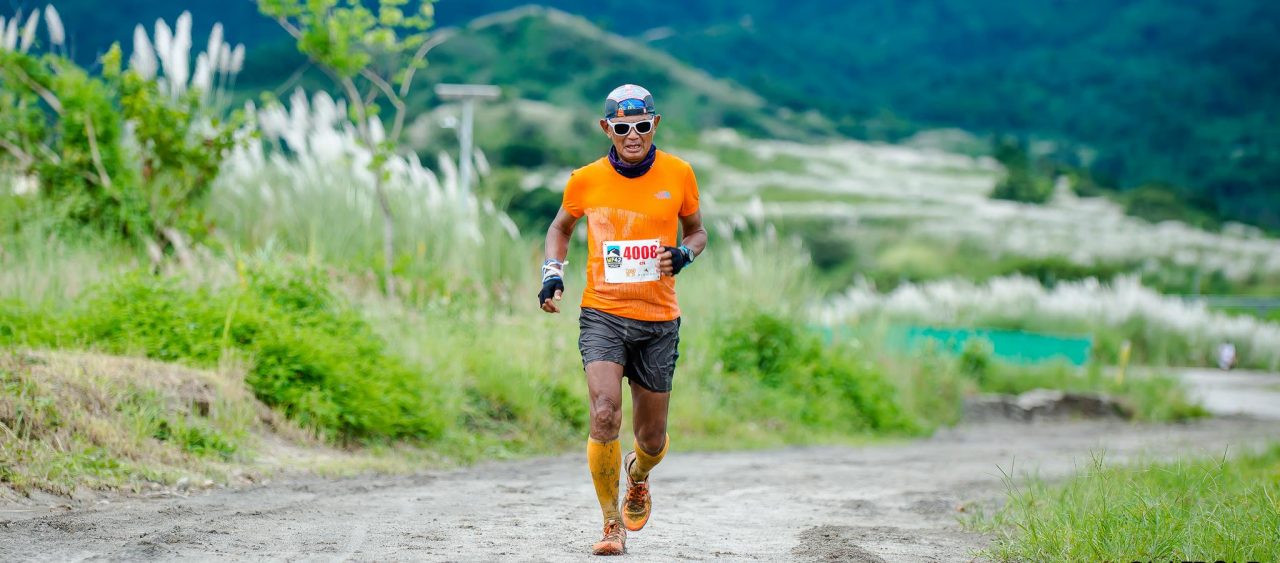
1st BR’s Barefoot 3.2K (2-Mile) Run


I am not a fan and practitioner of Barefoot Running. And I am not a member of any group or asssociation that promotes barefoot running in the country.

I read the book “Born To Run” by Christopher McDougall upon its release to the public when I was in the United States almost 3 years ago but it was just a part of my reading activities. I was amused by the dedication and passion of Caballo Blanco to live with the Tarahumara tribe in North Central Mexico’s Copper Canyon Mountains by coming up with a yearly ultra trail race within the community and at the same time being able to help on the welfare of the said tribe.

However, I was surprised that because of this book, it created a “niche” of minimalist shoes production from popular brands and influenced a lot of runners to shift to “minimalist” running or barefoot running. I am not yet into this but I was already using road racing shoes which technically considered as “minimalist” running shoes.

After experiencing injuries which most often occur on my calf muscles/lower leg, I slowly included barefoot running as part of my recovery process with the hope to strengthen my lower legs’ muscles and ligaments, most especially for those ones which are not reached by “cross-friction” manipulations through massage/therapy. After a 25-lap run on an oval track, I usually run/jog/walk on barefoot for four laps as my cool-down workout. In some instances, I would simply walk on the ground for about 15 minutes every day. These simple “after workout/cool-down” barefoot “stuff” could be the reason why my recovery from my lower leg injury was faster than what I’ve expected. But I never tried running barefoot on asphalt or cemented road.

So, what made me think of coming up with this running event called, “1st BR’s Barefoot 3.2K (2-Mile) Run” to the running community of the Philippines? The answer is very simple…Because NOBODY is doing anything about it.

I thought of this event while I was starting to adopt to my new training workout based on my heart rate during the last days of my stay in the US. While waiting for my connecting flight in San Francisco International Airport back to the Manila on July 9, I created an Event Page on my Facebook Wall and turned off my laptop computer. As soon as I arrived in Manila, I was surprised to see a very positive response from the runners as soon as I saw the update on my Event Page and the rest is history!

However, for the past weeks and days, I don’t see any positive response from the so-called “minimalist” shoe brand “corporates” who are promoting this kind of running. I simply asked them for me to meet their “Big Boss” in person! “Big Boss” would mean their CEO, President, or Regional Brand Manager. I don’t need to meet their mid-level/department heads due to unfavorable experiences in the past. (I don’t want to recall and post in this blog how these people would transact some arrangements with me on matters about running)

With or without corporate sponsorship, the event will go on. Fortunately, a group called “Barefoot Running Philippines” came forward to support and help in the conduct of this event. Lt Col Mike Logico of the Philippine Army, one of the Administrators of the Barefoot Running Philippines and a “hardcore” barefoot runner, volunteered to assist me in the administrative and logistics needs as the event will be conducted at the Philippine Army’s Grandstand and Parade Ground on August 6 at 4:00 PM.

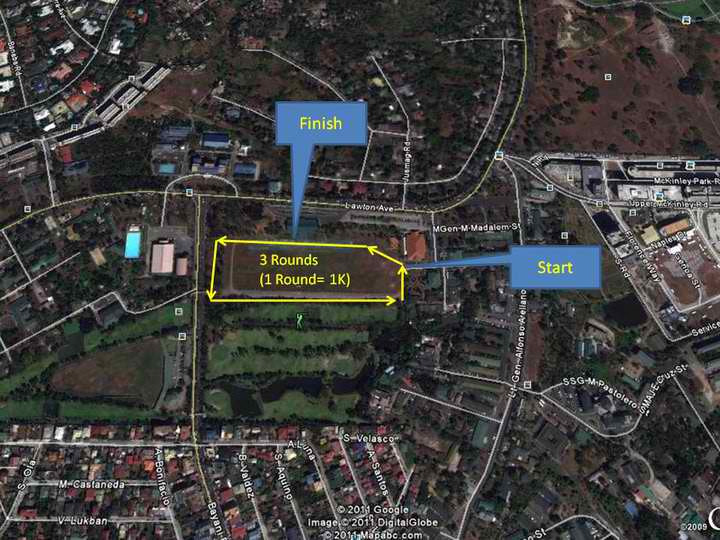
The registration is on site until 30 minutes before the start of the 3.2K run. The registration fee is Fifty Pesos Only (P 50.00). Runners will run 3 times along the 1-K loop on the said facility/area which has a mixture of asphalted and cemented road. Top 3 in the Overall (Open) Category and Top 3 in the Ladies Category will receive the BR’s Medallion.

This event will be done on a monthly basis with the next event to be conducted inside Camp Aguinaldo. We hope to come up with a 5K Barefoot Run/Walk.

In making this event as part in the history of running in the Philippines, I would like to thank and express my gratitude to Lt Col Mike Logico; the Philippine Army’s Headquarters & Headquarters Service Group and ASCOM’s Special Service Unit; and to the Barefoot Running Philippines.

See you this coming Saturday afternoon. Have fun! Kick off your running shoes and let us “tickle and burn” our feet on the paved ground! Walking barefoot is allowed, too!

BR's Barefoot 3.2K (2-Mile) Run Route (Courtesy of Lt Col Mike Logico)

Record Time: 52:37 Minutes


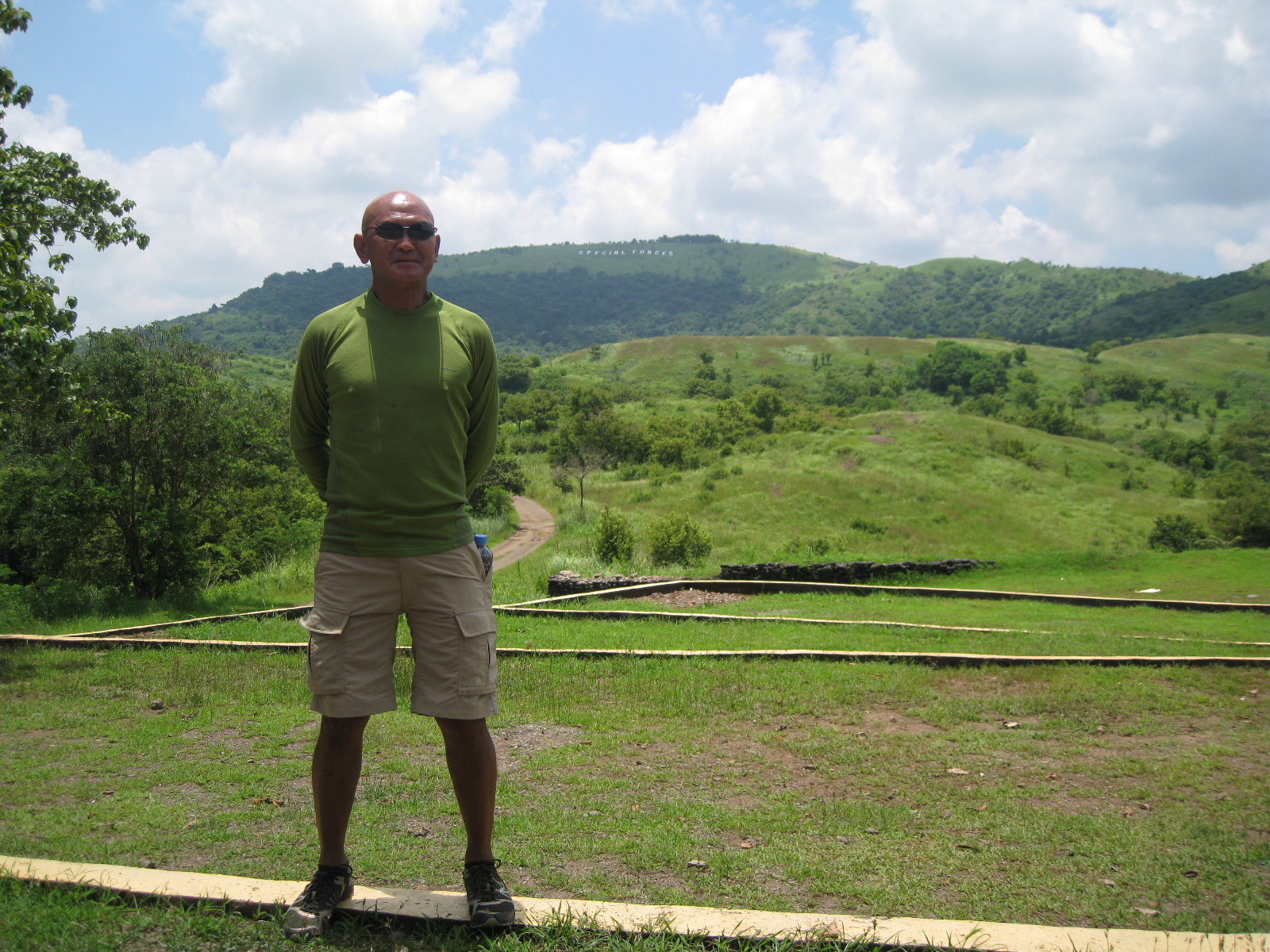
This was the elapsed time it took me to reach the peak of Mt Taklang Damulag as I started from the Fernandez Hill of the Special Forces Regiment’s Camp and Training Area inside Fort Magsaysay. The place is also popularly known as “Molave Complex”.

The plan was to recon and hike a segment of the 100-mile endurance run route that includes the Fernandez Hill-Taklang Damulag- Cordero Dam-Special Forces Training Area and back to Fernandez Hill. This a trail loop which has a distance of 13 kilometers. However, at the back of my mind, I was thinking of coming up with a first attempt with a record time for a trek to the famous Mt Taklang Damulag’s peak with the Fernandez Hill as the starting area.

Fernandez Hill Marker Serves As My Starting Line/Area
Mt Taklang Damulag On The Background

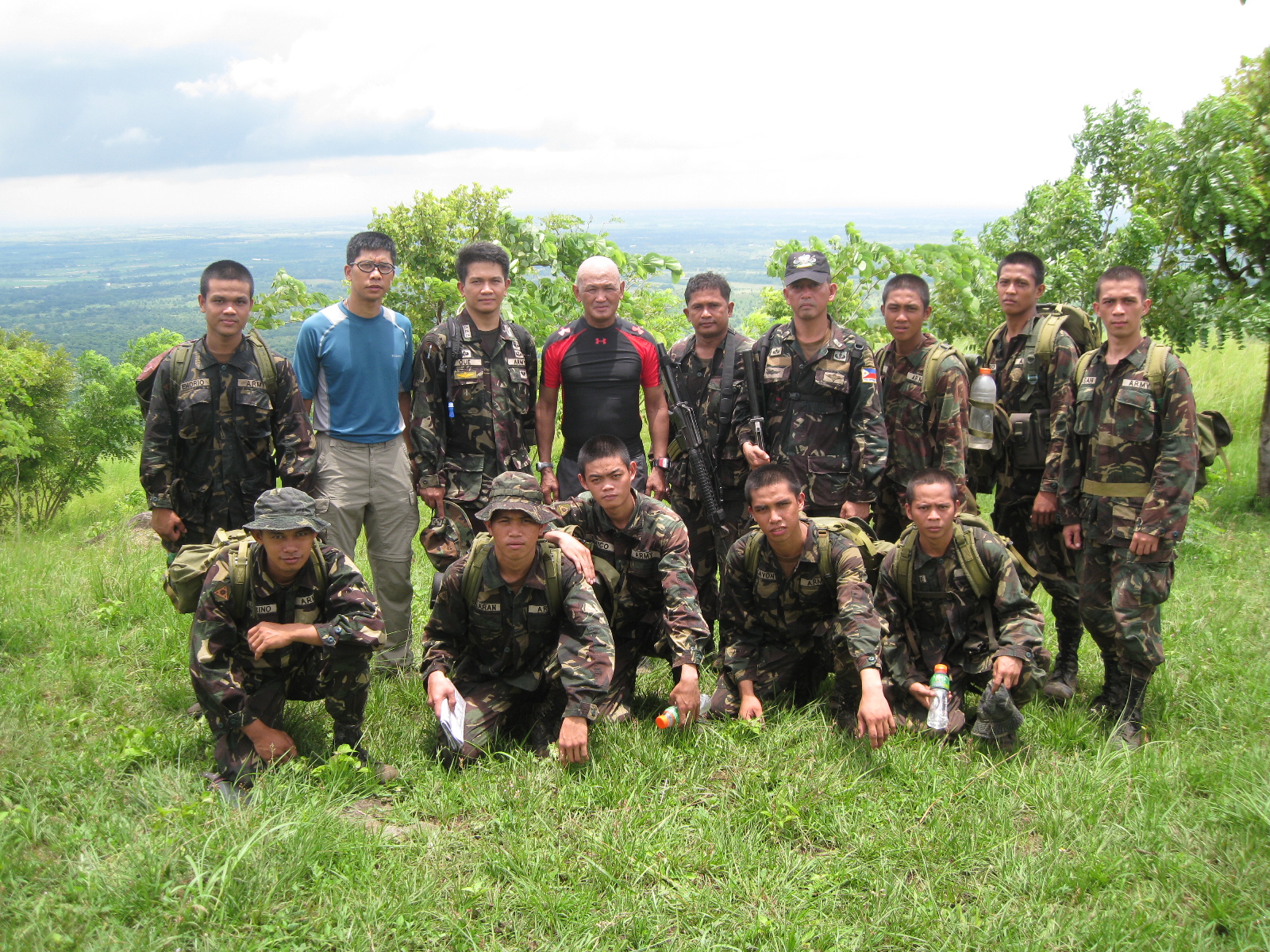
I was accompanied by Lt Col Dennis Pacis, the Chief Operations Officer of the 7th Infantry Division who is a triathlete and an ultrarunner; Captain Jason Que who is the Chief of the Training Department of the Special Forces School; Jack, a member of the Elite Team Bald Runner; two NCOs of the Special Forces who are both runners in the PA Battalion Run Team where I was the Commander; and nine (9) soldiers who are presently on training to become members of the Special Forces Regiment. I personally named this group as the “Ultra Recon Team Six” (based from the famous and popular US Navy Seal’s Team Six).

We started at 10:45 AM with overcast sky from the Fernandez Hill in line formation with at least 6 soldiers in front of me. As I was strictly following my HR training to include this trek, I maintained an HR of 135 about 100 meters from the start with LtCol Pacis and Capt Que behind me. However, our hiking started to increase its pace as we started to climb the mountain.

The trail leading to the peak of the mountain was a combination of crossing at least 3 streams where our feet/shoes have to thread on the water current; sticky, slippery and muddy soil; rocks; and single-track trail covered with grasses. My TNF trail shoes were no match to the combat boots of the soldiers in crossing the streams and walking along sticky and slippery mud along the route. My advantage to these soldiers was that my shoes were lighter than their combat boots.

As we started to climb the mountain, I started to think of coming up with a record time for a Military General, retired at that, to ever climb and reach the peak of the said mountain. Although I am not sure if the past Commanders of the Special Forces and Special Operations Command had undergone this record timing process, I thought that I might as well start coming up with a “trivia” as to who and what is the fastest time for a General (retired or active) to reach the peak of Mt Taklang Damulag.

In less than 400 meters from the start line, my HR started to spike to 145 bpm from my training max of 135 as a result of my excitement to reach the peak with a record time. And my HR steadily increased as I got higher towards the peak of the mountain.

I was wearing my GF 305 on my left wrist (to measure the distance and elevation) and my TIMEX HR Watch on my right wrist. From time to time as I moved upwards, I had to glance of these two watches for the distance covered and my prevailing HR.

From 145 bpm, my HR spiked to 165 and later to a maximum of 183 bpm when I reached the 2.4K mark on the uphill climb to the mountain. I decided to take a rest/breather for about 2 minutes just to be able to adjust to my breathing and to be able to look around on the lower plains of Nueva Ecija. I felt like I was going on a “blackout” or pass out as I started to feel dazed and exhausted but the scenery and the beauty below made me happy and satisfied. A lot of “deep breathing” repetitions made me recover and kept on glancing my HR watch as my bpm was decreasing. As soon as my HR watch reached and indicated 155 bpm, I continued my hike on the last 400 meters to the peak of the said mountain.

I simply tapped the white cross at the peak of the mountain with my right palm to signify that I reached and conquered the very peak of the mountain. My time was 52:37 minutes and I asked Capt Que to make a record/journal of it as part of the trivia of the Special Forces Regiment.

BR With the Special Forces' "Ultra Recon Team Six" On Top of Mt Taklang Damulag

The two Special Forces NCOs were surprised and gave me two “thumbs-up” for being the fastest hiker (whether in my age category or being a General of the Philippine Army, retired or active) to reach the peak. I just smiled to them while I was gasping for air! I wanted to tell them that I was not yet running and it was all hiking. In due time, I will try to run it and improve my time on my next trek to the mountain.

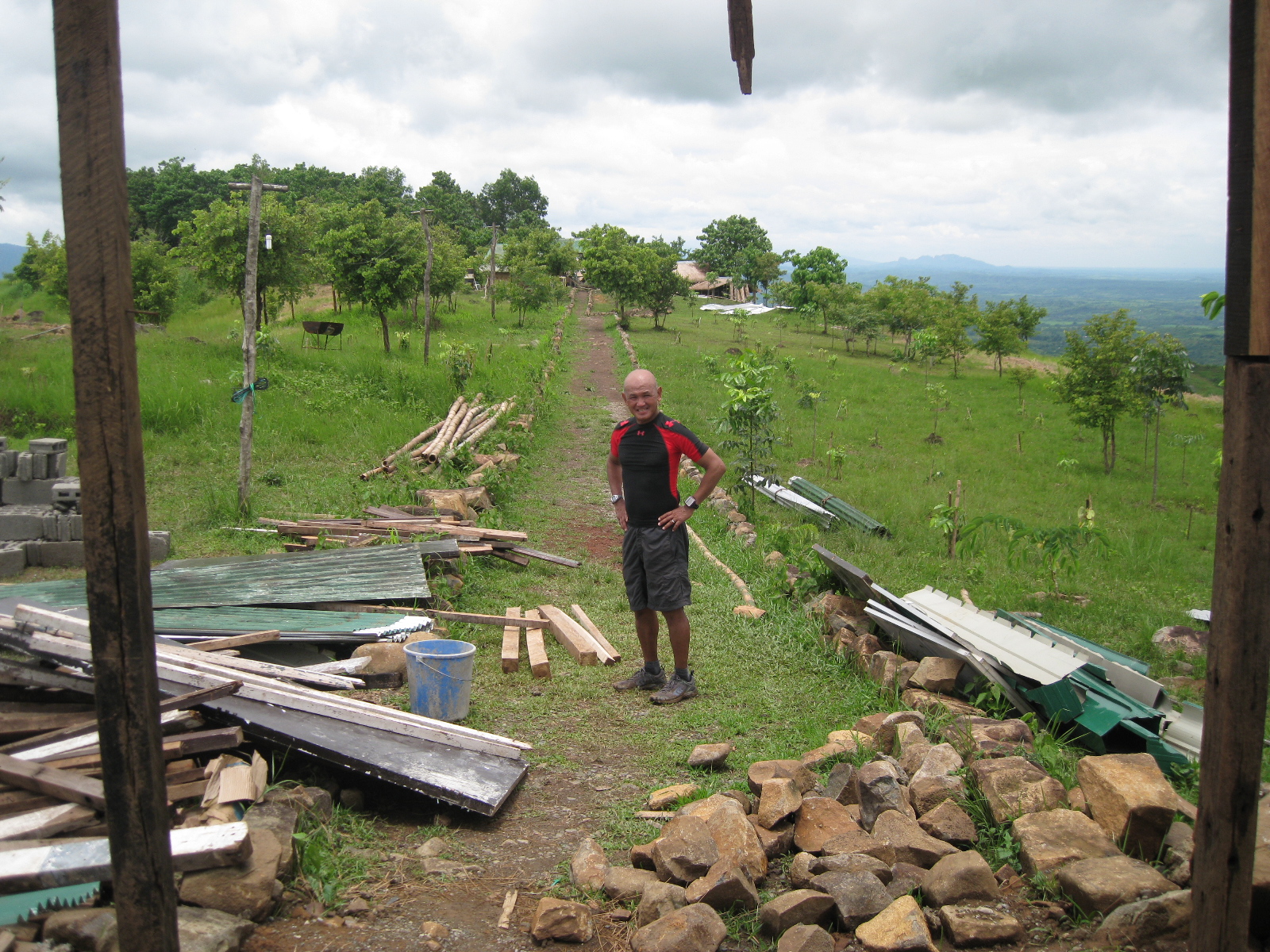
Resting and Looking Around the Scenery On Top of Mt Taklang Damulag

As per gathered by my GF 305, the highest peak has an elevation of 409 meters with a route distance of 2.7 kilometers from Fernandez Hill. It is a short course and a very low mountain but if you think of going up to this mountain for four times in a single event, then you have a very high mountain!

Now, I am thinking of a short trail running event which is dubbed as “Mt Taklang Damulag 5.4K Challenge” !

GYMBOSS


Even if my Garmin Forerunner 305 has Interval Workout
feature which up to now I don’t really even know how it is operated, I still
bought a Gymboss which I could easily clip on my running shorts or gym workout
pants or just simply place it on a table or any part of the room if I want to
use it.

While I was visiting the ARC Store in Manila last April, I
was trying to look for a pedometer or any gadget that would count my steps/cadence
while walking/hiking or running. Instead of looking for one, my eyes caught the
colorful Gymboss gadget displayed on one of the walls of the store. I
immediately lifted one of the units and tried to read the instructions on how
to use it.

Such visit in the said store ended buying a silver colored
Gymboss with a price of P 1,275.00. You might be surprised why I bought this
small gadget impulsively and without any hesitation.

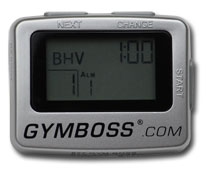
An Exact Replica of my GYMBOSS

The main reason why I bought the Gymboss was to use it in my
“Tabata” workouts for push-ups, sit-ups, strengthening workouts (yoga and
pilates) and dumdbell exercises at home.

Anyone can easily operate the Gymboss by selecting the
times/periods involved in my Tabata workouts to include the time of the
exercise, time of rest in-between exercise, the number of frequency, and the
selection whether you prefer a beep sound or vibration mode for the start and
end of every interval.

To give you an example of what I’ve been doing in my Tabata
workouts—I set the Gymboss for a duration of 40 seconds for me to do any kind
of exercise (push-ups, sit-ups, yoga/pilates pose, or strengthening exercises
using the dumdbell or any weight machine) and then set one-half of the duration
of my exercise as my rest interval which is 20 seconds. As a minimum of set of
intervals, I set 20 times which take exactly 20 minutes to do one set or cycle
of my exercises. In between intervals, the Gymboss would beep to warn the user
that it is the end/start of an interval period.

For almost three months, I’ve been using the Gymboss
purposely for my Tabata workouts and later for my daily 10-minute squat workout.
But it can be used also for running and cycling.

In running, one can use it for speed interval workouts at
the oval track and also with the Jeff Galloway method of running where one
could set the period of running and walking on interval mode.

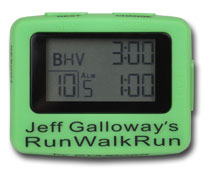
GYMBOSS For Jeff Galloway's Running Method

In cycling, the Gymboss can be used in interval workouts in
actual road cycling and on stationary bike if you want spinning workouts.

I highly recommend GYMBOSS to any endurance athlete.
Hopefully, ARC Manila has still stock available for everybody interested to own
this gadget.

Running Season


Do we have a “running season” in the Philippines?

Do you prepare and train for a particular race during this supposed “running season” in the country?

Are runners and race organizers observe this supposed to be “running season” in the country?

If your answer to these questions is NO, then, we have to find out what is the appropriate “running season” for the country.

In countries where they have four seasons—spring, summer, autumn, and winter—they usually start their running season during spring time up to the end of autumn. Runners usually recover during winter time when it is hard and cold to be running with sleet and snow on the roads and trails. They usually recover, re-charge, rest, or do indoor cross-training activities just to maintain a physically fit body. So, if you observe the race schedules of popular marathon races in these countries, they are scheduled from the end of spring up to the end of autumn (Ex. Boston Marathon in April and New York City Marathon on the 1st week of November). The same is true with the popular mountain trail endurance runs and the more extreme running events (Ex. Western States 100-Mile Endurance Run on the last weekend of June and Badwater Ultramarathon on the 2nd week of July).

In the Philippines, we have only two distinct seasons–wet and dry seasons, which means that we have 6 months of wet/rainy season and another 6 months of dry/hot season. Rainy season starts in the month of June and ends on the last week of November and the Dry season starts in December and ends on the last week of May.

If you think that the 6 months of the dry season would be the appropriate “running season” for the country, you could be slightly wrong. The first 3 months (December, January, and February) are the coldest months of the year but it is followed with the very hot months of March, April, and May where Race Organizers should start their races very early in the morning.

So, based on my observation, the appropriate “running season” for the country would be the period from the first week of December up to the last week of February.

If you are a smart runner, you have to follow a “running season” where all your training and preparations are geared and focused to races (marathon, half-marathon and ultra runs) scheduled in the months of December, January, and February. Make the other scheduled races in the remaining months as part of your your training and evaluation workouts. Also, make the first three months of the rainy season (June, July, & August) as your rest & recovery months or start of your aerobic endurance phase.

On the financial side, if you are preparing for a certain race on the suggested “running season”, you will be saving a lot of unnecessary registration fees to unnecessary weekend races which are not part of your training and evaluation program for a certain race. Be smart, be simple and focused to a particular race where your target goal is realistic and attainable.

This is just a personal advise and please feel free to make your own suggestions through your comments on your thoughts about our country’s “running season”.

2011 Takbo Runfest 16K


Respect and Loyalty. These are the two basic words that explain why I decided to run this 3rd edition of this running event which commemorates the 3rd Anniversary of Takbo.ph. Takbo.ph had been the No. 1 Running resource here in the country and it is very instrumental in spreading the awareness of long distance running to everybody. Takbo.ph had done a wonderful job for the past 3 years. Thanks to Jinoe & Quennie Gavan and to the rest of the Takbo.ph members for their dedication to running.

My attendance to this event could not be possible without the help of Jonel/FrontRunner Magazine who reacted to my call for a Race Packet as I was not able to register for this race due to my long stay abroad. Thanks, Jonel and I know already whom to call if ever I decide to run shorter races in the future.

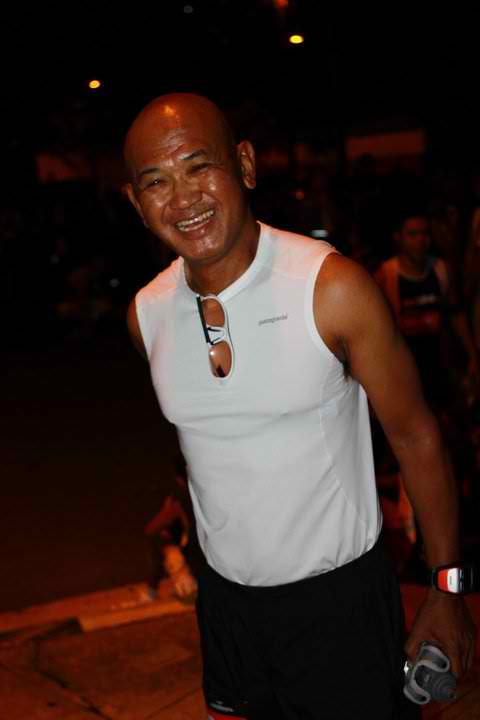
BR as Patagonia Model

At 4:55 AM, I was already at the Starting area and I observed the usual festive mood in road races done in Metro Manila. I think the last race that I joined with this kind of atmosphere was the Condura Marathon last February. I just smiled and try to compare the simplicity of my ultra races and to the rest of the road races that are done in the city. However, it is a must to have such festive mood to give justice to all the corporate sponsors that supported the event and at the same time “prep” the runners before the start of the race.

After almost 5 months of absence in road races in Metro Manila, old and new runners would greet me that would end up for photo-ops. It was nice to see friends whom I’ve been running with for the past 3-4 years. I was able to observe that there are new faces in running in different forms and sizes. This is a good indication that more of our countrymen are getting aware of adhering to a healthy lifestyle through long distance running.

My attendance to this race, aside from being seen and meeting old and new friends, was purposely used as my formal “comeback” run after recovering from an injury. It was also my intension to use the 16K race as my slow long distance run as part of my new training.

Easy Running

My new training program (on experimentation) is basically based on my Heart Rate Monitor (heart’s beats per minute). The goal is to be able to maintain an Average Heart Rate of 132-142 beats per minute during the run in order to develop my aerobic endurance base. Translating this to my average running pace, it is very, very, slow that I would end up brisk walking in some segments of the course.

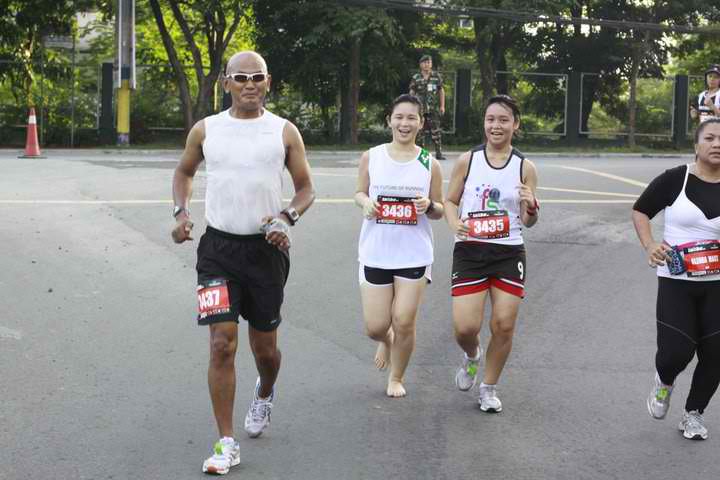
The race started on time and I was at the back of the whole pack once all the runners cleared the starting line. I was wearing two watches: Garmin Forerunner 305 on my left wrist and a Timex Watch with Heart Rate Monitor on my right wrist. My heart rate started at 122 bpm and gradually increased up to 135 bpm. During the run, I kept on glancing on my right wrist just to be sure that my heart rate monitor will not spike to 160 bpm.

By strictly observing my HR throughout the race, I was able to observe all the things that were going on, from the front/lead runners all the way to the last runners! Through the different turn-around points, I was able to greet and see more runners which I’ve never done before in my previous races. I guess, my new training brought me another view and perspective on how to observe the conduct of races and at the same time being seen by everybody.

BR with Barefoot Runner

Another aspect that resulted in this race was the fact that I had a lot of conversations with new runners at the back of the pack whose main purpose in joining the race was to be able to finish it. I came to realize that I was also a runner trying to inspire and motivate people at the back to finish the race, not through my posts in this blog, but also in “action” in road races! This another definition of running as fun!

Having Fun With The "Bald Runners" of Team Kamote

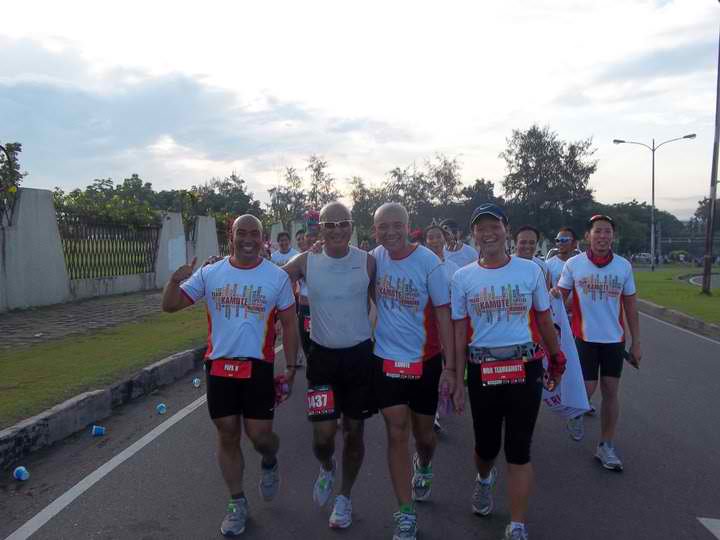
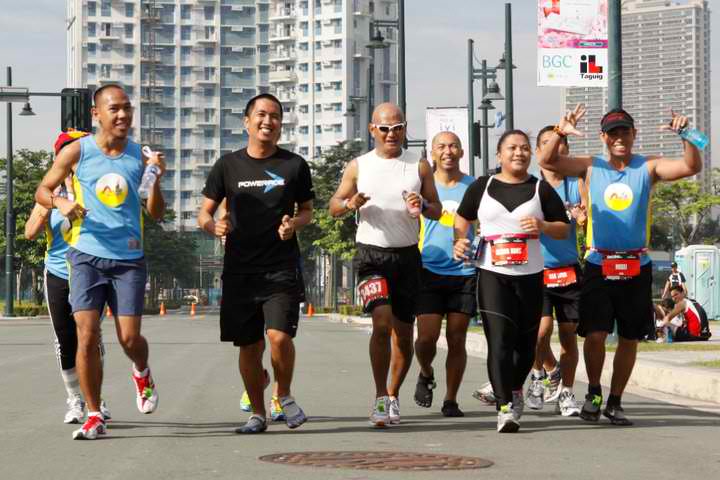
Special mention goes to Team Kamote Runners who were with me at the back of the whole pack. This team is awesome and a happy group that they run and finish together as a group/team. I enjoyed staying with this group from Km 8-12! See you in my ultra races!

A road race is not successful without the volunteers. I am happy to note that the ultra runners from the 1st  generation of Takbo.ph members were in full force as volunteers along the way as marshals, cheerers, and photographers. Guys, you are the best!

Having Fun With Runners At The Back of the Pack

Who cares about the finish time and PR for the race if you are following a new training program that would result to an injury-free running career for the years to come? But for the record, I crossed the finish line in 2:34+ hours (my GF time) with a bonus of 500+ meters. Yes, I was able to maintain an average heart rate of 132-142 bpm throughout the race and I really enjoyed the company of runners as well as the volunteers.

Based from my GF data and consistent to my new training, I usually cover 6.22 kilometers every hour with an average HR of 142 bpm. Translated to ultra run pace, you can easily finish a 100-mile endurance within the cut off time of 30-32 hours if you have the patience to follow this kind of new training. However, due to the heat and humidity in the country, I could run and walk slower at 5.66 kilometers per hour and still maintaining my average HR at 132-142 bpm.

This is the reason why I discovered a formula for the most relaxing cut-off time in my ultra races. Divide 5.66 kilometers by the distance of the race and you have your prescribed cut-off time!

Congratulations to Takbo.ph for another successful event! Happy 3rd Year Anniversary!

See you on the roads and trails!

(Note: Whoever posted the pictures above at FB, my special thanks to you, guys!)