2018 Salomon Cappadocia Ultra Trail Race Photo Video


Hereunder is the Photo Video of my trip to Turkey to join/participate in the 2018 Salomon Cappadocia Ultra Trail Race which was held in October 2018. This training running event is part of the Ultra Trail World Tour Event. I have published a Race Report of this event in this blog.

Thank you for watching.

Repost: 90% of Badwater 135 Runners Finish By Jason Koop


badwater 135

90% of Badwater 135 runners finish. Here’s what they can teach you about preparation.

Head Coach of CTS Ultrarunning

By the time this newsletter hits your inbox, runners in the 2020 edition should have been testing themselves along the course of the Badwater 135, which many consider to be ‘the world’s toughest footrace’. Alas, in a very last-minute decision, organizers of the Badwater 135 cancelled this year’s edition, leaving this year’s field wondering what they could have accomplished with their fully formed fitness and heat acclimation strategies.
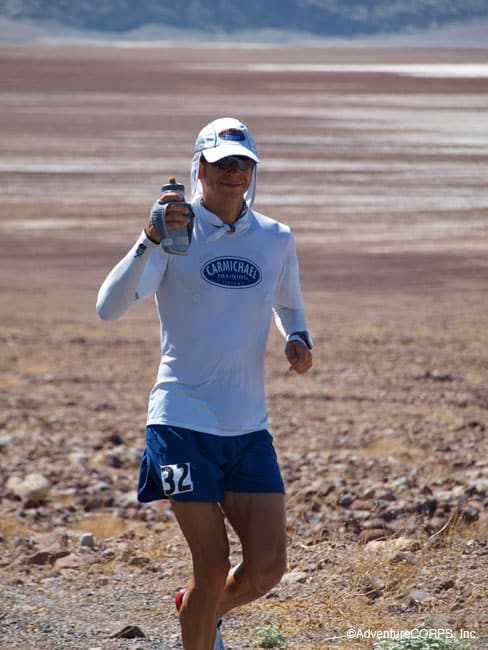
PHOTO ©ADVENTURECORPS, INC.

I have been fortunate enough to run and crew for the Badwater 135 a total of eight times, as well as prepare numerous runners for the event. All of these experiences have had an impression on me, and I am a better coach because of them. No other group of runners prepare quite as meticulously as the Badwater athletes do. The combination of the searing heat, mind numbing monotony of the road, the complexity of the application process and the exclusivity of getting an entry, the sheer expense of participating, and a relentless culture of improvement that has evolved over the years all combine to create what I observe to be the most prepared ultramarathon field on the planet. And the statistics bear this out. Badwater, despite the notoriously difficult conditions, has a finish rate of 85-90%. As a comparison, the Leadville Trail 100 hovers around a 50% finish rate for any given year, and the coveted Western States 100 has finish rates routinely between 70 and 80%. Make no mistake, the Badwater runners and their crews come fully prepared and bring it on race day.

Badwater is also one of the greatest hot environment sports performance proving grounds imageable. The searing heat will put your heat acclimation strategy to the test. Frequent access to your crew (your crew can leapfrog the runner in a support van) allows the runner to put cooling strategies and nutrition interventions in place without many logistical limitations. Being a crafty lot, Badwater runners have implemented an array of bizarre, sometimes effective and ultimately outlawed strategies in order to gain an advantage. Over the years I have seen everything from the use of refrigerated trucks to pacers on rollerblades with umbrellas (both of these strategies are now prohibited, by the way) to battle the heat. Still, the Badwater runners don’t always use the most efficacious strategies when it comes to heat acclimation and nutritional interventions. They tend to try to combat the challenges the course and environment will throw at them with contrived and combined strategies that at times are ineffective or even counterproductive. You might not ever have the urge to do the Badwater 135, but there are still some lessons we can all learn from the strategies this hearty group of ultrarunners use to battle the course and the heat, what actually works and how things go awry.

Heat Acclimation Strategies

Out of all the unique aspects in preparing for the Badwater 135, acclimating to the heat naturally gets the most attention. With temperatures that can be in excess of 120 degrees, runners rightfully approach this element of preparation with upmost importance. I first attended the Badwater 135 in 2006. When I arrived in Death Valley, I curiously took a straw poll of the participants to understand the heat acclimation strategies they used in training.

PHOTO ©ADVENTURECORPS, INC.

Over the years, either at the race of from afar, I have done the same straw polling and observed what the athletes were doing to prepare. I recently pulled my notes from these experiences and below is a short list of various protocols I’ve found, in no particular order:

  1. Running on a treadmill with a dryer vent blowing on your face. As a bonus, some runners would put portable heating elements round the treadmill for an added effect
  2. Running in the heat with a down jacket, pants and rain jacket
  3. Running on a treadmill in a greenhouse
  4. Running on a treadmill in the sauna. This normally involves cajoling the gym owner into some, shall we say, creative electrical engineering that may or may not pass a fire inspection
  5. If your gym owner was concerned about said electrical engineering, doing jumping jacks and core work in the sauna
  6. Driving around town with the heater turned up, perhaps with a down jacket
  7. Passive sauna exposure
  8. Camping in Death Valley in the weeks leading up to the event
  9. Turning up the heat in the house to > 90 degrees
  10. Some combination of some or all of the above with time frames that range from days to months

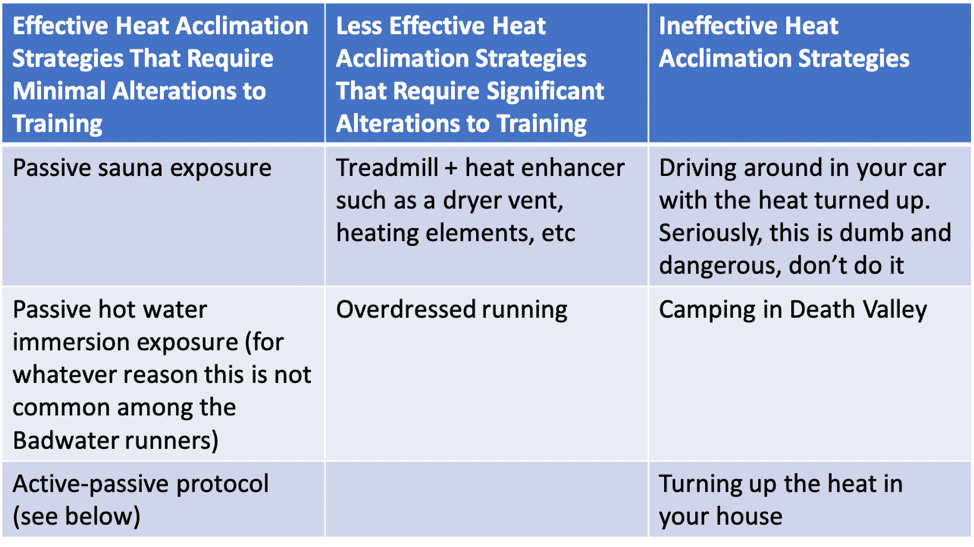
Although the complexity and duration of these protocols vary, they all can be catalogued into two broad categories: 1) passive acclimation/acclimatization strategies and 2) active acclimation/acclimatization strategies. Each have basic advantages and tradeoffs.

Passive strategies (strategies where you just sit there and let the environment do its job) allow for heat acclimation to occur with minimal interruption to training. They do not, however, allow you to ‘feel the heat’ while running, and many athletes feel the need to experience training in a hot environment before competing in one, simply to understand the sensation.

Active strategies (strategies that use a combination of exercises and environment) allow for heat acclimation to occur and for the athlete to feel the sensation of running in a hot environment. However, compared to Badwater, where the humidity is low and solar radiation is high, some of the contrived active strategies will be mismatched, particularly the overdressed ones that create a high humidity environment with little solar radiation. Additionally, active acclimation strategies involve some training compromise either by reducing the duration or intensity of the training session to accommodate for the increase in core temperature.

How Heat Acclimation Strategies Actually Work

Fundamentally, heat acclimation strategies work by inducing systemic and cellular responses to help your body cope with the heat. Systemically, your body responds (primarily) by increasing plasma volume and sweat rate in an effort to dissipate heat. Cellularly, your body upregulates heat shock proteins which act as cellular chaperones and managers for proteins that have been damaged by heat stress and other forms of degradation. Both systemic and cellular responses help athletes manage the heat in various ways, ultimately resulting in increased exercise capacity in the heat (and sometimes in temperate environments).

What has started to emerge in the research is that the extent of core temperature increase is critical to the success of the strategy. Heat up your body to a certain temperature and then hold that temperature for a certain amount of time and you get great results. Miss the mark on the temperature or duration and the physiological results are not as good. This critical core temperature, which appears to be in a very narrow range of 38-38.5 °C or 100.4-101.3 °F, is difficult to achieve and athletes will describe it as somewhere between ‘feeling hot’ to ‘too hot, dizzy and lightheaded’.

Through this lens, we can look at the aforementioned strategies from our (perhaps ill-fated) Badwater runners. Strategies that are capable of producing a core temperature of 38-38.5 °C will be markedly more effective than those that do not. Additionally, active acclimation strategies (strategies that involve running/cycling in the heat or overdressed) will most likely be hampered by compromising exercise intensity, as a high core temperature will limit the duration or intensity of running (how long can you run while being ‘dizzy and lightheaded’?).
heat acclimation strategies

The Best of Both Worlds

Many athletes now choose to use an ‘active-passive’ protocol, where they go out and do a normal run and then immediately jump into a sauna or hot water immersion bath. The initial run begins the process of increasing core temperate and the heat exposure from the bath or sauna finishes it off to achieve the critical temperature of 38-38.5 °C. In this way, training is not compromised and the sauna/hot water immersion bath session duration is reduced. If you really feel like you need to ‘feel the heat’ to experience the sensation of running in a particular environment, contrive the environment to try to match the temperature, solar intensity and humidity of your event as much as possible, and do so for the minimum number of sessions to do the trick. For the Badwater runners, a treadmill with a dryer vent blasting in your face a few times is a better option than running around in a down jacket for a month.

Hallucinations

whitney portal badwater 135

THE VIEW OF RACERS RUNNING INTO THE EVENING, FROM WHITNEY PORTAL.

Ultrarunning has been known to produce good hallucinations.  Sleep deprivation combined with physical exhaustion, bonking, and blurred vision is a ripe recipe for the mind to conjure up memories of distant past and teleport them into a fuzzy present.  And Badwater hallucinations are the best, by far. While your trail ultrarunning compatriots will brag about stories of a stick that turned into a snake, a tree stump that looked like a bear or a rock that talked, the Badwater hallucinations take this altered reality to a whole other dimension. The runners at Badwater encounter a cast of characters ranging from the Michelin Man to old 49er miners. Even the infamous white line painted on the road gets in on the action by transforming into various beings of and out of this world. Hallucinations come complete with incomprehensible background stories (the Michelin Man is there to run for President), unintelligible plot lines (I was helping the 49er change a tire), and bizarre interactions that border between a Star Wars movie and a DMT trip.

There is zero training for this. So, I have no help for you here other than to say if you really want an out of this world experience, just go run Badwater.

Too Much Aid Can Be a Bad Thing

One of the differentiating features of the Badwater 135 compared to other ultramarathons is that you have copious access to your crew and supplies. Food, water, pacers, your medical kit and the all-important performance enhancing ice, are never more than several minutes away. And, this level of assistance can be intensive. I once paced an athlete from Furnace Creek to Stovepipe wells, just a 24.6-mile section of the race, and blew through over 60 liters (15.8 gallons) of ice water in the process of drinking and dousing. And while it might seem like a luxury to have your every ultrarunning need fulfilled at a moment’s notice, at times it can be a bad thing.  Runners can take on too much fluid and too many calories, particularly in the beginning of the race, simply because they are there. And later they lean on their crews to bail them out of a situation when they could simply just put their head down and run.

Remember that when you are training, you are doing the vast majority of it by yourself. Almost any racing situation involves many times more support than you would receive during any training session. And Badwater is an extreme example of this. While ultrarunners should learn to leverage their crews, pacers and other support personnel, they should not rely on them to get the job done. You don’t need pacers or crew to get the job done (in most ultras). Do they help, yes. But, running is ultimately the responsibility of the runner.

Badwater will be back

Like many of the races that couldn’t happen this year, Badwater will ultimately be back. I look forward to returning in some capacity, as an athlete, coach or crew. I simultaneously learn and get a chuckle out of many of the strategies athletes use to prepare for the event. I love hearing stories of how many layers of clothing athletes put on for a simple training run and how Kermit the Frog ran alongside athletes in the middle of the night during the race. Soon enough, we will get to experience or hear about all of these again. Until then, we can learn for the next time.

References-

Gibson, Oliver R et al. “Heat alleviation strategies for athletic performance: A review and practitioner guidelines.” Temperature (Austin, Tex.) vol. 7,1 3-36. 12 Oct. 2019, doi:10.1080/23328940.2019.1666624
Allen’s Rice Cakes


Before Jason Koop wrote his book “Training Essentials For Ultrarunning” where he highly recommends Rice Cakes as one of the best solid food for ultrarunners, Dr Allen Lim, born in the Philippines and raised in the USA, Doctorate in Integrative Physiology; Director Of Sports Science for the Radioshack Pro Cycling Team and the Garmin Pro Cycling Team; and the only American scientist who had the unique distinction as the  Chef/Cook for the said teams in their 2010 & 2011 seasons for the Tour De France, is considered as the originator of the famous Allen’s Rice Cakes which are very popular to professional cyclists as their food during their daily races in the said Tour and during their training rides.

Dr Allen Lim (Picture From Velopress)

Copied from Dr Allen Lim’s book, “The Feed Zone Cookbook: Fast And Flavorful Food For Athletes”, the following are the ingredients and procedure on how to prepare/cook the said cakes:

Ingredients:

2 cups uncooked calrose rice or other medium-grain “sticky” rice or sushi rice

3 cups of water

8 ounces of bacon

2 tablespoons of liquid amino acids or low-sodium soy sauce

brown sugar

salt and grated parmesan (optional)

Procedure:

  1. Combine Rice and Water in a Rice Cooker
  2. While Rice is cooking, chop up bacon before frying, then fry in a medium saute pan. When crispy, drain off fat and soak up excess fat with paper towels.
  3. Beat the eggs in a small bowl and then scramble on high heat in a saute pan. Don’t worry about overcooking the eggs as they will break up easily when mixed with rice.
  4. In a large bowl or in the rice cooker bowl, combine the cooked rice, bacon, and scrambled eggs. Add liquid amino acids or soy sauce and sugar to taste. After mixing, press into an 8- or 9-inch square baking pan to about 1 1/2-inch thickness. Top with more brown sugar, salt to taste, and grated parmesan, if desired.
  5. Cut and wrap individual cakes. Makes about 10 rice cakes in rectangle form. Individual cakes can be wrapped with aluminum foil or strap wrap.

Per Serving (1 cake): Energy: 225 calories; Fat: 8 grams; Sodium: 321 mg; Carbs: 30 grams; Fiber: 1 gram; Protein: 9 grams

Time of Preparation/Cooking: 30 minutes

2018 Badwater 135-Mile Ultramarathon Race Documentary


I had the chance and opportunity to have been up close to the runners and crew in this particular edition of this iconic Badwater 135-Mile Ultramarathon Race in 2018. I was surprised to see this documentary film which was posted on You Tube in September 2018 and this is the only time that I learned about the fight for the Podium Places among the Elite Runners. I have seen how close these runners are who composed of what they call, “The Badwater Community”. My participation in this race as a Crew and Pacer will remain memorable as one of my best experiences as an ultramarathon runner.

Who would think that a Local Blogger who exposed this race to the minds of the Local Pinoy Runners through this blog and be able to copy its rules and regulations for his Bataan Death March Ultras and PAU Races, would be able to experience to be in the race and “rub elbows” with the past and present Champions of this race dubbed as the “Toughest Footrace In The World”. This video will explain what it takes to join and finish this race.

I hope you will enjoy watching this video. Thank you!

Video: Filipino Finishers Of The UTMB 106-Mile/171K Ultramarathon Race (2011-2019)


This is a Photo Video that I posted on You Tube with the objective to document the past accomplishments of our local trail runners in international trail running event like the UTMB. This video will be also an instrument for others who will be inspired to join this event in the near future. Thank you for watching.


Filipino Finishers Of Ultra Trail du Mont Blanc 106-Mile/171K Ultramarathon Race (UTMB)


In the history of the Ultra Trail du Mont Blanc (UTMB), the race started in 2003 but only after eight (8) years (2011) when Ultra Trail Runners from the Philippines started to join this iconic trail ultra which is considered as the “Holy Grail” of Ultra Trail Running In The World. Hereunder is the list of Filipino Runners who finished the race with their Official Finish Time and their year’s edition:

  1. Jonnifer Lacanlale—–44:00:57 hours (2011)
  2. Simon Sandoval—–45:19:06 hours (2011) & 20:25:13 (2012/shortened) & 40:25:11 hours (2013)
  3. Christian Vicera—–45:16:26 hours (2013)
  4. Aldean Philip Lim—–44:57:22 hours (2014)
  5. Deo Encarnacion—–43:55:17 hours (2014)
  6. Miguel Antonio Lopez—41:10:48 hours (2015)
  7. Roland Wangwang—–41:10:48 hours (2015)
  8. Aleksis Capili—–43:38:16 hours (2016) & 39:55:54 hours (2018)
  9. Hermogines Olvis—–35:33:54 hours (2017) *Fastest Time
  10. Miguelito Carranza—–37:01:00 hours (2017)
  11. Conrado Bermudez Jr—–40:18:29 hours (2017)
  12. Maria Josephine Liao—–42:15:14 hours (2017) *Female
  13. Donald Hermoso—–44:18:53 hours (2017)
  14. Benjamin Ramirez—–39:33:43 hours (2018)
  15. Patrick Hervic Aquino—–43:41:48 hours (2018)
  16. Felmer Hiponia—–44:53:06 hours (2018)
  17. Manuel Magbanua Jr—–45:59:25 hours (2018)
  18. Joseph Sibal—–46:04:59 hours (2018)
  19. Ronnel Valero—–39:29:59 hours (2019)
  20. Marc Conrad Molina—–41:07:23 hours (2019)
  21. Magno Rafael Gabotero—–44:10:00 hours (2019)
  22. James Tellias—–44:34:14 hours (2019)
  23. Mark Itol—–45:00:41 hours (2019)
  24. Thumbie Remigio—–45:27:15 hours (2019)
  25. George Javier—–46:18:16 hours (2019)
UTMB Official Logo

Camille Herron Joins 2020 Badwater-135 Ultramarathon Race


Last night when I was about to go to bed, I saw the post of Camille Herron on her Facebook Page that “she is jumping for joy and gratitude that the Badwater 135 got the green light as a “GO” race in two weeks time”. I was surprised about her post because I did not know that she is one of the listed participants for this year’s edition basing from the last update that I saw last week on the website of the event.

“Selfie” With Camille Herron @ 2017 Tarawera 100K Ultramarathon Race

I personally met Camille Herron during the Racing Briefing for the 2017 Tarawera 100K Ultramarathon Race in February 2017 in Rotorua, New Zealand. She won the Ladies Championship Trophy for that edition. From that simple meeting and “selfie”, we became friends on Facebook and from time to time I would leave a comment on her FB posts since then. I even went to the extent of sending her a copy of the Ultrarunning Magazine (courtesy of Badwater Ben Gaetos) where she was in the Cover Page being the Ultrarunning Magazine’s Ultrarunner Of The Year in 2017 for her autograph. I still have that signed magazine in my collection of Ultrarunning Magazines. Last year, she went back to Rotorua, New Zealand and joined the Inaugural Tarawera 100-Mile Endurance Race and she won again as the Female Champion with a new course record of 17:20:52 hours. On the same year (2017) when she won the Tarawera 100K Ultra Race, after four months, she won Ladies Champion of The Comrades Marathon in South Africa which brought back a US athlete in the Event’s Podium after an absence of 20 years! She is the 3rd US/American to win in this prestigious event.

2017 Ultrarunning Magazine’s Ultrarunner Of The Year

Being the President of the Philippine Association of Ultrarunners which sanctioned National Federation of Ultrarunning of the country with the International Association of Ultrarunners (IAU), I have been monitoring all the IAU World Championships Races where I was always been invited. Camille holds the record for being the FIRST to win all three of the IAU’s 50K, 100K, and 24-Hour World Championships. At present, she holds the following best performances:

50 Miles (Road)—–5:38:41 hours

100 Mile (Road & Trail)—-12:42:40 hours

100 Miles (Track)—-13:25:00 hours

12 Hours (Track)—–92.66 miles (149.12 kilometers)

24 Hours (Track)—–167.842 miles (270.116 kilometers)

She was voted as IAU’s International Athlete Of the Year in 2015, 2018, and 2019. I voted for her as I am one of the members of the IAU Nominating Committee in those years. Her performance in ultrarunning speaks well and she is deserving to get the award, winning over the Europeans and the Japanese women’s runners.

It will be a very exciting competition among the top athletes in this year’s Badwater 135 Ultra. Mike McKnight, a friend of mine also on Facebook, is one of the competitors in this year’s event and I came to know him when he ran solo (as an experiment) in a 100-mile route without taking any solid food where he finished in 18:40 hours. He is also holds the 2019 Course Record and Champion of the 200-Mile Triple Crown in 161:20:10 hours where he broke his own record the previous year by 46 hours. The Triple Crown consists of three 200-mile races: Bigfoot 206-Mile Race; Tahoe 205-Mile Race, and; Moab 238-Mile Race, a total of 650 miles.

Mike McKnight aka dirtymike89 During His Solo 100-Mile With Zero Calories (Picture From Instagram)

Since there are no Men’s and Ladies’ Categories in the history of Badwater 135-Mile Ultramarathon Race, this will a good fight who will be the Champion and First to cross the finish line at Mt Whitney Portal. Good luck to these two fine and very friendly athletes!

I will be posting updates in this blog for this year’s Badwater 135-Mile Ultramarathon Race.

$2.00 Donation


How To Qualify For Boston Marathon (Chapter 2)


Chapter 2: Consistency & Coaching Services 

On The Local Running Coaches

After six months of blogging on this site, I retired from the active military service and created a team of elite runners which was then called “Team Bald Runner (Elite)”. I had then the best running team in Local Races in the country consisting of active soldiers from the Philippine Army and Candidate Soldiers for Enlistment to the Philippine Army. The team was coached and supervised by three (3) local coaches who were active soldiers (also) and about to retire from the active military service. One was an officer with a Rank of Captain and the two other coaches were senior Non-Commissioned  Officers or Enlisted Men. The Officer and one of the Enlisted Men were IAAF sanctioned Level 3/4 Coaches while the other Senior Enlisted Man was a former Local Marathon Champion of so many Corporate-supported Marathon Races and winner also in International Marathon Races (Southeast Asia) in the 70s and early 80s.

During those days, my team won almost all the weekly fun runs and local marathon races, to include the early editions of Ultra Trail Running Events sponsored by one of the Outdoor brands. Their prizes were their personal incentives and I never had any share from their earnings. It was my way of helping them and motivate them to improve in their way of living. Almost all of them came from poor families in the provinces and longing to enter the military service with the running talent that they possess. I am proud that I became the bridge and instrument for them to enter the military service as most of them now have rise up from the ranks of Private to Staff/ Technical Sergeants, and for the smart ones, they became members of the Officer Corps. I had also the chance to bring them to International Races in Asia in IAU-sanctioned and world corporate sponsored races. In all these international races, they brought pride to our National Pride and Flag without any support coming from the Government.

Elite Team Bald Runner @ IAU-Sanctioned Jeju 100K Ultramarathon

The whole Team were housed and supported by me for three years. And one of the Multi-National Corporate Brands in the country had supported the Team for 6 months with the objective of qualifying them to the National Pool of athletes for the Marathon distance. Despite such effort, the support to this Team was not sustained as to the cohesiveness of the team and in terms of financial resources. There had been personal differences among my Coaches plus the fact that most of my runners became regular soldiers of the Philippine Army and some were re-assigned to different units outside Metro Manila. When the Team was dissolved, these three Coaches went on their own lives. One continued to develop runners in the “grassroots” level in the province where he is now residing. One is already immigrant in one of the temperate countries in the West. And the other one is still active as a Coach in Metro Manila. I think one of the Local Qualifiers for the Boston Marathon is being handled by this Coach. You can ask around about this Local Coach if he is still available to be your Coach and be able to guide you to qualify for the Boston Marathon.

For some of the former members of the Elite Team Bald Runner, I have seen them as “Coaches” to some new runners whenever I do my daily running workouts at the Philippine Army Parade Grounds’ Jogging Lane in the early morning or in the late afternoon.

As I have monitored in the Social Media for the past 6-7 years, I have read and seen Coaches on running giving their services to new runners and I am not sure where they got their IAAF Certification or other related Running Coach Certification as Running Coaches. I am not questioning their credibility but, personally, it is very irritating to hear new runners calling a certain average/competitive runner as a “Coach” as their title to them! This personal observation goes also to my former members of the Elite Team Bald Runner.

Why am I mentioning this thing? Because there are so many pretenders in the local running community.  I am very sorry to say this one and it is my opinion based from my personal experience and observation of what I see and hear around. Just because they (Local Coaches) can finish a Marathon Race in Sub-3 or Sub-4 hours, they are now allowed to be given the title as Coach. More often, if they always give you some advise and you feel you are getting stronger and faster, the tendency is for you to call this person as your “Coach”. I know, I am becoming “judgmental” on this but that is the reality nowadays. Just be aware that at some point as you progressed in your running career, you will experience what they call “running plateau” where the same workouts that are being fed to you by your Coach will no longer result to a better performance on your part and that will be the time that you are almost a few minutes or seconds before you can qualify for the Boston Marathon. This will be your greatest dilemma or challenge.

The Bible Of Ultrarunning According To Bald Runner

Always remember, if you want  the services of a Coach and if you don’t want to pay, YOU are the best Coach to yourself because Running is the experiment of one! And you are the most reliable to be able to “Listen To Your Body”. But if you have the time and money, get the services of a PROFESSIONAL Coaching Service and you will continuously progress towards the attainment of your goal without any injury.

(Note: Starting in my succeeding posts, I will be sharing what I have learned from CTS based from the training workouts given to me from those four (4) months leading to the 2017 Revel Canyon City Marathon. I will be requesting a $2.00 donation (not compulsory) if you think my suggestion/advise will be useful to you and in your training leading to your goal to qualify for the Boston Marathon. You can send it through Pay Pal through my e-mail address: jovie75@hotmail.com. Such donation will go for the maintenance of this website and Internet connection service. Thank you very much!)

$2.00 Donation

Better Trail Running Instructional Video


Two weeks ago, while browsing on the YouTube and trying to revive and locate my YouTube Channel which I created 5-6 years ago when I was staying for a vacation in the United States, I was able to come across this instructional video about Trail Running.

I think this could be one of the best instructional videos on trail running. Attached is a video entitled, “Better Trail Running Instructional Video”. I hope you will like this and be motivated always to hit the trails every day.

Thank you for watching this video. Happy Father’s Day!

How to Qualify For The Boston Marathon (From Google)


Before we continue with our series, maybe it is nice to check or read this article about our subject matter as suggested by Google.

https://www.wikihow.com/Qualify-for-the-Boston-Marathon

If you have any comments about this article, please post your thoughts on the Comment below and I will try to answer you as soon as possible. Thank you.

Our series about this topic will continue on Monday. Have a nice day to everybody!