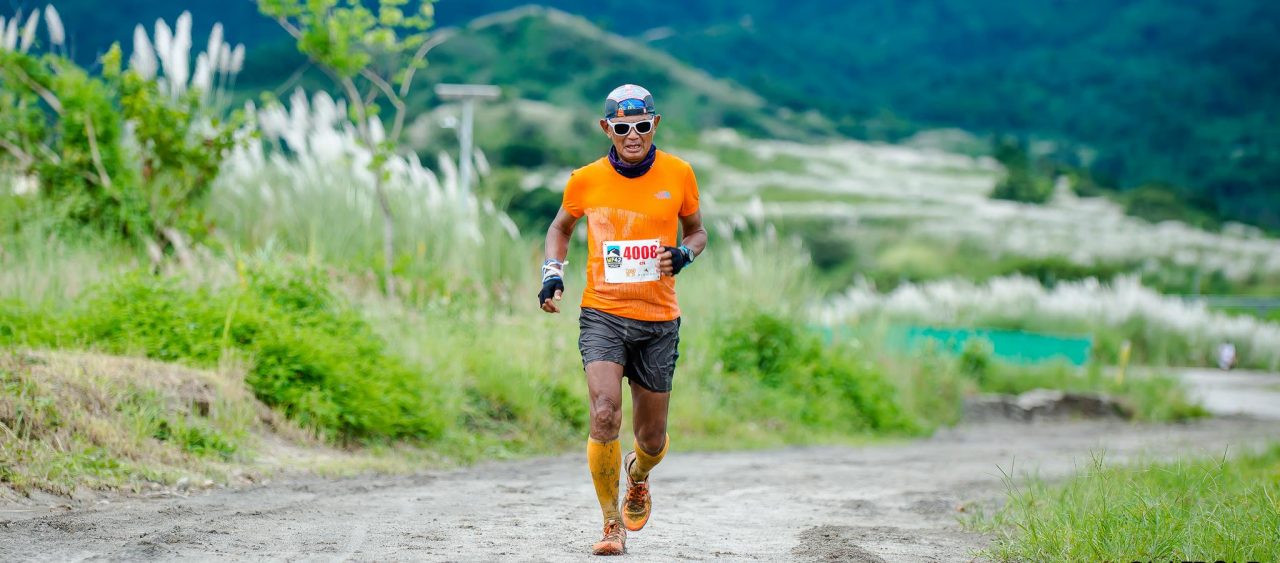
There are three (3) important things or information that I would like to report on this challenging ultra trail run here in the Philippines: First, I finished this race with a faster time as compared to my last year’s performance; Second, This is my third consecutive finish and I am on my way of getting the most coveted Baddest Ass Award for this event with two more editions to finish; and Third, I am still the Defending Oldest Finisher for three consecutive years for this Event.
Even if there is no specific award for the Oldest Finisher for this race, I am sure that I will be the First Senior Citizen to have coveted the Baddest Badass Award before the end of 2017. And maybe, it will mark my “retirement” from ultra trail running. Just maybe!
As compared to my last year’s five-month training preparation, I have a shorter training period for this year which are mostly done on the road, oval track, and hiking in the mountains on the first month of my 4-month training period. However, on the last six weeks/peak period, almost all my training long runs were done on the road, specifically on the road races that I have Race Directed since the middle of September. My Mt Batolusong 25K Trail Run participation was a test to validate my new nutrition strategy and narrow down the things that I need in a hot environment. However, I had more time to work on on my core and to rest/sleep as recovery for my running on the pavement.
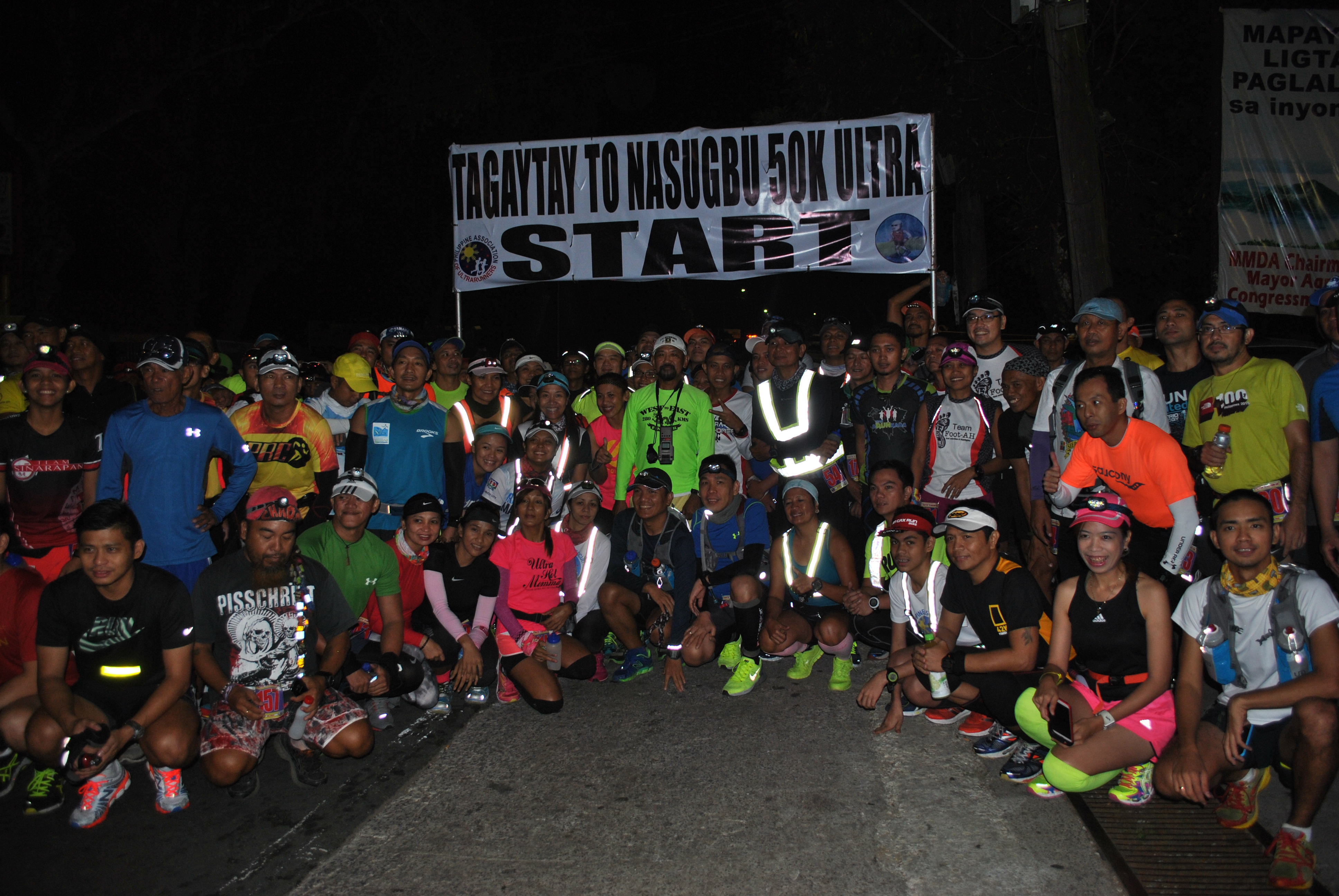
Last year’s Race Report on my second time finish on this event was very detailed and it was divided into four (4) parts and I believe that this is now considered as the number one resource or reference material for those “newbies”/”first-timers” for the CM50-Mile Event. I will not go through to the detailed description of the course and the usual “section-by-section” narrative of my experience on this Race Report but rather state or tell those significant things that made me faster and more efficient in my finish this time. The following are the things that I’ve considered and applied during the race:
Simplicity and Being Light—One week before the race, I’ve decided to use my two-year old New Balance MT Minimus 1010v2 Trail Shoes which is very light (240 grams per shoe) and it proved to be the best shoes for this kind of trail running. Believe me, there was no grain of lahar that penetrated its upper mesh and therefore, its lightness did not change throughout the race. I did not use any Hydration Vest but I’ve used three (3) Simple Hydration Bottles with only one bottle filled with my nutrient mix (Carbo Pro) diluted with water; one bottle of Carbo Pro Powder only; and one empty bottle as my previsionary “Water Cup”. It was only from the AS4 to the Peak that the three (3) Simple Hydration Bottles were filled with Carbo Pro Mix and Water. On my way back to the Finish Line from AS3, I have one bottle filled with Carbo Pro mixed with water and one bottle filled with Water Only. Stashed in my UD Waist Belt Pockets are two (2) Clif Meal Bars & Whistle. I was not wearing a pair of Calf Sleeves.
Familiarity of the Route—One month before Race Day, I went up to the “peak” and Miyamit Falls for a training run. It was on this run that I was able to “program” and plan for my hydration and nutrition requirements. I was able to register also my Average Pace on this part of the course in order for me to determine the “timeline” on each part of the course (from Km #24 to Km #56). I found out that I must be able to leave AS3 on my way to the Finish Line not later than 2:00 PM (13 hours elapsed time) so that I have enough “buffer time” before the cut-off time of 18 hours.
Simple/Light Nutrition—-Eating a Full Meal (Rice & Meat “Adobo”/Beef Steak) before the Start of the Race (30 minutes before) with hydration (water + Carbo Pro), proved that I could last for the first 3 hours without any hydration or food intake. I took two (2) packs of Clif Bloks and One Meal Bar for the whole duration of the race. I would place a Coffee Candy in my mouth regularly in order to maintain a little sugar to my saliva. In every Aid Station, I would drink a lot of water and Coke/Sprite and ingest a number of watermelon bites. I never used the two (2) Sports Gels stashed in my gloves during the race. I did not have any Drop Bags, instead, I used a “FlipBelt” where I stashed my CarboPro Powder Mix and Clif Bloks.
Heat Training & Hydration Strategy Training—One month before the Race Day, I’ve conditioned myself to start drinking my water after running 10 miles (16 kilometres) under the heat of the sun. Yes, I would carry a lot of water on my vest and waist during my training runs but I would finish my workout with only one-third being consumed. I suspect that my practice of ingesting Succeed Salt Capsules (it started last August this year) during my training runs had helped conditioned my body to take in a limited amount of water even if I was sweating profusely without having a “bonking” feeling/situation.
Focused On Moving Forward—I did not spend a lot of time staying on the Checkpoints and Aid Stations. I guess, two minutes of stay was my longest and it could be when I asked one of my running friends to take a picture of me at the “Turn-around” Point at Km #40 and another picture taking at the Miyamit Falls’ Checkpoint. The rest of my brief stops in the Aid Stations were purely on refilling my hydration bottles and mixing my nutrition powder. Instead of stopping in sari-sari stores for ice cold sodas along the populated areas, I opted to take a “quick shower” in a place where the locals were washing their clothes and it made my core and body to be more relaxed.
There are also things that made me slow down during the run. First, I’ve experienced “muscle cramps” on the groin area of my legs along the section AS4 to the Peak that I needed to slow down and hiked on this section. I expected this to happen as I knew I lacked the necessary total elevation gain in my training. This experience never happened in my previous two editions. Second, The heat of the sun slowed me down on the section from the Miyamit Falls to AS4 that I spent almost one hour for a section that is ONE MILE long, instead of power hiking it for about 25 minutes during my recon run. And of course, I carried all my gear down to the Falls from AS4 and back. From AS4 to AS3, I “power hiked” alone on the trail and started running downhill when another runner from behind was trying to pass me.
Looking at my Suunto GPS Watch once I arrived at AS3, I began to be in a “panic” mode knowing that I was registering an Average Pace of 3.0 miles per hour. I knew that it will take me five (5) hours to reach the Finish Line from this point. So, I started to run, jog and power hike until I was able to pass runners who were either lost, simply walking, resting on the side of the trail, or those who would stop in each of the Aid Stations or Convenience Stores along the way.
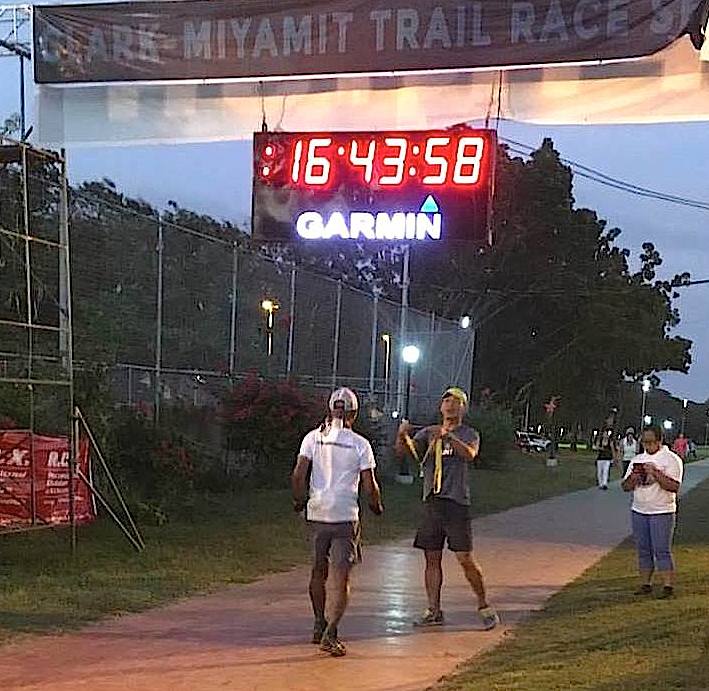
Finally, I finished the race with a time of 16:43:58 hours, faster than the time I had last year (17:50+), with a ranking of #87 among the 132 finishers within the cut-off time of 18 hours. I am still the Oldest Finisher of this race and I have the intention of defending this title for the next two years. Hopefully, I will get the most coveted Baddest Ass Award of this Event.
Crossing The Finish Line With RD Jonnifer Lacanlale
Congratulations To All The Finishers and Thanks to RD Jonnifer Lacanlale and his staff/marshals/volunteers for a successful event.
The training for the next year’s edition will start next week. Keep on running!
I did not realize that I’ve been through with four weeks of my training since I’ve started for the 2015-16 Ultra Trail Running Season. I started my training on August 3, 2015 and the first day was a Rest Day with some stretching exercises.
I am still following a training schedule program which I’ve been using for the past two years with a little adjustment on my weekly training volume which I’ve increased within the range of 5-10 miles per week which are mostly done in my weekend LSDs. Before, I was doing an average of 50-55 miles per week but for the past weeks, I’ve have reached a peak of 66-67 miles per week. I feel okey, healthy, and pain-free from my knees and legs and had no bouts of leg cramps or “bonking”. I guess, there must a lot of good reasons why at my age of 63, my knees are still holding up and I could still hike some steep mountains.
Surprisingly, the bottle of Aleve that I bought lately have not been opened yet and for the past four months, I’ve never taken any pain-killer tablet in my races and trail running workouts.
My past failures to finish a 100-mile mountain trail run were caused by nutritional and hydration problems on my part. It took me two or more years to experiment what is good for my body. I really don’t have any problems with 50Ks, 50-milers, and 100K trail races with regards to nutrition but when I join 100-milers in higher elevations, my nutrition just put me down on the last 30 miles of the race. Following my experiences in the 100Ks that I’ve finished, I would only take in Energy Gels and Water and some solid foods offered at the Aid Stations and I would finish the course without any problem. I bought some nutrition books for endurance athletes and made some researches on the Internet. In addition, I was able to get some suggestions and advise from the Filipino veteran ultra runners residing in the United States. These suggestions from them confirms the studies and researches that I’ve read on books and on the Internet.
On this new training season, I’ve concentrated on my nutrition, not only before during, after my workout, but completely observed my daily nutritional intake to my body. I don’t count the calories of the food that I ingest but I make sure that I have Carbohydrates, Fats, Proteins, and Vegetables/Fruits in my 3 meals a day. Snacks in between meals would be anything, whether it is a fruit juice, milk, fruits, yogurt, or snack bars. I’ve never drink milk when I was in the military up to 2 months ago. Lately, by accident, I found out that Organic Fresh Milk does not give me stomach trouble caused by lactose intolerance. I’ve indulged myself in eating avocado as part of my meal or snacks and ate more foods rich in fats.
On my nutrition before my runs, I would have a breakfast of coffee, oatmeal or cereal with milk, avocado with milk & sugar, yogurt or fruit juice.
During my runs, I would hydrate every time my GPS watch would beep to indicate that I’ve covered a mile and have to strictly do the said “drill” every time I hear a beep. For my runs less than 8-9 miles, I would just drink water and ingest one 1 capsule of S’Cap every hour and after the workout. But for my LSDs on weekends which are more than 9 miles, I would carry with me a Tailwind Mixed with water in two bottles and purely Water in my 1.5-liter hydrapak on my backpack. I would alternately, drink Tailwind and water every other mile. I would also ingest 1 capsule of S’Caps every hour. At the turn-around or after finishing the first half of my run, I would eat any solid food I brought with me like, boiled potatoes, power bars, dried fruits, and some baby foods (fruit/vegetable).
I’ve stopped using Energy Gels in my runs since the start of this training but I still carry at least two packs just in case of emergency. I’ve have observed in my past races that Gels, after ingesting about 10 pieces, I would end up throwing up even if I use different flavors and flavors that I liked that didn’t give nauseated feeling in my past ultra runs.
My post-nutrition intake would be immediately after the workout——lots of water, one can of coke or one bottle of Ensure and a Power Bar. Once I arrive home, I would eat a complete meal. For the rest of the day, I would continuously hydrate myself with water, sometime consuming 1.5 gallons of water, and strictly adhering to my complete meals—carbohydrates, fats, protein, vegetable and fruits.
I have also incorporated “speed” workouts in my weekly program. Wednesday is usually my “speed” day where I do it on a flatter ground and paved road. This is the only time that I don’t go to the trails and mountains. Since there is no oval track near my place, I would go to a Public Park (Echo Lake Park) where the streets that surround it has a total loop distance of exactly one mile. I would do 1 mile X 5-6 repetitions or 2 miles X 3 repetitions with at least 5-6 minutes rest/jog intervals in between repetitions. In the mountains/trails, I usually do some “strides” or fast & quick leg-turn-overs on flatter portions within a distance of 50-100 meters just to give some “wake-up” drill to my tired leg muscles.
Once or twice a week, I would go to a mountain which has an “up and down” route where I have measured on each way (2.5 miles up & 2.5 miles down). I would wear my hydration vest full of 2 water bottles and 1.5-liter of hydra pack on my back with solid foods. I would practice “power-hiking” on the UP portion of the course and never attempt to do any run or jog. I would register the time from the start up to the time I reach the peak of the mountain. I have observed that I had been improving my time to reach the peak every week. The 2.5-mile distance has a vertical distance of 1,280 feet and my best time so far is 43 minutes for the power hiking in the UP direction.
On the ridge of the mountain, I would continue jogging and hiking for about 2 to 3 miles. On my way back, I would start my fast “downhill run” on the measured portion where I had my “power-hiking” workout. My attitude here in the fast downhill run is a “go for broke” one! A fast and continuous downhill hill run for 2.5 miles would “thrash” my legs! I am surprised that my old knees can still withstand the hard pounding of my feet on the ground. Every week, I would improve on my time on this downhill run! My fastest time for the downhill run is 20 minutes!
Power Hiking and Fast Downhill Running made me register a faster pace and speed for my daily runs!
Two years ago when I shifted to trail running, I did not give any attention to the vertical distance (total ascent/descent) in my workouts but it was later last year that I have concentrated more on the vertical distance of the trails I’ve been into. However, since I’ve started this new training season, I made sure that my weekly totals on the vertical distance will not be lower than 6,000 feet.
On Mondays and Fridays, I would do some stretching and calisthenics/core strengthening exercises. I would also do “foam rolling” to my legs for about an hour with more concentration to my calves, hamstrings, quads, and butt muscles. I stopped my lap swimming for the past weeks and by the end of the 7th or 8th week, I would incorporate (stationary) cycling in my weekly workouts.
On my weekend LSDs, I don’t eat a heavy breakfast (ingesting only coffee) as I want to simulate how I would apply my nutrition and hydration strategy when I am about to reach my “bonking” period which is about 1-2 hours after the start of my run. This is where I would observe how my body would react to any food or fluids that I take in, whether it is water, Tailwind, S’Caps, solid foods (power bars/baby foods/power bars/dried fruits), electrolyte mix, or Clif Bloks. So far, my maximum LSD distance was 20 miles in 6 hours, carrying a heavy load of water in my hydration vest (2-20 oz of water bottle & 1.5-liter hydrapak on my backpack + solid foods). However, if I use my 2-16 oz Simple Hydration bottles (tucked in my race belt with power bars) and one hand-held 12 oz handheld water, that same distance of 20 miles is usually done in 5 hours or less!
On the technical aspect and the monitoring of my body’s feedback on my performance every workout, my Suunto Ambit 3 Peak GPS Watch, had been very useful in monitoring my Heart Rate, VO2, Cadence, Calories Consumed/Burned, and Recovery Period. From these data, I would be able to know on what to do for my rest and recovery for the next workout. My daily workouts are properly recorded in a notebook/journal that I would religiously write every time I finish a workout, to include, what I feel before, during , and after the workout.
In summary, I attribute my faster and better performance in my 4 weeks of trail running due to the following: (1) Better nutrition before, during , and after every workout; (2) Constant hydration with water every mile with Tailwind every other mile; (3) Speed workouts on Wednesdays and incorporation of “strides” in my daily runs; (4) Adapting my body to ingest S’Caps/Salt Sticks during the run on hotter days without any negative reaction to my body; (5) More vertical distance and higher altitude hiking/downhill running would acclimatize my respiratory system; and (6) “Foam Rolling” & Stretching with Core Exercises twice a week.
I’ve been using my Hoka One One “Speedgoat” Trail Shoes for my LSDs and most of my daily runs while my Inov-8 Race Ultra 270 Trail Shoes and Hoka One One Challenger ATR would be used in my recovery and tempo runs.
Monthly Mileage (August 2015): 238.65 Miles or 381.84 Kilometers
My friends and contemporaries would always tell me that I am CRAZY to be running ultra marathon distances in the mountains in the country as well as in Asia and the United States. I just smile because that is the best description we (as ultra runners) could get to those who have not yet experienced our sports. But now, more ultra runners have extended their body limits and endurance by introducing a 200-mile endurance mountain trail event which has doubled the famous 100-mile distance which is now being accepted as the NEW Marathon Distance in Ultra Running. The runners of this new event could be the CRAZIEST of them all and since it was introduced only last year in the first edition of the Lake Tahoe 200-Mile Endurance Run, three of these events had been scheduled for this year and called the Grand Slam of 200-Milers (it was supposed to be 4 races: Colorado 200; Arizona 200; Lake Tahoe 200; and Bigfoot 200 but the Arizona 200 was cancelled).
Let me introduce to you the CRAZIEST Ultra Runner who just recently finished the 1st edition of the Bigfoot 200-Mile Endurance Run——Conrado Bermudez Jr! Being the FIRST Pinoy to have finished this mountain ultra trail running event, it would be proper and fitting to have his story in running to be published here as one of the main highlights of this blog with the hope of inspiring others and telling to the world that we, Filipinos, are very strong and resilient in nature.
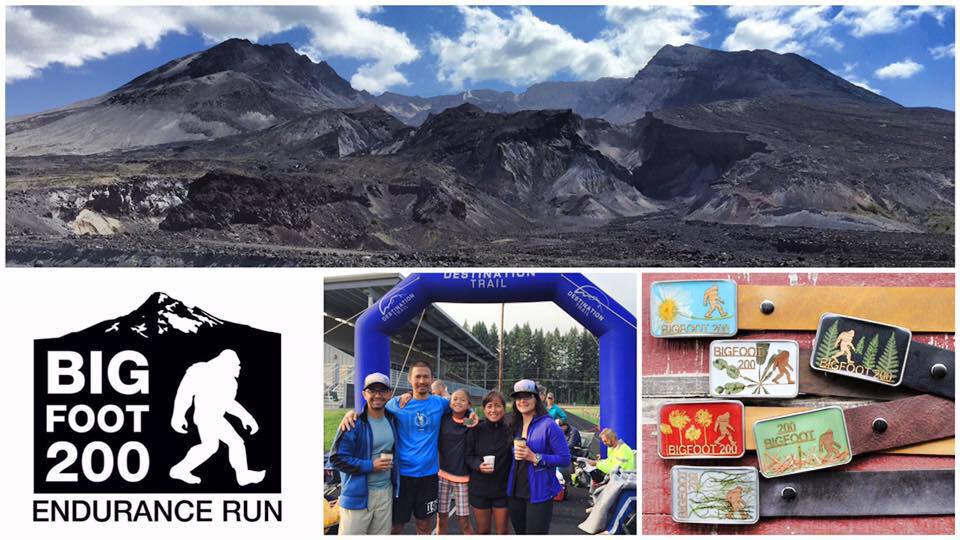
Bigfoot 200-Mile Endurance Race Picture Collage
Conrado Bermudez Jr, or fondly called as “Jun”, finished the 200-Mile Race in 94 hours, 26 minutes, and 30 seconds, placing himself as #40 among the 59 finishers where 80 runners started in the morning of Friday, August 7, 2015 at the Mt Helens National Monument in Washington State. The race has a cut-off time of 108 hours which is equivalent to 4 1/2 days, forcing the runners to complete 45 miles per day during the race. The following is the general description of the race as taken from its Website:
“The Bigfoot 200 is a trail running event in the Washington State that seeks to give back to the trails by inspiring preservation of the wild lands and donating money to trail building in the Pacific Northwest. The race is a point to point traverse of some of the most stunning, wild, and scenic trails in the Cascade Mountain range of Washington State. The Race ends in Randle, WA after traversing the Cascade Mountains from Mt St Helens to Mt Adams and along ridge lines with views of Mt Rainier, Mt Hood, and more!
The race will bring together people from all over the world to tackle this incredible challenge. With over 50,000 feet of ascent and more than 96,000 feet of elevation change in 2015 miles, this non-stop event is one of a kind in both its enormous challenge and unparalleled scenery. The race is not a stage race nor it is a relay. Athletes will complete the route solo in 108 hours or less, some without sleeping.”
Jun finished the race with barely 6 hours of sleep during the race! He was supported by his wife, Kat, their daughter and running friends who would meet him in Aid Stations where there is vehicular access. For more details of the race, one can visit the following link:
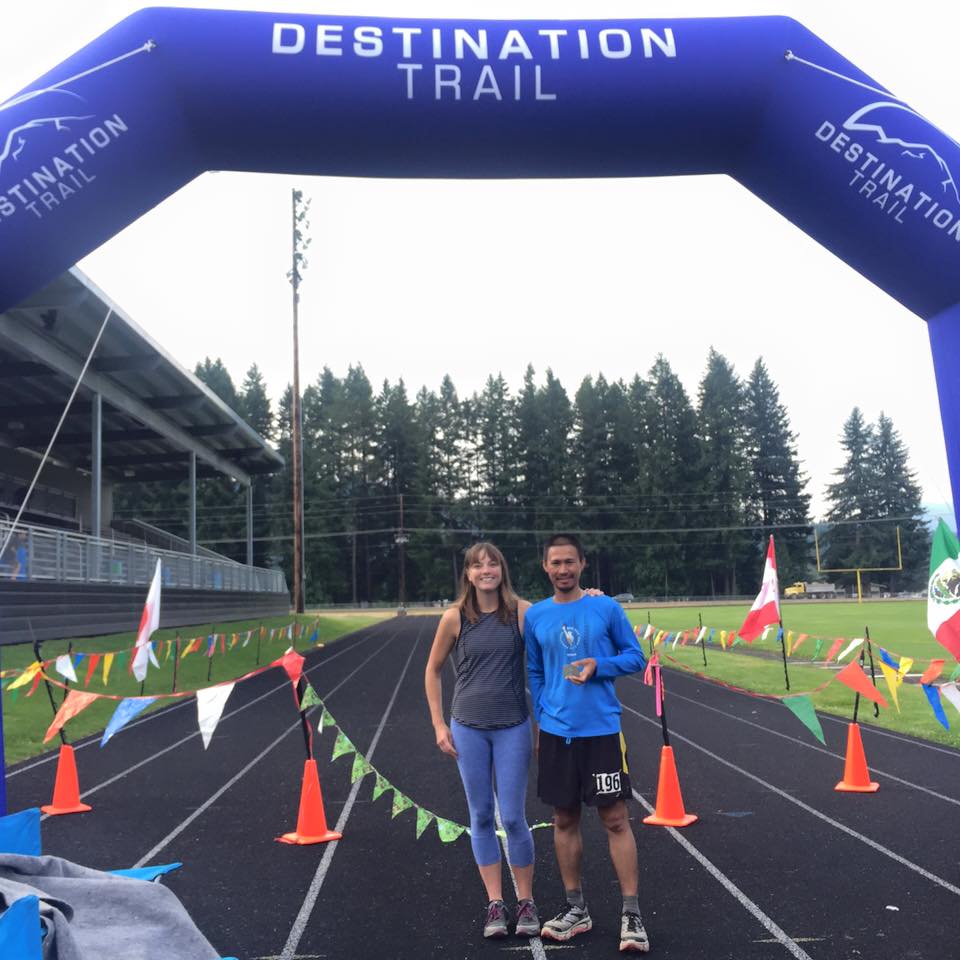
Finish Line Of The Bigfoot 200-Mile Race With The Race Director (Photo From Facebook)
Jun is a native of General Santos City, graduate of the Philippine Military Academy belonging to Class 1996, a Special Forces Airborne, and Scout Ranger of the Philippine Army before his family migrated to the United States.
In my interview with him on the later part of last year after he finished the other 3 100-Milers in the Grand Slam of Ultrarunning (except Western States 100); he recollected that he first personally met me when he was the Aide-De-Camp of the Commander of the Southern Command in Zamboanga City and I was then the Commander of the Task Force Zamboanga. The year was 2000 and he was barely 4 years in the military service. He went further to tell me that he got inspired by my blogs and photo running galore through my posts in our PMA Bugo-bugo Facebook Page.
Jun finished the prestigious Boston Marathon Race in 3:11:14 hours.
The following are the some of the data about Jun and the answer to the questions I’ve asked him:
1. Home Province-Gen. Santos City; Age-42 ; Height- 5’9″; Present Body Weight-146 lbs ; Schools Attended (Elementary to Graduate Schools)-Notre Dame of Mlang, Noth Cotabato (Elem), Notre Dame of Dadiangas College-High School Dept; PMA Class-1996 and Special Training in the Military-Scout Ranger, Airborne.
2. Places of Assignments and Positions held in the Military/Philippine Army:
Platoon Leader- Alpha Coy, 25IB, PA as Ready Deployment Force (striker battalion) of 6ID in Maguindanao, Sultan Kudarat, Cotabato Province. My platoon was also involved in capturing Camp Rajamuda in Pikit, Cotabato Province in 1997.
Company Commander- Bravo Coy, 25IB, PA , mostly deployed in Maguindanao. My company was also deployed in the front lines of Matanog and Buldon and was very instrumental in capturing Camp Abubakar.
3. Present Job & Working Hours-Security Officer in the United Nations Headquarters in NYC and works on day shift; City of Residence in the US-Jersey City, New Jersey; Wife’s Job- ER Nurse; Gender & Number of Children- one daughter
4. Brief Background of Running (during Childhood up to College and as Cadet of the PMA)
I started running when I was 7 years old. I grew-up in a farm and the only playground we had was an open field and trails where we would run and tag each other. In elementary and high school, I was so engrossed on soccer games than any other ballgames. This is why when I joined the PMA, I discovered that I was a decent runner because I was always in the lead pack when we had our 2-mile run as part of our physical fitness test. I also represented my company (PMA) in various races but most of the time I bonked because I usually go all out at the start and faint halfway through, which resulted to my ER visits. My style of running then was with a “do or die” mentality; no technique, no proper hydration and nutrition. It was just a plain “old-school” way and lots of brute force.
5. Best time in 5K- 19:22; 10K-42:08 ; Half-Marathon-1:26:52 ; and Marathon-3:11:14 All were done in 2013.
6. Brief story on your exposure to ultra distance running events—-first 50K; first 50-miler; first 100K; and first 100-miler.
I started joining races in 2012. That year I only finished 2 marathons. I was following your blogs and postings about the Bataan Death March 102 and 160 and the other races you directed and I got inspired by the spirit of the running community, and it was that I got curious about ultrarunning, especially the 100-mile distance.
To start my ultrarunning quest, I signed-up for a local flat, out-and-back, looped course. Thinking that 50km was just over a marathon, and 50 miles was just 2 marathons, I signed-up for a 100k, which was held in March 2013 in New Jersey. I’m glad that I met some new good friends there, who are now like a family. I was so proud that I finished in that muddy, swampy, and cold course third place. My wife and daughter were there for my first ultra. As a solitary person, running alone for a day was not such a big deal. The feeling of finishing a long distance further boosted my spirit… I got hooked. Then I signed-up for my first 100 miler scheduled three months after. It was in June in the inaugural Trail Animal Running Club (TARC) 100-Mile Endurance Run and the first 100-mile run in Massachusetts. The race started at 7 pm Friday with a cut-off of 30 hours. The course was in a 25-mile flat trails with some creeks spread along the way. I was very enthusiastic to train knowing that some of my friends are also running the race. As part of my preparation, I was reading some blogs and race reports, and I even asked your advice on how to deal with the distance. You discussed to me the proper nutrition and hydration and also incorporating hike into running. The course got indescribably muddy, with most sections in knee-deep mud in every mile, but with my grit and determination, I was able to finish despite a big number of DNF in the race. I felt reborn and my spirit was so high. It took me a week to recover from the pain.
In November, I did my first 50-mile race as a finale for the year. The JFK 50 Mile is the oldest and the largest ultramarathon in the US. The course is a combination of road and trail. It passes through the Appalachian Trail and C&O Canal Towpath then ends in an 8-mile paved road in Maryland. The course was pretty easy and fast. This is where I met some new hardcore ultrarunners from the Virginia Happy Trails Club.
After running all long distances, I signed-up for my first 50k as part of my back-to-back training for my incoming six 100’s. The Febapple Fifty was held on Saturday of February 2014. Then the next day, I ran the Central Park Marathon. The Febapple race was fun. The course was filled mostly with knee-high ice and snow in a rolling hills of South Mountain Reservation in New Jersey. It was quite a tough race because the ice turned slushy and it was a bit hard to run. I still managed to finish in the top ten.
All of my first attempts of these distances were mostly to get me into groove to venture and discover ultrarunning. I realized the 100-mile distance is my favorite.
7. Training Preparation in your 100-Miler Races and Nutrition Strategy in your Races. How do you balance your training with your work and family? (*I will discuss my training in item # 9).
In short ultra races, I carry a handheld bottle or belt hydration system. They are lighter that I could run faster. I take one salt tablet every hour but if I sweat a lot, I take two every hour and nothing at night when it’s cold. In aid stations, I eat potato, banana, watermelon, and PB & J aside from the Ensure that I carry as my basic load. I make sure I take more nutrition at the early stage of the race. I also drink ginger ale and Coke/Pepsi to refresh my mind from the lows.
I come home from work around 8pm and do my chores and help my daughter do her homework. If all is done, I relax for awhile and train. It usually takes me an hour or two to finish my training. I sleep around midnight and wake-up at 6am. I am fortunate that my wife is also supportive of my passion as she herself is an ultrarunner. And our daughter is also our number one cheerer. So far, everyone is in sync in the family.
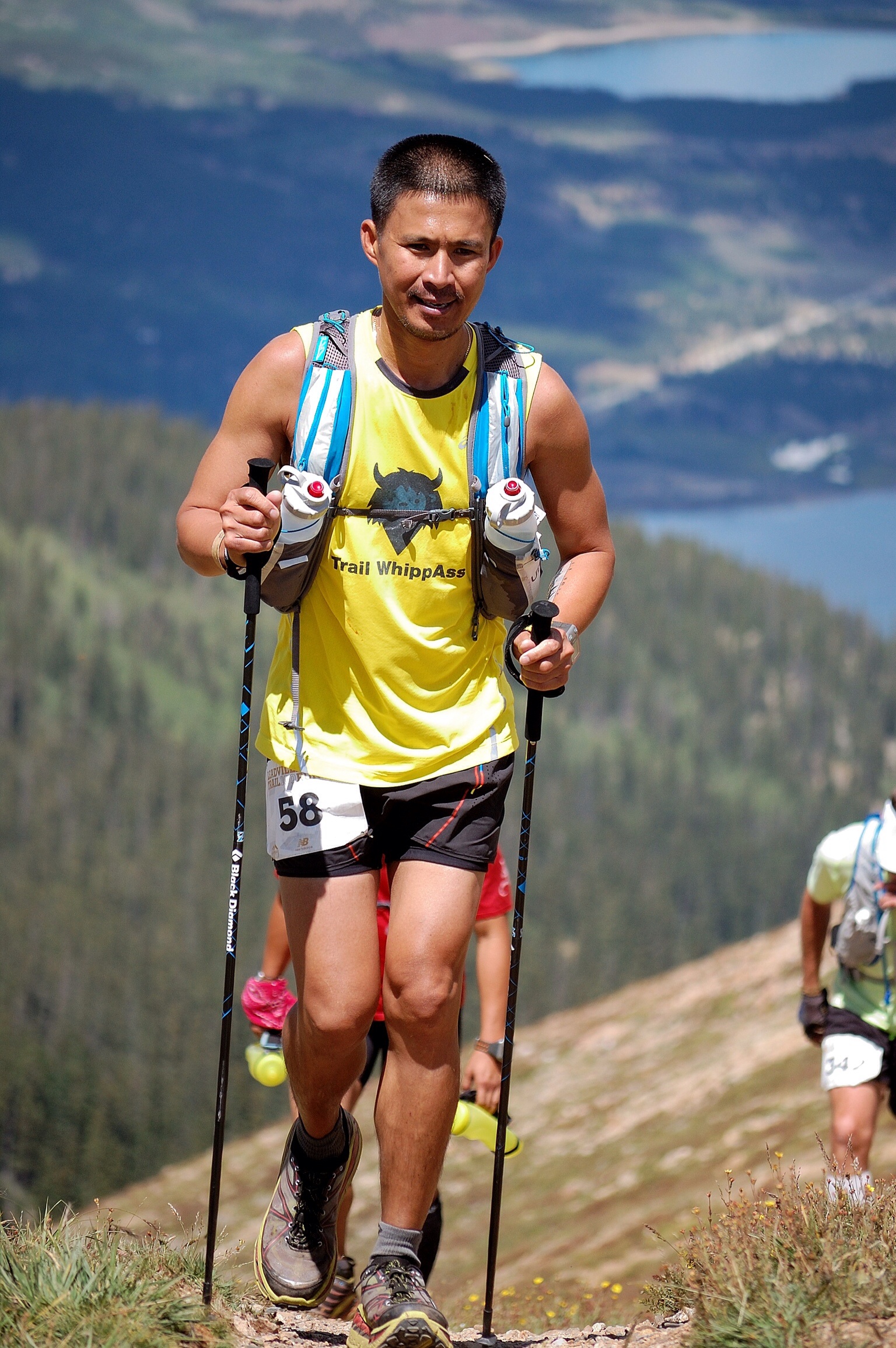
Jun Bermudez @ Leadville 100-Mile Race (Photo From UltraSignUp)
8. Were you aware of the US Grand Slam of Ultrarunning? Since you missed the Western States 100 this year, do you intend to take a shot on the 2015 US Grand Slam of Ultrarunning?
I did not have my qualifier for Western States last year. I was already aware of the Grand Slam of Ultrarunning, so to get the feel of it, I tried to sign-up for six 100-mile races. I put my name in Massanutten Mountain Trail 100 and Wasatch Front 100 for lottery and fortunately, I was accepted. Since I have proven that I could finish multiple races in a gap of 3-5 weeks, I have more confidence now to challenge myself in GS in the future. There’s only a slim chance for me to get into Western States with one ticket but I will make sure I will apply every year to increase my chances. If not, I am planning to do more challenging 100-mile mountain races next year. It just sank-in that what I did was insane. Every time I finished, I cursed myself for signing-up and promised myself not to do 100’s anymore. But a couple of days after, I feel that I am ready to go again. Thus, if ever I am accepted in Western States in the future, I won’t hesitate to join the Grand Slam.
9. Knowing that you are a “lowlander”, how did you train for the 100-mile mountain races that you finished? How did you cope up with the possibility of encountering “high altitude” sickness in your latest two 100-milers?
My training was focused in strengthening my legs, ankles, and feet in battling the rigorous technical terrain. But 90% of my training was indoor because of my busy schedule, and I have a child to watch that I could not leave at home if my wife is working or training for her ultra events. I usually do stairs workout, climbing up and down, up to 250 floors without rest every two weeks, which is a great way to improve my VO2max and giving me more mountain legs. Most of the time, I abuse my incline trainer/treadmill, which goes to 40%. I use it for incline hike/run with 10-15 lbs of rucksack together with my 2.5 pounder ankle weights. Although I hated speed workout, I still do my 5k in treadmill and this keeps my pace honest. Sometimes I do my trail long runs in the weekends with my friends but most of the time, I am stuck on my treadmill. Treadmill running is boring but it gives me more mental conditioning to tackle the distance. Aside from that, it also preserves my feet from the hard pounding of the pavement. I don’t really track my weekly mileage because I don’t have a proper training plan that I follow. I just listen to my body and do whatever I feel I need to work on. And to avoid injury, I do strength and core workout twice a week.
In an attempt to combat altitude sickness, I was taking iron, B complex, and vitamin C supplements. But these didn’t really help much. I still got more vomitting in Leadville (12,600 ft highest altitude) after mile 60 and had some also after mile 70 in Wasatch.
10. How did you balance recovery and preparation in between those 100-milers for the 6-month duration of your ultra events?
I treat every race as my long run. After the race, I relax, stretch, and foam roll for 3-4 days to get rid of the pain. I also come back to work 2 days after the race. At work, I stand for 6 hours. I think standing at work and walking from home to train station and to work helps my fast recovery. At the end of the week, I start doing easy runs again. Then the next week, I go back to my usual training routine. My taper starts 2 weeks before the next race. I did this routine in my last four 100 milers. In fact, I was feeling fresh every time I start the next race and my spirit gets stronger. I was amazed that I was able to do sub 20 hours in 3 100 milers. Although I did not achieve my goal of finishing Leadville 100 in sub 25 and Wasatch Front 100 in sub 30, I am still ecstatic that I finished those races SOLO (no pacer, no crew) and without getting injured. When I finished Leadville 100, I focused more on recovery by just doing stretching, hiking and easy runs. It was in Leadville that I suffered much because of the altitude and my mistake of not hydrating properly. I had nausea and I threw up every time I ate and drank after mile 60, and I was also suffering from a bad stomach issue. Wasatch is harder than Leadville. But due to my proper hyrdation and nutrition, I felt better and stronger although I still had gastrointestinal issues around mile 70, but later I managed to cope with them by slowing down and taking my time at aid stations to recover.
11. What are your tips and advise to those who would venture to mountain ultra trail running events. What would be the things that you have to improve upon if ever you want to improve your performance in your previous 100-milers?
It takes a lot of discipline. Training involves time away from your family and it is important that no matter what, family comes first. It is helpful if your family is supportive, so that is paramount in your quest for ultrarunning and paramount in the list of things you have to make sure you obtain, foremost.
Never be afraid of the adventure. It is not always about the destination (aka finishing) but the journey. That is my advice to other runners.
Personally, I think I need to improve on certain strategies like hydration and nutrition. Also, not just to eliminate issues like GI problems that come with certain races, but— more importantly— how to perform well regardless of these problems because, lets face it, problems encountered during races MAY NOT ever go away. So it is a matter of pushing past these issues and finishing strong. Thats what I need to work on.
12. Aside from the 2015 US Grand Slam of Ultrarunning plan, what is in store for you in the coming ultra running years?
I want to venture into other Ultra races. The challenging ones, in particular. There are many races out there to explore with challenging course and beautiful sceneries. When they go hand in hand, they become priceless experiences, especially when you finish them. Like I said, mountain 100-milers are my favorite, but that is not to say I will not try to explore on distances beyond that. We’ll wait and see.
Jun could not stop wanting for more and he is now one of the few mountain ultra trail 200-mile single stage finishers entire the world. For the past two years, he has the following 100-miler mountain trail races with their corresponding finish time in his belt :
TARC 100-Miler in Westwood, Massachusetts (June 14, 2013) —-25:19:27 hours
New Jersey Ultra Trail Festival 100-Miler in Augusta, New Jersey (November 23, 2013)—-18:53:31 hours
Massanutten 100-Miler in Front Royal, Virginia (May 17, 2014)—-28:05:55 hours
Great New York City 100-Miler (June 21, 2014)—-19:33:14 hours
San Diego (California) 100-Miler (June 6, 2015)—-22:16:27 hours
After his sub-24 hour finish at the San Diego 100-Mile Endurance Race, I told him that he has to rest and recover in between his races to let his body free from injuries brought about by over racing or over training in ultra distances. I even told him that he has to prepare for the possibility of being selected in the lottery for the Western States 100-Mile Endurance Race if ever he registers to join the race. I emphasized that I am betting on him that he will be the FIRST Pinoy Ultra Runner to be awarded the “One Day-24 Hour” Silver Buckle in the said race and I am sure that it will take another generation of Pinoy Ultra Runners to surpass such accomplishment.
My prediction on his ultra running career brought not a single word from his mouth but instead responded to me with a smile. Jun is a silent type guy and does not openly brag about his ultra running finishes on the Social Media and he does not even have a blog or journal where he can relate and share his stories in his ultra races. However, my interview with him has a lot of tips and advise for those who would like to embark on mountain ultra trail running, most specially to those who are in the lowlands and for those who don’t have access to the mountains or simply lazy to be in the outdoors.
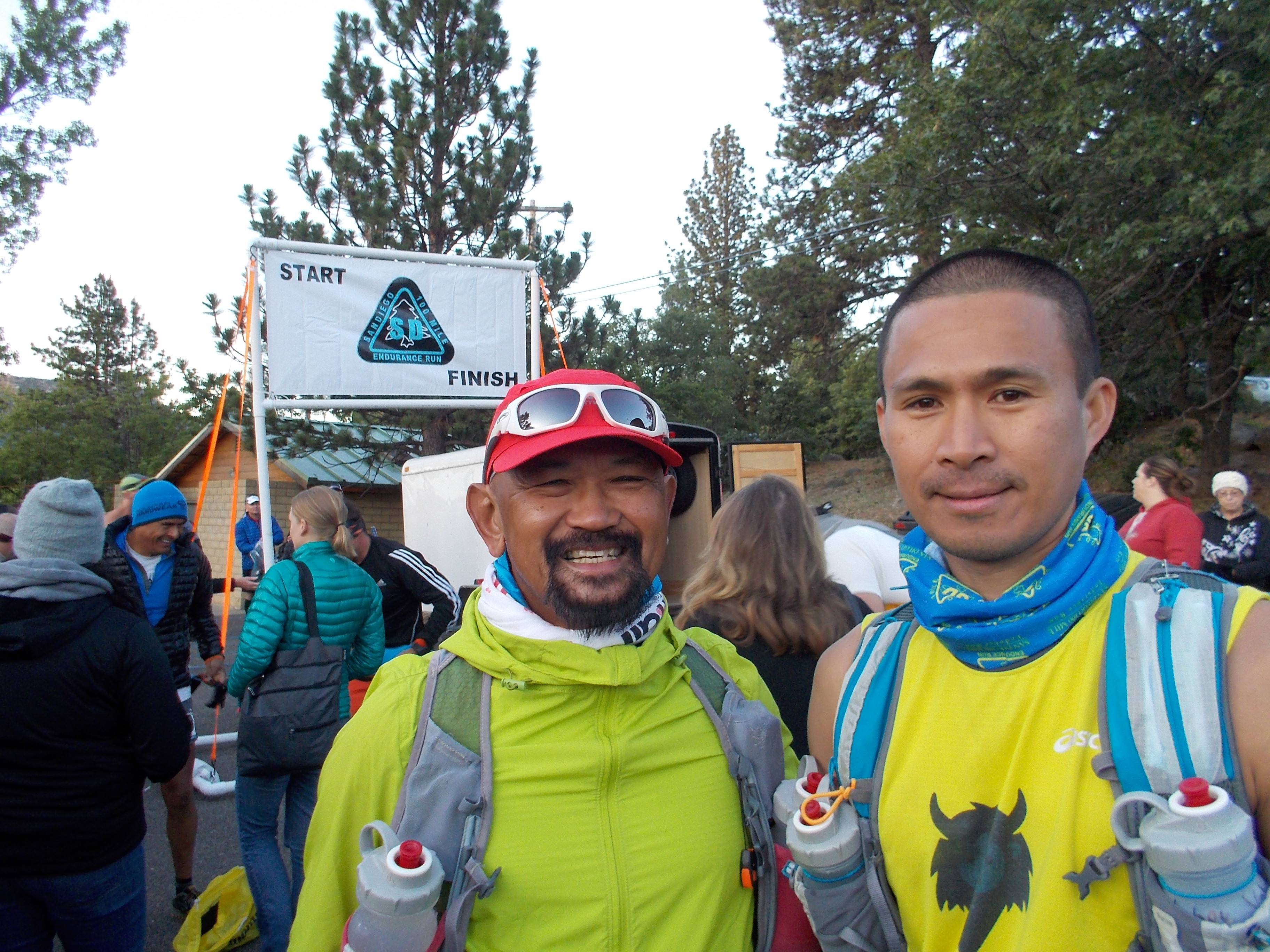
BR & Jun @ Lake Cuyamaca
Before we parted ways in Lake Cuyamaca in Mt Laguna, San Diego, California, he intimated to me that his ultra running career is not complete if he will not be able to finish the Grand Slam of the Bataan Death March 102/160 Ultra Marathon Race! Hopefully, that will be the day that Jun will be able to meet the whole Pinoy Ultra Running Community in his homeland.
This is what I said to Jun, “Get your Western States 100-Mile Silver Buckle first before coming home, Cavalier!”
(Note: Jun had been using HOKA ONE ONE Shoes in all his trail running races and training)
The “1st Running Boom” was felt in the Philippines after Frank Shorter of the USA won the Gold Medal in Marathon in the 1972 Munich Olympic Games which resulted to the conduct of more Marathon Races and other Running Events in the United States. Of course, more books and publications on running had been published making the sports more accessible to the public. The “ripple effect” on the popularity of Running in the USA had reached the shores of the country and it was too easy and convenient due to the direct interest and involvement of the government and the support from the private sector as sponsors, as well as, Race Organizers. It was also the period of Golden Age In Athletics in the country due to the government’s Project “Gintong Alay”, that produced our best athletes in medium to long distance runners and ultimately, which also catapulted us among the bests in the ASIAN Games and Southeast Asian Games. (Note: If you want to read more details on the “1st Running Boom” in the country, you can browse on my previous posts in this blog. Be patient.)
In the mid-80s, specifically, after the February 1986 EDSA People Power Incident and the change in Political Leadership, the conduct of Running Events had diminished but some of the international/multi-national companies in the country continued their yearly events as Race Organizers, maybe, it’s because it is one of their “tax shelters” or tax-deductible items and not so-much as an income generating activity for the company. It could had been a part of their so-called “Corporate Social Responsibility” by giving back something to the public as their main stakeholder. As for the government, there was no initiative to conduct such running events and the elite program in sports was ignored and shelved without any attempt of resurrecting it up to this time.
In the advent of the Internet and its accessibility to the country, the Social Media, through WordPress and Blogger, anybody who owns a laptop or computer with connection with the Internet, can already write anything under the sun and have it posted so that others could read them. In the country, Bull Runner started a running blog and I followed (after 5 months) to create my own and the Bald Runner was born and the rest is history. The year was in 2007.
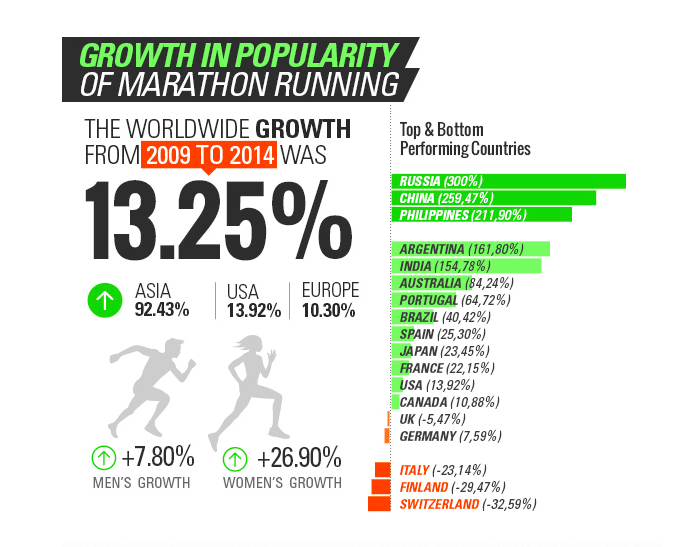
So, let us now go where this post is leading to. Few months back, there was a study published by RunRepeat.com showing data and observations about the rise of Marathon Running since 2009 and the study covered the period 2009 to 2014. The study compared the marathon activities and performance across all nations with a database of 2,195,588 marathon results and according to the study, their analysis is the largest in history of running. The research/study is entitled: Marathon Performance Across Nations. The details of the research could be seen here:
Out of the so many factors and topics on the research/study, this post will be dealing on the growth of Marathon Running in the country (Philippines) based from the data below:
Screenshot Taken From The Study
It appears that we are in the Top Podium, being the Number 3 in the Top Performing Countries with regards to the Growth In The Popularity of Marathon Running during the period of the study. We have a 211.90% growth in the Philippines which is HUGE! And as such, we also contributed as the Top Continent in the World (ASIA) with a 92.43% growth which is also huge! I can only surmise that Bull Runner and I were the “catalyst” of this phenomenon in the country as other bloggers/runners followed to create their own blogs whether they are there as “real and dedicated” runners or simply as running resource for running events or fond of “reposting” articles or links in the Internet related to Running.
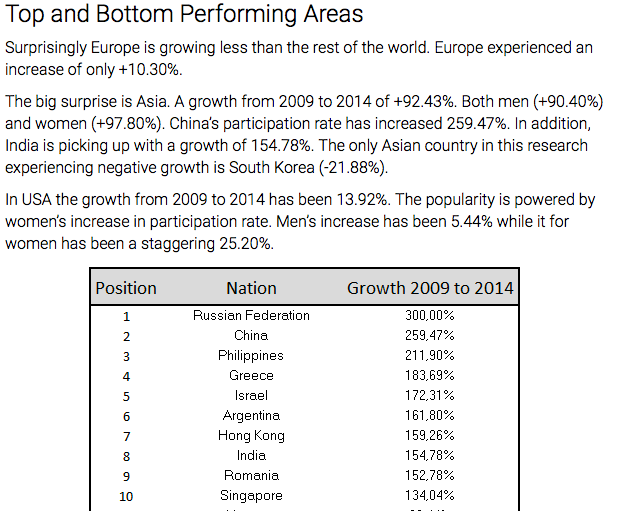
In the data below, China beats us for the 2nd place by mere 47+% but as compared to our population with theirs, our growth in running is REALLY HUGE!!! Other countries in Asia are also significantly growing in marathon running, Hongkong is #7 followed by India with Singapore as #10.
Screenshot Taken From The Study
Based from the data above, I would conclude that we are in our “2nd Running Boom” era. I could see that this is a good sign of things that had been happening since 2009 and for sure, more positive to come in the future. Why? Because the data portrayed had been good to the economy of the country! (Find somebody who is graduate of AIM or any Business Degree for the explanation!) There could be some exceptions to this case but I am very positive that this growth in marathon running had and will have a direct contribution to the economy of our country in the future.
In short, I am happy that I am one of those who are contributing to a positive outlook in the economy of this country due to running.
By the way, can somebody who has the time and resources/contacts come up with an Annual Report of Marathon Running in the country? A good reference would be what the USA is doing for the past years as seen in these links:
I wonder what would be the data and analysis if a study or research would be made for ultra marathon events, as well as, trail running events in the country would be like ever since I started with the Bataan Death March 102 Ultra Marathon Races and other PAU Races. I am sure, this will be an interesting one. But that will be another story in this blog!
Those “one-liners” below were the supposed titles which I would choose for this post but I ended up with a General Statement of what is really happening in our Running Events. This is again a very long post which will compensate the long period of time that I was not able to post in this blog. So bear with me and hope that my post will somehow prevent “Mr Murphy” from creating a havoc to our well-planned or well-organized running event. Happy reading!
Why Runners Die In Running Events?
Things To Do If You Want To Die In A Running Event
Why Die Running When You Are Supposed To Be Having Fun?
How Can We Prevent Deaths In Running Events?
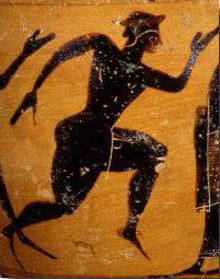
Phidippedes (Picture From Google)
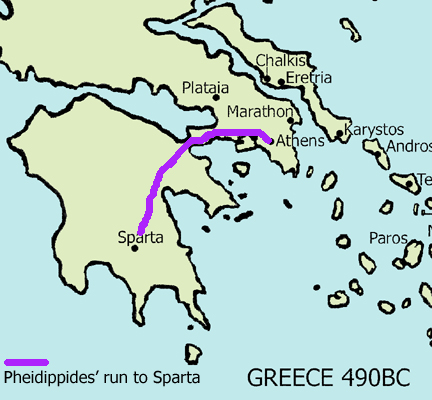
If you want to relive the origin and history of the Marathon Race, you are not Phidippedes, who was then a professional runner, messenger and one of the warriors of the Athenian Army before and after The Battle of Marathon in 490 B.C. If you don’t know what went through with him, then I have to refresh you with what he did before and after the said battle. Phidippedes was sent by the Athenian Army Generals to ask help and for additional troops from Sparta to repel the impending attack by the Persian Army by running a distance of 140 miles in 36 hours. After getting a negative feedback from the Spartan government, he went back to Athens running the same distance delivering the message of the Spartans. Without the support from Sparta, the Athenians went to battle with the Persians at the Battle of Marathon and the Athenians won with the surviving Persian Army retreating through their ships and tried to make their way nearer to Athens. Phidippedes was sent to Athens to deliver the message that the Athenians won the battle and warned the remaining Greek Army to prepare for the impending attack of the retreating Persians. After delivering the message, Phidippedes died despite running a distance of 26 miles. Thus, this heroic deed of Phidippedes as a runner-messenger gave birth to our sports of Marathon Running. (Note: If you read closely to the history, Phidippedes’ deed also gave birth to Ultra Marathon events!)
Map Showing The Locations Of Athens & Sparta (Picture From Google)
In this modern time, you, as a runner is not Phidippedes! You are not a trained warrior or a soldier of an Army who dons a warrior’s armor and spear or sword, running on trails and mountains or hills and through vegetation on sandals or maybe, on barefoot! Organizers of Running Events are already well-equipped and prepared to prevent and respond to any contingencies, more so, on the safety and well-being of every runner-participant. Nobody would like to die in a running event and want himself/herself to be declared a hero! Every runner has the ultimate desire to finish the race and hope that his/her attendance to future running events will give him/her a better performance.
Then why do we have these deaths in Running Events when we should be joining them for fun and healthy reasons?
Who gives a SHIT on this topic when only few people or runners gave such information (death/casualty of the race) on the Social Media and everything stops there? And as in the same with the previous deaths, this incident was not published in any of our traditional media and our BroadShits/Daily Newspapers
Where is the Official Statement of the Race Organizer for us to know the details of the death so that those “experts” would know what to do to prevent this thing being repeated in the future? Remember, the same death occurred five (5) years ago in the same Running Event and the same distance. And other deaths in running events were not officially reported in the past and up to this time, no studies or conclusions were published.
Is there any note/message/appeal from the family of the victim? Five years ago, the father of a runner came up with this article stating all the facts and his observations he gathered on the death of his son. It would be nice to refresh everybody’s mind on this. https://baldrunner.com/2010/07/16/r-i-p-remus-fuentes/
The father of the dead runner five years ago made a very well-written and well-researched article on the death of his son and asked some questions to be answered. However, his seven (7) questions to the Race Organizer remained to be unanswered up to this day. So far, I have never encountered published answers to these questions by the Race Organizer whether in Social Media/Traditional Media outlets or an information from the father of the victim if his questions were answered.
Whether such questions were answered by “other means”, I really don’t give a SHIT out of it. But the fact remains, there will be more deaths in running events in the future!
As they say, “History repeats itself!”
On the lighter side, I am coming out with a parody on the deaths of runners being organized by BIG Multinational Companies.
I might be senseless and insensitive or maybe, boastful but take these next statements as comical and non-serious in nature. I am just trying to express the possibilities of things to happen in the future on these deaths of runners.
—If you are depressed and wants to commit a suicide, join a running event without any training, run as hard as you can without hydration or food from start to finish. If nothing happens on your first attempt, do it again until you pass out. Hopefully, you will be considered as a hero and your bereaved family’s questions on your death will be answered by “other means” by the Race Organizer. Who knows your death would mean an educational scholarship on your younger brothers or sisters. Or maybe, your parents will have a capital to come up with a good investment or business to remember you!
—Since most of the greater bulk of runners lives below the poverty line, these people could just join any running event so that “others in their family may live”. Make sure they should join BIG Running Events sponsored by BIG Companies! Training & Race Strategy? NONE! Just go with the flow, stupid!
—Come up with a Facebook account, get as many Friends as you can get and fake yourself as a Runner. Develop your “fake identity as a runner” with lots of “selfies on running attire” and “photoshopped” running pictures. When the timing is perfect, join a running event without any training and no hydration. If you pass out and will be able to survive it, you will be more popular. Repeat the process until you die. Who knows, one of your siblings will be able to win the Presidential Race in the next elections!
OK, I will stop this non-sense! Anyway, these are just jokes playing in my mind. Back to being serious again.
Pictures Taken Where The Victim Was Carried To The Ambulance (Pictures From Facebook)
What are the things that we should do to prevent these deaths from happening in the future? I think there is no need for a Congressional Investigation on this matter as we know nothing would result in these investigations. Such investigation will put a great SHAME on our law-makers as they are ignorant of what a long distance runner is going through. In the first place, these people do not exercise as you can see in their body forms. They are ONLY good in RUNNING for an Elective Position! Right? Do we need Laws to be obeyed for us to organize and participate in Running Events? Who need Laws when they are not fully implemented and most of us would violate them after all? However, as I said, there are basic things that we should do to prevent these deaths from happening again.
The following are my suggestions:
1. Make it mandatory to state/print a BOLD Footnote in all advertisement of running events that “RUNNING WITHOUT TRAINING & HYDRATION IS DANGEROUS TO YOUR HEALTH. IT CAN KILL YOU”. Period! It is like buying a pack of cigarette where a word of caution/warning from the General Surgeon is written on the pack stating that “Smoking Can Cause Deaths & Other Forms of Disability” (some sort of that kind of message). This warning footnote should be printed in bold letters in every Registration Form of a Running Event.
2. If the advertisement is on TV, emphasize that “Running Without Proper Training Is Dangerous To One’s Life” with the pictures of dead runners of past events flashed on the screen of the TV.
3. Do not “force” or make the Running Event as “mandatory” to students of High Schools and Colleges/Universities through their Physical Education Departments. More so, making it mandatory to the young pupils in the Elementary Schools. By the way, who gives a SHIT if you have these “thousands or millions” of runners featured as a front page picture of the most popular daily newspaper/broadSHIT of the country? In the first place, such coverage of the event was paid by the Race Organizer from the registration fees of the runners! If you think you are attracting or inspiring more “soon-to-be” runners to join the event, then it is directly proportional that we will have more deaths in future running events. However, if you think you have more profits to rake with a lot of runners, then that is called GREED.
4. FREE Running Clinics should be conducted continuously during the year in order to educate the citizenry on the benefits of running, how to train for it, and the importance of hydration during ones training, and during the running events or races. Make these clinics or lectures in the local dialect so that the simple instructions on training will be absorbed easily in the minds of the runners. Simplicity is the KEY. The goal is to transform a person to an endurance athlete through graduated progression and preparation. This goal brings me to the next item.
5. It is the responsibility of the runner to transform himself to a long distance/endurance runner through graduated or calibrated progression. It is a basic step to start from walking for about 30 minutes and then jogging for 30 minutes after a period of time if one is bored with walking. From there, the 30 minutes jogging becomes one hour and so on. And the worse thing happens, you want some more time to run and you now try to find out how far you can run in one hour. And then the worst thing to happen is when you try to find out where you can register for a 5K race. Through these races, a runner is now addicted to the sports, most specially when he/she learns a lot of mistakes/lessons and be able to correct them as he/she progresses to longer distances, making this runner as a smart, strong, and fast “beast”. Simply said, there are NO shortcuts in training for a running event. “Everybody starts in the Kindergarten!” (Note: Every runner should be able to read and understand the Waiver Of Liability from the Race Organizer/Sponsors before writing his/her signature on the Registration Form)
6. More of the responsibility rests on the shoulders of the Race Organizer. The safety of the runners is the outmost goal of the Race Organizer in order to make it a successful event. This is the reason why 5K, 10K, 21K and Marathon (42K) races have its routes as closed from vehicular traffic. The runners are the Kings & Queens of the Roads for the duration of the race and that is why they paid so much for their registration fees. There are lots of Aid Stations which offer Water, Electrolyte Drinks and Bite Foods. There are lots of Medical Response Teams along the route ready to act on emergency cases involving the runners. But despite of these planning and preparations, something happens wrong. Mr Murphy is always there to test on how we prepared for such an event and most of the time, it is Mr Murphy the one who is laughing on us. And when Mr Murphy had done his damage on us, we try to look for somebody to blame to, pointing everybody around us, rationalizing that the Race Organizer had provided all the safety nets for the event. Through “other means” of solving the situation, the incident is buried in the memory of every runner until another victim comes along. And the cycle continues and this is very true in many running events around the world.
7. It is easier said than done. There is a need to establish a Race Management Regulatory Board which could be under the National Government (maybe, in the Local Government, too) or on the level or part of the National Sports Federation that would impose fines, penalties, and suspension of licenses to operate as Race Director and/or Race Organizer. This is the body that investigates incidents of deaths or casualties in running events. It also screens Race Organizers and even controls the “sprouting” of Running Coaches in the country. Every coach should have a license from this Regulatory Board in order to do their business. More functions and mission could be on the responsibility of this office/establishment for the benefit of the safety of the runners. Maybe, this is the reason that we should have a Department of Sports Excellence.
8. This is another “out of the box” suggestion. Every runner-participant in these BIG Races should belong to a Running Club or a Running Team which has an established organization, meaning, it has its elected officers with established protocols (training, etiquette, and others) for each member to follow. If there is a death among its members related to running in races, its officers and coaches should be held liable and appropriate criminal charges should be filed against them by the family of the victim or by the government. Having said this, each runner must submit a Certification from the Running Club/Team that he is fit and duly trained by the group as an additional requirement in the registration process. Most of the time, it is the “peer pressure” among Running Team Members that would force a seemingly not prepared and not well-trained runner within the group to join a running event.
9. How about those Medical/Health Practitioners who issue Medical Clearances and Certifications to every Runner, should they be liable also if their names appear in the submitted requirement? Of course, Yes! This should put a pressure on those issuing authorities of Medical Requirements to be thorough in their examination and tests to the runners before giving them the appropriate certificate. This process could be very expensive on the part of the runner but what is ones money’s worth when ones life is at stake in doing this process properly. Staying alive after a running a race is the best prize one could get in joining running events.
10. Just maybe the Government would come into the picture for the youth to be mandatory involved in Boy Scouting & Girl Scouting in Elementary Grades; Preparatory Military Training (PMT) for High Schools; and ROTC in the Colleges and Universities. Or maybe, come up with a Physical Fitness Test for High Schools and College Levels. Such programs would make our youths physically active instead of sitting their asses in front of their Laptops, iPads, or IPhones playing Internet Games or posting their status on Facebook.
11. Lastly, I could be wrong but in my opinion, the Emergency Response Teams are not capable in dealing with heatstroke and more so, if the runner had a heart failure/attack. Please correct me if I am wrong on this assessment to this group. I have only this word for them——Over Acting (OA)! I have the impression that the Emergency Response Team has the primary job to determine if the casualty needs to be transported to the hospital or not. If the personnel of this Team do not know what to do or on a panic mode, their best bet is to simply call for the Ambulance. This leads me to the next issue to ask—if the personnel in the Ambulance that transports the casualty have the capability to make first -aid procedure en route to the hospital.
For whatever is worth in this post, I wish this post would reach to all the runners, soon-to-be runners, Race Organizers, Race Directors, Sponsors, Volunteers, Race Marshals, members of the Race Management Staff, and the family/friends of runners with the hope that we should learn something from these deaths in running events.
Lastly, let me remind again that in endurance sports, always remember to “listen to your body”.



 Bald Runner
You must be logged in to post a comment.