Running In The Rain, LA Style & Annual National Running Day


The lyrics of a song say that “it never rain in Southern California” but at the start of summer season here, I am surprised that the weather had been cloudy and overcast for the past days (since the LA Marathon). It is an ideal weather for running at the middle of the day as I am lazy to wake up early and dread the cooler temperature in the early morning. But the weather yesterday was different. After coming from my doctor’s appointment, it started to rain. I was surprised!

While at home, waiting for the rain/drizzle to stop, I decided to run after two days of rest and recovery. I have observed that after running easy long runs back-to-back (Saturday & Sunday) during the weekend, I need at least two days to rest and recover. It was my time do some stretching and upper-core body exercises. I wore my Nike Compression Shorts, TNF Shirt, Nike Lunaracer, Running Cap and my “cheap” arm warmers which I bought from a walking vendor along Lawton Avenue at 35 pesos a pair as compared to the more expensive Moeben arm sleeves! By the way, I got 3 pairs for the price of One Hundred Pesos Only. This is the same arm sleeves that those motorcylists and tricycle drivers use in Metro Manila.

After doing a brief stretching exercises inside the house, I went out of the house with a slow run. After running almost 3 blocks, I started to pick-up my pace and proceeded to the Echo Park running route. As I was about to reach the Park, it started to rain and I temporarily went inside a shade at the side of the street. There was this (white) guy with a road race bike (who looks like a messenger in his early 20s) who was also inside the bus stop shade and busy scanning his folded road map of LA. And the guy asked me for some directions as to where he could reach the Downtown Area. I gave him the details on what street he has to take and warn him to be careful riding on his bike as the road was slippery. When the rain temporarily stopped, the bike rider and I left the shade and I went to the Echo Park Loop.

After running for about 500 meters, I started my tempo run for about 30 minutes with an average pace of 4:48-5:00 minutes per kilometer. Three-fourths of the loop is plain and there is a slight uphill for the rest of the loop. There were not much runners/joggers at the Park because of the rains. I tried my best to maintain my pace and there are portions along the route that I could pick-up my pace up to 4:18-4:25 minutes per kilometers. I was doing some “fartlek” along the way as I counted my strides up to 90, making sure that I was running at 180 steps in every minute.

What is good when I run at Echo Park or at Silverlake Reservoir or Elysian Park trails, there are water sources or “water fountains” (I am not sure of the correct term or words) along the route where anybody could press the button and drink from it with potable water! With these permanent fixtures on the Parks here, there is no need for me to bring my hydration belt. Instead, I just bring with me some cash in case I need to buy Gatorade in one of the nearby grocery stores. So, every time I finish 3 loops of the Park, I always see to it that I hydrate myself with these water fountains! Well, in the Philippines, we are better off in terms of our “water fountains”. We can simply get inside the Starbucks Coffee or Jollibee or McDonalds and ask for an Ice-Cold Water with the proper drinking glass!!! hahaha! But we are simply lacking and poor in terms of coming up with parks where we could run. Yes, we have parks but they are Memorial Parks and Cemeteries! Very sad, indeed!

After a tempo run of 30 minutes, I slowed down my pace to 5:15-5:30 minutes per kilometer and ran another 30 minutes. It was still raining and at the same time I was sweating hard. I could hardly feel the cold temperature in the air as my body’s heat was trying to balance my body temperature and with the help of those “cheap” arm sleeves that I was wearing. Finally, I finished my run at the Park with a distance of 13.2 kilometers with a time of 1:11:06 hours, with an average pace of 5:23 mins/km. It is a matter of time that I can reach and run comfortablywith an average pace of 11.5 kms/hour, my target pace for the MILO Marathon Eliminations. For this run, I was able to register an average pace of 11.1 kms/hr.

After taking my last sip of water at the Park, I made another loop at the Park and proceeded to my favorite uphill climb along the Beverly Blvd, fronting the Belmont High School. As I crossed towards the Beverly Blvd, I saw the guy who asked for directions 1 1/2 hours earlier, waiting for the red street/traffic lights to turn into green. I asked him if he was able to reach his destination and he said, “Yes, thanks! How was your run?” I replied to him, “Perfect run” as I passed him and went to his opposite direction.

The distance from the Park to the lowest part of this particular uphill climb is 1.2 kms. From the lowest portion up to the peak of the climb has a distance of 178 meters and I can estimate that it has a uphill grade of about 6-7 (just imagine that you have a setting of 6 or 7 incline on your treadmill machine). I did 5 X 178 meters where I slowly jogged going back to where I started. These were the results of my hill speed repeats taken from my average pace per run and its corresponding average HR:

1)  5:20 mins/km—153 bpm

2)  4:51 mins/km—150 bpm

3)  4:34 mins/km—153 bpm

4)  4:34 mins/km—155 bpm

5)  4:19 mins/km—155bpm

As my cool-down run, I jogged for about 1 km around the streets/blocks near my place before doing my post-stretching exercises. When I entered the house, my son was already home and just arrived from his work and he told me that I am “crazy” running in the rain!

Yes, I am “crazy”. Wait till I start training for my first “100-Mile” Trail Endurance Run! Ha! Ha! Ha!

I was able to run a total distance of 16.2 kilometers (10 miles). I nice way to celebrate the annual “The National Running Day” (For the USA). Maybe, we can also recommend to our government officials (attention goes to our physically active and athletic Senators and Congressmen) to come up with our own version of an annual National Running Day in order to promote awareness on the benefits of running and develop among us an active physical lifestyle. This will be a nation-wide activity where local government units are directed to come up with running activities and lectures/seminars among their constituents. Would you imagine if you have a running club in every town/municipality in the country?

Well, if there is no positive reaction on this suggestion, then I firmly believe that the definition of “running” among our politicians and government’s elected officials, is “running” as candidates to an elective position!!! I can easily predict that a smart politician would say that there is no need for a National Running Day for the whole country because we already have our National & Local Election Day (yon nga lang, every 3 years)!!! Ha! Ha! Ha!

P. S. Good Luck & Best Wishes to Ben Gaetos, Rick Gaston, Carmela Layson and to the rest of the Pinoy Ultra Runners living in California who will be participating (as runners and crews/pacers) in the San Diego 100-Mile Endurance Run (SD 100) this coming Saturday!!!

Meals/Food for Yesterday (June 3, 2009)

Breakfast:  None (due to Medical Tests)

Lunch:  Steamed Rice; Left-Overs (Sinigang na Salmon Head & Pork Adobo); Fresh Mango & Banana

Snacks:  GNC’s AMP Amplified Muscle Meal with Banana (Blended with Water & Ice)

After The Run:  20 Fluid Ounces of Gatorade & Lots of Water

Dinner:  Steamed Rice; Sauteed Clam (Shell) Meat with Kangkong; Fish Chips; Ripe Fresh Mango & Banana

Before Going To Bed:  Vitamic C Tablet & 3 tablespoons of Organic Honey
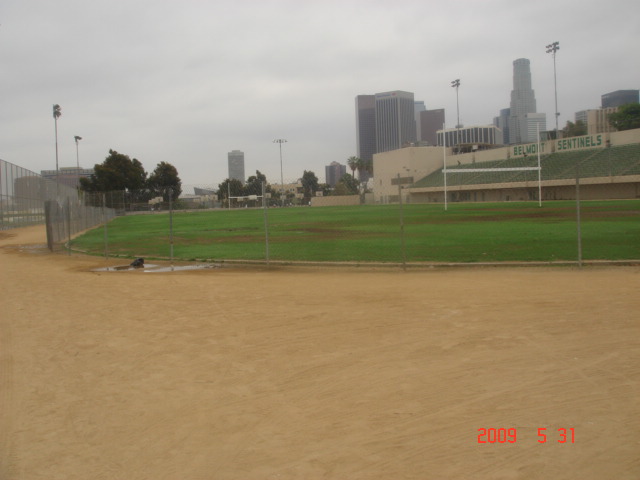
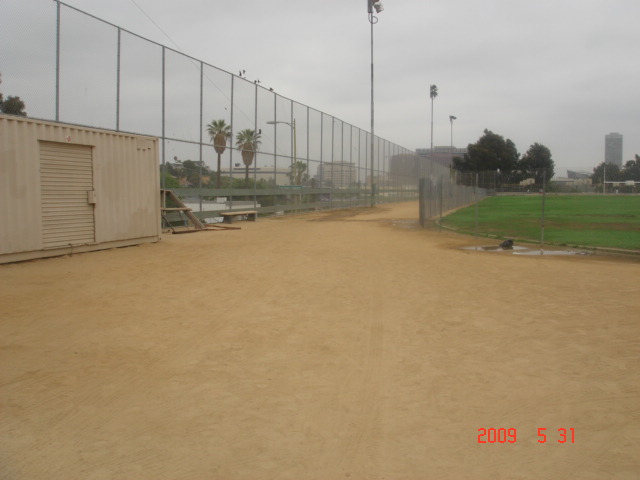
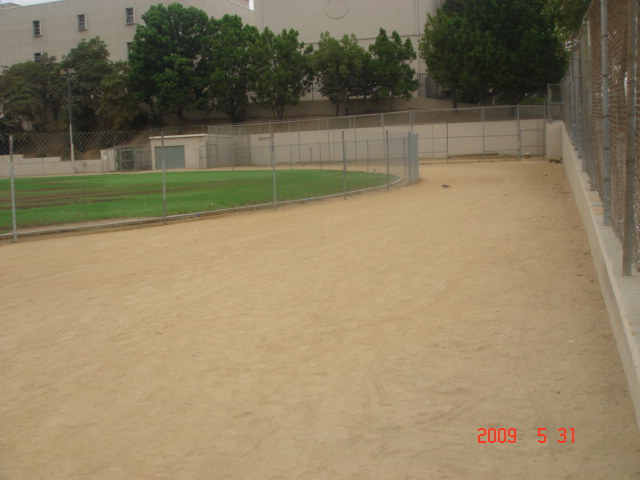
Belmont High School Oval “Dirt” Track


Belmont High School is two blocks away from home and this is where I do my active recovery runs and speed runs for the duration of my “rest/vacation” here in Los Angeles, and this will be my “ULTRA Oval Track”. What is good about this track is that it is made from the ordinary soil from the desert of California. It is a “dirt” oval track which is the same texture of soil that you see along the mountail trails and fire roads in the mountains here. However, it is better to run on the dirt/soil rather than running in an asphalt or concrete road. What is bad about the “dirt” track is that your shoes would easily become dirty because of the dust that stick on every part of your shoes to include the socks. I like running in this kind of track, whether I use my trail shoes or my training shoes as if I am running along the mountain trails. I usually use my TNF Arnuva 50 BOA when I run along this track because I could feel and hear the “crashing” sound of the shoes pounding on the sandy soil and my feet are more responsive to the ground.

I did a 35-minute recovery run a day after the Los Angeles Marathon and I was doing 80% of my effort with an average pace of 5:40 minutes per kilometer and an average heart rate of 144 bpm.

On the following day, I did another 30-minute slow run at my 70% of my total effort with an average pace of 6:50 minutes per kilometer and an average heart rate of 135 bpm. However, after the slow run, I tried to do some “speed” intervals every lap just to measure the distance of the oval track with a rest/recovery of one minute. I did 4 X 400 meters with an average pace of 1:52 minutes per kilometer and the oval has a distance of 408 meters at the inner edge. I had an average of heart rate of 152 bpm. The dirt oval track has no designated lane number. After the intervals, I slowly jogged to the house and did my post stretching exercises.

"Dirt" Oval Track
"Dirt" Oval Track With Water/Mud At The Inner Lane
My Running Shoes Gather Dusts While Running
High School Students Are Fast Runners Because of The Oval Track

I don’t know if all the runner-bloggers in the Philippines has a copy of the June 2009 issue of the Runner’s World Magazine. It would be nice if all of our runners, most expecially the beginners, has the chance to read the said magazine. In pages 65-69, the author of the article “Get On Track”, Erin Strout, has made a very good and very detailed presentation on everything a runner would know about an Oval Track from the definitions of terms on “speed” training, rules in using the oval, how to train at the oval, and workouts you can do. What is very important in this article is a pictorial/drawing of the oval with the RULES TO BE FOLLOWED. There is a Survey made with the question, “What’s your pet peeve on the track?” and the number one in the survey is, “Walkers In Lane One”. Very true! Everywhere not only at the ULTRA Oval Track!

Because of the overcast sky since Sunday and with a low temperature in the early morning, I usually do my running workouts at 10:00 AM when the clouds start to open up. I will have a one-day rest and resume my long runs this weekend.

Yes, I am preparing for the MILO Marathon Eliminations!

14K Evening Run @ Silverlake


8:30 PM 22 May 2009 @ Silverlake Reservoir

Silverlake Reservoir is a good 10-minute ride from my place and I had a run with my daughter after dinner. My daughter, Jovelle, had been running a lot in preparation for the Los Angeles Marathon on Monday. We started our run at 8:30PM with a prevailing temperature of about 64 degrees Fahrenheit. It was cold basing from my running weather standards in the Philippines but it was a nice weather for a run.

My warm-up run was about one kilometer with a pace of 6:30 minutes per kilometer and later increased my pace. I did not have any stretching anymore before I steadily increased my pace during the run. There were a few people along the running route and I only count about three people who are running and the rest of about four couples were walking with their dogs. There are portions of the route that are not lighted but the lights from the street posts would illuminate a portion of the running area.

Because of the nice and ideal weather for running, I started to sweat after running two loops of the route, which is equivalent to 7 kilometers. But once I perspired, it was a continous perspiration mixed with the cold air around. How I wished I could run some more but I did not want that my daughter would be waiting for me while her sweat and wet running attire would dry up.

I did four loops which registered in my GF 305 with a distance of 14 kilometers. I had a time of 1:23:45 hours. It was a slow run but I am happy that I could easily increase my pace during the run. I did some “fartleks” along the route as 3/4 of the whole loop is a dirt road. However, due to my slow warm-up run at the start and a slow cool-down run before I stopped the run, I was able to register an average pace of 6:00 minutes per kilometer. After the run, I did some stretching and waited for my daughter who did 3 loops for her running workout. I hope to have two more runs as my active recovery runs with a duration of 30 minutes each workout before the Los Angeles Marathon.

Running with a cold weather situation is a good activity to end the day.

Latest “1,000-Km Club” Finishers


As of May 17, 2009

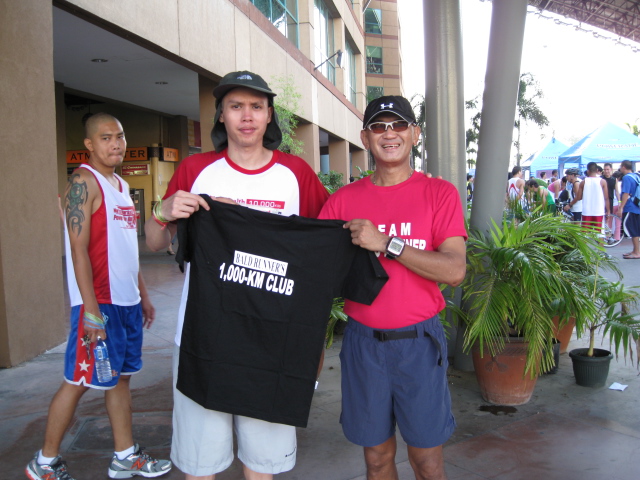
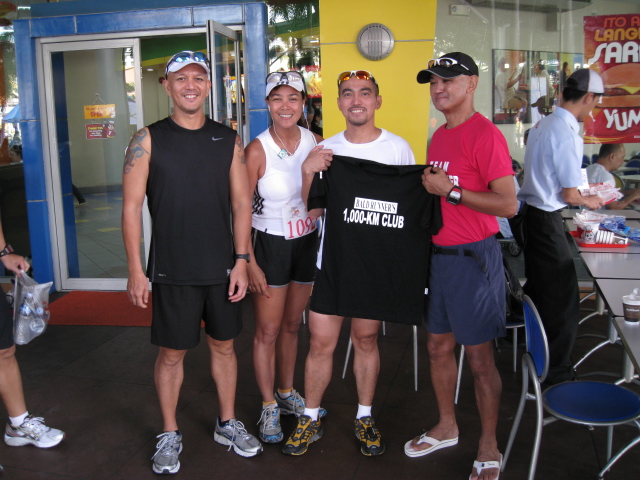
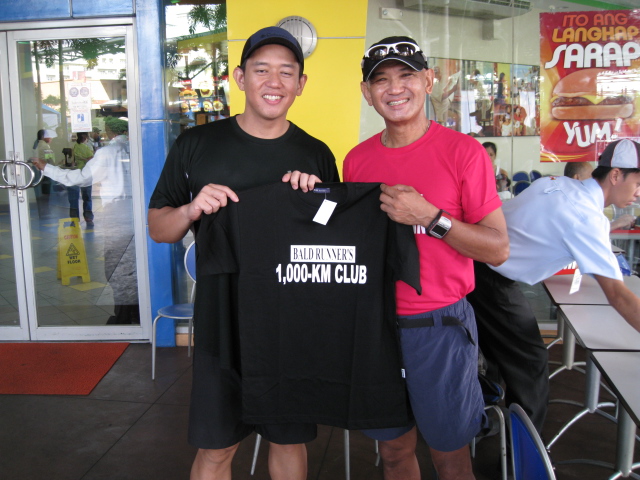
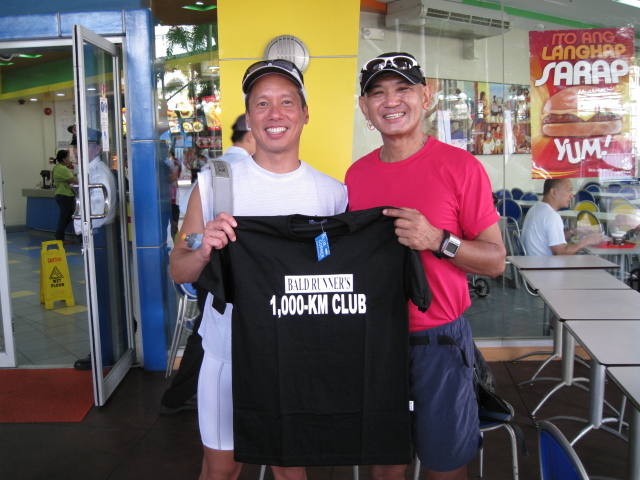
After breakfast at Jollibee Market! Market! yesterday morning, I awarded the Bald Runner’s “1,000-Km Club” Finisher’s T-Shirt to the following:

Jayson from the NIKE Training Group
Ultramarathoner Armand Fernando (Witnessed by Jonel & Ivy)
Enrico Tocol of Hardcore Group/Power Runners
Ultramarathoner Enrico Tocol of Hardcore Group/Power Runners
Ultramarathoner Jay Lee C-U of Hardcore Group/Power Runners

Ultramarathoner Jose Mari Javier was also awarded a “1,000-Km Club” Finisher’s T-Shirt but his picture was not taken due to a discharged battery of my camera. I am sorry, Mari, we will have your picture re-taken next time.

BR’s “1,000-Km Club” Finishers


This is a notice to those runners who registered or adopted the Bald Runner’s “1,000-Km Club” for them to be motivated to pile up their mileage in their running workouts. If you finished the required number of kilometers, you are entitled to receive a “Finisher’s T-Shirt” from no less than the Bald Runner. There is no need to show me proof of completion because I believe that runners are “honest and honorable” people.

After the Market! Market! 10-Mile Run this Sunday, the Bald Runner will be awarding a limited number of “Finisher’s T-Shirts” to runners who completed the said number of kilometers. The T-shirt will be awarded on a “first come, first serve” basis. (Note: Those who have received their first “1,000-Km” Finisher’s T-Shirts are no longer qualified to receive such T-Shirt for finishing their succeeding  1,000-Km runs.)

Active Recovery Run After Botak 42K


After finishing the marathon race yesterday, I took time to hydrate, eat, and rest/sleep for the rest of the day. I was limping last night and it took me some time to walk straight this morning. I already knew what to do in order to relieve the pain on my legs, hips and lower back area within this day.

I need to have my active recovery run for 30 minutes within the day after the marathon race. At 7:30 PM, I went to the ULTRA Oval Track to have my recovery run. I actually did a 35-minute recovery run at an average pace of 6:40 minutes per kilometer. Surprisingly after doing my post stretching exercises, the pain and stiffness on my left hip and leg muscles had disappeared and I was able to walk without any limp and it was a relief to walk straight and step up on the stairs without any pain on my legs.

Tomorrow, I’ll be doing a 10-15K run at my 85% effort and hope to be back again on my training for my future road and trail races.

Tempo Run In The Rain


Last Wednesday night, I had my running workout at the ULTRA Oval Track. Initially, I planned to have an endurance run for about 15 kilometers with an average pace of  5:30 minutes per kilometer but when I started running, I thought of finally doing a tempo run.

After a brief stretching exercises, I started running, using the farthest lane, Lane #8, of the oval track. My first 2 kilometers (5 laps) registered an average pace of 6:10 minutes per kilometer. After finishing 5 laps, I started to increase my pace, still using Lane 8, for the next 20 laps (8 kilometers) consistently increasing my pace up to 4:52 minutes per kilometer but ended up with an average pace of 5:20 minutes per kilometer.

On my last 2K as cool-down run, it started to rain and most of the runners at the oval took refuge at the shaded bleacher/grandstand. I kept on running as the rain started to keep on getting stronger just to be able to complete my last 5 laps around the oval. Initially, I was alone running at the oval with the strong rain but I found out later that other runners from the Team Bald Runner-Professional Group joined me in running into the rain. It was nice to hear positive comments from them that thei enjoyment of running in the rain. I finished my last 2-Km (5 laps) with an average pace of 6:05 minutes per kilometer.

Instead of doing a 15-km run, I ended doing a 12-km tempo run. I needed to stop because my shoes were becoming heavy and the oval track was already full of water but the other members of Team Bald Runner kept on running into the rain. These are hardcore runners!!! I immediately changed my wet clothes with my dry clothes and did some post-stretching exercises.

Due to running in the rain, my GF 305 was affected and it could not be opened/started for the past two days. It was only this morning that I was able to start it by simultaneously pressing the Lap Button with the other buttons of the watch. My last Wednesday’s night tempo run registered a distance of 12.2 kilometers with an average pace of 5:30 minutes per kilometer.

Yesterday, due to Typhoon Emong’s rains, I opted to rest and have a full body massage.

Readings On VO2 Max & My Workout


In one of my collections of old Running Times Magazine, I came upon an article written by Pete Pfitzinger, a two-time Olympian athlete, about the importance of VO2 Max and how to improve it. The following are the important points of the article as copied:

“According to the said article, VO2 max or “maximal aerobic capacity” is the maximal rate at which the body can transport oxygen to the muscles so that it can then be used to produce energy. The higher your VO2 max, the more energy you can produce aerobically relative to your bodyweight. Everything else being equal, if you can produce nore energy aerobically, you can mantain a faster pace.

The range of one’s VO2 max is set genetically; meaning that some runners are naturally gifted with relatively high maximal aerobic capacity and others are not so lucky. Where you fall within your range depends on how much and how hard you train. VO2 max increases substantially with the correct types of training.

There are two schools of thought on what is the optimal workout to make the largest gains in your VO2 max. Some coaches believe that doing speedwork faster than the VO2 max pace jolts the body to increase maximal aerobic capacity. The other school of thought which the author/writer adheres is that the greatest stimulus to improve the VO2 max is provided by running at an intensity that requires about 95 to 100% of your current VO2 max.

In the duration of intervals, the VO2 max will improve most rapidly by running repetitions of two to six minutes in duration (typically about 600 meters to 1,600 meters), which can be done on the track, roads, trails or uphill. Shorter intervals are not as effective in providing this stimulus because you do not maintain the optimal intensity range long enough.

On the length of workout, the writer suggests that a runner should aim to do 4,000 meters to 8,000 meters of intervals per workout within the 95-100% of his current VO2 max in order to improve his VO2 max.”

As part of my training & preparations for longer distance races like marathons and ultra trail runs in the future or in the next few days and weeks, I am trying to adopt this school of thought for me to increase my VO2 max.

Last Monday afternoon, after a warm-up run of 4 laps at the oval track, stretching exercises and speed drills, I did 10 laps within my best effort. During the run I tried to find out my 1-mile split time and I was able to glance at my GF 305 with a time of 8:47 minutes after passing the 1-mile mark at the track. For the distance of 4.16 kms, I was able to register a time of 20:39 minutes with an average pace of 4:57 mins per km. For this particular workout, I was running  below my 95-100% VO2 max effort.

Yesterday evening, I had to go back to ULTRA Oval Track for another workout to improve my VO2 max. After the usual 4-lap warm-up jogging, I did my stretching exercises, however, instead of doing those “speed” drills, I did a continuous “stair-drill” exercises, doing 10 repetitions at the ULTRA bleachers. After a slow recovery run for one lap at the oval track, I started my 5,000-meter run (12 1/2 laps) at my best effort.

During the run, I was surprised to see in my GF 305 that I was able to register a time of 7:46 minutes for my 1-mile split. I observed that I slowed down on my last lap due to some disturbance made by one of the runners who made a conversation with me but I tried to make up for such situation by increasing my pace for the rest of the workout. I was able to finish 5 kilometers in 24:07 with an average pace of 4:47 minutes per kilometer. Basing from my VO2 max results, I was running at my 102% best effort which is a big improvement from my last Monday’s performance.

In conclusion, I was able to prove that I could improve on my VO2 max after a rest of 24 hours and with proper warm-up, stretching, “speed” drills, strong legs, lots of experience and positive attitude.

Running Clinic: AZEUS Runners Group


It simply started with a SMS or text message from a certain “Jaydee/JD” requesting me to conduct a running clinic to a group of his officemates few weeks ago. After some exhanges of SMS, the running clinic lecture was scheduled on the 23rd of April 2009.

I found out later from JD that his group is composed of employees working for an office called “AZEUS”, an IT serice provider and IT software developer whose main headquarters is located in Hongkong. Their office is located within the Ortigas Complex and they wanted to have their running lecture clinic within the area and for their practical running demonsration to be done at the ULTRA Oval Track.

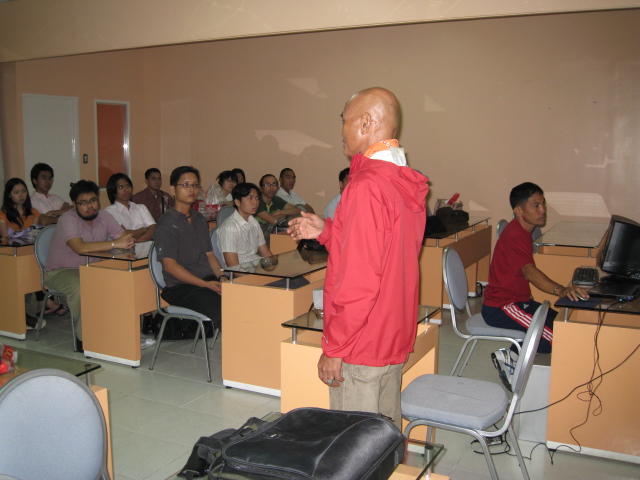
Finally, this group of running enthusiasts and beginners arranged a lecture room at the PowerTips at The Podium as the venue of the lecture. These guys really spent for the rent of the said lecture room which could fit a group of 30-40 participants. I was surprised to see such venue at the 5th Floor of The Podium which is a venue complete with white board which serves as the white screen, fully air-conditioned, with LCD projector and computer. It has also chairs and tables and it was a comfortable and silent place for a lecture presentation.

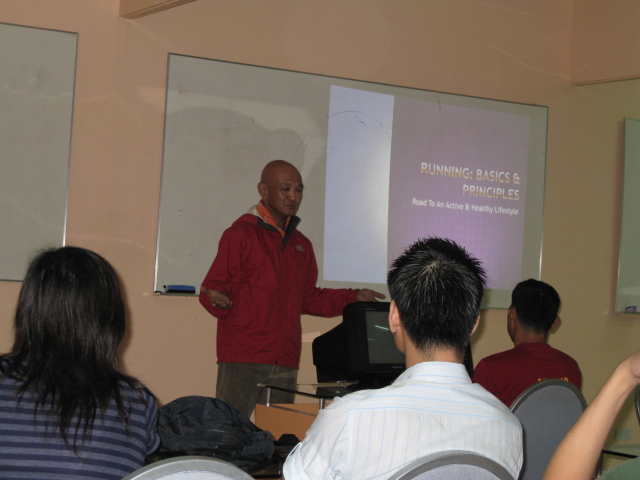
Lecture Started at 7:30 PM at The PowerTips @ The Podium
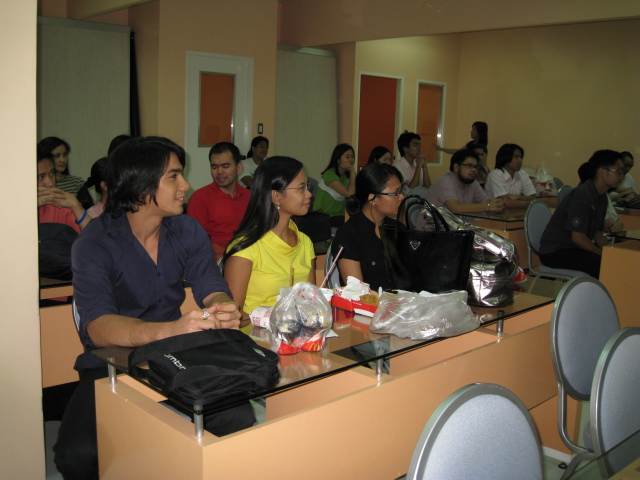
Participants Are Young & Interested To Learn About Running
Another View of the Lecture (Note: I was recovering from a Flu During the Lecture)

The group consisted of about 35 participants who are beginners and interested to learn the scientific way of training for running. All of the participants are single and in their mid and late 20’s. The lecture started at 7:30 PM as most of them came directly from their office. The lecture went well and an open forum was conducted for the Q & A portion. The lecture was concluded at 9:30 PM with a request from me and Coach Salazar that an actual practical demonstration must be done in order to apply what we had lectured to them.

I found out later that the participants of the lecture is the core group of the AZEUS Runners Group/Team whose members would like to join weekend road races in Metro Manila. JD, as one of the prime movers of the group, had just started running last November of 2008 and he is a regular visitor of this blog.

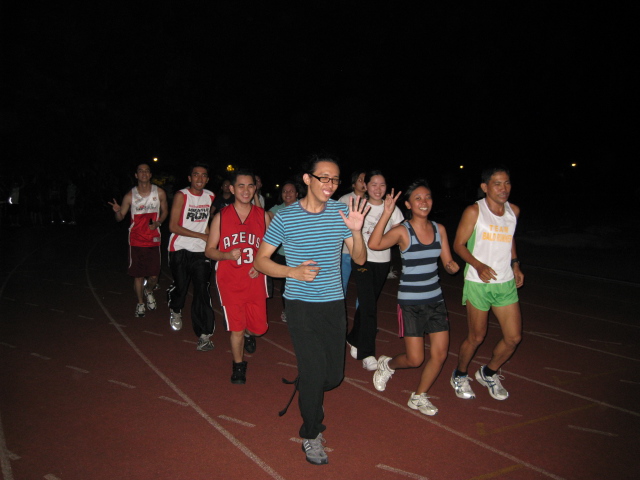
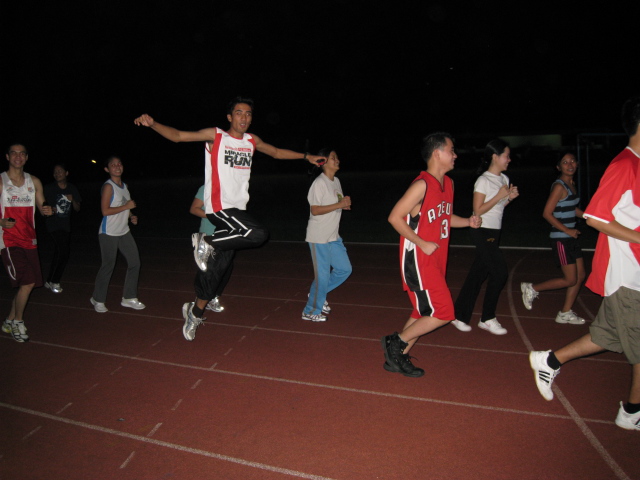
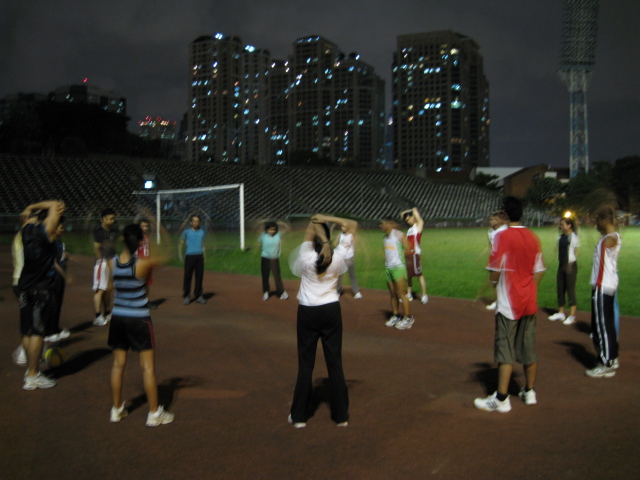
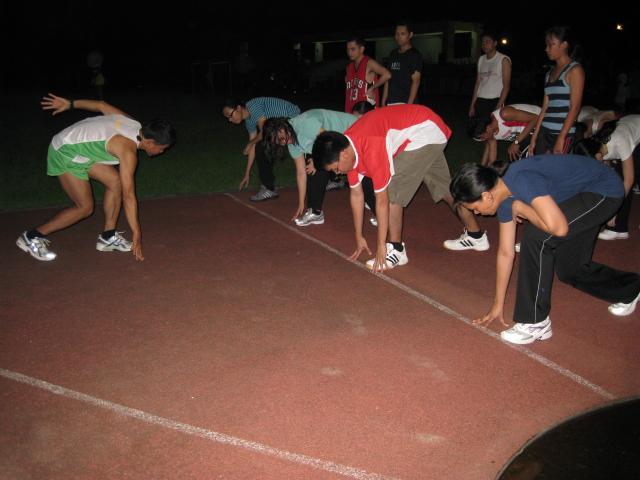
Due to the rains last week, the actual practical demonstration and application was finally scheduled last night at the ULTRA Oval Track. A group of 17 employees from AZEUS finally showed up at 7:30 PM and Coach Salazar taught them on how to warm-up properlyby jogging around the oval, did stretching exercises, did some “jumping and foot” drills, and a relay run to the group. All the “basics” in running were properly explained by Coach Salazar through demonstration and application by each of the participant. The demonstration covered running form, running strides, midfoot vs heel-strike running, stride frequency, and arms swinging. The actual running demonstration and practical exercises were finished at 9:30 PM with full satisfaction from the participants.

Coach Titus Led The Group To a 4-Lap Warm-Up Jog
Nice "Jump" & Jogging Shot!
Stretching Exercises!
Speed Drills & Correct Running Form Practical Demonstration

As an extra and bonus part of the practical instructions, we taught each of the participant on how to pick-up a water cup from a water station and for them to drink the water while running. We also taught them the courtesy and etiquette in using the oval track.

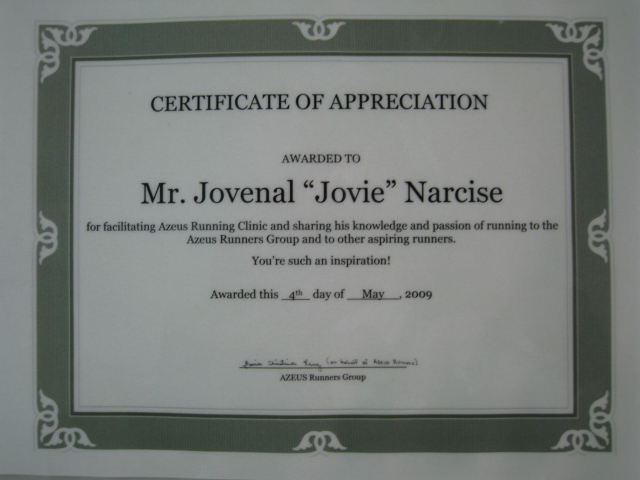
Before it rained and before the group finally left the Oval Track, the group presented Certificates of Appreciation to Coach Salazar and to myself. Thanks, Jaydee and to your group. I hope  you have learned a lot from our lecture and practical demonstrations on running.

Very Nice Laminated Certificate of Appreciation
Good luck to the AZEUS Runners Club and Congratulations for joining and finishing the Southern Race 5K & 10K Runs at the Ayala Town Center last Sunday.

This running clinic program of Team Bald Runner will continue to be conducted to interested groups and it is FREE. It is the objective of the Bald Runner and Team Bald Runner to spread its advocacy to let everybody appreciates the benefits of running through scientific approach in training in order to promote an active and healthy lifestyle.

“Dirty Secret Tips” in Ultra Trail Running


The following “dirty secret tips” are highly recommended to those runners who will be participating/competing in the TNF 100 Solo Run which will be held on 23-24 May 2009:

1) On problems of Bowel Movement & Gastro-Intestinal “Issues”—At least 1 1/2 to 2 hours before the start of a long race (marathon or ultramarathon distance), take one (1) tablet of Diatabs or Immodium.  An intake of one tablet will “stabilize” the food and fluids in your stomach/intestines for the next 24-36 hours or even as long as 48 hours. Just be sure that after the race, take a lot of hydration fluids/water and fresh fruits to lessen any problem of constipation.

2) On Pain Relievers—This is one aspect where nobody among the trail runners openly admit that they take “pain relievers” before or during the race. But I have a strong suspicion that these “hardcore” runners take Ibuprofen; Tylenol; or any pain relieving tablets during races. If you are joining the TNF 100 Solo Run, try to take one Alaxan FR after running your first 25 kilometers. That pain reliever will bring you to the finish line without any major leg pain or muscle cramps as long as you follow your food/hydration strategy and race strategy.

3) Dose of Caffeine—GU Roctane had always been my favorite sports gel that has more caffeine than ordinary sports gel. There are other Sports Gel which have the same properties and purpose like the Hammer Gel but I’ve never tried it. Try to take a GU Roctane sports gel every 10-12 kilometers. This regular intake will make you awake during night time and give you the much-needed energy during the race. (Note: Do not litter the trail with those GU empty packs)

4) Preserve Your Strength—On the first half (50 kms), maintain a slow pace and try to preserve your strength for the last 50 kms of the course. Brisk-walk while you are going for the uphill climb and then run on the downhill and level portions of the route. If you think you still have the strength on the last 10-20 kms of the route, then go for it for a strong and hard finish. Learn to brisk-walk and practice in the urban streets of Metro Manila through “walkabout”. Put more time on your feet to the ground. Expose yourself to the heat of the sun during your “walkabouts”.

5) Recon the Place of the Race—Get the map of the route and conduct a “test run”. Don’t wait for the Race Organizer/Race Director to call for a “test run”. Take the initiative and be the first to explore the route. Such initiative will give you the much-needed confidence to finish the race and apply your race strategy. “Knowing the Enemy” or “Know The Terrain” simply does the trick in ultra train running survival. You can also conduct a “test” if there is any cellphone signal in the area. By conducting a recon of the trail route, you will be able to determine your hydration needs and be able to adjust on what type of  hydration pack you are going to bring for the race. You will find out if you need extra clothing needs for the race if you conduct your “test run” in the race route. (Note: The place always rain in the afternoon) 

6) Energy & Chocolate Bars—Expect that there will be no solid foods or “hot” meals to be served in the Aid Stations. The most practical solution for this is to have Energy Bars and/or Chocolate Bars or dried fruits in your shorts pockets or in your pack. (Note: Do not litter the trails with those empty packs of your energy/chocolate bars and other thrash)

7) Extra trail shoes and socks—Through your “test run”, you’ll be able to find where you can have your drop bag located along the route. There is a need to change your shoes and socks as they will become wet due to river crossings and perspiration from the body. Try to look for running socks made of “Coolmax” or “DryMax” materials. I highly recommend them, as well as, from famous ultramarathon runners. During your “test run”, try to run with your wet shoes & socks after crossing those lahar-filled river and test how it feels to run with them (to include some lahar sands inside your shoes).

8) 3-Pocket Trail Shorts—If you don’t want to carry too much load on your pack, get a trail shorts with pockets where you can store your energy bars and sports gels.

9) 2-Bottle Hydration Belt—I prefer to use this type of hydration belt/pack rather than using a bladder hydration pack like Camelbak or TNF Thresher. I have an option of using one bottle for water and another one for sports drinks/electrolyte drinks. Alternately, sipping water and electrolyte drinks would be a nice hydration strategy during the race, making sure your hydration supply will last up to the next Aid Station. When I joined my first Bulldog 50K, I was using my “Small On The Back” Nathan Water Belt for my sports drinks and a “Quick Draw” Hand-Held Nathan Water Bottle for my water. It worked perfect for me.

10) Headlights & Flashlight—Be sure to have those lights during the race, most especially during your night movement. Bring fresh/new batteries just in case you need immediate replacements.

11) Petroleum Jelly and/or Body Glide—Blisters on your feet are prevented by applying petroleum jelly or Body Glide in-between toes and entire feet. This is also to include the crotch area, nipples, upper right arms, Heart Monitor strap area and armpits.

12) Runner’s Cap, Sunglass, OFF Lotion, Sunscreen Lotion, Watch, Bandana & Compass—Bring these items to the race for obvious reasons. Why for a Bandana? Aside from being a “coolant” on your neck when it is already damped and wet with your perspiration, you can use it to cover your mouth to prevent those small insects to get into your mouth as you inhale, on daytime or nighttime.

13) Run With A Group or Have a “Buddy”—Be sure to have somebody with you as your “buddy” during the run or come up with a group of 3-4 runners to make the trail run more fun and enjoyable. You must be running almost at the same pace. Alternately, act as “guide” or “pacer” for the group. Try to Help & Motivate each other to finish the race.

14) Do the “drills” and try the “100-Km Challenge”—One of the “drills” I’ve picked up from my readings and been doing for the past months is the one-leg squats or one-leg bending. Using only one leg, try to bring down your butt at the exact position when one of your legs land on the ground while running and then bring up your butt with the leg straight. Repeat this bending for the next 5 minutes. Do the same one-leg bending to the other leg with the same number of minutes. Try to increase the number of minutes until you are comfortable doing the drill for one hour or more. For your endurance test, find out my previous post on “100-Km Challenge” and try to experience it. 

15) Lastly, the Camaraderie and Helping One Another During The Race is the most important virtue to be developed and encouraged in ultra trail running races. Competition among runners and yourself is only second to the love of the sports itself. Try to develop that habit of asking a runner who is sitting or lying on the side of the trail of what is his condition so that you can relay such information about him to the next Aid Station. Try to share what you have for runners who are in need during the race. You will never know when you need also some help from the other runners. 

Do not “whine” during and after the race. If you “whine”, then you did not do your homework!

Good luck to all the TNF 100K Solo Runners!!!