“Back To The Slope” #3 (2nd Week)


1. This is my second week of my training cycle. I am still with my base training after slowly recovering from a chronic muscle tear injury on my peroneus-calf muscle (left leg).

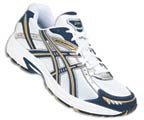
2. After experimenting on using Adidas’ Climacool & Adizero Racing Shoes in my past Marathon Races (MILO Finals, SIM, & Pasig River), I am going back to my dependable and more stable ASICS Gel Shoes. Since I started this training cycle, I’ve been using my ASICS Kayano-14 and Kanbarra-4. For my light and recovery runs at the oval track, I use my NIKE Lunaracer. The ASICS provide me with better stability and comfort during my base training.                                                                                                                          

ASICS Gel-Kanbarra 4
ASICS Gel-Kayano 14

3. I was able to run a total of 61 kilometers for the week. The following was my daily workout for the 2nd week:

Dec 21 (Monday)—-8K easy run at the ULTRA Oval Track with an average pace of 6:48 mins per km
Dec 22 (Tuesday)—-8.5K easy run with 100-meter faster pace every lap at the oval track at an average pace of 6:23 mins per km
Dec 23 (Wednesday)—-10K easy run at the BHS Loop with an average pace of 7:22 mins per km
Dec 24 (Thursday)—-8.5K easy run at The Fort with an average pace of 6:47 mins per km
Dec 25 (Friday)—-13K easy run at The Fort & McKinley Hill with an average pace of 6:28 mins per km
Dec 26 (Saturday)—-13K easy run at the UP Diliman Loop with an average pace of 6:22 mins per km
Dec 27 (Sunday)—-Rest
4. I made sure to do my warm-up/cool-down and stretching exercises before and after my runs. All of these daily workouts were done early in the morning (starting at 5:30 AM and ending at 7:30 AM or 8:00 AM). For this week, I did a lot of “high-knees”, bounding steps, and faster stair runs for my strengthening drills. For my daily nutrition after workout, I have to eat within 30 minutes to one hour. My meal consists of steamed rice & two pieces of fried egss, lots of fresh ripe bananas, and one serving of hot MILO “3-in-1 For Adults” Drinks!
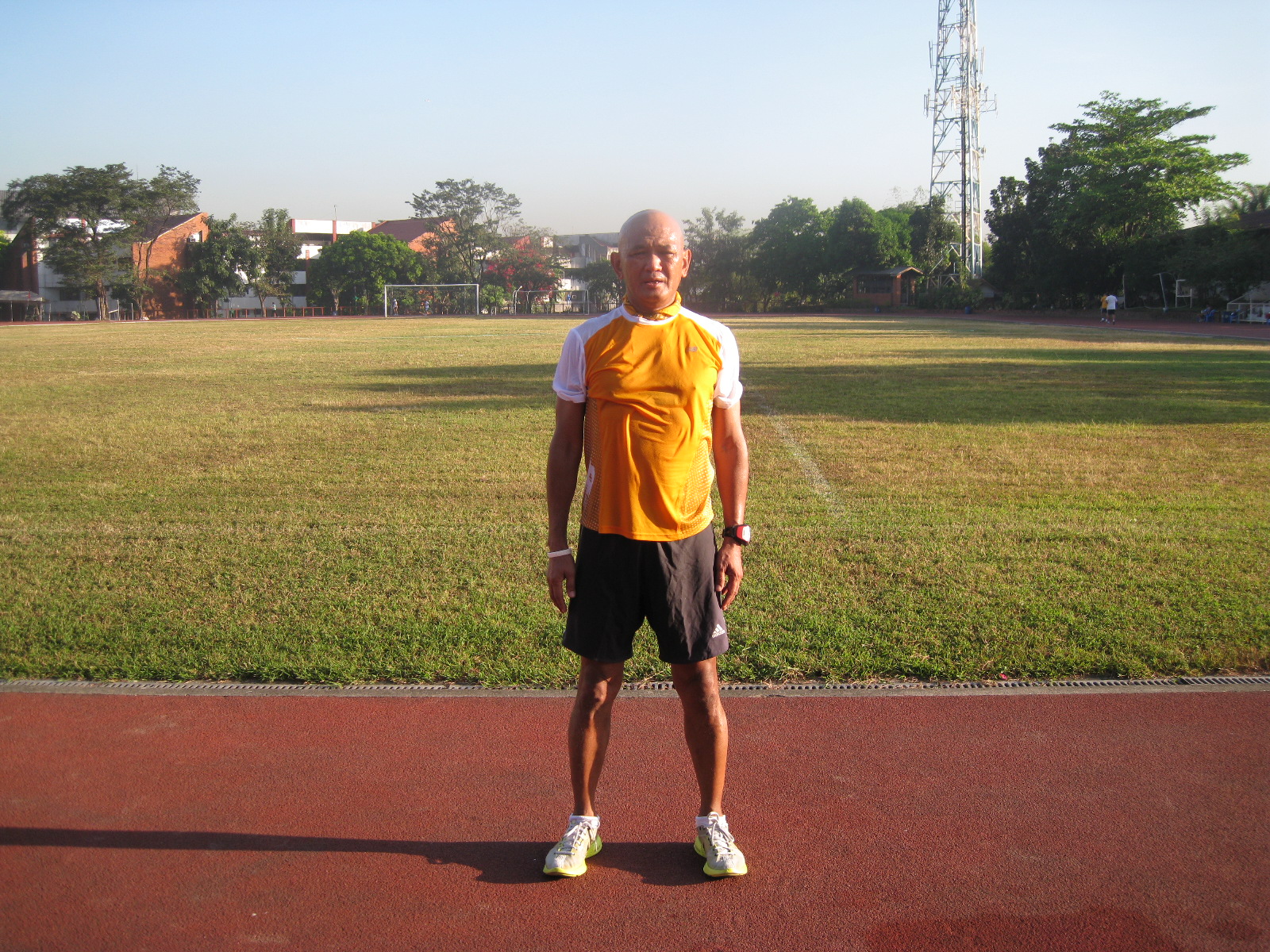
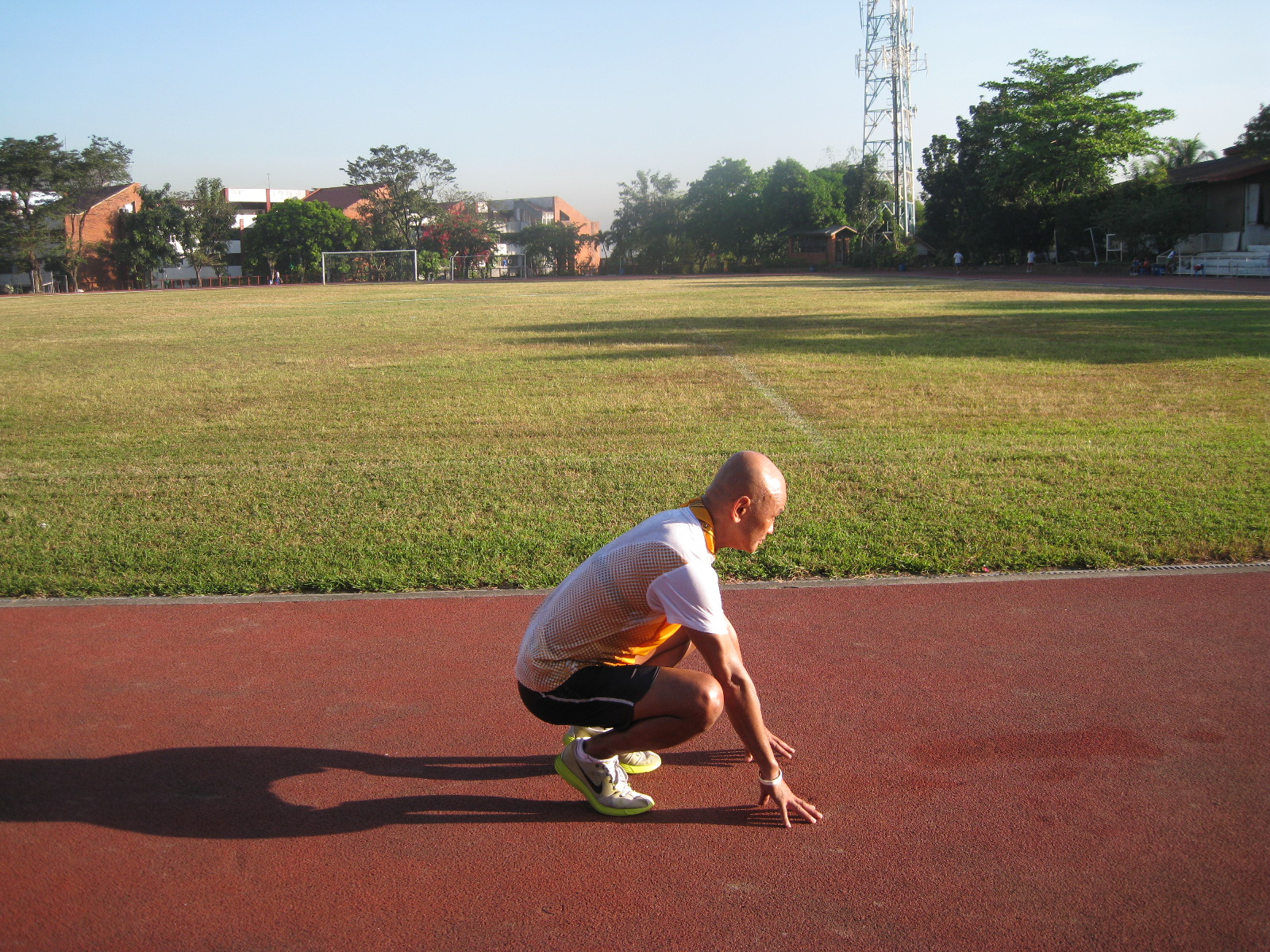
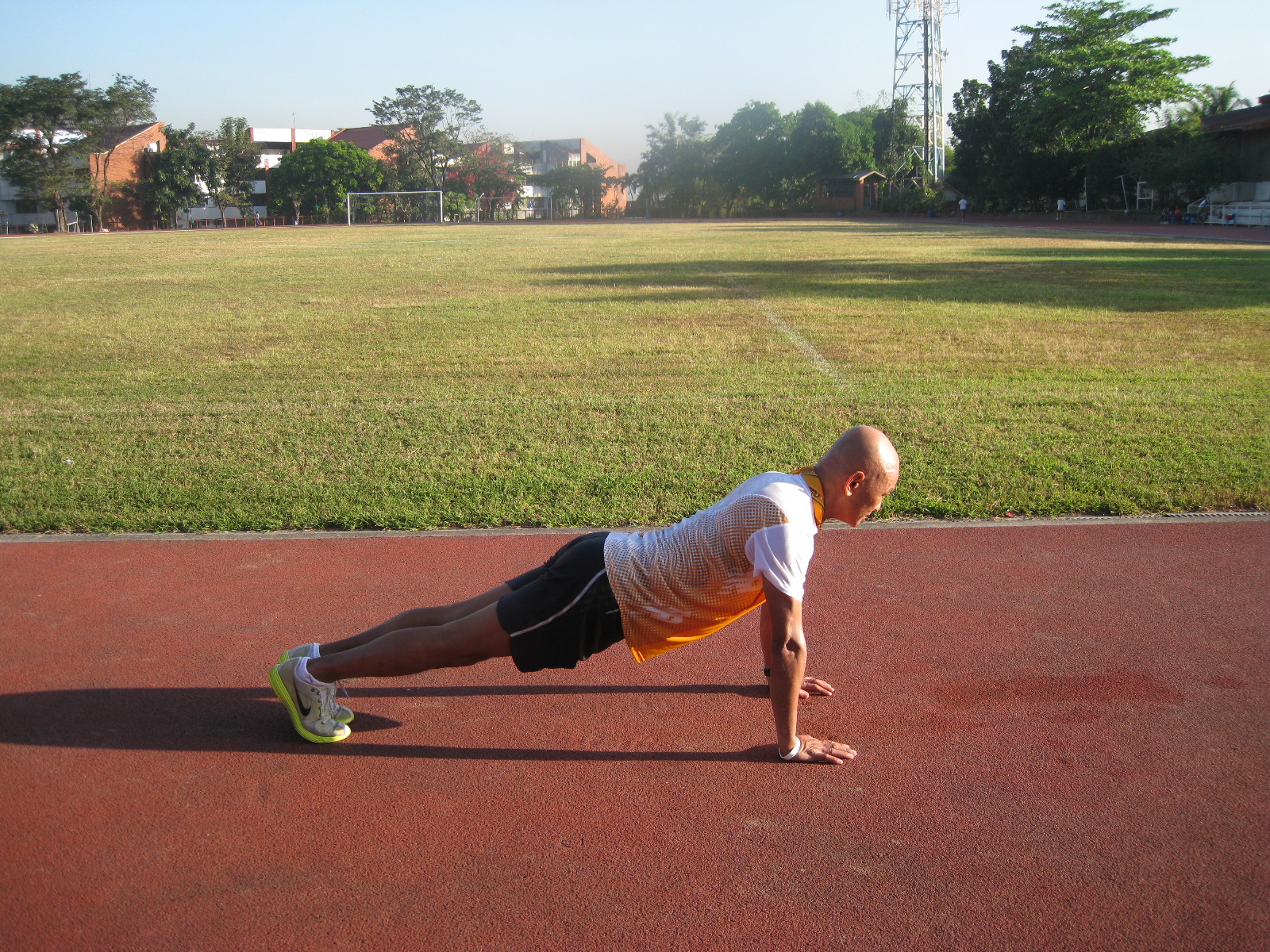
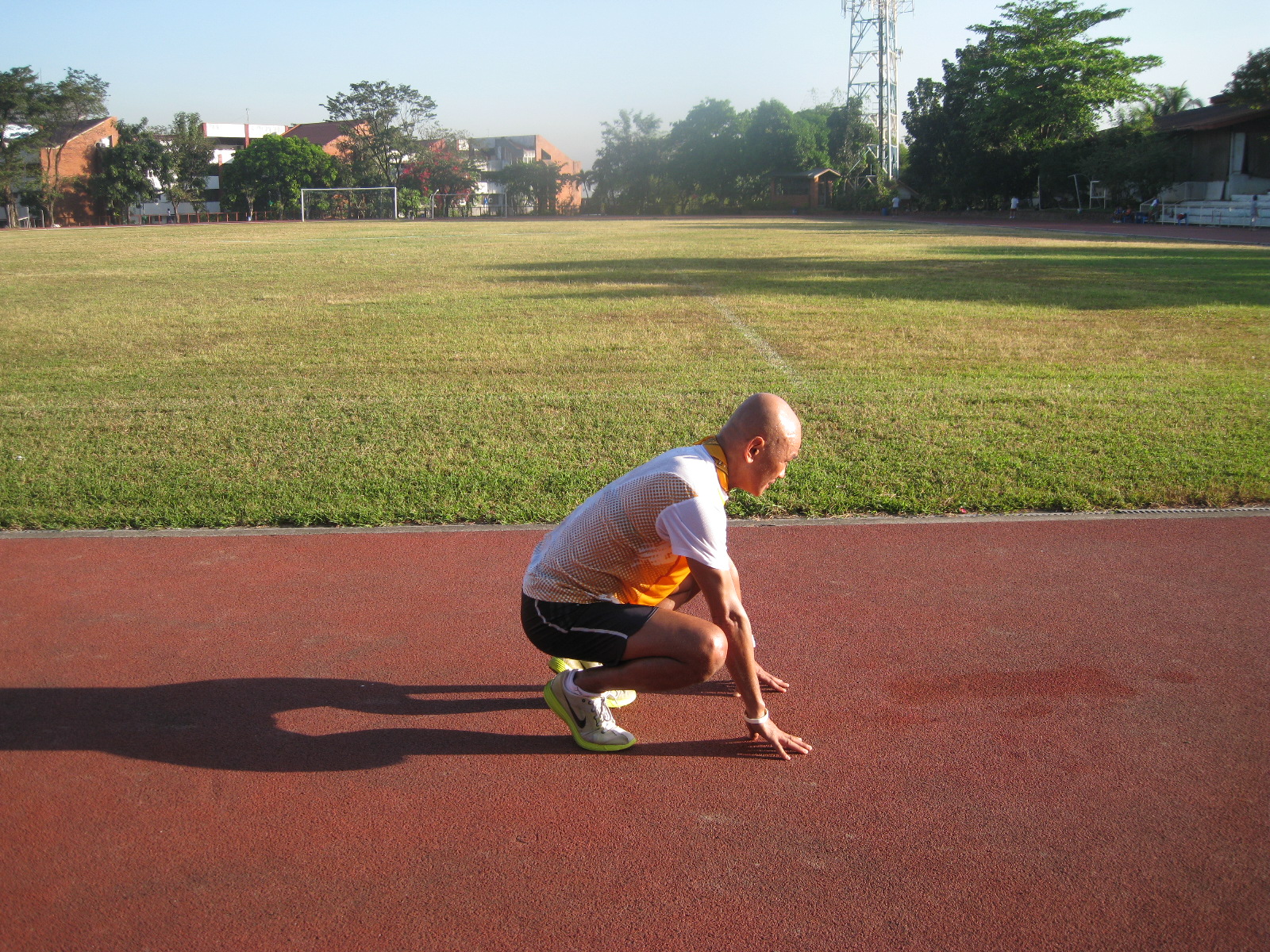
5. One drill that I introduced for this week is what athletes call as “burpees” or in the military, it is called “squat thrust”. It is an exercise that combines “squats” and “push-ups”. I did 20 repetitions. It can be shown on the following pictures, step-by-step:
First, Stand Erect with Feet Apart or Together
Bring Down the Whole Body & Place Hands Infront of Your Feet
Thrust Your Legs Backwards & Do Push-Up
Thrust Your Legs Forward & Stand Erect To Complete 1 Repetition

There are so many variants of this exercise. However, the steps I’ve mentioned (squat thrust + push-up) is the basic “burpee” exercise. You can jump upwards or leap forward once you bring your body back to the starting position for a higher intensity drill.

Lesson #3: Rule of Thumb In Increasing Mileage—10% of your previous week’s total mileage. Abruptly increasing your weekly mileage to more than 10% of your previous week’s mileage will result to overtraining and/or the possibility of a running-related injury.

Note: If you are a beginner or serious runner, you have to maintain a Runner’s Diary or Log where you can write your distance, time, heart’s pulse rate, weight, and other data related to your running workout. I suggest also that you try to sign in with www.dailymile.com and try to be motivated with your friends who have registered in the said site.

“Back To The Slope” #2 (1st Week)


1. “Back To The Slope” simply means “Back To Basics”. After a forced rest & recovery due to a chronic muscle tear on my Peronues muscle for six (6) weeks, I am starting from base training again. This “Back To Slope” thing will be a series of “tips and lessons” for beginners as well as competitive runners.

2. For the 1st week of my training cycle, I was able to run a total of 55 kilometers as seen on the following log of my runs:

14 Dec (Monday)—10K in 1:09+ hours at an average pace of 6:55 mins per km

15 Dec (Tuesday)—6K in 45+ minutes at an average pace of 7:04 mins per km

16 Dec (Wednesday)—8K in 48+ minutes at an average pace of 5:57 mins per km

17 Dec (Thursday)—8K in 1:00+ hours at an average pace of 7:29 mins per km

18 Dec (Friday)—10K in 1:02+ hours at an average pace of 6:13 mins per km

19 Dec (Saturday)—13K in 1:35+ hours at an average pace of 7:27 mins per km

20 Dec (Sunday)—Rest/30-min Active Recovery Run

3. As gleaned from my log workout for this week, I’ve been strictly following the 2nd training principle which I want my readers to know and follow. It is the principle of “hard-easy” method. If the workout intensity is hard for today, the following day’s workout should be easy. By following this principle, the body would be able to rest and recover for the following day’s workout. This is one way of preventing a running-related injury.

4. There will be no road races on Sundays for my base training phase. I am giving a day for my body to rest & recover for the week’s running workouts after doing a 30-minute slow active recovery run (at 7:30-8:00 mpk pace). However, I strictly made more stretching and selected Pilates exercises before and after my daily workouts.

5. The following are the suggested “drills” and stretching/Pilates workouts for core strengthening:

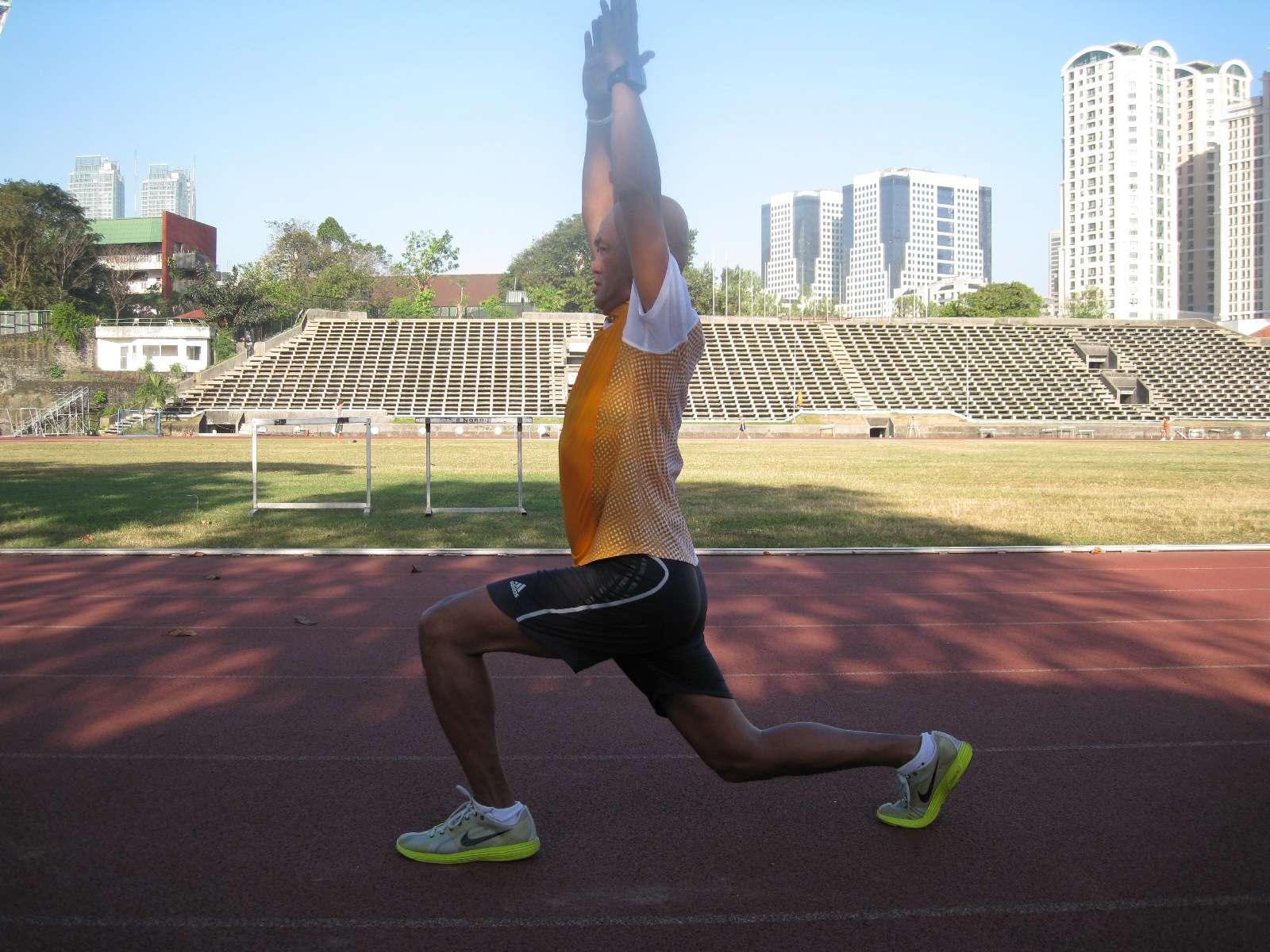
Forward or Walk Lunges

 Lunge one foot forward as far as you can and bring the body down while bringing both arms up in the air. Do 10 lunges per foot/leg.

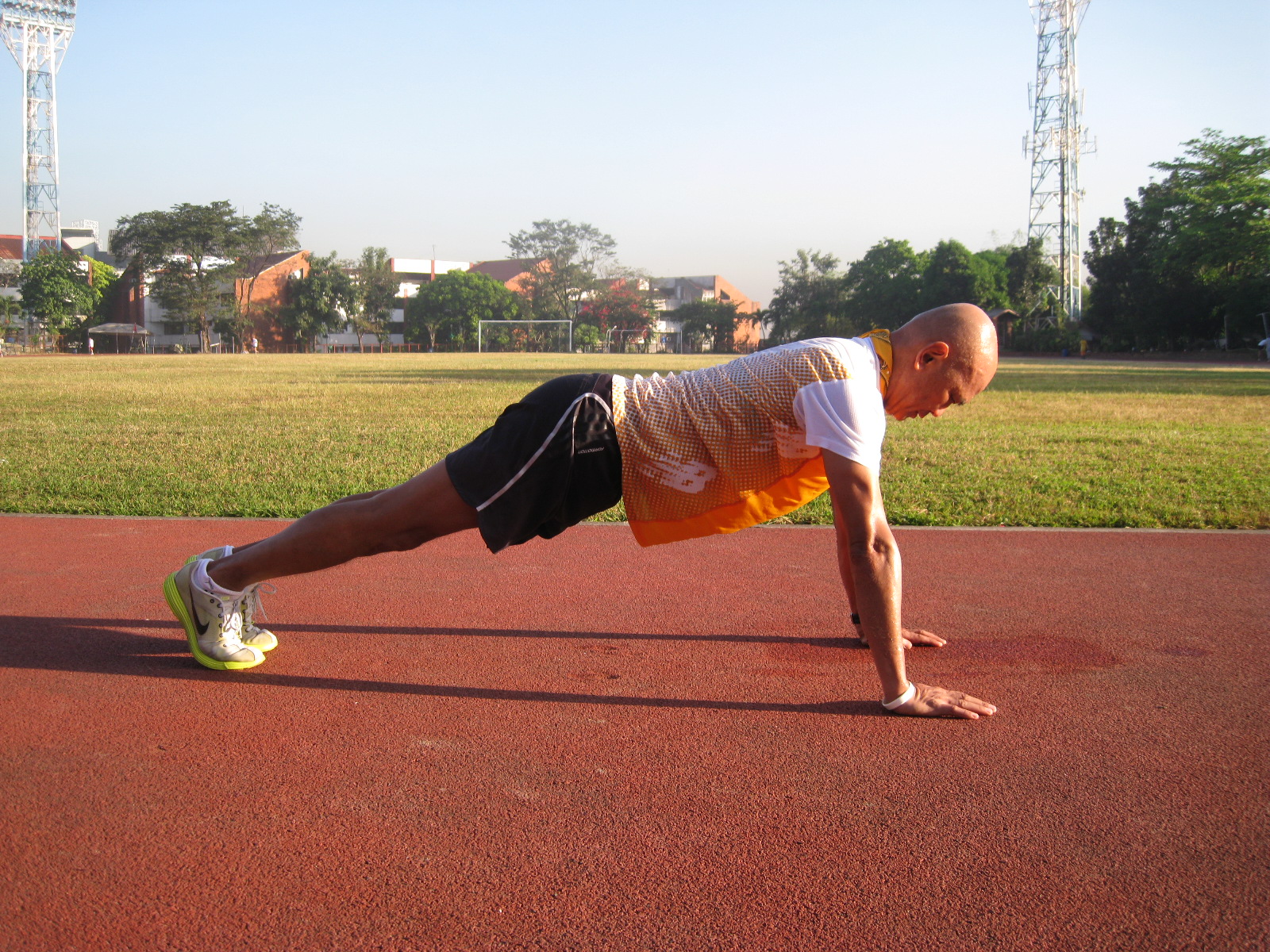
Push-Up (Starting Position & Up Position)

 I always try to do 20 repetitions of push-up properly after my workouts. Be sure that your upper arms are aligned with your back when you are on “down” position. Your palms’/hands’ distance should be your shoulders’ width.

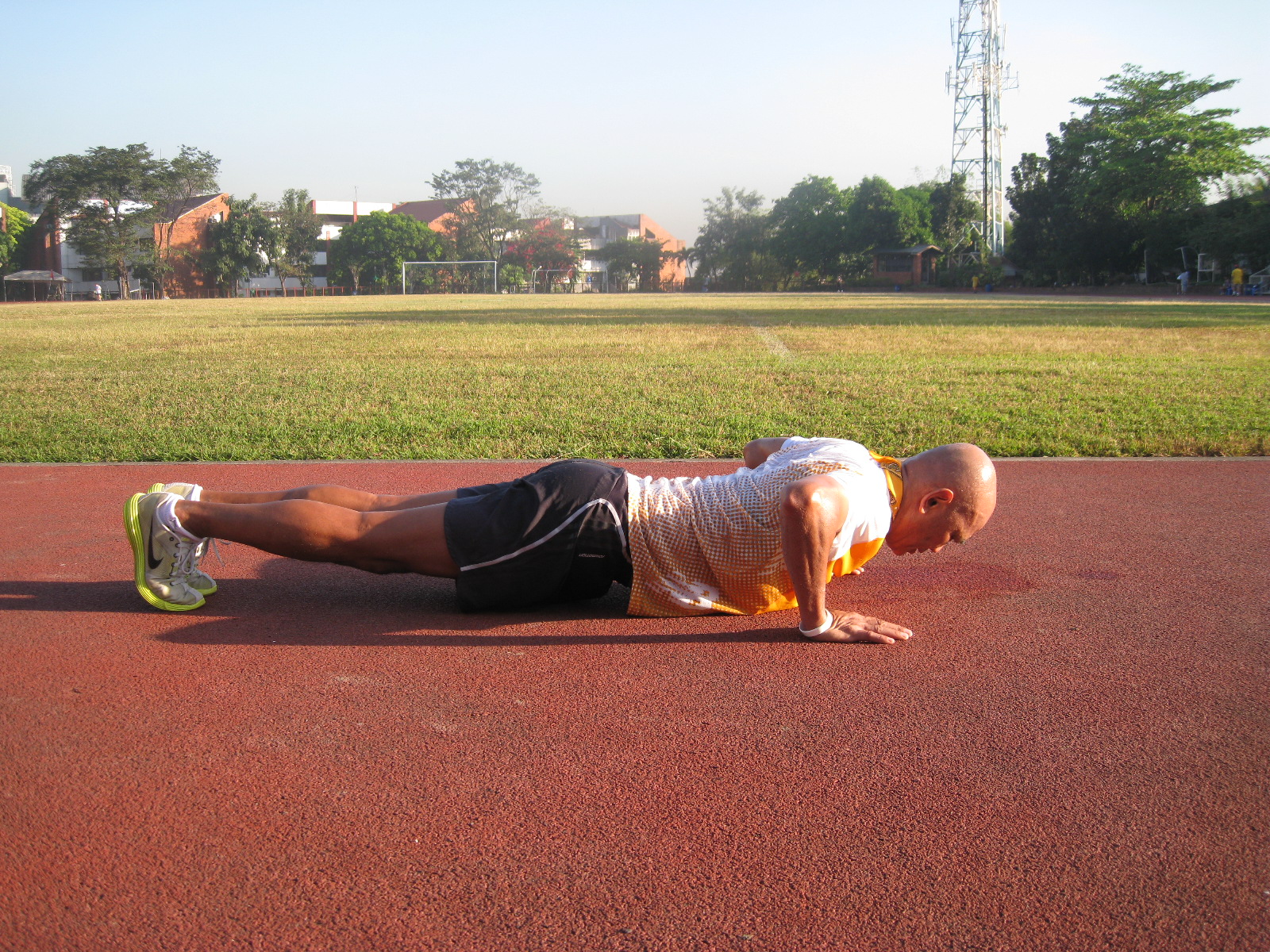
Push-Up (Down Position)

 Try to keep your feet together and the whole body should form a straight line while doing your repetitions. Inhale as you push your body up and exhale while you put your body down.

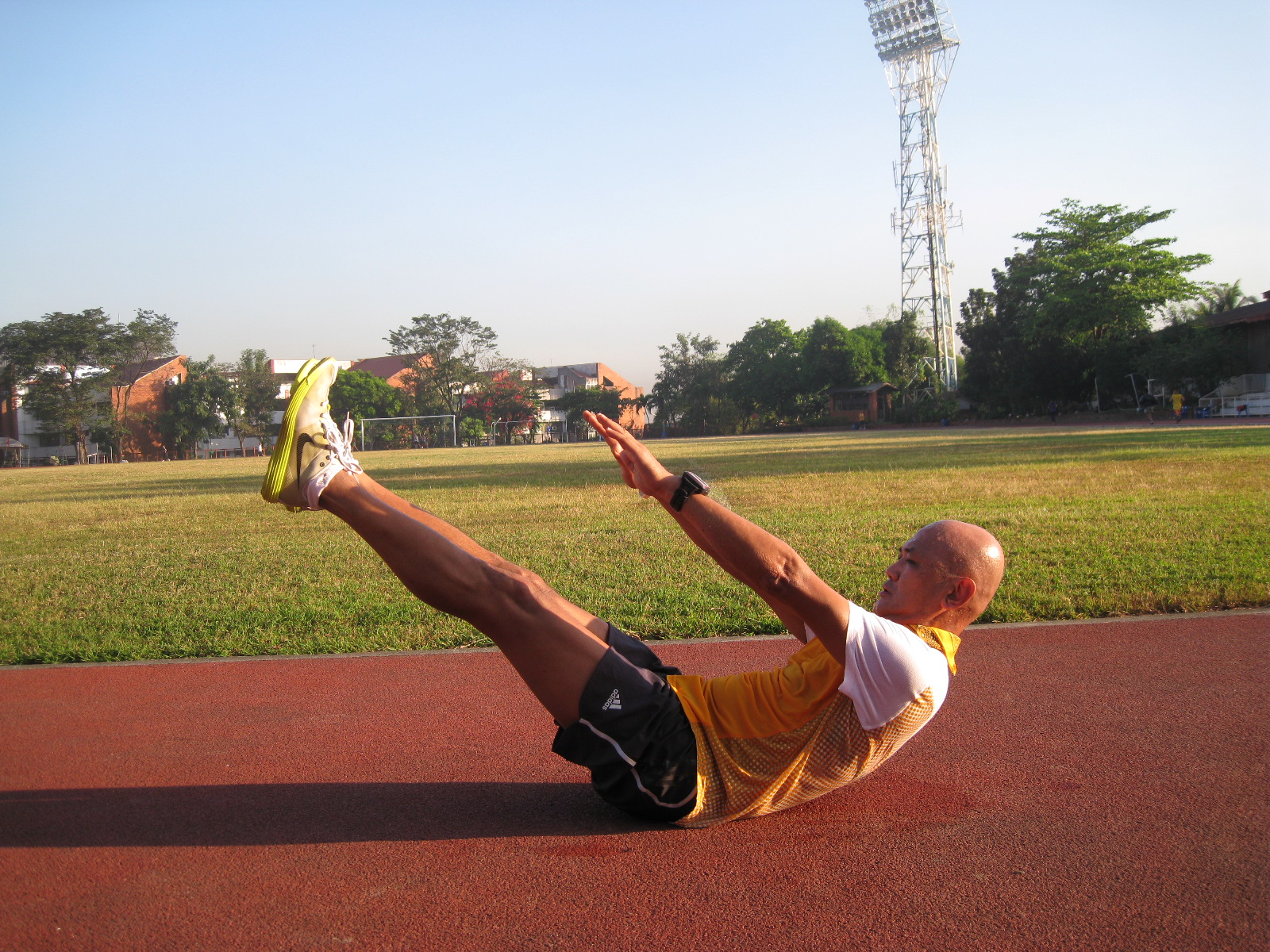
Leg & Upper Torso Lift

 Try to hold your body in this position from 30 seconds to one minute while maintaining your regular breathing. You will be surprised what part of the body will be strenghtened!

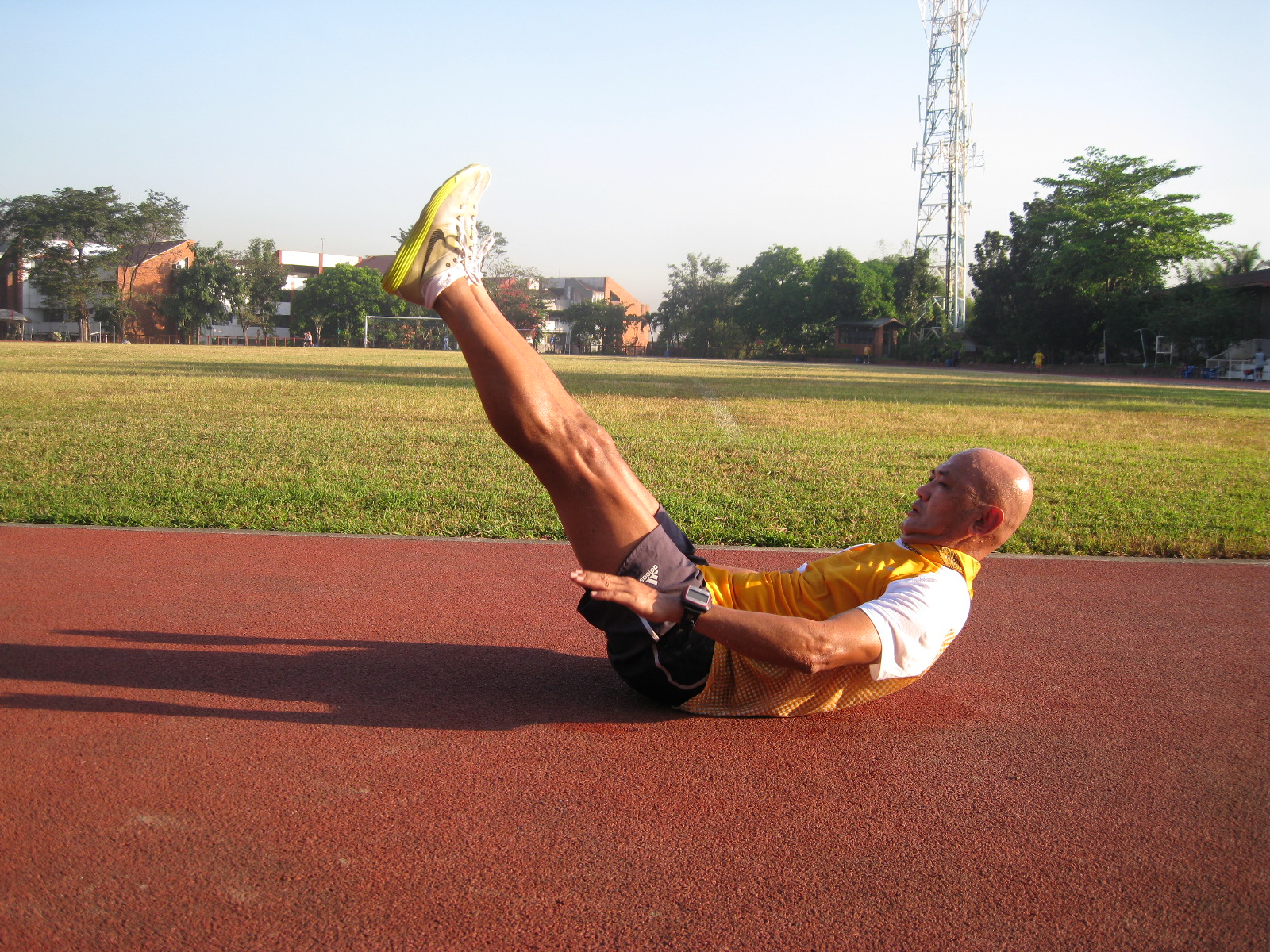
The Hundred

 They call this as “The Hundred” because you have to pump your arms 100X while maintaining this pose and regualr breathing.

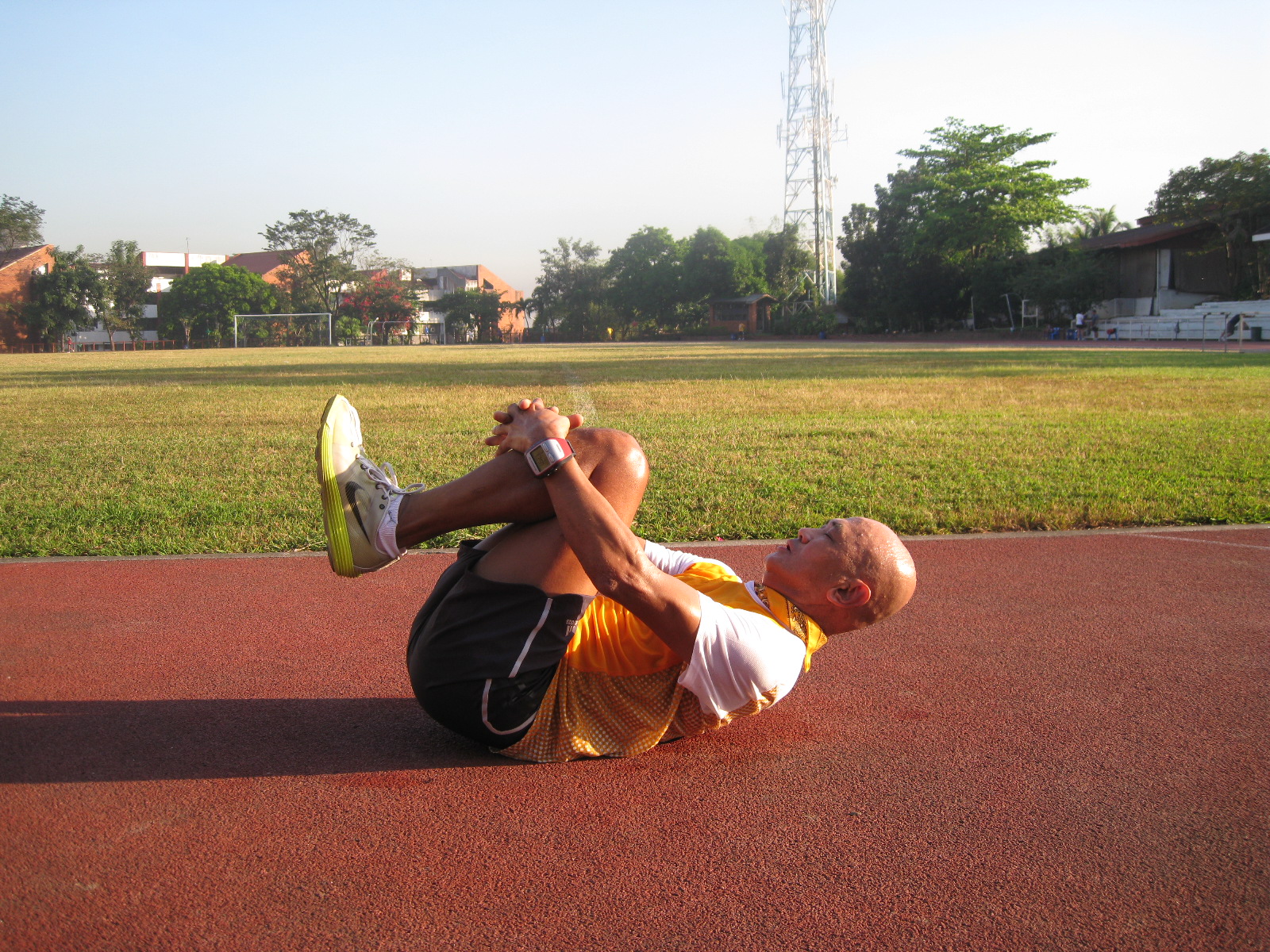
Roll Like An Egg On The Spine

 This rolling exercise will strengthen your spine and your back muscles.

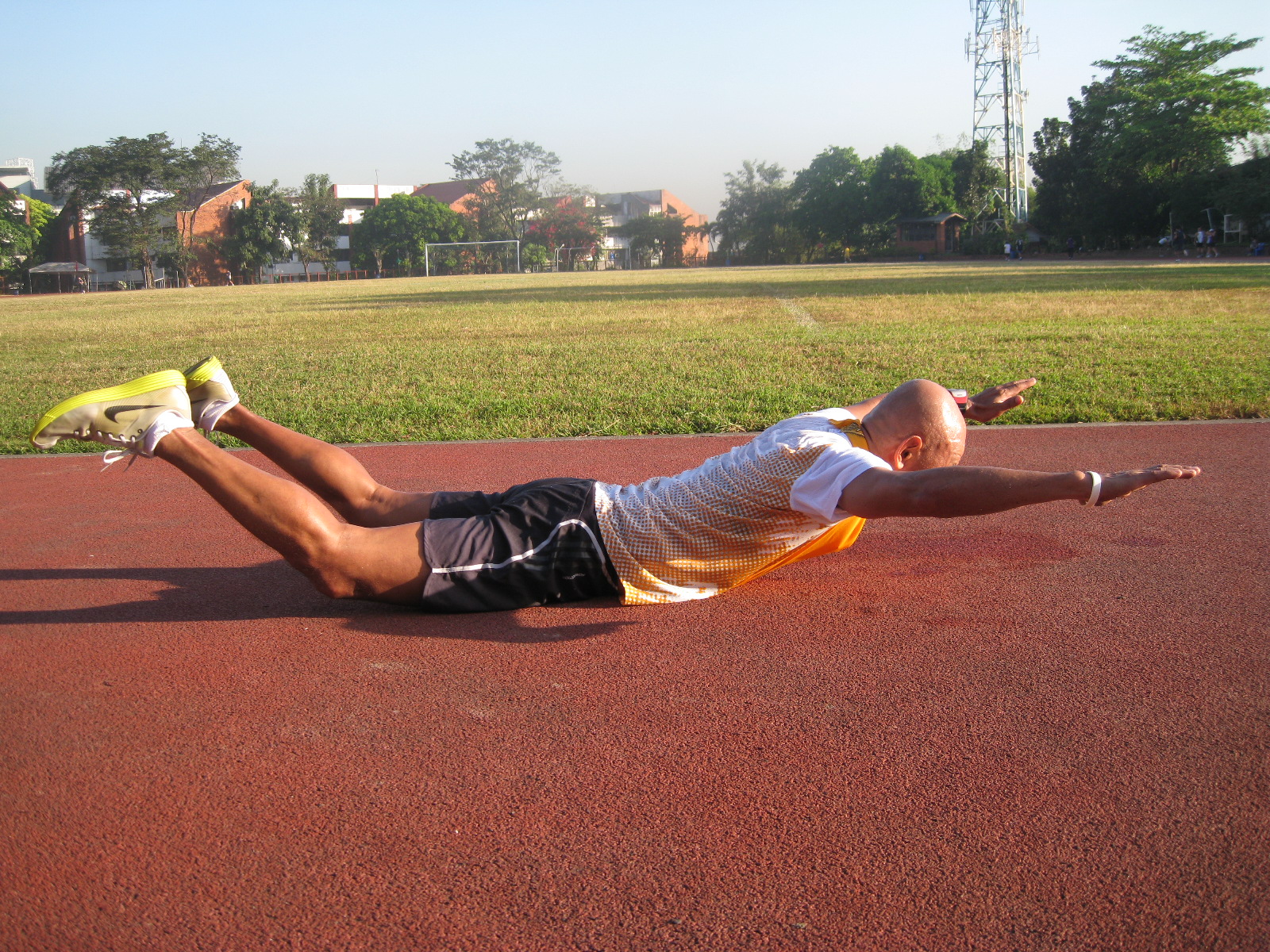
Swimming

Lift your legs and upper torso with arms straigthen forward and hold this position for 10 seconds. Repeat 4X. Maintain regular breathing.

Lesson #2: Follow the “Hard-Easy” method of training.

Pathetic!


Yesterday morning, I had a chance to talk to sports executives working in a multinational company which is a major sponsor in Sports Events in the country and even in Asia. It was a casual meeting and we had a brief conversation about running in the country, the Standard Charter’s Singapore Marathon and other running related activities.

Our conversation led to our present standing in the 25th SEA Games of which two of the executives openly told me that they just arrived from Vientiane, Laos to observe the preparation, opening ceremony, and initial conduct of the Games. I asked if it is true that our National Athletes arrived in two groups, in two separate “chartered” planes—one group of athletes was supported by POC and the other group of athletes was supported by PSC. POC is the Philippinje Olympic Committee which is headed by Jose “Peping” Cojuangco while the PSC is the Philippine Sports Commission which is headed by Harry Angping.

If you have been reading the Sports Pages of our national dailies for the past months, you would know that there is an animosity between these two sports institutions in the country. The PSC is a government entity which is responsible for our national sports excellence by providing the necessary funds to the Sports Federations and to our elite athletes; while the POC is the country’s representative organization of the International Olympic Committee (IOC) which is responsible in sending our National Athletes to International Games under the auspices of the IOC. SEA Games and ASIAN Games are the only International Games under the auspices of the IOC. In short, funding for training & incentives for medalists is the responsibilities of PSC; while the expenses for the travel of athletes to IOC’s International Games is the responsibility of the POC. I might be wrong but this is my impression about their arrangements when sending our National Athletes to such IOC meets/games.

Anyway, it is true that our athletes arrived in Laos in two separate “chartered” flights direct from Manila. My source of information could not determine if it is really true that one plane was boarded by PSC-supported athletes while the other plane was boarded by additional athletes recommended by POC and POC Officials. I also confirmed that there were no officials from the PSC who joined the delegation & party. However, by knowing that the delegation of our country nearly reached 400, there is a need for two planes to ferry our athletes and officials.

You might be wondering why our delegation was able to get a chartered flight from the Philippine Air Lines. It is because the release of the funds to buy for the tickets for our athletes and officials were delayed and in turn it would be expensive to buy them with few days before the scheduled departure. The other reason for the chartered flight is that, there is no direct flight from Manila to Laos and our delagation has to change plane from Bangkok/Saigon/Hongkong and this will entail additional expenses and more hours for the trip.

And now this is the worst part, the executives who were present during the 25th SEA Games Opening Ceremonies almost cried when they saw our Philippine Delegation marching at the Oval Track in “Athletic Attire” (Athletic Jacket; jogging pants & rubber shoes) while the other Country Delegations were wearing Suits & Leather Shoes. I was told that the Vietnam delegation wore a Barong Tagalog- look alike with “crumpled” look (“Gusot Mayaman Barong”). And the best part among the worst news is that, the uniform that our delegation wore during the Opening Ceremony was given on the day before the delegation left Manila. (Note: If you want to see a picture of our delegation during the Opening Ceremony, browse at www.laoseagames2009.com and click at the Photo Gallery on the left side of the site. Look for picture #38 and click it).

I am not making a post showing a “crab mentality” attitude in our sports excellence program but I am trying to show the prevailing situation in our sports, moreso, with the “message” we are showing to our neighboring countries and to our people. We always talk and read about “unity in purpose” and “unity among us” but for us, as a nation competitng with other nations in an international sports meet, we should show our best.

The good news is that Ed “Vertek” Buenavista and Jo-An Banayag won the Gold Medals in the Men’s & Ladies’ Marathon Race in this morning’s 25th SEA Games Athletics events. Their finish times at 2:21+ and 2:46+ hours, respectively are good enough to win the gold medal with a cash incentive of P 300,000 each, but it is still far from the ASIAN and OLYMPIC Games’ standards. Nevertheless, what is important is that we got the GOLD in the most important running event for us who are long distance runners!

Whatever will be the final results of the 25th SEA Games, I hope there will be no “finger pointing” as to who should be blamed for our dismal performance and lowest output in the history of the SEA Games. However, I am still sure of the following assessment: (1) that “politics” and “sports” do not mix, and (2) for the government and the private sector to help in the funding and support to our athletes.

Let us see what will happen to our National Team in the next ASIAN Games which will be held in 2010, next year!

“Back To The Slope!”


1. When I was a cadet at the Philippine Military Academy, I always hear this statement or command from my Tactical Officers if they want the cadets to repeat a practice on our Parades and Ceremonies after doing one or two rounds. The start area of our parade and drills is a sloping/downhill road towards the Borromeo Field, the Parade Ground of the Academy. Figuratively, if this phrase or statement is uttered, it means that you have to repeat from the start what you have done in order to correct a mistake or error.

2. After five weeks of rest & recovery due to an injury, I am going “back to the slope!” and have started to follow a training program as a guide for my future marathon and ultramarathon races for the year 2010 and beyond.

3. The first step in my training program is to abide and recall the most basic principle in training for a running event—base training. I always say in my running clinic lectures that preparing for a running event is like constructing a building or a house where you need to have a durable and stable base/foundation. In running, base training  means building a base of aerobic endurance.

4. So, early this morning, I had my first “base training” at the ULTRA Oval Track completing a distance of 10 kilometers, running along the outer lane. I did my stretching exercises before and after the run. In addition, I did some running-related “drills” during and after the run. I finished my 10-K run in 1:09:13 hours with an average pace of 6:55 minutes per kilometer. I was so happy that I was able to breach the 7:00-minute per kilometer pace. Slowly, but surely, I could run within my base training pace.

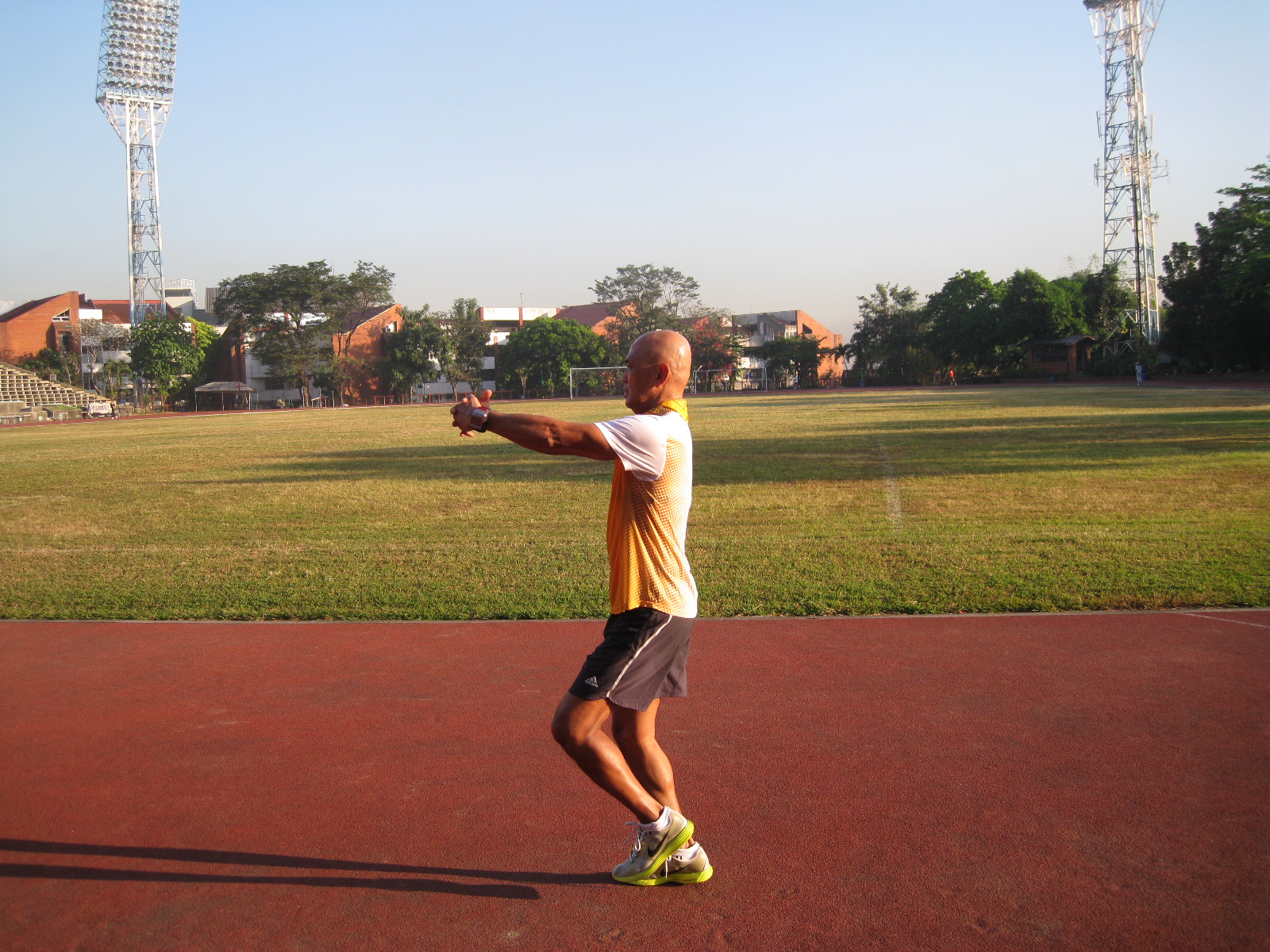
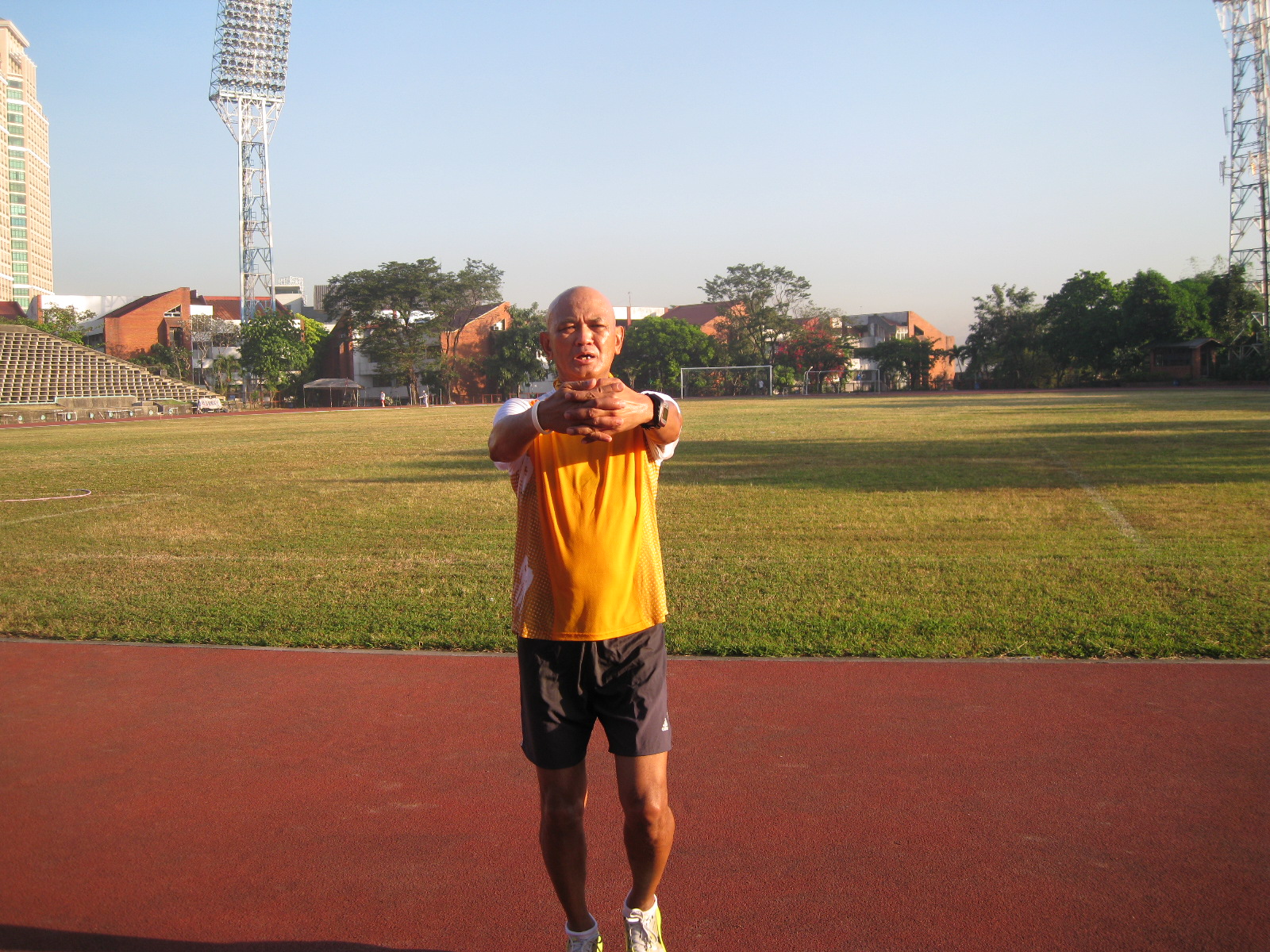
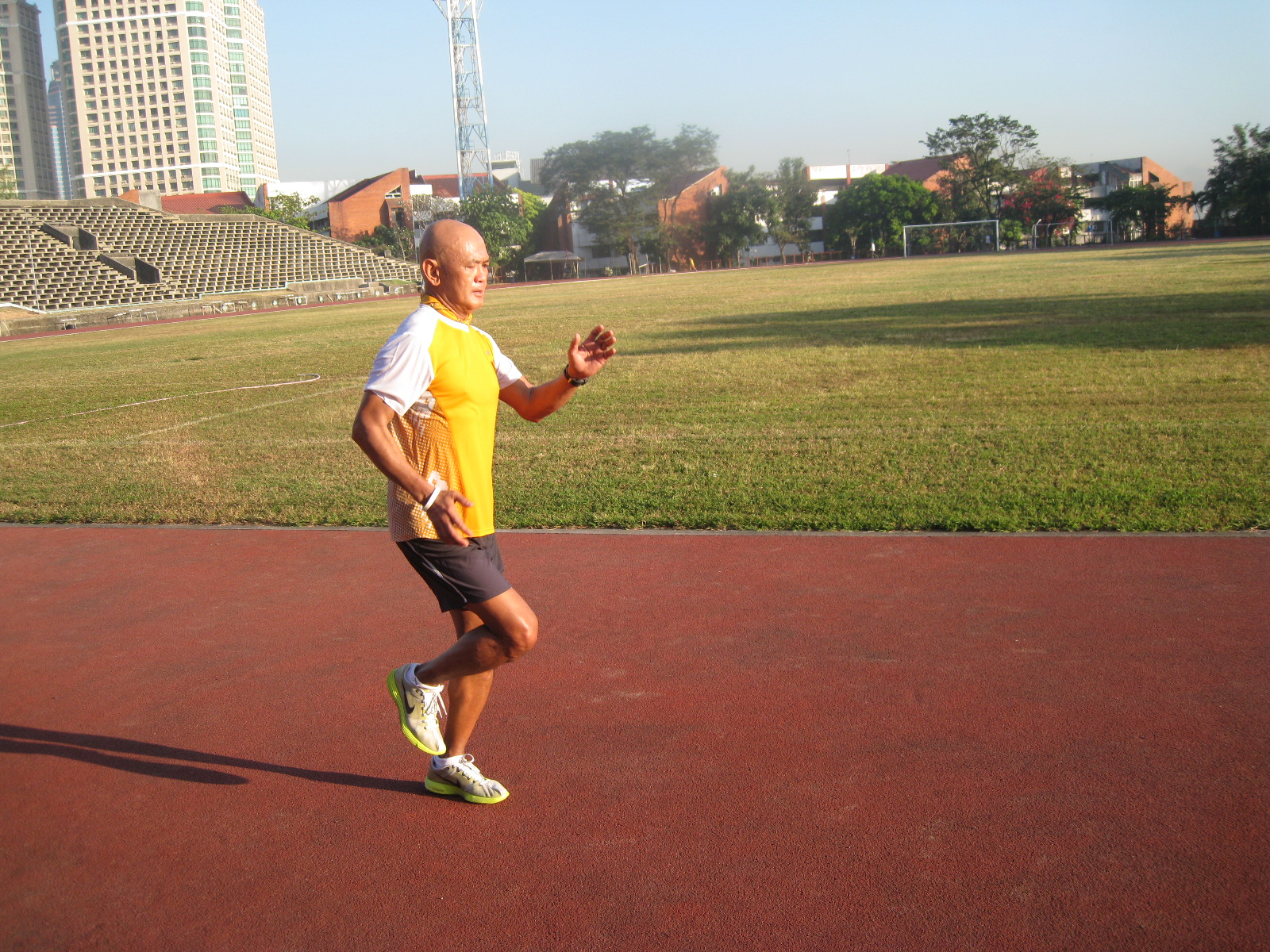
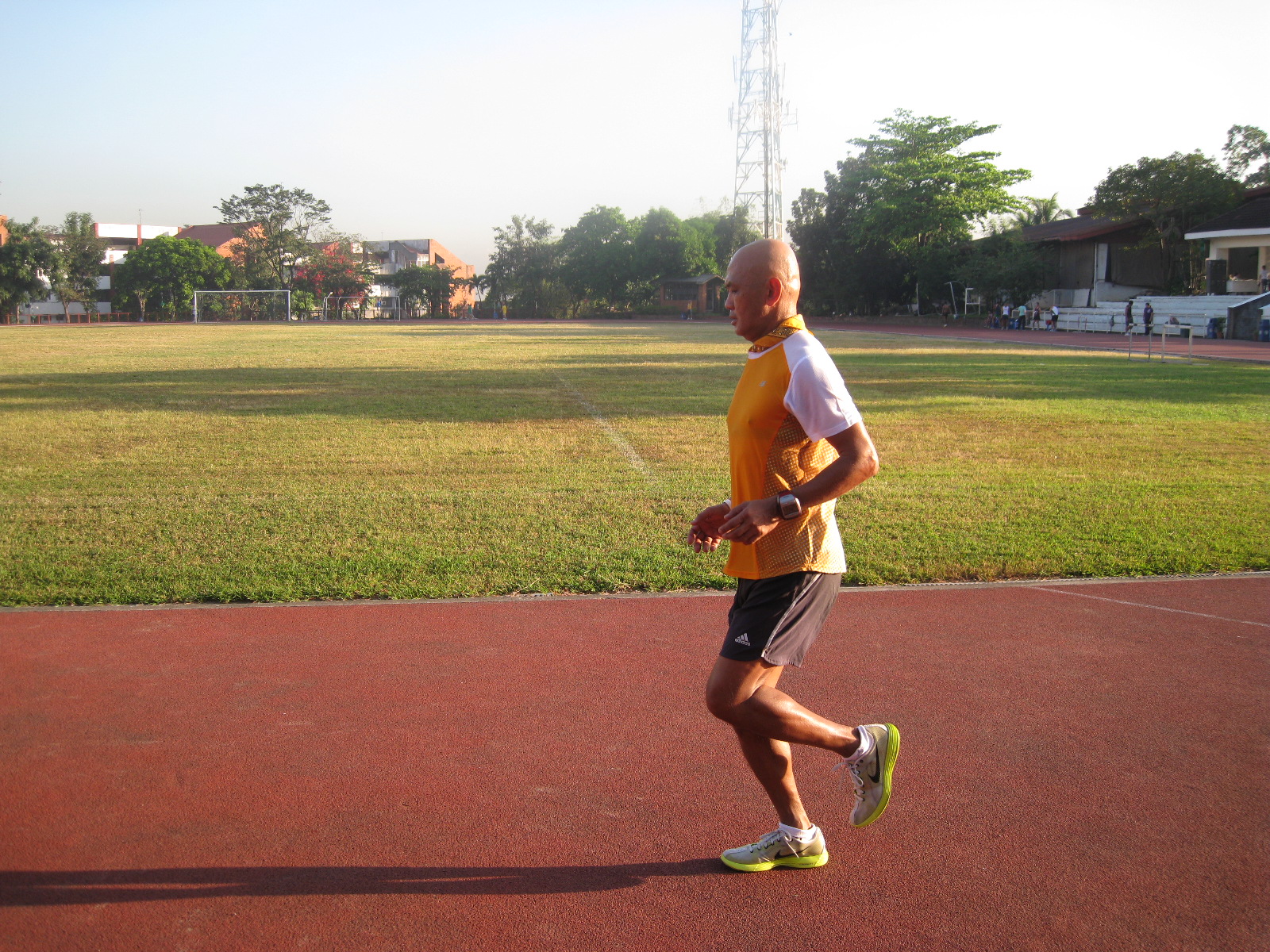
5. To give a full description of the drills I’ve done during/after my run, I am posting the following pictures with the hope that other runners would also adopt them to make them stronger and faster.

"Running No Arms"
Front View of "Running No Arms"

To do this drill, a runner must lace his fingers and form a big circle with his arms at shoulder level. Run 100 yards at moderate fast pace with arms in this position. Return to your running form after 100 yards and repeat after running another 100 yards. I did 10 times of this drill while I was running around the track.

This drill forces my inner abdominal muscles to maintain an upright posture and activates such muscles while running. It also eliminates unnecessary swaying or rotation of my shoulders from my waist while running.

"One-Leg Hop"
One-Leg At A Time

To do this drill, one has to run as fast as possible with one leg for 20 seconds or approximately 20 leaps/bounce or more. This drill will increase one’s push-off power of the feet and will enhance the stability of the hips, pelvis, lower spine and knees on impact of the foot to the ground by forcing the muscles to stabilize the joints for a short period of time.

Lesson #1: In a training cycle, first phase is to develop your aerobic endurance base.

(Source/Reference: “Brain Training For Runners” by Matt Fitzgerald)

Finally, I am Back!


1. Exactly one month after the PIM Pasig River Marathon, I was back running at the ULTRA Oval Track yesterday afternoon. I did 1-Kilometer slow run at the soccer field, another 5K at the oval track, and finished my workout with another 1K at the soccer field and 1K at the oval track. My average pace of 7:30+minutes per kilometer was enough to bring myself back to (competitive) running. An 8K run at the oval track was “heaven”!

2. Actually, I had my first attempt to run/jog last Thursday when I took pictures of the future site of the Ultra Trail Run that I am planning to implement. I was able to run/walk/jog a distance of 8.5 kilometers but I was still in pain but after this run and a deliberate and very long session of “deep-tissue” massage, all the pain was gone!

3. I had another 6K Run at the Rizal High School Oval Track last Saturday afternoon and it was a workout where I was able to run continously without any walking breaks. Even if my average pace was 8:30-9:30 minutes per km, I was happy that I could run again.

4. From the book of Tim Noakes’ “Lore of Running”, I found out that my injury is called “Chronic Muscle Tear”. “He concludes that this kind of muscle injury occurs in various muscles at specific sites that, for reasons unknown, develop eccentric muscle weakness. This weakness is exposed during faster running. When the eccentric loading exceeds the muscle’s eccentric strength, a small section of the muscle is strained and develops an inflammatory response. This initial tear is too small to cause discomfort. However, once the initial tear has occurred, a cycle of repair and reinjury and reinflammation develops that leads ultimately to the large tender knot.”

5. For the specific treatment, Tim Noakes stated “The only treatment that works is a physiotherapeutic manuever known as cross-frictions. A better term would be “crucifixions” because this is the most painful treatment a runner would experience. In simple terms, this is what I call “deep-tissue massage” or “hilot”. Ask Coach Titus Salazar of Team Bald Runner how this procedure is properly done!

6. You will see me more at the ULTRA Oval Track during the Team Bald Runner’s “Speed” Training on Tuesday, Wednesday, and Friday afternoon from 5:30 PM to 9:00 PM.

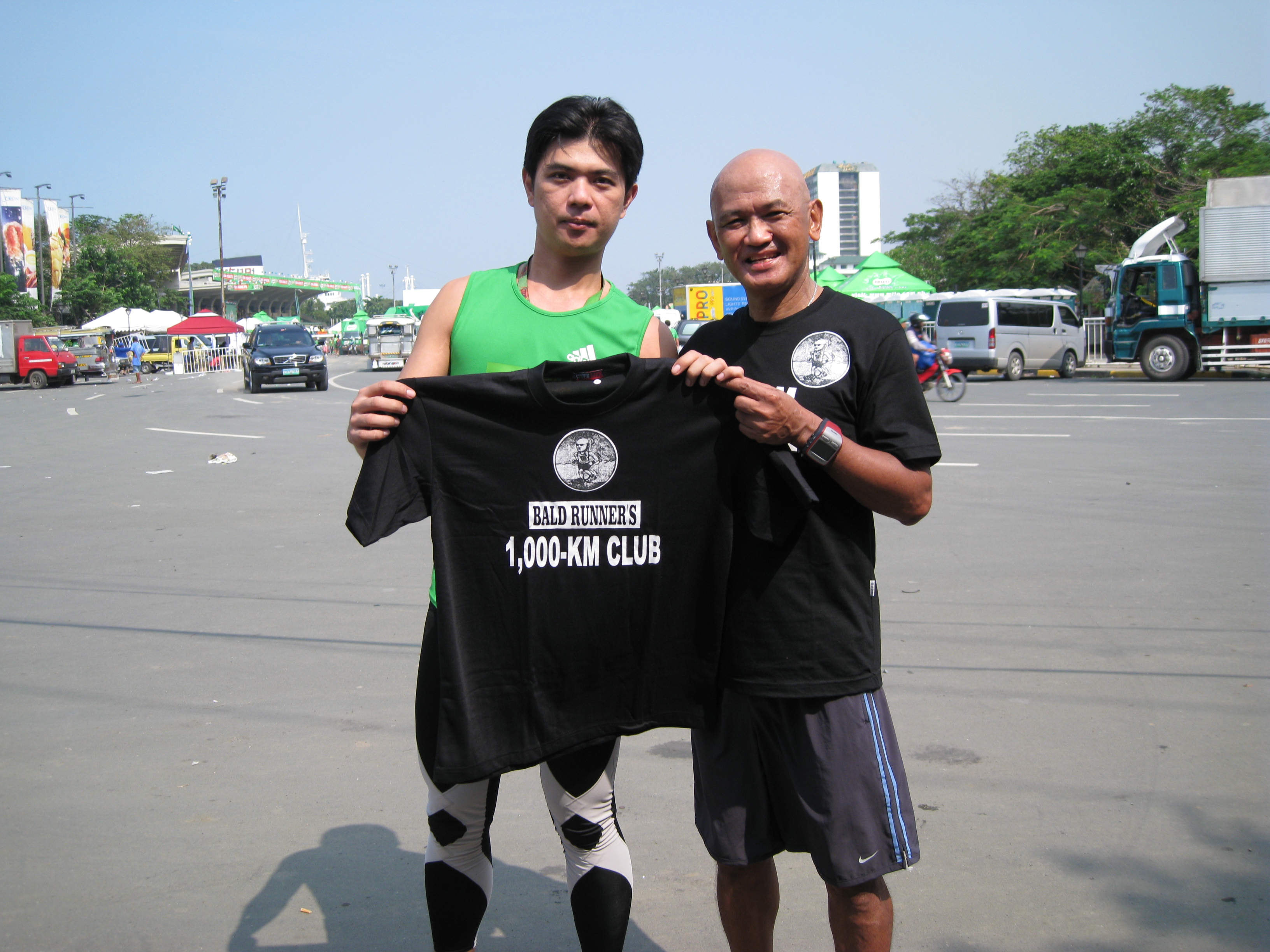
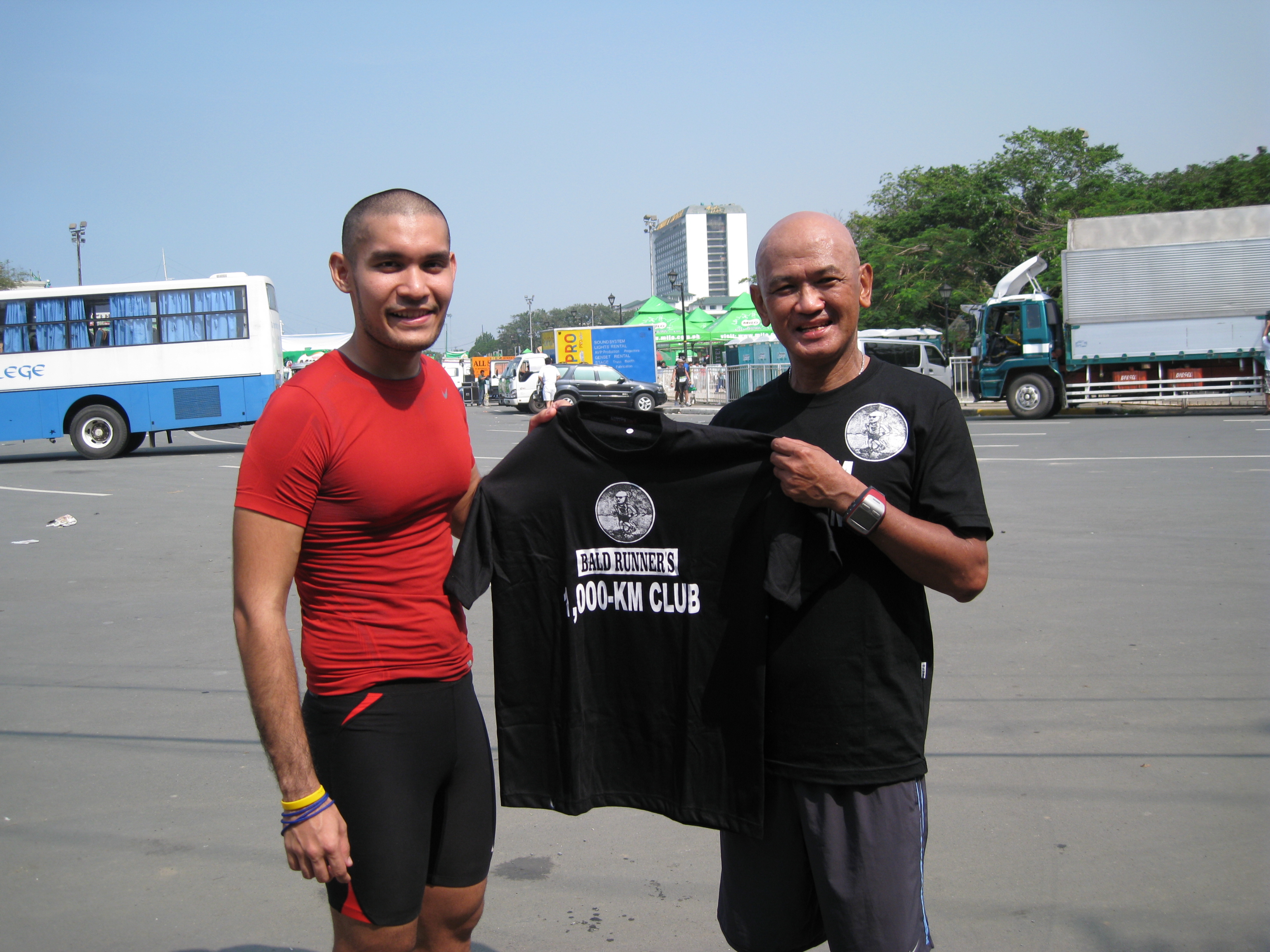
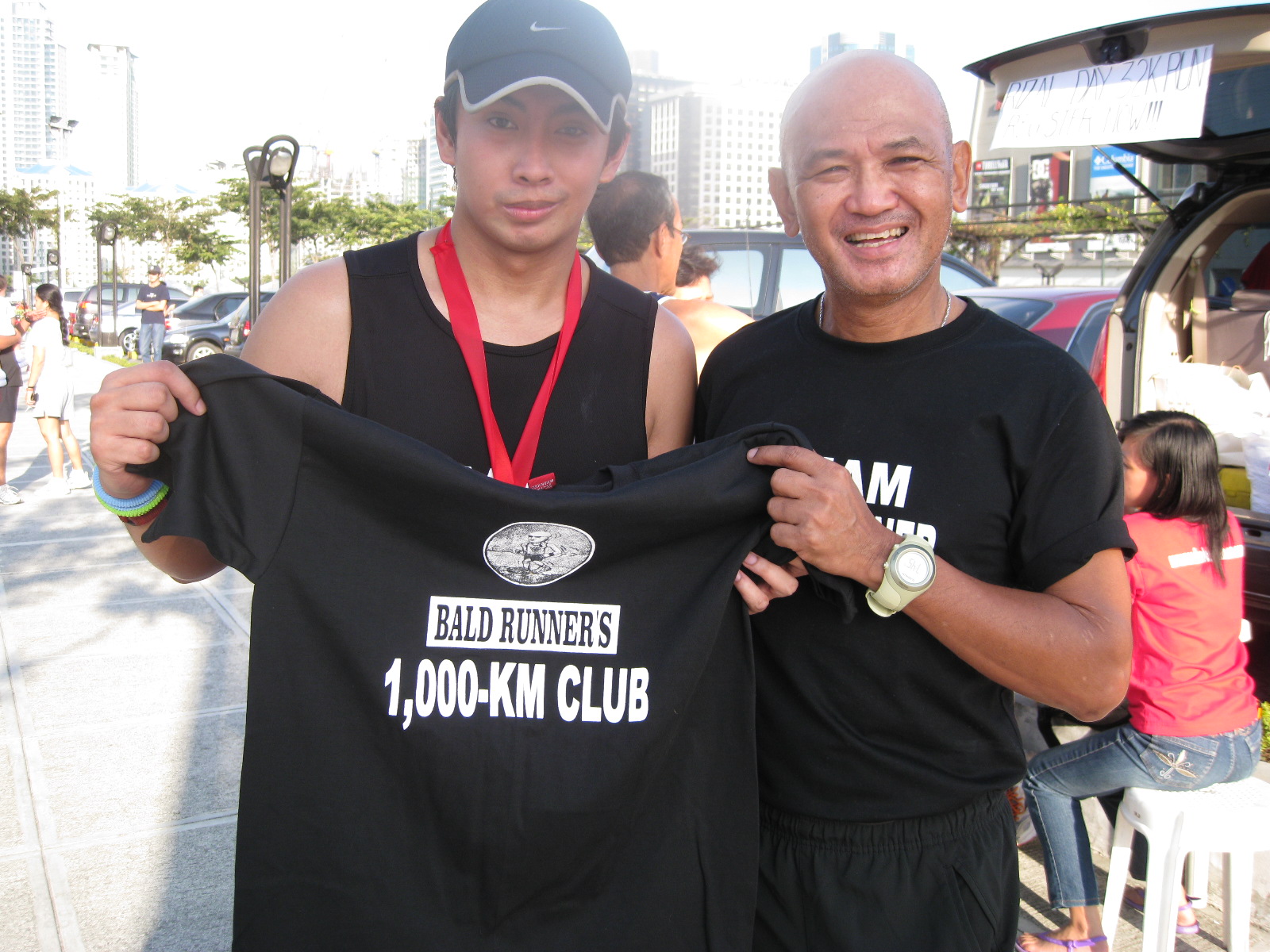
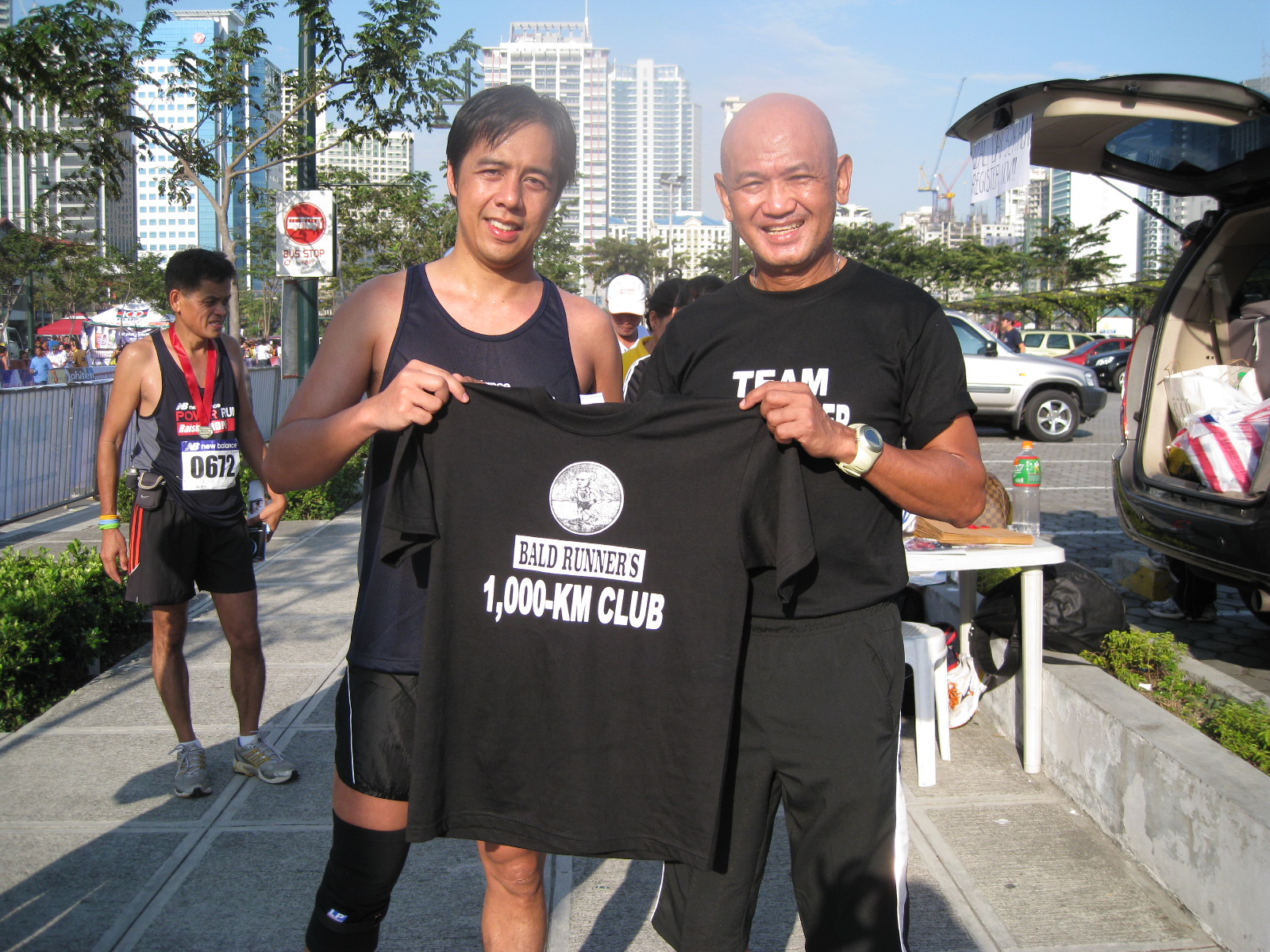
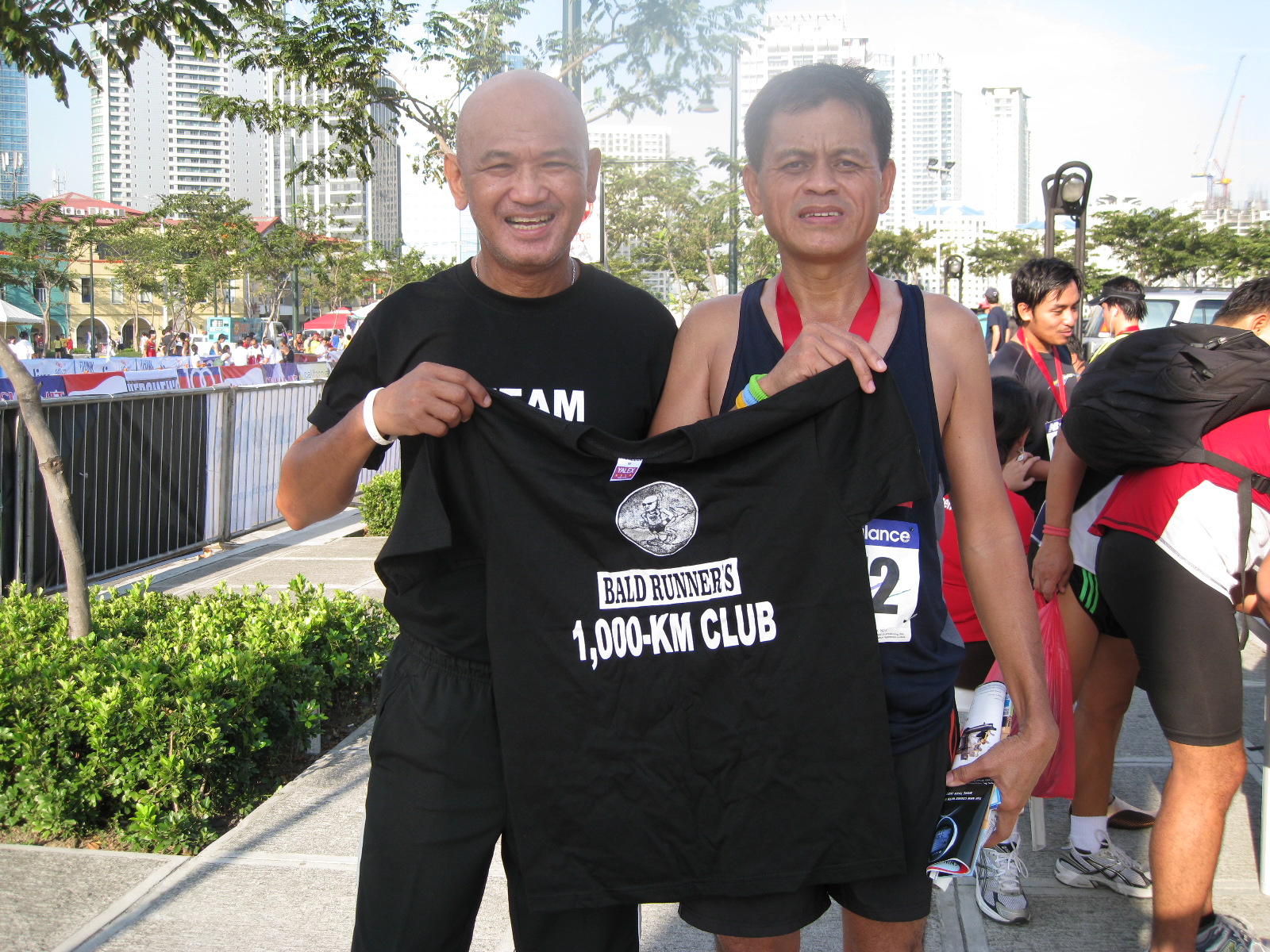
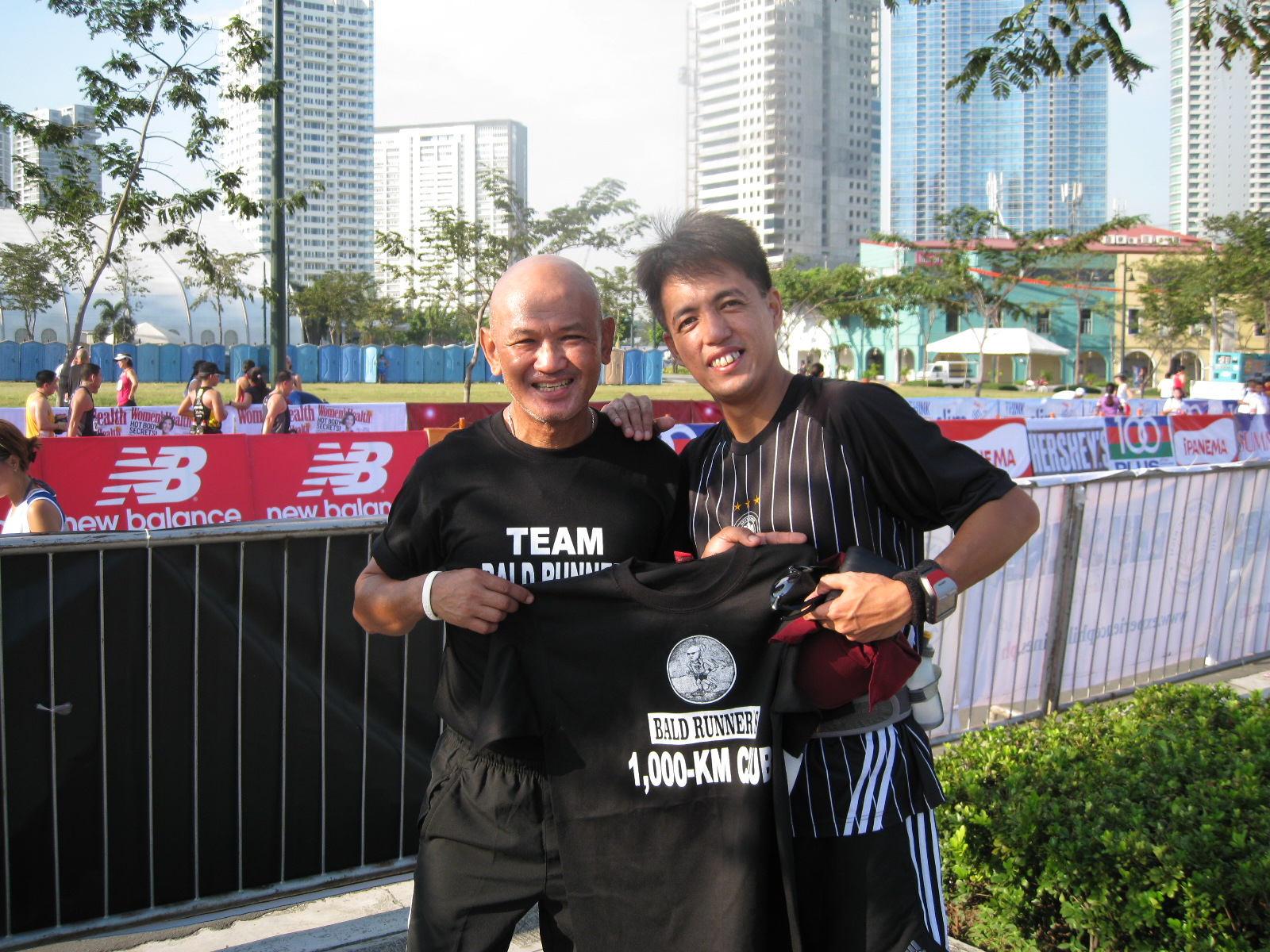
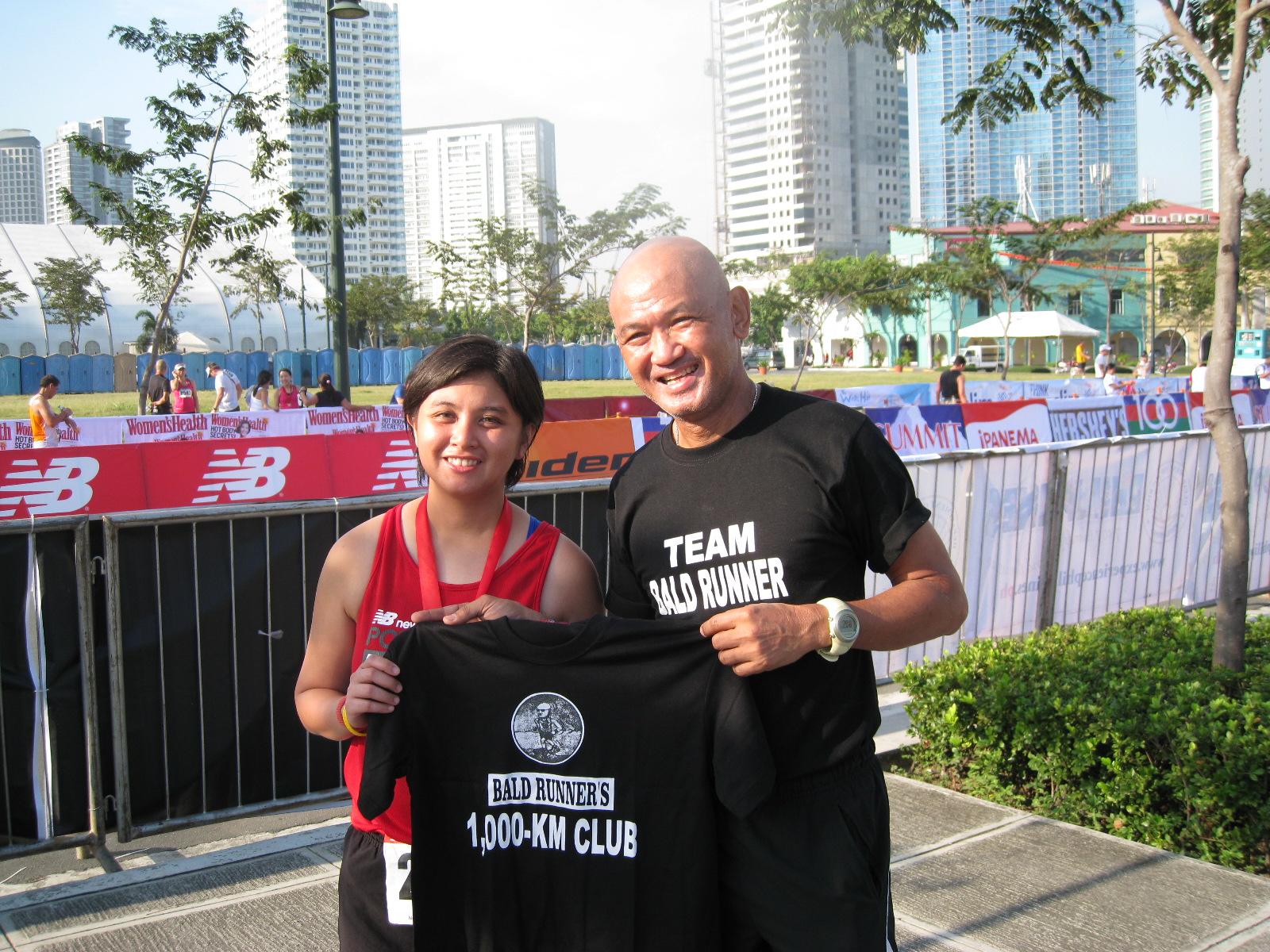
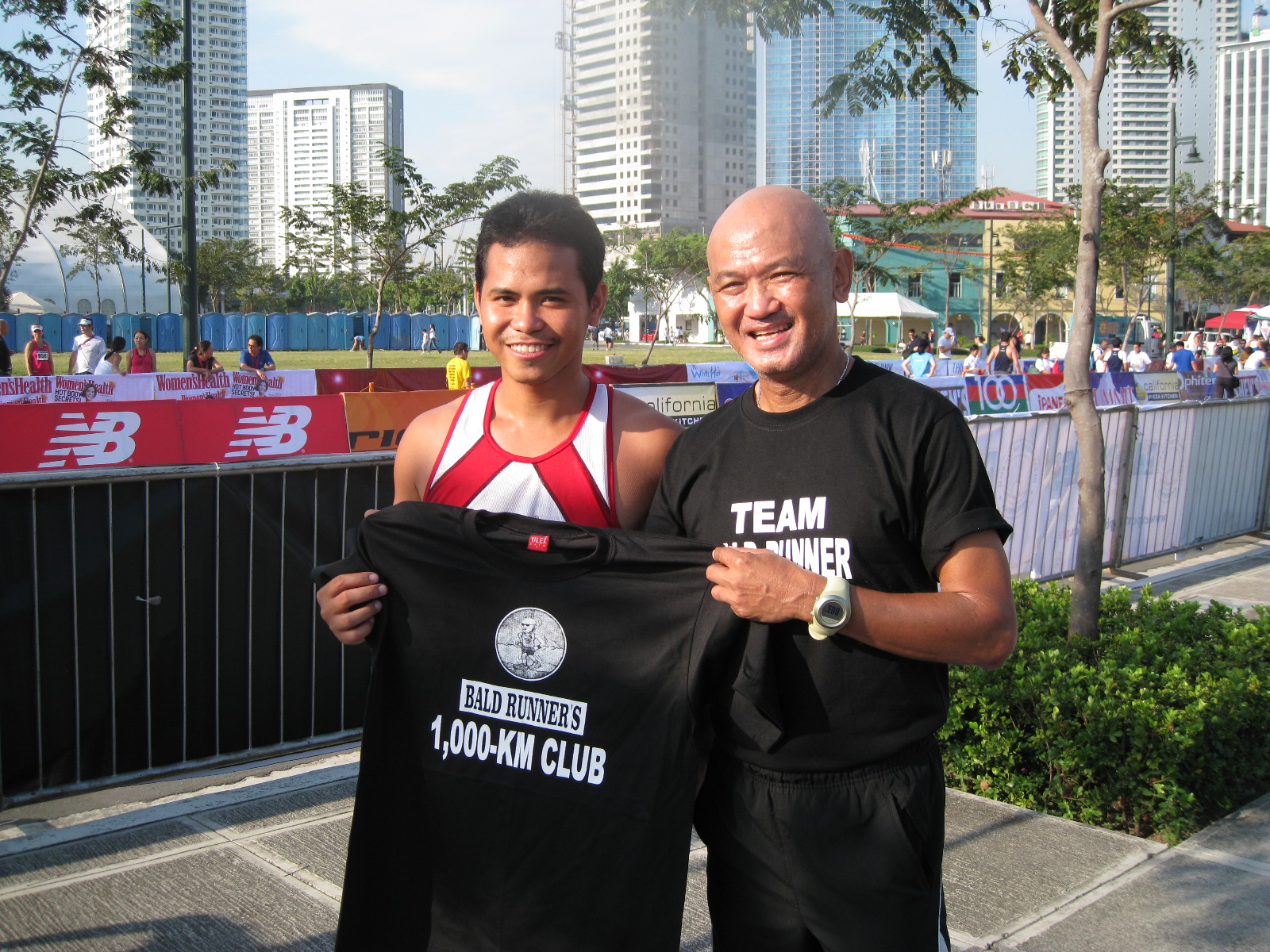
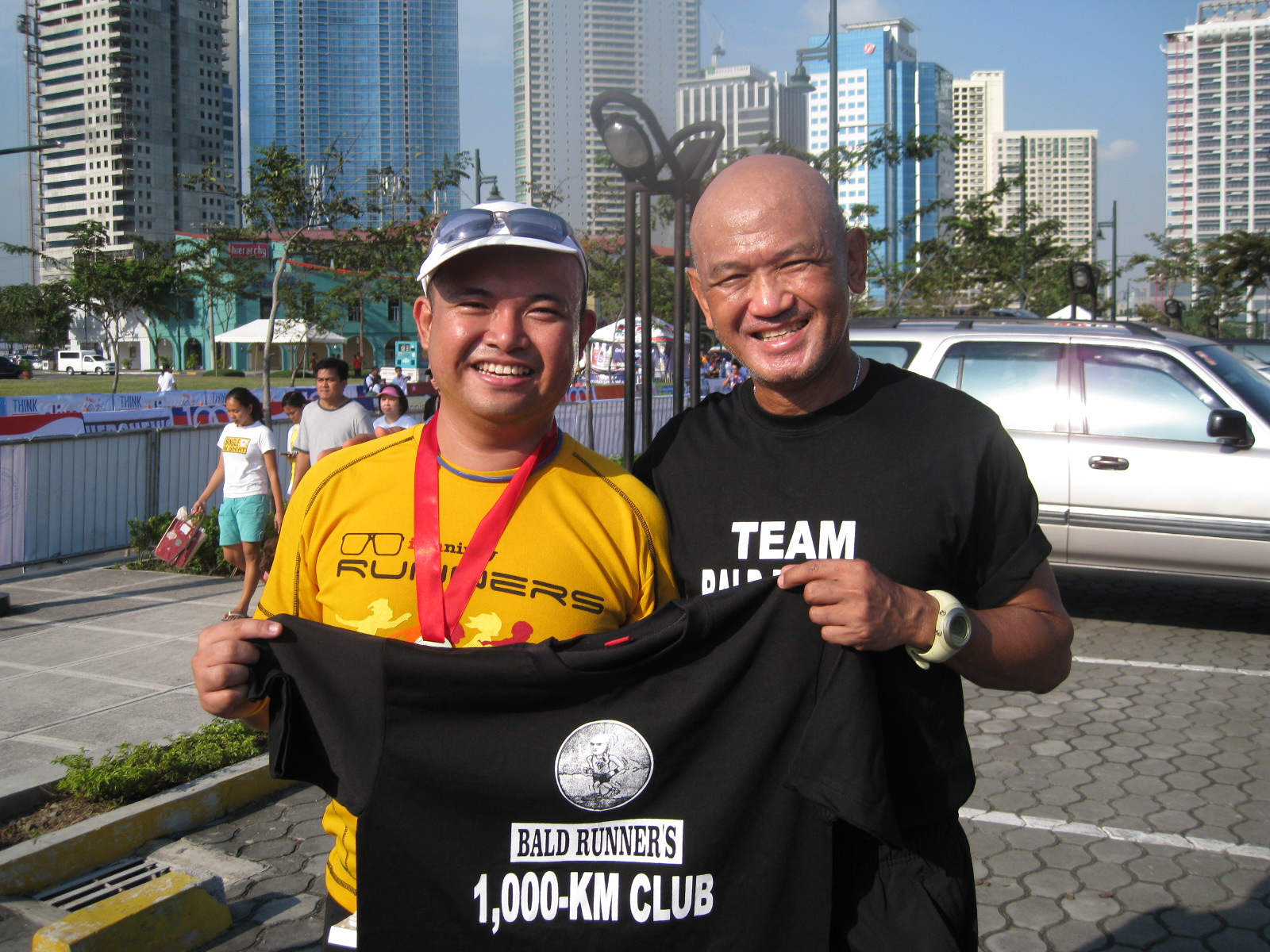
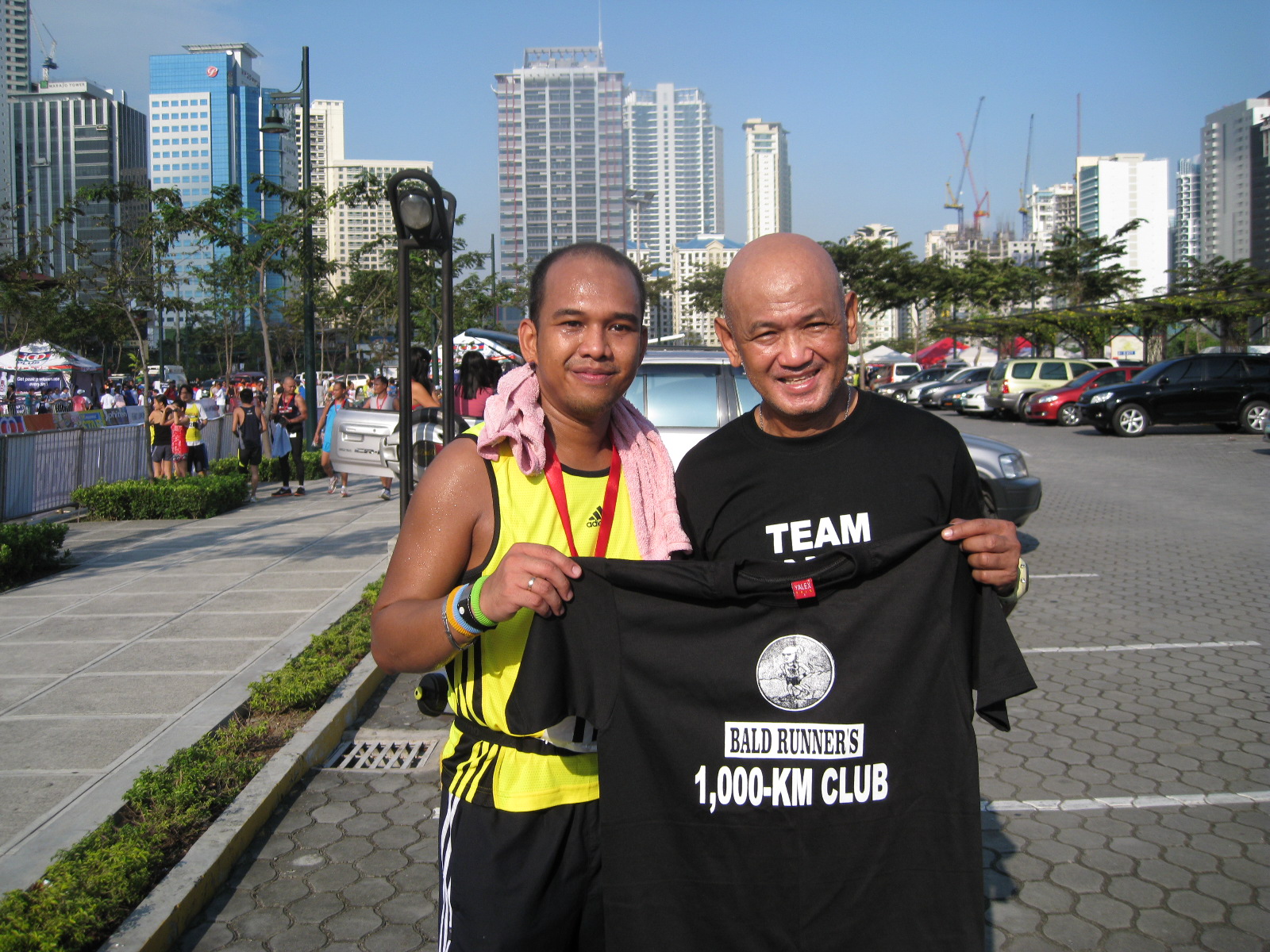
“1,000-Km Club” Finishers


The following runners are the latest finishers/awardees of the Bald Runner’s “1,000-Km Club”. Congratulations!!! 

Ultrarunner George aka The Talkative Runner
Ultrarunner Ralph
Ultrarunner Luis aka The Gingerbread Running
Nolan Llanora
Supt. Gregorio Torres PNP
Macky Chamorro aka Gleeman
Carly Dizon
Rodel Cuaton aka Argonaut
Jet Paiso
Paul Paranal

Of Running Clinics; Meetings; & Visit


1. We no longer offer FREE Running Lectures/Clinics. We are now asking a honorarium for the conduct of our Running Lecture/Clinic. The fee will be used to support our Elite Team Bald Runner Distance Project and logistical needs for the 2nd BDM 102.

2. I was invited for the Send-Off Party this week for our athletes in Athletics (Track & Field) who will represent the country in the 2009 ASEAN Games to be held in Laos. The Track & Field athletes consist of 20 athletes; 6 Coaches; and 1 Head of the Party. The PATAFA Team will be leaving on December 6 for Laos. The 25th ASEAN Games will start on December 9. The TEAM Philippines “HOPES” to get at least 45-50 Gold Medals in the Games.

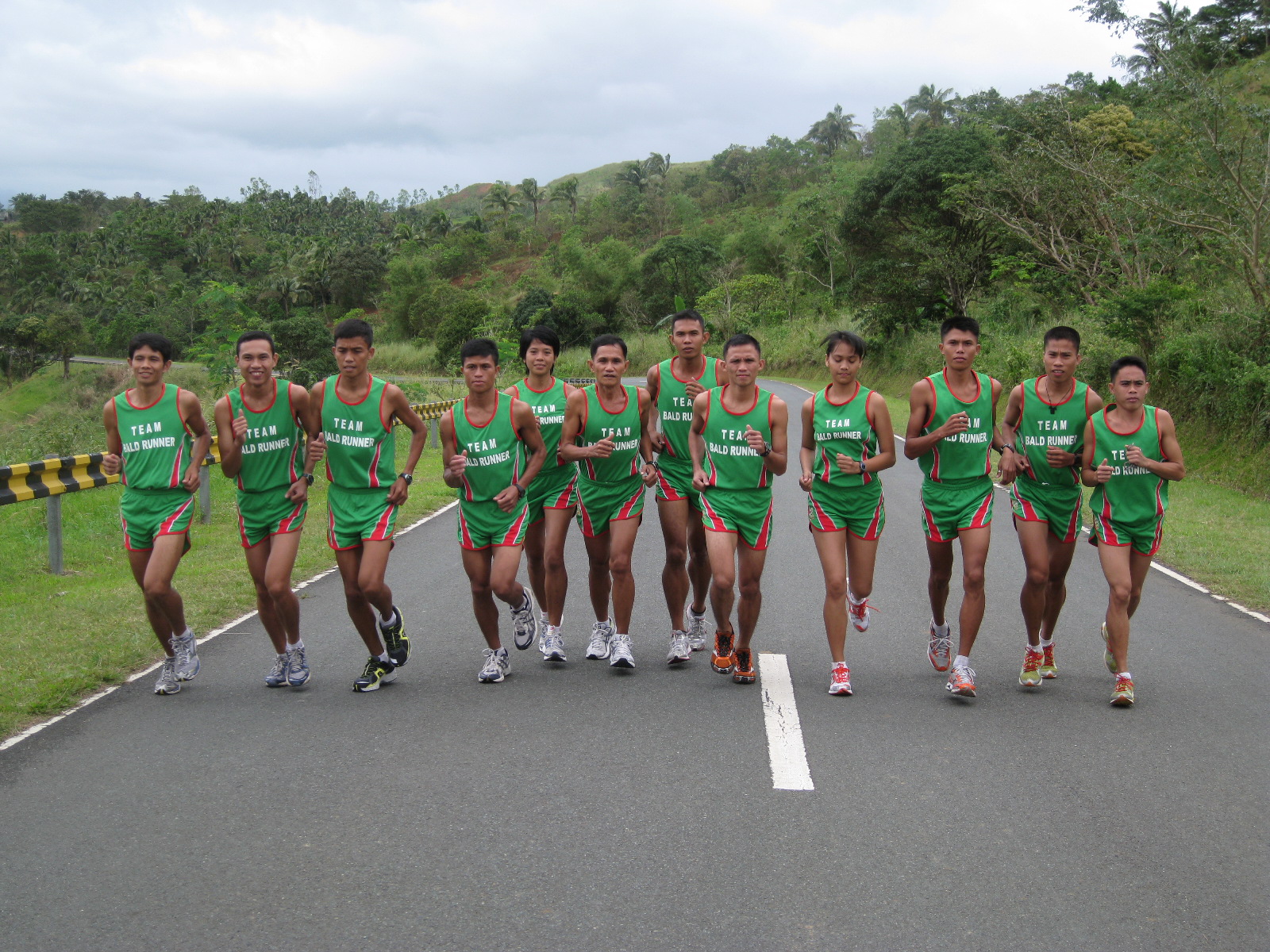
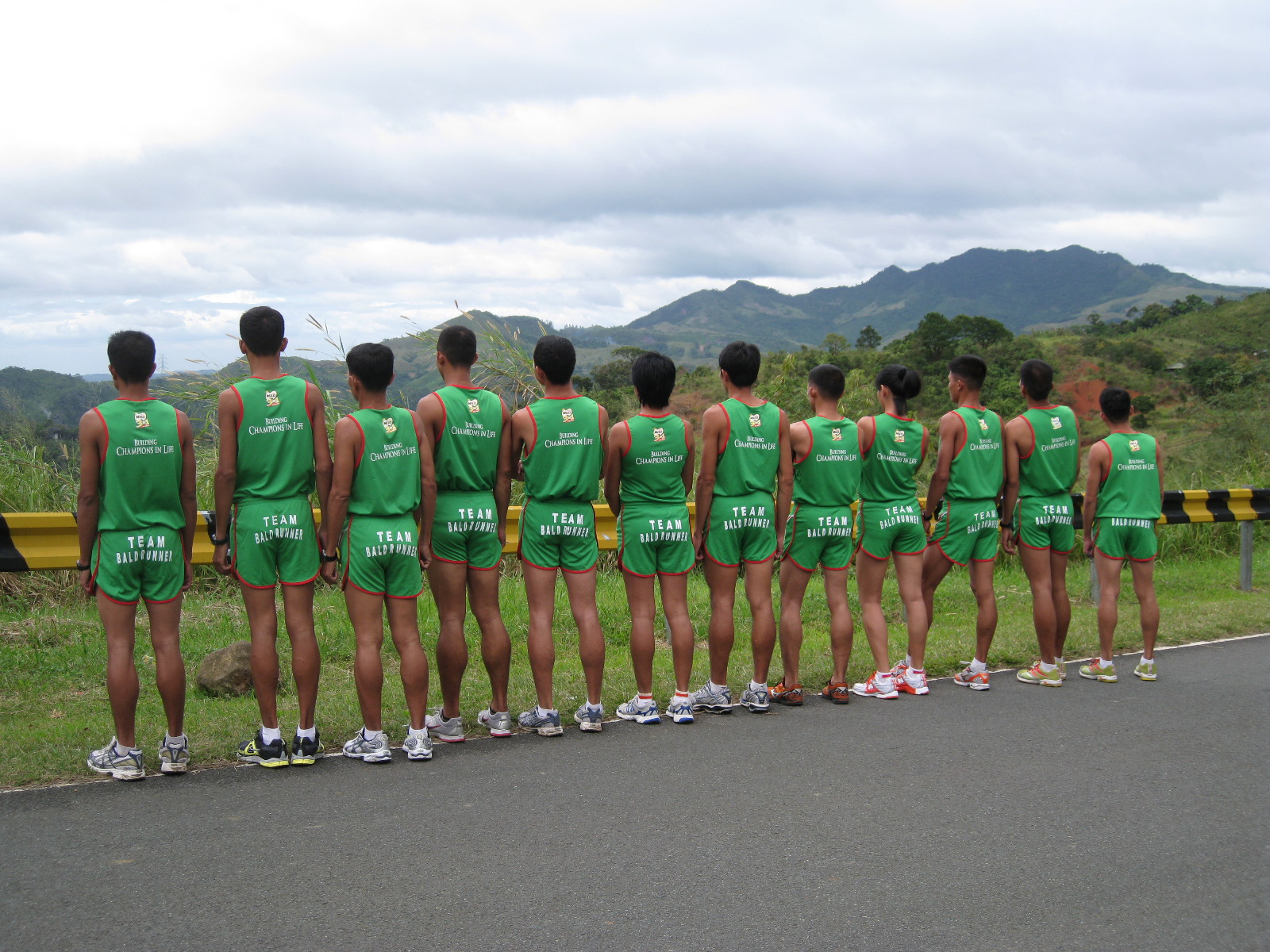
3.  I made a “surprise” visit to my Elite Team’s “training camp” in the Sierra Madre Mountains and we had some pictorials with them with their new Team Bald Runner uniform courtesy of MILO/Nestle, Phil. Altitude, Hill workouts, trail running, and clean air are the keys for better performance.

Elite Team Bald Runner Distance Project Members
Looking For A Brighter Future In Running

4. A Leadership Training/Speaking Engagement Module had been offered to me by a Private Company engaged in the conduct of training to corporate offices. I think this is a good job while I am on “rest & recovery” period.

5. “Brainstorming” session was conducted among the members of Team Hardcore and other ultrarunners about the creation of the Philippine Association of Ultrarunners (PAU) at the Board Room of Reinier Pacific which was hosted by Capt Amado Castro Jr aka Reinier6666. The meeting was very productive and I was able to gather positive insights about its creation and its availability for membership.

PAU's "Trailblazers" & "Pathfinders"

6. There are already 147 runner-applicants for the 2nd BDM 102. There are 40 slots reserved for the AFP/PNP runners.  If the slots for the AFP/PNP will be filled up, there are already 186 runner-applicants. However, I still encourage runners to apply in my Bataan 102 Events Page. There are 96 Days to go before D-Day!

7. More suggested logos for PAU had been received. Thanks for your interest to come up with PAU’s Logo. Deadline of submission is December 31, 2009.

(Note: Latest Awardees/Finishers of the 1,000-Km Club will be posted next!!!)

A Comment From Coolrunner1009


Mr Coolrunner1009 posted this comment on the article/story, “Who Listens To RUNRADIO”. I am posting his comment so that all my readers would be able to read it and you can make a rejoinder or comment on this post.

“Thank you BR for your suggestions. I discovered the joy of running in the 1979 and was also a witness to the running boom that swept across the country like wildfire for more than a decade. From my recollection, running at that time had a wider grassroots base because both the government and private sectors were at the forefront in showcasing the Filipino athlete’s (or runner should I say) talent. There were even FREE races like the Kabataan Barangay’s People’s Run (circa 1980?) where I finished my first 5K. Who could forget the Siglakas and Band Aid Marathon clinics then? The athletes who gave our country much pride then – Lydia de Vega, Isidro del Prado, Jimmy dela Torre, Elma Muros, to name a few, all came from our society’s grassroots.

The way I see it now, the renaissance that we are now witnessing has not yet reached down and deep to the lower strata of society which must be teeming with vast but untapped potential. While the middle and upper classes could definitely produce great runners, the grassroots, by mere function of demographics must be the reservoir of our future champions.

I agree that the use of the lingua franca as well as the involvement of less privileged but outstanding athletes e.g. Bertek in promoting running could make much of a difference. While I appreciate NU 107 in doing its best to promote running, there are inherent constraints because this station couldn’t stray too far from its English-literate, upper to middle class target audience. However, should not do much harm if the folks at Run Radio would use Taglish at least, in this metropolis where Pilipino is the lingua franca. Other sectors (AM stations, gov’t agencies, NGOs, etc.) should follow suit in reaching down and deep to socio-eoconomic classes C&D. A multilingual and multisectoral approach by the key players (or promoters) should enhance their effectiveness in reaching a broader audience. Me impression kasi na ‘burgis’ at ‘pa-cute’ kung palaging English na lang ang gamit. Ang telenovela nga, isinasa-Tagalog para lamang maakit ang mga masang manood. The ratings will tell you the rest of the story.

Lastly, I find it PATAFA’S decision to ban runners from the national pool legal but not moral. It’s a pity that our best runners are living a hand-to-mouth existence. I also lament the fact that registration fees at major races, which range from Php 350-500, would cost the common tao more than a day’s wage. It’s difficult for a breadwinner who is passionate with running to justify spending such an amount for a race at the expense of hungry mouths in his/her hungry family. I cannot imagine how many of our less fortunate fellow runners who belong to the minimum wage earner have been running with guilt in their consciences just to experience the euphoria of competing in a road race. I don’t know if socialized registration fees for races would work. What do you think BR?

More power to you BR for your advocacy! Although your expressions occasionally tend to draw strong criticisms from other sectors, it is always necessary to comfort the afflicted and to afflict the comfortable for the sake of raising the bar on running.”

I really like this kind of comment from my readers who had experienced what was like during the “running boom” in the late 70s and the whole decade of the 80s. I still remember that there were so many running activities then—fun runs, running clinics, relay runs, corporate running competitions where the champion team was sent to Stanford University for the International Corporate Running Competition. Through my personal experience and research, the government was at the forefront in organizing road races—whether to celebrate a national event or historical event or in major road race competitions. The Ministry of Youth and Sports Development (MYSD) under Minister Doretheo who was also an athlete himself and he could muster the cooperation of the city governments in Metro Manila, PC-METROCOM, Philippine Highway Patrol, PATAFA, volunteers, PATAFA, and private corporate sponsors. The country was still then under Martial Law!

I just wished that the concept of Project Gintong Alay during those times will be fully appreciated by the present sports authorities. As I said before, as long as we have different personalities holding these key sports instituions in the country, the perceived “sports politics” and “finger-pointing” syndrome will always be there and our athletes are the ones being jeopardized. And as long as we have “fat-bellied” & “very, very, very old” sports commissioners/officials/sports federation leaders who could not even experience what it takes to run a 3-Km distance, then our sports excellence program will not reach a higher level of accomplishment. No amount of being trained and very good in PR, marketing, and “savvy” in management, what we need is a good leadership who can set an example and transparent to our athletes and to the public.

Socialized Registration Fees? Depending on the cause or advocacy of the road race, it could be done. But the problem is, how can you distinguish the Class A from B from C & from D? What are parameters if you want to consider a runner to be at the Elite, Middle, or Poor Class of the society? This is a very tedious work for the Race Organizer. The runners will complain if you require them to bring their ITR or SAL to find out if they belong to a certain category according to their income & property. Actually, if we have a supportive government and corporate sponsors, we can have a road race that could be free from registration fees!

It is true that some of my posts and expressions are very “abrasive” to some group of runners and/or race organizers and even to sports authorities and government elective officials. Running is a way of life for me, for the hardcores, and to most of us who want to enjoy the “intangible” benefits of running. Others would make running to make a living with the hope and greed to enrich themselves. Others would run because it is the “in” thing nowadays and they want to be identified with this group and that group. Others would use running to help others which is to me is a crap and cheap reason to earn more money. Others would run because they are “celebrities” and they voluntarily or get paid/rewarded to endorse some running-related products. Others would want exposure to the public for some personal or political reasons. The reasons are so many. But for me, if you want to help in running, we have to go to the “grassroots” and encourage the less-priveleged ones to run and get the best from them. Train, educate, feed, ingrain to them good values and lead them to a better life by transforming them to be the best runners. Who knows, this could be the solution for the country’s problem why we could not even earn a Gold Medal in the Olympic Games. For a population of 90 Million, I believe there is somebody out there who would be a future star in Athletics that will make us proud in the Olympics. All is needed is for somebody to discover him/her, rear, guide, feed, educate, train, and lead him/her to be the best runner.

At least, I am doing my part by coming up with the Elite Team Bald Runner Distance Project for the past 15 months, without the support of the government, from PATAFA, or from any corporate entity except from a few friends of Bald Runner who really believe in this advocacy. It is better doing something to solve the problem (even if it will take years to produce a result) rather than not doing anything at all. I hate to hear and read from cheap talks and cheap posts in blogs and in media releases about pronouncements on how to solve such problem. I’ve been reading and hearing their plans & pronouncements to improve our sports excellence program for the past years but nothing happened to elevate the level of excellence of our athlete’s performance. It is very frustrating to observe that our “sports excellence” is up to the level of the ASEAN Games. No amount of promising hefty amount of rewards for medal winners (in the Olympic Games or in any International Games) if the training & service support of our athletes are not adequate and lacking. I firmly believe that it is better to “front-load” these cash rewards for the training of the athletes rather than dangling them as rewards to be attained.

Let me enjoin everybody then to help and support the Elite Team Bald Runner Distance Project as this is our hope in Long Distance Excellence in the country. My deepest thanks to Coolrunner for the comment he posted in this blog and I hope one of these days I would be able to personally meet him in one of the future road races.

See you on this weekend’s road races!
“I need the money…I need to buy vitamins”


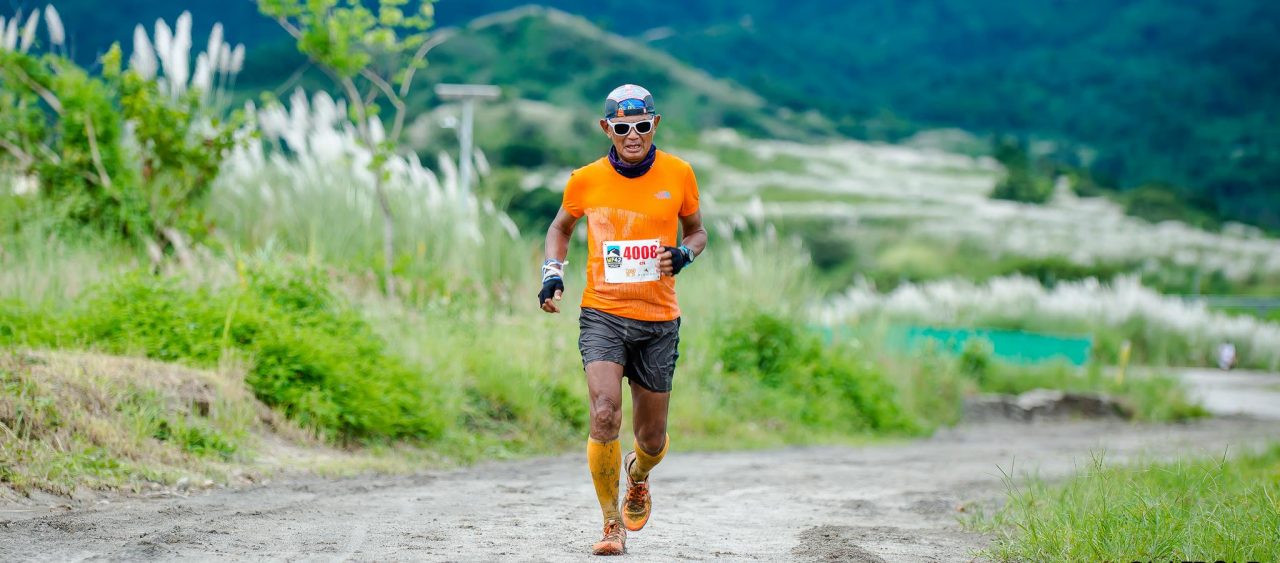
“Yes, I’m a candidate for ejection from the Philippine team,” said the four-time champion Martes, the youngest Milo winner at 21 years old in 1999. “I’ll just talk to them and explain. I need the money. I’m having laser therapy for my old injuries and I need to buy vitamins.” (Note: Copied from news report at www.inquirer.net)

These were the exact words from the mouth of Christabel Martes, Lady Champion of the 33rd MILO Marathon FINALS held last Sunday, for her reason why she ran and finished the race despite an strict memorandum from PATAFA (Philippine Amateur Track & Field Assosiation) that National Pool Athletes are restricted from running more than a distance of 10K competitive Road Races at least 3 months before an International Games/Competition Meet. The reason for this memo is to make sure that our National Athletes do not divert themselves to their training program in order for them to “peak” during the competition period/date and at the same time, prevent them from becoming injured.

In the reaction of the PATAFA officials, as published in the news, Martes will be definitely removed from the list of National Athletes slated to be included in this coming Southeast Asian Games which will be held on the first week of December 2009 in Laos. For winning a cash prize of Seventy-Five Thousand Pesos (P 75,000)  or equivalent to $ 1,595.00 in the MILO Marathon FINALS, her chance of winning the Gold Medal in Marathon in the ASEAN Games is gone!

 Money versus Pride For the Country? Present Reality of our Athletes versus Present Situation of our Sports Excellence Program?

Now, let us try to discuss the present condition of our National Athletes basing from the title of this post/comments from Christabel Martes.

It appears that our National Athletes are not properly or adequately supported by our Sports Federation or the Philippine Sports Commission (PSC). As per PSC’s guidance, for an Athlete who won Medal/s (Gold, Silver, or Bronze) in the previous ASEAN Games and other International Competition Events and presently training to compete in an International Games, he/she receives a monthly support of   Fifteen Thousand Pesos (P 15,000)  or $ 320.00 inclusive of food, vitamins, training needs, and stipend. While on training, with the guidance of their coach, they are left on their own and stay/live in Sports Facilities being managed by PSC. It is also concluded that the athletes had to deal with their own injuries and have to get the services of professionals to cure them for a considerable fee. Which means that our Sports Support Services (Sports Medicine, Nutrition, Sports Psychology, etc) are lacking! In short, 15K Pesos is nothing if we want our athletes to be “world-class”. The same amount of money is equivalent to a ONE-DAY MEAL for Michael Phelps, I guess!

For a potential medal placer and a “newbie” in the National Pool of Athletes, he/she receives a monthly stipend of Six Thousand Pesos (P 6,000) or $ 128.00. This is translated to P 200.00 per day meal for the athlete and he/she could not even buy vitamins and sports drinks for his hydration & electrolyte resplenishment needs during his training. And if he/she wants to compete in weekend road races, he/she is selective as to where he/she will compete because the registration fee will be deducted from this amount of money. But our athletes are “brave warriors” because they have to risk in investing their training money to weekend road races that have Cash as Major Prizes for the Top Finishers! If they loss and don’t get any cash prize, the more that they will train harder but their training money is now draining and they are forced to spend their money to their barest needs. In essence, our athletes are on “survival” mode!

This situation is not only applicable to our runners but to all our athletes in other sports!

Now, you know already why our runners in our National Pool of Athletes are only good for our local Road Races with Cash Prizes, not for the ASEAN Games, not for the ASIAN Games, and never for the OLYMPIC Games!

Masters In Marathon (M.I.M)


While reading the back issue of the magazine “Running Times” dated November 2003, I came upon an article entitled “A Master’s in Marathoning: Choosing the Education of Running” by Mike Tymn. The article stated that running a marathon race is in itself a post-graduate education degree that has a curriculum and subjects to be attended to. For a student who enrolls in this Graduate Studies on Marathon Running, it would take years before he/she could complete or graduate depending on the goal/objective to be attained—to simply finish or finish within a desired time or improve one’s PR or qualify for the Boston Marathon! The following is some of the excerpts from the said article:

The marathon curriculum begins with courses in anotomy, physiology, and medicine. We learn about cardiovascular endurance, anaerobic threshold, oxygen debt, target heart rate, maximal oxygen uptake, running injuries, pronation, supination, to name just a few. The curriculum continues with courses in Physical Education as we are schooled in the principles of adaptation, overload, progression, specificity of training, recovery and rest. We are exposed to interval training, fartlek, LSD, circuit training, stretching, tapering, pacing, peaking and overtraining. We learn about diet and nutrition, finding out what to eat and what not to eat. We are introduced to carbohydrate loading, electrolyte replacement, and proper hydration.

The marathon curriculum includes lessons in psychology, as we must better understand how to deal with problems in goal setting, self-motivation, mood swings, errors in anticipation, regression under stress, and fear of failure. We learn about such things as mental rehearsal, visualization, and self-reward reinforcement.

There are also lessons in planning, time management, and conflict resolution, especially for the runner who is attempting to balance family and occupational responsibilities with the demands of training.

I see the marathon as a microcosmic lesson in life. We learn to commit ourselves to a goal, to discipline ourselves to the demands of that goal, to develop, adapt and evolve, to pace ourselves for both the short and the long haul, to cruise, to struggle, to overcome, to struggle again, to push on, to slowly “die”, (as oxygen is depleted), then to be “reborn” (as we cross the finish line).

There are so many lessons.

We learn that we can work a lot harder than we had ever realized possible, but we also learn that we can work too hard and set ourselves back.

We learn that we can start too fast and never finish, and we can go out slow and never catch up.

We learn that winning or achieving our goals can be fun and fulfilling, but we also learn that winning can bring unwanted pressures and harmful stresses.

We learn that being a poor loser is better than being a poor winner.

We learn that our fiercest rivals can be our best friends.

We learn that success can instill pride, but it can also bring an abundance of humility.

We learn that we can get slower with age but faster with adaptation and experience.

We learn that there are a lot of contradictions in running, just as there are in life, and the key is a balance mixed with just the right amount of patience, persistence and perseverance.

More than anything, marathon running is a course in philosophy, an attempt to answer the essential questions of life. To what end? At what price? The questions and answers are endless.

Whether you are an elite athlete who makes running as your source of income or a competitor who finds challenge in trying to find your body limits or a runner who wants to engage in an active healthy lifestyle, running in itself is a way of life.

So, if you want to graduate in this course of Masters in Marathon, you have to “pay your dues/fees”, study your lessons, do your assignments/homeworks, and above all, pass your quizzes and comprehensive examinations!

(Source: A Master’s in Marathoning: Choosing the Education of Running by Mike Tymn. Running Times Magazine. November 2003. pp. 29-30)