History: 1st Manila International Marathon by Red Dumuk


Finally, the then famous Manila International Marathon is being revived this year. I am not sure if the use of 30th edition of this race is proper as I know that some of the editions in the past had never been conducted. I hope my friend, Red Dumuk, shall make some adjustments on this. However, I appreciate the posting of this article on the website of the said Marathon Race.

If my memory serves me right, this was my first Marathon Race and Red Dumuk specifically mentioned my name and my finish time.

Thanks, Red for bringing back those good memories of Road Racing in the 80’s.

HISTORY

The First Manila International Marathon

By Red Dumuk

Running great, Bill Rogers, winner of four Boston Marathons and four New York Marathons, apprised of the race route and the weather conditions, predicted 2:20 as the winning time in the inaugural Manila International Marathon. His visit to Manila came at the heels of his dismal performance in Japan. As he was off-form, he begged off from showing his form in the MIM.

Rogers’s fearless forecast was way, way off. When East German Waldemar Cierpinski, second only to Ethiopian Abebe Bikila to have ruled back-to-back Olympic Marathons (Bikila turned in the trick in 1960 Rome and 1964 Tokyo Olympic Games while Cierpinski in 1976 Montreal and 1980 Moscow), breasted the tape with President Marcos heading the spectators, the display clock showed 2:14:27, a good 5 minutes and 33 seconds inside the expected time.

The time could have been lower had there been stronger challenge. After 5K, the MIM morphed into a battle against the clock for Cierpinski, who in 1976 frustrated 1972 Munich gold medalist Frank Shorter’s bid to join Bikila as back-to-back Olympic Marathon champion. In the 1976 Olympic Marathon, Cierpinski beat Shorter, considered to have ignited the running boom in the United States, by 49 seconds (2:09:56 against 2:10:45).

Cierpinski’s winning time which is 3 minutes and 24 seconds outside the clocking he posted in Moscow Olympics less than two years earlier can be better appreciated against the backdrop of marathon times in other parts of the world held in different seasons in 1982.

It’s no wonder, therefore, why the 2:14:27 has yet to be expunged as the all comers best in the Philippine Marathon theater. (Domingo Tibaduiza whose time was 20 seconds slower than Cierpinski’s when the former claimed the top prize in the 1982 Berlin Marathon emerged as 2nd MIM champion. He checked in at 2:25:01, nine minutes 34 seconds adrift of the existing standard in 1983.)

Runner-up American serviceman Phil Camp might have found Cierpinski out of his league but his 2:19:39 timing would have outweighed the first placers’ in four of the above marathons.

The last berth in the podium was hotly contested by Chang Ming Chen of Chinese-Taipei and Peng Jiazheng of the People’s Republic of China. There was a sideshow even. A PROC embassy official protested minutes before the cannon fired off the marathoners the display of the Republic of China’s flag on Chang’s singlet and threatened to pull out Peng from the marathon. We explained to the embassy official we were aware if Chang has to show a flag on his breast, it should be the IOC designated banner. We added we subscribe to the one-China policy of the government. Then, we convinced Chang to have the ROC flag covered with a masking tape. Had Chang not acquiesced, disqualification awaited him.

When the smoke of the conflict had settled, so to speak, Chang outstripped Peng by 59 seconds–or just about the time it took the former’s official to tape that offending flag–to claim the third position. Chang’s 2:26:49 clocking bested winning times of two 1982 AIMS events. Peng’s 2:27:48, on the other hand, beat the champion’s time of one of the AIMS member marathons.

Great Britain’s Tim Johnston (2:31:31) rounded out the top 5 finishers. He crossed the finish line two minutes and 30 seconds ahead of the first Filipino finisher, Army man Ricardo Carillo (2:34:01). Landing in the top 5 among the locals and top 10 overall were Manuel Carmelo (2:35:28),7th; Guillermo Padilla (2:37:31),8th; Ireneo Illut (2:38:01), 9th and Carlito Solis (2:38:06), 10th.

Fifty-three runners (only seven were foreigners) registered sub-3 hours clocking. By comparison, looking at the results of the recent marathons in the country, less than 10 runners with sub-3 times seems to be the current norm.

In the distaff side, only the 11-year old wonder girl Joan Laput, tops among the 11 lady finishers, broke 3:30. Laput ranked 173 overall with her time of 3:28:22. Laput’s “preys” included priest marathoner Amado Picardal (3:20:16, 195th), the Baldrunner (3:58:44, 286th) and arguably, the country’s No.1 race organizer Rudy Biscocho (4:40:02, 440th).

Of the 603 hopefuls who answered the starting cannon, only 30 did not finish–a remarkable mortality rate of measly 4.98%. The most courageous and greatest survivor was cardiac patient Teofilo Espejo, Jr. He placed 509th with a time of 5:11:16.

Asst. Race Director Colmenares running and finishing the MIM spoke volumes about the organization and management of the race. He clocked 3:47:50, good for 281st position, well in the upper half of the finishers.

It would be great seeing another Philippine President accommodating the top 200 finishers of a marathon or any road race of prestige in Malacanang and treat them to dinner after the awarding ceremonies where he would trace the history of marathon even as he extols its virtues in his address.

In another first, the country’s top sportscaster then Joe Cantada found his equal in Katherine Switzer during the coverage of the 1st MIM. Joining the fun was Zal Marte, another sportscaster of note. This would never be duplicated. “The Voice” has passed on to the great beyond.

As recognition for a job well done, Race Director Dorotheo’s peers in AIMS elected him as member of the original batch of Board of Directors. It goes without saying the Manila International Marathon was accepted as full-fledged AIMS member barely four months after its initial edition. Dorotheo was to be reelected to the AIMS Board.

And from the locals, what was the reward? The second MIM saw the size of the field doubled.

1st Manila International Marathon Statistics

Countries Represented

  • Macao
  • Sweden
  • Australia
  • Bangladesh
  • United Kingdom
  • Taiwan
  • Norway
  • Indonesia
  • Philippines
  • United States
  • People’s Republic of China
Starters

603

Finishers

573

95.02 %

Men

562

98.08 %

Women

11

1.92 %

Locals

536

93.53 %

Foreigners

37

6.47 %

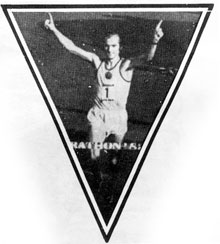
Waldemar Ciepinski flashes the No. 1 sign more than 5 minutes ahead of the 2:20 winning time predicted by Bill Rodgers
Source: http://manilainternationalmarathon.com

Cut-Off Times


I have been making a research in running books and running resources on the Internet on the basis of cut-off times of Marathon and Ultra Marathon Races. It seems that I could not see any “authority” or “regulation” in the IAAF or IAU Manuals and Protocols as to what is the accepted formula in the declaration of cut-off times in every race.

Without any basis, I have the impression that this “rule & regulation” in a running race, whether road or trail, on the prescribed cut-off time is arbitrary and based on the decision of the Race Organizer/Race Director.

On the part of a Race Organizer in a busy City Marathon Race, a six-hour cut-off time is a standard period for a 42K distance. This will minimize the time for the closure of main streets from vehicular traffic. The lesser time for the roads and streets are closed, the better for the riding public and commuters. It will also lessen the time of exposure and involvement of security, medical, marshals, and volunteers and other administrative and logistic supports for the race.

Obviously, this is true also to ultra marathon distance races but with longer and extended period of cut-off times.

Comrades Marathon (90K), the oldest ultra marathon, had an 11-hour cut-off time for so many years until it was extended to 12 hours since 2003. Aside from being the largest ultra road race, it is also the hardest in terms of elevation profile and with a very restrictive cut-off time.

The North Face Ultra Trail du Mont-Blanc (UTMB), 166K ultra trail race, has a cut-off time of 46 hours.

Western States 100-Mile Endurance Run, also a ultra trail race, has a cut-off time of 30 hours.

Jeju International Ultra Marathon 100K Race, a road ultra, has a cut-off time of 16 hours.

Miwok 100K Ultra Trail Run has a cut-off time of 16 1/2 hours. Most of the 100K ultra trail distance races in the USA has a cut-off time of 16 hours.

Singapore’s Sundowm Ultra Marathon 100K Race, a road ultra, has a cut-off time of 16 hours.

Bulldog 50K, an ultra trail race, has a cut off-time of 9 hours. Most of the 50K ultra trail races in the USA have a cut-off times of 9 hours.

Headlands 50-Mile Trail Run has a cut-off time of 14 hours and this is true to almost all the 50-milers except for the JFK 50-Mile Endurance Run which has a cut-off time of 18 hours ( based from tradition and history).

The Hardrock Ultra Marathon, the officially dubbed as the hardest ultra trail race in the USA, has a cut-off time of 48 hours.

The Barkley Marathons (100-mile trail race), the unofficial hardest ultra trail race in the USA, has a cut-off time of 60 hours, however, each loop which has a distance of 20 miles must be completed in 12 hours. It is a “lucky” year’s edition if there is a “survivor-finisher” for this race. Since its first edition in 1986, only nine (9) had finished the race up to this year.

Surprisingly for this year, the Badwater Ultramarathon has reduced the cut-off time from 60 hours to 48 hours! There was no reason in its website for the said dramatic change, however, its registration fee had increased from $ 850 to $ 995.

In my opinion, the cut-off times give an impression on the degree of difficulty of the race to the participants and at the same time provide a status of distinction for the said race.

For the runners, cut-off times serve as their lowest target time to finish. They should not be satisfied to finish the race way beyond the prescribed cut-off time. Finishing any Road or Trail Race must be defined strictly as Finishing the required Distance within the prescribed Cut-Off time. A runner is fooling himself or herself if he/she brags about finishing a race way beyond the cut-off time. For the Race Director, runners who finish the distance beyond the cut-off time are considered as DNF (Did Not Finish).

Simply stated, a runner must train and prepare to finish a race within the cut-off time.

Insights & Observations @ 2011 Miwok 100


On Race Management

1. Registration—Every runner must apply and register at Ultra SignUp, at least 8 months before Race Day. The deadline of application is approximately 6 months before Race Day. (Note: It is a good motivation to follow a 24-week training program for this ultra trail event). The last day of application was on December 1, 2010. All runner-applicants must go through a lottery to be able to cover the maximum number of runners allowed for the race to 446 only. The final list of accepted runners (through lottery) are published at Ultra SignUp effective on December 10, 2010. The registration fee of $ 155.00 is immediately credited from the runner’s Credit Card once he/she is accepted . Few weeks from race day, each runner is designated with a Race Number. Most of the runners can redeem their Race Packet/Bib within the period of at least one hour before the Start of the race.

2. Maturity of the Race—The 2011 Race is the 16th edition of the event as it started in 1996. I am sure through the years, the Race Management, to include the Prizes and “give-aways”/schwag, had improved with the presence of corporate sponsors. According to Rick Gaston, Miwok 100 had built its reputation as the “prime” ultra trail run at the Marin Headlands during the spring season. The other trail race that is also popular and has one of the best reputation in terms of race management and attendance of top elite athletes in the Marin Headlands is the TNF 50-Mile Championship on the 1st weekend of December every year. Maturity goes with the proper planning and preparation of the event as seen by the favorable feedback from the runners after the race. As one of the volunteers, I was impressed on the cooperation and unity among the members of the group.

3. Volunteer System—The involvement of the volunteers was impressive. The leadership of the Race Director in orchestrating all the jobs of all the committees involved speaks well of the excellent organization, planning, and professionalism of everybody. I was able to feel the “bayanihan” atmosphere among the volunteers. Each of the volunteers had specific job to perform and they are expert and knowledgeable of what to do. I am not surprised about this because all the volunteers are ultra marathoners themselves!  The volunteers at the different Aid Stations made sure that each runner was attended through all their needs, from cheering, filling their hydration bottles, serving them with food and even locating and giving them their drop bags.

4. Prizes, Schwag, and Montrail Cup Series—If I joined the race, finishing the distance within the prescribed cut-off time would be the most defining “prize” for me. Those schwag/give-aways are just souvenirs or evidence to prove that I was part of the race. However, for the top elite runners, what is important to them was to earn points as this race was part of the annual Montrail Cup Series where a runner joins at least four (4) ultra trail races of the said series and the runner with the highest points will be awarded a cash prize of $ 5,000.00. For this year, the Miwok Race started to award $ 500.00 for the Champion.

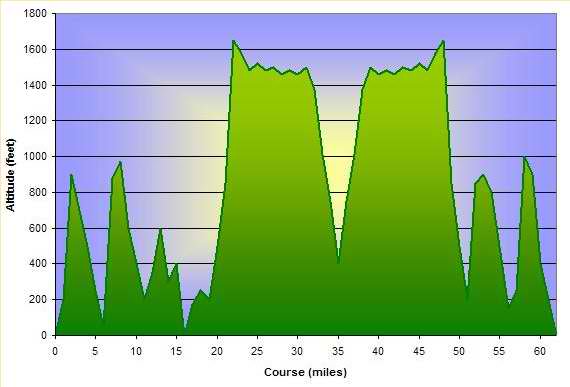
Miwok 100 Altitude Profile (Source: Miwok 100 Website)

5. Simplicity—Trail Running events are not evaluated in terms of bright lights, lots of tarpaulins and banners, loud speakers with blaring disco music, Emcees with nice English pronunciation, leading a prayer and singing the National Anthem, arches, marshals and security personnel at the Start/Assembly Area. They are evaluated by the simplicity of the event. Trail running is the purest form of running event where the scenery, degree of difficulty, and the camaraderie of the participants and the volunteers count most. The event lacked the things that I mentioned previously. Also, there are no distance markers along the route as the location of the Aid Stations serves as the distance markers for everybody. I did not even see water cups filled with water or sports drinks on the tables available in the different aid stations. What I saw were water pitchers being used to fill-up the hydration bladders and bottles of runners who need water or sports drinks. The route was marked with pink-colored ribbons tied on the shrubs, trees, grasses, and trail posts; and the paved road had pink-colored adhesive tape with an arrow-directional sign. What impressed me most was the fact that the race started on time!

On the Runners

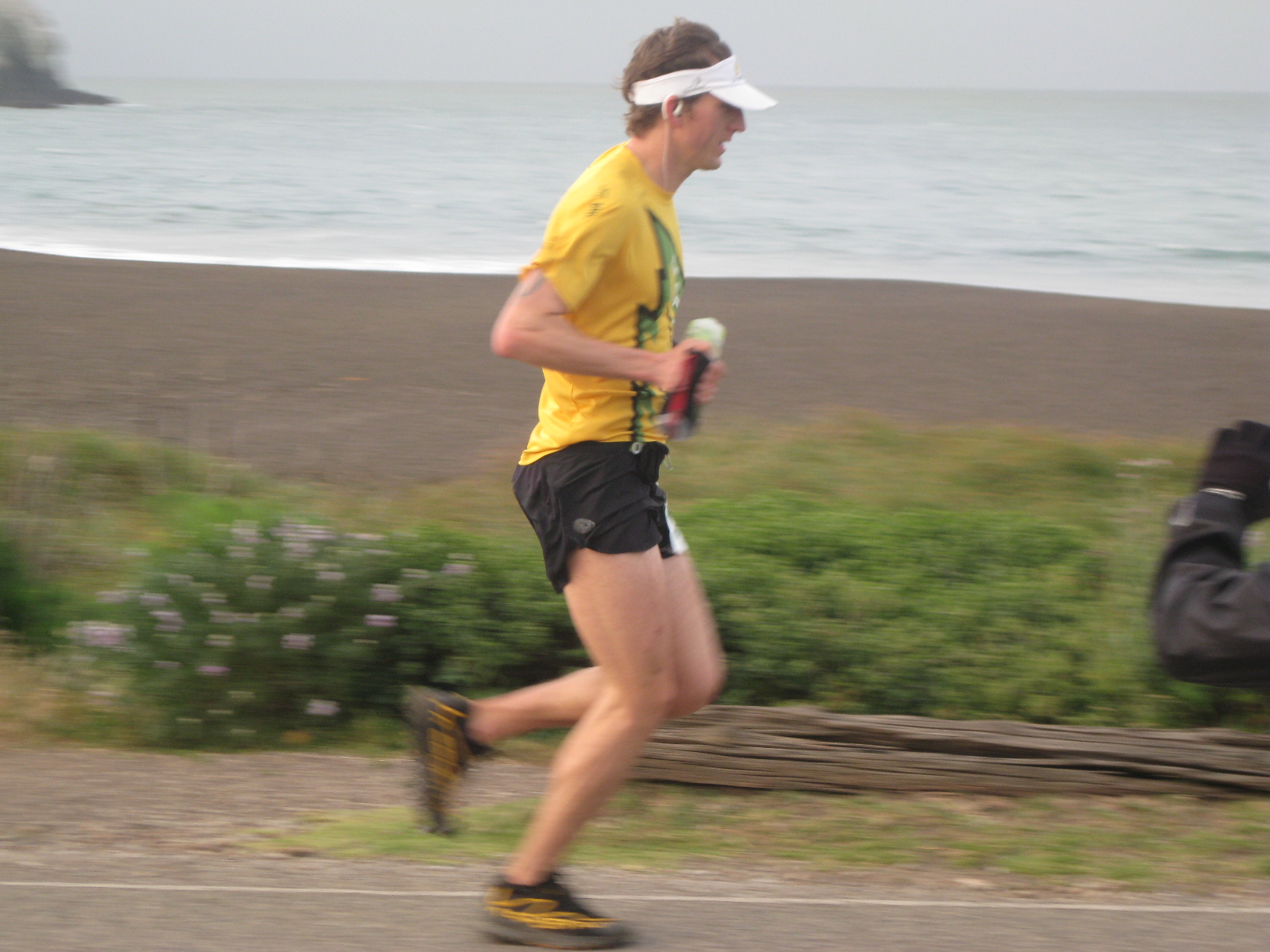
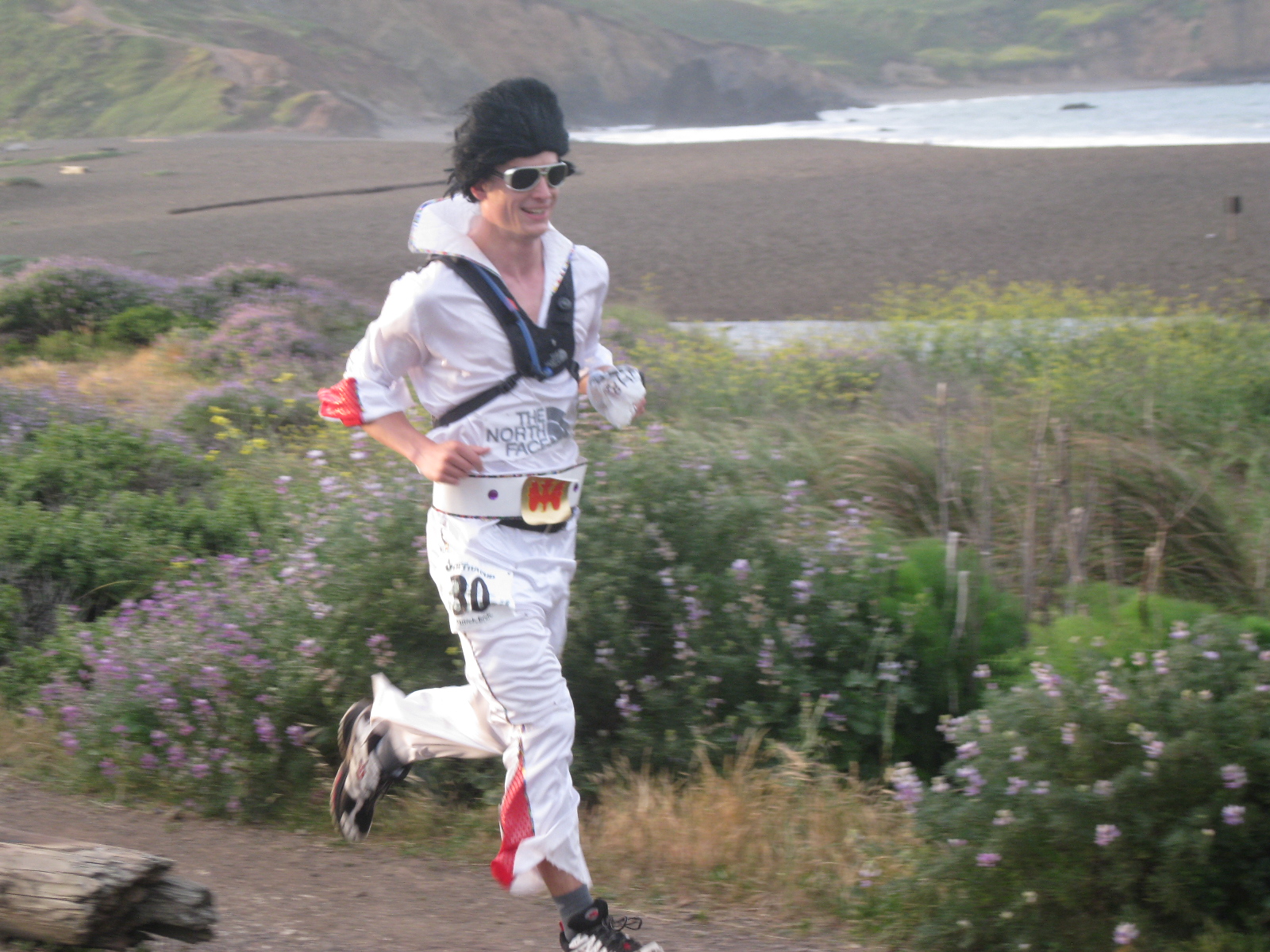
1. Hydration System—Out of the top ten finishers whom I personally observed at the Starting Line up to the Pan Toll Aid Station and at the finish line, it was only Ian Sharman aka Elvis Presley (#10) who was running with a shoulder hydration pack (TNF Enduro BOA Hydration Tack). I did not see Hal Koerner holding or sporting a hydration system throughout the race. All the remaining top 8 runners were holding a hydration bottle on either one of their hands during the race. On the mid-pack and the sweeper groups, most of them use hydration backpacks (Camelbak & Nathan) and some with hydration belts with at least two bottles of 20-ounces each in liquid capacity.

2. Running Shorts—It was only Hal Koerner who was using a compression shorts and the rest of the top 8 runners were using the regular running shorts which are the split and v-notch type. I would suspect that their running shorts must have a lot of pockets where they can stow their gels, endurance powders, Vitamin I, and Clif Bloks. Or else, they have their respective support crew waiting for them in every Aid Station to provide them with their necessary nutrition and hydration needs. I did not recall if I saw any of the men among the participants using long compression tights.

3. Body Structure—Dave Mackey, Mike Wolfe, Hal Koerner, and Dakota Jones are tall and have muscular bodies. Which is translated to longer legs and ultimately, longer strides when they run. Their longer and strong legs could withstand their momentum in maintaining a running form on the inclines/uphills of the route. With such body structures, you could just imagine how fast these guys would run on the downhills. As for Ian Sharman, he has an average body size of a runner who happens to be an inch or two taller than me and leaner than the top 4 runners but I was able to discover why he was able to beat Tony Krupicka at this year’s Rocky Raccoon—he has a very fast, quick and light leg turn-over in an ultra race! Personally, I can predict that Ian Sharman will be this year’s Champion in the Western States 100-Mile Endurance Run even with the presence of Kilian Jornet Burgada.

4. Running Shoes—I was surprised to see Dave Mackey using a weird-looking trail shoes (Hoka One One) which he used in his past 1st place trail running events. This is an opposite view of the minimalist approach of some of the elite trail running athletes. I was more surprised when I saw Mike Wolfe, a TNF model & endorser, to be using a New Balance MT 101 Trail Shoes! On the other hand, Hal Koerner was using a NIKE Lunaracer which is considered a road racing flat shoes!

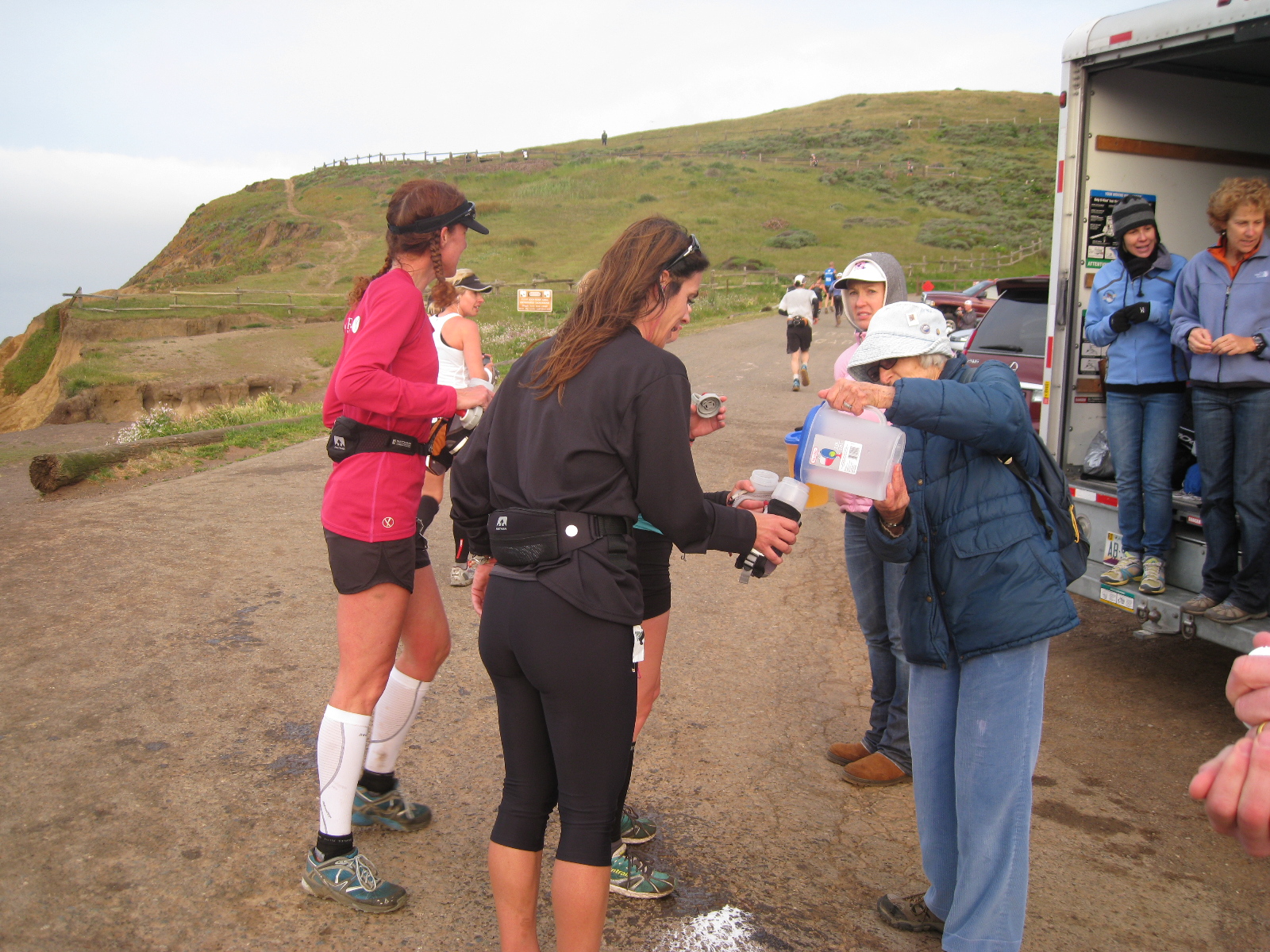
5. Stop or Pass On Aid Stations—Elite athletes do not stop at Aid Stations if they have support crew waiting for them to hand them what they need from one Aid Station to another. For those who who don’t have any support crew, they stop to refill their hydration bottle/s or packs with the needed fluids and grab some gels or foods offered on the tables. A few yards from the Aid Station, the runners would remove the lid/cover of their bottles and as soon as they reach the Aid Station, the runner would simply extend his/her arm to the volunteers who would refill such bottle using a water pitcher. Sometimes, they just grab canned soda drinks and drink the contents while they are running. You will be surprised how they would stow their empty cans and empty gel packs in their running shorts up to the next aid station where trash bins are located. Runners are strictly following the rule of not littering their trash on the trails or else they will be disqualified. As for the mid-pack and sweepers, stopping on the Aid Station is a must for re-supply and rest purposes as long as they are within the cut-off time of arrival on such Aid Station.

Runners With Open Bottles Few Yards From the Aid Station
Volunteers With Water Pitcher Refilling Hand-Held Bottles @ Aid Station

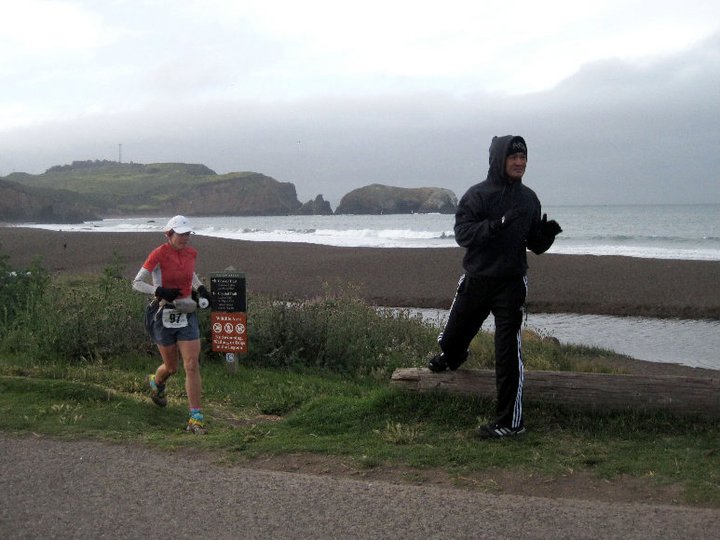
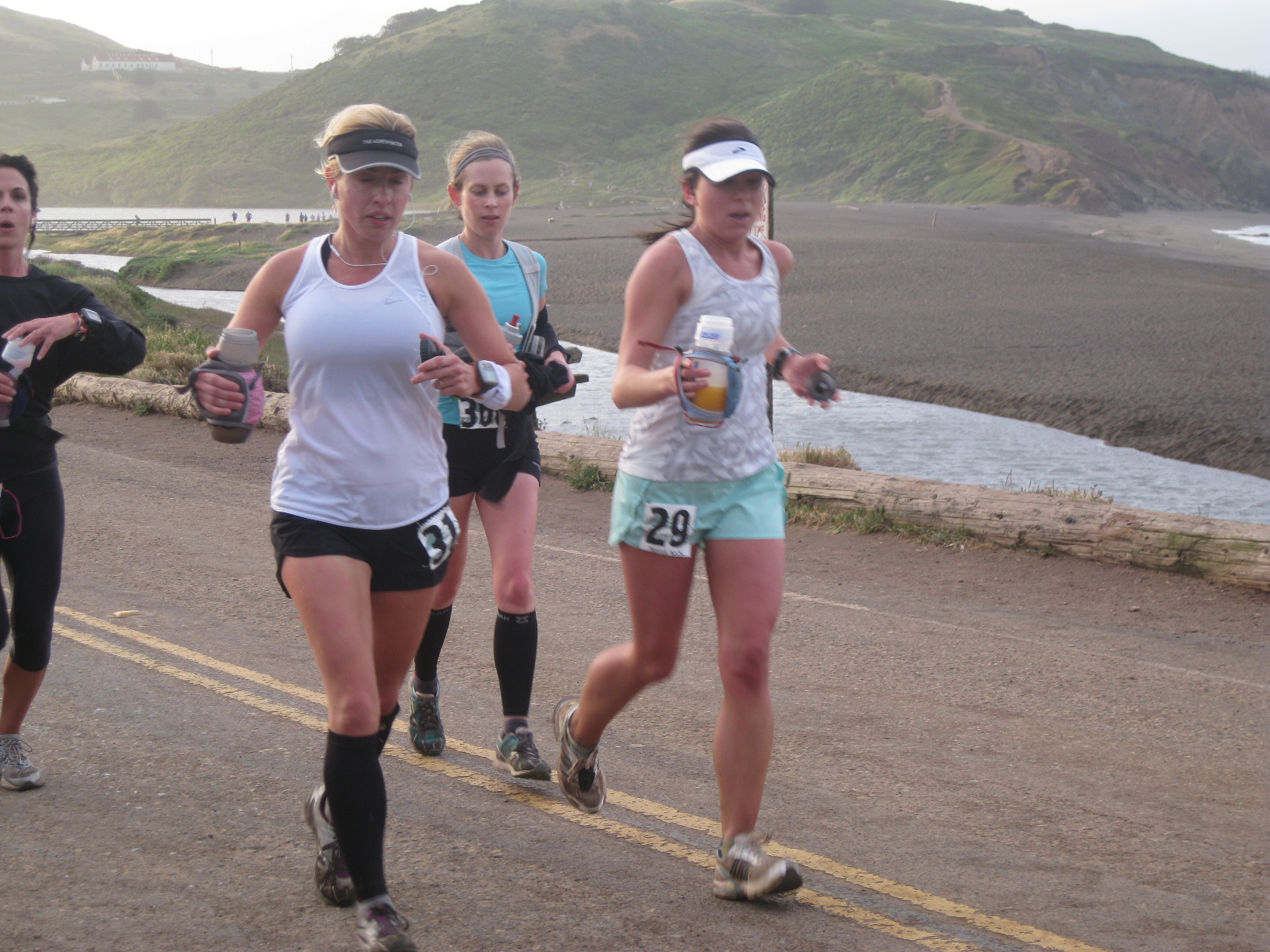
6. “Fanny” Packs or Belt Bags—These bags worn as belt could be seen on the picture above where the two lady runners are using. If a runner is using hand-held water bottles and using running shorts with small pockets, these “fanny” belt packs which are light, flat and snugged to the body are good running accessory for an ultra trail runner where he/she could stow a cellphone/camera, cash, keys, sports gels, sports mix, salt tablets, Vitamin I, and sports bars/food.

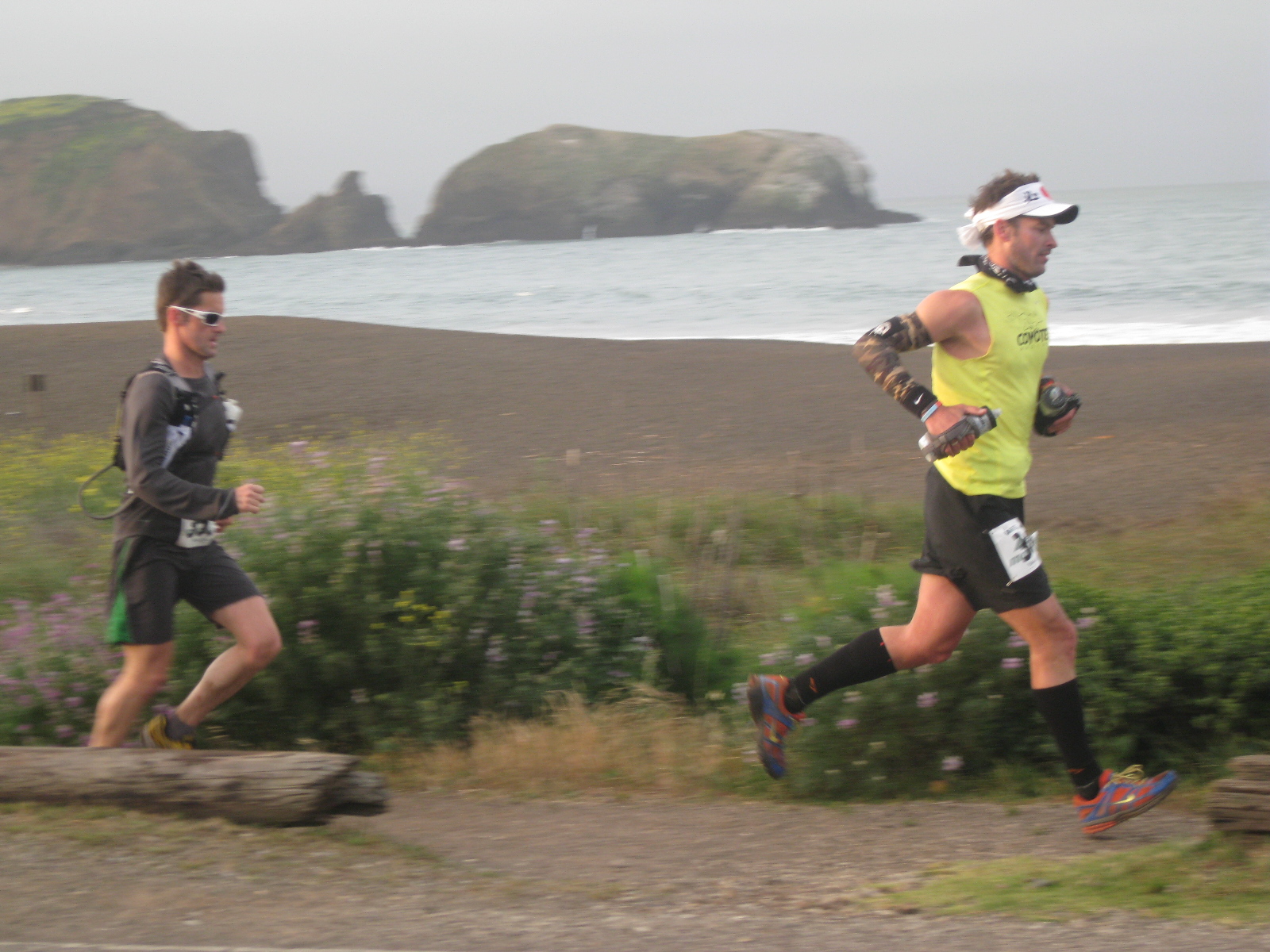
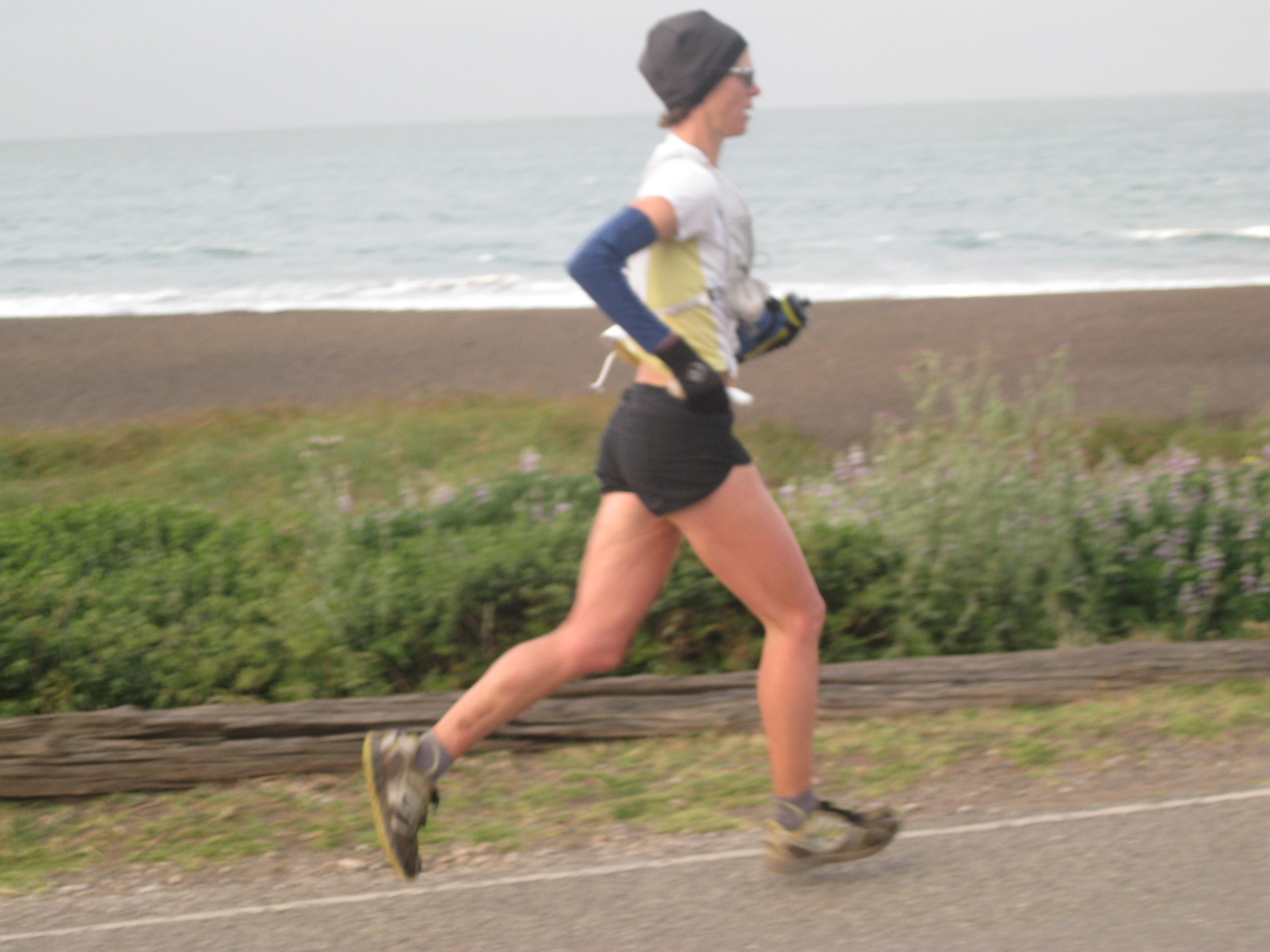
7. Arm Sleeves & Calf Sleeves—It is reasonable that the runners would use arm sleeves because of the cold temperature but I could see that most of the runners were using calf sleeves, to include the lady runners. In my experience, I believe in the use of these calf sleeves during my workout and during my recovery. I am presently using the Zensha Compression Calf Sleeves during my long runs while a tighter 2XU Compression Calf Sleeves are used during my recovery periods.

One of the top runners (Freedman) with Arm & Calf Sleeves

8. Using of “Wires”—The top 4 male and female runners were not using any “wires” to their ears. I believe that these elite runners are well-focused and sharp on the task at hand during the race. In the Race Reports of these elite athletes, they could hear the steps, breathing, and sounds of the environment. These top runners would maintain conversation among themselves on wider trails. Instead of listening to music, these runners listen to their footsteps on the trails; they listen how their competitors’ breathing in order to find out if they are still strong or exhausted; and listen to the steps of the runner ahead and behind them. On single-track trails, there is a need to communicate to the runner ahead of you if you intend to pass and it would be inappropriate if a runner to be passed is using some “wires” with some loud music being played on his earphones and could hardly hear the verbal warning from the runner behind him.

Lastly, Tia Bodington (RD) sent me an e-mail 2 days after the event expressing her thanks for being a part of the Volunteer Group of the event. She called me as one of the members of the “Miwok 100 Traffic Czars”. Sweet!

2011 Miwok 100 Video


This is the video of the frontrunners during the 2011 Miwok 100 Trail Run.

This video was copied from “you tube” which was posted by the Endurables.

Looking at the video, the recording or filming of this event was done by one of the runner-participants who leapfrogs from one section of the course to another by taking the adjacent paved road that is parallel to the direction of the trail. He could be using a car from one entry-access to the trail to another. It is just my suspicion but I might be wrong since I did not see any cyclist mounted on a mountain bike trying to film the event.

The first few seconds of the video shows the top 3 finishers who were sitting and conversing with one another. Hal Koerner in blue upper shirt, black compression shorts, and blue calf sleeves; Dave Mackey wearing a sun visor; and Mike Wolfe.

I am familiar with the 1st 7 miles of the course as some of it are on the paved roads of the Marin Headlands. After their early start at the Rodeo Lagoon Beach, all the runners go to the Rodeo Trail until they reach the paved Conzelman Road which is located south of the Rodeo Lagoon until they reach the Coastal Trail that leads the runners back to where they started. After the runners cross the small bridge at the Rodeo Lagoon, it is now the start of their climb towards the Townsley Battery and northward direction to Mt Tamalpais Park.

It was my first time to enter the Pantoll Station which is 13 miles away from the Rodeo Lagoon. I’ve seen and ran on the trails all the way up to Muir Beach after passing the Wolfe Ridge Trail, Miwok Trail, Old Springs Trail, and towards the Tennessee Valley. But from Muir Beach, I could say that it is a continuous uphill towards the Pantoll Station by looking at the overall contour of the area.

The next portion of the video where there is a muddy area along the curve portion of the trail is that part which is approaching the Tennessee Valley Aid Station. At this point, the runners had covered 11 miles and on their way back, this will be the last Aid Station before they reach the Finish Line.

The portion where you see the runners in single file is the trail on the ridge of the mountain facing the Pacific Ocean. By looking at the movement of the grasses surrounding the runners, you could conclude how strong was the wind coming from the ocean.

Looking at the video, the race was contested between the top 4 runners—Dave Mackey, Mike Wolfe, Hal Koerner, and Dakota Jones as the “real” race started after the turn-around. The first 3 runners are veterans of ultra trail running competitions and they had been running this route and part of the Miwok 100 past editions. Dave Mackey is the holder of the course record in 7:53+ hours. It was Dakota Jones first race at the Miwok 100. After the turn-around and on their way back to Pantoll Station, Dakota Jones took the lead with Dave Mackey behind him. But, before reaching the Pantoll Station, it was a competition between Mike Wolfe and Dave Mackey. Dakota explained in his blog what happened to him during the race.

I had finished with my job as a volunteer when Dave Mackey was approaching the Point Bonita YMCA as the first runner of the race. He finished in 8:03:22 hours, followed by Mike Wolfe in 8:06:00 hours and then Hal Koerner in 8:06:55 hours. Dakota Jones arrived almost 11 minutes behind Hal Koerner.

My next post on this race will deal on my personal observations on the race and its runners.

DNS @ 2011 Miwok 100


DNS…In Running Protocol, it means “Did Not Start”! My running injury from my latest Adventure Run on my lower left quads which turned out later to be an injury on my left knee did not heal even if I rested for so many weeks. After my LSD trail run for more than 6 hours at the Wunderlich State Park in Redwood City, California 4 weeks before Race Day, it gave me an assessment that finishing a 100K ultra trail run with a total ascent of more than 10,000 feet will be an impossible feat to accomplish.

Despite such assessment on my part, I tried my best to remedy the situation by taking all the necessary treatment I could gather from the different running resources in the Internet, running books, magazines and personal journals of famous trail/marathon runners. I even went to the extent of soaking my legs regularly on warm water mixed with Epsom Salt; regular massages; and even taking Alaxan FR capsules. I am glad that my cross-training in the gym kept me busy from the lack of more prolonged time of running on the road. One week before Race Day, I made my decision to DNS the race.

Miwok 100K Guy & Logo

Instead of joining the race, I thought of offering my presence on Race Day as one of the Volunteers of the Race to the Race Director, Tia Bodington. After a brief exchange of e-mails with the RD, I was accepted as a Volunteer at the Starting/Assembly Area and at the Aid Station #1 which happen to be at the same location.

The motivation to do a volunteer work for Miwok 100 was due to the following as stated at the event’s WebsiteEight hours of volunteer work at Miwok fulfills the Western States 100 service requirement. Eight hours of volunteer work at the Miwok 100K also gets you an extra ticket in the following year’s entry lottery. Hopefully, my injury will heal soon so that I will prepare specifically for the next year’s edition of this race.

DNS…Did (A) Nice Spectating…by Volunteering!

As a Volunteer at the Starting Area/Aid Station #1 @ 7.1 Mile, I was able to witness every minute how the Race was managed by the Race Director.

I arrived at the Assembly Area at the same time with the arrival of the RD who was driving a U-Haul Truck at 3:45 AM last Saturday. Tia Bodington was alone. The beach of Marin Headlands was dark, cold and windy on the early morning and I was prepared for the weather. I immediately approached the RD and introduced myself. The two of us started to bring out the necessary things needed for the processing of the runners from the truck and I even shared my flashlight to her as she was trying to locate some traffic/reflectorized vests and other flashlights needed for the volunteers.

The U-Haul Truck was filled with containers filled with water, timing device, foods, and other stuffs needed for the race to include the “loot” for every finisher of the race which trail runners call “schwag”. I was smiling as I recall myself on the shoes of the RD whenever I start the races for the BDM and PAU Races.

After a few minutes, another runner/volunteer arrived with a casted/bandaged right wrist & hand. The guy, Charlie, was supposed to run the race also but he met an accident (slipped while running along rocky trail) on training and opted also as a volunteer for the race. The guy was given a reflectorized vest and a flashlight and he was asked by the RD to act as the Parking Attendant at the Authorized Parking Area for the Runners. In a few minutes, I was asked also by the RD to act as the Checkpoint at a point that is 200 yards from the Parking Area for the Runners. My job was to ask the drivers/passengers of each vehicle approaching the Assembly Area if they are runners or volunteers. If they are runners, I simply advised them to proceed to the “dirt” Parking Area. If they are volunteers or dropping their passengers for the race, I simply advised them to proceed to the paved Parking Area. Just imagine a Police/Military Personnel/Traffic Enforcer stopping your car/vehicle with a flashlight and the other hand signalling you to stop. Yes, that was my job as a volunteer for almost 2 hours!
As the lone personnel at the Checkpoint, I was able to see the faces of the runners! It is unfortunate that I was not able to glimpse on the faces of Anton Krupicka, Scott Jurek, and Geoff Roes! They opted to DNS, too!

At 5:30 AM, I was approached by Tia telling me that I was doing my job well and she informed me that my volunteer job was done. However, I asked her that I could still be of help in any of the Aid Stations or at the Finish Line as I wanted to see the Front Runners cross the Finish Line. She accepted my offer and I started to observe how the race would start.

Runners Crossing The Bridge To Rodeo Beach Lagoon
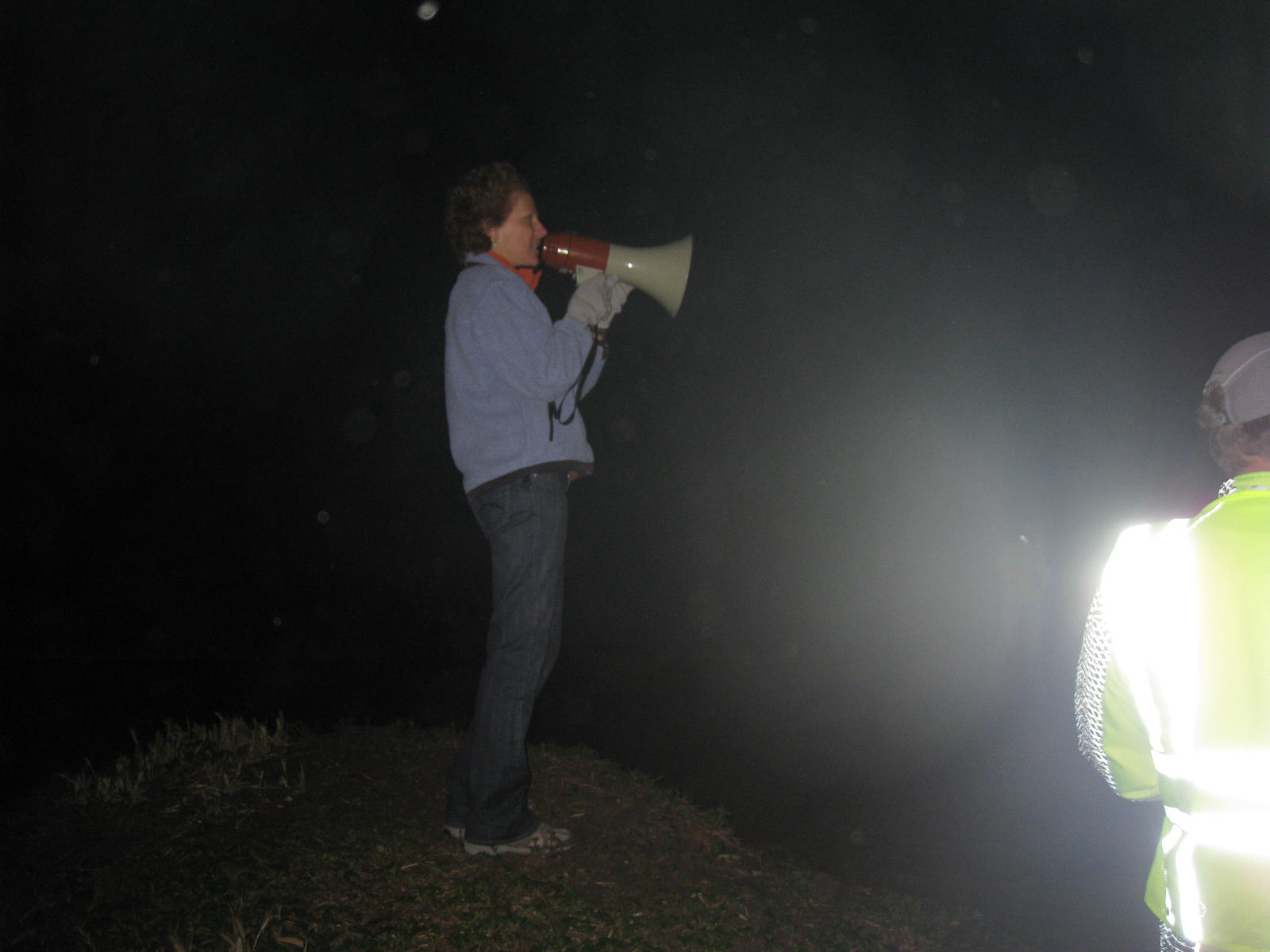
Tia Bodington, RD, Announcing To The Runners On Her Final Instructions
No Arch, No Lights, No Starting Line...Just Runners Who Want To Have Fun & Enjoy The Trails

The processing of runners was very simple. Each runner simply got his/her race bib from one of the volunteers and that’s it! Ten minutes before the scheduled start time at 5:40 AM, all the runners were led to the beach near the Rodeo Lagoon which is about 300 meters from the Assembly Area. There were no intricate START Arch/Tarpaulins; no sound system; no music; no lights; no invocation/prayer; and no singing of the National Anthem. The RD positioned herself on top of a little mound on the beach while the runners lined up before an invisible starting line listening to the final instructions from her. Tia’s final instructions were about RESPECT. If I can recall them right, she said something like—“Respect the trails”; “Respect the Volunteers & Marshals”; “Respect the other Runners”; “Respect the Race & the Distance”; “Respect your Goal”; and “Respect Yourself”. After a few seconds, the RD simply shouted “GO” and the runners started the race along the sands  of Rodeo Lagoon.

The Runners Were Off From The Starting Area

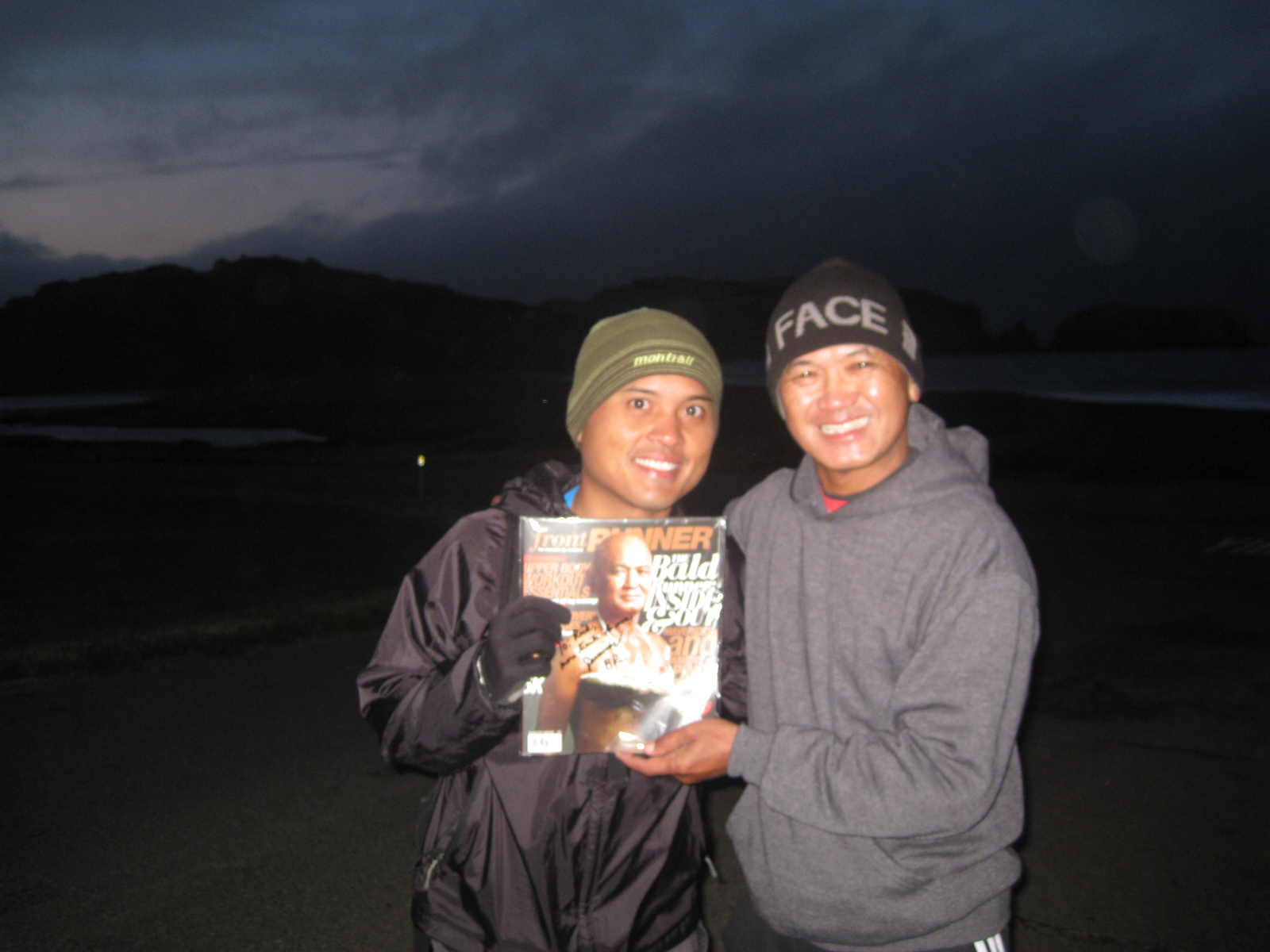
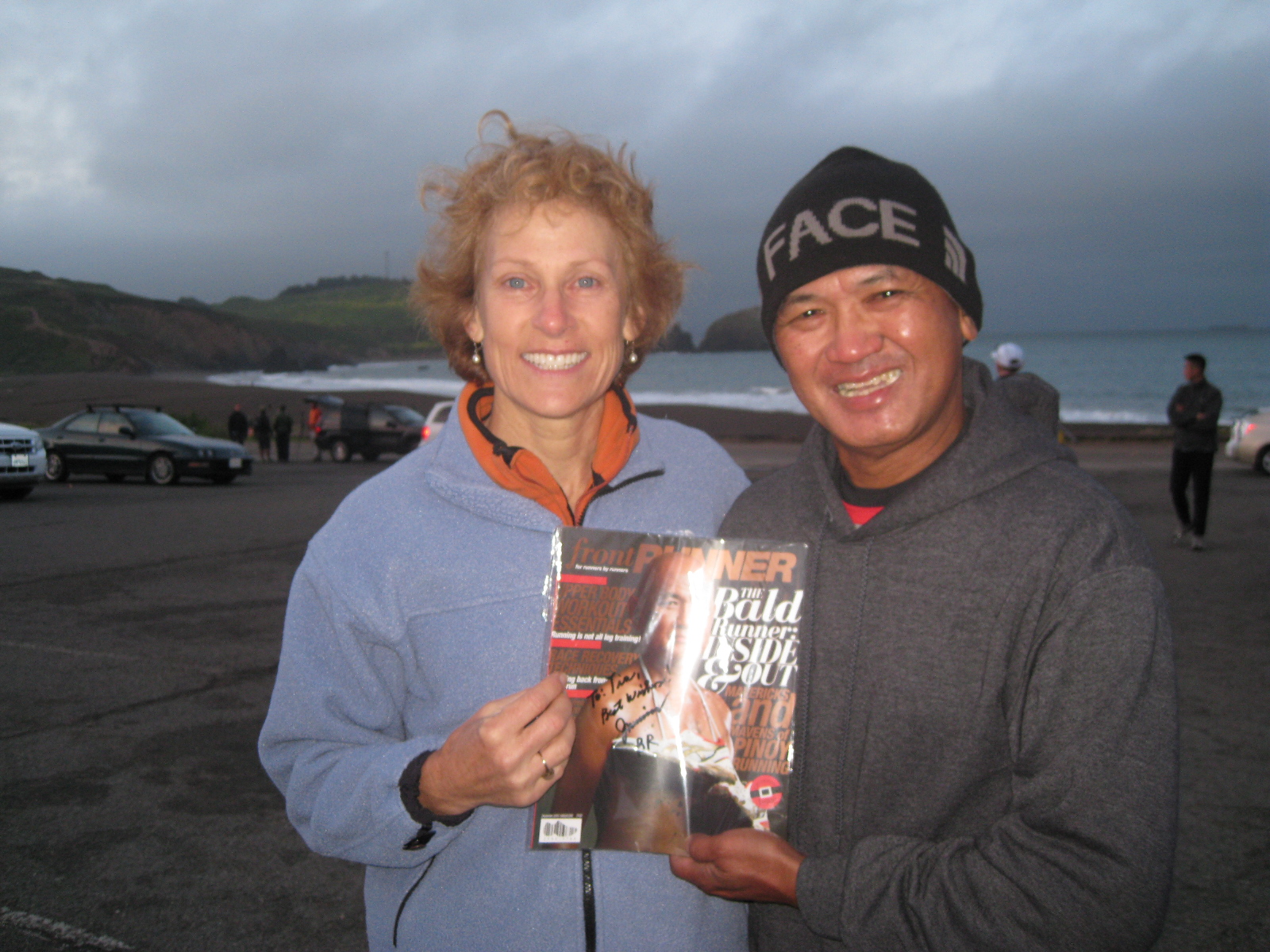
After the race had started, Rick Gaston and I were able to talk while the rest of the volunteers and spectators went back to the Assembly Area. This is where all the volunteers (to include myself) helped in loading the “drop bags” of the runners to be transported to the Finish Line which is about 3 kilometers away. After this job, I was able to engage more conversation with Tia and had a chance to give her a copy of the frontRunner Magazine. It was a good chance for me to have a picture with her.

Rick Gaston in Montrail & BR in TNF Skull Caps
With Tia Bodington, RD of Miwok 100 & Editor-In-Chief of Ultrarunning Magazine
U-Haul Truck & Drop Bags To Be Loaded

While waiting for the lead runners to pass at the Aid Station #1, I was introduced by Rick to Brett Rivers who is also an elite ultrarunner, got to talk to Mark Gilligan of UltraSignUp, and the rest of his ultrarunning friends whom I could not recall their names. Finally, I was able to back-up my e-mail messages to Matt for the possible inclusion of the BDM Races to UltraSignUp through a longer conversation and personal interaction. We had a longer discussion about the matter/issue when we had a chance to meet again at the Starbucks at Mill Valley.

With Mark Gilligan of Ultra SignUp
Shouting The Runner's Race Bib Number to Mark Gilligan

At the Aid Station #1, Rick and I became instant volunteers for Mark Gilligan’s Live Update in his Website by posting each runner’s split time. We were requested by Mark to shout to him the Race Bib Number of each of the runner approaching our place. It was a good chance to stretch my vocal chords! After the last runner had passed our station, I found out from Matt that there were 345 starters out of the 416 accepted/registered runners.

At Mile 7.1, Dave Mackey (Right) & Mike Wolfe (Center)
Nathan Yanko
Look At That Stride!!! Leading Runner Meghan Arbogast
Jean Pommier (Another Ultra Blogger) @ http://www.fartherfaster.blogspot.com
Kristin Moehl at the Middle
Pam Smith (Lady Champion of the Race)
Ian Sharman aka ELVIS, The King!

At the Pantoll Aid Station (Mile #20 & 41)

Rick brought me to Pantoll Aid Station to observe and spectate to the runners passing. The top runners just passed the area when we were looking for a parking space. It was nice to observe the other fast runners on how they re-supply themselves with their hydration packs; how and what they eat at the Aid Station; and how lively the cheerers to the incoming runners.

Don't Try To Imitate This Guy!
The Legendary Ultrarunner Scott Mills @ 59 Years Old (Ranked #49)
Cheering The Runners at The Old Mine Trail

Later, I positioned myself about 30 meters along the trail before runners would reach the Aid Station. The trail is called Old Mine Trail. As the runners would approach my position, I would shout encouraging words while clapping my hands. The words, “Looking Good”; “Good Job”; “You Can Make It” and other positive ones shouted to the approaching runners would boost the runners to jog at a faster pace. As a response, the runners would say, “Thank you for being here” with a smile on their faces!

This is where I was able to meet Geraline Harvey, a Filipina runner from Ontario, Canada who greeted me with the words “Kumusta kayo?” After a few seconds, Carmela Layson and her group approached me as I was cheering them! At last, Carmela and I met in person. Actually, if ever I decided to push through with this race, it was my strategy in this race to stick to her all the way to the finish line. Carmela had been a veteran of Miwok 100! If ever I would have a chance to run in this race in the future, my race strategy would remain the same, I’ll stick on her tail. Carmela had been an active contributor of my Project Donate-A-Shoe! (Congrats, Carmela & Geraline for a successful finish!)

With Carmela and Friends at the Old Mine Trail
With Geraline of Ontario, Canada

Finish Line @ YMCA Point Bonita

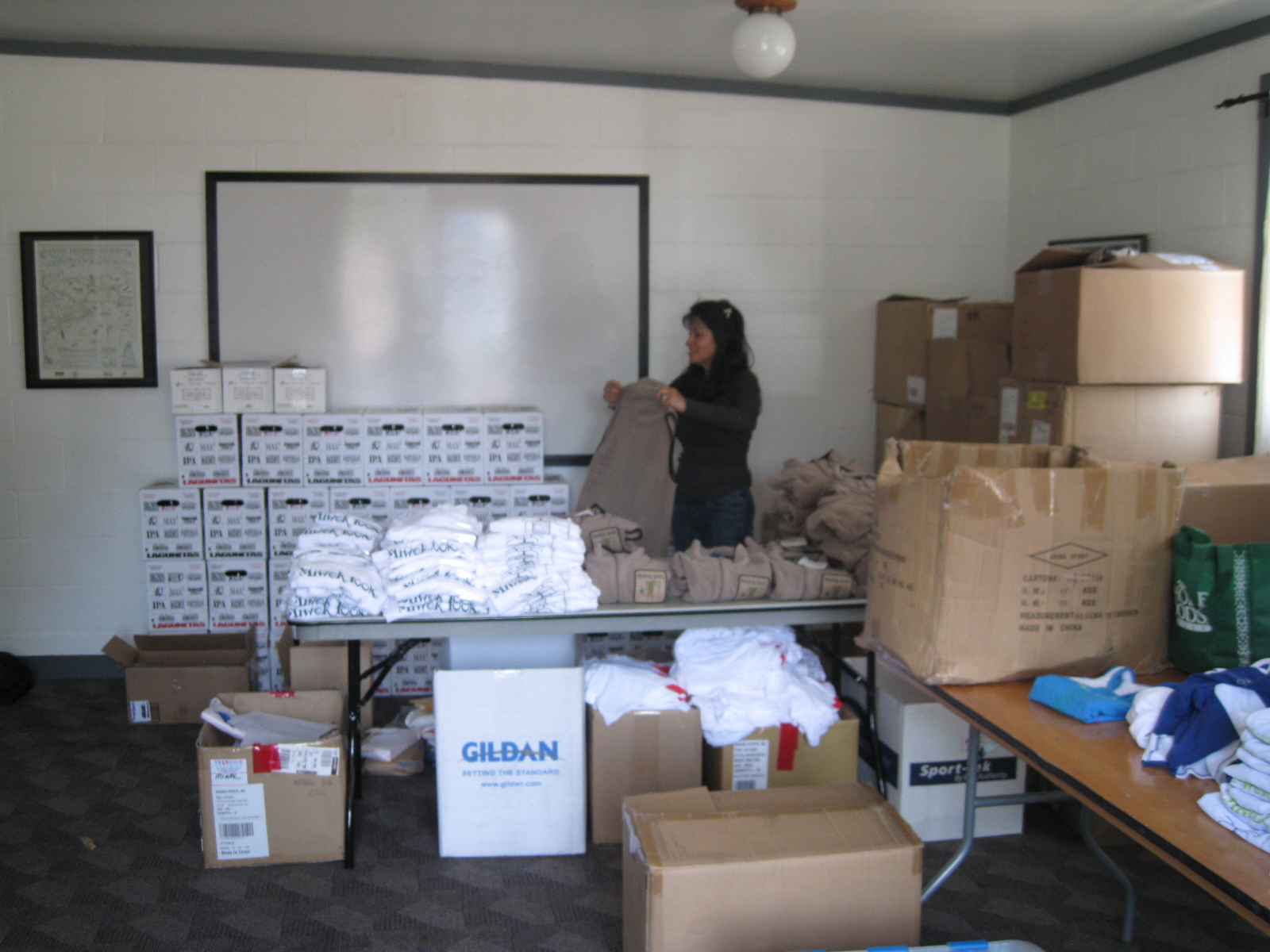
From this point, it was time to go to the Finish Area and try to help the other volunteers. I was able to meet Jorge and Rich (with ages in their late 20s) who are also ultra runners planning to earn their entry through the lottery for next year’s edition of the race. There was another lady runner who was supposed to run but due to stress fracture on her legs, she opted also to volunteer. We helped in organizing the different “schwag” for the runners and preparing for the BBQ Party venue after the race for all the finishers. It was worth the fun and time to be working and volunteering with the rest of the other senior and younger ultra runners.

Helping This Lady Runner Who Became One of the Volunteers For The Schwag
Finisher's Shirts & Fleece Vests & Beers in White Boxes
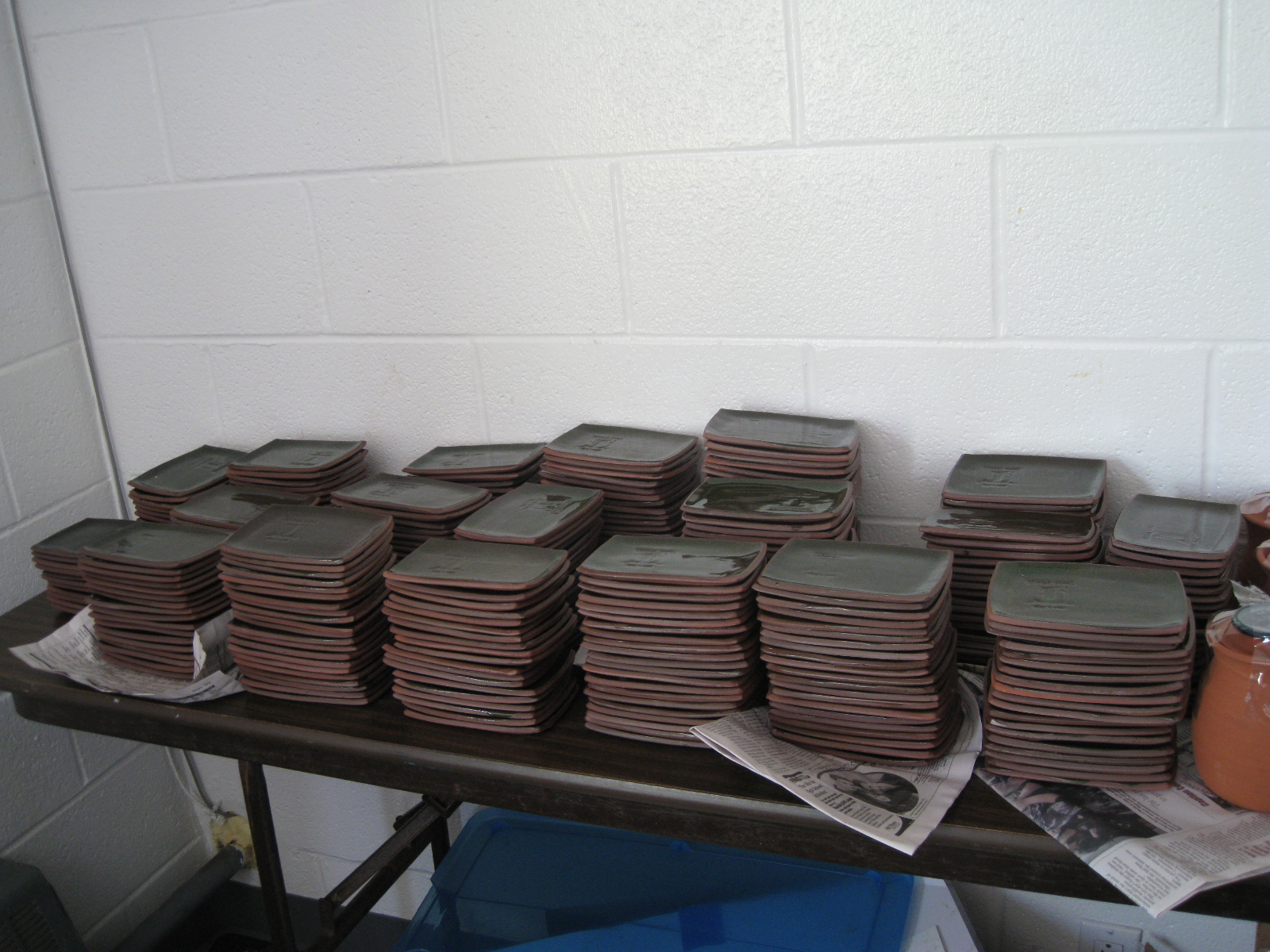
Finisher's Commemorative Plates

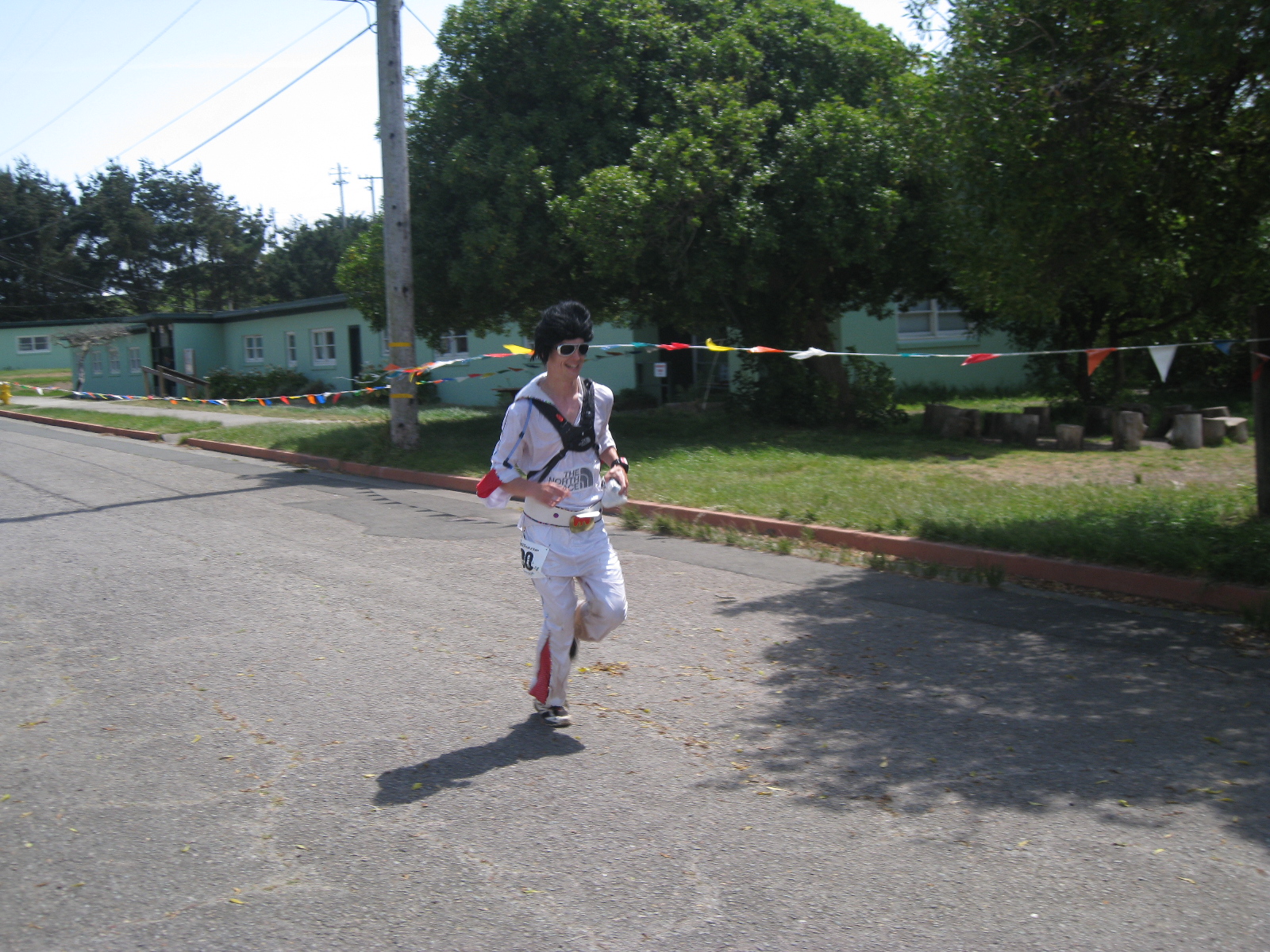
At 1:30 PM when the lead runner was a few miles away from the Finish Area, all the schwag were properly organized and packed. The job was done and the next job for me was to watch each of the lead runners cross the Finish Line. The plan was to wait for the arrival of Ian Sharman who was running the whole race as ELVIS before leaving San Francisco in order to catch up with the Pacquiao-Mosley Boxing Fight in Las Vegas!

Champion Dave Mackey Approaching The Finish Line
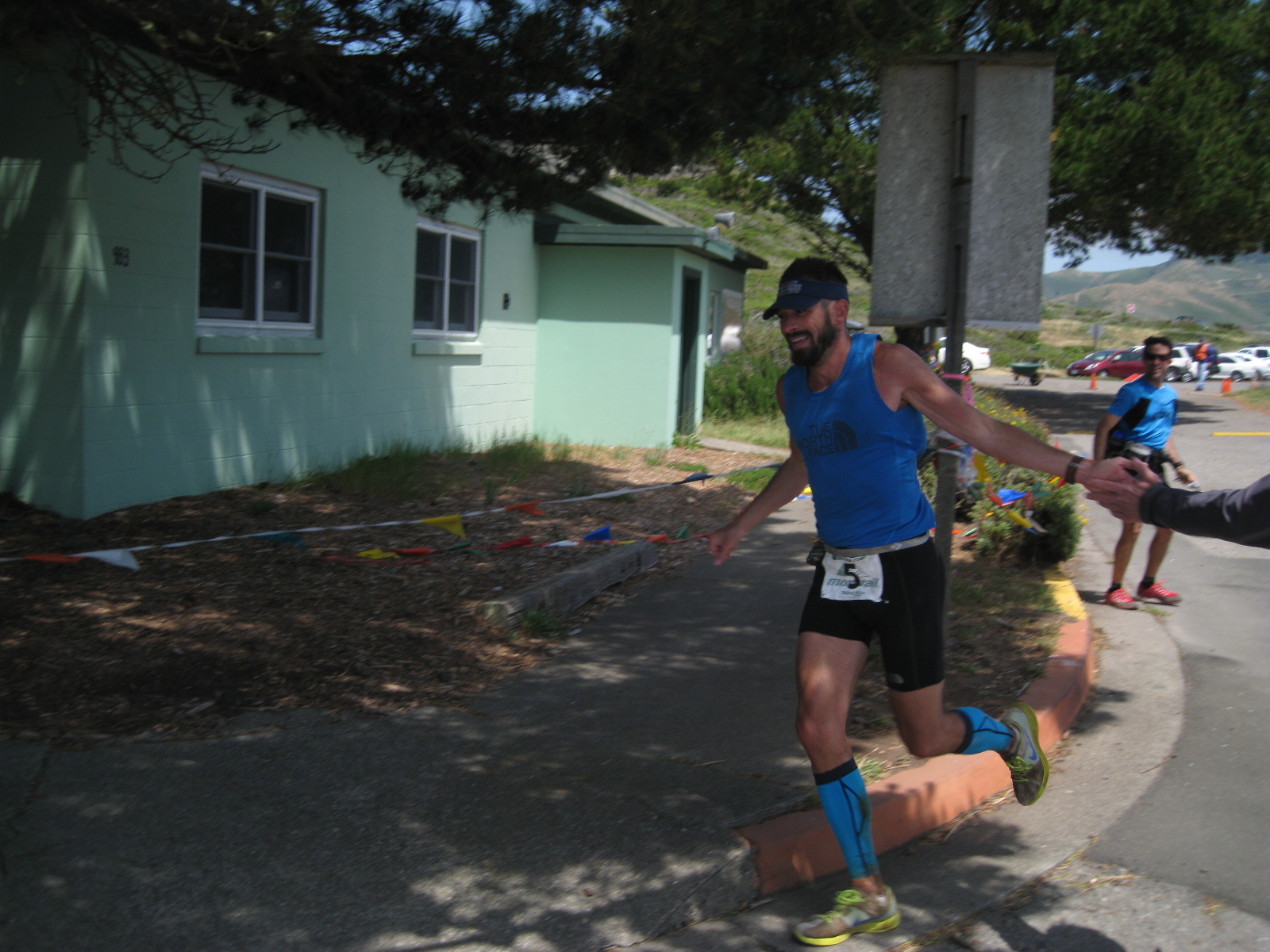
Hal Koerner At The Last Turn Before The Finish Line
ELVIS Approaching The Finish Line

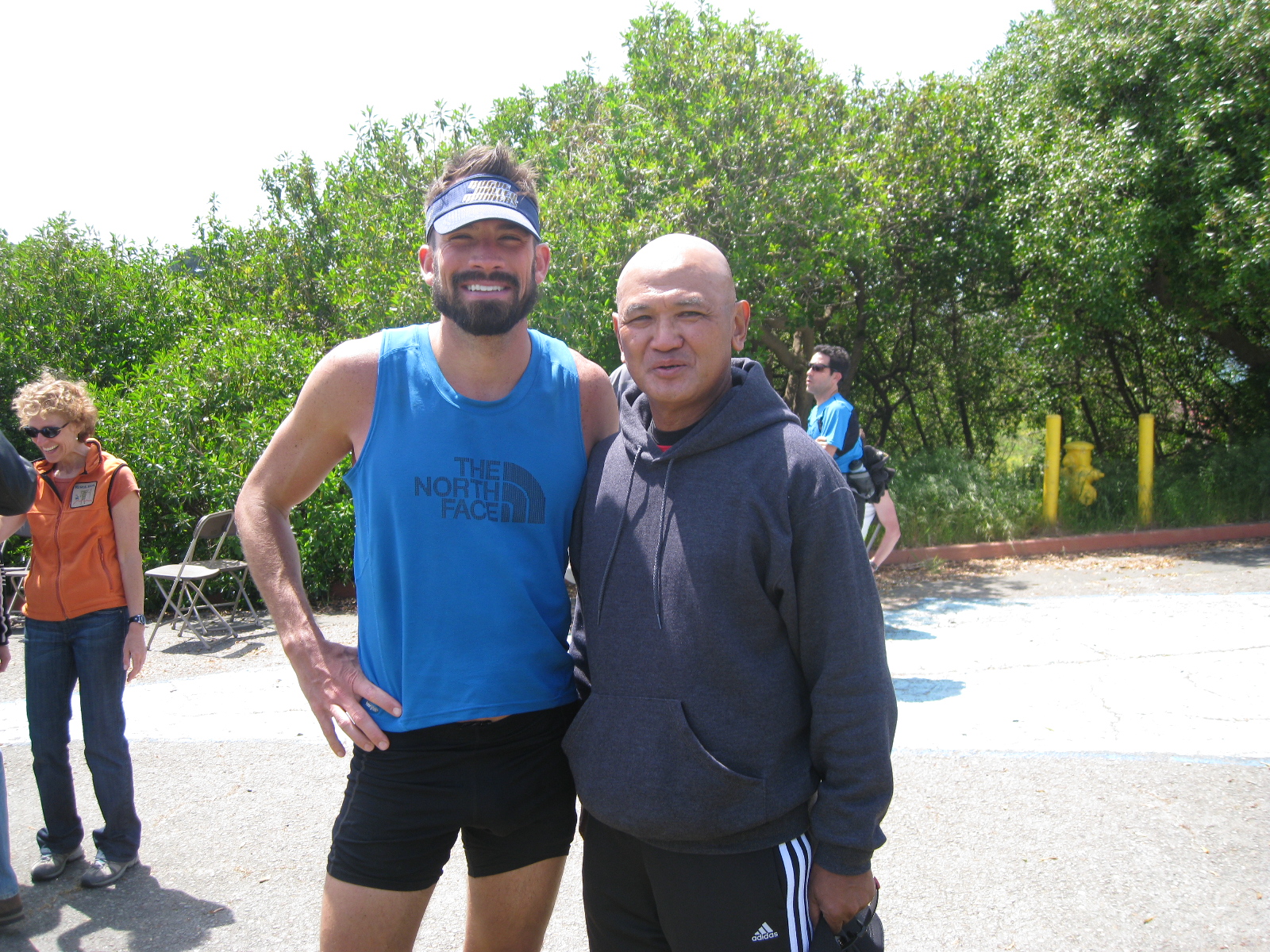
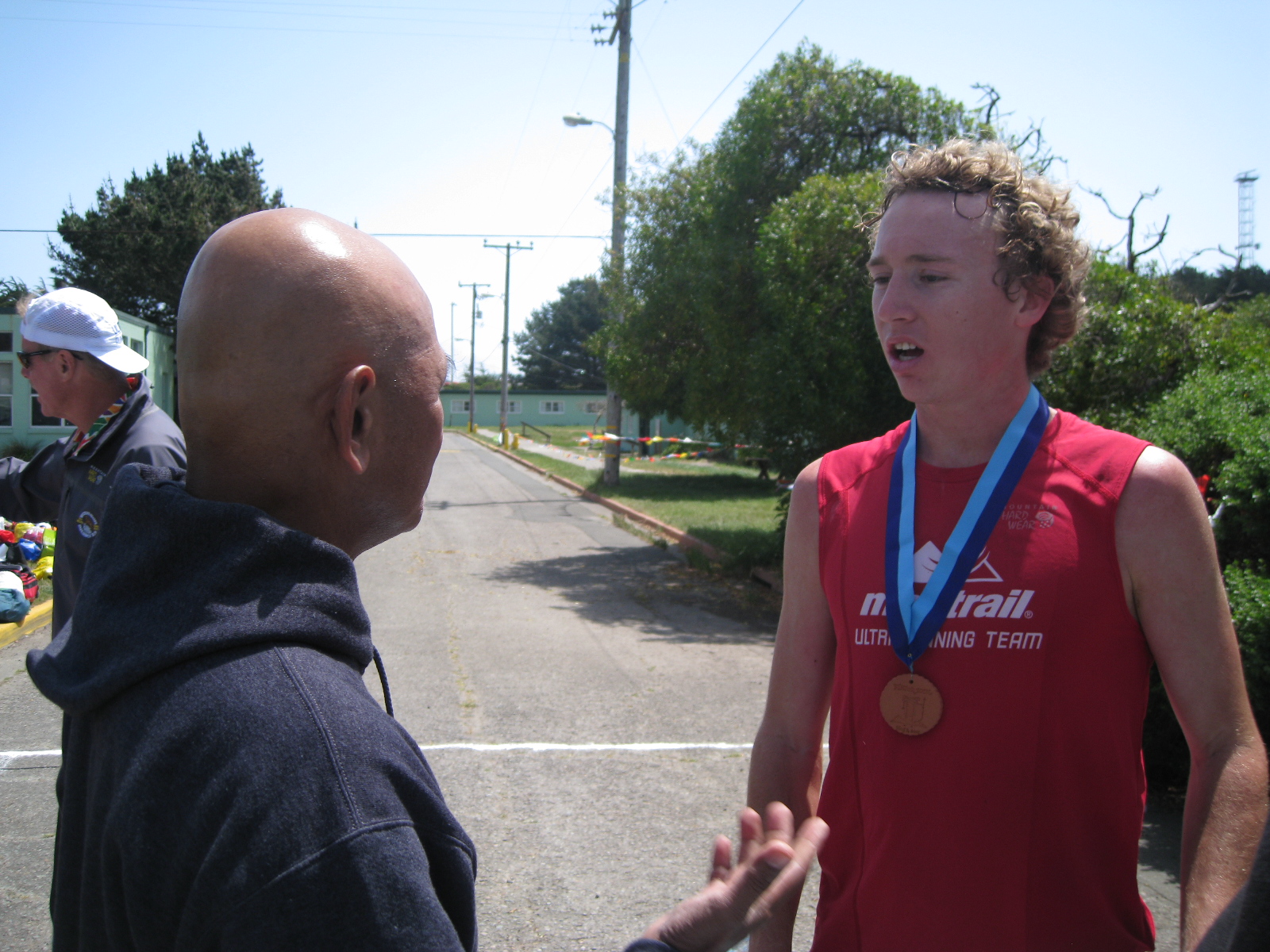
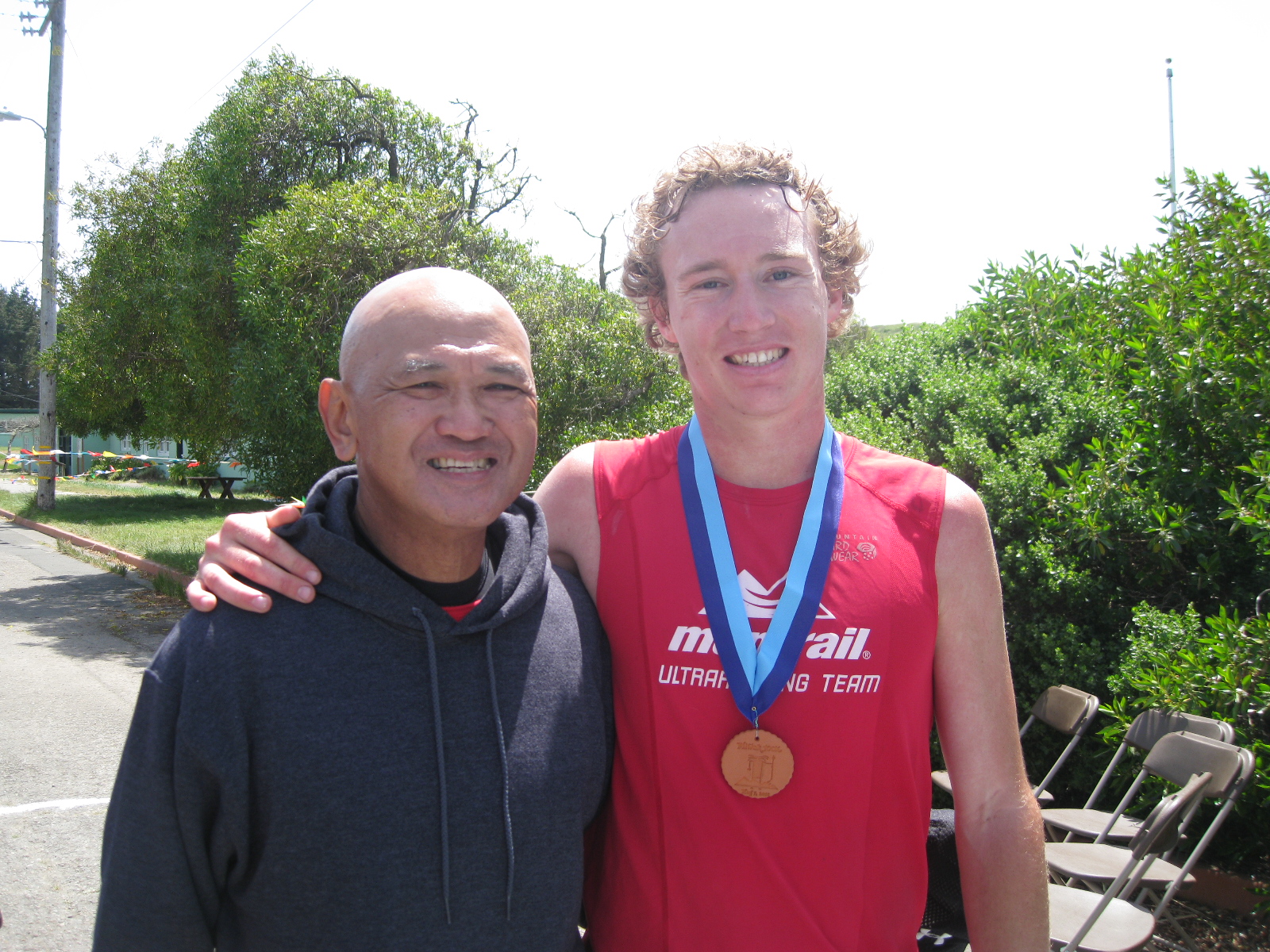
While waiting for ELVIS to cross the finish line, I was able to talk to the Front Runners/Top Finishers of the Race. It was nice talking to these wonderful guys in ultra trail running which ended with a brief pose with them.

Congratulating & Talking To Dave Mackey & Mike Wolfe
A Pose With The Champion Dave Mackey & Mike Wolfe, 1st Runner-Up
Hal Koerner, Champion of 2009 & 2007 Western States 100-Mile Endurance Run
Talking To Dakota Jones, 4th Placer in the 2011 Miwok 100
A Pose With The Kid
Talking With The ELVIS in Ultrarunning
Ian Sharman Finished in 10th Place & Bound For Comrades Ultramarathon This Month

After about 10 hours of volunteer work at the 2011 Miwok 100K Ultra Trail Race, I really enjoyed and had fun for being a part of the race as one of the volunteers. As an spectator, I was able to interact with the top runners in ultra trail running in the United States which I could not have a chance to do such if I finished the race in 15-16 hours. For sure, they are already sleeping in their houses as I cross the Finish Line!

Before I left the Finish Line area, I talked and thanked Tia for being a part of the Volunteer Group for the event and told her about my early departure to catch a flight to watch the Pacquiao-Mosley Fight in Las Vegas. In return, she thanked me also for being a part of the Volunteer Group for the event . She assured me also that I will be coming back to run the 2012 Miwok 100!

The results of the 2011 Miwok 100 are published here.

Running Around “The Ring”


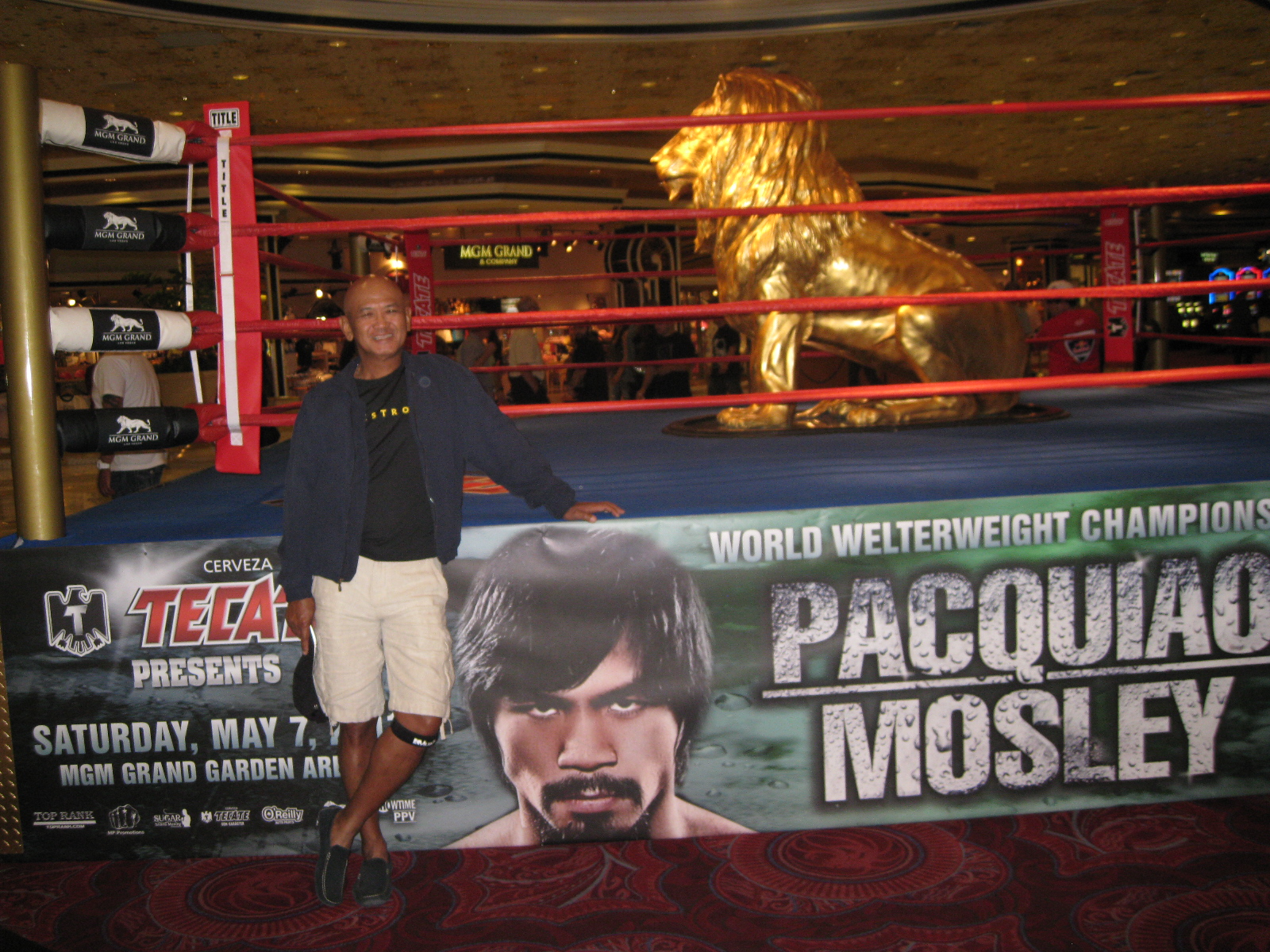
My running injury did not heal for the race I’ve been preparing for this year. Instead of forcing the issue to run the race and be able to finish the prescribed finish time of 16:30 hours for the Miwok 100K Ultra Trail Race at the Marin Headlands in San Francisco, California last Saturday, I have opted to watch how Manny Pacquiao and Shane Mosley “run around” the boxing ring at the MGM’s Grand Garden Arena.

Congratulations to Congressman Manny Pacquiao for another impressive show and for “entertaining” the whole world through boxing!

At The MGM Hotel, Las Vegas, Nevada

Something To Read & Think About


Before you read the following article which I copied from the website of Marathon Guide (http://marathonguide.com), I would like to mention my insights about the New York City Marathon which is true to the other Marathon Races in the different cities in the USA and to other countries around the world:

1. It takes an avid or regular runner who has the passion in it to create, organize, and implement  a Marathon Race, no matter how small the number of runners on its first edition. What it needs is a good leader and a vision for the event. Fred Lebow, founder of the New York Marathon and later President of the New York Road Runners, was neither a natural-born American nor an elite & fast runner but through his dedication to the event, the race had become as one of the World’s Championship Marathon Races.

2. The need to be backed-up by an organization that shares your vision and purpose. The New York Road Runners had been the running club/organization that is behind the event. Of course, the club has membership fees and such fees have corresponding privileges.

3. Partnership with the City Government and Sponsors.  I am sure the City Government had the strategic thinking/view that the event will become bigger as the years come. With more participants to this race, it will increase the number of visitors, and income to the different establishments, thereby making the economy of the city more vibrant and active. The bottom line is that the city government receives more revenues from the taxes being paid  by such establishments.

4. Involvement of the Community. Like the Los Angeles Marathon, San Francisco Marathon and other city marathons, they are very memorable to runners because of the involvement of the community as volunteers and cheerers along the ENTIRE route of the event. By reading the experiences of runners in their marathon experiences, you could find out that almost the whole route is lined up with musicians; volunteers with water, beverages, sports drinks, and even beer; acrobats; dancers; rock bands; loud stereo music from big speakers; and simply people cheering you loudly and even stating your name.

5. Lastly, the runner-participants. The more the runners participating the event, the better for the event and the city. It is stated in the report below that the runners contribute much in the economy for the city from their brief stay in terms of hotel accommodations, foods, tours and shopping. On the other hand, the taxes being paid by the Race Organizer, the New York Road Runners, to the City Government come from the registration fee paid by the runner. So, if you are wondering why you are paying much for the registration fee as compared from other Marathon Races in some of the key cities in the USA, it’s because you are in New York!!!

Enjoy reading this one.

2010 ING New York City Marathon Generates $340M for NYC

Race Raised $30.8M for Charities

Total Economic Impact Increased 25% Since 2006

New York, NY—The ING NYC Marathon generated a new high of approximately

$340 million in total economic impact for New York City last year, a New

York Road Runners (NYRR) commissioned study released today found. In

addition, the study showed that the Marathon generates more than $30

million for charities, and a record number of visitors, participants and TV

viewers were involved in last year’s race.

The study is based on a survey of over 1,000 participants in the Marathon,

and assesses their spending in categories such as hotel, travel,

entertainment and retail, in addition to their direct expenditures on the

race itself.  In addition, the study includes other metrics such as total

charitable donations captures, visitor estimates and number of total race

participants.

“This study demonstrates the crucial role the ING NYC Marathon plays in

bringing benefits to our whole city and making it more vibrant every year,”

said New York Road Runners CEO and President Mary Wittenberg. “In addition

to the hundreds of schools we help with health and fitness programs and

hundreds of thousands who participate in the races, this race has clearly

become a cornerstone of positive economic activity for New York that the

city can count on year in and year out.”

“The New York Road Runners impact our economy by bringing in millions of

dollars through programs that benefit our overall city’s health including

hundreds of thousands of students in public schools,” said Council Member

Robert Jackson, Chair of the New York City Council Education Committee. “I

look forward to continue participating in races to come and supporting its

initiatives to improve the health and daily lives of our children.”

“Running the ING NYC Marathon is a feat of willpower – but it’s also a

testament to the economic power of the 2 million spectators, the runners

and their guests, the sponsors, the vendors, and the New York Road

Runners,” said New York City Economic Development Corp. Chief Operating

Office Josh Wallack. “Not only does the marathon raise money for charity,

it results in real contributions to the City’s booming tourism economy.”

The study showed two ranges of total economic impact.  The “conservative”

range showed $304 million in impact and the “baseline” range $378 million.

The conservative range includes only those impacts that would not have

occurred within New York City without the Marathon, and the baseline

includes all expenditures associated with Marathon participants and their

guests.

The full report can be requested by emailing ahowe@globalstrategygroup.com

Other key findings from the report include:

  • Total economic impact from visitor and guest spending is 25% greater in

2010 than in 2006

  • Tax revenues to New York City from the ING NYC Marathon ranged from

$10.8 to $11.2 million.

  • 2010 ING NYC Marathon drew 45,350 participants, 2 million spectators,

and a television reach of 315M worldwide

  • The race raised $30.8M for charities, $24.3M of that went to charities

in NYC

  • The total number participants and their guests was about 290,250 people
  • Participants spend a total of close to $1,800 each during their visit

The 2010 ING NYC Marathon made an unprecedented charitable impact, raising

$30.8 million overall, $24.3 million of which went to NYC based charities.

NYRR provides a number of charities with entries to the event, each of

which recruits runners to raise at least $2,500 per participant and then

provides the runner with guaranteed entry into the race.  NYRR receives a

fee for the entries, all of which is dedicated to NYRR’s non-profit

mission.

More than 2 million spectators came to watch the 45,350 runners in person

and total direct spending was approximately $153.2 million from

participants and their guests.

The first phases of findings were based off an electronic survey of

approximately 1,000 participants in 2010 ING New York City Marathon. In

addition NYRR collected data concerning spending by Marathon sponsors and

vendors as well as charity fundraising. The final estimates were based off

ING NYC Marathon participants and their guests, the NYRR organization

itself, Marathon sponsors, vendors at ING Health and Fitness Expo, and

associated charity fundraising.

The analysis does not include spending and impacts generated by

unaffiliated spectators because many of them are likely NYC residents who

would be spending money anyway, even though this does not account for the

many others who are likely non-NYC residents who traveled into the city for

the race but were not associated with a participant.

Expenditures by Marathon sponsors, vendors at the ING Health and Fitness

Expo, and charity revenues generated by fundraising are also considered in

the impact analysis. Sponsor and vendor expenditures as well as NYC-based

charity revenues are assumed to be either directly or indirectly associated

with the Marathon.

Expenditures by media organizations for providing televised coverage of the

event, public costs of staging the event (security, street closures etc)

and media and branding value from extensive world-wide television exposure

for NYC were not considered.

NYRR retained AECOM to estimate the economic and fiscal impacts of the ING

New York City Marathon 2010. AECOM was retained on similar occasions by

NYRR to conduct a similar analysis.

New York Road Runners

Headquartered in New York City, New York Road Runners is dedicated to

growing the sport of running, enhancing health and fitness for all, and

meeting our community’s needs. Our goal is to leverage the expertise

acquired in our 50+ year history to empower all people of all ages to live

fitter, healthier lives through participation in our races, community

events, instruction and training resources, and youth programs. Our races

and other fitness programs draw upwards of 300,000 people annually. The ING

New York City Marathon, NYRR’s premier event, is the largest and most

inclusive marathon in the world, attracting the world’s top professional

runners and raising over $20 million for charity annually. NYRR’s

running-based youth programs, which currently serve nearly 100,000 children

in hundreds of schools and community centers, promote children’s physical

fitness, character development, and personal achievement in underserved

communities.

So, after reading this report from the New York Road Runners, it is deplorable and sad to remember that we had then a Manila International Marathon; PAL International Marathon; and Pasig River Heritage Marathon since the early 80’s but all of these just disappeared.

Sayang!…What a waste!!!

I rest my case.

(Source: http://www.marathonguide.com)

2012 Olympic Games Qualifying Standards For Athletics


Sculptor Art For the London Olympic Park (From http://www.london2012.com)
In a meeting last April 11-12, 2011 in Daegu, South Korea among the members of the IAAF Council, it was approved that  there are 47 Medals (Men & Women) to be contested which are categorized as the following:
IAAF Qualification System Athletics 2011. In addition to the list of events, a qualification system is also discussed and stated.
Running/Walking/Track Events—29 Medals
Field (Throwing & Jumping)—16 Medals
Combined Events (Decathlon & Heptathlon)—2 Medals
Total Medals In Athletics—47 Medals
With the list above, it is in Athletics where you have the most number of Medals in contention in the Olympic Games. The next sports which has the most number of medals would be Swimming. I think the 3rd medal earner would be Gymnastics. And the last would be a tie for boxing, taekwando, and other combat/contact sports like wrestling and judo.  It could be noted that these sports are all DOABLE for the Pinoys and we could excel in them! Basing from our physical features, average height and weight, we are not different from the Chinese, Japanese and Koreans who had been among the top medal earners in the Olympic Games.
I will not deal on how we would be able to excel and become Olympic qualifiers on these sports because our Sports Officials and NSA Coaches have better ideas and have the necessary resources to attain such objective/goal.
The following are the qualifying times and distances for the different track/running and field events for the 2012 London Olympic Games:
The following are the list of Marathon Races which are considered as Olympic Games Qualifying Races for the 2012 London Olympics’ Marathon Race. It is well noted in the list that the 2011 CAMSUR Marathon Race is the qualifying Marathon Race in the Philippines. I hope our National Pool of Athletes for the Marathon Race will be able to attain their qualifying time for the 2012 London Olympics.
On Racewalking, the following are the published races which are considered as Official Qualifying Races for the 2012 London Olympic Games.
I hope the above documents will be a good reference to our NSA in Athletics, to their Coaches, our National Pool of Athletes and to the upcoming elite athletes in athletics.

Unbelievable!!!


There is only one word to describe what happened at the 115th edition of the Boston Marathon which was held last Monday—Unbelievable!

For the past years, I was not interested  in trying to monitor what is happening “live” during the race due to the fact that the elite runners were not so much known to me as most of them were from East Africa—Kenya and Ethiopia. After Toshihiko Sato of Japan won the race in 1987 for the 2nd time, the succeeding years up to now had been won by either from Kenya or Ethiopia, except in 1990 when it was won by Gelindo Bordin of Italy and in 2001 when Lee Bong-ju of South Korea won the race. On the women’s division, after Rosa Mota of Portugal won the race in 1990, those elite runners from Poland, Germany, Russia, and of course, Kenya & Ethiopia did not “ring” a bell in my ears. It could be that the winners’ names were hard to memorize or it could be my non-interest then of running because my sensitive assignments or it could be that I did not mind updating myself on what was happening in the running world’s events by not subscribing or buying the latest editions then of the popular running magazines.

But what caught my attention again in this year’s edition of the Boston Marathon was the fact that Ryan Hall and Kara Goucher of the USA had been featured in the runners’ magazines and other running news of their desire to win in the said race. Of course, who would not be excited to see an American/US citizen who will win this year’s edition when the last American winner (Greg Meyer) was in 1983 (almost 3 decades ago). And this is the reason why there is a lot of euphoria and expectations on the result of this year’s edition as being played by the press releases, articles published in running magazines, and other media pronouncements.

But the results in last Monday’s race proved that the Kenyans would steal the show from the rest of the elite runners. Geoffrey Mutai of Kenya won the race in the fastest ever recorded Marathon Finish of 2:03:02 hours. In the Ladies Division, Catherine Kilel of Kenya won the Championship with a time of 2:22:36 hours. Geoffrey Mutai and Moses Mosop are definitely the fastest marathoners whose times were faster than the existing record time of 2:03:59 hours by Haile Gebrselassie at the 2008 Berlin Marathon. Whether Mutai’s time was not considered as an official Marathon World Record, it is considered as a New Course Record for the Boston Marathon. In my opinion, Mutai will not be affected with such decision as he is more interested in cashing in the Cash Prize he received for his efforts. A cash prize of $ 200,000 is a lot of money for a Kenyan runner!

Ryan Hall, Desiree Davila and Kara Goucher of the USA had also unbelievable results in their efforts where each of them improved their respective PRs. But there was another unbelievable show during the race which was 53-year old Joan Benoit Samuelson’s finish time of 2:51:29 hours making her the record holder for the fastest finish time in the ladies age group of 50-54 years old.

Lastly, the most unbelievable of them all is the decision of the BAA last February of this year to reduce the qualifying time for each age category for the Boston Marathon by 5 minutes. This means that I have to finish a marathon race in 3:55:00 hours by next year (as I will turn to be a 60-year old!) if I need to include joining the Boston Marathon in my “bucket list”. At this point in time, a decision to join or qualify for the Boston Marathon in the future will entail a lot of focus, patience, determination, and resources. There is a need to completely dedicate my time in this life-defining quest for excellence in running.

But, for the Bald Runner to finish the Boston Marathon that would definitely be…UNBELIEVABLE!!!!

For 2013, these are the new qualifying times for the Boston Marathon

Age Group Men Women
18-34 3:05:00 3:35:00
35-39 3:10:00 3:40:00
40-44 3:15:00 3:45:00
45-49 3:25:00 3:55:00
50-54 3:30:00 4:00:00
55-59 3:40:00 4:10:00
60-64 3:55:00 4:25:00
65-69 4:10:00 4:40:00
70-74 4:25:00 4:55:00
75-79 4:40:00 5:10:00
80+ 4:55:00 5:25:00

Race Director’s Report: 1st Mayon 360 50-Mile Run


4:00 AM April 2, 2011/Penaranda Park, Legazpi City


Event's Logo By Yves Yu


A Dream Race 

Yves Yu, an avid visitor of my blog and a member of the Jaycees International of Legazpi City, and I personally met during the 1st Mt Mayon Trail Run in October 2008 when I joined the said trail run. In one of our conversations, he asked and invited me to try and run the circumferential road of the Mount Mayon Volcano and be the first runner to complete and run the distance from Penaranda Park and back where I’ve started. I told him that I will be back to Legazpi City and have a try on the said run.

Fast forward. After three years such attempt to run around Mt Mayon did not materialize but the dream was still alive. When I participated in the 3rd Mt Mayon Trail Run last October 2010, Yves again reminded me about the run and I said that finally, I will be coming back soon to have a try to run the dream run.

On the early part of January this year, Yves and Provincial Board Member JP Lee had a chance to meet in Manila and we discussed about the conduct of the said event as part of Albay’s Magayon Festival. The schedule was set and the overall administration and operational needs of the event were laid out already. It was a plan which needs to be approved by the Governor of Albay, Hon Joey Salceda.

Recon Run in Legazpi City (January 25, 2011)

Although I was still recovering from my injury, I visited Legazpi City on the later part of January this year. Instead of running through the road surrounding the volcano, I opted to have a short recon run and measured the whole distance of the route while inside a vehicle. After seeing the route and scenic surrounding of the places we passed by during the recon run, I told Yves and his friends with the JCI Legazpi that the course is beautiful and challenging to ultra runners. It is doable and there is a need to implement the plan for the said race without any delay and it could be done on the first Saturday of April.

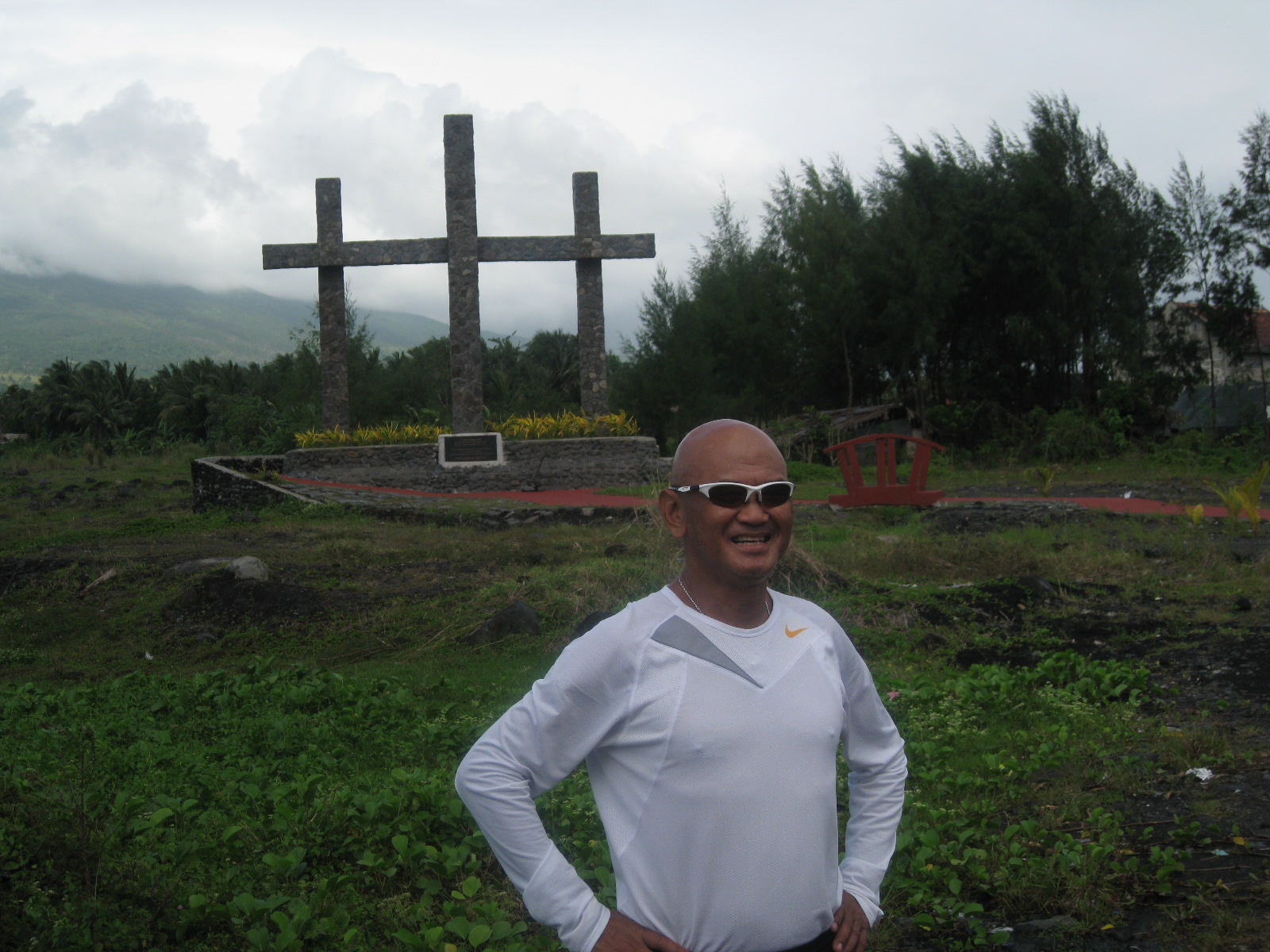
Mt Mayon & Memorial Park For The Victims of a Flood/Disaster Incident

And just like that, assignments of jobs to be done were designated to each member of the JCI Legazpi City and I was tasked to be the Race Director and have the race sanctioned by the Philippine Association of Ultrarunners (PAU). Despite the needed qualifications of runners imposed by the standards of PAU, the Race Organizers approved the implementation of such standards.

The Majestic Mt Volcano From The Oval Track of BSU

Courtesy Call To Governor Joey Salceda

While I was in Legazpi City for the recon run, the Event Organizer decided to drop by the Office of the Governor for a short courtesy call. It was my first time to meet the Governor. The planned short visit and courtesy call lasted for 2-3 hours. The casual conversations about the running event and other topics led to the approval of the budget for the said event. In short, the Mayon 360 50-Mile Ultra Marathon Race was approved as part of the Magayon Festival with the approved budget for the Cash Prizes for the winners and for the expenses needed for the logistics and mobilization of security/administrative personnel and volunteers.

Governor Joey Salceda of Albay & BR

Governor Joey Salceda simply wanted something different to happen in his province for the Magayon Festival. He knows that nobody had done such feat, to run around the most beautiful volcano in the world in 15 hours, and he knows that this is an opportunity to create awareness about ultrarunning for his province.

Vision

The Race Organizer/JCI Legazpi and I were one in coming up with such running event with the thought of not making a profit out of it. I could be corny and try to be naive but it was far from our thoughts and objectives of raising some funds from such event. The mere fact that the Provincial Government had supported the event, it was already enough to have this dream realized. The vision was to develop this sports event as part of the yearly Magayon Festival and promote “Sports Tourism” in the region.

I told Yves that if we have 70 runners, it will be a good start to create awareness about the event as it will be the first PAU-sanctioned ultra marathon race being organized by a Provincial Government outside Metro Manila. Yves understood my point as he experienced what came out with his Mt Mayon Trail Run (MTR) for the past 3 years. His races which he founded and initiated had grown in its participants through the years and runners keep on coming through the years.

I have a prediction that the Mayon 360 will be a regular ultra marathon schedule of the year where runners would train and prepare for. It will be an ultra race where the participants will be growing in numbers through the years.

Coordinating Meetings & CarboLoading/Briefing Party 

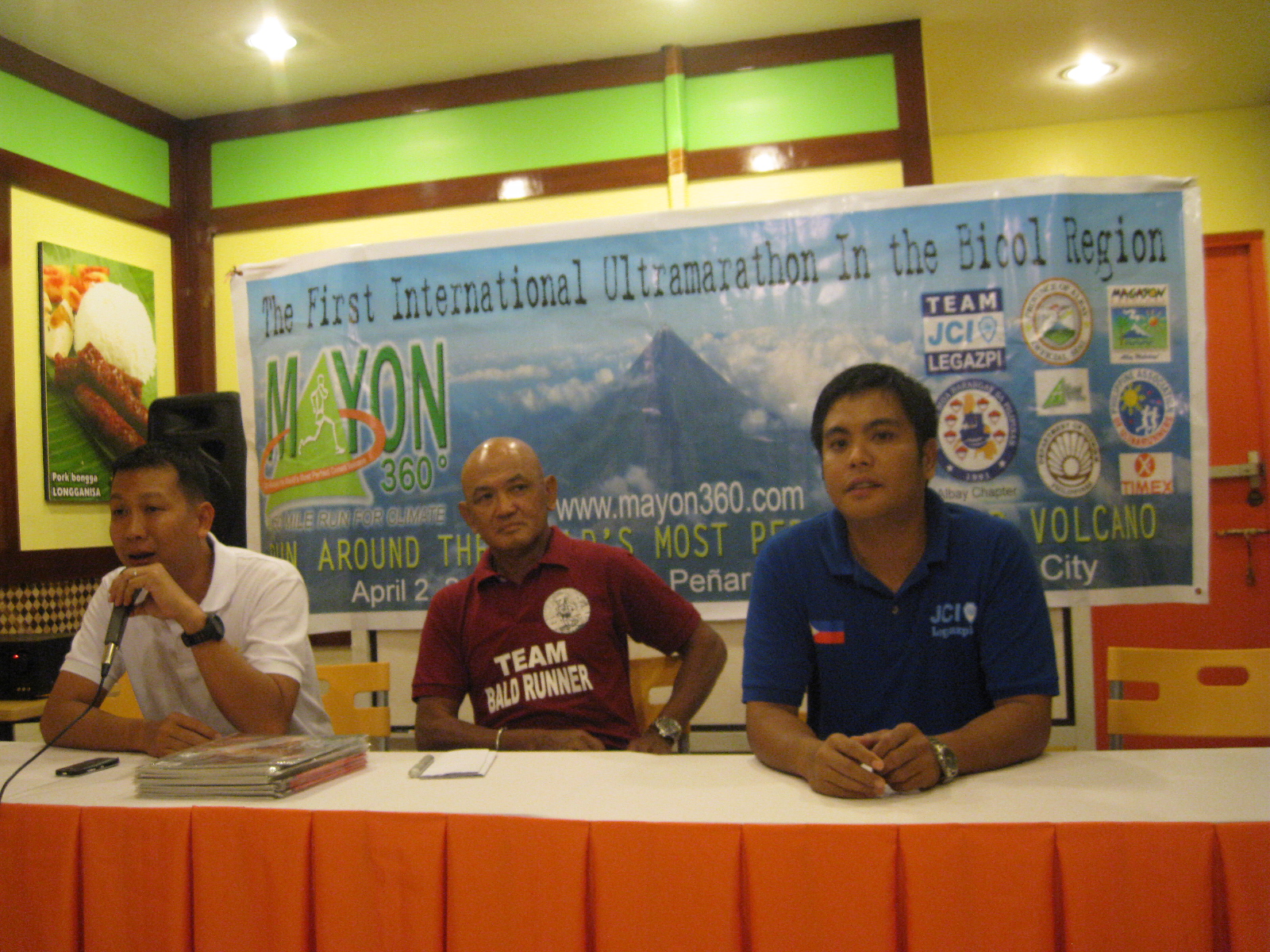
Two nights before Race Day, I joined the last coordinating meeting among the different committees involved in the said race. I was impressed on how the member-units were able to brief the whole group on their preparations and jobs to be done during the race. Different scenarios had been played and “brainstormed” by the group or committee involved in any particular situation to happen during the event. These guys were so meticulous on their preparations and I could see in their eyes the interest and drive to make this event a successful one. 

Coordination Meeting With All The Committees Involved

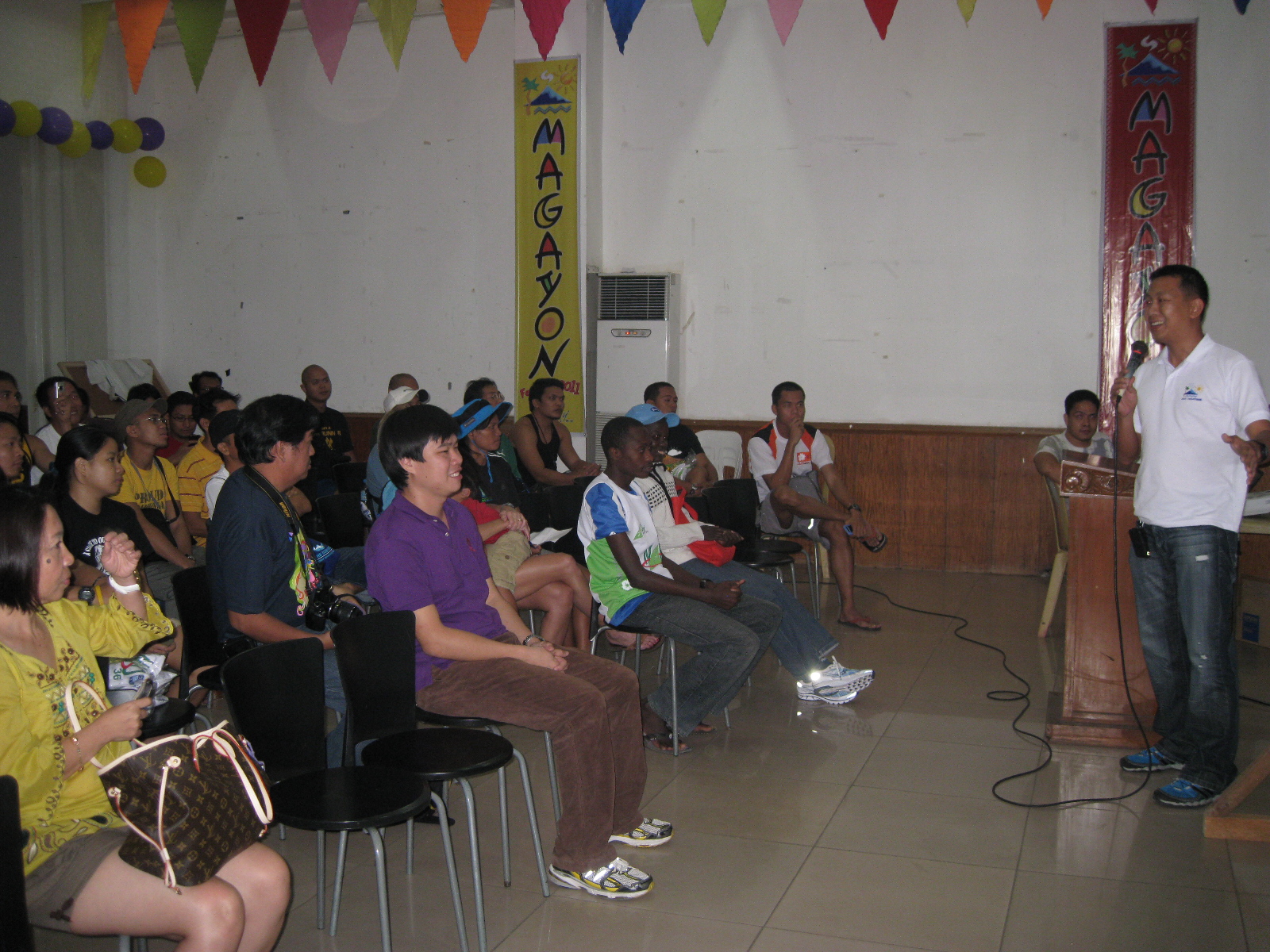
The CLP and Briefing was done at the Provincial Capitol Center with almost all the runners who most of them are from Metro Manila and the so-called “PAU-loyalists” and “BDM Veterans”. I was happy that these runners, although not yet fully recovered from their BDM Races, have joined this event and be a part of history in running in the Bicol Region.

Prov'l Board Member & President of League of Barangays JP Lee, BR, & Oriel Maddela/Chairman, JCI Legazpi

As the Race Director, I delivered a very detailed Briefing about the race and what the runners would expect along the route, to include the elevation and the logistics, but I did not tell them about the beauty of the scenery of their surroundings while they will be running the race. Finally, I told them that they are already part of history in this event as the first group of runners who ran around the Mt Mayon Volcano. They should not be pressured with the distance as the people of Albay will be in every Aid Station to cheer and support them in their run from Start to Finish.

Board Member JP Lee Delivering His Opening Remarks to the Guests & Runners
Runners & Guests From Metro Manila
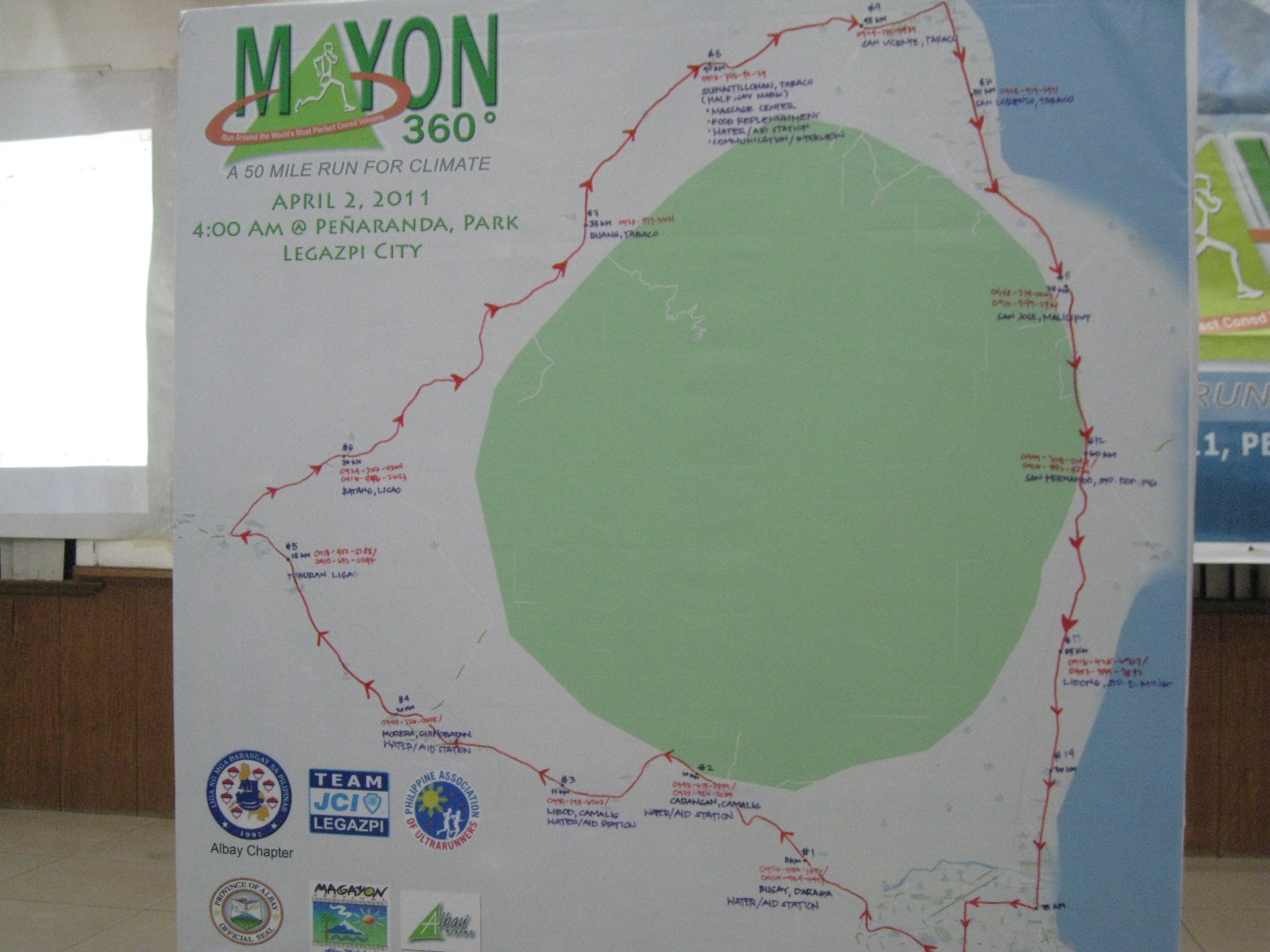
Route of the 1st Mayon 360

Race Proper

My first frustration in directing a road race is when the scheduled time of start is not done on the dot. I have that “signature” of starting my races before or on the scheduled time of start. It is a little shy of 5 minutes after 4:00 AM that the race started after a short prayer, singing the national anthem, and a short talk from the Race Organizers. At least, the race started not more than 10 or 20 minutes from the scheduled time. I knew the runners would not notice such a little delay. 

Start of the 1st Mt Mayon 360 50-Mile Run

The communications, support, and logistics systems of the race were great and everybody was working as a team and they were very efficient. A local radio station was broadcasting a “live update” of the race from the top runners from Start to Finish. The AMA School Computer Team was also feeding a “live update” on the event’s website at http://mayon360.com with photos of finishers as they cross the Finish Line! Results of the Race were on real-time as they are posted on the website immediately. Simply great!

Mt Mayon 360 Website Picture

What is nice about an ultra marathon race is the “drama” within each runner; the “drama” among runners and competitors; and the “drama” of the runner with the challenges of the environment; the route; and the warm hospitality & appreciation you receive from the local people witnessing the event. Moreso, the interaction of the runners with those people who volunteered to make this road race an enjoyable and successful one! 

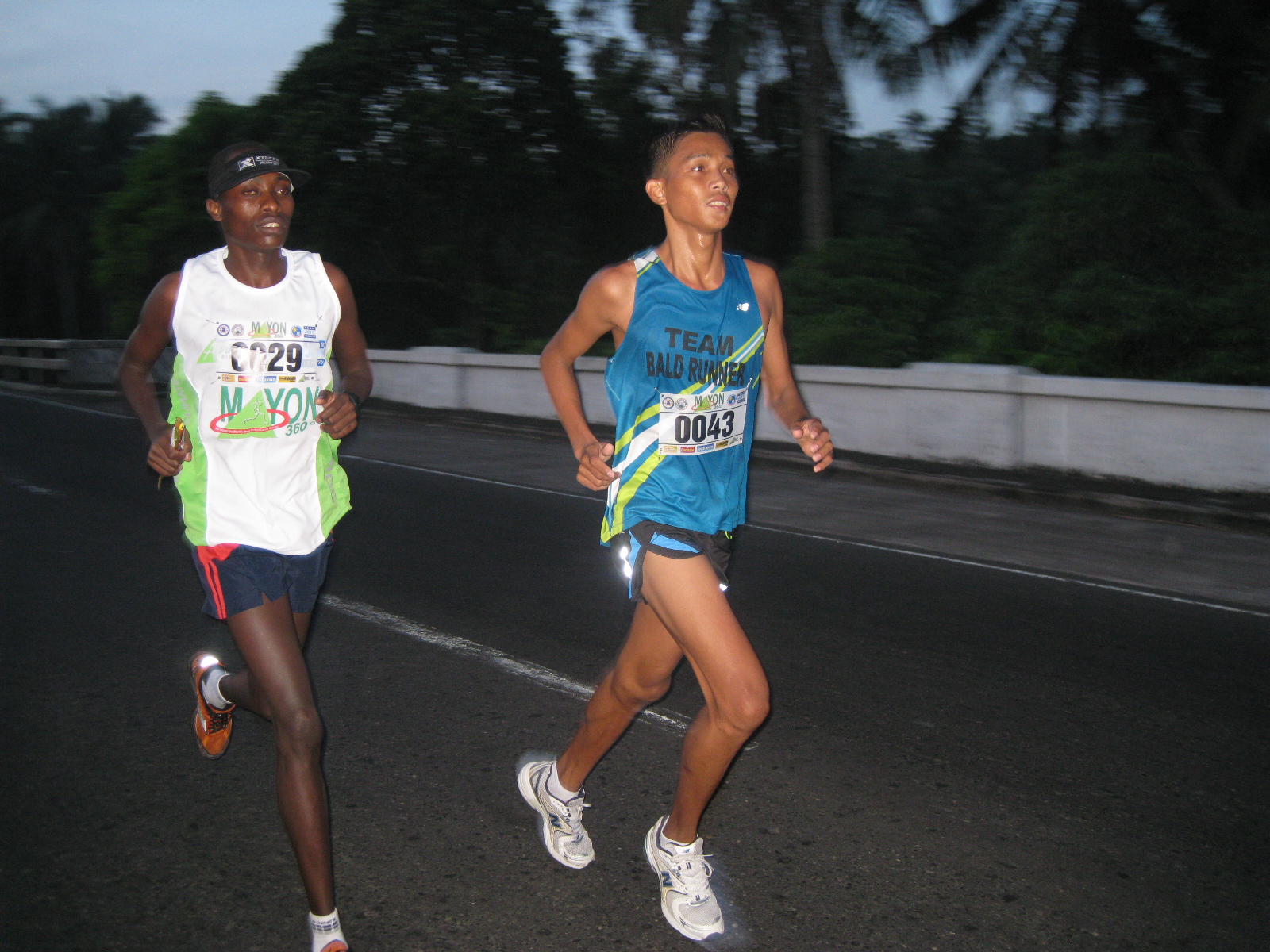
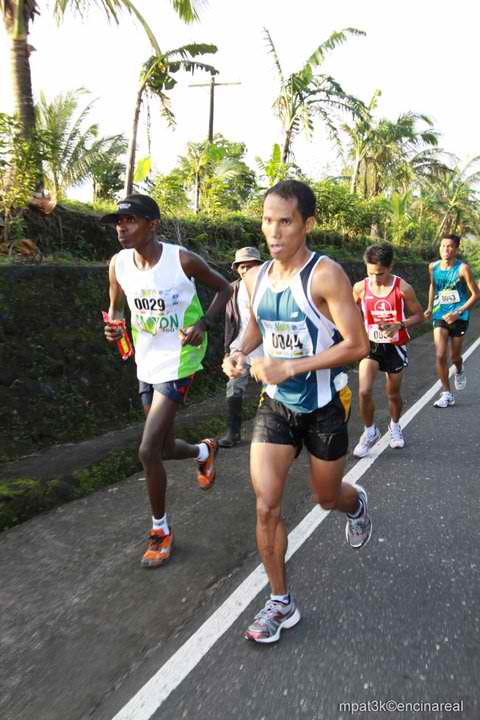
Elmer Sabal & Willy Rotich Leading The Race @ Km 25
Alley Quisay, Willy Rotich, Mario Maglinao, & Elmer Sabal @ Km 40

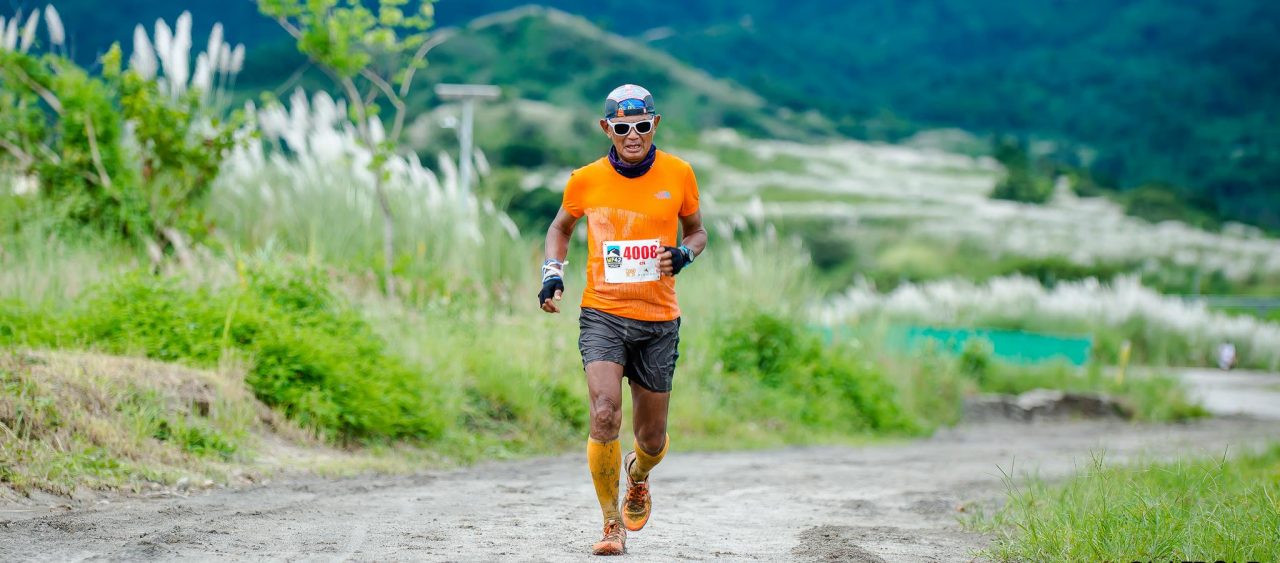
The “drama” on the first half of the race was the competition between our own elite runners, Elmer Sabal, Alley Quisay and Mario Maglinao with the visiting Kenyan runner, William Rotich. The four made up the frontrunners for almost 40 kilometers with each of them exchanging places from time to time, depending on the terrain of the route. At Km 41, Elmer Sabal dropped out from the race due to severe muscle cramping in his legs and declared as DNF before he rode in one of the support vehicles. From here on, it was a matter of knowing who will win as the Champion as the three of them were confident to bring home cash prizes after the said run. At Km 50, Mario and Alley were already having problems with leg cramps and they slowed down. William took advantage of the situation and started to speed up his pace towards the Finish Line. He did not look back and went alone to win the race. Mario was running 2nd place while at far back of him of about 500 meters, Alley was trailing his back.

Willy Rotich Leading The Race at Km 70
Alley Quisay Running 2nd at Km 70

The “drama” started to unfold between Mario and Alley when suddenly Mario was struck with a severe leg cramping that he had to lie down on the pavement to be given a “massage” by the Medical Team. Alley was able to pass him with 15 kilometers more to go before the Finish Line. Alley maintained his pace and he was able to create a big gap from Mario. When Mario was able to recover and started to run again, Alley was already 2-3 kilometers ahead of him. Alley won 2nd place and later, Mario arrived in 3rd place.

The Hardcores of Ultrarunning!!!

There was a “big drama” with the Women’s Division. Merlita Arias was leading for about 2 kilometers from the Kenyan runner at halfway but at Km 60, Merlita slowed down due to cramps and Poywo was able to overtake her at Km 70 and she was leading for awhile. But Merlita was able to recover and through her strong will to win the race, she placed all her efforts to regain back the first position. On the last 10 kilometers, they alternately changed positions but Merlita prevailed and she was able to lead the race until she reached the Finish Line. Poywo came in second.

Merlita Arias Dunkin @ Km 25
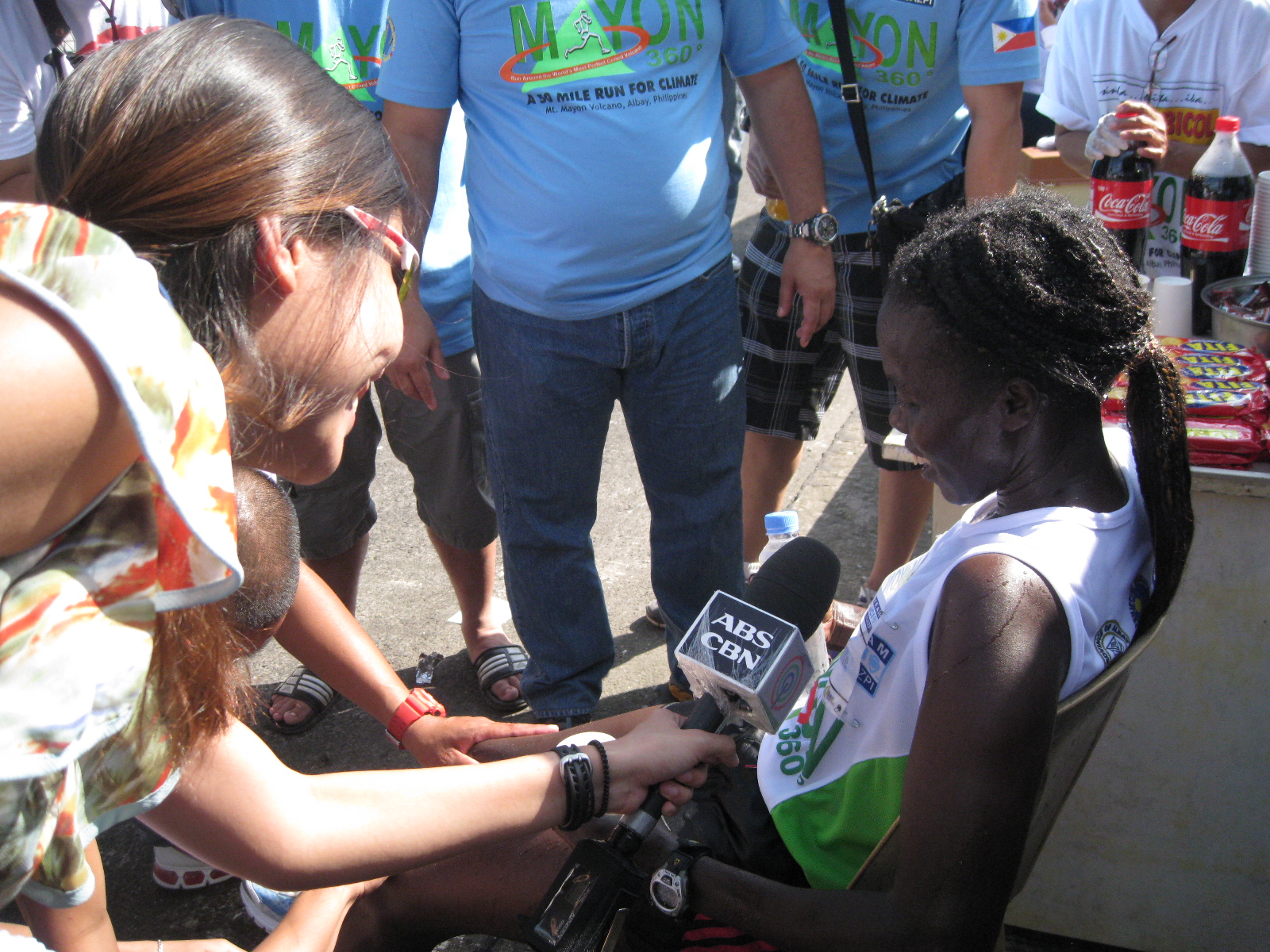
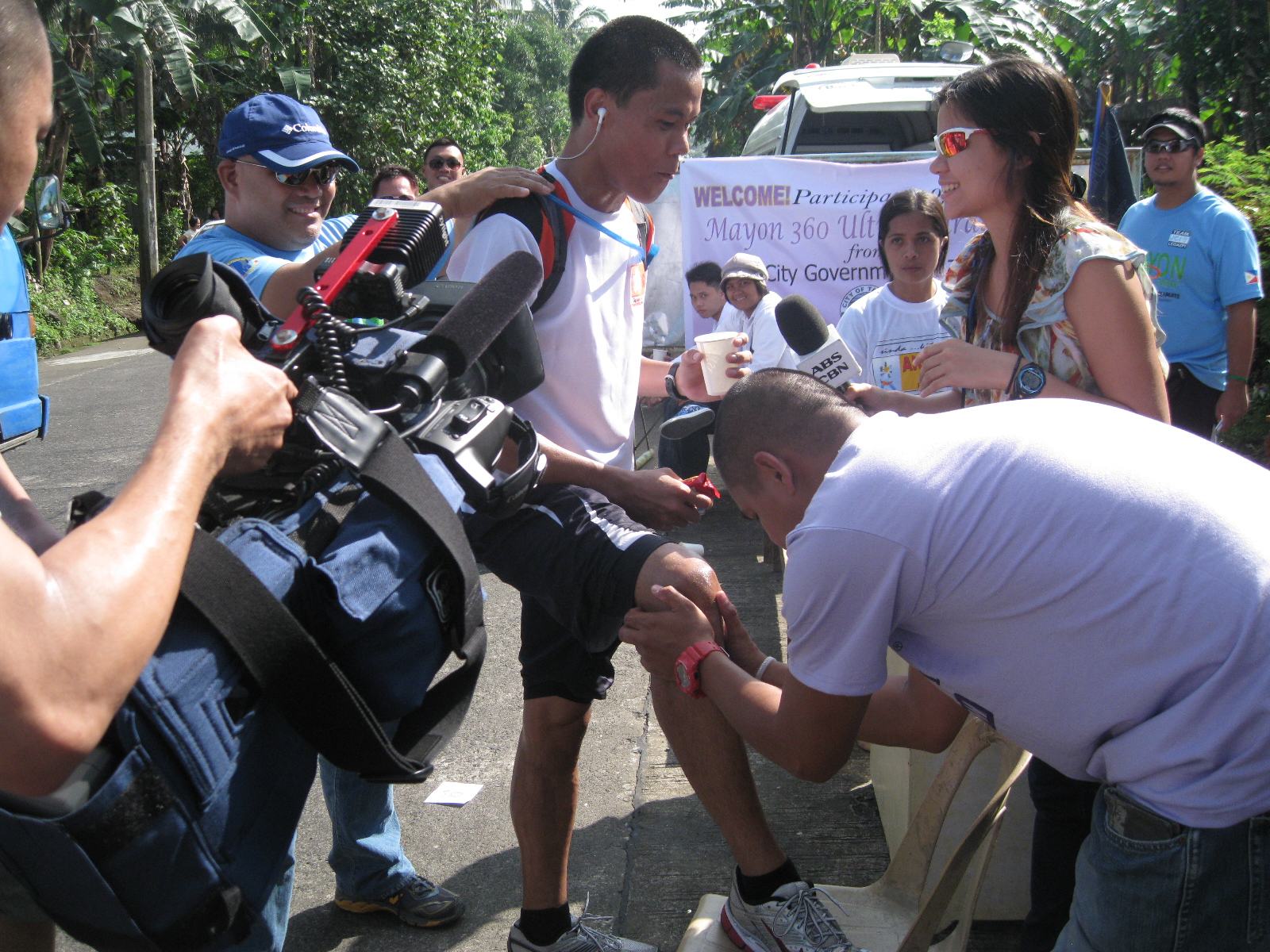
Peris Poywo of Kenya Having Massage & TV Interview @ Km 40

Due to unavoidable circumstances, a first-time lady ultrarunner whom I invited to join the event through the Event’s Page on Facebook got the 3rd place. Arianne Ortega was surprised when she crossed the Finish Line and declared as the 3rd top finisher among the women’s division. She joined her first ultra marathon race with the only objective to finish the race within the prescribed cut-off time of 15 hours but she got a bonus for winning a cash prize of $750.00. She was very happy and she thanked me for the invitation. Nice and happy lady!

Out of the 69 runners who started the race, 59 runners were able to cross the finish line and all of them were declared “official” finishers as they finished within the cut-off time of 15 hours. 

Mac Milan Having Massage & TV Interview at Km 40
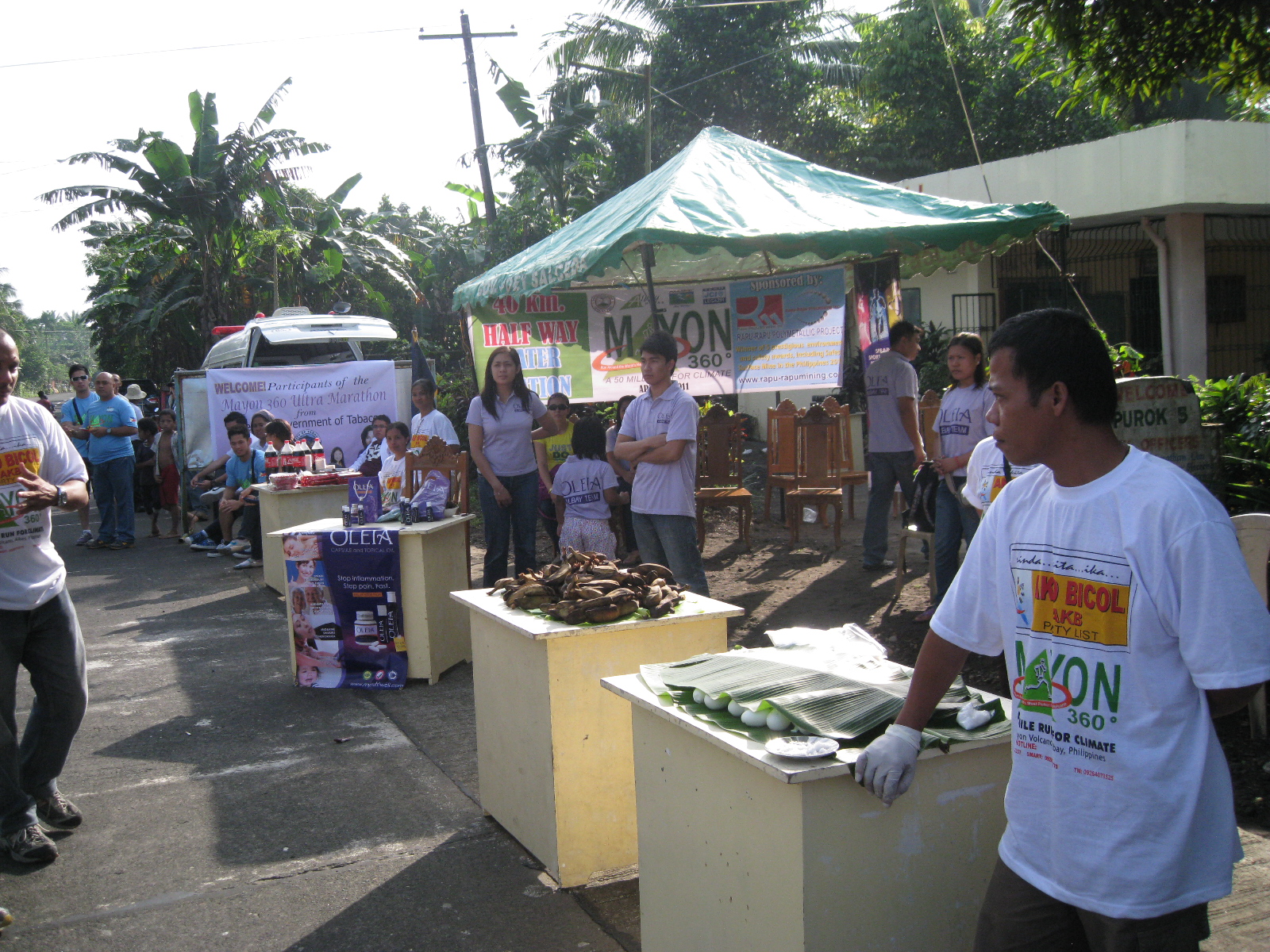
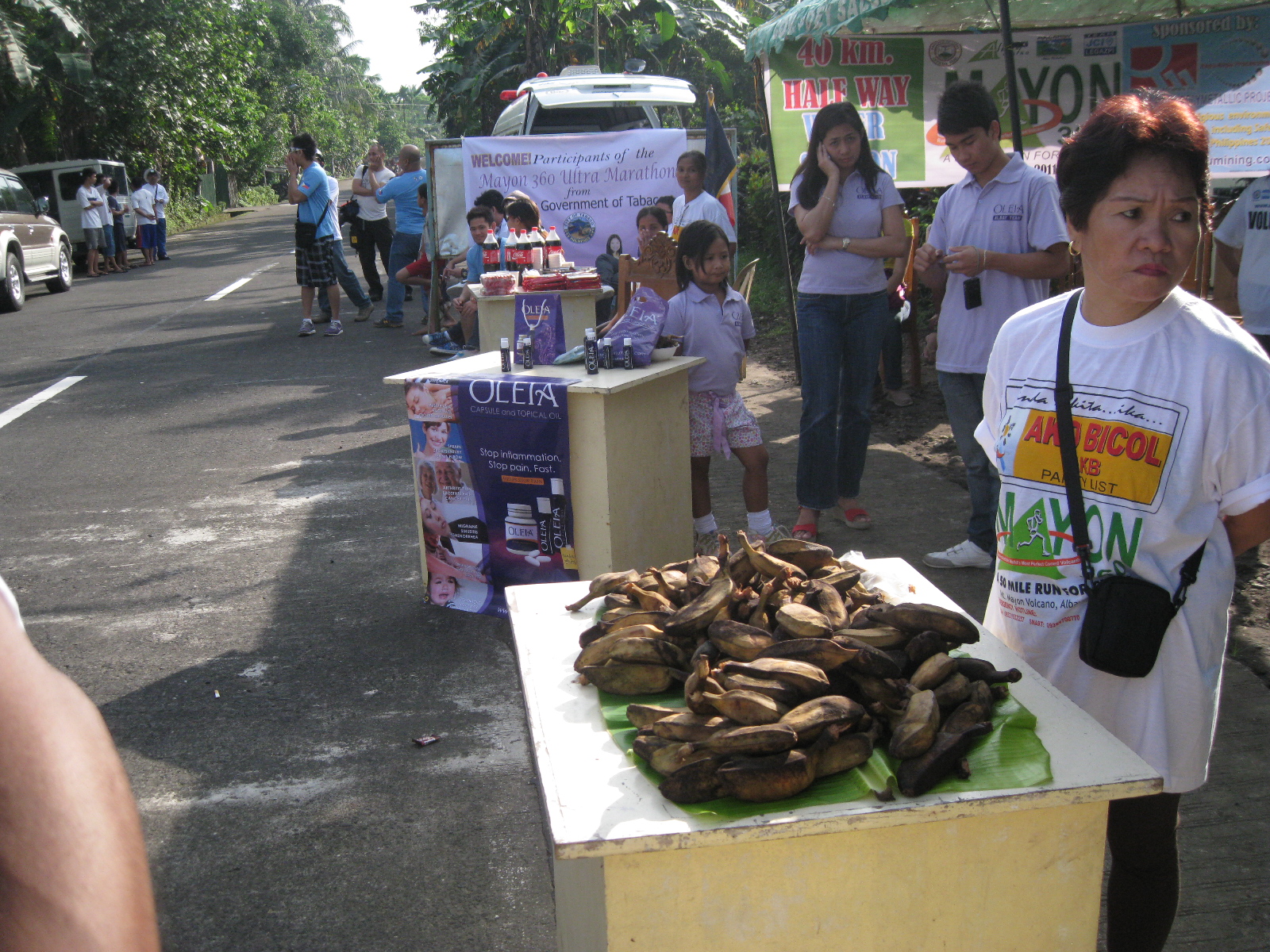
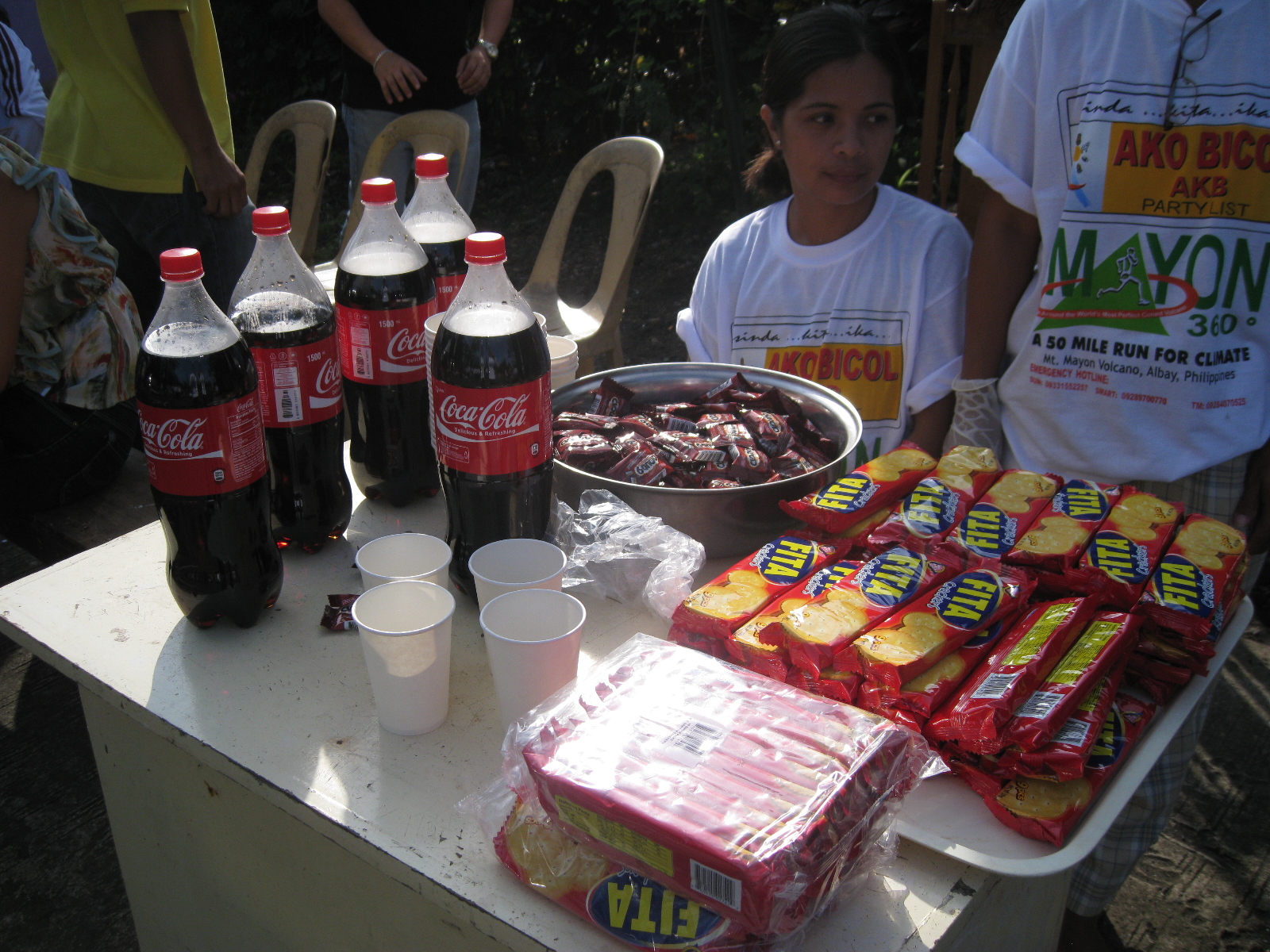
A Typical Aid Station Along The Route
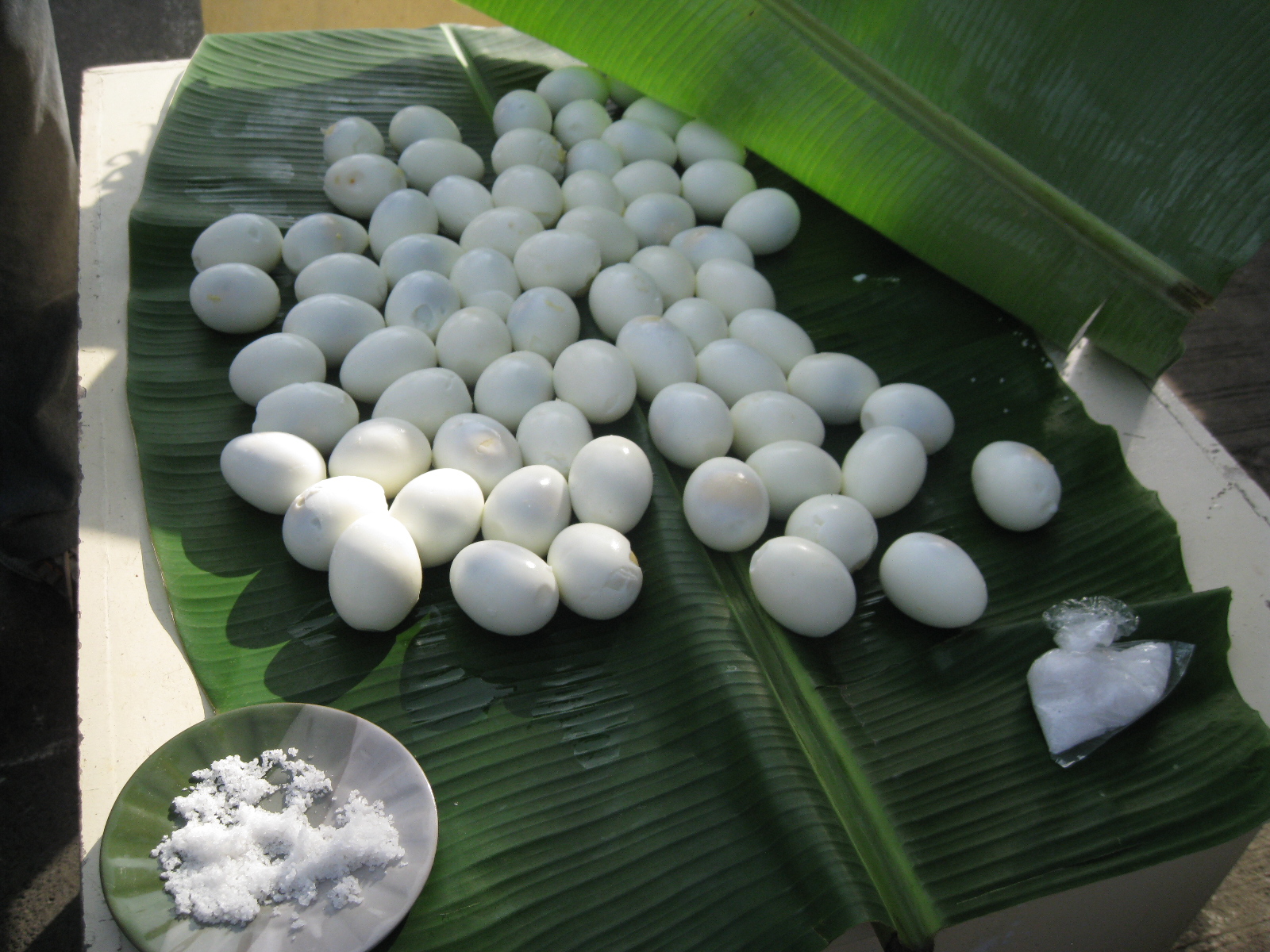
Hard-Boiled Eggs With Salt
Boiled Bananas & Massage Station at the Next Table
Sodas & Bite Foods

Awarding Ceremony

The awarding ceremony started as soon as the last runner crossed the finish line. Gov. Joey Salceda awarded the cash prizes, medals, and certificates to the top finishers (men’s and women’s). Governor Salceda was satisfied with the result and the awareness the event had created among the people of Albay. He stated in his closing message that this event will be made bigger and with more participation from international runners in the next year’s edition. Thus, this event will be a permanent activity for the Magayon Festival that will promote Sports Tourism in the Region.

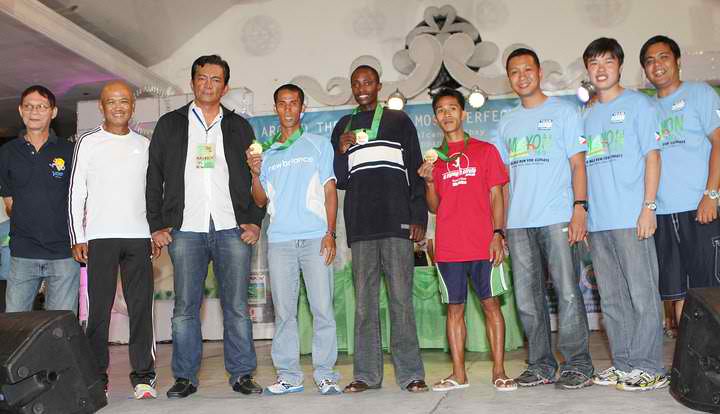
Awarding Ceremony With Governor Joey Salceda

Things To Be Improved

Knowing that 85% of the runners would be coming from Metro Manila and the “usual suspects” in PAU and BDM Races, I did not strictly impose on the rules and regulations of PAU Races because I knew that such rules/regulations are already “automatic” to them. I did not realize that the local “first-time” ultra runners were not aware of such rules and regulations. We will improve on the strict implementation of the PAU/BDM Races’ rules & regulations on the future editions of this road race event. (Note: About 30+ local runners ran as “bandits” and pacers for the registered local runners)

Through my suggestion, a local Marathon (42K) race must be conducted in Albay months prior to the Magayon Festival to give a chance for the local and regional runners to qualify for the next edition of the race.

Future and Expectations 

As stated by Governor Joey Salceda in his closing remarks during the Awarding Ceremony, the ultra running event will remain as a permanent activity of the yearly Magayon Festival. It will be a bigger event where international runners will be invited and hopefully, included in the calendar of events in ultra marathon websites and Ultrarunning Magazine Online.

The involvement of the Provincial Government, League of Barangays of Albay, JCI Legazpi, and the people of the 3 cities, 7 municipalities and 77 barangays of the province will showcase the unity, warmth, hospitality, and the kindness of the populace.

This ultra marathon race must be a part of the yearly checklist of an ultrarunner!

See you next year!