Five years ago, I went to Mt Pinatubo together with a group of ultra runners where five of us were training for the 1st BDM 102. While the 5 of us were having our “pit stop” at the edge of crater lake, I started to discuss with the group about my plans in promoting ultra marathon events in the country. And the rest is history. The ultra runner’s group whom we asked to join in our trek to Mt Pinatubo just completely “vanished”. I wonder why.
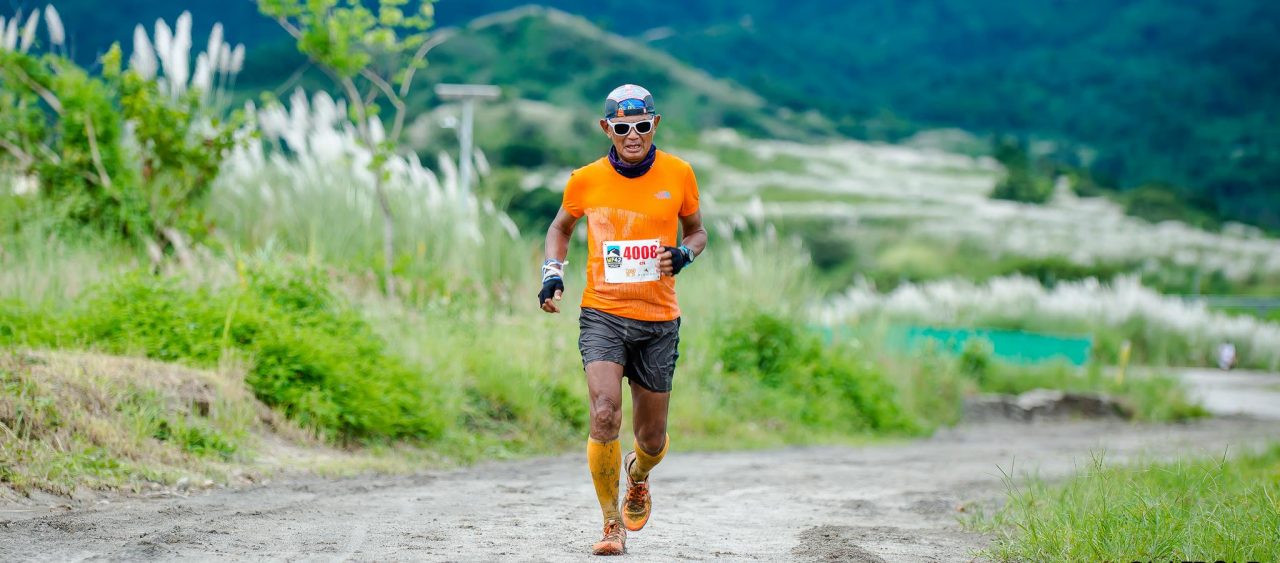
Every edition of the Mt Pinatubo 50K Trail Challenge has a unique story and experiences to every runner as the landscape of the route would completely change every year. In short, there is a different story for every runner every year. And the challenges brought about by the landscape, the river, the lahar, the rocks, the elevation, the heat and the rains make this event totally different from the other trail running events in the country. This is a trail running event where you need agility, quick thinking, smart running strategy and orienteering skills in order to run safely back to the finish line.
If you look closely on the elevation profile of the race route, this could be the first ultra “FKT” (Fastest Known Time) event held in the country. The fastest recorded time was 5:35:09 hours by Marcelo Bautista while the Lady’s Course Record is 8:00:59 by Majo Liao. These course records stand up to the present.
Mt Pinatubo Elevation Profile
For this year, the event was held after a day when Typhoon Santi’s strong winds had devastated the towns of Tarlac, Pampanga, Bataan and Zambales. The roads to the starting area, Barangay Santa Juliana in Capas, Tarlac had been filled with fallen trees and debris but with the immediate response from the Local Government Disaster Committee, the roads were cleared for traffic.
Much to my desire to personally recon the route on the day before Race Day, I was advised by the local authorities that It would be best to wait for the river’s depth to subside and start the race when there would be natural lighting as the sun arises.
I was expecting only 52 runners to join this race. I guess, 3 of the runners who requested to be included in the list of registered runners decided not to join the race as a result of the typhoon. I decided to run the race as the “sweeper” and safety marshal for the last runners.
Most of the runners arrived at the assembly area few hours before the start of the race and they were surprised to see the devastation brought about by Typhoon Santi. I made clear to all the runners that the race start would be delayed for us to wait for the day’s sunlight to appear. At exactly 5:35 AM, the race started in front of the Barangay Hall of Santa Juliana, Capas, Tarlac with 49 runner-starters. My salute goes to these runners who braved to be at the starting area.
Runners who had their first time to join the race are always surprised with the first river crossing which is about 1.3 kilometers from the starting area. It is always the same feeling and apprehension for all the runners. The river had been wider and some portions are deep and the current is strong. Runners would cross the river deliberately in groups trying to test the depth and current of the flowing river. At a distance, every runner would see the road that leads to the cogon/tall grasses and that was the target of all the runners.
Due to the loose and unstable ground brought about by the typhoon, the first 4 X 4 vehicle to serve the runners as the Aid Station had been stalled at Km 8. The 2nd 4 X 4 vehicle move on to about a few kilometers.
I started to run the race after 5 minutes from the Gun Start time. I purposely made myself as the “sweeper” and safety runner for the runners at the rear. After one hour of hiking and running, I was able to spot the stalled 4X4 vehicle and the last runners leaving the Aid Station. I immediately called my staff at the Starting Area to send another 4X4 vehicle to reach Kilometer 17, if possible.
I have to wait for about 45 minutes for the replacement 4X4 vehicle to arrive at the stalled vehicle. Once it arrived, I continued my run with the instruction for the replacement vehicle to move forward closer to Km 17 if the condition of the ground and the river permit. The replacement vehicle passed me somewhere in Km 10 and I could still see the last runners in front of me with a distance of about 500 meters. However, the driver of the replacement 4X4 vehicle had to stop the vehicle about 1-2 kilometers ahead of me due to loose ground and deeper parts of the river.
The race marshals and volunteer that I requested to be positioned at the Crater Lake had to walk for about 6 kilometers but decided not push through to the peak of Mt Pinatubo due to the lack of time. With this situation, the runners who will be reaching the turn-around at the Crater Lake will not be able to see my Race Marshals.
I was amazed and surprised to see the landscape to have completely changed after a year! Gone are the temporary trail where the 4X4 vehicle would run through. Another landscape of rocks and lahar had appeared. The temporary waiting area for the 4X4 vehicle at a place called “GMA” is completely gone. Most of the runners at the rear were lost at this portion but with the presence of the Race Marshals and Volunteer, they were advised to go to their position and were able to get their proper direction.
When I reached the “GMA” area, I was able to catch up with the last runner. The distance to the peak is still 7-8 kilometers from this point. From here, I pushed the last runner to continue the race and be able to reach the turn-around point. The first runner going back to the finish just dropped by at the “GMA” as we started our trek to the peak. After about 500 meters, we met the 2nd runner, Robert Watson and the third runner, July Oconer was 200-300 meters behind. After 15 minutes of hiking, we met the 4th runner, Graciano Santos. As we reached the Waiting Sheds at the foot of Mt Pinatubo, we were able to meet a group of 5 runners coming from the peak. More runners would be going down from the peak as we were trying to trek the last 2 kilometers to the peak of the mountain.
As we reached the peak of Mt Pinatubo, we were able to catch up with the last 4 runners who just came from the Crater Lake. After a brief “pit stop” at the Crater Lake, we were ready to move on for the last half of the course.
Coming from the peak and going back to the finish line could had been very easy if not for the numerous rocks to step on, more time spent on looking for open ground to land your feet, and the river to cross. After a few kilometers, the last runner, Joel and I were able to catch up with the 4 last runners.
It was already noon time and the sun was already on top of us as the sky went clear from clouds. It became hotter and we tried to conserve the water we had in our hydration bottles and tried our best to reach the Aid Station at Km #11/49. Three of the runners of the last 4 runners went ahead of us and the 4th runner, Allenstein joined us as the last 3 runners.
After hiking, jogging and telling some “running” stories with my companions, we were able to reach the Aid Station. This is where we ate boiled eggs and bananas; refilled our hydration bottles; and drank lots of soda drinks sponsored/provided by our ultra runner and friend, Jun Padilla.
I was surprised to see that the river had subsided and became narrow. More lahar grounds were exposed as a result of few hours of sunshine but some were not stable as our feet would sink for a few inches when walking. At one point, I would remove my shoes and clean them from the accumulated lahar/sand with the flowing river. The flowing river carries a lot of sand/lahar and they ultimately gets inside the shoes and accumulate on the toe box/sole portion of the shoes.
After a few kilometers, we reached the last Aid Station and we were able to catch up with the rest of the runners as some would eat, refill their bottles and wash their shoes from the lahar/sand. It was the last 8 kilometers to the finish line but some runners have the tendency to be lost on this part of the route.
I was with another runner-friend, Many Ocampo, from this point as I tried to encourage him to run with a faster pace and by taking the shortest route/trail to the last river crossing. After some “hit and miss” and “bushwacking” on tall grasses, we were able to reach the 2nd to the last river crossing that would lead us to the trail to the last river crossing.
At this point, I became the “guide” for the rest of the runners at the rear on the last 3 kilometers of the course. I felt strong and faster with my pace from this point. It is just a matter of time and I know I would be able to finish the race in less than 12 hours!
The following were the observations made and some adjustments to be implemented on the next edition of this race:
Despite the more challenging situation of this year’s edition, all the starters were able to finish the race. I could see that our runners are becoming braver, stronger and smarter.
Runners attempting to join this race must have some knowledge on orienteering. Some skills on tracking would also be needed. A runner is smart if he/she tries to look for marks/foot prints or signs of runner’s track along the rocks and trails.
Most of the runners are “repeaters” in this event and I am glad they were able to act as guide/pacers to other runners. This is the essence of trail running—everybody helps each other to overcome the challenges along the route and be able to finish the race safely.
Integrity of the race was maintained and the runners went down to the crater lake despite the presence of eroded portion of the stairs. Next time, I would advise that handheld digital camera will be required for each runner and for them to submit a “selfie” picture of themselves with the Crater Lake as the background as an evidence that they reached the turn-around point. This is an “out of the box” way just in case the Race Marshals would not be able to reach the Crater Lake.
Since I included a First Aid Kit as a required equipment carry-on for each runner, this will be thoroughly inspected before the race. I am glad there were no serious accidents during the race.
Runners must be always vigilant and observant with the course features that they would pass on their way to the peak. These land and river features would be needed for the runner to guide him/her back to the finish line. There are steel towers along the left side of the open space/river as the runner would run towards the peak. The same towers would be seen on the right side of the runners as they go back to the finish line.
Last year, we had time to prepare for ribbons tied on bamboo sticks but on race day, most of the sticks were taken by Aeta kids and made as souvenirs. What is worse was that most of the runners were not able to see these ribbons that we placed along the route on the first 5 kilometers as most of the runners followed the trails. For this year, we were not able to place those ribbons but runners were smart to follow the river and made their run with due direction towards the South.
The Aetas/local tribe in the area were very helpful that they made some access trails on the steep banks of the river for the runners. They even see to it that they give instructions on where to go to avoid the deeper parts of the river. Nobody from the tribe asked for any food or money from the runners.
If not for the typhoon, we could have pushed the 4X4 vehicles to reach “GMA” where runners would be able to replenish their hydration before their final trek to the peak of the mountain. I know that some runners were asking for some water after coming from the peak but they persevered until they reach the stalled 4X4 vehicle on the last 12 kilometers. On the next edition, we will see to it that every runner must be able to carry at least 2 liters of water on the last Aid Station before their trek to the peak or before reaching the turn-around point.
All Finishers were able to receive new versions of the Finisher’s T-Shirt and Finisher’s Medal.
On the next edition of this race, we have to add some amount for the registration fee in order for us to offer Cash Prizes to the podium finishers. We will adopt what we will do with the next edition of the Tagaytay To Nasugbu 50K Ultra Marathon Race.
We will continue to announce the details of the next year’s edition through our Facebook Event Page.
Every year, we have Foreigners in this race and we hope to continue accommodating them in our next editions.
My special thanks to the Northern Luzon Command (NOLCOM), AFP, Philippine Air Force, Tarlac and Capas PNP, Light Armor Division (LAD) of the Philippine Army, Barangay Sta Juliana Personnel, Jun Padilla for the Pepsi Products & Drinks, Ronnel Go for the Photo Coverage, Volunteers, and Staff of Bald Runner’s Events for their untiring efforts to make this event safe for the runners and for the success of this event.
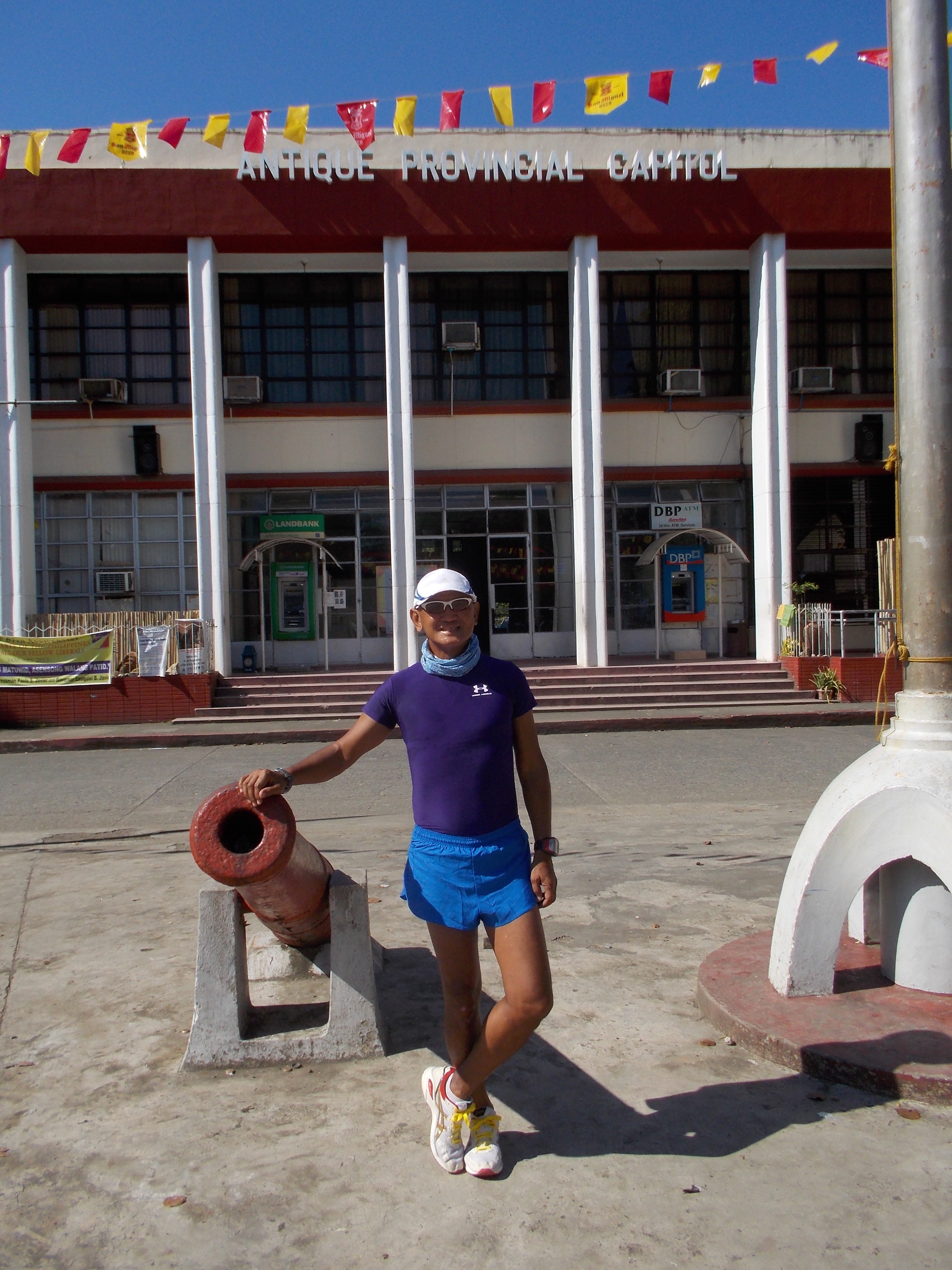
Before The Run In Front Of Antique Provincial Capitol
On the first week of May this year, I decided to run from San Jose De Buenavista, Antique to Barangay Caticlan, Malay, Aklan via Nabas, Aklan along the Antique-Aklan Highway. I started my run at 9:00 AM May 6, 2013 in front of the Provincial Capitol in San Jose De Buenavista and was able to reach the town of Tibiao, Aklan in 14 hours and it was already 11:00 PM. I rested and slept for awhile and then continued my run and was able to reach my destination, through walking and slow jogging on the last half, at the Army Transient Facility (ATF) in Barangay Caticlan, Malay, Aklan on or about 5:00 PM of May 7, 2013. I was able to run the distance of 166 kilometers in 32 hours with more “pit stops” on the last 86 kilometers of the route.
Very Hot & Sunny Run
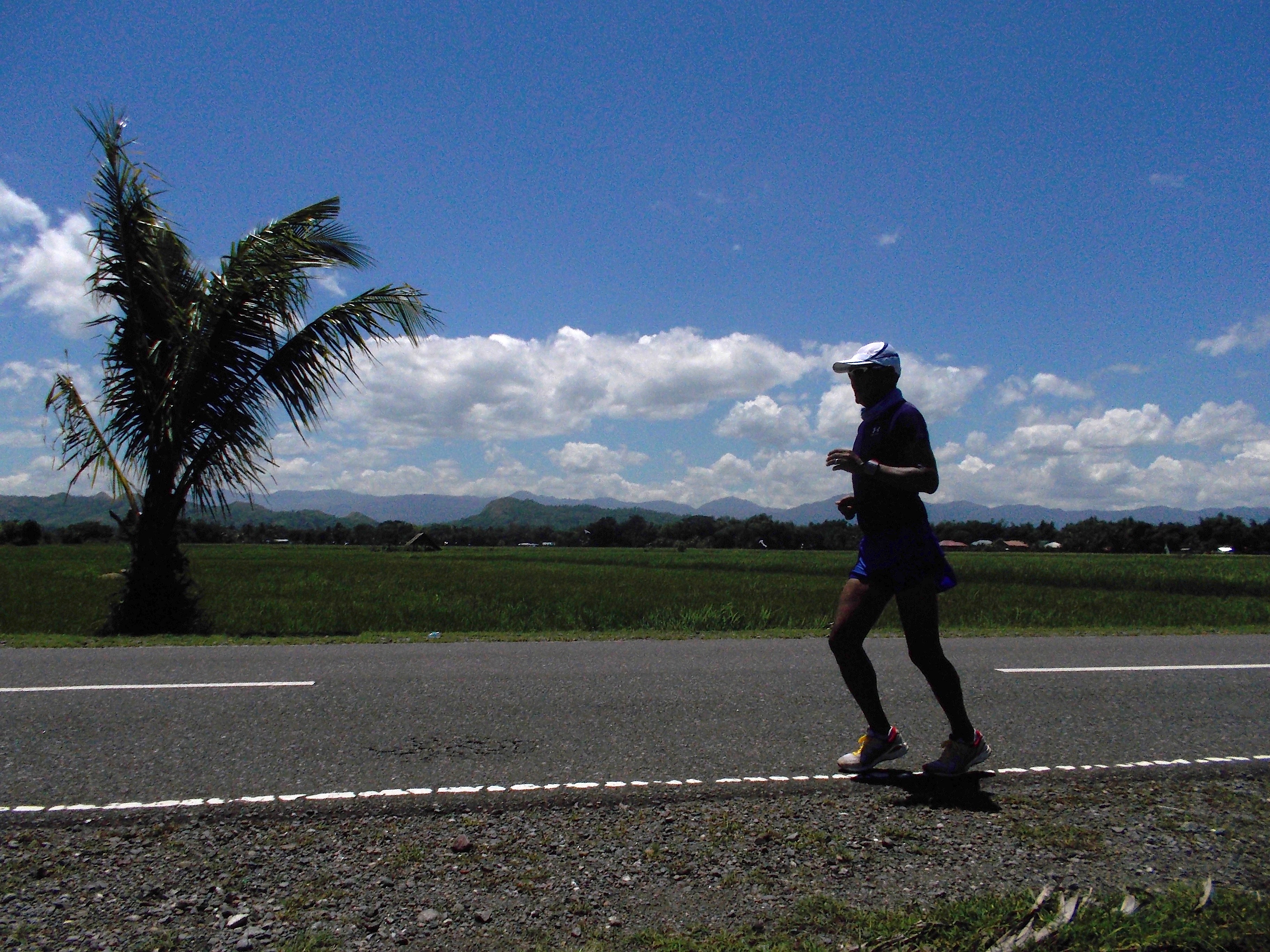
Since it was Summer when I did this adventure run, it was too hot during daytime and it became colder during nighttime as I felt the cold wind coming from the sea. But on the following day, I was totally tired and drained due to the heat of the sun from Pandan, Antique to Barangay Caticlan, Malay, Aklan. I was forced to walk on populated areas because of the presence of dogs. And from Nabas, Aklan to my destination, there was a lot of traffic of vehicles coming from Caticlan and Kalibo, Aklan as most of the tourist were going and coming from Boracay Island. It was practically a “Death March” for me on my last 20K to the Finish Line.
From my experience of this adventure run, I came up with an Ultra Marathon Race with the same route that I’ve ran and placed intermediate cut-off times along the way so that runners will be forced to maintain their pace and could cover the distance with a faster time than what I’ve recorded. The following intermediate cut-off times were announced and included in the rules and regulations:
Kilometer #40—–6:30 Hours
Kilometer #80—–14 Hours
Kilometer #100—-18 Hours
Kilometer #120—–23 Hours
Kilometer #160/Finish Line—–30 Hours
However, with the “bonus” (additional) 6 kilometers of the route, I decided to give an additional “bonus” time for all the runners as a surprise news/gift to them once they arrive at the Finish Line.
It was raining on the night of the starting day of the event. The weather forecast indicated a rainy weather and thunderstorm for the whole weekend and it was a good sign that the runners will experience a cooler temperature as compared when I did this run last May. It will also deter or prevent the runners from being exposed to the stray dogs staying along the road. But it was expected that runners will be battling with the rains and cold winds.
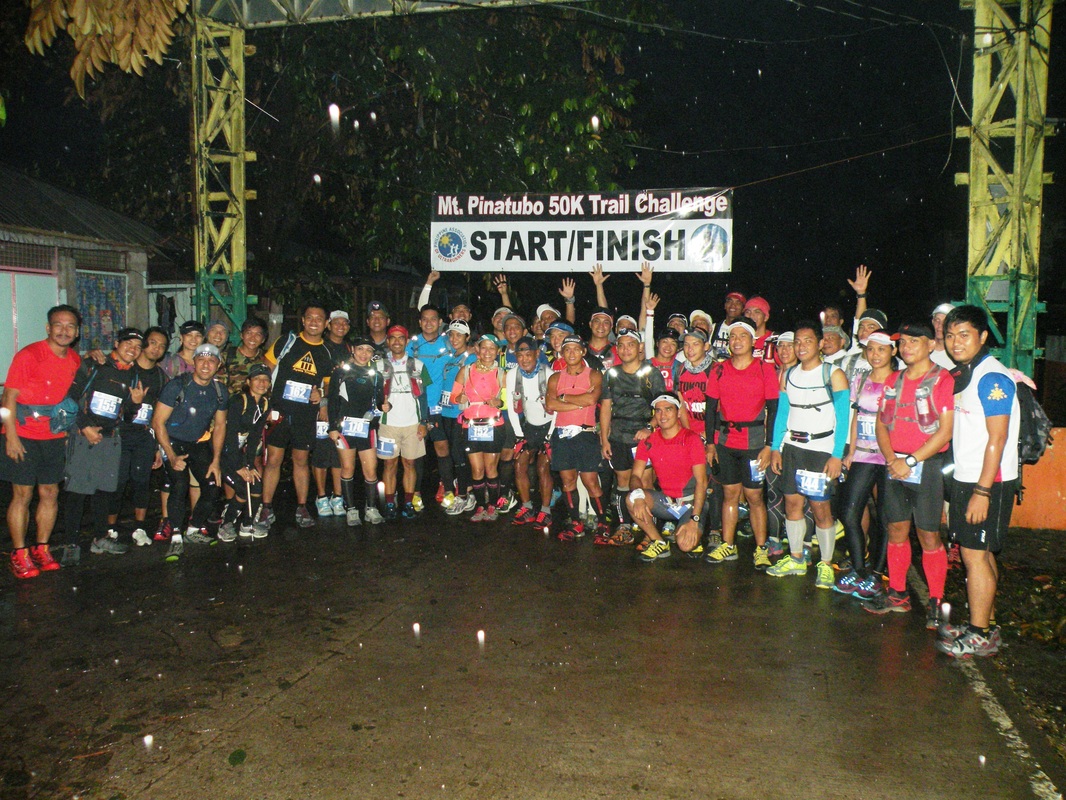
After a short briefing and photo-ops at the Starting Area, the race started at exactly 11:00 PM in front of the Provincial Capitol in San Jose De Buenavista, Antique with 29 runners for the 100-Mile Race and 3 runners for the 50-Mile Race. It rained hard after the runners left the Provincial Capitol.
After giving final instructions to my staff and security detail for the event, I started to run and acted as the official “sweeper” of the race. After 7 kilometers of running, I was able to see the last runner and was able to maintain at least 10 meters behind the runner. After running for 12 kilometers (1:20 hours), I boarded my support vehicle and started to monitor the running condition of each of the runner on the road.
All the runners were doing fine and they were seen running at their comfortable pace. The leaders, Tenny and Ilmar, from Iloilo were leading the group after 20 kilometers with Wilnar Iglesia and Alfred Delos Reyes trailing them from a distance of about 100 meters. Some were running in pairs and some were in groups of three and four. The leaders were running at an average of 10 kilometers per hour and a stretch of 2-3 kilometers covered the distance of the first runner to the last runner.
Despite the strong rains and some flooded areas along the route, the runners kept their respective pace and determined to arrive at designated checkpoint within the prescribed cut-off times. However, most of the runners were so fast that they arrived at the initial checkpoint 2 hours ahead of time! At Km #40, one lady runner barely missed the cut-off time by 15 minutes but the last runner was unable to reach the first checkpoint in 6.5 hours. Two runners were declared as DNF due to injury and inability to reach at Km #40 in 6.5 hours.
At Km #81, at Tibiao Bridge in Tibiao, Antique, I established the Finish Line for 50-Mile Race and all of the runners were able to beat the cut-off time of 14 hours. It was already daytime when the leading runners passed by this checkpoint but the sky was overcast and cloudy. The runners were still enjoying the cooler weather brought about by the rains and overcast sky. Three of the registered runners for the 50-mile race arrived within the cut-off time of 14 hours and I immediately awarded their “loot” to each of them. Two were males and one was a female runner.
From Km #81, I moved to Km #100 and I was able to watch and see the runners that passed the previous checkpoint and they were still strong. The top runners were trying to maintain their pace while the mid-pack runners were power walking and the rest of the runners were on their respective “pit stops”. At Km #100, 7 runners were able to pass the checkpoint and they were building up more gap from the rest of the runners. At this point, I could sense that some of the runners at the back would not be able to cross the checkpoint within the prescribed cut-off time of 18 hours as the sun started to shine at noon up to the early afternoon. However, they braved on and were able to cross the checkpoint on the designated cut-off time except for the last runner who was at least 2-3 kilometers away but I allowed the runner to run through the checkpoint.
At Km #120, I changed to my running attire and alighted from my support vehicle and started my workout for the day—I have to run at least 35 kilometers for the day! On the day the race started (Friday), I was scheduled to run 10 kilometers but I was able to cover a distance of 12 kilometers. While running on the last 46 kilometers of the route, I was being informed by my staff about the condition/status of the runners. I started to receive reports of DNFs and telephone calls from runners asking if they are on the right direction/route. Some of the callers would show symptoms of hallucinations as they thought they are lost or “going on circle” along the route. I just told them to keep/stay calm and try to look for the DPWH Kilometer Posts (colored yellow) located on the right side of the road. If the number below the letter M (Malay) is descending/decreasing as they move forward along the road, then they are nearing the Finish Line!
I actually ran 38 kilometers and started to ride my support vehicle when I was informed that the leading runner was about 7-8 kilometers behind me. It was already almost 9:00 PM when I entered Caticlan, Malay and I went directly to the area where the Finish Line is located. I knew that the runners will curse me as the final and last 500 meters of the course will be a steep climb to the top of a hill which is an unpaved road with lots of grasses.
After waiting for about an hour, the first runner arrived at the Finish Line and it was Wilnar Iglesia, the Course record Holder of the BDM 160 Ultra Marathon Race. The following the is the result of the race:
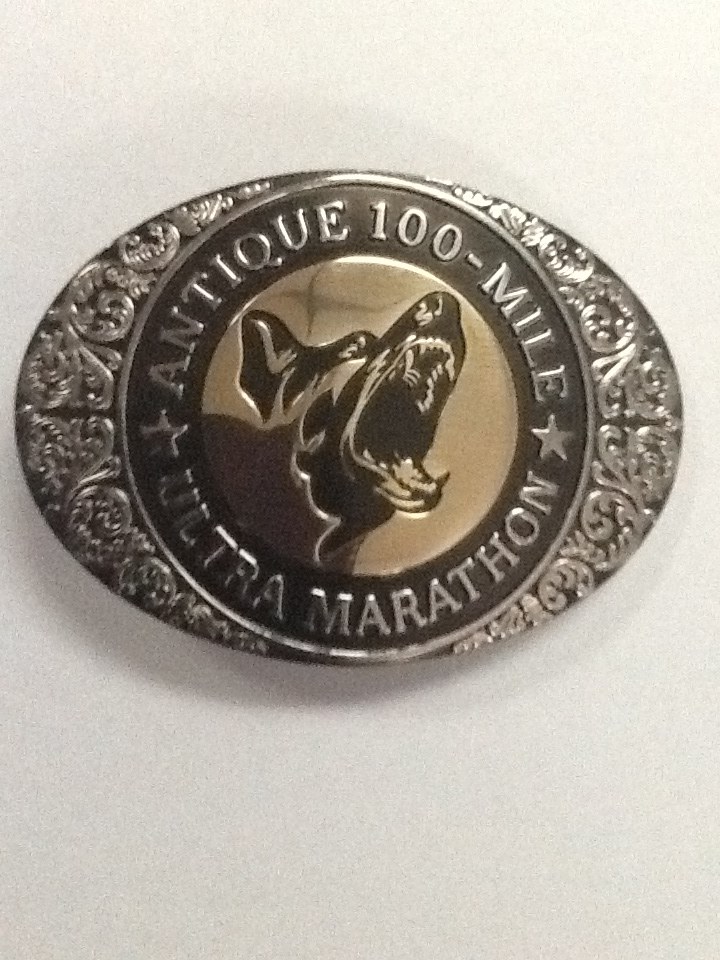
Out of the 29 runners who started at the Starting Area in San Jose De Buenavista, Antique, 18 runners crossed the finish line in 31 hours and they received the Finisher’s Buckle. And the rest is history.
Out of the 18 runners who crossed the finish line in 31 hours, 85% of them arrived at the 29th hour of the race or within the last hour of the original cut-off time of 30 hours. The answer to this observation/data could be explained with the following:
1. Most of the runners did not have appropriate training and relied much on “brute force” to finish the race. Most of the finishers had experienced finishing 100-milers and barely to finish within the prescribed cut-off time is their ultimate goal. It’s the Finisher’s Buckle that counts most, not the Finish Time!
2. Those who trained properly for this race could move easily and walk properly after they have taken their shower and short sleep. The rest of the runners were sluggish and could hardly move their legs and feet after taking a bath.
3. Those who prepared and trained properly for this event wore their shoes from start to finish. The rest of the runners shifted to shoes then to sandals and some would start with running sandals and then shifted to running shoes. If you are not born in the Copper Canyon in Northern Mexico, then don’t think that you can finish a 100-miler race with sandals!
4. All my ultra races are held whether it is raining or when there is a typhoon or not. Most of the runners were not prepared to have extra socks with them. I have always prescribed the brand DRYMAX to all the ultra runners who have delicate skin on their feet but some are still using local brands of socks. Blisters became a big challenge to almost all the runners.
5. Aside from blisters, chafing is the second most challenging problem to the runners. It was my problem also when I ran this distance last May of this year! I had to change my running shorts to compression shorts when I started to feel that I was developing some chafing on my groin area caused by my wet shorts.
6. Except for the local runners (from Iloilo/Panay), the rest of the runners are new to the area and did not have any chance to recon or run through the area. Some of the runners are also “first-timers” to Boracay Island and some had been in the area but they seem to be lost while they are on foot under the cover of darkness on the route from Kalibo to Caticlan!
7. Runners take so much time in their “pit stops”! In one occasion, I recorded the time on how long a runner would stay in his “pit stop” to hydrate, eat, and rest. I was surprised to find out that the runner stayed for 20 minutes on a chair! You can do the math if this runner made his “pit stop” for about ten times during the event!
8. Some runners would bring a lot of food or grocery in their support vehicle. When they need something to eat, it would take a lot of time to locate where they stashed the particular food that they want/need while having their “pit stops”.
9. Some runners would sleep in waiting sheds along the road; another runner would drop by for a hot coffee in a wake of a dead person; and some would start conversation with the people along the highway. Such additional activities of the runners on the road are added to the time being spent by the runners.
10. Some of the runners would share the services of one support vehicle. Such vehicle would shuttle from the fastest to the slowest runner who shared for the cost of the support vehicle. If a runner would like to have a good performance in terms of finish time, he/she would have a dedicated support vehicle.
I am stating these observations as a “mirror” to our ultra runners. I am not complaining about their actuations but I am trying to point out on things where they can improve in their performance in future races. In due time, these runners would have the intention of joining international ultra road races in the future and as early as possible these observations should be corrected.
Most of the runners proceeded to Boracay for the much-needed rest and recovery and a chance to visit the place. A “Boodle Fight” & “fast food hopping” was held in Boracay as part of the “body fuel” recovery while the “beach and sea” body immersion was part of the sore muscles and chafing treatment for all the runners.
Pictures of the event can be seen on the following links:
Just like in my participation to the Pagsanjan To Majayjay 50K Road Ultra last September 1, Clark-Miyamit 42K Trail Marathon was not a part of my training as an intermediate race in preparation for my target race but knowing that all the known fast trail runners and “hardcore” ultra runners that I know of are going in the event, I finally decided to join the said event barely one week before the scheduled date.
CM42 Logo
The Race Director, Atty Jonnifer Lacanlale was kind enough to accept my request to join the event together with one of my elite runners, Danin Arenzana, who happens to have won in last year’s CM60K Trail Run. Danin had been my training partner for the past 3 months in my training ground and running after him during the race served as my target-competitor to force me to keep on moving relentlessly from start to finish.
Due to my numerous visits to the Miyamit Falls and recon runs previous to this event, I was confident of finishing this race better than those times that I had visited and trained in this place.
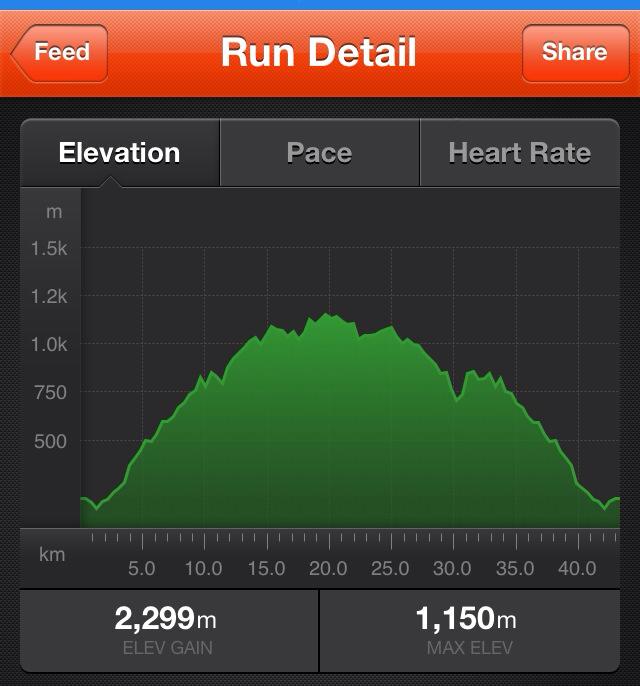
Clark-Miyamit 42K Elevation Profile (Courtesy of Rey jimenez)
I was prepared to arrive at the starting area at 3:30 AM last Sunday, September 22, 2013 but due to a text message from Jonel Mendoza of frontrunner Magazine that the race start time will be delayed for a hour due to the inclement weather in the area and some problems with the transport of the volunteers/marshals to the peak of the mountain, I took my time to travel and prepare the things/logistics I will be needing in the race.
At 4:30 AM, I arrived at the assembly area and got processed where I was able to sign some papers and got my race bib. It was raining and the temperature was cold and refreshing. I was able to talk to some of the runners and it was some sort of reunion among ultra runners and trail runners. They jokingly told me that I was so serious to say in my blog that I will be on a Race Mode, thus, I will not have any time to talk or “socialize” to any of the runners during the race. I just smiled to them and wished them good luck and have fun during the race.
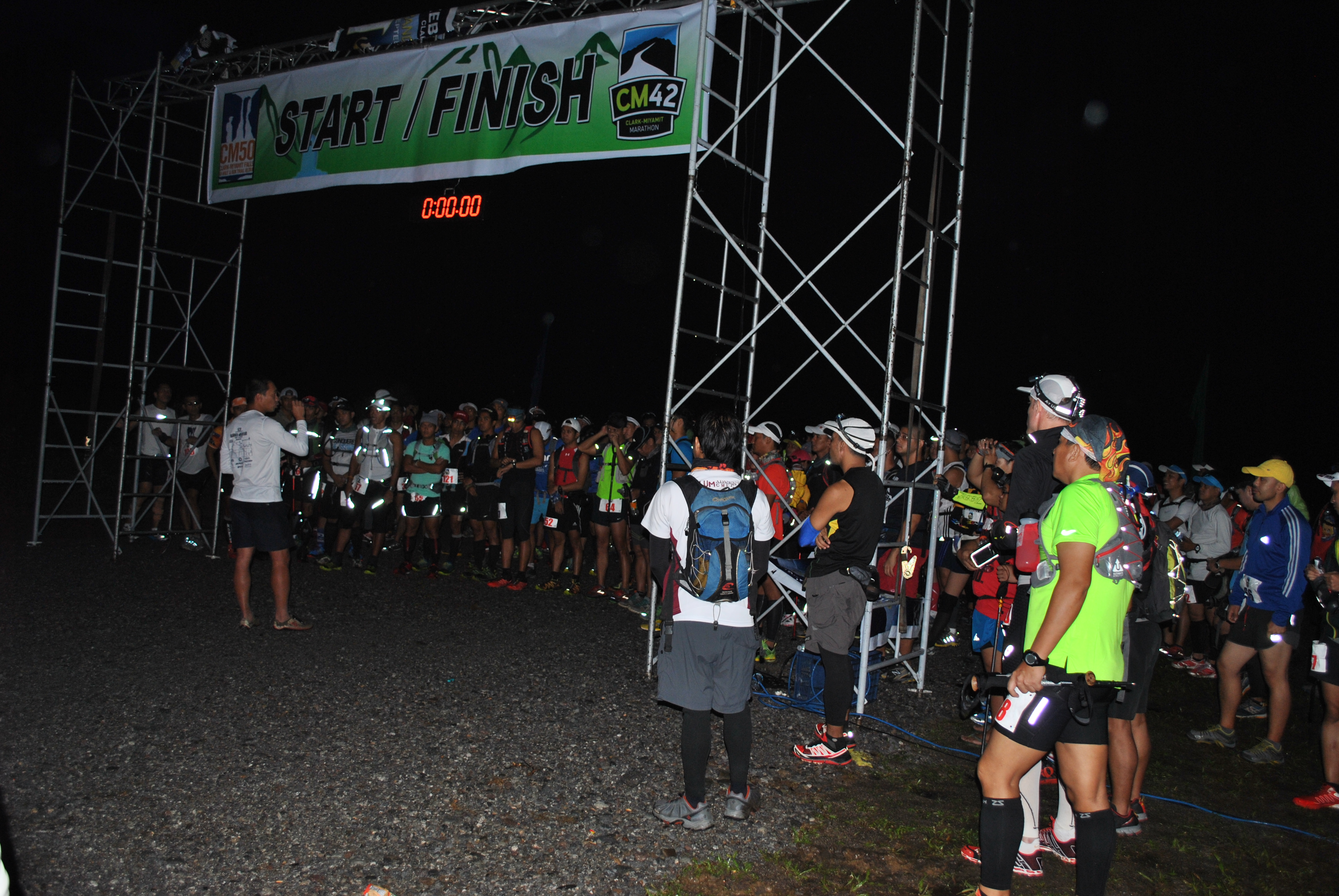
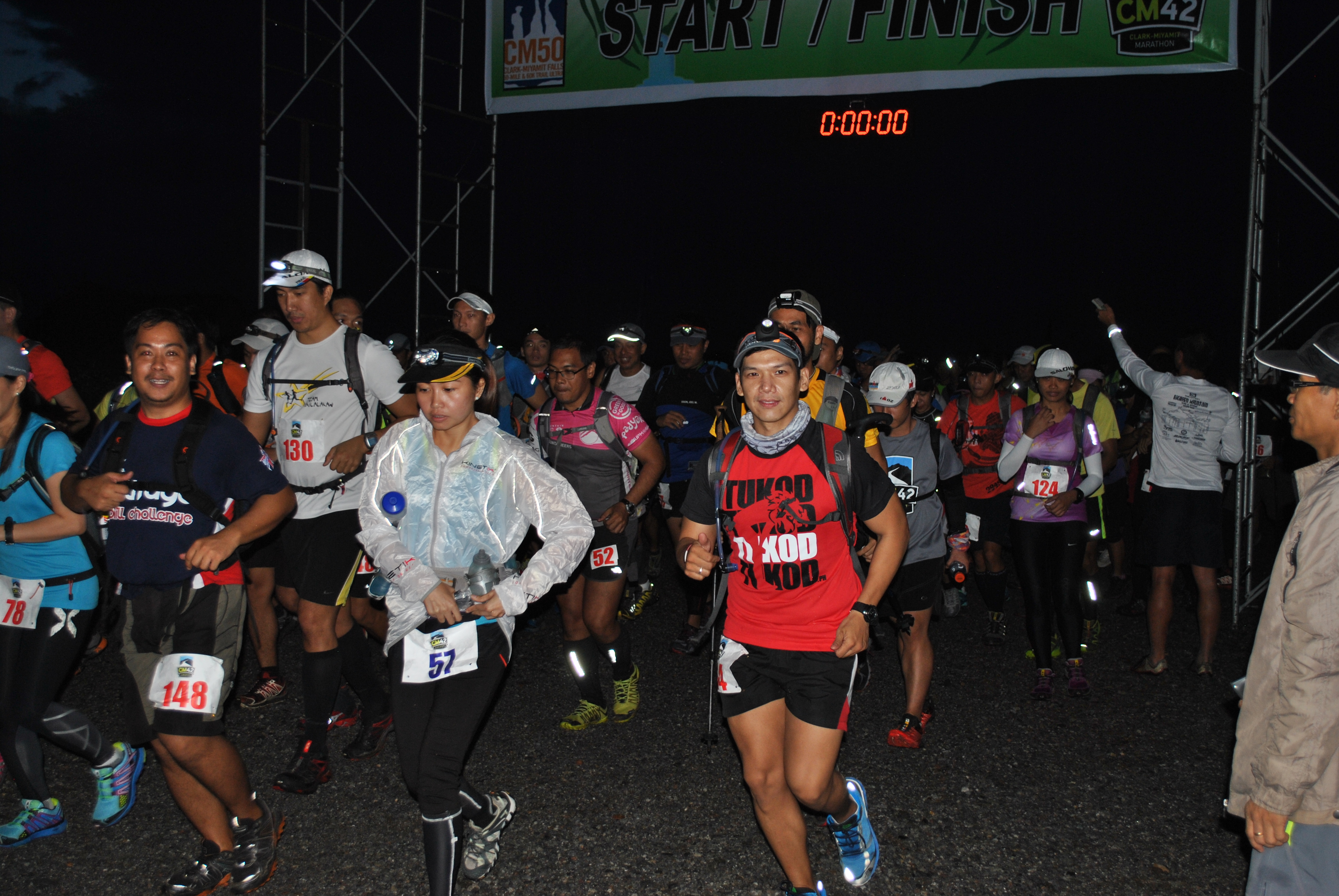
All the runners were called under the Start/Finish Arc for the final briefing by the Race Director 15 minutes before the start time. There were some pointers and warnings issued by the RD for the runners to know due to the weather condition of the day. I positioned myself at the back of the runners while listening to the briefing. At exactly 5:30 AM, the race started and I was with Jonel as the two of us were last runners to leave the Starting Line.
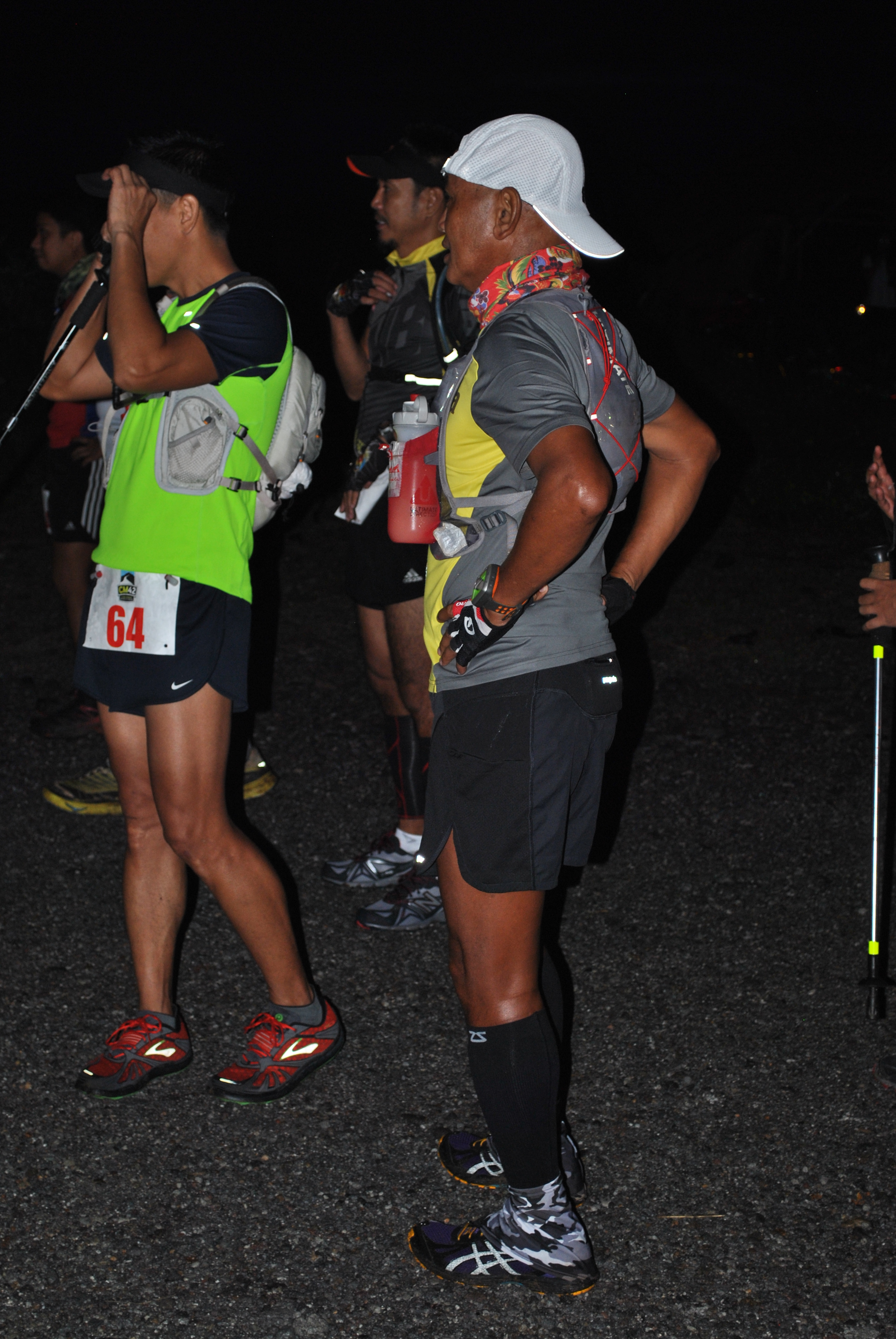
Final Briefing By RD Jon LacanlaleStill Dry & Looking Fresh @ The Starting AreaThe Gun Was Fired And We Were Off!
My race strategy was to position myself at the back of the pack at the start and then slowly pick-up the pace as the race progresses. The first two kilometers were made as my warm-up period with a slow and easy jog as this part of the course is flat and slightly going down. Most of the runners picked-up their pace immediately on the 1-2 kilometers of the route. As soon as I hit the first uphill of the course, I was already sweating, though I was hiking briskly.
On this very challenging trail race, I always see to it that I “brisk-walk” or power hike the uphills and once I reach the top, I force myself to jog and run on the flat and downhill parts of the course. This drill is being repeated from start to finish. However, if the uphill is not too steep, I would attempt to jog over it by taking small gaits/steps but with faster cadence. In order to be consistent in this, I would briskly pump my arms, over swing them and breath faster. Of course, I would do this in my training runs and comfortably apply this in my races.
Jonel & I Were The Last Runners To Leave The RD
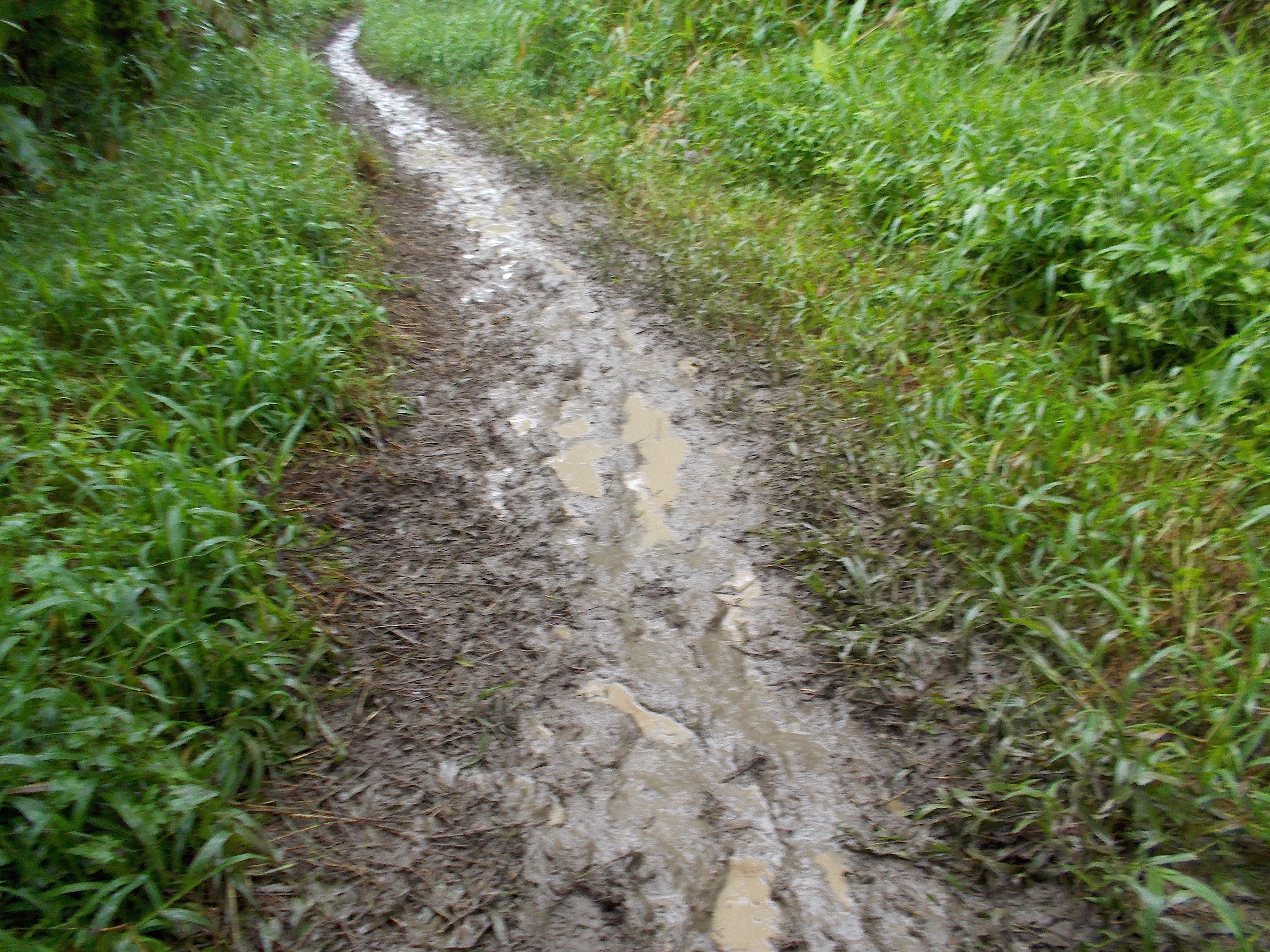
At the back of my mind, I would like to register a “negative split” of my time in this race by being slower on the first half and then going faster on the last half of the race. Obviously, that will happen because the first half is an uphill climb to Mt Miyamit/turn-around point which has an elevation of about 1,150 meters above sea level and then the last half will all be generally downhill. But such conditioning to the mind did not happen because of the weather condition that brought about with those slippery, muddy, and water-soaked trails.
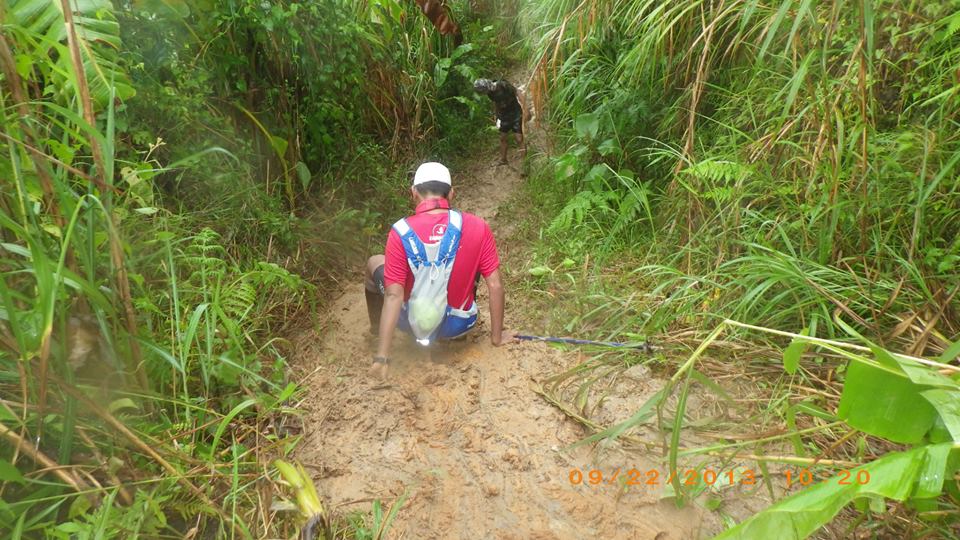
On the second half or downhill part of the course, the trail was so slippery that most of the runners would look for the sides of the trail where they would land their feet without falling on their butts or worse, on their faces. The muddy condition of the ground had also slowed down most of the runners. But all these were part of the challenge and I really enjoyed running on these muddy, slippery, loose, and water-covered trails.
Runner Falling On His Butt To The Ground Due To Muddy & Slippery Trail (Picture Courtesy of CJ “Miles” Escandor)
After the Km #10/AS 3 as I was going up to the peak/turn-around point, I was trying to count the number of runners that I would meet in order to find out my ranking among the runners. It was fun to see these faster runners as they go back to the finish line. I would not be surprised to see these top runners as they see me going up to the turn-around point. But I could see in their faces how surprised they are when they see me as I get nearer to the turn-around point! They are also surprised that they have a few meters gap from me from their backs! As I reached the turn-around point, I was able to count 47 runners that I met along the way which makes me as the 49th runner (Danin was the 48th runner).
A Part Of The Easier Sections Of The Course
Everything that happened in this race was so fast, except when I was going up from the checkpoint at the foot of Miyamit Falls up to the Aid Station #3. I practically walked this uphill stretch of about a mile/1.5 kilometers and it took me 31 minutes! I was not sure if I was exhausted or needed some “sugar” to my body system. I took this opportune time to eat more solid foods (hard-boiled eggs with salt) and take in a GU Gel.
On the last 10 Kilometers to the Finish Line, I tried my best to run and jog all the way except for some delay on those steep downhill slippery parts of the route where I have to walk slowly. I maintained a steady pace and Ultra Runner Jon Borbon kept me company as he was tailing me throughout the said distance.
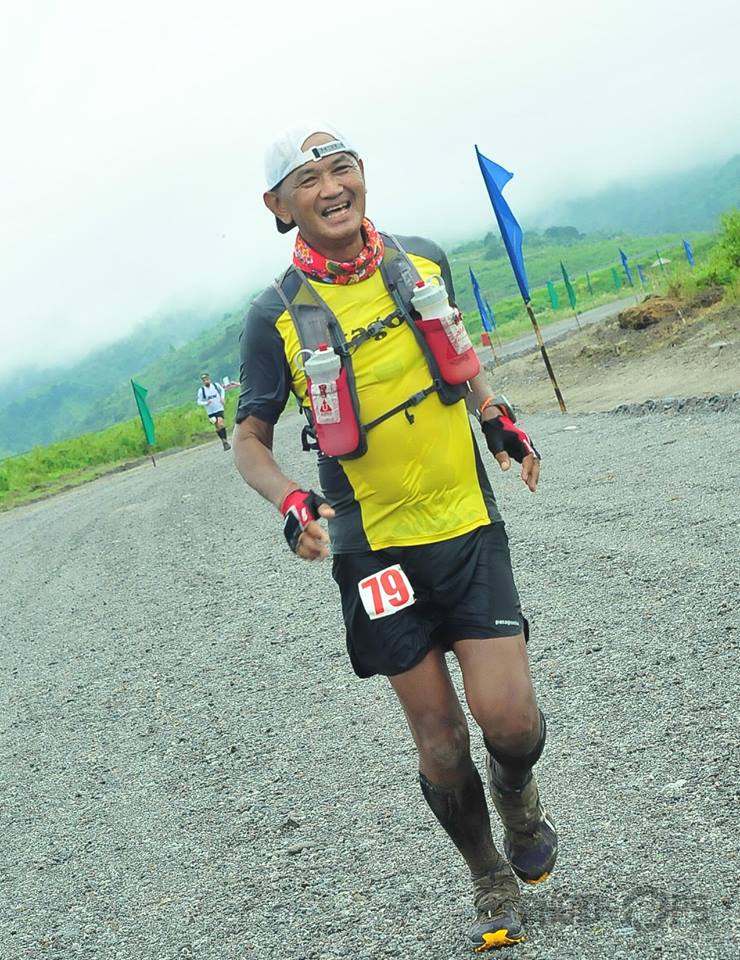
Wet, Dirty, & Tired But Still Smiling Towards The Finish Line (Picture By Photo Ops)
I finally reached the Finish Line with an Official Time of 7:57:58 hours with a rank of 36th runner among the 115 Finishers. The RD was at the Finish Line to award the Finisher’s Medal and congratulate me for finishing the race.
Finishing at 36th place was more than a success to me since I have targeted a conservative goal for this race to place on the top 50% of the runners. As a result, I landed among the upper 31% of the finishers!
I would attribute such accomplishment on the following:
1. Consistency—I have followed a structured training program for the past 3 months + one week leading to the race where I have completed a total distance of 1,627 Kilometers or 1,017 Miles. Since this mileage was done in 85-90% of mountain trails, I can roughly estimate my total workout for about 325 hours (1,627 kilometers X 12 minutes/kilometer).
2. Specificity of Training—As shown above, almost all my training was done in the mountain trails where my 61-year old body slowly adapted to the challenges of the environment. Speed was put behind and more focus was concentrated on endurance and proper footing/feet-landing techniques on different kinds or situations on the mountain trails. The more slippery or muddier the train is, the better for me!
3. Nutrition & Hydration—In my training, I have experimented on my nutrition and hydration, most specially on my weekend long runs. Such experimentation was applied during the race. For the race, I ate a simple breakfast of steamed rice + 2 pieces of hotdog + hot coffee, 45 minutes before start time. Some runners who greeted me at the Starting Line saw me eating this stuff. I took in some water with the food. Twenty (20) minutes before start time, I took in my first Espresso Love GU Gel. From the start up to the finish, I took this GU Gel every 40-45 minutes and hydrating with Perpetuem Mix and Water every 20 minutes in an alternate manner. At the turn-around point, I started eating my Hopia as my solid food. On my way from Miyamit Falls to the Finish Line, I was able to eat 2 pieces of hard-boiled eggs with salt. I have also six pieces of Butterscotch from Biscocho Haus of Iloilo City in my pack as my reserve food. At the end of the race, I was able to consume eight (8) GU Gels; 4 pieces of Hopia; 2 pieces of hard-boiled eggs; 40 oz. of Perpetuem Mix; and 40 oz of Water. This nutrition & hydration strategy was strictly followed to keep me from “bonking” and reacting to it and as a result, I was being proactive to the needs of my body during the race. It is like being attached with an Intra-Venous (IV) fluid where every drop of fluid enters the body every second.
Two Packs Of Hopia
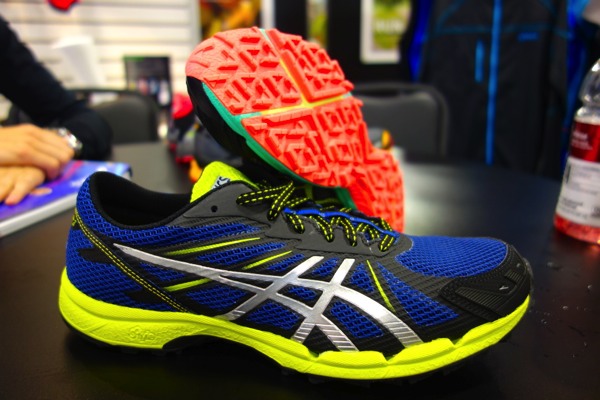
4. Running Kit & Apparel—-My Patagonia Shorts kept my iPhone on its back pocket with 6 GU Gels (3 pieces on each side pocket). My Patagonia shirt was very light even if it was damp/wet the whole race. The Ultimate Direction AK Vest which I use in my training kept my 2 bottles for hydration and food at the back pack; my tiny Nikon Camera on my right shoulder pocket; and two GU Gels on my left shoulder pockets which I used also to keep my trash during the run. I was wearing my favorite Giro Cycling Gloves which was very useful during the run (I guess, I need to post a separate story for this!). Calf sleeves were used to protect my legs from the sharp leaves of wild grasses along the trails. I also used Gaiters to protect debris and other dirt from entering my shoes. I’ve chosen my ASICS Gel-Mt Fuji Racer Trail Shoes instead of Inov-8 Mudroc 290 due to its lightness and easy drainage of water entering the shoes and it gave me the much needed confidence to paddle through water-soaked, muddy, and slippery trails. My Under Armour running cap and Buff which were damp and wet were also useful in maintaining a lower body temperature on my head and nape.
ASICS Mt Fuji Racer Trail Shoes
5. Rest, Recovery, Taper—-From Wednesday up to Friday before the race, I had full sleep during nighttime of not less than 8 hours per night. On Saturday night, I was able to sneak in at least 5 hours of sleep. During my training period, I have to fully rest (without any runs) on Mondays—it’s the day when I eat my favorite food, walk and watch a movie in the malls, and/or read some books. One day before the race, it was completely a rest day for me.
6. Knowledge of the Terrain and Be Able To Acclimatize with the Environment—-Having been to the route at least one month before the race with the same weather condition, I already knew what to expect and I even tried to locate for points/places along the route where I could slow down or speed up or where I would take in my nutrition. I was able to test and find out what would be my running apparel/kit for the race during my last recon run to the place. I was able to test also the amount of fluid and food I would need for the race proper, thus, it would lead to the next factor to consider as stated next to this.
7. Not Stopping At The Aid Stations—–It is enough to hear the cheers and greetings from the volunteers and then for me saying, “Thank you for being here for us” to them as I continue my run and pass every Aid Station along the route. It is either I slowed down with my run or simply hiked/walked as I reached the Aid Stations to greet the volunteers. For the Aid Station on the wider road, I would just wave my hand or give them a “thumb-up” sign to acknowledge their presence on the trails even with the rainy weather condition. The cooler atmosphere and rainy condition contributed for my body not to perspire so much and I was able to conserve my intake of hydration fluid. It was only at the place where the 4 X 4 vehicles were parked where I was able to ask for water refilling on my way back to the finish line.
8. Listening To My Body—My HR Monitor was my basis to get feedback why I would breath heavily during the run. I would see to it that I was maintaining an Average HR of not more than 150 beats per minute. There was only one instance where my Average HR reached to 152 bpm and I had to slow down with my power hike on a steep trail. I would feel some pain on my knees and quads on the second half of the race and that I would slow down and observe if such pain would disappear or not. Generally, I did not experience any severe pains/injury or muscle cramps in any parts of my body up to the end of the race.
Success and being able to reach one’s goal in any race is not developed and attained overnight or for a short time even if one has had finished harder and more challenging races in the past. It takes a lot of planning, attitude, determination, patience and handwork.
In short, this is in my own words is called, “discipline”!
Congratulations to RD Atty Jonnifer Lacanlale for a successful race and my special thanks to those volunteers who braved the inclement weather in the mountains to make sure the safety and well-being of all the runners on the night before the race as well as, after the last runner had crossed the finish line. Good job, guys!
The primary objective of the Philippine Association of Ultrarunners (PAU) is to promote the sports of ultrarunning/ultra marathon races, whether they are on roads or trails. It is also a way of bringing the sports closer to the grassroots with the hope to discover new and younger talents and potentials as elite runners. It also serves as a contribution in the Sports Tourism Program in the locality where the event is being held. Such events and presence of runners from other regions and countries would bring added income and economy to the local establishments and at the same time for the runners to explore the site of the event.
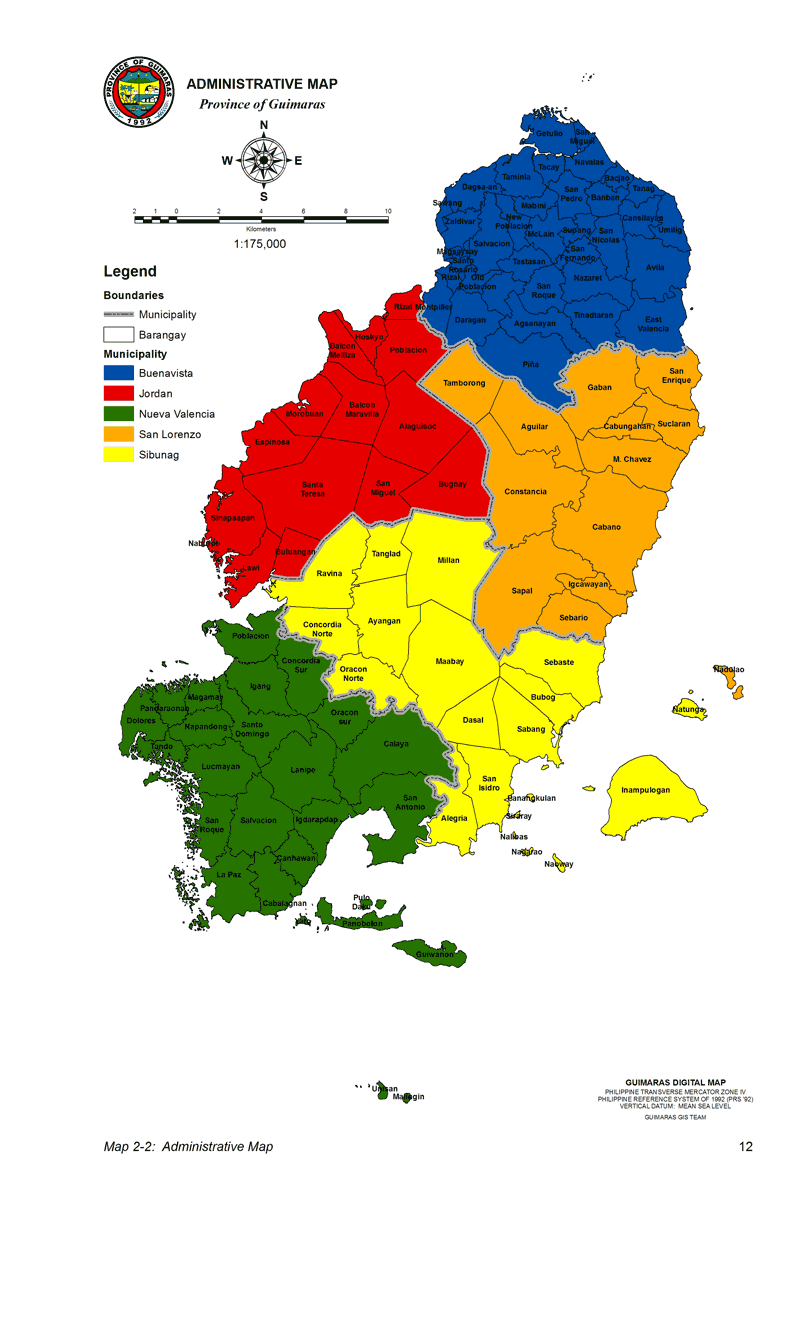
The PAU Nationals, for the second year, had been held in Guimaras Island Province which has a 125-Kilometer Circumferential Highway on the outer edges of the island. It is accessible from the long distance runners from the islands of Panay and Negros, where potential elite runners are residing. Rene Herrera, our Olympian 5,000-meter and 10,000-meter runner, hails from the Province of Guimaras.
Through the help of Dick Balaba, PAU Runner of the Year 2011, who is presently assigned in the 3rd Infantry Division of the Philippine Army whose Area of Responsibility covers the Island Provinces of Western Visayas, my trip arrangements and courtesy call to the new Provincial Governor, Honorable Samuel Gamurin, were scheduled and implemented without any problem.
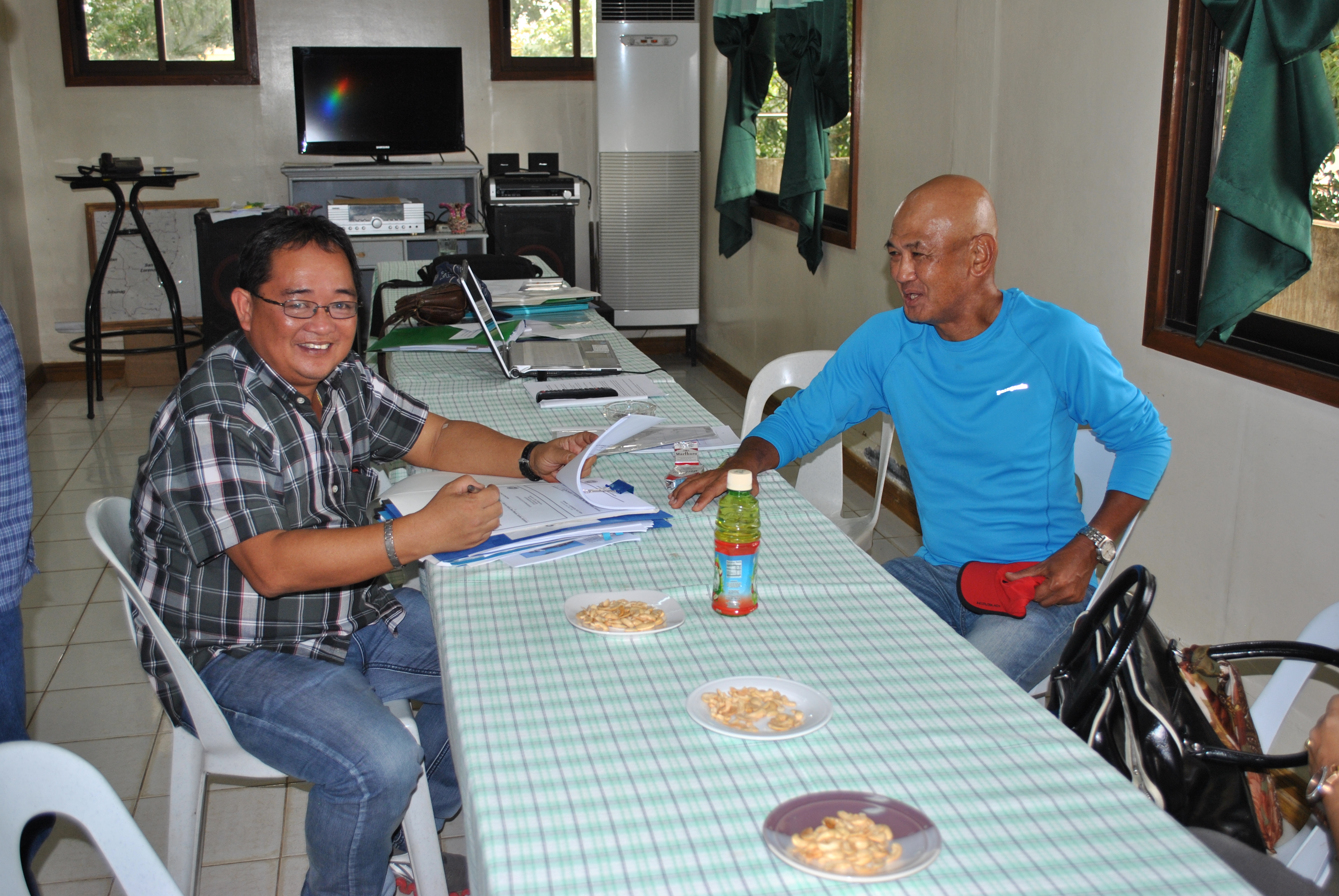
Courtesy Call/Meeting With Governor Gumarin
My staff and I were received by Governor Gamurin in his office and immediately gave instructions to his Provincial Administrator, Provincial Tourism Officer, and the Provincial Risk Reduction Management Administrator who was the Action Officer during the conduct of the 1st PAU Nationals in the province. With a short notice, the 5 Municipal Tourism Officers were called for a meeting with the Governor giving instructions for the support for the event, to include the PNP and the Philippine Army Reservist/Reserve Force in the province.
Governor Gamurin fired the Starting Gun at Midnight of Friday in front of the Provincial Capitol and he event went to the extent of manning the first Aid Station at Km #10, asking and giving food to the runners, and later inspecting the rest of the Aid Stations along the route.
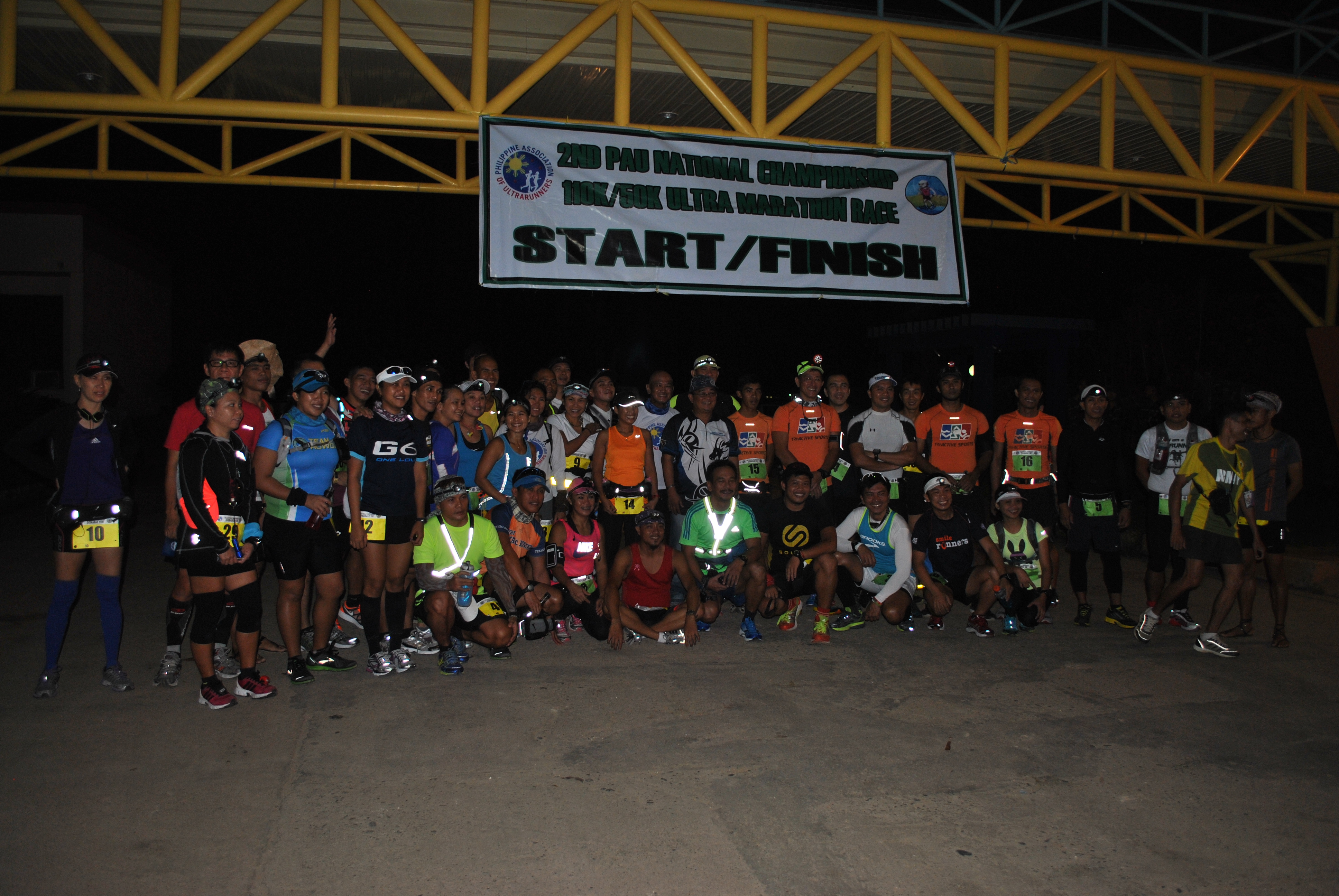
Starting Area & Runners
The Barangay Captains in places where Aid Stations were located were properly supervised by the Barangay Captains themselves and their Councilors. PNP elements were also stationed in the Aid Stations and some selected points along the route. Critical intersections were covered by the Philippine Army Reservists and they served as Marshals. Roving patrols and checkpoints were also manned by the PA Reservists.
The 50K runners were ferried from the 50K Finish Line back to the Provincial Capitol aboard specially-built vehicles for tourists along the rest of the circumferential road of the island. This is an improvement from last year’s experience for the 50K runners where they were ferried by military 6 X 6 trucks!
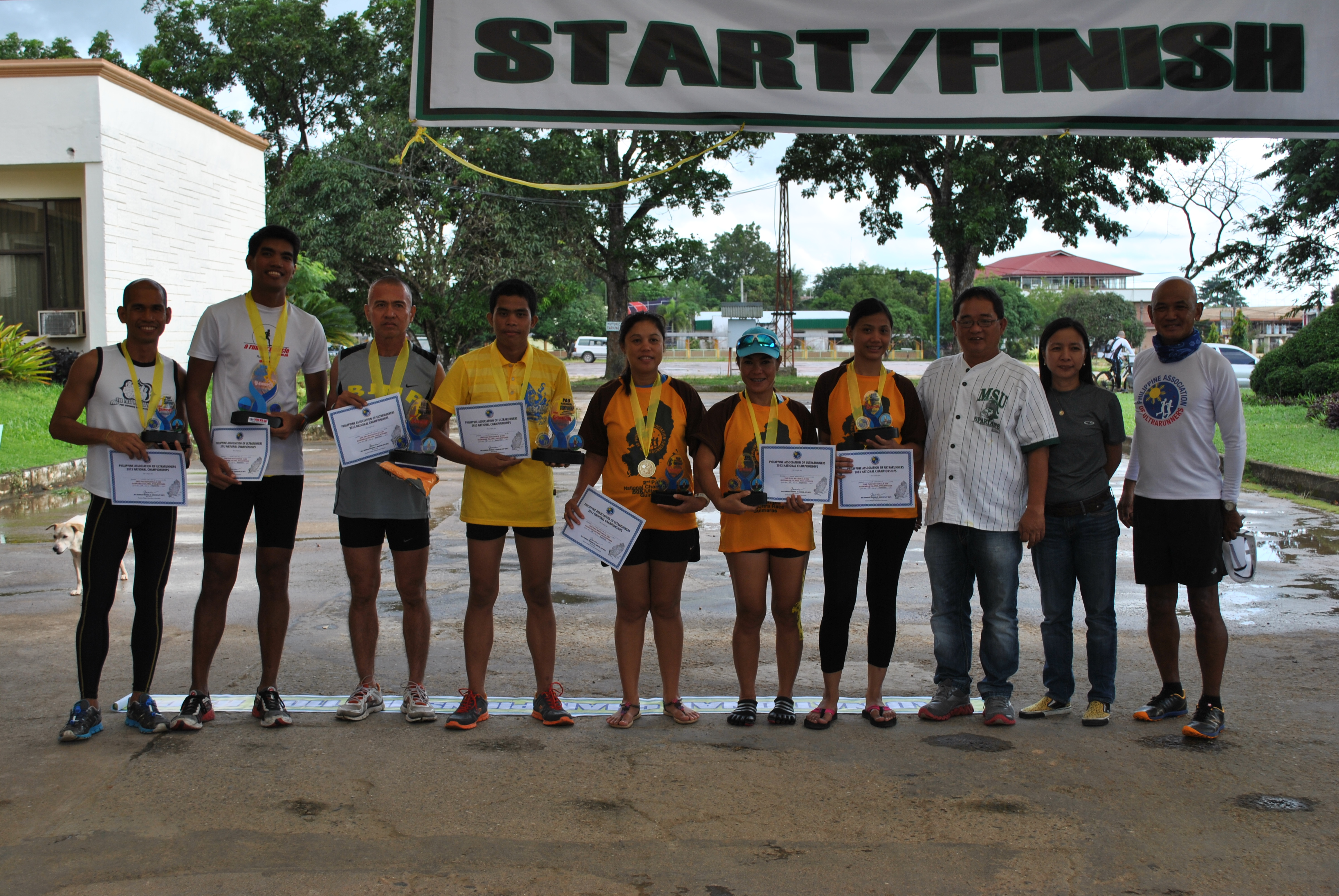
The Governor and First Lady, Vice-Mayor Cecille Gumarin of Buenavista, Guimaras awarded the Trophies, Medals, Finisher’s Shirts and Certificates to the Podium Finishers of the 50K and the Overall Top 3 Runners for the 110K Race.
Podium Finishers With The Governor & First Lady
Even if I prepared packed lunch/dinner for all the runners, the Provincial Government prepared also another set of packed lunch/dinner with one ripe Guimaras Mango for all the Finishers!
Before the Governor left the Finish Area, he promised to fully support the next edition of the race where he suggested that the event will be a part of the Octoberfest in the province. He said that there will be lots of beer for the runners and Rock Bands on Stage near the Provincial Capitol. This is something that ultra runners would like to experience after finishing the race.
There was a 100% finish rate for the 50K runners while 3 runners declared themselves as “Dropped/DNF” among the 27 starters for the 110K race. A total of 50 runners started in front of the Provincial Capitol of Guimaras.
The Course Record in the 50K Race was broken by Marianito “Jun” Ramirez, Jr of Iloilo City with a time of 5:03:28 hours , improving the time by 7 minutes.
I would say that the mission/objectives of PAU were satisfied with the conduct of this event. New potentials/talents were discovered among the runners in the area. Sports Tourism for Guimaras was promoted and the presence of the runners and their family & friends had greatly contributed to the economy in the area.
(Note: This post is to make tribute to an ultrarunner who sponsored and hosted two of my Team Bald Runner’s Elite Athletes’ participation in this year’s Hongkong 100K Ultra Trail Run)
While we were having lunch in one of the hotels in Hongkong a day after the HK 100 Run last January of this year, Andre told me that his goal for this year is to participate and finish the 2013 Grand Slam of Ultrarunning in the United States. When I asked why he was going to aim for such feat where an ultrarunner has a limited time to recover in between races, he answered, “I am not getting any younger and I will try to focus my training to finish all the races”. I just replied to him that how I wished I was still young and be the same with his age. Andre is 43 years old.
The Grand Slam of Ultrarunning in the United States consists of four (4) of the oldest 100-Mile Trail Runs which one has to finish within a span of 10 weeks from the last week of June to the 1st week of September (a week after the US Labor Day). Basically, it covers the whole summer season in the United States. One has to finish the following races in the following order: First, Western States 100-Mile Endurance Run in California; Second, Vermont 100-Mile Endurance Run in Vermont; Third, Leadville Trail 100-Mile Endurance Run in Colorado; and Fourth & Last, Wasatch Front 100-Mile Endurance Run in Utah.
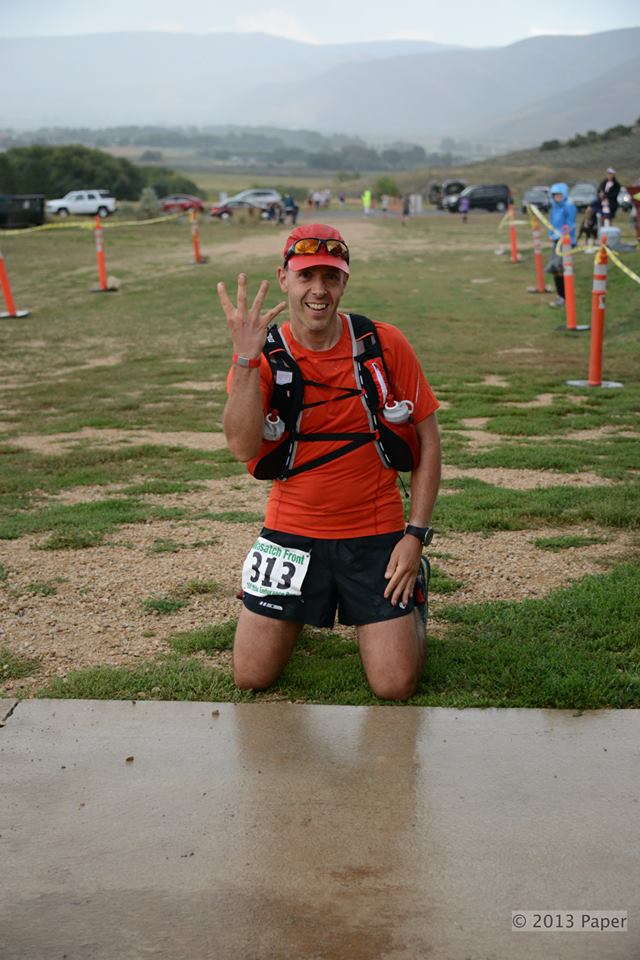
Andre @ The Finish Line Of Wasatch Front 100 (Photo By Paper)
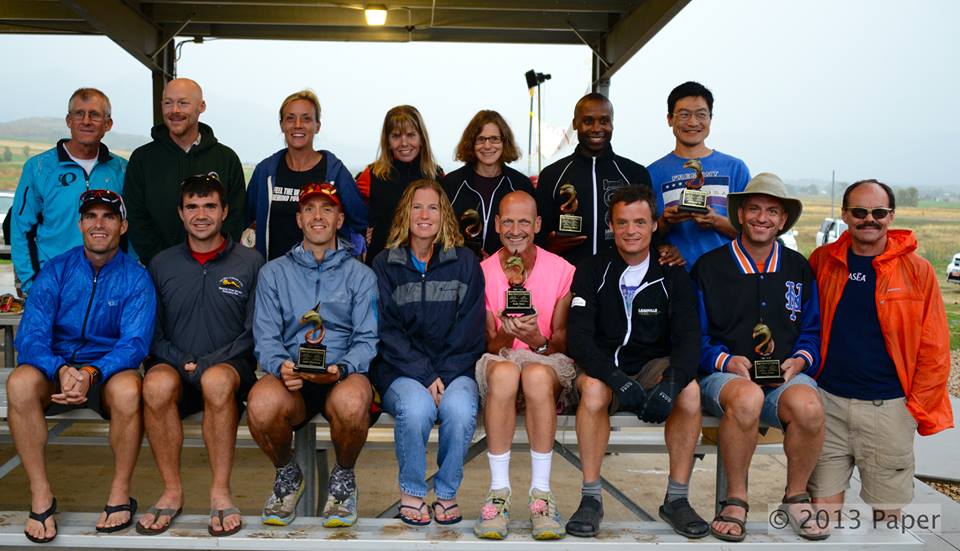
This Grand Slam of Ultrarunning started in 1986 and after 28 editions, there are only 254 ultra runners who finished the said series. Andre Blumberg placed Hongkong as one of the few countries represented among the list of finishers in this series. He is the first Hongkong resident to have done it!
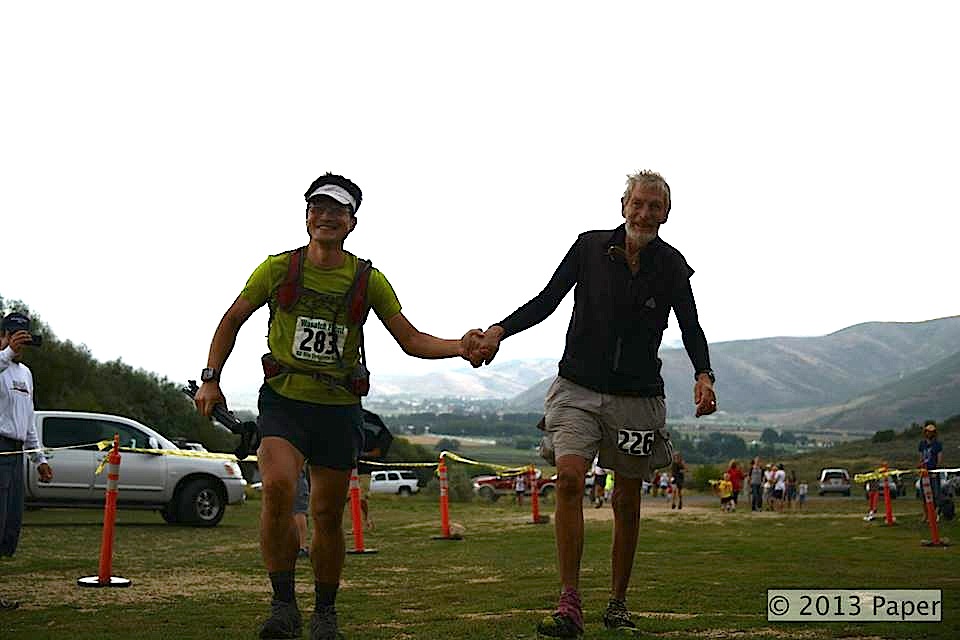
Ultra Runners Get Stronger As They Become Older (Photo By Paper)
After browsing the pictures taken by Paper, wife of Andre, on Andre’s Facebook Wall, I saw this picture of a 73-year old finisher of the Wasatch Front 100-Mile Endurance Run. The guy is Hans-Dieter Weisshaar, a German ultra legend with about 150 finishes of the 100 miles distance, also a Grand Slam Finisher in the years 2000, 2003, and 2005, at his age, I feel inspired to be able to reach this age and still running ultra marathon races! (Note: The runner beside him is Chihping Fu of California who is one of this year’s Grand Slam Finishers!)
After all, Andre was right. We, the ultra runners, are not getting any younger and we try to challenge our limits of physical endurance and spirit in our training and races. This defines our endurance sports which we dearly love and respect.







 Bald Runner
You must be logged in to post a comment.