Dream Race


I was surprised when Jael Wenceslao, one of the 1st BDM 160 Finishers, posted a picture on Facebook a portion of one of the pages of the latest edition of the Runners World Magazine Philippine Edition. Since I have not seen the actual page or have with me a copy of the said magazine, my information was based from the status posted by Jael.

BDM Ultramarathon: Dream Race

It appears that a survey was conducted by the Magazine to Pinoy Runners and the result showed that the BDM Ultramarathon ranked with the two most prestigious Marathon Races in the World—Boston & New York City Marathon.

I was overwhelmed with joy and at the same time worried that my vision to make this race as the “Comrades Ultra Marathon” in Asia is coming to reality at a faster pace as compared from my personal conservative expectations. I could not imagine how the race would look like when you have at least 500 runners or more in it. As of now, the race takes its form by increment and maintains to be a road race by invitation only.

As an expression of gratitude and a way of giving back to the community, most especially to all the endurance athletes in the country, I am offering FREE ENTRY to all PINOY FINISHERS of the 2011 KONA IRONMAN to the 2012 Edition of the BDM 102K. In addition, PINOY FINISHERS in the 2011 TNF Ultra Marathon Mont Blanc 100-Mile Run; ultra runners former PNP Director Samuel Tucay (Ret.), Fr. Robert Reyes, Cesar Guarin, Joy Roxas, and Fr Picx Picardal will be invited also for free entry in the said event.

If you think you are considered as one of the TOP 5 Pinoy Runner-Bloggers, please contact me as I might as well give you a FREE ENTRY to the 2012 BDM 102K which will be held on March 3-4, 2012.

Thanks for your support. Let us make BDM Races known throughout the world!

Bataan Death March (BDM) is in the Philippines and not in any other country!

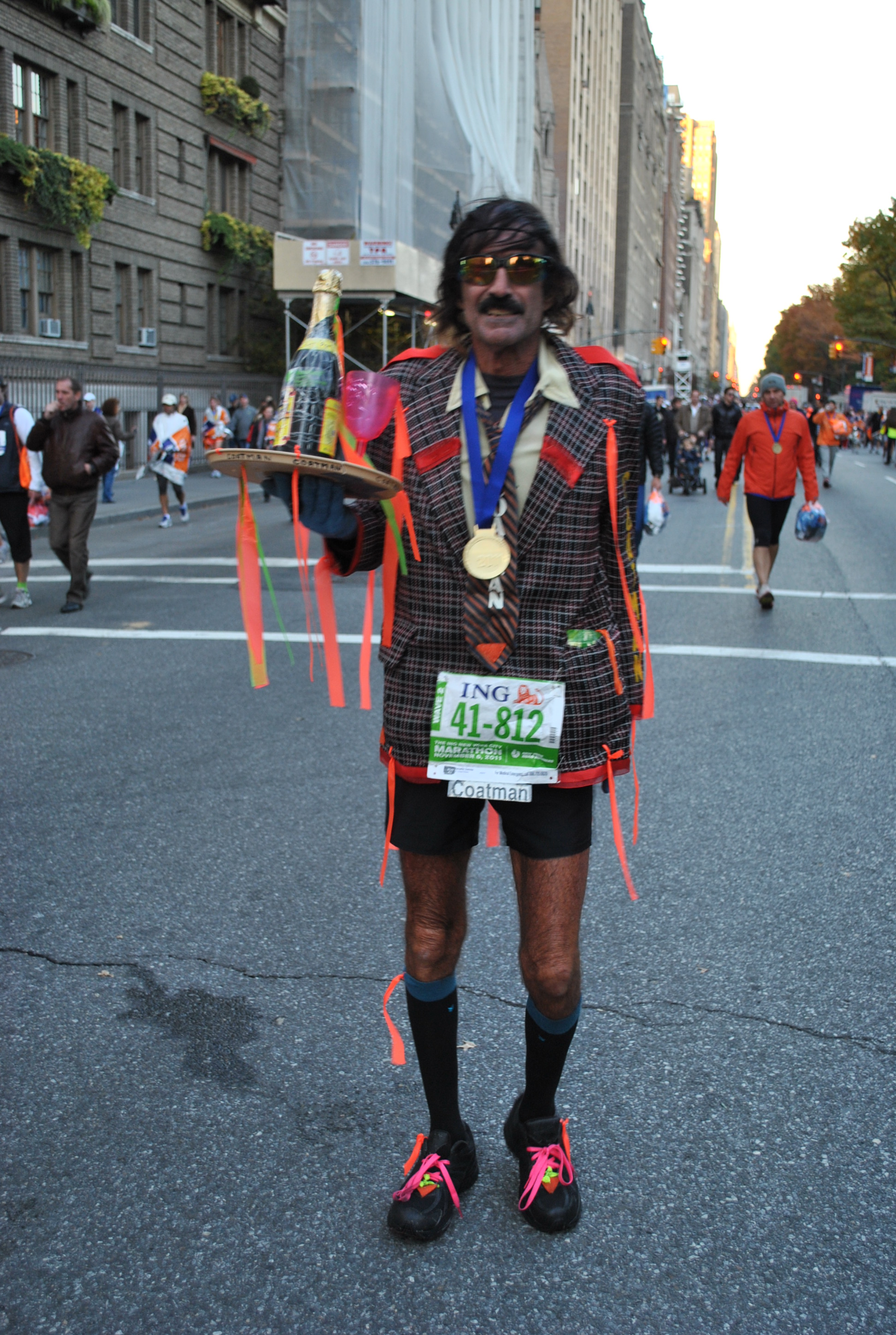
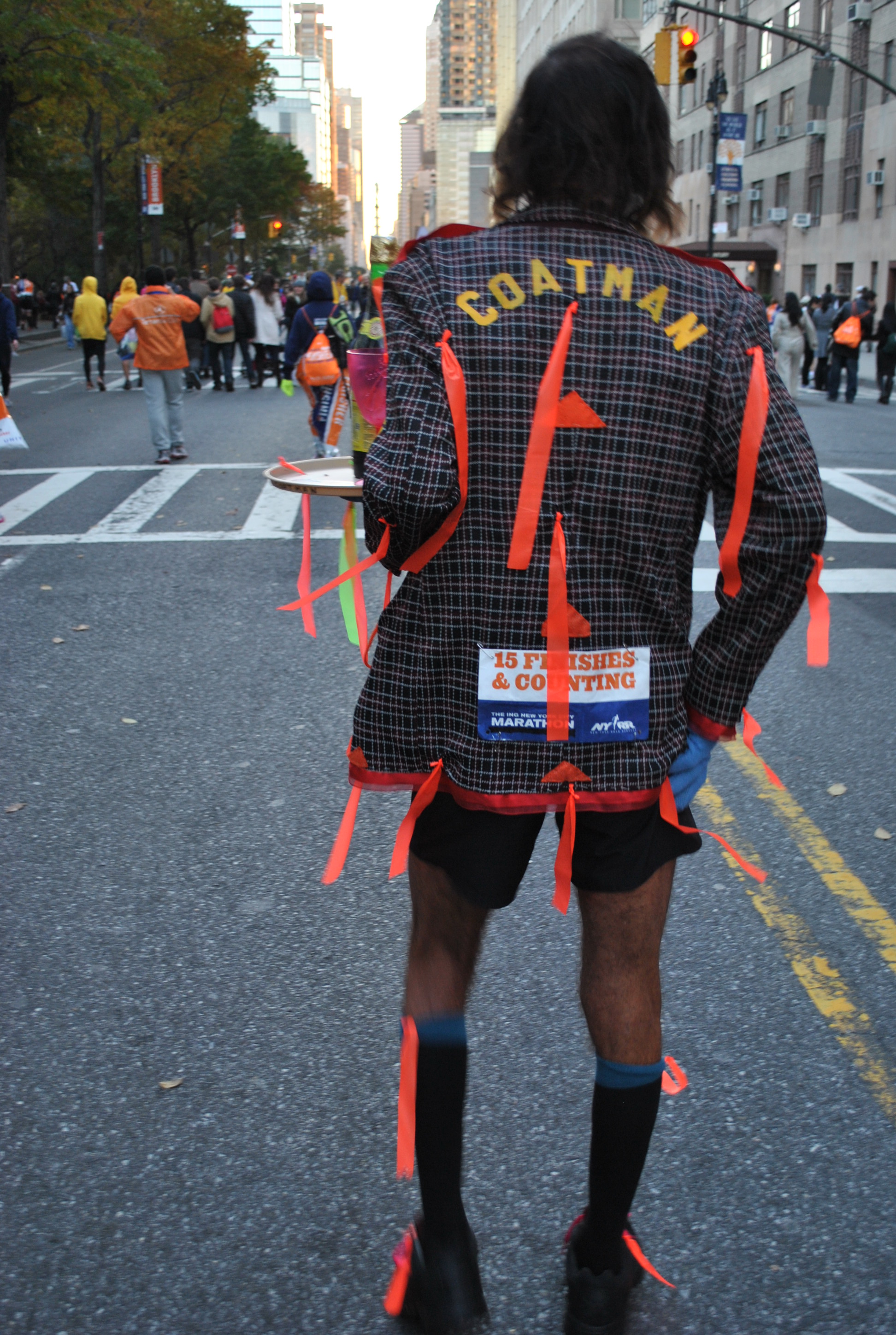
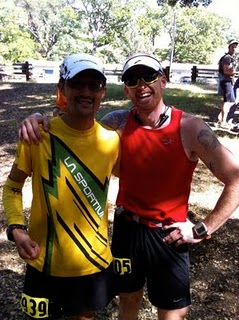
The Running Sartorialist #1: @ Central Park, New York City, USA


Humble & Friendly


It could be friendly and humble. These two words simply describe a person whom I’ve met during the Miwok 100K Run at the Marin Headlands where I served as one of the volunteers.

He is Jorge Maravilla, pronounced Hor-He. I mentioned his name (first name only) in my post about my experience as spectator and volunteer during the said run. He was with another guy whose first name is Rich but I later identified him as Rich Conder. As we were doing the things we were instructed/requested to do at the Finish Line Area, Jorge was the one who was starting all the conversation among us while Rich was always silent. So, while the three of us were doing the same job, Jorge was the one who was very much engaged with some conversation with me.

As far as I can remember, these were some of the salient points about our conversation:

Jorge: You said your name is Jovenal, how will I call you? Call me Jorge (Hor-he)

Bald Runner: Call me Jovie, that’s my nickname!

Jorge: Where do you stay here?

BR: I am from Manila, Philippines. I came here to run the Miwok 100.

Jorge: What happened?

BR: I had an injury in the middle of March while doing a 7-day adventure run covering a distance of 270 kilometers and it got worse during one of my practice runs here.

Jorge: Oh, I am sorry. How is ultra marathon in the Philippines?

BR: We are trying to expose our runners in ultra distance runs. We started with a race which is called the “Bataan Death March 102K Ultra Marathon Race” three years ago but the race is done on paved roads. The race is done on the exact place where history happened during World War II.

Jorge: Great! Philippines is hot and humid, right?

BR: Yes, we train our runners as if they are running the Badwater! I am glad we don’t have any cases of “heatstroke” in our ultra races.

Jorge: That’s good.

I was trying to think of a question to ask why he is volunteering for the race with Rich but I concentrated on the task requested us to do. Jorge was later requested by Tia Bodington, the Race Director to get some stuff inside the U-Haul truck. After few minutes, Jorge was back and he started another conversation with me.

Jorge: Jovie, you must be popular in the Philippines!

BR: What? (And I just smiled. I assumed he saw the FrontRunner Magazine placed on the Driver’s Panel Board of the truck)

Jorge: I saw a Running Magazine with you as the Cover Page and I saw you autographed it for Tia.

BR: Oh..The publisher of the magazine is also an ultra runner and a friend of mine. Both of us are promoting ultra running in the country.

Jorge: Maybe, I’ll get to know you some more. Do you have a Business Card?

BR: Yes, I have. They are in my car. I will give you one later. I’ll give one also to Rich.

Jorge: Thanks!

After we finished the task requested of us to do, Jorge and Rich left the place and acted as Marshals in an intersection 500 meters away from the Finish Line.

I was not able to give my Business Card to Jorge and Rich as I left the area after the 10th overall runner crossed the Finish Line.

After one week, I read a blog of Mark Tanaka about his Race Report on the Diablo 60K Trail Run. I was surprised to find out that Jorge was the Champion in that race which was held on May 1, one week before the Miwok 100. I can conclude that he was there at the Miwok 100 as a volunteer and not as an injured participant like me! Rich Conder was also one of the top 10 finishers in the said race where Jorge won. At Athlinks.com, Jorge has a PR Marathon of 2:49+ hours which he got on the 1st quarter of this year.

What surprises me more is their voluntary act of helping another race to make it a success. Instead of resting and recovering from a previous race, Jorge and Rich, upcoming elite runners in ultra trail runs, were there at the Marin Headlands for the whole day as volunteers! I am sure these guys offered their time and services to the Race Director without any “strings attached” or renumeration. Simply, they were there to help!

Last weekend, I found out from the Race Result of the Bishop High Sierra 100K Trail Run that Jorge Maravilla won again in the said distance, breaking the course record by 55 minutes! By being humble, Jorge does not even have a blog where he can, at least, brag about his accomplishment. I wonder why.

As I gathered from reading the blogs of ultra runners, I found out that Jorge will be running his first 100-mile run at the Tahoe Rim Trail next month. I am sure this guy will make it to the top 10 in this race.

As I recall my brief meeting and conversation with Jorge and my brief conversation with the top elite runners in the Miwok 100 last month, I came to my personal conclusion that these runners are simply friendly, humble, kind, accommodating, and simple/”low-profile”. They also find time to help one another as race volunteers, pacers and support crew to other runners. Ultra running is simply a good community of runners.

How I wish some of the Pinoy ultra runners will be offering their services as volunteers in my races.

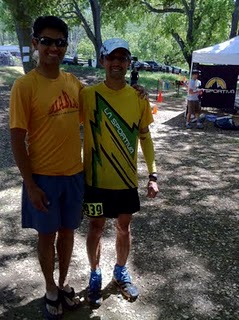
Jorge Maravilla & Mark Tanaka (Source: Mark Tanaka's Blog)
Mark Tanaka & Rich Conder (Source: Mark Tanaka's Blog)

(Source: http://ultrailnaka.blogspot.com/2011/05/sort-of-inaugural-diablo-60k.html)

2012 BDM 102 Marathon Qualifier


Let me remind all the runners who are interested to apply to join the 2012 Bataan Death March 102K Ultra Marathon Race (BDM 102) that the deadline of acceptance of letter of intent will be on September 1, 2011. Such deadline is also true to all runner-applicants for the 2012 BDM 160K Ultra Marathon Race. There will be no extension of deadline on this matter.

Since the deadline will be on September 1, 2011, those who have not yet finished a Marathon Race (42K) have two (2) Marathon Races where they could qualify. The earliest is the Manila International Marathon which will be held on June 26, 2011 and the later one will be the MILO Marathon Manila Eliminations on July 31, 2011. The month of August does not have a local Marathon Race scheduled not unless the runner would opt to finish a Marathon Race outside the country.

Personally, I suggest runners without any Marathon experience to join the Manila International Marathon. Looking at the published Race Route, the course is flat and fast as it will cover the roads along the Roxas Boulevard-CCP Area-MOA Area-Macapagal Avenue, however, the runners will have to do two loops of these areas. It’s better than doing three (3) loops!

I am sure MILO Phils. will not repeat their Manila Marathon Elimination Race Route last year because of some complaints and tragic accident. However, if the runner does not have enough time to prepare for the earlier marathon race, then the MILO Elims would be the appropriate Marathon qualifier before the deadline of BDM 102 application.

Again, the “only qualifier” for the BDM 160 is to finish the BDM 102.

If you are qualified for the 2012 BDM “Grand Slam”, the deadline of application is still on September 1, 2011.

Number of slots for BDM 102—200 runners (to include AFP/PNP & “invited” runners)

Number of slots for BDM 160—80 runners

Please relay this information to the other runners who are interested to join the BDM Races.

For BDM Races updates and details, please visit http://bataan102.blogspot.com. 

History: 1st Manila International Marathon by Red Dumuk


Finally, the then famous Manila International Marathon is being revived this year. I am not sure if the use of 30th edition of this race is proper as I know that some of the editions in the past had never been conducted. I hope my friend, Red Dumuk, shall make some adjustments on this. However, I appreciate the posting of this article on the website of the said Marathon Race.

If my memory serves me right, this was my first Marathon Race and Red Dumuk specifically mentioned my name and my finish time.

Thanks, Red for bringing back those good memories of Road Racing in the 80’s.

HISTORY

The First Manila International Marathon

By Red Dumuk

Running great, Bill Rogers, winner of four Boston Marathons and four New York Marathons, apprised of the race route and the weather conditions, predicted 2:20 as the winning time in the inaugural Manila International Marathon. His visit to Manila came at the heels of his dismal performance in Japan. As he was off-form, he begged off from showing his form in the MIM.

Rogers’s fearless forecast was way, way off. When East German Waldemar Cierpinski, second only to Ethiopian Abebe Bikila to have ruled back-to-back Olympic Marathons (Bikila turned in the trick in 1960 Rome and 1964 Tokyo Olympic Games while Cierpinski in 1976 Montreal and 1980 Moscow), breasted the tape with President Marcos heading the spectators, the display clock showed 2:14:27, a good 5 minutes and 33 seconds inside the expected time.

The time could have been lower had there been stronger challenge. After 5K, the MIM morphed into a battle against the clock for Cierpinski, who in 1976 frustrated 1972 Munich gold medalist Frank Shorter’s bid to join Bikila as back-to-back Olympic Marathon champion. In the 1976 Olympic Marathon, Cierpinski beat Shorter, considered to have ignited the running boom in the United States, by 49 seconds (2:09:56 against 2:10:45).

Cierpinski’s winning time which is 3 minutes and 24 seconds outside the clocking he posted in Moscow Olympics less than two years earlier can be better appreciated against the backdrop of marathon times in other parts of the world held in different seasons in 1982.

It’s no wonder, therefore, why the 2:14:27 has yet to be expunged as the all comers best in the Philippine Marathon theater. (Domingo Tibaduiza whose time was 20 seconds slower than Cierpinski’s when the former claimed the top prize in the 1982 Berlin Marathon emerged as 2nd MIM champion. He checked in at 2:25:01, nine minutes 34 seconds adrift of the existing standard in 1983.)

Runner-up American serviceman Phil Camp might have found Cierpinski out of his league but his 2:19:39 timing would have outweighed the first placers’ in four of the above marathons.

The last berth in the podium was hotly contested by Chang Ming Chen of Chinese-Taipei and Peng Jiazheng of the People’s Republic of China. There was a sideshow even. A PROC embassy official protested minutes before the cannon fired off the marathoners the display of the Republic of China’s flag on Chang’s singlet and threatened to pull out Peng from the marathon. We explained to the embassy official we were aware if Chang has to show a flag on his breast, it should be the IOC designated banner. We added we subscribe to the one-China policy of the government. Then, we convinced Chang to have the ROC flag covered with a masking tape. Had Chang not acquiesced, disqualification awaited him.

When the smoke of the conflict had settled, so to speak, Chang outstripped Peng by 59 seconds–or just about the time it took the former’s official to tape that offending flag–to claim the third position. Chang’s 2:26:49 clocking bested winning times of two 1982 AIMS events. Peng’s 2:27:48, on the other hand, beat the champion’s time of one of the AIMS member marathons.

Great Britain’s Tim Johnston (2:31:31) rounded out the top 5 finishers. He crossed the finish line two minutes and 30 seconds ahead of the first Filipino finisher, Army man Ricardo Carillo (2:34:01). Landing in the top 5 among the locals and top 10 overall were Manuel Carmelo (2:35:28),7th; Guillermo Padilla (2:37:31),8th; Ireneo Illut (2:38:01), 9th and Carlito Solis (2:38:06), 10th.

Fifty-three runners (only seven were foreigners) registered sub-3 hours clocking. By comparison, looking at the results of the recent marathons in the country, less than 10 runners with sub-3 times seems to be the current norm.

In the distaff side, only the 11-year old wonder girl Joan Laput, tops among the 11 lady finishers, broke 3:30. Laput ranked 173 overall with her time of 3:28:22. Laput’s “preys” included priest marathoner Amado Picardal (3:20:16, 195th), the Baldrunner (3:58:44, 286th) and arguably, the country’s No.1 race organizer Rudy Biscocho (4:40:02, 440th).

Of the 603 hopefuls who answered the starting cannon, only 30 did not finish–a remarkable mortality rate of measly 4.98%. The most courageous and greatest survivor was cardiac patient Teofilo Espejo, Jr. He placed 509th with a time of 5:11:16.

Asst. Race Director Colmenares running and finishing the MIM spoke volumes about the organization and management of the race. He clocked 3:47:50, good for 281st position, well in the upper half of the finishers.

It would be great seeing another Philippine President accommodating the top 200 finishers of a marathon or any road race of prestige in Malacanang and treat them to dinner after the awarding ceremonies where he would trace the history of marathon even as he extols its virtues in his address.

In another first, the country’s top sportscaster then Joe Cantada found his equal in Katherine Switzer during the coverage of the 1st MIM. Joining the fun was Zal Marte, another sportscaster of note. This would never be duplicated. “The Voice” has passed on to the great beyond.

As recognition for a job well done, Race Director Dorotheo’s peers in AIMS elected him as member of the original batch of Board of Directors. It goes without saying the Manila International Marathon was accepted as full-fledged AIMS member barely four months after its initial edition. Dorotheo was to be reelected to the AIMS Board.

And from the locals, what was the reward? The second MIM saw the size of the field doubled.

1st Manila International Marathon Statistics

Countries Represented

  • Macao
  • Sweden
  • Australia
  • Bangladesh
  • United Kingdom
  • Taiwan
  • Norway
  • Indonesia
  • Philippines
  • United States
  • People’s Republic of China
Starters

603

Finishers

573

95.02 %

Men

562

98.08 %

Women

11

1.92 %

Locals

536

93.53 %

Foreigners

37

6.47 %

Waldemar Ciepinski flashes the No. 1 sign more than 5 minutes ahead of the 2:20 winning time predicted by Bill Rodgers

Source: http://manilainternationalmarathon.com

Cut-Off Times


I have been making a research in running books and running resources on the Internet on the basis of cut-off times of Marathon and Ultra Marathon Races. It seems that I could not see any “authority” or “regulation” in the IAAF or IAU Manuals and Protocols as to what is the accepted formula in the declaration of cut-off times in every race.

Without any basis, I have the impression that this “rule & regulation” in a running race, whether road or trail, on the prescribed cut-off time is arbitrary and based on the decision of the Race Organizer/Race Director.

On the part of a Race Organizer in a busy City Marathon Race, a six-hour cut-off time is a standard period for a 42K distance. This will minimize the time for the closure of main streets from vehicular traffic. The lesser time for the roads and streets are closed, the better for the riding public and commuters. It will also lessen the time of exposure and involvement of security, medical, marshals, and volunteers and other administrative and logistic supports for the race.

Obviously, this is true also to ultra marathon distance races but with longer and extended period of cut-off times.

Comrades Marathon (90K), the oldest ultra marathon, had an 11-hour cut-off time for so many years until it was extended to 12 hours since 2003. Aside from being the largest ultra road race, it is also the hardest in terms of elevation profile and with a very restrictive cut-off time.

The North Face Ultra Trail du Mont-Blanc (UTMB), 166K ultra trail race, has a cut-off time of 46 hours.

Western States 100-Mile Endurance Run, also a ultra trail race, has a cut-off time of 30 hours.

Jeju International Ultra Marathon 100K Race, a road ultra, has a cut-off time of 16 hours.

Miwok 100K Ultra Trail Run has a cut-off time of 16 1/2 hours. Most of the 100K ultra trail distance races in the USA has a cut-off time of 16 hours.

Singapore’s Sundowm Ultra Marathon 100K Race, a road ultra, has a cut-off time of 16 hours.

Bulldog 50K, an ultra trail race, has a cut off-time of 9 hours. Most of the 50K ultra trail races in the USA have a cut-off times of 9 hours.

Headlands 50-Mile Trail Run has a cut-off time of 14 hours and this is true to almost all the 50-milers except for the JFK 50-Mile Endurance Run which has a cut-off time of 18 hours ( based from tradition and history).

The Hardrock Ultra Marathon, the officially dubbed as the hardest ultra trail race in the USA, has a cut-off time of 48 hours.

The Barkley Marathons (100-mile trail race), the unofficial hardest ultra trail race in the USA, has a cut-off time of 60 hours, however, each loop which has a distance of 20 miles must be completed in 12 hours. It is a “lucky” year’s edition if there is a “survivor-finisher” for this race. Since its first edition in 1986, only nine (9) had finished the race up to this year.

Surprisingly for this year, the Badwater Ultramarathon has reduced the cut-off time from 60 hours to 48 hours! There was no reason in its website for the said dramatic change, however, its registration fee had increased from $ 850 to $ 995.

In my opinion, the cut-off times give an impression on the degree of difficulty of the race to the participants and at the same time provide a status of distinction for the said race.

For the runners, cut-off times serve as their lowest target time to finish. They should not be satisfied to finish the race way beyond the prescribed cut-off time. Finishing any Road or Trail Race must be defined strictly as Finishing the required Distance within the prescribed Cut-Off time. A runner is fooling himself or herself if he/she brags about finishing a race way beyond the cut-off time. For the Race Director, runners who finish the distance beyond the cut-off time are considered as DNF (Did Not Finish).

Simply stated, a runner must train and prepare to finish a race within the cut-off time.

2012 Olympic Games Qualifying Standards For Athletics


Sculptor Art For the London Olympic Park (From http://www.london2012.com)
In a meeting last April 11-12, 2011 in Daegu, South Korea among the members of the IAAF Council, it was approved that  there are 47 Medals (Men & Women) to be contested which are categorized as the following:
IAAF Qualification System Athletics 2011. In addition to the list of events, a qualification system is also discussed and stated.
Running/Walking/Track Events—29 Medals
Field (Throwing & Jumping)—16 Medals
Combined Events (Decathlon & Heptathlon)—2 Medals
Total Medals In Athletics—47 Medals
With the list above, it is in Athletics where you have the most number of Medals in contention in the Olympic Games. The next sports which has the most number of medals would be Swimming. I think the 3rd medal earner would be Gymnastics. And the last would be a tie for boxing, taekwando, and other combat/contact sports like wrestling and judo.  It could be noted that these sports are all DOABLE for the Pinoys and we could excel in them! Basing from our physical features, average height and weight, we are not different from the Chinese, Japanese and Koreans who had been among the top medal earners in the Olympic Games.
I will not deal on how we would be able to excel and become Olympic qualifiers on these sports because our Sports Officials and NSA Coaches have better ideas and have the necessary resources to attain such objective/goal.
The following are the qualifying times and distances for the different track/running and field events for the 2012 London Olympic Games:
The following are the list of Marathon Races which are considered as Olympic Games Qualifying Races for the 2012 London Olympics’ Marathon Race. It is well noted in the list that the 2011 CAMSUR Marathon Race is the qualifying Marathon Race in the Philippines. I hope our National Pool of Athletes for the Marathon Race will be able to attain their qualifying time for the 2012 London Olympics.
On Racewalking, the following are the published races which are considered as Official Qualifying Races for the 2012 London Olympic Games.
I hope the above documents will be a good reference to our NSA in Athletics, to their Coaches, our National Pool of Athletes and to the upcoming elite athletes in athletics.

Unbelievable!!!


There is only one word to describe what happened at the 115th edition of the Boston Marathon which was held last Monday—Unbelievable!

For the past years, I was not interested  in trying to monitor what is happening “live” during the race due to the fact that the elite runners were not so much known to me as most of them were from East Africa—Kenya and Ethiopia. After Toshihiko Sato of Japan won the race in 1987 for the 2nd time, the succeeding years up to now had been won by either from Kenya or Ethiopia, except in 1990 when it was won by Gelindo Bordin of Italy and in 2001 when Lee Bong-ju of South Korea won the race. On the women’s division, after Rosa Mota of Portugal won the race in 1990, those elite runners from Poland, Germany, Russia, and of course, Kenya & Ethiopia did not “ring” a bell in my ears. It could be that the winners’ names were hard to memorize or it could be my non-interest then of running because my sensitive assignments or it could be that I did not mind updating myself on what was happening in the running world’s events by not subscribing or buying the latest editions then of the popular running magazines.

But what caught my attention again in this year’s edition of the Boston Marathon was the fact that Ryan Hall and Kara Goucher of the USA had been featured in the runners’ magazines and other running news of their desire to win in the said race. Of course, who would not be excited to see an American/US citizen who will win this year’s edition when the last American winner (Greg Meyer) was in 1983 (almost 3 decades ago). And this is the reason why there is a lot of euphoria and expectations on the result of this year’s edition as being played by the press releases, articles published in running magazines, and other media pronouncements.

But the results in last Monday’s race proved that the Kenyans would steal the show from the rest of the elite runners. Geoffrey Mutai of Kenya won the race in the fastest ever recorded Marathon Finish of 2:03:02 hours. In the Ladies Division, Catherine Kilel of Kenya won the Championship with a time of 2:22:36 hours. Geoffrey Mutai and Moses Mosop are definitely the fastest marathoners whose times were faster than the existing record time of 2:03:59 hours by Haile Gebrselassie at the 2008 Berlin Marathon. Whether Mutai’s time was not considered as an official Marathon World Record, it is considered as a New Course Record for the Boston Marathon. In my opinion, Mutai will not be affected with such decision as he is more interested in cashing in the Cash Prize he received for his efforts. A cash prize of $ 200,000 is a lot of money for a Kenyan runner!

Ryan Hall, Desiree Davila and Kara Goucher of the USA had also unbelievable results in their efforts where each of them improved their respective PRs. But there was another unbelievable show during the race which was 53-year old Joan Benoit Samuelson’s finish time of 2:51:29 hours making her the record holder for the fastest finish time in the ladies age group of 50-54 years old.

Lastly, the most unbelievable of them all is the decision of the BAA last February of this year to reduce the qualifying time for each age category for the Boston Marathon by 5 minutes. This means that I have to finish a marathon race in 3:55:00 hours by next year (as I will turn to be a 60-year old!) if I need to include joining the Boston Marathon in my “bucket list”. At this point in time, a decision to join or qualify for the Boston Marathon in the future will entail a lot of focus, patience, determination, and resources. There is a need to completely dedicate my time in this life-defining quest for excellence in running.

But, for the Bald Runner to finish the Boston Marathon that would definitely be…UNBELIEVABLE!!!!

For 2013, these are the new qualifying times for the Boston Marathon

Age Group Men Women
18-34 3:05:00 3:35:00
35-39 3:10:00 3:40:00
40-44 3:15:00 3:45:00
45-49 3:25:00 3:55:00
50-54 3:30:00 4:00:00
55-59 3:40:00 4:10:00
60-64 3:55:00 4:25:00
65-69 4:10:00 4:40:00
70-74 4:25:00 4:55:00
75-79 4:40:00 5:10:00
80+ 4:55:00 5:25:00

Creed For The Ancient Marathoner


For those who are about to reach their “half-century” age and “senior citizen” status, the following “creed” is nice to read and as a good reference. The complete article where this excerpt was taken can be browsed at Marathon and Beyond Magazine. This creed applies to me!

Creed for the Ancient Marathoner

1.  Honor the run. Train enough, but not too much. Don’t rely on yesterday’s experience for today’s challenge. Be true to the task. Know
that you are the torchbearer for those younger. You show them not just what you can do but what they will be able to do. You show
them their future.

2.  Don’t be surprised. Train in the heat and in the cold. Know how todrink and eat. Know where each step is taking you.

3.  Don’t take any extra weight along with you; be spare.

4.  Be rested, be fresh, and arrive at the start ready for a full go. Know that each part of you is ready to go the full course.

5.  Age is not an excuse. It is an advantage. Each of us has been up our personal hill more often than the younger runners. We are older, we have experienced more, we have more to give—and we understand more.

6.  Don’t make excuses. Don’t rely on someone else. You are in charge. You alone can crest the rise, fight the fatigue, master the moment.

7.  Although you are in charge of yourself, you are not alone. Your number increases. You run in the footsteps you have made—but also in the paths of Emil, Frank, Johnny, Grete, Clarence, George, and others. You tie your shoes with their laces. You are one with the heroes and heroines.

8.  Don’t compete with your yesterday. No one can defeat you. Be the best that you can be this day. By being your best today, you will
prepare for being your best tomorrow.

9.  Listen to the wisdom of your body. It is older. It has been tested. It knows how. Pay respect and learn from its teachings.

10.  Have fun, don’t take the run too seriously, be confident. 

Bortz’s Law: “It is never too late to start, but it is too soon to stop”

(Source: Running, Aging, and Human Potential by Dr Walter Bortz, Marathon And Beyond Magazine, Sep/Oct 2009)

Paul Tergat’s Book: Running To The Limit


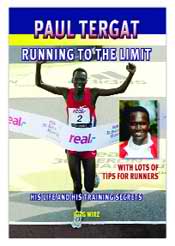
“Paul Tergat: Running To The Limit” by Jurg Wirz

This book was published in 2005 by Meyer & Meyer Sport (UK) Ltd. Obviously, the book is about the life, training “secrets” of Paul Tergat and his tips for runners for them to excel and adhere to running as a way of life.

Cover Page of Paul Tergat's Book (Photo Courtesy of Google)

He was not yet a runner when he entered the military service in 1990. With his assignment in Nairobi’s Air Force Base, he started to run with a big group around the Air Force Base with a distance of 15 kilometers in the morning and sometimes running also in the evening on a daily basis. In one of their inter-unit running events, although he finished far behind the leaders, a coach was impressed on his running form. The coach invited him to the training camp where the “top guns” are preparing for three months for the Armed Forces Cross Country Championships. He managed to finish third in the said event. After two months, he won the National Cross Country Championships and he was on the top of the Kenyan running scene at the age of 22 years old. And the rest is history.

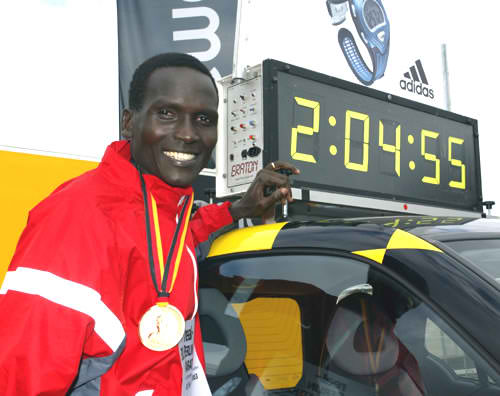
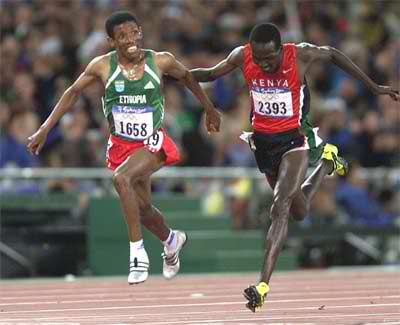
He set the World Record in 10,000 meters in 1997 with a time of 26:27.85 minutes; World Record in Half-Marathon in 1998 with a time of 59:17 minutes; and a World record in Marathon in 2003 with a time of 2:04:55 hours. Epic rivalry in the 10,000-meter run between Haile Gabrselassie and Paul Tergat had been displayed during the 1996 & 2000 Summer Olympics and in the 1995, 1997, & 1999 World Championship where he won the Silver Medals on these events.

Tergat's WR Time in Marathon (Photo From Google)
Epic Rivalry Between Haile & Paul in the 10,000-Meter of the 1996 & 2000 Summer Olympic Games (Photo From Google)

It is unfortunate that he was not able to win any Gold Medal in the Olympic Games within the span of his running career. He tried his best to train for the 2004 Athens Olympics’ Marathon but things did not turn out within his expectations as he finished #10.

Paul Tergat mentioned his roots and the poverty prevailing in his country which he considers as the number one “motivator” for them to excel in long distance running. There are other reasons why the Kenyans excel in long distance running but on how he refined his competitiveness and being on top among the elites in the world were mentioned in detail in his book through his training and tips.

What is most significant in this book is how the international corporate shoe brands helped to finance and support the establishment of “training camps” for runners in Kenya aside from the traditional Armed Forces “training camps” for the military elite runners. With the support and guidance of their Italian Coach Gabriele Rosa, the Kenyan runners were able to train for the best in long distance running.

Obviously, Paul Tergat is already rich and famous even without winning a Gold Medal in the Olympic Games. He is now an athletics promoter for running events in the eastern part of Kenya which is considered as the driest and poorest part of the country. With the support of a corporate food brand, he is bringing the awareness of running to the “grassroot” level to develop more competitive runners. He is a philanthropist and a member of the IAAF Athlete’s Commission.

There are two things that we could learn from this book. In order for the country to excel in long distance running, there is a need for a dedicated corporate support for the athletes and the establishment of “training camps” to continously develop athletes to elite status and at the same time, discover potentials from the grassroot level. It happened already in the past and it had been proven to be successful. It easy to say it. We know the supposedly “secrets” of the Kenyans and the Ethiopians but nobody is doing about it in an organized manner. When will our sports officials ever learn and put the sports “money” where it is supposed to be? I am still wondering what is happening to our elite sports program and sustainable “grassroots” program. 

This book is a nice reference if you want to train like the Kenyans in long distance running.

(Note: This is a part of this blog’s program/project to feature at least one book about running every week which started with the book, “Once A Runner”. Due to the “back-to-back” BDM Races for the past weeks, I was not able to publish this post as scheduled.)