Last month, I was able to get a free copy of the Competitor Magazine and one of the featured articles is about Kelly Starrett’s stretching methods and workouts which are featured in his blog at www.mobilitywod.com. In his blog, he promised his readers that he will post stretching exercises on a daily basis which started sometime in August of last year.
What impressed me most is his 10-minute “squat test” which he featured in his first “you tube” post in his blog. And for the past week and days, I’ve been dong this workout on a daily basis. On my first day, I could hardly bend my legs due to the tightness of my left lower quads, calf and knee (due to my injury). I could hardly complete a 2-minute duration of half-squat. I admit I cheated on my first day by trying to tip-toe my feet while bending my legs on half-squat. It was really painful and challenging that I have to sweat it out before finishing a duration of 2 minutes. I was not able to complete the 10-minute squat test on my first day!
Persistence and patience did it and after 10 days, I could already fully squat with my feet flat on the floor but I have to either use the wall as my anchor on my back or hold the legs or edge of a heavy table while keeping myself on a squat position for continuous duration of 10 minutes.
I am happy to say that I got positive results for the past 3 days. My tight quads and calf had loosen and I could no longer feel any pain on my left knee while walking or jogging. I would say that the daily 10-minute squat test is very effective in treating my injury.
As what Kelly Starrett has recommended, I have been strictly following his basic instructions for injured runners/athletes on their lower extremities. Aside from the daily 10-minute squat test, these are his key instructions:
1. Hydrate your body tissues. The formula is to divide your weight in pounds by two and the result is the number of fluid ounces your have to normally drink everyday. If you are involved in running or any endurance sports, you have to drink 16 fluid ounces for every hour of workout. Right now, my weight is 146 pounds, by dividing it to 2, the result is 73. That is 73 fluid ounces of water! If there are 33.8 fluid ounces in one liter, then you can do your math as to how many liters of water you have to drink every day.
2. Take some supplements. He recommends Glucosamine and Omega Oil (Fish Oil) as daily supplements for one’s nutrition needs. He says that these supplements lubricate the joints, reduce inflammation and speed recovery.
3. Follow the Mobility Workout of the Day as featured in his blog.
Desperately wanting to speed up my recovery from my injury, I’ve been a “sucker” to Kelly’s method and instructions. I’ve been following his instructions for the past two weeks (to include the supplements) and I am recovering fast. One more week of “squats” and I would be back again pounding my feet on the ground.
If you are interested to follow the Mobility Workouts of the Day of Kelly Starrett, you can click the MobilityWOD on my blogroll.
The following “you tube” clip was Kelly Starrett’s first blog post on the 10-minute “squat” test.
They call this running event as “Marathon” even if it is actually an Ultra Marathon Race with a distance of 86.96 Kilometers (52 Miles). The race route is on the paved road between Durban and Pietermaritzburg in South Africa. It is one of the oldest ultra marathon races in the world but at present, it is being dubbed as the world’s largest ultra marathon race whose runners would reach up to 23,000 with cheerers and spectators lined up throughout the course! (With the increasing number of International runners reaching up to almost 2,000, this event promotes Sports Tourism to South Africa!)
This Sunday, May 29, it will be the 86th edition of the race which started as a commemoration of the dead British & South African soldiers who were the casualties during World War I. It was created by a retired British Army Officer to honor his “comrades” who died as heroes during the World War I Campaign in South Africa, hence, it was named as the Comrades Marathon.
If they have the Comrades Marathon in the continent of AFRICA, then we have also the Bataan Death March 102K & 160K Ultra Marathon Races in ASIA. The reason and purpose of the two running events are similar but Bataan Death March attracts more interest due to its historical significance, popularity and involvement of war’s atrocities and heroism of the Filipinos and Americans.
The following link will describe in details the history of the Comrades Marathon from its origin up to its last edition last year.
Due to the popularity of the Comrades Marathon in Europe and USA, I read somewhere and overheard other ultra runners saying that you are finally called as a “full pledged ultra runner” if you have finished the Comrades Marathon within the prescribed cut-off time of 12 hours. It is for this reason that I am already making my travel preparation and training for the next year’s edition of the race! God willing.
In the Philippines, a runner is not a full pledged ultra runner if he/she has not finished the BDM 102K Ultra Marathon Race within the prescribed cut-off time of 18 hours. It is my personal declaration and I will stand by it.
You can browse more about how to join the Comrades Marathon at their website at www.comrades.com.
Let me remind all the runners who are interested to apply to join the 2012 Bataan Death March 102K Ultra Marathon Race (BDM 102) that the deadline of acceptance of letter of intent will be on September 1, 2011. Such deadline is also true to all runner-applicants for the 2012 BDM 160K Ultra Marathon Race. There will be no extension of deadline on this matter.
Since the deadline will be on September 1, 2011, those who have not yet finished a Marathon Race (42K) have two (2) Marathon Races where they could qualify. The earliest is the Manila International Marathon which will be held on June 26, 2011 and the later one will be the MILO Marathon Manila Eliminations on July 31, 2011. The month of August does not have a local Marathon Race scheduled not unless the runner would opt to finish a Marathon Race outside the country.
Personally, I suggest runners without any Marathon experience to join the Manila International Marathon. Looking at the published Race Route, the course is flat and fast as it will cover the roads along the Roxas Boulevard-CCP Area-MOA Area-Macapagal Avenue, however, the runners will have to do two loops of these areas. It’s better than doing three (3) loops!
I am sure MILO Phils. will not repeat their Manila Marathon Elimination Race Route last year because of some complaints and tragic accident. However, if the runner does not have enough time to prepare for the earlier marathon race, then the MILO Elims would be the appropriate Marathon qualifier before the deadline of BDM 102 application.
Again, the “only qualifier” for the BDM 160 is to finish the BDM 102.
If you are qualified for the 2012 BDM “Grand Slam”, the deadline of application is still on September 1, 2011.
Number of slots for BDM 102—200 runners (to include AFP/PNP & “invited” runners)
Number of slots for BDM 160—80 runners
Please relay this information to the other runners who are interested to join the BDM Races.
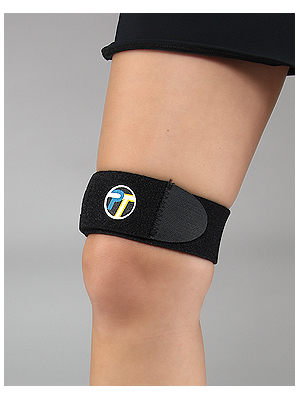
These are strap bands that are very popular among athletes, most especially to runners.
For the past weeks, I could not run without using these bands. They are simply called PT Bands or Pro-Tec Bands, their brand name.
For the first two weeks, I’ve been using the PT Runner’s Knee Band on my left leg which is the one where I’ve been injured. However, instead of placing the front of the band beneath my knee cap, I place the “hard” part of the band behind my knee in order to relieve a mild pain on it.
Pro-Tec Knee Band
After two weeks, I was able to buy a Pro-Tec IT Band Strap which I use to strap my lower left quads. The said strap was able to relieve the pain on my lower quads whenever I over exert my left leg. This strap had been a good medical aid during my runs.
Pro-Tec IT Band
I’ve been putting some miles again on the road and trails by running and hiking and these two bands (Knee and IT) had been helpful in easing the pain on my leg.
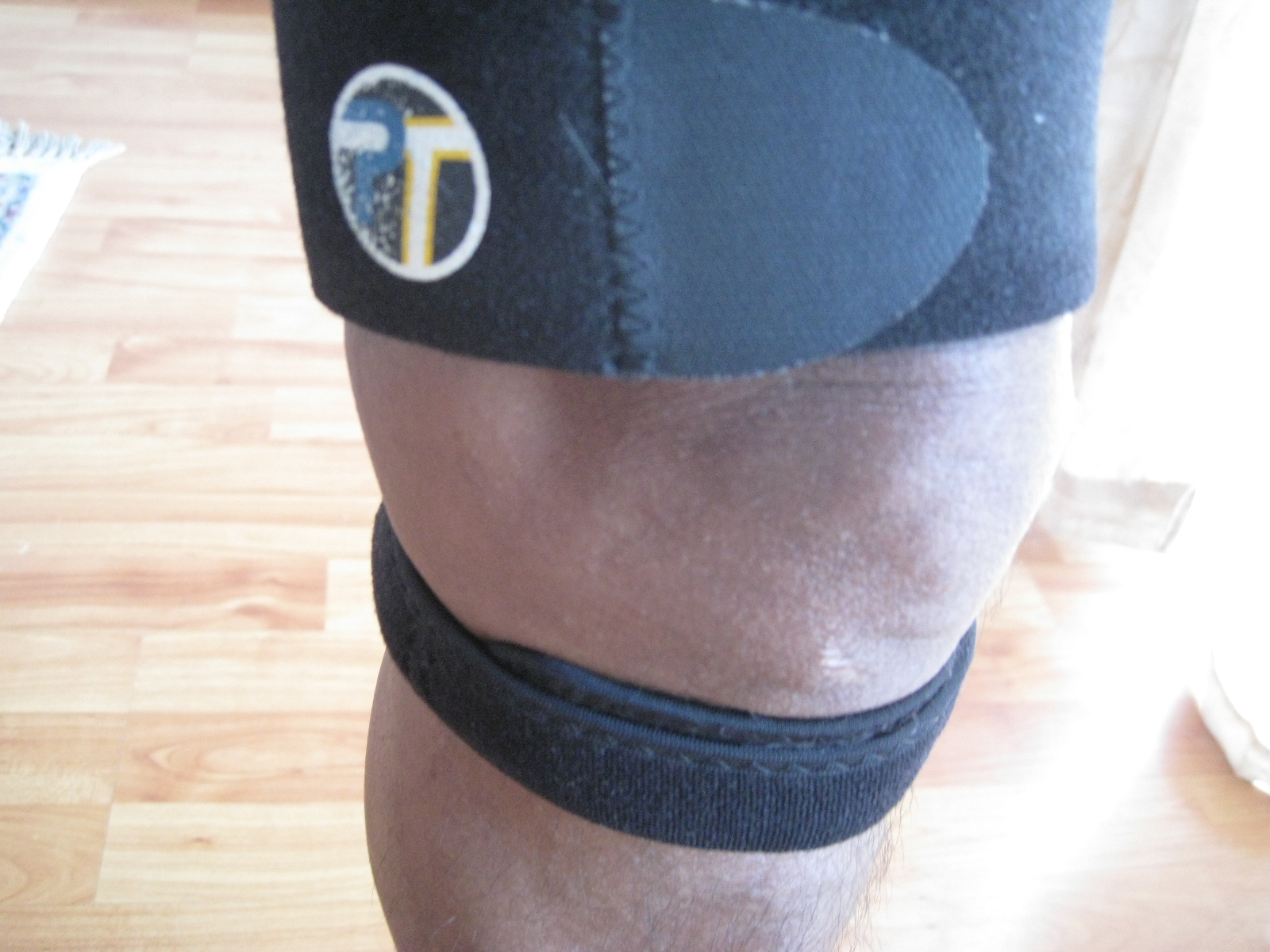
This is how it looks when they are strapped on my left leg.
My Left Leg With Straps!
I could be hard-headed again with my treatment and recovery but it makes me CRAZY & bored if I can’t run/walk at least once a day no matter what the distance is.
(Note: 1st & 2nd pictures were copied from the Pro-Tec Band’s website)
The following is an article that I copied from a trail running book which I want to share to my readers, whether you are a newbie runner or an accomplished/competitive ultra runner. You can share also your answer to the said question on the title.
Do We Love Pain?
Not long ago, I posted the question on a blog site: “Are we endurance athletes driven by the solipsistic need for self-validation, as in, ‘we hurt, therefore we are’; or is it that we love the pain and exertion and, therefore, more is better?”
The answers were quite edifying so I thought I’d share them:
–Personally, I love it–the pain, I mean. But most importantly, I view the pain as the engine to drive me to reach my goals. In other words, I know I’m hurting because I’m on hour four of a six-hour effort and that I’m that much closer to seeing nature in full effect. Or, that the pain is getting me through a technical uphill section. The pain is an indication that I’m do-ing!
–I train so I don’t hurt any more.
–I tend to agree; when I was most prepared to race, pain wasn’t much of a factor. The validation came in competing against others.
–I was getting massage last night, and the therapist asked, “You do work your body hard, don’t you? What is your motivation?” I didn’t know what to say, mainly because my face was being shoved into the hole as he stretched my calf and it was hard to talk anyway…but he made me think. I don’t know that I have a good answer, but I agree that training is to avoid future pain, I also know that I absolutely love being out in the wilderness, and the harder I train, the more time I am able to spend in that environment.
–It’s all about the balance. You feel so good afterwards because you suffered through the pain during it. The sweetness of completing something wouldn’t be the same if it was easy to do. Being in pain, working through it, and finishing bring the accomplishment more meaning.
–I say it’s like most things in life: combo platter.
–I don’t love pain…but it makes me stronger, and in that way it helps me achieve my goals. I think the key to the answer lies within our personal goals.
–Balance. For me it’s all about the three-part teeter totter: sport, family, work. Each causes (good) pain the harder you try at it, and all must be in balance to make each truly meaningful.
–Maybe we like the pain. Maybe we’re wired that way. Because without it, I don’t know, maybe we just wouldn’t feel real. What’s that saying? “Why do I keep hitting myself with a hammer? Because it feels so good when I stop.” I can’t take credit for the qoute, but it seems somewhat appropriate.
–I love it and think that more is fun but moderation is the key to longevity and health. I’m enjoying my Boston Marathon hangover. Pain is relative. I just wish I could recover quicker!
–If pain feels good, if pain = pleasure, then is it really pain? But I am proud to be one of the finish-line crossers so maybe pain = proud.
–It’s not the pain that’s enjoyable, it’s the feeling of accomplishment and daily reinforcement that your body is adapting—getting stronger and/or faster. Pain is a reminder that you pushed hard. We need to be more aware about the weakest point in our body, as that seems to break first. Strengthen the weakest part to keep the rest in balance.
–So many times I’ve been asked if I love pain. Or, why do I put myself through all this “insane training and criminal early (very early) morning runs?” And I have questioned myself, too: why? I love pain, I do, it make me feel alive! It makes me feel I trained, I paid my dues, I have a right to be where I am. Too crazy? Maybe.
(Source: The Ultimate Guide To Trail Running: 2nd Edition by Adam Chase & Nancy Hobbs. Guilford, Connecticut: 2010; pages 71-73)
Don’t be confused with that simple arithmetic. I am now 59 years old, 3 years after my retirement from the military service and 4 years after I have renewed my dedication and time in serious running and be the Bald Runner.
To celebrate the day, I would have to run 59 kilometers but with my recovery from injury, I would be committing a “suicide” and make my condition worse.
It was a choice of running 59 minutes or 59 seconds or walking 59 steps or 59 meters or running 5 + 9 = 14 kilometers.
And finally…
To make the day significant, I had to run without any pit stop. I added the two numbers in my age and I was able to run 14…miles, not kilometers! That is equivalent to 22.4 kilometers with some additional yards & feet as change. I finished the distance in 2:35:20 hours with an average pace of 11:02 minutes per mile (6:51 minutes per km) and an elevation gain of 1,120 feet (342 meters). It was a slow and easy run but it was worth every pace and stride of it.
One year more and I will be a dual-citizen…Filipino + Senior Citizen. I was able to get a “tip” from Sir Amado Castro Jr aka Reinier6666 that the Senior Citizens have a lot of privileges to include free movies on Mondays; free admission at the ULTRA Oval Track; 20% discount on meals in restaurants and purchase of medicines in drugstores; and if I declare my residence in Makati City, I would be receiving medical privileges in their hospitals and one sack of rice (?) and birthday cake every time I celebrate my succeeding birthdays. Sir Amado and I made a deal to be meeting every Monday for meals and movies after “race walking” with him at the ULTRA Oval Track as soon as I will get my Senior Citizen’s Card next year!
I would like to express my sincerest thanks to those who greeted me at Facebook (400+ friends out of 1,125), through e-mail, SMS, and personal greetings. It took me hours to reply each greetings from my Wall which I truly enjoyed. As usual, Jonel aka FrontRunner was the first to greet me and Sir Amado had the longest message. Thanks, Jonel & Sir Amado and to everybody.
So, what is next?
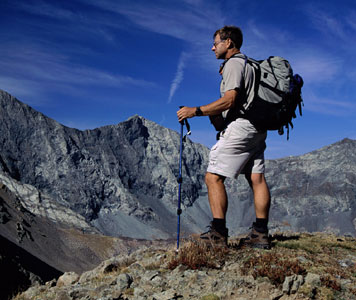
I will still be running but more on ultra marathon (and marathon training for a Boston Qualifier and as LSD workout) and this blog will be featuring more on ultra marathon training and activities. And I will be adding “hiking and backpacking” as my other cross-training sports activity (not necessarily posting my journal here in this blog).
I want to be like this (excluding the hair!)….
Hiker/Backpacker (Source: Google Images)
Watch out for the Bald Packer or Bald Hiker or Bald Backpacker or Bald Ultra Walker! Any suggestion?
Finally, the then famous Manila International Marathon is being revived this year. I am not sure if the use of 30th edition of this race is proper as I know that some of the editions in the past had never been conducted. I hope my friend, Red Dumuk, shall make some adjustments on this. However, I appreciate the posting of this article on the website of the said Marathon Race.
If my memory serves me right, this was my first Marathon Race and Red Dumuk specifically mentioned my name and my finish time.
Thanks, Red for bringing back those good memories of Road Racing in the 80’s.
HISTORY
The First Manila International Marathon
By Red Dumuk
Running great, Bill Rogers, winner of four Boston Marathons and four New York Marathons, apprised of the race route and the weather conditions, predicted 2:20 as the winning time in the inaugural Manila International Marathon. His visit to Manila came at the heels of his dismal performance in Japan. As he was off-form, he begged off from showing his form in the MIM.
Rogers’s fearless forecast was way, way off. When East German Waldemar Cierpinski, second only to Ethiopian Abebe Bikila to have ruled back-to-back Olympic Marathons (Bikila turned in the trick in 1960 Rome and 1964 Tokyo Olympic Games while Cierpinski in 1976 Montreal and 1980 Moscow), breasted the tape with President Marcos heading the spectators, the display clock showed 2:14:27, a good 5 minutes and 33 seconds inside the expected time.
The time could have been lower had there been stronger challenge. After 5K, the MIM morphed into a battle against the clock for Cierpinski, who in 1976 frustrated 1972 Munich gold medalist Frank Shorter’s bid to join Bikila as back-to-back Olympic Marathon champion. In the 1976 Olympic Marathon, Cierpinski beat Shorter, considered to have ignited the running boom in the United States, by 49 seconds (2:09:56 against 2:10:45).
Cierpinski’s winning time which is 3 minutes and 24 seconds outside the clocking he posted in Moscow Olympics less than two years earlier can be better appreciated against the backdrop of marathon times in other parts of the world held in different seasons in 1982.
It’s no wonder, therefore, why the 2:14:27 has yet to be expunged as the all comers best in the Philippine Marathon theater. (Domingo Tibaduiza whose time was 20 seconds slower than Cierpinski’s when the former claimed the top prize in the 1982 Berlin Marathon emerged as 2nd MIM champion. He checked in at 2:25:01, nine minutes 34 seconds adrift of the existing standard in 1983.)
Runner-up American serviceman Phil Camp might have found Cierpinski out of his league but his 2:19:39 timing would have outweighed the first placers’ in four of the above marathons.
The last berth in the podium was hotly contested by Chang Ming Chen of Chinese-Taipei and Peng Jiazheng of the People’s Republic of China. There was a sideshow even. A PROC embassy official protested minutes before the cannon fired off the marathoners the display of the Republic of China’s flag on Chang’s singlet and threatened to pull out Peng from the marathon. We explained to the embassy official we were aware if Chang has to show a flag on his breast, it should be the IOC designated banner. We added we subscribe to the one-China policy of the government. Then, we convinced Chang to have the ROC flag covered with a masking tape. Had Chang not acquiesced, disqualification awaited him.
When the smoke of the conflict had settled, so to speak, Chang outstripped Peng by 59 seconds–or just about the time it took the former’s official to tape that offending flag–to claim the third position. Chang’s 2:26:49 clocking bested winning times of two 1982 AIMS events. Peng’s 2:27:48, on the other hand, beat the champion’s time of one of the AIMS member marathons.
Great Britain’s Tim Johnston (2:31:31) rounded out the top 5 finishers. He crossed the finish line two minutes and 30 seconds ahead of the first Filipino finisher, Army man Ricardo Carillo (2:34:01). Landing in the top 5 among the locals and top 10 overall were Manuel Carmelo (2:35:28),7th; Guillermo Padilla (2:37:31),8th; Ireneo Illut (2:38:01), 9th and Carlito Solis (2:38:06), 10th.
Fifty-three runners (only seven were foreigners) registered sub-3 hours clocking. By comparison, looking at the results of the recent marathons in the country, less than 10 runners with sub-3 times seems to be the current norm.
In the distaff side, only the 11-year old wonder girl Joan Laput, tops among the 11 lady finishers, broke 3:30. Laput ranked 173 overall with her time of 3:28:22. Laput’s “preys” included priest marathoner Amado Picardal (3:20:16, 195th), the Baldrunner (3:58:44, 286th) and arguably, the country’s No.1 race organizer Rudy Biscocho (4:40:02, 440th).
Of the 603 hopefuls who answered the starting cannon, only 30 did not finish–a remarkable mortality rate of measly 4.98%. The most courageous and greatest survivor was cardiac patient Teofilo Espejo, Jr. He placed 509th with a time of 5:11:16.
Asst. Race Director Colmenares running and finishing the MIM spoke volumes about the organization and management of the race. He clocked 3:47:50, good for 281st position, well in the upper half of the finishers.
It would be great seeing another Philippine President accommodating the top 200 finishers of a marathon or any road race of prestige in Malacanang and treat them to dinner after the awarding ceremonies where he would trace the history of marathon even as he extols its virtues in his address.
In another first, the country’s top sportscaster then Joe Cantada found his equal in Katherine Switzer during the coverage of the 1st MIM. Joining the fun was Zal Marte, another sportscaster of note. This would never be duplicated. “The Voice” has passed on to the great beyond.
As recognition for a job well done, Race Director Dorotheo’s peers in AIMS elected him as member of the original batch of Board of Directors. It goes without saying the Manila International Marathon was accepted as full-fledged AIMS member barely four months after its initial edition. Dorotheo was to be reelected to the AIMS Board.
And from the locals, what was the reward? The second MIM saw the size of the field doubled.
1st Manila International Marathon Statistics
Countries Represented
Macao
Sweden
Australia
Bangladesh
United Kingdom
Taiwan
Norway
Indonesia
Philippines
United States
People’s Republic of China
Starters
603
Finishers
573
95.02 %
Men
562
98.08 %
Women
11
1.92 %
Locals
536
93.53 %
Foreigners
37
6.47 %
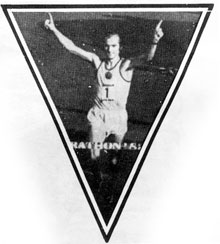
Waldemar Ciepinski flashes the No. 1 sign more than 5 minutes ahead of the 2:20 winning time predicted by Bill Rodgers
I have been making a research in running books and running resources on the Internet on the basis of cut-off times of Marathon and Ultra Marathon Races. It seems that I could not see any “authority” or “regulation” in the IAAF or IAU Manuals and Protocols as to what is the accepted formula in the declaration of cut-off times in every race.
Without any basis, I have the impression that this “rule & regulation” in a running race, whether road or trail, on the prescribed cut-off time is arbitrary and based on the decision of the Race Organizer/Race Director.
On the part of a Race Organizer in a busy City Marathon Race, a six-hour cut-off time is a standard period for a 42K distance. This will minimize the time for the closure of main streets from vehicular traffic. The lesser time for the roads and streets are closed, the better for the riding public and commuters. It will also lessen the time of exposure and involvement of security, medical, marshals, and volunteers and other administrative and logistic supports for the race.
Obviously, this is true also to ultra marathon distance races but with longer and extended period of cut-off times.
Comrades Marathon (90K), the oldest ultra marathon, had an 11-hour cut-off time for so many years until it was extended to 12 hours since 2003. Aside from being the largest ultra road race, it is also the hardest in terms of elevation profile and with a very restrictive cut-off time.
The North Face Ultra Trail du Mont-Blanc (UTMB), 166K ultra trail race, has a cut-off time of 46 hours.
Western States 100-Mile Endurance Run, also a ultra trail race, has a cut-off time of 30 hours.
Jeju International Ultra Marathon 100K Race, a road ultra, has a cut-off time of 16 hours.
Miwok 100K Ultra Trail Run has a cut-off time of 16 1/2 hours. Most of the 100K ultra trail distance races in the USA has a cut-off time of 16 hours.
Singapore’s Sundowm Ultra Marathon 100K Race, a road ultra, has a cut-off time of 16 hours.
Bulldog 50K, an ultra trail race, has a cut off-time of 9 hours. Most of the 50K ultra trail races in the USA have a cut-off times of 9 hours.
Headlands 50-Mile Trail Run has a cut-off time of 14 hours and this is true to almost all the 50-milers except for the JFK 50-Mile Endurance Run which has a cut-off time of 18 hours ( based from tradition and history).
The Hardrock Ultra Marathon, the officially dubbed as the hardest ultra trail race in the USA, has a cut-off time of 48 hours.
The Barkley Marathons (100-mile trail race), the unofficial hardest ultra trail race in the USA, has a cut-off time of 60 hours, however, each loop which has a distance of 20 miles must be completed in 12 hours. It is a “lucky” year’s edition if there is a “survivor-finisher” for this race. Since its first edition in 1986, only nine (9) had finished the race up to this year.
Surprisingly for this year, the Badwater Ultramarathon has reduced the cut-off time from 60 hours to 48 hours! There was no reason in its website for the said dramatic change, however, its registration fee had increased from $ 850 to $ 995.
In my opinion, the cut-off times give an impression on the degree of difficulty of the race to the participants and at the same time provide a status of distinction for the said race.
For the runners, cut-off times serve as their lowest target time to finish. They should not be satisfied to finish the race way beyond the prescribed cut-off time. Finishing any Road or Trail Race must be defined strictly as Finishing the required Distance within the prescribed Cut-Off time. A runner is fooling himself or herself if he/she brags about finishing a race way beyond the cut-off time. For the Race Director, runners who finish the distance beyond the cut-off time are considered as DNF (Did Not Finish).
Simply stated, a runner must train and prepare to finish a race within the cut-off time.
DNS…In Running Protocol, it means “Did Not Start”! My running injury from my latest Adventure Run on my lower left quads which turned out later to be an injury on my left knee did not heal even if I rested for so many weeks. After my LSD trail run for more than 6 hours at the Wunderlich State Park in Redwood City, California 4 weeks before Race Day, it gave me an assessment that finishing a 100K ultra trail run with a total ascent of more than 10,000 feet will be an impossible feat to accomplish.
Despite such assessment on my part, I tried my best to remedy the situation by taking all the necessary treatment I could gather from the different running resources in the Internet, running books, magazines and personal journals of famous trail/marathon runners. I even went to the extent of soaking my legs regularly on warm water mixed with Epsom Salt; regular massages; and even taking Alaxan FR capsules. I am glad that my cross-training in the gym kept me busy from the lack of more prolonged time of running on the road. One week before Race Day, I made my decision to DNS the race.
Instead of joining the race, I thought of offering my presence on Race Day as one of the Volunteers of the Race to the Race Director, Tia Bodington. After a brief exchange of e-mails with the RD, I was accepted as a Volunteer at the Starting/Assembly Area and at the Aid Station #1 which happen to be at the same location.
The motivation to do a volunteer work for Miwok 100 was due to the following as stated at the event’s Website—Eight hours of volunteer work at Miwok fulfills the Western States 100 service requirement. Eight hours of volunteer work at the Miwok 100K also gets you an extra ticket in the following year’s entry lottery. Hopefully, my injury will heal soon so that I will prepare specifically for the next year’s edition of this race.
DNS…Did (A) Nice Spectating…by Volunteering!
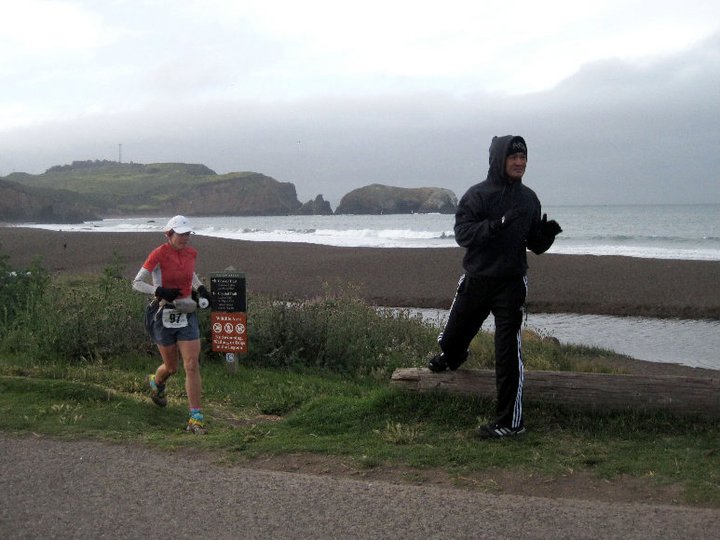
As a Volunteer at the Starting Area/Aid Station #1 @ 7.1 Mile, I was able to witness every minute how the Race was managed by the Race Director.
I arrived at the Assembly Area at the same time with the arrival of the RD who was driving a U-Haul Truck at 3:45 AM last Saturday. Tia Bodington was alone. The beach of Marin Headlands was dark, cold and windy on the early morning and I was prepared for the weather. I immediately approached the RD and introduced myself. The two of us started to bring out the necessary things needed for the processing of the runners from the truck and I even shared my flashlight to her as she was trying to locate some traffic/reflectorized vests and other flashlights needed for the volunteers.
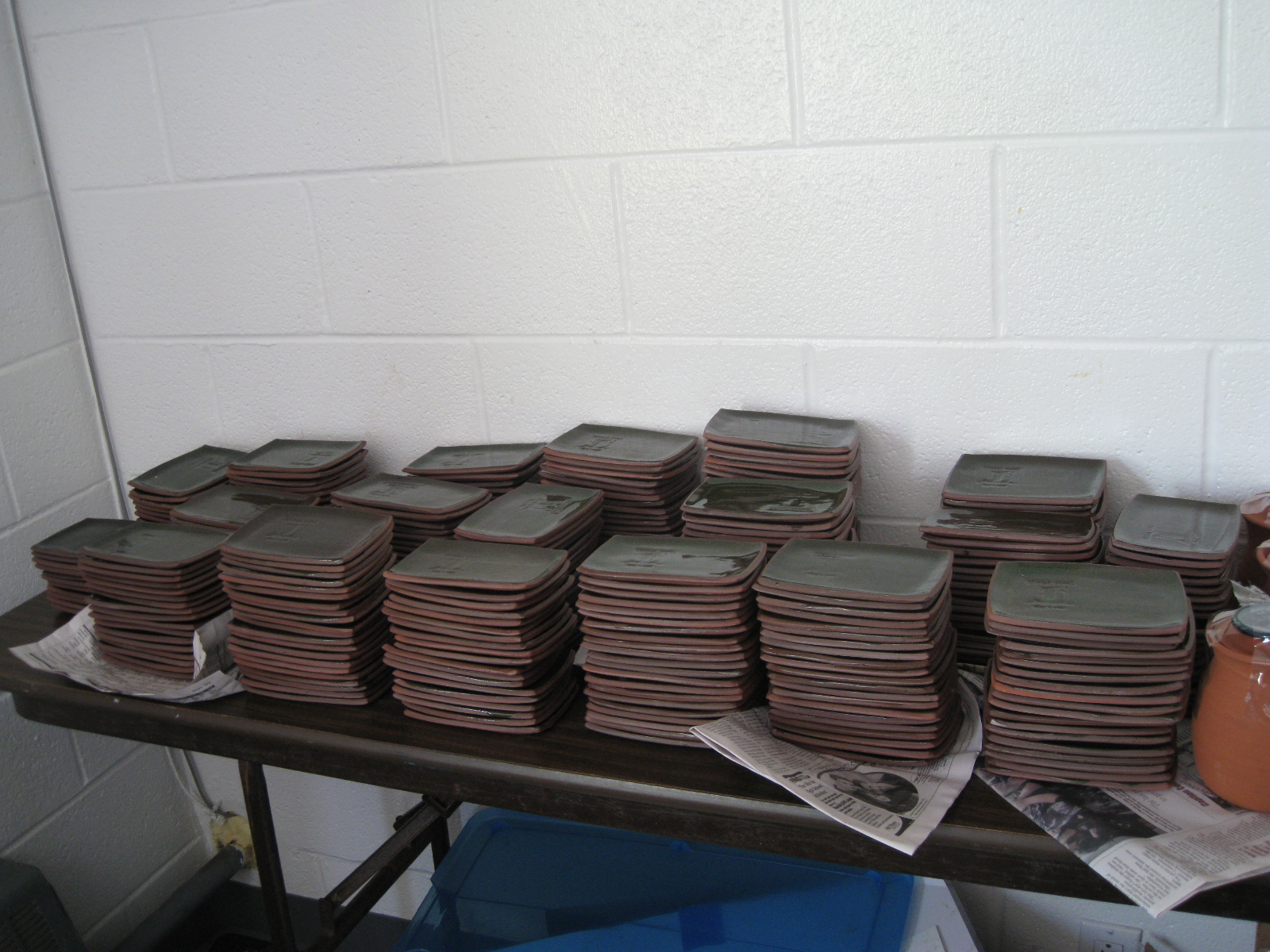
The U-Haul Truck was filled with containers filled with water, timing device, foods, and other stuffs needed for the race to include the “loot” for every finisher of the race which trail runners call “schwag”. I was smiling as I recall myself on the shoes of the RD whenever I start the races for the BDM and PAU Races.
After a few minutes, another runner/volunteer arrived with a casted/bandaged right wrist & hand. The guy, Charlie, was supposed to run the race also but he met an accident (slipped while running along rocky trail) on training and opted also as a volunteer for the race. The guy was given a reflectorized vest and a flashlight and he was asked by the RD to act as the Parking Attendant at the Authorized Parking Area for the Runners. In a few minutes, I was asked also by the RD to act as the Checkpoint at a point that is 200 yards from the Parking Area for the Runners. My job was to ask the drivers/passengers of each vehicle approaching the Assembly Area if they are runners or volunteers. If they are runners, I simply advised them to proceed to the “dirt” Parking Area. If they are volunteers or dropping their passengers for the race, I simply advised them to proceed to the paved Parking Area. Just imagine a Police/Military Personnel/Traffic Enforcer stopping your car/vehicle with a flashlight and the other hand signalling you to stop. Yes, that was my job as a volunteer for almost 2 hours!
As the lone personnel at the Checkpoint, I was able to see the faces of the runners! It is unfortunate that I was not able to glimpse on the faces of Anton Krupicka, Scott Jurek, and Geoff Roes! They opted to DNS, too!
At 5:30 AM, I was approached by Tia telling me that I was doing my job well and she informed me that my volunteer job was done. However, I asked her that I could still be of help in any of the Aid Stations or at the Finish Line as I wanted to see the Front Runners cross the Finish Line. She accepted my offer and I started to observe how the race would start.
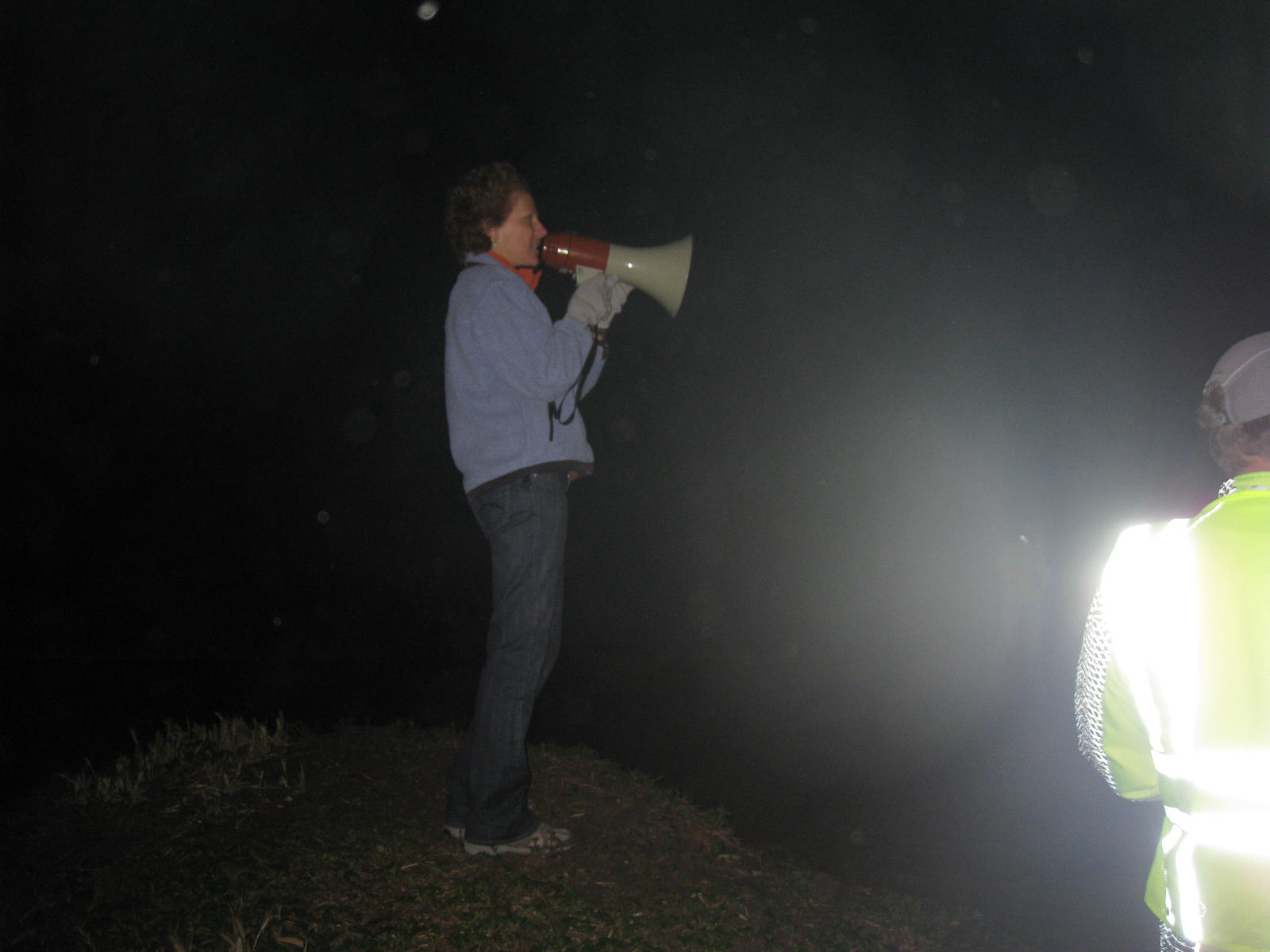
Runners Crossing The Bridge To Rodeo Beach LagoonTia Bodington, RD, Announcing To The Runners On Her Final InstructionsNo Arch, No Lights, No Starting Line...Just Runners Who Want To Have Fun & Enjoy The Trails
The processing of runners was very simple. Each runner simply got his/her race bib from one of the volunteers and that’s it! Ten minutes before the scheduled start time at 5:40 AM, all the runners were led to the beach near the Rodeo Lagoon which is about 300 meters from the Assembly Area. There were no intricate START Arch/Tarpaulins; no sound system; no music; no lights; no invocation/prayer; and no singing of the National Anthem. The RD positioned herself on top of a little mound on the beach while the runners lined up before an invisible starting line listening to the final instructions from her. Tia’s final instructions were about RESPECT. If I can recall them right, she said something like—“Respect the trails”; “Respect the Volunteers & Marshals”; “Respect the other Runners”; “Respect the Race & the Distance”; “Respect your Goal”; and “Respect Yourself”. After a few seconds, the RD simply shouted “GO” and the runners started the race along the sands of Rodeo Lagoon.
The Runners Were Off From The Starting Area
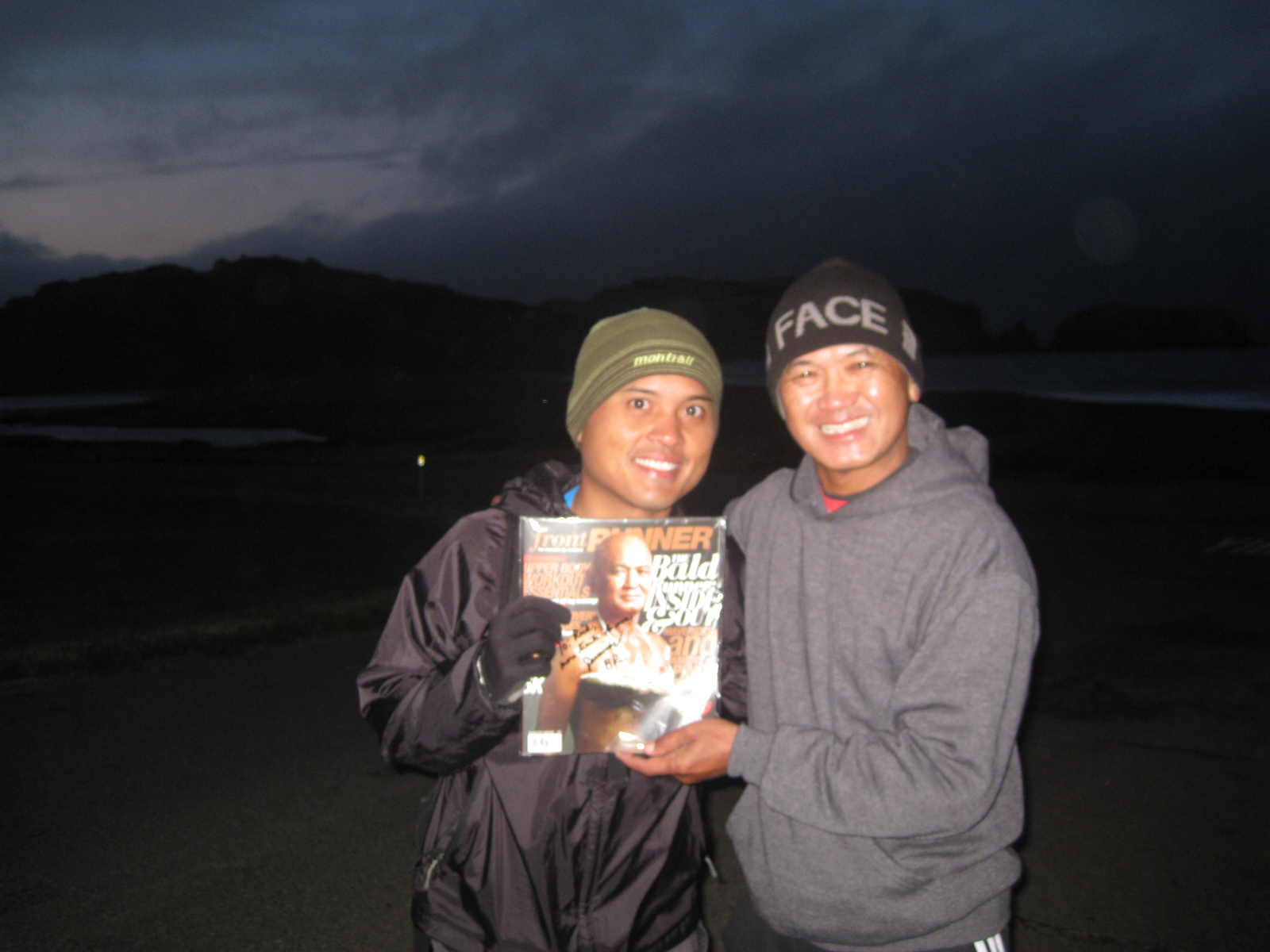
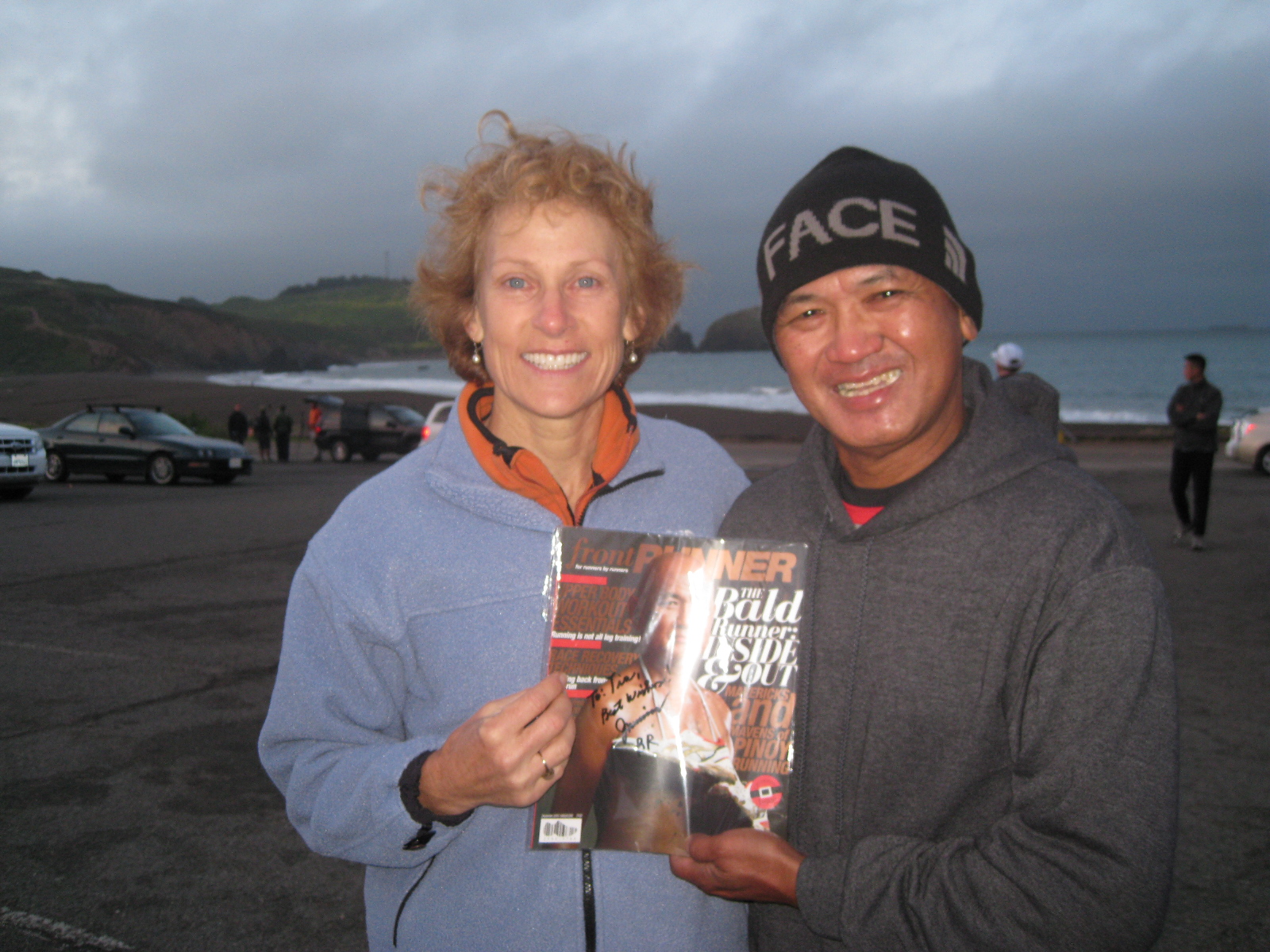
After the race had started, Rick Gaston and I were able to talk while the rest of the volunteers and spectators went back to the Assembly Area. This is where all the volunteers (to include myself) helped in loading the “drop bags” of the runners to be transported to the Finish Line which is about 3 kilometers away. After this job, I was able to engage more conversation with Tia and had a chance to give her a copy of the frontRunner Magazine. It was a good chance for me to have a picture with her.
Rick Gaston in Montrail & BR in TNF Skull CapsWith Tia Bodington, RD of Miwok 100 & Editor-In-Chief of Ultrarunning MagazineU-Haul Truck & Drop Bags To Be Loaded
While waiting for the lead runners to pass at the Aid Station #1, I was introduced by Rick to Brett Rivers who is also an elite ultrarunner, got to talk to Mark Gilligan of UltraSignUp, and the rest of his ultrarunning friends whom I could not recall their names. Finally, I was able to back-up my e-mail messages to Matt for the possible inclusion of the BDM Races to UltraSignUp through a longer conversation and personal interaction. We had a longer discussion about the matter/issue when we had a chance to meet again at the Starbucks at Mill Valley.
With Mark Gilligan of Ultra SignUpShouting The Runner's Race Bib Number to Mark Gilligan
At the Aid Station #1, Rick and I became instant volunteers for Mark Gilligan’s Live Update in his Website by posting each runner’s split time. We were requested by Mark to shout to him the Race Bib Number of each of the runner approaching our place. It was a good chance to stretch my vocal chords! After the last runner had passed our station, I found out from Matt that there were 345 starters out of the 416 accepted/registered runners.
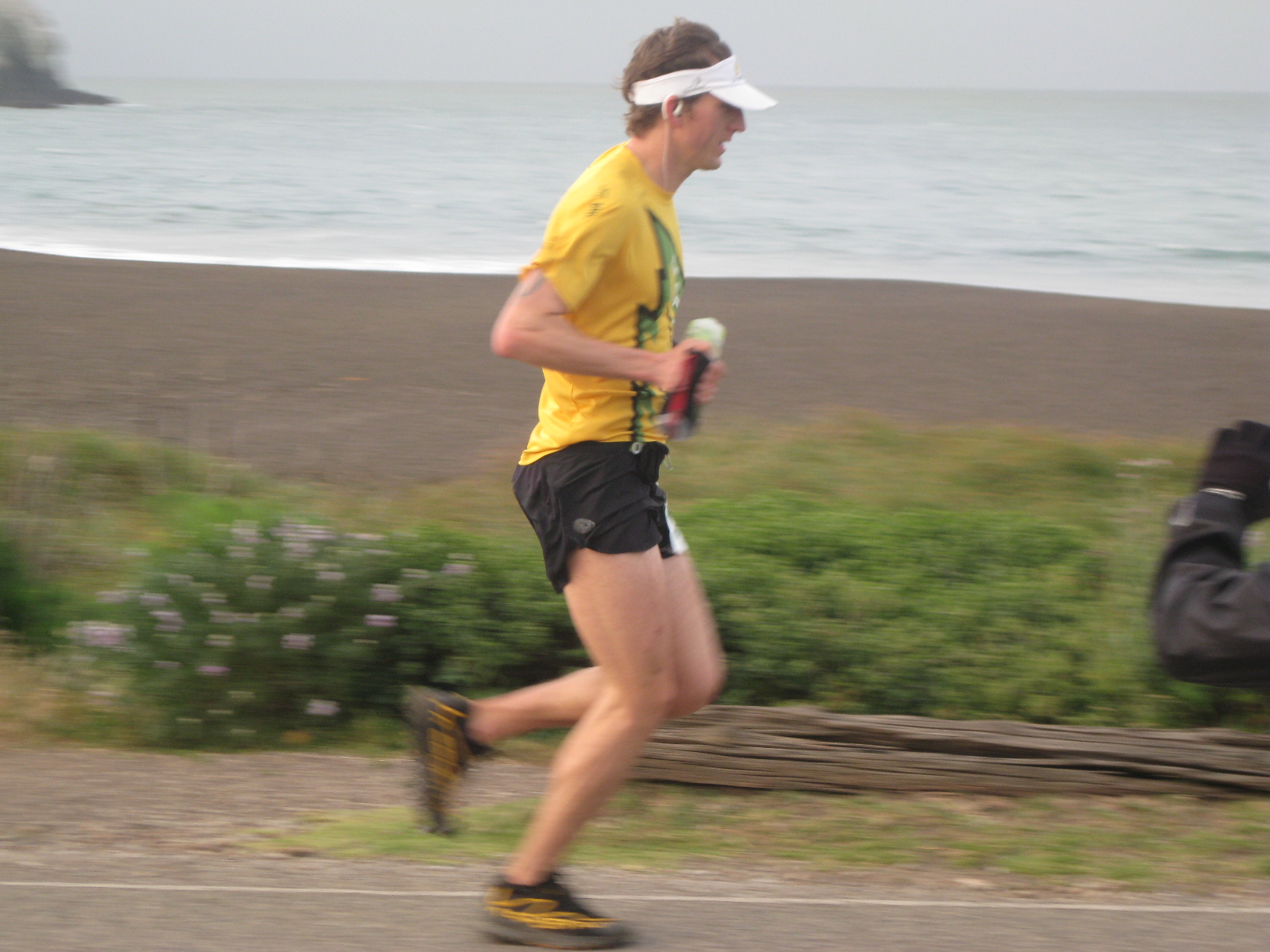
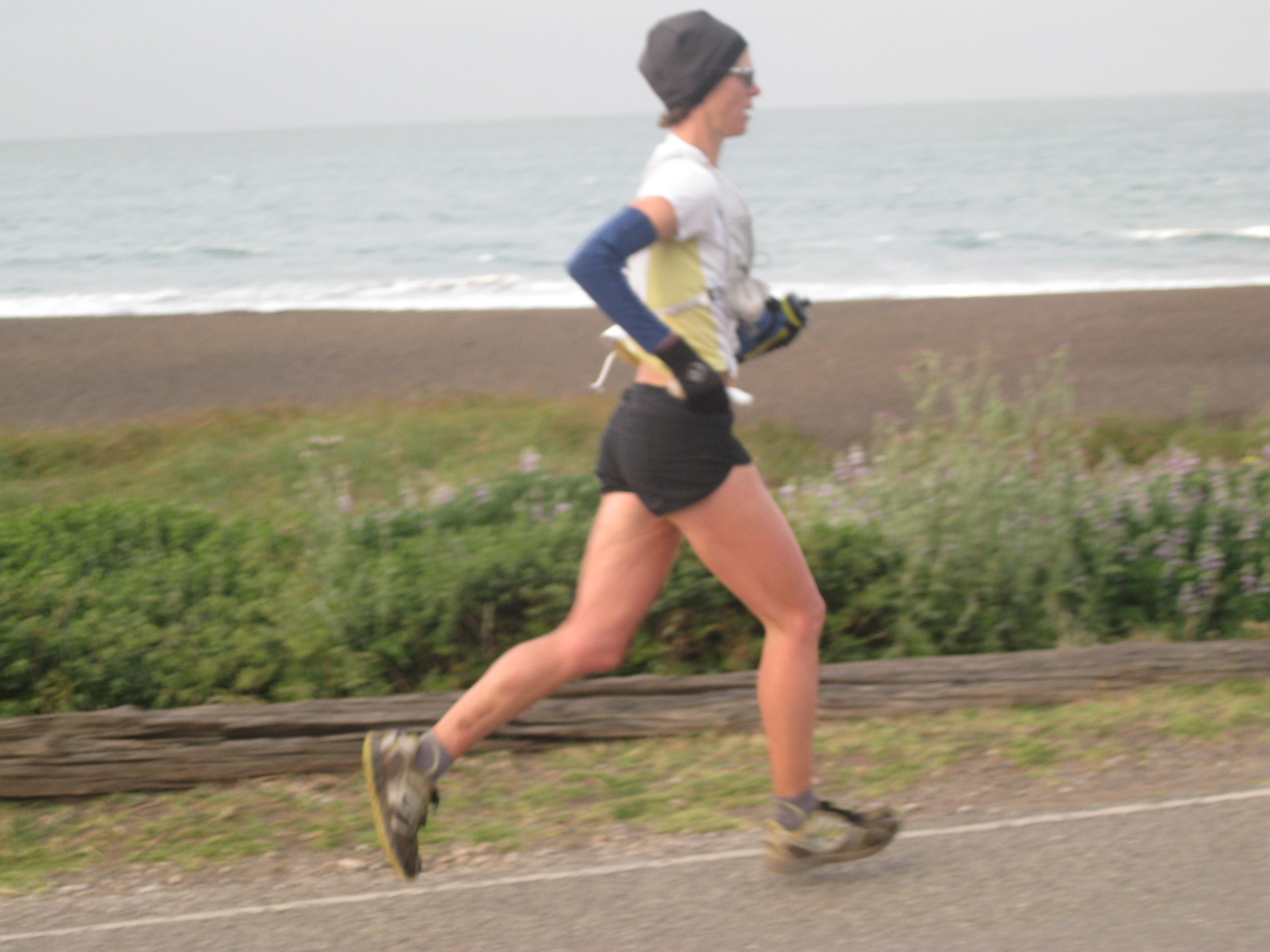
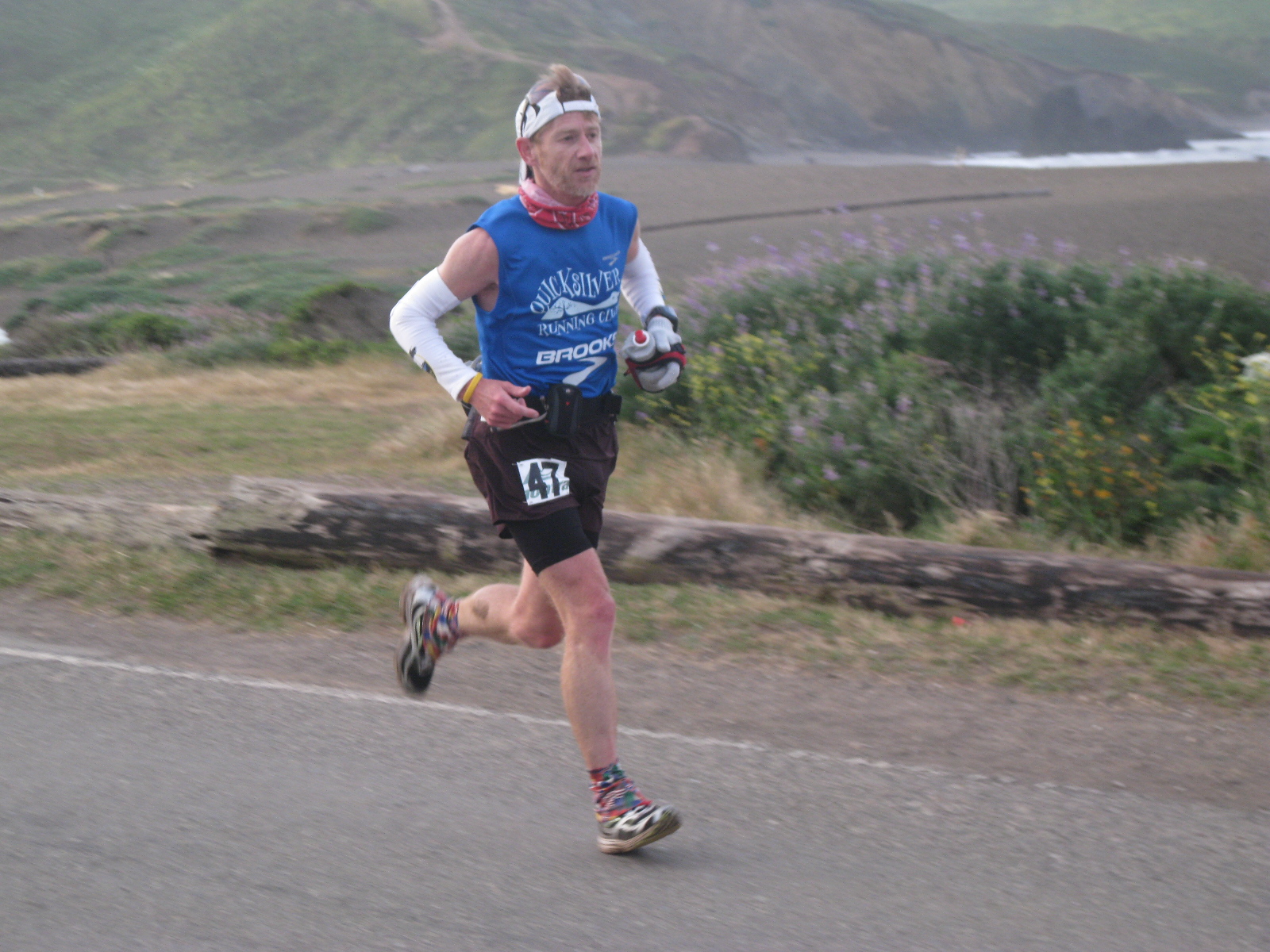
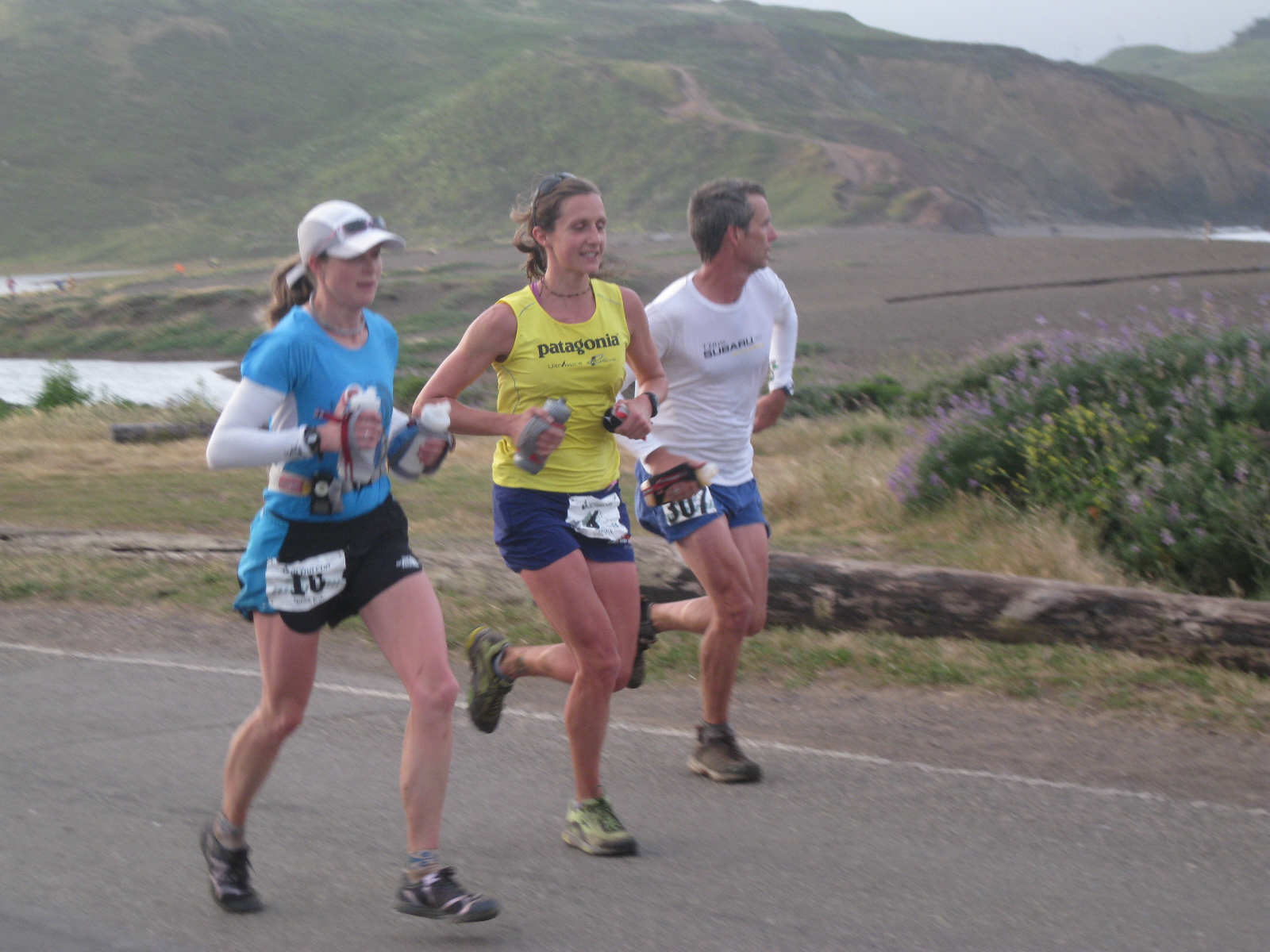
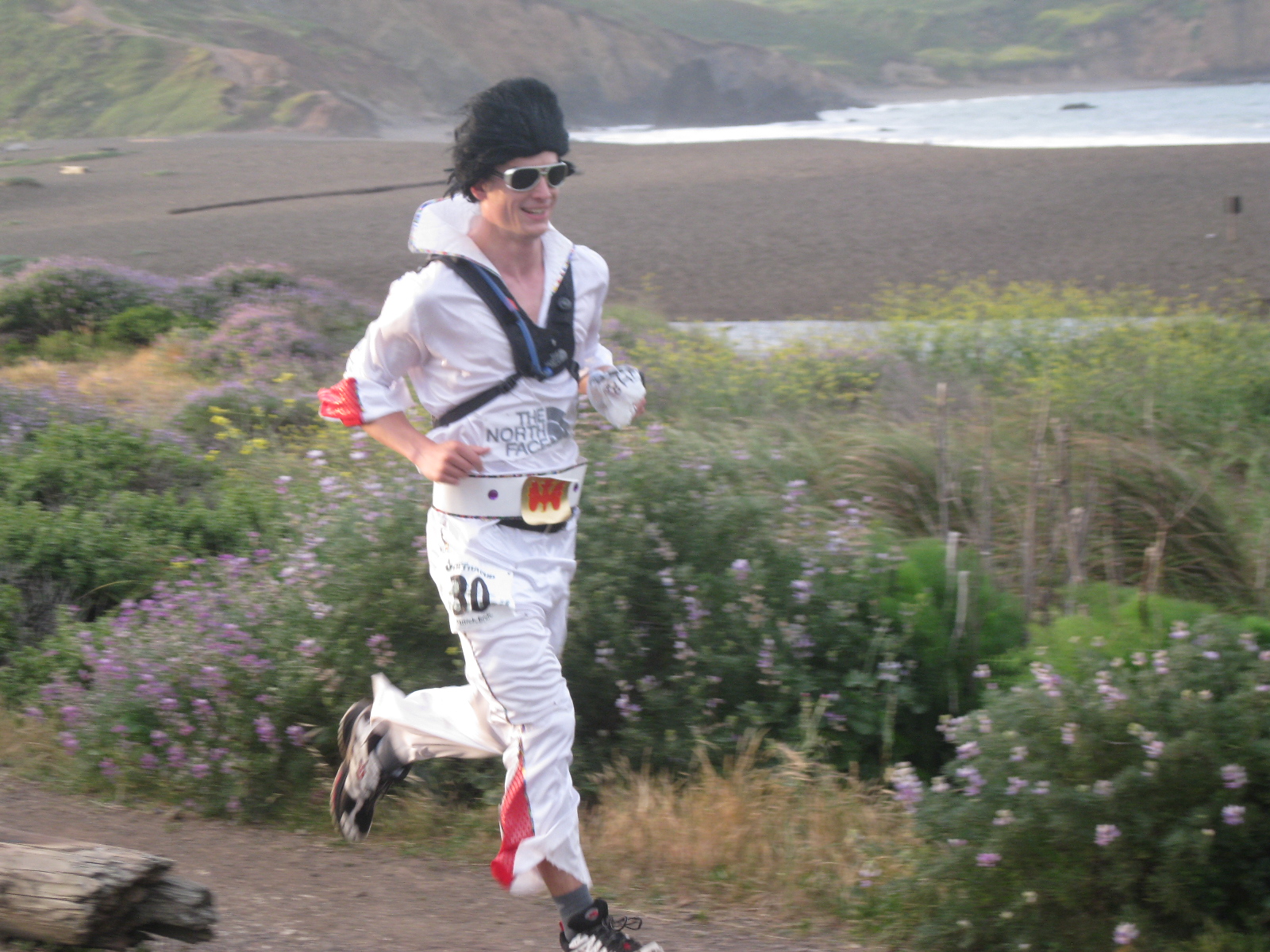
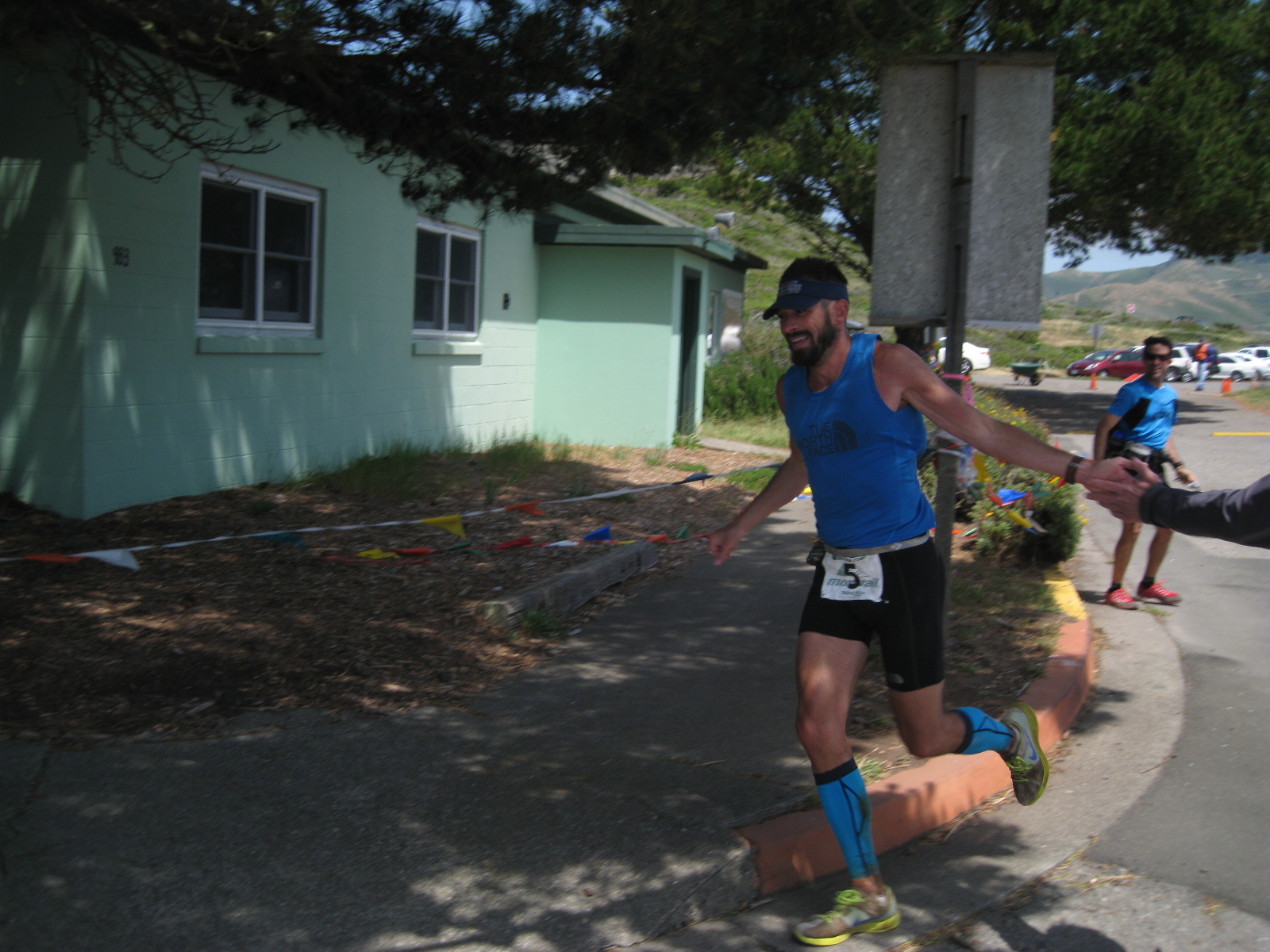
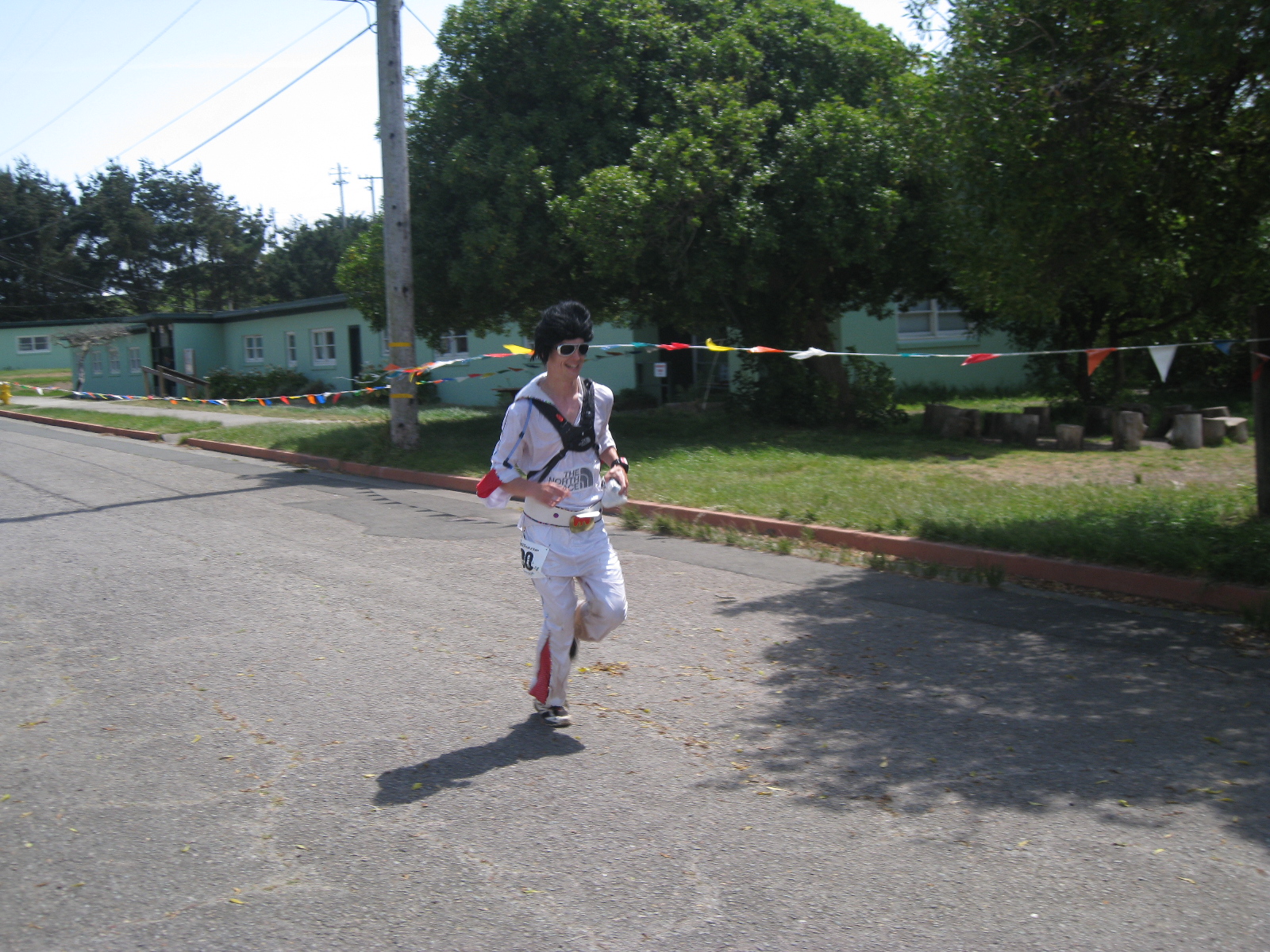
At Mile 7.1, Dave Mackey (Right) & Mike Wolfe (Center)Nathan YankoLook At That Stride!!! Leading Runner Meghan ArbogastJean Pommier (Another Ultra Blogger) @ http://www.fartherfaster.blogspot.comKristin Moehl at the MiddlePam Smith (Lady Champion of the Race)Ian Sharman aka ELVIS, The King!
At the Pantoll Aid Station (Mile #20 & 41)
Rick brought me to Pantoll Aid Station to observe and spectate to the runners passing. The top runners just passed the area when we were looking for a parking space. It was nice to observe the other fast runners on how they re-supply themselves with their hydration packs; how and what they eat at the Aid Station; and how lively the cheerers to the incoming runners.
Don't Try To Imitate This Guy!The Legendary Ultrarunner Scott Mills @ 59 Years Old (Ranked #49)Cheering The Runners at The Old Mine Trail
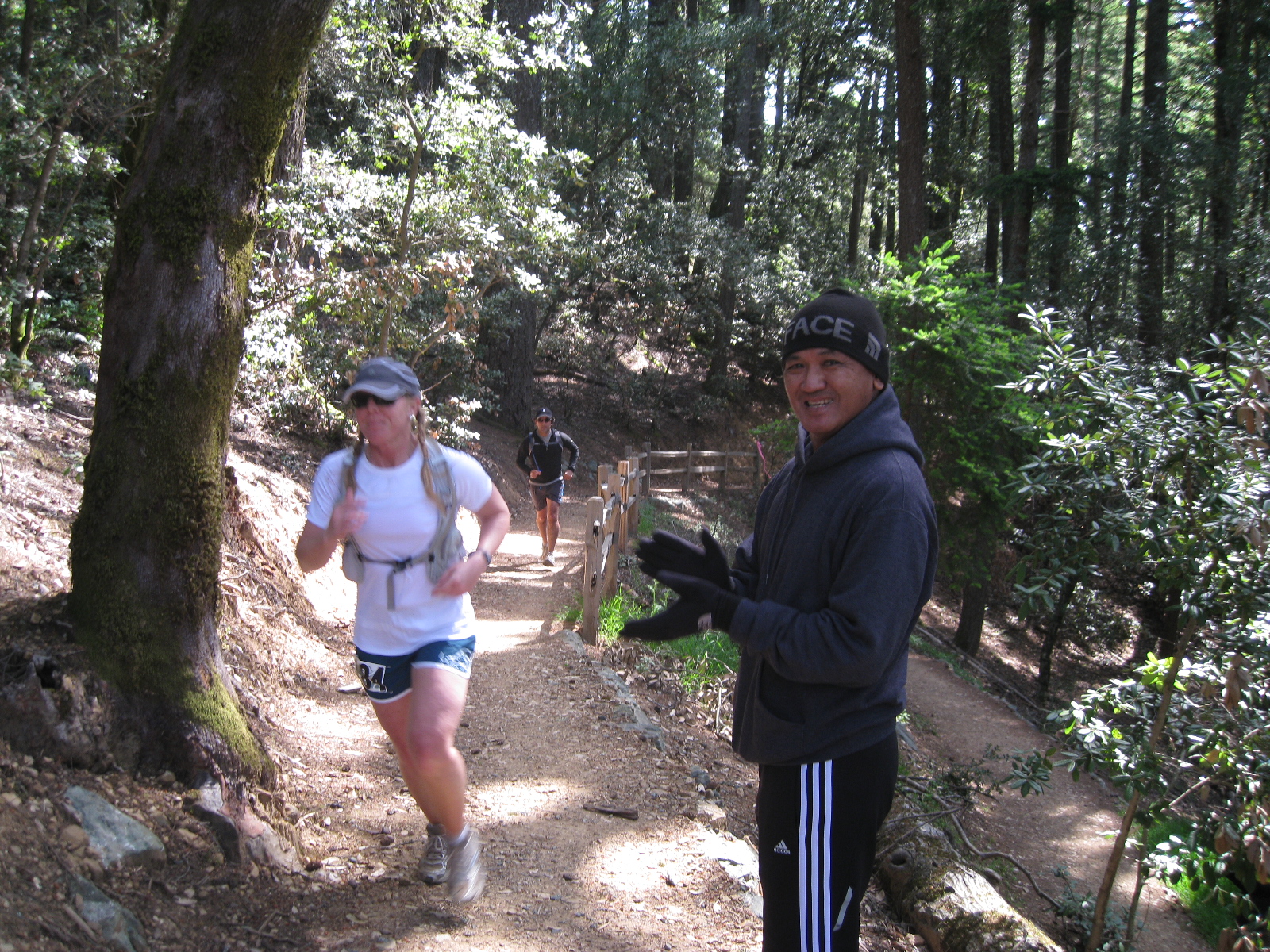
Later, I positioned myself about 30 meters along the trail before runners would reach the Aid Station. The trail is called Old Mine Trail. As the runners would approach my position, I would shout encouraging words while clapping my hands. The words, “Looking Good”; “Good Job”; “You Can Make It” and other positive ones shouted to the approaching runners would boost the runners to jog at a faster pace. As a response, the runners would say, “Thank you for being here” with a smile on their faces!
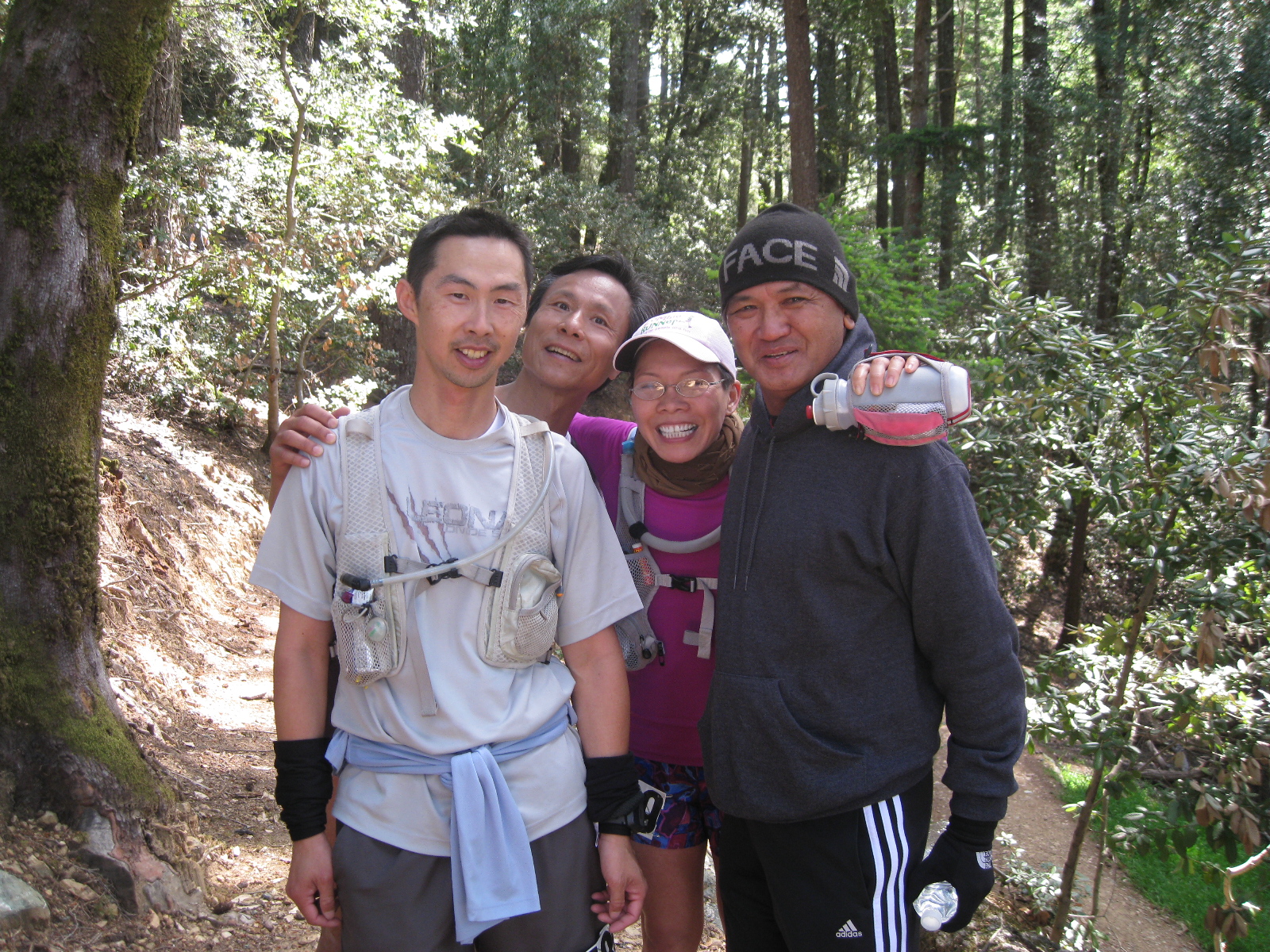
This is where I was able to meet Geraline Harvey, a Filipina runner from Ontario, Canada who greeted me with the words “Kumusta kayo?” After a few seconds, Carmela Layson and her group approached me as I was cheering them! At last, Carmela and I met in person. Actually, if ever I decided to push through with this race, it was my strategy in this race to stick to her all the way to the finish line. Carmela had been a veteran of Miwok 100! If ever I would have a chance to run in this race in the future, my race strategy would remain the same, I’ll stick on her tail. Carmela had been an active contributor of my Project Donate-A-Shoe! (Congrats, Carmela & Geraline for a successful finish!)
With Carmela and Friends at the Old Mine TrailWith Geraline of Ontario, Canada
Finish Line @ YMCA Point Bonita
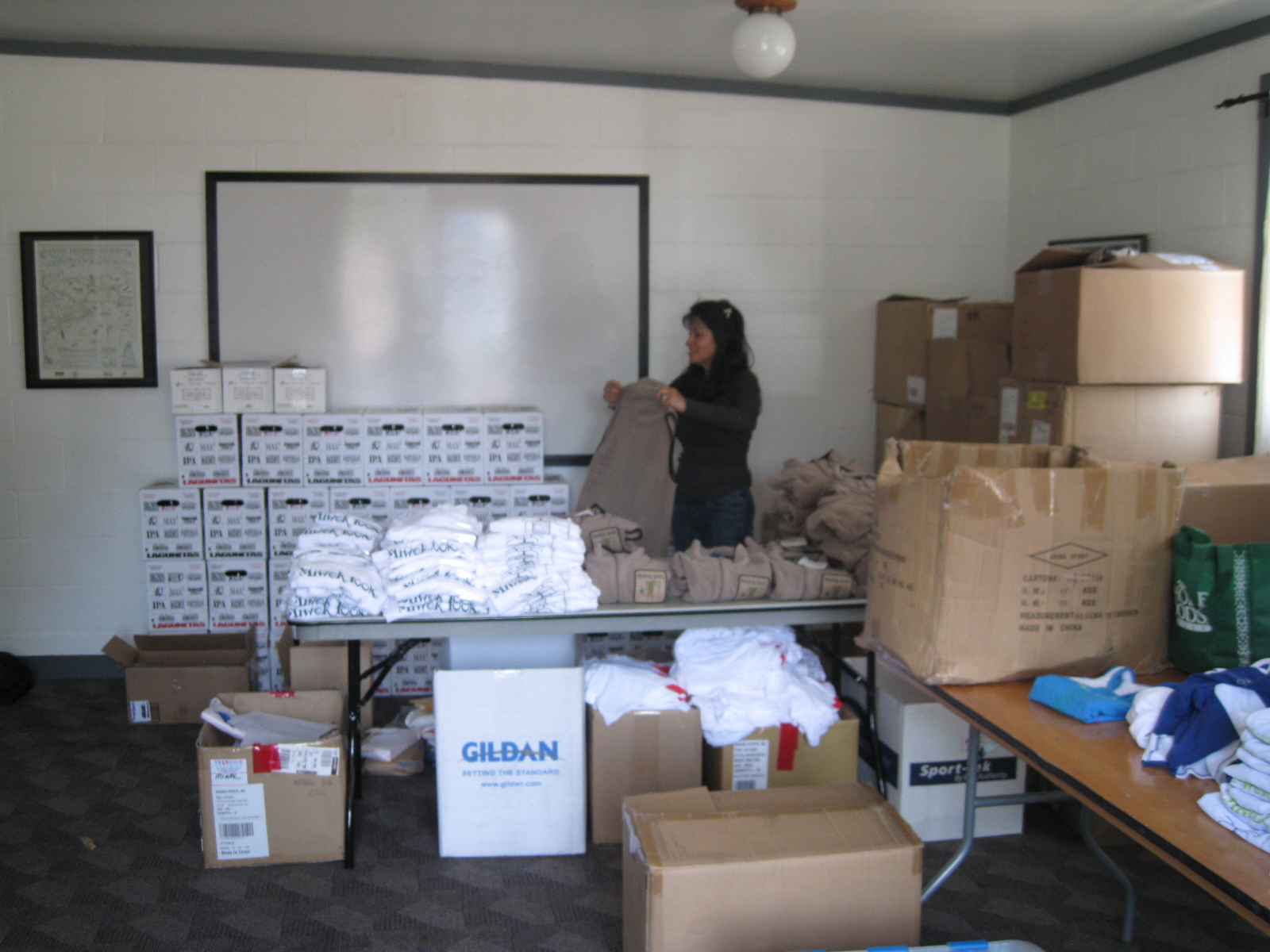
From this point, it was time to go to the Finish Area and try to help the other volunteers. I was able to meet Jorge and Rich (with ages in their late 20s) who are also ultra runners planning to earn their entry through the lottery for next year’s edition of the race. There was another lady runner who was supposed to run but due to stress fracture on her legs, she opted also to volunteer. We helped in organizing the different “schwag” for the runners and preparing for the BBQ Party venue after the race for all the finishers. It was worth the fun and time to be working and volunteering with the rest of the other senior and younger ultra runners.
Helping This Lady Runner Who Became One of the Volunteers For The SchwagFinisher's Shirts & Fleece Vests & Beers in White BoxesFinisher's Commemorative Plates
At 1:30 PM when the lead runner was a few miles away from the Finish Area, all the schwag were properly organized and packed. The job was done and the next job for me was to watch each of the lead runners cross the Finish Line. The plan was to wait for the arrival of Ian Sharman who was running the whole race as ELVIS before leaving San Francisco in order to catch up with the Pacquiao-Mosley Boxing Fight in Las Vegas!
Champion Dave Mackey Approaching The Finish LineHal Koerner At The Last Turn Before The Finish LineELVIS Approaching The Finish Line
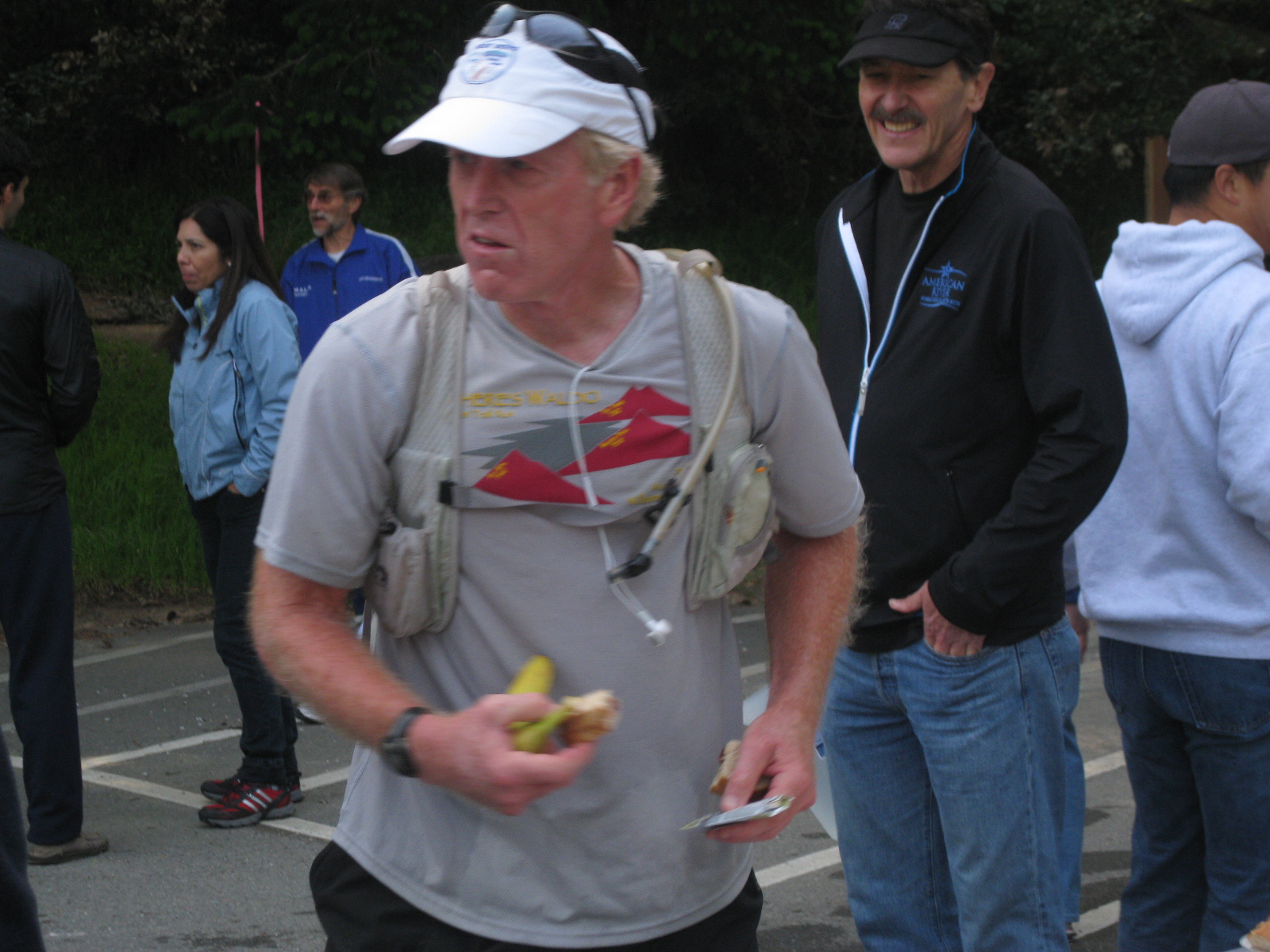
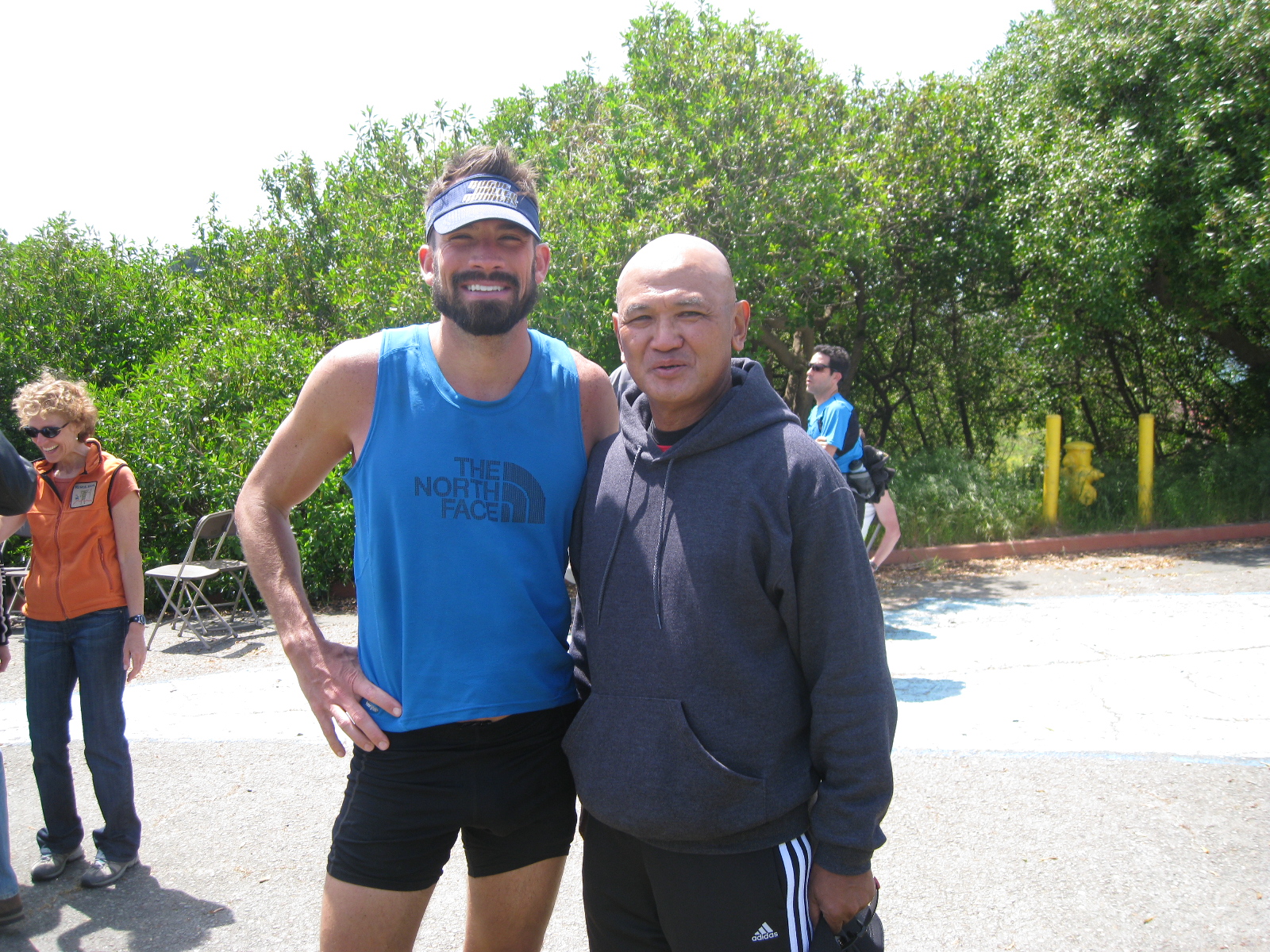
While waiting for ELVIS to cross the finish line, I was able to talk to the Front Runners/Top Finishers of the Race. It was nice talking to these wonderful guys in ultra trail running which ended with a brief pose with them.
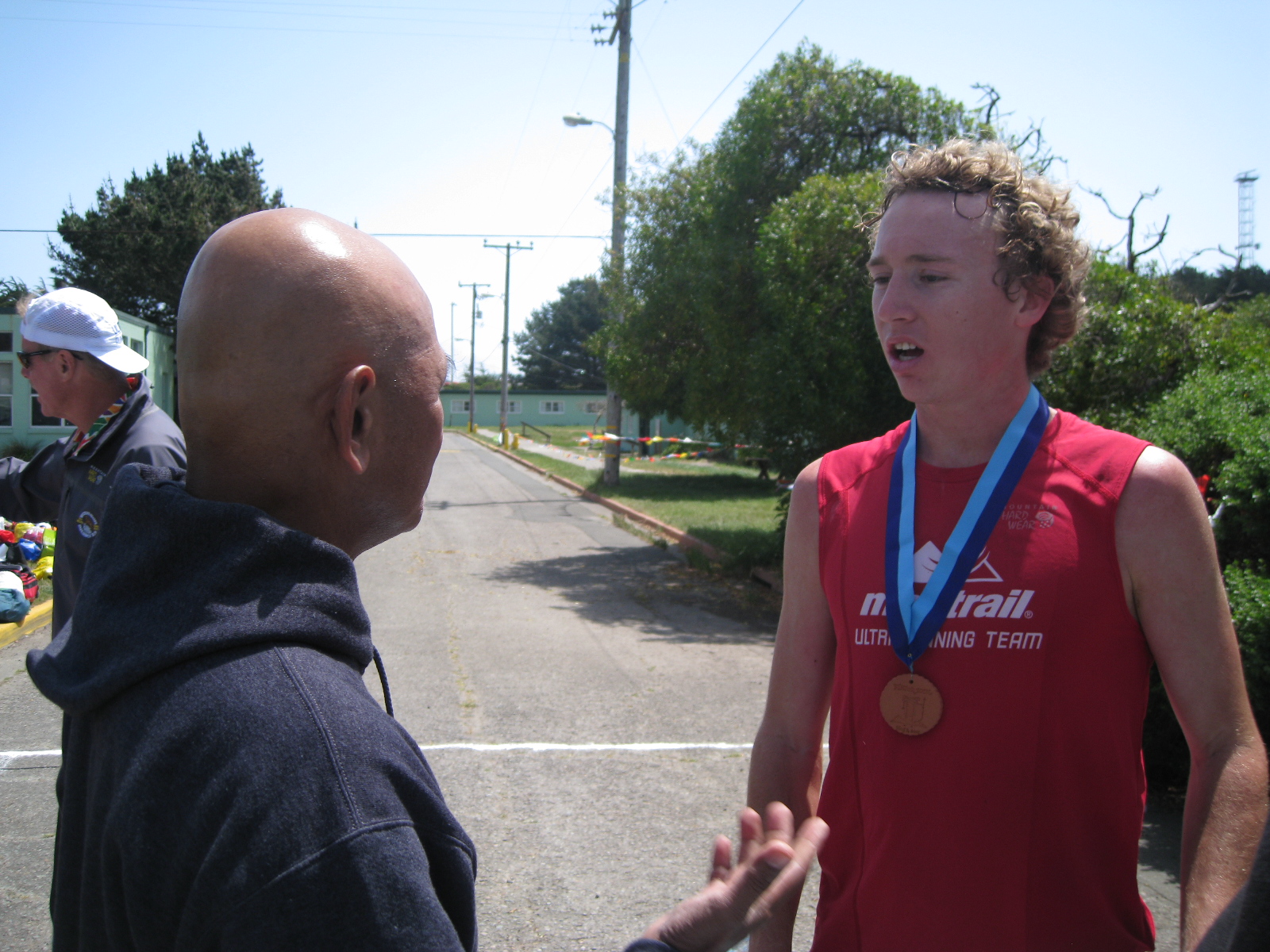
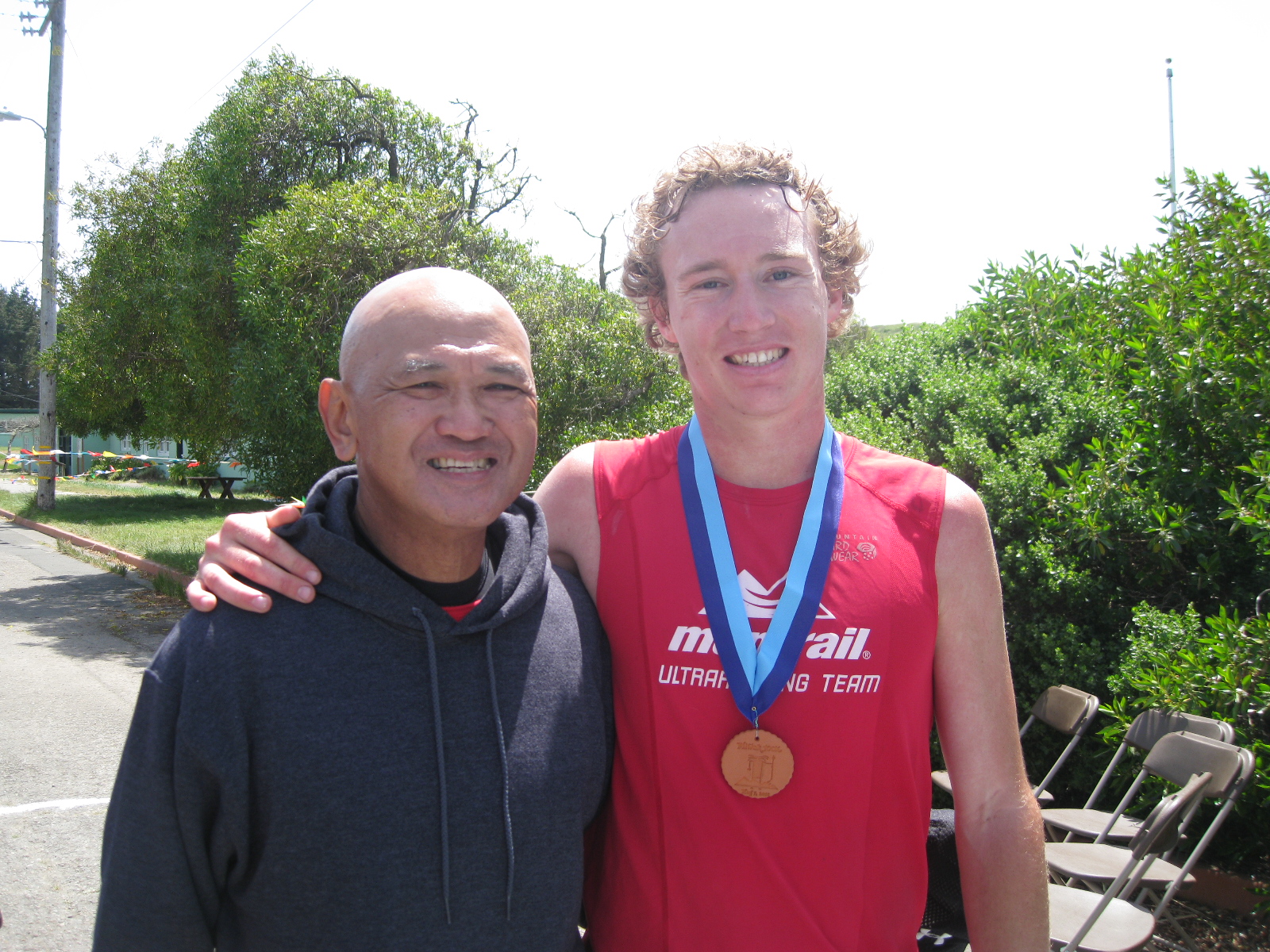
Congratulating & Talking To Dave Mackey & Mike WolfeA Pose With The Champion Dave Mackey & Mike Wolfe, 1st Runner-UpHal Koerner, Champion of 2009 & 2007 Western States 100-Mile Endurance RunTalking To Dakota Jones, 4th Placer in the 2011 Miwok 100A Pose With The KidTalking With The ELVIS in UltrarunningIan Sharman Finished in 10th Place & Bound For Comrades Ultramarathon This Month
After about 10 hours of volunteer work at the 2011 Miwok 100K Ultra Trail Race, I really enjoyed and had fun for being a part of the race as one of the volunteers. As an spectator, I was able to interact with the top runners in ultra trail running in the United States which I could not have a chance to do such if I finished the race in 15-16 hours. For sure, they are already sleeping in their houses as I cross the Finish Line!
Before I left the Finish Line area, I talked and thanked Tia for being a part of the Volunteer Group for the event and told her about my early departure to catch a flight to watch the Pacquiao-Mosley Fight in Las Vegas. In return, she thanked me also for being a part of the Volunteer Group for the event . She assured me also that I will be coming back to run the 2012 Miwok 100!
The results of the 2011 Miwok 100 are published here.
Raul and Perkins of A Runner’s Circle in Manila asked me to watch the movie on DVD entitled “Running America”, when I visited the store before the Mayon 360 50-Mile Run. They lend to me the DVD of the said film and returned it after I saw the entire film. The film “Running America” is about the documentation of the Trans-Continental Run Across the United States of America by two famous ultramarathon runners, Charlie Engle and Marshall Ulrich, which was held sometime before the US Presidential Election in 2008 with Marshall Ulrich finishing the run by himself.
What impressed me about the film is the portion where Marshall Ulrich was gracefully using the use of trekking poles while he was running. Actually, it was my first time to see a runner using the trekking poles while he is in the act of running on a paved road. I usually see the use of such poles when I watch downhill slalom, biathlon and other cross-country ski sports events on the TV. Lately, I saw some runners at the UTMB (Mont Blanc Ultra Marathon) using such trekking poles as part of their equipment to finish the race. Films on UTMB with runners using and carrying trekking poles could be seen at You Tube.
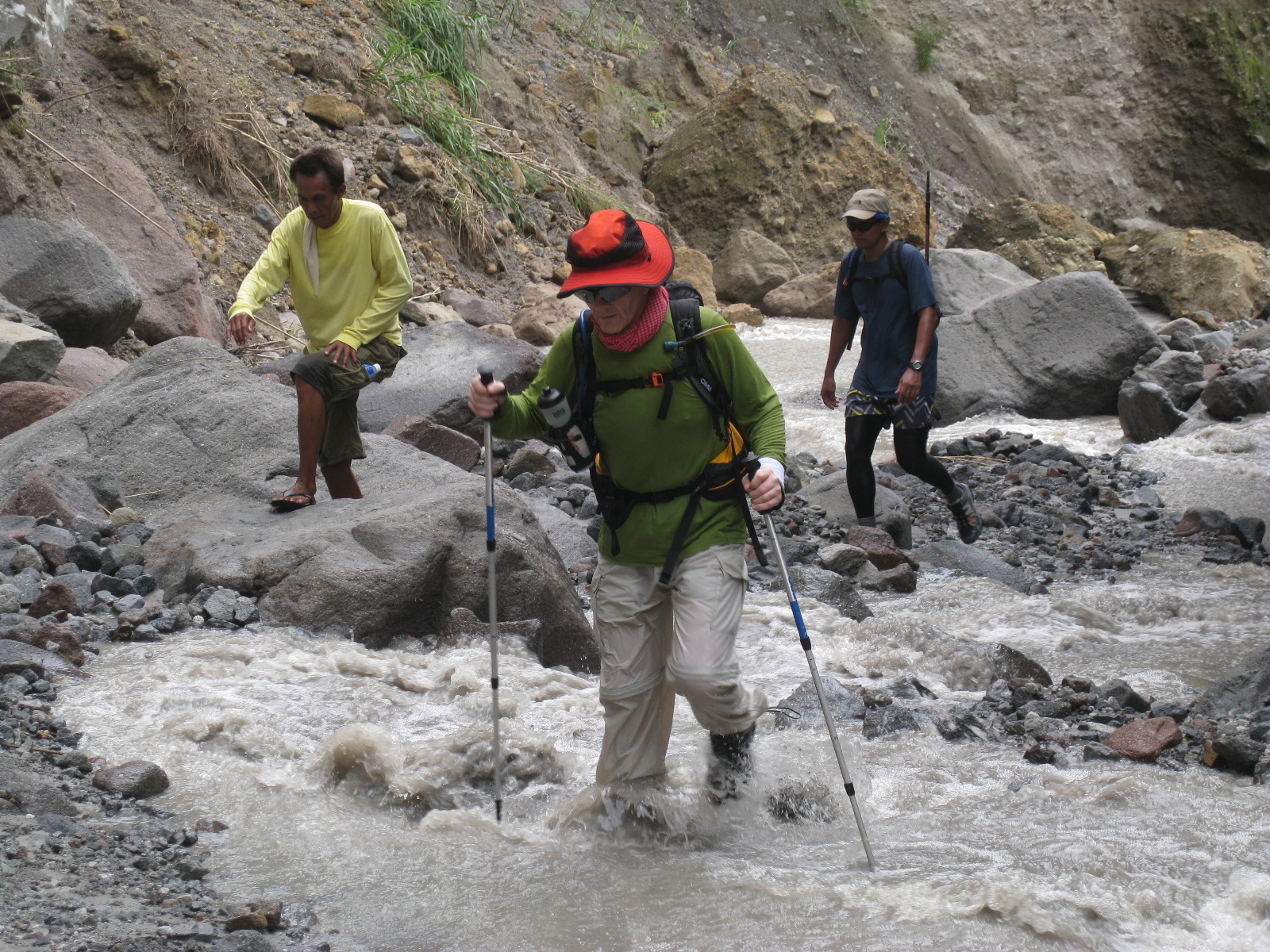
In the Philippines, I saw only two (2) ultra runners who had been using these trekking poles on a trail run. The first one was Doc Punzalan of Pinoy Ultra Runners (PUR) in 2008 when I joined his group for my first trail run to Mount Pinatubo. The second guy whom I observed to be using these poles was Jerome Cartailler during my second run to the same area, Mt Pinatubo in July 2010. I saw these guys how they used such trekking poles while they brisked/power walked along the rocky portions of the trail and when they balanced themselves in crossing the river and other water crossings. I was not surprised that these good ultra runners had the appreciation to use these poles. Doc Punzalan had experienced running the UTMB and Jerome is from France, one the countries where the UTMB course would pass.
Jerome Cartailler Using His Trekking Poles To Mt Pinatubo
After those observations (years ago), I’ve tried to look for those trekking poles in the local market and it was at ROX where I found a pair that costs about P 6,000 (?). I was surprised to see the price and opted just to hold them. And I forgot all those trekking poles!
I know that most of the Pinoy mountain trekkers/hikers know the value of these poles and to some of the TNF 100 trail run participants. However, I have yet to see one of them using these trekking poles in action.
But, running with trekking poles on paved roads? It is something that is unthinkable and out of the norm. But I was intrigued when I saw that part of the film where Marshall Ulrich was using these poles on the paved roads across America. So, I made some research on the Internet.
I was able to find out the following through some research on the Internet:
1. Nordic walking which was known before as “ski walking” using ski poles was a good off-season workout for elite Finland/Scandinavian ski athletes to maintain their consistency in their sports. Ski coaches concluded that the use of trekking/ski poles during summer contributed to the success of world-class ski athletes. Ski athletes would train the whole year round using the trekking poles.
One of the Pictures Taken From The Internet On Nordic Walking
2. The use of trekking poles on power walking or running would lessen the impact of the feet on the ground as the weight of the body would be supported by the trekking poles. This form of running/walking is suggested as cross-training for those athletes who are recovering from knee injury or those who are under leg-injury rehabilitation.
3. There are lots of instructional films on the Internet/You Tube on Nordic Walking/Running. All you have to do is google the word “Nordic Walking”.
4. There are a Sports Federations for Nordic Walking in the United States and other European countries which had been in existence for the past 10-14 years.
5. There is a Marathon (42K) Race on Nordic Walking at the Portland Marathon which is on its 5th edition this year. Rules and Regulations are posted in their website. In Europe, there are already existing Nordic Walking Championship Events.
7. Almost all the ultra trail races in Europe allow the use of trekking poles. In the most prestigious UMTB, most of the runners have in their packs a pair of folded trekking poles.
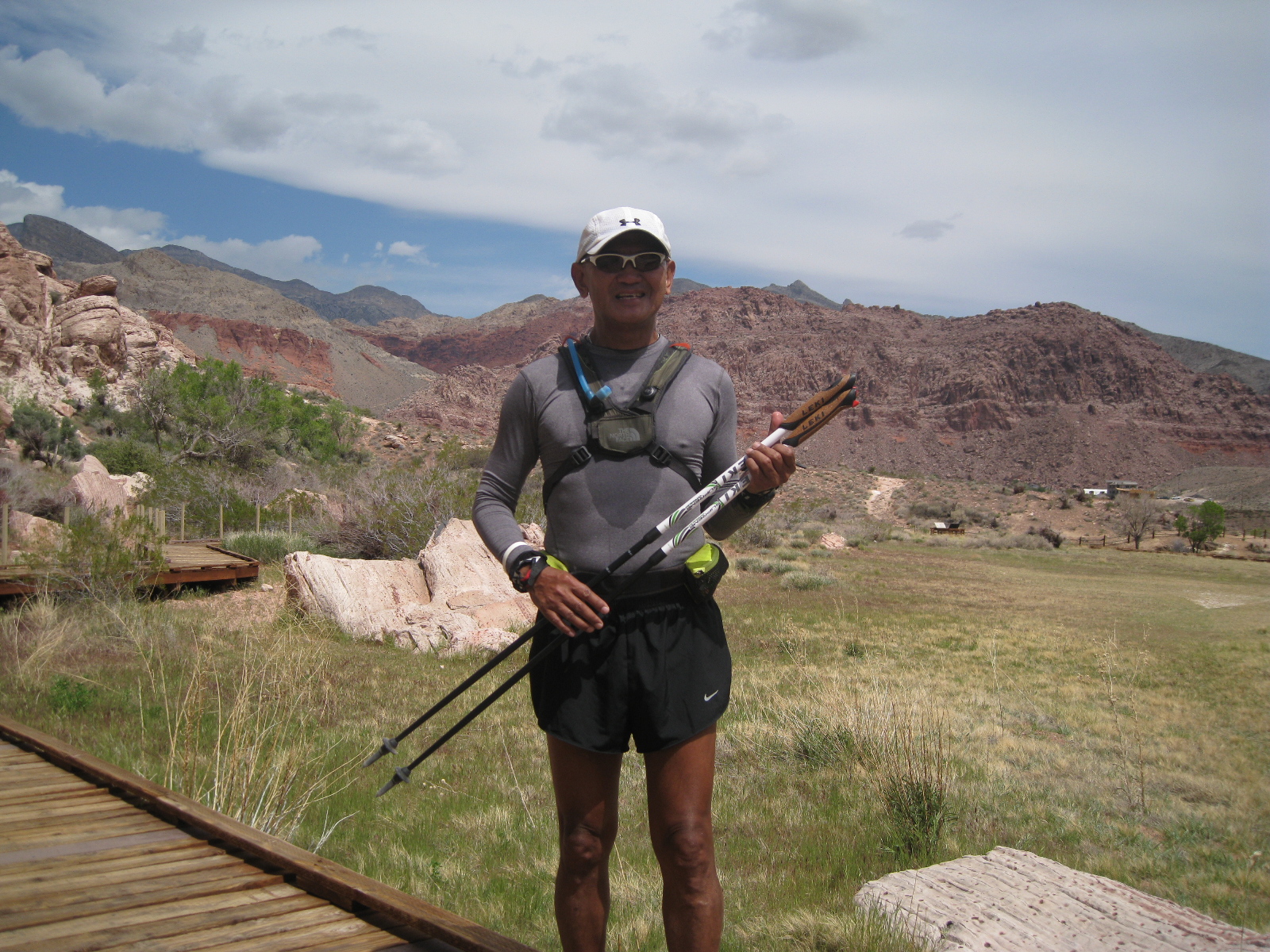
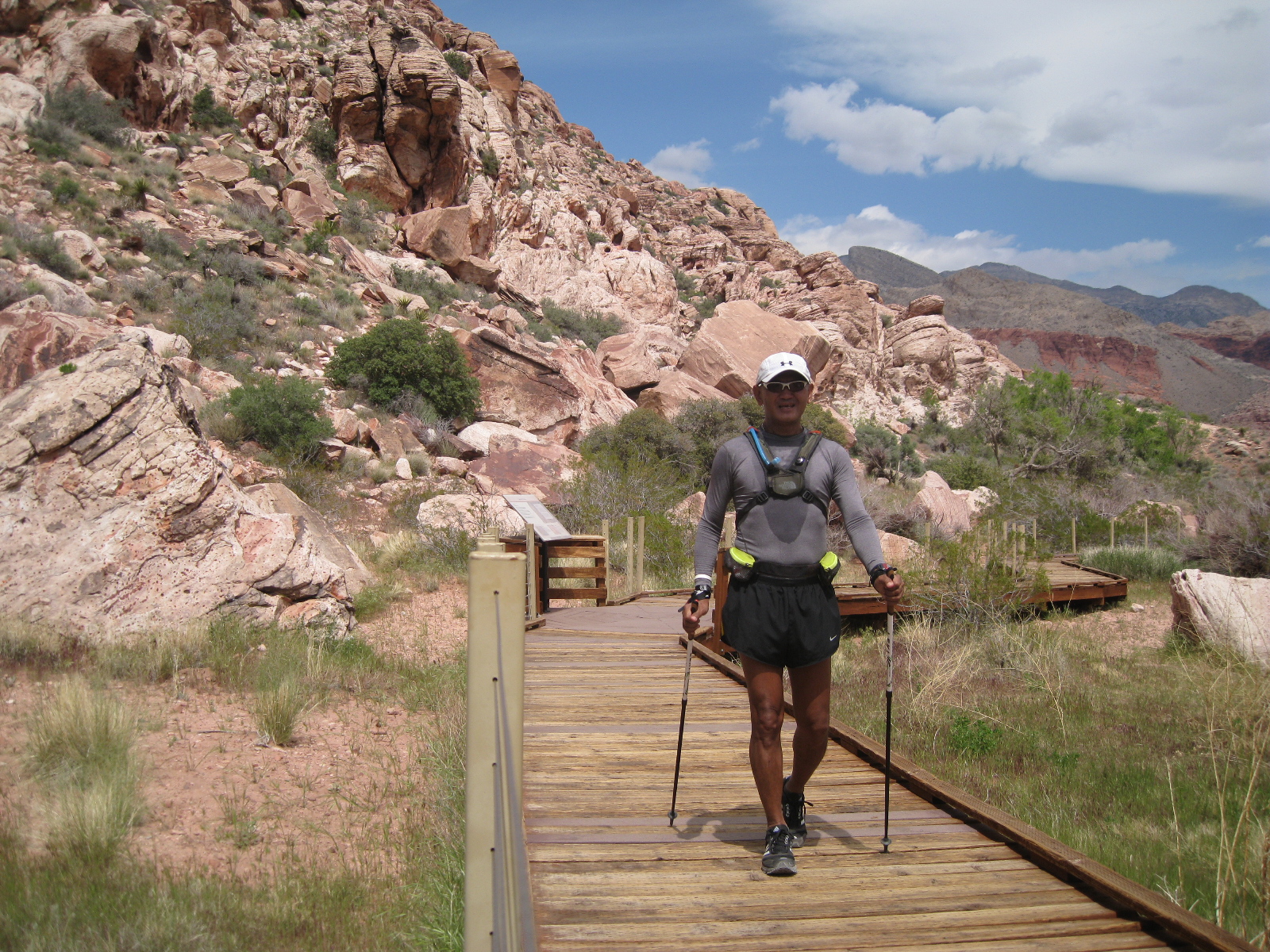
For the past two weeks, I’ve been using a pair of LEKI Titanium Trekking Poles during my regular power walking and I even went to the extent of running with them for 3 hours along the rocky Calico Hills Trail of the Red Rock Canyon Park in Las Vegas, Nevada.
With My LEKI Titanium Trekking PolesEasy Effort On Nordic Walking
I could say that the use of trekking poles on technical trails would lessen the impact of my feet on the ground, making my knees less sore and painful after my run on the trails. With regards to running on the paved roads with the trekking poles, I am confident that I can already run with the same ease and grace like Marshall Ulrich! (Note: It is purely coincidental that I bought LEKI trekking poles, the same trekking pole brand that Marshall Ulrich used in all his adventure runs to include his feat in “Running America”)
Running and/or walking with trekking poles is a great cross-training activity for me as an old and under rehab average competitive runner.
With my present exposure and training with the trekking poles, I am thinking of allowing their use in the incoming PAU’s Pinatubo 100 to all the participants.
I will be glad to know about your comments on this.
















 Bald Runner
You must be logged in to post a comment.