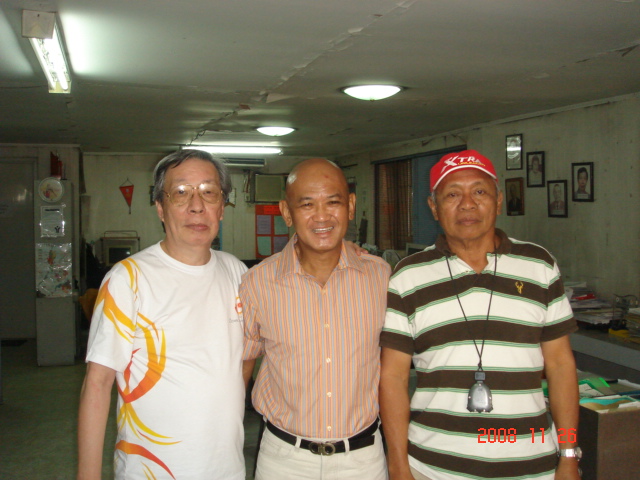
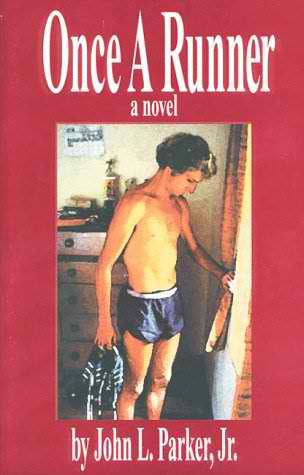
Once A Runner: A Novel


“Once A Runner” by John L. Parker, Jr.

The author has written for Outside, Runner’s World, and numerous other publications. He was the Southeastern Conference Mile Champion three times, and the United States Track and Field Federation National Champion in the Steeplechase, and was teammate of Olympians Frank Shorter, Jack Bacheler, and Jeff Galloway on several championship cross-country teams. He is a journalist, practicing lawyer, and had been the Editorial Director of Running Times Magazine. (Note: The author should be as old as Jeff Galloway!)

This book was first published in 1978, at least one year after the “Complete Book On Running” by Jim Fixx was published, and it was written as a novel about a mile-runner, Quenton Cassidy while he was studying to earn a College Degree with a time setting in the mid-70s. It was mentioned that the author had sold copies of this book on the back compartment of his car every time he attended road races during weekends and copies of this novel had been circulating from one runner’s hand to another.

Looking at the profile and background of the author, this novel could be easily analyzed as the author’s personal account of his life as a college student and a passionate runner who would like to cross the barrier of sub-4-minute mile during those times.

Elite runners, ultra trail runners, and runner-authors/writers have considered this book as the best book ever written about running. I’ve read this book’s title being mentioned by most of the runner-authors who considered this novel as the best story being written about a runner. They say it’s a “classic”. Others would say that you are not a full-blooded runner if you don’t have a copy or have read this book. It is also being mentioned as part of the Runner’s Etiquette/Rules for a runner to have read this book if he is really a true runner. It is for this reason why I had to buy this book when I had a chance to see one at the Zombie Runner Store in Stanford, California.

I was not frustrated when I found out that the book speaks for itself. It is really the best book for a runner and every runner should be able to read it.

I’ve repeatedly read this novel for three times already. This is always my companion whenever I travel from Manila to other parts of the country when I board the local flights.

Cover Page of Older Publication of the Book (Photo From Wikipedia)

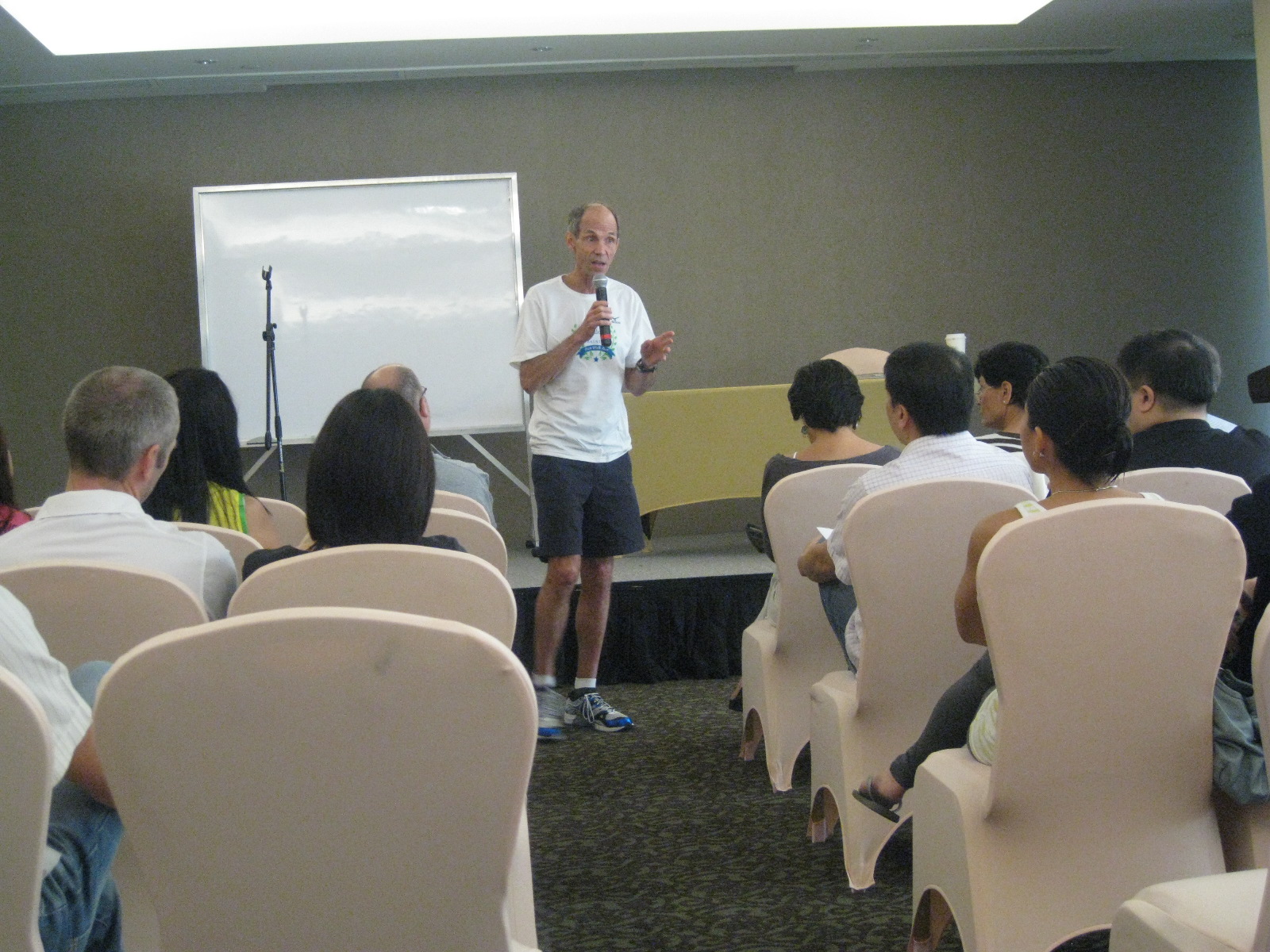
Jeff Galloway’s Lecture @ Oakwood


Weeks before the arrival of Jeff Galloway to the country, I was invited by Lit Onrubia after he crossed the Finish line at the Rizal Day 32K Run to attend in one of the scheduled lectures. On the other hand, a few days after,  Jerome Cartailler, BDM 102 veteran/PAU runner and resident chef of Oakwood Premier also extended his invitation for me to attend a “shorter” version of Jeff Galloway’s Lecture at the said hotel. I learned later that Jeff Galloway stayed at the said hotel during the duration of his stay in Manila.

I opted to join the lecture at the Oakwood Premier as it suited to my schedule for the said weekend. Twenty minutes before the scheduled start of the activity, I was already at the venue with another runner. Jonel Mendoza of FrontRunner Magazine joined later and Lit Onrubia of Chi Running was also there as he acted as the host and moderator of the event.

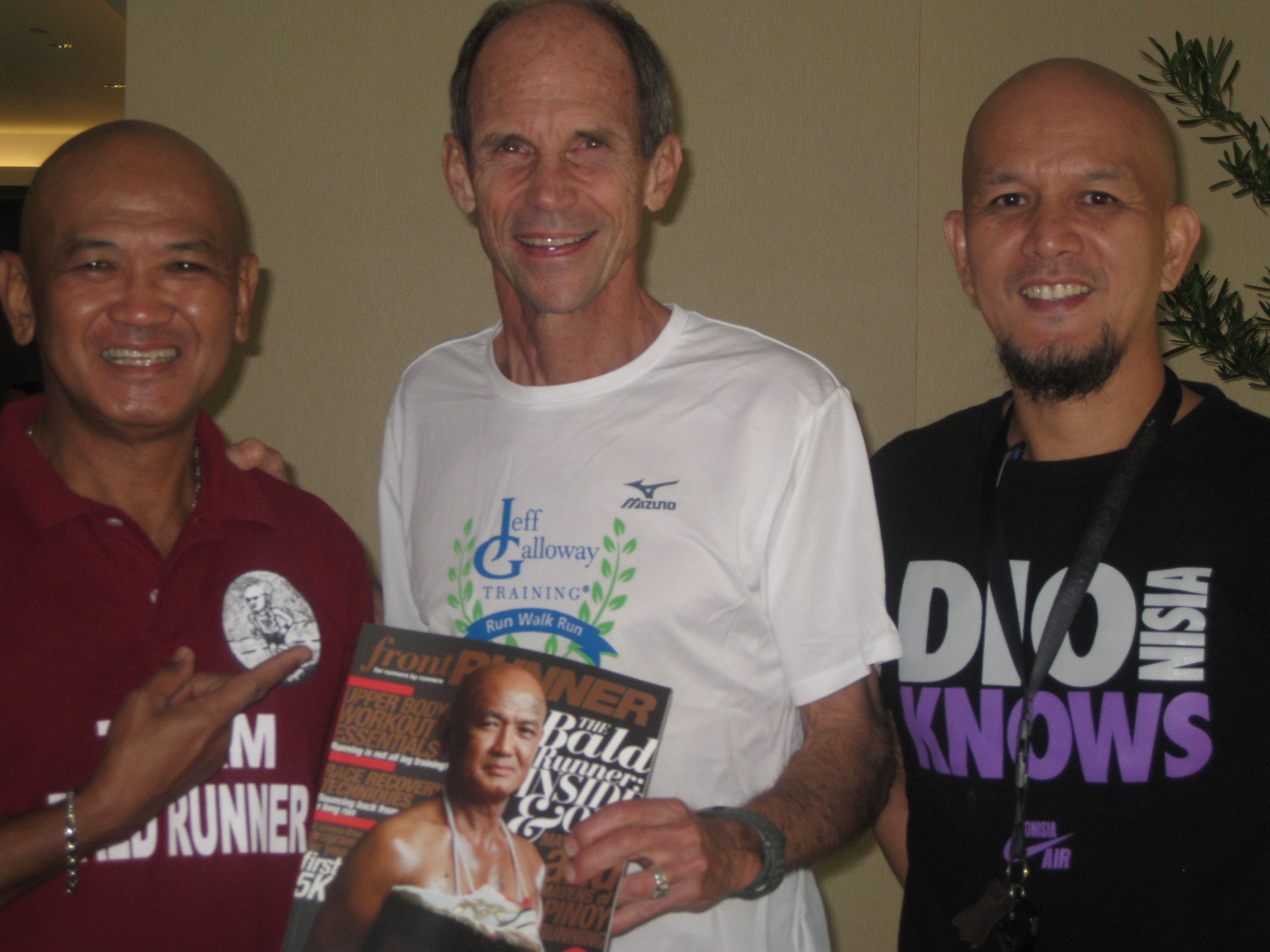
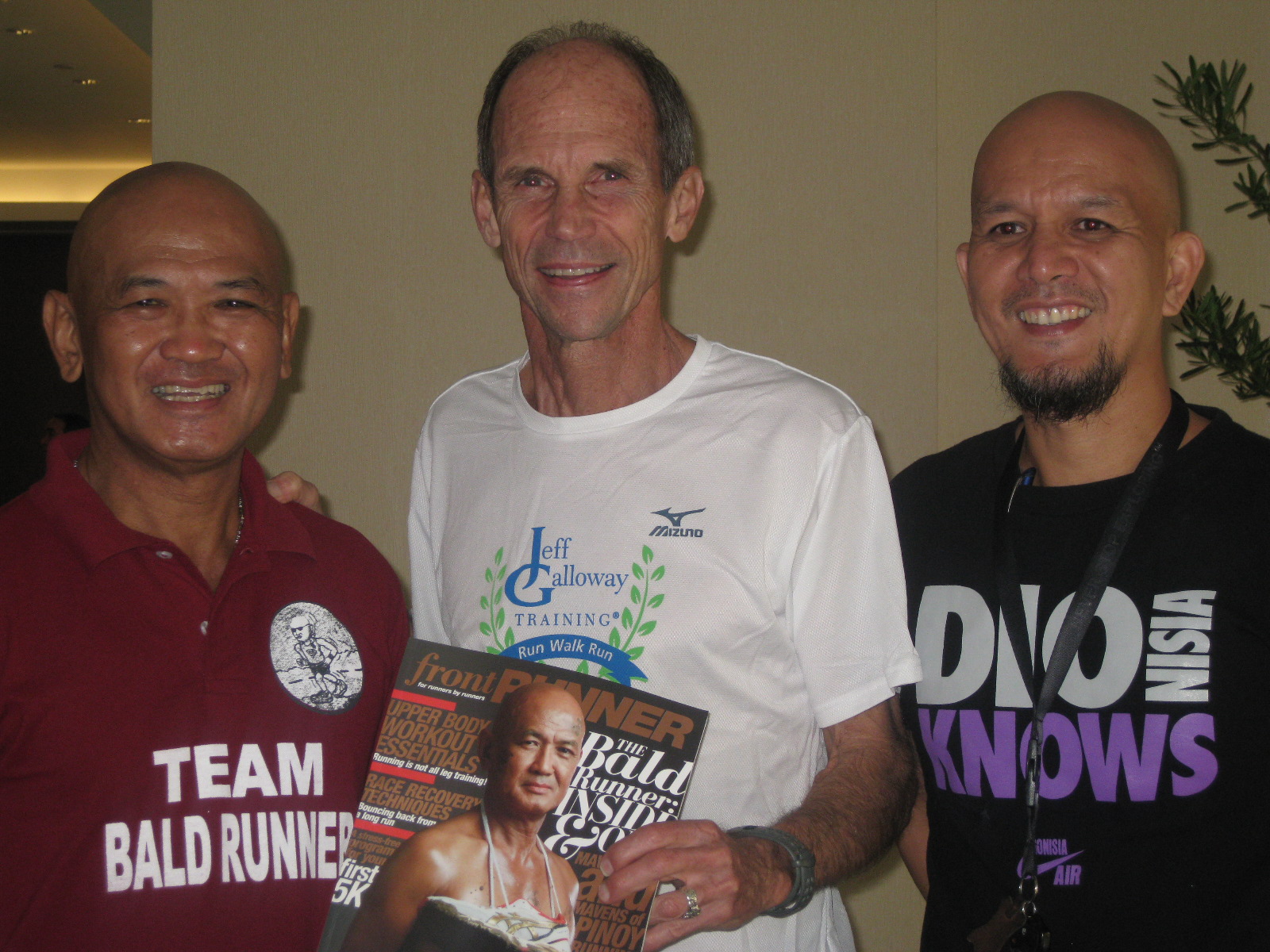
As soon as Jeff Galloway entered the lecture area, Jonel and I approached him and we started a conversation with him. As usual, Jonel was the more articulate and talkative one for the introductions and Jonel “trapped” Jeff Galloway with copies of his FrontRunner Magazine as he gave Jeff lots of them. The “blitzkrieg” approach led to a special pose for picture with the guest lecturer!

Number 1!!! BR, JG, JM

I could sense that Jeff Galloway knew things about me and Jonel (He could have visited my blog or had been well-informed by his Hosts about the running community and the running magazine of Jonel). He started a topic where he informed us about his son, Brennan Galloway, a running film producer who made lots of running films about the famous “minimalist” ultra trail runner, Anton Krupicka. There you go, Jeff knows that we are ultra marathon runners!

After a few conversations with the guests and Jeff, the lecture started at least 10 minutes late from the schedule which was okey with us as more interested guests were entering the venue. At least, 40 guests were present during the lecture.

Jeff Galloway had been in the country when he was still in the active military service as he was with the US Navy in his younger years. He knows about Subic and Olongapo, of course! He did not mention the particular year when he was here in the country. I could only guess that he was here during the Martial Law years under the administration of former President Marcos. (Note: Dr George Sheehan, a runner, writer and lecturer was also with the US Navy rising to the rank of Navy Captain).

One Hour Lecture Full of Information About Run-Walk Strategy

Jeff Galloway Lecture was geared towards his “The NO PAIN Marathon Program”. Let me quote the brochure which was available for all of us that explains the Jeff Galloway Method of Training:

  • Minimum workouts needed: 20-30 minutes on Tuesday and Thursday plus a weekend run.
  • Weekend Run gradually increases to goal distance in gentle increases, followed by short runs.
  • Walk breaks are inserted into every run, from the beginning, to erase pain and fatigue
  • Avoid running too fast by using a “magic mile” prediction exercise (MM).
  • Many surveys have shown that taking walk breaks early and often result in faster finish times.

The “Magic Mile” can predict current potential and set long run pace. You should be able to time yourself for one mile (4 laps around the oval track) about every 3 weeks and the following Run-Walk-Run Strategies should be followed depending on your pace (per km or per mile).

Pace Per Km Pace Per Mile Run/Walk Amount
4:58 8:00 4 min/30 sec
5:16 8:30 4 min/45 sec
5:35 9:00 4 min/1 min
6:12 10:00 3 min/1 min
6:50 11:00 2.5 min/1 min
7:27 12:00 2 min/ 1 min
8:04 13:00 1 min/ 1min
8:41 14:00 30 sec/ 30 sec
9:19 15:00 30 sec/ 45 sec
9:56 16:00 20 sec/ 40 sec
10:33 17:00 15 sec/ 45 sec
11:11 18:00 10 sec/ 50 sec

 More interesting insights and information were gathered during the “Open Forum” where Jeff Galloway was able to answer questions from the guests. Some of the pointers were the following:

  • He does not recommend stretching exercises  for long distance runners
  • Extensive Long Slow Distance Run (LSD) every 3 weeks in the Marathon Program
  • More Long Runs For Endurance rather than Speed runs
  • “Speed Training” is NOT recommended for the 1st time Marathon runners. They should simply enjoy the experience and have fun
  • On Core Strengthening, he recommends two (2) workouts: “Arms Swinging with Light Weights” (natural form when running) and Abdominal “Crunches”
  • Running is controlled by the Brain Function
  • On running compression tights, no benefits on the performance of a long distance runner. However, there are studies that compression calf sleeves are the most beneficial to runners. He highly recommends such apparel to long distance runners.
  • Water hydration during the race is the only thing that is needed during a marathon race.
  • It takes 24-48 hours for the body to absorb the replacement electrolytes from Sports Drinks like Gatorade, PowerAde, Propel, Pocari Sweat, and others.
  • Carboloading from foods rich in carbohydrate taken a day before the race is beneficial.

On a personal note, I don’t agree with his answers about his view on the unnecessary need of sports drinks and food being ingested during the marathon race. In a country like ours, the heat and humidity make our body metabolism faster and there is a need for sports drinks and food to be taken in somewhere along the marathon distance. He thought that Philippines is like Taiwan, South Korea, Japan or the United States where the temperature is too low that a runner could hardly perspire during a marathon race.

I could follow the Run-Walk-Run Galloway Method in an ultra running event to last and finish the distance but I will never walk in a Marathon Race where my goal is to finish a better PR best time.

Ironically, in my collection of running books, I found out that I don’t have any of the books written by Jeff Galloway.

One Hour With Jeff Galloway


Jeff Galloway is in town! He is lucky to meet the Bald Runner and FrontRUNNER Magazine’s Publisher!

BR, JG, & FR

Details of his One-Hour lecture and meeting will be posted soon!

“Classic” Running Books


 Aside from being “classic” and being sought after, the following books are considered as the best books in running that greatly influenced people from their sedentary life to being active through running. These books contributed in the resurgence of “running boom” in the United States and in other countries.

Few minutes before the start of the 2nd PAU “P2P” 70K Run last Sunday, Paolo Osmena, a PAU member and BDM 102 veteran, gave me these three (3) “classic” running books which I consider as “collectors’ items” for seasoned runners. I was surprised and humbled by the generous gesture of Paolo of giving me these “treasures” among runners. Thank you very much, Paolo!

1st Book That Started The Popularity of Running

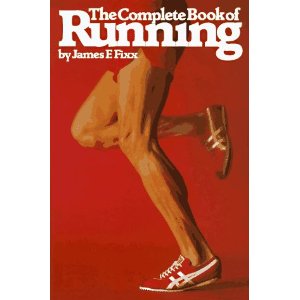
 The Complete Book of Running by James Fixx was published in 1977 and it became as the best selling book for that year. I tried to look for this book in the 70s and 80s in the local bookstores but it was not available. While I was on schooling in Fort Benning, Georgia in the mid-80s and during my stay in Los Angeles after my schooling, I was not able to buy or look for this particular book, to include the other two books. There was no Amazon.com at that time yet. So, when Paolo gave  me this book, it was my first time to actually hold and browse the pages of such book.

The red color of the cover, the running legs of the author, the red running shorts, and the red ASICS racing shoes were properly conceived as a “marketing” ploy for the book and it was a success. Nowadays, you seldom see red running shorts, red ASICS racing shoes, and running without socks!

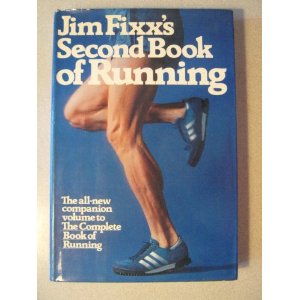
2nd Running Book By James Fixx

The Second Book of Running by the same author was published in 1980 but it did not create the same magnitude of popularity of the first book. It would be noted that the color of the cover page was in blue—blue running shorts, blue Adidas running shoes, running without socks, and the same running legs of the author. Four years after this book was published, the author died due to heart attack after completing his daily running workout. He was 52 years old. 

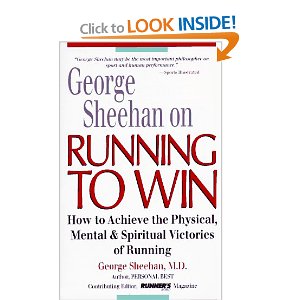
One of the Books Written By George Sheehan

 Dr George Sheehan is considered as the modern day “philosopher of running”. He was a cardiologist in profession but became popular due to his writings about running with an essay he wrote every week in local newspapers and later with the Runner’s World Magazine. He died at the age of 75 due to prostate cancer. This particular book was the second to the last book that was published before he died in 1993. This book is a compilation of the essays he wrote and published in his column/page with the Runner’s World Magazine.

On a personal note, Paolo is sending me a “message” by giving these most treasured books about running. He is telling me to write and publish also a book about my entries in this blog which had been my plan for the past years. It is a dream to write a book as a compilation of all the entries of this blog and it is a matter of organizing them from one general topic to another. I know that this dream will become a reality.

Thanks, Paolo!

 (Note: Photos of the books were taken from Amazon.com)

Official Result: 2nd PAU 70K Run


  2nd PAU 70K Run Official Result
  Pasuquin to Pagudpud, Ilocos Norte
  August 29, 2010
       
  NAME TIME  
1 Reynaldo Pascua 6:29:10 Champion (Male)
2 Moses Moreno 6:46:57 1st Runner-up (Male)
3 Raul Patubo 7:14:20 2nd Runner-up (Male)
4 Hermogines Olvis 7:20:25  
5 Rizaldy Juan 7:49:13  
6 Jonnifer Lacanlale 7:53:11  
7 Christopher Rodriguez 7:56:32  
8 Jose Mari Javier 8:00:18  
9 Eduardo Madariaga 8:03:13  
10 Michelle Estuar 8:06:46 Champion (Ladies)
11 John Frederick Abenina 8:16:12  
12 Jonel Mendoza 8:20:37  
13 Sandy Alentajan 8:29:10  
14 Graciano Santos 8:32:52  
15 Armand Fernando 8:38:08  
16 Alfred Delos Reyes 8:45:06  
17 Junrox Roque 8:45:13  
18 Julius Savella 8:45:14  
19 Wilnar Iglesia 8:45:15  
20 Siosan Baysa 8:50:15 1st Runner-up (Ladies)
21 Paolo Osmeña 8:51:47  
22 Carly Dizon 8:52:16 2nd Runner-up (Ladies)
23 Camilla Brooks 8:59:00  
24 Albert Sama 9:12:38  
25 Raul Tapia 9:13:58  
26 Dennis Ravanzo 9:27:07  
27 Jose Dueñas 9:32:07  
28 Albert Henson 9:45:38  
29 Bonifacio Dalisay 9:45:39  
30 Simon Miranda 9:46:20  
31 Jereven Adriano 9:47:00  
32 Rodel Cuaton 9:51:54  
33 Jose Wacangin 9:51:55  
34 Lymuel Pascua 9:55:59  
35 Berns Tan 9:56:21  
36 Jade Lee 9:56:22  
37 Mark Adrian Hernandez 9:56:59  
38 Jeffrey Avellanosa 10:01:28  
39 Oscar Sañez 10:07:27  
40 Christine Ferrera 10:09:44  
41 Jeremiah Isip 10:09:45  
42 Chips Dayrit 10:17:21  
43 Roberto Delos Santos 10:18:45  
44 Henry Realgo 10:24:07  
45 Mon Marchan 10:26:26  
46 Earl Quero 10:27:48  
47 Carl Noel Balagot 10:29:48  
48 Ria Go Tian 10:31:40  
49 Wellington Yao 10:32:32  
50 Chester Puno 10:38:43  
51 Emerson Go Tian 10:39:23  
52 Allen Aguilar 10:39:48  
53 Michael Angelo Fabian 10:40:31  
54 Joseph Baltazar 10:41:08  
55 Ronnel Go 10:41:09  
56 Precy Hernandez 10:45:29  
57 Noel Hernandez 10:45:30  
58 Edward Villareal 10:49:12  
59 Warren Earl Navor 10:49:13  
60 Faivo Bartolome 10:49:55  
61 Shiela Compendio 10:50:14  
62 Charit Agana 10:51:13  
63 Allen Gaspar 10:52:51  
64 Christian Oting 11:04:40  
65 Rogelio Alejandro 11:12:53  
66 Frederick Gabriel 11:13:04  
67 Francisco Lapira 11:13:11  
68 Grimaldo Anecito 11:18:05  
69 Kessel Que 11:21:45  
70 Cecil Morella 11:23:19  
71 Chito Carreon 11:26:10  
72 Mel Severino 11:26:13  
73 Yul Antonio Almayda 11:32:56  
74 Nicomedes Jaranilla 11:35:05  
75 Blas Ople Tiangco 11:37:16  
76 Reynaldo Jimenez 11:37:30  
77 Jael Wenceslao 11:37:36  
78 Jeff Adriatico 11:45:10  
79 Mikko Barranda 11:45:10  
80 Ivy Macainan 11:45:45  
81 Camillo Kagaoan, Jr 11:48:17  
82 Elma Gabriana 11:48:24  
83 Bhrein Salazar 11:48:43  
84 Ronnie Gabriana 11:49:15  
85 Chinky Tan 11:49:26  
86 Lemuel Narcise 11:51:56  
87 Junar Layug 11:54:48  
88 Benedict Meneses 11:58:18  
89 Randolph Camalig, Jr 11:58:36  
90 Edwin Rara 12:00:31  
91 Samuel Narcise 12:03:52  
92 Rosgar Apolinario 12:05:01  
93 Ricardo Cabusao, Jr 12:05:23  
94 Karen Kate Pascual 12:06:24  
95 Craig Logan 12:09:31  
96 Emil Ancheta 12:13:23  
97 Aaron Anievas 12:14:32  
98 Emiliano Burgos 12:19:14  
99 Vic Viola 12:31:21  
100 Angel Henson 12:31:22  
101 Jose Lorenzo Mina 12:32:50  
102 Marlin Marilag 12:35:04  
103 Roselle May Dadal 12:36:44  
104 Crisanto Ubungen 12:42:54  
105 Teresa Ybañez 12:50:54  
106 Marco Christopher Montaos 12:50:55  
107 Don M Co 12:55:26  
108 Francis Acop 13:00:38  
109 David Buban 13:04:24  
110 Arturo Virata 13:05:54  
111 Raymund Anthony Abenojar 13:13:54  
112 John Vincent Ong 13:16:34  
113 Galo Pira 13:26:20  
114 Carina Manansala 13:37:56  
115 Alfred Paul Paiso 13:57:40  
116 Ayette Padua 13:59:09  
117 Jimmy Ong 13:59:09  
118 Joseph Frederick Calulut 14:00:03  
119 Eugene Tariaga 14:29:33  
120 Norberto Mortel 14:30:08  
121 Ellen Abegail Castillo 15:19:16  
122 Yan Dizon 15:19:16  
  Angela Jacinto DNF  
  Grace Jacosalem DNF  
  Ryan Marquez DNF  

Rey Antoque: The “Old Warrior”


Rey Antoque is presently one of the Coaches of the Elite Team Bald Runner. His credentials as a runner speak for itself. He had been with the Elite Team for the past ten (10) months. What I like with him is that he started to train hard for the Marathon Race at the age of 33 years old, an old age for an elite runner for the Marathon distance.

His performance in Marathon Races in the 1990’s and early 2000’s speaks well of his focused training, dedication, perseverance, and determination.

On his first competition on Marathon Road Racing, Rey placed No. 4 in the 1990 Pilipinas International Marathon with a time of 2:24:06 hours which was considered at that time as the fastest time for a Filipino in a marathon race held in the country. He was 33 years old.

After one year of training for the Marathon distance, he placed #3 Overalll in the 9th PAL Manila International Marathon in 1991 at the age 0f 34 years old.

In 1992, the following year, he won as Champion in the 16th MILO Marathon with a time of 2:28:47 hours at the age of 35 years old. At that time, he won a Cash Prize of P 60,000.

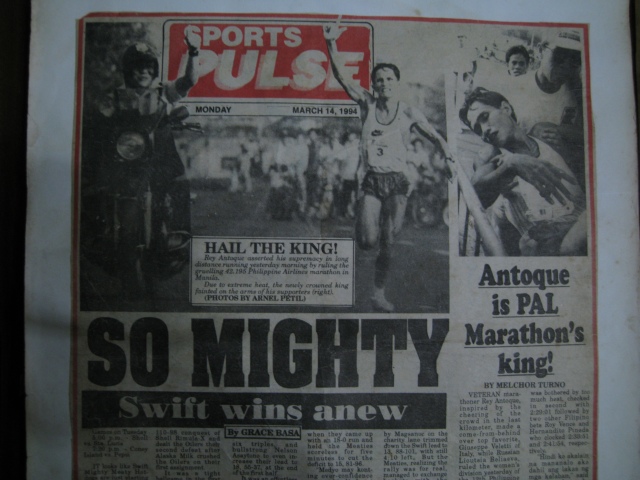
Picture Depicts The Intensity of Rey's Race & Finish

In 1993, he was the 1st Top Filipino and 2nd Overall in the Pilipinas International Marathon where a Belgian runner won as Champion. Rey Antoque improved his time at 2:27:32 hours.

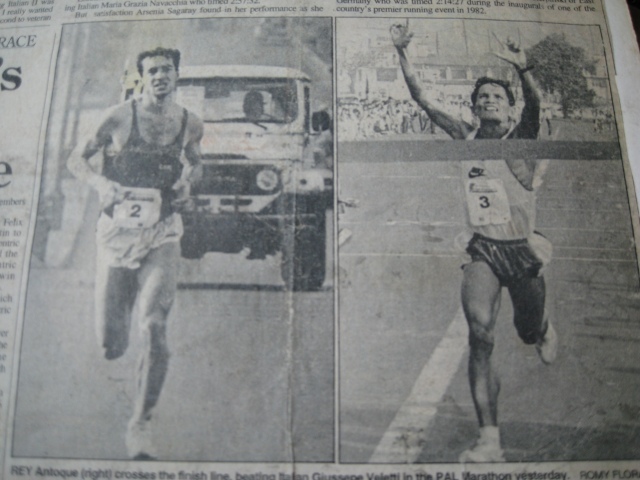
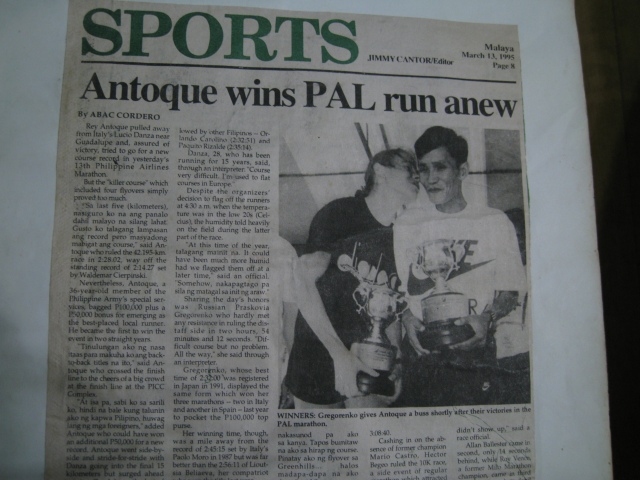
In 1994, he was the Champion in the 12th PAL Manila International Marathon on March 13, 1994 with a time of 2:28:24 hours. He was able to beat and overtook the younger Guiseppe Veletti of Italy who was then 25 years old on the last kilometers of the race. Antoque was then 36 years old.

Guiseppe Veletti of Italy & Rey Antoque

In 1995, the following year, he was able to defend his title as the Champion in the 13th PAL Manila International Marathon on March 12, 1995 beating again a younger Lucio Danza of Italy (28 years old) who was with Guiseppe Veletti. He registered a time of 2:28:02 hours at the age of 37 years old. He won P 100,000 as the Champion and additional prize of P 50,000 for being the Top Filipino Finisher.

Women's Champion Praskovia Gregorenko of Russia Gives Rey a Buss

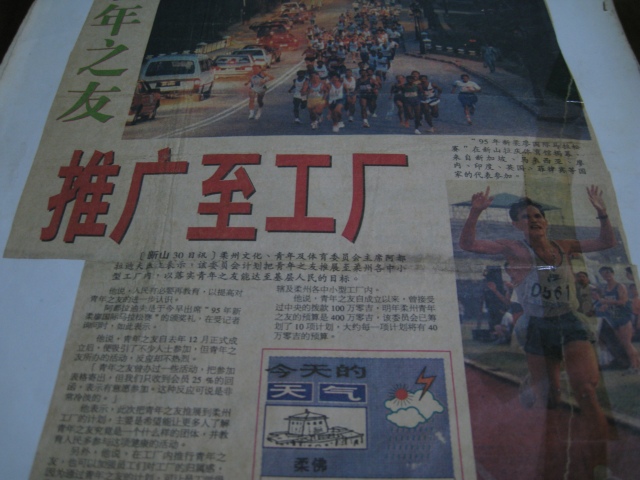
On July 30, 1995, he was the Champion in the 1995 SIJORI (Singapore-Johor Bahru-Riad) International Marathon Race held in Johor, Malaysia with a time  of 2:33:16 hours. He won a prize of RM 10,000.

Malaysian Newspaper With Rey Antoque in the SIJORI Marathon

In November 20, 1994, he was the Champion in the 5th 10-Mile YAKULT Run with a time of 1:03:15 hours.

In 1996, he was the Champion in the 9th Annual PUMA Half-Marathon with a time of 1:08:46 hours.

In 2004, he won the Gold Medal in the 5,000-meter and 10,000-meter runs in the ASIAN MASTERS Championship held in Bangkok, Thailand.

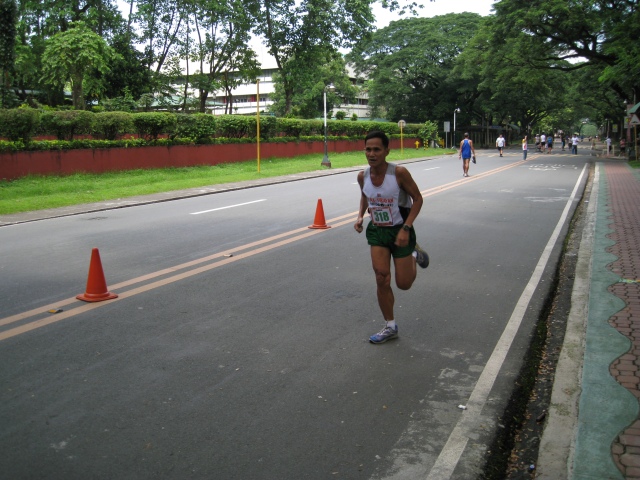
Rey Antoque, 54 years old @ BOTAK's 1-Street Mile Run

He shared some of his “training secrets” of which I am going to divulge in this post.

He trains and prepares the whole year only for ONE Marathon Race Event.

He spends and stays in Baguio City at least 6 months during his training. Kennon and Naguilian Roads were his training routes.

He applied what he learned from a Kenyan elite runner—running three (3) times with a distance of 5,000 meters in 15 minutes with 3-5 minutes of rest/interval in between repetitions in his speed workouts at the oval track. I did this speed workout once (in 23 minutes) and I had to rest & recover for two days!

He runs twice a day, morning & afternoon, reaching up to 200+ kilometers mileage per week. His long run workouts exceeded the marathon distance!

He is a disciple of Arthur Lydiard.

(Note: News Clippings Courtesy of Rey Antoque’s Files & Memorabilias)

Brian Stark: USA Transcontinental Trail Runner


As I mentioned in my previous posts, I’ve been reading the book, “Getting To The Point: In A Dozen Pairs of Shoes” by Brian Stark who did his 5,000-mile solo trail run for 238 days from March to November 2008 along the newly designed American Discovery Trail from Cape Henlopen, Delaware to Point Reyes, California.

Since the activity was a solo run, he did not have any support crew or pacer during the run. He just carried with him a 10-pound pack which included his water hydration system, making sure to run along the trails across America.

What I admire with this guy was that he really prepared for the said run. It took him one year to coordinate with the organizations that maintain the American Discovery Trail; compile at least 500 maps; arranged for logistics drop-off point in selected Post Offices of towns & cities along the way; created his personal website for the event; and saved $ 10,000 cash to finance his trip. He even arranged for his shoe sponsor making sure that a brand-new shoes as replacement would be picked-up in a pre-designated Post Office along the way. Even media outlets (newspapers, radio and TV) were coordinated and informed about his running event.

Brian Stark, in his daily runs along the trails, would be able to finish at least 30-40 miles and then look for a decent place to stay if a trail is located near a town or city at the end of the day. Sometimes, he would sleep in parks, Fire Stations, churches, schools, and in the homes of strangers who are willing to offer dinner & breakfast, bed and shower.

To update his website and reply to messages in his e-mail address, he would go to Public Libraries along the way to use their computer. The following excerpts was taken from a post from the Internet describing the feats of Brian Stark:

After driving back from the Boston Marathon, where his dad had run, Brian Stark, then 7, got out to use the bathroom during a stop for gas somewhere in Pennsylvania. No one took note, not even when Stark ran up and banged on the family van as it pulled away. “When my parents stopped for breakfast 300 miles away, they noticed I was missing,” he says. These days, Stark could have just kept running until he caught up with them. In 1998, he ran 4,800 miles across the country on the American Discovery Trail, which runs along America’s trails and back roads. It began in a sleet storm in Delaware and ended 238 days later at the Golden Gate Bridge — followed by a drive to L.A. and an appearance on “The Price Is Right.” “I won eight stuffed teddy bears and two trips, one to Hawaii, one to Canada,” says Stark, 36, who frequently pulls experiences from his trek while teaching gifted language arts at Corona Foothills Middle School in the Vail School District. And yes, he sometimes jogs to school, all 35 miles. “I have to get up at 1:30 a.m.,” says Stark, who is married and a father to two little girls, ages 2 and 3. He kept a journal while on his run and afterward wrote a book about the experience, “Getting to the Point: In a Dozen Pairs of Shoes.” “I picked out 12 pairs of running shoes and mailed them to 12 post offices 400 miles apart,” says Stark. When he arrived at each post office — each about three weeks apart — a new pair of shoes would be there to replace his worn-out ones. Along the way, local newspapers and TV stations chronicled his trek through their towns and CBS “Sunday Morning” broadcast a brief telephone interview. Sometimes he slept in motels. Other times he slept under bridges, in barns, even in outhouses. More than once, he’d just knock on a door. More often than not, he’d be invited in for a meal, and maybe a bed. Not once, he says, did anyone slam a door in his face. “No one ever threw anything at me, or tried to run me off the road.” Eight policemen, however, did inquire as to what he was doing, the first in Kansas. “I was sitting on a guardrail looking at a map and he pulled up in his squad car. He asked me what I was doing in the middle of Kansas without a car. I said, ‘I’m running to California.’ ” Even though he handed the cop a card explaining his circumstances, “He still checked me out.” Born in Indiana, Stark ran cross-country in middle school, continuing through high school and then at Hanover College in southern Indiana. After graduating in 1995, he rewarded himself with a five-month, 2,000-mile hike from Maine to Georgia along the Appalachian Trail. In Massachusetts, he met a man who hiked nude every Tuesday. Naturally, it was a Tuesday. Even so, Stark continued on. For the next three years, he lived as a caretaker in a primitive cabin in southern Indiana. “There was no running water and the only heat came from a fireplace,” he says. “After that, I thought I needed a break.” The “break,” of course, would be running across the country. “I’d never been west,” he says. A brother dropped him off at the edge of the Atlantic Ocean on the morning of March 8, 1998. It was 43 degrees and sleeting. Stark was carrying a 10-pound backpack filled with a sleeping bag, jacket, water bottle, cheese crackers, credit card, maps and “one Band-Aid, just in case.” As his brother rolled away, he cracked the window and told him to call if he wanted to quit. Stark never did, aiming to get to the Rocky Mountains after most of the snow had melted. He mostly ran and sometimes walked about 10 hours a day, trying to space it about 25 to 35 miles between towns. That proved impossible in Nevada, where the towns were more than 100 miles apart and he had 37 mountain ranges to cross.

In 2001, Stark did the Arizona Trail between Mexico and Utah in 39 days. In 2004, he ran across Iowa.

While reading this book, the following thoughts came to my mind:

1) Did Cesar Guarin of BOTAK come up with a book or a written account of his Run Across America in the 80s? I knew that he is one of the consultants of Joy Rojas and Mat Macabe during their planning preparation for the Takbong Pangarap Run Across America. A running experience as big as Running the Continental USA is worth to be printed in a book.

2) I thought of Joy Rojas and I tried to find out from the Internet if there is any word about the progress of her Takbong Pangarap. Since I could not see any information after she started her run in Eagle Rock, California almost 60 days ago, I posted the question in my Twitter as to where she is right now. Ben Gaetos had the initiative to answer my question by sending an e-mail to Joy Rojas and it led to Mat Macabe’s call to him.

3) Why did Joy Rojas thought of not creating a blog or website on her own instead of relying to the website of www.thepoc.net? After leaving Eagle Rock, California, POC had never updated her running activities. Being a news editor and news writer, she would have known the importance of the Internet in order to “journalize” her daily runs and let her readers know where she is and her daily experiences. In the book, Brian Stark would update his running journal in his website at the end of the day if he had an access to the Internet, if not, he would write his journal in a notebook and later wrote his updates whenever he had an access to the Internet. As compared now and the time when Brian Stark did his run across America’s trails, every town or city has its own public library with a computer, if not, there are so many Internet Cafes in every commercial establishment, even Motels now have Wi-Fi connections in every room with a very minimal additional cost. Access to the Internet right now is very common, cheap, and accessible. I am sure that every house in every big town or city has an Internet connection. Even cellphones nowadays have access to the Internet to include social networking sites like Facebook and Twitter.

4) One of my readers made a comment in my post about Joy Rojas and he/she has doubts about her running adventure to the point that she is suspected to be riding and running along the way. There goes the another “controversy” again! The following is the comment from cutierunner about Joy Rojas’ run from Las Vegas, Nevada to Denver, Colorado:

i too wondered where she was after she reached las vegas on may 23 and then silence until she pops out in denver for the western union shindig on june 23/ is she running or riding part of the way? google maps say that from las vegas to denver is a good 844 miles / from reports she says she takes a break every six days that leaves her with only 25 running days going from the desert to the state with the highest mean elevation in my country/ that’s uphill all the way to Colorado (during a season when flash thunderstorms occur), at 30 miles a day which is more than a marathon a day, she would still be short by 94 miles, so she must do something like 20% more to be statistically in denver by the date/ To set records, it would have been better if she wore one of these tracker gps items available here so that we do not have to rely on the word of her trainer who i hear is her boyfriend anyway and guess whether she is actually running or riding part of the way – also strange is having a crew of one

(Note: In my previous post on the pictures of Joy Rojas, I did not notice if she is wearing a Garmin watch, have you?)

I strongly believe that Joy Rojas could also do ala-Brian Stark running adventure across America if she has the necessary preparations, contacts along the way, and updated information about her daily activities.

5) In one of the Ultrarunning Magazines that Rick Gaston gave me, I read about Dean Karnazes plan to run across America using the American Discovery Trail from San Francisco to the East Coast and it is presently on the “drawing boards”. I guess, this will be fully supported by sponsors, marketing stuffs, and good PR support. What I like about Brian Stark is that he did it on his own without any “gimmicks” or marketing stuffs and even without any crew or support and pacer along the way, most especially while he was running the winding roads and trails of Colorado’s Rocky Mountains reaching an altitude of 12,000 feet above sea level.

6) Brian Stark did not set a deadline for him to finish his run and he did not pressure himself to reach a designated place. He had to take a lot of rest for his body to recover during the early part of his run and as the days and weeks have passed, he became stronger. He would find time to visit museums, tourist attractions, historical places and even enjoy the food distinct to every place he stayed while recovering from his rigorous runs. This a good example of a running adventure where you have enough time to explore the places you are passing through by visiting their tourist attractions, museums, and other historical places. Hence, he was able to write a book with all the pictures and clippings of newspaper accounts on his run.

If you have plans of running a multi-stage/multi-day running adventure, Brian Stark and his book is a good inspiration and source of experiences and a guide to a successful running adventure. I am highly recommending every runner to read this book.
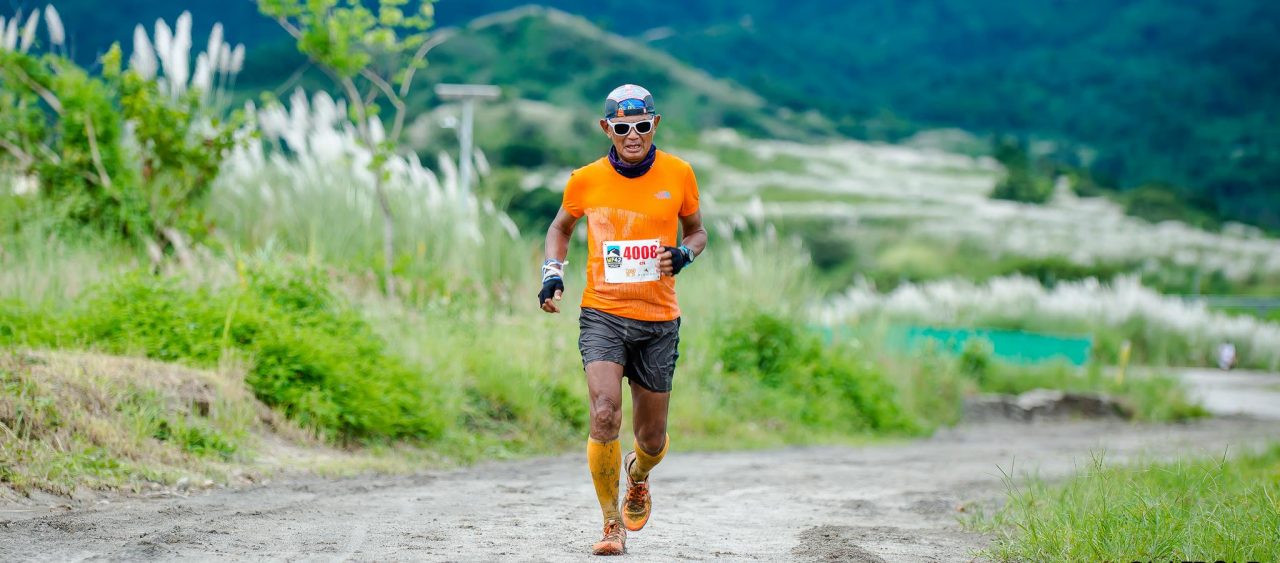
Pictures of Joy Rojas’ Takbong Pangarap


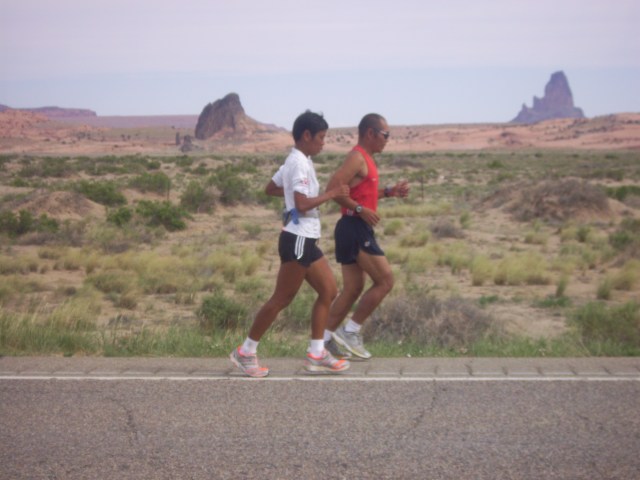
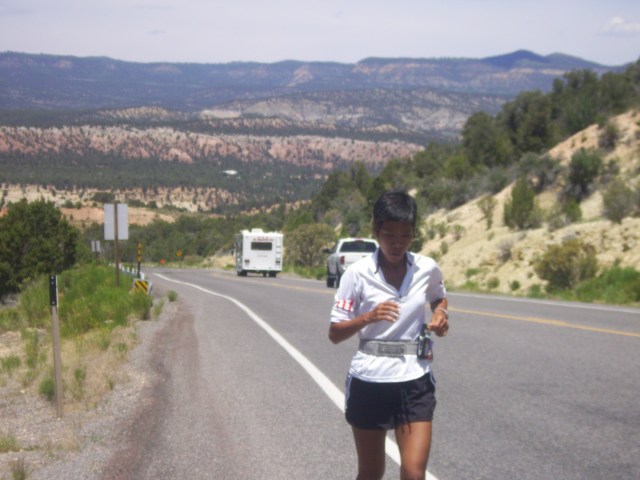
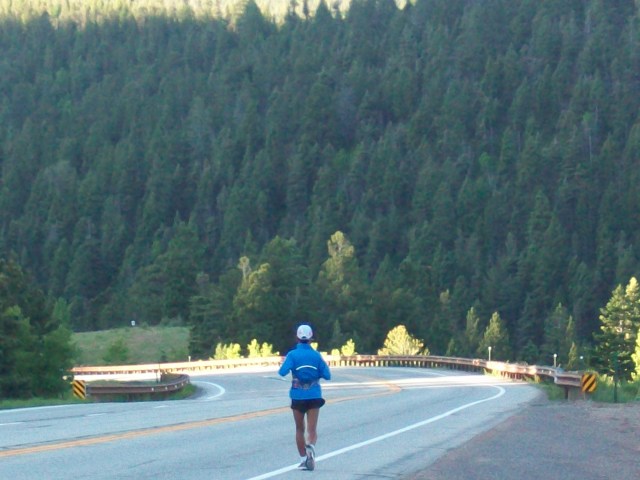
Joy Rojas was able to read my post about her present location and at the same time read the e-mail I sent to her. While I am waiting for her permission to post or make a story about her side on the incident that happened to them after she and her pacer/support crew, Mat reached Las Vegas, she sent me some pictures showing her running along the route she is taking towards her destination.

Enjoy the view and imagine yourself running with her.

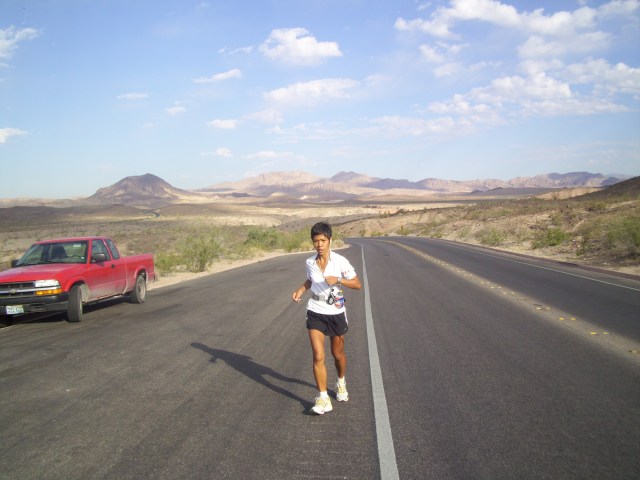
Joy Rojas at Lake Mead, Nevada
Joy & Mat Running Together
Running Along The Mountains of Kanab, Utah
Joy Rojas On Her Way To Walsenburg, Colorado

Where Is Joy Rojas?


At present, I am reading a book entitled, “Getting To The Point: In A Dozen Pairs Of Shoes” by Brian R. Stark. This book is about the personal account of the author as a “Transcontinental Runner” by running along the newly designed American Discovery Trail (ADT), starting at Cape Henlopen State Park in Lewes, Delaware to Point Reyes National Seashore (50 miles north of San Francisco, California). It was a solo trail run without any support and crew covering a distance of 5,000 miles which he completed in 238 days (8 months) from March to November 1998.While reading this book, I thought of Joy Rojas of Takbong Pangarap Run Across America as to where she is now after starting her 120 days run from Eagle Rock, California to New York City on the 2nd week of May this year. She is already one-half of her scheduled duration to complete her feat and there is no available update about her. This is the very reason why I asked a question on my Twitter about her whereabouts.Yesterday, I received an e-mail from Ben Gaetos, an ultra runner friend from Los Angeles who ran with Joy Rojas for 5 miles from Eagle Rock Plaza (start of the run), informing me that Mat Macabe called him and Ben relayed to me the salient information about the progress of Joy Rojas run across America.Joy Rojas and Mat Macabe are presently somewhere in the plains of Kansas after crossing the high mountain ranges of the Rocky Mountains which means that they were able to cross the states of California, Nevada, Utah, Arizona, and Colorado.

According to Mat Macabe, Chuck Crisanto, one of the crew/support, abandoned them in Las Vegas, Nevada. I think Mr Chuck Crisanto was supposed to be the PR guy and driver of their support vehicle and at the same time alternate support crew to Mat Macabe. Moreover, Chuck Crisanto brought with him his wife and his 2 toddlers in the trip. Mat also claimed that Chuck was out all the time shopping and when on the run, he’s nowhere on the road as he uses the Freeway instead of  following Joy’s run on the side roads. The worse is that Mat also said that Chuck is in his possession 70% of the donated money to support the run. Fortunately, Joy and Mat found someone to support them after Chuck Crisanto abandoned them. The “Good Samaritan” is an editor or owner of a Pinoy newspaper who provided them with a support vehicle.

The abovementioned information came from the side of Mat Macabe who is in constant contact with Joy Rojas being her pacer & support crew. I really do not know personally Mr Chuck Crisanto as he should be able to explain his side about the said information about him and his family’s whereabouts. 

 Yesterday, I sent an e-mail to Joy Rojas as she requested Ben Gaetos to find out and send to her my e-mail address. I hope Joy Rojas will be able to respond to my message. If you have the time and want to send a message of support to Joy Rojas, you can send your e-mail message to www.thepoc.net.

The picture of Joy Rojas was taken from the following news report of Joseph Pimentel of the Asian Journal Los Angeles dated July 11, 2009.

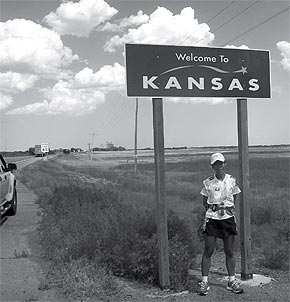
Joy Rojas In Kansas
Joy Rojas In Kansas

Joy Rojas in Kansas

Sunday, 12 July 2009 23:49 Joseph Pimentel / AJPress Los Angeles

LOS ANGELES – THE text message read, “We are in Great Bend, Kansas, staying on highway 50 and 56.”

She followed it with a phone call to this reporter.

“We’ve made it to Kansas,” exclaimed Filipina marathoner Joy Rojas to the Asian Journal last Thursday July 9. “It’s totally different running here than it was in Colorado. Kansas is flat and hot with lots of corn and wheat fields, lots of sun.”

She says the Midwest sun gets as hot as Manila in the summer.

The 44-year-old Rojas is less than halfway from her goal of running across the United States of America.

Waking up at 6am everyday, Rojas has been running 30 to 35 miles a day since she began her Trans-USA run called Takbong Pangarap or Dream Run at the Eagle Rock Plaza in Los Angeles, California on May 10. She made a quick stop over in Las Vegas, Nevada where she was celebrated during Western Union Customer Appreciation Day on May 23 and another stopover at the Western Union headquarters in Denver, Colorado. Western Union is one of the sponsors of her Trans-USA run.

She says that she’s on her way to reaching her goal of arriving at the Philippine Consulate in New York City on September 8.

So far, Rojas and her trainer, Mat Macabe, have run for more than 40 days now, crossed five states, jogged over 1,000 miles, and touched the lives of many people who see the two running on highways and streets across America.

While passing through Arizona, a couple saw Rojas and Macabe running. When they found out the reason for Rojas’ run, they immediately invited the Filipina and her partner to their home for dinner. The same thing happened in Colorado. Rojas recalls how before reaching Denver, a Filipino man read the words “Can we ignite the Filipino spirit across America?” on the Western Union support vehicle. He then immediately introduced himself to Rojas and Macabe. After the day’s run, the Filipino man came over to their hotel where he cooked them dinner consisting of elk and deer that the man had hunted.

“Can you believe that? All of these strangers that we meet everyday have been so kind and generous to us,” said Rojas. “I’m a vegetarian but when he asked if I was eating elk and deer I said ‘for you, I will.’ You have to be a gracious guest.”

Another time in Colorado, Rojas met a group of cyclists on the road like her but they were biking across the US from San Francisco to New Hampshire.

Rojas and the cyclists took pictures and wished each other well.

The experience has been so far so good, says Rojas.

Rojas also admits that the run sometimes is a bit unforgiving. In Colorado, she had to withstand the high altitude and steep roads that at times, required her to stop and walk but she continues to persevere.

Despite being tired at times after a long day’s run, she says that by the time she wakes up the next morning, she feels refreshed and ready to go.

A survivor of tuberculosis, Rojas’s is running for her beneficiaries: a Division of the Philippine Heart Center and the Anti-TB Program of the Inner Wheel Club of Quezon City, District 378

Rojas said that after Colorado, her run should be smooth as the flat plains of Kansas.

Philippine Amateur Track and Field Association


Philippine Amateur Track and Field Association (PATAFA)

For the past months, the following questions had been playing in my mind whenever I have my running workouts and during my participation in weekend road races in Metro Manila and in other provinces:

1)      Why is it that there are so many road races every weekend up to the point that at least four road races are being conducted in one day? Is there an instituion or body who should be controlling all of these races?

2)      Why is it that there is no uniform registration fee for every road race? Who should be responsible in controlling the registration fee of every road race?

3)      Who are the registered and authorized “road organizers”? Who controls the prolifiration of road organizers in the country?

4)      Why is it that there are so many running “coaches”? Are these running “coaches” certified and have a permit/s to operate their coaching business? Who controls their “coaching fees”?

5)      What is the organization or institution that covers and governs everything about road races and running in the country?

6)      Who is going to inspect and determine the presence and quality of support system ( like water, security, medical & emergency needs) to be given to runners during road races?

7)      Who determines or certifies a road race if the distance is precise and accurate?

8)      Who gives sanctions to race organizers where there are reported cases of stealing  and other criminal acts committed during road races?

Through my research, I found out that the International Amateur Athletics Federation (IAAF) is the international governing body for Athletics (track and field sports, to include road races) and in among member nations/countries, a National Athletics Federation is the governing body for Athletics. In the Philippines, IAAF’s national athletics federation is the Philippine Amateur Track and Field Association which is simply called PATAFA. The PATAFA is so powerful that everything that happens in Athletics in the country should happen under the authority of the federation and nothing should be organized without the approval of the federation. It has a great power and at the same time has a great responsibility!

The roles of PATAFA are:

1)      To lead and serve the Federation

2)      To manage all aspects of Athletics

3)      To build on past successes

4)      To ensure a financial basis for present and future activities

5)      To act as guardian of the values of the sport and have the responsibility to set an example and promote these values to the benefit of Athletics.

The following are the functions and obligations of the PATAFA:

A)     On Governance

1)      To be responsible for all aspects of Athletics in the country.

2)      To promote the sport of Athletics and the development of an Athletics Culture.

3)      To provide an appropriate administrative structure and services for the functioning of the Federation and the sport.

4)      To maintain an official list of National Records.

5)      To undertake proceedings against athletes who have rendered themselves ineligible and to impose sanctions where appropriate.

6)      To undertake proceedings against any individual who may have violated the rules of the Federation and to impose sanctions.

B)      On Resources

1)      To obtain and manage the financial, human and technical resources required for the functioning of the Federation.

2)      To set budgets and maintain financial records.

3)      To control expenses.

4)      To arrange for an audit of financial statements.

C)      On Communications

1)      To maintain good relations with and appropriate information to athletes and members of the Federation.

2)      To maintain good relations with the government office responsible for sports and other organizations which have an interest in Athletics or may be of assistance to the Federation.

3)      To maintain good relations with the media in order to ensure the positive promotion of the sport and the Federation’s activities.

D)     On Competitions

1)      To promote the development of a program of competitions including national championships.

2)      To select and organize teams to participate in international competitions.

3)      To maintain a national calendar of Athletics competitions.

4)      To provide official sanctions for competitions including those organized by other parties.

E)      On Facilities and Equipment

1)      To ensure that competition venues and equipment meet the technical specifications mandated by national and international rules.

2)      To guarantee the accurate measurements of road courses used for running and race walking competitions.

F)      On Officials and Coaches

1)      To oversee the recruitment, training, certification, deployment and control of the athletic officials and coaches required to carry out the programs and activities of the sports.

G)     On Medical & Scientific

1)      To plan and coordinate the delivery od sports medicine services to athletes.

2)      To plan and coordinate the delivery of scientific services to coaches and athletes.

3)      To ensure that a doping control program is implemented in accordance with the rules of the IAAF and relevant national regulations.

To confirm all these items I’ve researched, I arranged for an appointment with our country’s President of the PATAFA, Mr Go Teng Kok and I was able to meet and talk to him lengthily about the prevailing situation of athletics and road racing in the country. He confirmed such powers of PATAFA and also admitted that he lacks the resources to implement the rules and regulations/proper administration of Road Races in the country. I presented to him the “projects/programs” that I’ve been doing since I was the Program Director of the DND-AFP Fintong Pangarap for Marathon two years ago and as the “Bald Runner” for the past year. He was surprised to know all these projects. After almost 1 ½ hours of conversation, he asked my assistance for the implementation of the rules and regulations in road racing, of which I accepted on a consultation basis, I think!

dsc04577

Mr Go Teng Kok, Bald Runner & Coach Andaya of FEU at the PATAFA Office

So, to all the Road Organizers, Coaches & “coaches”, Race Sponsors, and the road racers, you know already that there is somebody “up there” who should be supervising us and putting some “sanity” to those numerous weekend races and who should be able to look for each runner’s welfare while participating in a road race.