(Note: This was written and posted for possible News Story in any of our country’s Media Outlets. PLEASE SHARE. Thank you!)
After 35 years, a Pinoy Ultrarunner was invited and successfully finished the Badwater 135-Mile (217 Kilometers) Ultramarathon Race which is globally recognized as “the world’s toughest foot race” where 90-100 of the world’s toughest athletes—runners, triathletes, adventure racers, and mountaineers, are invited to compete against each other and to survive the elements, elevation and extreme hot temperature of the Death Valley Desert in California, USA.
Badwater Ultramarathon, simply known as “Badwater 135” is a “by invitation only” race where a five-member committee selects 100 of the best endurance/ adventure athletes worldwide to compete in this event. This race is considered as “the holy grail of running” due to the extreme conditions of the route and the environment. For the first time in its race history, Philippines’ Flag/Colors will be displayed on its official website and function areas due to the successful finish of a Pinoy Ultrarunner.
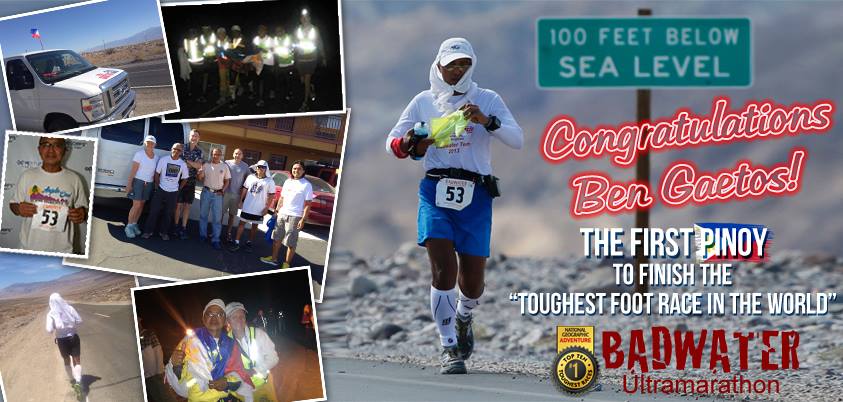
Benjamin Gaetos of Eagle Rock, California finished the race in 44 hours 8 minutes 7 seconds after starting from Badwater, Death Valley, which marks as the lowest elevation in the Western Hemisphere at 280 feet below sea level, on a non-stop run to the Finish Line at the Mt Whitney Portals with an elevation of nearly 8,300 feet above sea level. Popularly known as “Ben Gaetos” among ultrarunners, he endured the hot temperature reaching up to 130 degrees Fahrenheit and the course cumulative vertical ascent of 13,000 feet that covers three mountain ranges in the Death Valley Desert and a cumulative descent of 4,700 feet. The race was held last July 15-17, 2013 and it usually starts on the third Monday of July every year, few weeks after the start of Summer Season in the United States!
He finished with a ranking of 64th Finisher out of the 81 runners who crossed the Finished Line within the prescribed cut-off time of 48 hours. For the past editions of the race up to 2010, the cut-off time was established at 60 hours. But due to the distance, elevation, and the extreme hot temperature of the course, even the best and toughest ultrarunners would succumbed to dehydration and foot blisters. With a reduced cut-off time, more pressure was on the shoulder of each of the participants. Fifteen runners declared themselves as Did Not Finish (DNF) in this year’s edition.
This year’s 36th edition of the race was joined by 97 runners from 25 countries, the most number of international runners to participate, to include the United States of America. For the first time in the history of the race, Philippines was represented in the person of Ben Gaetos. Two other Southeast Asian ultrarunners, from Malaysia and Singapore, were also represented for the first time in this race. Seow Kong Ng of Malaysia, finisher of our country’s BDM 102 Ultra Marathon Race and Taklang Damulag 100-Mile Endurance Run, successfully finished the said race.
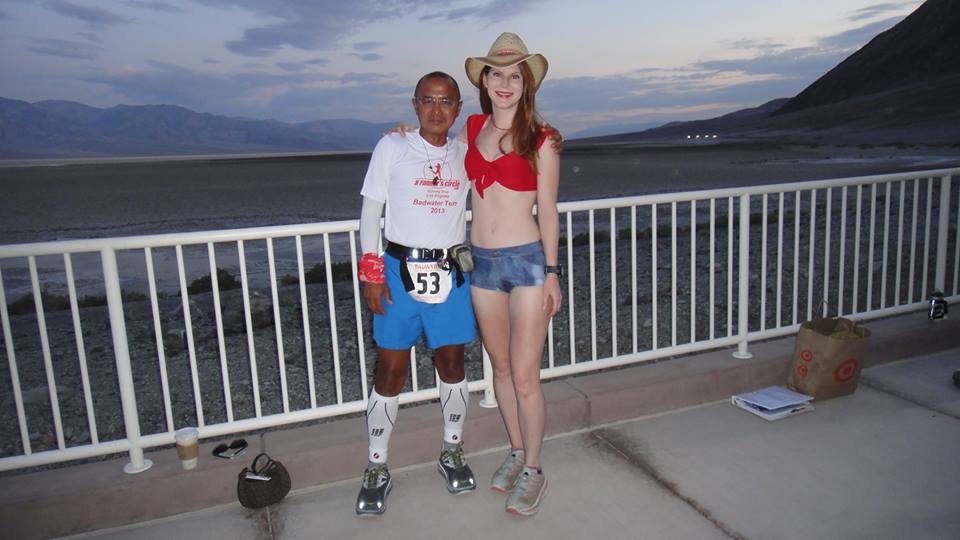
Ben Gaetos At The Staring Line
Out of the 97 runners, 48 runners are considered as Badwater “veterans” and 49 runners are “rookies”/”first-timers”. Ben is one of the “rookies” for this race but he is an accomplished ultrarunner for having finished almost 60 ultra running events to include 100-mile runs, 100K races, 50-milers and 50K runs. Ben is also a Finisher of the BDM 160 and 102 Ultra Marathon Races where he finished the BDM 160 Ultra in less than 24 hours.
In this year’s race, the runners consist of 74 men and 23 women. The Overall Champion Award went to Carlos Alberto Gomez De Sa of Portugal with a finish time of 24 hours 38 minutes 16 seconds. The Lady Champion went to Catherine Todd of Australia with a finish time of 29 hours 55 minutes 29 seconds with a ranking of 11th overall finisher.
Valmir Nunez of Brazil still holds the course record with a time of 22 hours 51 minutes 29 seconds which he set in 2007. On the other hand, Jamie Donaldson of Colorado, USA still holds the women’s course record with a time of 26 hours 16 minutes 12 seconds which she set in 2010.
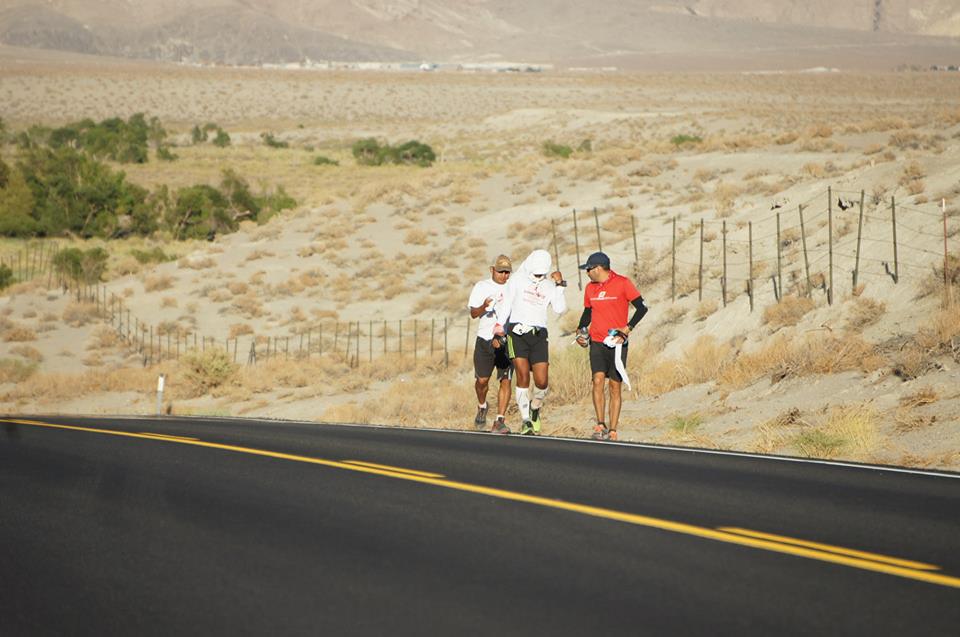
Ben Gaetos Being Paced By Balmore Flores (L) & Rafael Covarrubias (R)
At the age of 56, Ben Gaetos said, “The mountain ranges near my house in Eagle Rock, California had helped me with my strength and endurance in preparation for the race. The hot weather in California and regular sessions of “Sauna” since February of this year had also given me the confidence and acclimatize to the heat in the Death Valley Desert”. Ben had also a good familiarity of the route as he had served as a member of the Support Crew and Pacer for the Badwater’s Past Champion Jorge Pacheco and top ultra runner Badwater Finisher Adalberto “Flaco” Mendoza in 2010.
Ben, in an interview with him, said that he had been to, as far as, Las Vegas Red Rock Canyon Park and at the Death Valley Desert for some practice runs weeks prior to the race event for him to acclimatize with the extreme heat in the desert. And most of the time while he was doing his heat training in Palm Desert, Palm Springs and Twenty-Nile Palms in California, he would be stopped by the roving California Highway Patrols and he would be asked with these questions: “Are you lost?”; “Where are you going”; “Where did you leave your car?”; “Are you out of gas?”; “Do you need help or a ride?”. The funniest thing that he relayed to me was that, he was suspected to be a terrorist running in the desert where he had to give his hydration pack and bottles for inspection to the CHP Officers.
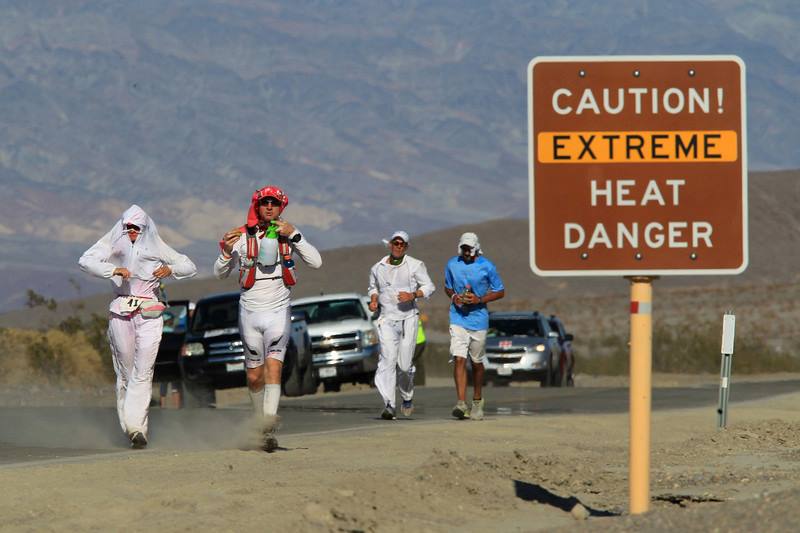
Ultra Runners In Action
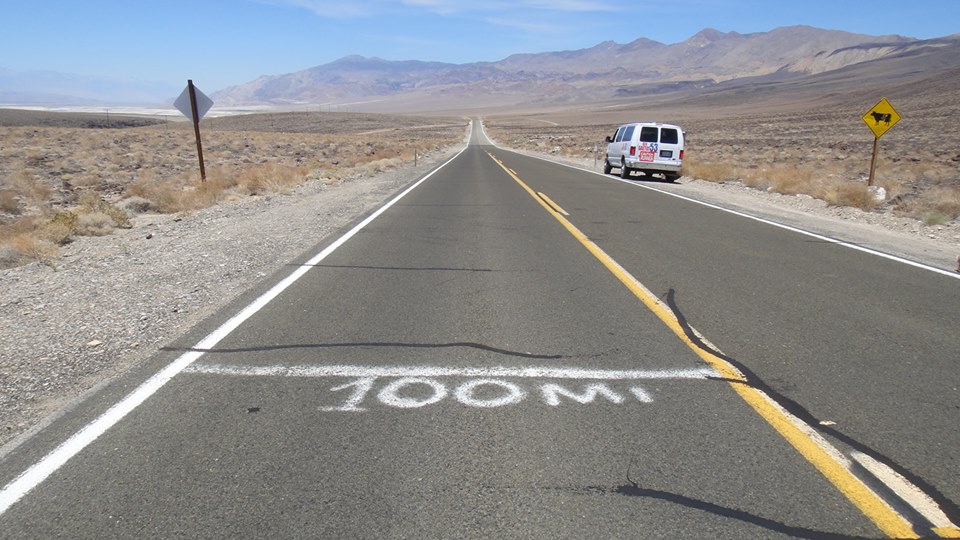
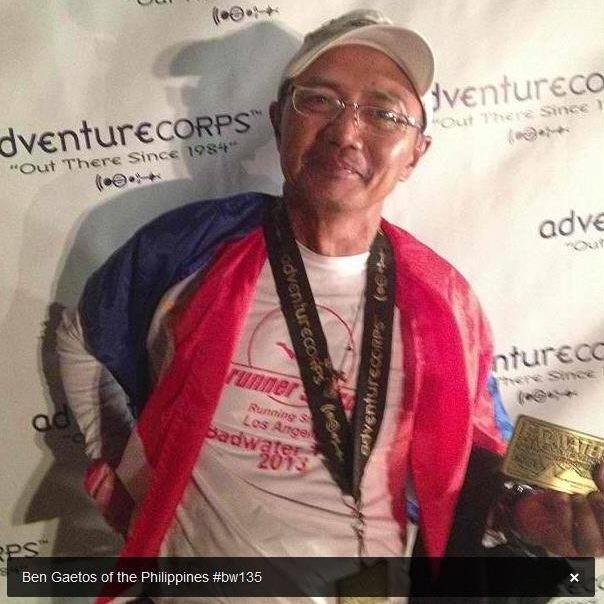
Constantly running for 135 miles on the white line on the left edge of the asphalted road along CA Highways 190 and 136, Ben complained of swollen ankles on his last 35 miles to the finish line. “I slowed down with my pace before I reached Lone Pine with my swollen ankles but I never thought of quitting the race. I know my ultra friends back home in the country expected much from me as my participation and finish would be a significant part in the history of ultrarunning for the country. I will not fail my friends and my country”, Ben Gaetos said after he was awarded with the Badwater’s Medal & Buckle at the Mt Whitney Portals.
The White Paint Line On The Left Edge of the Road. 35 Miles To Go!
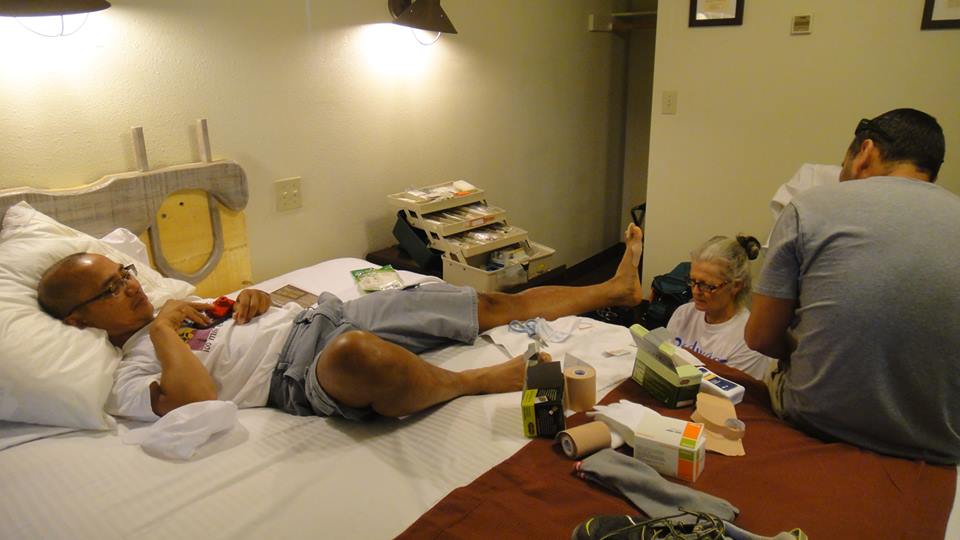
“My successful finish in the 36th Badwater Ultramarathon would not be possible without the help and assistance of my Support Crew and Pacers led by my Ultra Coach Nancy Shura-Dervin, a Badwater Ultramarathon Finisher, who patiently bandaged my feet on the night prior to the start of the event. The bandage made by Nancy on my feet prevented me from having any blisters during the run which had been the culprit of numerous DNFs of runners in this race”, Ben said. Filipinos based in the Los Angeles area have also served as members of the Support Crew/Pacers of Ben.
Bandaging of The Feet By Nancy Shura-Dervin
A Runners Circle (ARC) Specialty Store in Glendale, California owned by Pinoy runners & triathletes Joe Matias and Derek Lee Biesheuvel is one of the major sponsors of Ben Gaetos’ participation to the 36th edition of the Badwater Ultramarathon.
Ben Gaetos is presently working as an Architect of the Los Angeles City Government’s Department of Public Works and he is humble not to mention openly that he is the main/chief architect of the newly constructed bridges/overpass/underpass and parks within the City of Los Angeles. It is worth mentioning also that he also a part of the team of city architects that made the latest transformation and reconstruction of the famous Echo Park Lake in Los Angeles.
Ben Gaetos is a regular donor of Bald Runner’s Donate-A-Shoe Project for the past 5 years where he would send Balikbayan Boxes of used shoes from California. He is also a Contributing Writer to the Ultrarunning Magazine for his Race Reports in Ultra Events. His Race Report in the BDM 160 Ultra was featured in the said prestigious monthly magazine last April 2012.
Ben Gaetos’ parents are from the Province of La Union and he was born in Santa Ana, Manila. He graduated from the University of Santo Tomas with Bachelor of Science Degree In Architecture. Ben is a full-blooded Ilocano! He is married to Josie Manila and have only one daughter, Paula.
Ben Gaetos Showing His BW Medal & Buckle
When I asked if he is going to do the race again in the future, he immediately replied, “Never Again!” “But I will continue sharing my experiences to all Pinoy ultra runners and ready to help by being a Pacer or Support Crew if they intend to join 100-Miler events here in California”
(Note: All pictures were taken & copied from Benjamin Gaetos Facebook’s Wall)
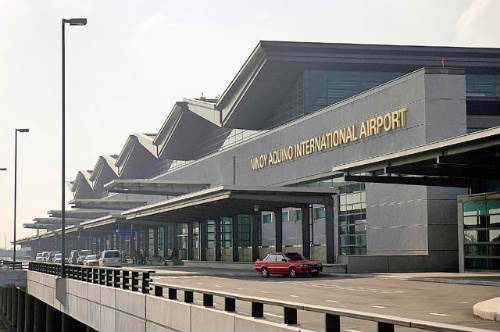
For the past weeks, I have been outside of Metro Manila traveling from one airport to another. I usually take Cebu Pacific and PAL Express flights as I could get promotional prices for these local flight carriers. By taking these carriers, one has to use the new Ninoy Aquino International Airport Terminal 3.
Ninoy Aquino International Airport Terminal 3 (Google Pictures)
Let me tell my readers my observations about the airports that I’ve used in my travels to the Visayas and Mindanao for the past weeks.
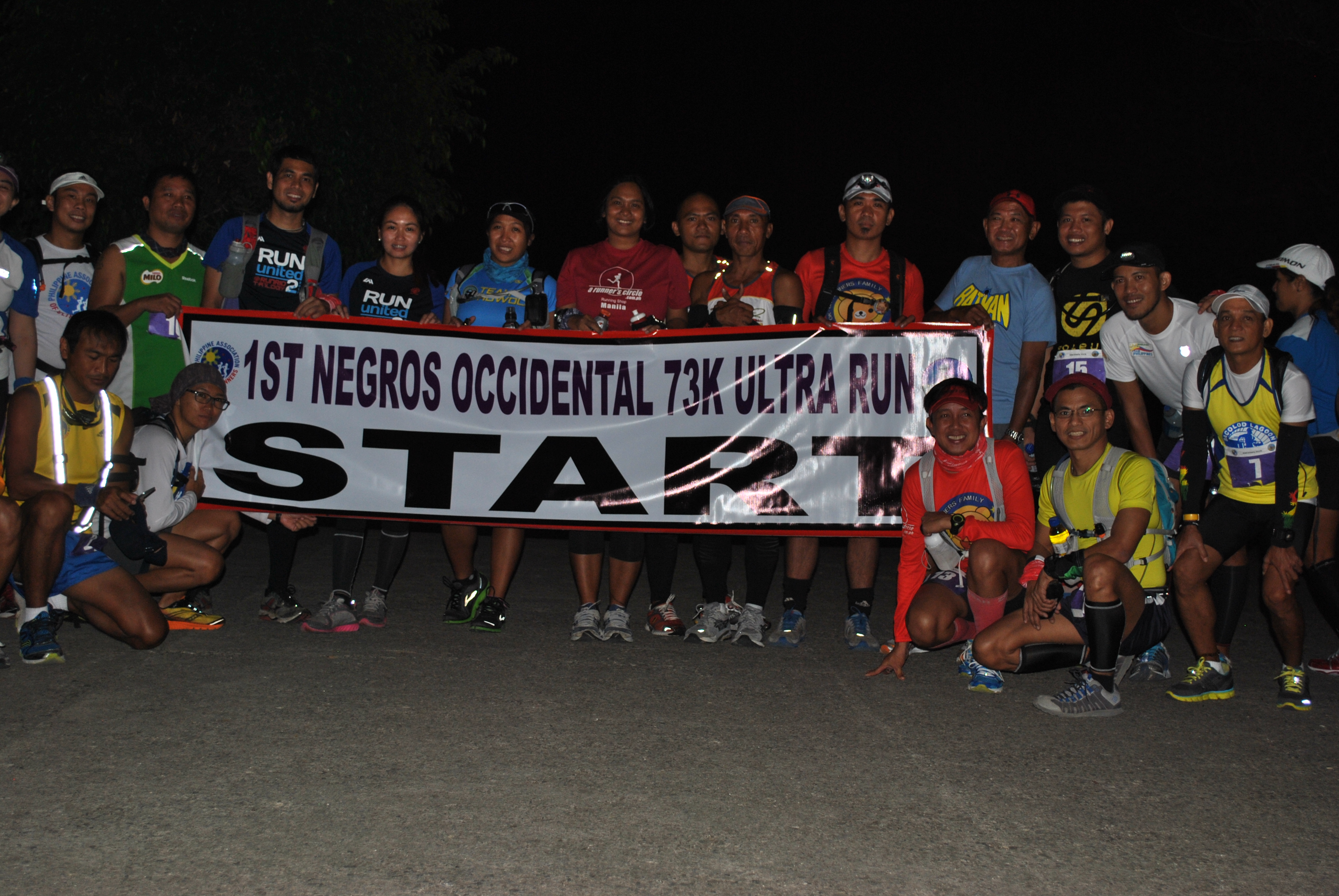
On the first week of this month, May, I went to Bacolod City to coordinate with the conduct of the 1st Negros Occidental 73K Ultra Marathon Race among the Provincial Government and the AFP units in the area. Since I was using the Cebu Pacific flight, I had to check-in at the Ninoy Aquino International Airport Terminal 3 for its first flight for the day, arriving thereat at 4:30 AM. I usually take a taxi ride from my place in Manila to the airport.
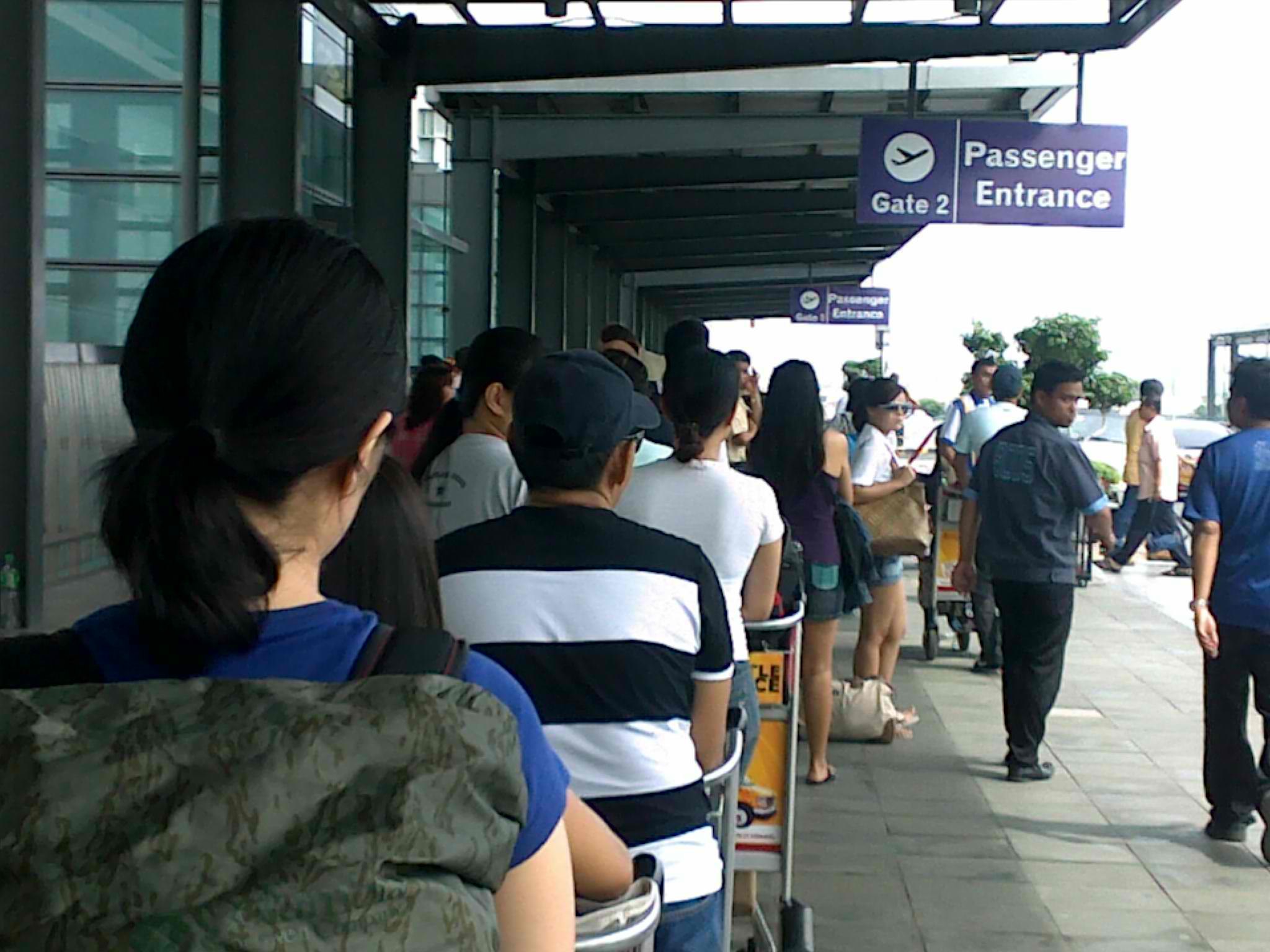
Long Line of Passengers Before The Entrance of the Terminal (Google Pictures)
The usual sight is always there—long lines of passengers trying to enter the airport even if there are two entrances at the Departure Area where the X-ray machines & metal detectors are located. I think there is something WRONG here. Why do you have to place an X-Ray machine & metal detectors for the passengers and baggage just at the entrance of the airport? In my trips abroad, I don’t see any X-Ray machines/Metal Detectors for passengers and baggage right at the entrance of the terminal/airport. Most of these X-Ray machines are located inside the airport or at the terminal’s lobby or sometimes, each of the airlines have their own X-Ray machine and personnel operating such equipment.
The air conditioning system inside the airport/terminal was not working. I thought it was just a temporary situation when I went to Bacolod City but on my next trip to Mindanao after one week, the air conditional system was still not working. For a new airport, it is surprising why its air conditioning system is not working. I really don’t know the reason why the airport authority and its management are allowing this thing to happen. It is summer time and it is annoying to be perspiring inside the airport while standing in line in front of the check-in personnel. Are they minimizing the cost of electricity? Is the management incompetent that they don’t care about the welfare of their customers?
I am glad that the bus that ferries passengers from the terminal to the plane are air-conditioned ones as it gives comfort to the passengers once they leave the terminal.
I am not complaining if there is NO free Wi-Fi in the airport. I am still the conservative type of passenger waiting for boarding at the airport reading a book or a magazine. You can count with your fingers among hundreds of passengers at the boarding area on those passengers reading a “printed” book (hardbound or paperback). What you see now are passengers using their SmartPhones to take pictures and update their Facebook account/s. Some just simply play games on their phones and iPad/Mini-iPads but sometimes I could see people who read books on their iBooks & Nooks!
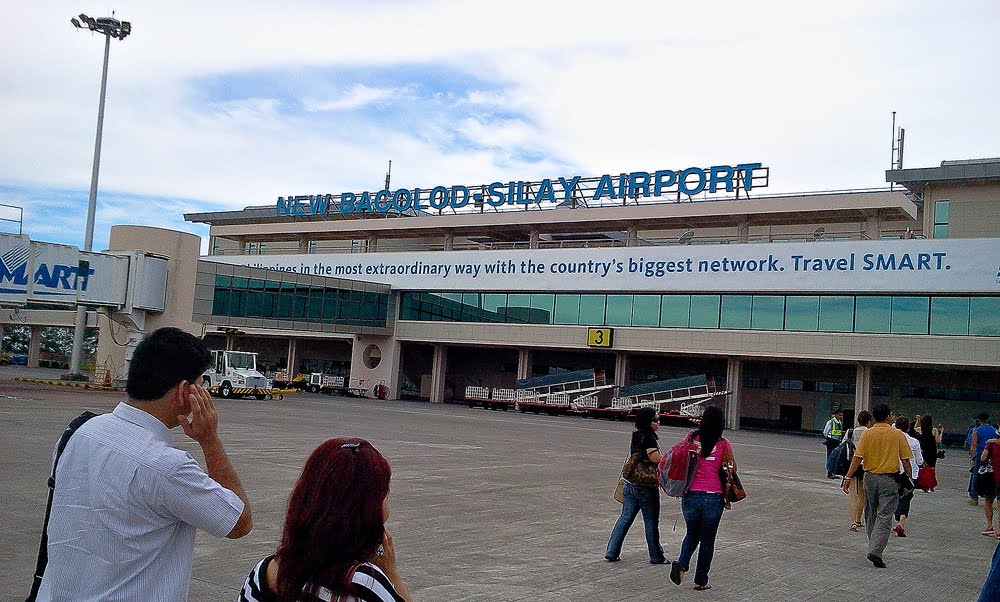
In Bacolod City, the new airport in Silay, Negros Occidental is very nice but it is very far from Bacolod City. I have only one complaint though. The air conditioning system was not working at the arrival area. Since my “contact” in the area was able to fetch me with a vehicle, I was not able to experience what it is like to commute from the Silay Airport to Bacolod City. I hope there are vans, UV Express, and taxis available at the airport for the tourists and other arriving passengers.
New Bacolod-Silay Airport (Google Pictures)
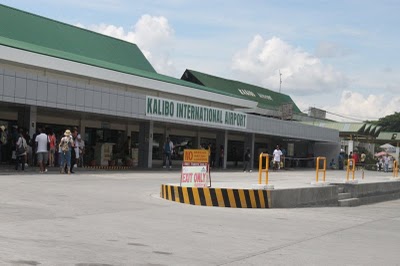
In Kalibo Airport, there is no change since I had my last trip here five (5) years ago. With additional international and local flights, the boarding area and the air conditioning system are still the same and I could hardly feel the cold air with the jam-packed passengers waiting for their respective flight. Although there is a second floor in the terminal area, the space is filled with stores, cafe and convenience stores. The passengers who don’t have seats at the boarding area have to go to the 2nd floor to wait for their boarding calls. There is a need to improve and expand the terminal with the increasing number of local and international flights due to the increasing number of tourists and visitors to Boracay Island.
Kalibo Airport (Google Pictures)Entrance To The New Kalibo International Airport (Google Pictures)
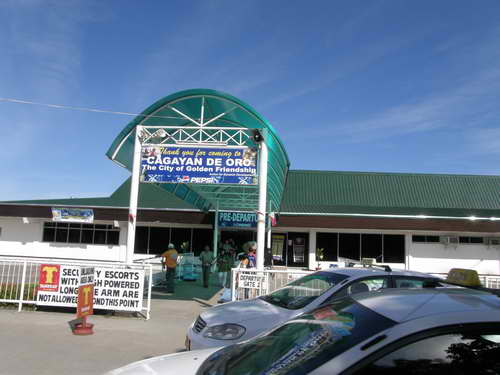
At the Lumbia Airport of Cagayan De Oro City (Misamis Oriental), it is still the same airport that I’ve been going through while I was still in the active military service. It was raining when the plane touched down and my shoes were wet when the rain created a small flooding at the tarmac as I approached the terminal. The baggage carousel is still the same small one where one has to wait for a longer time for the baggage to reach the carousel. The boarding area is still the same where some of the passengers would stand to wait if there are two flights about to take-off in few minutes between each other. Although I was in the comfort of the VIP Room at the departure area, the rest of the passengers were contended with the weak air conditioning.
Lumbia Airport, Cagayan De Oro (Google Pictures)
Airports are supposed to be the “mirror-image” of the place where the airport is located. However, it does not mean that the airport terminal should be warm, hot and humid like our climate but at least, it should be comfortable to everybody. There should be enough space, seats, and a reliable working air conditioning system so that passengers would not be perspiring/sweating while waiting in line in flight counters. It is very frustrating to see passengers sitting and lying on the floor to sleep inside the terminal.
The airport authority and management should not be trying to save power/energy to run those air conditioning system because each of the passenger is paying a terminal fee to address such cost to include maintenance, security, and toiletries in comfort rooms. Aside from its collection of terminal fees, the Airports have an appropriated budget for their Maintenance and Other Operating Expenses under the Department of Transportation and Communications. If I am not mistaken our International Airports in Metro Manila are the top clients of MERALCO (Manila Electric Company). (I am just wondering if our NAIA Terminals are up to date in the payment of their electric bills to MERALCO!)
Here comes the worst part if you are arriving in one of the Airport Terminals in Metro Manila. There are NO Bus Lines or Bus Transportation Lines that pick-up arriving passengers in front of the Terminals! Before when we had only ONE Airport Terminal, we had the so-called California Bus Lines and Love Bus which would pass along the airport’s terminal and whose route would go along the Metro Manila’s main streets and cities. Once you reach a Commercial District or City within Metro Manila, that’s the time you flagged down a Taxi and the driver would bring you to your final destination.
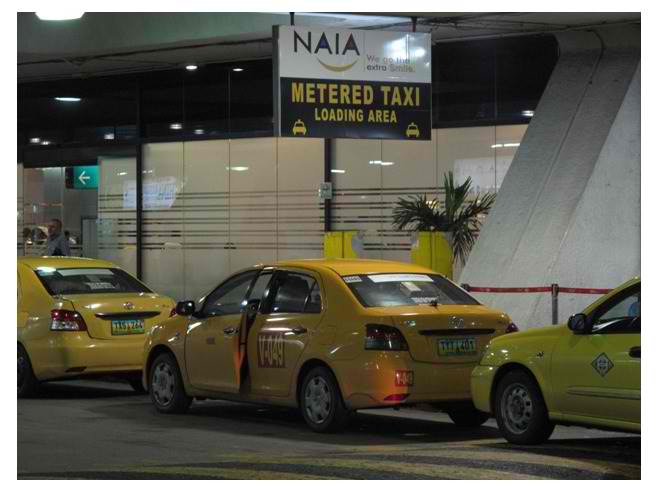
Airport (Yellow) Taxi (Google Images)
Those travel arrangements from the airport once you arrive in Manila are gone now. At present, it is either you get the services of a Rental Car, Airport Taxi, or from a regular Taxi. Obviously, the Airport Taxi (cars painted in yellow) is very expensive. I don’t use such transport service for obvious reason. If you intend to use the services of a regular Taxi (mostly colored/painted white), you should be smart and practical. It is suggested that you proceed to the Departure Area and make an Exit thereat and try to flag down those taxis that just dropped incoming passengers at the terminal. The drivers will not be choosy as they need a passenger once they leave the airport instead of nothing. Problem arises when you take the last flight inbound to Manila if you are coming from local destinations. Obviously, most of these last flights would arrive at the terminal at the same time and it would result to a longer line of passengers waiting for the regular taxi to arrive. Patience is needed in this kind of situation.
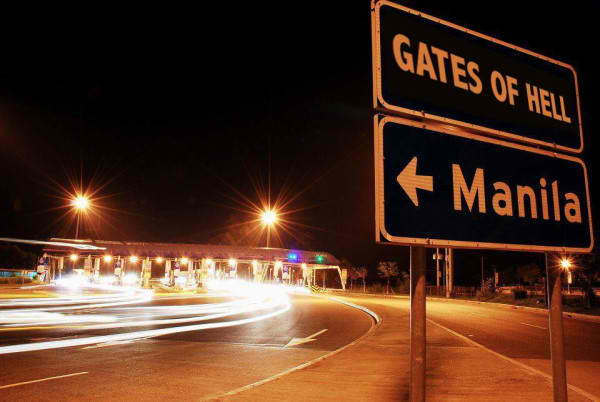
For those foreigners who would like to join our ultra races in the provinces (Luzon area) and choose to arrive in one of the airports/terminals in Metro Manila, Car Rental is the best option. But be careful. Be careful with those “fake” and/or “off duty” MMDA traffic enforcers as they might be attracted with the color of your skin and un-Filipino facial features. These notorious “fake” and/or “off duty” traffic enforcers would flag you down as you leave the Car Rental or a few blocks away and tell you that you can’t drive in our country without a Philippines Driver’s License. That is not true! You can use your country’s Driver’s License for a 30-day stay in the Philippines. If the traffic enforcer does not believe you, tell him that you are a friend of “Bald Runner” (Retired Major General Jovenal Narcise of the Philippine Army). If he still does not release you, then prepare to haggle for the amount of money you have to give for his coffee/snacks.
If he releases you after giving him some cash, then I would say, “Welcome to the Gates of Hell”.
As early as January 4, 2010, I made an appeal/wish in my blog for the establishment of a “Runners’ Museum & Library”.
This is the exact wordings of my 2010 Running Wish—-“A Runners Library & Museum—A place where runners could share their running “collections” and a place where runners would meet and make their research. A place where we could see the Hall of Fame in Athletics!”
After a year, I made a follow-up blog to remind my readers about my wish for the benefit of the growing number of runners as the years passed. The following is the link of such wish:
I made a specific wish to Coach Rio (I am not sure if he is reading my blog then!) and to other runners to come up with an “cooperative effort” where every runner could share in the realization of my wish. But nobody made the move and I thought that if I have a wish to attain, it is upon me to make the MOVE and start initiating such effort. However, I could see that each runner, blogger, race organizer, and race director have their own personal interest to focus on. And as for me as the “initiator” of this idea through my blog, I simply kept silent on the said wish.
After two years, I was surprised to see on Facebook about the “100 Miles Cafe” concept that my ultra running friend, Jael Wenceslao, had posted in one of his rare “status” at the PUMAGs (Pinoy Ultra Marathoners Group) Page on Facebook.
Months later, I was invited to see for myself where this establishment is located. I would not like to describe in details on what to see and expect in this place.
It may not the exact ideal “Library & Museum” concept that I was thinking but it’s purpose as a place where runners, endurance athletes, their guests and families, relatives and friends could meet and share their “stories” to one another and at the same time a place where lectures, forums, and meetings would be conducted, is very fitting for the said place. But I know, in a few months, this place will transform into a “Library & Museum” for all runners/endurance athletes!
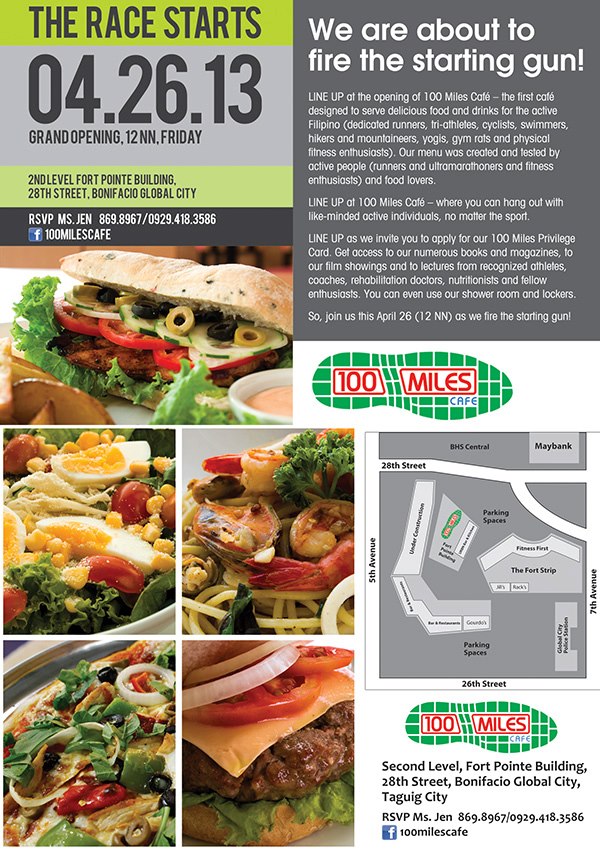
Finally, 100 Miles Cafe will be officially opened with a simple ceremony where runners and other endurance athletes are invited.
100 Miles Cafe Inauguration Invitation
See you at the Starting Line @ 100 Miles Cafe, 12 Noon, tomorrow, Friday, April 26, 2013!
Congratulations To Jael and to the Wenceslao Family!
I did not finish this race and I declared myself as Did Not Finish at Km 55. But as I promised in my past post where I mentioned my purpose in joining the race, I am here to make a Race Report and officially make a journal of what transpired before, during and after the race.
Start of Training & Preparation
I’ve never joined a TNF100 Phil event for the past five years but I have sponsored and sent my Elite Team Bald Runner to join the yearly event. Except for last year which was the first TNF 100 in Benguet-Baguio area, my elite runners had won the Team as well as the Individual Championship Awards.
Now, it is my turn to join this race as part of my preparation and training for another event. And since February of this year, I started to build-up my mileage and I enjoyed my “peak bagging” activities but these runs were less than the half-marathon distances.
The following significant races or runs were part of the mileage build-up for this race:
Bandit 50K Trail Run In Simi Valley, California on February 16, 2013 where I finished in 8:07+ hours
2013 BDM 102: Ran the first 50K in 8:20+ hours as the 50K Cut-Off Marshal.
Siquijor 75K Run last March 2013 where I was able to register a time of 13:23+ hours
Mt Ugo Trail 42K Marathon where I finished the race in 8:23+ hours
I was logging at least 10-12 kilometers every day and I had my trail runs on weekends that would last up to 6 hours.
For the months of March and April (2 weeks), I went up to Baguio City for five (5) times to recon the race route with ultra running friends. These recon activities were purely hiking in nature and some picture taking on what will be expected along the race route. On these recon hikes, I was able to test my nutrition, hydration, apparel, and race strategy depending on the terrain of a certain portion of the route.
Except for the portion where past runners would call the “mossy area” and the downhill route from Barangay Alang to the Bridal Veil or Aid Station #5 (AS5), I had already a familiarity of what to expect once I will be in the race. This part or portion of the course covers an estimated distance of 20 kilometers. The remaining 80 kilometers were part of my recon hikes on those days and weekends that I went up to Baguio City.
Tripping Accident
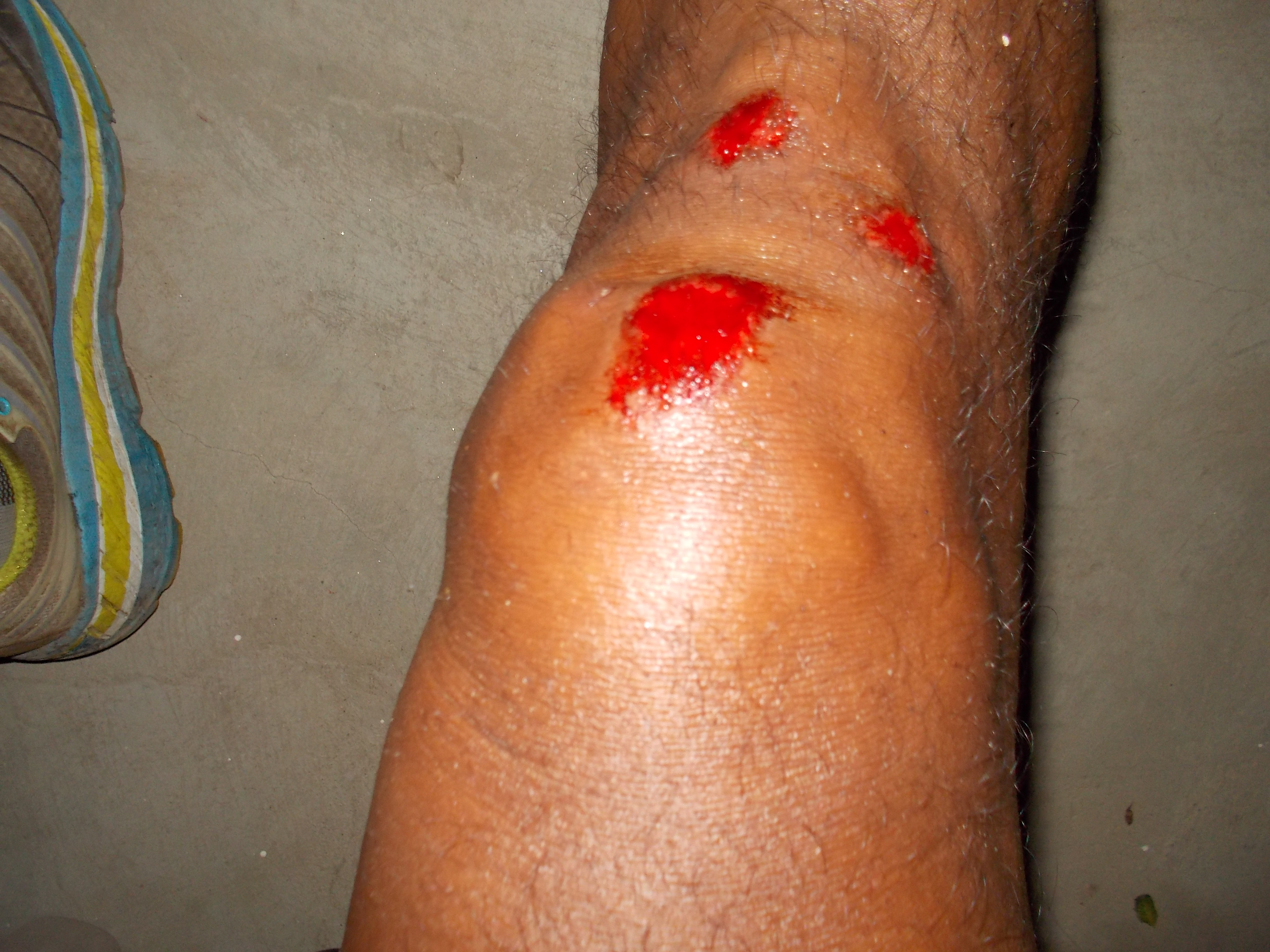
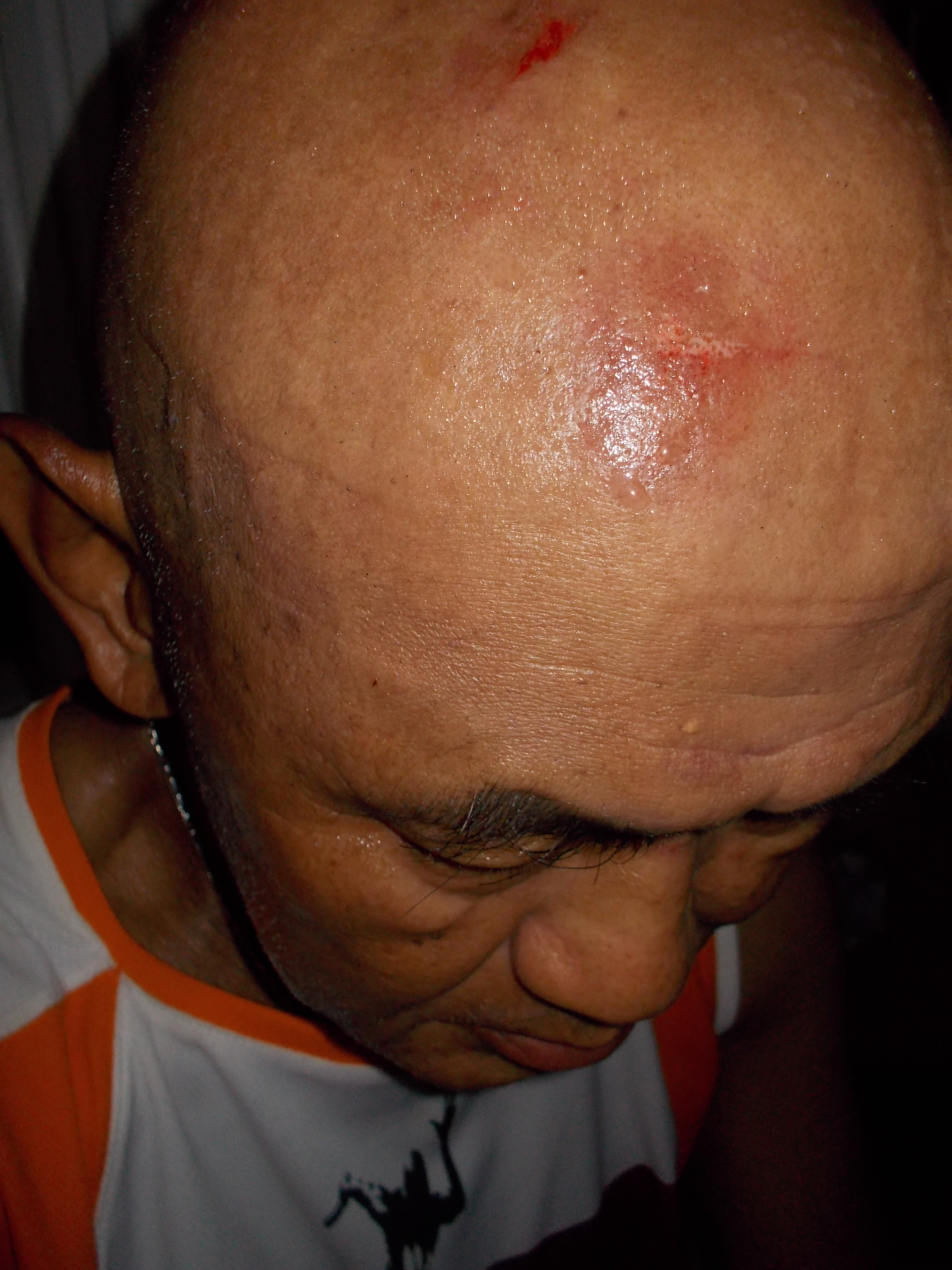
In the middle of March and two weeks before the Mt Ugo 42K Trail Marathon, I had a tripping accident which happened after running 14 kilometers of trails in the mountain of Bataan. It was already in the early evening and I was using my old headlight. I was already running on a paved road when I accidentally tripped a water hose laid across the road which was covered with a wood. I was not able to retain my balance and my right knee hit the ground first, my right arm was used to prevent my upper body from dropping to the ground but my arm collapsed and my head went crushing on the cemented road. I had 3 scrape wounds on my right knee and at least 3 scrape abrasions on the right side of my head.
I was able to recover immediately from the fall and tried to stand with the help of one of my elite runners who was with me in the run. We had to take a break by dropping by one of the “sari-sari” stores at the foot of the mountain and took a Coca-Cola drink and some biscuits as food. After 10 minutes of rest, together with my elite runner, we continued our run for the last 6 kilometers until we reached our training base camp.
On the following day, I could barely walked because of the infection brought by the wounds. For almost 2 weeks prior to the Mt Ugo Trail Marathon, I did not have any running workouts. However, I still managed to join the race in Kayapa, Nueva Ecija despite my lack of specific preparation for the race and the presence of pain on my right knee as a result of the tripping accident.
Shit Happens!Not On My Face!
Another Tripping Accident!
I really could not explain. Am I really getting old or something up above is telling me to stop running or am I simply hard-headed and crazy? Another tripping accident happened again barely one week to go before Race Day for the 2013 TNF 100. It happened during a night run where I was testing my new Headlight and new HOKA shoes. My right foot stepped on a shallow hole and my shoes front end hit the edge of the hole and it took away my balance. The healing wounds on my first tripping accident were the ones that hit the ground but I was able to use my right hand to prevent my whole upper body to hit the pavement. Yes, there was blood again on my legs and I was limping when I reached my place.
I still managed to have my last recon hike, one week before race day, despite my limp on my right leg. The last recon hike would cover the first 30K of the race on a Saturday and the last 25K on the following day, Sunday.
Race Strategy
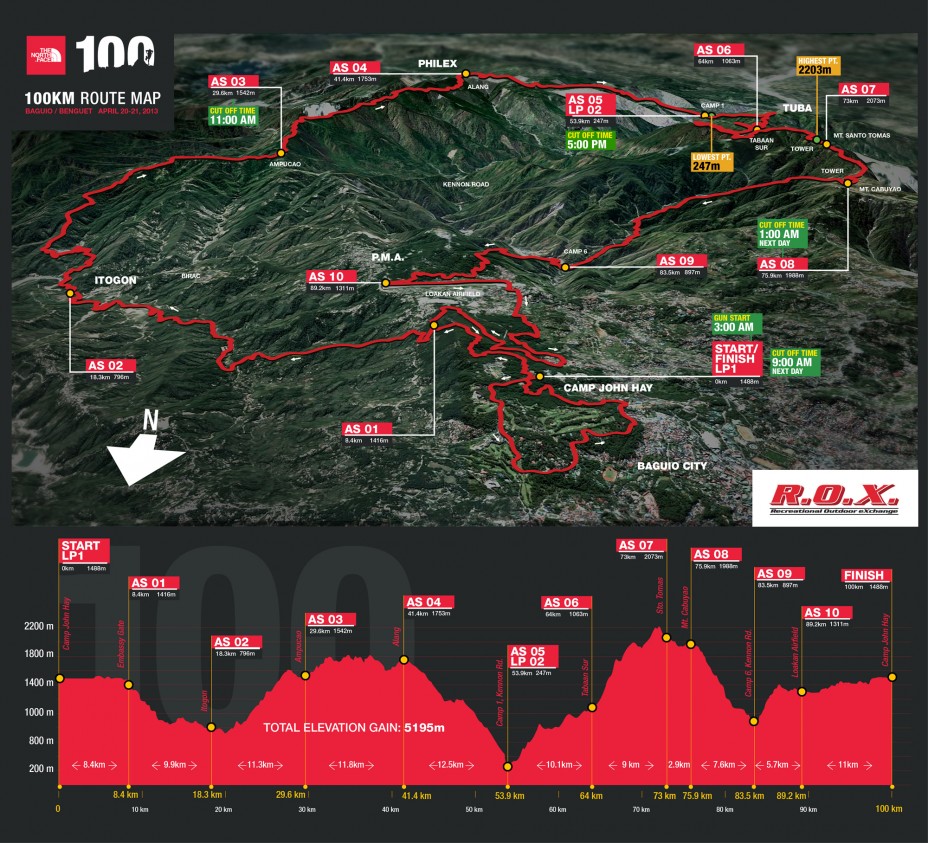
Since I am not confident on my running capability for the race because of the lack of long runs, tempo runs, and speed runs due to injuries brought about my tripping accidents, my target for the race was to try my best to finish within the cut-off time of 30 hours by following these time targets: (Note: Please refer to my previous post on the location of these places I am going to mention here. Thanks.)
Start To AS3 (Ampucao)—-Finish In 6 Hours
AS3 To AS5 (Camp 1/Bridal Veil)—-Finish In 6 Hours
AS5 To Cabuyao—-Finish In 9 Hours
Cabuyao To Camp 6—-Finish In 3 Hours
Camp 6 To Finish—-5-6 Hours
My estimates were based from the recon hikes that I’ve conducted. Except for the portion, AS3 To AS5, I know where I could run and jog and be able to shave off some of my time of running.
In my recon hikes, I had at least 12 hours of getting lost on the first 30K of the course and I knew that if I could run at least 5 kilometers every hour, I could reach Ampucao in 6 Hours. From Bridal Veil to Cabuyao, it took me almost 8 hours on pure hiking with rests. From Cabuyao To Camp 6, it took me 2:45 Hours during the day and I am confident to jog on the flatter trails with 3+ Hours as time to finish the portion. My recon hike from Camp 6 to the Finish Line (without those additional mileage inside the Camp John Hay Area) took me almost 4 Hours.
I took the risk of not knowing about the terrain in the “mossy forest” and the road from Barangay Alang to Camp 1/Bridal Veil due to the following reasons: (1) The trail inside the “mossy forest” was not yet available during those days when I had my recon hikes. The trail was newly cleaned few days before the race. (2) No available past runner/s or “guide” for the said part of the route join me in my attempted recon hike in the said place.
This part of the course proved to be my “waterloo” during the race but there are other more significant factors that simply sapped my strength during the race.
The bottomline of the Race Strategy was to run/jog the flatter sections, do power walking/hiking on the uphills, and keep the knees and quads from hurting on the downhills. I had to use my trekking poles to the maximum in order to be consistent on my pace.
Nutrition Strategy
Take a meal before the race and I did take a full breakfast meal of fried eggs, fried SPAM, and rice with coffee.
Eat while on power walking and never stop in-between AS just to eat. Ingest something that is solid every two hours. Eat while walking! At the AS, if you want to eat, make it fast and then take something to eat while on the road
Hydration Strategy
Drink if you think you are sweating a lot. Drink while chewing your food. If there are sources of water along the route, drink 1/2 full of hydration bottle and then fill up your bottles before resuming the race. Drink alternately with Gatorade. Drink Gatorade by sips or in small amount. Never fill the water bottle to the rim.
Running Apparel
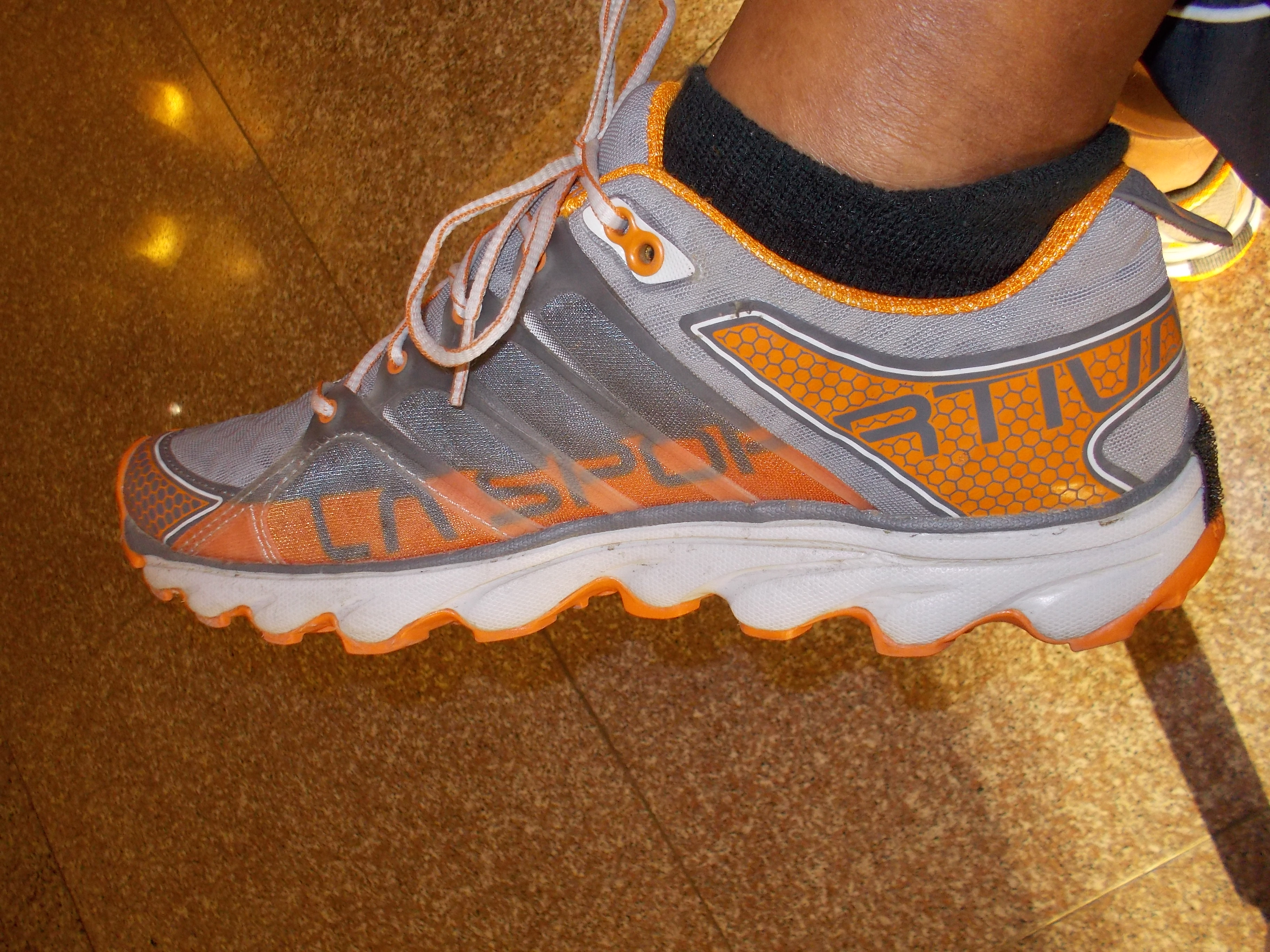
I bought my Helios/La Sportiva Shoes while I was in the USA last February for the sake of trying this Italian running shoe brand. I used them in my peak bagging workouts while I was in Los Angeles and like them. I appreciated more of its capabilities when I used them in my recon hikes most especially on the Cabuyao To Camp 6 route. While the rest of group on the hike were tripping and sliding as we went downhill, I did not experience any misstep, sliding or tripping. The structure of the sole was simply amazing as they really “gripped” on the ground and the pavement. I immediately decided to choose these shoes for the race. Drymax socks were used instead of my Eddie Bauer socks.
Helios By La Sportiva
In anticipation for moderate rain during race, I used my long-sleeved Patagonia baselayer which is colored dark green. (I had a light Poncho that weighs a garbage bag tucked in one of my hydration pockets, in case of rains.) The shirt is light and could easily dry up if it becomes wet with my perspiration or by the rain. I used a Salomon EXO compression tight shorts because of its high waist line and pockets. The compression feeling on its waist portion was perfect pressure applied on my core. It also served as an absorbent for my sweat from my upper body and prevented my feet and socks to be wet during the run. On top of the compression shorts, I used my black Patagonia Trail Shorts which have 5 pockets (two at the front; two at the back; and one zippered pocket on the right upper side behind the shorts). My cellphone (IPhone4) & reading glass were on my right front pocket; trail mix food was on my left front pocket; cereal, Gatorade powder and fruit bars were evenly distributed on the pockets behind my shorts.
Although I did not use my Salomon S LAB Hydration System during my recon hikes, I opted to use it because it has a whistle (mandatory equipment), string to tie my trekking poles, and lots of zippered pockets. My rain jacket was thinly folded inside the hydration compartment where the 1.5 liter bladder is supposed to be located. (I removed the 1.5 liter bladder and water hose to lessen the load and have more space for my trail food). My Nike reflectorized vest was thinly folded on the left zippered pocket while a light poncho was also folded on the right zippered pocket together with capsules of Pharmaton. Some trail foods were also stashed in the zippered back pocket of my hydration system. My lighting systems (old and new ones) from Black Diamond were stashed on the pockets of the hydration system.
I used calf sleeves from Zhensa for whatever it can do to my calf muscles, protect my exposed legs to small shrubs and sharp leaves of grasses, and absorb whatever sweat coming from my legs. I used some gaiters to prevent debris and small rocks from getting inside my shoes and they perfectly functioned well for the race.
I used also my favorite Buff placed on my neck to absorb my sweat coming from my head & used it to cover my nape from the heat of the sun and used an Under Armour Skull Cap on the early part of the race which fit well with the straps of my Black Diamond headlight. It also absorbed a lot of my sweat from my head. To anticipate the heat of the sun after I reached AS3, I switched to my Patagonia Legionnaires Cap.
Headlight System
I used the latest Black Diamond’s ICON Headlamp which I bought in the USA last February and I was satisfied with its performance. It has separate battery case that can accommodate 4 AA batteries. It has a long wire and heavier in weight but the illumination was perfect for night running. It brought so much confidence in me to run in the dark through its illumination and life/power expectancy from its batteries. The separate battery pack was perfectly stowed on the main compartment of my Salomon Hydration Pack. I have another old Black Diamond headlamp in my pack just in case of any contingency.
Lastly, I brought some strips of band-aids and antiseptic as my first -aid kit which was placed in the pocket where my poncho was located.
End of Part 1. Race Briefing & Race Proper to follow. Pictures To Be Inserted Later.


 Bald Runner
You must be logged in to post a comment.