Thanks to Ben Chan of Photovendo for the following pictures:
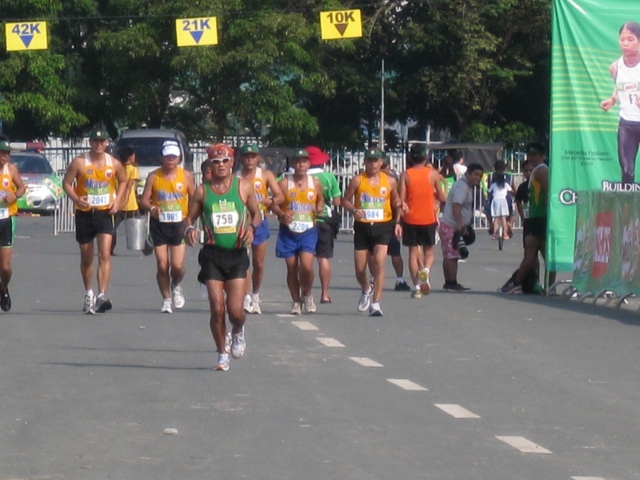
Up to Km 30 Point
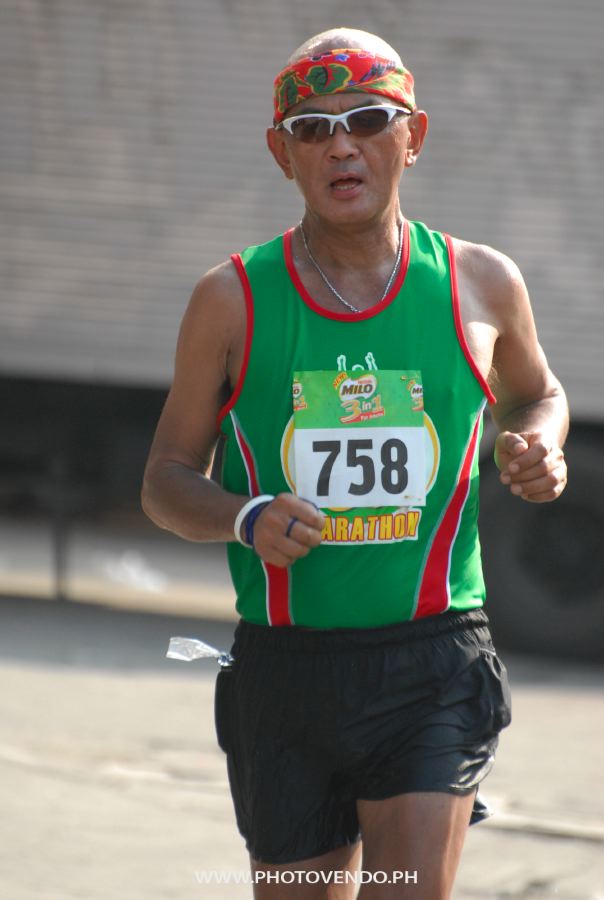
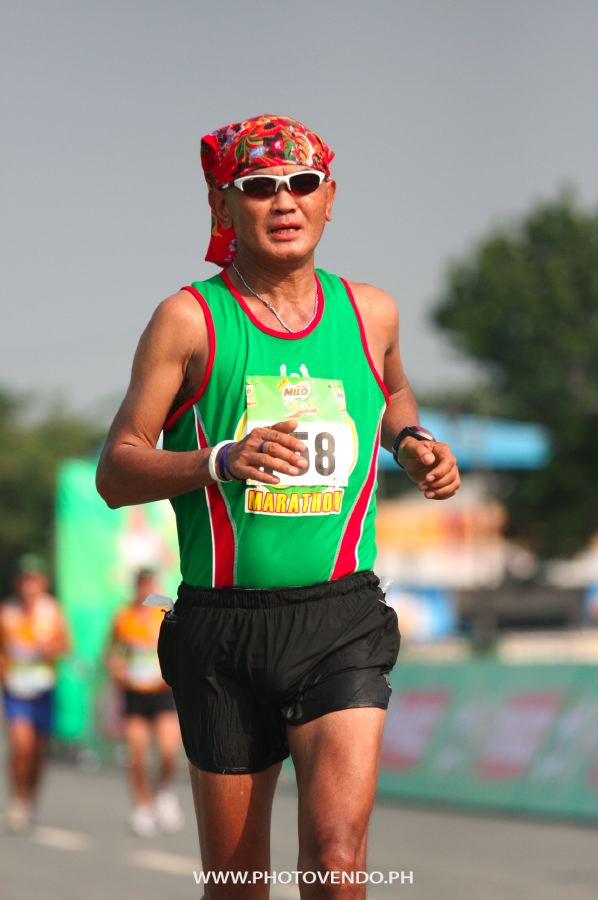
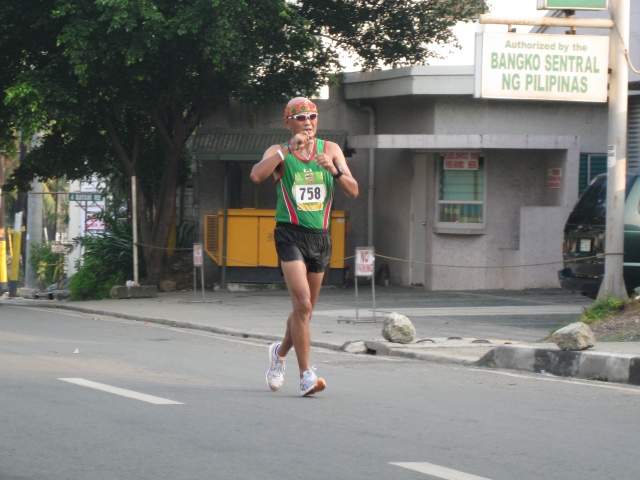
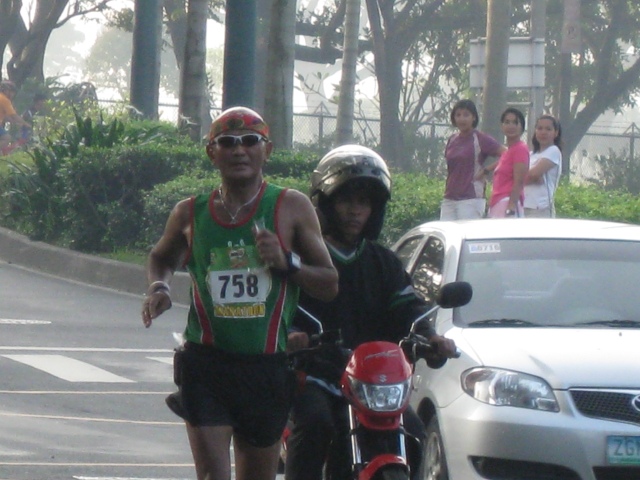
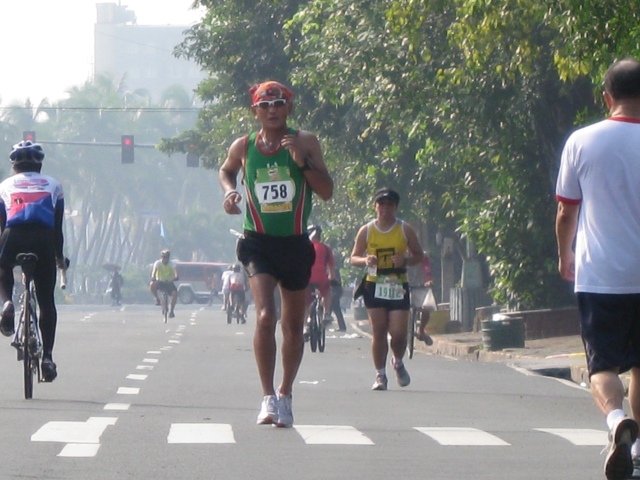
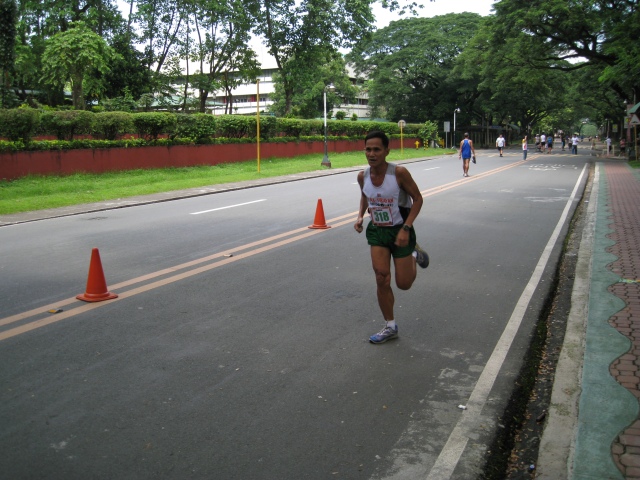
Instead of my usual bandana, I was using a “Buff” bandana on my head to absorb my sweat from my head and keep my eyes & face from the dripping sweat. As I passed the Water Stations, I usually grab two cups of water—one cup for drinking and another cup for dousing water on my head. The wet/damp “Buff” bandana also served as my head “coolant” most especially when the sun’s heat brought higher temperature during the race.
The race bib’s size was too big that I had to fold it on both ends to make it better looking with the MILO singlet. I had been consistently pinning my race bib on my breast and never been using some “race belts” and either pinning my race bib on my running shorts. Why? That’s is the proper way I know that even world elite athletes in international competitions would do to display their race numbers.
The MILO singlet was nice and I did not experience any “chafing” on my arms, nipples, or any part of my upper torso. You must have noticed the “ice candy” plastic bag filled with water on the side pocket of my running shorts! These are my “hydration containers” in marathon races! Yes, my running shorts from The North Face is now my favorite running shorts for the marathon distance because it has side and back pockets. One side pocket can accommodate two pieces of Sports Gel packets. I usually carry 4 Sports Gel packets during marathon races and this running shorts fits well with my needs. As for the back pockets, I used them as my “thrash bag”. Each side pocket could also accommodate at least two “ice candy” bags filled with water. I started using this TNF running shorts during the 2009 Los Angeles Marathon and I used it again during the MILO Marathon Eliminations.
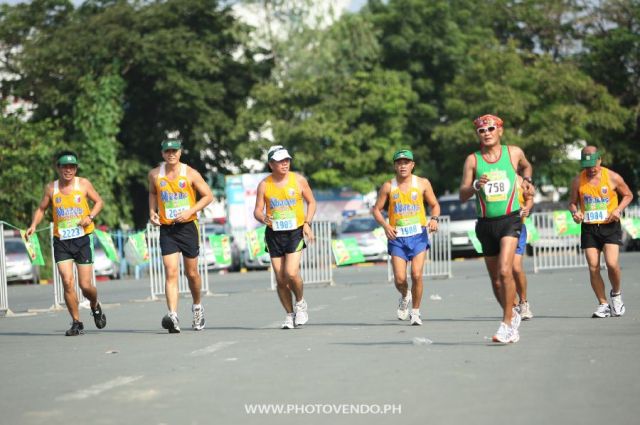
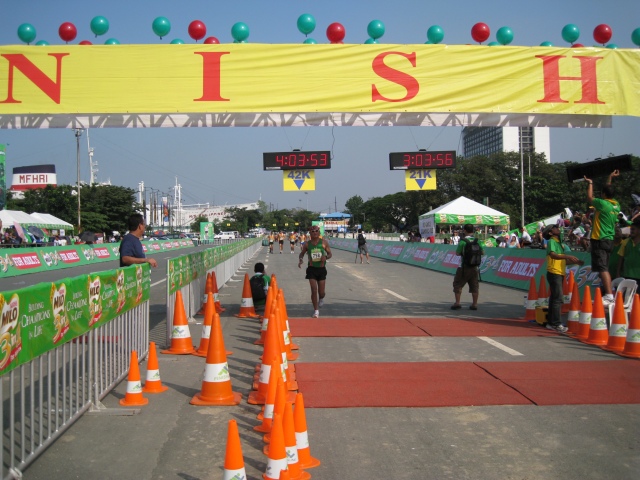
On My Last Turn Before The Finish Line
I was using ASICS-Gel Hyper Speed 3 Racing Flat shoes with Drymax Socks and I found comfort and blister-free with the shoes and socks!
Last 20 Meters To The Finish Line
On my last 8K as the sun’s heat was too much to bear, I adjusted the way I wore the “Buff” bandana in order to cover my head and at the same time my nape. I usually tie around my wrist the blue-colored string given in one of the turn-around points instead of wearing it as a necklace! Lastly, the “ONE” White Wrist Band is always there on my right wrist as my “symbol” for my part or contribution in the worldwide advocacy to “make poverty a history”.
Thanks to the Finish Line of Coach Rio De La Cruz & Vince Mendoza for the Timing Chip & for the fast publication of the following RunPix Results:
Gun Time: 4:03:55 hours
Net Time: 4:03:43 hours
Finisher #92 out of 125 Finishers. I wonder what happened to the other 112 runner-qualifiers for the Final Race! They must have DNFed!
Finisher #82 out of 112 Finishers in the Male Category.
Average Pace: 5:47 minutes per kilometer or 9:18 minutes per mile.
Time of Finish & Average Pace:
From 0K to 9.8K—-57:32 minutes @ 5:52 minutes per kilometer
From 9.8K to 25K—-1:30:08 hours @ 5:56 minutes per kilometer
From 25K to 35K—-54:51 minutes @ 5:29 minutes per kilometer
From 35K to Finish—41:12 minutes @ 5:44 minutes per kilometer
So far, so good, this was my 4th Marathon Race for the year. Not bad for a 57-year old Bald Runner!
“Yes, I’m a candidate for ejection from the Philippine team,” said the four-time champion Martes, the youngest Milo winner at 21 years old in 1999. “I’ll just talk to them and explain. I need the money. I’m having laser therapy for my old injuries and I need to buy vitamins.” (Note: Copied from news report at www.inquirer.net)
These were the exact words from the mouth of Christabel Martes, Lady Champion of the 33rd MILO Marathon FINALS held last Sunday, for her reason why she ran and finished the race despite an strict memorandum from PATAFA (Philippine Amateur Track & Field Assosiation) that National Pool Athletes are restricted from running more than a distance of 10K competitive Road Races at least 3 months before an International Games/Competition Meet. The reason for this memo is to make sure that our National Athletes do not divert themselves to their training program in order for them to “peak” during the competition period/date and at the same time, prevent them from becoming injured.
In the reaction of the PATAFA officials, as published in the news, Martes will be definitely removed from the list of National Athletes slated to be included in this coming Southeast Asian Games which will be held on the first week of December 2009 in Laos. For winning a cash prize of Seventy-Five Thousand Pesos (P 75,000) or equivalent to $ 1,595.00 in the MILO Marathon FINALS, her chance of winning the Gold Medal in Marathon in the ASEAN Games is gone!
Money versus Pride For the Country? Present Reality of our Athletes versus Present Situation of our Sports Excellence Program?
Now, let us try to discuss the present condition of our National Athletes basing from the title of this post/comments from Christabel Martes.
It appears that our National Athletes are not properly or adequately supported by our Sports Federation or the Philippine Sports Commission (PSC). As per PSC’s guidance, for an Athlete who won Medal/s (Gold, Silver, or Bronze) in the previous ASEAN Games and other International Competition Events and presently training to compete in an International Games, he/she receives a monthly support of Fifteen Thousand Pesos (P 15,000) or $ 320.00 inclusive of food, vitamins, training needs, and stipend. While on training, with the guidance of their coach, they are left on their own and stay/live in Sports Facilities being managed by PSC. It is also concluded that the athletes had to deal with their own injuries and have to get the services of professionals to cure them for a considerable fee. Which means that our Sports Support Services (Sports Medicine, Nutrition, Sports Psychology, etc) are lacking! In short, 15K Pesos is nothing if we want our athletes to be “world-class”. The same amount of money is equivalent to a ONE-DAY MEAL for Michael Phelps, I guess!
For a potential medal placer and a “newbie” in the National Pool of Athletes, he/she receives a monthly stipend of Six Thousand Pesos (P 6,000) or $ 128.00. This is translated to P 200.00 per day meal for the athlete and he/she could not even buy vitamins and sports drinks for his hydration & electrolyte resplenishment needs during his training. And if he/she wants to compete in weekend road races, he/she is selective as to where he/she will compete because the registration fee will be deducted from this amount of money. But our athletes are “brave warriors” because they have to risk in investing their training money to weekend road races that have Cash as Major Prizes for the Top Finishers! If they loss and don’t get any cash prize, the more that they will train harder but their training money is now draining and they are forced to spend their money to their barest needs. In essence, our athletes are on “survival” mode!
This situation is not only applicable to our runners but to all our athletes in other sports!
Now, you know already why our runners in our National Pool of Athletes are only good for our local Road Races with Cash Prizes, not for the ASEAN Games, not for the ASIAN Games, and never for the OLYMPIC Games!
In last year’s MILO Marathon Finals, I was able to peak for my marathon training and I was able to register a finish time of 3:48:32 hours. I was not able to join the Marathon elimination run last year but I was able to make some arrangements with the Race Director for me to join the Finals, hence, I was able to participate in the said race.
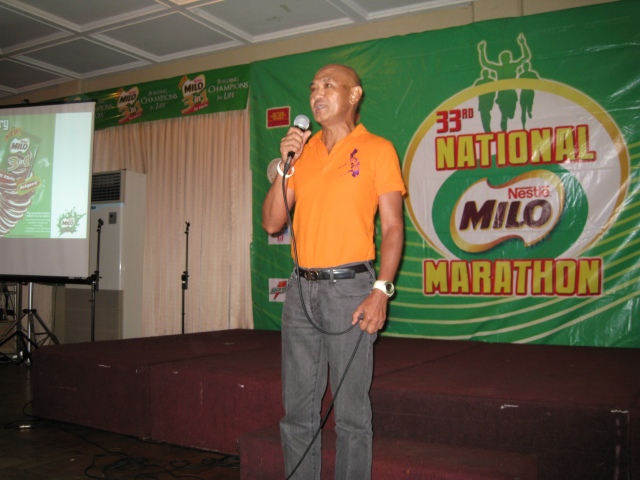
This year, I was able to participate in the MILO Marathon Eliminations but I was not able to qualify because I finished the race in 4:20:45 hours. This was due to the fact that I participated in the 2009 Los Angeles Marathon five weeks in between two marathon races. However, with the popularity of this running blog, I was able to make some arrangements (again!) to run the FINALS as a “guest runner”. But I have to “pay back” for such request as I was requested by the Race Organizer, my friend, Mr Rudy Biscocho to deliver an inspirational message to the Finalists of the Marathon Race during its Carbo-loading Party last Thursday evening at North Greenhills Clubhouse. The gist of my Inspirational Message speaks well of the title of this post.
Inspirational Talk @ MILO Carbo-Loading Party
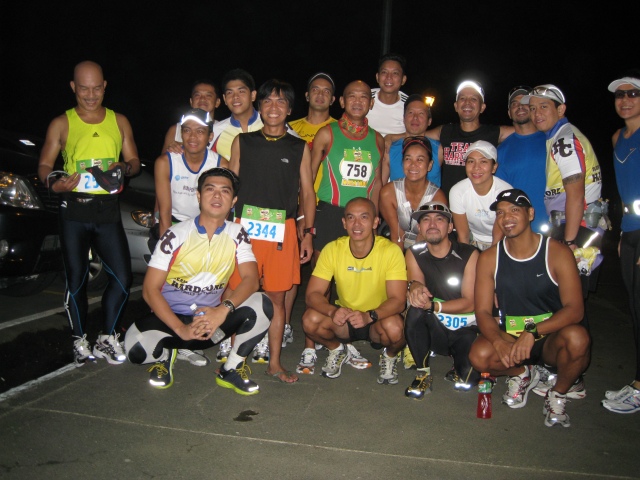
I arrived at the Luneta Park at 4:00 AM and I immediately set my GF 305 and made a slow jog in order to warm-up. After a few minutes, I joined the members Team Hardcore and Finishers of 1st BDM 102. We had “photo-ops” and brief chat with one another. From there, we proceeded to the Starting Line. At the Starting Line, I was able to meet the other runners and Executives of NESTLE/MILO who are joining the 42K Race.
Group Picture With Team Hardcore & 1st BDM 102 Finishers
At exactly 4:29 AM, the starting gun went off and I placed myself at the back of the runners. I planned to run with an easy even pace for the whole race and I was hoping to have an extra strength at the last 10 kilometers to have a finish time of less than 4 hours.
After running through this course for so many times, I was already confident to finish the race right from the very start and did not mind about the terrain of the route. The thing that kept me worried was at what point or distance where I will encounter my first “muscle cramps”? Three weeks before this race, I did a 40K long steady run as part of my preparation for this race and I never had any cramps during this workout. As compared during the last Elimination Race, I had my muscle cramps at Km #16 and it affected my finish time.
@ Bayani Road
I finished the 1st 10K in 56:15 minutes and I was confident that I could meet my objective for this race. After running 20K, I was still within my planned finish time but I started to slow down while I was on my way back to the Finish Line. The heat of the sun and the humidity made me slower but I was able to maintain a sub-6-minute per kilometer pace on the last 10K. It was only at Km # 36 that I checked on my GF 305 and my time registered at 3:22+ hours. I started to panick and tried to increase my pace. At this point, I knew I could make it but every time I increased my pace, my legs would act otherwise and they became heavier. I did not feel any cramps but I could not simply lift my knees higher and drive my arms faster.
@Lawton Avenue-Essensa Area ( See the Background!)
@ Roxas Boulevard/2K to the Finish Line
Along the last 3K before the Finish Line, I was distracted by a number of cyclists who were going on counter-flow right where the exact direction of my run. I could not understand why these cyclists would meet head-on with the runners while the road is too wide for them on my right side. I had to shout at these cyclists and told them to clear the path for the runners. I even dared one of them to collide with me! But, on the last few feet, they had to avoid me. It was a better option for them to avoid me rather than the cyclist falling to the ground.
@The Luneta Near The Finish Line
Except for this negative observation/experience during the race, the MILO Marathon Finals have improved a lot. At last, I was able to see long tables filled with lots of water cups up to the last water station before the Finish Line. There were lots of route marshals and Traffic Enforcers of each City were properly briefed on what they have to do in order to give way for the runners and at the same time decongest the traffic brought about by the Marathon Race. The presence of Reinier Pacific & Takbo.ph Volunteers and Aid Station at Gil Puyat Avenue (Buendia) was very helpful to all the runners which offered chopped fresh fruits (apples & oranges) and efficascent oil spray for the muscles. My sincerest thanks to Mr Amado Castro, Jr for having the initiative to bring to the country what he had observed and experienced when he “racewalked” the 2009 Los Angeles Marathon last May. How I wish that those “more influential” runners who have experienced running Marathon Races in other countries would also take the initiative to offer support to runners in Marathon Races. “Mayayabang kayong sabihin sa mga “media releases” ninyo na natapos ninyong tumakbo ng Marathon Races sa Europe at America, pero wala naman kayong ginagawa para tulungan kaming mga mahihirap na mananakbo para pagandahin natin ang Marathon Races dito sa Pilipinas”.
Not only the presence of abundant water stations, MILO’s Race Organizer made good in making it standard to have “Gatorade Stations” along the route which were located in between the Water Stations. I also appreciate the presence of a Fruit Stand/Station at the corner of Lawton Avenue and Bayani Road.
Gone are those Maynilad Water Lorry Trucks that we always see parked beside the Water Stations! Instead, I was able to see lots of Nestle Bottled Water containers and I assumed that we were drinking bottled water during the race as briefed by the Executives of MILO during the Carbo-Loading Party. This was a nice improvement!
So far, the most commendable innovation in this edition of MILO Marathon Finals is the RFID Timing Chip! I was happy to see the “sad faces” of identified consistent cheaters of this marathon race as I met them near the turn-around points along the route. However, I got an information that one of the top 15 finishers in the 42K race was “caught” cheating (by making the race as a relay run of two runners).
I finished the race in 4:03:54 hours (based from my GF 305), a few minutes from my target finish time of sub-4 hours! I did not encounter any muscle cramps during the run and I was fully satisfied with my performance. My average pace was 5:44 minutes per kilometer with an average HR of 152 bpm. However, I don’t complain this time that my GF 305 registered a distance of 42.46 kilometers.
Congratulations to Mr Rudy Biscocho, to the NESTLE, Philippines and to the Volunteers for a “world-class” marathon race in the country. MILO Marathon Race proved it once again that it is the most prestigious and well-represented marathon race in the country today. I just hope that NESTLE/MILO would bring back those times when the Champion/s of the Marathon Finals were sent to Marathon Races in key cities in the United States/Europe. Who knows another Manny Pacquiao or Efren “Bata” Reyes would emerge as Marathon Champion in one of these International Marathon Races. This is a dream but it could be done!
See you at the Starting Line in the next Marathon Race for this month of October!
The following article was copied from www.marathonguide.com. The famous Berlin Marathon is being held today, 20 September 2009. This Marathon Race is considered as one of Marathon Races included in the World’s 4 Grand Slam Marathon Races.
This is where Haile Gebrselaissie got the world’s record finish time for the Marathon Race in 2:03:59 hours.
Check on the website of the Berlin Marathon for the LIVE Update at www.scc-events.com
Gebrselassie Versus Kibet – The Fastest Marathon Duel Ever?
No one could have imagined that the BERLIN-MARATHON would become one of the
most spectacular sports events in Germany when the race was started for the
first time 35 years ago. That happened next to the Grunewald, a forest in
West Berlin, and there were only few spectators. Today the real,-
BERLIN-MARATHON attracts around one million people who celebrate one of the
greatest running events on the globe. It was almost 20 years ago – after
the fall of the Berlin Wall in November 1989 – when the race got a huge
boost. Leading through both parts of the German capital from 1990 onwards
the real,- BERLIN-MARATHON became famous for superfast winning times, great
crowd support and growing fields. This Sunday we could well see another
thrilling race: defending champion and world record holder Haile
Gebrselassie (Ehtiopia) will be up against Kenya’s Duncan Kibet, who leads
the current world season’s list.
A record number of 40,923 runners from 122 nations have entered the 36th
edition of the real,- BERLIN-MARATHON. Since the race belongs to the World
Marathons Majors (WMM) even more people want to take part. A year ago
35,783 runners finished the real,- BERLIN-MARATHON. That was the highest
number ever in the history of the event and the 2008 event became the
seventh biggest marathon ever seen. In 2006 Race Directors of the
prestigious marathons in Boston, London, Berlin, Chicago and New York had
formed the WMM.
Gebrselassie targets his own record once again
So far five runners have established personal bests of sub 2:05 at the
classical distance. Two of them will run in Sunday’s real,-
BERLIN-MARATHON. While Haile Gebrselassie had improved his global record in
Berlin in 2008 to 2:03:59 Kenya’s Duncan Kibet had run 2:04:27 earlier this
year and has moved up to number two on the alltime list.
Haile Gebrselassie’s goal is obvious: He intends to break his world record
again. If he succeeds it will be the third time in a row that he would
establish a new world best at the real,- BERLIN-MARATHON. So far the 36
year-old has broken an amazing 26 world records during his career.
Gebrselassie thinks that he can at least slice off another 30 seconds from
his present marathon record. “If everything fits together perfectly then
may be even 2:02:59 would be possible,” says the Ethiopian, who is going
for a record fourth consecutive victory at the real,- BERLIN-MARATHON.
But Sunday’s marathon could well be the toughest for Haile Gebrselassie in
Berlin. In a recent interview Kenya’s star runner Paul Tergat named four
fellow countrymen who he thinks may be able to break Gebrselassie’s world
record: Olympic Champion Sammy Wanjiru, Martin Lel, James Kwambai and –
Duncan Kibet.
For more than two years Haile Gebrselassie has not competed against an
athlete as strong as Duncan Kibet in the marathon. This could well become a
fascinating duel. “I feel honoured to be able to run against Haile
Gebrselassie,” said Duncan Kibet during Thursday’s press conference in
Berlin. My training went very well and I think it is a very good sign that
my training partner James Kwambai ran 59:09 minutes last Sunday at the
Rotterdam Half Marathon.” Duncan Kibet did not want to comment on a
possible world record attack, but said that he intends to break his
personal best. For this he must of course run in the region of the world
record. “After Rotterdam I though that I might be able to run even faster
in Berlin. So this is why I decided to go for this race.”
Looking ahead to a duel with Haile Gebrselassie the Kenyan record holder
said: “I don’t know about Haile’s training. And he does not know about my
training. So we will have to wait and see how it develops. But I will try
to run his pace.”
There will be two more Kenyans and one Ethiopian with high-class personal
bests in the race. Francis Kiprop came fourth at the Seoul Marathon in 2008
with 2:08:30 and Mariko Kiplagat (all Kenya) placed fourth at last year’s
real,- BERLIN-MARATHON in 2:09:04. Ethiopia’s Eshetu Wondimu was able to
improve to 2:08:41 despite bad weather conditions in this year’s Dubai
Marathon. The strongest non-African runner could be Atsushi Fujita (Japan)
who has a personal best of 2:06:51. This however is already nine years old.
Ethiopian favourites in the women’s race
Askale Tafa Magarsa will be the favourite in the women’s race on Sunday. A
year ago the 24 year-old Ethiopian finished second behind Irina Mikitenko
(Germany), clocking a great personal best of 2:21:31. With that she
remained the second fastest woman worldwide in 2008. Now Askale Tafa
Magarsa returns to the real,- BERLIN-MARATHON and will be eager to further
improve. She may well be able to establish a world season’s best, which
currently stands at 2:22:11. Irina Mikitenko clocked this time when winning
in London in April. Askale Tafa Magarsa’s strongest rival probably will be
a fellow Ethiopian: Atsede Habtamu clocked 2:25:17 in torrential rain in
January’s Dubai Marathon, where she took second place.
Genet Getaneh will also be in with a chance on Sunday. The 23-year-old
Ethiopian finished fifth in 2:26:37 at the Dubai Marathon this year. The
strongest Kenyan should be Leah Malot. She has a very good long distance
track record and improved to 2:30:29 at the Paris Marathon this April.
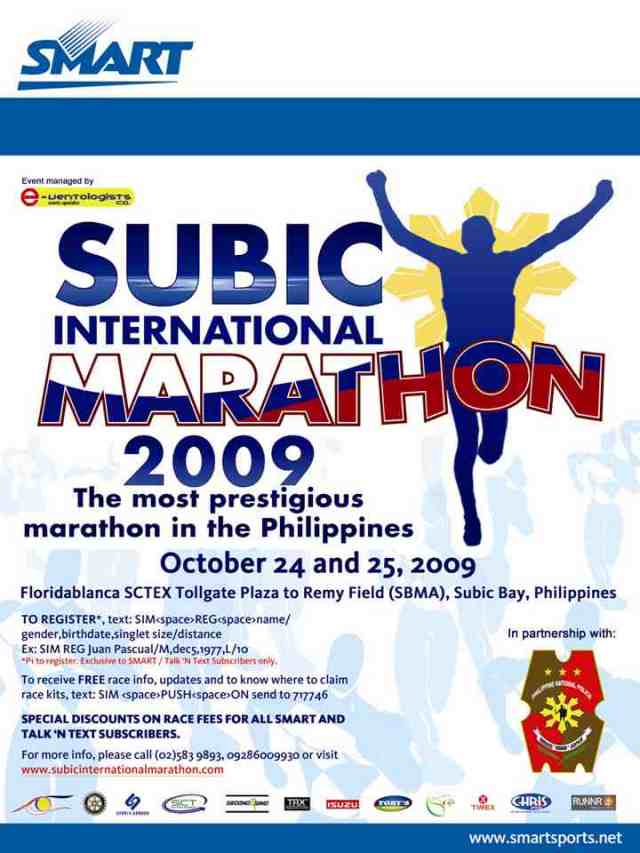
The following are the reasons why I am going to join the 2nd Subic International Marathon where SMART is the Major Sponsor of this running event:
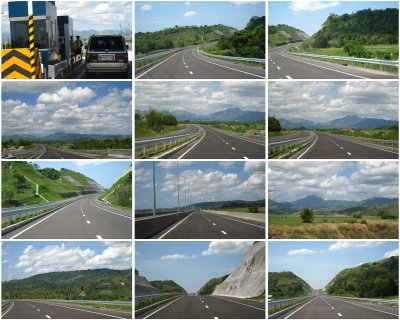
1) Location of the Route—If you want a variety of running route in your Marathon running experience, then the route of the SMART Subic International Marathon is the best! The new SCTEX’s Floridablanca’s Exit/Entry will be the starting area and the finish line is located at the Remy Field’s Oval Track, inside the Subic Freeport. This is a chance to leave Metro Manila for awhile in order to change your running environment. As compared to the route in last year’s Marathon Race, this year’s route is more pleasing and better for the runners, most especially to those who are intending to finish their first Marathon Race.
2) Pollution-Free—Unlike in Marathon Races held in Metro Manila, the SMART SIM offers a race route that is free from pollution—air and noise pollution. The route is devoid of heavy traffic of vehicles, no buildings, no populated areas, and no distractions. No crazy or yelling drivers at you while you are running. No intersections and no pedestrians! Everything that you see around you along the route is the long asphalted road infront of you; the rice fields seen on both sides of the Expressway; hills and mountains on your front and right side and sometimes on your left side when the highway cuts through a hill.
3) Running Surface—The expressway is made of asphalt which a softer and more forgiving surface for our running legs than the concrete-paved roads. Runners would not notice it but the running surface in a marathon race gives a big factor on how our running legs perform in a long distance road race. However, since the cross-section view of the highway is curved on its edges, it is advisable for the runners to shift to the more level part of the highway. I am sure I will be running along that white paint protion on the edge of the road because it is softer than the asphalt.
4) Time of the Race—The race starts at 4:00PM which I think will be the first full Marathon Race to be held on such time of the day in the history of Road Racing in the country. The North Star 10K Run in Laoag City & Paoay, Ilocos Norte is the only Road Race then that starts at 4:00PM on the 3rd Saturday of December. I am sure the sun is still on the west horizon and about to set. This is the time when the heat of the asphalt road and the cooler air that is brought by the setting of the sun would meet. It is expected that the temperature and humudity will still be high but this will be compensated with winds/breeze coming from the mountains and the rice fields. Runners would have a chance and expect to see the sunset on the horizon while running which in contrast with the usual morning road races that we join in Metro Manila.
5) Registration Fee is Cheap!—As compared to the other Marathon Races, this race is very cheap and the singlet that goes with it is nice and of good quality. This is one of the few Marathon Races where you can have your Race Packet (with singlet) given to you once you submit your registration form.
6) Prizes Are Very Attractive—For the elite and international runners, the prizes at stake are very attractive and SMART has really invested in this Marathon Race for the promotion of long distance running competition in the country. Hopefully, this race will put the Philippines in the map of world’s famous marathon races. This race will also promote Sports Tourism for the country.
7) Race/Event Organizer & Race Director—Without a doubt, the people behind this race are very responsive to suggestion and/or comments from runners. In short, they are considered “professionals” in the world of road racing events. Adi De Los Reyes and his team had been in the sports corporate and events management for years and he had conceptualized a lot of ideas for the running community. Chief Superintendent Samuel Tucay of PNP who just retired few months ago is also a seasoned marathon runner, a friend, will be the Race Director for the said event. Actually, the Subic International Marathon is the “brainchild” of C/Supt Samuel Tucay and he maintained to be the Race Director since last year’s edition.
SMART 2nd Subic International Marathon Poster
8) Advocacy of the Event—While C/Supt Samuel Tucay was the Chief of the PNP’s Training and Education Command based in Subic Freeport, he advocated the adherence to running to all PNP personnel who are considered as “scalawags” in the service as they were transformed from “bad eggs” to “good models of policemen” in his Command. C/Supt Tucay was very successful in his program and later adopted such program for the whole PNP and to the different regions. It is through running and adherence to physical activity that anybody could be transformed into a “productive” individual to the community.
9) Dedication to My Bereaved Mom—I joined this Subic International Marathon last year but I was registered for the Half-Marathon as part of my training for the 2008 Pasig River Heritage Marathon. It was January 20, 2008. I will never forget this date as few hours after I finished the race, I got the news from my youngest sister that my Mom died after eating her lunch. She was 82 years old and she died due to cancer. Since then, I made a promise to myself to run the Subic International Marathon annually as a dedication and tribute to my Mom.
10) My Picture On My Blog’s Title—Yes, that picture on top in my blog’s Home Page Title was taken while I was running the 1st Subic International Marathon. I never changed my Blog’s Presentation/Theme with the said picture for the past year & months. So, every time I see my blog, the Subic International Marathon is always recalled and remembered. By the way, I don’t intend to change the Presentation/Theme & such picture on the title of this blog and that is what I call “Consistency”!
And lastly, I am a loyal subscriber of SMART since 2000 and I never changed my cellphone number!!! That’s another example of “Consistency”!
Good Luck on your training and See you at the Starting Line!
Rey Antoque is presently one of the Coaches of the Elite Team Bald Runner. His credentials as a runner speak for itself. He had been with the Elite Team for the past ten (10) months. What I like with him is that he started to train hard for the Marathon Race at the age of 33 years old, an old age for an elite runner for the Marathon distance.
His performance in Marathon Races in the 1990’s and early 2000’s speaks well of his focused training, dedication, perseverance, and determination.
On his first competition on Marathon Road Racing, Rey placed No. 4 in the 1990 Pilipinas International Marathon with a time of 2:24:06 hours which was considered at that time as the fastest time for a Filipino in a marathon race held in the country. He was 33 years old.
After one year of training for the Marathon distance, he placed #3 Overalll in the 9th PAL Manila International Marathon in 1991 at the age 0f 34 years old.
In 1992, the following year, he won as Champion in the 16th MILO Marathon with a time of 2:28:47 hours at the age of 35 years old. At that time, he won a Cash Prize of P 60,000.
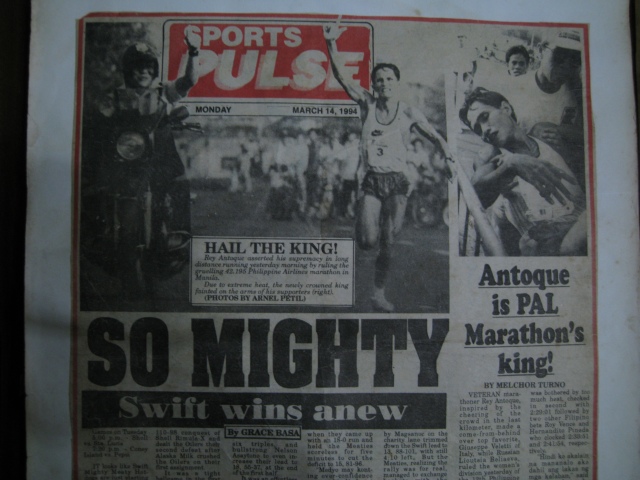
Picture Depicts The Intensity of Rey's Race & Finish
In 1993, he was the 1st Top Filipino and 2nd Overall in the Pilipinas International Marathon where a Belgian runner won as Champion. Rey Antoque improved his time at 2:27:32 hours.
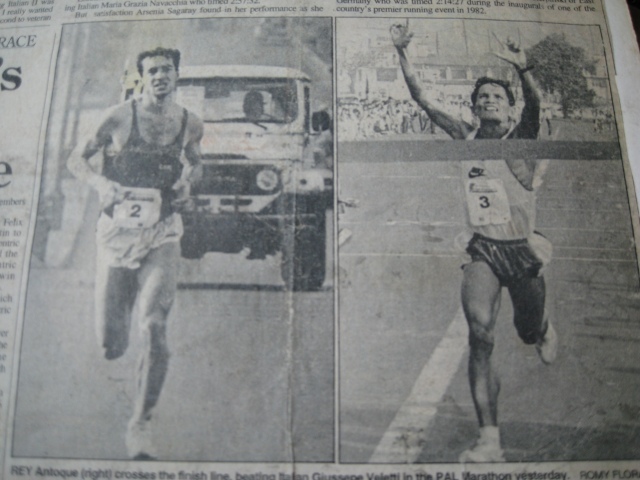
In 1994, he was the Champion in the 12th PAL Manila International Marathon on March 13, 1994 with a time of 2:28:24 hours. He was able to beat and overtook the younger Guiseppe Veletti of Italy who was then 25 years old on the last kilometers of the race. Antoque was then 36 years old.
Guiseppe Veletti of Italy & Rey Antoque
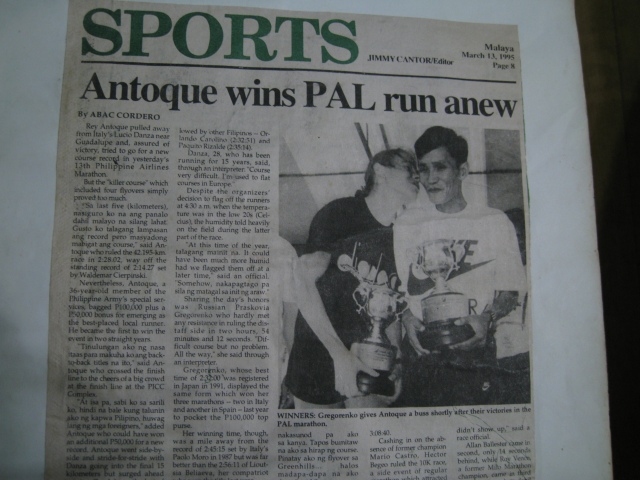
In 1995, the following year, he was able to defend his title as the Champion in the 13th PAL Manila International Marathon on March 12, 1995 beating again a younger Lucio Danza of Italy (28 years old) who was with Guiseppe Veletti. He registered a time of 2:28:02 hours at the age of 37 years old. He won P 100,000 as the Champion and additional prize of P 50,000 for being the Top Filipino Finisher.
Women's Champion Praskovia Gregorenko of Russia Gives Rey a Buss
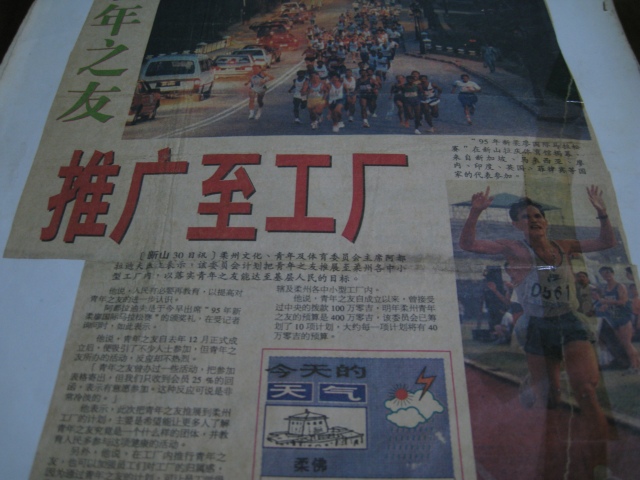
On July 30, 1995, he was the Champion in the 1995 SIJORI (Singapore-Johor Bahru-Riad) International Marathon Race held in Johor, Malaysia with a time of 2:33:16 hours. He won a prize of RM 10,000.
Malaysian Newspaper With Rey Antoque in the SIJORI Marathon
In November 20, 1994, he was the Champion in the 5th 10-Mile YAKULT Run with a time of 1:03:15 hours.
In 1996, he was the Champion in the 9th Annual PUMA Half-Marathon with a time of 1:08:46 hours.
In 2004, he won the Gold Medal in the 5,000-meter and 10,000-meter runs in the ASIAN MASTERS Championship held in Bangkok, Thailand.
Rey Antoque, 54 years old @ BOTAK's 1-Street Mile Run
He shared some of his “training secrets” of which I am going to divulge in this post.
He trains and prepares the whole year only for ONE Marathon Race Event.
He spends and stays in Baguio City at least 6 months during his training. Kennon and Naguilian Roads were his training routes.
He applied what he learned from a Kenyan elite runner—running three (3) times with a distance of 5,000 meters in 15 minutes with 3-5 minutes of rest/interval in between repetitions in his speed workouts at the oval track. I did this speed workout once (in 23 minutes) and I had to rest & recover for two days!
He runs twice a day, morning & afternoon, reaching up to 200+ kilometers mileage per week. His long run workouts exceeded the marathon distance!
He is a disciple of Arthur Lydiard.
(Note: News Clippings Courtesy of Rey Antoque’s Files & Memorabilias)
I just received an e-mail from the Race Organizer of the Los Angeles Marathon stating therein that their Online Registration will be open effective on August 31, 2009. The Race Day will be on March 21, 2010. The last day of Registration will be on March 1, 2010. The Race Route will be completely different from the past editions as the race will start at the Dodgers Stadium and end in Santa Monica Beach. Registration Fee is $125.00.
From this information, let me point the following observations:
1. Registration Period—An International Marathon Event opens its registration at least six (6) months before Race Day. This is a positive indication that the event will push through and it is already calendared in the list of Marathon Races in any of the websites maintaining a list of Marathon Races in the USA or in International Cities/Countries. The 6-month period is an appropriate duration to train for the said event. May the Local Race Organizers learn from this.
2. Deadline of Registration Period—If the Online Registration published the date for the deadline of Registration, such date will be strictly followed. There will be no “special” accommodation for late registrants! The reason why the Race Organizers always set a deadline for registration in International Marathon Event is that they want a 100% Customers Satisfaction to all the participants. This is translated to efficient production of Race Packets, Finisher’s T-Shirts, Medals, & Certificates to include coordination for security, medical, and safety protocols for the said race. On the said race, the Race Organizers had at least 3 weeks before the distribution of kits and on the race day to prepare the Race Packets of the participants to include the “giveaways” at the Finish Line. I hope our local Race Organizers will learn from this to avoid some “lapses” in the distribution of kits. It is also on this period that the race results encoders will be able to input all the data of the runners in their Master List of Participants for easy post-processing of results immediately after the last runner had passed the Finish Line. It should be noted also that the entity that receives your Online Registration is completely a different group from the Race Organizer.
3. Registration Fee—The registration fee is $ 125.00. Nowhere in the website where you can see where your registration fee will be used. The Race Organizer will not explain where your registration fee is going to be spent!!! If the Race Organizer decides not to give you a singlet or Finisher’s Shirt, they don’t need to explain. It’s either you want to pay the registration fee or not/join the race or not! It’s your choice. However, I am sure the money you paid for the registration is worth the experience during the race.
4. No Need To Invite Elite Foreign Runners—Let the name of the city or location of the Marathon Event speaks for itself. However, if you announce your Marathon Race as an International Event with 60 days before Race Day, there is a slim chance that the best international runners will be coming to participate in the said event. The best runners are already focused to join races which had been known by them 5-6 months ago. If ever foreign runners will participate in our International Marathon Events for the months of October & November, these runners would be their 2nd or 3rd rate runners. We hope these runners to arrive in the country at least two weeks before race day in order to acclimatize with the weather and humidity.
The first time that I attended a “media launching” of a running event was when I was personally invited by Jinoe of takbo.ph for the Kenny Roger’s Urbanite Run. I really enjoyed that scheduled meeting as it was done in the evening at the KR’s branch at SM Megamall and the fact that most of the invited guests were the “runner-bloggers” and not one from the media sports reporters in daily broadsheets and tabloids. Although I was not impressed with the punctuality of the presentation or briefing, I had a good time talking and exchanging ideas with the other “runner-bloggers”. It was in this event that I personally reminded the Race Organizers to “beef-up” the security services during the race as preventive measure for car thefts or “breaking-in” of parked cars of the runners. The reasoning that I presented was the fact that we had incidents of thefts during daytime races and there is a greater possibility of “bad things” to happen during nighttime. I am glad that the Race Organizers heeded to my “reminder” and so far, there were no reports of thefts or “break-ins” in parked cars during and after the race.
Two weeks ago, I received an e-mail inviting me to attend the media launching of the 1st Quezon City International Marathon. I fondly recalled that this was informally known by runners to be conducted on the first few months of this year. To be exact, it was supposed to be conducted for the month of February but for reasons I don’t know, it was rescheduled indefinitely. It was only when Rene Villarta aka JAZZRUNNER made a post in his blog that this race will push through in October of this year.
The media launching was scheduled at 8:00 AM of 18 August at Max’s Restaurant inside the Quezon City Circle Park and I was at the venue at 7:55 AM. I was the first registered “runner-blogger” and the first one to take a seat in a row of tables prepared for a lunch! Finally, the event started at 9:35 AM which was the time I was scheduled to meet another person within the vicinity of the venue. I was glad the person whom I was supposed to meet joined the event and was seated in my table. So, while I was listening to the speakers of the event, I was also talking to a writer and author of a book who wrote a history of the Bataan Death March. I guess, this is what they call “multi-tasking”.
So, what are the things that I have observed during the launching of the 1st QC International Marathon? To mention a few, the following were my observations:
1) Why do you have to set a “media launching” at 8:00 AM when most of the guests will arrive late and the food prepared was for a lunch? When will we ever learn to be punctual to a scheduled event?
2) This time, there were more media sports reporters than the “runner-bloggers” who attended the event. I can only count, at least, five (5) runner-bloggers as compared to almost 20 reporters & photographers. I think most of the “runner-bloggers” were in their offices or respective work.
3) It is my observation that these media sports reporters have “negative” impression on the capability of the Race Organizer to conduct a Marathon Event as big as this, based from the questions they presented during the Open Forum.
4) Most of the media sports reporters/photographers and other attendees were asking for “freebies” or pack of “freebies” to advertise the event from the Race Event Sponsors. It was nice to see those “personnel & staff” during the event who were wearing those “blue & yellow” 1st QC International Marathon T-shirts as they look to be the Route Marshals for the race. I did not intend to ask “freebies” for this event as I immediately left the place for another meeting after it was adjourned.
Media Launching of the 1st Quezon City International Marathon
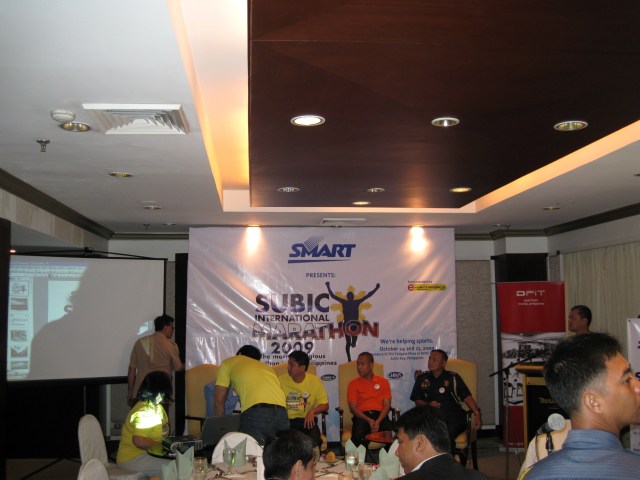
In the afternoon of this day (Tuesday), I received a txt message and an e-mail from the people of SMART inviting me to attend the “media launching” of the 2nd SMART Subic International Marathon (SIM) on the following day at 10:30 AM at Dusit Thani Hotel in Makati City.
I brought the two (2) coaches of the Elite Team Bald Runner with me for the said “media launching”. I was impressed! Arriving at the venue at exactly 10:30 AM, the Boardroom was already filled with lots of media reporters & guests and it seemed I was the one already late for the said event. In a few seconds, the program started and presentations were made about the conduct of the SMART Subic International Marathon.
What were the salient points and my observations during the “media launching” of the SMART Subic International Marathon? Many! And they are the following:
1) Most important, it was my first time to meet Tanya Lara of Philippine Star in person as I was seated next to her!
2) I finally met Chuck Crisanto and his wife, Joyce of Joy Rojas’ Takbong Pangarap’s Run Across America. Although, Chuck Crisanto sent me a very long Comment on this blog about his answer on the allegations from Mat Macabe about his actuations during the early part of Joy’s run, we discussed more about the condition of Joy Rojas during the run. How I wish I could post the Comment of Mr Chuck Crisanto on this blog but I will let him settle everything in the presence of Joy Rojas & Mat Macabe about their respective allegations to one another. I was surprised to see him and his wife here in the country as I know Joy Rojas and Mat Macabe are still running towards New York City. In the end, I had a nice time talking to the couple during our lunch.
3) It was an “eye-opener” for me when Mr Patrick “Pato” Gregorio of SMART SPORTS delivered his message on their Corporate’s “vision & mission” to help in realizing our country’s “first Gold Olympic” Medal and it is through this Marathon Event and other running events that SMART could be a great “catalyzer” and supporter in our Sports Excellence Program. I did not leave the hall not until I was personally introduced to Mr “Pato”. I hope SMART would also involve themselves in a “mass-based” running events just like what MILO is presently doing in order to discover “new talents” in Athletics.
4) The conduct of the SMART SIM is a partnership with the Philippine National Police in their advocacy to reform the police “scalawags” through running. I really appreciate the contributions made by Chief Superintendent Samuel Tucay, who is also a passionate runner, and considered as the driving force in this worthy advocacy of the PNP while he was in the active service, specifically when he was the Chief of the PNP’s Training Command.
5) I was able to meet the people behind the E-ventologists, Inc which is the Race Event Manager/Director of the Marathon Race. I have yet to find out a significant road race event that these people had handled in the past. As I left the Boardroom, one of the personnel of the Race Manager gave me 2 pieces of hand towel as part of the “freebies”.
SMART Subic International Marathon Launching At Dusit Thani Hotel
Since I was not invited during the “media launching” of the Philippine International Marathon for Pasig River, I could not tell what really happened but based from posts I read among bloggers, I’ve gathered some negative feedbacks already like the route of the race (instead of a schematic drawing of the streets, the route was simply a list of streets where the runners will take) and others.
In these media launching or media lunch events as part in the marketing of Marathon or Road Races, the foods were great with lots of “freebies”. But sorry to say, I was not able to eat much and get as many “freebies” I would want. I just hope that such expenses or costs for these PR events will be charged to the different sponsors and not from the runners!
So, starting on the 11th of October up to 8th of November, a span of 4 weeks, our runners have a choice of four (4) Marathon Races, 3 Marathon Races in Metro Manila and 1 Marathon Race in Pampanga to Olongapo/Subic Freeport.
I will post a separate assessment and comparison of these Marathon Races in my future blog entry.
5:30 AM January 31, 1982/Start & Finish @ Quirino Grandstand, Luneta Park
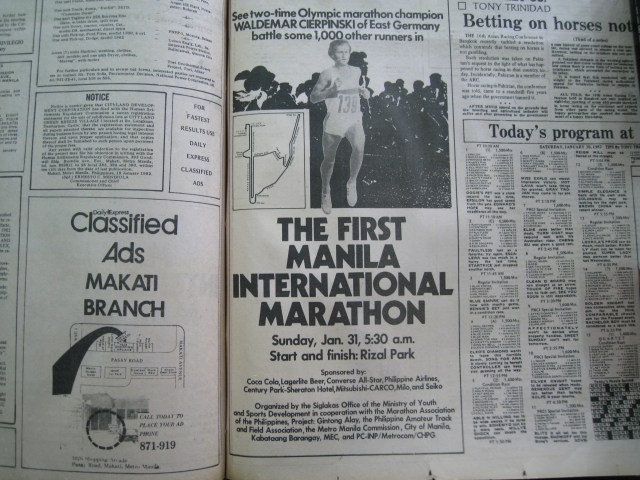
The 1st Metro Manila International Marathon was held under the auspices of the SIGLAKAS, a mass-based Sports Program of Minister Elpidio Dorotheo of the Ministry of Youth and Sports Development, and the Marathon Association of the Philippines. Coca-Cola and Lagerlite Beer were the major corporate sponsors of the said marathon race.
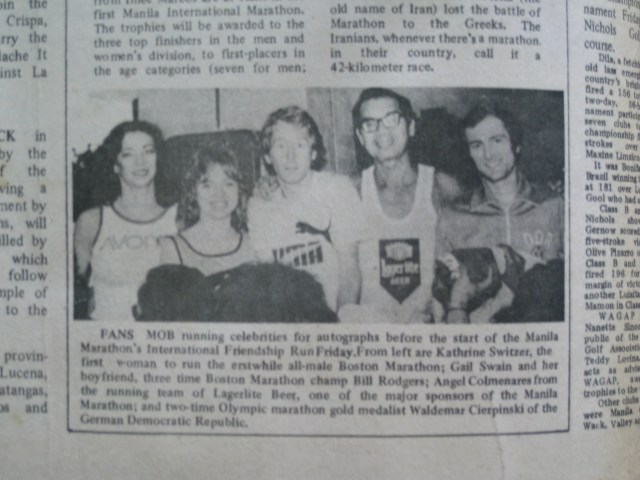
A Marathon Exposition was held at the Century Park-Sheraton Hotel where famous Marathon Champions Bill Rodgers and Katherine Switzer were invited to speak and deliver lectures to the running community. Dr John Wagner of the Honolulu Marathon Association was also one of the invited speakers. The Expo was officially opened and sponsored then by Miss Imee Marcose as the Kabataang Barangay (KB) National Chairman. The said Expo was conducted two days before the date of the Marathon Race. On the morning of the day before the opening of the said Expo, a short run from Luneta Park to Malacanang Palace dubbed as “International Friendship Run” was held in the presence of Bill Rodgers, Katherine Switzer, Waldemar Cierpinski, Peng Jiazheng of People’s Republic of China, Minister Dorotheo, and other Sports Officials. The said run culminated with a breakfast at the Palace with then President Ferdinand Marcos.
This Marathon Race was a well-planned event that the prevailing ratio of the Runners and the Officials/Marshals and Aid-Station Volunteers was 1:1. With 1,000 runners in the said race, there were also 1,000 Officials/Marshals & Volunteers who were involved in making this race a success.
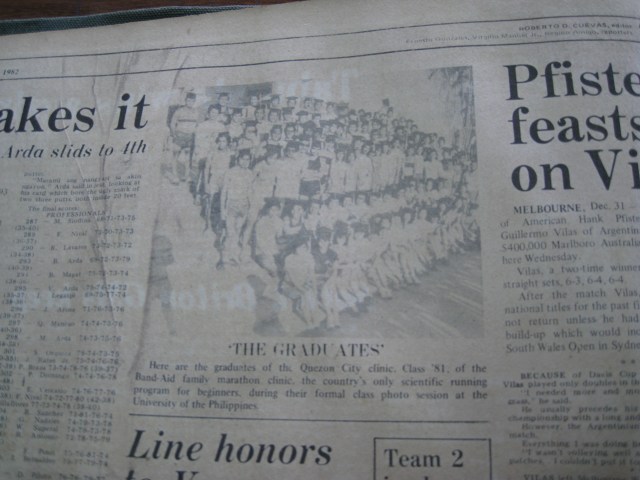
This race was well attended by graduates of a 9-month Scientific Fun Run Clinic sponsored by San Miguel Corporation (SMC). The running clinic was held every Monday, Wednesday & Friday at 5:30-7:30 PM at the periphery of Ugarte Football Field in Ayala and Long Run sessions at the Quezon Circle on Sundays. A Lagerlite Beer Running Club headed by Angel Colmenares was also one of the famous/active corporate running teams fielding 41 marathon runners in the said event.
The top 3 runners of the (Men’s & Women’s Categories) received Presidential Trophies and the top 200 runners were awarded the Presidential SIGLAKAS Medals. The awarding ceremony of the Winners was done at the Malacanang Palace at 3:00 PM on the same day of the race with no less than the President as the Guest of Honor. At the finish line, every runner received a Finisher’s Medal, Singlet, Finisher’s Certificate, and every runner drank lots of Free Coke and Lagerlite Beer!
Waldemar Cierpinski of East Germany, two-time Olympic Gold Medalist in Marathon (1976 & 1980), won the 1st Metro Manila International Marathon with a record time of 2:14:27 hours which up to this time is the “all-comers” record time in a Marathon Race in the country. Cierpinski adapted to the weather and humidity of Metro Manila by arriving in the country three (3) weeks before the race. I think this was the primary reason why Cierpinski was smiling and running at a steady pace when I met him going back to the finish line at the Guadalupe Area (infront of the Loyola Memorial Park) as I was going to the Ortigas turn-around (infront of the Robinson’s Galleria).
The second runner who arrived at the Finish Line was a certain Ricardo Carillo, a Filipino runner with a time of 2:35+ hours.
The race route was very simple then as it started at Quirino Grandstand and went all the way along Roxas Boulevard up to the Paranaque Coastal Road and back; turn right at Buendia Blvd; right at Ayala Avenue; left at EDSA until the turn-around point at crossing Ortigas Ave & EDSA and retrace the same route back to the Quirino Grandstand with runners immediately turning right a Roxas Blvd at the end of Buendia Ave. Runners had to go at the underpass of Shaw Boulevard and at that time one lane of EDSA was devoted to the runners.
1st Metro MIM Newspaper Ads With The Picture of Cierpinski
(Fm Left to Right) Katherine Switzer, Gail Swain, Bill Rodgers, Angel Colmenares, & Waldemar Cierpinski
“The Graduates” of the Quezon City’s Class ’81 of the Johnsons & Johnsons “Band-Aid” Family Marathon Clinic @ UP Diliman
What are the things we learned from our past road races during the early 80s when the first “running fever” hit the country? In my opinion, the following are some of the “pointers” and my personal assessment of the road races then:
1. First, the National Government, through the MYSD, was the overall race organizer of this Marathon Race with the direct involvement of the President of the country down to the MMDA and different cities in Metro Manila.
2. If a road race was a Full Marathon, then, it was solely a Marathon Race. There were no other lesser-distance road races on the sides.
3. There was full support from the private sector due to the presence of different corporate running clubs and their sponsorships.
4. World-known Marathon Champions were invited with the proper Exposition and Lectures from them and from sports & medical experts and this was indicative of a well-prepared Marathon Race. It also means that money were spent to invite such “international stars” in running. No Cash Prizes were published for the winners.
5. The 1:1 ratio of the runners and the officials/marshals & volunteers was really a “big” task then to make sure that the runners were safe and secured. The volunteers then were well-trained and prepared.
6. If my memory is still right, the registration fee then was One Hundred Pesos (P 100.00) and the runners were well-supported with hydration and fresh fruits in Aid/Water Stations along the route.
7. Runners did not have any complaints about registration as every applicant got his/her race packet upon registration. There were no complaints on route distance accuracy; race results; and traffic during those days. I wonder how the SIGLAKAS and the Marathon Association of the Philippines did to make our road races then without any problems! I guess, the people behind these races were then well-trained, coordinated, and matured, in short, they were “professionals” & experts in their field.
8. Marathon Races and other Running Events were given “preferential” and favorable exposure through news stories in Sports Pages in Daily Newspapers then, up to the point of relating dramatic stories of top competitors and predictions who will win the race. At this time, except for the annual MILO Marathon Eliminations and FINALS, all the other running events are featured in the Lifestyle Section/Pages of our Daily Newspapers (days and weeks after the race). For almost two years of being a runner-blogger, I have yet to see a picture of a Top Finisher/Champion of a Road Race running towards and crossing the Finish Line Tape in the Lifestyle or Sports Section in any of the broadsheets!!!
9. Running Clinics which were sponsored by Corporate Offices had a training period of Nine (9) Months in preparation for the runners’ first Full Marathon Race. These running clinics were supervised by trained coaches and conducted at least, three times a week. These running clinics were fully advertised in the local newspapers. Experts on sports injuries, nutrition, and past Marathon Champions were invited to speak before the runners. I was not able to join these clinics before as I was assigned in the Ilocos region, however, I trained for my first marathon race for almost one year, running at least 10 kilometers everyday and 20-30 kilometers in my weekend long runs.
(Note: Photos Taken From the Philippine Daily Express dtd 31 January 1982)
Have you heard or read about this term in running? If not, then you were not born yet in the 70s and 80s or you were not yet into running during those times.
“Collapse Point” is the point along the marathon race where you hit your “Wall”. This term was made famous by Dr John Wagner of the Honolulu Marathon Association during the 70s where he led the Honolulu Marathon Training Clinic to runners who would like to finish the Honolulu Marathon. Through this Running Clinic, it resulted to a high percentage of finishers in the said Marathon Race.
According to Dr. John Wagner, the following is the simple test to determine your “collapse point”:
1) Calculate/Determine your total mileage (in miles or in kilometers) for Sixty (60) Days prior to Marathon Day.
2) Divide the total by the figure 20.
3) Result gives your approximate “collapse point”.
Examples:
If you have a weekly mileage of 70 kilometers (10K per day), your total mileage for 60 days is 600. Divide 600K with 20, the result is 30K, which is approximately your “collapse point” in a marathon race.
If you have a weekly mileage of 105 kilometers (15K per day), your total mileage for 60 days is 900. Divide 900 with 20, the result is 45K as your “collapse point” which is more than the marathon race distance.
Good luck to those who will be running their first marathon race this coming October and before the year ends!



 Bald Runner
You must be logged in to post a comment.