I have learned about Intermittent Fasting (IF) from my ultra running friends living in California, USA. In my hikes and trail runs with them, we discussed about nutrition and our respective training in trail running and most of them have been practicing IF in their daily and weekly routines. This leads to gain more information from them until I would “google” the topic with more results of articles to read about it. Since then (almost one year already), I would do my own version of Intermittent Fasting which is fitted to my lifestyle as a Senior Citizen and part of my training as for the 2019 Boston Marathon Race.
I am reposting an article which I read in one of the articles of Training Peaks. I hope you can gain some information from it. Thank you!
Can Intermittent Fasting (IF) Improve Your Performance?
JANUARY 24, 2019 · BY ZACH NEHR
Simply limiting your calorie consumption to a specific window every day could give you performance and health benefits.
Can fasting make you faster? Some studies have suggested that intermittent fasting (IF) help you gain strength, burn fat, and ultimately improve your performance.
What is Intermittent Fasting (IF)?
Here’s the key: IF isn’t about eating less, but rather eating within a specific time window. Simply limiting your calorie intake to a specific period every day can kick off a cascade of physiological adaptations that can improve your health.
Basic IF guidelines say that you should fast for at least 12 hours every day — that is, eating only within a 12-hour window, and fasting for the other 12 hours of the day. Dr. Satchin Panda, Professor at the Salk Institute for Biological Studies, recommends upping that window to a 14-16 hour daily fast in order to maximize benefits, especially when it comes to improved muscular endurance.
12 hours might sound like a long time, but consider that on average, most of us get about 7-9 hours of sleep per night. If you eat a relatively early dinner and do a fasted workout first thing in the morning, you’ll most likely find it easy to hit that fasting window with minimal adjustments to your schedule. T
INCREASE FAT OXIDATION
Exercising in the fasted state forces the body to use its energy systems more efficiently, since carbohydrate stores are nearly depleted after a 12-16 hour fast.
Fasting also activates the body’s sympathetic nervous system (SNS) which is responsible for our fight-or-flight response. When the SNS is activated, heart rate increases, digestion slows, and muscle tension increases. During fasted exercise, the activation of the SNS causes an increased breakdown of fat for energy (Varady et al. 2013).
Fat oxidation also increases for 24 hours following a fasted workout (i.e. an easy aerobic exercise session done first-thing in the morning following an 8-12 hour overnight fast). Essentially, fasting helps your body become better at metabolizing fat rather than relying on the carbohydrates that are readily available in a non-fasted state.
DECREASE INSULIN RESISTANCE
Many endurance athletes will eat little meals or snacks every couple of hours (while awake) to give the body a continuous source of energy throughout the day. However, perpetual food intake also requires a constant release of insulin to help maintain stable blood sugar, which over time can cause the body stress. Worse, if insulin is constantly present in the bloodstream, the body can develop resistance, which is a precursor to diabetes.
Much like a muscle’s response to exercise stress, your digestive system needs time to recover so it can respond efficiently to the next stimulus. Fasting allows the body’s digestive, endocrine, and inflammatory system to repair and reset (Sutton et al., 2018).
While overnight fasting generally provides the body with sufficient time to rest, it is the challenge of a fasted morning workout that puts the body’s physiological systems (and subsequent endurance benefits) into overdrive. After completing a workout in a state of glycogen depletion, the body’s growth hormone and testosterone responses are stronger compared to athletes who fuel more constantly (Greenfield 2018).
How to Incorporate IF Into Your Training
Fasted exercise doesn’t need to be hard, in fact, most of the benefits of fasted exercise can be attained by performing a light, aerobic workout in a state of glycogen depletion. It could be a 30-minute walk or hike, an easy swim, or even just a sauna session — the key is to get moving and get your heart rate up for at least 20-30 minutes (Greenfield, 2018).
High-intensity interval training (HIIT) is much more difficult to perform while fasted. HIIT (>70% Max heart rate) requires the use of glycogen as a fuel source, and attempting a HIIT workout in a fasted state will likely result in poor performance due to low energy availability. However, the ability to perform high-intensity workouts in a fasted state seems to vary greatly among individuals, so talk to your coach before attempting such workouts.
It is also important to remember that refueling is paramount after a fasted morning workout — the body readily absorbs carbohydrates, fats, proteins, and micronutrients quickly and efficiently in the 1-2 hour window following fasted exercise. My favorite post-fasted workout meal is a big bowl of oatmeal, nuts, dried fruit, and whey protein powder.
How to Fast
Traditional fasting allows you to drink only water during the fast. That means no calories, flavoring, salt, sugar, etc. Fortunately, most experts agree that you can have your morning coffee without technically breaking your fast — just skip the cream and sugar (Panda, 2018).
Your success in intermittent fasting for endurance performance depends on finding an eating window that works for you. If you are a night owl, for example, try making your eating window 12PM-9PM – followed by a 15-hour fast. If you’re a morning person like me, try a 9AM-6PM window – which still makes for a 15-hour fast.
When it comes to IF, the most important thing about maintaining your daily fast is that it is consistent and sustainable. Try different windows, meals, and timing to see what works best for you.
Repost: Copied From the Facebook Page of the International Association Of Ultrarunners (IAU)
2018 IAU 24H Asia & Oceania Championship Race Report
Japan dominated 2018 IAU 24 hour Asia & Oceania Championship. Yuri Matsumoto (219.112 km) and Yoshihiko Ishikawa (253.420 km) both from Japan took home gold medals in individual competition. They lead both teams for double gold medals at Team competition with Women aggregated result of 620.181 km and Men 752.474 km. This was fantastic event.
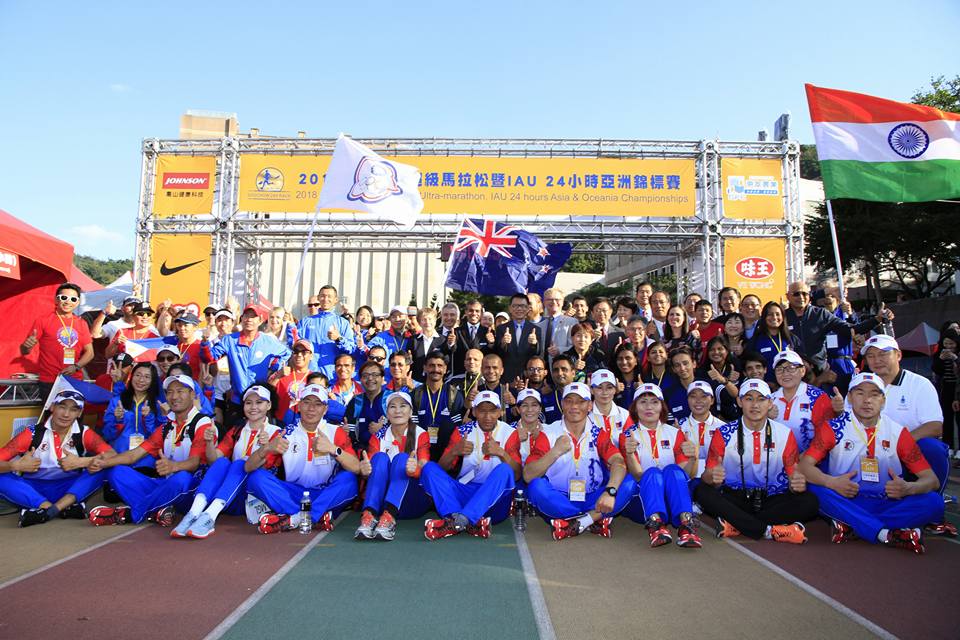
2018 Soochow 24H Race Group Picture (From IAU Facebook Page)
The championship took place on December 1st-2nd at Soochow University, Taipei in conjunction with the Soochow 24 Hour race, this year celebrating its 18th edition. The race was organized on 400 m track. The LOC had few international invitees for the open race. Among them was a 27 years old Ivan Penelba Lopez from Spain participating in open race who took early lead in the race. He was running superbly and managed to lead the races during entire 24 hours. Finally reaching over 258 km he was over 5 km ahead of Championship winner Yoshihiko Ishikawa (JPN). Ivan builds secured lead over the time and kept lead over the track at Soochow University.
In the Championship from early hours there were few nations running together. The majority were from Mongolia, Japan and Australia. After 6 hour in the lead we had 3 runners from Mongolia and Japan, 2 from Australia and India. All of them being within 4 km distance. Slowly over time stinging was changing in favour of runners from Japan, Australia and India. However other runners kept very good pace. After 12 hours in top 5 we had 3 runners from Japan and one form Australia and India.
Top 5 men after 12H
NARAKI, Toshiro (JPN) 135.600 km
ISHIKAWA, Yoshihiko (JPN) 133.600 km
TAKAHASHI, Nobuyuki (JPN) 131.200 km
THWAITES, Michael (AUS) 128.400 km
HOSAHALLI NARAYANA, Ullas (IND) 125.947 km
It was very similar in women competition. Runners from Mongolia had a very strong opening but after 12 hours we did not have as strong domination as in men field. There were two ladies from Japan, one from Australia, New Zealand and Mongolia.
Top 5 women after 12H
HAYVICE, Fiona (NZL) 121.481 km
AOTANI, Mizuki (JPN) 120.000 km
JONES, Tia (AUS) 118.227 km
GANBAATAR, Uugantuya (MGL) 118.175 km
MATSUMOTO, Yuri (JPN) 116.800 km
The next few hours settle the standing in both competitions. Men field was led by 3 Japanese where in women Tia Jones from Australia was leading the pack. It was not over yet, especially in women competition as after 18 hours there were only few meters difference between Tia (AUS) and Fiona Hayvice (NZL) and least than 1.5 km among all top 4 ladies.
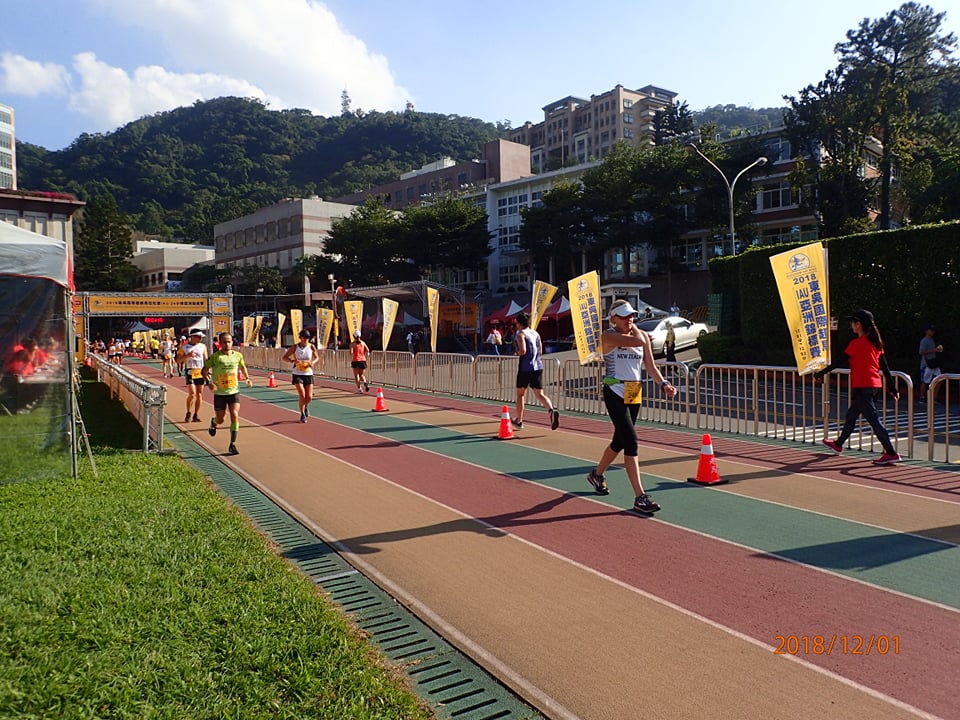
2018 Soochow 24H Event’s Running Picture (From IAU Facebook Page)
When we were getting closed to the end it was more and more exciting as all top runners were in striking distance from each other especially in women competition. In the last 3 hours Yuri from Japan joined the battle with Tia from Australia over 1st place. There was only 600 m difference between both ladies.
In men competition Yoshihiko from Japan has a solid lead of 5.6 km over second teammate Nobuyuki. Ullas from India was just 140m behind second place and it was still 2.5h to go. Finally the standing remains unchanged for men but all three were close to each other and over 250 km.
In women competition Yuri final manage to build a gap and secure gold medal. Second place after a long lead and battle went to Tai from Australia and bronze to Aiko from Japan.
Individual results
Men
ISHIKAWA, Yoshihiko (JPN) 253.420 km
TAKAHASHI, Nobuyuki (JPN) 252.301 km
HOSAHALLI NARAYANA, Ullas (IND) 250.371 km
NARAKI, Toshiro (JPN) 246.753 km
HORSBURGH, Ewan (AUS) 235.771 km
Women
MATSUMOTO, Yuri (JPN) 219.112 km
JONES, Tia (AUS) 218.177 km
KANEMATSU, Aiko (JPN) 212.700 km
HAYVICE, Fiona (NZL) 202.320 km
TUFFERY, Dawn (NZL) 202.041 km
Team Results:
Men
Japan 752.474 km
Australia 675.354 km
India 645.936 km
Women
Japan 620.818 km
Australia 599.654 km
New Zealand 563.443 km
This is a great opportunity to thank LOC, Chinese Taipei Federation, other involved for hosting great continental championship.
Race Report: 8th Clark-Miyamit 50-Mile Ultra Trail Run (CM50)
The score is now 3-2! For the past six years since 2012, I finished successfully the Clark Miyamit 50-Mile Race for three consecutive years, starting when I just turned 60 years old. I was lost on the last 3 kilometers to the Finish Line in the 2016 edition missing the cut-off time where I could had finished it easily. And then I volunteered as the Aid Station Marshal at AS3 in last year’s edition as my way of giving back to the trail running community in the country.
In my past Race Reports of this event, I made sure my story to be detailed as I can remember so that future trail runners who would like to join and challenge themselves with this event had some background on what to expect along the route and get some lessons and tips about my training/preparation; nutrition and hydration strategy; and those detailed things on what to do if things would go wrong. Until this time, I would re-read and review all my previous posts about my Race Reports whenever I have plans of joining this event. The RD, Atty Jonnifer Lacanlale is a very good friend who would readily accepts me to run his event in a short notice.
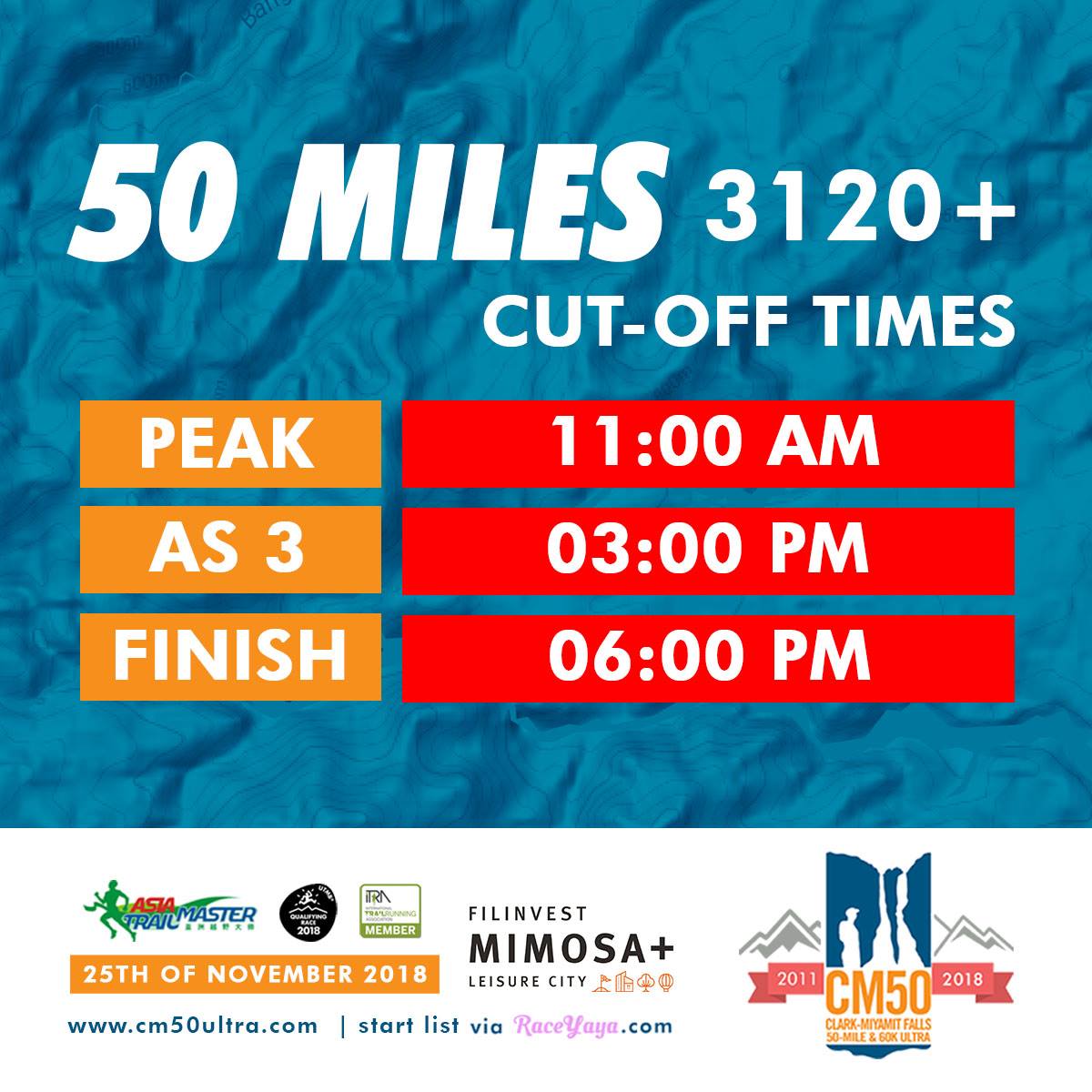
As everybody knows, I posted on Facebook that I finished the race but beyond the cut-off time of 9+minutes and I am considered as an Official DNF of the event. Out of 205 starters, I could had been the last finisher at #162 ranking and would had defended my self-imposed title as the Oldest Finisher of this Badass Event. And I was devastated and frustrated once I crossed the finish line for not being able to implement on my Race Plan—reach the turn-around point/Peak before 9:00AM; leave AS 4 after coming from the Miyamit Falls on or before 12 Noon; reach AS3 at 1:30PM; and a “go-for-broke” and “survival” mode on the last 4:30 hours for a distance of 22+kilometers to the Finish Line.
Cut-Off-Times
I failed “big time” on the last section of the plan where I had 4:30 hours of time to run a distance of 22+kilometers. If I finished the race within the prescribed cut-off time of 18 hours, I would not be here explaining those things that went wrong during the run. I would have easily said that everything went right and mentioned some “glitches” that challenged me to endure in order to reach the finish line. The runners who were with me on our descent from AS4 and AS3 towards the Finish Line were surprised that I faltered on the last 19 kilometers (AS2) up to the last last 8 kilometers (AS1). With those who were with me “fighting for the last golden minutes” (I think there were 5-6 of them whom I passed on the last kilometers, who are younger), I am sorry for giving them a false expectation or hope of telling them that we could still make it before 6:00PM. What I was trying to instill in them was to fight for their last strength and breathe in order to cross the finish line….they should have the “do or die” attitude to reach and cross the finish line, end their suffering, and of course, collect their deposit of P500.00!
You might say that I am “sour-graping” or looking for some excuses for not being able to finish this race as what I had planned for. But this is me, I had been a runner throughout my life and a fighter and passionate in this sport. It is in my brain, blood, and my body system. Whether I fail or succeed, I will still be a runner. And this is what really happened…..
My Coach prepared a Training Schedule for me after finishing the Salomon Cappadocia 63K Medium Race (in the middle of October) in preparation for the MILO Finals Marathon which will be held on December 9, 2018 in Laoag City. I told him that I would like to finish my BQ time of 4:10 or faster for my age of 66 years old in the said race. So, since then, everything on my workout was for a Marathon distance. However, two weeks ago, I told him that I will be joining a 50-miler trail run and just be able to finish the event as an LSD. I lied on the reason! Actually, I was trying to earn my UTMB/ITRA Points in this event and maybe, improve on my ITRA Performance Index. He told me not to join the event but I could have the option to choose a lesser distance and I told him that I could downgrade to the 60K event. He replied that 60K was too much for me and he was against it. So, the only choice I had was for the 10-miler event which I did not mention to my Coach. For the past days, I just kept silent and followed my prescribed training every day but on two weekends before the CM50, I would increase the number of hours of hiking in the mountains with my trekking poles in the company of one of my ultra running friends who joined and successfully finished the 60K course. My Coach silently knew that I was “hard-headed” and he would see my posts on Facebook that I am going for the CM50. This was my first mistake…not following the advise of the Coach whom I am paying for his services. Lesson learned: Let the experts do their work and strictly follow their advise!
@ AS3 Going To The Finish Line (Photo By Trail Ready)
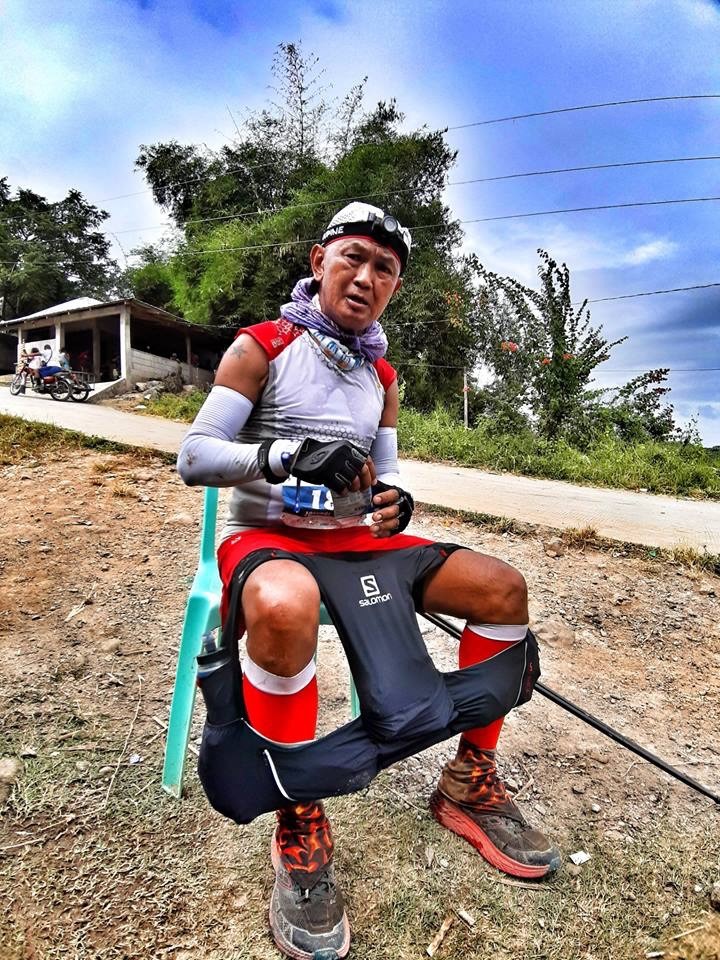
2. For the first time, I decided to use a HOKA One One Speedgoat2 for this race, instead of my New Balance or ASICS Racing Flats or my Salomon Speedcross 4 which I’ve been using before. At Kilometer #8, while approaching PUNING’s RESORT my left foot hit a small rock imbedded on the road and I tripped, making my left knee hit the ground first, and then my right knee, and then followed with my two hands which acted as my brace to protect my face from hitting the ground! It was a hard fall as the ground was hard and solid, not a sandy ground! Shit! This tripping/falling to the ground was happening again early in the race with a pair of HOKAs on my feet. This thing happens to me all the time whenever I wear these HOKAS! I knew it was going to happen because I am natural “shuffler” when I run! Even if I was wearing the brightest headlamp available in the market, Lupine Lighting System, at that time, a sloppy “shuffler” runner like me should not wear HOKAS in a trail race. The impact of the fall on my knees would bring back havoc and pain as I descended from the peak down to Barangay Sapang Uwak. Lesson learned: I should have used my Salomon Speedcross 4 or Speedcross PRO or my new NB Racing Flats!
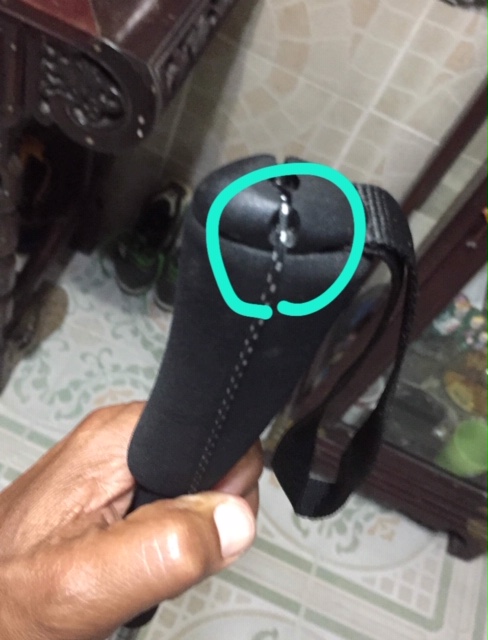
3. I bought the most expensive Trekking Poles in the market——GIPRON Trekking Poles and they are the lightest! I used them once or twice in my short runs and they were fine. But during my ascent and descent to and from the Peak (during the race), they gave me some “pain in the ass” as the string would loosen its hold on the different segments of the pole. Instead of the usual 3 segments in the Black Diamond and Leki Poles, GIPRON are folded in 4 segments. I would stop whenever the segments would loosen as both poles create a weird sound as they hit the ground. I would tighten the string only to find it loosen again after a few meters. It was stop and go for me fixing on this problem. Because of this problem, it slowed me down and just distracted my focus to maintain my speed/pace. A lot of runners had passed me on my way down from the Peak to the Falls because of this predicament. After a day since the race, I sent a message to an ultra running friend in Hongkong and sent him a picture of the locking system of the GIPRON Trekking Pole and told him my experience during the race. He told me that the trekking poles were not LOCKED when I used them during the race. He instructed me to pull the string harder until I could see a small knot on the string and let that knot to be anchored on the slot at the top end part of the handle! Another SHIT again!!! I saw the small knot as I pulled the string harder away from the handle! I was cursing and laughing when my friend told me that “I was not the FIRST one who experienced this SHIT on these trekking poles!” Lesson learned: Ask the manufacturer of this expensive trekking poles to enclose some written instructions on the package whenever they ship out to their buyer! Not even the video on YouTube would tell you about the presence of this small knot (on the string) on these trekking poles!
UNLOCKED Without The Appearance Of the Small Knot
4. Whether I apply Anti-Chafing Stick or “thing” on my Red Salomon S-LAB Sense Shorts or not, they still give me chafing on my groin areas! Yes, I have my chafing already as early when I was at Km 19 and it became worst when I was on my way back from the Peak. After the race, I could see the chafed areas as big as the size of a 10-Peso Coin on my left and right groin areas. When I finished the Salomon Cappadocia Ultra, I had the same chafed areas but they were not as deep and big; and did not give me so much pain during the race. Lesson learned: I should always bring an Anti-Chafing Stick as part of my Mandatory Gear for 50K and up races.
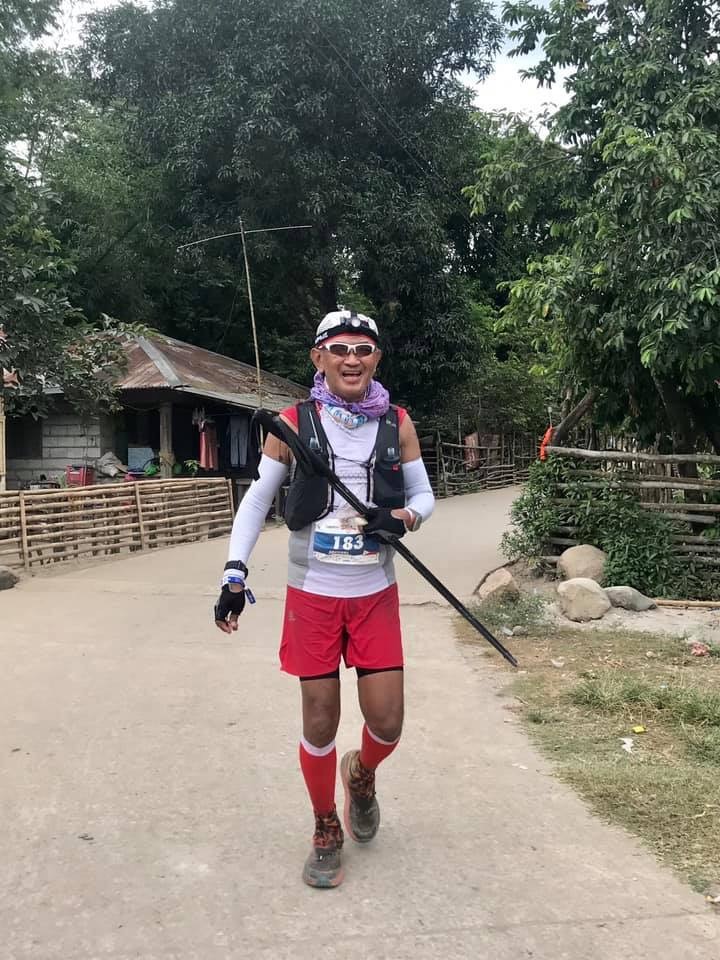
Last 22K To The Finish Line (Photo By Elle Alvarez)
I did not have any problems with my nutrition and hydration strategy during the race. I had enough water, electrolytes, and “solid” foods with me stashed in my hydration vest’s pockets and inside the pockets of my AMIHAN GoLite Belt. My Ice Bandana was always full of ice whenever I stopped at the Aid Station. I don’t think I stayed so long in the Aid Stations as I would eat the prepared solid foods most specially at AS4 and 3 (on my way back to the Finish Line) which were manned by special friends in the ultra running community.
The Race Organization; Trail Markings; Aid Station Services; and the prevailing Weather during the race were the BEST, so far, in the history of this race. Thanks to Atty Jonnifer Lacanlale for this International Standard Badass Event and for his Outstanding Leadership to make this yet another successful event.
Congratulations to all the Runners! Hopefully, I will be strong enough to join in next year’s edition!
Sometime in August 2015, I featured Conrado “Jun” Bermudez, Jr in this blog as the First Filipino Runner/Ultrarunner to have finished a 200-Mile Mountain Trail Single-Stage Endurance Race at the Bigfoot 200-Mile Endurance Race in Washington State, USA. It was in the post in this blog where I wrote about his background and running accomplishments since he became a passionate runner. For this year, 2018, he finished the Ultimate Award in Ultrarunning in the United States which is the “Grand Slam of Ultrarunning” Eagle Award and I was able to send him an e-mail to congratulate him on this inspiring feat which is considered as a “dream” to be accomplished among the best ultarrunners in the world. I also sent him some questions to answer of which I am now publishing his answers in this blog.
BR: Congratulations on your 2018 US Grand Slam of Ultrarunning finish! That’s a huge accomplishment and biggest pride for being the First Filipino to receive the Eagle Award in Ultrarunning. You are now Finisher #354 out of the 363 Finishers of the GSU since this award was created in 1986.
As usual, hoping that you will have the time, I am sending you some questions for you to answer which I will publish in my blog. There is no deadline though as I know you are still resting and recovering.
Jun:Thank you for this opportunity to be included on your blog, sir. Thank you also for mentoring me when I started my ultrarunning way back in 2013. As a Filipino citizen, it is a great pleasure and honor to represent our country in this sporting event. My heartfelt gratitude to all the support!
As a 45 year-old runner, joining the Grand Slam was a no-brainer. There was no shadow of doubt not to join. It was a once-in-a-lifetime opportunity and this chance may not be available to me in the future. If it is going to happen by that time, I may not be physically that capable anymore for the challenge due to old age.
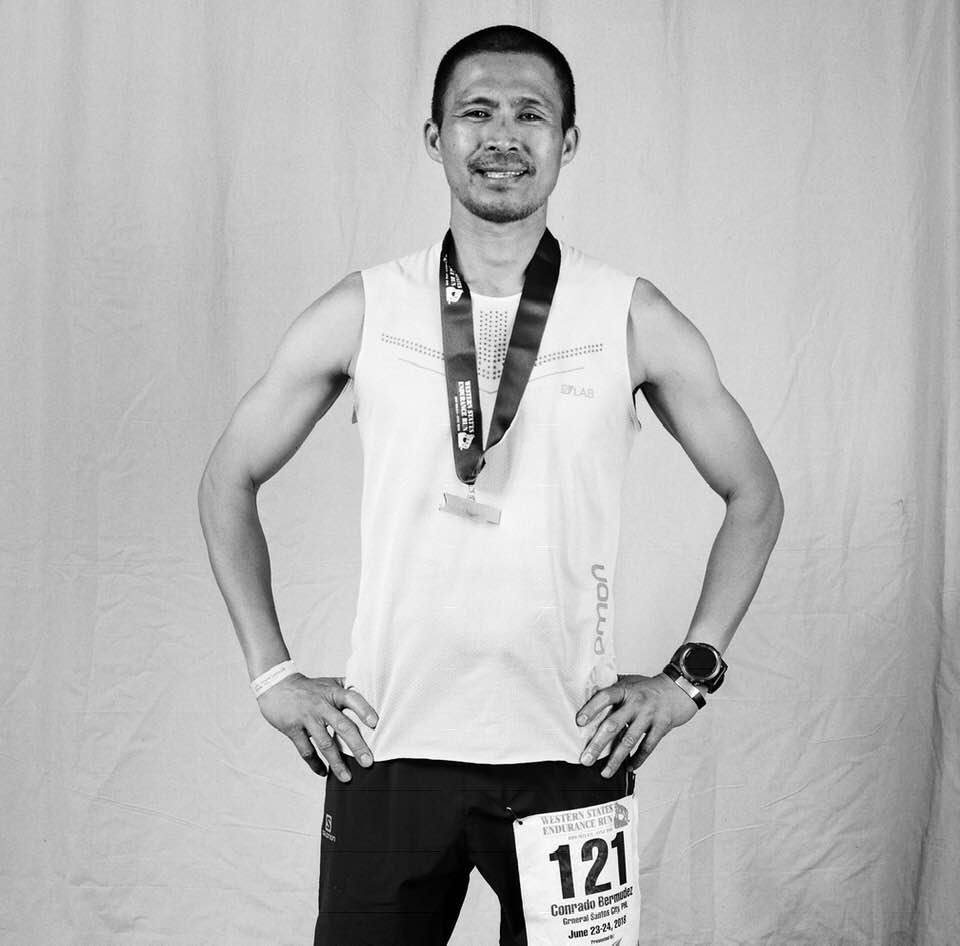
Jun Bermudez Western States 100 Picture
BR: What is your feeling now that you have finished the US Grand Slam of Ultraruning with an impressive time of 106:52:09 hours and the First Filipino to have received the prestigious Eagle Award in Ultrarunning?
Jun: I am deeply delighted and humbled to be part of this 32nd year of the Grand Slam of Ultrarunning, a special historical event in ultrarunning world. It still feels surreal that I was able to finish them and trace the footprints of the first finisher, Thomas Green, in 1986 and the grandfathers of the five 100 milers. These races are the oldest 100 milers in the US or probably in the world with the Old Dominion 100-Mille Cross Country Run for 40 years, Western States 100-Mile Endurance Run for 41 years (the oldest in the world), Vermont 100-Mile Endurance Run for 30 years, Leadville Trail 100 Run for 35 years, and the Wasatch Front 100-Mile Endurance Run for 38 years. Just to be entered in the Grand Slam of Ultrarunning events, itself, is a privilege. It takes a lot of luck in the lotteries (Western States 100, Leadville 100, Wasatch 100) to get entered in the same year. All of the races, except Wasatch 100, do not give provisional entry anymore. For non-lottery events, the Vermont 100 is a first-come-first-served basis and the registration sold out in less than 15 minutes when it opened, and the Old Dominion 100 got filled up weeks before the event date which normally did not happen in previous years. My success was not possible without the support of my friends and, of course, the encouragement, the love and understanding of my wife and my daughter.
BR: You are one of the few Eagle awardees who finished and completed the FIVE Races in a span of three months, what was your recovery in between these races?
Jun: The Grand Slam is arduous to complete. The three to four weeks of minimal time for recovery between races and the cumulative fatigue put so much toll on our body.
I ran two road marathons in April (Boston and New Jersey) prior to the Old Dominion 100 (02 June). I started my taper three weeks before the race day so my body could fully recover. In between races, my first week of recovery consisted of moderate stretching and no running, which were slow hiking and light spinning workout. For the first two days after the race, I was doing ice therapy on my feet to remove the inflammation. And mostly during the period, I was doing a dynamic compression of my legs to flush out waste and hasten muscular recovery. Also, I am sleeping with my legs elevated almost every night even when I am not on training because I spend so much time on my feet at work with the load (tactical gear) on my body. I was taking Essential Amino Acids (EAA’s) complex to include Branched Chain Amino Acids (BCAA’s) to stop muscle tissue breakdown and reduce muscle soreness. It would take three to four days after the race for my legs to feel fresh and pain-free again. I was also consistent with my bodyweight strength workouts all throughout the Grand Slam.
In the second week and onwards, my recovery usually started with 30 minutes of easy running then alternated the next days with spinning and short tempo or intervals (controlled pace) on the treadmill.
A week before race day, I spent most of the days resting and sleeping. My routine was
taking two nights of having eight to ten hours of sleep two to three nights before the event so I would regain my energy and not be sleepy during the race. Although my recovery plan was not perfectly executed, I was still able to prevent injury and was able bounce back to be prepared for another adventure, and nailed them one by one to enjoy the experience.
Below is the illustration of events with their respective dates:
Old Dominion (02 June, Saturday) > 3 weeks >
Western States (23 June, Saturday) > 4 weeks >
Vermont (21 July, Saturday) > 4 weeks >
Leadville (18 August, Saturday) > 3 weeks
Wasatch (07 September, Friday)
BR: It seems that you did not have any “issues or concerns/injury” in every race, how did you manage to fight the “demons” (heat, exhaustion, muscle cramps, if any, GI issues, altitude, and “bonking”) during these races? What was the “hardest race” in this series of race?
Jun: My body held up very well. I do not have injuries since I started running ultras in 2013 except for my sprained ankle that I twisted during the HURT 100-Mile training in early December last year. I think my training on incline trainer/treadmill has preserved my legs to be stressed and injury-free. With my work schedule, at least 85% of my training was conducted indoor.
100 miles is a long journey but a manageable distance. For that long, I experienced nausea, vomiting, GI issue, and cramping during races. But I embraced them as my “normal”. I approached these races in a simple way, to control them by avoiding mistakes. As my spiritual endeavor, I ran the five races solo (no pacer, no crew) and dug myself deeper and fighting the adversities alone. One key to success is I put my heart and soul in this endeavor.
In my training, I focused on the elements that could eventually hit me during races. Since these are summer series, heat is the biggest factor. The US west coast has a dry heat with extremely high temperatures while the east coast has high humidity that brings to higher heat index. Twice or Thrice a week I was doing heat training on my incline trainer from one hour to a maximum of five hours wearing a double layer of thermal gear and raising our room temperature to make it hotter. To complement my heat training, I was wearing my armored vest at work for the whole day even during the hottest days. During the race, I was wearing a hat, bandana, and arm sleeves where I placed ice cubes in them. All of these help to neutralize my body temperature. So, for heat, I was really prepared and it did not bother me during the races.
Another element that is quite difficult to prepare is altitude. It is the most dominant factor that resulted to a huge number of DNF (Did Not Finish). Shown are the high altitude races of the Grand Slam with their corresponding highest elevation: Western States 100 (8,750 ft/2,667 masl), Leadville 100 (12,600 ft/3,840 masl), and Wasatch 100 (10,467 ft/3,190 masl). There are also significant sections of the courses that are above tree line. This is my weak point as a sea level flatlander. I incorporated speed work on my training since running on altitude is ran at slower pace. Although it does not really contribute on acclimation, it is still beneficial to run the race faster in order to have enough buffer from the cutoff and finish it with less pressure.
Among the Grand Slam events, the Old Dominion 100 and Vermont 100 have the fastest courses with 66.27% and 79% finish rate, respectively. Old Dominion has a cutoff of 28 hours. They are a runner’s race since the climbs are not long and steep. But the Old Dominion could be surprising. The Sherman Gap section is a steep technical climb. These two courses are on low elevation but with high humidity. In Western States 100, I suffered a lot of cramping in most parts of my legs starting at the early miles until halfway. The second half was even worse when I had a stomach issue. The course is point to point mountainous terrain but it got easier in the second half with the course going more downhill than uphill. I felt that among these races, my body was beaten up the most here. Despite the heat, it has 81% of finish rate. In Leadville 100, cramping was not that significant but I was nauseous the whole time. I did not have solid food intake all throughout the race. Every solid I took just went out. I went to Colorado 13 days before the race. But even with acclimation, breathing during a long climb in Hope Pass was a struggle. The air is just so thin that I could not push hard. The cutoff of 30 hours also made the race harder. The high altitude and fast cutoff contributed to a low finish rate of 57.9%.
The most difficult event for me is the Wasatch 100. It has a 62% finish rate. After four races, my body was not primed to run anymore, especially that my legs felt sluggish. The nausea hit me after a quarter of the race and I could not take solid food again. The course has more climbing and it is on high elevation. It was also the second hottest temperature in the history of the race. This year a significant number of bees were scattered in different sections of the course, which was difficult to avoid. Some got stung 14 times. Fortunately, I was only hit twice. Although this is the most technical course of the Grand Slam, this also has the most beautiful scenery. During this race as I was to retrospect the past four races, and the long journey of trials and tribulations, I was feeling highly and spiritually rejuvenated since it is already the finale of my Grand Slam journey.
I have some friends and compatriots who shared the trails with me and it lifted my spirit and energy. Thanks to Casey Fisher (Old Dominion, Western States, Leadville), Jovencio Luspian (Western States), Tim Aquino (Leadville), Kian Vicera(Leadville), Philip Pagdanganan (Leadville and Wasatch), and Ryan Espulgar (Wasatch) for friendship. The memories we have will be forever etched in my heart.
BR: What would you recommend or advise to Filipino Ultrarunners who would plan to complete or join this series of Ultrarunning Races?
Jun: The new system of the Grand Slam (started two years ago), which includes four of the five events with Wasatch 100 as a mandatory race, has given more opportunities for runners to join without undergoing through the virtually impossible selection process of the Western States 100.
The Grand Slam events per se involves time and money. As a starter, if a runner can afford the financial and logistical burden, and manage the time schedule, non-running-wise, he is ready to tackle the series. We just live once anyway. Taking the Grand Slam challenge is a priceless opportunity and a big milestone.
In the Grand Slam, a runner can choose what series he wants to attempt. A total of 18 finished this year from 28 starters. These are the variations with the corresponding number of finishers:
1) original version: Old Dominion, Western States, Leadville, Wasatch Front. None (except the two who did five races)
2) pre 2017 version: Western States, Vermont, Leadville, Wasatch Front. Seven
3) Old Dominion, Western States, Vermont, Wasatch Front. Six
4) Old Dominion, Vermont, Leadville, Wasatch Front. Three
5) Old Dominion, Western States, Vermont, Leadville, Wasatch Front. Two
In my personal point of view, the core of the Grand Slam are the Western States and the Leadville, aside from Wasatch Front which is mandatory. Missing either one of them could mean not a “complete” satisfaction for me. Leadville is known for being a grandslam-killer. And these two races are icons in the annals of the 100-mile races worldwide, especially the Grand Slam series.
Another step is to find a Western States 100 qualifying race that has more climbing and elevation in order to get used to the mountainous course. Applying for lottery every year gets a runner more chance to be picked.
In Leadville 100, there’s a 50% chance to be selected in the lottery. In the essay part of the application/registration, a runner has to indicate his willingness to be entered into the Grand Slam and make a convincing story of his running journey to get a better chance to be selected. Although it is a lottery, I still believe that the race organizer gives considerations to this special request.
Wasatch Front 100 is the mandatory and final race of the Grand Slam. It is also a lottery and the chance of getting in is high. If in case a GS entrant will not get picked in the lottery, the race organizer gives a provisional entry, meaning the entrant has a chance to run Wasatch if he is successful on his third race.
Another aspect to consider is the physical and mental readiness of the runner. Experience is a huge factor. So, doing back to back races that have difficult terrain is a good test. This is also to develop the physical stamina as well as to harden the mental fortitude of the runner. Most of the time, it is the indomitable spirit that brings the runner to the finish line.
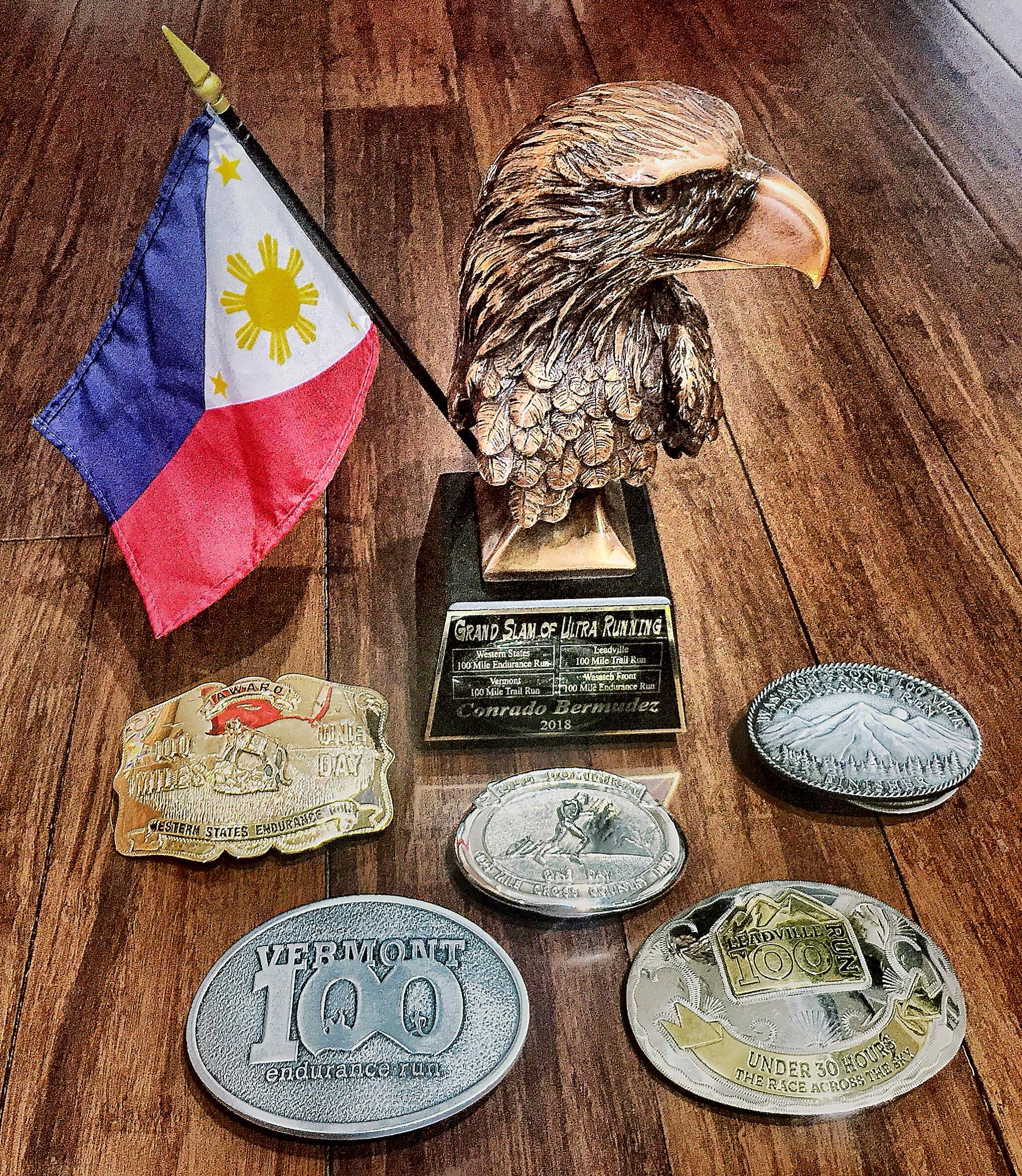
US Grand Slam Of Ultrarunning Eagle Award & Finisher’s Buckles
BR: Having closely followed your Ultrarunning feats and accomplishments, you have only 2 DNFs, Barkley Marathons and UTMB. You redeem yourself in the 2017 UTMB and you finished in one of the coldest UTMB race. Do you have plans of going back to Barkley? What are your future races?
Jun: The Barkley is not in my thoughts right now. Being out there knowing the difficulty of the course, that five loops is an impossible feat. It is arguably the toughest race I ever experienced. I gave my all and had managed to finish one loop. I do not have a definite race for next year except for the Boston Marathon. I threw my name for lotteries in Hardrock 100 (5th year application) and Western States 100 (1st year application after getting in this year). There are some interesting races that I want to do in the future, maybe another mountain 200 miler and road ultramarathon. Some of the races that I did are also worth coming back. I love the electrifying spirit of UTMB, Leadville, and Western States, and also the old traditional and small community feel of the Old Dominion.
BR: Lastly, Did you get the services of a Professional Coach in preparation for this year’s events and what shoes did you use in your Grand Slam Races?
Jun: I did not get the services of a Professional Coach and I did my training on my own. I used the Hoka One One Mafate Speed 2 for Old Dominion and Western States and Hoka One One Mafate EVO for Vermont, Leadville and Wasatch Front.
Thank you, Jun for answering my questions. Your answers are considered as “Gold Mine” for those ultra runners, Filipinos or Non-Filipinos, dreaming to be a Finisher of the US Grand Slam of Ultrarunning. Keep inspiring us and good luck on your future runs/races.
 Bald Runner
You must be logged in to post a comment.