Taklang Damulag 50K/50M (TD 50/50) Ultra Trail Run & Half-Marathon


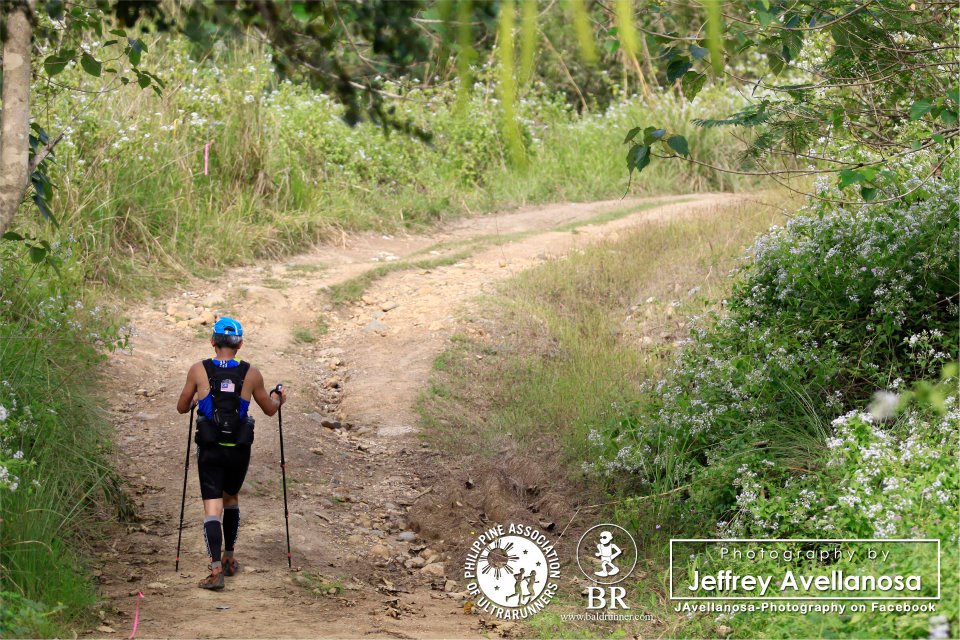
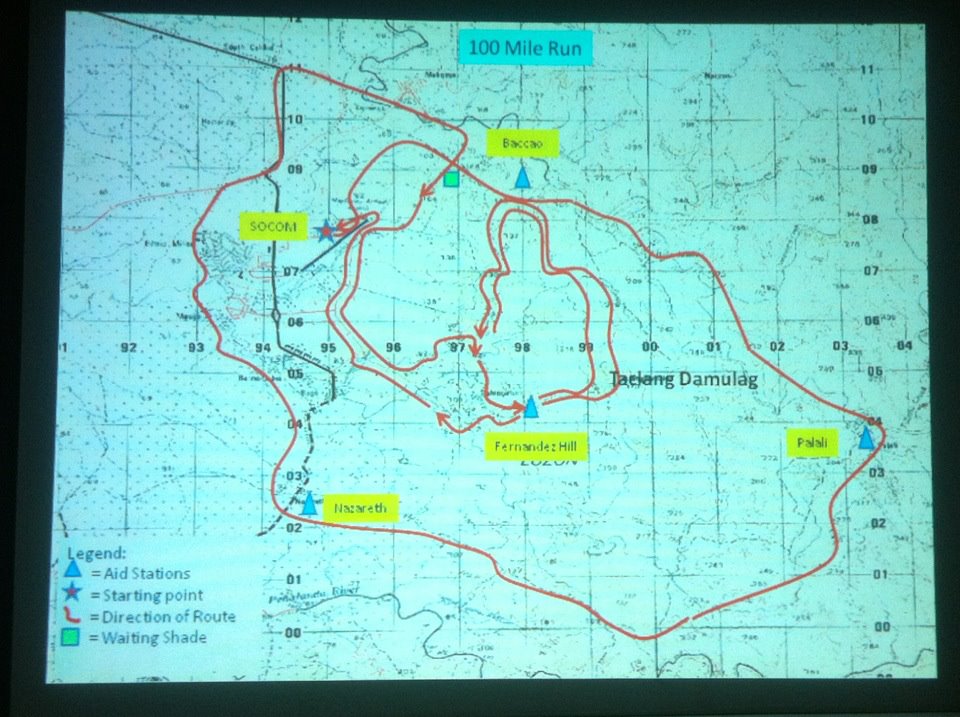
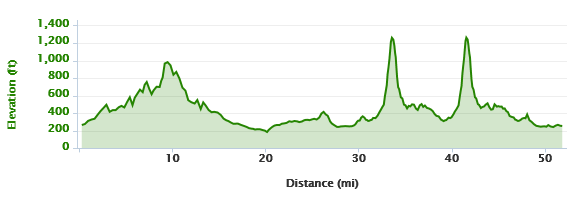
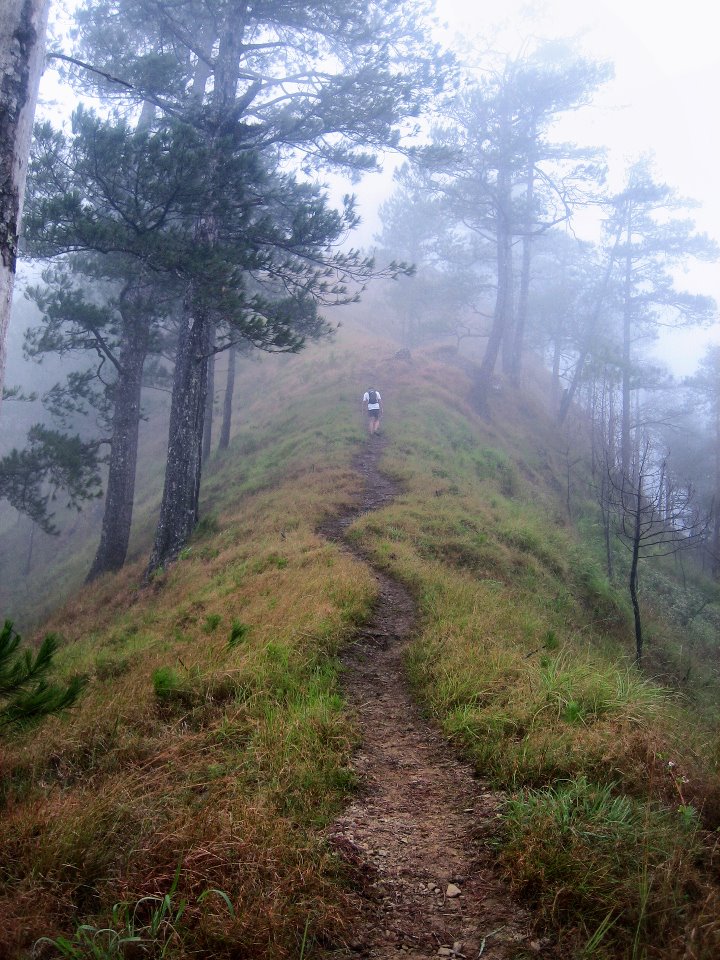
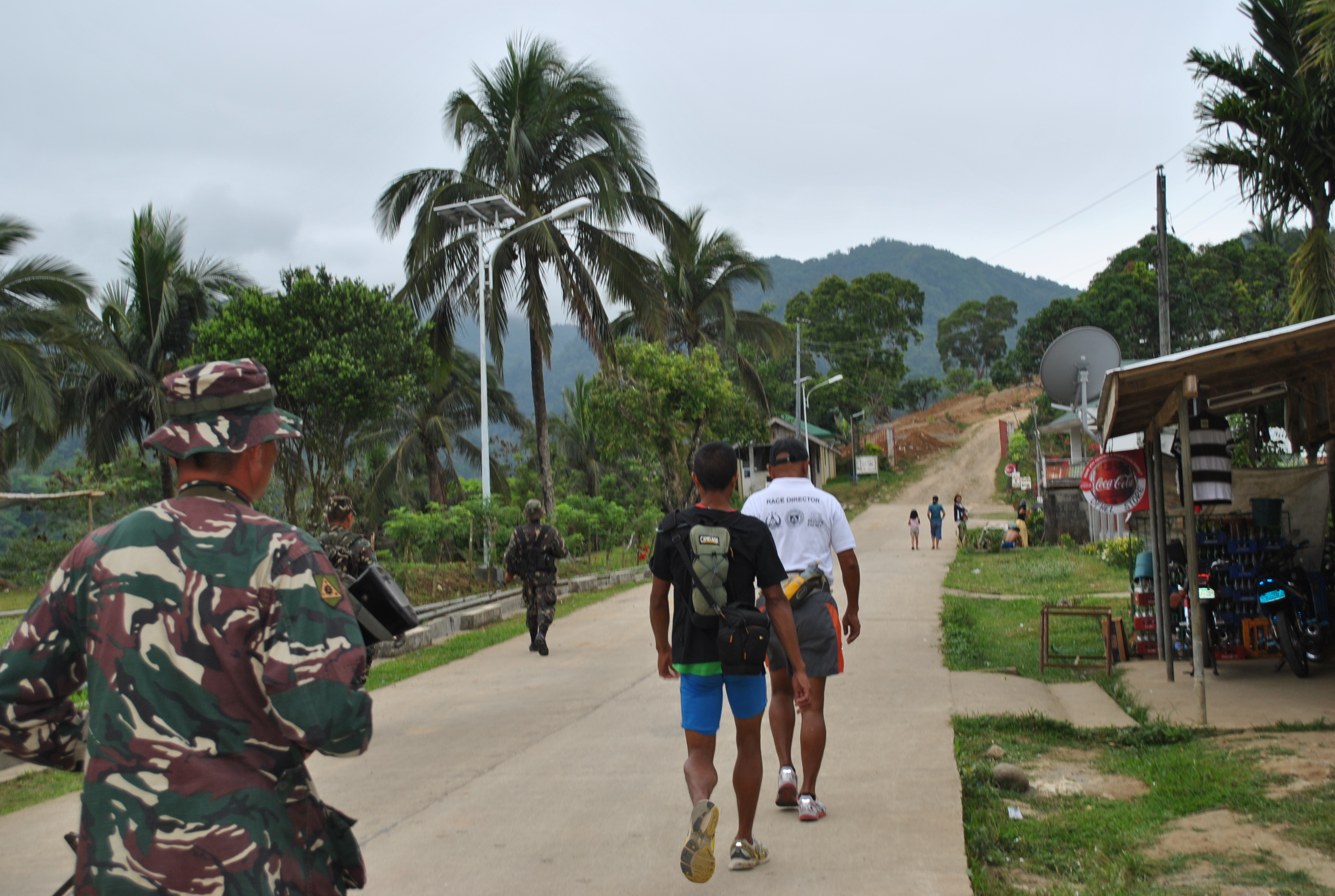
In connection with the celebration of the 50th Founding Anniversary of the Special Forces Regiment of the Philippine Army in June of this year, the Philippine Association of Ultrarunners (PAU) & Bald Runner’s Events had scheduled the conduct of three (3) trail races inside Fort Magsaysay in Palayan City, Nueva Ecija on June 2, 2012.

These races will serve as a “recon or test run” for those who are intending to join in this year’s 2nd edition of the Taklang Damulag 100-Mile Trail Endurance Run which is scheduled on December 15, 2012.

The following are the details of the races:

Date of Race: June 2, 2012

Place of Assembly and Starting Area: Infront of the SOCOM Headquarters, Fort Magsaysay, Palayan City

Assembly Time for 50K & 50M Races: 3:30 AM June 2, 2012

Assembly Time For 21K Run: 4:30 AM June 2, 2012

Gunstart For 50K & 50-Mile Runs: 4:00 AM

Gunstart For Half-Marathon: 5:00 AM

Cut-Off Time For 50-Mile Run: 16 Hours

Cut-Off Time For 50K Run: 10 Hours

Cut-Off Time For 21K: 4 Hours

Registration Fee For 50-Mile Run: P 2,000.00

Registration Fee For 50K Run: P 1,500.00

Registration Fee For 21K Run: P 1,000.00

***Included in the Registration Fee: Dinner & Accommodation Inside Fort Magsaysay on Friday night, June 1, 2012.

Registration Period: May 2, 2012 to June 1, 2012

Registration Center/Area: ARC Running Store OR Deposit the Registration Fee at BPI Savings Account #0296-0673-22 in favor of Jovenal Narcise OR at the Dinner/CLP & Race Briefing on or about 6:30 PM of June 1, 2012 at the SOCOM Headquarters. (Note: Please bring your validated deposit slip to the CLP/Race Briefing)

Good luck & see you at the starting line!

Culture Of Road & Trail Racing


In my “peak bagging” activities throughout the country, I had some observations and information which I would consider as the “culture of road and trail racing” in the countryside. These observations and information gathered could be explained in details through the following topics:

1. No Prize, No Race. In the early times, racing has always a prize for grabbing. It is either money, property, position or any tangible object which one can sell or need in their daily lives. Running feats for faster times had been won by wagers and bets. In the countryside, the best runners don’t run if there are no cash prizes! For obvious reasons, they paid for the registration fee from their savings or had loaned from somebody else. The motivation for winning is to be able to regain what they have paid for and at the same time, earn some money for their basic needs. Bragging rights for them is not for the Finisher’s Shirt or Medals or Loot Bags. They simply need the money!

2. No Sponsor, No Run. Runners with talent and fast finish times always look for sponsors to finance their registration fees. Instead of getting a loan, they would prefer to look for somebody in their community to finance their participation in a race where there is cash prize. It could be their leaders (local government, barangay captain & officials) or somebody who is supportive to their passion/talent. Runners don’t need to pay back the Sponsor just in case he/she does win any of the cash prizes. If they don’t have any sponsor, they would not join any race.

3. Cheating Is Not A Big Deal. Runners in the countryside would finish the race at all costs, even if they cheat! To them, it is natural to cheat because they know that everybody cheats, from their leaders, business-owners, traders, vendors, parents and friends!

4. Running as Talent Is Normal. Most of the best runners were exposed to hardships and manual labor during the early stage of their childhood. Most of them lives in villages in the mountains and they have all the time to ascend and descend the area to look for food, fetch water, and cultivate some lands on a daily basis. Due to their environment and living conditions, they were honed to be endurance athletes since birth. Try to look for one elite runner and conduct an interview about his/her family background and you would know what I mean. And at the same manner, try to look for an elite runner who belongs to the upper class of our society and you will be surprised to find out that you are looking for a “dream”.

5. New Running Kit Is Alien To Them. For obvious reasons, they don’t have any opportunity to use the latest running apparel and shoes due to poverty. Most of their kits are used (second-hand or “ukay-ukay”) and given to them to protect them from the elements. They don’t have any access on the new technology of running in terms of shoes, apparel and accessories. If they have an opportunity to grab a “glossy” runner’s magazine, attention is more focused on the pictures and not on the articles written inside it. I am not sure if they can read or understand English or what is written on those pages.

6. Hydration & Nutrition Are Also Alien To Them.  They drink if they feel thirsty. They eat if they feel hungry. They replenish the basic necessities for their body by feel. They only react to any problem when it is there. They usually drink and eat after finishing the race.

7. There Is NO Shame in DNF. If they think they could not place themselves on the ranking where there is a prize money, they simply stop and declare themselves as DNF and say lots of alibi and complaints. To them, finishing a race where they did not train properly is a punishment! They have to preserve their body from any exhaustion or injury and be “race-ready” again for the next race. In short, they don’t take the “extra mile” to persevere in order to finish the race. It is worthy to note that my Elite Team Bald Runner members are also like this in major races in Metro Manila. However, it took me sometime to change this kind of attitude.

8. Bragging Rights & Recognition. Among their friends, they would brag that they finished a certain race with a certain ranking but the truth is that he cheated along the route by riding a passing motorcycle or a public utility vehicle along the route. But for them, recognition of finishing and receiving an award is translated to the money that they received as a prize! So, if there is a cash prize in a race, the temptation to cheat is always there because it is a part of their training and preparation to finish the race. Very smart, indeed!

9. Race Organizers & Directors Are Businessmen. They organize and direct events for you for a fee! Of course, they should be! It is because they appear to be professional but in the end they will take advantage of you. Not all Race Organizers/Directors are elite runners as most of them are average athletes/runners. Those athletes think that if they finish one or two ultra marathon events, they have already the skills to organize one. Race Organizers try their best to invite runners through ads on the internet, radio and printed materials because for them, more runners means more income aside from the fact that they are being paid for P 85,000 per event, which is the lowest rate outside Metro Manila. But once the gun is fired at the starting line, his work is done!

In short distances up to half-marathon, their time to monitor the runners is up to 2 hours! After 2 hours, they packed up and just leave the last runners to cross the finish line on their own. Sometimes, without marshals, ambulance or water at the aid stations. Once the top 3 runners cross the finish line (Overall and Female Categories), the race is done. The results of the rest of the finishers are immaterial as the results of the race will not be published. Only the top 3 runners are awarded with cash prize and a simple tap on the back of the athletes is enough. The Race Organizer will just say, “see you on the next race!”.

I am writing this post for the simple reason that the nationwide 2012 MILO Marathon Races are about to start. Our best runners in the regions and provinces are now training for this much-awaited event because it is the most prestigious running event in the country and it offers a lot of cash prizes for our runners in the “grassroot” level and a free trip & accommodation in Metro Manila for the MILO Marathon FINALS. This makes me wonder again why there is NO Filipino Corporate Entity (Filipino-Owned) that could match or even start what MILO had been doing to promote running in the “grassroot” level for the past years! I just hope also that our best runners in the regions and provinces would be training properly and not prepare/train to cheat on the said races!

Does it ring a bell if I say that there were cases of cheating in MILO Marathon & Elimination Races in the past editions? Well, that proves my point, there will always be a cheater (or  bandit) if there are cash prizes to be grabbed at the Finish Line.

On the other hand, I hope this kind of culture of road/trail racing in the running community would be removed in due time. There is a need to aware the runners that cheating has no place in running/racing events and it will eventually result to the end of their running carreer as they would be declared permanently “banned for life” in running events.

In life, like running a Marathon or Ultra Marathon Race, the opportunity to cheat is always there easily to be grabbed with or without any material rewards or prizes. Your actions will define the character you are made of and if you will fall to the temptation of cheating, there will always be someone who will see what you have done!

See you at the Starting Line!

Race Report: 1st King Of The Mountain (KOTM) Mt. Ugo Trail Marathon


#3 “Peak Bagging” @ Mt Ugo, Itogon, Benguet via Kayapa, Nueva Vizcaya (2,150 MASL)

4:30 AM April 1, 2012/Kayapa, Nueva Vizcaya

This mountain trail run was the very reason why I started my “peak bagging” feats. On my way to Kayapa, Nueva Vizcaya to recon the route of this marathon race, the road to the Mt Pulag National Park was there nearer from the Ambuklao Dam and the attraction of the said mountain due to its popularity was hard to resist. My trip to the peak of Mt Pulag gave me much confidence to reach the peak of Mt Ugo which is 800 meters lower. And my previous trek to the peak of Mt Natib, two days before race day, gave me a general impression on what to expect in climbing mountains.

If you are climbing to the peak of a mountain, expect a slightly ascending and winding path with so many switchbacks from the base of the mountain or from the trailhead until you reach the base of the peak. The trail is wide and well-maintained where one has to expect more ascending portions than descending ones. From the base of the peak, expect a single-track trail that is very steep on only one side of the peak. I usually call this as the “assault” trail to the peak/summit. Due to steep incline of every step of the trail and the thin oxygen in higher altitudes, one has to experience hardness of breathing and faster heart rate, thus, making one perspire some more. In a race, it is very hard to jog on the steep trail on the side of the peak of the mountain. Walking moderately would be a good option to adopt while on this final assault to the peak.
Depending on the kind or nature of the mountain, every trail is different. If a mountain is a volcano, dormant or active, expect some hardened lava and big rocks as part of the trail. If it is an ordinary mountain, expect a lot of changes on the vegetation or biodiversity of plants in every range of elevation and the trail ground can sometimes be pure earth without any rocks.

I arrived in Kayapa, Nueva Vizcaya after lunch of Saturday, March 31 and my friend, Jonel was at the Municipal Hall & Plaza giving intructions to his staff and at the same time receiving runners who just arrived in the area. Since I gave him the notice weeks ago of my intention to join this event, he designated the only “home stay” facility in the town as my place of accommodation. Kayapa is a small town and there are no commercialized tourist facilities in the area. Just like in Kabayan, Benguet, they have also a “dormitory-type” transient house where the rate is very cheap—P 200.00 per night in double-decked beds. Some of the runners were accommodated in the transient facility of the different barangays of the town. However, there is a big space for campers if runners would decide to pitch their tents infront of the municipal church.

At 4:00 PM, Jonel as the RO/RD of the race event, conducted the race briefing at the Municipal Plaza, infront of the Municipal Hall. It was nice to meet the “usual suspects” in ultra races as well as the local runners from Baguio City and Region 1. I was happy to see runners who came all the way from the Ilocos Provinces, Central Luzon (Region 3) and Metro Manila.

After the briefing, some had their “carboloading” in the local eateries located in the Public Market of the town which is just across the road from the Municipal Hall. It was time to taste the local foods! The pork stew with the local’s native pig is always a winner! And there is also a bonus dish which is the “adobong inasinan na baboy” (preserved salted pork cooked with soy sauce & garlic). The eatery where I ate have also pancit (noodles)!

After dinner, I had a brief talk with some of the runners and everybody was in a relaxed mood. Nobody talked about the race and what to expect during the race. On my end, I told them about my experiences in my new passion of “peak bagging” where Mt Ugo will be my 3rd mountain peak to conquer!

At 9:30 PM, I was already sleeping. However, I was awaken by the movements of the other runners staying in the same place who started to have their shower as early as 1:30 AM. There is no point of forcing myself to sleep some more. I slowly prepared my things and took a shower.

At 4:00 AM, I was already with the rest of the runners at the Starting Line/Municipal Hall which is located across the road from the place I was staying. It was nice to greet more friends and everybody were all smiles. I didn’t see any tense looks or faces among the runners. We were there to enjoy the outdoors and have fun in experiencing the 1st Mountain Trail Marathon in the country.

In a simple ceremony, Jonel led the Invocation/Prayers and I was the one who led the singing of the National Anthem. After a simple welcome and reminders about the critical areas in the race from Jonel, we were ready to go. At the schedule start time, 4:30 AM, the race started with a simple countdown from the count of 10 to 1 & “GO!” from the Race Director.

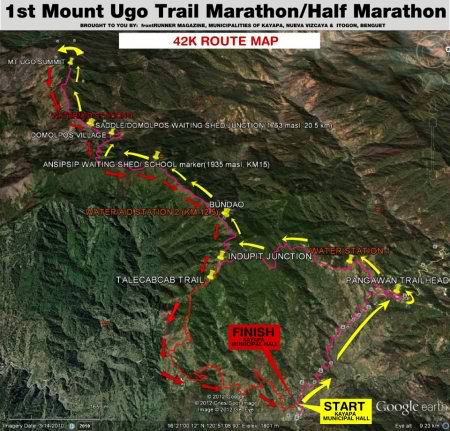
The first 5 kilometers was an uphill/ascending route along the Benguet-Nueva Vizcaya. I did not run or jog on this part. I just simply brisked walked with the aid of my trekking poles. After 2 kilometers of this winding uphill road, I knew I was one of the last runners of the more than 150 runners who joined the half-marathon and the marathon distances. There was nothing to worry as I knew there will be more ascending portions as the race progresses.

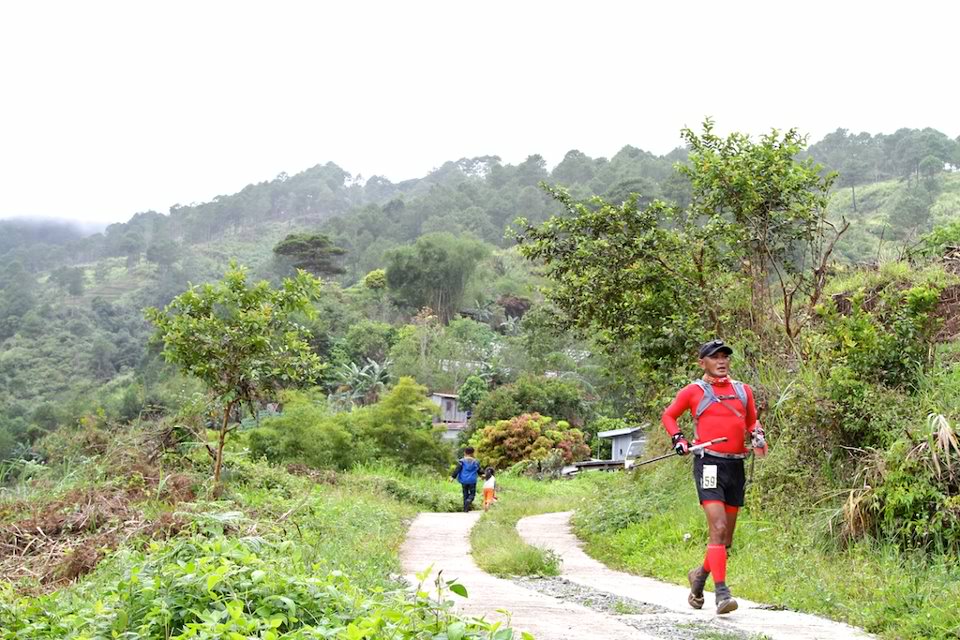
As I reached the trailhead, I started to jog along the unpaved road leading to a narrower trail. It had been raining for the past days and I knew that most of the route will be slippery and muddy on portions with loose soil. I would run on flat and descending portions and then brisk walk on steep inclines. This ritual had been repeated through the race. I would be very careful on portions where there are slippery rocks and muddy portions of the trail. I was very confident on my footings due to the trekking poles I was using.

In less than 1 1/2 hours, I was able to reach the turn-around point of those who were participating in the half-marathon at Bundao and I was able to meet the lead runners who were under way to the finish line. I said to myself, the half-marathon distance did not offer much challenge and nice scenery for the runners. I just envy the runners that they are through with the day!

I could say that the trail from Kayapa side is well-maintained and I could see lots of vegetable farms on the sides of the mountains all around. Well, there are animals also that you could meet along the trail. I observed cows and wild/native pig on the sides of the trail.

After almost 17 kilometers, I met incoming runners who were telling me that I was on a wrong trail and I had to retrace myself to the nearest trail intersection. It was good, I was lost for only about 50 meters!
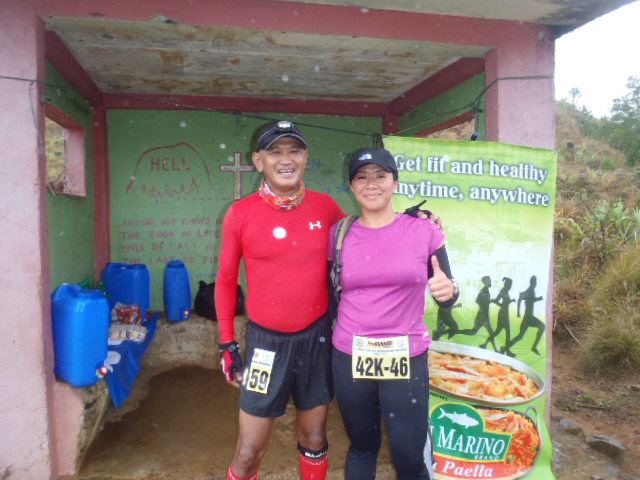
I memorized the word “Domolpos” as the place of the last Aid Station towards the peak of the mountain and it was my target to reach where I could take my first food through my power bars and gels and Gatorade mix. I was with a group of runners (Ed Yonzon, Chito Carreon, Vener Roldan and Gay Baniwas, a lady runner from Baguio who finished 1st Runner-Up in the Ladies Category) when I reached this place. Gay asked me to have a picture with her and later on,  I remained in the Aid Station as they left one by one. I took a pee, ate my energy bar, took a gel, and mixed my Gatorade powder. I guess, I spent almost 3-4 minutes in the process.

When I was back on the trail, I could no longer see the rest of the runners who were with me at the Aid Station. I kept on pushing myself until I saw the back of Gay and I was relieved. Gay became as my “guide’ towards the peak of the mountain. We would have another and more photo-ops along the steepest portions of the “assault” trail towards the peak. I passed her when she stopped to take some more snapshots of the scenery around the trail.

I kept on pushing and digging more of my trekking poles on the steepest parts of the peak and regularly looking for the bright light to appear in between the plants and bushes that cover the peak. If I could see a brighter light source in between the trees and plants ahead of me as I look up to the direction of the “assault” trail, it means that the peak is within my grasps!
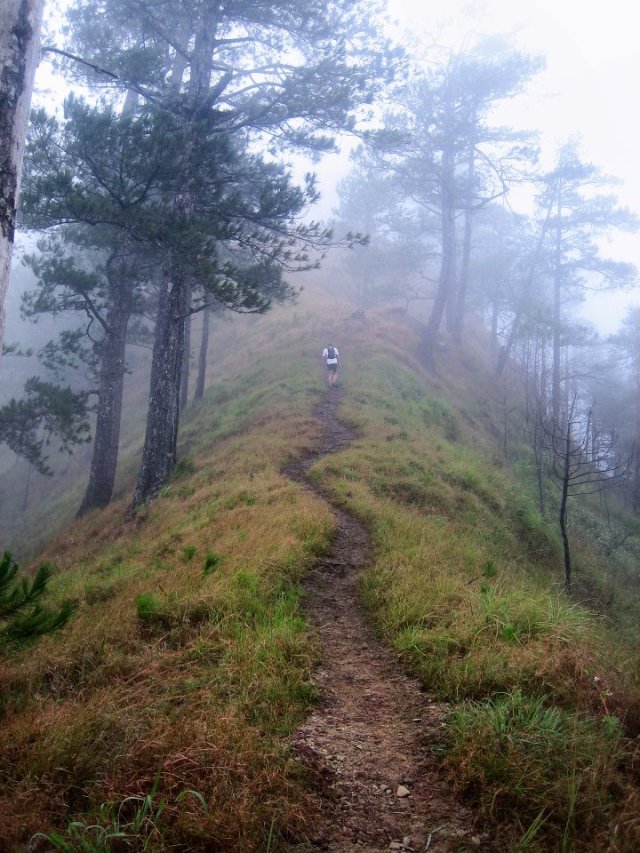
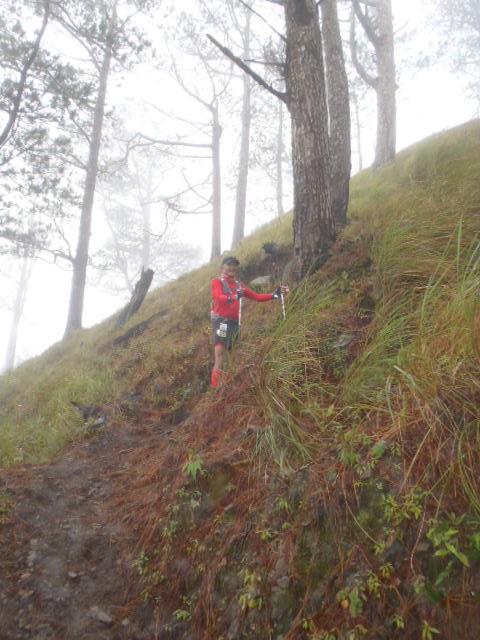
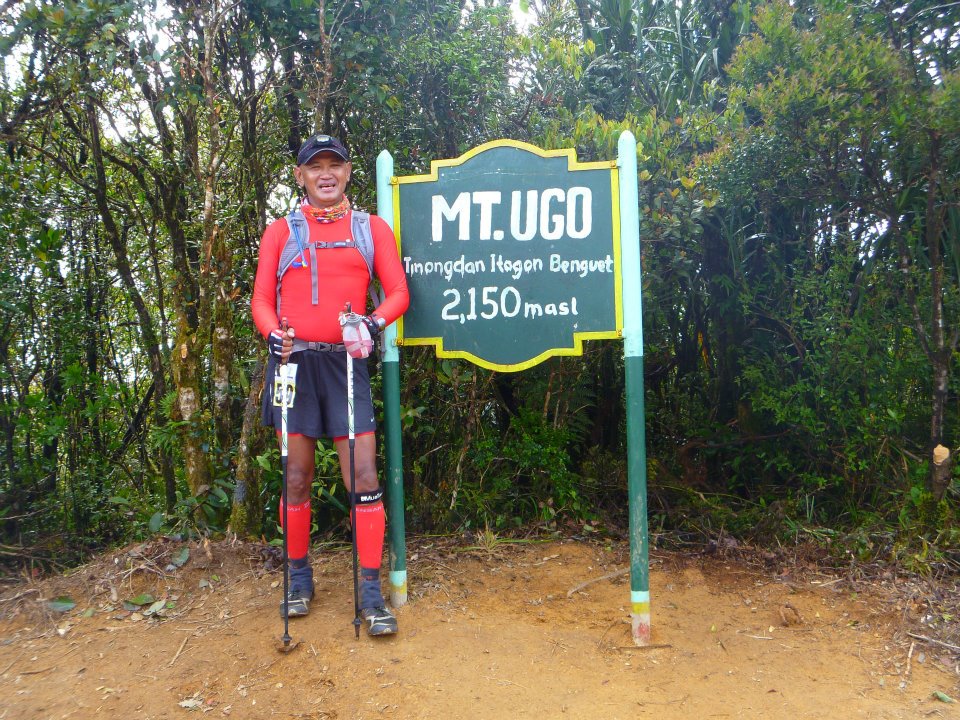
After 4:25 hours, I reached the peak and I was able to meet again Chito, Vener, and Ed Yonzon who just happened to be having their photo-ops near the peak’s marker. I congratulated Koi Lapira for a nice route as he prepared to take a picture of me at the peak marker as a proof that I reached the turn-around point. My GF 305 registered a distance of 23.1 kilometers and an elevation of 2, 165 MASL. After my photo-ops with Koi Lapira, I joined the rest of the runners for another pose.
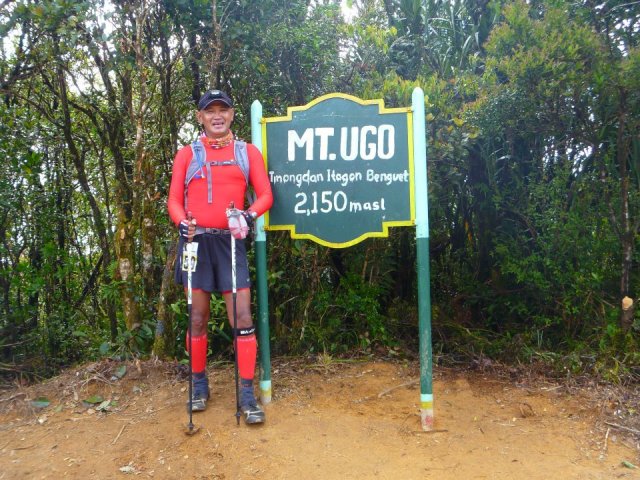
After my photo-ops with Koi Lapira (the evidence that I reached the turn-around point), I joined the rest of the runners for another picture pose. On our descent to the Domolpos Aid Station, I led the runners at a fast & decent pace.

At the Aid Station, I did the usual ritual—pee, eat, and mix my drinks while the rest of my companion started to resume their run. At the Domolpos Elementary School, I was able to catch up with their tail but I needed to slow down my pace as I approached a very steep trail as I left the school. As I reached the top of the trail, I could no longer see them on the flatter portions until I was able to pass one runner.
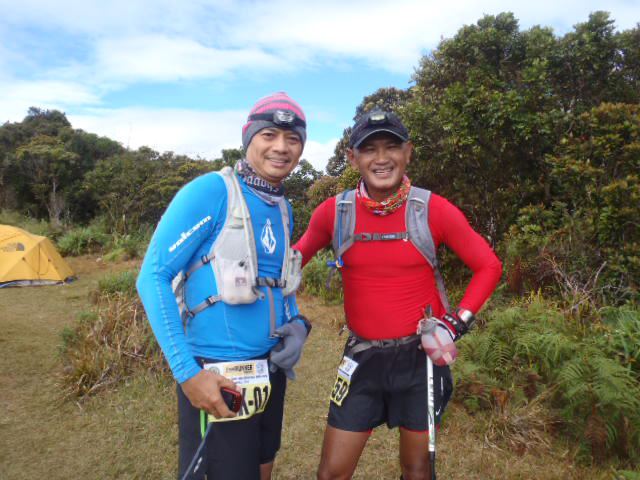
When I was about to approach the next Aid Station (Ansipsip), I saw 3 runners who just left the station. I saw Philippe Arenillo, a Pinoy runner, and the French guy whom I met the day before the race running in a single file. I stopped at the Aid Station and drank some Mountain Dew and asked from the Marshall what is my ranking/position among the runners who just passed. The marshal said that I was #30. I became excited as I have some “targets” to follow. However, I was still trying my best to catch up with the group of Chito, Vener and Ed.

Few meters from the Ansipsip Aid Station, I was able to pass the Pinoy runner and the French guy and ultimately joined Philippe. Philippe and I brisked walked and jog together on those descending portions of the route along Telecabcab Trail. I could not speed up on those steep descending trails because I was trying to protect my painful knees! My quads were already burning while the trail was very slippery. More fences to overcome until Philippe asked me for him to go ahead after having a conversation with him for about 2 kilometers.

Philippe became my “target” as I could see him infront of me. Switchback after switchback, I could still see him until I saw another runner who was walking and later overtaken by Philippe. At this moment, I was #28 runner! When I approached the runner, it was Ron Sulapas and I engaged a conversation with him and encouraged him to join me to catch up with Philippe. He joined me in my jog but later after a few minutes he slowed down and I continued my run. I could still see Philippe about 10 meters infront of me but he started to increase his pace until I lost him. I said to myself, #27 finisher would be a good accomplishment already!
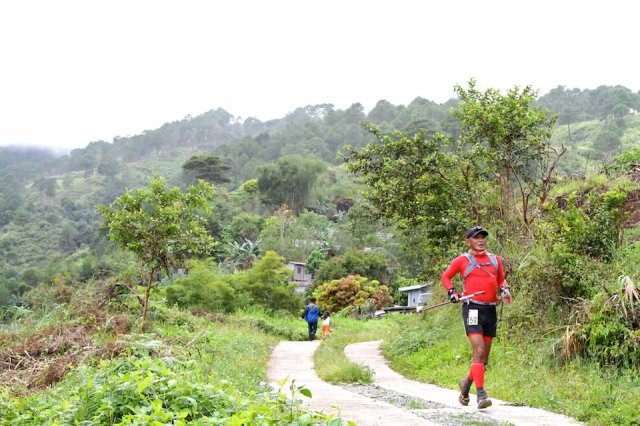
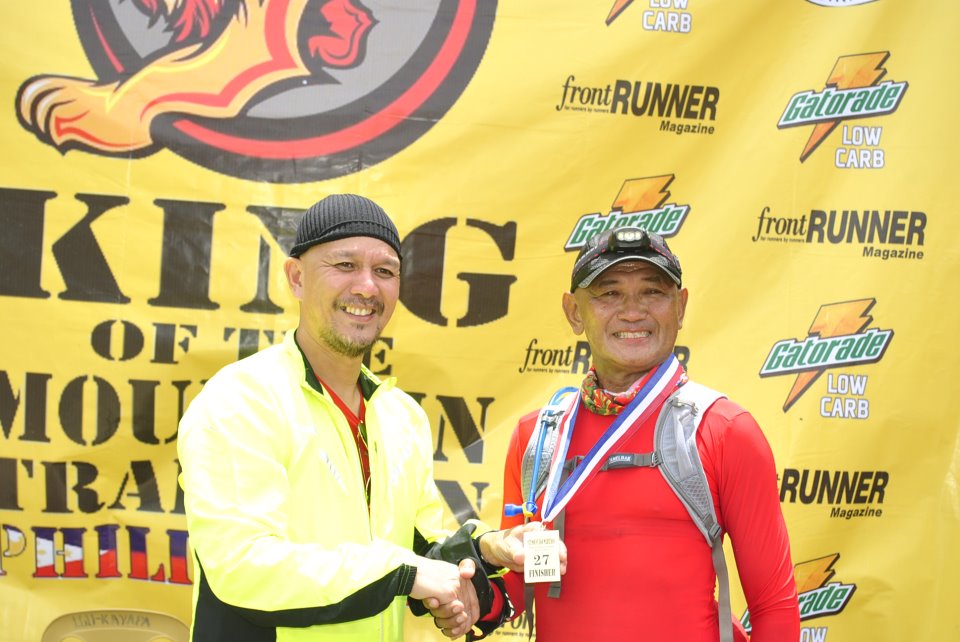
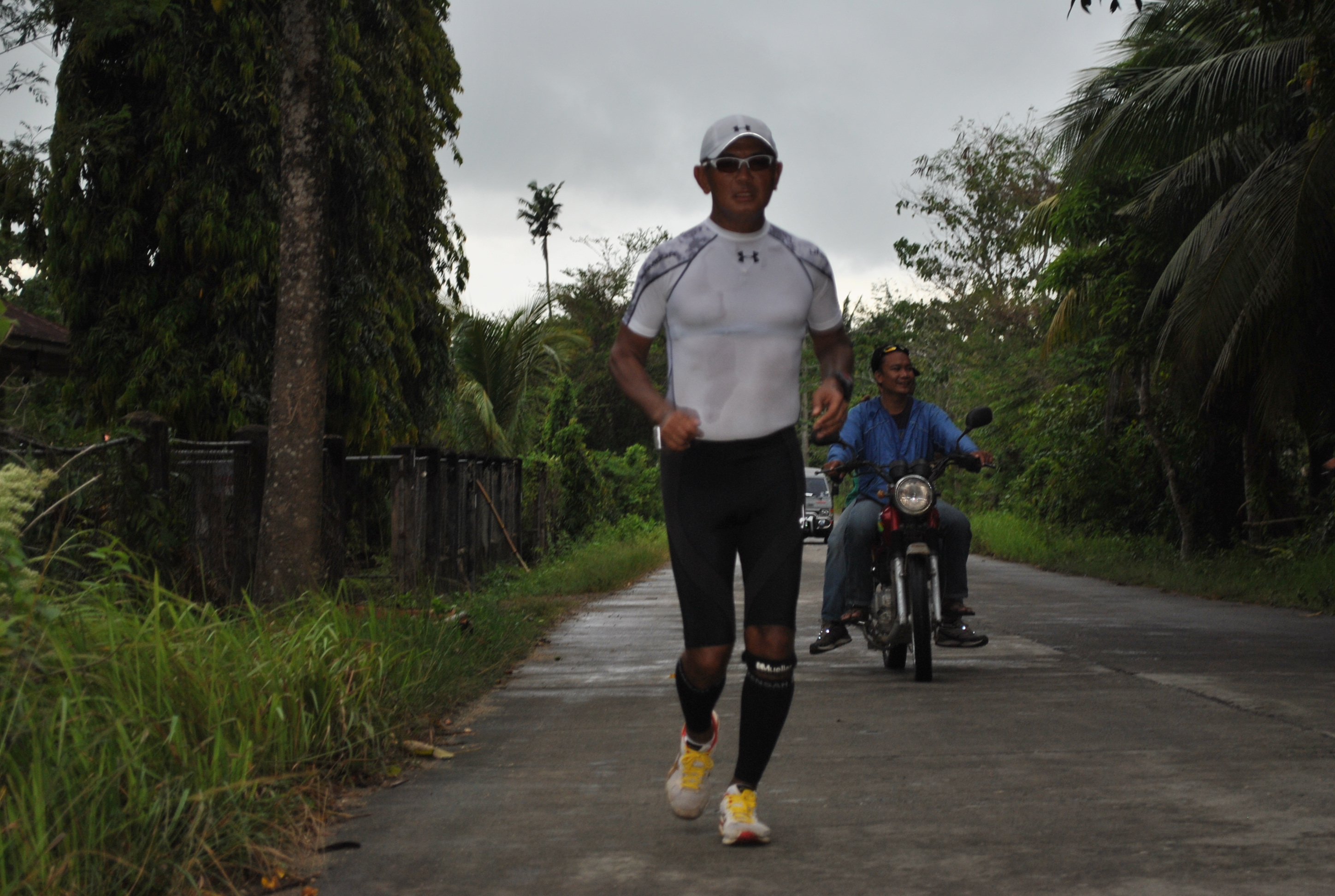
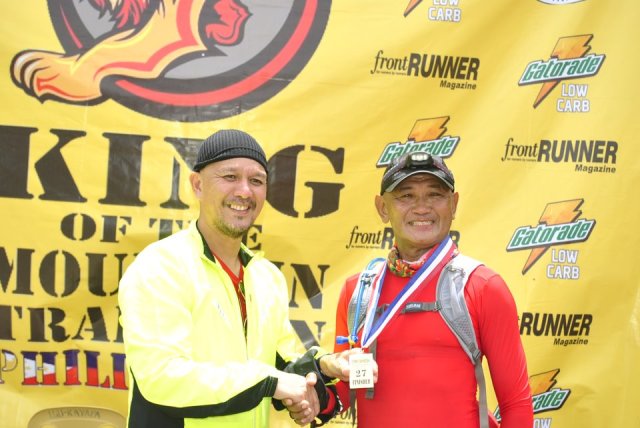
As soon as I reached the last incline of the route/trail, I was back on the main road and the last 50 meters of the race was very fulfilling. I could here the banging of a gong, the ringing of cowbells, and the cheers of those who finished ahead of me from the finish line. I was all smile on those last 50 meters as I carried my trekking poles as if they are my batons! I crossed the finish line in 7:56:57 hours. Officially, I am ranked as #27 out of 69 finishers. Not bad for a 59-year (& 11 months) old runner.
The following were the data downloaded/recorded by my Garmin Forerunner 305:

Distance: 42.06K

Average Pace: 11:20 minutes per kilometer

Average Speed: 5.3 Km/hr

Maximum Speed: 12.5 Km/hr

Average HR: 150 bpm

Max HR: 171 bpm

Total Ascent: 2,751 meters

Total Descent: 2,794 meters

Highest Peak Elevation: 2,169 meters above sea level

Distance From Start to Peak: 23K

If you want to become an all-season trail runner, this is a Marathon Trail Race which you should not miss. I highly recommend this trail run. However, you should find time to make a reservation on your accommodation in the town of Kayapa weeks before the event and if possible, conduct a recon on the said mountain.

Congratulation to Jonel, his FrontRunner Magazine staff, and to all the Finishers for a job well done!

See you on May 26-27, 2012 for the 1st KOTM Mt Ugo Trail Ultra Marathon Race!

(Note: Pictures Courtesy of Jake Manzano, Gay Baniwas, Ed Jonson & Ismael Ilagan)
#2 “Peak Bagging” @ Mt Natib, Bataan (1,287+ MASL)


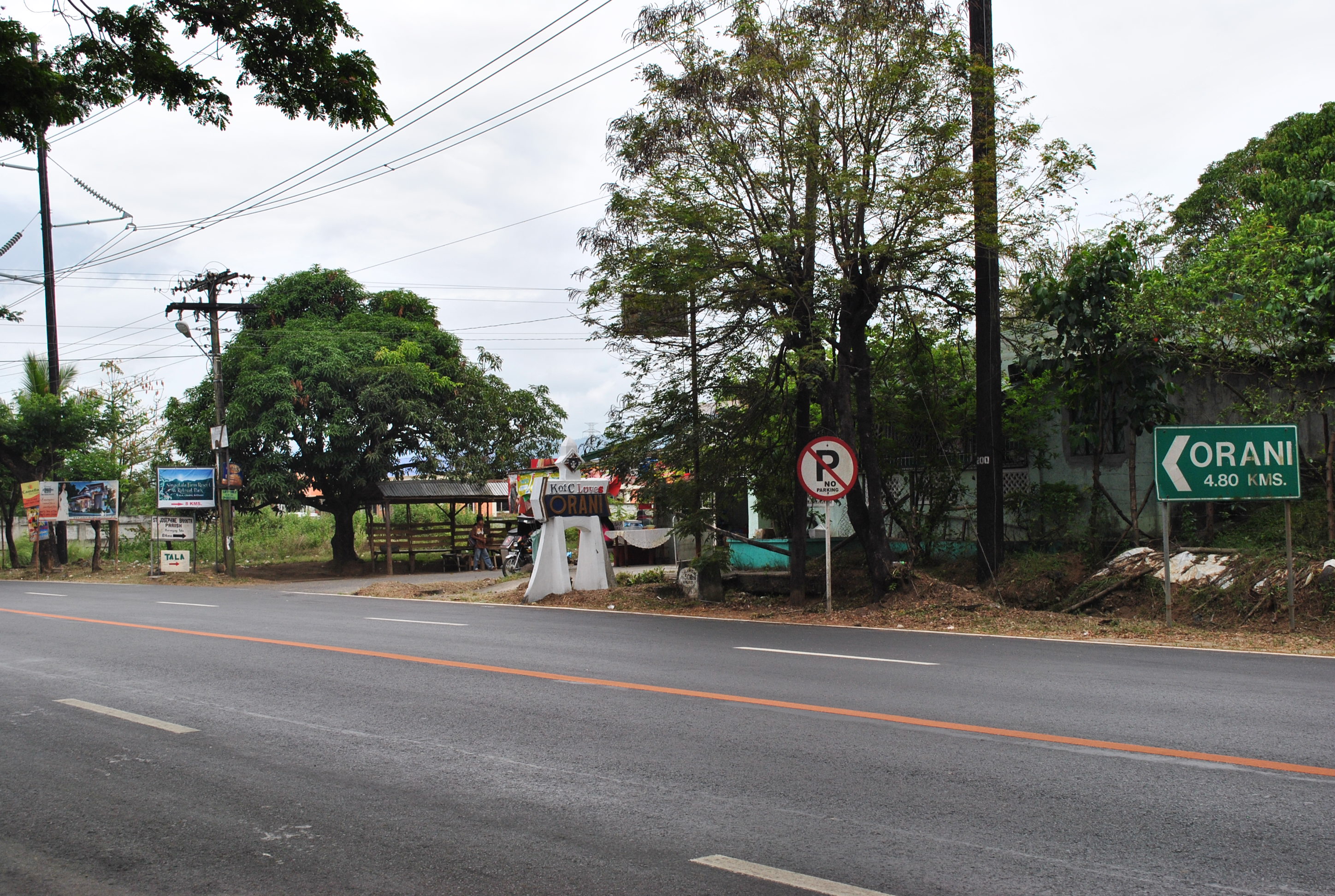
March 29, 2012 @ Mt Natib, Barangay Tala, Orani, Bataan

Mt Pulag is more than twice as high as Mt Natib in Barangay Tala, Orani, Bataan.

Exactly 14 days after Mt Pulag’s “peak bagging”, I was on my way to Bataan and try find out if I can reach the peak of Mt Natib within half day. It started with a simple Personal Message on Facebook with a “friend” who happens to be the Military Commander of the Northern & Central Luzon Areas and then later with telephone calls to two subordinate commanders whose areas are within Bataan and other provinces in Central Luzon. After 12 hours from the time I sent a PM on Facebook, everything was set and I could run and hike up to the peak of the famous Mt Natib the following day.

Two days before joining the 1st King of the Mountain Mt Ugo Trail Marathon, I was on my way to Balanga, Bataan to visit the Commander of the 7th CMO (GWAPO) Battalion, Colonel Benny Doniego, who gladly received and escorted me to the 73rd DRC Detachment in Barangay Tala, Orani, Bataan where I would start my run & trek to the peak of Mt Natib. I was surprised that he prepared a breakfast for me and my staff! It was nice to see Col Doniego after I’ve retired from the military service for the past almost 5 years. He happens to have served under me when I was assigned at the 7th Infantry Division in Fort Magsaysay.

Not only did Colonel Doniego prepared a breakfast for me, he even went to the extent of providing me with one officer and one team/squad of soldiers (9 soldiers) as my escorts. His parting words for me was that there will be fresh coconut juice and my favorite dish of “sinampalokang native na manok” waiting for me as soon as I arrive running/trekking from Mt Natib for lunch! Wow! What a nice incentive to finish the activity in a faster mode!
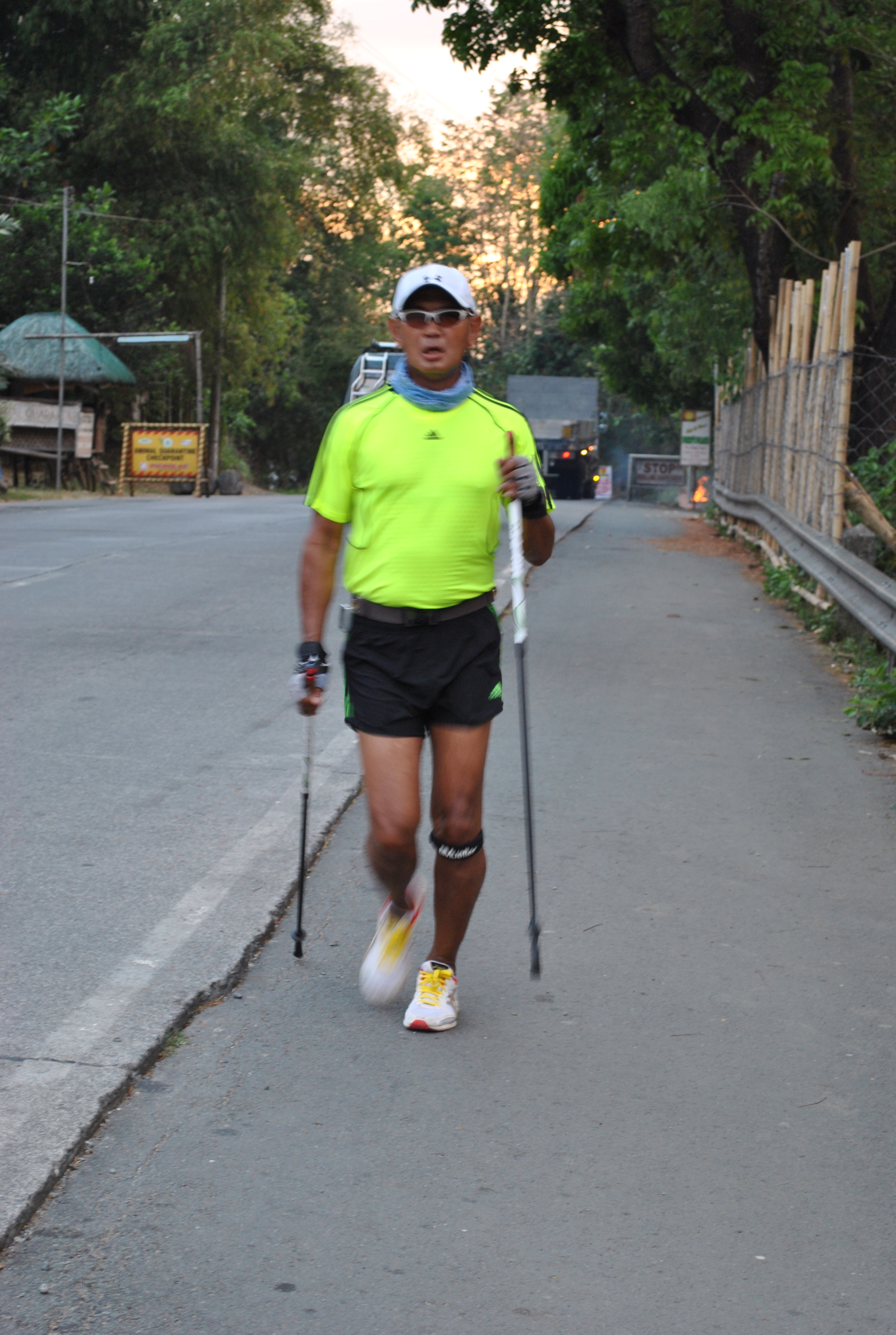
With military escorts infront and on my back, I started my run/hike from the Philippine Army Detachment at 9:30 AM. From the starting point, everything was going uphill until I reached the place which they call “Pinagbutasan” which happens to be a wide man-made “pass” or “breakthrough” on a mountain so that a trail was made on the other side of the mountain. There is a steel gate/fence that protects the unnecessary use of the trail from 4-wheeled vehicles. From this point, you could see the nice vista and mountains/ridges overlooking the towns of Morong and parts of the Subic cove.

The trail is wide with hardened soil/earth on the first part of the route from “Pinagbutasan” and then it transforms to a trail that has lots of stones and rocks. I was informed that the trail was made/constructed by PNOC on their digging explorations on the said mountain years ago. It is worthy to note that Mt Natib is considered as a dormant volcano and I have the suspicion that PNOC was looking for a geothermal source on the said mountain due to its nature as a volcano. Geothermal is one of the alternative sources of power energy. Unluckily, PNOC was not able to find any geothermal source in the said mountain as evidenced by their exploration diggings covered with concrete cement. You can ask your guide if you are interested to find out where these diggings are located.

On this rocky & stony portion of the trail, it is mostly covered with trees and plants. The terrain is not steep and I was able to jog on most parts of this shaded portion of the trail.

It was cloudy and cold during the day that I had my trek on this mountain and I could hardly see its peak. What went into my mind was to be able to reach its peak, take some pictures, and then descend from the mountain peak for my warm and tasty lunch!
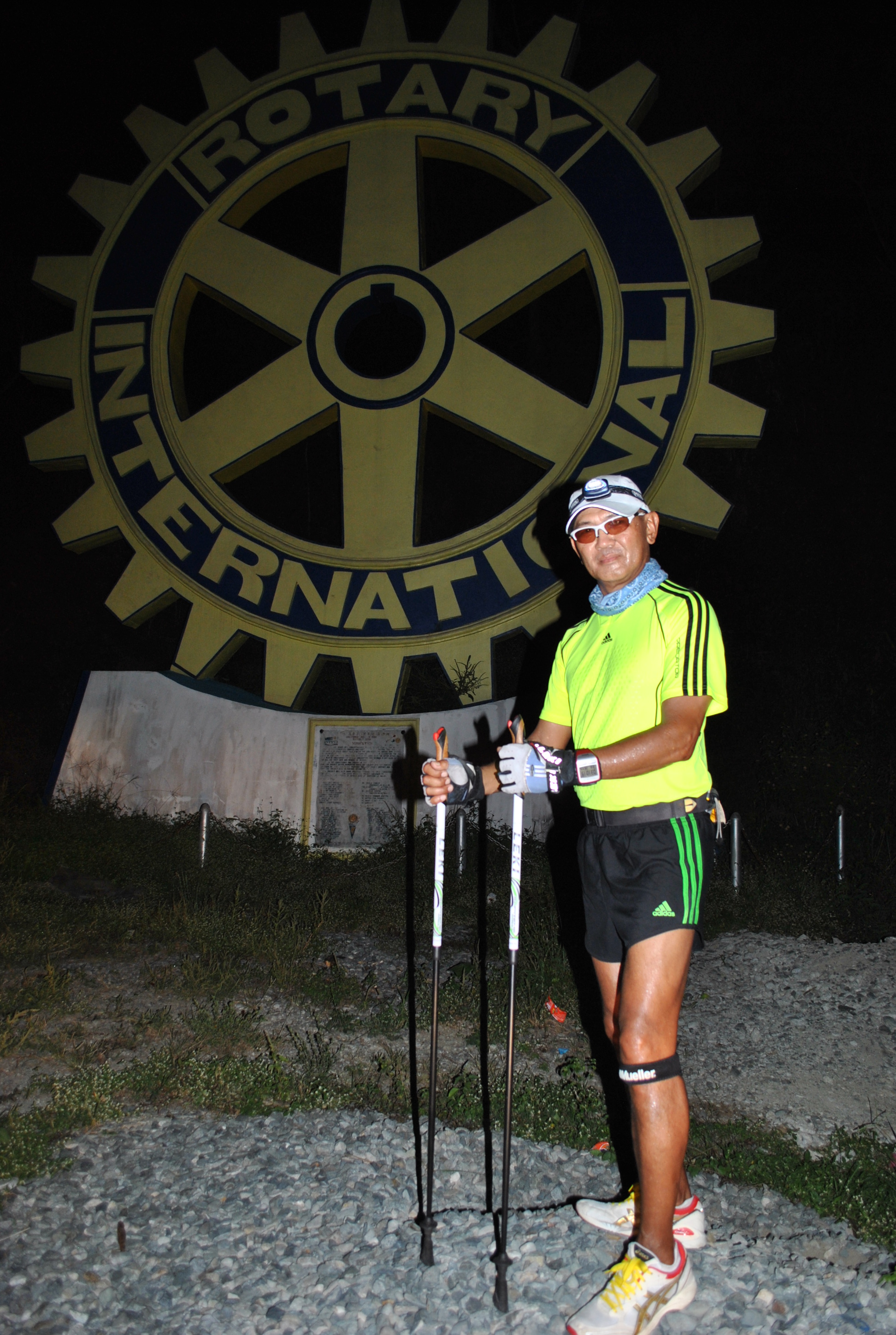
After the shaded portion of the trail, an opening of two small hills beckons with tall grasses with the trail on the middle. I could only see the clouds that cover the mountain and the tall grasses as I proceeded with my power hike. More tall grasses on both sides of the single-track trail and then I was told by our guide to turn left towards a clearing.

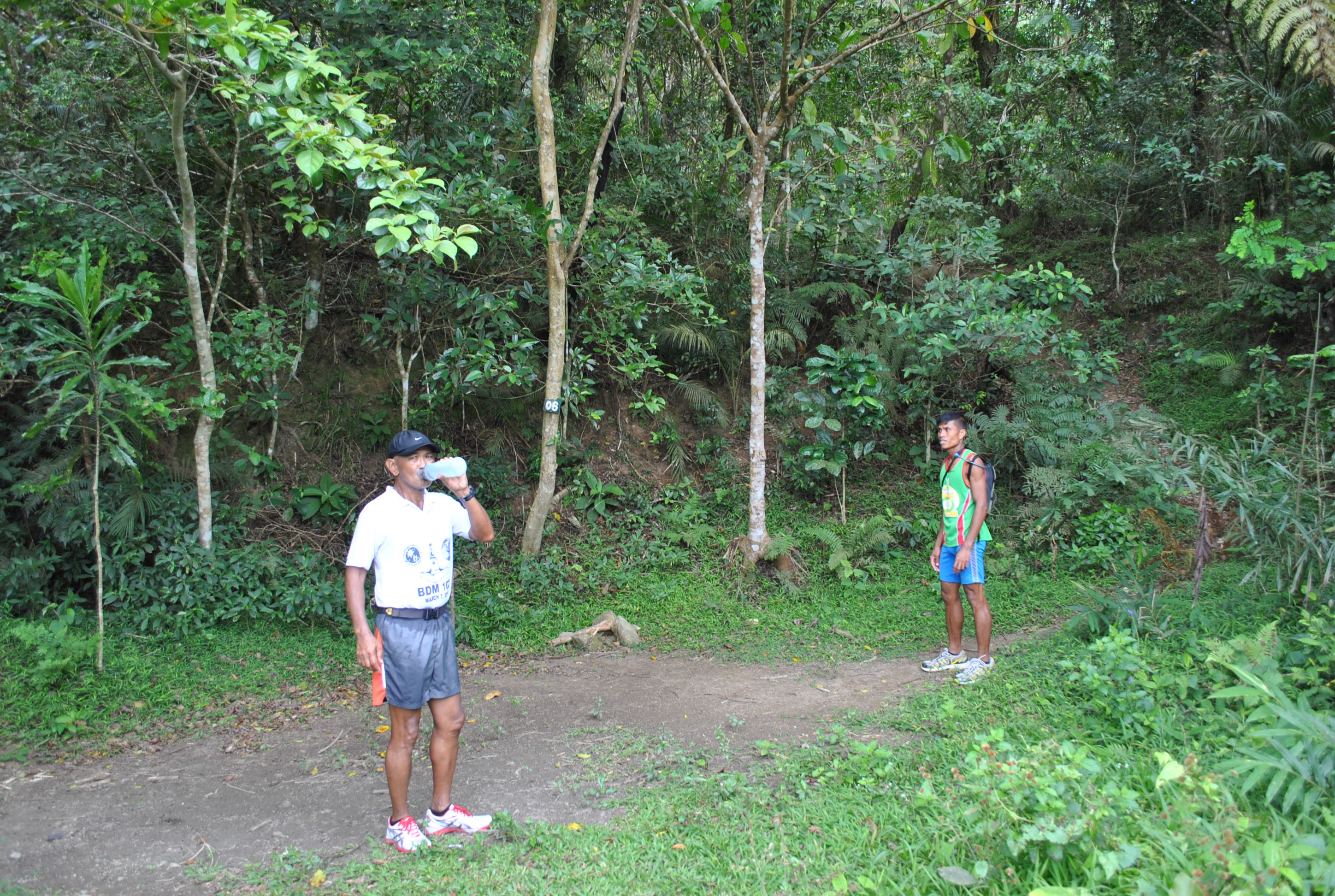
There was a clearing which they call “Area 1”. It is actually a camping site which is good for 3-4 tents and located on the very base of the peak of Mt Natib. There is a number “06” marker on one of the trees around the campsite. This site is the start of the “final assualt” to the peak of the mountain!

Aside from the soldiers as my escorts, I had with me two of my elite runners who were there as my personal photographer and assistant. We started our final climb towards the peak with me located in between my two runners on single file. The runner in front of me would clear the way for branches and twigs/thorny vines and the other on my back was there to make sure that I will not roll down from the mountain if I tripped or slipped on the rocks. It was raining then and the trail was slippery. It was more slippery on the rocks that we have to use extra effort to push our feet up to the trail.

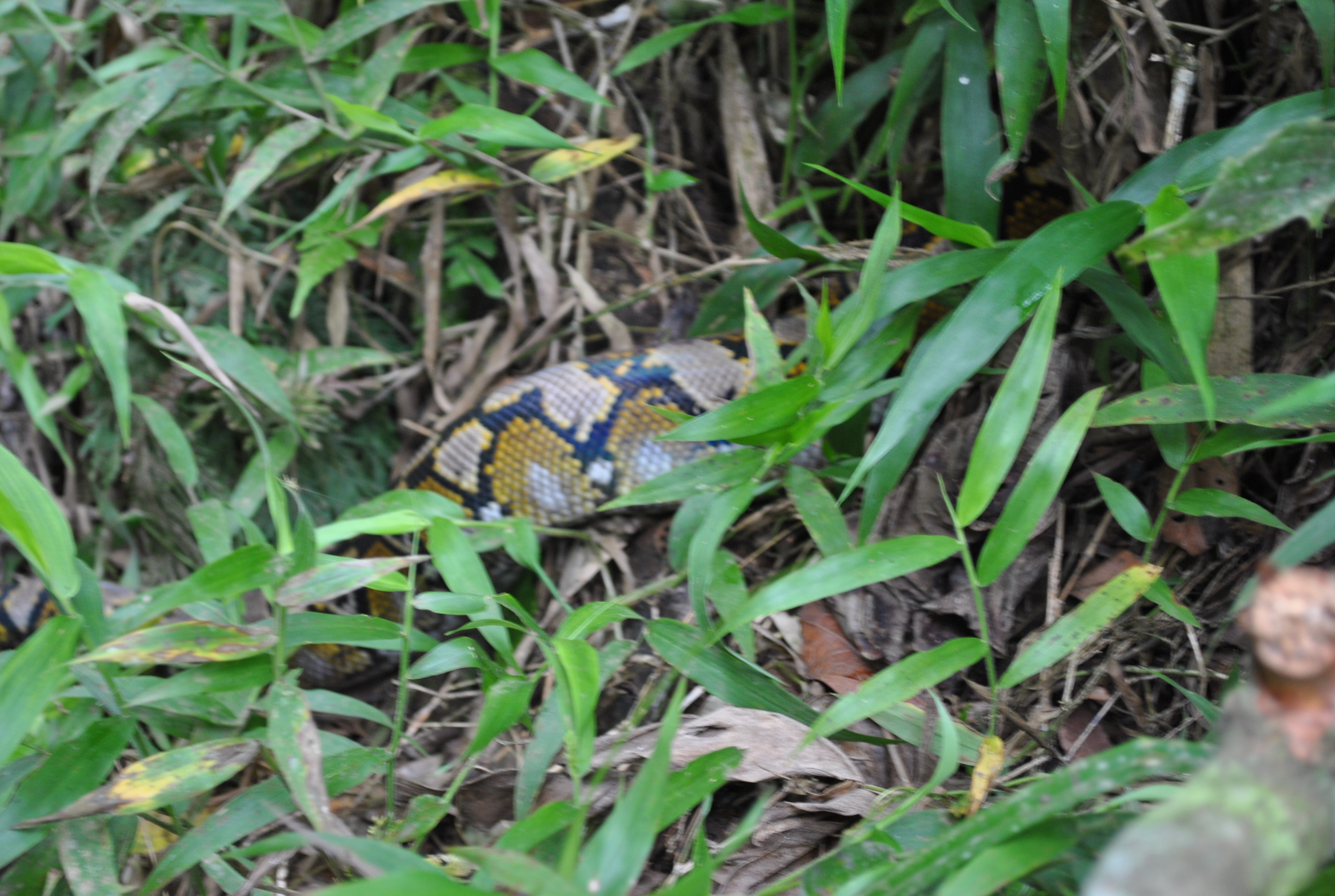
After 50 meters on the trail, the first runner suddenly stopped and started to retrace his footings backwards. He told me that there is a snake infront of us crossing our path. I told him to get nearer to it and find out where the head is located! He hesitated! I was the one that went nearer to the snake and it was really big but we could hardly see its head! I was about to hold its tail and yanked the whole body out of the thick foliage but I thought that it was not my main “mission” to look for snakes. I am not a hunter and I am not looking for food or for a pet! I am after the peak of Mt Natib, stick and stay focus to the very simple mission! In a split of a second, I instructed my runner on my back to give me my camera and I was able to get a close-up picture of its tail portion as the snake went to the thicker foliage part on the side of the trail.

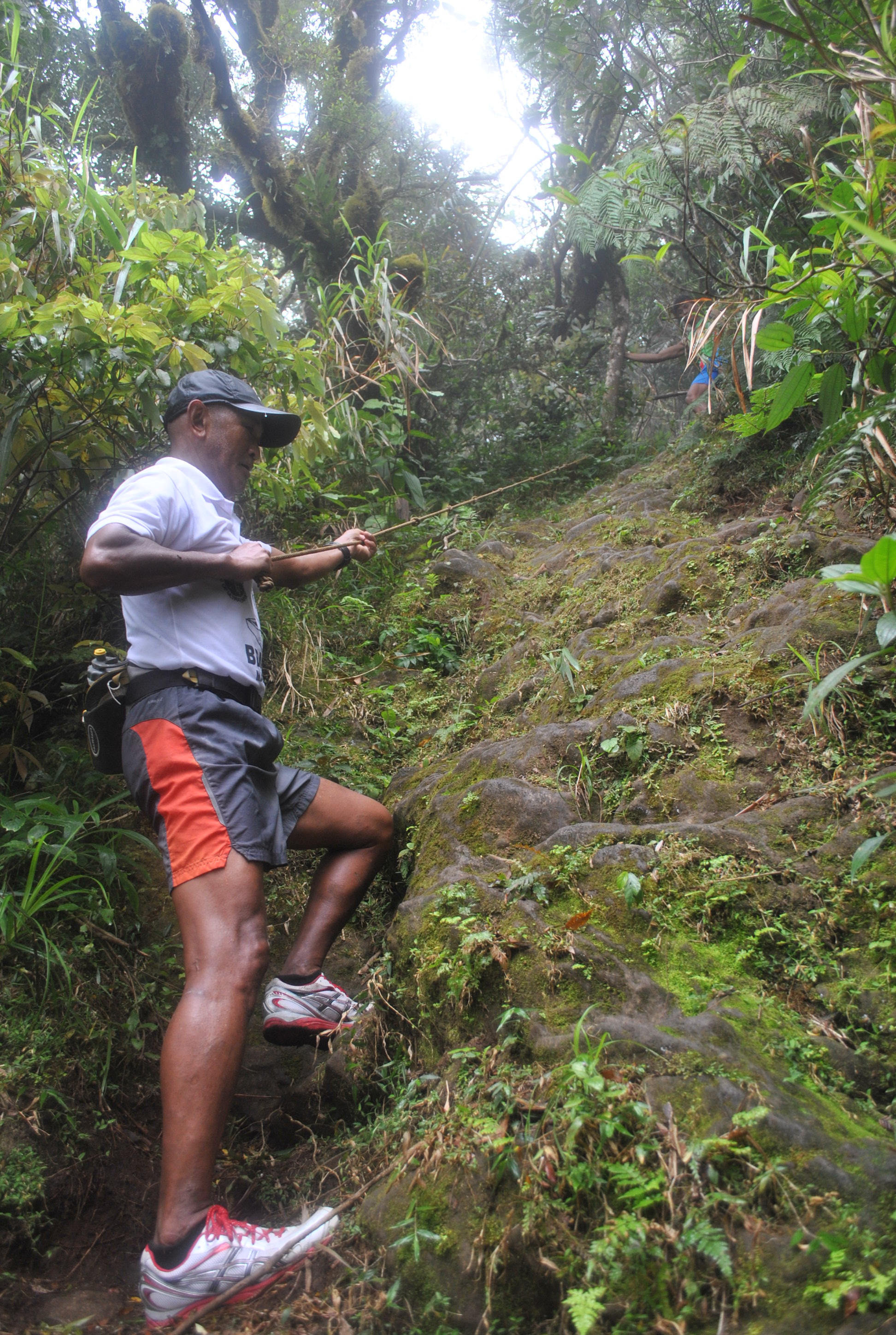
After the snake encounter, we went higher and higher with more caution. Then, we were faced with a “vertical wall” which is about 10 meters! It’s good there is a nylon rope where one could hold for a nice rapelling experience! However, the challenge was for the the foot anchor to be firm on every leg push and strong arms pull on the rope towards the top of the wall so that there would be no slipping or sliding due to the slippery wet rocks brought by the drizzle. Going up on top of the wall was very slow and deliberate. There is no point of making it fast to reach the top of the wall. Patience is needed in this kind of situation.

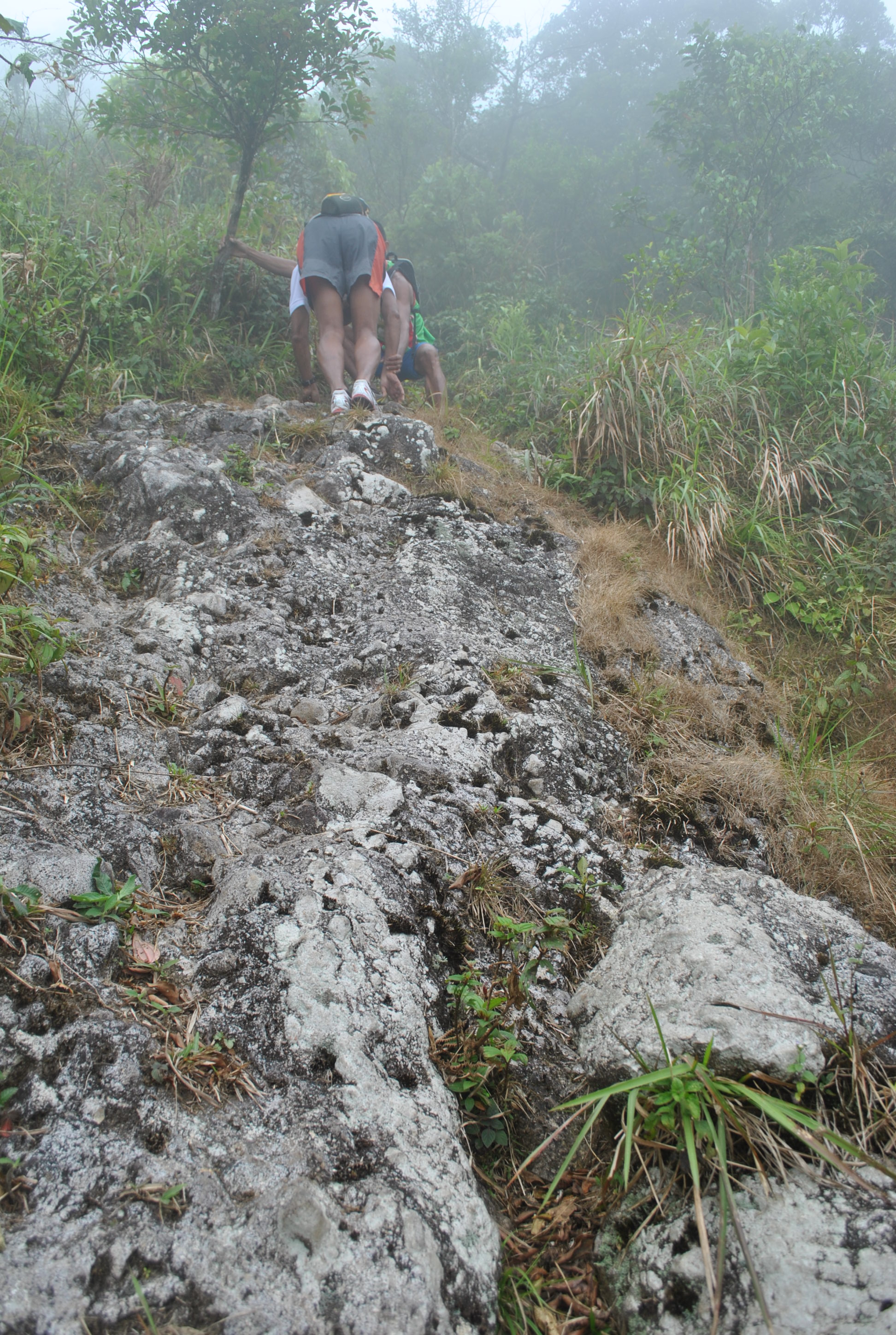
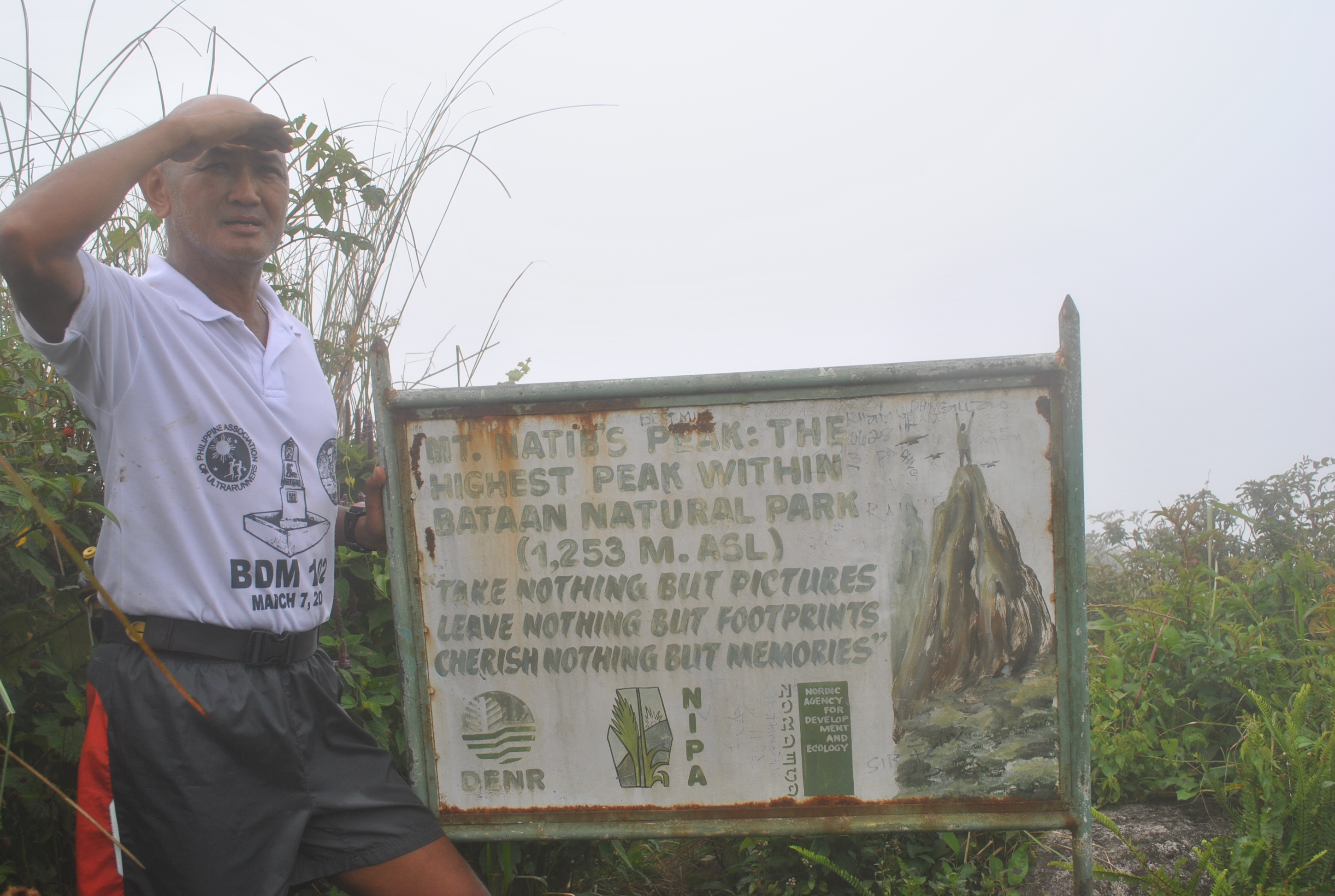
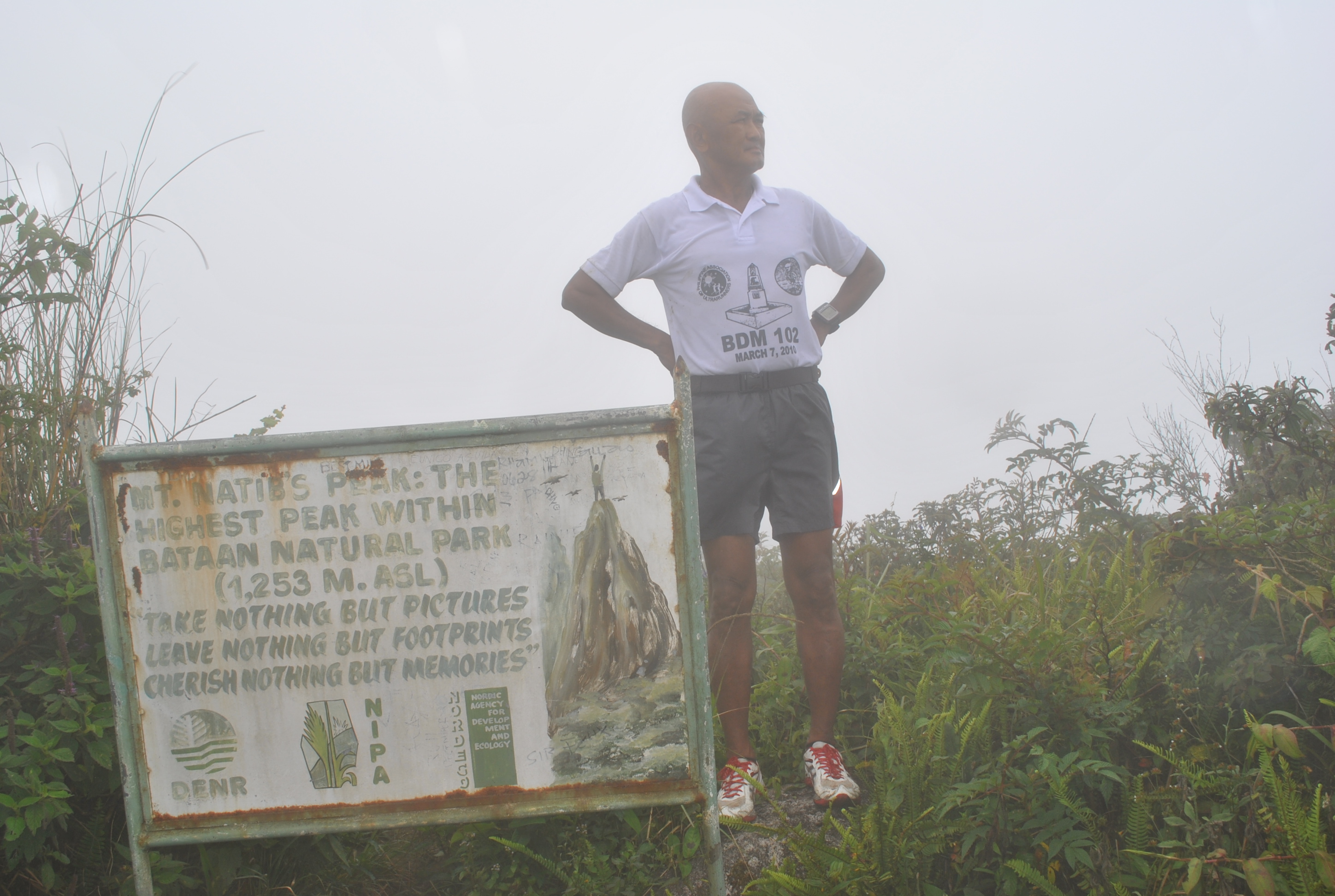
After the first wall, there are rocks as part of the trail that I had to crawl just to be sure that I would not slip. Patience paid off. But there was another mini-wall (about 5 meters) with a rope (again!) to be climbed to its top. After passing this last wall, everything was a smooth uphill and in about 50 meters, I was greeted with the Peak/Summit Marker of Mt Natib! Finally, I was able to “peak bagged” Mt Natib!

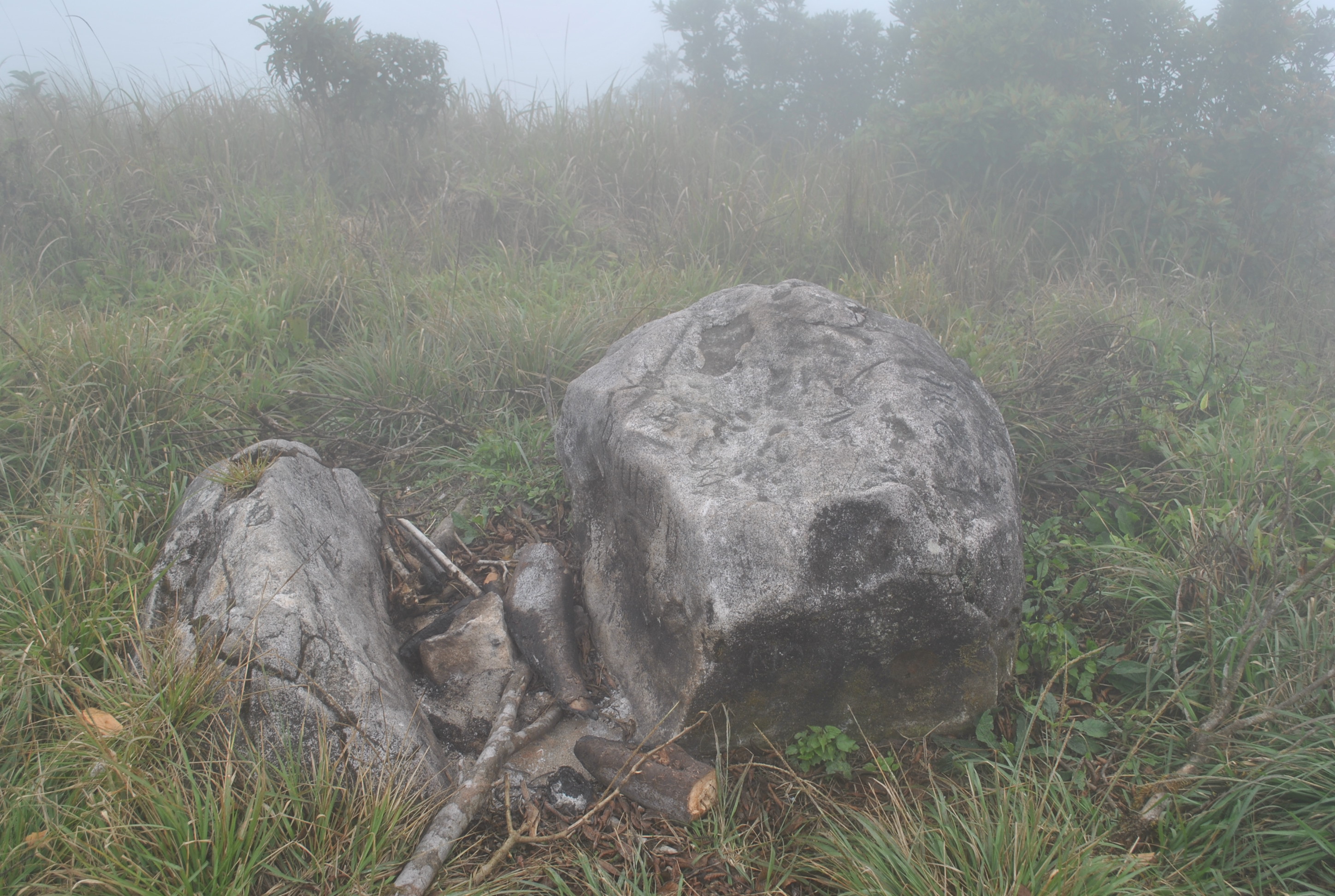
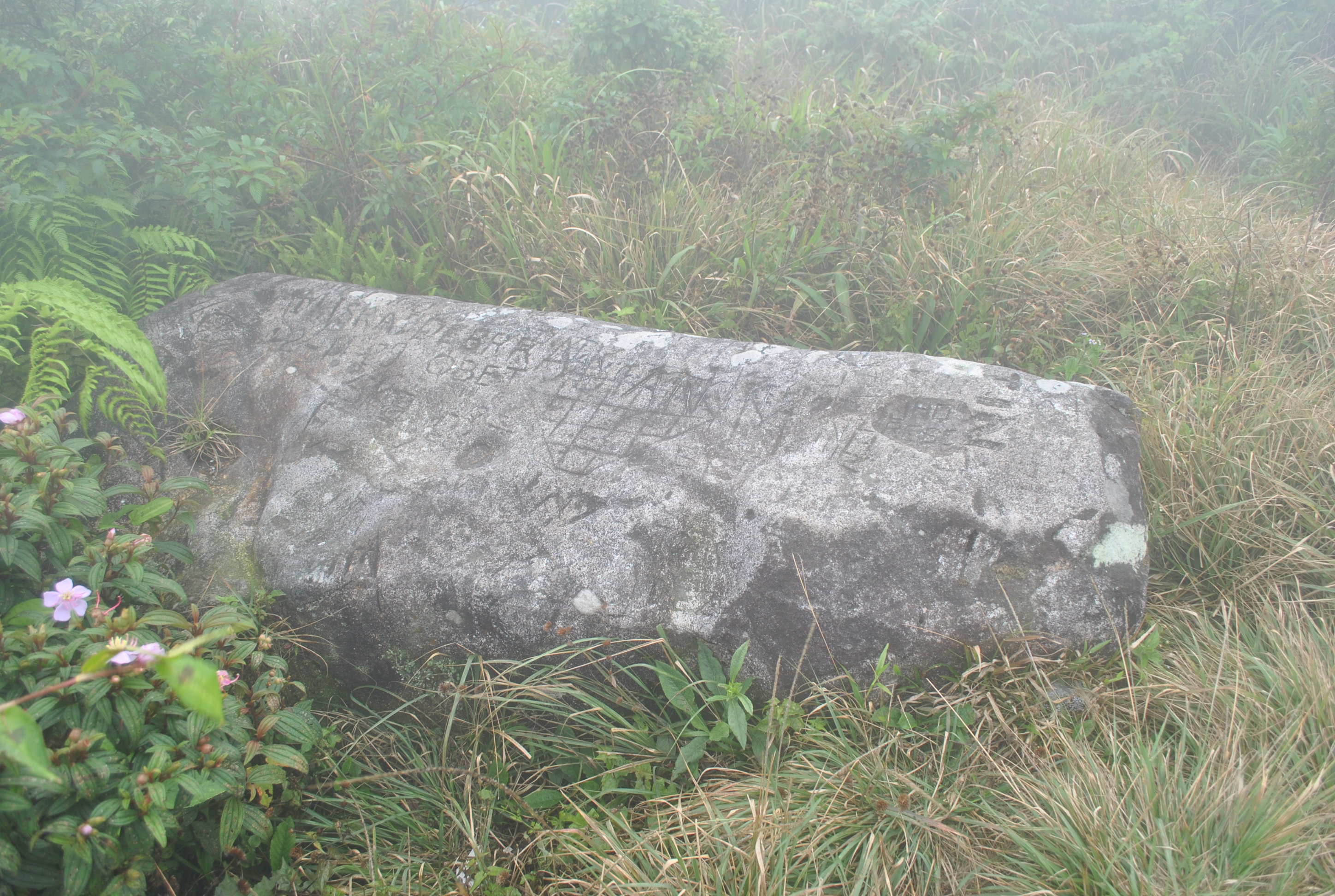
Three of us, my two runners and I, were the only one who reached the peak. Our escorts were not able to make it! We spent our almost 20 minutes taking pictures and trying to survey the whole area of the peak. There was no view to be seen from the top of the mountain as it was raining and we were covered with clouds. However, I was able to take note of the trashes being scattered on the different places on top of the mountain. In my estimate, the peak can acommodate at least 8-10 tents (solo or double) and there seems to be no attempt to clean and maintain the area. I said to myself, I will be back to clean the mess here on the peak of Mt Natib in the days to come!

We reached the peak in 3 hours. And we were all in a hurry to go back to where we started at the Philippine Army Detachment. However, we needed more patience and more deliberate footing as we went down the two “walls” and rope rapelling. We spent more time in going down on the “final assualt” portion of the mountain. As soon as we reached “Area 1”, we started to jog and brisked walked. Since we did more on jogging and power walking as almost parts of the trail were descending, we made our way to the detachment in almost 2 hours. My GF 305 recorded an elevation data of 1,296 meters at the peak of Mt Natib!

The trip was concluded with a sumptous late lunch at the Battalion Headquarters with Colonel Doniego and I told him of my plan of going back to the peak of Mt Natib during a day with a nicer weather in the company of my running friends. I also told him of my plan to conduct Operation Linis on the said mountain with an specificied date. It will be April 15, Sunday! His answer was affirmative!

Well, this proves that I am already addicted to “Peak Bagging”!

Next….Mt Ugo…in the 1st King of the Mountain Trail (42K) Marathon…after two days!

Excited!


After 4 1/2 years of blogging with WordPress and with 1,288 published posts, it is only now that one of my posts had been published and selected among the “Freshly Pressed” articles. My post entitled, “Guimaras 110K Run” was the selected story under the Category of Travel. Of course, I am excited that my post had appeared in the WordPress’ Web Page. As such, it created a lot of comments and hits for my blog.

On the first day that my story was published, it recorded a high of 1,890 hits and on the second day, 2,640 hits! Lately, I have increased the number of subscribers of this blog to 1,001 readers.

Thanks to WordPress and to my readers!

“Peak Bagging” & Mt. Pulag


March 12, 2012 @ Ambangeg, Bokod, Benguet

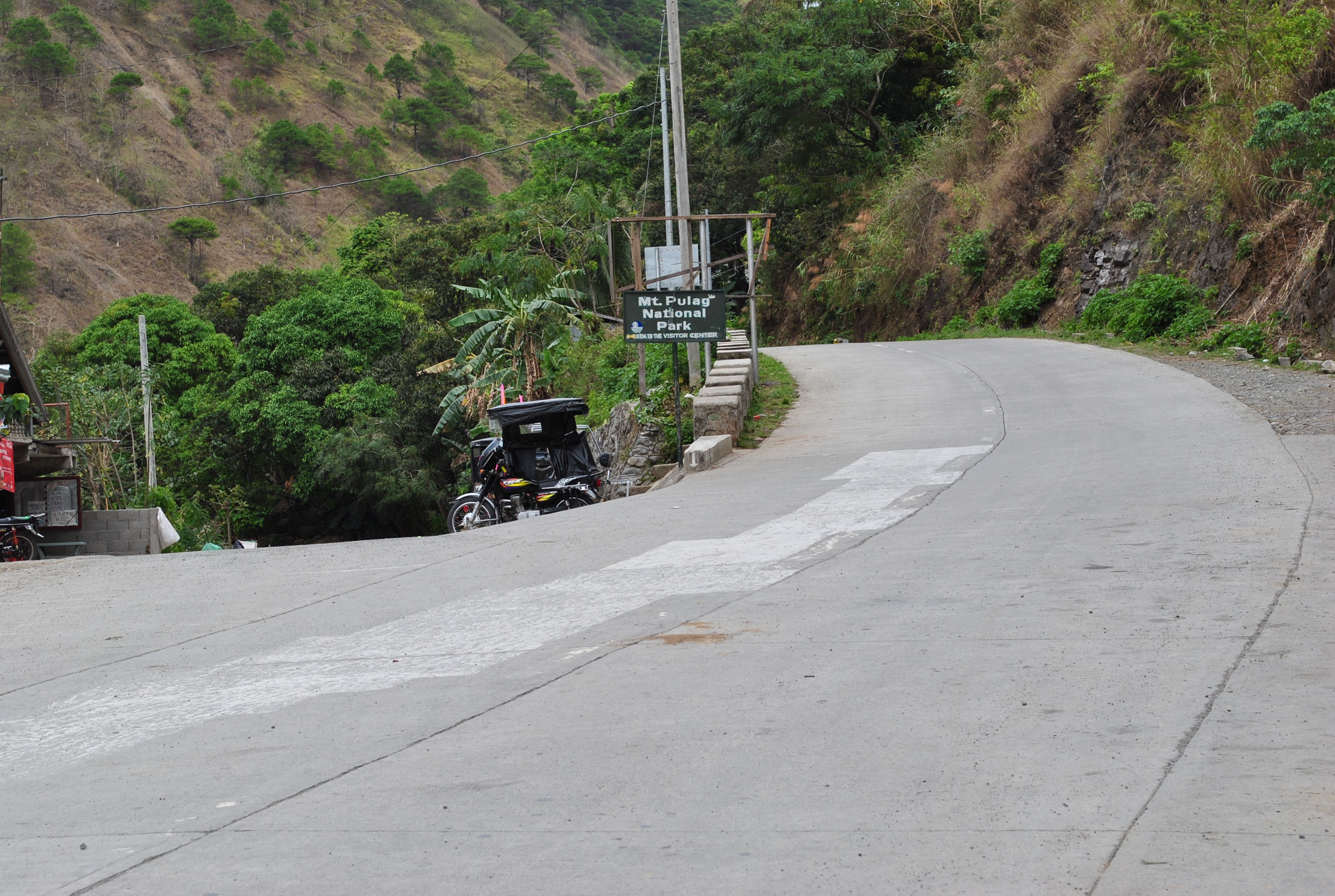
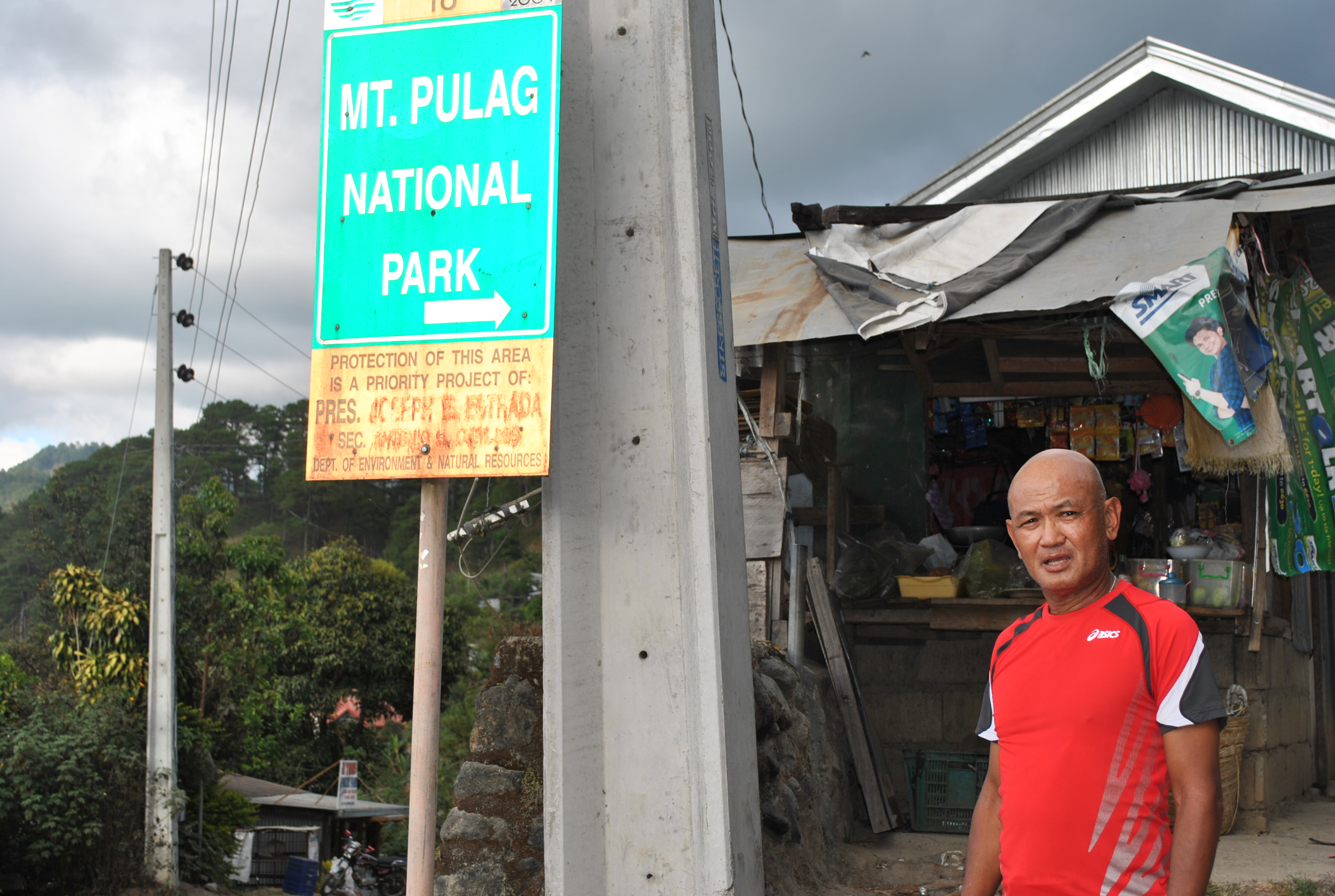
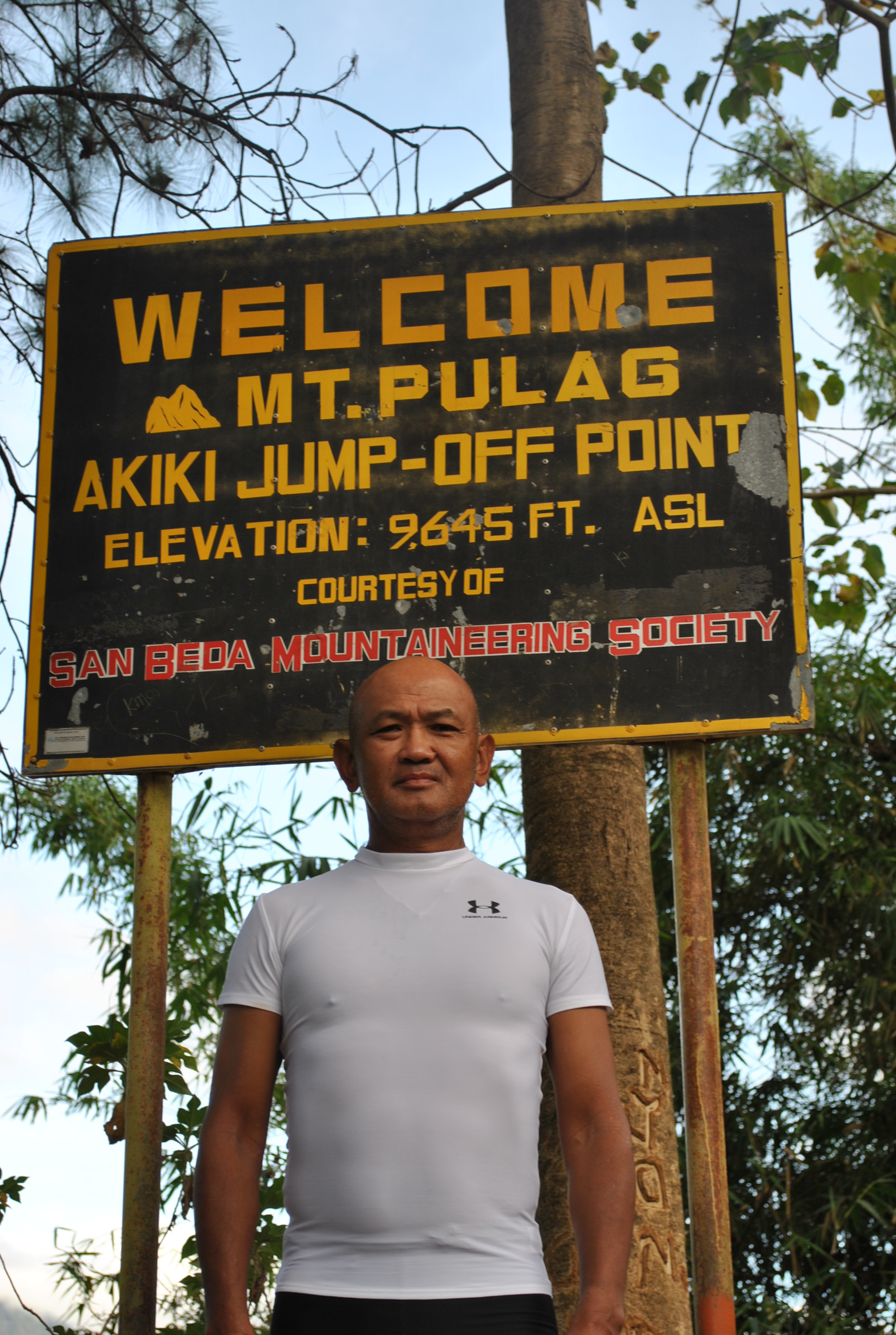
On my way to Kayapa, Nueva Vizcaya along the Benguet-Nueva Vizcaya Highway, I saw a directional sign that points to the Mt Pulag National Park. It was at the PNP Station in Barangay Gurel, Bokod, Benguet that changed my intention of going to Mt Ugo in order to recon the Marathon Route of Jonel’s race.

I said to myself, “Mt Pulag is the highest peak in Luzon and I am already here, maybe, I’ll drop by first on this mountan and then proceed later to Mt Ugo!” As I turned left at the intersection, there is no point of turning back. I am back again to my habit of being a “risk-taker”!

The road from the Gurel Junction to Barangay Ambangeg, Bokod is almost completely paved as some parts are still on road cementing construction. The road is winding and uphill and I did not notice that I traveled 9 kilometers up to the DENR Office/Police Detachment.

I am not a trained mountaineer and I am ignorant on the protocol of climbing peaks and mountains in the country. What I needed was the guts to ask questions and have the patience to listen…and listen intently! This thing was entirely new to me but I guess, I quickly learned some of the basic protocol in mountaineering. Everything boils down to “common sense” and respect to the culture and beliefs of the people in the community.

Although it was already almost 4:30 PM when I was given the usual briefing presentation by the DENR about the mountain I am going to visit, the sun was still shining brightly and I have to deal with the fact that I am taking my time from taking one step of the process at a time. There is no point to worry if my trek to Mt Pulag’s peak will be realized the following day.

After the usual briefing and payment of permit fee, additional information was provided by the people assigned in the said office. Permit fee per person is P 200.00 but you will be issued two receipts from the Bureau of Treasury. Since I am not with a group of mountaineers on a group tour, the office personnel advised me to contact a certain “Julius” to bring me to the Ranger Station in Ambangeg aboard a motorcycle. The fee for one-way is P 300.00 per person.

I was also advised to get a guide at the Badadak Ranger Station, the place where I am going to start my trek to the peak of Mt Pulag. The guide’s fee at the Ambangeg Trail is P 500.00. I found out later that the guide’s fee is more expensive if the entry point is from the Akiki Trail which is obviously a longer route to the peak. It can cost you P 1,800.00 but one guide may be good for a group of 6-7 hikers. It is a “must” to get a guide in trekking in most of our mountains in order to avoid of being lost.

The problem with Barangay Ambangeg is that there is no place to stay for the night! The nearest place where there is a dormitory-type of accommodation is at the Poblacion of Kabayan—a good 1 1/2 to 2 hours drive of unpaved road! There was no other choice but to go to Kabayan. The adventure continues and it is a part of touring and knowing the place for the first time.

It was already nighttime when I entered the quiet town of Kabayan. Only one establishment was still open with food to be cooked and ordered at 7:00 PM. Our overnight stay in the one and only dormitory in town cost us P 200.00 per person! One has to sleep on two-deck beds with basic mattress and pillow. The dormitory has a communal bathroom and toilet with separate bathroom for the ladies. There was no hot water or shower but the ever-reliable pail and “tabo” were there!

On that night that we stayed in the said dormitory, two European couples were with us and four males working with a company that delivers and sells bulbs and lighting fixtures to every barangay in the towns of Benguet. A simple greetings and smile was enough for the foreiners but for the people I’ve met along the trip, being an Ilocano was already an  asset during my trip as the people in every place in Benguet could easily understand my dialect. I could easily communicate with them!

We left Kabayan after a simple breakfast and we arrived in Ambangeg, Bokod after almost 2 hours of slow driving and taking pictures along the way. I saw the entrance to the Akiki Trail along the road and I found out that this is the harder entry towards the peak of Mt Pulag. I took some pictures of the place and promised myself to be back and make an assault to the peak using this entry.

“One-time deal” parking fee in Ambangeg cost me P 100.00 from 10:00 AM up to the time we left the place. I think, it was already 7:00 PM. I left my car and I was in tandem with Julius on his motorcycle on our way going higher to the foot of Mt Pulag. It was my first time to be riding in tandem on a motorcycle ride and Julius was complaining that I was doing some unnnecessary movements with my butt. He didn’t know that the bumpy road made me fly a few inches from the saddle/seat and the continous butt-jumps made me nervous that I might fall off from the motorcycle! My light weight made me unstable riding on a motorcycle on rocky/bumpy road!

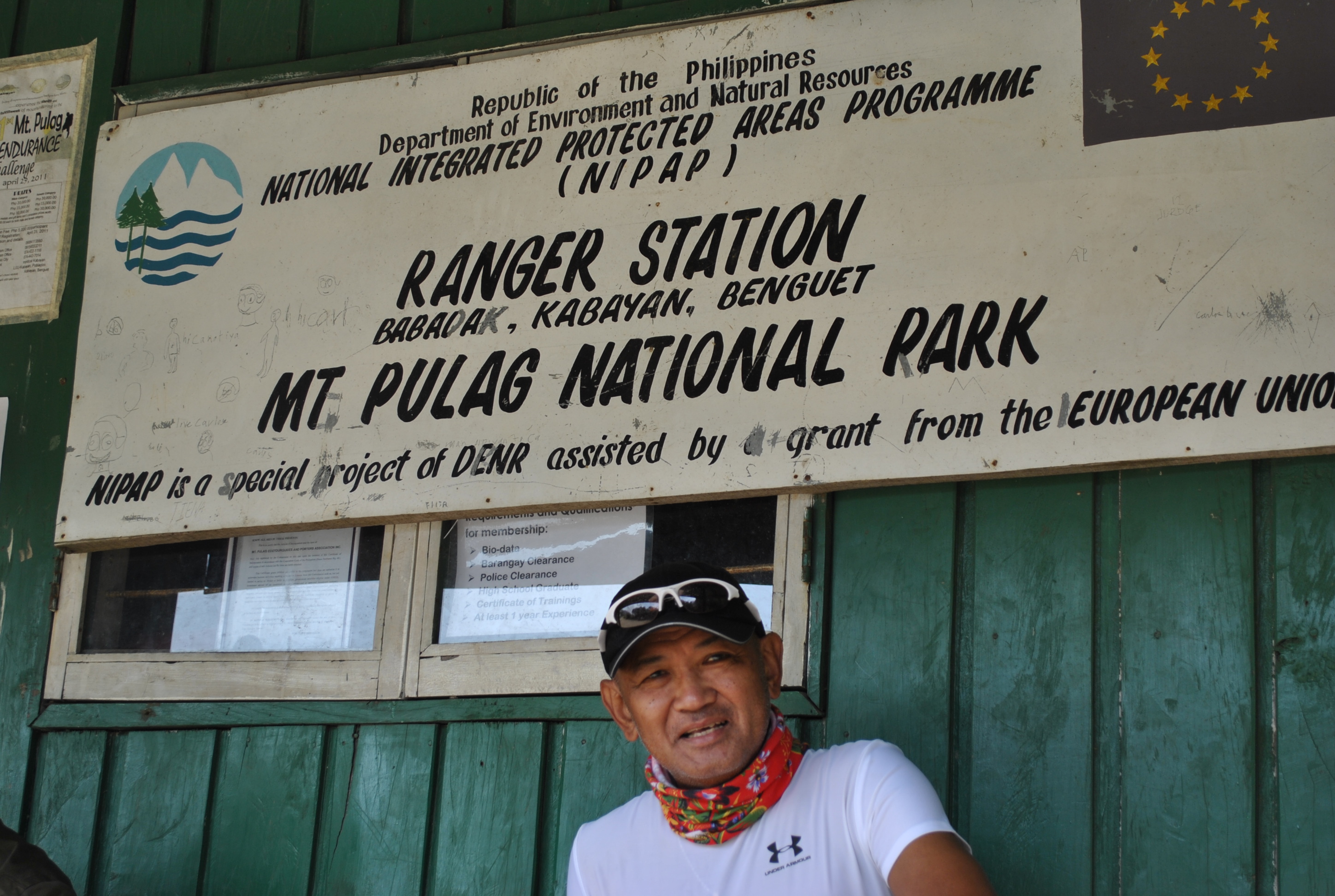
Wow! That was the most horrible ride I’ve experienced! The 9+ kilometers with rocks and slippery mud on the uphill path could be the longest 40 minutes of my life! Finally, we arrived at the Ranger Station in Sitio Badadak, Ambangeg. The Ranger assigned in the station was having his Lunch Break at 11:30 AM and there was no person to whom I would show the receipt that I paid as my permit fee. I just thought that I would see the Ranger once I’ll be back from the peak of the mountain.

After 15 minutes of waiting for a guide, Edgar came forward and signed up to guide me in my trek to the peak of Mt Pulag. I told Julius and company to return to the Ranger Station to pick us and bring us to where my car was parked at exactly 5:30 PM. Julius was surprised and made a statement that with the limited time, I might not be able to reach the peak of the mountain with such time. I just smiled at him and told him that I’ll be waiting for him at the Ranger Station on the said time.

Mountaineers (with packs) usually reach the peak in 4-5 hours from the Badadak/Ambangeg Ranger Station. Well, Julius and the rest of the people at the Ranger Station didn’t know that I will be running, jogging, trotting and brisk walking to and from the peak of the mountain! And so I did!

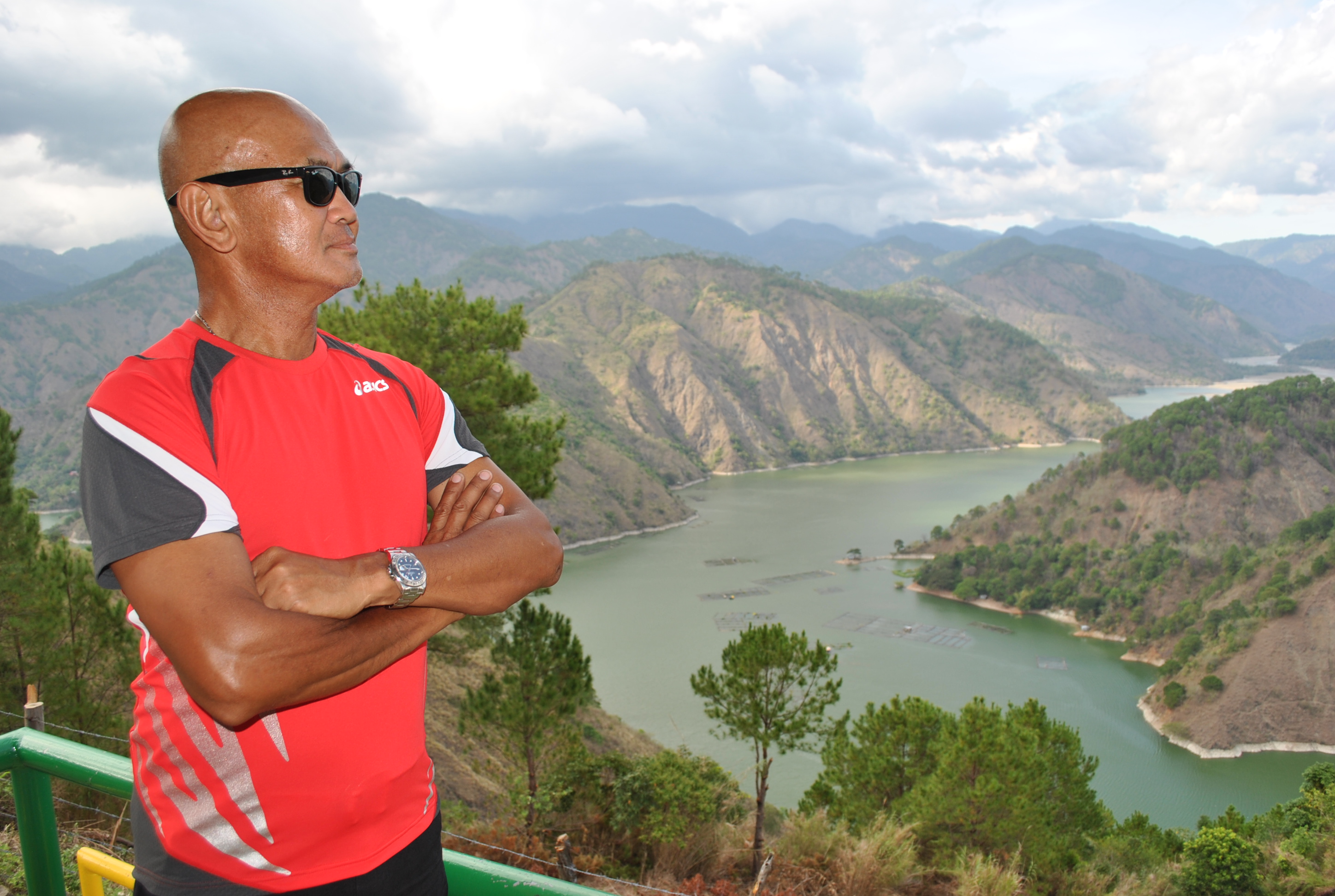
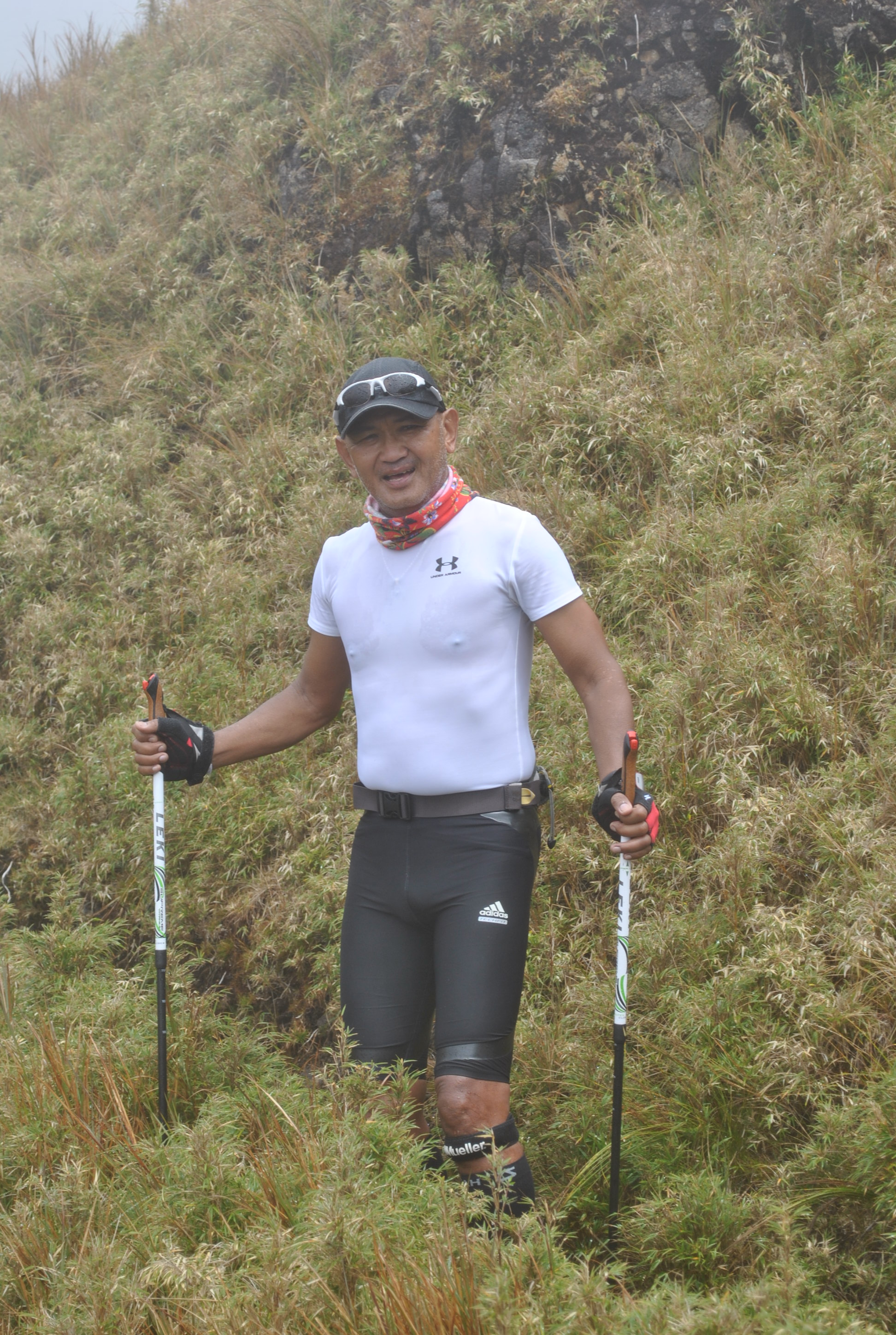
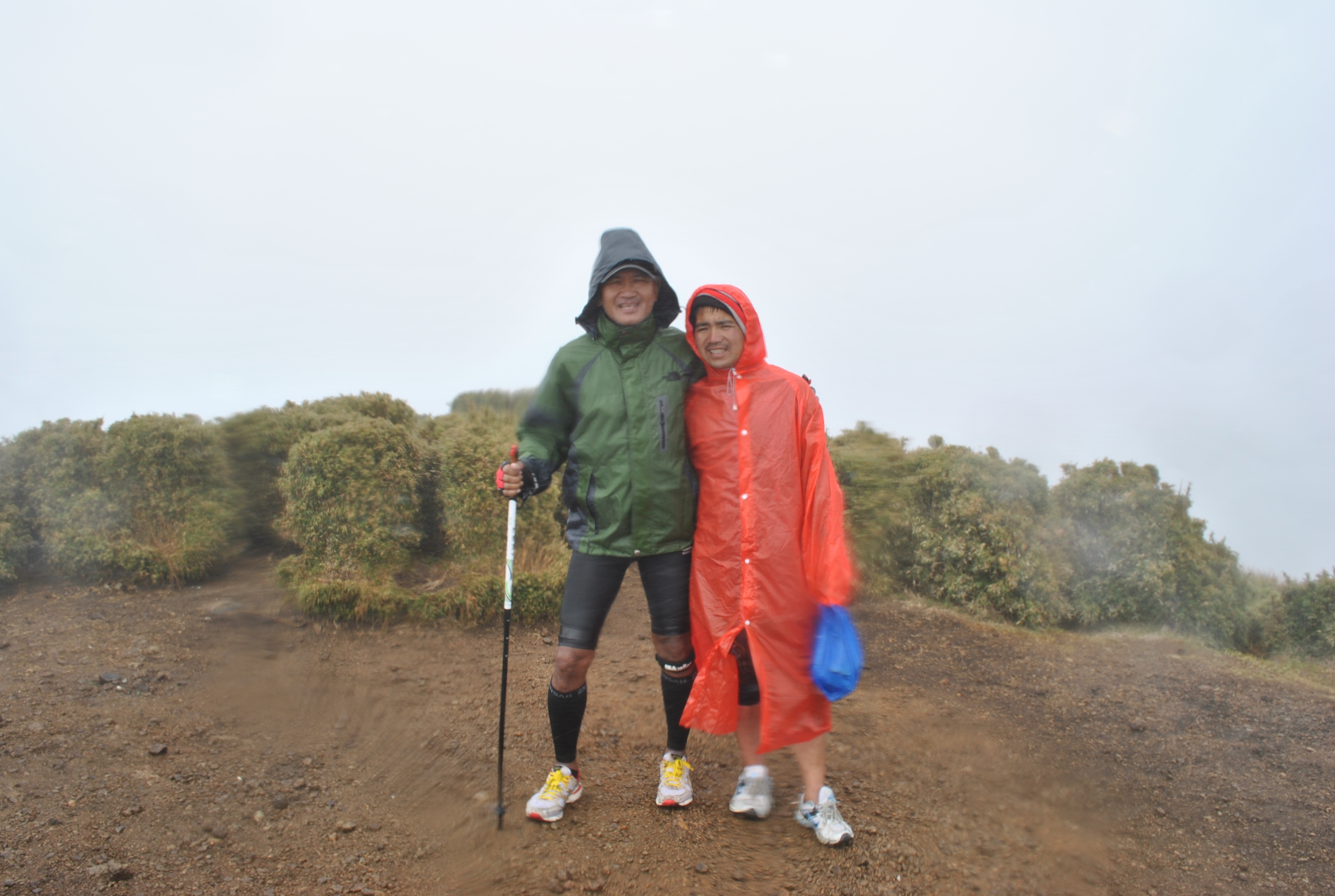
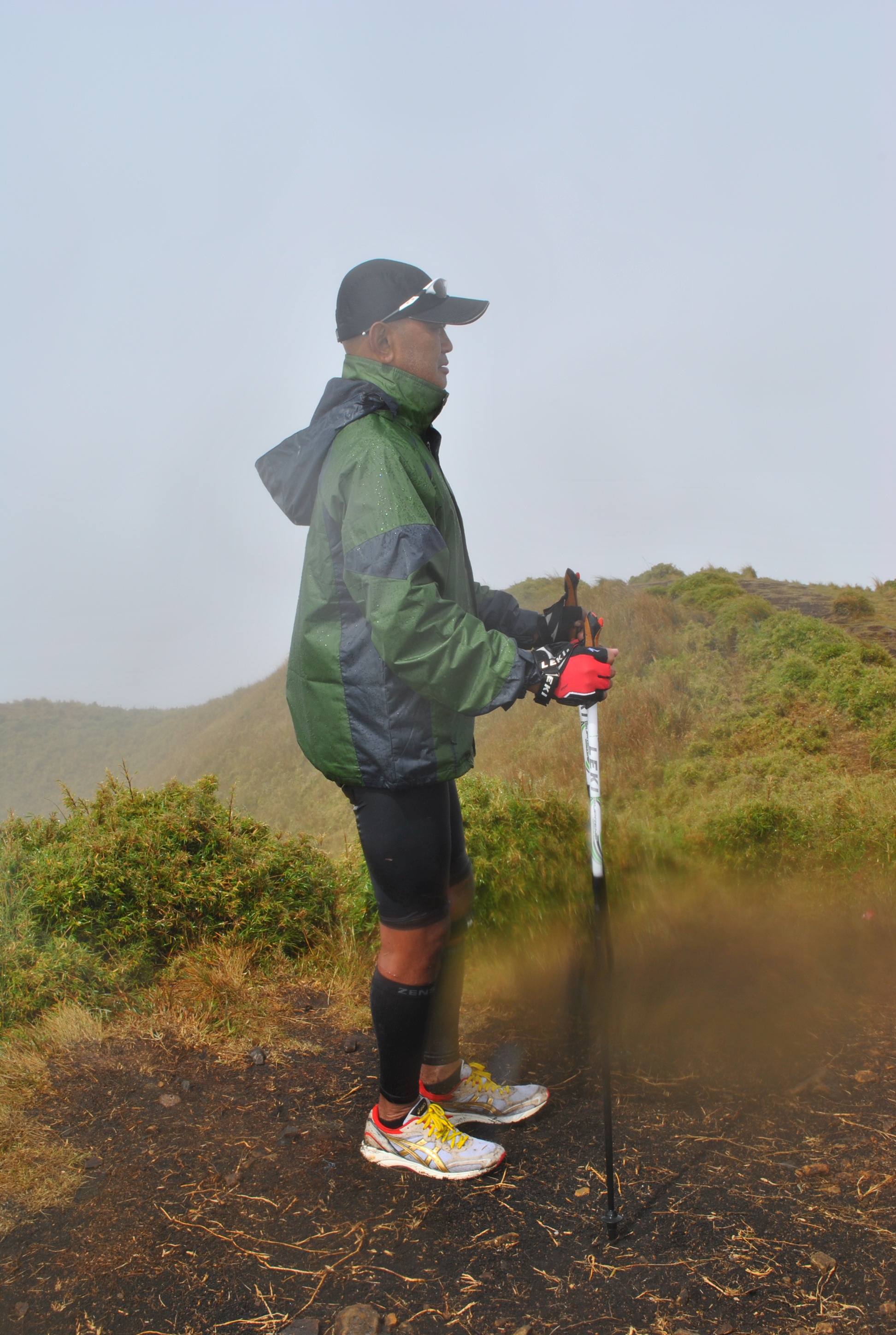
At 4:30 PM, I was back at the Ranger Station! I was able to reach the peak of Mt Pulag by “assualting” it through its steepest approach trail (last 50 meters) in 2 hours! Spent 15-20 minutes on the peak for picture taking and moving around the topmost portion and admiring the damp brown dwarf bamboos. The temperature at the peak was freezing as it was raining and the peak was covered with clouds! In a few minutes, my fingers were numb and my body started to feel the cold temperature. I kept on walking on the open space of the peak but the freezing temperature would make my body shiver.

On my way to the peak after passing Camp 1 and before entering to the “Mossy Part”, I was able to meet a couple, a male foreigner and a Filipina, and I greeted them while I was jogging. As soon as I reached the place they call “Grassland”, I met a group of 18 campers/mountaineers with their guide and porter. This is the same group that I would catch up at Camp 1 on my way back to the Badadak Ranger Station. This group is from Lufthansa Airline Company. I would found out later that these campers whom I met along the Ambangeg Trail had been on the trail for 2 days as they have started their climb from the Akiki Trail and they had camped at a placed called “Saddle or Camp 3” before reaching the peak of Mt Pulag.

While waiting for Julius and his motorbiking friends to arrive at the Badadak Ranger Station, I asked Edgar, my guide, where I could buy some snacks—native hot coffee and some local bread. Edgar invited me to his parent’s house and I enjoyed sitting at a place where it is near their stove. Julius and company arrived with a delay of almost one hour. It was okey with me since I had a nice time talking to Edgar’s folks and brothers. The 30-minute downhill ride to the center of Ambangeg took a longer time due to faulty brakes on the motorcycle I was riding. After some stops and quick-repair/disassembly & assembly of rear brakes & tire, I was able to reach my parked vehicle. It was already nighttime.

My trip to Kayapa, Nueva Vizcaya has to be postponed and I decided to do my “peak bagging” to Mt Ugo on Race Day itself for the 1st King of the Mountain Mt Ugo Trail Marathon. I was already tired. I need the comfort of a nice bed in Baguio City. After a 2 1/2 drive to Baguio City, I was able to take my late dinner and I was in my favorite hotel room in Baguio City—taking an ice-cooled bath and sleeping under soft and clean linens!

This was my first experience of “peak bagging” on the highest mountain peak in Luzon and 3rd highest in the country! For the round-trip distance of 15K from the Badadak Ranger Station to the peak of Mt Pulag and back, I was able to register a time of 5 hours to include my stay at the peak and “pit stops” in every Camp that I reached. I started from an estimated elevation of 2,400 meters and was able to reach the peak of the mountain where my GF 305 registered an elevation of 2,940 meters!

After some research in the Internet and other blogs, I found out that there are events in Europe, particularly in England where mountain trail runs are called “fell running”. And there are also trail running events that would last for 24 hours or more where the number of mountain peaks are considered and counted to be reached as part of the route. Reaching those peaks is called “Peak Bagging”!

This is my own way of applying such event that I’ve learned from “fell running”. The procedure is so simple. Target one mountain peak at a time, run and walk through it, take some pictures at the peak, and run/jog downhill to where one has started. This is the “travel lite” of mountain trekking or climbing without the intention of camping overnight on each mountain. With my first experience of “peak bagging” at the highest mountain peak of Luzon, I guess, a new frontier and form of trail/road running is born!

Now, if you ask me if I enjoyed my experience? You bet! “Peak Bagging” is addictive!!!

Surprisingly, the road distance from the Gurel Junction along the Benguet-Nueva Vizcaya Highway up to the peak of Mt Pulag through the Ambangeg Trail is exactly 25 kilometers! And if you double the distance by going back from the peak of Mt Pulag to the Gurel Junction, the total distance would be a good 50 kilometers!

This could be the most challenging 50-Kilometer Ultra Run in the country!

Birth Of Another Ultra Route


March 9-10, 2012

After the Awarding Ceremony & Get Together Party for the 2012 BDM and PAU Races, I had already a plan in my mind to try the initial King of the Mountain Road Race envisioned by Jonel two years ago. This is the Road Race which he dubbed as the Baguio To Baguio Route which is popular among professional cyclists and the popular cycling lap that determines who would eventually  win in the yearly Professional Cycling Event in the Country.

However, the main reason and goal of this running trip/adventure run was to be able to recon the King of the Mountain Mt Ugo Trail Marathon route which I was planning to join. Running along the Marcos Highway, Kennon Road, and Naguilian Road would serve as my easy long runs as part of the training before going to Kayapa, Nueva Vizcaya.

Coming from Manila after breakfast of Friday, March 9, I drove my car without any target time for me to start my run as I planned to start at the Saitan Junction in Rosario, La Union once I reach the place and after wearing my running shoes. At exactly 3:00 PM, I arrived at the planned starting area and I was surprised to see that the structure on the said place is already abandoned and left to rot and decay. I wonder who is supposed to be responsible for its upkeep and cleanliness. Anyway, I parked the car and started to eat some cooked foods which we brought for my adventure run. We had cooked rice, pork and chicken adobo and fried fish. After my full meal, I changed to my running attire and I was ready to start my run.

My route has to take the Maharlika Highway going to the town/poblacion of Rosario, La Union and then turn right at the Junction which is the start of the Marcos Highway which is now called, “Ben Palispis Highway”. I wonder who is this guy who replaced the name of the former President of the country! From the Junction, the Marcos Highway would lead me to Baguio City. I finally started my run at 3:30 PM.

Strictly following my run-walk method of 3 minutes of run & 45 seconds brisk walk, I was able to progress my ascent to the summer capital of the country. My support vehicle would be able to “leap-frog” every 3 kilometers which is the estimated time that I would consume the water or Gatorade mix on my “Sprint” Nathan hand-held bottle. The last 5 kilometers climb to Baguio City would be the most challenging part of the route as I had to brisk walk most of the distance. I was able to run and walk the Marcos Highway going to Baguio City, a distance of 47 kilometers with a total gain of more than 6,000+ feet from the place where I started, at Barangay Saitan, Rosario, La Union. I did it in 8:20+ hours. I stopped my run infront of the Baguio General Hospital.

After an overnight rest in one of the decent hotels in Baguio City, I continued my run the following day from where I stopped and run through the famous Kennon Road going back to where I started. It was all downhill but I had to be cautious because I don’t want my quads and knees to suffer for the pounding with the distance of 33 kilometers. My trekking poles provided me with much comfort on those steep downhill portions of the route. With longer “pit stops”, I was able to reach my destination in 6:00+ hours.

After completing the 2-day running feat, I would discover that the total distance would result to 80 kilometers which is a good 50-miler route for an ultrarunning event. Thus, I decided to dubbed the event on this route as the “Marcos-Kennon 50-Mile Ultra Road Classic”. A status posted at FB gave some commitments from running-friends to help and support in the conduct of this event. Thanks to my ultra running friends!

I’ve decided not to run the Saitan, Rosario to Bauang, La Union route along the Maharlika Highway and instead, measured the distance aboard my car using my GF 305 watch. The distance registered at 53 Kilometers. Stayed overnight in Bauang, La Union. Enjoyed the food, beach and sea breeze of the place and I enjoyed my much-needed rest. From the Bauang, La Union Junction to Baguio City, the distance is 44 Kilometers up to Burnham Park. I did not run through the route but I simply observed the terrain closely as I drove towards Baguio City.

In summary, adding up all the routes of the Baguio-Baguio, the Original King of the Mountain Road Ultra of Jonel, it has a total distance of 224 Kilometers and it can be depicted on the following measured legs:

Baguio City To Saitan, Rosario via Kennon Road—33 Kilometers

Saitan, Rosario To Baguio City via Marcos Highway—47 Kilometers

Baguio City To Bauang, La Union via Nagulian Rd—44 Kilometers

Bauang, La Union To Saitan, Rosario via Maharlika—53 Kilometers

Saitan, Rosario To Baguio City via Marcos Highway—47 Kilometers

I will let Jonel push through with his plan Baguio-Baguio Route to be implimented. However, I will just take a portion of the said route as another challenging race route for interested ultrarunners to experience. Thus, the “Marcos-Kennon 50-Mile Ultra Road Classic” is born. Planning for this race route is not complete if I don’t share to you what are the detailed expenses incurred in order to discover and plan a certain ultrarunning route.

The following were my expenses incurred in the said trip:

Gasoline Expenses (Round Trip From Manila-Baguio & Back)—P 5,000

Food Expenses For 3 Days (For 2 Persons)—P 4,000

Hotel Accommodations—P 4,500

Miscellaneous Expenses—P 1,000

Hydration & Nutrition Needs For My Recon Runs—P 3,000

T   o   t   a    l ————-P 17,500

This is excluding for the Payment for the Wear & Tear/Service for the Car that I am using in my Recon Runs. And since this is my passion, I don’t give a price or costing on the time and effort/services I have to provide in order to create a safe road race for everybody. In addition, the daily salaries of my driver and assistant/support crew are not yet included in the above costs!

I hope in the future, Jonel would be able to stage a multi-day running event on his original Baguio-Baguio Route.

The Ultra Race along this route will come sooner than you think! Keep on running!

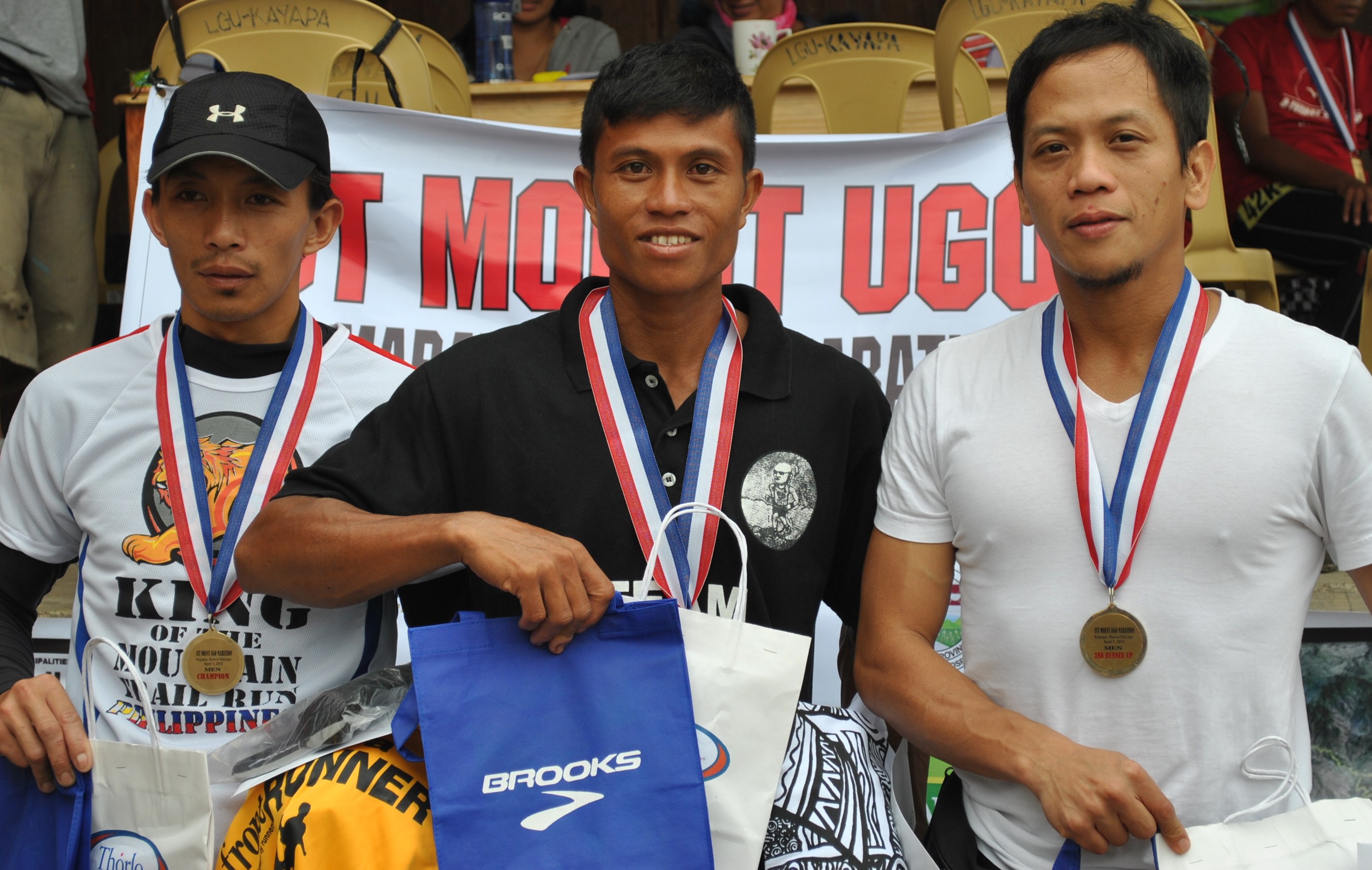
Podium Finisher @ 1st KOTM Mt. Ugo Trail Marathon


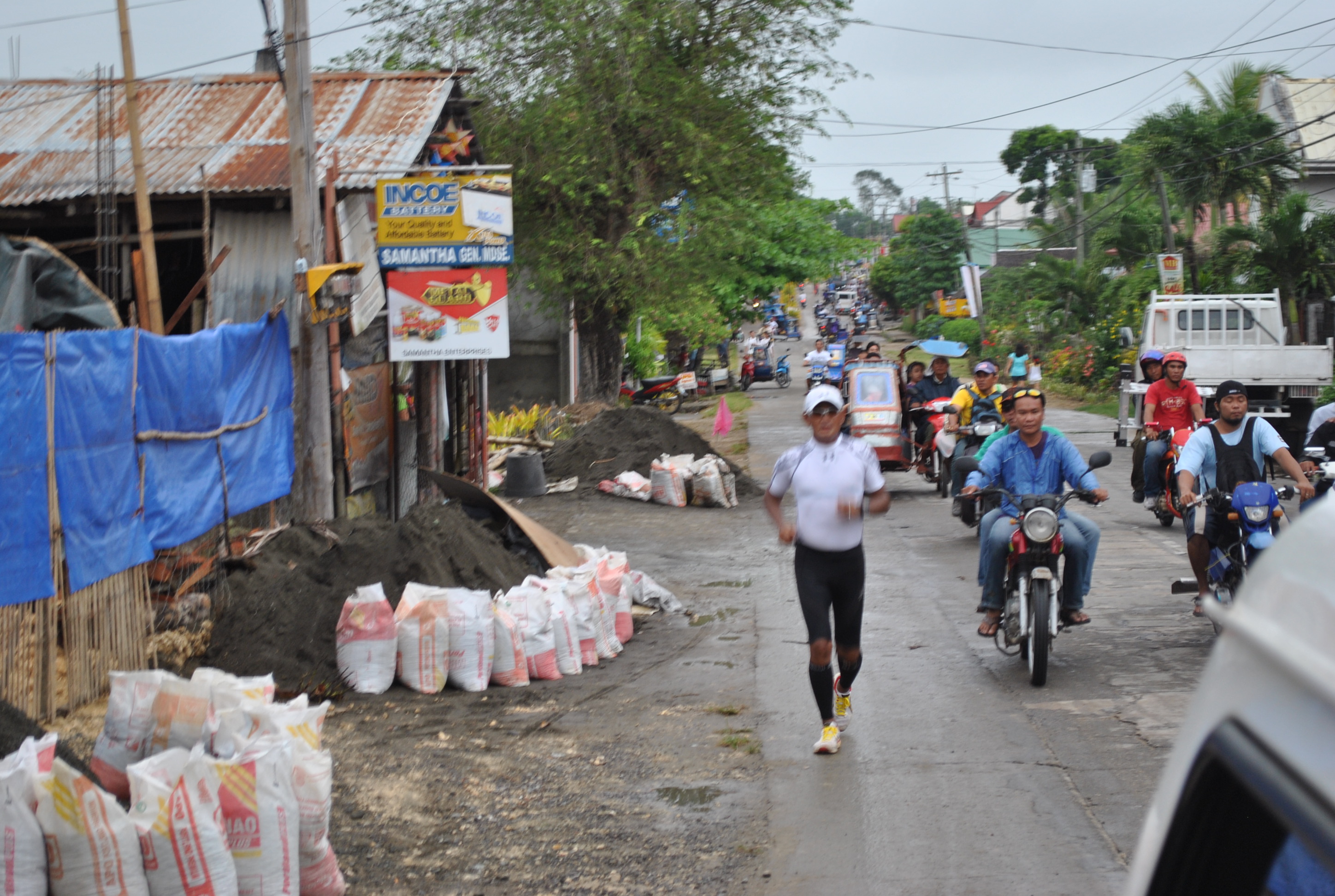
Danin Arenzana of Elite Team Bald Runner placed 1st Runner-Up Overall in the 1st King of the Mountain (KOTM) Mt. Ugo Trail Marathon in Kayapa, Nueva Vizcaya on April 1, 2012.

Despite being “lost’ along the trail route for three times, he was able to catch up and pass some of the lead runners and ultimately, finished the race with a time of 4:56:58 hours. He was the 3rd runner to reach the summit of Mt. Ugo.

This is the first time that Danin finished a full Marathon distance which happens to be also his first official running competition since he joined the Team Bald Runner almost three years ago!

He prepared for only 18 days for this event, concentrating on endurance, strength, and specificity. He goes almost everyday to “Brown” Mountain and its environs. His endurance runs on weekends would reach up to 60 kilometers in one workout on his peak training!

Well, don’t ask who the hell is his COACH!

Danin In Black

Danin and his COACH will be back for the 1st King of the Mountain Ultra Trail Run on May 26-27, 2012!

Congratulations, Danin!

(Note: Danin is on the Middle, wearing the BR’s Black Shirt)

Running Is “Hard and Easy”


One of the time-tested principles of running is “Hard and Easy”.

“Hard” means running with much more intensity and more speed. The following are considered as “Hard” workouts for running—interval training on the Oval Track or on a measured distance on the road; tempo runs; hill repeats; and “fartlek” sessions. I would also consider some “cross-training” workouts as “hard” if they are done with much more intensity like lifting of heavier weights; interval workouts in cycling and swimming; and the likes of Crossfit and P90X or its derevatives.

“Easy” means running on a more relaxed and easy pace. Your “30-minute” a day run and LSD/easy run for at least one hour are considered as “easy” workouts. Yoga, Pilates, Stretching, easy and relaxed swimming and cycling, hiking/walking, and rest/sleep are considered as your “easy” workouts.

If your training is to run everyday to prepare a certain event, you don’t have to run the “hard” way everyday. You have to alternate “hard and easy” workouts throughout the week. Let your body rest and recover and you will be stronger on your next workout. If there is pain or soreness on your leg muscles, it’s time to rest and/or take the “easy” workout the following day.

Running the “hard and easy” ways is common sense!

Guimaras 110K Run


1:00 AM To 8:20 PM, March 20, 2012/Start & Finish @ The Provincial Capitol

On the last week of February, I made a trip to Guimaras Island purposely to visit the place, talk to the Provincial Governor, and recon the circumferential road with a plan to have it as a venue for the incoming PAU National Championships which I scheduled for September 15, 2012.

Despite my initial coordination with the Office of the Governor of Guimaras, my contact person informed me that Gov. Felipe Nava and his wife left for Manila for an important meeting the day before I arrived in the island. So, we had to make some adjustments for the initial coordination.

Provincial Board Member Roy Habana was our savior for the trip. He happens to be a former police officer and personally knows my Uncle-General of the former Philippine Constabulary who was also assigned in the Visayas Area. I explained the purpose of my visit in the island-province to Board Member Habana and he positively endorsed my plan to the Provincial Tourism Officer. After almost one hour of meeting with the Capitol’s Staff concerned on the preparation of my event, the good and very accommodating Board Member Roy invited us for a trip around the island with him as our driver!

For almost 3-4 hours trip on the road around the island, Board Member Roy was our “tourist guide” and host for our “impromtu” lunch prepared and coordinated by her wife in Buenavista, Guimaras (the busiest town of the island). It is in this recon trip that I started to appreciate and love the beauty of the different scenery around the island. Each town has a distinct characteristic of its own which I wanted to feel and see while I am actually running on the ground.

My initial impression of the place is that, this is a “paradise” for ultrarunners! No frills, no vehicular traffic, very nice scenery, challenging terrain of the route, nice people, air quality is very good and above all, a very peaceful environment. No restrictions on what side of the road you would like to run and I intend to allow the use of earphones for the race!

The purpose of my day trip to the island had been attained. Before I left the island, I promised to Board Member Roy that I’ll be back soon for me to actually run around the island. He was amazed! He told me that I will set the record and history for the island for the first runner to run around the island-province! I smiled at him and expressed my heartfelt thanks for the hospitality given during my stay.

Fast Forward. Almost after three weeks, I landed in the Iloilo Airport (again, for the 2nd time this year) with my support crew/security waiting for me. Visiting Iloilo City is not complete if I don’t have my lunch at the Mang Inasal Resto inside the SM Mall in the city, a practice or habit I developed when I was a Division Commander of the Philippine Army in this area. After lunch, I bought my nutritional and hydration needs at the SM Grocery. Top on the list are “Biscocho” & “Butterscotch” from Biscocho Haus; lots of Gardenia Loaf Bread & a bottle of Lily’s Peanut Butter; SMB Pale Pilsen in Cans; Mountain Dew; Nescafe Latte in Cans; Gatorade Powder Mix (I brought it with me); and Absolut Bottled Water. (Yes, I drink beer during my adventure runs!)

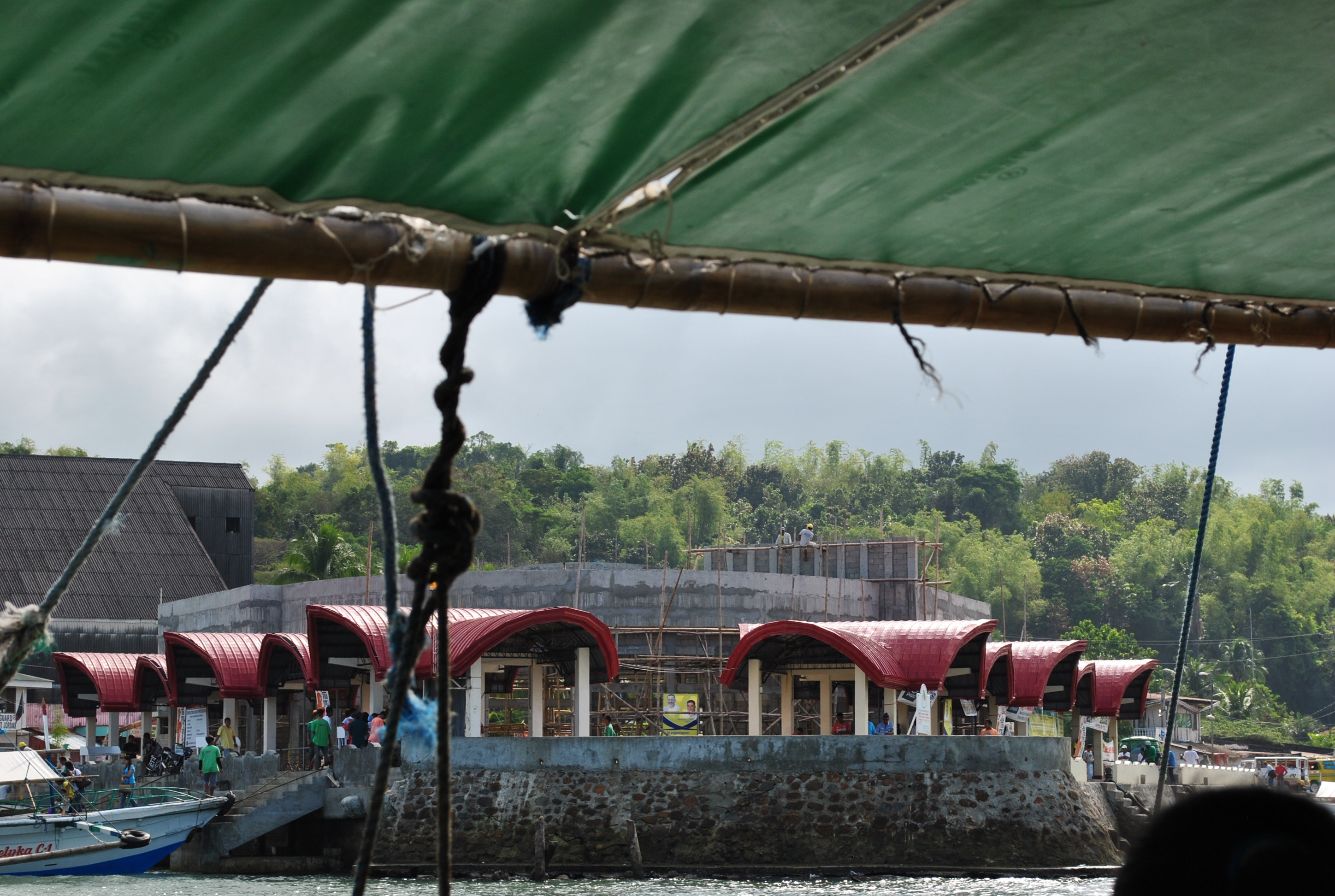
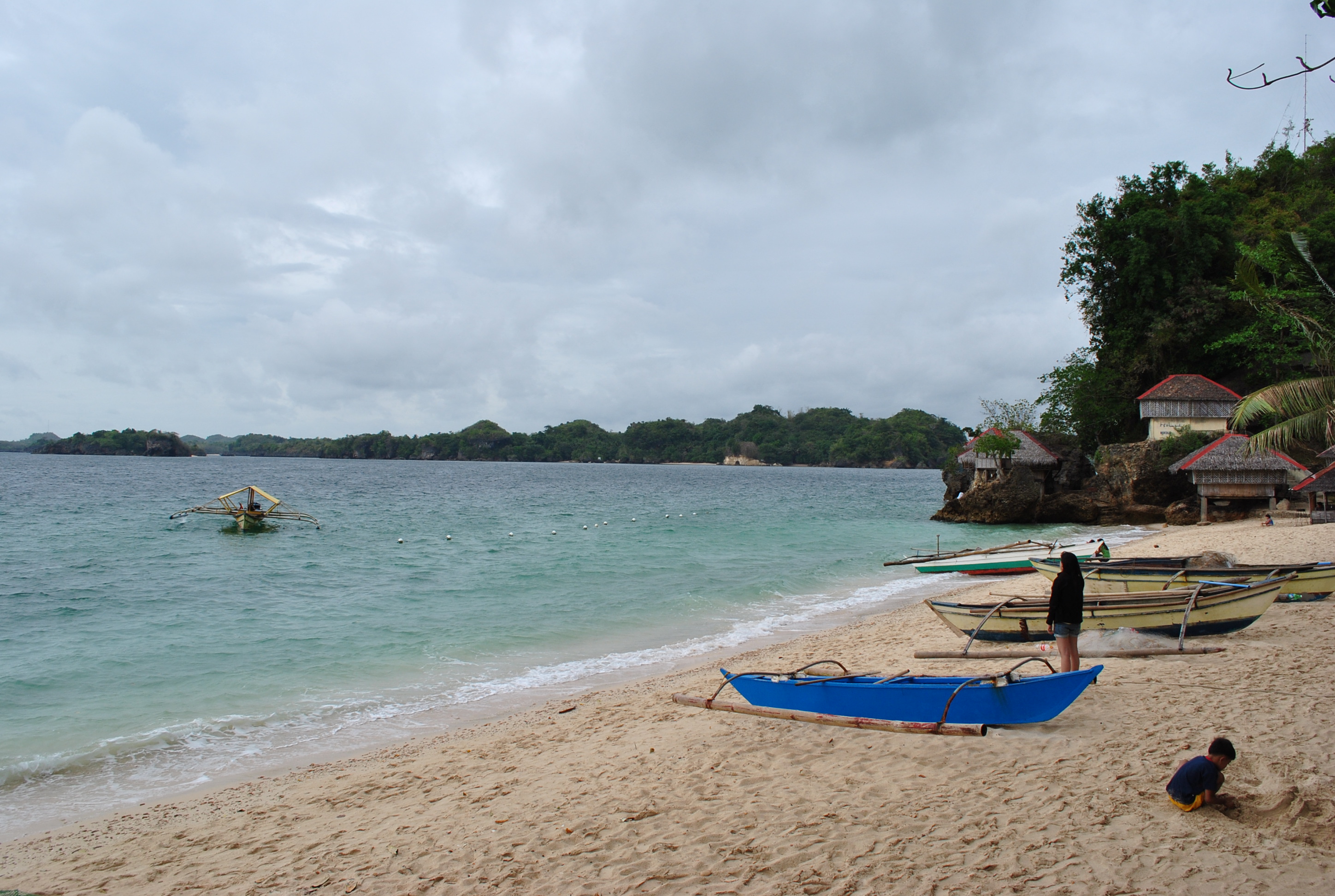
A boat ride (each boat is good for 50 passengers) from the city to the island of Guimaras followed after leaving the SM Mall. The fare is only Fifteen Pesos (P 15.00) per person and in 20-25 minutes, we were at the Jordan’s Port in the island. The boat ride was slower this time as compared on my first visit because of the rains, strong winds, and cloudy skies but the sea water is always calm in between Iloilo and Guimaras.

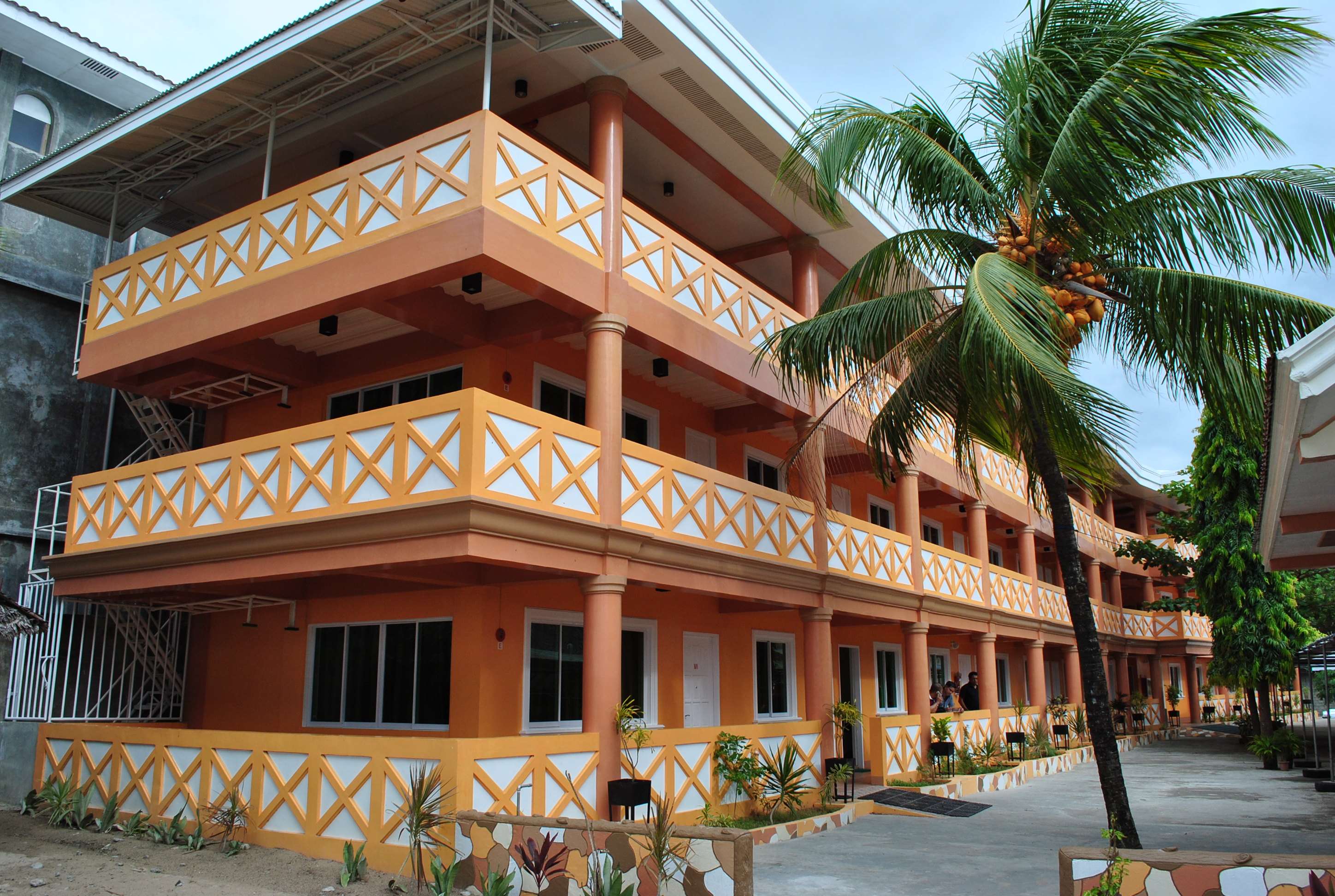
The generosity and hospitality of the Province is superb! Governor Nava prepared for my team’s free hotel accommodation and 50% discount on food for two days at the Raymen Beach Resort in Barangay Alubihod, Nueva Valencia, Guimaras plus the dedicated support vehicle, an Escapade Nissan Van (but I had to buy for the diesel/gas during the whole trip) ! The place, beach, water and amenities are great. Although it is far from the Provincial Capitol, my stay in this place was very relaxing!

As soon as the team was settled in the resort, I met my support crew/security and briefed them about the details of my adventure run. My run would start infront of the Provincial Capitol in Barangay San Miguel, Jordan at 1:00 AM the following day and the run will go on a counter-clockwise direction around the island. My team was advised to sleep immediately after the briefing with a dinner call at 7:30 PM and then sleep again; and then with a “wake-up” call at 12:00 Midnight before going to the Starting Line. My support vehicle would “leap-frog” every 2 kilometers with a motorbike-riding-in-tandem would be on my tail. This adventure run would follow an ala-military operations style of implementation so that it will come out with a successful result! There should be no point where mistakes/errors should be committed.

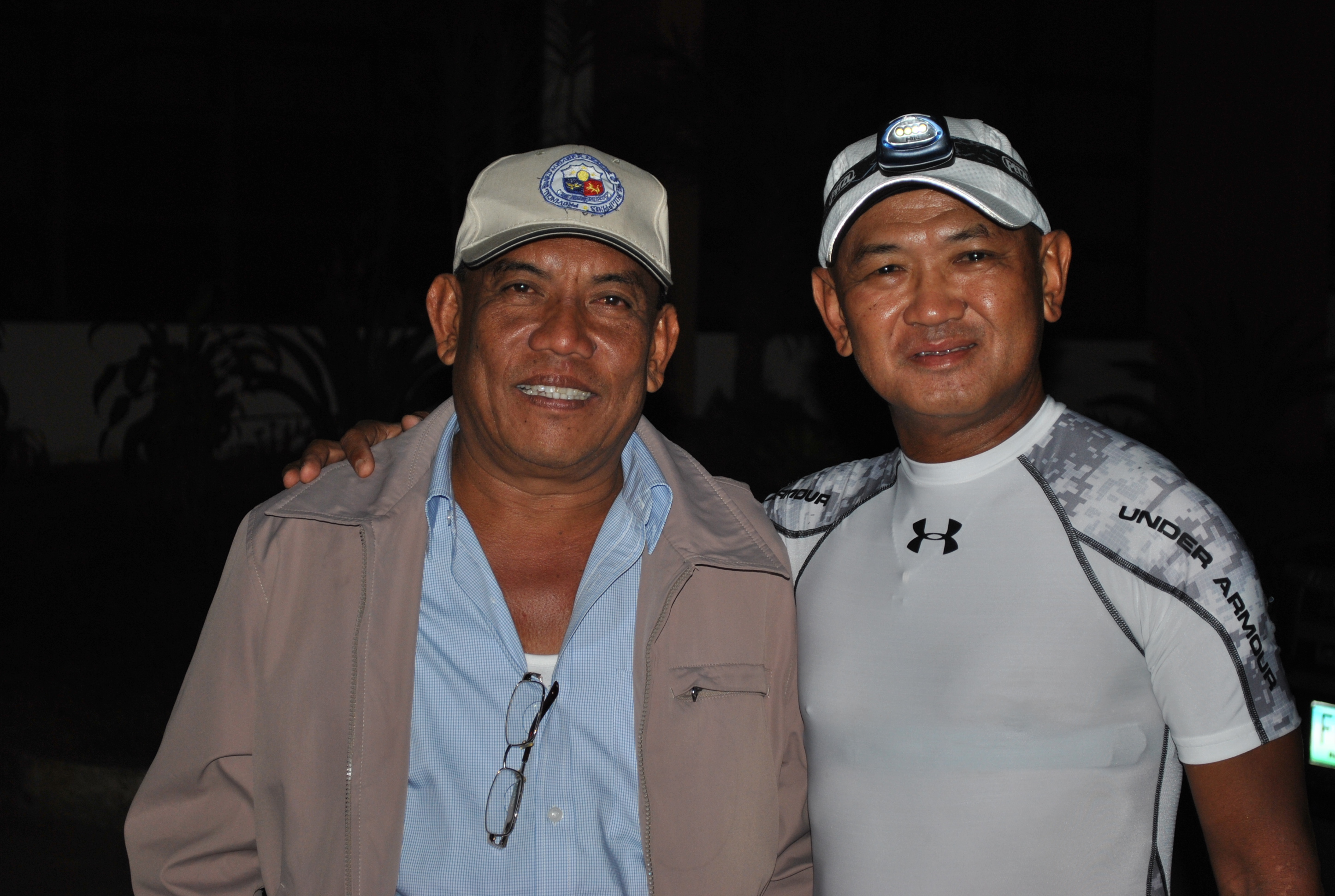
At 00:45 AM, I was met by Board Member Roy Habana infront of the Provincial Capitol. Wow! I really admire this guy! I am not surprised why the people of Guimaras would elect him to his elective post every election year! My salute to this fine gentleman who is known from his unblemished and outstanding service in the Philippine National Police! We had a brief talk and he wished me good luck before I started my run. After offering a personal prayer for this run, I left the Starting Area at exactly 1:00 AM of March 20, 2012.

My run from the Provincial Capitol was generally downhill but there are also places where there are uphill climbs for the rest of the town of Jordan until I reached the boundary of Nueva Valencia, which is the next town. Nueva Valencia offers a mix of rolling hills just like Jordan but the southernmost part area in this town has a lot of places where it seems there is only the town of Nueva Valencia that covers the whole province! After covering a distance of 42K, I was still in the said town!

It was about sunrise when I saw a lone runner sprinting uphill doing his morning run in one of the last barangays of Nueva Valencia. He was the only runner whom I saw during my run. Nueva Valencia-Sibunag area has a lot fishponds and the scenery was simply refreshing to the eyes! Most of the Sibunag roads are under construction and there are sparse places where runners would encounter uphill climbs!

I would religiously follow my Gymboss setting of 3-minute run & 45-second brisk walk for the first 50 kilometers of my run and I did not feel any pain or imminent attack of cramps on my calves. I was fresh and still strong! Every 2 kilometers, I would eat 2 pieces of “biscocho” and 2 pieces of “butterscotch” with water or gatorade mix and the drill was repeated throughout my run. This is not an advertisement for Biscocho Haus of Iloilo City but that was my nutritional intake for the whole run. If you have tasted these two delicacies already, then you know already why it powers me up during this run!

Board Member Roy Habana linked up with me in the boundary of Sibunag & San Lorenzo for my breakfast/lunch in a roadside eatery/resto where I ate the best “native chicken” tinola in the region with lots of broth! I was simply feeling cold because of my damp running apparel brought about by the rain during the run but the hot broth/soup of the dish kept me warm and my leg muscles’ fresh! I think we stopped for 40 minutes for lunch as more interesting conversation cropped up with the good host-Board Member Roy. Well, he paid for our lunch, to include the police escorts’ meal! Being the Chairman of the Peace & Order of the Provincial Council, he made sure that I was properly escorted by the PNP in every municipality of the Province! Amazing! I did not get this kind of treatment & attention when I was still in the active military service!

As I resumed my run, Board Member Roy passed by on a muddy part of a road under construction and said that he will be going ahead and hope to see me finish at the Provincial Capitol.

I made a discovery that I could run stronger and my endurance last longer if I drink 2-3 cans of beer during my adventure runs. Drinking one can at a time should be spaced properly during such runs. One should not drink more than one can every pit stop! I usually start to drink beer after finishing the marathon distance of 42K (at least, one can to reward myself for finishing the marathon distance) and from there every 10K, I take a sip and once I finished my 2nd marathon distance (84-85K), I should have finished my 2nd can of beer. However, every 2-Kilometer “pit-stop”, I have to drink water or Gatorade and ingest “biscocho & butterscotch”! The 3rd can of beer is taken after finishing my run! It worked well with me.

However, there are times when I fell sleepy while taking my time to finish my 2nd can of beer. The solution is to bring out my Nescafe Latte or Espresso Blend in Cans to perk me up. Espresso Blend is better though because of its strong bitter taste!

As I approached the 90-Kilometer mark all the way to the Finish Line, it’s time to bring out the most powerful source of sugar/glucose—Mountain Dew!

The strong headwinds and crosswinds of San Lorenzo almost zapped my strength on this run. The road is so flat that I was bent on increasing my pace but the wind was so strong that I spent so much force to maintain my short but quick strides. As usual, I was maintaining my Heart Rate of not going beyond 150 beats per minute for the whole duration of this run. There is no use to battle it out with the wind and I concentrated on following my Gymboss setting.

After the strong winds in San Lorenzo, here comes now the start of never-ending uphill climbs once I approached the town of Buenavista. Board Member Roy told me beforehand that there is only one uphill climb from San Lorenzo going to Buenavista, but he was wrong. I think I counted four (4) major uphill climbs before I reached the town!

Passing along the Poblacion of Buenavista was a blast! Board Member Roy, his wife and friends were on the roadside cheering and clapping their hands as I passed by! This town could be the busiest town in the island with lots of people/students leaving their schools; lots of people going and coming out of the public market; and vehicles/tricycles plying along the road.

I was scheduled to reach the finish line between 6:00 and 7:00 PM but the hills in Buenavista and Jordan prevented me from attaining it. It was getting darker already when I slowly ascended each of these hills that I had to brisk walk and took my time to breath the fresh air around. At this point, I was starting to feel the most awaited thing in endurance sports—pain, agony and suffering for an ultrarunner. I was already on my last 10 kilometer before the finish line and all the pains coming from all parts of my body were starting to appear. It is a warning that I need to take something solid in my stomach. I am lucky that we bought a lot of “biscocho & butterscotch”! Biscocho Haus’ products & Mountain Dew are the best food & hydration on this part of my run!

The last 10-kilometer distance in all my adventure runs is simply the hardest but the sweetest of them all. You can easily forget your first 10 kilometers in every ultrarunning race but the last 10 kilometers will always remain in your thoughts that gives a special signature or significance of the race/run that you have successfully finished! This is where you remember to recite and shout your favorite running mantra; this where the “demons and angels” of running will argue with each other; this is where “mind over body” would work; this is where you determine what you are made of; this where you remember your loved ones who are rooting for you to finish this race; this is where you think of your inspiration; this is where you curse yourself why you are doing this run/race; and lastly, this is where you separate yourself from being an ordinary “running boy or girl”! This is where you think that you are a brave “warrior” and nobody would defeat you in order to win your battle!

The last 10 kilometers were challenging part of the route indeed! My Garmin Forerunner 305 would prove that the Provincial Capitol sits on the peak of the highest hill in Jordan, Guimaras!  I finally reached the exact place where I started my run infront of the Provincial Capitol with a clock time of 8:20 PM of the same day which means that I finished my run in 19:20+ hours for a distance of 110 Kilometers.

Hereunder are the summary of data taken from my two (2) GF 305:

Distance: 110 Kilometers

Time: 19:20:04 hours

Average HR: 135 beats per minute (bpm)

Maximum HR: 149 beats per minute (bpm)

Total Calories Spent: 5,066 cal

Total Ascent: 3,663 meters (12, 088 ft)

Total Descent: 3,653 meters (12,055 ft)

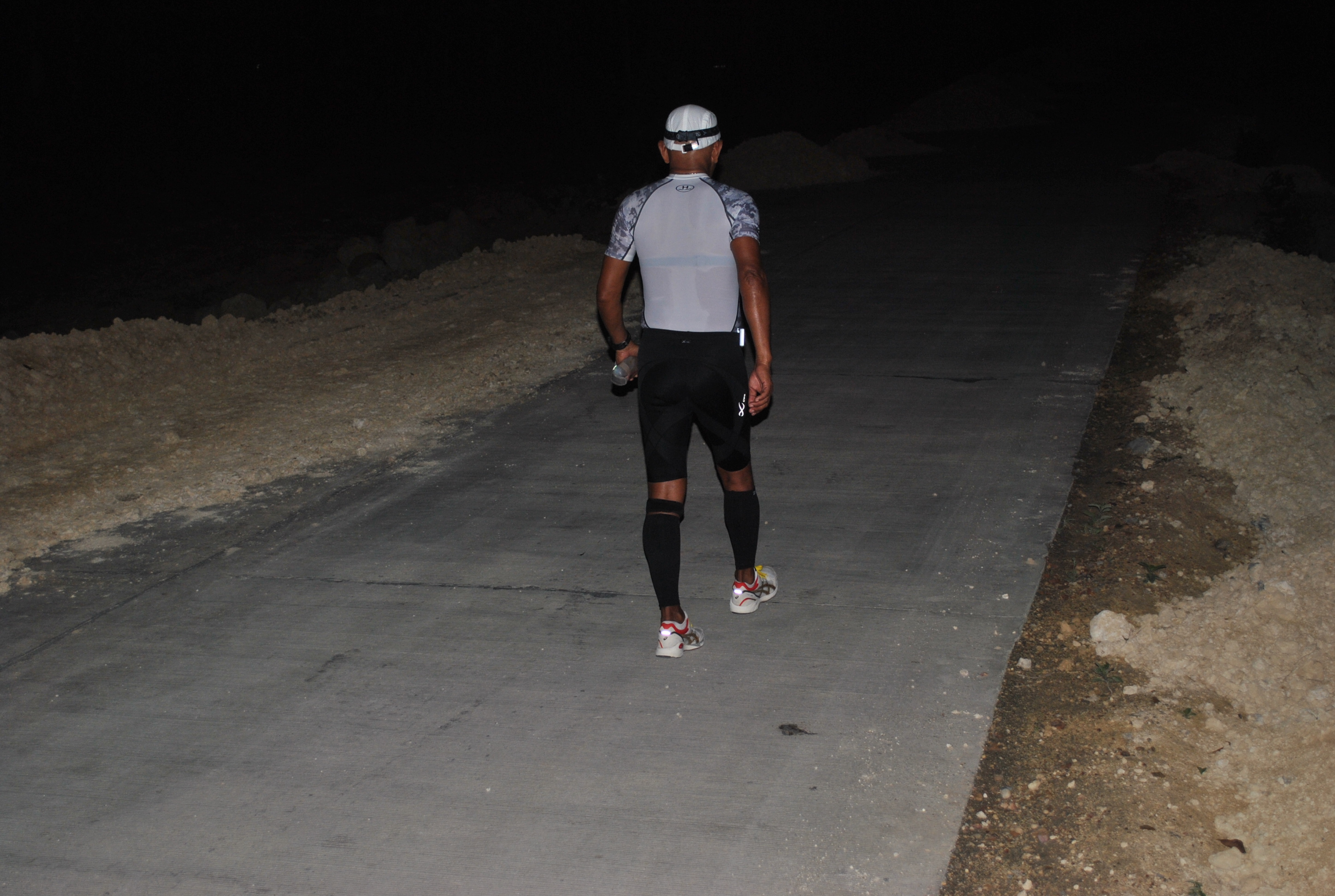
Running Kit:

Under Armour Compression Shirt

CW-X Compression Shorts

Drymax Socks

ASICS Gel-Tarther

Under Armour Runner’s Cap

Nathan “Sprint” Watter Bottle

Peltz Headlight

2 GF 305 Watches with Heart Monitor

Ice Bandana

Oakley Sunglasses

Gymboss

After a dinner of Fresh Fish Sinigang, Native Chicken Adobo, Pancit Canton and lots Guimaras Mangoes, I was already on my bed snoring loudly. After almost 9 hours of sleep, I was already on the salty waters of the beach soaking my tired legs for almost 30 minutes.

Before my team left the island, I had the chance to personally talk to Governor Nava about my run and my plan to hold the PAU National Championships in his province in the later part of the year. He appreciated my feat in running the whole island and he told me that I made a history in the island as the first and only person (and the only retired Major General of the AFP) to have run around the island in a single stage. He also appreciates my purpose of bringing “Sports Tourism” in the province.

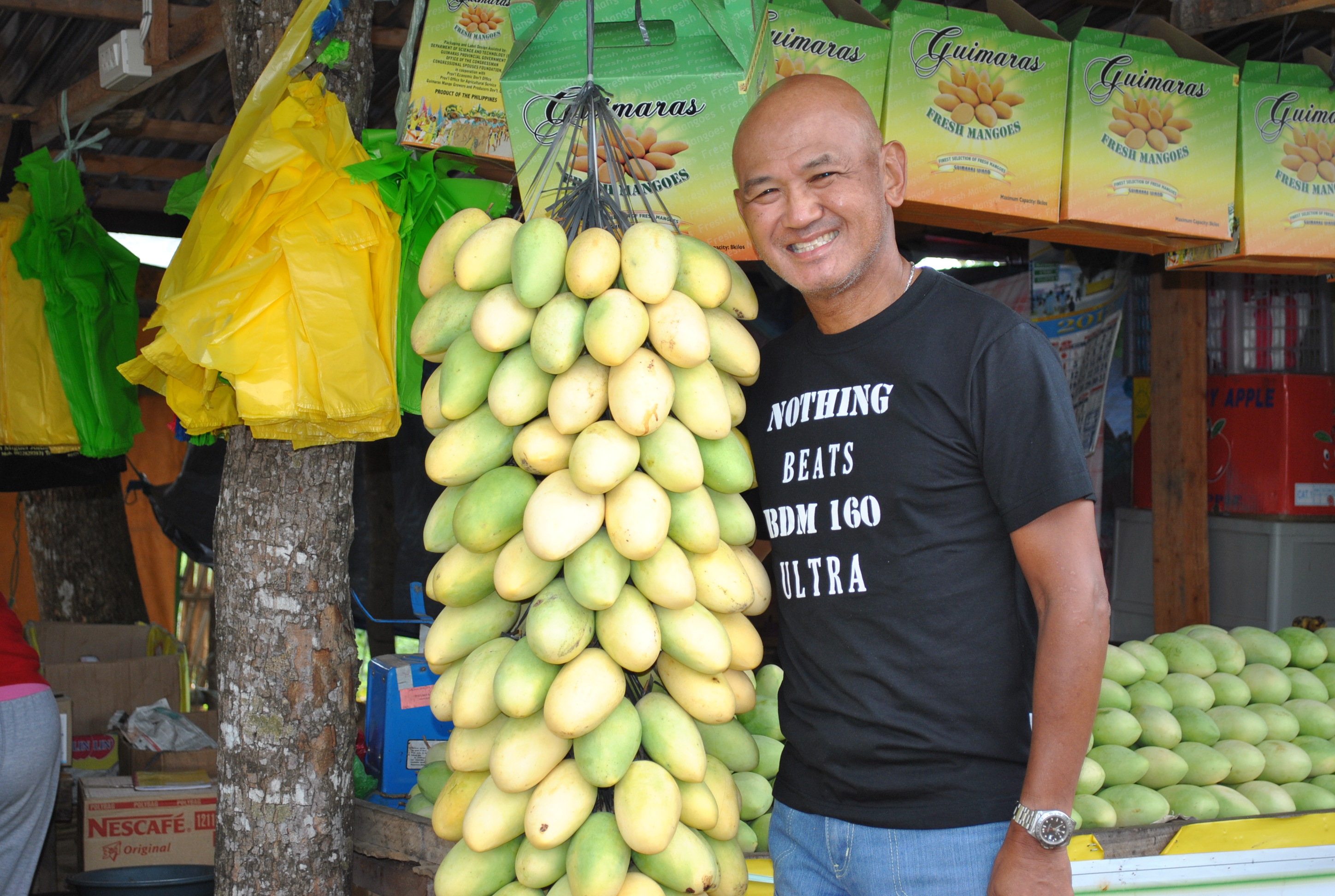
A visit to Guimaras is not complete if you have not tasted and brought back home the sweetest mango in the world—Guimaras Mangoes! “Nothing Beats The Guimaras Mango”!!!

See you in Guimaras in September 2012!