Cebu City Marathon Poster


"Official Poster"

Picture Clipping: BDM 102


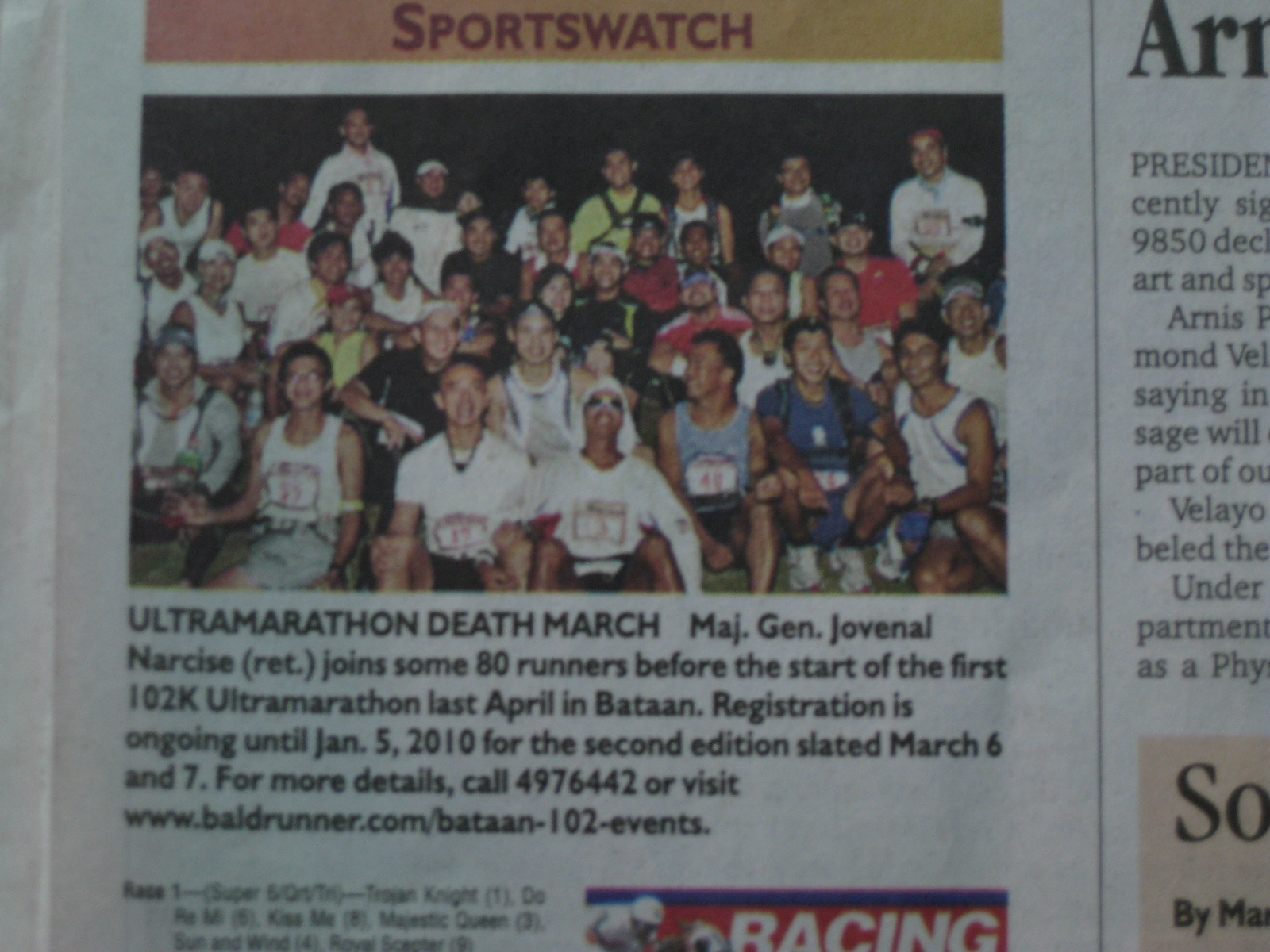
In last Sunday’s edition of the Philippine Daily Inquirer (Dec 20, 2009), the runner-participants in the 1st Bataan Death March 102K Ultramarathon Race who posed in a picture taken before the race were featured in a picture posted at the “Sportswatch” section of the said newspaper.

The picture below consists of the 82 “new brave warriors” who started the race from Km #0 in Mariveles, Bataan last April 5, 2009 and finished at Km #102 in San Fernando, Pampanga. Out of the 82 starters (with 8 foreign runners), 63 runners finished the race within the cut-off time of 18 hours.

News Picture Clip on the 2009 BDM 102

 As of today, there are 167 runner-applicants for the 2nd edition of the BDM 102 which will be held on 6-7 March 2010. In addition, I have reserved 40 slots for the AFP-PNP runners who will join the race.

For the details of registration and rules & regulations for the 2nd edition, please visit www.bataan102.blogspot.com. Applicants for this race should leave a comment at the Bataan 102 Page of this blog by stating their name, age, date of birth, e-mail address, contact number, and last marathon race finished. Last day of application is January 5, 2010.

To the runner-applicants, good luck on your training!

GO BEYOND YOUR LIMITS !!!

“Back To The Slope” #2 (1st Week)


1. “Back To The Slope” simply means “Back To Basics”. After a forced rest & recovery due to a chronic muscle tear on my Peronues muscle for six (6) weeks, I am starting from base training again. This “Back To Slope” thing will be a series of “tips and lessons” for beginners as well as competitive runners.

2. For the 1st week of my training cycle, I was able to run a total of 55 kilometers as seen on the following log of my runs:

14 Dec (Monday)—10K in 1:09+ hours at an average pace of 6:55 mins per km

15 Dec (Tuesday)—6K in 45+ minutes at an average pace of 7:04 mins per km

16 Dec (Wednesday)—8K in 48+ minutes at an average pace of 5:57 mins per km

17 Dec (Thursday)—8K in 1:00+ hours at an average pace of 7:29 mins per km

18 Dec (Friday)—10K in 1:02+ hours at an average pace of 6:13 mins per km

19 Dec (Saturday)—13K in 1:35+ hours at an average pace of 7:27 mins per km

20 Dec (Sunday)—Rest/30-min Active Recovery Run

3. As gleaned from my log workout for this week, I’ve been strictly following the 2nd training principle which I want my readers to know and follow. It is the principle of “hard-easy” method. If the workout intensity is hard for today, the following day’s workout should be easy. By following this principle, the body would be able to rest and recover for the following day’s workout. This is one way of preventing a running-related injury.

4. There will be no road races on Sundays for my base training phase. I am giving a day for my body to rest & recover for the week’s running workouts after doing a 30-minute slow active recovery run (at 7:30-8:00 mpk pace). However, I strictly made more stretching and selected Pilates exercises before and after my daily workouts.

5. The following are the suggested “drills” and stretching/Pilates workouts for core strengthening:

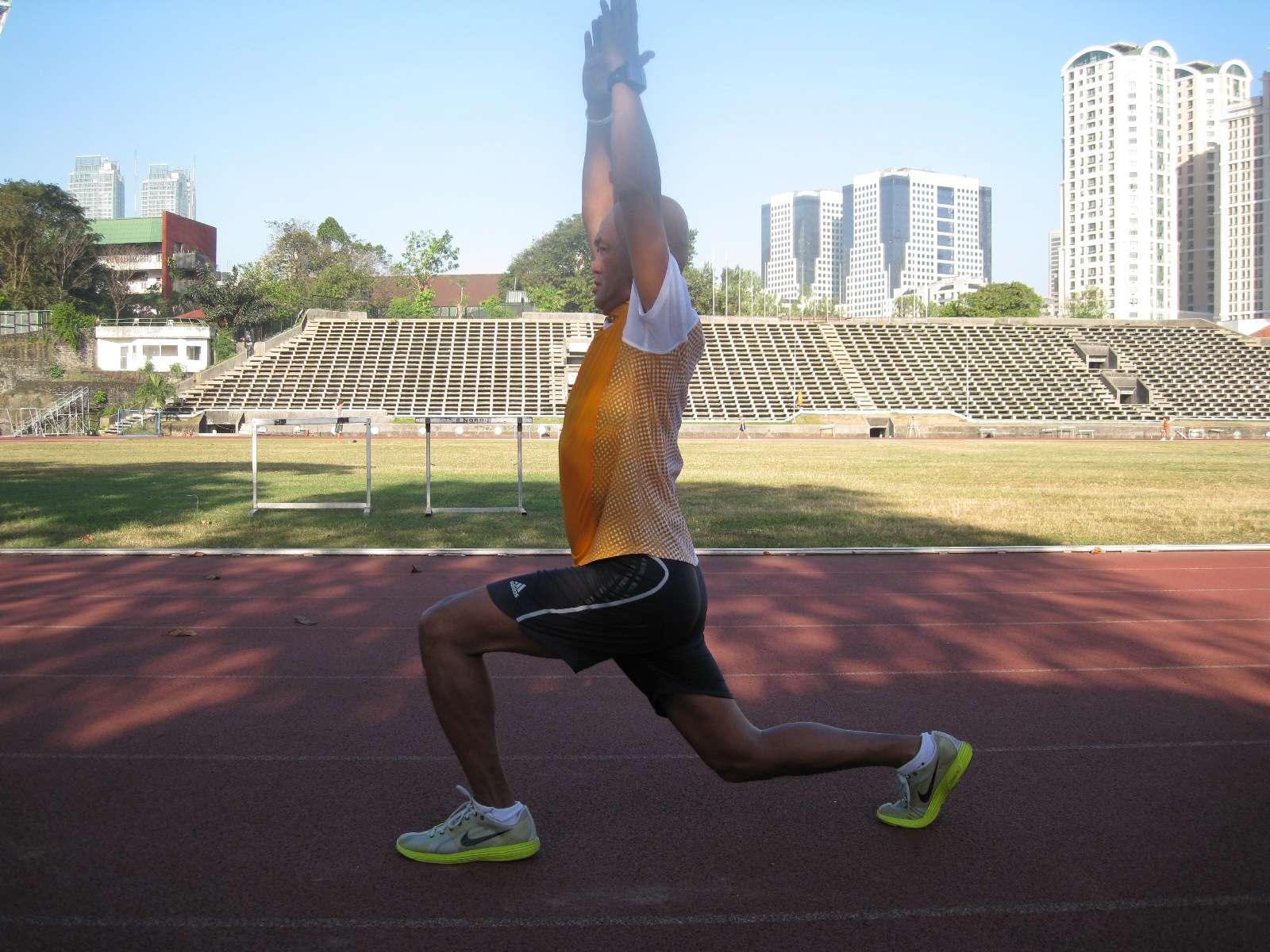
Forward or Walk Lunges

 Lunge one foot forward as far as you can and bring the body down while bringing both arms up in the air. Do 10 lunges per foot/leg.

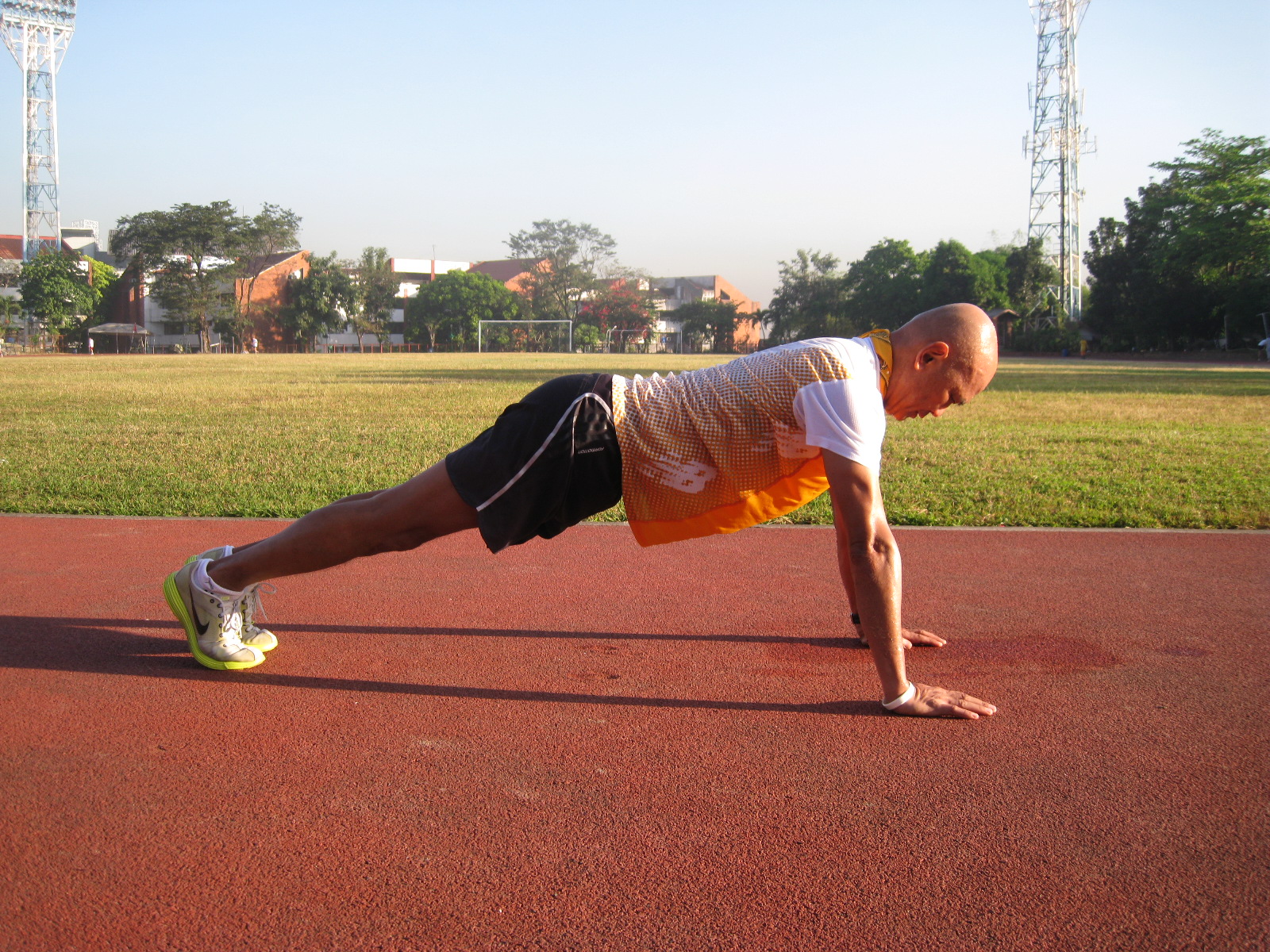
Push-Up (Starting Position & Up Position)

 I always try to do 20 repetitions of push-up properly after my workouts. Be sure that your upper arms are aligned with your back when you are on “down” position. Your palms’/hands’ distance should be your shoulders’ width.

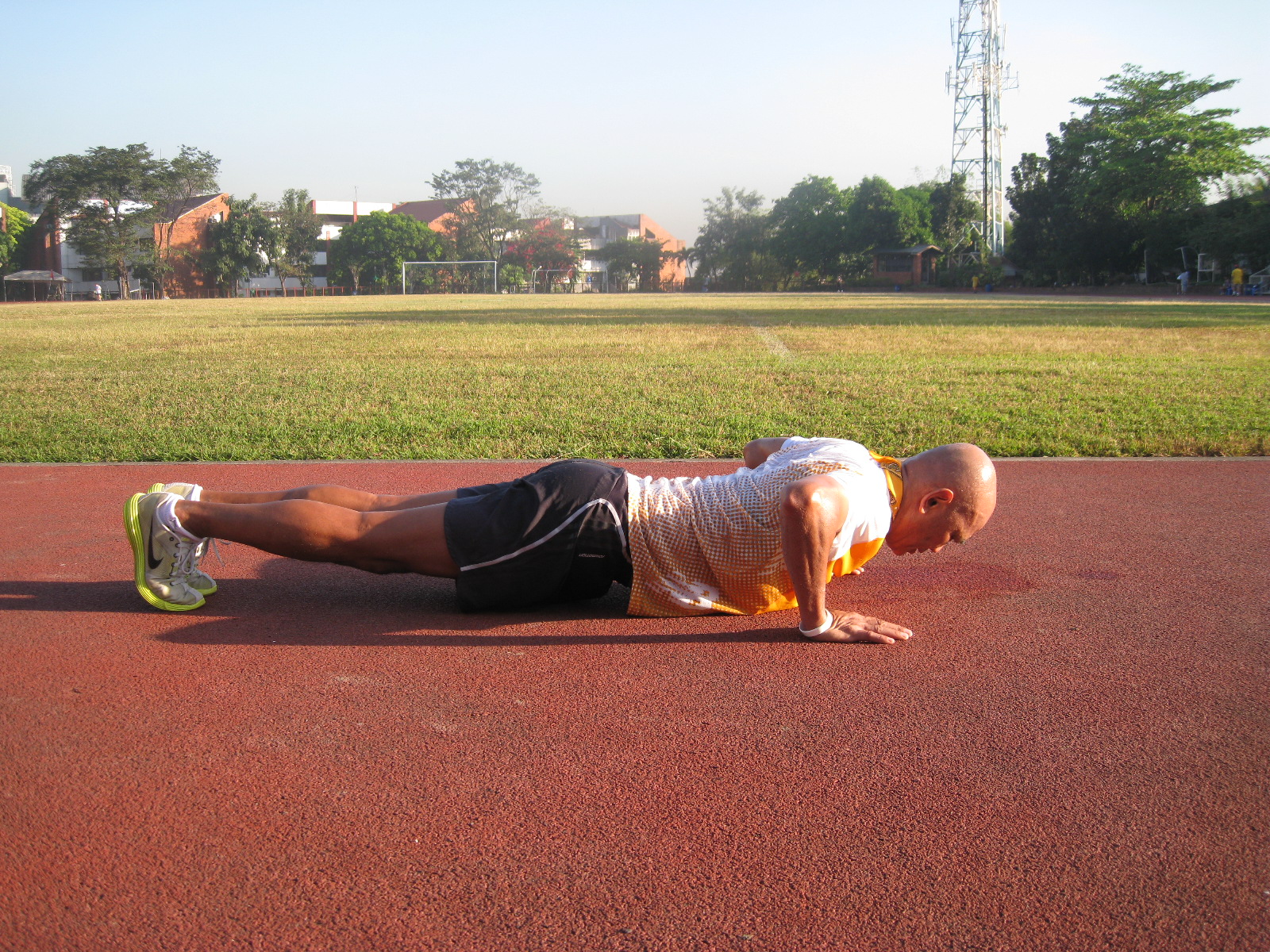
Push-Up (Down Position)

 Try to keep your feet together and the whole body should form a straight line while doing your repetitions. Inhale as you push your body up and exhale while you put your body down.

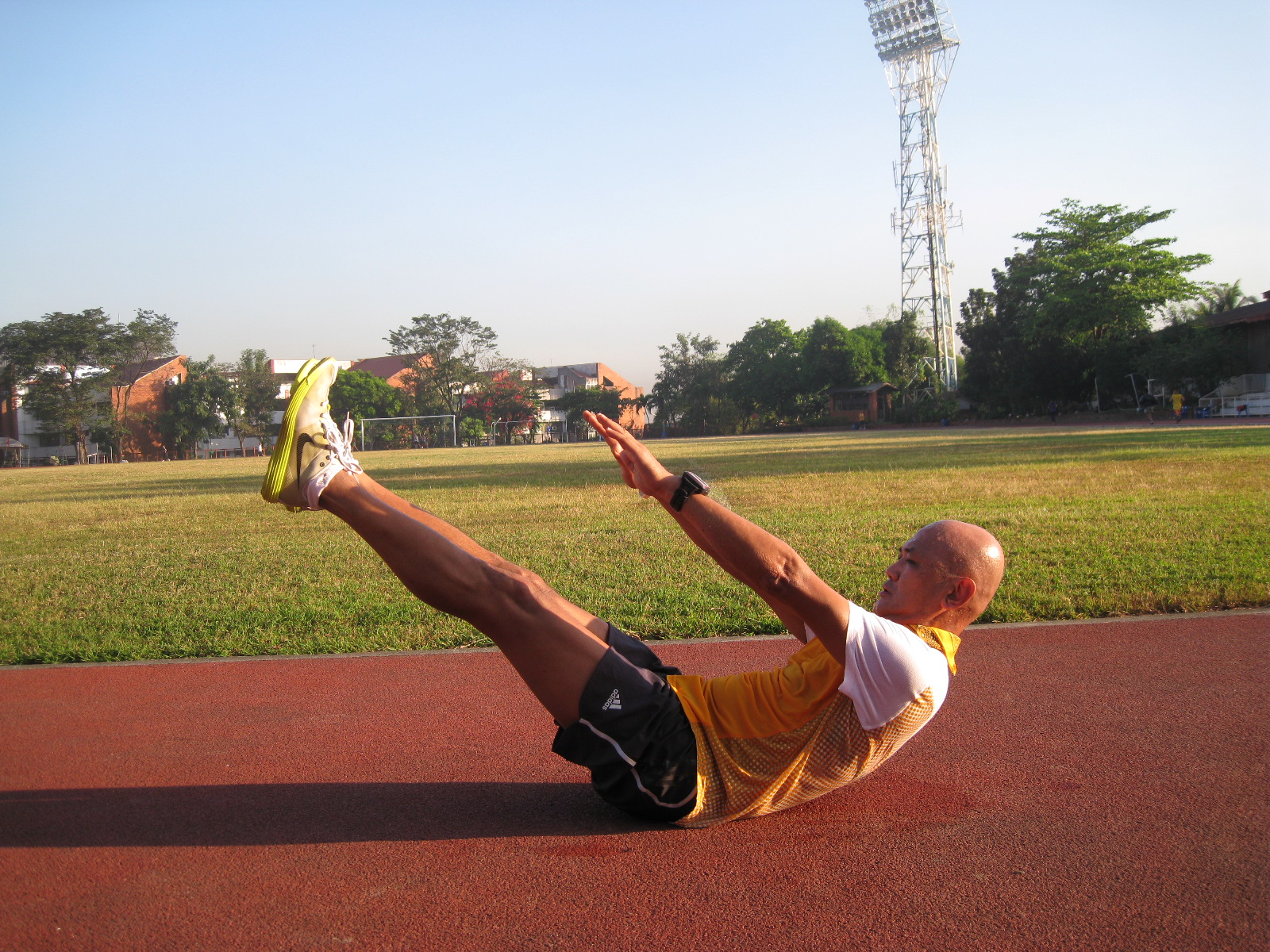
Leg & Upper Torso Lift

 Try to hold your body in this position from 30 seconds to one minute while maintaining your regular breathing. You will be surprised what part of the body will be strenghtened!

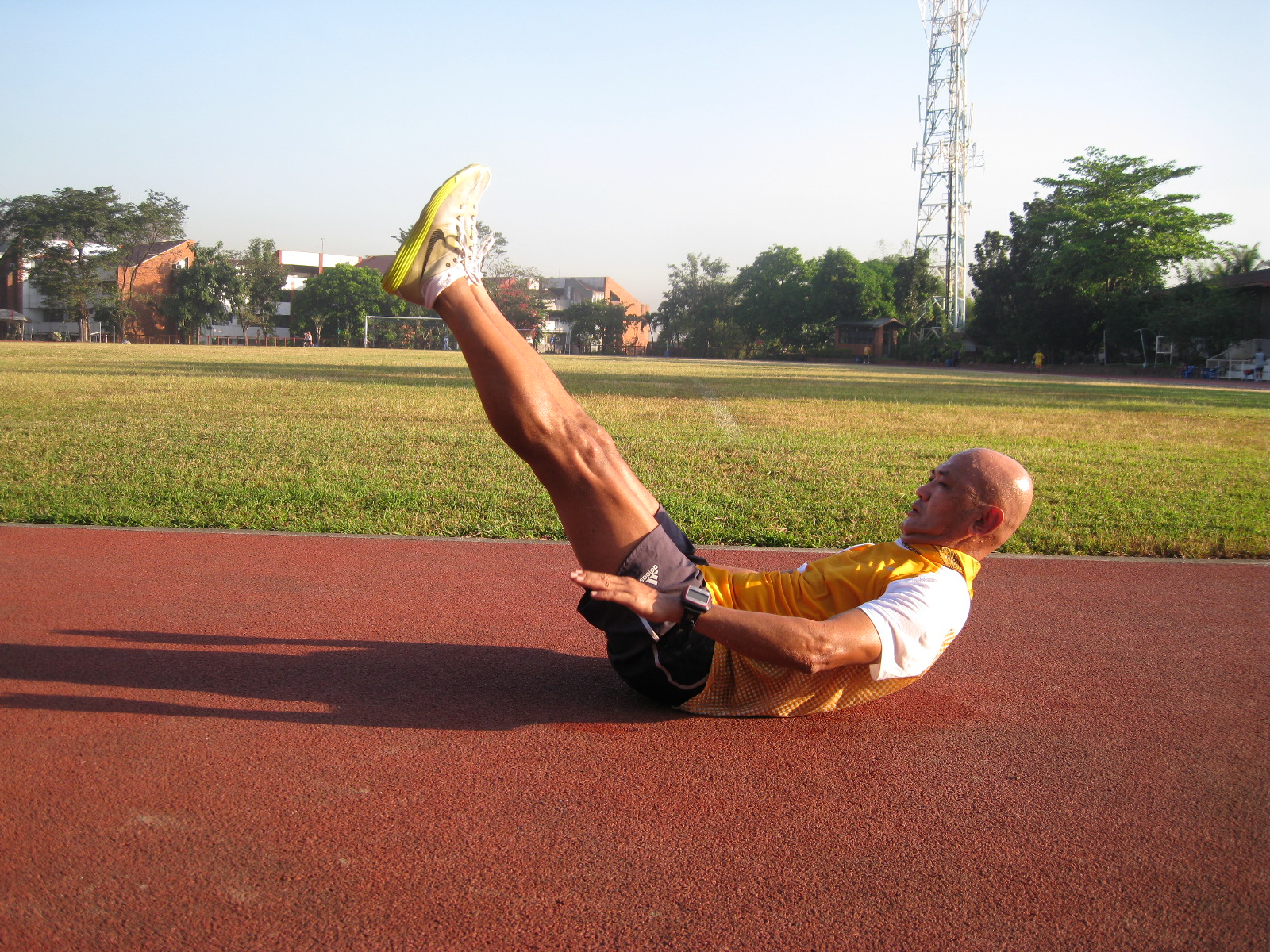
The Hundred

 They call this as “The Hundred” because you have to pump your arms 100X while maintaining this pose and regualr breathing.

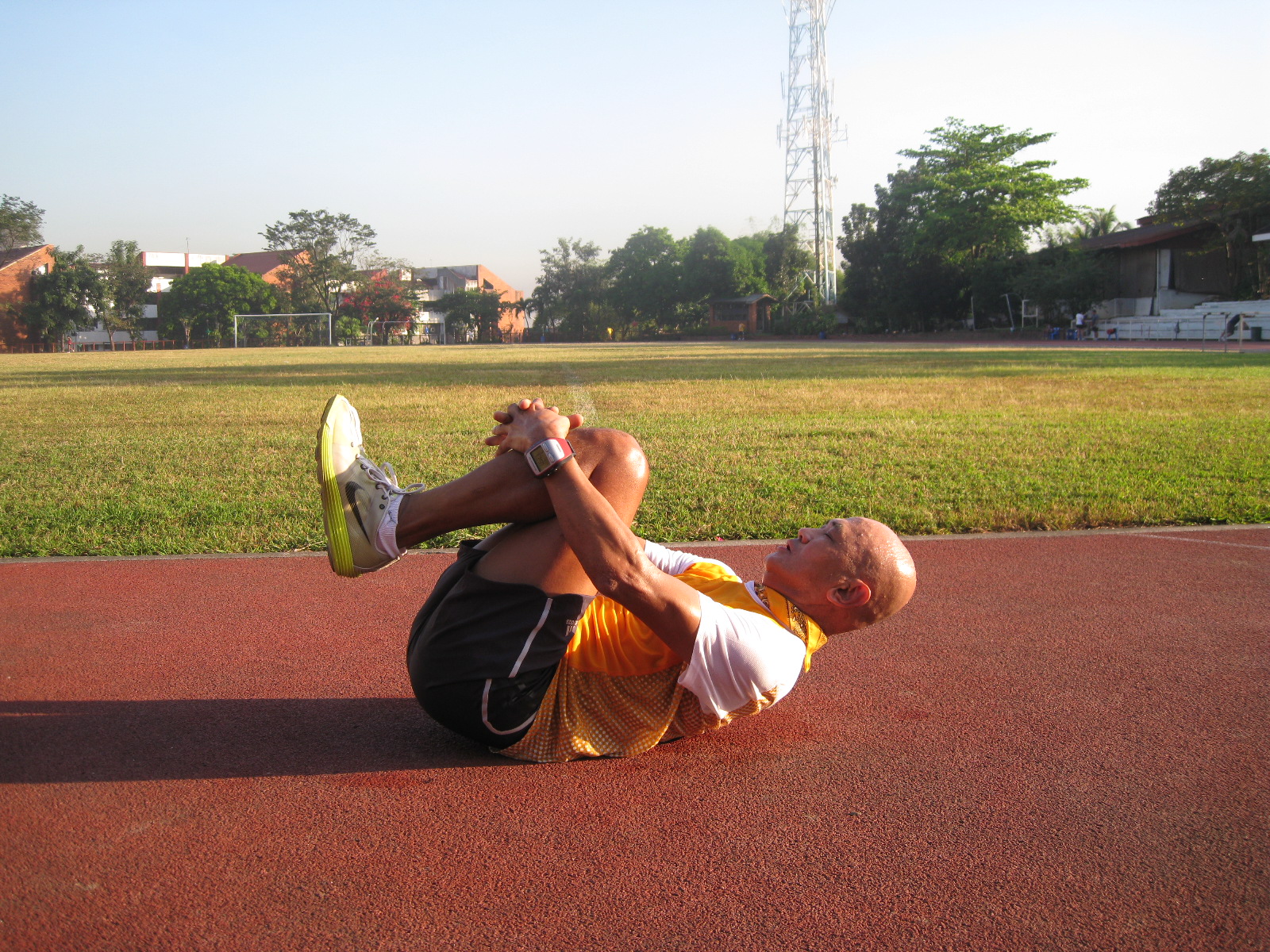
Roll Like An Egg On The Spine

 This rolling exercise will strengthen your spine and your back muscles.

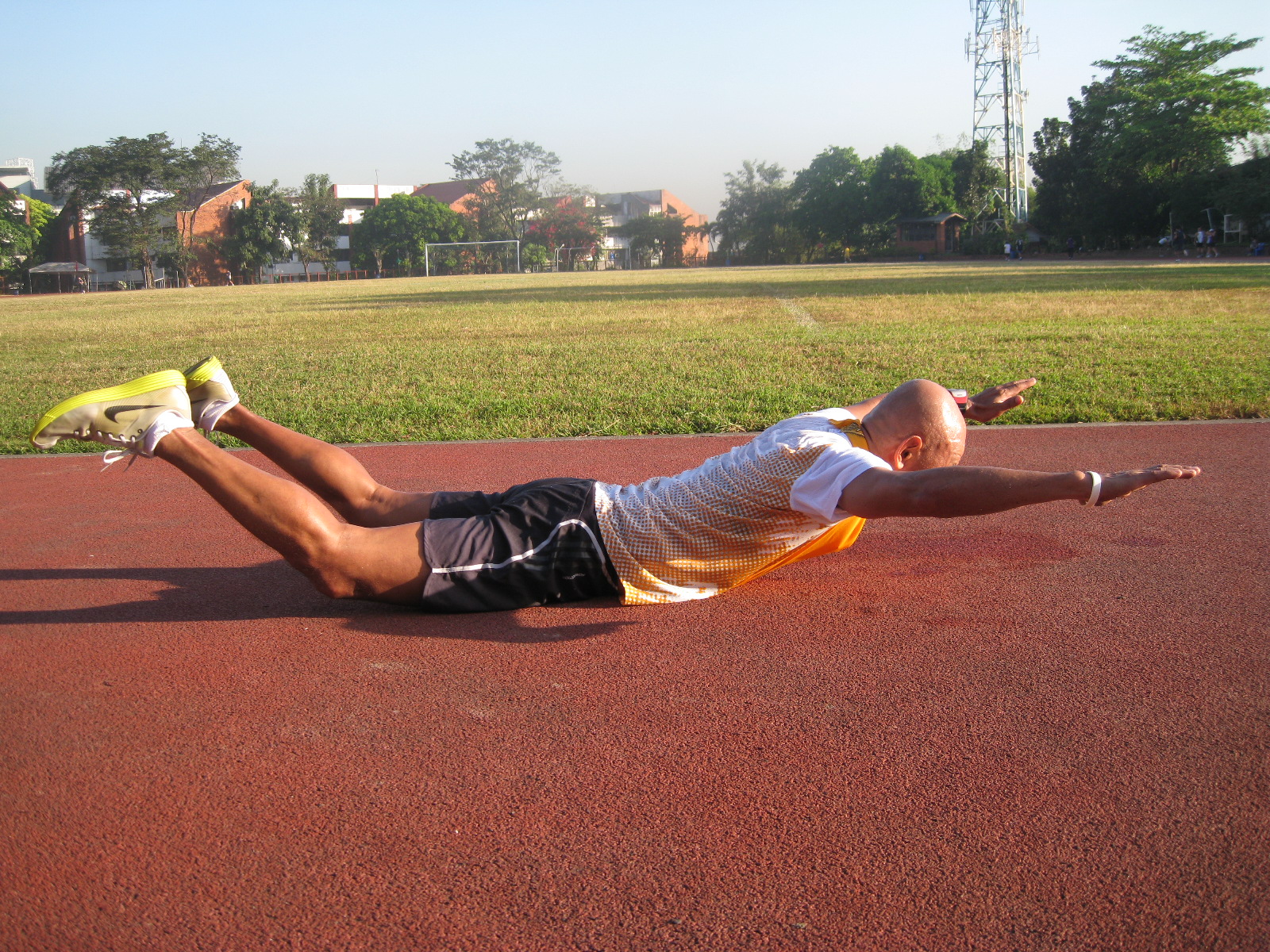
Swimming

Lift your legs and upper torso with arms straigthen forward and hold this position for 10 seconds. Repeat 4X. Maintain regular breathing.

Lesson #2: Follow the “Hard-Easy” method of training.

“Thanks For Not Inviting”


1. In a few hours today, Joy Rojas’ “Takbong Pangarap” Run Across USA will hold a Press Conference at the Hotel Intercontinental in Makati City about her 3,000-Mile Run Across USA which she completed on the middle of November 2009.

2. I knew this Press Con event from a Race Organizer who is close with Joy Rojas and Mat Macabe last week. I asked from the Race Organizer if I can attend the said event since I know that such event needs an invitation letter of e-mail. However, since Monday, I was given a lot of reasons and “alibis” for me not to be able to contact a certain Leila Caringal, the event organizer. And the Race Organizer who informed me about the event is no longer answering my text messages if there is a possibility that I could attend the Press Con. And what is worst, I know that Mat Macabe has my cellphone number.

3. It is on record in my blog that I tried to locate the location of Joy Rojas after a month or two from the time she started her run from Eagle Rock, California on the 2nd week of May of this year. From the e-mails I received from my ultra running friends and comments in my blog, some problems emerged from the team of “Takbong Pangarap” where one of the members left the team and returned to the Philippines due to some “complaints” and “misunderstanding” with Joy and Mat. Aside from the said “misunderstanding”, one of my readers questioned the integrity of the running event. I tried to get the side of Joy and Mat about such “issues” and it was an opportunity to exchange e-mails with Joy and she was able to send me some of her pictures of which were “grabbed” by other websites. Joy tried to evade to answer the “issues” but she told me that her run will go on. As Joy reached Idaho, I stopped monitoring her running event and since then, I never heard about her whereabouts.

4. After reading the book of Brian Stark on his experiences of running across the USA through the American Discovery Trail and Trail Roads without any support; watching the DVD film on Dean Karnazes’ 50/50 and Running The Sahara; and browsing the different blogsites and websites of runners who ran the Transcontinental USA for the past years ( pls refer to www.seejohnrun.com), I have my personal doubts about the feat and accomplishment of Joy Rojas. These ultra runners prepared their plans for years and collected at least 500 maps to trace and plan for their routes; they have journals and documents to prove their feat through their websites and blogs, complete with pictures; and they take advantage of the gadgets and devices that the high-technology world has to offer in order to track and recors their runs.

5. An ultra runner friend of mine, Tess Geddes, a Filipina who finished two editions of the Marathon Des Sable in the Sahara Desert had recommended me to track one of his ultra running friends, Ray Zahab, who was running across Canada with the use of a GPS tracker. By clicking his website at www.impossible2possible.com, I was able to locate him on real-time on what part of Canada he was running! Ray Zahab is the Canadian runner who is one of the team members who was featured in the film “Running The Sahara”.

5. If you think that this is one of my “crab mentality” stories and insights, this is not so! We are dealing here with the truth and integrity of a runner’s accomplishment and purpose. If I was not invited for this presscon because of the thought that I might “ruin” or question the integrity of Joy Rojas accomplishment, then they are wrong. I will let this blog speaks for itself. You will be the judge.

(P.S. I never met Joy Rojas in person! The PressCon would have been a nice venue to meet and congratulate her personally)

Pathetic!


Yesterday morning, I had a chance to talk to sports executives working in a multinational company which is a major sponsor in Sports Events in the country and even in Asia. It was a casual meeting and we had a brief conversation about running in the country, the Standard Charter’s Singapore Marathon and other running related activities.

Our conversation led to our present standing in the 25th SEA Games of which two of the executives openly told me that they just arrived from Vientiane, Laos to observe the preparation, opening ceremony, and initial conduct of the Games. I asked if it is true that our National Athletes arrived in two groups, in two separate “chartered” planes—one group of athletes was supported by POC and the other group of athletes was supported by PSC. POC is the Philippinje Olympic Committee which is headed by Jose “Peping” Cojuangco while the PSC is the Philippine Sports Commission which is headed by Harry Angping.

If you have been reading the Sports Pages of our national dailies for the past months, you would know that there is an animosity between these two sports institutions in the country. The PSC is a government entity which is responsible for our national sports excellence by providing the necessary funds to the Sports Federations and to our elite athletes; while the POC is the country’s representative organization of the International Olympic Committee (IOC) which is responsible in sending our National Athletes to International Games under the auspices of the IOC. SEA Games and ASIAN Games are the only International Games under the auspices of the IOC. In short, funding for training & incentives for medalists is the responsibilities of PSC; while the expenses for the travel of athletes to IOC’s International Games is the responsibility of the POC. I might be wrong but this is my impression about their arrangements when sending our National Athletes to such IOC meets/games.

Anyway, it is true that our athletes arrived in Laos in two separate “chartered” flights direct from Manila. My source of information could not determine if it is really true that one plane was boarded by PSC-supported athletes while the other plane was boarded by additional athletes recommended by POC and POC Officials. I also confirmed that there were no officials from the PSC who joined the delegation & party. However, by knowing that the delegation of our country nearly reached 400, there is a need for two planes to ferry our athletes and officials.

You might be wondering why our delegation was able to get a chartered flight from the Philippine Air Lines. It is because the release of the funds to buy for the tickets for our athletes and officials were delayed and in turn it would be expensive to buy them with few days before the scheduled departure. The other reason for the chartered flight is that, there is no direct flight from Manila to Laos and our delagation has to change plane from Bangkok/Saigon/Hongkong and this will entail additional expenses and more hours for the trip.

And now this is the worst part, the executives who were present during the 25th SEA Games Opening Ceremonies almost cried when they saw our Philippine Delegation marching at the Oval Track in “Athletic Attire” (Athletic Jacket; jogging pants & rubber shoes) while the other Country Delegations were wearing Suits & Leather Shoes. I was told that the Vietnam delegation wore a Barong Tagalog- look alike with “crumpled” look (“Gusot Mayaman Barong”). And the best part among the worst news is that, the uniform that our delegation wore during the Opening Ceremony was given on the day before the delegation left Manila. (Note: If you want to see a picture of our delegation during the Opening Ceremony, browse at www.laoseagames2009.com and click at the Photo Gallery on the left side of the site. Look for picture #38 and click it).

I am not making a post showing a “crab mentality” attitude in our sports excellence program but I am trying to show the prevailing situation in our sports, moreso, with the “message” we are showing to our neighboring countries and to our people. We always talk and read about “unity in purpose” and “unity among us” but for us, as a nation competitng with other nations in an international sports meet, we should show our best.

The good news is that Ed “Vertek” Buenavista and Jo-An Banayag won the Gold Medals in the Men’s & Ladies’ Marathon Race in this morning’s 25th SEA Games Athletics events. Their finish times at 2:21+ and 2:46+ hours, respectively are good enough to win the gold medal with a cash incentive of P 300,000 each, but it is still far from the ASIAN and OLYMPIC Games’ standards. Nevertheless, what is important is that we got the GOLD in the most important running event for us who are long distance runners!

Whatever will be the final results of the 25th SEA Games, I hope there will be no “finger pointing” as to who should be blamed for our dismal performance and lowest output in the history of the SEA Games. However, I am still sure of the following assessment: (1) that “politics” and “sports” do not mix, and (2) for the government and the private sector to help in the funding and support to our athletes.

Let us see what will happen to our National Team in the next ASIAN Games which will be held in 2010, next year!
“Back To The Slope!”


1. When I was a cadet at the Philippine Military Academy, I always hear this statement or command from my Tactical Officers if they want the cadets to repeat a practice on our Parades and Ceremonies after doing one or two rounds. The start area of our parade and drills is a sloping/downhill road towards the Borromeo Field, the Parade Ground of the Academy. Figuratively, if this phrase or statement is uttered, it means that you have to repeat from the start what you have done in order to correct a mistake or error.

2. After five weeks of rest & recovery due to an injury, I am going “back to the slope!” and have started to follow a training program as a guide for my future marathon and ultramarathon races for the year 2010 and beyond.

3. The first step in my training program is to abide and recall the most basic principle in training for a running event—base training. I always say in my running clinic lectures that preparing for a running event is like constructing a building or a house where you need to have a durable and stable base/foundation. In running, base training  means building a base of aerobic endurance.

4. So, early this morning, I had my first “base training” at the ULTRA Oval Track completing a distance of 10 kilometers, running along the outer lane. I did my stretching exercises before and after the run. In addition, I did some running-related “drills” during and after the run. I finished my 10-K run in 1:09:13 hours with an average pace of 6:55 minutes per kilometer. I was so happy that I was able to breach the 7:00-minute per kilometer pace. Slowly, but surely, I could run within my base training pace.

5. To give a full description of the drills I’ve done during/after my run, I am posting the following pictures with the hope that other runners would also adopt them to make them stronger and faster.

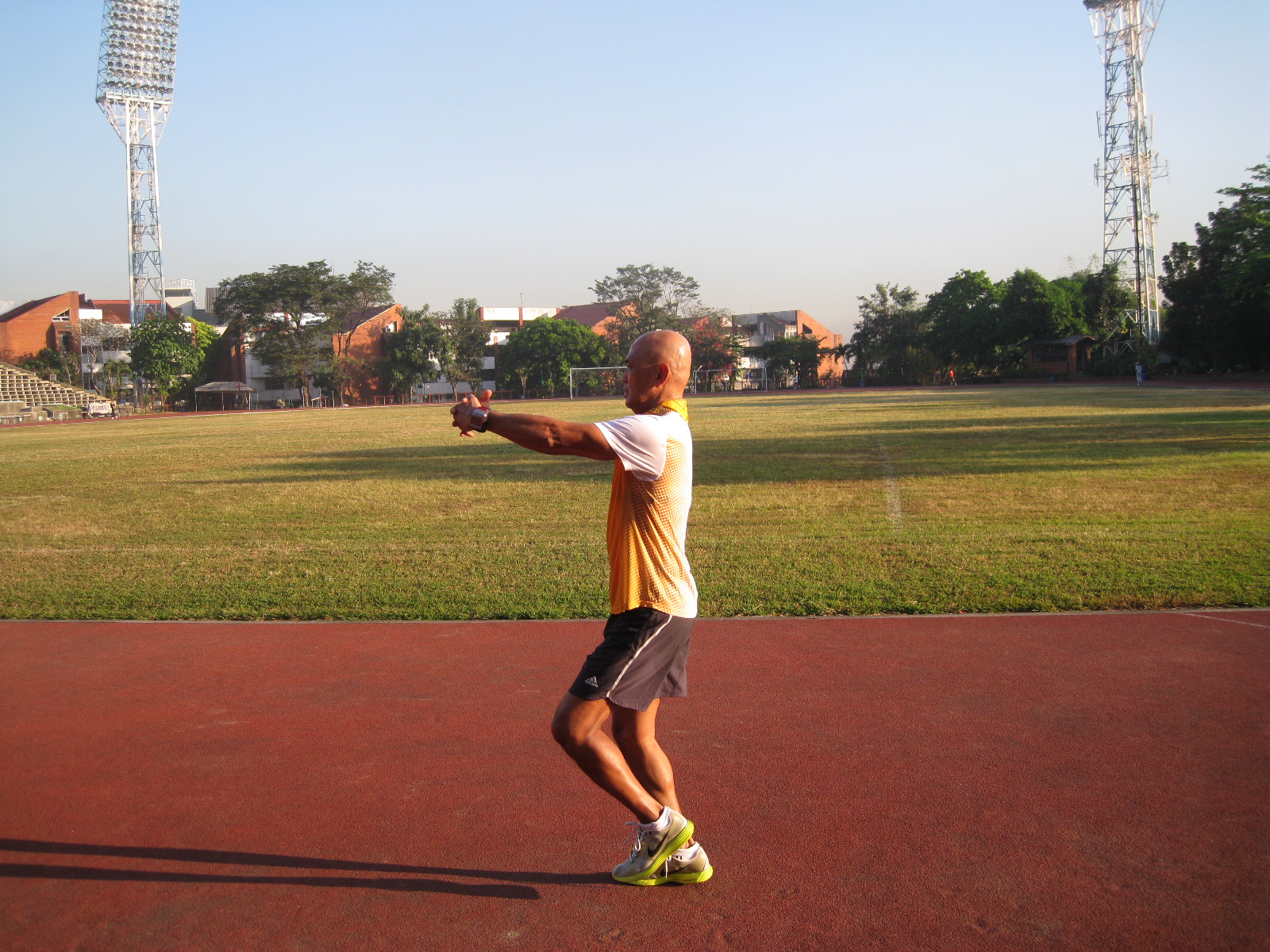
"Running No Arms"
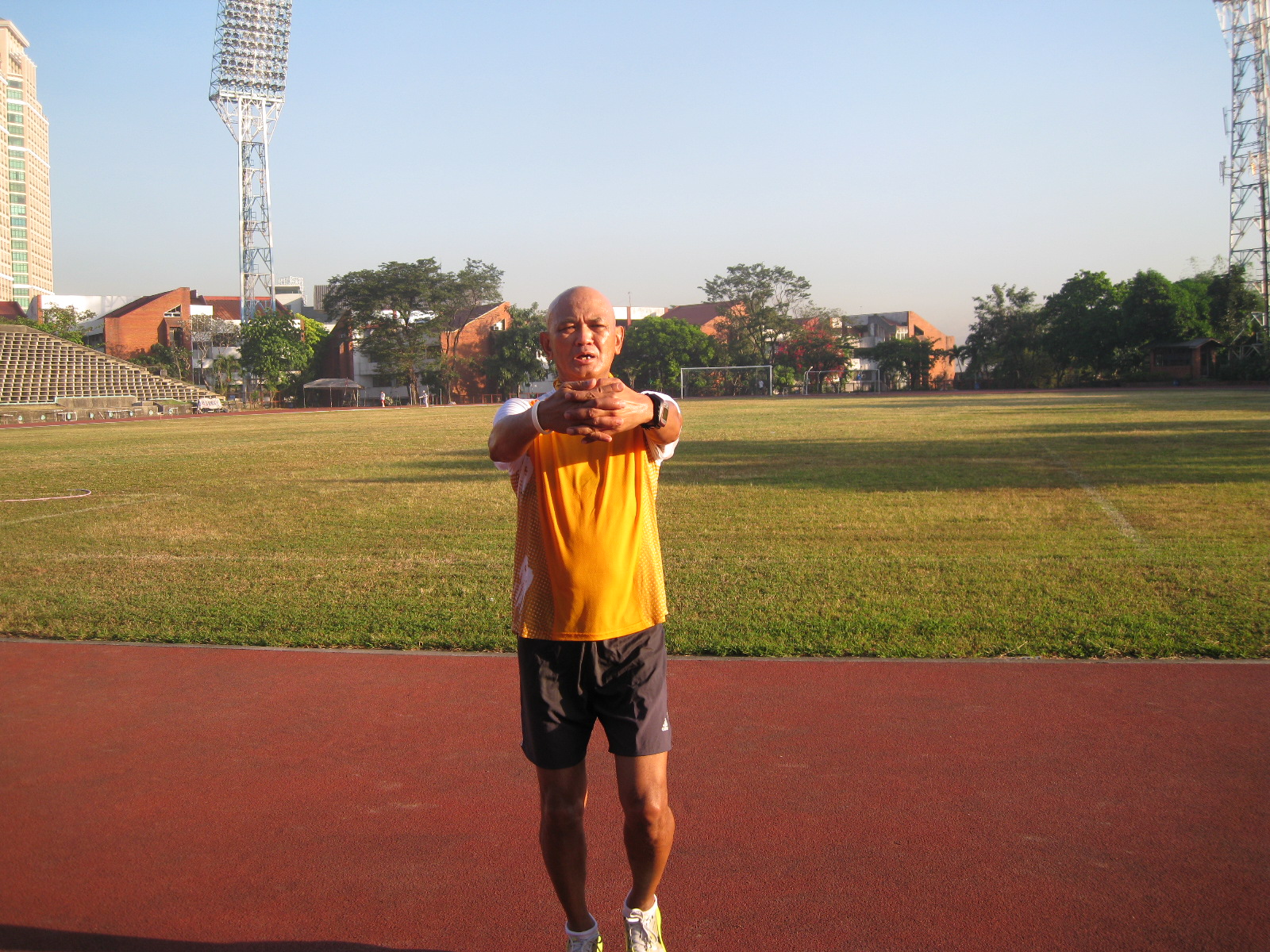
Front View of "Running No Arms"

To do this drill, a runner must lace his fingers and form a big circle with his arms at shoulder level. Run 100 yards at moderate fast pace with arms in this position. Return to your running form after 100 yards and repeat after running another 100 yards. I did 10 times of this drill while I was running around the track.

This drill forces my inner abdominal muscles to maintain an upright posture and activates such muscles while running. It also eliminates unnecessary swaying or rotation of my shoulders from my waist while running.

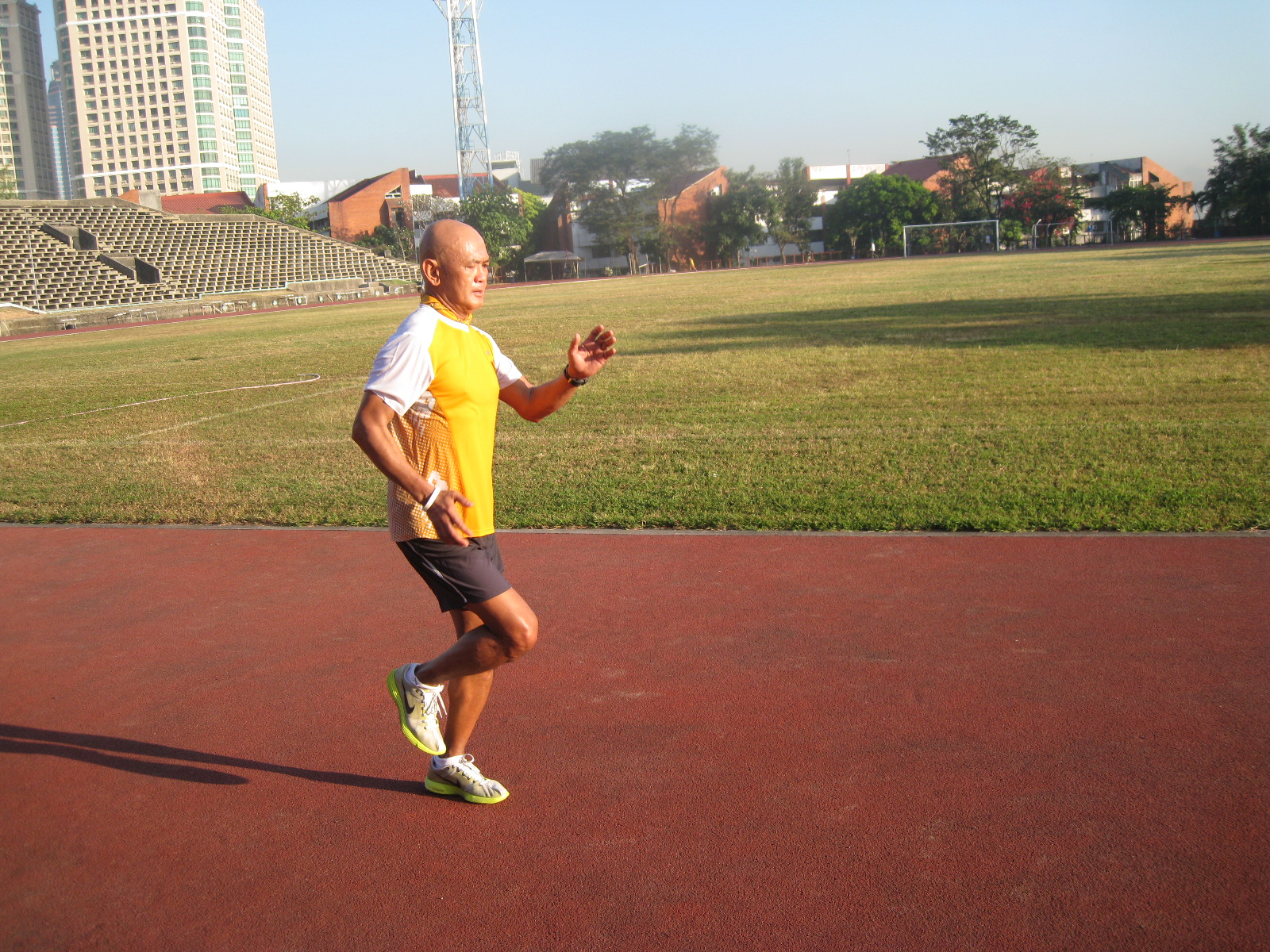
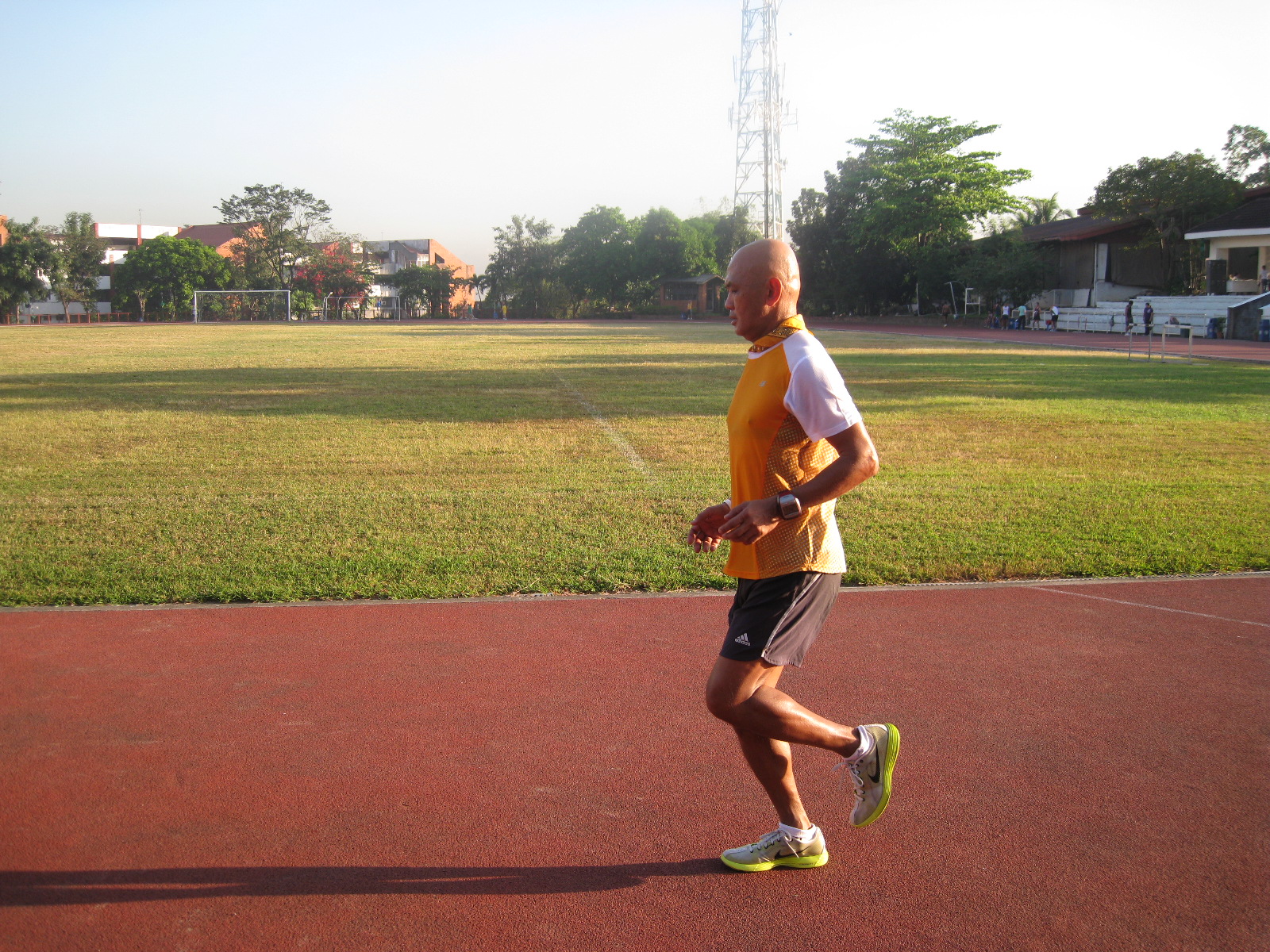
"One-Leg Hop"
One-Leg At A Time

To do this drill, one has to run as fast as possible with one leg for 20 seconds or approximately 20 leaps/bounce or more. This drill will increase one’s push-off power of the feet and will enhance the stability of the hips, pelvis, lower spine and knees on impact of the foot to the ground by forcing the muscles to stabilize the joints for a short period of time.

Lesson #1: In a training cycle, first phase is to develop your aerobic endurance base.

(Source/Reference: “Brain Training For Runners” by Matt Fitzgerald)

“50/50” & “Running The Sahara”


1. I received a very early X’mas gift  from Jay Nacino aka Prometheus Cometh two weeks ago and it was delivered through courier system. The gift was a compilation of running films/movies recorded in two (2) CDs. Thanks, Jay for the gift. God bless.

2. The following films were recorded in those two CDs: Chariots of Fire; Without Limits; 50/50; and Running The Sahara. Having seen the first two films mentioned in widescreen, I was very interested to watch 50/50 and Running  The Sahara because they deal more on ultramarathon and multi-day stage runs. Both of these running events were filmed sometime in 2006.

3. I will not deal with the whole story of these films as every reader of this blog could easily browse or “google” the title of the films and they could get the details of these running events. 50/50 was made as a film and at the same time published as a book to document Dean Karnazes’ 50 marathon races, in 50 States in the US, in 50 days. Running The Sahara is a film about three (3) ultrarunners from the USA, Canada, and Taiwan traversing the African continent by passing through the Sahara Desert in 111 days.

4. What I like to point out and emphasize in these running events is the tremendous PLANNING involved to undertake such feats. Dean Karnazes took at least 3 years to convince The North Face in appreciating his plan to run 50 marathons, in 50 different States, in 50 days and another year to finally coordinate and arrange for the implementation of the said project. It was only when his book “The Ultramarathon Man” became a No. 1 Top Seller and his being a top contender in the 100-Mile Western States and Winner in one of the Badwater Ultramarathon editions that he became popular.

5. The planning and preparation for the three (3) ultra runners in 3 different countries in the Running The Sahara took also years. Moreso, with the logistics; production/film crew; and other administrative requirements preparations for the event. This film/event also tested the endurance of the support staff and film crew in order to finish the running event.

Kevin Lin (Taiwan); Ray Zahab (Canada); & Charlie Engle (USA)

6. These two running epic events were well-planned and documented. These films really inspire other people to seek their endurance limits and at the same time promoting some advocacies/charities to help less-fortunate people. So, if ever you plan to do such endurance run, whether an ultramarathon event or multi-stage/day run, you have to document it so that the INTEGRITY of the event is intact. A simple blog (with pictures) would do or inexpensive tracker/GPS device to record your event should be with you all the time during your run.

Finally, I am Back!


1. Exactly one month after the PIM Pasig River Marathon, I was back running at the ULTRA Oval Track yesterday afternoon. I did 1-Kilometer slow run at the soccer field, another 5K at the oval track, and finished my workout with another 1K at the soccer field and 1K at the oval track. My average pace of 7:30+minutes per kilometer was enough to bring myself back to (competitive) running. An 8K run at the oval track was “heaven”!

2. Actually, I had my first attempt to run/jog last Thursday when I took pictures of the future site of the Ultra Trail Run that I am planning to implement. I was able to run/walk/jog a distance of 8.5 kilometers but I was still in pain but after this run and a deliberate and very long session of “deep-tissue” massage, all the pain was gone!

3. I had another 6K Run at the Rizal High School Oval Track last Saturday afternoon and it was a workout where I was able to run continously without any walking breaks. Even if my average pace was 8:30-9:30 minutes per km, I was happy that I could run again.

4. From the book of Tim Noakes’ “Lore of Running”, I found out that my injury is called “Chronic Muscle Tear”. “He concludes that this kind of muscle injury occurs in various muscles at specific sites that, for reasons unknown, develop eccentric muscle weakness. This weakness is exposed during faster running. When the eccentric loading exceeds the muscle’s eccentric strength, a small section of the muscle is strained and develops an inflammatory response. This initial tear is too small to cause discomfort. However, once the initial tear has occurred, a cycle of repair and reinjury and reinflammation develops that leads ultimately to the large tender knot.”

5. For the specific treatment, Tim Noakes stated “The only treatment that works is a physiotherapeutic manuever known as cross-frictions. A better term would be “crucifixions” because this is the most painful treatment a runner would experience. In simple terms, this is what I call “deep-tissue massage” or “hilot”. Ask Coach Titus Salazar of Team Bald Runner how this procedure is properly done!

6. You will see me more at the ULTRA Oval Track during the Team Bald Runner’s “Speed” Training on Tuesday, Wednesday, and Friday afternoon from 5:30 PM to 9:00 PM.

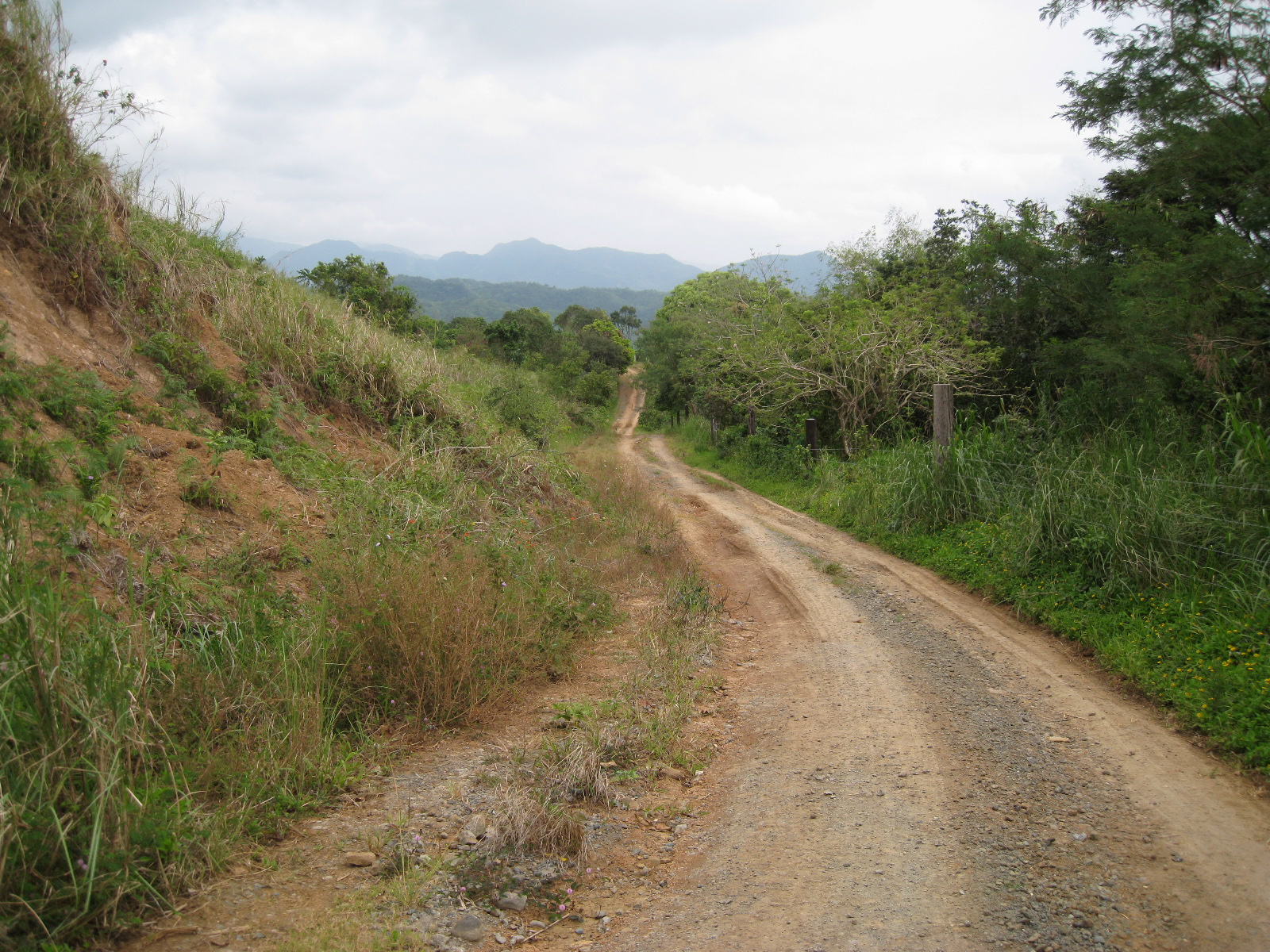
What’s Next After BDM 102?


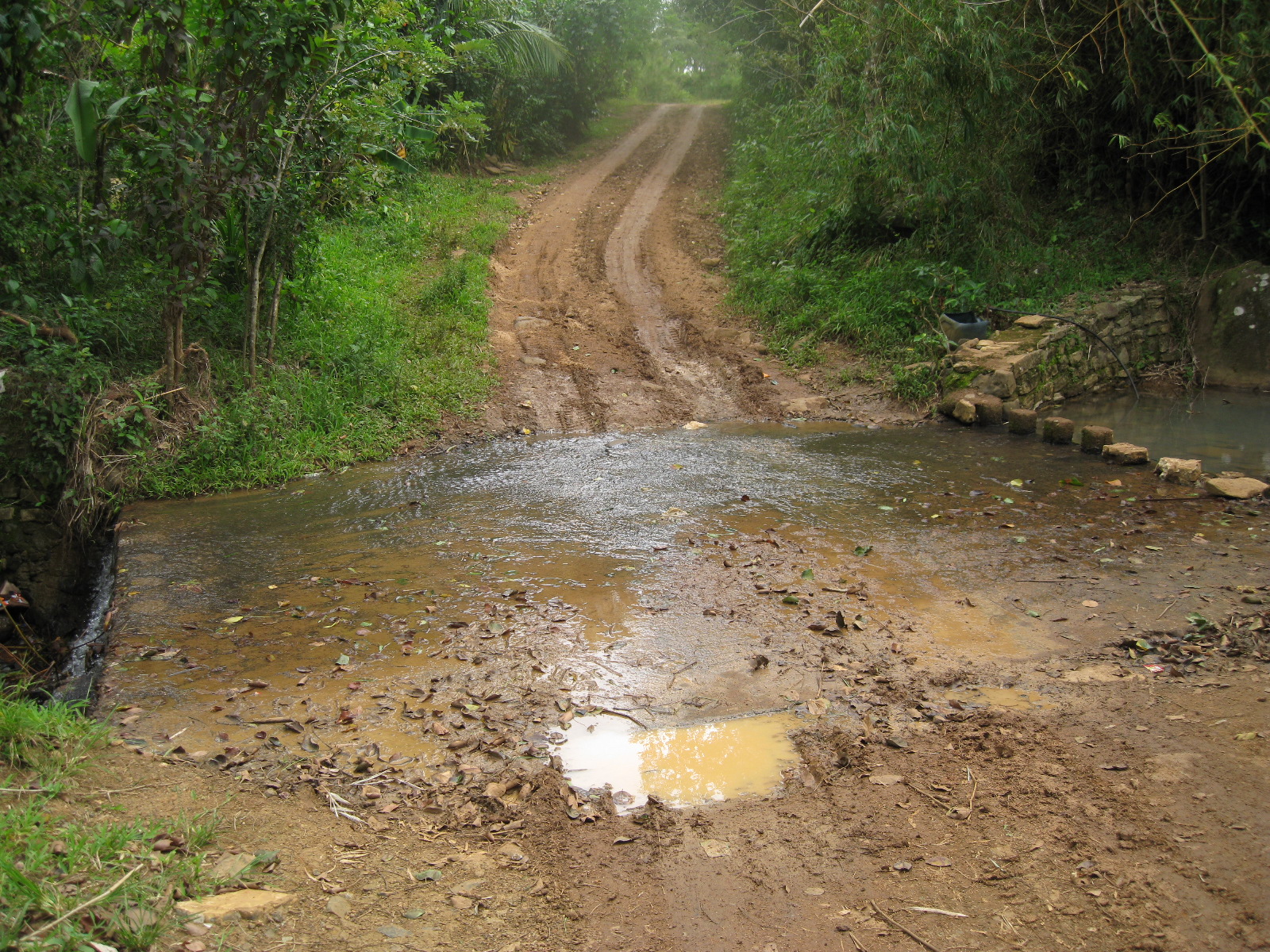
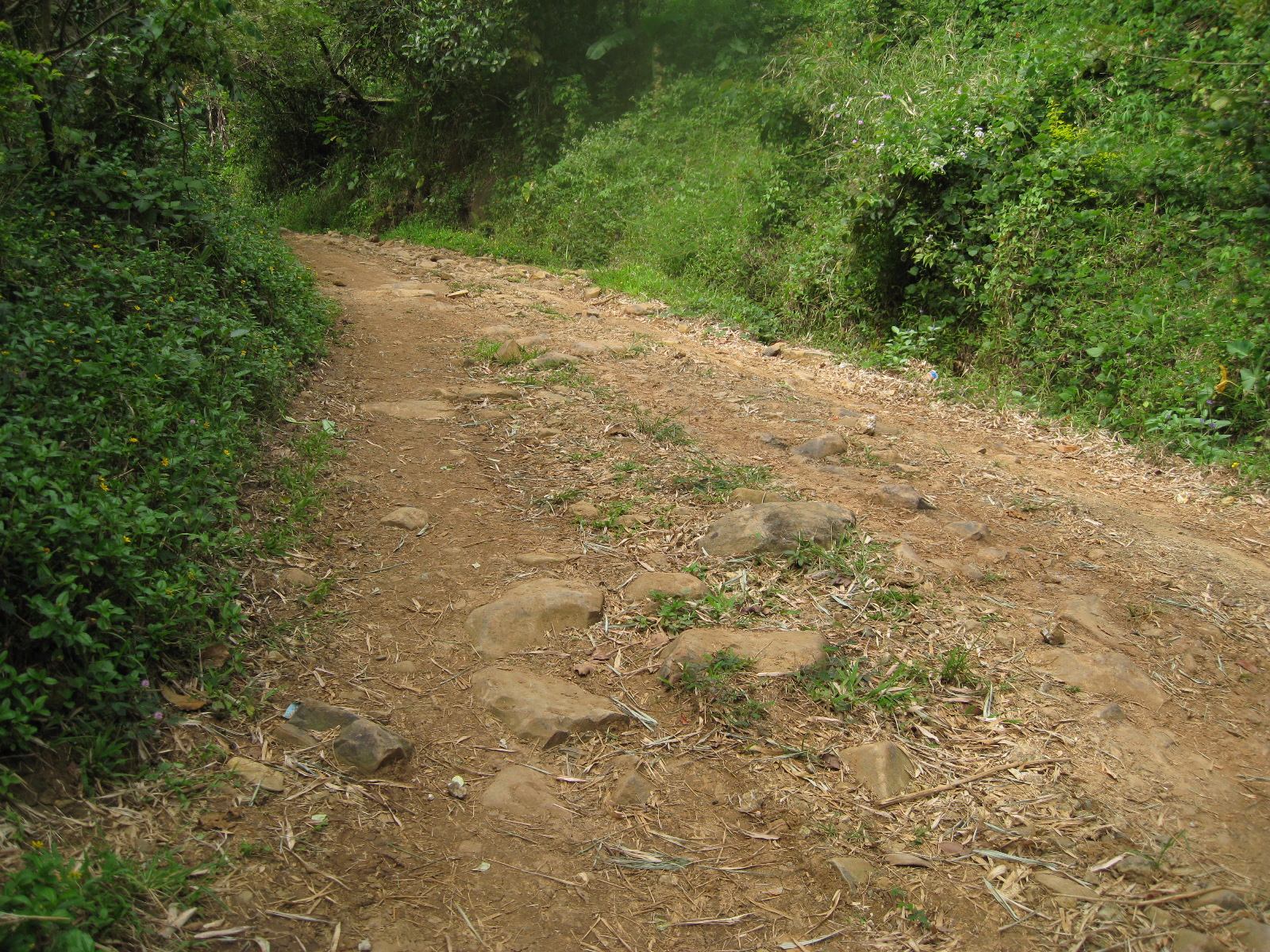
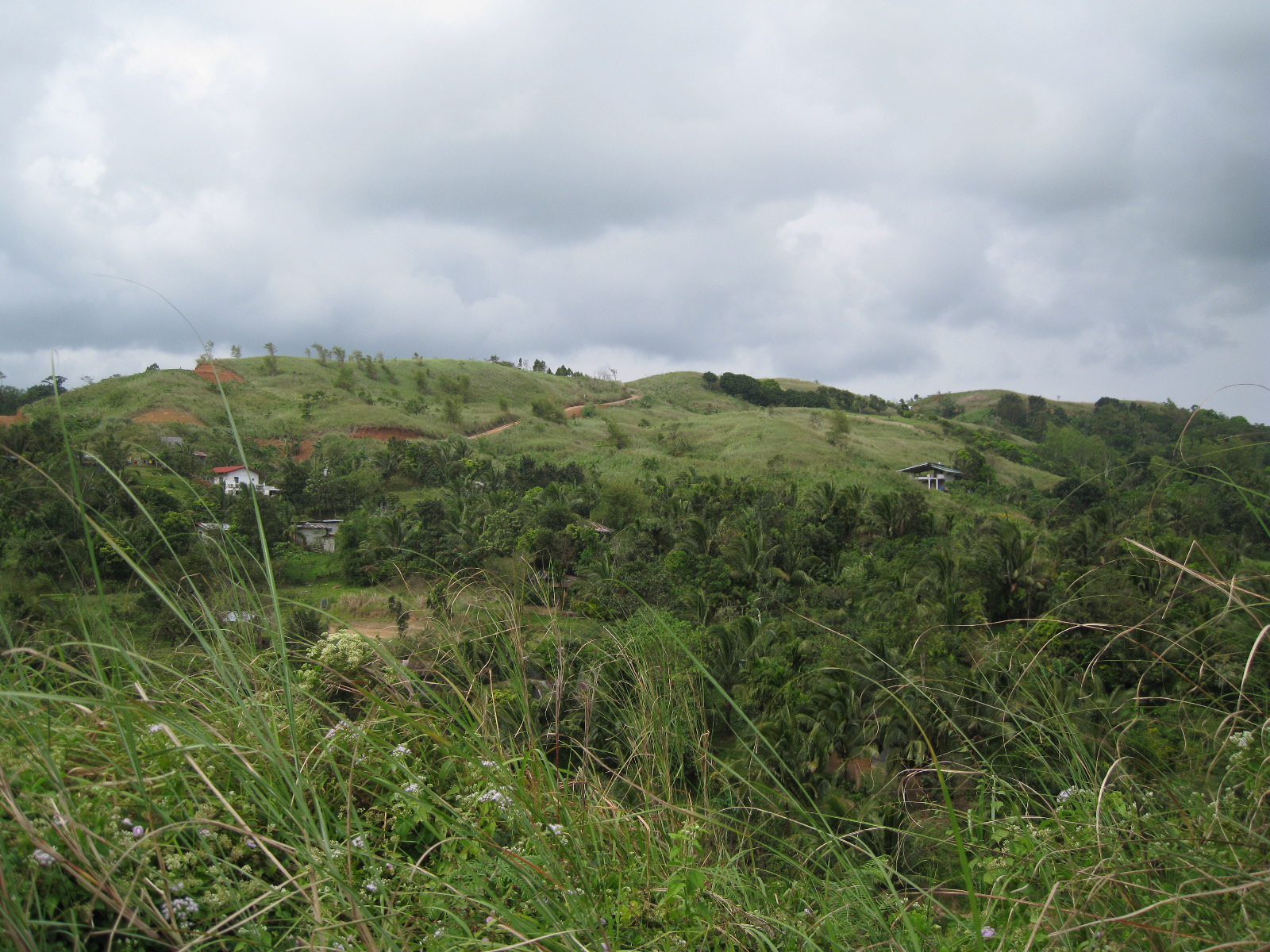
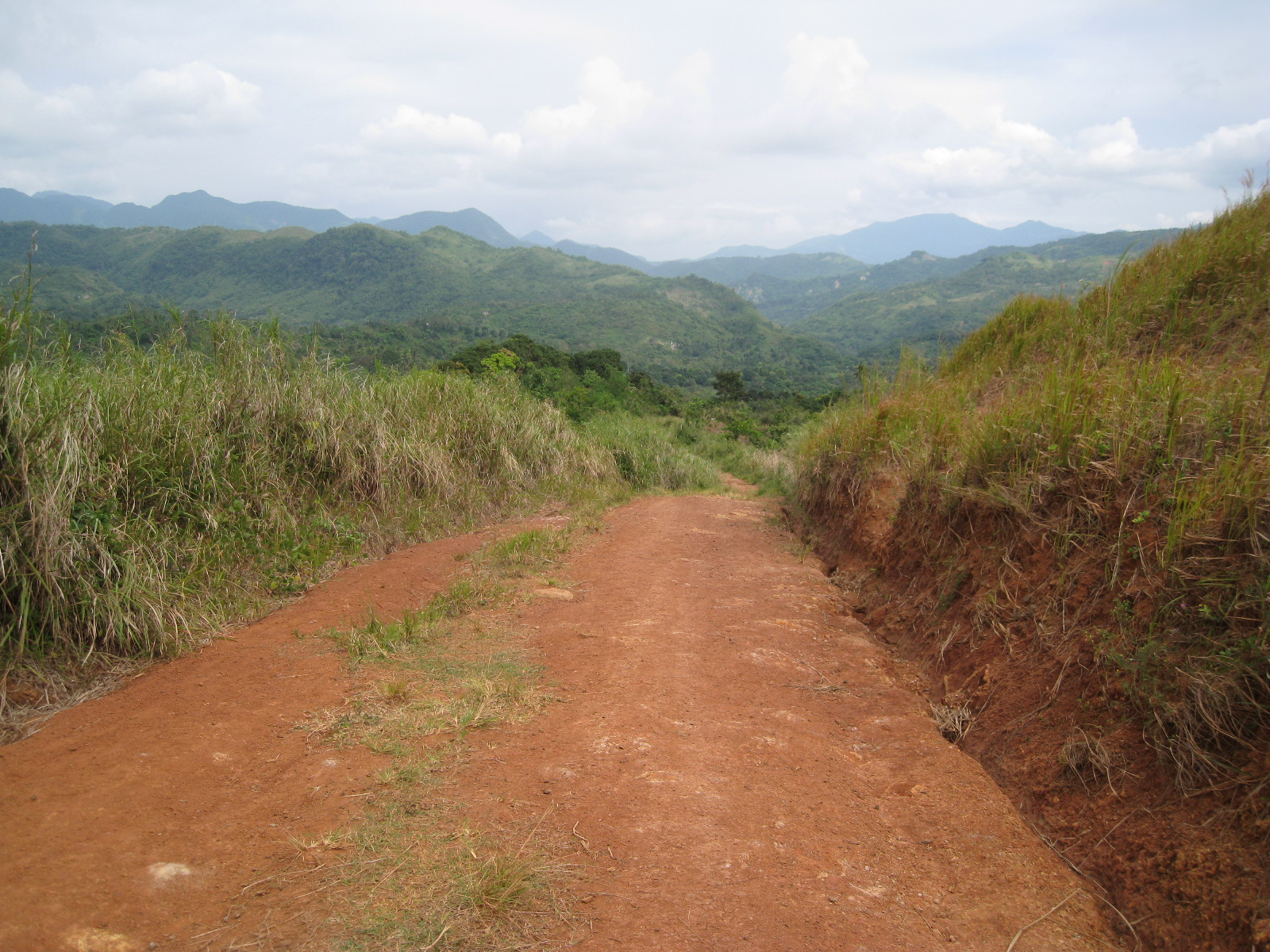
An Ulramarathon Trail Run somewhere in the Sierra Madre Mountains!!!

Clean Air, Quiet Place, & Challenging Route
With Some Water Obstacles
With Some Rocks...
Elevations from 400-800 MASL
Part of the 25-Km Loop Mountain Trail

If you are interested, you have four (4) months to train and prepare. Good luck!

Finding The Cure


1. Simply Rest—This is the first thing that I did after the PIM Pasig River Marathon.  For one week, I ate foods rich in carbohydrates and protein, drink a lot of water, and had full-time 8-hour sleep during nighttime. I tried to walk slowly with a limp around the house. It was a painful experience walking for the first week after the race.

2. Massage—Coach Salazar’s deep-tissue massage was finally introduced to my affected muscle on the 2nd week. I think I had 2-3 sessions with him for the duration of 3 weeks. My stiff Peroneus muscles slowly loosened up but there was still some inflammation and pain to other muscle strands located in between the peroneus and calf muscle. Coach Salazar taught me how to stretch my Peroneus muscles.

3. “Water Treatment”—My regular weekly visits to the Laguna Hot Spring in Calamba, Laguna had greatly improved and maintained my endurance level of fitness without much pounding on my legs. During these visits and immersion in the hot sulphuric water for a maximum of 6-7 hours, I did “water jogging”, leg kicking, leg flipping, and then later, swimming. I’ve been to this place for four times already and my stay here were fruitful as I came to meet more people and get more “insights” from the different sectors of the society.

4. Pain Reliever, Ointment & More Protein Drinks—On the third week, I started to take Alaxan FR before going to bed. Charlie Chua, one of the BR Runners with the Professional Group, suggested an ointment, Fastum Gel (Ketoprofen), for inflammed muscles which I’ve been using for the past two weeks. I also maintained drinking milk, Ensure and MILO’s 3-in1 For Adults (2x a day). All of these contributed to my recovery.

5. Join Road Races as Photographer & Cheerer—Watching the runners at the Start and Finish Lines during Road Races and taking their pictures while cheering them gave me the feeling and urge to recover immediately. I believe that positive thinking has a lot to do when someone needs to recover at a faster rate from any setback.

6. “Brisk” Walking & “Slow” Jogging—Last Thursday, I forced myself to an 8.5-Km distance “brisk” walking and jogging even if I felt pain on my affected leg. I was able to finish the distance in almost 1 1/2 hours. My workout was done in the mountains, 70 kilometers east of Metro Manila!

7. Deep-Tissue Massage (More Deliberate)—Aside from Coach Salazar, I have another staff who had been trained as “masseur” by the members of my Elite Team. He gave me a 1 1/2-hour massage after my 8.5-Km workout and I was crying and shouting in pain. The inflammation of my Peroneus muscle had gone but there is a tiny strand of muscle beneath the Peroneus muscle which needs to be loosened and my staff just patiently did the right thing. After an overnight sleep, the pain on my left lower leg is entirely gone!

8. Rest Some More & Start With a Training Plan—My injury is a blessing in disguise as I was able to rest from the grinds of training and joining in the past marathon & half-marathon races. However, I need more time to rest and do strengthening exercises through Pilates, Yoga, and Weight Training before finally hitting the road, track and trails. I will start a training plan for a 100-Mile Run soon!