The following are the meanings of the word “engage” taken from the Free Online Dictionary:
en·gage (n-gj)
v.en·gaged, en·gag·ing, en·gag·es
v.tr.
1. To obtain or contract for the services of; employ: engage a carpenter.
2. To arrange for the use of; reserve: engage a room. See Synonyms at book.
3. To pledge or promise, especially to marry.
4. To attract and hold the attention of; engross: a hobby that engaged her for hours at a time.
5. To win over or attract: His smile engages everyone he meets.
6. To draw into; involve: engage a shy person in conversation.
7. To require the use of; occupy: Studying engages most of my time.
8. To enter or bring into conflict with: We have engaged the enemy.
9. To interlock or cause to interlock; mesh: engage the automobile’s clutch.
10. To give or take as security.
v.intr.
1. To involve oneself or become occupied; participate: engage in conversation.
2. To assume an obligation; agree.
3. To enter into conflict or battle: The armies engaged at dawn.
4. To become meshed or interlocked: The gears engaged.
In my trail running’s “playground” and in other mountain trails that I run and visit, I always make it a point to greet the people that I pass, meet, and see along the route. It could be a simple greetings of “Good Morning or Good Afternoon” in the local dialect or ask the question “How are you?” (Kumusta kayo?). Saying such greetings must go with a smile on my face. Most of the time, the people I see along the trail would reply positively and I think something is being planted on the minds of this people about me and my companions.
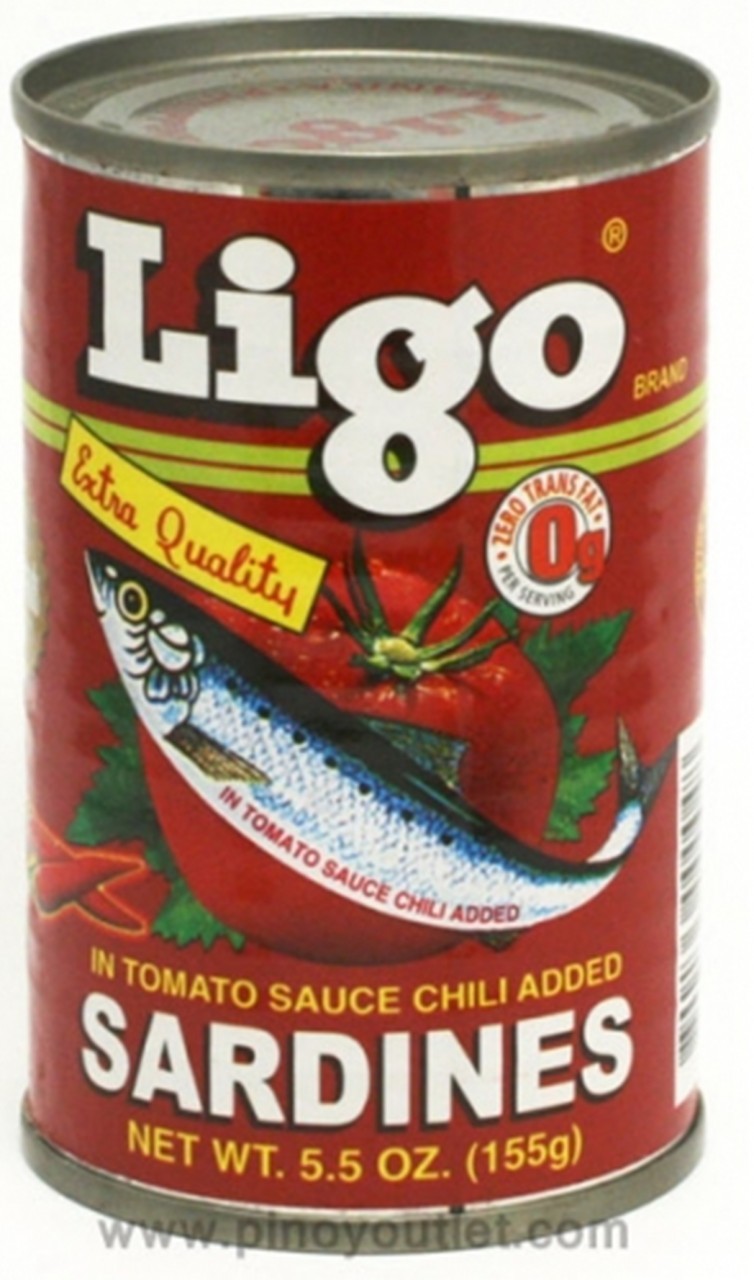
In places where there is a house/hut and family living along the trail, I would make such place as my “pit stop” where I could eat, sit and rest, and refill my hydration bottles from their source of drinking water. I would use and apply the “sardines approach” of building some friendship to such family. I usually talk to the head of the family and tell him about our activity in the mountains, tell him where we came from, request him for a brief stay for some rest and ask if they have a natural source of potable water. After eating our trail foods and refilling our water bottles and bladders, I would give “two cans of sardines” before leaving the place.
Ligo Canned Sardines @ P13.00 Per Can
A can of sardines is like a most treasured “pork ham” for these mountain people, of which I learned during my younger years as a combat officer of the Philippine Army scouring in the forests and mountains in Luzon and Mindanao. And sardines were also our most convenient food ration when we spent weeks in the deep forests and mountains. Sardines is also a form of currency when people in the mountains would prepare and butcher one of their livestocks for me and the rest of my men but such thing happens “once in a blue moon”!
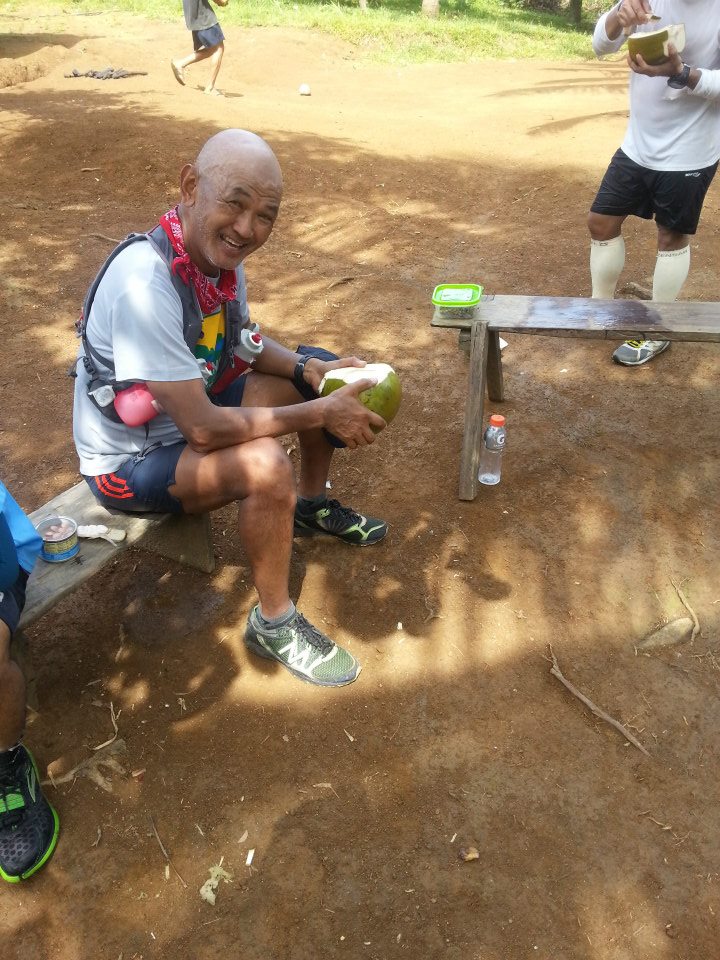
On my next visit to the place of the family during my runs, everything would be automatic and my group would be attended as royal visitors! However, sometimes sardines are too heavy for the next outings and we instead give the family some cash for whatever we would like to eat or harvest from their farm. A fresh coconut juice and soft meat would be a heavenly pleasure for me and my running friends.
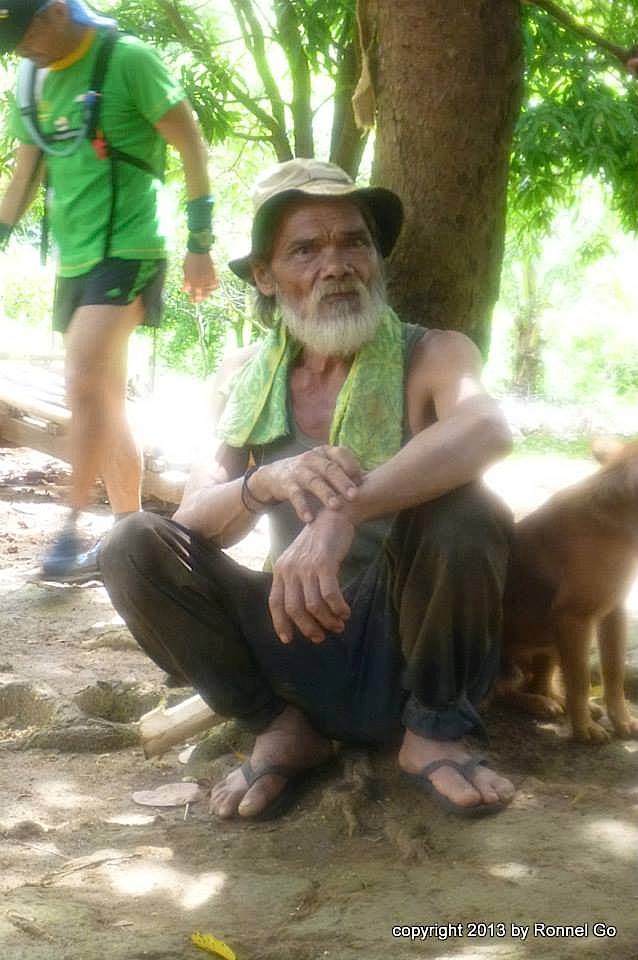
Mang Mario, The Farmer
In contrast with the other mountains and trails that I ran and visited, the people that I would meet, pass, and see would be the one who would take the initiative to “engage” me in a conversation! It is either they would ask for money or ask something from me. They would tell me that they have not taken their breakfast or at least, ask from me some loose change/bills for their subsistence. I am surprised why these people would be so brave to ask something to me and my companions. I would guess, it is the fault of the other people who would give something to these people whenever they are being visited in their own locality. In doing so, this mountain tribe would assume that visitors going or passing through their places have the means or cash or food to share to them.
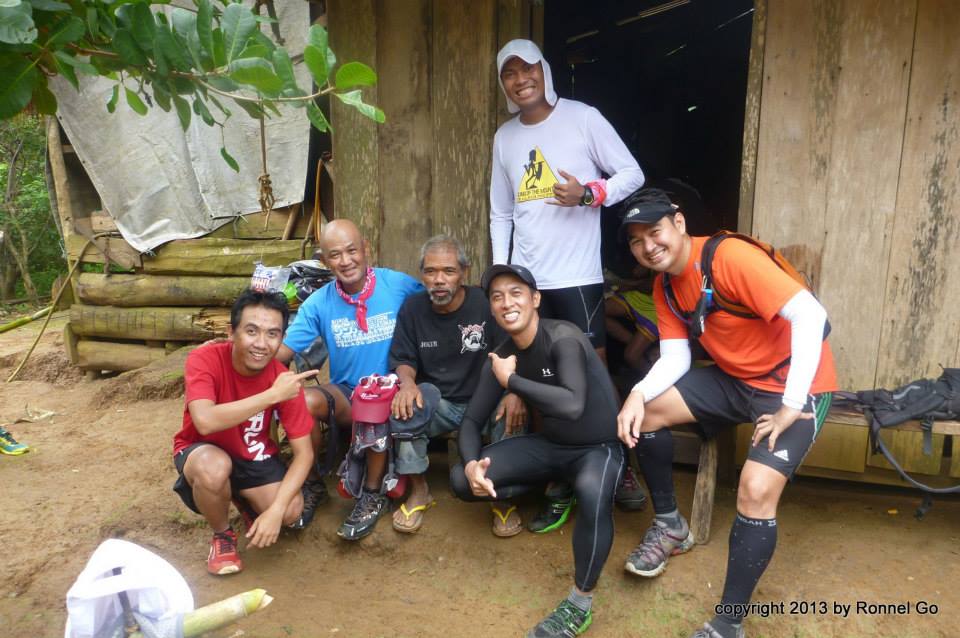
Mang Diego Garcia, The Jungle Survivor Expert (In Black Shirt & Sandals)
If you are a regular trail runner who would pass through the “farm”/orchard/property of the people or locals in the area, you have to respect and befriend them. You can apply my “sardines” approach and pay for whatever you eat and ask from the family. However, if you engage with some tribes who ask for something from you, it is either you ignore their request or give a little from what you have.
When I was growing up, Pinoy movies would be “copycats” of Hollywood Movies, whether they were about love, comedy, horror, thriller or action-filled movies. Action movies would revolve around fighting for justice, revenge, “cowboy” stories, secret agent stuffs with unbelievable gadgets, and lots of fighting, whether they armed or unarmed combat fightings between the main character with the rest of the cast.
Lately, Pinoy movies would deal on love triangle, betrayal of trust, and other social issues prevalent in the country or in any community or society. Sometimes, it would depict a fight or conflict between the rich and the poor families with an ending that gives some moral lesson to the viewers. Whether they are action, thriller, love story, or comedy movies, the viewer can easily depict the ending of the movie.
I think that since the early 70s, I started to draw myself to Hollywood Movies and did not had an opportunity to watch Pinoy Movies. However, I would watch some of the action movies of FPJ where he portrays being a policemen, a soldier, or simply somebody who defends those who are oppressed.
After 40+ years, I was tempted to watch a Pinoy movie.
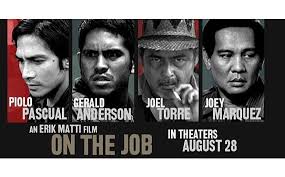
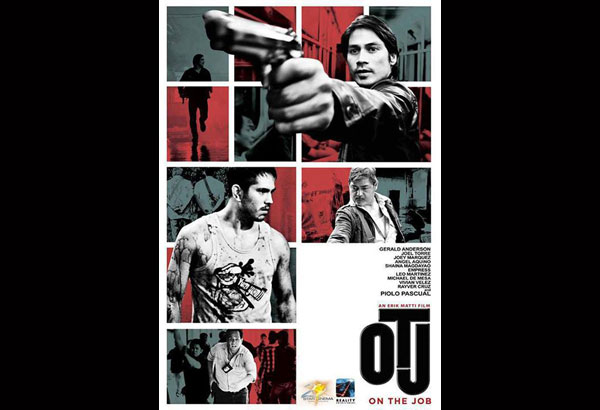
Movie Ads From The Internet (Google)
The movie “On The Job” is completely a different genre of a Pinoy Movie which was brilliantly and perfectly presented from a story that is based on actual events. The movie portrays a “rotten and corrupt” system from the top of the government up to the very basic unit of the society which is the family. In between such spectrum, we have the law enforcement agencies; the prison system; and the convicted felons serving their respective sentences inside the prison. Generally, the story revolves around an old and young prisoners who are “hired contract killers” who could get out and in the prison with ease when they are ordered to “hit” their target.
The “twists and turns” and climax of the story are very jolting to one’s senses and differs from the mind conditioning that we expect for a much favorable ending of the movie. It will keep your mind asking for answers for the “why” such things happened in the movie story. There might some small “flaws” and inconsistencies on the characters and the technical aspects of the movie but they are not significant to affect the general story and message it wants to share to the viewing public.
The movie is simply outstanding and it strikes to the very core of our “problematic” society and corrupt system of governance.
If you ask me why I am doing a movie review in a runner’s blog? It is because the prisoners, with their lack of better nutrition, training, and physical conditioning system, are better RUNNERS and SHOOTERS than the law enforcement personalities portrayed in the movie story.
With the things that are presently happening in the country right now, I just wish that our political leaders and the institutions that are part of the justice and penal system of the country will be able to see this movie and serves as their “mirror” and maybe, do something to correct the “rotten and corrupt” system.
If a policeman would be able to pay for his “banana cue” from a poor lady looking for an income for her family, then, that would be a good start to correct the situation we are in.
In my road runs, I find it more relaxing and comforting when running alone enjoying the scenery of the things that I could see along the road. I would concentrate on my running form and let my legs and feet land on the ground as if they are well-oiled machine pumping until I need to slow down my pace or just simply have my walking breaks. In the comfort of road running, everything is automatic and I could cruise along with my comfortable pace.
In my trail runs, I always have the company of one or two of my athletes/”trainees” as my safety runners or pacers. I don’t run along the mountain trails alone and it is my number one rule in trail running. You may never know when shit happens!
Some of my friends started to ask about my “playground” in trail running when I started posting my pictures on Facebook and they showed some interest in trying to find out about the place and experience what it is like to run in such place. Anybody can go to this place as it is open to the public but one needs to inform the barangay or the village that you are there to run or hike.
It took me some time to figure out and discover a trail loop that ends up to a distance of 18 miles or 28+kilometers which could be extended up to 50 kilometers. But the 18-mile loop is already a very challenging route that would take me 6 to 6 1/2 hours of pure trail running. How I wish I could get the correct cumulative ascent descent in meters/feet on this course.
I really do not invite runners or my running friends to this place. I let my friends do the initiative to personally contact me through Facebook (Personal/Private Message) or simply send me a SMS if they are interested to join me in my weekend trail runs in this place.
Last Saturday, one of the “usual suspects” in my Ultra Races decided to have his Birthday Run in the company of his friends and some of my ultra friends also contacted me that they would like to join me in my weekend runs. So, on that day, our group consisted of seven runners with one pacer and one sweeper, nine runners in all.
We started the run after breakfast at around 7:00 AM. The first 200 meters of the course is an uphill where nobody would dare to run and I usually use this uphill climb as my warm-up hike. After the first kilometer, everybody would cross a river and all our shoes would be soaked and wet. After crossing the river and with a heavier shoes, the group would start to jog and run for a slight uphill within a single-track trail covered with grass.
The trail is a semi-technical trail where you need to keep your sight on the ground and decide quickly where you would want your feet to land. There are streams to cross and muddy portions where you must avoid or let your shoes be buried in deep mud. There are some dogs and there are some herd of cows and carabaos. The cows, even if they are tied with a rope, would run after us during our runs. The carabaos are more calm when their bodies are completely soaked in some mud pools along the route. Just don’t mind the smell when you pass these mud pools!
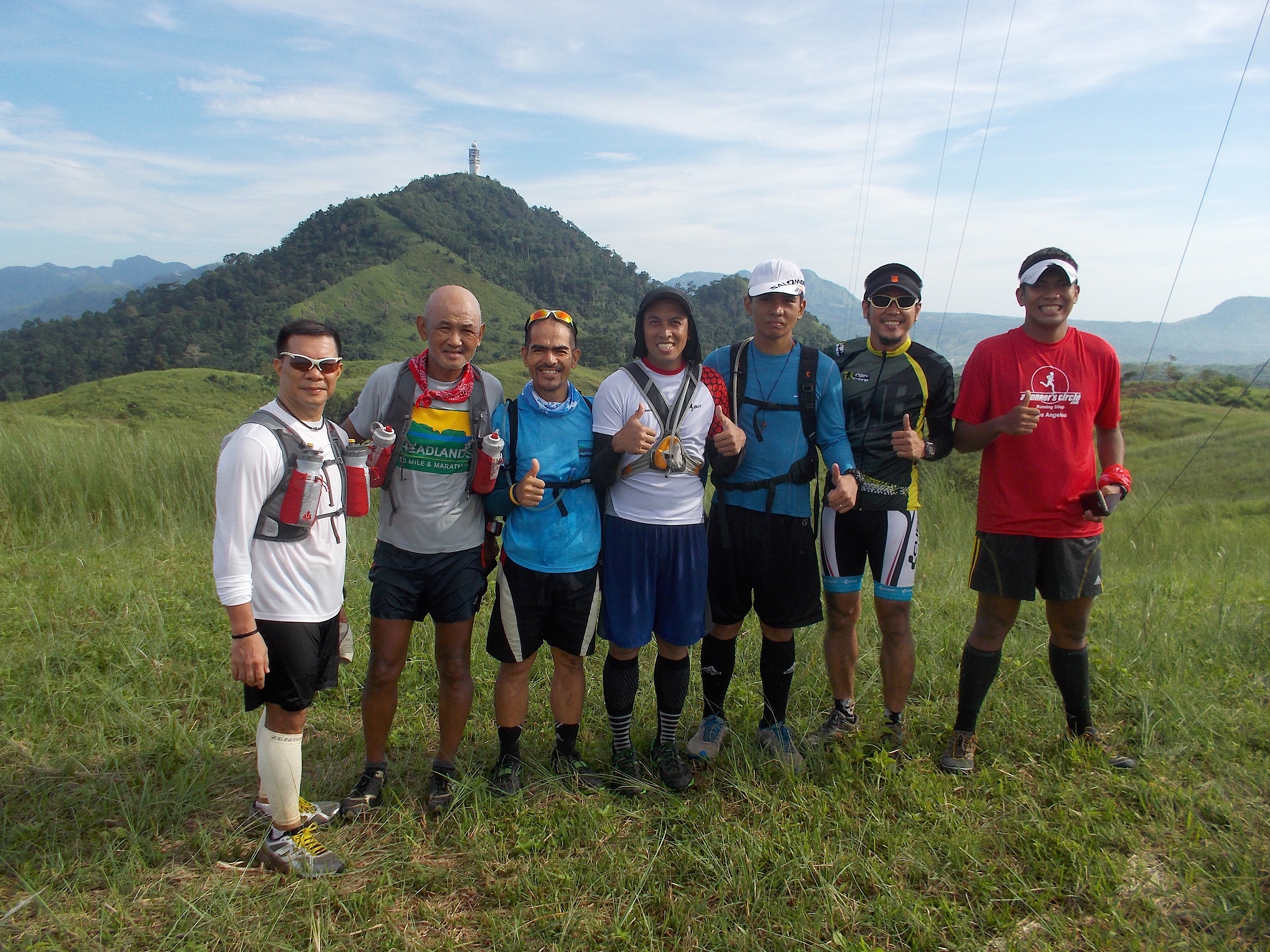
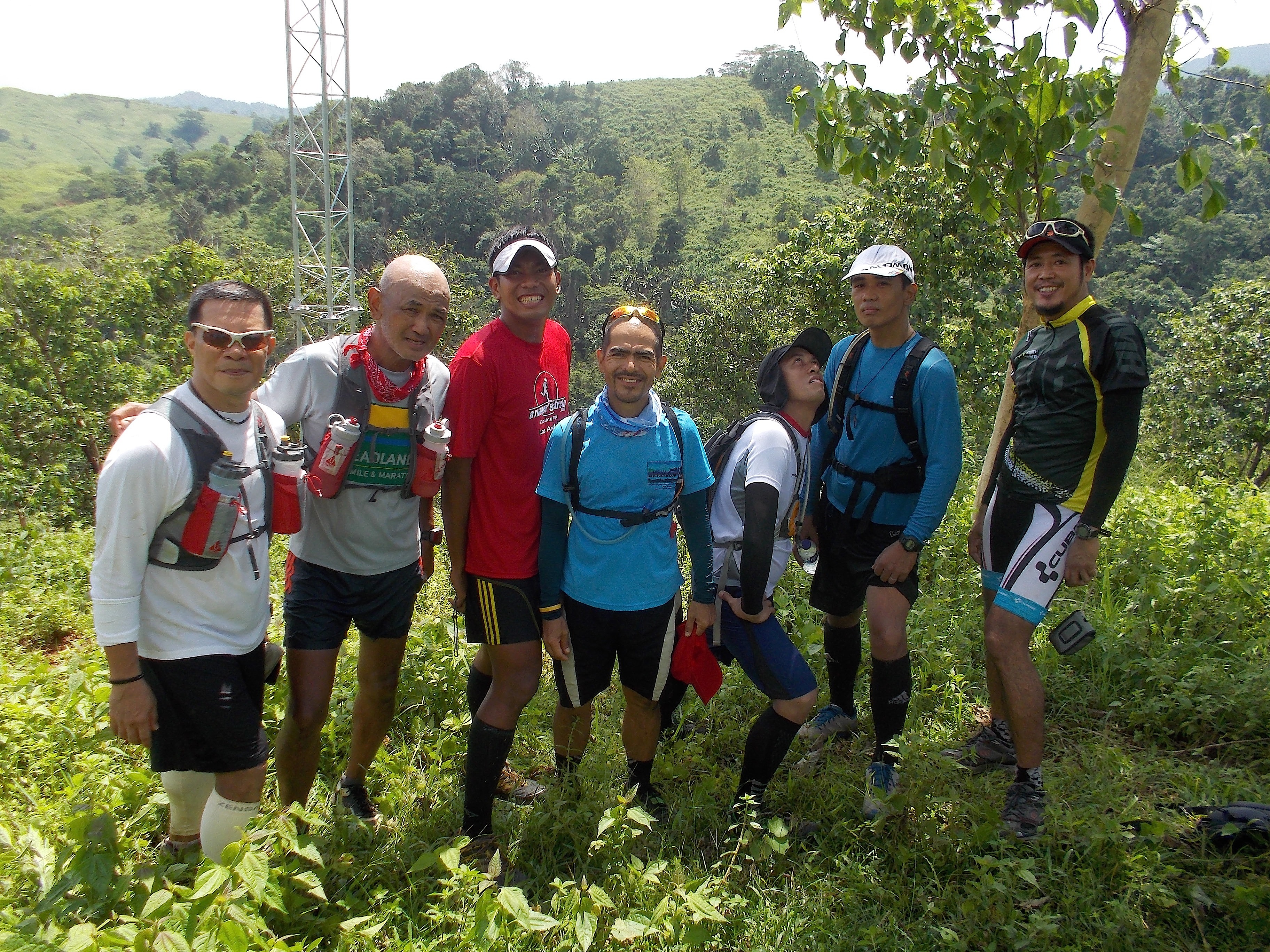
Seven Runners @ The First Antenna
We usually reach our first stop after 1:10-1:15 hours of running in a nipa shed/hut with benches around it and the registered distance in our GPS watch is 6.2 kilometers. An antenna (weather or radio signal purpose) is located near the hut. We usually have our first picture taking in this place and spend at least 5 minutes of stay in this place.
From this 1st antenna, we go downhill towards another river and after crossing the said river, it is all uphill again. Once we reach a wider trail road, our next goal to reach is the other antenna which is located 7 kilometers away from the first one which is located in a higher elevation. Hence, I call this trail loop as “Two-Antenna” Trail Loop.
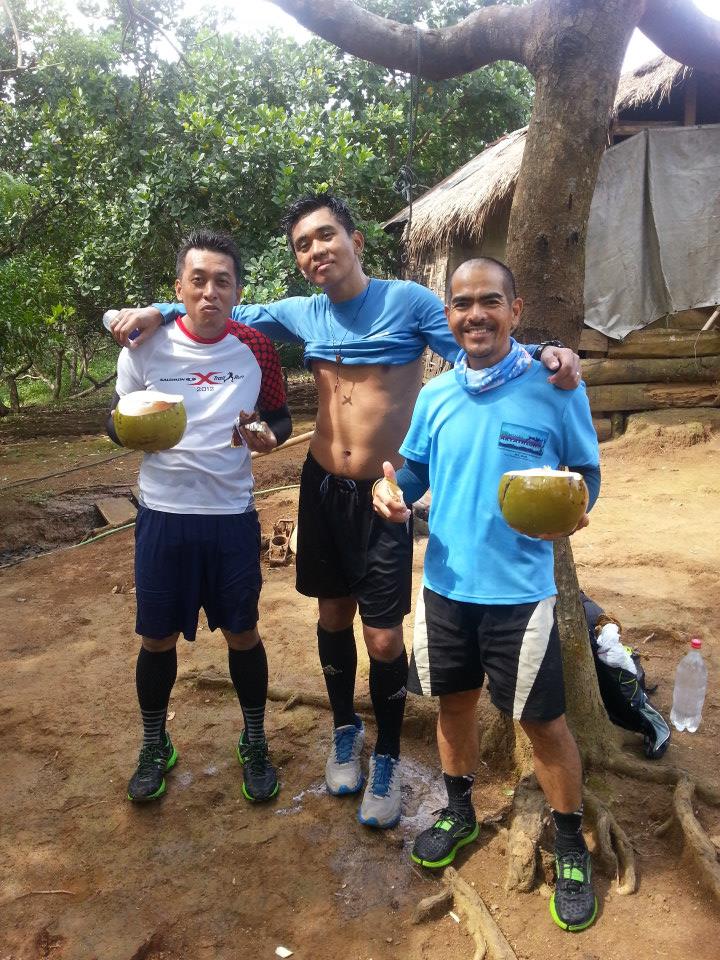
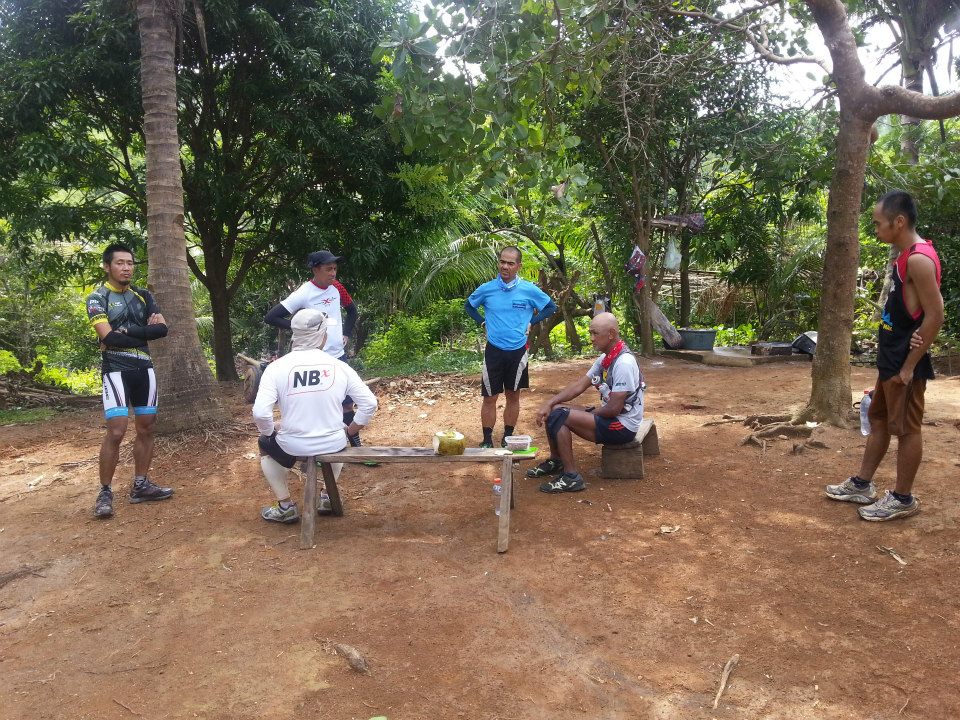
Fresh Coconut Juice In Mang Mario’s Farm (Photo By Ronnel Go)Somebody Is Telling Me Some Jokes! (Photo By Ronnel Go)
After the uphills, downhills and some flat areas, we would cross two big streams until we reach the farm of one of the locals, Mang Mario. This is where we refill our bottles with water; have a taste of fresh coconut juice direct from the tree; hydrate & eat some snack food we carried and another chance to take pictures. I usually talk to Mang Mario and his wife and later give him some packs of “Pentagon” Cigarettes, his favorite brand, and some cash to pay for our coconut fruits before we leave his farm. Well, for the past 2 months that I’ve been dropping by in his farm in my runs, Mang Mario and I became friends and he knows what runners would need when we stop in his place. He would offer his benches for us to sit and order his son to pick some coconuts immediately. This is a result of my “sardines approach” in winning some of my friends in the mountains.
Serious Discussions On Trail Running & Ultras (Photo By Ronnel Go)
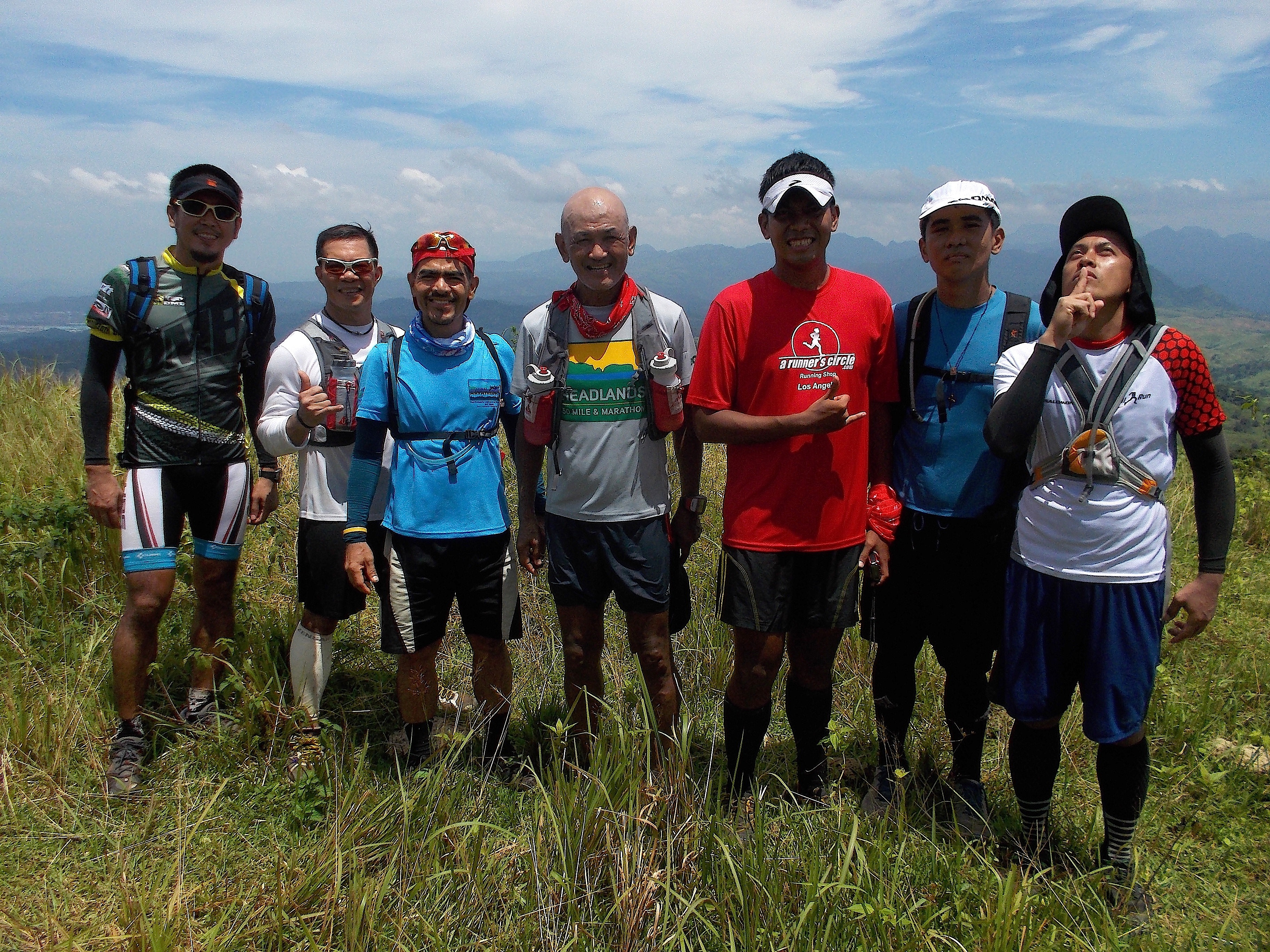
After one kilometer of uphill climb from Mang Mario’s place, we would reach the 2nd antenna and the scenery of the place where we came from (1st antenna) is just amazing! It calls for another group picture with the antenna and the grassland/mountains around as background!
At The Second Antenna
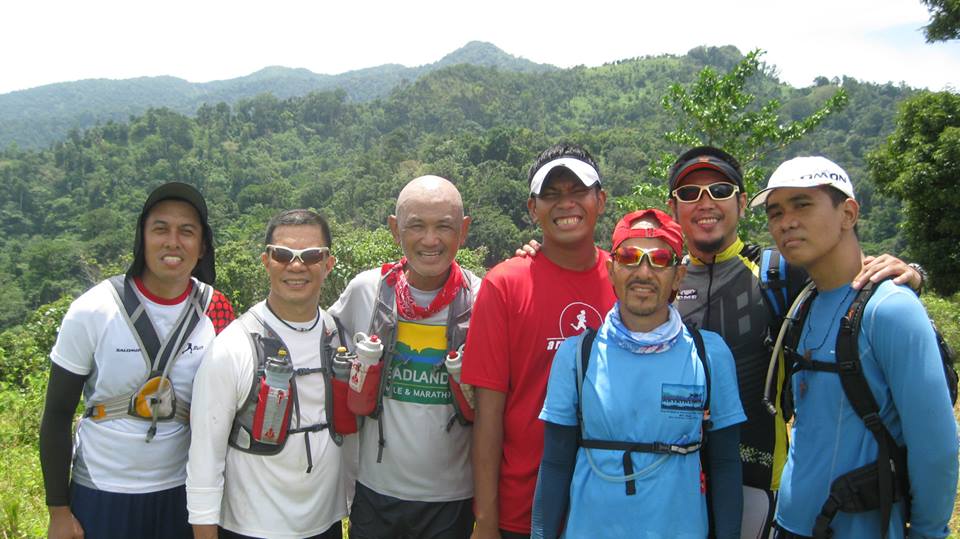
The next two kilometers will be steeper climbs until we reach the highest point of the course which is registered at 550 meters above sea level. I consider this place as the halfway/turn-around point of the course. The scenery is getting better as we go higher in elevation and it calls for another group picture! This is where we eat the remainder of our trail foods with some “ice drops” which we call “Joy-Joy”. They give joy for the tongue and mouth because of its sweet and cold taste. They are “life savers” when the heat of the sun is almost under our heads!
Closer View of the Runners (Photo By Roy Garcia)
After 10 minutes of rest, it’s time to go down to a “roller coaster” elevation of hills until we reach the 1st antenna but the place all around are grassland where there are no trees to provide us with cover from the heat of the sun. The distance is 7 kilometers from the turn-around point to the 1st antenna. This is where we fight it out with the heat of the sun, from the hot air and from the heat of the ground with what remains in our water/hydration bottles. This is also a stretch of the course where the runners would race with one another to reach the 1st antenna. Well, I usually position myself at the back of the pack with the “sweeper” behind me all the way to the first river/stream that we crossed! This would prevent the new ones to this course not to get lost when one could not see the runner in front of him.
At The Highest Elevation Of The Course
It is good that the house of one of the “cowboys” or cattle caretakers, which is also a friend that I came to develop and know since I started running in this area, is located near the 1st antenna. This is where we can have our re-supply of water which is enough to bring us to where we started.
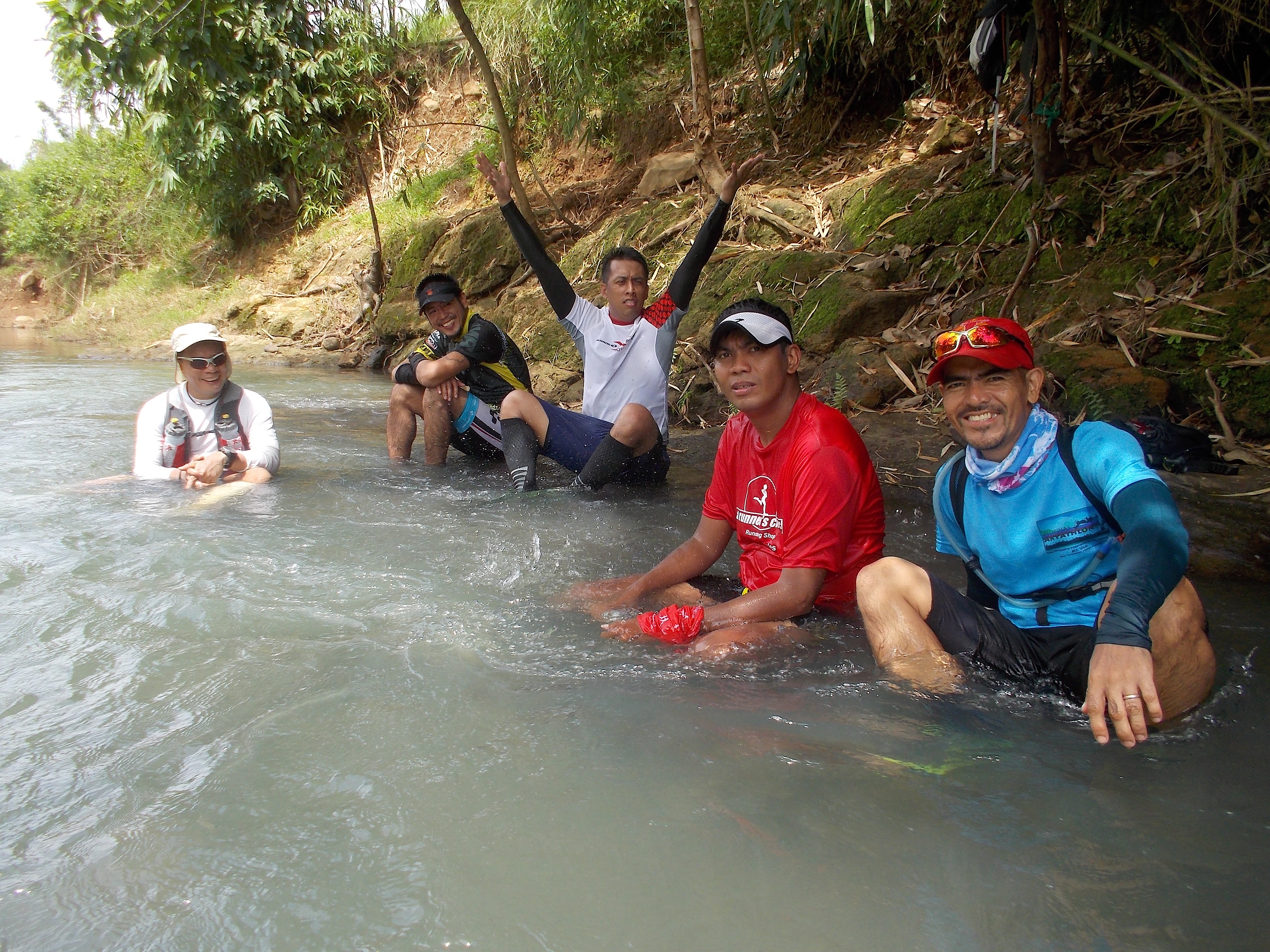
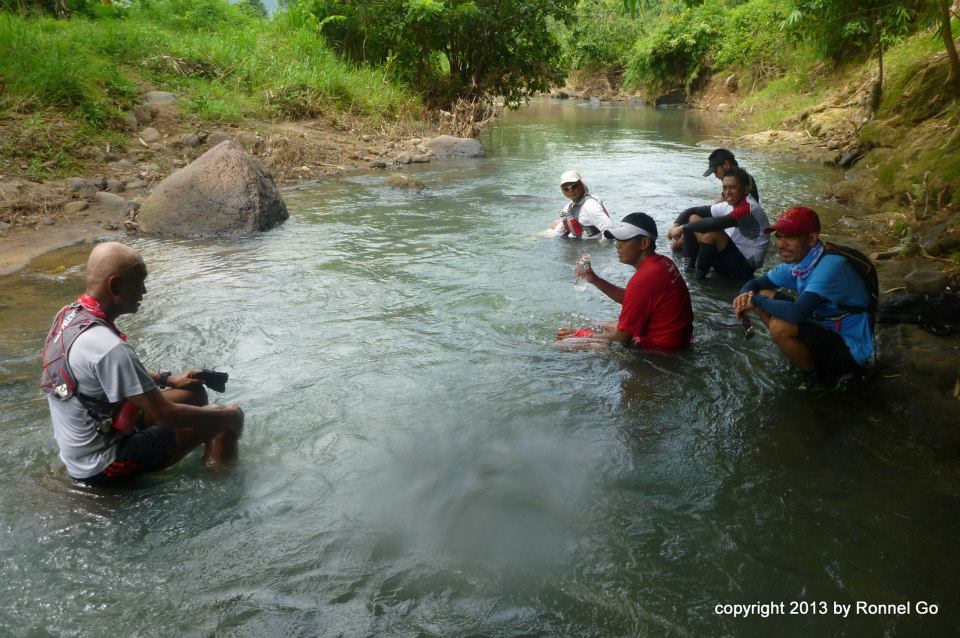
From the 1st antenna, everything will be relatively downhill and the distance to the first river is 6 kilometers. Reaching the first river is a relief for everybody. We would check our watches and we could not believe that we spent 6 1/2 hours along the course. We thought that we just spent 3-4 hours of having fun in the mountains! It is in this river that we start cleaning our shoes from the mud; cleaning our feet and legs; and simply soaking our tired legs with cold and refreshing flowing water while waiting for the last runner and “sweeper” to arrive.
Cooling Off Our Tired LegsMy Position With The Group In The River (Photo By Ronnel Go)
Ice-cold Coca Cola drinks would be our initial “prize” for finishing the run and followed with a recovery meal which would also serve as another “carbo-loading” feast for the next day’s long run!
What I like with my running friends when they are with me in my “playground” is that I could not hear any words of complaint from them even when there is an intense heat from the sun in the middle of the day or when the trails are slippery during inclement weather/rainy days where some would fall on their knees or butts.
These runners are “hardcore” and “monsters” on the trails!
If you are interested to experience what these runners went through, there will be a scheduled trail running 101 training camp for a day which is strictly limited to only 10 runners. Further announcements on this event will be made through Facebook.
(Note: This post is to make tribute to an ultrarunner who sponsored and hosted two of my Team Bald Runner’s Elite Athletes’ participation in this year’s Hongkong 100K Ultra Trail Run)
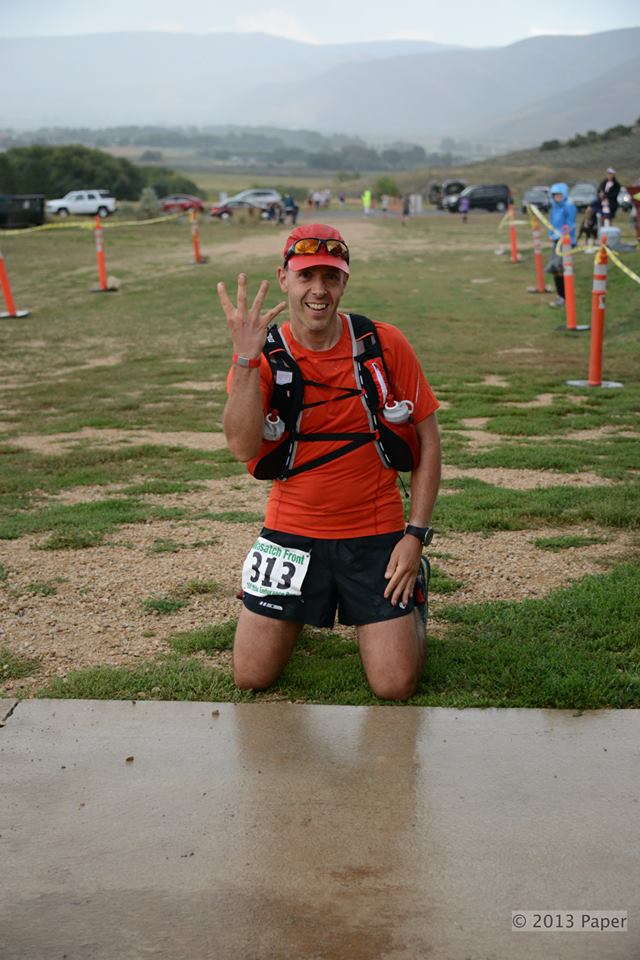
While we were having lunch in one of the hotels in Hongkong a day after the HK 100 Run last January of this year, Andre told me that his goal for this year is to participate and finish the 2013 Grand Slam of Ultrarunning in the United States. When I asked why he was going to aim for such feat where an ultrarunner has a limited time to recover in between races, he answered, “I am not getting any younger and I will try to focus my training to finish all the races”. I just replied to him that how I wished I was still young and be the same with his age. Andre is 43 years old.
The Grand Slam of Ultrarunning in the United States consists of four (4) of the oldest 100-Mile Trail Runs which one has to finish within a span of 10 weeks from the last week of June to the 1st week of September (a week after the US Labor Day). Basically, it covers the whole summer season in the United States. One has to finish the following races in the following order: First, Western States 100-Mile Endurance Run in California; Second, Vermont 100-Mile Endurance Run in Vermont; Third, Leadville Trail 100-Mile Endurance Run in Colorado; and Fourth & Last, Wasatch Front 100-Mile Endurance Run in Utah.
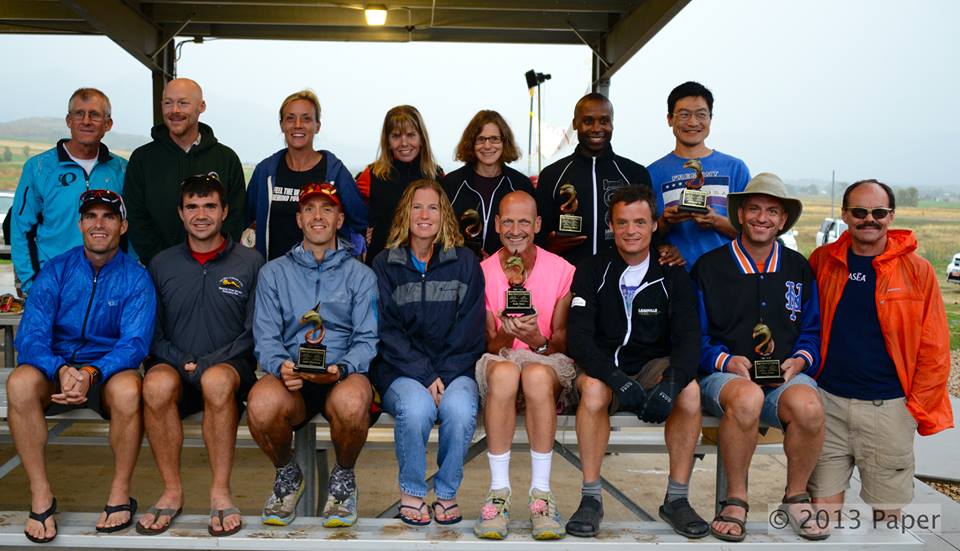
Andre @ The Finish Line Of Wasatch Front 100 (Photo By Paper)
This Grand Slam of Ultrarunning started in 1986 and after 28 editions, there are only 254 ultra runners who finished the said series. Andre Blumberg placed Hongkong as one of the few countries represented among the list of finishers in this series. He is the first Hongkong resident to have done it!
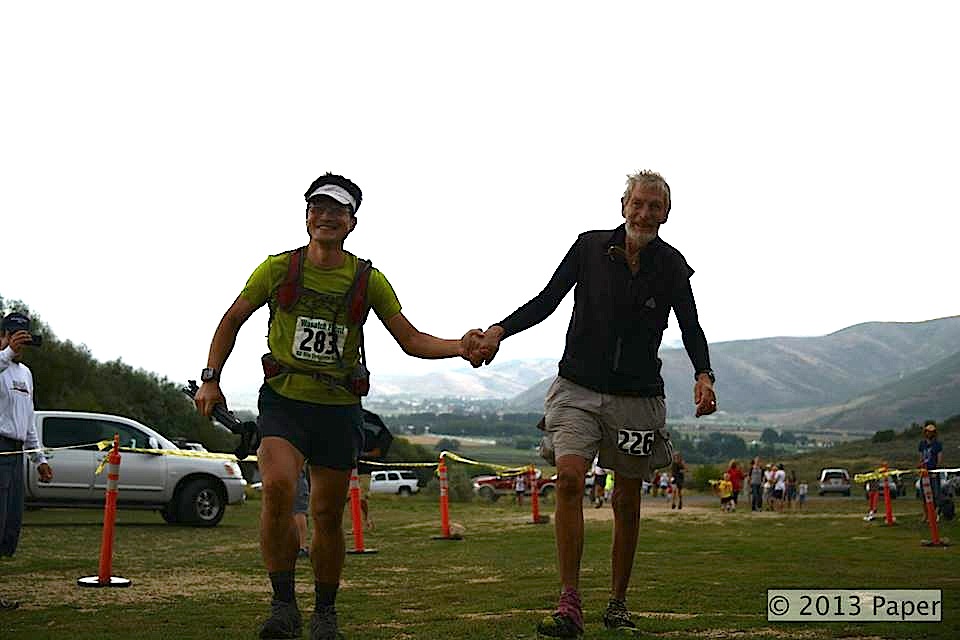
Ultra Runners Get Stronger As They Become Older (Photo By Paper)
After browsing the pictures taken by Paper, wife of Andre, on Andre’s Facebook Wall, I saw this picture of a 73-year old finisher of the Wasatch Front 100-Mile Endurance Run. The guy is Hans-Dieter Weisshaar, a German ultra legend with about 150 finishes of the 100 miles distance, also a Grand Slam Finisher in the years 2000, 2003, and 2005, at his age, I feel inspired to be able to reach this age and still running ultra marathon races! (Note: The runner beside him is Chihping Fu of California who is one of this year’s Grand Slam Finishers!)
After all, Andre was right. We, the ultra runners, are not getting any younger and we try to challenge our limits of physical endurance and spirit in our training and races. This defines our endurance sports which we dearly love and respect.
I bought this pair of trail shoes from Zombie Runner Store in November 2010 and I am still using them in my trail running. This pair of shoes might have reached more than 800 kilometers for almost 3 years that I’ve been using them. However, I am not sure if this kind of model is still available in the market.
This trail shoe is durable and it is only today, after running 28 kilometers of trails, that I’ve seen the glue of the sole to the uppers starting to open up at the right toe box. For the price of $85.00 then, it is worth using it where I did not have any injuries or any problems with my feet and legs.
The shoe is very light, for a weight of 7.2 ounces in size 9.5 inches, and considered as “minimalist” trail running shoes. Even if it is soaked with my sweat or wet due to river/stream crossings, the shoes is still very light. The water that would enter the shoes could be easily extracted or dried up due to the porous nylon upper mesh. Due to its lightness, I would usually use it for my speed interval workouts at the oval track and tempo runs over paved roads.
New Balance MT 101 Trail Shoes
The elite ultra trail runner who designed this particular model uses it without socks. However, I never tried using this shoe without any socks. Even if I used socks with it, the toe box is very wide and it gives a plenty of room with my toes which is the most that I like with this model. As compared with the other trails shoes that I have, this has the widest toe box.
Sole Of NB MT 101
The treads on the soles are not suitable for the muddy and sticky trails in the country, although they are good in running on rocks. The treads are very durable and they are responsive in hardened and dried trails. The shoe has a toe-heel drop of 10 mm according to its manufacturer’s specifications but when I use it, I feel that the drop is less than what is stated.
Since it has a wider toe box than the other trail shoes that I have, I usually tighten the laces to feel a well-snugged fit to my feet. In doing so, the lace would still be very long after doing double-knot tie. To keep it from “flying” on the sides of the shoe, I would insert the exposed lace under two criss-crossed laces over the tongue of the shoes.
My plan is to have the sole and uppers to be stitched with one of the local shoe repair shops and have it handed down to one of my elite runners who have wider toes.
This particular trail running shoe model is highly recommendable.
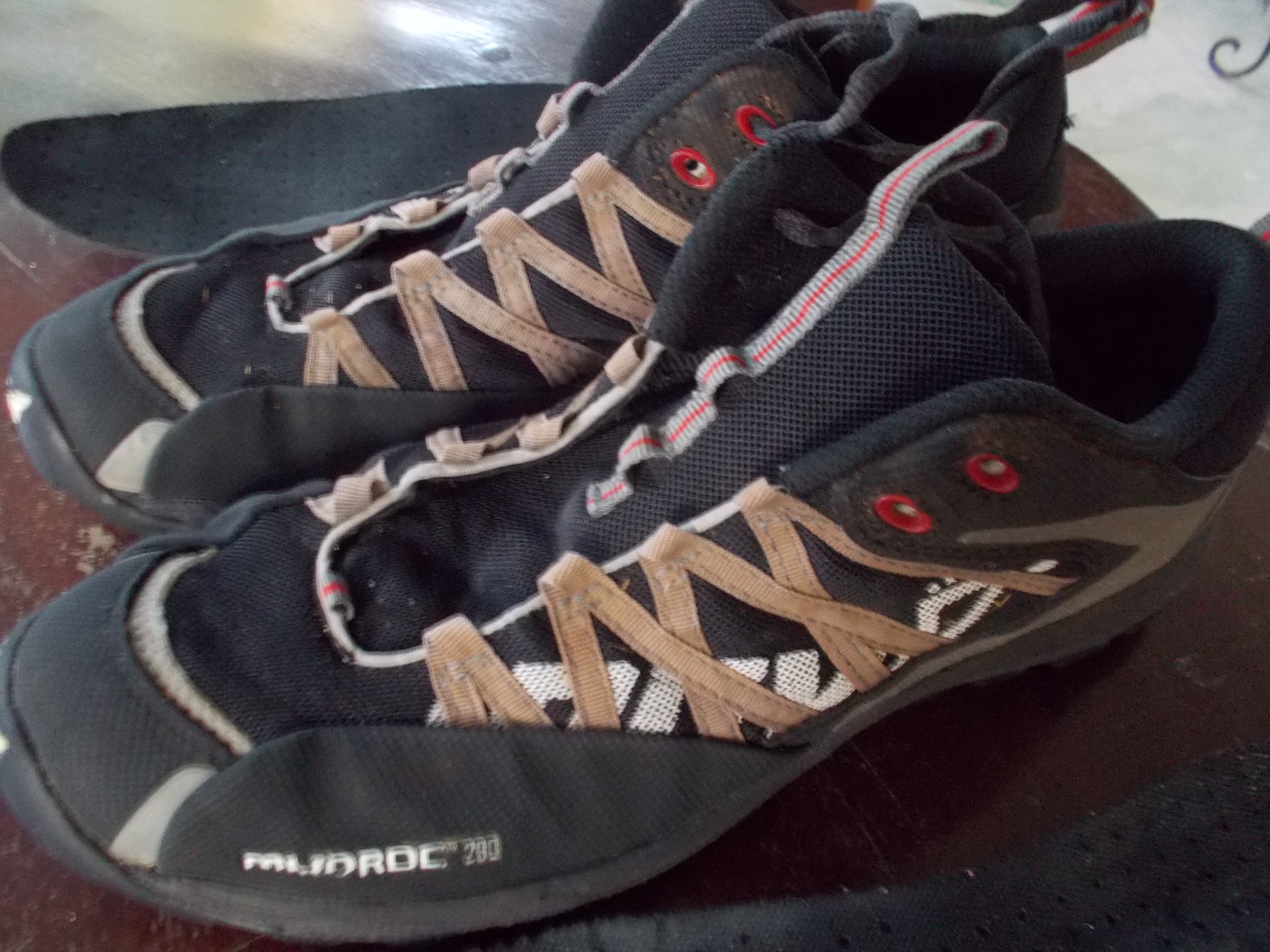
INOV8 Mudroc 290 Trail Shoes
I bought this pair of trail running shoe in one of the local shoe stores, Athlete’s Foot Store, which was sold On Sale last February of this year. I bought it in less than P 3,000 and it was the only one left in their inventory. Buying it was a good decision.
It was my first time to use this brand of shoes and it was only when I bought it when I started to browse in the Internet trying to find out about the specifications of the said model. Mudroc 290 is tagged as the Original Mountain Trail Shoes and it is really true!
INOV8 Mudroc 290
The first thing that strike me was the color. It’s black and I liked it. Second is the lacing system where there are no holes on the uppers but nylon strip sewed on the sides of the shoes and it has two holes/slots on top of the tongue where the laces would pass through. I guess, it is a breakthrough in a new kind of lacing system where it keeps the uppers and tongue in a snugged fit to the fit and keep the debris from entering the shoes while running.
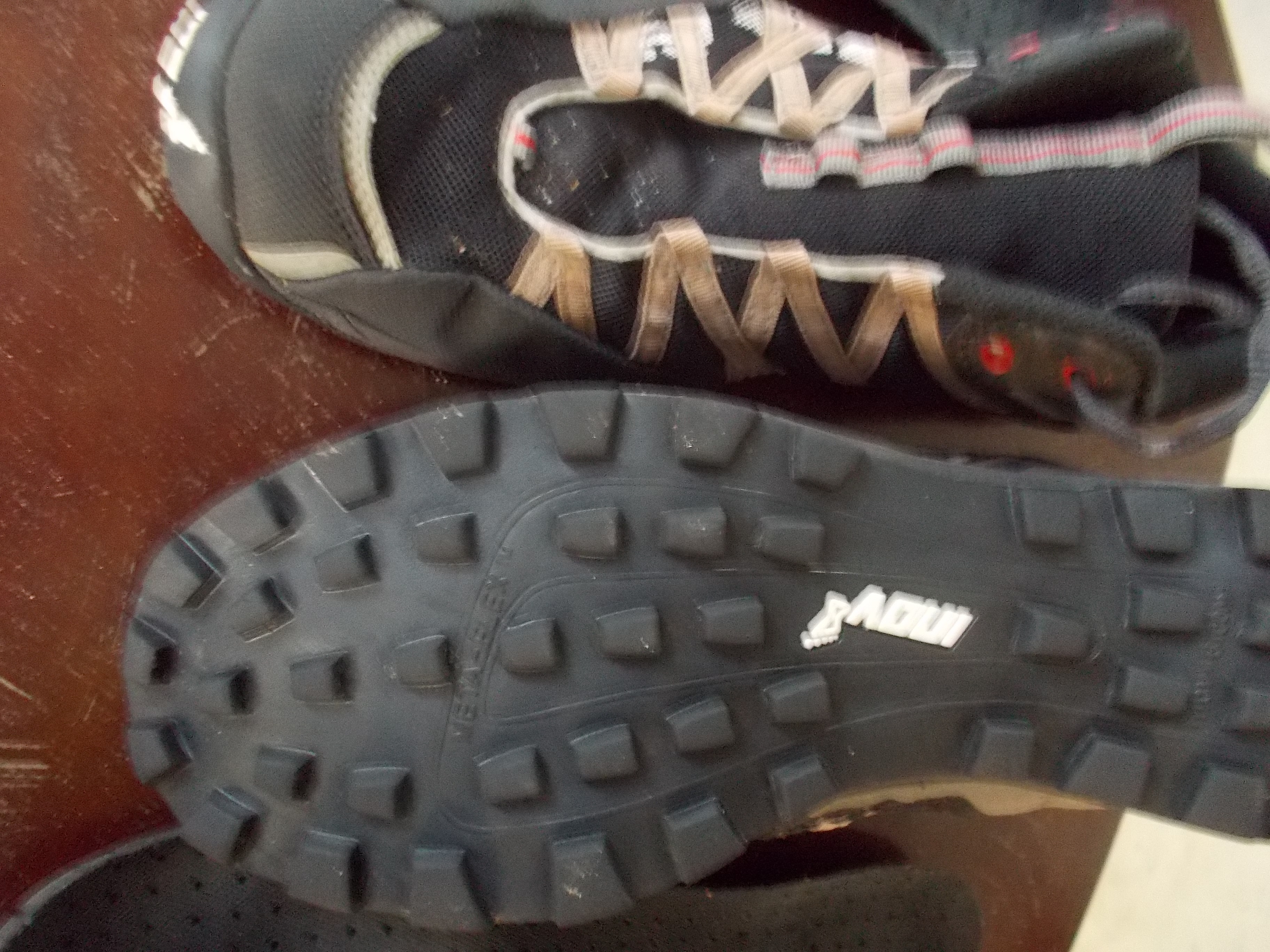
Sole & Tread Of INOV8 Mudroc 290
Third revelation for this trail shoes are the treads on their soles. They are much thicker and more aggressive/pronounced than the New Balance MT 101.
It weighs 10.2 ounces/290 grams (thus, the numbers attached to the mode’s name) and has a toe-heel drop of 6 mm. It is also considered as a “minimalist” trail shoes but is far heavier than the NB MT 101. Additional weight is put into the shoes when it is wet after crossing some streams/rivers and it takes time to make it drier while running which is the only negative observation I had with this pair of shoes.
I immediately put on lots of mileage on this shoes when I prepared/trained for the 2013 TNF 100K but on the first few times that I used it, I would loosen the tightness of the shoe laces as the back portion of the shoe would rub on my right achilles tendon which resulted to some pain most specially on steep ascending portions of the course. However, after using it for some time, the heel counter’s cushioning had loosen up and it did not bother my right achilles tendon.
As the name of the model would imply and describe, the shoes is really perfect for wet, muddy, and sticky trails. I never had any experience of slipping or dropping on my butt on slippery trails using this shoes. This shoes really rocks on mud!
As compared with the New Balance MT 101, the toe box is very narrow but it fits well with my feet as I want my trail shoes to be well-snugged to prevent debris from entering the shoes.
In conclusion, these two trail shoes are very good choices where one would use in different environment conditions—if the trail is wet and do your workout during inclement weather, the INOV8 Mudroc 290 is the best choice; and if you want to run faster on dried or sun-baked trails, the New Balance MT 101 is the lightest shoes for your run.
Most of my training runs are done in the mountain trails with the assumption that the mountains in the Philippines are public domain and owned by the government. Some of the other mountains are declared as National Parks but one could see the lack of administration and governance of these parks. I have yet to see a mountain that is well-managed with trails that are well-maintained.
Trails in the mountains start as footpaths of hunters/locals as they look for food in the forest, whether they are wild animals or wild edible plants or root crops. These footpaths usually become as the “passageway or open canal” for the water that comes from the peak of the mountain during the rainy season. The current of the flowing water going down the slope of the mountain would create a more pronounced extraction of earth from the ground. And the cycle continues with the footpaths of more hunters and the flow of water during the rainy season.
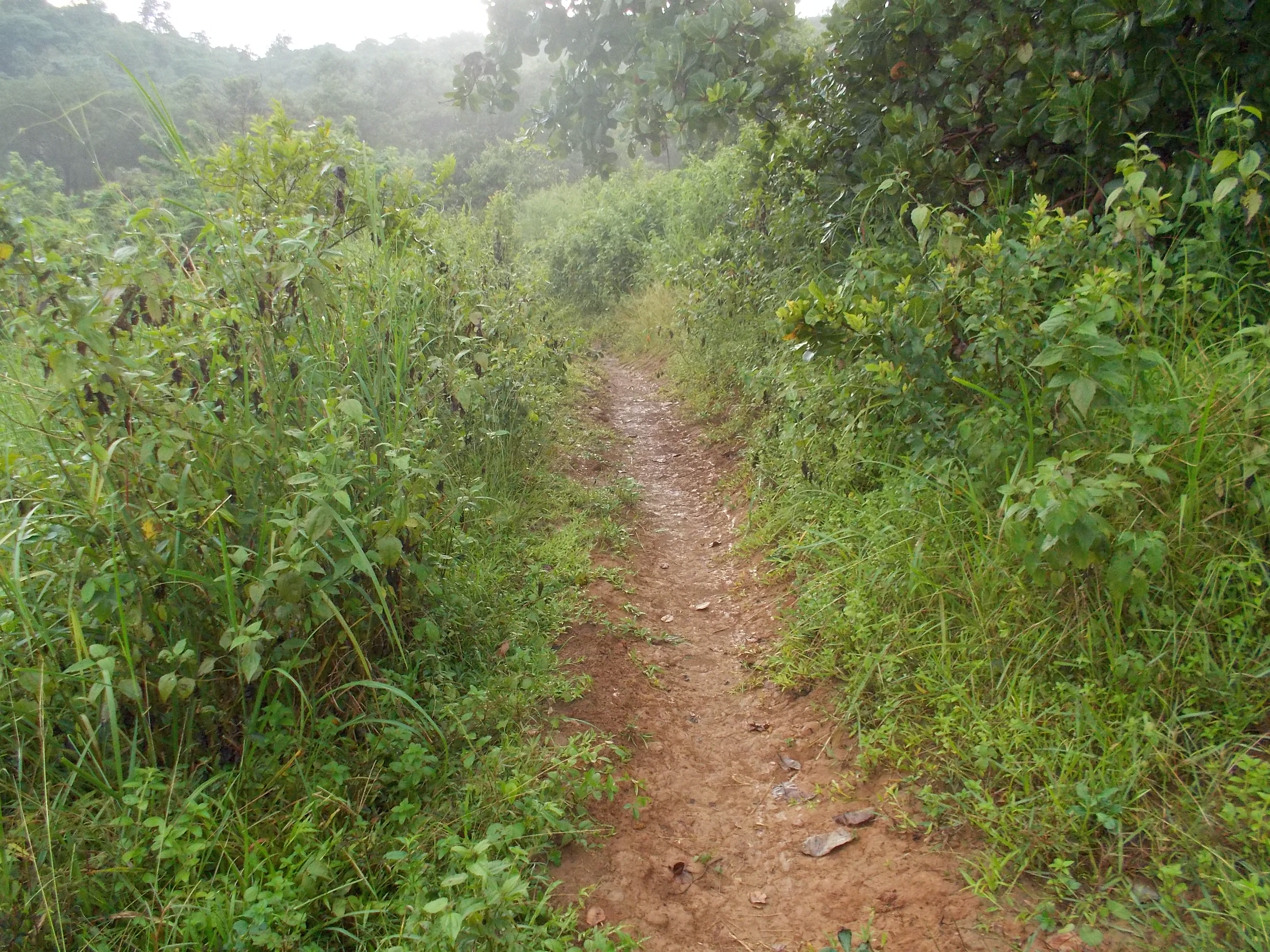
Typical Single-Track Trail In My Playground
Once these trails would widen, they give an opportunity for the locals to bring their domesticated animals where they could feed them with the available grass on the slopes. Some would bring their sleds being pulled by their carabaos or cows to bring cut trees from the forest for the construction of their houses and for fuel in cooking their foods.
Now, these mountains are being invaded by “illegal” settlers where they could start to raise their crops and animals. Worst, if these mountains and trails are the regular route of the insurgents and other bandits/cattle rustlers.
Trail Work/Cleaning In Progress
But one thing that I’ve observed in my training along the trails is that there is no accountable/responsible entity that has the job to maintain these trails. It could be the local Barangay unit but it seldom dips its authority in maintaining such trails. The maintenance of these trails are bestowed on the initiative of those locals who have interests in those mountains but not on a regular basis.
What is my point? If one is a regular visitor of a mountain and uses the trail, he/she must be a part in the maintenance of such trail. It is either by volunteering to clean the trail of debris and trash or by preserving such trail by not making another footpath. (Remember that another footpath would result to another “passageway” of water coming from the top of the mountain!)
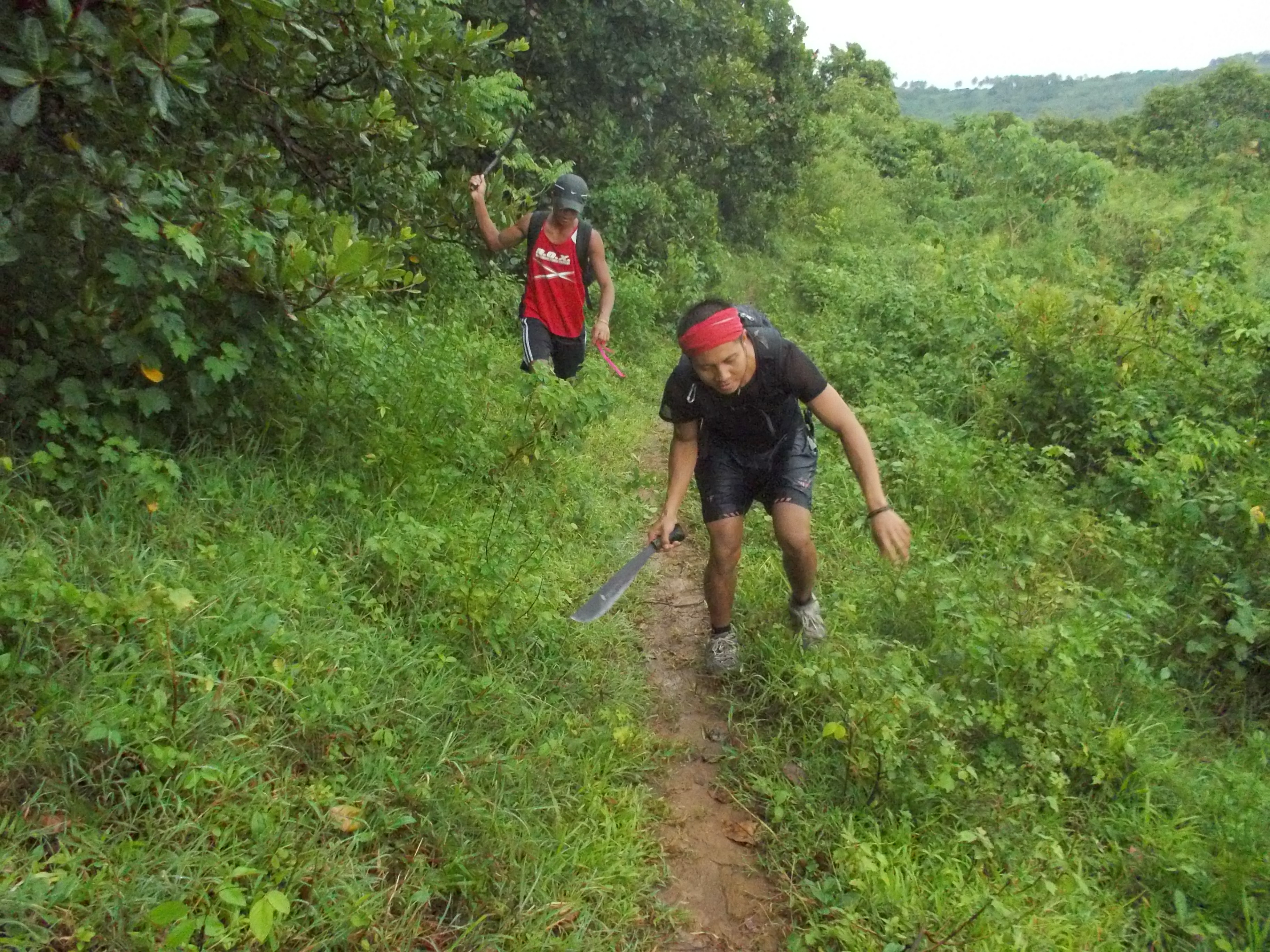
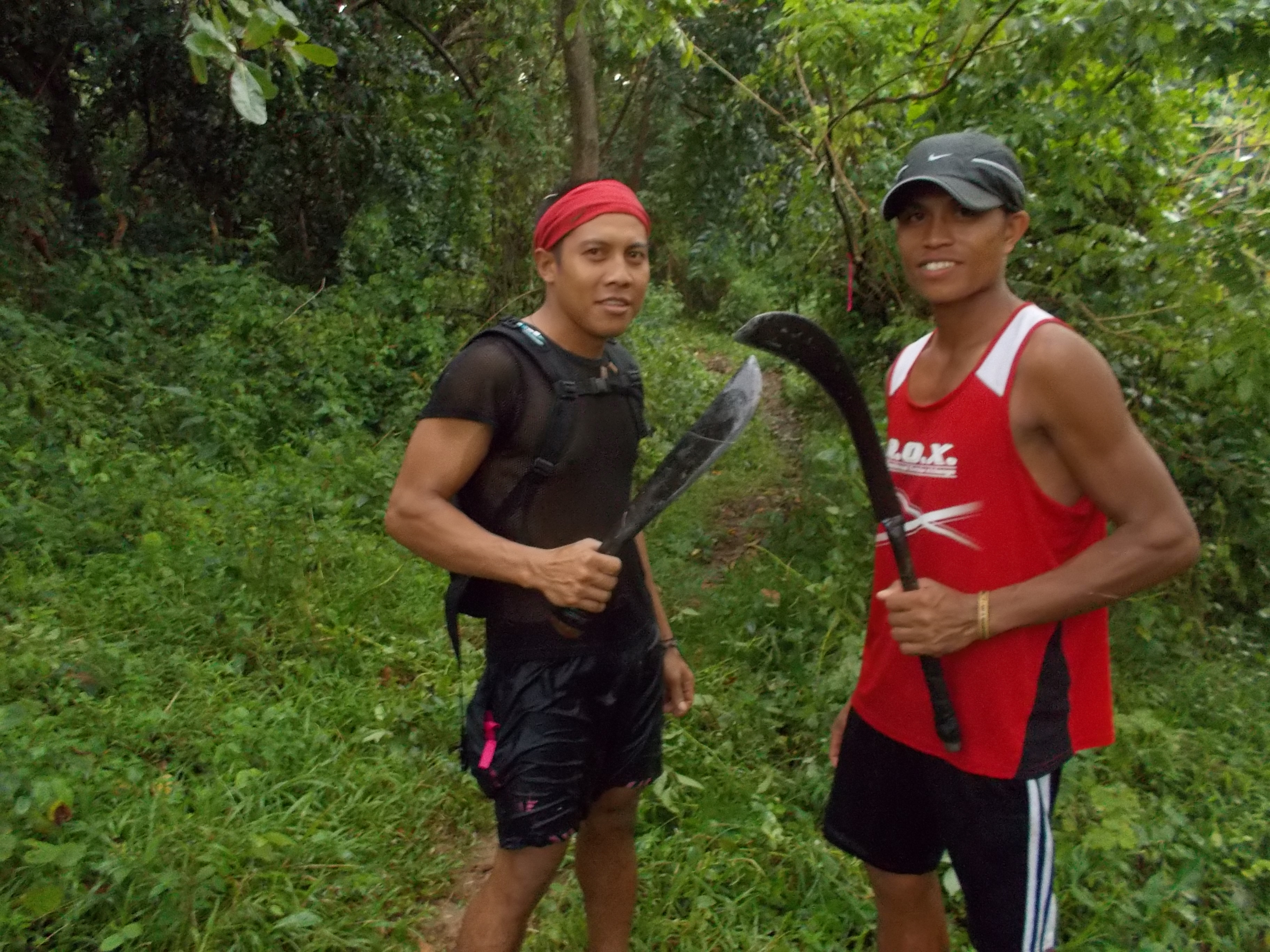
“Diego Bandidos” As Work Force
So, for this week, I made a commitment to maintain the trails that I’ve been using for my training. This scheduled trail work will be done once in two weeks in my “playground”. We have started to cut some plants and grasses on the sides of the trails and during the dry season, we will try to flatten the trails and make some of them to be wider. I already bought some tools for this purpose.
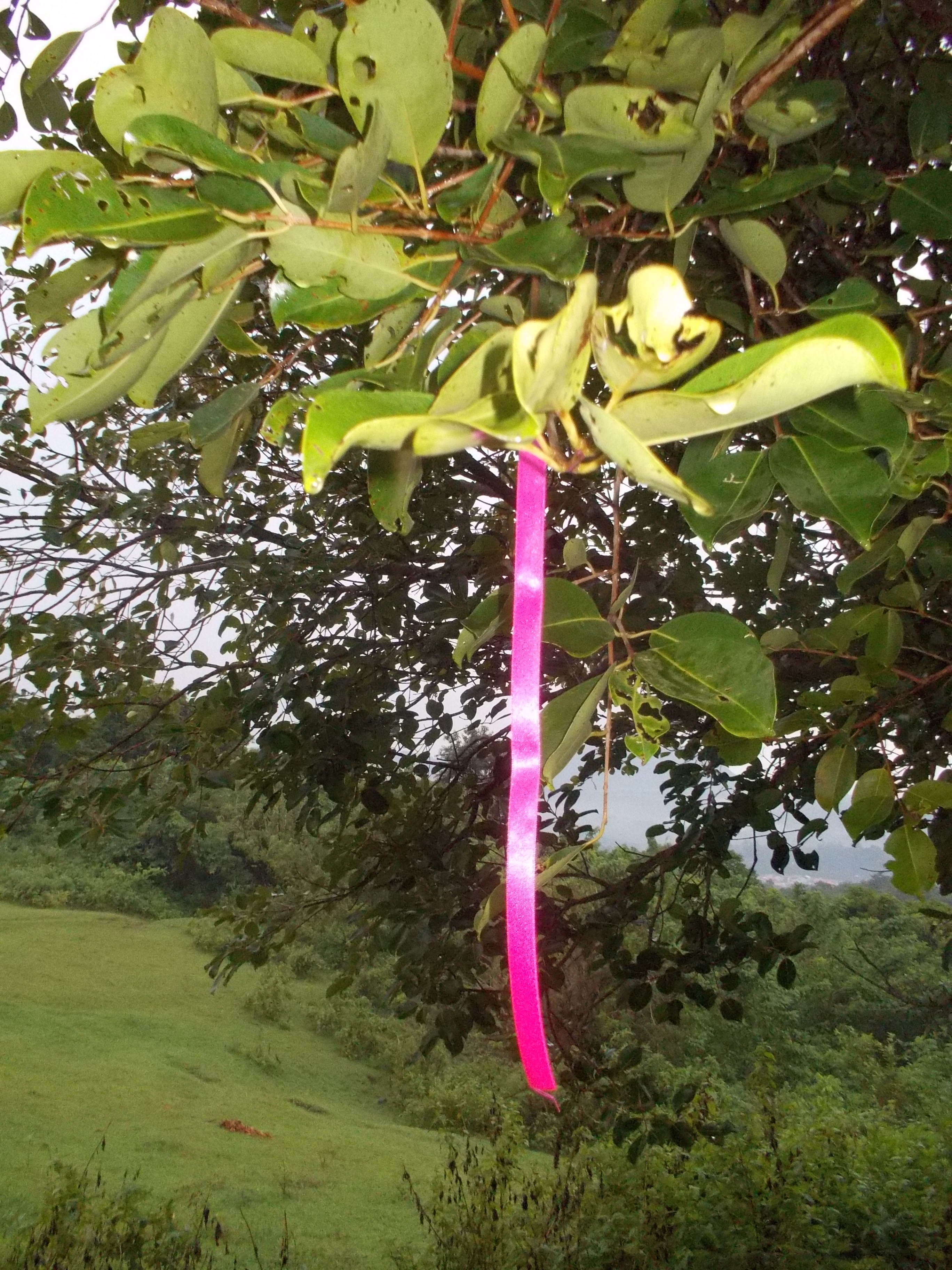
“PINK” Color Signature In My Trail Events
Lastly, I placed some pink ribbons as initial markers for the turns and bends along the trail with the hope that my friends will not get lost during their runs. More markers/ribbons will be placed in my future runs in the place.
Salomon XT Advanced Skin 5 S-Lab Hydration Pack was available in the market (USA) in February 2011 but I was able to purchase it through a friend in Hongkong last May 2012. It costs me $185.00 and up to this date, this item/product is not yet available in the Philippine market.
Since it is a Salomon product, it was used by Kilian Jornet in his previous Champion Finishes at the yearly Ultra Trail Du Mont Blanc 166K Race (UTMB) and met the requirements of the necessary hydration vest and pack for a runner joining the said event. It has an insulated 1.5-Liter water bladder & tube; thermal blanket; whistle; trekking pole strap; and lots of zippered pockets where the bigger pocket at the back can fit a light jacket/windbreaker. It has also two big pockets on each of the front straps which are not symmetrical in placement where additional water bottles could be secured.
With the 1.5-Liter water bladder on the back portion plus additional two bottles in the front pockets, I could carry 2.5 liters of liquid in my trail runs using the said hydration pack. The other 2.5-Liter space is allocated for the zippered pockets where I can stash a light jacket/windbreaker, foods/energy bars, headlight, and gels.
The whole pack weighs at 21 ounces or 593 grams, without the emergency blanket and two bottles for the front strap pockets. But when it is worn with the necessary contents in its pockets, it keeps a very snugged fit to the body with the weight of the pack more concentrated on the upper back/shoulders. The fit to the body can be adjusted by two elastic straps that connect the two shoulder straps.
After more than one year of using it in races and training runs, I can say the following:
1. It is a very expensive buy as compared to the newer hydration vests available in the market.
2. The whole pack (without the accessories & contents) is heavy as compared to other hydration packs/vests.
3. After not using the pack for few months, the zippers on the pockets got stuck and I could hardly open the pockets. Dried sweat and dirt might have contributed to this condition but it took me sometime to figure it out on how to loosen the zippers. If one of the zippers will be broken, it will be the end of this pack.
4. Sometime, I have a hard time “hooking” the two elastic front straps on the edge of the other shoulder strap.
5. There are times also that I would hit the edges of the two bottles placed on the front straps’ pockets with my moving arms while running. Instead of trying to clip my moving arms towards my torso while running, I would open up my elbows outwards in order not to hit the bottles.
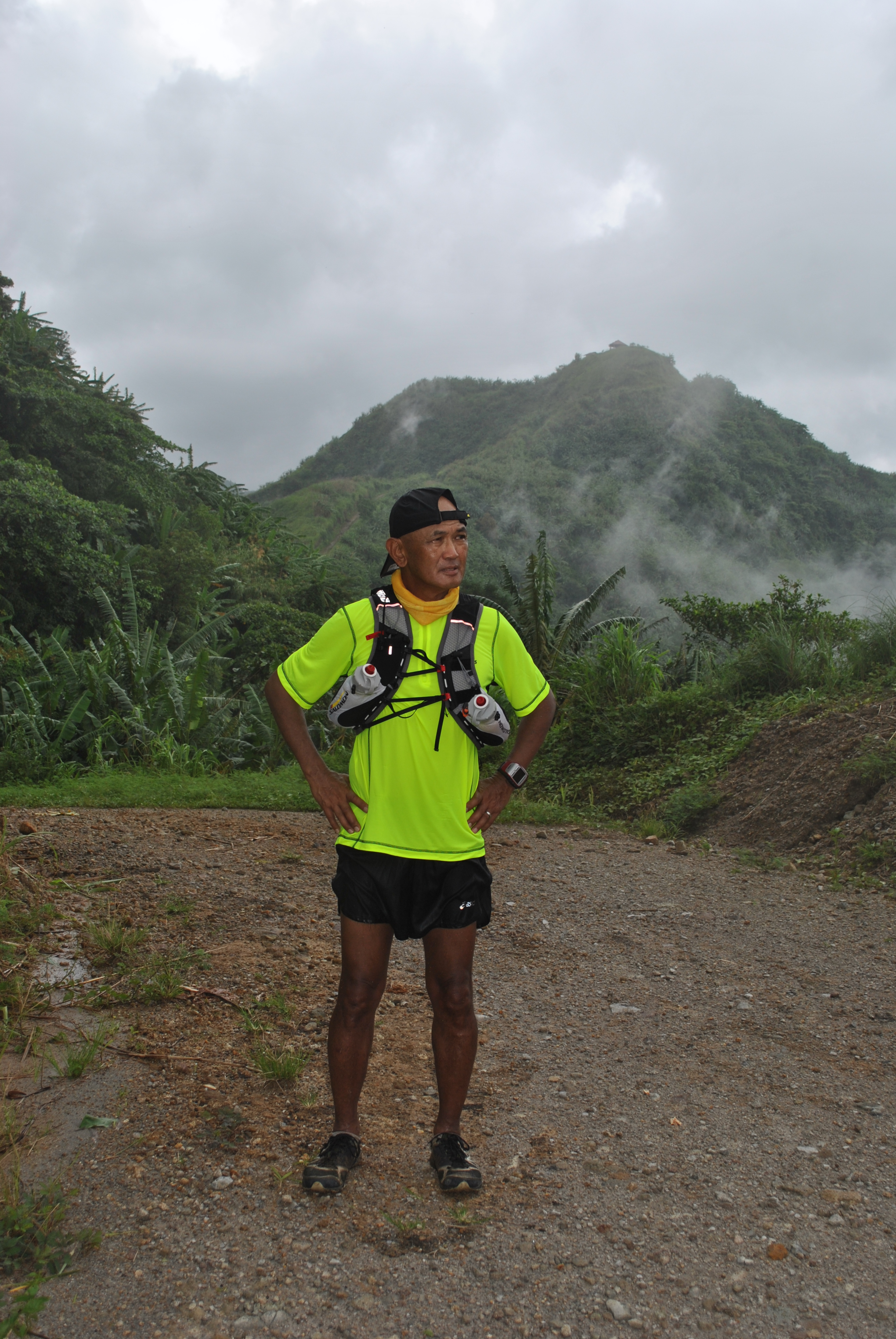
Front View Of The Salomon Skin S-LAB Hydration Pack
The front view of the hydration pack would show the two elastic straps with a hook (colored red) on each end. It shows also the two pockets on the shoulder straps which can accommodate 20-oz. or taller water bottles. It is observed that the two pockets are asymmetrically positioned with one another. The pockets are not upright but slightly slanted under the armpits.
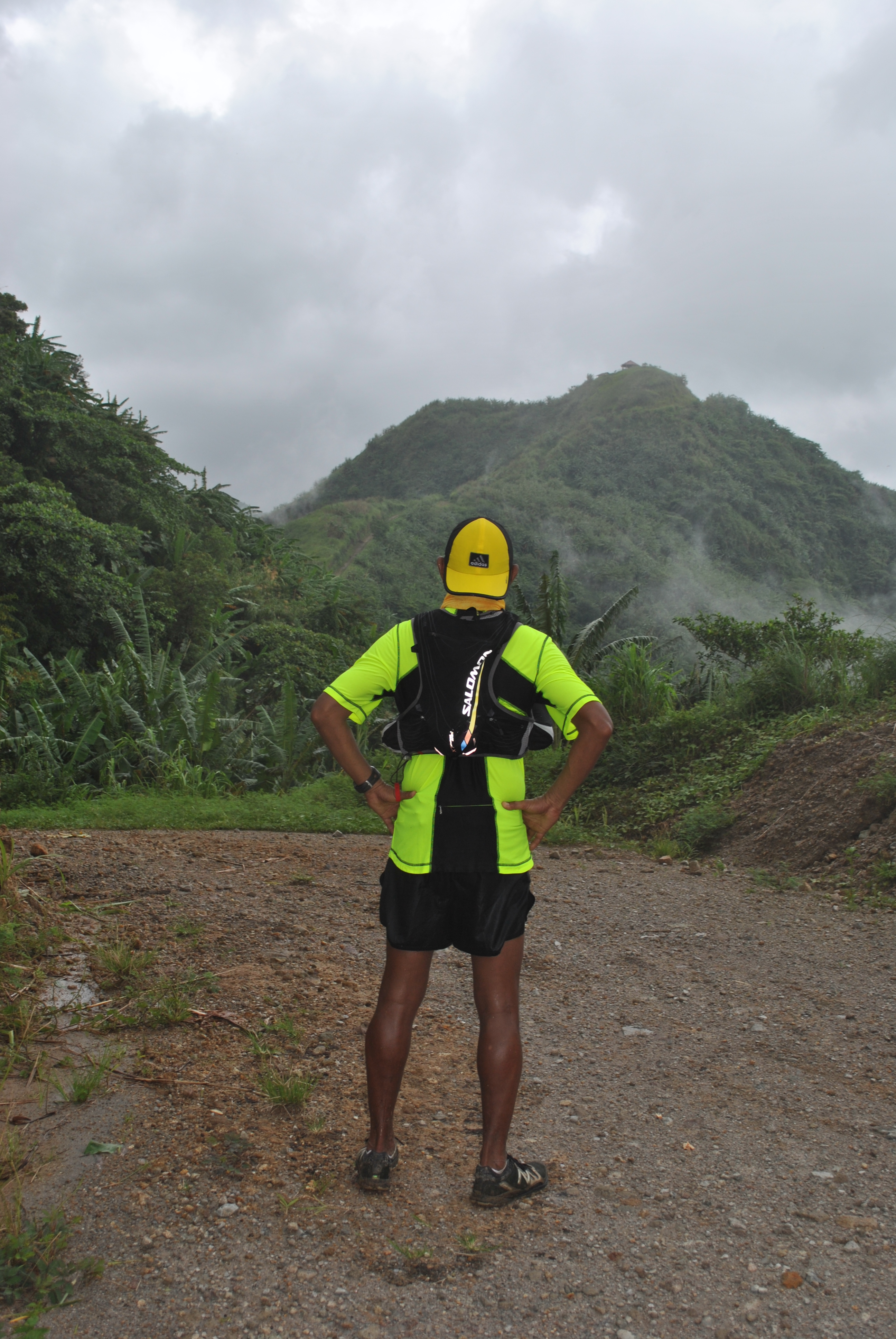
Back View of the Salomon Skin S-LAB Hydration Pack
The back portion of the pack shows the big letters of the brand Salomon. The whole pack sits on the back much higher than any of the other brands of hydration pack/vest which a big advantage of this product. There is no “bouncing” feeling of the pack on the body when one is running.
The last advantage of wearing this item is to send a Big Fashion Statement to the other runners, not as a fast and strong runner, but as somebody who can afford to buy what is not available in the local market!
The Ultimate Direction’s Anton Krupicka (AK) Signature Series Hydration Pack/Vest is a “sold-out” item in the USA starting last November 2012 and the next orders available on their Website/On Line would be available on January/February 2013. But Andre Blumberg who joined in last year’s Taklang Damulag 100-Mile Endurance Run (TD100) gave this hydration pack/race vest as a gift last December 2012. Since then, it was my favorite choice in my weekend long runs in the mountains.
This product is being manufactured in the Philippines (but not available yet in the local market) in a place near the Starting Area of the yearly Bataan Death March 102K & 160K Ultra Marathon Race in Mariveles, Bataan. The price is $89.00, a way lot cheaper than the Salomon’s Advanced Skin 5 S-LAB Hydration Pack.
It is the lightest and most “minimalist” hydration pack/vest in the market which weighs 6 ounces/170 grams without the bottles. The pack comes with two 20-oz bottles only. There is no water bladder but the back part of the pack can accommodate a 1.5-Liter water bladder.
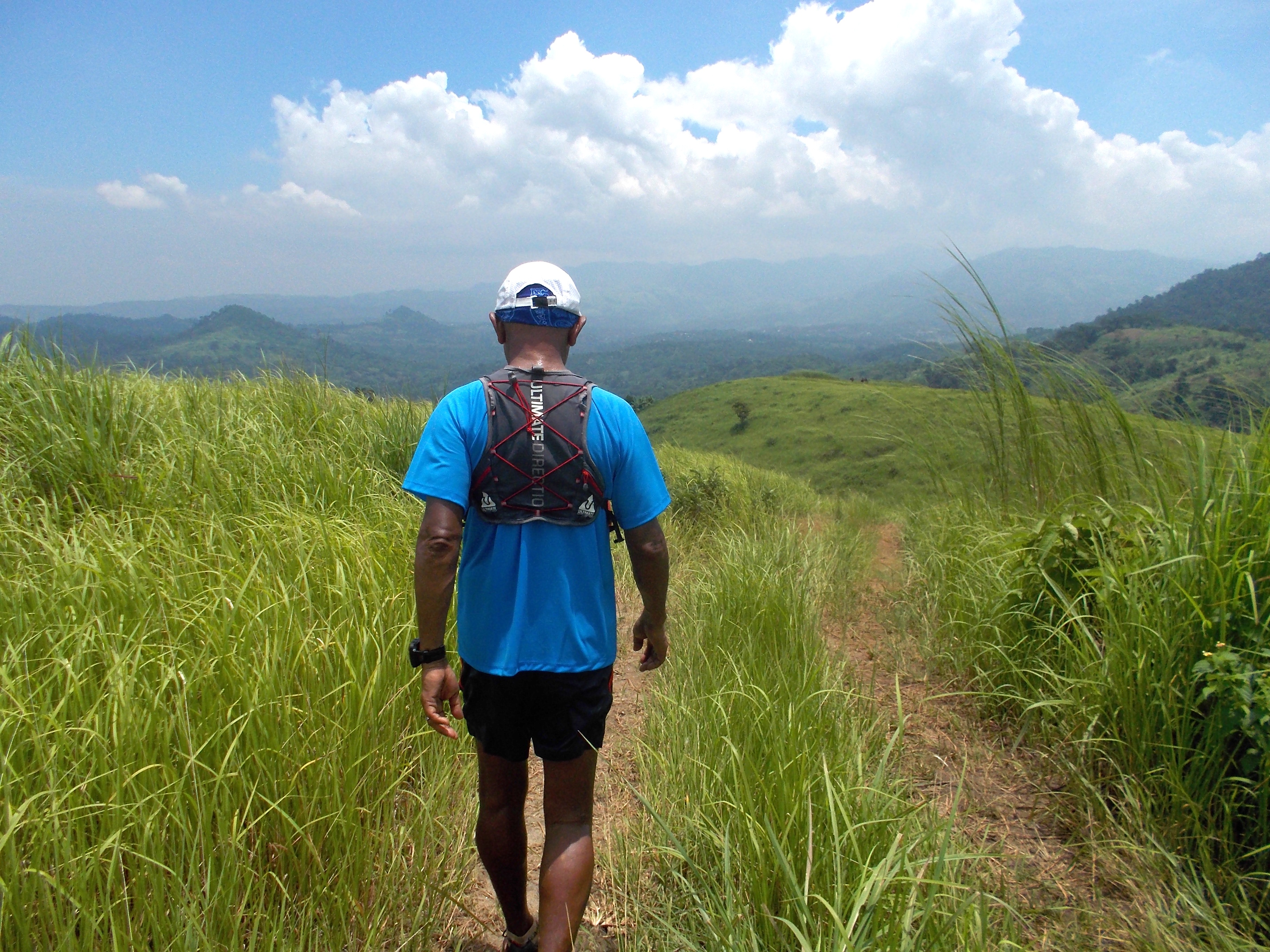
Front View: Ultimate Direction (UD) Anton Krupicka (AK) Signature Series Hydration Vest
There are two small zippered pockets on the lower back portions of the pack and lots of more small pockets (4 pockets in all) on the front of the pack. I seldom use the zippered pockets on the back of the pack that can accommodate some energy gels but I prefer to use those small expandable pockets on the shoulder straps for my small camera and gels. I have no problems with the zippers even if the whole pack is dirty for using it almost every weekend without washing it. Most of the pockets’ openings are secured with Velcro strips which are very easy to open & close.
Back View: UD Anton Krupicka Signature Series Hydration Vest
I have never used the back pocket of the pack for a water bladder but I got very favorable feedback from other runners who do such. According to them, it gives them a good balance and nice snugged feeling of the pack with 2 bottles in front and a water bladder on the back. The pack has an elastic rope/string with a hook on the back part which can secure a light jacket or a poncho or a windbreaker.
As compared with the Salomon Hydration Pack, I don’t have any problems with the UD AK Hydration Race/Vest with regards to the movements of my arms while running. The placement of the bottles on the front straps does not even create any “chafing” on my chest or nipples. Even the snap locks on the straps on my chest could be easily “linked” easily even with my eyes are closed.
So, to choose which one is better among the two hydration packs, the Ultimate Direction’s AK Hydration Pack/Race Vest is a winner!
In the past years, I’ve been buying GU Gels by pieces, depending on the distance of the race that I would join. I’ve been conditioned to use GU Gels in half-marathon and full marathon races, taking one gel every hour of the race. I’ve never used gels in my training runs because they are very expensive and it was hard to be accustomed with the best tasting one.
When I started to join ultra marathon races, I was sparingly using the GU Roctance until I completely shifted to solid foods. Since then, I forgot to use these Gels in my training and races.
One Box Of GU Gel (The Thing You Could See On Top Of The Box)
With my new training program which started three months ago, I re-introduced the use of GU Gels in my body system during my weekend long runs but only when I am in the verge of bonking on the second half of my workout. The Espresso Love Flavor is presently my most preferable tasting GU Gel and it gives me the desired energy on the last 1-2 hours of my long runs.
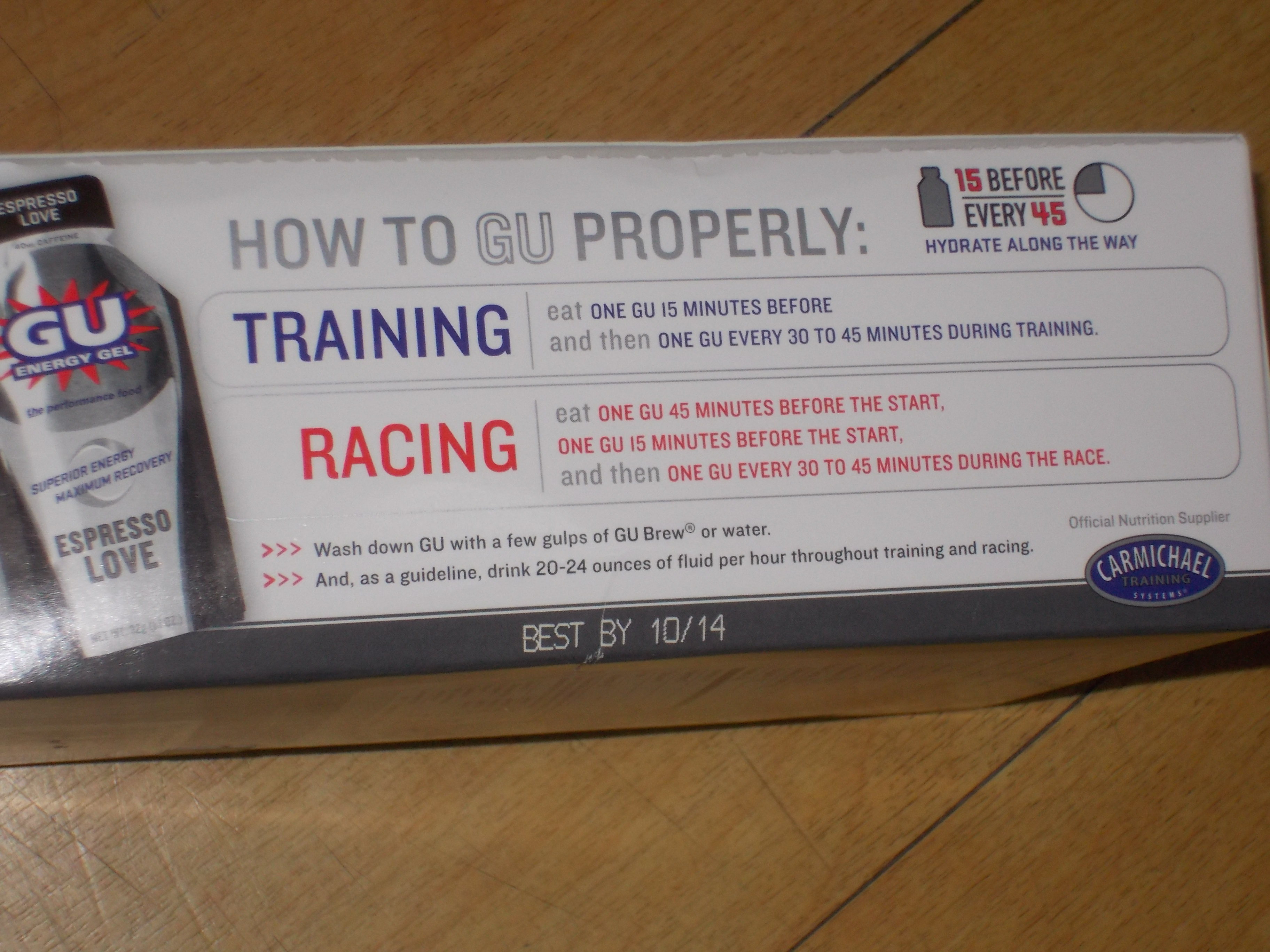
What Is Written On The Side Of The Box
It was only when I bought this preferred flavor in boxes when I read the printed instructions on the side of the box on how to use GU properly.
It states that in one’s training workout/run, the runner must ingest ONE GU 15 minutes before starting the run and then ingesting ONE GU every 30-45 minutes during the run. In order to save my stash of GU gels, I eat solid foods before I start my run and during the first half of my workout. On the second half of my workout, if I feel that I am losing my energy, I would ingest at least ONE GU in order to maintain a strong finish.
The instructions also states that when a runner is going to join a race, he/she has to ingest ONE GU 45 minutes before the start of the race and to be followed by another GU 15 minutes before the start of the race. During the race, the runner must be able to ingest ONE GU every 30-45 minutes.
In my latest ultra road race last Sunday, I made some adjustments with the suggested instructions since I had prepared some Perpetuem Mix and additional solid foods for my additional nutrition. I ingested ONE GU 15 minutes before the start of the race and then ingested ONE GU every hour during the race. I think my regular intake of GU Gels with solid foods and liquid/water provided me the much needed energy to finish strong in the said race.
ONE GU Gel (Espresso Love) has 100 calories in one sachet. If it is taken every 30 minutes, the runner has 200 calories for his energy to burn in one hour which is enough to maintain for a consistent energy for the body.
It took me sometime to experiment on the use of GU Gels for the past months. It is costly but very effective but if you have the desire to finish a race, the costs will be worthy.
Finally, it should be noted and highly suggested that the empty sachets of these GU Gels should not be littered along the course. Make sure to return the empty sachets to the pocket or hydration belt/vest where you stashed them before the start of the race and dispose them later in trash bags/bins at the Finish Line.
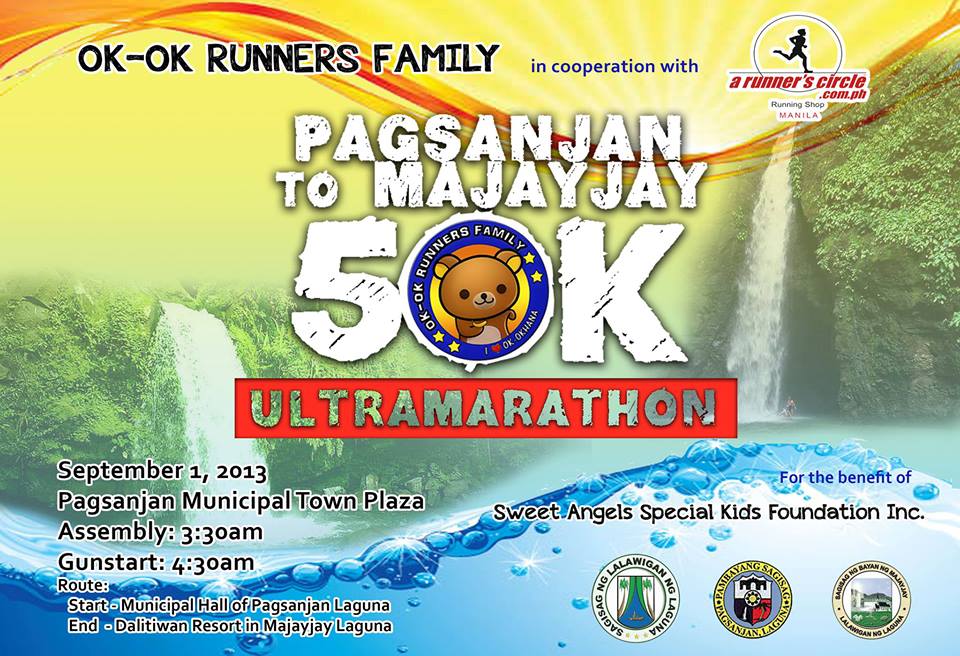
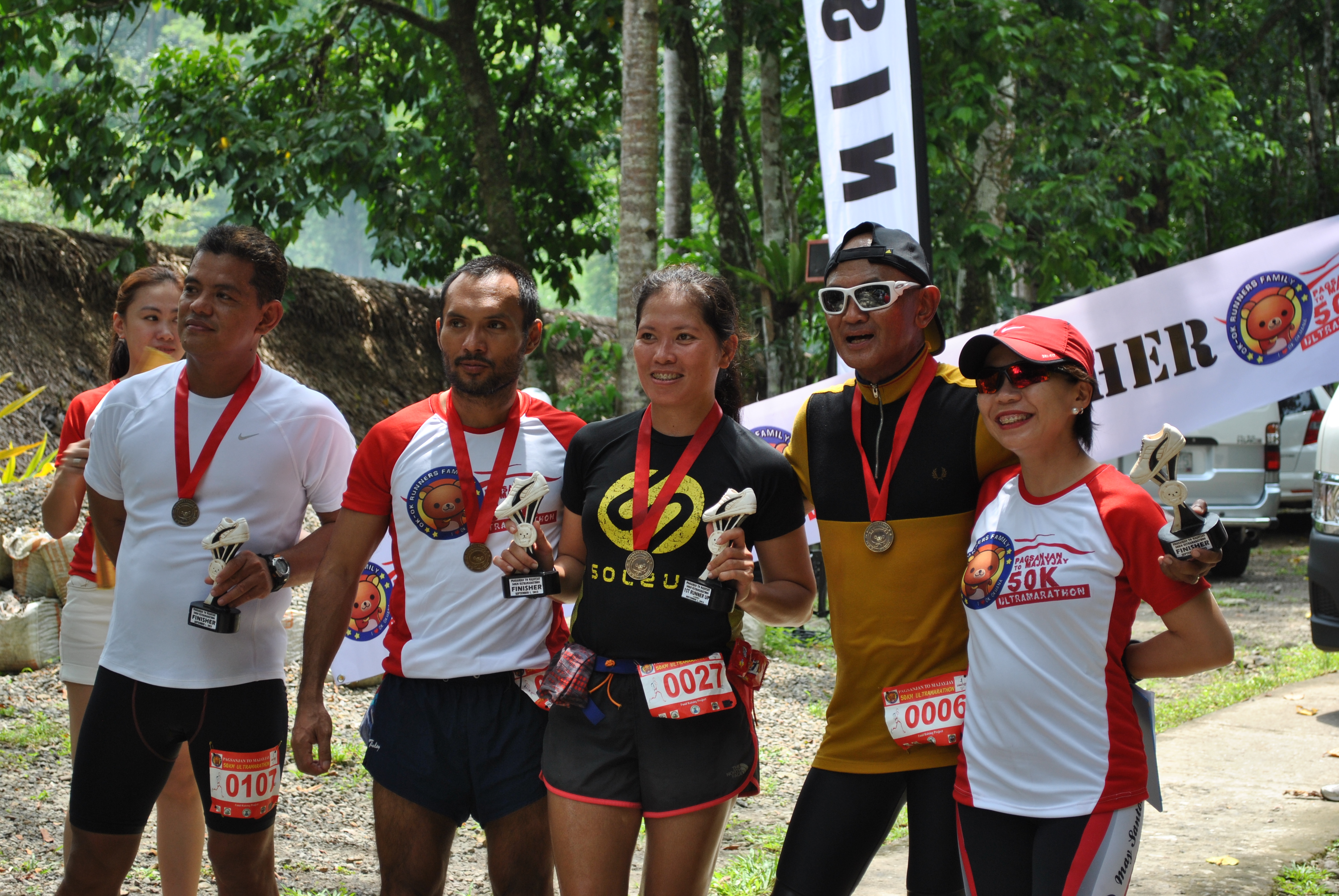
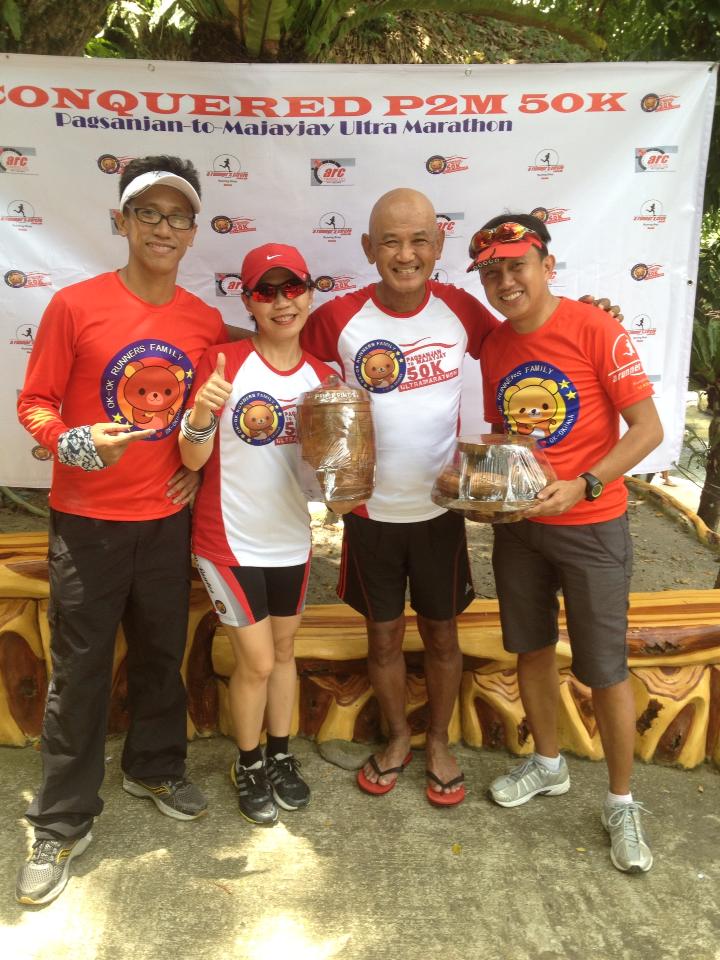
I have high respect and appreciation to the members of the OK-OK Runners Family who are very consistent in joining my Ultra Events and it was a personal decision to join their 2nd Anniversary Run which happens to be a 50K Road Race in the province of Laguna, south of Metro Manila. Although I have opted not to join road races for the past months due to my trail running training, it was time to repay this running group/club for their “loyalty” and good friendship and of course, a good opportunity to meet and “engage” with new ultra runners.
Event’s Ads On Facebook
I was supposed to run 17 miles/27.2 kilometers on Saturday and then 14 miles/22.4 kilometers on Sunday as part of my training program on the trails but I had to make some adjustments last weekend. I ran for 6:30 hours covering a distance of 28 kilometers of trails last Friday; rested the whole day of Saturday; and then joined this 50K road ultra race yesterday, Sunday.
What I like with the race was that the organization and race management were outstanding. They followed my Race Rules and Regulations; they have Aid Stations manned by members of Running Clubs who are Ultra Runners; very punctual with the Start Time; and fast publication of Official Result. How I wish all the other Ultra Road Races in the future will follow their “style” and efficiency.
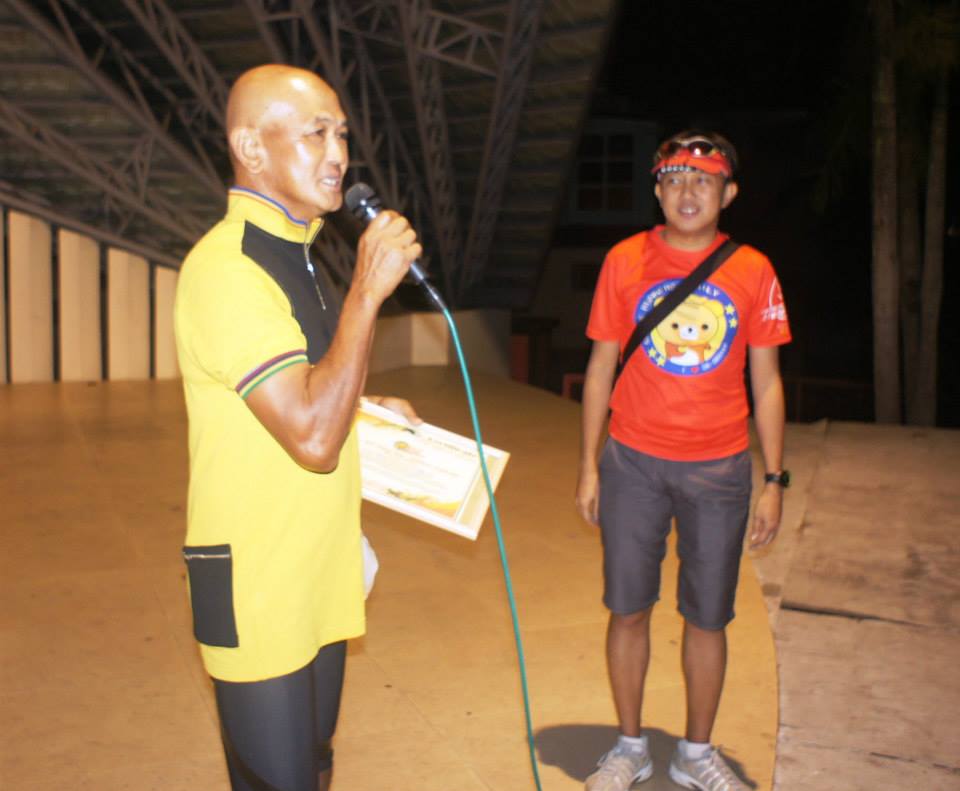
Delivering A Short Remarks After Giving Me A Certificate Of Appreciation (With OK OK Head, Joseph Pineda)
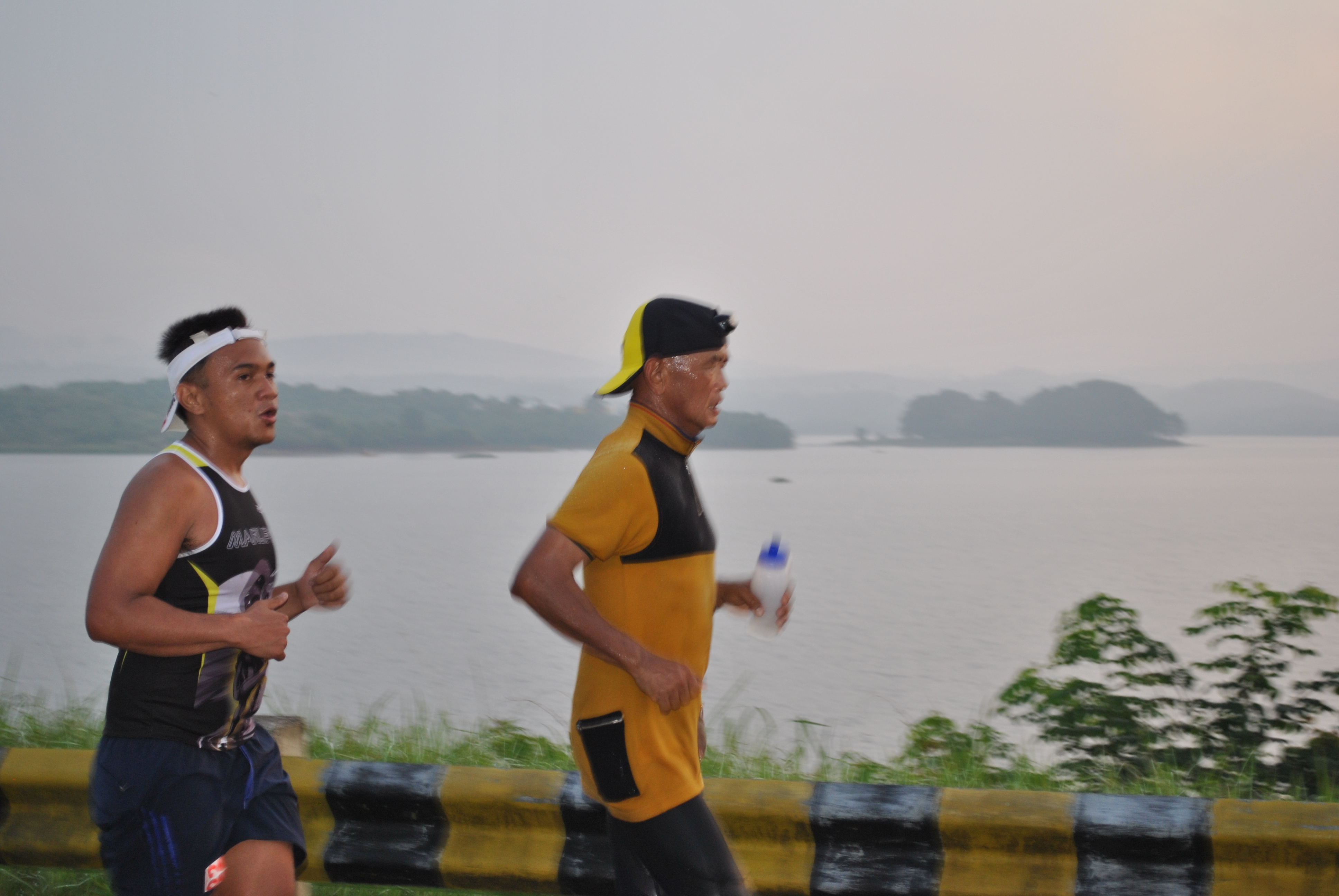
After a short program before the race where the group requested me to have an opening remarks and race briefing by Joseph Pineda aka OK OK Otek, the race started at 4:30 AM at the Municipal Plaza of Pagsanjan. I positioned myself at the back of the pack trying to maintain a slow pace for the first 3 kilometers. Meljohn Tezon, an ultra runner, paced with me but we were silent and did not talk to one another. We were exchanging the sounds of our breaths as we overtook runners along the way. It was a non-stop run/jog except when I would approach my support vehicle to replace my empty water bottle for a new one. At Km #28, Meljohn “surrendered” to my pace and I was running alone trying to catch other runners ahead of me.
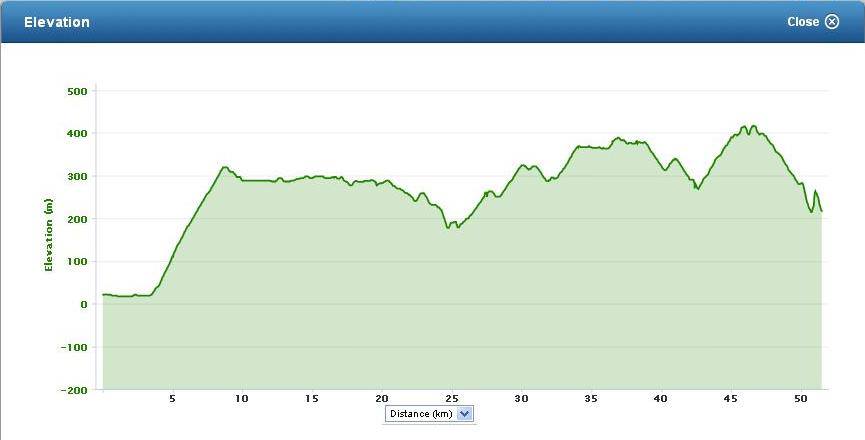
A Very Intense Pace With Meljohn (Lake Caliraya On The Background)Elevation Profile (From Joanne Raquel)
I was actually attacking the uphills and maintaining my running form on the downhills. I did not stop on any of the Aid Stations except for the last one on the last 8K of the course. Support vehicles were not allowed to enter on the said stretch. I started to run and walk from Km 43-47 due to the uphills and intense heat from the sun but I tried my best to reach the turn-around point. From the turn-around point, 2-3 kilometers were downhill to the finish line but I need to fill-up my water bottle on the last Aid Station for my last push.
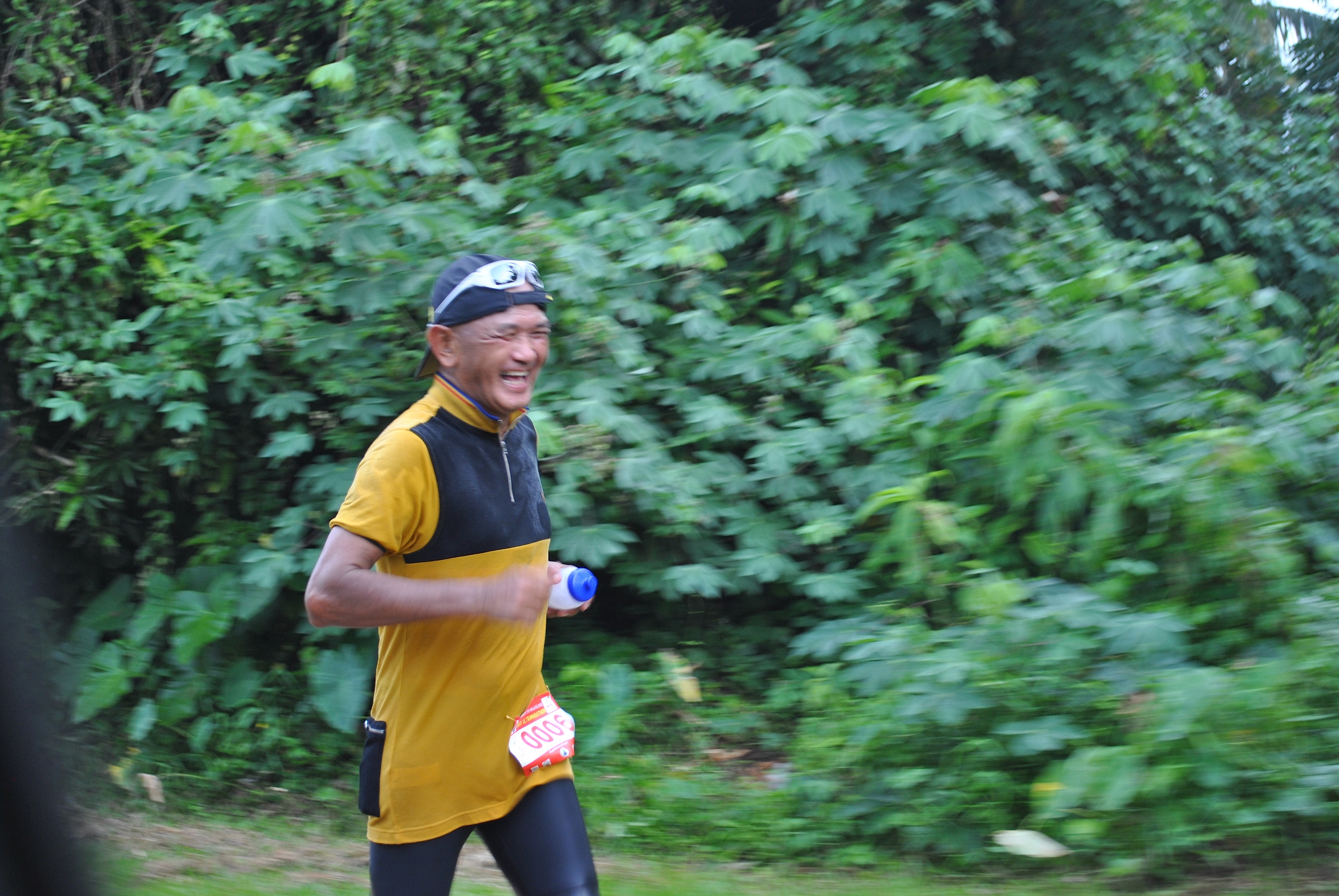
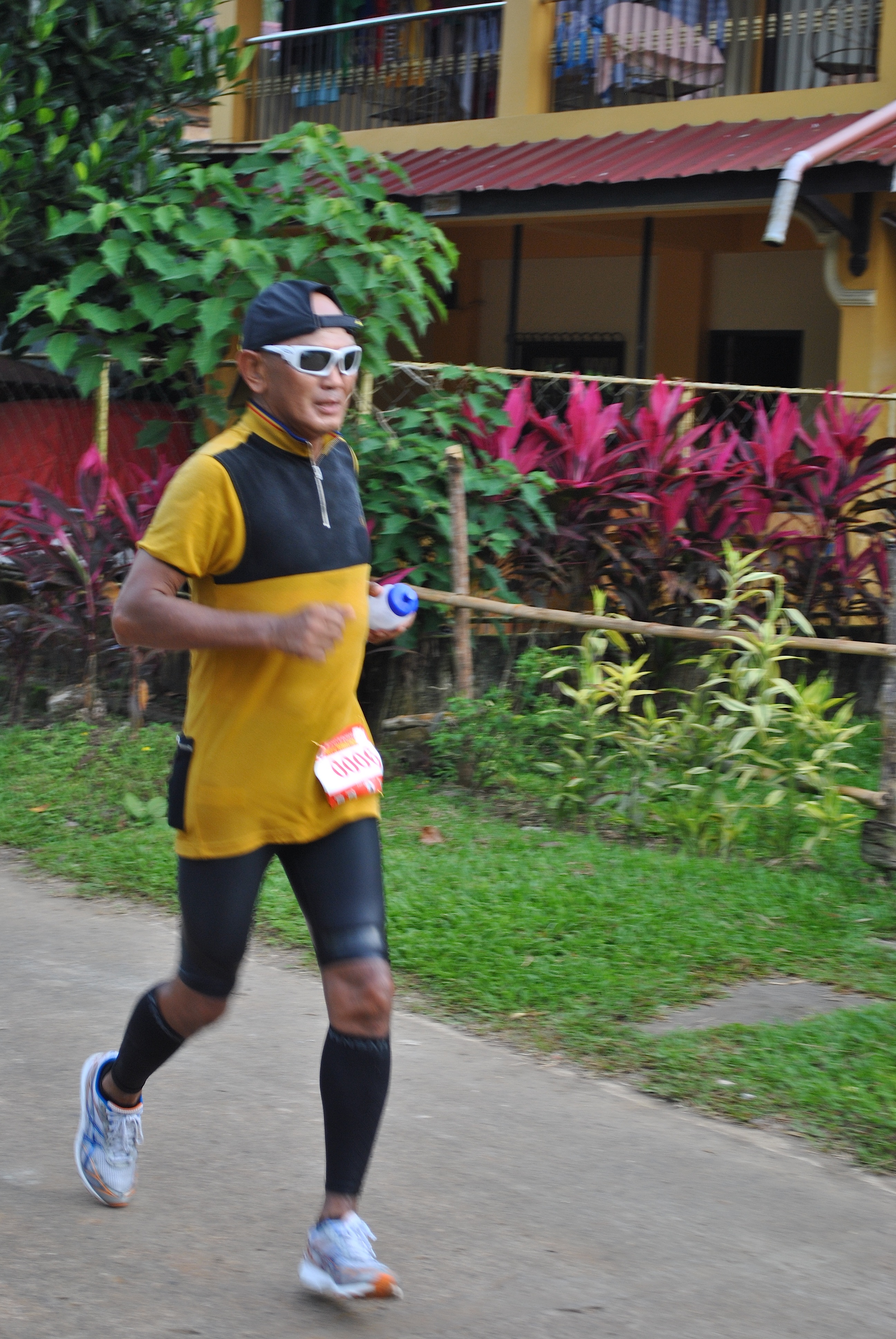
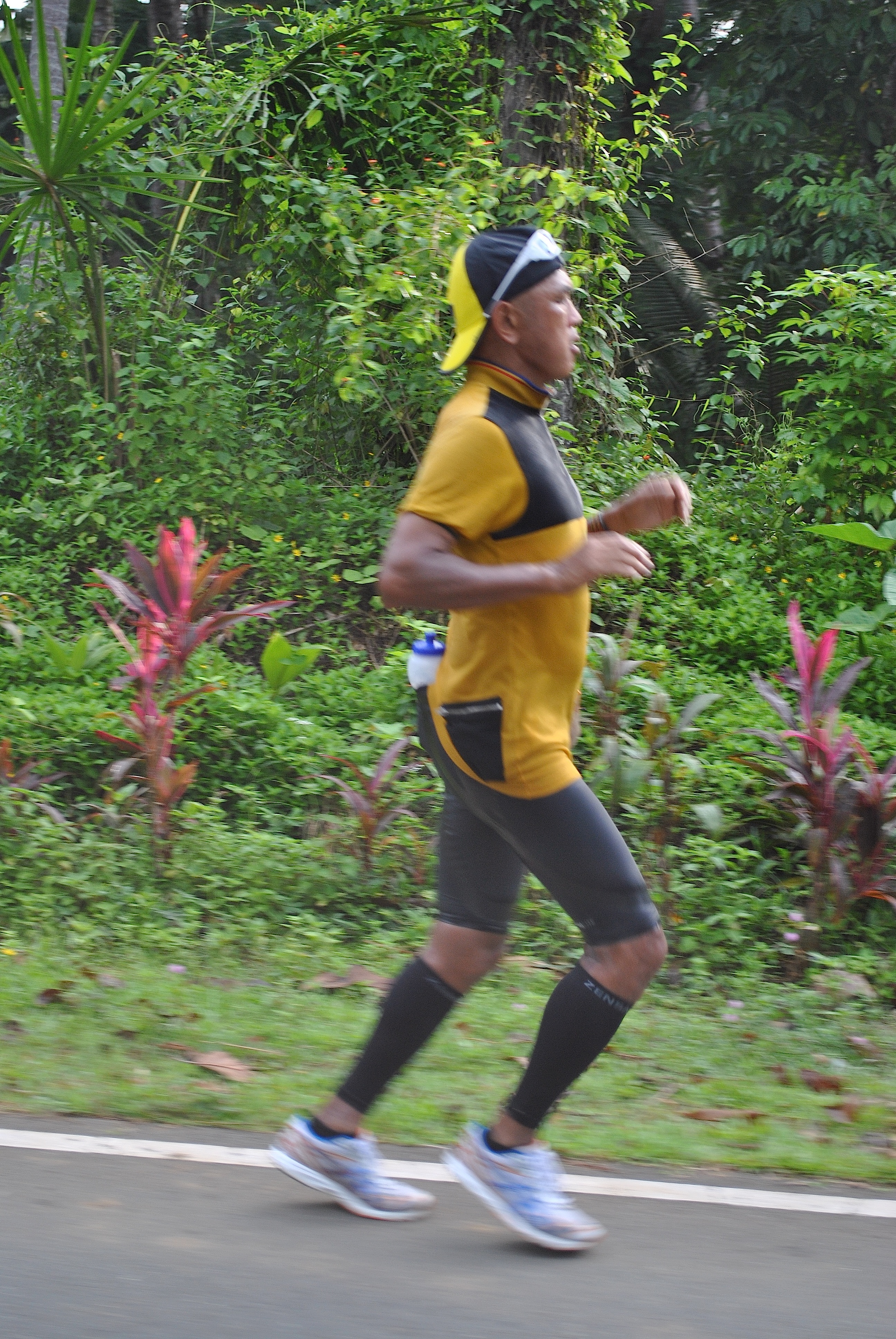
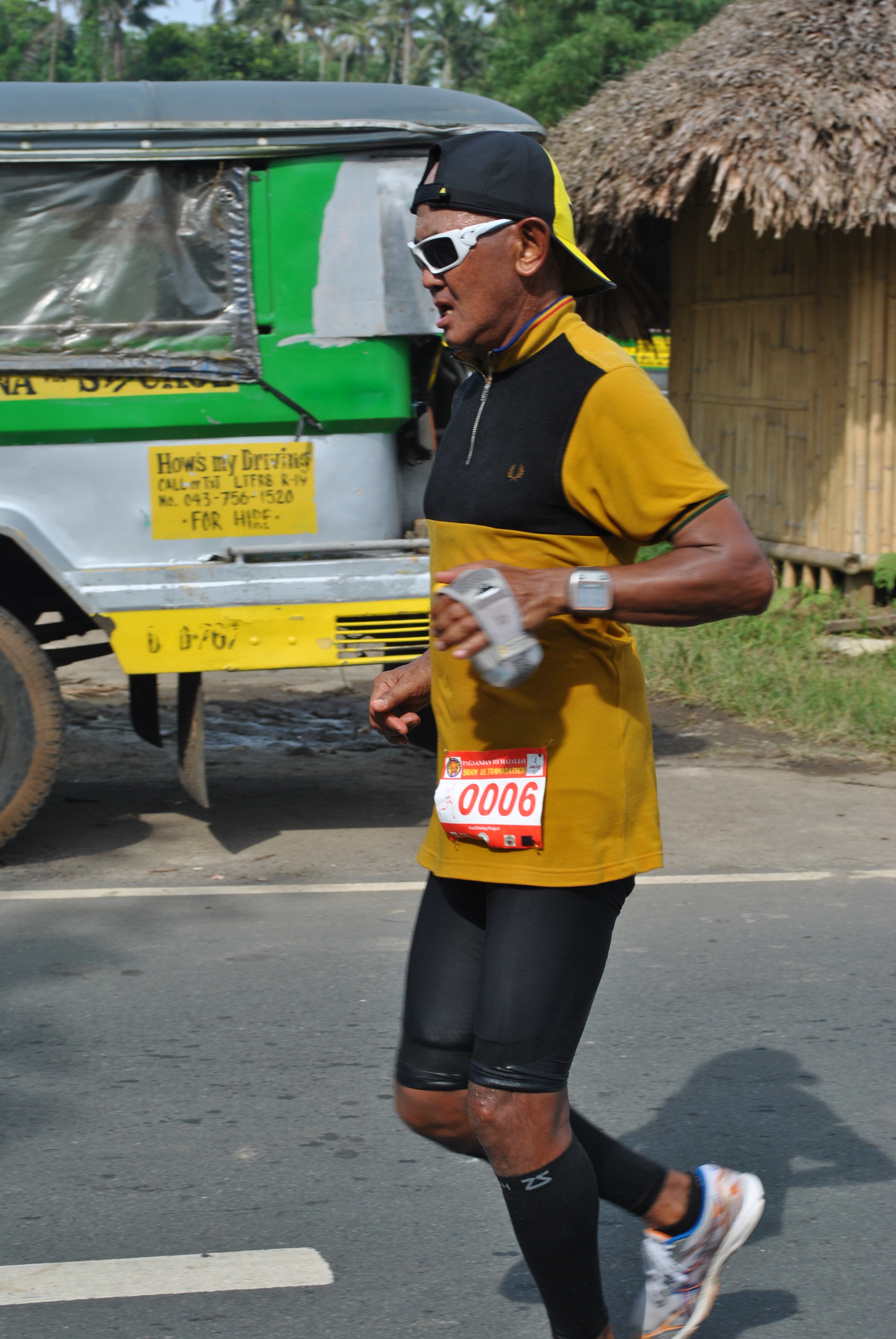
Smile & Laugh…This Is A Training Run!Run Efficiently & Maintaining One’s Running FormTip: Try To Eat Solid Foods While RunningWho Says That You Can’t Wear A Cotton Shirt In An Ultra?
At Km #42, I was ranked as the 12th runner and I was surprised to know about it. On the last 4K of the course, I was overtaken by two runners and I tried to maintain my pace up to the Finish Line. I finished the race in 6:23:21 hours, with the rank as the 14th runner to finish, improving my Tagaytay To Nasugbu 50K Run last May 2013 by 12 minutes. If not for the more challenging elevation profile of this race, I would have targeted a sub-6 hours finish time.
At The Finish Line With The Podium Finishers
I would attribute this improvement with the following:
1. Good nutrition and hydration strategy during the race. Consumed two 20-oz. bottles of Perpetuem Mix; 6 pieces of GU Gel Espresso Love (one GU taken 15 minutes before start time); 4 pieces of Ube Hopia; 1 Liter of Fresh Coconut Juice; 1 Liter of Coke; and 16-oz. of water every 3 kilometers.
2. Slower pace on the first half and then stronger and more consistent pace on the second half of the course.
3. Not dropping by the Aid Stations (except for the last one) and spending not more than 15 seconds in getting what I wanted from my support vehicle and attending to my personal necessity (urinating).
4. Consistent running workouts with at least one day of recovery/rest every week. I was thinking of this race as a validation on the progress of my training program.
5. Running and hiking in the mountain trails as part of my running workout. My finish time for this 50K Race is equivalent to my time to finish my trail running workout in my “playground” with a distance of 28 kilometers.
6. Core workouts and stretching exercises, at least, 2-3 times a week.
At the age of 61, I am happy that I have the speed and strength to finish this race. But my salute goes to the 67-year old ultra runner who finished ahead of me and placed #9 among the 119 runners who finished the race. How I wish I could run that strong and fast when I reach such age.
Congratulations To OK OK Runners Family! Good Job!
Congratulations to the OK OK Runners Family and the Volunteers for an splendid race management and organization. My salute also goes to all the Finishers who endured the challenging route and braving the heat of the sun. And for those who were “baptized” to the ultra running family, I personally welcome you to this noble sports of honest outdoor athletes.


 n-g
n-g j
j )
)




 Bald Runner
You must be logged in to post a comment.