Brief Chat With Karno


After the pictures of the 10AM Group had been taken and the final instructions had been delivered by the Chief, Race Organizer, some of the runners and crews and even the members of the race organizer had their pictures taken with Dean Karnazes. I finally approached Dean when he finished taking some pictures with the race organizers and my brief chat went like this:

Bald Runner: Hi, Dean! I am a runner from the Philippines and they call me as The Bald Runner in my country.

Dean Karnazes: Hey, you are not bald! You still have a lot of hair sticking out on your head. (Loooking at my head with his smiling face)

BR: I read your book and you instantly became my idol in ultramarathon and intend to join an ultra running event in the future. You are very popular to the runners in the Philippines. I have a blogsite and I posted your book and your accomplishments as the ultramarathon man. It’s baldrunner.com.

DK: That’s great! I’ll check it out.

BK: By the way, I will be running the San Francisco Marathon with my kids, son and daughter.

DK: This coming San Francisco Marathon?

BR: Yes

DK: I will be at the Runner’s Expo for two days before the San Francisco Marathon and you have to see me there. I want to meet your kids!

BR: Yes, we’ll meet you at the Expo. Can I have a picture with you, Dean?

DK: Ok! ( I asked one of the race organizer’s photographers to take a picture with my camera)

BR: Thanks, Dean! (I offered my hand for handshake & he grabbed my hand)  

DK: You are welcome. I will check your blog.

After that brief conversation, Dean left the place and went to his support vehicle to change his cap and get his hand-held water jug and later lined up with the rest of the runners at the starting line.

After the runners left, my wife and I took some pictures at the Badwater Basin; checked and reviewed the pictures taken; drank a lot of water and Gatorade to replenish the sweat while I was taking pictures; and took some time to use the comfort room in the area. It was already almost 40 minutes had lapsed when I started to drive the car along the direction of the runners.

While Dean Karnazes was running towards Furnace Creek, barely one hour after the start of the run, I slowed down the car and stay beside briefly with him and I opened the window of the car, brought out my head and shouted:

BR: Good luck, Dean!

DK: Thank you, Bald Runner! (in a loud voice while pouring water on his cap/head from his hand-held water jug and he was smiling!)

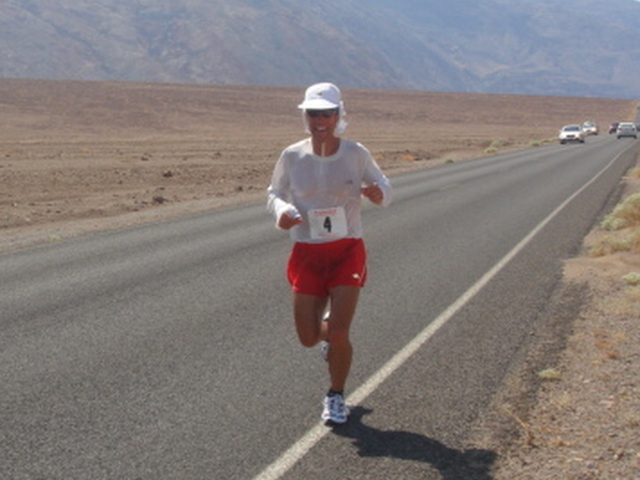
Later, I took the following picture as he was running  #4 from the leading runner on his way to Furnace Creek:

Being sponsored by The North Face, Dean Karnazes wears running shoes and apparel of the said sports company. His running apparel is now lighter and different from his clothes when he ran the Badwater Ultramarathon in 2005.

Badwater Ultramarathon #2: Dean Karnazes; Pam Reed; and Others


I woke up at 4:00AM, prepared my things, took a shower, and before 5:00AM, I was already on the road with my wife towards Badwater, California. It was still dark and the street of Los Angeles were clear and I was the only one on the side streets near our place before hitting California State Highway 101 North and later merging at Interstate Highway 10 East after leaving the City of Los Angeles. (Note: US Highways are designated with odd numbers if they go North to South or vice-versa and even numbers if they go West to East or vice-versa)

Well, it had been a long time that I did not drive a car. In the Philippines, I still have my driver to bring me where I want to go in Metro Manila and when I am in Laoag City. But once I am here in the United States, my son or my daughter or my wife becomes my official driver/s and I rarely drive while I am with my family. However, I am a holder of a California Driver’s License which I had renewed regularly since I got it after my schooling in Fort Benning, Georgia and having stayed with my family in Los Angeles for a few months in the early ’80s.

For today’s trip to Badwater, I was made to drive the car as my son and daughter have their respective offices/jobs to attend to plus their scheduled attendance to a Coldplay Concert in Los Angeles on Monday evening. Driving in the US is very easy and efficient unlike driving in the Philippines. Where on Earth (except in Europe’s Autobahn) would you experience driving for hours with an average speed of 80-90 miles per hour? Yes, that was my speed along Interstate Interstate Highway 10 East and later hit Interstate Highway 15 East. Sometimes, I would increase to 100-110 MPH but my wife would remind me that I was way above the authorized 75 MPH speed. She would not like to pay a fine of $260.00 for speeding. That would be equivalent to the price of a Newton and an ASICS Running Shoes!

After one hour of driving, we have to stop at Barstow to fill up the gas tank of our Toyota RAV 4, bought ice cubes for our Coleman Ice Chest where I placed a lot of bottled water, Red Bull, Gatorade and fruits, and we had coffee to go. After 15-20 minutes stop at Barstow, we were on our way to Baker, California, as our Gateway to Death Valley National Park, where we would leave Interstate Highway 15 North and hit California Highway 127 towards north going to the center of Death Valley National Park.
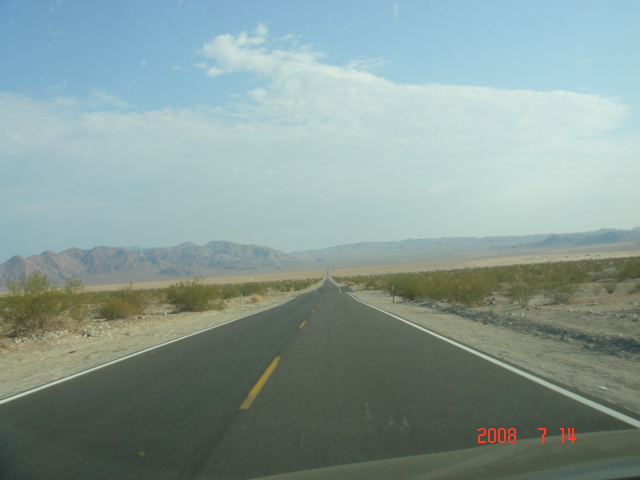
This is California State Highway 127 after leaving Baker, California. At this point, I still had 110 miles (176 kilometers) to go before reaching Badwater Basin, the Starting Area of the Badwater Ultramarathon. There are no structures along the way as it is preserved as a National Park because of its desert and unique land features and mountains.

Driving along CA Highway 127 was a bliss and fast as I was alone on the road. I think I had overtaken two vehicles and met at least 3-4 vehicles on the opposite way for the distance of almost 60 miles before turning left to California Highway 178. CA Highway 178 goes directly to the heart of the Death Valley Park and I had to travel 25 miles along this road until it became an ordinary asphalted road without any center divider line to separate the opposite lane. The CA Highway 178 ended to become the Badwater Road.

At the end of CA Highway 178, there were parts of the earth/soil which were washed away from the mountain and desert due to flash floods and rains on the middle of the road and it made our trip slower for a while. However, once we hit the Badwater Road, we could see the lowest part in the whole United States and we seldom met any vehicle along the road. For almost 45 minutes, we were alone along the said road with a temperature reaching to 100-110 degrees Fahrenheit. My wife became nervous as we did not see any other vehicle for almost 30 minutes except when we had a sight of a Ranger Patrol Car parked on the side of the road.

I was confident that I had the right direction and I was always asking my wife what is the time as I estimated to be at the Badwater Ultramarathon Starting Area in 4 hours and 30 minutes to include our brief stop along the way. I was thinking that I had to reach Badwater at 9:30AM with my estimate of our travel time. And suddenly, the Starting Line was on our sight after a long curve on the road.

I arrived at the Badwater Basin at 9:25AM and I was happy that I had still 35 minutes to take some pictures and time to mingle with the elite runners and later witness the start of the 10AM elite runners group on the 31st rendition of the Badwater Ultramarathon.

The Badwater Ultramarathon Starting Area is a small Rest Area or Viewing Area of the Badwater Basin along the CA Highway 190 which has a parking area good for about 50 cars, toilets, and a wooden elevated stage where the elite runners had their group picture before the start of the race.

The following were the pictures taken before the start of the Badwater Ultramarathon.
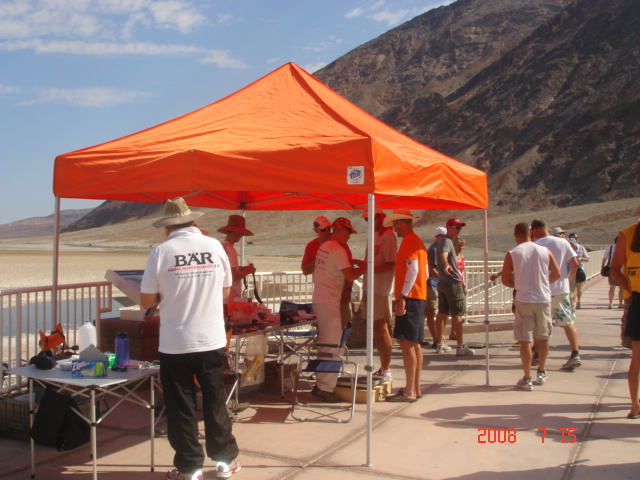
This is the only shaded area at the Starting Area where the race organizers would take blood samples, conduct brief medical check-up and weight-in to all the runners/participants.
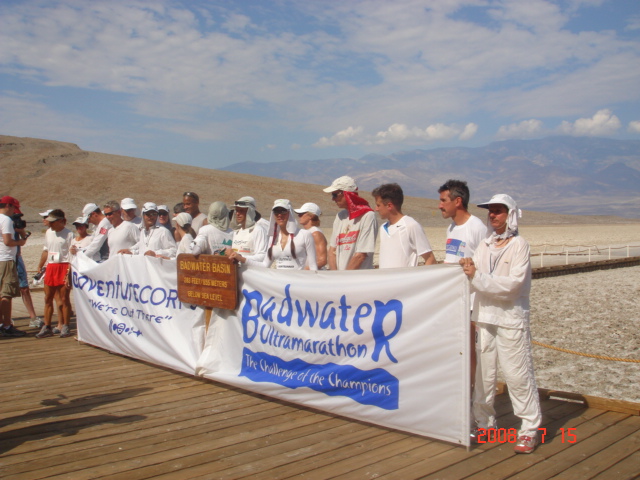
This is the elevated wooden structure on top of the Badwater Basin where a small amount of water is left on the sides. Fifteen minutes before the start, all the 10AM group of elite runners had a picture taking and at the same time served as their final meeting place and got their final instructions from the race manager. Sports photographers, media, relatives, friends, and crew members were infront of the runners taking pictures. I observed I was the only Asian and spectator for the 10AM event as the rest of the crowd were the race organizers, marshalls, medical staff, members of the family & friends of the runners, and members of the crew of each respective runner/participant. 
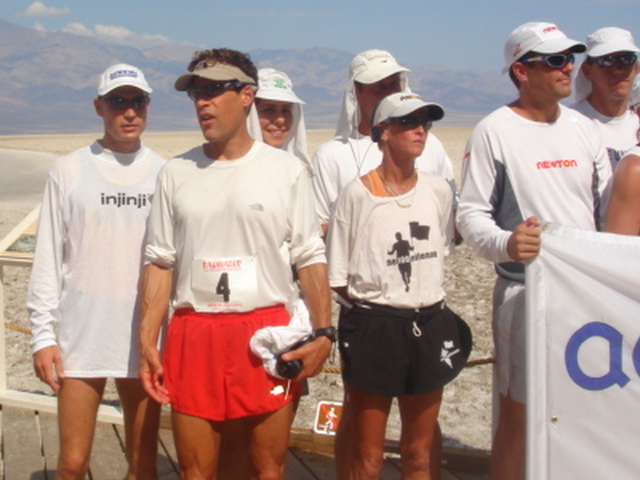
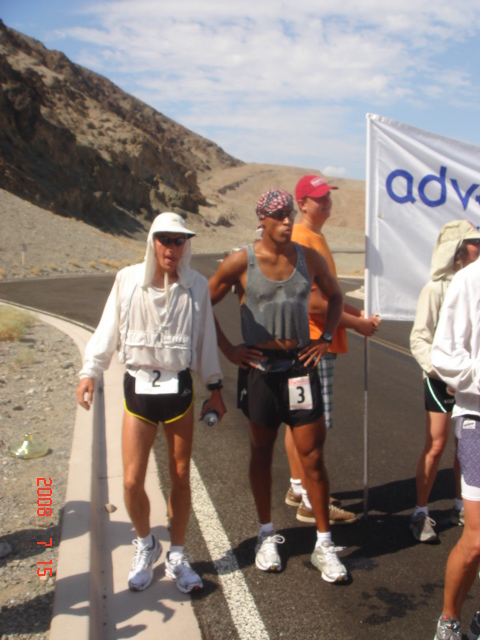
From left is Akos Konya (with white cap) who is 33 yrs old from Oceanside, California and a native of Hungary, Dean Karnazes (#4), and Pam Reed (with black shorts). These three elite ultramarathoners are the favorites in this race. Konya finished 2nd last year.
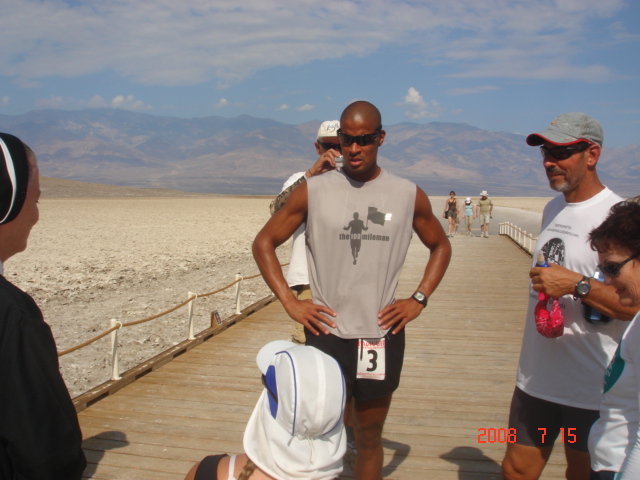
This tall guy is David Goggins (#3) who carries the brand The 100 Mile Man. He is the present US Record Holder of the most number of miles ran in 48 hours (203.5 miles). He is presently a member of the US Navy Seals and he has an impressive record in ultramarathon for the past two years. He finished #3 in last year’s Badwater Ultramarathon.
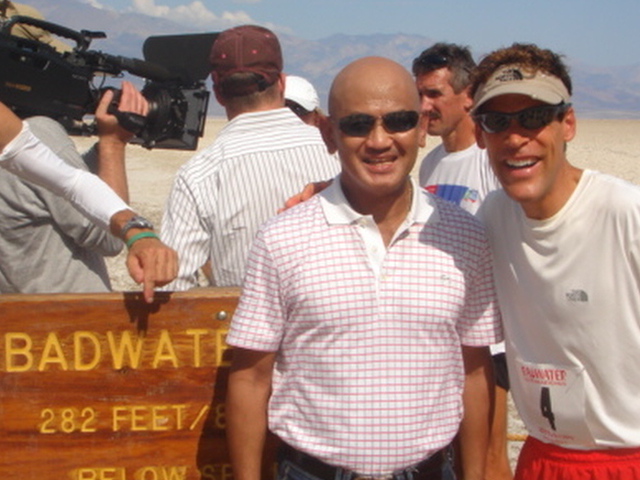
Well, this is the Best Picture For The Year. A pose with The Ultra Marathon Man, Dean Karnazes. I will post another story later on my brief chat and meeting with Dean Karnazes. 
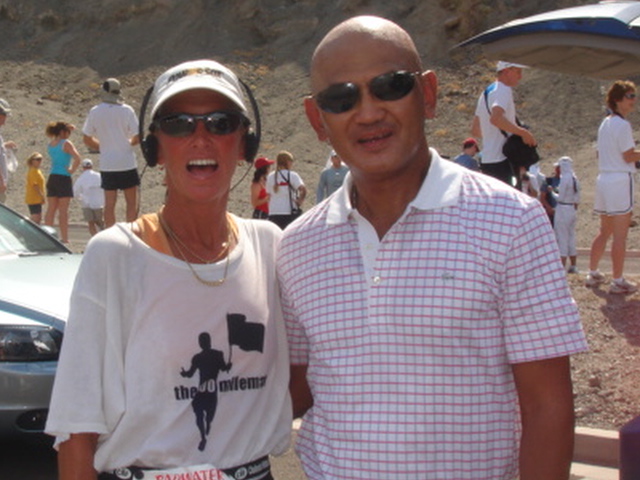
Aha! Another Best Picture For The Year! A pose with Pam Reed, The Ultra Marathon Woman. I will be posting another story about my brief meeting and chat with this wonderful lady.

Konya and Goggins at the Starting Line. Here are two contrasting apparel of two ultramarathoners where one is wearing a white long-sleeved shirt with cap and another wearing a dark-colored singlet for an ultrarun with a temperature reaching up to 125 degrees Fahrenheit on daytime.
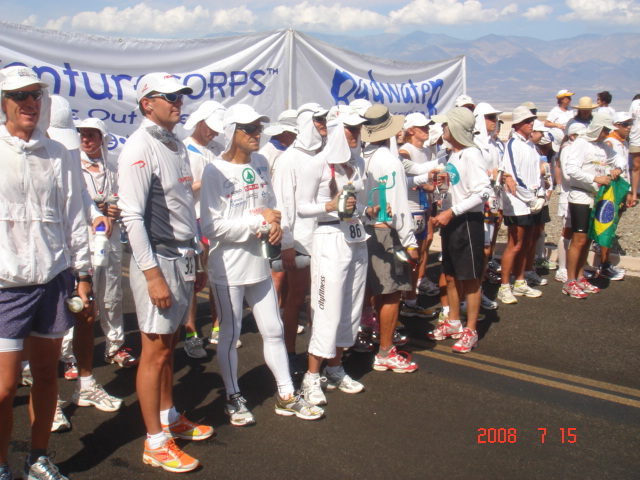
I counted 32 ultra runners for this 10AM group out of the 80 runners who finally accepted the invitation of the Race Organizers to run this event. There were no prayers before the start of the run but they had to play and sing the US National Anthem (Star Spangled Banner) before finally starting the race.
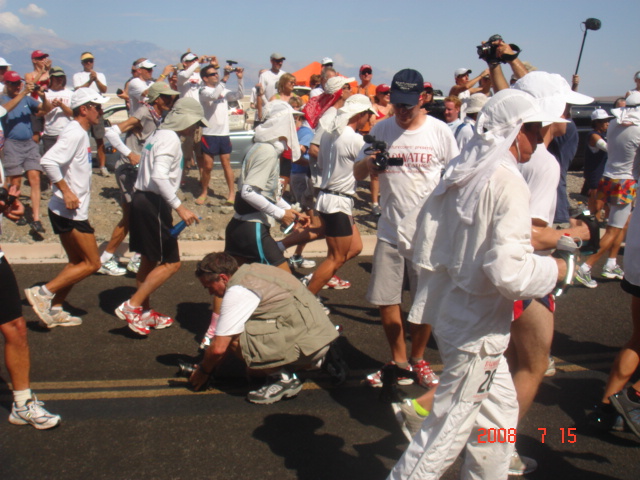
And there they go! The start of a 135-mile distance in 60 hours along California Highway 190 and 136.
Badwater Ultramarathon #1


Early tomorrow morning at 4:00AM, 14 July (8:00PM, Monday, Manila Time), I will be leaving Los Angeles by car to Badwater, California, located inside the Death Valley National Park. The distance from Los Angeles to Badwater is 290 miles or 460 kilometers which is the estimated distance from Manila to Paoay/Currimao, Ilocos Norte. In my estimate, it will take me 4 1/2 hours to reach the place without any traffic problem or being get lost along the way.

My son just prepared me a printed map which he downloaded from Google with the detailed directions from our house to Badwater. I will be missing the runners who will start at 6:00AM and 8:00AM. The elite runners will start at 10:00AM and hope to meet some of them and witness their start of this ultramarathon event. Hopefully, I will be able to take some pictures of these runners while they will be running along Highway 190.

The following news article was copied from Puhrump Valley Times.

Death Valley race pushes to the limit
BY CHRISSY OHLINGER
PVT


BADWATER, Calif. — Many people don’t savor the idea of crossing Death Valley in the summertime by car. Some actually prefer to go on foot. This July 14-16, Route 190 in Death Valley National Park will be littered with people who do just that during the 31st annual AdventureCORPS Badwater Ultramarathon. The extreme sport event will track participants on foot through 135 miles of the hottest, most treacherous and isolated country in the country and the world: from Badwater, Death Valley National Park, to the trailhead of Mt. Whitney in California. The race route yo-yos from a plunging 280 feet below sea level across three mountain ranges before rising to the chilling heights of Mt. Whitney. Some contestants will even choose to scale the tallest mountain in the Lower 48 as an unofficial finish to their journey. Continue reading “Badwater Ultramarathon #1”

Bald Runner’s Team @ TNF 100


I instructed Captain Ferdie Espejo to come up with a team to run/participate in The North Face 100 this coming 26 & 27 July 2008 in Nasugbo, Batangas. If not for my trip and plan to run the San Francisco Marathon this August 3, I could have registered to run in the Team Relay or the 100K solo run. Anyway, the other reason why I have to leave Manila earlier is to witness the start of the Badwater Ultramarathon in Badwater, Death Valley, California this Monday, 14 July 2008 and to adapt early on the weather of California and have more running workouts in Los Angeles.

The Bald Runner’s Team for the TNF 100 will consist of the following:

Rey Antoque and/or Rolando Piamonte for the 100K Solo Run

Cresenciano Sabal and Reynaldo De Los Reyes for the Team Relay 100K

Mamerto Corpuz for the 20K

Ferdinand Elpidio Espejo Jr for the 10K

Bald Runner’s Team will also be running in the TNF 100 Singapore on October 4, 2008.

Good luck to those who will be joining this running event.

Dean Karnazes: UltraMarathon Man


Dean Karnazes is the author of the book, “UltraMarathon Man: Confessions Of An All-Night Runner”. This book was published in 2005 but it was only when QuickSilver Runner mentioned his name in his blog last December 2007 that I knew and heard the name of this famous ultra runner. The second time that I read about this guy was in the book of Pam Reed entitled, “The Extra Mile” who was the strongest contender for the Champion Runner in the Badwater Ultramarathon in 2003, only to be defeated by Pam Reed in few minutes.

The book of Dean Karnazes is a very inspiring one for runners, most especially to those who would like to run farther than the marathon in order to test their endurance and accomplish more than running a marathon race. Through this book, I was able to appreciate and find out that there is a group of extraordinary endurance runners who are dedicated in their training, preparation, diet, health and other technical aspects for ultrarunning.

Dean Karnazes had finished so many ultra running events like: the annual Western States 100-Mile Runs, Badwater Ultramarathons, South Pole Marathon, and The Relay, a 199-mile footrace which is participated by teams with 12 member-runners but he ran the distance alone. He was a team of one in the said The Relay Ultra Running Event finishing the distance in 46 hours and 17 minutes! Since then Dean Karnazes had been a popular figure in endurance runs and his participation in such races were tied with charity works to help children who are in need of medical treatment.

Dean K ran the famous 50 marathons in 50 States in 50 days finishing this feat at the New York Marathon last November 2006. Last March of this year, he won the Atacama Crossing in Chile which is a 250-kilometer race in 6 stages at Atacama Desert. Last month, he finished the Gobi March in 4th place held at the Gobi Desert, China which is also a 250-kilometer footrace in 6 stages. Next Monday, he is expected to join the 82 runners who will participate in the 2008 Badwater Ultramarathon.

Here are some tips from Dean in preparing for Ultra running events:

1) When preparing for an ultra running event, he runs at least 70-100 miles per week. Wakes up at 4:00AM and run 3 hours before bringing the kids to school and going to his office. He takes another 45 minutes to one hour quick run after office work. On Saturday mornings, he runs 30-40 miles.

2) For a 50K or 50-mile event, he suggests doing at least one eight-hour training run. For 100-miler, he recommends doing an all-night run to simulate race condition without sleeping.

3) An ultrarunner should be properly hydrated with water and energy drinks with electrolytes. In his early ultra running events in the 90s, he was using Oral Pedialyte for his electrolyte replacements.

4) His daily diet consists of 40% Carbohydrates; 30% of Protein & 30% of Fats. He eats salmon 4-5 days a week and lots of organic salads.

5) He trains half and half for the roads and trails. But he prefers more time running on the roads.

6) He goes to the gym for muscle strengthening workouts. If he can not make it to the gym, he does 4 sets of 50 push-ups and 4 sets of 90 push-ups—once in the morning and once in the evening.

In 2004, Dean Karnazes won the Badwater Ultramarathon covering 135 miles in 120-degree Fahrenheit temperature in 27 hours and 22 minutes of non-stop running.

He is a columnist for “Men’s Health Magazine” and the President of Good Health Natural Foods. He lives with his wife and their two children in San Francisco. To know more about him and his schedule of ultramarathon races, visit www.ultramarathonman.com.

I hope I will be able to watch his movie, “The Ultramarathon Man”, on 31 July 2008 (in the USA) and buy a copy of his new book, “50/50”.

I recommend this book (“Ultra Marathon Man”) to every runner. Happy reading!

Ultra Marathon 101


Starting for the month of July, I will be posting articles about ultra marathon and ultra trail runs. Please feel free to browse additional sites in my blogroll about these extreme running/endurance sports (Ultra Running & Trail Running). The following article is my recommended basic information about Ultra Marathon.

You can read, copy, save this in your files, print it and keep it for your reference. I copied this article from the Ultrarunning Magazine Online which I think would help those runners who are still looking for the ultimate running race event. This is the way to the future of running and for you to test your body in the world of endurance sports. There is no need to bike, swim, or row your kayaks or boats in one stage just to test the limit the body could endure. You only need your shirt, running shoes (there is no need to buy trail or ultra shoes), running shorts, watch, runner’s cap, and hydration system…and a positive attitude! Good luck and enjoy reading. Continue reading “Ultra Marathon 101”

Extreme Running: The Book


“Extreme Running” is a book written by Kym McConnell and Dave Horsley. Both of the authors are well-respected ultramarathoners and had been going from one continent to another to participate to these extreme running events, all for their passion to test their body limits and challenge the environment. This book was published in London, UK last year, 2007.

I found and bought this book at PowerBooks (Glorietta) two months ago after failing to locate or buy the book, “The Ultramarathon Man” by Dean Karnasez.

This book takes the reader on a world tour of ultramarathon races. The book is divided into seven chapters looking at each continent’s ultra foot races. Each ultra race has its own history, pecularities, preparations, challenges, strategies, experiences/adventures and the characters/personalities involved in each race. Pictures, maps, race course routes, and other informative notes were included in each page of the book.

To mention some of the extreme running events, the following is the list of some ultramarathon races in every continent in the world:

Europe:

1) The North Face Ultra-Trail Du Tour DU MONT-BLANC (UTMB)—101-mile race (163 Km) in Mount Blanc trails that passes through France, Italy & Switzerland held in the later part of August. Cut-off time: 46 hours. Limited to 2,000 runners.

2) Spartathlon—Athens to Sparta Road Race which has a distance of 152 miles (245.3 Kms). This is the original ultramarathon from Athens to Sparta which the Greek messenger, Pheidippides, took in 490 BC to deliver Athen’s request for reinforcements to resist the Persian invaders. Cut-off time—36 hours. Regular number of participants—300 runners. It is being conducted during the month of September.

Africa:

1) Marathon Des Sables—In Sahara Dessert, East Morocco during the month of March or April. It is a 6-stage course which has a total distance of 220-240 Kms (135-150 miles). Number of participants—700 runners.

2) Comrades Marathon—It is a single stage race in South Africa, covering a distance of 56 miles or 90 kms being held in June. Number of Participants—11,000 runners.

3) Trans 333—It is a single stage race in a desert location which is being held in a different host country each year. It has a distance of 333 Kms (206 miles). This is considered as the “World’s Longest Single Stage Desert Race”. Number of Regular Participants—20 runners. Maximum Time Permitted to complete the race—108 hours

North America:

1) Badwater Ultramarathon—It’s a single stage race from Badwater, Death Valley to Mt Whitney in California covering a distance of 135 miles (217 Kms) which is done in mid/late July. Number of Participants is limited to 90 runners (by invitation only). Time Lite to Finish the race is 60 hours.

2) Wasatch Front 100 Miler—Single stage race in Kaysville, Utah, USA which is done in the month of September. Number of Regular Participants—225. Time Limit to Finish—36 hours.

3) Yukon Arctic Ultra—In Whitehorse, Yukon, Canada which is held in February. Distances are: 42K, 160K, 480K & 736K (26.2, 100, 300 & 460 miles).

South America:

1) Jungle Marathon—In The Amazon Jungle in Brazil. It is a 6-stage, 200-Km (125 miles) road race in October and participated by 80 participants.

2) Atacama Crossing—In Atacama Desert in Chile. It is a 6-stage, 250-Km (150 miles) road race which is participated by by 150-200 runners which is conducted in March/August (alternate by year).

Asia:

1) Everest Marathon—In Nepal; 42.2 km, single stage with approximately 75 participants with 10 Nepalese runners. It is conducted during the month of November.

2) Gobi March—In Xinjang Province, China. The course is 6-stage foot race with a distance of 250 kms (150 miles). It is now on-going this week. Check out at www.thenorthface.com with Dean Karnazes participating in the said race. Number of participants—200 runners.

3) Lake Baikal International Marathon—In Lake Baikal, Listvyanka, Russia. 42.2 kms, single stage with approximately 30 participants during the month of March.

Oceania:

1) Kepler Challenge—In Te Anau, South Island, New Zealand. It is a single stage 60-km run (37 miles) done in December with limited participants of 400 runners.

2) Te Houtaewa Challenge—In 90 Mile Beach in Kaitaia, New Zealand. It is running along the beach with a distance of 60 kms (38 miles), single stage held during the month of March. Approximate number of participants—30 runners.

3) Bogong To Hotham Trail Run—In Mount Bogong, Victoria, Australia. It is a single stage run with a distance of 64 kms (40 miles) held in the month of January. The race is limited to 60 runners.

Polar:

1) Antarctica Marathon—In King George Island, Antarctica. It is a single stage 42.2-km run held in February. It has a limited number of participants to 180 runners.

2) Antarctic Ice Marathon (South Pole Marathon)—In the foothils of Ellsworth Mountains, Antarctica. It is a single stage race with distances of 42.2 kms and 100 kms. It is held in December with a limited number of participants to 25 runners.

3) North Pole Marathon—It is located in 89N-90N, Arctic Ice Cap. It is a singlke stage race with a distance of 42.2 kms held in April. The number of participants is limited to 24 runners.

My Order Had Arrived


After accidentally bumping into the book, “The Extra Mile” by Pamela Reed and reading it, I came up with a post in this blog about the said book and the feats the author had accomplished in the underground sports of ultramarathon. I was fascinated with her experiences, preparations, training and the ordeal she has to go through winning the Badwater Ultramarathon Race which is considered the “hardest ultramarathon race” in the world” for two consecutive years, 2002 & 2003, beating the best men in ultramarathon entire the world.

I’ve heard about Dean Karnazes, for the first time, in one of the early posts of QuickSilver Running in his blog and found out later that he (Dean) has a runner’s blog; website and a coach of Runner’s World Magazine. After checking and browsing his website, I found out that he had written a book which is entitled, “The Ultramarathon Man”. In Pam Reed’s book, she mentioned about Dean Karnazes as one of the competitors and  a “threat” to her in defending her championship at the Badwater Ultramarathon Race in 2003 but ultimately did not affect her resolve to defend her title as she emerged as the champion and winner for that year’s race. I hope to know the reason why Dean Karnasez was not able to dislodge Pam Reed as the defending champion in 2003 in his book.

Since then, for the past 2-3 months, I’ve been looking for the said book by Dean Karnazes in the different bookstores in Metro Manila but to no avail. I asked my wife to buy me one and send it through my niece who was scheduled to return to Manila after a brief visit in Los Angeles on June 3, last Tuesday.

I got a call from my niece last Thursday morning telling me that she had arrived safely in Manila an she had my book with her. I told her to just leave it in my quarters and I will be able to have it once I arrive in Manila from Laoag City.

I am looking forward to read this book and post a book review on this..soon!

Pam Reed: The Ultramarathon Woman


I bought a book at National Book Store entitled “The Extra Mile” by Pam Reed. This is the story of Pam Reed, a runner, wife, and a mother who started to bring awareness to the public through the media on ultramarathon races. Long before Dean Karnazes became popular as the Ultramarathon Man, Pam Reed was already making a name in ultramarathons when she won the Badwater Ultramarathon in 2002 and 2003. Dean Karnazes initially participated in the Badwater Ultramarathon on 2003 but he was defeated by Pam Reed by 25 minutes. Of course, Dean K won the next year’s event in 2004.

As I was reading the book, I could imagine the place and the distance where the Badwater Ultramarathon is done annually during the middle of the month of July. One time, my family and I visited Las Vegas during the month of July and while on the road going to Las Vegas, I could see along the Death Valley desert the giant Thermometer with the reading of 120 degrees Fahrenheit and this is the place where the ultramarathon starts. Badwater Ultrmarathon is considered as the “most challenging and hardest” route for an ultramarathon event. The race starts at an elevation of 282 feet below sea level (Badwater at Death Valley Desert) and finishes at Mount Whitney with an elevation of 8,360 feet. The race covers a distance of 135 miles or 216 kilometers and each runner should be able to finish the race in 60 hours.

The flat distance of 216 kilometers is from Manila to Damortis, La Union or from Laoag City to Balaoan, La Union or running along the North Luzon Expressway three times (up to Mabalacat Exit). But if you consider the terrain and the heat of the sun/temperature in this event, this event becomes even harder. Pam Reed still holds the women’s record of finishing this event in 27 hours and 56 minutes and covering the distance with an average speed of 7.7 kilometers per hour.

These are the tips I got from the book:

1. Ultramarathoners train as marathoners.

2. Run conservatively slow and the goal is to be able to Finish the race.

3. You must have a “handler” and a crew who will support you along the way.

4. The first “17 miles” of the race must be ran without any support or crew. After the 17th mile, your crew can pace, spray you with water, give you water and food, and accompany you along the route.

5. Divide the distance in segments and finish each segment one at a time. The distance may vary from 5 miles or 1 mile per segment. Ultramarathon requires “extreme” patience and mental toughness.

6. Take a break but keep on moving your legs.   

7. Drink Plenty of Fluids. Ensure, Red Bull, Gatorade, and Water are the favorite drinks of Pam Reed. She finished 40 cans of Ensure during her fourth Badwater Ultra.

8. Eat and store calories or put additional pounds of body weight within 3 weeks before the race. These calories and extra pounds will be needed on the last half distance of the race. 

This is a nice book to read, most especally to runners. The book is very inspiring as Pam Reed balances her training, work, family, health and the races she joined. I am higly recommending this book.