Top 20 Female: 2008 Pasig River Marathon


             Name                                    Time

1.   Jho-Ann Banayag                      3:02:26

2.  Christabel Martes                      3:o6:50

3.   Jeruto Kigen Caroline               3:10:26

4.   Joanne Manangat                      3:37:33

5.   Flor Donos                                  3:42:46

6.   Katie Fischer                              3:46:09

7.   Anna Vargas                               3:48:16

8.   Enate Sayrol                               3:54:56

9.   Jenny Kinsella                           3:55:01

10. Geraldine Sealsa                       3:58:31

11. Ailyn Morillo                              4:04:55

12. Genevieve De la Pena              4:05:51

13. Mila Paje                                    4:08:43

14. Annie Agoncillo                         4:09:35

15. Joan Pallones                            4:09:36

16. Olive Cortez                              4:11:18

17. Debbie Marie Bautista             4:14:52

18. Daisy Castillon                          4:15:11

19. Reva Magno                              4:20:10

20. Monique Nimo                         4:22:45

The Good, The Bad, and The Ugly


Critique on the conduct of the 2008 Pasig River Marathon

This is not about the movie which was shown when I was 1st year in College (1968/69?) and this is not about Clint Eastwood, Lee Van Cleef, and Eli Wallach. Do you still remember them? I think these Actors are still alive up to the present. In one of the blogs that I visited, the writer/runner described his experience running a marathon by these three words and I am going to copy him in describing how the 2008 Pasig River Marathon was conducted. In one of my earlier posts, I described my experience running this marathon in 2006 which I gave a failing grade comparing it from the PAL and Manila Marathons in the ’80s-’90s. So, here are the things I could say and impression about this Marathon Race.

The Good

This is the eight annual rendition of the Pasig River Marathon which changes its name for the nth time. Seven years is a lot of time to improve the race and I was impressed that this 42K race had improved tremendously! First, the attendance of runners for the 42K had increased to almost four times from the time I first joined this race. This is a proof that Filipinos had become more health-conscious and they put more premium on having a healthy heart and being fit. Second, the organizers changed the course/route–from Marikina Riverbank to Quirino Grandstand as compared from the old route–from Intramuros to The Fort, crossing almost all the bridges that cross the Pasig River. The new route was very advantageous to the runners as nobody could be lost along the way in the first 20 kilometers even the surroundings were still dark because the roads are wide and easy to follow. In the old route, many runners got lost in the first 5 kilometers because the roads were narrow and dark. Third, starting the race at 4:00 AM was a “cool” idea! The roads from the start up to the 30 kilometer point were exposed to the sun but running on these roads were easy as it was still dark and cold. And the next ten kilometers were along roads that were shaded with fences, houses, and buildings except for that long bridge which was my first time to see in Pandacan. Finishing a marathon in four hours and the heat of the sun at 7:00-8:00 AM is still tolerable to the body even if the sun was shining. Fourth, I was happy to see kilometer markings every 4 kilometers placed on top of parked vehicles of the marshalls. Fifth, there were lots of water stations along the way and the supply of water was not a problem. People in the squatter areas in Mandaluyong and Pandacan were giving water in plastic bags to everybody which was not part of the organizer’s designated water station/s. I even saw some ladies offerring raisins and bananas to the runners. Sixth, there were lots of road marshalls and I was glad that the Philippine Army contributed with soldiers/Military Police lined up from the entry of Bayani Road near Heritage Park up to The Fort area and down to the old Gate 1 of Fort Bonifacio near Kalayaan Road. The Philippine Army Band was also at the Bayani Road playing lively music to the delight of the runners. Seventh and last, the weather was the “best” weather for a marathon race. It was cloudy and the sun did not appear at all!  Bottomline? The 2008 Pasig River Marathon was a well-planned and well-prepared marathon race.

The Bad

First, the traffic and road construction at the E. Rodriguez Jr Ave. made the runners inch their way in between trucks and vehicles, barely one kilometer from the starting line. Second, running along C-5 with the vehicles on your side and back was a scary experience for runners. Orange-colored street cones should had been placed along C-5 in order to separate the runners from the vehicles going in the same direction. I could still remember that these cones were present along C-5 during the past races. Third, I’ve never seen a “portalet” along the way. For drinking so much water/liquids before the start of the race, I had to “relieve” myself along Julia Varga St, barely 8 kilometers from the start, by approaching one of the plants along the road. Fourth, a gasoline tanker nearly bumped me, head-on, when the driver forced his way in a crossing passing through a “red light” in Pandacan. I was glad the road/race marshall and the traffic enforcers were there to stop and shout at the driver! Fifth, the traffic was so bad on the crossing Nagtahan Bridge and Legarda St up to the Quirino Grandstand. Sixth and last, there were so many multi-colored strings given along the way just to prove that a runner passed through a certain part of the route. This is our “primitive” RFID “runner’s chip” tool, but I didn’t see anybody at the finish line checking all of these (dozen of) strings in every runner’s neck or wrist. I guess, I was an insignificant runner/finisher finishing the race more than four hours! Although these were minor lapses, I knew these things will be corrected in the incoming races for the Pasig River Marathon.

The Ugly

First, the squatters area at Mandaluyong (along Pasig River) and Pandacan. Do I have to explain this? Do we have to show “our dirt” to our guests/international runners. It’s okey if the African (Kenyans & Ethiopians) runners are our only international runners because we have better living conditions than them, how about the US and European runners? Second, very poor quality of air and the carbon monoxide emissions from trucks & “jeepneys” that we breath while running in Manila. Third and last, it’s the foul SMELL of the Pasig River! I just hope that the proceeds and earnings from this Marathon Race will benefit the project to rehabilitate Pasig River. I was smiling when I overheard one of the runners beside me asking from his companion if there are fishes that thrive with the dirty waters of Pasig River. The other runner answered back laughing with the words “None”. 

P.S. I can not make any comment on what happened in the “Pasta Party” which was held o/a 4:00 PM of 22 February 2008 (Friday) at The Orchidarium, Teodoro Valencia Circle in Rizal Park because I did not attend to this. Instead, I brought my daughter, her boyriend and my mother-in-law to the Centennial Airport for their departure back to Los Angeles. I hope they have improved already on how to properly cook their “pasta”. Lastly, I did not observe any “cheating” along the way. The “long bridge” at Pandacan which every runner took going the North and then back going South has a divider that could be easily crossed was very tempting to “cheats”. I was glad I did not see anybody who dared to cross the said divider.

My overall rating/grade for the 2008 Pasig River Marathon—90%

Things To Be Done After Marathon Race


1.  Cool-down and make your usual stretching exercises slowly as your muscles are still sore.

2.  Drink a lot of water/liquids.

3.  Take a cold shower, not a warm one. Studies had proven that cold shower would make the muscles more relaxed.

4.  Eat carbohydrates and “hot meal” with soup. My favorite after a race/run is a “Mami Noodle Soup with Beef Briskets & Tendons” at Causeway Restaurant (C-5, near Jollibee Green Meadows) coupled with “Lychees w/ Almonds in Sweet Syrup & Ice” as dessert. Don’t forget to bring with you your “support team” to this occassion.

5.  Sleep early at night and take some more time to rest with your sore legs elevated. Remember the word R-I-C-E to treat muscle soreness/injuries—Rest, Ice, Compression (Massage), & Elevate.

6.  Let your muscle sores/pains treat itself. I don’t recommend pain relief medications to solve this problem.

7.  Keep on moving when not in rest or in bed.

8.  Start to take a long walk on the second day after the marathon race.

9.  Evaluate your running performance.

10.  Take a vacation and relax with your family.

11.  Give thanks to the Lord for finishing the race without any injury or problems.

12.  Reward yourself with something…maybe, a new running shoes, a new running attire, Ipod, DVD movie, or something that will remind you on finishing the Marathon Race.

P.S. I should had posted this immediately after the marathon race. Sorry, guys! However, you can still follow my recommendations #5 to #12.               

D-Day: 2008 Pasig River Marathon


24 February 2008

Yesterday morning, I went to Marikina Riverbank to familiarize myself with the route of the Pasig River Marathon. I happened to meet a certain “Robert” who was wearing a runner’s attire and looks like a seasoned runner at the Marikina Riverbank. He happens to be a regular runner of the Pasig River Marathon for the past seven years and we talked for awhile. He noticed that I was coughing while I was talking to him and he tried to tell me that it will be a hard and difficult situation for me to finish the marathon with my condition. I just smiled and he later oriented me with the starting area and the route.

Knowing the route, except for the Mandaluyong-Sta Mesa-Pandacan area, I immediately took some of my medications and was able to rest the whole afternoon of Saturday and slept early at 8:00 PM. I woke up at 2:00 AM, took a shower, shaved, had my last “crap”, ate oatmeal, applied petroleum jelly on my inner thighs/feet/inner part of my upper arms/below my armpits and wore my running attire. At 3:00 AM, I was already on my way to Marikina Riverbank.

The race program started at 3:30 AM and the race started on time at 4:00 AM. Nobody among the runners were paying attention to the remarks/speeches of the VIPs on the stage except for the singing of the National Anthem. In my estimate, there were about 1,500-2,000 runners for the 42K to include members of the Philippine National Police and the Armed Forces of the Philippines.

 dsc00487.jpg

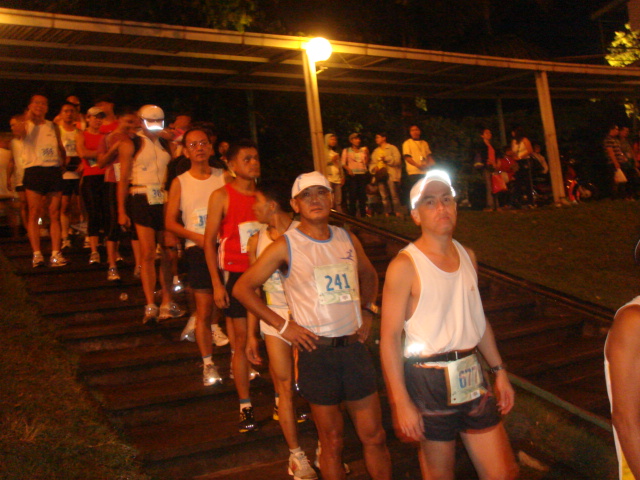
Getting in line for the check-in before runners could enter the starting area. It took at least 30 minutes for marshalls to mark all the runners. Runners were lined up while the race program was on-going. 

 dsc00498.jpg

I thought I started very slow on the first 10 kilometers but when I reached the 20 kilometer mark, I was surprised to see that my GF 305 registered a time of 2 hours! I was running too fast, contrary to my final plan of running conservatively. There was no way I could see what was going on with my GF 305 because it was still dark and there was no bright light/lamp post along the route.

dsc00500.jpg

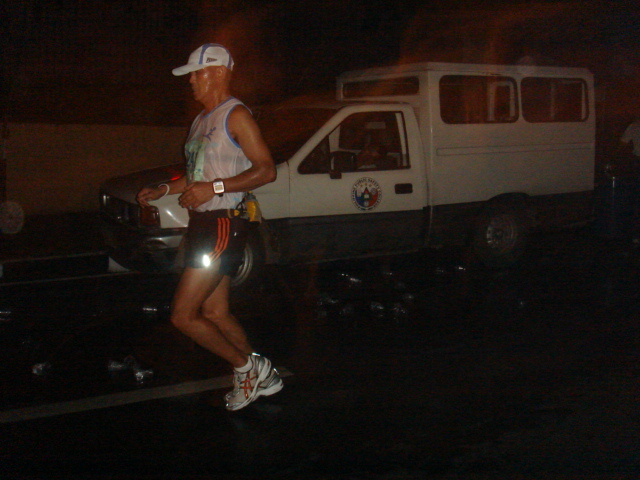
A fast pace at the C-5 Bridge, near Kalayaan Avenue where my staff had a problem getting a better picture of me while it was dark!

dsc00517.jpg

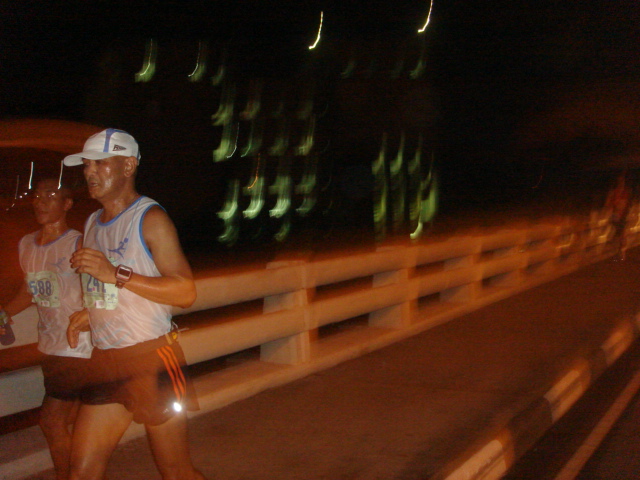
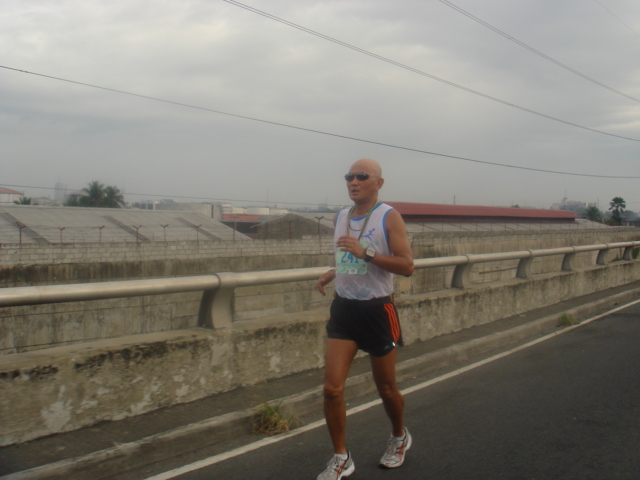
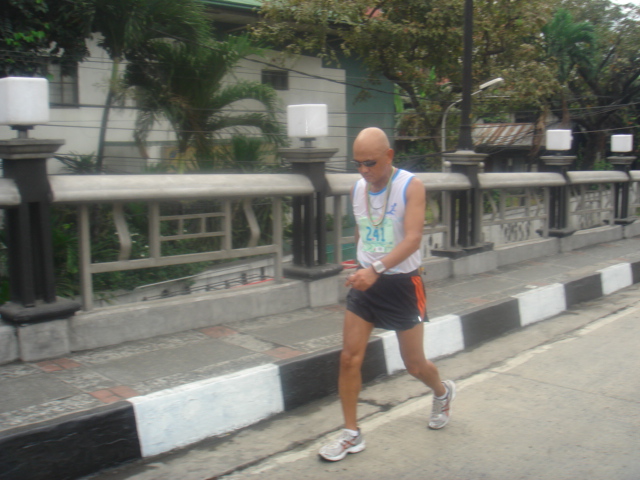
Crossing one of the bridges in Mandaluyong

dsc00525.jpg

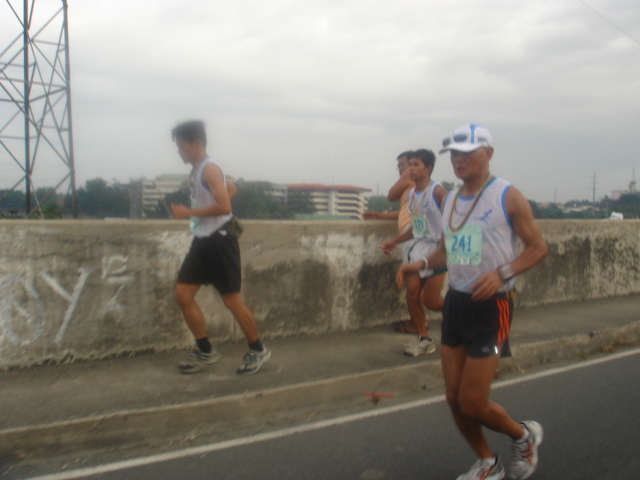
I need to “shuffle” and take little steps just to prevent my legs from getting cramps!

dsc00528.jpg

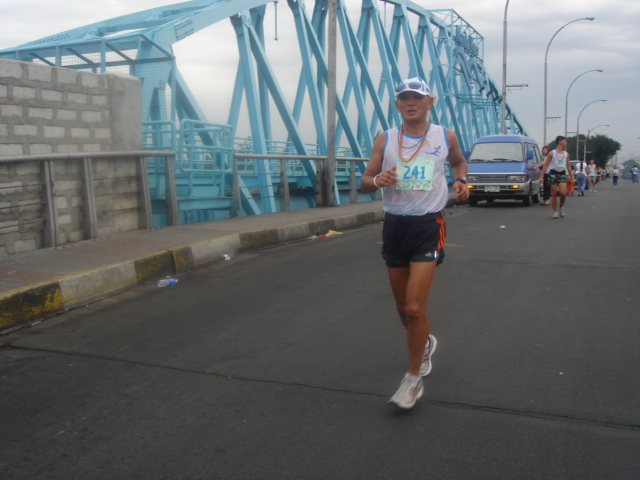
One of my security men recommended me to wear my runner’s cap while passing at the squatters area in Mandaluyong and Sta Mesa for security reasons. Once I was already at the Nagtahan Bridge, I removed my cap and wore my sunglasses!

dsc00531.jpg

And then I had to walk briskly as I was about to experience “cramps” on my both legs (calves & hamstrings). I started to experience muscle cramps at Km # 36!

dsc00536.jpg

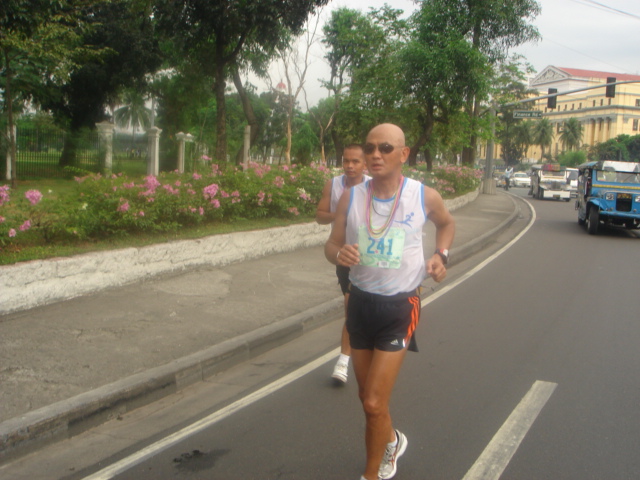
At last, I could see Manila Hotel from this point and I knew I could finish the race.

dsc00539.jpg

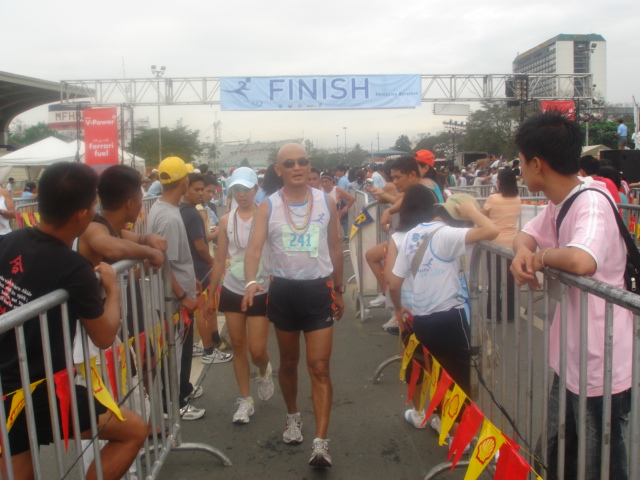
Every runner should smile after passing the finish line. Before passing the Finish Line, I heard some of the runners in the audience shouting “BALD RUNNER”. One of the marshalls at the finish line told me that she is a regular reader of my blog.

dsc00542.jpg

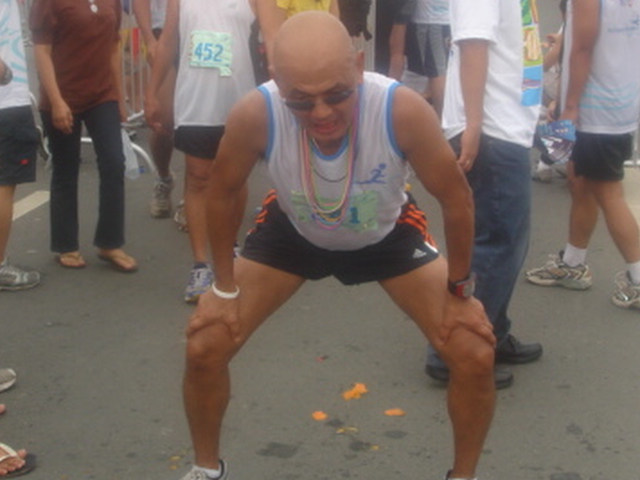
The Bald Runner trying to copy the picture of Lance Armstrong after finishing the 2007 New York Marathon!..Ha! Ha! Ha!

4:49:48 Hours @ 2008 Pasig River Marathon


24 February 2008 (4:00 AM-8:49 AM)

Yes, I finished the 2008 Pasig River Marathon in 4:49:48 hours (unofficial time) without any injury or any problems. Surprisingly, I did not have any coughing along the way, from start to finish!

The following data were taken from my GF 305:

Distance—42.6 kilometers           Average Pace—6:48 minutes/kilometer

Average Speed—8.8 km/hr         Maximum Speed—13.6 km/hr

Average HR—155 bpm                Maximum HR—165 bpm

Calories—3,016                             Total Ascent—1,265 meters

More stories and pictures on my next posts. Guys, I need some rest!

Congratulations to all the 42K runners and finishers!!!

D-3 Day: 2008 Pasig River Marathon


21 February 2008

My short running along the Iloilo City Sports Complex Oval Track where I was exposed to rains made my body weak. On this day, I arrived in Jamindan early in the morning and I started to experience coughing. I did not mind it and I joined my officers, men and civilian employees for our regular taebo and 2-mile run physical conditioning activity which is usually done on Tuesday & Thursday afternons.

The taebo exercises lasted for 35 minutes and I had a 4-mile slow run as my last physical activity before the marathon race. However, my coughing started to be intermittent on the evening. I slept at 10:00 PM hoping that my body needed more rest and let my coughing pass away.

It was a big mistake on my part to have exposed myself to the rains during my oval track run last Wednesday evening. But my coughing will not prevent me from joining and finishing the 2008 Pasig River Heritage Marathon this Sunday morning.

I am wishing myself…Good Luck!

Route: 2008 Pasig River Marathon


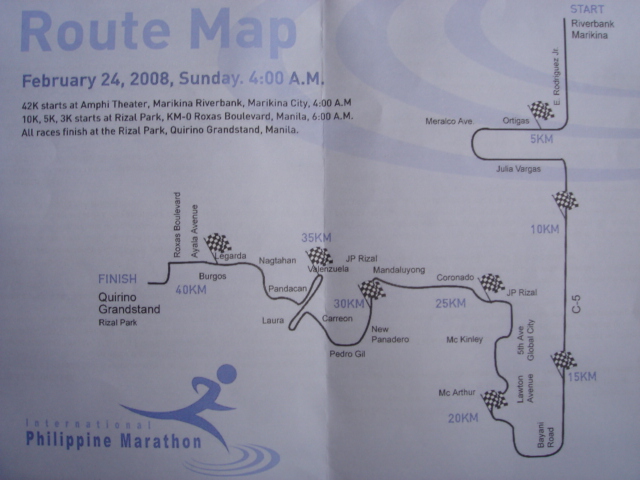
Finally, I got hold of my race packet for the Pasig River Heritage Marathon. But the organizers changed the name of the race into “International Philippine Marathon”. I guess, this is the fourth time that they changed the name of the race and the first time that they changed the route of the race. I hope the picture below will be clear for my co-runners and readers to see.

dsc00484.jpg

I haven’t seen the actual route but I will try to visualize the route as I recall passing through these roads in the past. The race starts at Riverbank Marikina and runners go south along E. Rodriguez Jr. Avenue–right at Ortigas Avenue (uphill)–left at Meralco Avenue–left at Julia Varga (downhill)–right at C-5 (uphill at the Bridge before Kalayaan & at Market!Market! & McKinley Hill)–right at Bayani Road (my “Heritage Mile” & uphill to Gate 3 Ft Bonifacio)–pass by along Phil Army Golf Course–right at Lawton Avenue–passing through The Fort and exit at the old Gate 1 of Fort Bonifacio all the way to JP Rizal Avenue Makati–runners cross the Pasig River along a bridge towards Coronado (I am not sure if this is the bridge that connects Makati Avenue) & JP Rizal Mandaluyong–turn left at New Panadero–right at Pedro Gil–right at Carreon–left towards Plaza Dilao–turn-around & go towards Valenzuela and back along Pandacan, Sta Mesa–right at Laura–right to Nagtahan Bridge (uphill)–left to Legarda–pass along Ayala Avenue–and Finish infront of the Quirino Grandstand.

Approximate Locations of the following Kilometer Markings: 

5K—along Ortigas Avenue

10K—along C-5 (near Toyota)

15K–along C-5 (squatters area)

20K—back of HPA Grandstand along Lawton Avenue

25K—crossing with the street leading to the old Gate 1 of Fort Bonifacio & JP Rizal Makati

30K—New Panadero

35K—Pandacan, Sta Mesa

40K—Legarda

42K—Quirino Grandstand

D-4 Day: 2008 Pasig River Heritage Marathon


20 February 2008

At 5:30 AM, I was already on my way to Dauin, Zamboanguita and Siaton, Negros Oriental after staying overnight in Dumaguete City. After one hour, I was able to reach Siaton where one of my Battalions had deployed three days ago after coming from Bohol. I was able to talk to the men of this Battalion and informed them of the prevailing situation in the area and their specific mission in their new place of assignment.

I was informed by my Battalion Commander that the Municipal Mayor of Siaton does not like the Philippine Army to be deployed in his town/municipality. This is an indication that the “insurgents” are in the area and the Mayor is afraid of them. I gave specific instructions to my Battalion Commander on how to deal with the uncooperative Municipal Mayor and maintain his position to stay in the said town.

From Siaton, we have to go back to Dumaguete City and proceeded to Bacolod City, passing through Mabinay, Negros Occidental. We had our lunch in Kabankalan City with their famous Mang Inasal Chicken & Pork Sisig and lots of free rice! Our trip was a slow one and we were able to reach Bacolod City at 2:30 PM and had more time to buy the Negros famous Piaya and Dried Mangoes.

I took the 3:30 PM trip back to Iloilo aboard a fastcraft. At 5:30 PM, I was already at the Iloilo City Sports Complex Oval Track for a short run. I was surprised to see a lot of people playing basketball, volleyball, soccer/football, and runners/joggers on the oval track. Almost all the lanes at the oval track were occupied with people of various ages and sizes (man & women).

The following were the data taken from my GF 305 on every lap it registered:

Lap # 1

Distance—1,750 meters                 Time—9:52 minutes

Average Pace—5:30 mins/km      Calories—127

Average Speed—10.6 kms/hr       Maximum Speed—12.1 kms/hr

Average HR—139 bpm                   Maximum HR—150 bpm

Lap # 2

Distance—448.61 meters              Time—1:47 minutes

Average Pace—3:59 mins/km     Calories—28

Average Speed—15.0 kms/hr      Maximum Speed—16.3 kms/hr

Average HR—156 bpm                  Maximum HR—167 bpm

Lap # 3

Distance—891.03 meters             Time—4:04 minutes

Average Pace—4:34 mins/km     Calories—63

Average Speed—13.1 kms/hr      Maximum Speed—15.2 kms/hr

Average HR—162 bpm                 Maximum HR—167 bpm

Lap # 4

Distance—874.55 meters             Time—3:37 minutes

Average Pace—4:08 mins/km    Calories—60

Average Speed—14.5 kms/hr     Maximum Speed—16.9 kms/hr

Average HR—163 bpm                 Maximum HR—173

Lap # 5

Distance—886.63 meters             Time—4:32 minutes

Average Pace—5:07 mins/km     Calories—64

Average Speed—11.7 km/hr        Maximum Speed—15.2 km/hr

Average HR—160 bpm                 Maximum HR—167 bpm

Aside from the registered laps, I was able to run the following:

2 X 400 meters—Cool-Down Run

4 X 400 meters—Rest/Recovery Run in between laps

Total Distance Covered—7.5 kilometers or 4.68 miles

After dinner, I had my Sauna, Bath & Body Massage (one and a half hours) at Riviera Spa of Iloilo City at a promotional price of Two Hundred Pesos Only (P 200.00)! This is the cheapest Spa service I’ve experienced so far!

I slept at 10:30 PM.
Running Generals


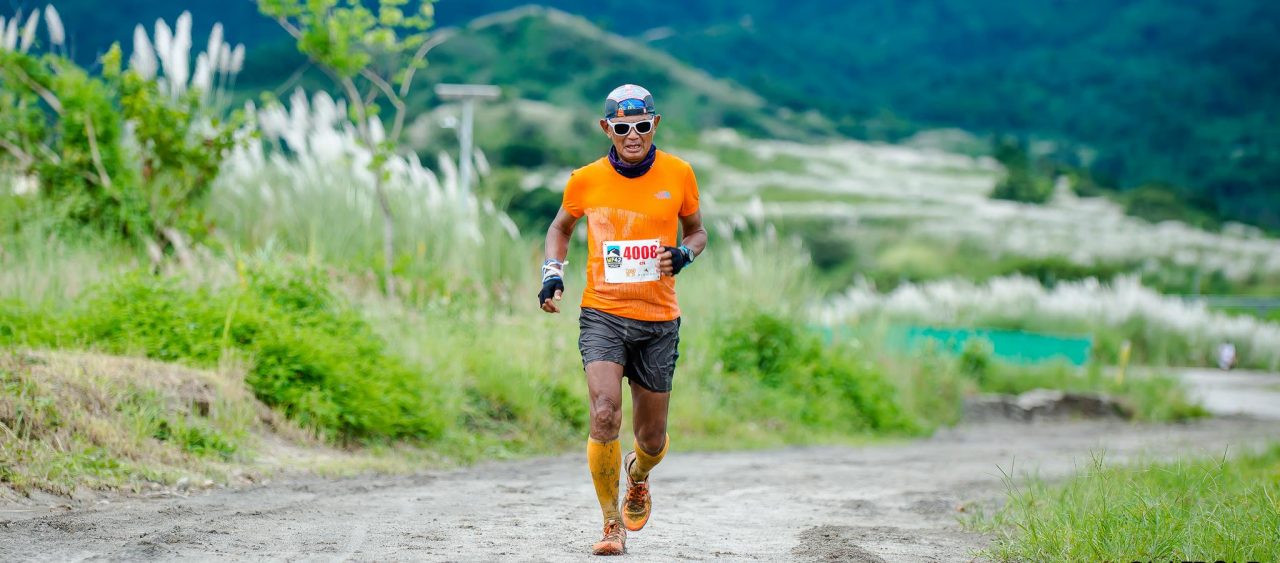
“Running Generals” are rare breed of disciplined, consistent, patient, focused and passionate officers of the Armed Forces of the Philippines and the Philippine National Police who take running seriously and part of their daily scheduled regimen. These Generals should not be misconstrued as Generals “running” away from the enemy or “running” away from the battlefield and take the comfort of their “air-con” offices in the General Headquarters or in Metro Manila. These are the real “marathoners”. Most of them finished marathon races in the past and some of them are still adding more marathon races to their personal records even if they are already retired from the service.

I would like to pay tribute to some of the officers of the Armed Forces of the Philippines who later became Star Rank Officers or Generals who had finished marathon races in the past and in the present. Most of them became my models/idols but always my running competitors in road races in the past and some running events during alumni homecomings of the Philippine Military Academy.

Brig Gen Max Bejar, retired, as the Dean of Corps of Professors and Assistant Superintendent of Philippine Military Academy from 1986-1989. In my recollections, he was the first active General who run two consecutive marathons, 1987 & 1988 Pilipinas International Marathon. He was then a Brigadier General when he ran these two marathons. He is tall and stocky guy and finished his first marathon in 5 hours +. He migrated to the United States after his retirement from the service and he is still actively connected with the corporate world.

Admiral Jorge Necesito of the Philippine Navy, retired, as the The Naval Inspector General. He was the former Chairman of the DND-AFP Gintong Pangarap for Marathon for two years until I replaced him as the Chairman almost two years ago. He is one of the few Naval Officers who started running the marathons in the early ’80s.

Brig Gen Antonio Romero of the Philippine Army, retired, as the Assistant Division Commander of the 7th Infantry Division, Philippine Army based in Fort Magsaysay, Palayan City. He finished marathons in the ’80s and a consistent member of the DND-AFP Team for the annual participation to the International Corporate International Run Competition held in Palo Alto, California in the ’80s.

Brig Gen Samuel Narcise of the Philippine Army, still active in the service, presently The Inspector General of the Philippine Army. He finished a number of marathons in the ’80s and early ’90s together with me. He later shifted to badminton and he is now considered as one of the top active Generals in the sports of Badminton.

Chief Superintendent Samuel Tucay of the Philippine National Police, still active in the service, and presently the Director of the PNP Training Command. He is an active marathoner and acts as a Chairman of one of the Federations of Running Organizations in Metro Manila. 

Lt Gen Alan  Cabalquinto of the Philippine Army, recently retired from the service, and retired as the Commander of the National Capital Region (NCR) Command in May 2006. He was my running colleague/partner in the 2005 Pasig River Heritage Marathon and some of the PAL International Races in the ’90s. We both idolize Dr George Sheehan and exchange notes on running tips, training, and running fashion.

Commodore Vic Agdamag of the Philippine Navy, still active in the service, and presently the Commander of the Philippine Naval Command-North. He finished marathon races in the ’90s and a single-handicapper in golf up to the present.

General Benjamin Defensor, Jr. of the Philipine Air Force, retired, as Four-Star General and former Chief of Staff of the Armed Forces of the Philippines. He finished marathon races in the ’80s and presently holds an Ambassador position for Global & International Counter-Terrorism under the United Nations Organization.

Among these running Generals, only Brigadier General Max Bejar and Lt Gen Alan Cabalquinto were able to run and finish marathon races while they were actively holding the ranks as Generals. Their feat and passion in running marathons were not highlighted by the AFP and the media then but this simple posting on my blogsite will surely put them as part of the history of marathon running among the senior officers of the Armed Forces of the Philippines and the Philippine National Police.

“Shuffle, Don’t Bounce”


When I joined the 1st City of Angels Half-Marathon Race in Los Angeles last December 4, 2006 with my daughter, I observed that she was “bouncing” during the run. “Bouncing” means that you are pushing much of your legs after your foot hits the ground. In effect, the whole body is bouncing as you run, creating extra effort to your legs, knees and body. Sometimes, bouncing creates a semblance of being suspended on the air for a half of a second before your leading foot strikes the ground. Well, I didn’t mind her style of running while we were on the race but I encouraged her to increase her speed and maintain her cadence and breathing rythym on the last 3-4 miles before the finish line.

Immediately after the race, she was happy that she was able to improve her PR best time for the distance by 12 minutes. I congratulated her for the determination she had shown despite for the reason that she just had her “monthly visitor” (which she told me only after the race!). Anyway, while we were walking back to home (our house is 2-3 miles away from LA City Hall), I told her about her tendency to “bounce” during running.

Of course, she told me that she is not “bouncing” when she runs. I described and demonstrated how she was “bouncing” while running. I also demonstrated to her how to “shuffle” while running. I suggested and recommended to her to adopt the “shuffle” style of running.

Basically, I am a “shuffler”. Shuffling means that a runner does not need to raise his/her knees too much in the air and the foot should not be ahead of the knees while running. It is an exaggerated trotting of the feet with the ball of the feet or heel hitting much of the ground. This is the most relaxing way to run with the knees not being forced to exert extra effort. It takes time to practice and adopt this kind of running. But for me, this is the best running style I recommend for runners training for their first marathon.

My running models in marathon in the ’80s; Bill Rodgers, Alberto Salazar, Robert de Castella, Toshihiko Seko,  Steve Jones, and Waldemar Cierpinski; were all “shufflers”.

My God, I am really that old and bald if you don’t know these famous marathoners in the past!!!