31st National Milo Marathon: Results


Hereunder are the results of the 42K National Finals of the 31st National Milo Marathon held in Manila, Philippines on 18 November 2007. The results were taken from “RACE–Race Results Specialists”.

MALE/NAME                    TIME                   PACE (per K)

1.  Cresenciano Sabal             2:22:57                         3:25

2.  Bernardo Desamito          2:25:03                         3:28

3.  Juniel Languido                2:25:07                         3:28

4.  Eric Panique                      2:28:40                         3:33

5.  Mamerto Corpuz               2:29:42                         3:34

6.  Crifrankreadel Indapa     2:31:23                          3:37

7.  Angelito Sibayan               2:31:52                         3:37

8.  Rogelio Sarmiento            2:32:48                        3:39

9.  Elmer Sabal                       2:33:44                         3:40

10. Reynaldo de los Reyes    2:34:00                         3:40

11. Modesto Madalang           2:35:42                         3:43

12. Joel Bangtay                      2:37:20                         3:45

13. Reynaldo Pascua              2:38:38                          3:47

14. Ronald Despi                    2:38:48                          3:47

15. Jerry Lindawan                2:38:57                           3:48

   FEMALE/NAME             TIME                    PACE (Per K)

1.  Flordeliza Carreon            2:53:20                         4:08

2.  Estela Diaz                         3:01:05                         4:19

3.  Mona Liza Ambasa           3:01:58                         4:20

4.  Grace de los Santos          3:11:12                           4:34

5.  Ailene Tolentino               3:15:09                          4:39

6.  Leszl Gitaruelas                3:18:01                           4:43

7.  Maricel Maquilan             3:20:17                           4:47

8.  Flordeliza Donos              3:23:15                           4:51

9.  Hanny Jean Delfin           3:25:37                          4:54

10. Joanne Manangat            3:27:55                          4:58

11. Allyn Grace Salas              3:31:52                          5:03

12. Madelyn Carter                 3:36:56                         5:10

13. Ana Liza Vargas                 3:39:06                        5:13

14. Geraldine Sealza                3:43:21                         5:20

15. Sharon Vega                       3:45:57                         5:23

2006 Pasig River Heritage Marathon: Results


Source: Association of International Marathons and Road Races (AIMS): RESULTS

26 FEBRUARY 2006: PHILIPPINE MARATHON FOR THE PASIG RIVER

Gripping drama characterized this second marathon edition in Metro Manila. In the midst of the country’s political turmoil, the marathon nevertheless started and ended without a hitch.

The top two men are in-house athletes of the Philippine Army, who, at that time, were under red alert following a Presidential Proclamation placing the entire country under a “State of National Emergency.”

On the women’s side, youth triumphed over experience when Jhoan Banayag, of the University of the East Athletics Team, won over a veteran field which included last year’s winner Maria Estela Mamac-Diaz.

This was the first time, including the first four years when the road race was known as the Pasig River Heritage Marathon, that an international-calibre runner was among the 903 starters. Robert Njoroge Wambugu flew in barely four hours before the gun with little more than a pair of training shoes. Fellow competitor Cesar Bollecer of Direct Link Running Club, showing the visitor the unique Filipino brand of hospitality, exchanged running shoes with him on the start line, but the drama did not end there.

Njoroge, benefitting from his extensive international exposure, immediately took the lead. But after two of the course’s nine bridges, jet lag, lack of sleep and the warm weather began to tell on his legs, allowing the locals to catch up and pull away. Dropping to a 10th-place finish, Wambugu vowed to be back to redeem himself in next year’s edition.

The marathon is an advocacy project of the Clean & Green Foundation Incorporated on behalf of the Philippine Government’s Pasig River Rehabilitation Commission. It seeks to harness the people’s participation in the long-running Pasig River rehabilitation program.

The Pasig River is the Philippines’ most historical and important inland waterway, which runs from east to west dividing Metropolitical Manila into north and south areas. The country’s history in the last 400 years is closely intertwined with the river, spanning Spanish, British, American and Japanese colonial occupations, revolutions, world wars, and local uprisings. Located along its banks are the Filipino’s most historical districts, buildings and sites.

MEN:
1  Cresciano SABAL             PHI  2:26:13
2  Bernardo DESAMITO           PHI  2:30:29
3  Memerto CORPUZ              PHI  2:32:24
4  Regelio de Leon SARMIENTO   PHI  2:35:28
5  Rodolfo TACADINO            PHI  2:36:02
6  Allan BALLESTER             PHI  2:37:00
7  Jujet DE ASIS               PHI  2:37:24
8  Michael CANILLO             PHI  2:38:11
9  Wilson MANINGKIL            PHI  2:39:26
10 Robert WAMBUGU              KEN  2:40:00
 
WOMEN:
1  Jhoan BANAYANG              PHI  3:02:37
2  Flordeliza CARREON-CACHERO  PHI  3:09:13
3  Ailene TOLENTINO            PHI  3:09:28
4  Ma. Estela MAMAC DIAZ       PHI  3:09:42
5  Liza DELFIN                 PHI  3:24:22
6  Merlita ARIAS               PHI  3:34:17
7  Mila PAJE                   PHI  3:37:04
8  Marychiel MINAS             PHI  3:41:18
9  Joanne MANANGAT             PHI  3:43:58
10 Genevieve DELA PENA         PHI  3:44:39
Pasig River Heritage Marathon


Hereunder is  a Presidential Proclamation which in itself is a directive and authority for the conduct of the yearly Pasig River Heritage Marathon in Metro Manila (Philippines) which is usually held on the last Sunday of February.


It appears that the Clean and Green Foundation, Inc. and the Pasig River Rehabilitation Commission are the main  offices/entities vested to manage and administer the conduct of the Pasig River Heritage Marathon in collaboration and support from the different Presidential Cabinet Offices.


I really do not know the persons and personalities running these “main offices/institutions” in the conduct of the said marathon but I will make a separate postings on my observations when I joined the 2005 Pasig River Heritage Marathon Race on 27 February 2005.


Later, the name “Philippine Marathon For The Pasig River Day” was changed to its present name as “Pasig River Heritage Marathon”.


MALACAÑANG

Manila

BY THE PRESIDENT OF THE PHILIPPINES

PROCLAMATION NO. 780

DECLARING FEBRUARY 27, 2005 AS “PHILIPPINE MARATHON FOR THE PASIG RIVER DAY” AND THE MONTH OF FEBRUARY 2005 AND EVERY YEAR THEREAFTER AS “PHILIPPINE MARATHON FOR THE PASIG RIVER MONTH

WHEREAS, the Philippines, being a signatory to several international conventions on the environment, manifests a strong adherence and commitment to international environmental laws;

WHEREAS, the Department of Tourism is mandated to develop sustainable tourism and ensure the sustainable use, develop and management of the country’s environment, natural resources and cultural heritage;

WHEREAS, the Pasig River Rehabilitation Commission is mandated to undertake the rehabilitation of the Pasig River and ensure its ecological well-being;

WHEREAS, the annual Pasig River Heritage Marathon is one of the biggest events in local sports and environmental advocacy and has been accredited by the International Association of Athletic Federations and the Association of International Marathons and Road Races, thereby making it an official international marathon event.

NOW, THEREFORE, I, GLORIA MACAPAGAL-ARROYO, President of the Republic of the Philippines, by virtue of the powers vested in me by law, do hereby declare February 27, 2005 as “Philippine Marathon for the Pasig River Day” and the month of February 2005 and every year thereafter as “Philippine Marathon for the Pasig River Month”. All concerned departments and agencies of the government are enjoined to participate in the celebration by properly observing the event and actively supporting the programs and activities related to this occasion.

The Department of Interior and Local Government, Department of Environment and Natural Resources, Department of Tourism, Department of Transportation and Communication, Metro Manila Development Authority, Philippines Sports Commission and all local government units in the National Capital Region are hereby directed to fully collaborate with the Clean and Green Foundation, Inc. and the Pasig River Rehabilitation Commission to ensure the success of the programs and activities related to this event.

DONE in the City of Manila, this 7th day February, in the year of Our Lord, Two Thousand and Five.

(Sgd.) GLORIA MACAPAGAL-ARROYO

By the President:

(Sgd.) EDUARDO R. ERMITA
Executive Secretary


My First Marathon Race


If my recollection serves me right, I had my first marathon in 1981 after I successfully proven to myself that I could be a better competetive runner. The PMA Alumni Race where I won number 2 inspired me to plan and run for the Marathon Race.

At that time, I was assigned in Region 1 (Northern Luzon) and my work included going to all the provinces of Ilocos Norte, Ilocos Sur, La Union, Pangasinan, Abra, Mt Province, and Benguet conducting seminars, lectures and meeting local government officials. However, most of the time, I stay in Laoag City because my office and staff were located thereat.

I am a product of the “Old School of Running”—build-up enormous mileages for 3-4 months and slowly build-up and combine speed workouts for 2 months and “simulate” running the marathon distance for the last one month before the marathon race.

In order to build mileage for the week, I have to run early in the morning for 10 kilometers and another 10 kilometers in the afternoon/early evening. And I did this from Monday to Friday. I usually run from our office in Laoag City to the Ft Ilocandia Golf Course and sometimes from Laoag City Poblacion to the Ft Ilocandia Hotel. The road/course is nice. And at that time, there were less traffic and vehicles plying those routes. On Saturdays, I do my long slow runs reaching up 20 to a maximum of 25 kilometers. Sunday was my rest day. Sometimes, I do my long runs on Sundays and make Monday as my rest day, and start my weekly runs on Tuesdays. Progressively, I increased my daily runs up to 15 kilometers per session and increase my weekend long runs up to 30 kilometers.

My speed workouts were done in the athletic oval of Laoag and sometimes in the athletic oval of Teachers Camp in Baguio City (the one that was used by the Gintong Alay athletes of Michael Keon). My speed plays vary when I am in the oval but most of the time they consisted of 400-meter fast and 400-meter recovery runs by jogging slowly. I usually do 10 to 15 repeats of the speed runs. However, I became creative with my speed plays. I did my speed runs on my road runs by using the kilometer markers as my reference points (alternately, running faster in-between two kilometer markers and then doing my recovery/slow jog up to the next kilometer post). Sometimes, I use the electric posts along the road/streets as my reference points for shorter speed plays. But what made me more creative was when I discovered the “color-coded” foot trails around the perimeter-slopes of Camp John Hay Base in Baguio City (when the Americans were still running/managing that camp). In every sector of the perimeter of the camp, the trunks of the pine trees along the trails were painted with spots of dark red, green, blue, orange, and white paints. So, I alternately did my speed plays every other colored trail while running. I really don’t know if these “color-coded” trails are still there.

To “simulate” or practice the marathon one month before the race, I should be able to run at least 35 kilometers during my weekend long slow distance workout with minimum effort. I have one of my men “leapfrog” every 3-4 kilometers for my regular water intake/supply. I start my run at the same time with that of the race starting time.

I did my practice runs alone on the road, ovals, and trails.

I finished my first Marathon race, the Manila International Marathon, in 3 hours; 24 minutes; 46 seconds.

Finishing my first marathon race entails planning, hardwork, persistence, patience, discipline and commitment to finish the race. Such values and attitude I need to pursue my life and carreer in this ever challenging and unpredictable world.

Marathon race is life in itself.

Practice Run/Speed Run


Yesterday afternoon, I had to wait for the rain to stop before starting my practice run around the camp. While the rain became weaker, I started to have my stetching exercises, from the bigger muscles to the smaller ones, to include my heel tendons which are already prone to pains after long endurance runs. My stretching session lasted for 15 minutes and I was ready to go.

My practice run for the afternoon was a speed workout within the 2-mile course that I personally measured passing through the cemented roads inside the camp. Sixty percent (60%) of the course is uphill and the rest is plain and downhill grade. The reason why it is a must to have a 2-mile course in the camp is because every officer and soldier, regardless of rank and age, must be able to pass the Army Physical Fitness Test every quarter which consists of three events/activities: 2-minute Push-ups; 2-minute Sit-ups; and a 2-mile run. A failure in each event means failure to the whole test. On the average, an officer/soldier must be able to finish the 2-mile run in 21 minutes. 

I finished my first round on the course in 17:26 and timed the second and last round at 17:54. My total time for the distance of four (4) miles was 35:20. Not bad, after having my last run/competitive race last Sunday where I joined the Generals’ Relay (5 x 100 meters) in Camp Aguinaldo.

It appears that I ran a distance of 6.4 kilometers in 35:20. On the average, my pace was 5:21 per kilometer. This is not bad for my age and the terrain where I am having my speed workouts. It was a nice and refreshing speed workout.

Most of the days, I spend my time in my camp situated within the mountains of Jamindan, Capiz. Jamindan is an obscure but large in land area municipality which is located southwest from Roxas City. Its land territory reaches up to the boundaries of Aklan and Antique. The average altitude is 300-350 meters (1,000+ feet) above sea level.

I can safely say that I get my strength and endurance with the clean/unpolluted air around me, high altitude training, fresh & organic foods, restful & quiet nights and the challenging rolling terrain.

My First Road Race


My first experience in running was when I was a “plebe” (first year cadet) in the Philippine Military Academy during the summer of 1970. We had daily morning runs for almost two months in platoon formations. These daily runs as part of the military training made me strong and active but exhausted at the end of the day.

On the 1st semester of that year, I joined the running team (as most of the plebes without any “talents” in other sports) of my Company (“Charlie”) for a 10-K race on the month of November. The race starts at the VOA Gate along the Baguio City-PMA Road, going towards the end of the runway of Baguio Airport and then running practically along the runway towards the trail leading to the back of the PMA Chapel. This trail was the “killer” as it ascends abruptly towards the peak of a hill where the PMA Chapel is located. From the chapel, the road is going down up to the Parade Ground.

Looking on hindsight, the training and coaching advice/tips by our upperclassmen/seniors were all wrong and unscientific at that time. They did not allow us to drink water before the race and along the route because they told us that the water will make us heavier. Stretching exercises were limited to the “Army Dozen” exercises & “Jumping Jacks”. We did not talk about pacing, time splits, and PR best times. Even nutrition and food were not considered as long as the members eat lots of “boodlefights” every after practice runs. “Boodlefights” were practically a mixture of mashed sardines with steamed rice seasoned with salt and fresh hot chili.

On the race day, I placed # 15 among 120 runners. Our Company Marathon Team won the Championship.

Runners’ Fashion & Attire


As they say, “Everything is Perception”. For so many years that I’ve been to running and joining/competing in road races, I can judge the capability and degree of proficiency of a runner by his/her looks and the attire he/she is wearing, to include the running shoes.

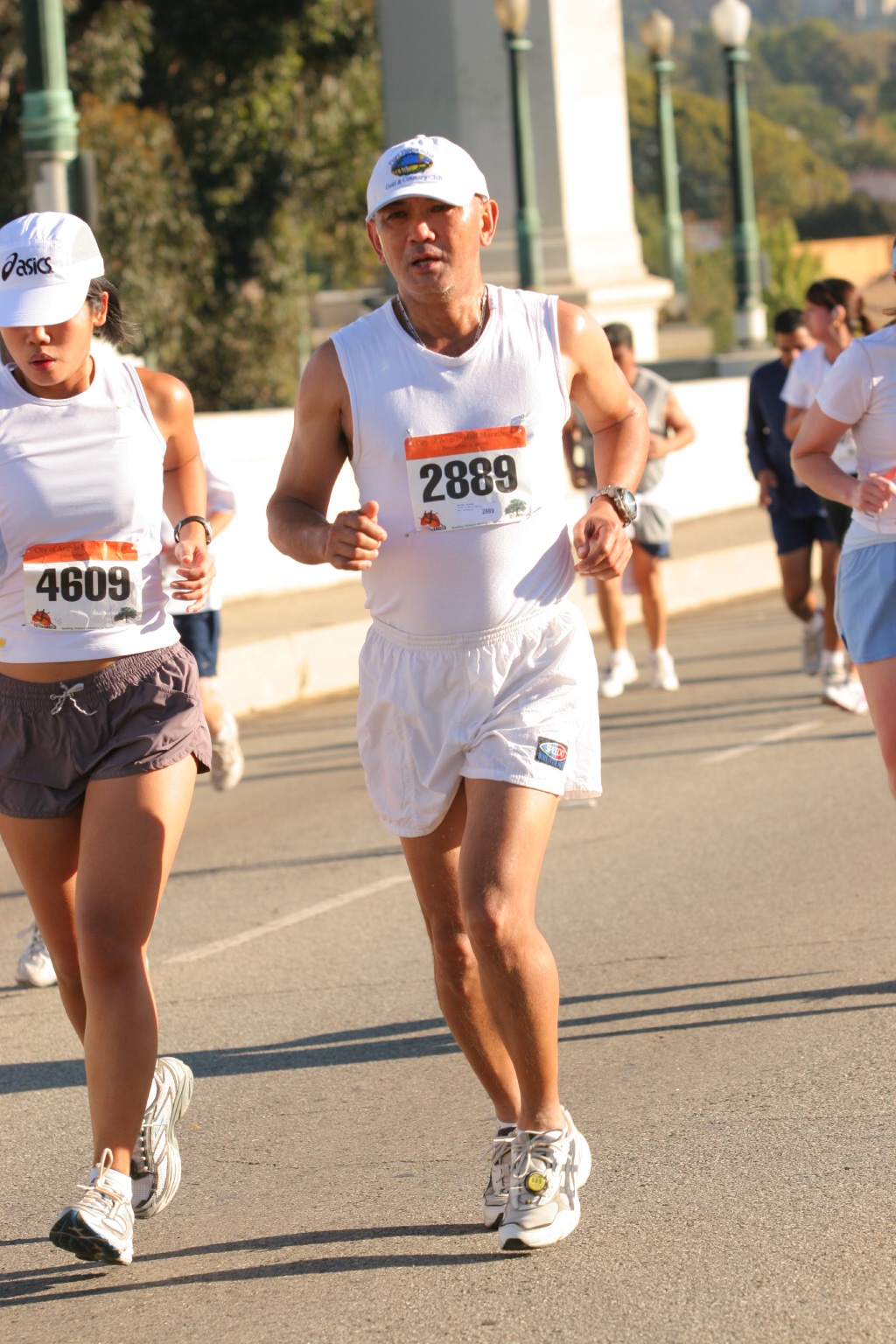
My picture in the 1st City of Angels Half-Marathon Race shows an old, worn-out and determined runner to finish the race. My cap is a golfer’s cap which I bought as a souvenir when I played a round of golf at Fort Ilocandia Golf Course in Paoay, Ilocos Norte in 2002. I have two pieces of this cap which I always use for my practice runs, as well as, during race days, obviously, to cover my bald head and it absorbs the sweat from my head, making it as my dependable “coolant”! My shirt is a “muscle shirt” from Bench which I usually used as my workout shirt in the gym. It is stretchable and cool to the body even if it is wet from my body sweat and I bought two of this one in 2003. My running shorts is Speedo, it’s a loose swimming/running shorts, which I bought with my Bench shirts in 2003 with 30% discount. I have two sets of this shorts and I usually use this  in my gym workouts. My running shoes is an ASICS Tiger shoes which I’ve been using for the past four years. I think I bought this shoes On Sale at Big 5 Store in Glendale, California in December 2002. After the race, I retired this pair of shoes and bought a new one which is an upgraded model of ASICS Tiger. The watch I am wearing is a Casio “Sea Pathfinder” Titanium which is light and water proof. It has a stop watch and timer functions whose digital numbers could be seen without my “reading glasses”. This watch was given to me as a Christmas gift by my younger brother in 1999 and had its battery changed only once. I am still using this watch in my practice runs and races.

The “yellow thing” tied with my shoe laces is what they call “runners’ chip” which activates and registers to the time recorder/computer once it passes the starting and the finish lines. Simply put, it registers your actual time of running from start to finish. In this particular race, it was used for the runners free of charge but for bigger marathon races, each runner pays a fee for using such “chip”. These “chips” are collected by the race organizers after you finish the rack.

At present, my running attire and fashion sense show an old runner whose legs and heart are still strong to finish any road race where he could compete. I consider myself as an average runner.

1st City of Angels Half-Marathon (Los Angeles) 03 December 2006


City of Angels Half-Marathon (Los Angeles) 04 December 2006

This is a picture taken along the Hyperion/Los Feliz Bridge with my daughter on my right. We just passed by the 7-mile marker at this point. We finished the race in 2 hours & 14+ minutes. My daughter’s PR time for the said distance improved by almost 12 minutes. I was running a pace of 10:15 minutes per mile. I placed/ranked #1,878 out of 3,652 finishers.

How I wish I could race again this year in this event.

Runners’ Blog


Little did I know that the Internet is full of runners’ blogsites. Last night, while browsing on my past postings in my other blogsite, I noticed that some “visitors” clicked on my postings regarding my running practices in preparation for a sports activity. This gave me the idea to come up with my blogsite specifically for my running activities.

I have seen blogsites of new, young and old runners in the Philippines as well as in other countries. But, “The Bull Runner” inspired me to make this blog and through my recollections of my past running feats, I could share my insights and experiences for the past so many years that I had been running to other runners and “would-be” runners.

Life, in itself, is a marathon race.