Race Report: 33rd MILO 42K Eliminations @ Luneta Park/4:25 AM July 5, 2009
Reading a lot of books and blogs of elite athletes influenced me to re-assess my training program after finishing the BDM 102K, BOTAK 42, and the LA Marathon (LAM) in a span of two months. It is said that these elite and competitive athletes adhere to the principle of “periodization” for the marathon and ultramarathon distances and provide a much-needed rest and recovery to their bodies from severe training and competitions. If these athletes/runners who are younger than me by 25 to 30 years had included in their training a period of rest and recovery, how much more for an older runner like me?
After doing a lot of “walkabouts” and “runabouts” in Los Angeles after the LAM, I’ve observed that there was some tightness and pain below my left knee cap and as a result, I immediately decreased my weekly mileage and ultimately embraced the need for a full rest and recovery even if I was already registered for the 33rd MILO 42K Elimination Race. As a warrior, I thought that I could not win every battle where I am going to fight if I am not sure I will not win. However, I thought of going to the battle to try and find out where I need to improve with the thought that if I will loss in this battle, I knew I could win the WAR in the next battle.
And so, at the beginning of the race, my mind was already geared towards the ultimate goal of finishing the race decently and make the MILO Finals goodbye and not included to be a part of my future battles. Last year, I was not able to join the 32nd MILO 42K Eliminations because I was in the United States for my first ultra trail run at Bulldog 50K. But due to my request then to the MILO Race Organizers, I was able to join the MILO Finals with an impressive time of 3:48:32 hours which I think I was then on my “peak period” for the year! It was then that I thought of planning to improve my time with the intention of qualifying for the Boston Marathon as I could make it to the 3:45 hours qualifying time for my age (55-59 years old).
Unfortunately, the BDM 102 and the BOTAK 42K made me a slower runner but I knew I could have a better time at the LAM.
I was already at the vicinity of the former Army & Navy Club (Luneta Park) at 3:40 AM with enough time to pin my race number and do some stretching exercises. Out from nowhere, the Hardcore Team (Jonel, Mari, Jay C, Lester, Kevin, Martin Lorenzo & Odessa) approached me and we had a brief chat and some photo-ops. I saw Jay aka Prometheus Cometh and Vener aka RunUnlimited having their warm-up. In a few minutes, we proceeded to the starting area where the rest of the runners were doing some stretching exercises. Inside the corral, I was able to greet and meet other runner-bloggers, BDM 102K Finishers, and the usual hardcore runners who are always present in almost all the road races in Metro Manila. A certain “Mike” (I am not sure if that’s the name I can recall) from California introduced himself and he gave me the impression that he is in the country to run the MILO 42K as he is also a passionate runner who had finished a lot of marathon races in the US, to include NY & Boston Marathon. He is 55 years old!
As in the rest of past Rudy Biscocho’s races, the race started ahead of the scheduled time and we were off for the race at 4:25AM. The race was totally different from my LAM experience at the few meters from the starting line. A 42K race with about 500 runners as compared to a sea of almost 15,000 runners is a “sign” that I am really back to the reality of running in my own country. However, the advantage is that, I could immediately start my GF 305 without waiting for about 10-15 minutes before crossing the starting line! In Manila, you only miss or wait a few seconds from where you start running before passing the starting line.
For the 1st 10 kilometers, I could still see the backs of Vener and Jay N at a distance and I estimated that I was running at an average pace of 5:45-6:00 minutes per kilometer. But later, Joms Paras, a younger and a fast runner, joined me along my side for almost 3-4 kilometers and I knew that I was already looking for trouble as I was doing a faster pace than what I estimated. Keeping pace with Joms and trying to maintain seeing the backs of Vener & Jay N at the 10K distance was already an invitation for a disaster to happen.
I was very confident to climb those overpass along Roxas Boulevard and was also confident to run up to the Kalayaan Flyover/Overpass without any problems. Well, that was what I thought. As soon as I was about to go down from the Kalayaan Overpass to The Fort area, an early sign of muscle cramps on my left calves started to appear and I had to slow down. I think this was where most of the runners overtook me. At this point, I tried to recall my past running workouts since I finished the LAM. While watching the leading runners going the opposite direction at Fifth Avenue, I tried to “shuffle” and make sure I don’t overstrain my calves while maintaining my running form with the hope of meeting my support crew along Bayani Road for my hard-boiled eggs and oatmeal. I knew I had been religiously taking my GU Roctane since the start of the race, drinking water in every water station, and drinking Gatorade in the provided stations along the way but still I could not figure out why at the early stage of the race I was already experiencing early signs of muscle cramps. I was expecting a sign of cramps at Km 25, not at Km 16!!! Whenever, the pain disappears, I would increase my pace with the hope that I could, at least, improve my finish time.
You could just imagine how desperate I was to spray that cannister of “pain killer” at the “P & G” runner’s booth infront of the Southern Police (PNP) Headquarters along Lawton Avenue!!! The Bald Runner was already dying with cramps and help was not coming!
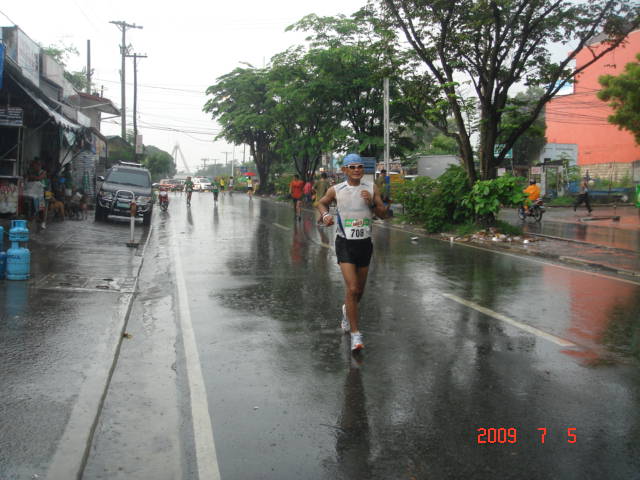
I guess, my “hot temper” (which I did not show to the ladies at the booth) within me acted as my natural “pain killer” which made those cramps disappear while I maintained a slower pace. All of a sudden, I was already approaching the Heritage Park when the rain started. It gave some relief to my hot body but I knew that my pace was not improving at all.
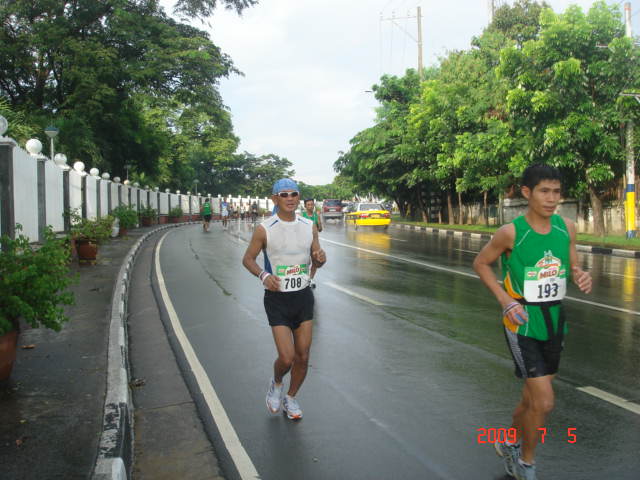
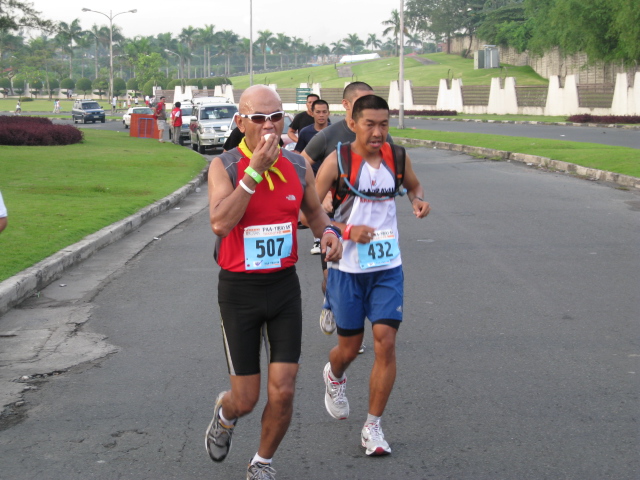
On My Way Towards Heritage Park/C-5 Turn-AroundAlong Bayani Rd After The Rain/Going Back To Lawton Ave
I met my support crew along the Bayani Road on my way back to Lawton Avenue. As planned, I ate one hard-boiled egg and one pack mix of oatmeal with Gatorade drinks.
After this brief stop, it was already a battle between being DNF in this race or continue to struggle up to the finish. Well, I never had a DNF in my running races and never had a DNF in my military career and much more never will have a DNF in the so-called trip called “Life”. I said to myself, DON’T QUIT! And I could still remember what I learned and always hear from my Officers and Soldiers when I was assigned with the Special Operations Command of the Philippine Army, that goes this way, “Mas mabuting mamatay, Huwag lang mapahiya”! (“It is Better To Die than Live in Shame”!)
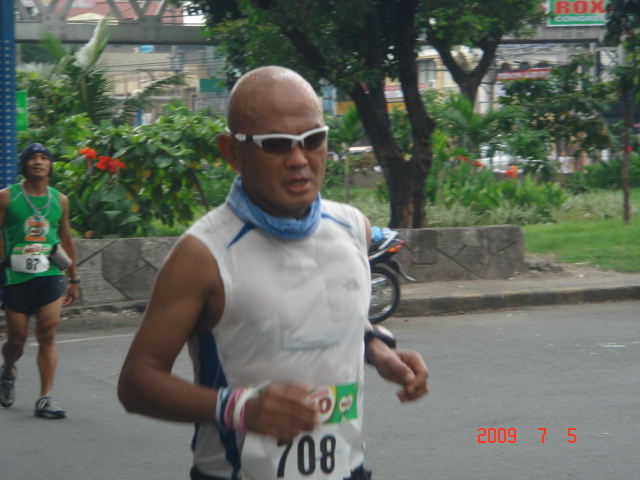
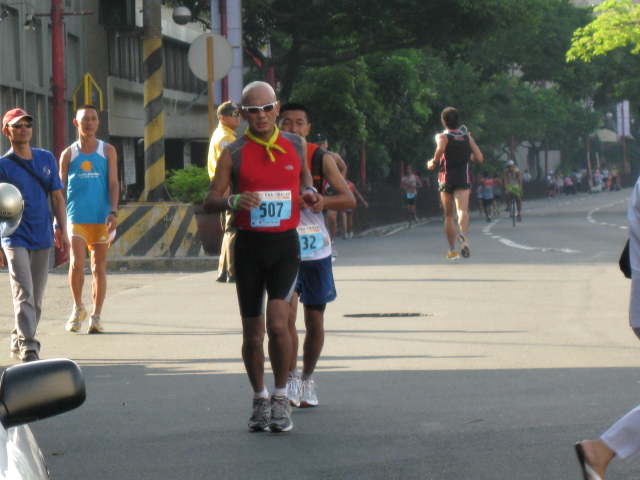
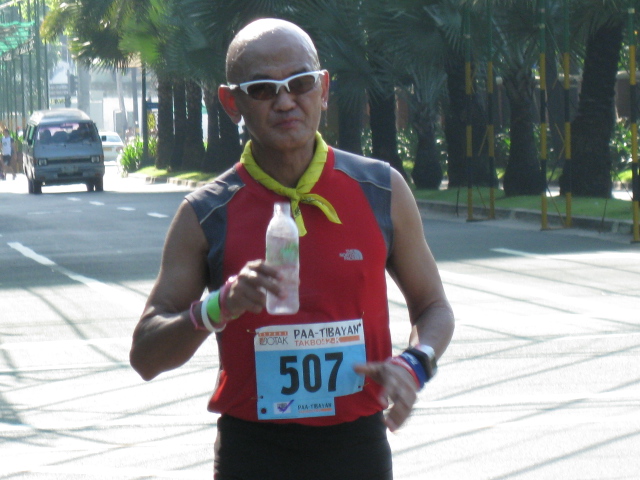
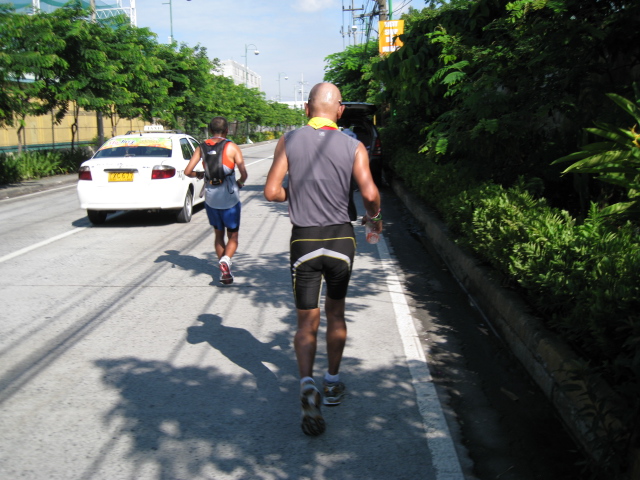
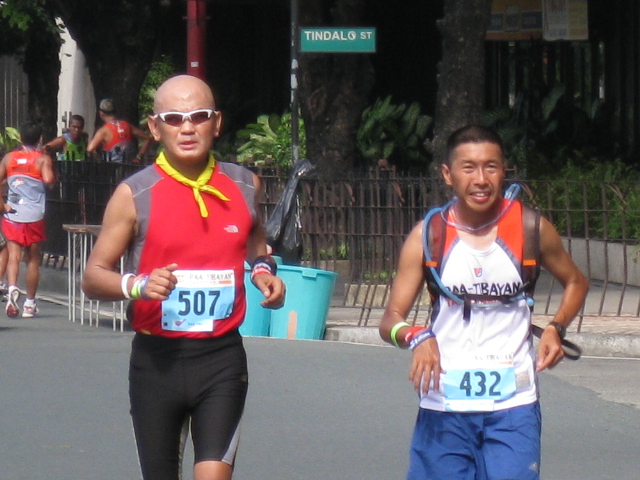
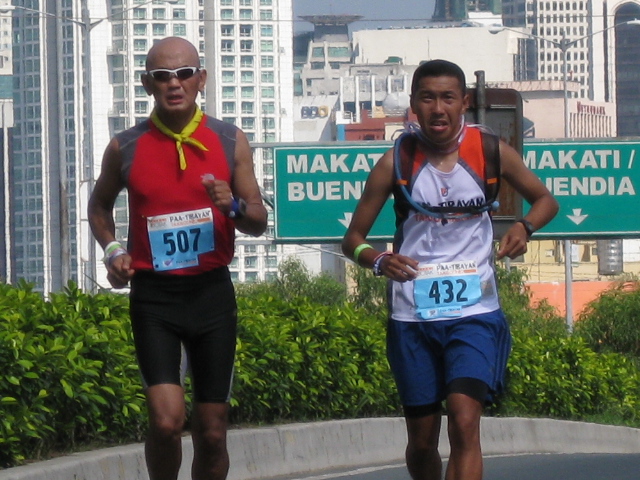
Along Lawton Avenue & Back To The FortAt 5th Avenue, The Fort"Don't Quit" Running Form!!! (Photo Courtesy Of Harry Tan, Jr aka Mukhang Guilty)
And so, that was the running “mantra” while other faster runners would pass me along the way. I made sure I would drink water in every Water Station; drink Gatorade in cups in every Gatorade Station provided by the Race Organizers; ask hard-boiled eggs on the last 6 kilometers from my support; swallow my GU Roctane every 10 kilometers; and don’t over stride so that my muscle cramps would not appear.
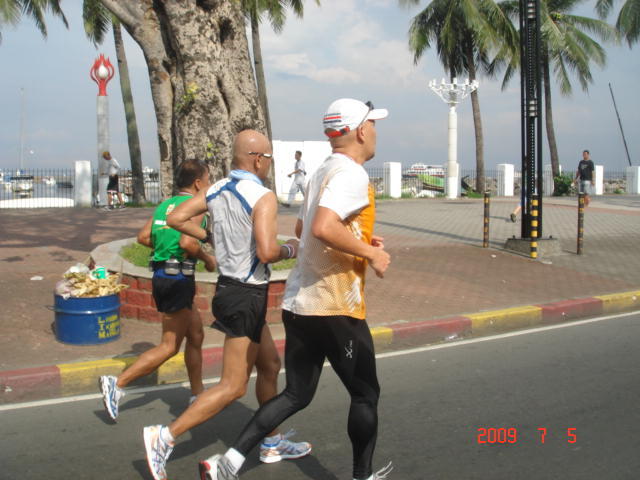
Mesh V aka My Iron Shoes & Coach Titus Overtook Me at Lawton Avenue (Good Luck On Your SFM!)
People at the Support Stations of different running groups who know me would cheer me but I observed that they were not offering something for me. Of course, I did not ask anything from them in the first place but if these people would have the experience on how it feels to run a marathon, maybe, just maybe, one of them might offer a cup of water or cup of Gatorade drinks to me just to show some spirit of “volunteerism” in a marathon race. It is regrettable that this is another great disparity or difference in running the LAM and our local marathon races. On the other hand, I highly appreciated the support of Hardcore Team’s Ivy and Odessa for offering their drinks & food when I really needed them. Thanks, Guys!
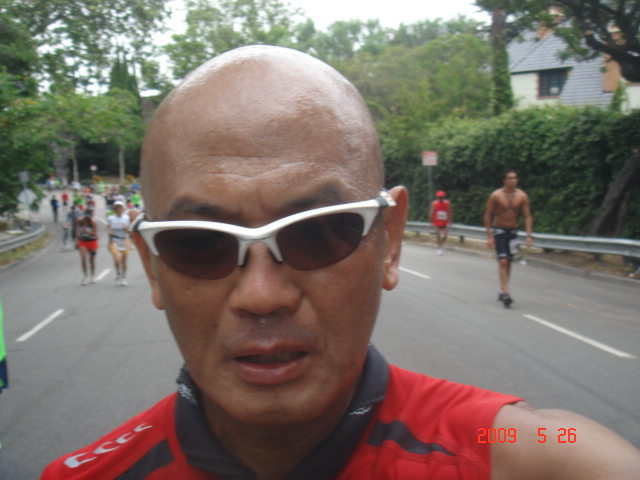
The Face of A "Road Warrior"...In Pain!BDM 102 "Warriors" Along Roxas Blvd (Albert Nama, Jonel, & BR)Another View of These Ultra RunnersOn My Last Kilometer To The Finish Line
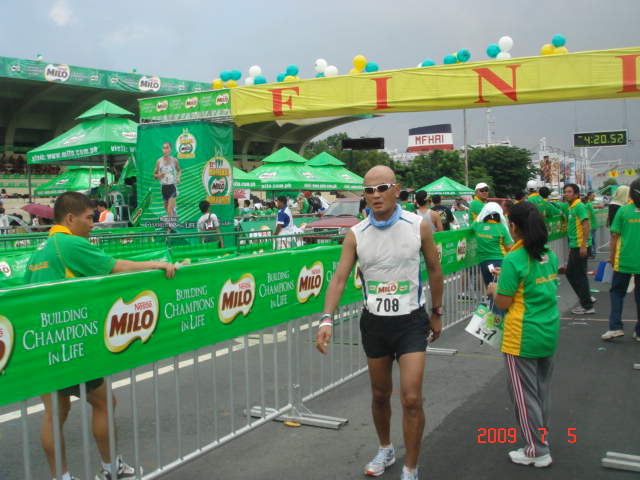
Finally, I finished the race in 4:20:45 hours. Nothing extraordinary and it was a challenging fight with myself. Now, I can proudly say that I am Not Qualified (NQ’d) for the MILO 42K FINALS.
After Passing the Finish Line! Tired & Happy!
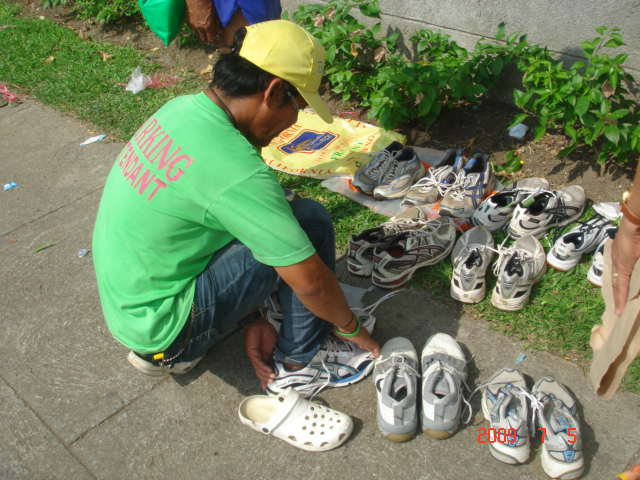
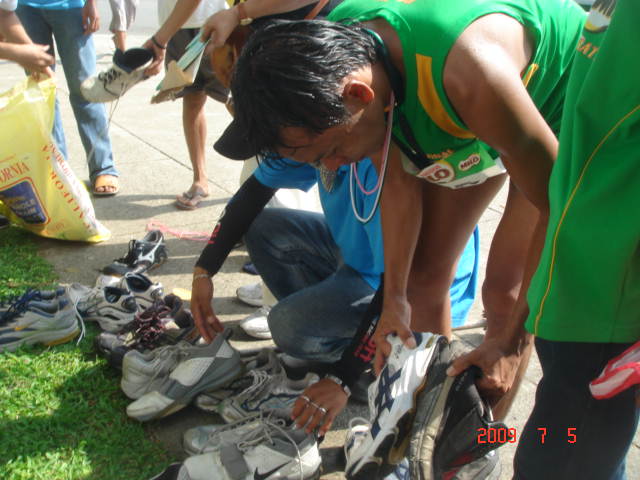
Instead of looking for other runners and congratulating them for their finish, I opted to display my Project Donate A Shoe tarpaulin in a place where other runners would see and my support crew displayed at least 50 pairs of donated shoes. In less than 10 minutes, all the shoes were gone and were received by runners and by even street/park sweepers of Luneta Park with their happy faces. I was happy that these donated shoes would end up to runners and those “poor souls” who needed them most.
Choosing The Right Shoe That FitsNot Only Runners Were Given With ShoesIn A Few Minutes All The Shoes Were Gone!
To all the runners who were qualified for the MILO FINALS, my warmest congratulations to you! I will be cheering you along the route or maybe I will be putting up a “BEER STATION” for all the runners (if Mr Biscocho & MILO will permit it). Anyway, if you have “bandit runners”, I am sure there should be “bandit aid/support stations”. So, watchout for the “BANDIT BEER STATION”!!!
To all the runners who were not qualified, please don’t run as “bandits”! It is better for you to “volunteer” as aid station personnel for the “bandit beer station”. Your reward for being a volunteer will be the remaining bottles and cases of beer which will not be consumed by the passing runners!!! In the first place, you were the ones who committed to donate those cases of cold beer!!
7:31 AM 25 May 2009 @ Figueroa Street & 6th Street, Los Angeles, California
Most of my friends and readers were surprised to know that I ran the BOTAK 42K Marathon Race last 10 May knowing that I have the Los Angeles Marathon scheduled on my list of Road Races to participate into after 14 days of recovery. They don’t know that I was not serious to exert much of my effort in the BOTAK Run and I treated it as my long run in preparation for the bigger event which is the Los Angeles Marathon. Aside from that reason, I had predicted that the BOTAK 42 would be a failure in its administrative, technical, and logistics support for the runners by just looking at their race route. And I was right! The race was a failure in terms of a standard and well-organized Marathon Race but I accomplished what I intended to be attained–to make this race as my “long run” before tapering off for the LA Marathon.
At my age, who would dare to run two (2) Marathon Races in one month with 14 days in between? Hmm…I think it’s only the Bald Runner! (and my Ultramarathon runner-friends) Ha! Ha! Ha! This was the reason why I did not register for the TNF 100 Solo Run—I was already registered to run the LA Marathon way back during the last week of January 2009 (when TNF was not yet decided to conduct the said race!). And this point/issue shows a big difference of the major races done in other countries as compared to the schedule of races that we have in the Philippines. Major races in the USA are scheduled one year ahead while most of our major races are “knee-jerk” running activities where you have at least 2-3 months as lead time. I am sorry but this is the reason why the 2nd Bataan 102K Ultramarathon Race is already scheduled on March 5-6 next year and it will never be postponed.
Running the LA Marathon was a dream to me since its creation, 24 years ago. A year after the 1984 Los Angeles Olympic Games, the LA Marathon was born and I had been a spectator on this event whenever I was here for a vacation. Traditionally, the LA Marathon was held on the month of March but I usually come over here during the months of June or December but there are times when my December vacation would be postponed to January or February and I would stay up to the day of the LA Marathon. So, there was no chance for me to seriously consider running this marathon. The original route of the race, to include the 1984 Olympic Marathon, was 2 street blocks away from our place and I was just contented to watch the elite runners and other competitive runners passed along Sunset Boulevard.
Due to the change of ownership of the LA Marathon last year, it was decided that the March schedule was changed to the month of May. There had been a lot of debates and arguments about such change but the owner’s decision prevailed and had it scheduled on Memorial Day to honor their dead heroes and other soldiers who died in the line of duty, most especially those who are assigned across the seas. And so, my kids and I planned to run together again in a marathon race just like what we did last August 2008 in the San Francisco Marathon as early as January this year.
After I have acclimatized for one week since I arrived last 17 May by running under the cold and hot conditions in LA, I knew I was ready for the race. We woke up at 5:00 AM this morning and I did the usual “ritual” everytime I join a marathon race (except taking the Immodium tabs)…hot coffee, instant oatmeal, cereal with milk, hard-boiled eggs, and bananas. Shaved, took a shower, apply petroleum jelly on my feet, inner upper arms, and upper inner legs/groin part, tied the D-Tag on my shoe lace, and wore my running kit with my bib. We were out of the house at 6:40 AM and walked about 2 kilometers to the Starting Line.
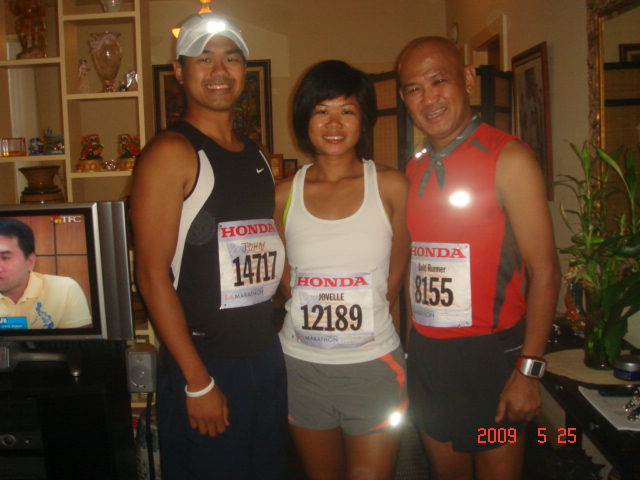
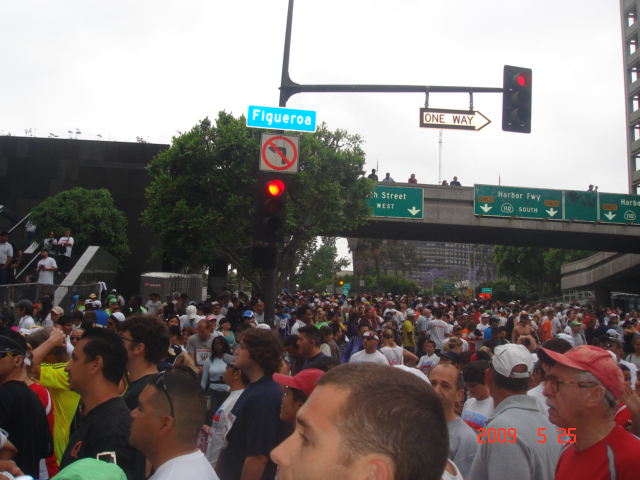
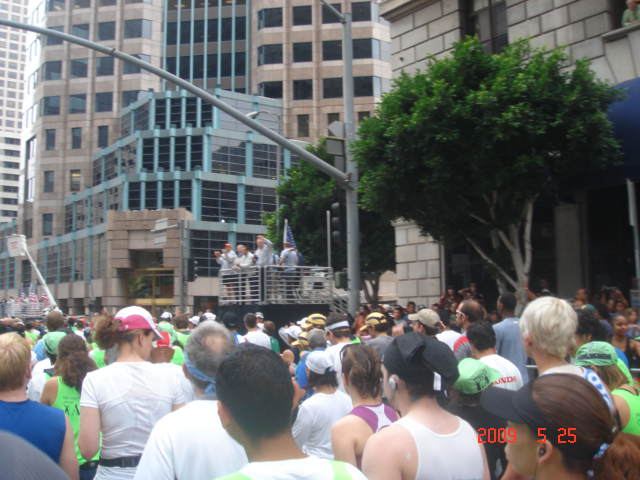
Our Picture Before Leaving The HouseThe Runners & Starting Area Crowd
I was amazed to see a lot of runners, more than the runners I saw in last year’s San Francisco Marathon. Almost a distance of 200 meters from the Starting Line up to the back was filled with runners and walkers. We immediately positioned ourselves about 100 meters from the Starting Line as more runners were packed like sardines in the front areas. After the singing of the Star-Spangled Banner, which could hardly be heard in our position, was sang by a choir and it was followed by a Prayer. The speech of the City Mayor followed and it ended with the blowing of the horn which officially started the race. The race started at 7:31 AM, a delay of 11 minutes from the scheduled time of start.
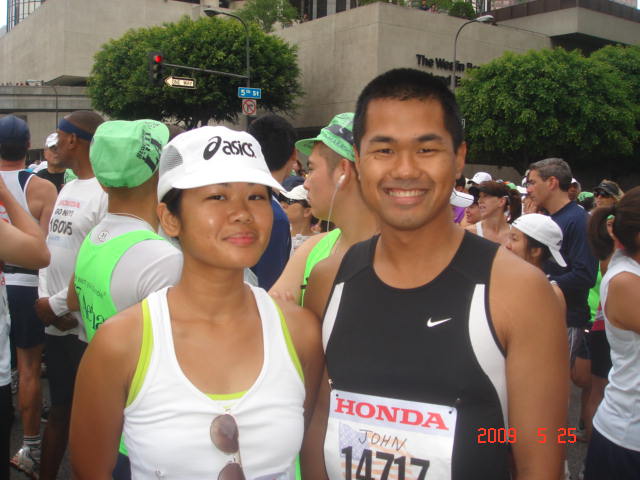
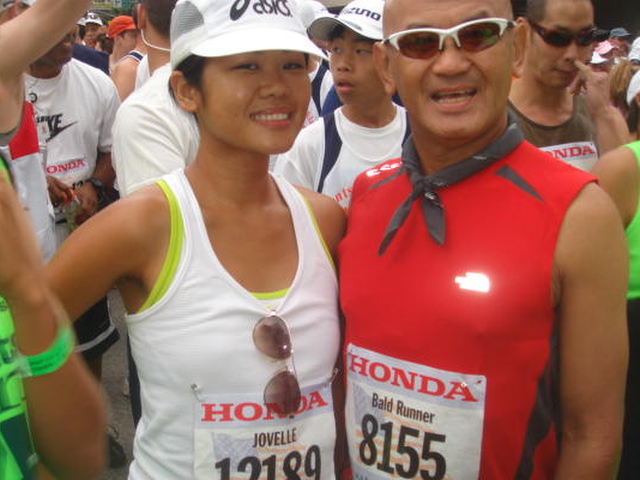
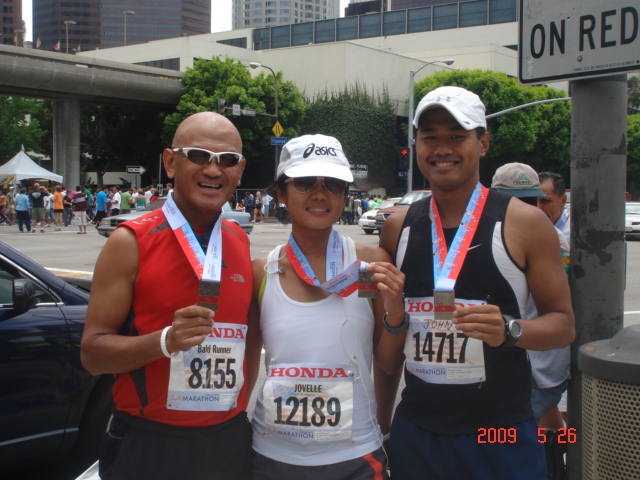
More Runners At The Cross StreetsJovelle's 4th Marathon & Jonh Paul's 7th Marathon
The weather was cool with a prevailing temperature of 60 degrees Fahrenheit and there was an overcast sky. It was a perfect weather for a marathon race! We started to walk towards the Starting Line as the runners at the front started to run and vacate the space where they were waiting before the race started. Even if we occupied the whole wide Figueroa Street, the runners were still shoulder-to-shoulder and tightly could not run or move faster. It took us almost 5 minutes and 35 seconds to finally cross the ChronoTrack Timing sensor at the Starting Line which activates our D-Tags tield on our running shoes and I simultaneously pressed the Start Button of my GF 305. My watch cooperated this time as I deleted some of the data stored in it and made sure that it was fully charged.
Finally, We Were Moving Towards The Starting Line
Mile 1
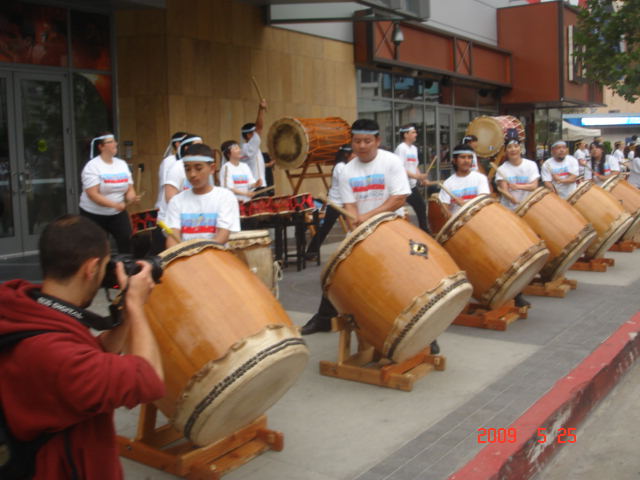
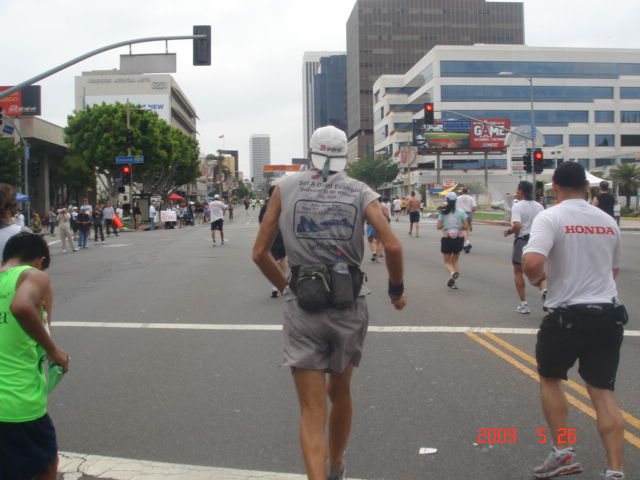
The whole stretch of Figueroa St going south covers the whole first mile and succeeding miles of the race. My pace was a slow one as the runners were still closely near with each other. I was forced to slow down because of the situation and I maintained my pace and imagined it as my warm-up run. I had to make a zigzag moves to prevent from bumping on some walkers who were mixed with the runners and who were located infront of us. I finished the first mile in 10:20 minutes and I panicked because it was a very slow pace for me. I started to calculate my finish time by making an average pace of 10 minutes per mile and I assumed that I could finish the race in 260 minutes or 4:20+ hours! I wanted to finish the race with a faster time than that! A group of Japanese drummers would fill the air with noise and rythmic beat as we reached the Staples Center. And that was the start of a festive and noisy environment along the route.
Big Drums on the 1st Mile
Mile 2
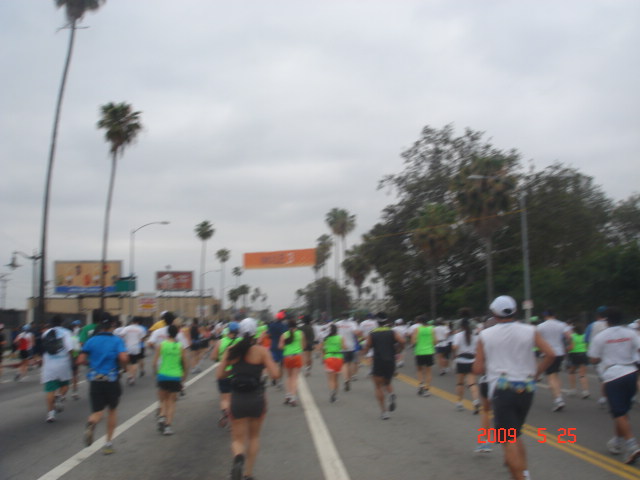
The roads along the route were completely asphalted roads and it is more comfortable to run with it than running on a concrete road. At this portion, the runners are still tight and there is a lack of space where I could overtake the runners infront of me. I just took my patience and slowly increased my pace as the road is slightly downhill and flat. You could see a lot of people along the sidewalk cheering the runners and the LA Police and other security units would be around to see to it that all runners are protected. The runners practically owned the whole street and there were no vehicular traffic crossing the street where were are. We are still along Figueroa Street and as I approached the end of mile 2, I could see that I have gained some speed and was able to shave off at least 30 seconds. I registered an average pace of 6:15 minutes per kilometer, a 9:00+ minutes per mile pace.
Mile Marker/Banner On Top Of The Runners
Mile 3
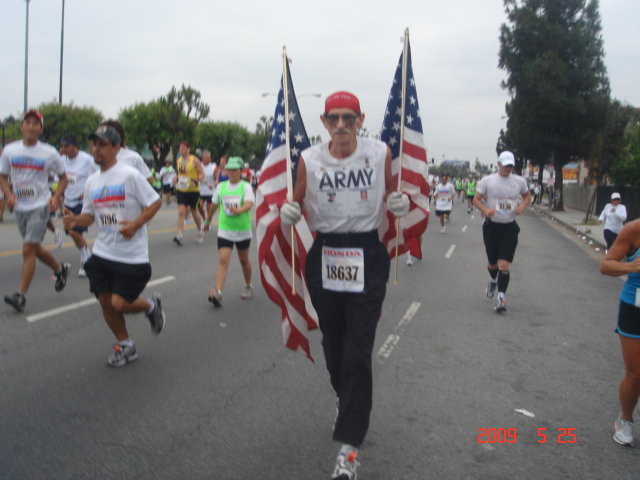
We are still along the Figueroa Street and I could see the entrance to the LA Olympic Stadium at my right and later I could see the stainless steel markings of the Exposition Park. The crowd of runners is slowly loosening and I was able to increase my pace. This is the part that I started to perspire but the cold air that is meeting us would slowly dry up my sweat. This is where I started to overtake more runners—some are teen-agers, lady runners, male runners older than my age, and US Armed Forces Veterans carrying the US Flag. Along this portion, I started to feel the urge to urinate as I drank a lot of water before leaving the house. I controlled it as the portalets along the way have a long line of runners waiting for their turn. Despite this situation, I had to drink water and Gatorade in every hydration station. I started to take in my first regular GU Sports Gel as I carried with me 2 regular GU and 3 GU Roctane and a pack of Cliff Shots (Chewable Electrolyte Source). My TNF Racing Shorts was equipped with side & back pockets where my ration was stashed. My right hand was holding my SONY Cybershot Digital Camera wrapped in a Ziplock Bag to prevent my sweat from going to the camera. I was able to shave off another 30 seconds from my average pace.
A US Armed Forces Veteran & Marathon Runner
Mile 4-6
From the wide road of Figueroa, we turned right to a narrow road where there is a construction on the opposite side of the road. Even if it was a narrow, the space in between runners became bigger and had more chance to overtake a lot of runners. And then suddenly, after a series of turns, the first uphill climb would appear infront of the runners. I didn’t panic as I increased my pace by taking shorter and faster strides as I run through the uphill climb. I had to overtake more runners along this portion. After the climb, it was downhill and I was back on my usual stride and had to make my leg turn-over faster. I was registering a faster pace this time.
Mile 7-10
More spectators would cheer the runners by shouting, “You can do it”; “Looking good”; Runners! Go! Go! Go!; “Bald Runner, Wohoo”. Yes, a lady who was giving Gatorade drinks to the runners, saw my race bib and shouted those cheers! I guess, there were at least five people who saw my race bib and shouted “Bald Runner”. There was a mixture of Rock and Roll Bands and Mariarchis (Mexican Band) along the route and it was a delight to hear live music from these volunteers/spectators. As we passed along the Residential Areas, I saw the residents cheering and shouting to the runners. They even have banners and posters where they wrote greetings to the runners. Others would have their “coolers”/ice chests with them and gave cold bottled water and soda/sports drinks to runners who are in need. Wow, this is unbelievable. The whole community treated the Marathon Race as a festival with music, cheering, and drinks ligned up along the route and each of the resident-volunteers showed some hospitality to the runners. I had a steady pace along this portion as I passed more runners along the way.
Mile 11-14
Finally, I could no longer hold my urinary bladder and made a “bold” move on the ligned 6 portalets on the right side of the road. Instead of waiting on the line of runners standing infront of each portalet unit, I immediately went at the back of the portalets and relieved myself with my urine dropping at the grass. Another two white runners would follow me and relieved themselves, too! One guy would say, “Hey, that was a smart move’! I answered, “yes! the grass on the sidewalk needs some fertilizer” and both of us laughed. As I approached the 13.1 mile mark, there was a “carpet” for the RFID timing system that triggers my D-Tag to register my half-marathon split time and passed through it while checking at my GF 305. I saw that my watch registered a time of 2:03 hours and I panicked (again!). I wanted to have a finish time of sub-4 hours on this marathon race. I was already calculating to have a finish time of breaking the 4-hour limit but I recalled that the second half would be a harder task for me because the route is uphill up to the finish line. I tried to increase my pace by “shuffling” and counting the number of strides per minute and made the counting as my running “mantra”.
Mile 14-18
The distance in between runners would stretch at this part as some would be seen walking, other would be seen stretching their calves and legs along the sidewalk, and most of the runners would walk while drinking their water or Gatorade drinks. This part is really the hardest as more uphill climbs would challenge the runners. There was some relief for the downhill but it would take the runners for another uphill climb again. It was a roller coaster at this part. Volunteers along the route would ask each runner if they feel pain and they would spray Salonpas liquid on the parts where the runner would feel pain. Other volunteers would offer Vaseline Ointment or Petroleum Jelly for those who have problems on “chaffing”. Other volunteers would offere sliced fresh oranges and bananas, and sometimes candies. There is also a hydration point where volunteers would offer “ice cold beer” to the runners. I could just imagine if any of the volunteers in the Philippines would offer this kind of hydration to our runners. I am sure the Filipino runners would ask for the “pulutan” that goes with the “ice cold beer”! Ha! Ha! Ha! At this point, a familiar face overtook me and it was a 7-time Badwater Ultramarathon runner-finisher who was introduced to me by Joe Matias of the A Runners Circle Running Store (I forgot his name!). I would make him as my “target/benchmark” as we had a “see-saw” race on this portion of the route. He is a tall runner and he is fast.
The 7-Time Badwater Ultramarathon Finisher Infront of Me
Mile 19-22
I was surprised when one of the spectators shouted “Manny Pacquiao” when I passed him. Hmmm..I think he means that I am a Filipino! More cheers, more rock bands, more fruits and water along the way. I took my 2nd regular GU at Mile 6 and then started to take my 1st GU Roctane at Mile 10; my second Roctane at Mile 16; and my last one at Mile 22 which would carry me up to the finish line. The Cliff Shots were mostly taken from Mile 16 to Mile 24. At this point, I don’t feel any pain on my legs except for some slight pain on my left knee cap which disappears whenever I shift to my “shuffling” mode with faster frequency of strides. I really do not bend my knees when doing my “shuffling” and only lift my feet a few inches from the ground and I gain more speed and grounds by doing this and I would be relieved from the pain. It was still a slight uphill along the route. One of the volunteers would shout to the runners, “Dude, you have less than 10K run to go, the Finish Line is near”. Yes, dude, it is easy to say that if you are not running!
An Uphill Climb With The Runners Walking On mY Back
Mile 23-26
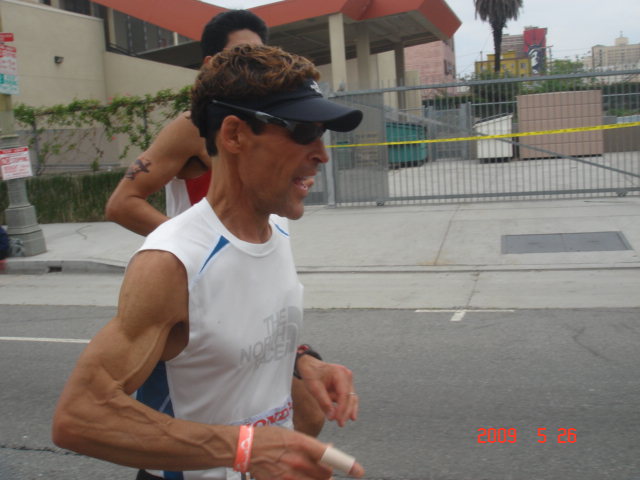
I managed to overtake more runners as these runners were positioned at the front before the start of the race. They are walking and some are having cramps. Others would run quickly to overtake and then stop and walk. The Badwater Ultramarathon runner would eventually build a considerable distance between us and he was able to position himself at least 300 meters ahead of me. He is the only runner who overtook me from the start of the marathon race at this point. As I was approaching Mile 25, I noticed a loud steps of a runner on my left who was about to overtake me and to my surprise, it was Dean Karnazes in person! I tried to keep up with his pace for about 800 meters and I greeted him and told him that I am the “Bald Runner”. He offered his hand and we had a handshake and started a conversation by asking him about his TNF 100 Australia experience. He told me that the TNF 100 was fine and challenging and I told him that the TNF 100 Philippines was held last weekend. I asked him if he is joining the upcoming San Diego 100-Mile Endurance Run and he said that he’ll not join the ultra running event as he will be running the San Diego “Rock & Roll” Marathon next Sunday. I checked on my GF 305 average pace while I was running with him and it registered a 5:00-minute per kilometer pace! I tried to keep up with his pace and I slowly faded with his blistering speed/pace as we are approaching the last 300 meters to the Mile 26 marker. It was my fourth encounter with the famous Karno since I met him at Badwater last July 2008. Dean Karnazes was the 2nd guy who overtook me during the duration of the race! In summary, those guys who overtook me were two (2) elite ultramarathon runners who are much younger than me.
Dean Karnazes While We Were Talking To Each OtherDean K's Back & TNF Muscle ShirtMy Back & My TNF Muscle Shirt (Dean K & I Were Using The Same Shirt!)
Finish Line
As I reached the Finish Line, I stopped my GF 305 and saw the readings on the digital clock with a time of 4:13:02 hours. My GF 305 registered a time of 4:07:35 hours and my official Finish Time (Chip time) is 4:07:33 hours as posted on the Official Results. Not bad! If not for the heavy traffic of runners at the first half and the difficulty of the terrain on the second half, I could have reached the finish line in less than 4 hours. Anyway, it will be one of my objectives to improve my finish time in the coming days in preparation for the Milo Elimination Marathon Run on the first week of July.
Based from the Official Results, I placed #1,902 out of 14,185 finishers; # 1,630 out of 9,011 Male runners; and placed #47 out of the runners in my Age Category 55-59 years old. I registered an average pace of 9:26.6 minutes per mile.
In my GF 305, I registered an average pace of 5:48 minutes per kilometer and an average heart rate of 154 beats per minute. As for the distance, my watch registered a distance of 42.68 kilometers. I could have ran an extra distance of 500 meters!
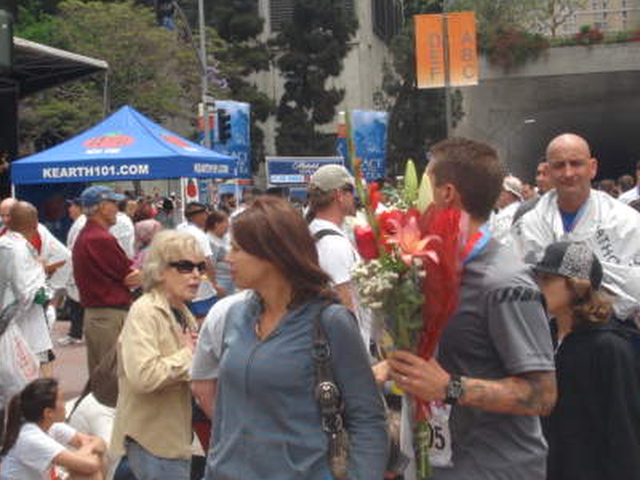
Yes, They Offer Flowers As Gift To 1st Time Marathon Finishers
Assessment & Conclusion
It was a blast and fun to experience running a marathon with almost 14,000 participants where infront and at your back is a “sea of runners”. The cooperation of the whole community and the support of the volunteers are awesome and phenomenal which is hardly experienced in the Philippines. What surprises me now is the fact that there are high-ranking influential and rich personalities in our society (they are in government service and some are in the corporate world) whose feats and finishes in international marathon races (like New York & Boston) for the past months and years had been published in the newspapers with their pictures on the front pages of our daily broad sheets but I don’t feel or see or heard from them any actions or initiatives to raise the bar or standards of helping or supporting our running events (especially an International Marathon Race in Manila) in the country which could attract international runners. You know already as to whom I am referring to. Kailan kaya tutulong ang mga ito? Kinakailangan bang maki-usap at lumuhod tayo sa kanila para tutulong at gagalaw sila?
As an advise to the hardcore runners and competitive ones who want to experience a memorable and “complaint-free” Marathon Race, save some money and travel to the United States and select one of the marathon events held in the cities along the Pacific States or in Hawaii. You can also try the New York Marathon or to any other marathon events in the USA where you are comfortable (where you have a relative who can support you in terms of accommodation and transportation). Once you experience joining one of the Marathon Races in the US, then you will know what I am talking about. Guys, forget Hongkong, Singapore, Kuala Lumpur, and other Asian city’s Marathon races, go to the USA and you will never regret it.
Lastly, I consider the XXIV Los Angeles Marathon a “perfect” marathon event.
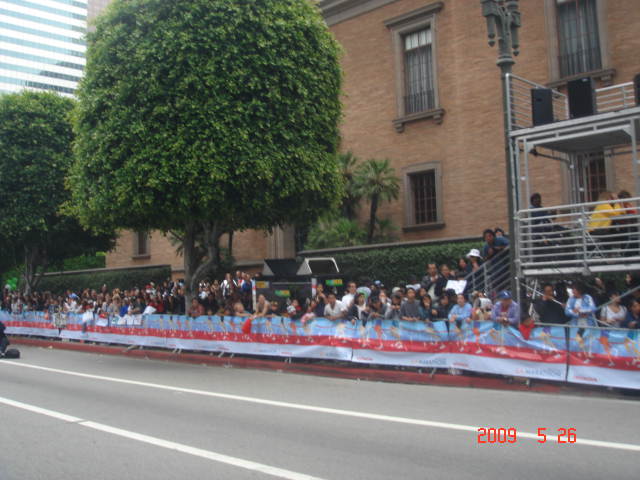
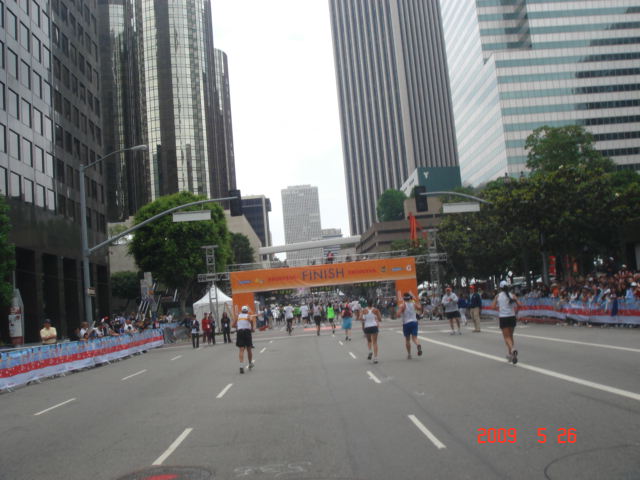
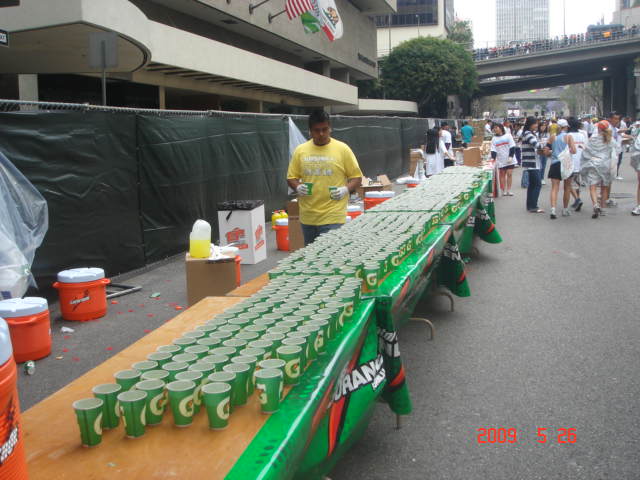
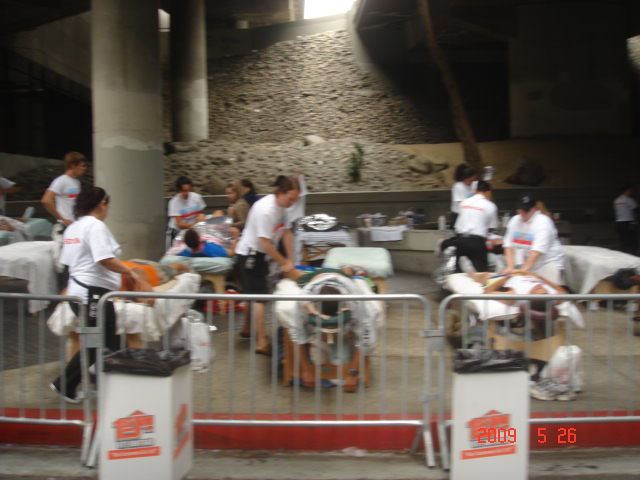
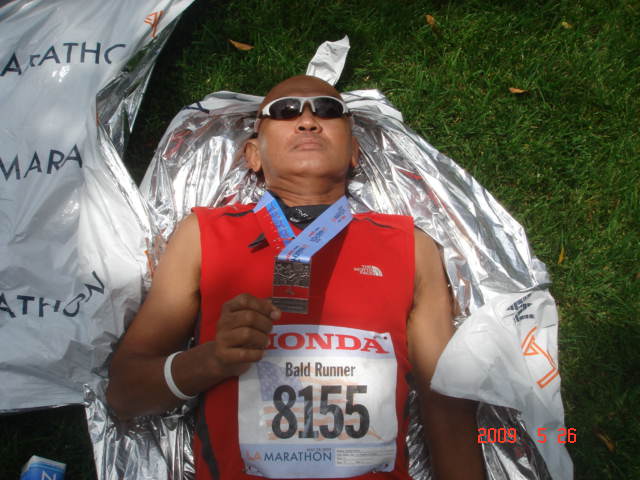
Look At The Legs Of Karno!Spectators Before The Finish LineThe Finish LineTo Our Race Organizers, This Is How Long A Water/Garorade Station Is During The Race (On Both Sides of the Road!)Free Massage After The Race But The Waiting Line Is LongResting On The Grass While Waiting For Jovelle To Arrive"Team Bald Runner-Los Angeles Group" Members With Their Finisher's MedalEat & Hydrate After The Marathon Race
This question had been asked repeatedly by Ronnie De Lara aka Runner For Christ and Dennis Enriquez when they saw me at the ULTRA Oval Track last Wednesday afternoon for my running workout. They were surprised to learn that I’ve been back to my running workout after finishing the BOTAK 42K Paa-bilisan last Sunday with a 35-minute active recovery run last Monday, a day after finishing the marathon race.
I seriously told them that I placed a lot of patience, hardwork, determination, and discipline into my legs whenever I am preparing for any race. Such answer led in telling them on how I prepared for my first two marathon races in the early 80s. They were surprised to know that I prepared for a marathon race for almost one year by running almost everyday. My daily runs would consist of “doubles”, 10K run in the morning and another 10K run in the late afternoon, with a constant regular pace without any speed run training in the oval track. My long runs during weekends would cover a distance of at least 20 kilometers. Speed runs would be limited to “fartlek” runs in between electric posts along the road or in between kilometer posts. My preparations/training were done when I was assigned in the Ilocos Region and I was able to strengthen my legs and develop aerobic capability of my lungs and heart. During those days, I did not join any road race in Metro Manila in preparation for the marathon event.
I was then in my early 30’s and my marathon finish times were within 3:30-3:40 hours. How I wish I could bring back those times when I was fast in my finish times and my legs have those strength to run everyday. I also told them of my injuries before but I learned from these injuries to appreciate the need of rest/recovery and be able “listen to my body”.
Ronnie, thank your very much for those donated “finisher’s t-shirts” which you gave to me during our meeting. Good luck on your TNF 100 Sacobia.
Race Report on the BOTAK 42K Paa-bilisan @ The Fort/10 May 2009
By looking at the map route of the Marathon Race, I already predicted that the marathon race will have some problems. And my predictions were right. There was a lack of road marshals, many runners were lost and most of them registered fast finish times for the marathon distance, the race started late, there was a lack of water cups (again!), and you need to really have your personal support team in order to finish a marathon race with better results.
I am sorry, Franco but you need to improve your support system for the runners if you want more runners to join your races. Please don’t give me the reason that you “sub-contracted” the guys who delivered the water supply and water cups for your race. Do I have to do the mathematics again on how much a race organizer would spend for the water cups in all the water stations? Okey, we will do the math again. Assuming you have 600 runners for the marathon distance and there are 20 water stations for the marathon distance, you will have a total requirement for 12,000 water cups. If you buy water cups in Divisoria, it will cost you P 37.00 per 100 pieces. So, that is 120 X P 37.00 = P 4,440. The cost for the water cups is equivalent to the registration fee of 11 runners. The cost might be lesser because not all the 600 runners are running the full marathon distance.
Meeting & Talking To BDM 102 Finishers
1st Marathon Race For The Year
I was happy at the first 10K to see Gatorade drinks in Gatorade cups but it ended there. I never saw and tasted Gatorade drinks in the succeeding water stations. It is also a very pitiful sight to see runners using the covers of those 5-gallon containers as water cups!!! From my support team, I would share my bottled water, Gatorade drinks and even food to the runner on my side. Armand Abalos from Lucban, Quezon and my running “buddy” from Km # 75 to 90 in the BDM 102K was my running “buddy” again for this marathon race and he is really a strong runner.
1st 20K of the RaceEating Hard-Boiled Egg While Running
The race lacks the much-needed race marshals as there are more turns (right & left) than the number of kilometers in the race. By following the runners infront of me and the other runners, I admit that I missed the Pasong Tamo (after coming from the Kalayaan Flyover) turn-around as runners should proceed directly to the said turn-around before proceeding the the Powerplant Loop. Due to the absence of road marshal, we turned right towards the direction of Powerplant. In my estimate, we missed at least one kilometer distance. However, at the Finish Line, I heard comments from those GF 305 users that they registered a distance of 43, 44, and 45 kms. Afterall, the distance was longer than a full marathon distance and the turn-around that we missed had compensated for the additional distance. Ha!Ha!Ha! Unfortunately, my GF 305 did not work efficiently as the digital readings kept on “flashing” from the very start of the race. Instead of being “pissed off” with the condition of my GF 305, I just maintained my pace and treated the run as my long run.
At the Gil Puyat/Buendia Avenue (26K)
I did not have any problem about the late start of the race. The marathon race was supposed to start at 4:30AM but it started almost 5:00AM. After the grueling experience with the heat of the sun during the BDM 102K last month, the early heat of the sun for this marathon was never an “issue”. At least, the shaded streets at the Powerplant loop gave comfort to the runners but there were no water stations on sight. However, running along Gil Puyat Avenue, Kalayaan Flyover and at The Fort area before reaching the Finish Line gave problems to the other runners.
With my GF 305 not working, I don’t have any numbers and location points to speak of or write on this post except for those observations I’ve noted during the race.
Drinking Water from the Bottle While Running (No Water Cups!)
The race route is very challenging. The terrain of the route was very hard as it was concentrated in Taguig and Makati. In the history of the US occupation of the country before start of the 20th century, the US Army selected the area called Fort Bonifacio, formerly called as Fort McKinley as their Artillery Camp (where the US Army deployed their artillery guns) because it was the highest point in Manila where they can observe the movements of our “revolutionaries” passing along the Pasig River and easily can pinpoint targets within the populated area of the Old Manila and Manila Bay. So, running in Makati & Taguig entails a lot of challenging rolling terrain. Such race route would never attract a world-record pace for the marathon race.
Running Along the Powerplant Loop
Despite constructive criticisms from runner-bloggers about how we “race organize” our road races, it seems that we are not improving, instead, we are going back to the “stone-age” where we have to bring our own water & provisions after paying somebody to support us in our road adventures.
Guys, I don’t blame you why you prefer to go abroad to run a “perfect” marathon race but you must also think that you are paying an equivalent average amount of Five Thousand Pesos or more for the Registration Fee as compared to a measly P 400 to P 500 for a marathon race in our country. Having said that, at least, our race organizers must be able to buy enough water cups for all the runners. We don’t need fresh fruits, gels, power bars, pain relievers and other “gimmicks” (loudspeakers with music) along the race route, just give us potable water and water cups and responsible road marshals. I was laughing when one of the road marshals along C-5 asked me if I am a 42K runner. The road marshals did not know what distance the runners are running even by looking at the color-coded race bibs!
My Running "Buddy", Armand from Lucban, Quezon (BDM 102 Finisher)At the Kalayaan Flyover, 3 Kms from the Finish Line
If there is a positive comment I’ve heard from most of the finishers, it is the fact that this marathon race was a “redemption” race for those runners who participated in last December’s SC Singapore Marathon. They told me that they improved a lot from their finish times and proud that they got new PRs on their marathon finish time in this race.
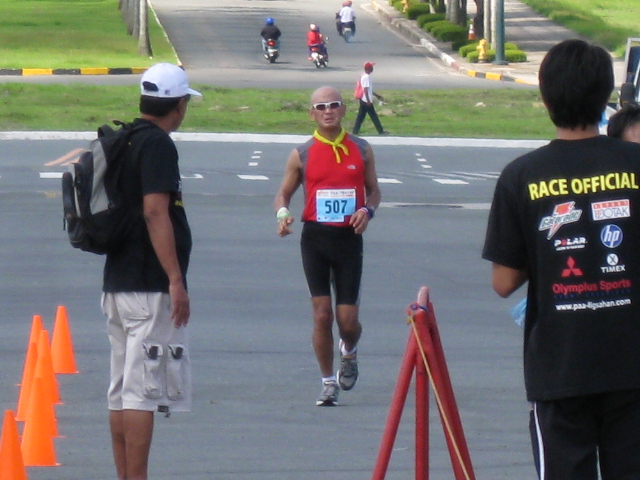
Before I passed the Finish Line, I slowed down to see the digital clock and I registered a Finish Time of 4:35:10 hours. I am not proud of my time as I ran too slow without an operational GF 305. Based from the Race Chart of Running Times Magazine, I had an average pace of 6:30 minutes per kilometer/10:30 minutes per mile. It is my ultramarathon pace! Ha!Ha!Ha!
At The Finish LineMy Prize---A Finisher's Medal, Certificate & A Smile
By the way, next Saturday will be TNF 100 Australia. There are 250+ solo runners for the 100-Km distance. Dean “Karno” Karnazes, the Ultramarathon Man, will be competing in the said race. The next Saturday after TNF 100 Australia, it will be TNF 100 Sacobia, Clark, Philippines. There are 100 solo runners for the 100-Km distance. Dean “Karno” Karnazes will be in the 2009 Los Angeles Marathon Expo for his book signing. Good luck to all TNF 100 Sacobia Solo Runners!!!
Due to the hot temperature and humidity in the country, a Marathon Race is usually held during the months of December, January, or February due to the cooler temperature during these months. For this year, there were no scheduled marathon races during the 1st Quarter. But BOTAK came up with a Marathon Race during the month of May which is considered as within the Summer Months of the year. It is expected that the average temperature within this month would be hotter and more challenging to the runners. I really don’t know why the race organizer would schedule such a marathon race during the hotter months of the year.
Anyway, since I am a “sucker” and a “hardcore” on long distance run adventures, I registered for this race. I might be considered as “crazy” if I mention the reasons why I am going to run this race after 35 days from my participation in the 1st Bataan 102K Ultramarathon Race.
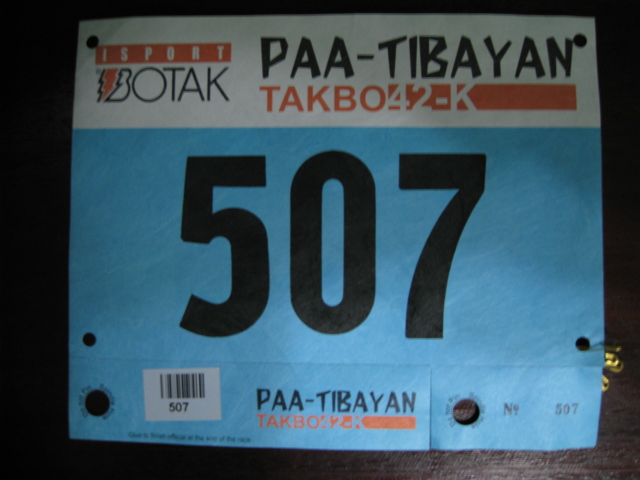
My Race Bib
I don’t expect to have a PR on this marathon race. I will consider this marathon as a long steady distance (LSD) run with an average pace of 5:00-3:30 minutes per kilometer. It will be nice and fun to be running with the other “hardcores” and the Bataan 102 Ultramarathoners.
Running a marathon distance is hard and challenging with the hot temperature that is prevailing during the month of May. However, depending on one’s experience, training & preparation, and race strategy, finishing a marathon could be an easy or hard running experience. It is a humbling experience when you encounter some “issues” during the race and at the same time a fulfilling accomplishment if you finish the race without any problems or injuries.
As a word of advice to those runners this Sunday’s marathon race, don’t believe in the “wall” as long as you hydrate, eat your power gels and bars, and stick to your race strategy.
I really do not know the background and past accomplishments of the race organizer of this marathon race but after studying the race route, I could predict some problems during the race like water stations, availability of road marshal to give directions, traffic, presence of kilometer markings and other support requirements to the runners. Anyway, it would be best to have your own support team to “leap-frog” along the route.
To all the “road warriors”, good luck and run strong!
The following are the tips for runners while running their first marathon race:
1. Drink plenty of water or fluids. Take at least 2-3 “gulps” of water every 3 -4 kilometers. If you don’t have any water or hydration belt, don’t miss every water station to drink. If the weather is hot and warm, you can pour water over your head or body.
2. Start at the middle or back of the pack. Run slowly (within your ability and training) and be conservative on your average pace. To be safe, a 3o-second slower time with your average pace for a kilometer or mile is acceptable. But if you feel you can pick-up the pace on the last 10 kilometers, slowly increase your pace and observe any pain that comes out from your legs or body.
3. Maintain a good running form. “Shuffle” and don’t sprint. Use a short, economical stride, bringing the knees up just enough to move your legs. Use the heel-ball footstrike. Maintain a comfortable breathing rythym. Relax your shoulders and arms. Arms should be swinging not higher than the nipple level and going down on the side of your running shorts. Remember the “talk-test” while running (you should be comfortable talking while running).
4. If you are injured or feeling sick or ill—walk! If the symptom remains and the pain increases, ask for medical assistance. Leave the race! Don’t be a hero for continuing, but you will be considered a fool for insisting. Many people had died already in marathon races.
5. If you have cramps and feel you have reached the “wall”, start to walk and “listen to your body”. Drink more water/liquids, take in your sports gel and walk briskly. It would be better for you to alternate brisk walking and jogging/running and think of finishing the race.
6. Nobody has ever said that running a marathon is a “walk in the park”. If you have trained properly and don’t feel any sickness and have no injury during the race, then you should be able to finish the marathon race. Running the last 6 miles or 10 kilometers is all “mental or an exercise of positive attitude”. Get the support of other runners around you. Find a group of runners whom you can run with during the race and help one another through period of weakness. Keep moving, take one step at a time, one kilometer marker at a time, and show that “big smile” when you cross the finish line!
7. Lastly, do not cheat! Don’t be tempted to ride on a vehicle running/passing along the route. Do not make any shortcuts!
The following tips are recommended for the first time runners joining a marathon race. These tips are recommended to be done or followed at least one week and immediately before D-Day of the Marathon.
1. Eat carbohydrates during the last three or four days before the Marathon.
2. Get your race packet early and prepare your running attire.
3. Select your running attire you are going to use for the marathon. Use the running shoes you’ve been using to prepare for this marathon. Wear light shorts and singlet. Your running socks should be comfortable to your feet and it should not cause blisters.
4. Apply foot powder on your feet to prevent blisters. Apply “baby oil” or virgin coconut oil (VCO) on your crotch and inner thighs; on your upper forearms (below your armpits); and on your nipples to prevent rubbing and chafing with your shorts and singlets.
5. Apply sunscreen lotion to parts of the body exposed to the sun except for the face. Sunscreen lotion mixed with your sweat will create a problem if it goes to your eyes.
6. Use a runner’s cap and sunglass to protect the face and eyes from sunlight.
7. Don’t get excited. Stay calm and relaxed. Think of the race as one of your weekend races or long slow distance runs.
8. Two days, or on the day before the marathon, take a short and easy jog.
9. Don’t forget your last body massage before D-Day. Experience wise, I prefer to have my massage two days before the race.
10. Full 8-hour sleep is a must on the 2 nights before D-Day. Just to be in the safe side, no sex on these days.
11. Wake up at least 2-3 hours before the race. You should be able to take a shower, take your “crap” for the last time, and take a light meal before leaving the house.
12. Try to conduct a “reconnaissance” or see the actual route and ride through it. Locate uphill terrain along the route and visualize your “strategy”. I don’t expect that kilometer markings will be available along the route, you should be able to estimate the distance from a certain point through your vehicle’s pedometer.
13. Wear your hydration/water belt, if you have any. In my experience running full marathons in the Philippines, nobody have ever perfected the location and needs of every water station.
14. Prepare to bring with you sports “gel” and sports “energy drinks”. If not, request your friends or members of your family to act as your “support team” and position themselves along the route to provide you with water, sports “gel/energy drinks”, food, and the much-needed “cheers and words of encouragements”.
15. Drink water or any fluids 10-15 minutes before the start of the race.
16. Stretch, warm-up, walk and jog at least 30 minutes before the start of the race near the starting line.
17. Be sure that your running equipment (digital watch/Garmin/Polar/Sunto/Ipod) are fully operational and with battery charged.
18. Come up with your strategy or plan in finishing the marathon race. Listen to your body and from your training workouts, you could determine your goal/objective in finishing the race. Since it is your first time, be contented of finishing the race without any serious injuries and this will serve as your experience to excel some more in your next marathon. Your time of finishing the race is only secondary to your primary aim of finishing the race.
19. Always think positive. If there is still enough time before the race, talk to other runners and be friendly to them. Remember, your opponent is yourself and the route, not the other runners.
20. Remove your fears. Think that you are not the last runner to reach the finish line.
21. Pray and give thanks to the Lord that you had undergone a hard training without any injuries or accidents and for you to be able to join and experience your first Marathon Race of your life.
The list of top runners/winners of the 2008 Subic International Marathon held last 20 January 2008 in Subic Bay Freeport, Zambales is now available at http://www.subicmarathon.com/winners.html
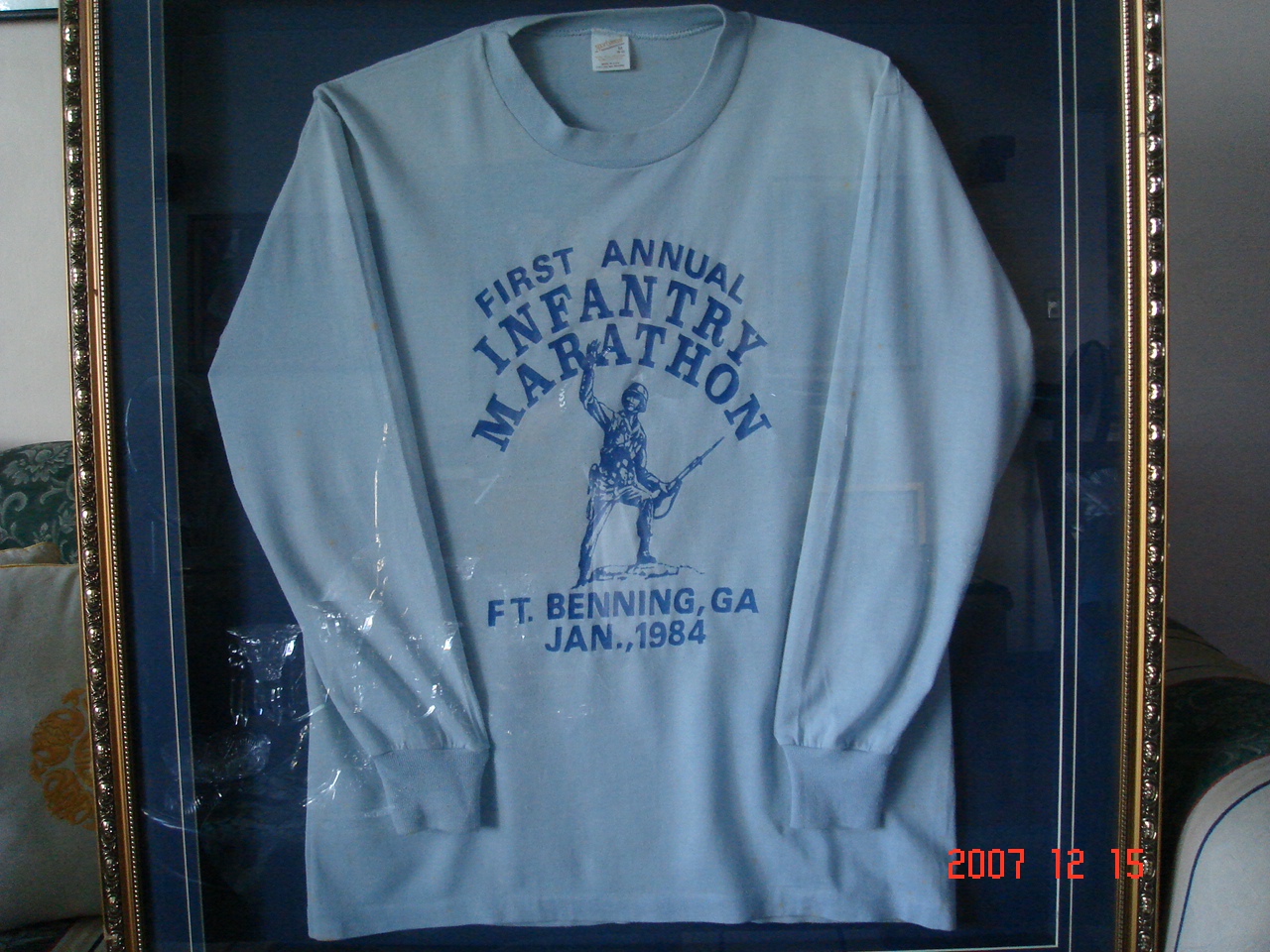
Being my first International Marathon Race since I started running in the early ’80s, I was able to preserve the Finisher’s T-shirt of the Inaugural Infantry Marathon held in Fort Benning, Georgia on the third Sunday of January 1984.
Hereunder is the picture of the shirt which I placed in a frame. The back of the shirt is printed with the Badge of the Infantry with the words “Follow Me”.
I am always fascinated with this Marathon Race in Japan during the 80’s where Toshihiko Seko won this race from 1978 to 1980 and winning his last championship in 1983. Frank Shorter of USA had won this event for four (4) consecutive years in 1971 to 1974. My other running “idols” who won this race were Bill Rodgers of USA in 1977 and Rob de Castella of Australia who won in 1981. Shorter and Seko are still the only runners who won the event for four times.I consider this marathon event as the race among the “elite marathoners” of the world because of the prestige it brought during the 70’s and early 80’s. This is where the Marathon record time was always broken.Invitation to this race had never exceeded to 700 runners, all male runners.I am posting this article about Fukuoka Marathon for the younger runners and “soon to be” marathoners. This is also my way of remembering my “running idols” of the past—Seko, Shorter, Rodgers, and de Castella.
This is a preview written by Sharon Ekstram:
The Fukuoka International Open Marathon Championship will celebrate its sixty-first running on December 2, 2007 and will, as usual, set the stage for some incredible distance running. Notable for 2007 will be the debut marathon performance by Half-Marathon world record holder Sammy Wanjiru who will be competing against an international roster of elite marathoners as well as most of the top Japanese marathoners who will be attempting to qualify for the Japanese Olympic Team in this first race in Japan’s Olympic selection process.
History of Fukouka Marathon The Fukuoka Marathon is an all-male invitational race with a long, history that dates back to shortly after World War II. Originally called the Asahi Marathon, the first marathon was held in Kumomoto, hometown of Shizo Kanaguri, the godfather of marathon running in Japan and one of the first athletes to represent Japan, running in the 1912 Olympics.
During the early years, this race was held at several different locations, but as the race had the same name and sponsorship, it was considered the same marathon. Th event found its permanent home in Fukuoka in 1963 when it was run on the proposed 1964 Tokyo Olympics course. In 1966, the race became the Fukuoka International Marathon Championships and was sanctioned by the International Association of Athletics Federations (IAAF) and organizers adopted the concept of a year-end event which would invite the winners of all the major marathons around the world to crown the best marathon runner of the year.
Olympian Frank Shorter, who was the four-time winner of the Fukuoka Marathon (1971-1974), had this to say about the race: “Before the big city marathons (pre 1978) Fukuoka was viewed by all the athletes as the de facto World Championships because it was the only race where the iron curtain countries would participate between Olympic Games. It fell off in prestige in the 80’s and is now starting to come back. It’s flat and fast and you are pampered. You get the feeling all they want you to do is run your best.”
In many years, Fukuoka’s elite roster outshone the Olympic Marathon field. Two world records were set at Fukuoka: Derek Clayton set the record of 2:09:36 in 1967 and became the first marathoner to break 2:10 and Rob de Castella set the world record of 2:08:18 in 1981. As another indication of its speed, Fukuoka has seen sub 2:10 winning times in each of the past 10 years.
The 2007 Elite Runners Headlining the race at the young age of 21 is Sammy Wanjiru (KEN) who holds the two fastest times in the Half Marathon Distance (world record of 58:33 at the 2007 Den Haag Half Marathon). Returning from a hamstring injury incurred at the IAAF World Road Running Championships in October 2007, Wanjiru will debut in the marathon distance and, as he has told the media, he intends to win in a 2:06. Wanjiru also has his sights on the 2008 London Marathon which is one of the two races designated by the Kenyan Federation for Kenyan Olympic team qualification. Wanjiru may also be at an advantage to other members of the elite field, as Fukuoka is home turf for Wanjiru who spends part of the year training in Japan under Barcelona Olympic silver medalist Koichi Morishita.
Japanese runners do not generally travel to the USA or Europe, so are less well-known to westerners, but they are held in high esteem in international running circles. Fukuoka will highlight the best of these, including: Toshinari Takaoka (37), the Japanese National Record Holder with a 2:06:16 best from the 2002 Chicago Marathon, winner of the 2005 Tokyo International Marathon, fourth at the 2006 World Championships in Helsinki; Atsushi Fujita (31), Course Record Holder with a 2:06:51 at the 2000 Fukuoka Marathon and winner of the 2007 Beppu-Oita Marathon; and Shigeru Aburaya (30)(pr-2:07:52 2001 Lake Biwa Marathon) who was 5th at the World Championships in 2001 and 2003 and 5th place finisher at the 2004 Athens Olympic marathon.
Other elite athletes registered in the field include Haile Negussie (ETH, 28)(PR=2:08:16) winner of the 2005 Boston Marathon, Daniel Yego (KEN, 28)(pr=2:08:16), winner of the 2007 Rock N Roll Marathon, Alberto Chaico (POR, 34)(pr – 2:09:25) 8th at the 204 Athens Olympics and Mark Carroll (IRE, 35) a 5,000 meter specialist who has participated in three Olympics in the past, his 2002 New York City Marathon debut earned him a 6th place, but he would like to run the marathon at the Beijing Olympics. Ireland is using Fukuoka as a marathon qualifier for the 2008 Olympic Games.











 Bald Runner
You must be logged in to post a comment.