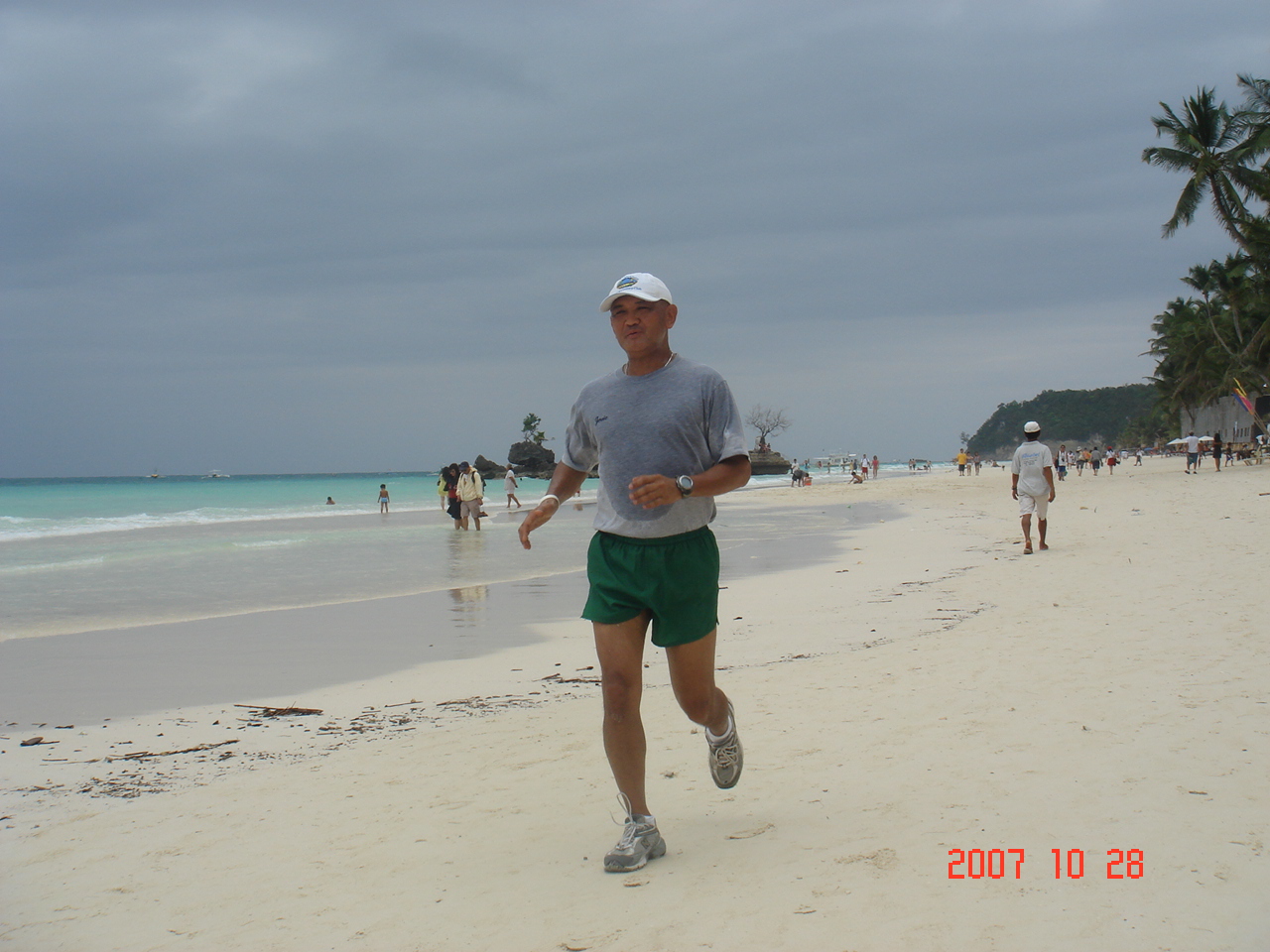
I had 40 minutes speed play along the beach of Boracay on 28 October 2007. It was a nice workout with winds coming from the North.
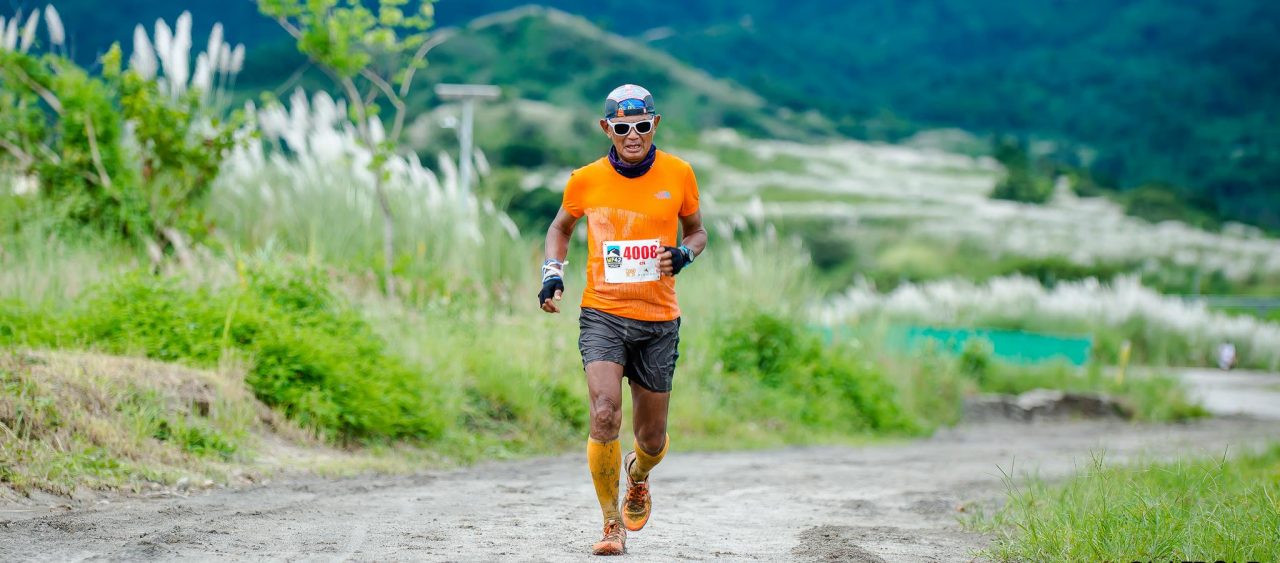
I had 40 minutes speed play along the beach of Boracay on 28 October 2007. It was a nice workout with winds coming from the North.
If my recollection serves me right, I had my first marathon in 1981 after I successfully proven to myself that I could be a better competetive runner. The PMA Alumni Race where I won number 2 inspired me to plan and run for the Marathon Race.
At that time, I was assigned in Region 1 (Northern Luzon) and my work included going to all the provinces of Ilocos Norte, Ilocos Sur, La Union, Pangasinan, Abra, Mt Province, and Benguet conducting seminars, lectures and meeting local government officials. However, most of the time, I stay in Laoag City because my office and staff were located thereat.
I am a product of the “Old School of Running”—build-up enormous mileages for 3-4 months and slowly build-up and combine speed workouts for 2 months and “simulate” running the marathon distance for the last one month before the marathon race.
In order to build mileage for the week, I have to run early in the morning for 10 kilometers and another 10 kilometers in the afternoon/early evening. And I did this from Monday to Friday. I usually run from our office in Laoag City to the Ft Ilocandia Golf Course and sometimes from Laoag City Poblacion to the Ft Ilocandia Hotel. The road/course is nice. And at that time, there were less traffic and vehicles plying those routes. On Saturdays, I do my long slow runs reaching up 20 to a maximum of 25 kilometers. Sunday was my rest day. Sometimes, I do my long runs on Sundays and make Monday as my rest day, and start my weekly runs on Tuesdays. Progressively, I increased my daily runs up to 15 kilometers per session and increase my weekend long runs up to 30 kilometers.
My speed workouts were done in the athletic oval of Laoag and sometimes in the athletic oval of Teachers Camp in Baguio City (the one that was used by the Gintong Alay athletes of Michael Keon). My speed plays vary when I am in the oval but most of the time they consisted of 400-meter fast and 400-meter recovery runs by jogging slowly. I usually do 10 to 15 repeats of the speed runs. However, I became creative with my speed plays. I did my speed runs on my road runs by using the kilometer markers as my reference points (alternately, running faster in-between two kilometer markers and then doing my recovery/slow jog up to the next kilometer post). Sometimes, I use the electric posts along the road/streets as my reference points for shorter speed plays. But what made me more creative was when I discovered the “color-coded” foot trails around the perimeter-slopes of Camp John Hay Base in Baguio City (when the Americans were still running/managing that camp). In every sector of the perimeter of the camp, the trunks of the pine trees along the trails were painted with spots of dark red, green, blue, orange, and white paints. So, I alternately did my speed plays every other colored trail while running. I really don’t know if these “color-coded” trails are still there.
To “simulate” or practice the marathon one month before the race, I should be able to run at least 35 kilometers during my weekend long slow distance workout with minimum effort. I have one of my men “leapfrog” every 3-4 kilometers for my regular water intake/supply. I start my run at the same time with that of the race starting time.
I did my practice runs alone on the road, ovals, and trails.
I finished my first Marathon race, the Manila International Marathon, in 3 hours; 24 minutes; 46 seconds.
Finishing my first marathon race entails planning, hardwork, persistence, patience, discipline and commitment to finish the race. Such values and attitude I need to pursue my life and carreer in this ever challenging and unpredictable world.
Marathon race is life in itself.
When I was a cadet at the Academy, there was only one type of athletic/sports shoes issued to everybody, that was the Converse Rubber Shoes (Hi-cut), colored white, which was basically for Basketball. Yes, that was the running shoes we used in that long distance race where I had my first taste of competetive running.
During my first and second Alumni Homecoming Running Competitions in 1980 & 1981, I was using the cheapest Adidas Running Shoes which was made of soft leather and thin soles. Although it was heavy as compared in today’s running shoes’ technology, this particular shoes endured my long distance runs which made me one of the top runners among my peers.
My wife left for the USA on the later part of 1981 and since then I was getting a regular supply of “state-of-the-art” running shoes. She sent me the latest model of the New Balance Series 300. I guess, she had chosen New Balance because the symbol “N” on the sides of the shoes corresponds to the first letter of our last name. At that time, it was only the New Balance shoes that were exclusively “Made in USA” while Adidas Shoes were made in Germany then. Since 1981, I used at least two models of New Balance Running Shoes in my running practices and was able to finish three (3) Marathon Races up to 1983. I really liked New Balance shoes because it was the lightest running shoe at that time that provides comfort on the heel portion because of its thick soles and it has an integrated anti-pronation system. Up to this time, I am still using a New Balance Shoes for my practice runs. Although my shoes (NB 716) which was bought three years ago is already old, I still feel comfortable with it. This is the shoes I am using here in the mountains of Jamindan.
During the summer of 1983, I ordered from my wife the lightest running shoes in the market and specifically asked her an ASICS Tiger Running Shoes. Since then, I’ve been using ASICS Tiger Shoes for my racing days. Presently, I am using a “Cumulus” Model of ASICS Tiger which my wife bought last December 2006 at the Phidippides Sports Center, along Ventura Blvd, Encino, CA. I really like and appreciate the staff of this sports store as they made me run for about 50 meters to observe my footwork. This is my fourth ASICS Tiger running shoes since 1983. If my recollection is right, I have been using ASICS Tiger shoes to finish another five (5) Marathon races since then.
So, as an old runner, my running shoes preference is limited to my New Balance shoes which I use for my running practices and my ASICS Tiger shoes which I use only for my competetive races.
Important Running Tips For Every Runner to Know by Dr George Sheehan
This column is for the benefit of those taking up jogging with the coming of favorable weather. Here are a few practical pointers to keep in mind:
1) Keep a record of your morning pulse. Lie in bed for a few minutes after you awaken and then take your pulse. As your training progresses, it will gradually become slower and after three months or so plateau out. From then on, if you awaken and find a rate of 10 or more beats higher, you have not recovered from your previous day’s runs, races or stresses. Take the day or more off until the pulse returns to normal.
2) Weigh yourself regularly. Initially you will not lose much weight. What you lose in fat you will put on in muscle. Running consumes 100 calories a mile and there are 3,500 calories to a pound so you can see weight loss will be slow unless you do heavy mileage.
3) Do your exercises daily. The more you run, the more muscle imbalance occurs. The calf, hamstrings (back thigh) and low back muscles become short, tight and inflexible. They have to be stretched. On the other hand the shins, the quads (front thigh) and the belly muscles become relatively weak. They must be strengthened. Learn the Magic Six: Three strengthening exercises, three stretching exercises.
4) Eat to run. Eat a good high-protein breakfast, then have a light lunch. Run on an empty stomach at least two, preferably three hours after your last meal. Save the carbohydrates for the meal after the run to replenish the muscle sugar.
5) Drink plenty of fluids. Take sugar-free drinks up to 15 minutes before running. Then take 12 to 16 ounces of easily tolerated juices, tea with honey or sugar, defizzed Coke, etc. before setting out. In winter that should be all you need.
6) Run on an empty colon. Running causes increased peristalsis, cramps and even diarrhea. Having a bowel movement before running and particularly before racing prevents these abdominal symptoms.
7) Wear the right clothes. In winter this means a base of thermal underwear followed by several layers of cotton or wool shirts with at least one being a turtleneck. Wear a ski mask and mittens. Use nylon if necessary to protect against wind and wet. In summer the main enemy is radiant heat. Remember to wear white clothes and use some kind of head covering.
8) Find your shoes and stick to them. High-arch feet do better with narrow heels. Morton’s Foot (short big toe, long second toe) may need an arch support in the shoe. If a shoe works, train in it, and wear it to work.
9) The fitness equation is 30 minutes at a comfortable pace four times a week. Your body should be able to tell you that “comfortable” pace. If in doubt use the “talk test”. Run at a speed at which you can carry on a conversation with a companion.
10) Run economically. Do not bounce or overstride. You should lengthen your stride by pushing off, not by reaching out. Do not let your foot get ahead of your knee. This means your knee will be slightly bent at footstrike. Run from the hips down with the upper body straight up and used only for balance. Relax.
11) Belly breathe. This is not easy and must be practiced and consciously done just prior to a run or a race. Take air into your belly and exhale against a slight resistance either through pursed lips or by a grunt or a groan. This uses the diaphragm correctly and prevents the “stitch.”
12) Wait for your second wind. It takes six to 10 minutes and one degree in body temperature to shunt the blood to the working muscles. When that happens you will experience a light warm sweat and know what the “second wind” means. You must run quite slowly until this occurs. Then you can dial yourself to “comfortable,” put yourself on automatic pilot, and enjoy.
13) Run against traffic. Two heads are better than one in preventing an accident. Turn your back on a driver and you are giving up control of your life. At night wear some reflective material or carry a small flashlight.
14) Give dogs their territory. Cross to the other side of the road and pick up some object you can brandish at them. Never try to outrun a dog. Face the dog and keep talking until it appears to be safe to go on.
15) Learn to read your body. Be aware of signs of overtraining. If the second wind brings a cold clammy sweat, head for home. Establish a DEW line that alerts you to impending trouble. Loss of zest, high morning pulse, lightheadedness on standing, scratchy throat, swollen glands, insomnia, palpitation, are some of the frequent harbingers of trouble.
16) Do not run with a cold. A cold means you are overtrained. You have already run too much. Wait at least three days, preferably longer. Take a nap the hour you would usually spend running.
17) Do not cheat on your sleep. Add an extra hour when in heavy training. Also arrange for at least one or two naps a week and take a long one after your weekend run.
18) When injured find a substitute activity to maintain fitness. Swim, cycle or walk for the same time you would normally jog.
19) Most injuries result from a change in your training. A change in shoes, an increase in mileage (25 miles per week is the dividing line; at 50 miles per week the injury rate is doubled), hill or speed work, or a change in surface. Almost always there is some associated weakness of the foot, muscle strength/flexibility imbalance, or one leg shorter than the other. Use of heel lifts, arch supports, modification of shoes and corrective exercises may be necessary before you are able to return to pain-free running.
20) Training is a practical application of Hans Selye’s General Adaptation Syndrome. Stress is applied, the organism reacts, a suitable time is given to reestablish equilibrium. Then stress is applied again. Each of us can stand different loads and need different amounts of time to adapt. You are an experiment of one. Establish your own schedule, do not follow anyone else’s.
Old runners like me always talk about this guy who is considered as the “Guru of Runners”. The first time I saw and read his writings was when I got hold of a Runners World Magazine way back in the summer of 1980. Buying at least three editions of the monthly Runners World Magazine in Dau, Angeles City was my solution to gain more information about the science of long distance running.
Few months before that, I joined my first attendance to a long distance running competition among the alumni of the Philippine Military Academy in commemoration of its Founding Anniversary during the mid part of February. I practiced running short runs on staggered basis 2-3 months before the competition and I thought I could compete in this race and finish well. The course starts at the gate of Camp Allen (near Baguio City Hall), passing through Harrison Road, and along the road going to Fort Del Pilar and finishing infront of the Grandstand of PMA Parade Grounds. Well, I was wrong! I did not compete in this race but I barely survived finishing the race.
Surprisingly, my younger brother, who graduated a year after me from the Academy, finished outstandingly and ranked as Number 4 among the top runners. If I can remember right, I finished within the 60+ place among almost 200 runners. After that run, I said to myself to excel and improve in the next edition of this race on the following year.
Reading the articles of Dr Sheehan in those past issues of the Runners World Magazine inspired me to plan, train, and test my capabilities in running. The result? After those LSDs, “fartleks”, lots of mileage, carbo-loading, positive attitude and discipline for almost 9 months, I became the second fastest runner among the alumni for three consecutive annual renditions of this PMA Alumni Race.
Now that I am getting older, Dr George Sheehan will always be my “guiding light” in running, my No. 1 Running Hero.
I highly recommend all runners to visit his website and read his essays at: www.georgesheehan.com/essays.
Published November 02, 1998, in The Post-Standard.
By Dr Kamal Jabbour, Contributing Writer
On Thursday, Dr. George Sheehan would have turned 80 years old. However, this week marks the fifth anniversary of Sheehan’s death at his home in Ocean Grove, New Jersey, four days shy of his 75th birthday.
A runner, a cardiologist and a writer, Sheehan was the philosopher of our sport. Although he wrote many books and hundreds of articles on running, Sheehan did not tell us how to run faster or further. Instead, Sheehan told us why we ran. He explained the “why,” not the “how,” of running, and earned the nickname of “running guru.”
Sheehan was born on November 5, 1918 in Brooklyn, New York, the first of George and Loretta Sheehan’s 14 children. He competed in high school and college, but stopped running in 1940 when he started medical school. He joined the US Navy as a physician in 1943. Sheehan married Mary Jane Fleming in 1944, and they had 12 children.
In 1963, Sheehan returned to running and racing. Six years later, he ran a mile in 4:47, setting an age group world record, and running the world’s first sub-five-minute mile by a 50-year old. He competed regularly, and raced often in New York’s Central Park. From 1964 to 1984, he ran 21 consecutive Boston Marathons. He ran his fastest Boston Marathon in 1979 in 3 hours 1 minute at age 60.
In 1968, Sheehan began writing a running column for the Red Bank Register, his hometown newspaper. In 1970, he wrote his first column for Runner’s World. Two years later, he published his first book, “The Encyclopedia of Athletic Medicine,” followed in 1975 by “Dr. Sheehan on Running.” The success of his writing propelled him onto the lecture circuit, and he became a popular speaker at major races.
His 1978 book “Running and Being: the total experience,” was a bestseller. In this book, Sheehan transformed running into poetry. In eighteen chapters with one-word titles, Sheehan preached about living, discovering, understanding, beginning, becoming, playing, learning, excelling, running, training, healing, racing, winning, losing, suffering, meditating, growing and seeing.
Sheehan considered himself an experiment of one. What worked for him, may or may not work for others. He saw racing as the only reason for running. He ran hard in every race, believing that a runner who could walk out of the chute did not try his best.
Philosophically, Sheehan proclaimed that the difference between a jogger and a runner was a race entry form. Therefore, when the fitness craze swept the country in the seventies, he characterized fitness enthusiasts as joggers, and competitive athletes as runners. He went on to claim that health benefits ended where competition began, and that runners raced for a goal higher than fitness.
My mentor raced against Sheehan at various venues, and watched him run and speak. He remembers him as a quiet man, a motivating speaker and a tenacious racer with a strong finishing kick.
While I never met Sheehan, he has had a lasting influence on my running and my writing. He inspired me into racing for self fullfilment, and into writing only following a run. He also gave me the courage to share those inner feelings that made every runner an experiment of one.
On a family vacation on the Jersey shore, my mentor and I ran the board walks past Sheehan’s house, partaking for a few moments in the warm sunrise over his spacious ocean. A public water fountain stood outside the house as a reminder of Sheehan’s unselfish love for fellow runners.
In his last book “Going The Distance,” Sheehan shared his fear, anger and pain, as he prepared for the ultimate peace at the end of his journey. Through life and in death, his “experiment of one” continued to touch and inspire.
Five years from now, we will celebrate the tenth anniversary of Sheehan’s death. Then, it is my hope and belief that we will also commemorate his life with the issuance of a US postal stamp.
Kamal Jabbour escapes in the writings of George Sheehan when life spawns tough challenges. His RUNNING Column appears in The Post-Standard on Mondays. He maintains The Syracuse Running Page and receives email at jabbour@syr.edu.
Yesterday afternoon, I had to wait for the rain to stop before starting my practice run around the camp. While the rain became weaker, I started to have my stetching exercises, from the bigger muscles to the smaller ones, to include my heel tendons which are already prone to pains after long endurance runs. My stretching session lasted for 15 minutes and I was ready to go.
My practice run for the afternoon was a speed workout within the 2-mile course that I personally measured passing through the cemented roads inside the camp. Sixty percent (60%) of the course is uphill and the rest is plain and downhill grade. The reason why it is a must to have a 2-mile course in the camp is because every officer and soldier, regardless of rank and age, must be able to pass the Army Physical Fitness Test every quarter which consists of three events/activities: 2-minute Push-ups; 2-minute Sit-ups; and a 2-mile run. A failure in each event means failure to the whole test. On the average, an officer/soldier must be able to finish the 2-mile run in 21 minutes.
I finished my first round on the course in 17:26 and timed the second and last round at 17:54. My total time for the distance of four (4) miles was 35:20. Not bad, after having my last run/competitive race last Sunday where I joined the Generals’ Relay (5 x 100 meters) in Camp Aguinaldo.
It appears that I ran a distance of 6.4 kilometers in 35:20. On the average, my pace was 5:21 per kilometer. This is not bad for my age and the terrain where I am having my speed workouts. It was a nice and refreshing speed workout.
Most of the days, I spend my time in my camp situated within the mountains of Jamindan, Capiz. Jamindan is an obscure but large in land area municipality which is located southwest from Roxas City. Its land territory reaches up to the boundaries of Aklan and Antique. The average altitude is 300-350 meters (1,000+ feet) above sea level.
I can safely say that I get my strength and endurance with the clean/unpolluted air around me, high altitude training, fresh & organic foods, restful & quiet nights and the challenging rolling terrain.
My first experience in running was when I was a “plebe” (first year cadet) in the Philippine Military Academy during the summer of 1970. We had daily morning runs for almost two months in platoon formations. These daily runs as part of the military training made me strong and active but exhausted at the end of the day.
On the 1st semester of that year, I joined the running team (as most of the plebes without any “talents” in other sports) of my Company (“Charlie”) for a 10-K race on the month of November. The race starts at the VOA Gate along the Baguio City-PMA Road, going towards the end of the runway of Baguio Airport and then running practically along the runway towards the trail leading to the back of the PMA Chapel. This trail was the “killer” as it ascends abruptly towards the peak of a hill where the PMA Chapel is located. From the chapel, the road is going down up to the Parade Ground.
Looking on hindsight, the training and coaching advice/tips by our upperclassmen/seniors were all wrong and unscientific at that time. They did not allow us to drink water before the race and along the route because they told us that the water will make us heavier. Stretching exercises were limited to the “Army Dozen” exercises & “Jumping Jacks”. We did not talk about pacing, time splits, and PR best times. Even nutrition and food were not considered as long as the members eat lots of “boodlefights” every after practice runs. “Boodlefights” were practically a mixture of mashed sardines with steamed rice seasoned with salt and fresh hot chili.
On the race day, I placed # 15 among 120 runners. Our Company Marathon Team won the Championship.
As they say, “Everything is Perception”. For so many years that I’ve been to running and joining/competing in road races, I can judge the capability and degree of proficiency of a runner by his/her looks and the attire he/she is wearing, to include the running shoes.
My picture in the 1st City of Angels Half-Marathon Race shows an old, worn-out and determined runner to finish the race. My cap is a golfer’s cap which I bought as a souvenir when I played a round of golf at Fort Ilocandia Golf Course in Paoay, Ilocos Norte in 2002. I have two pieces of this cap which I always use for my practice runs, as well as, during race days, obviously, to cover my bald head and it absorbs the sweat from my head, making it as my dependable “coolant”! My shirt is a “muscle shirt” from Bench which I usually used as my workout shirt in the gym. It is stretchable and cool to the body even if it is wet from my body sweat and I bought two of this one in 2003. My running shorts is Speedo, it’s a loose swimming/running shorts, which I bought with my Bench shirts in 2003 with 30% discount. I have two sets of this shorts and I usually use this in my gym workouts. My running shoes is an ASICS Tiger shoes which I’ve been using for the past four years. I think I bought this shoes On Sale at Big 5 Store in Glendale, California in December 2002. After the race, I retired this pair of shoes and bought a new one which is an upgraded model of ASICS Tiger. The watch I am wearing is a Casio “Sea Pathfinder” Titanium which is light and water proof. It has a stop watch and timer functions whose digital numbers could be seen without my “reading glasses”. This watch was given to me as a Christmas gift by my younger brother in 1999 and had its battery changed only once. I am still using this watch in my practice runs and races.
The “yellow thing” tied with my shoe laces is what they call “runners’ chip” which activates and registers to the time recorder/computer once it passes the starting and the finish lines. Simply put, it registers your actual time of running from start to finish. In this particular race, it was used for the runners free of charge but for bigger marathon races, each runner pays a fee for using such “chip”. These “chips” are collected by the race organizers after you finish the rack.
At present, my running attire and fashion sense show an old runner whose legs and heart are still strong to finish any road race where he could compete. I consider myself as an average runner.
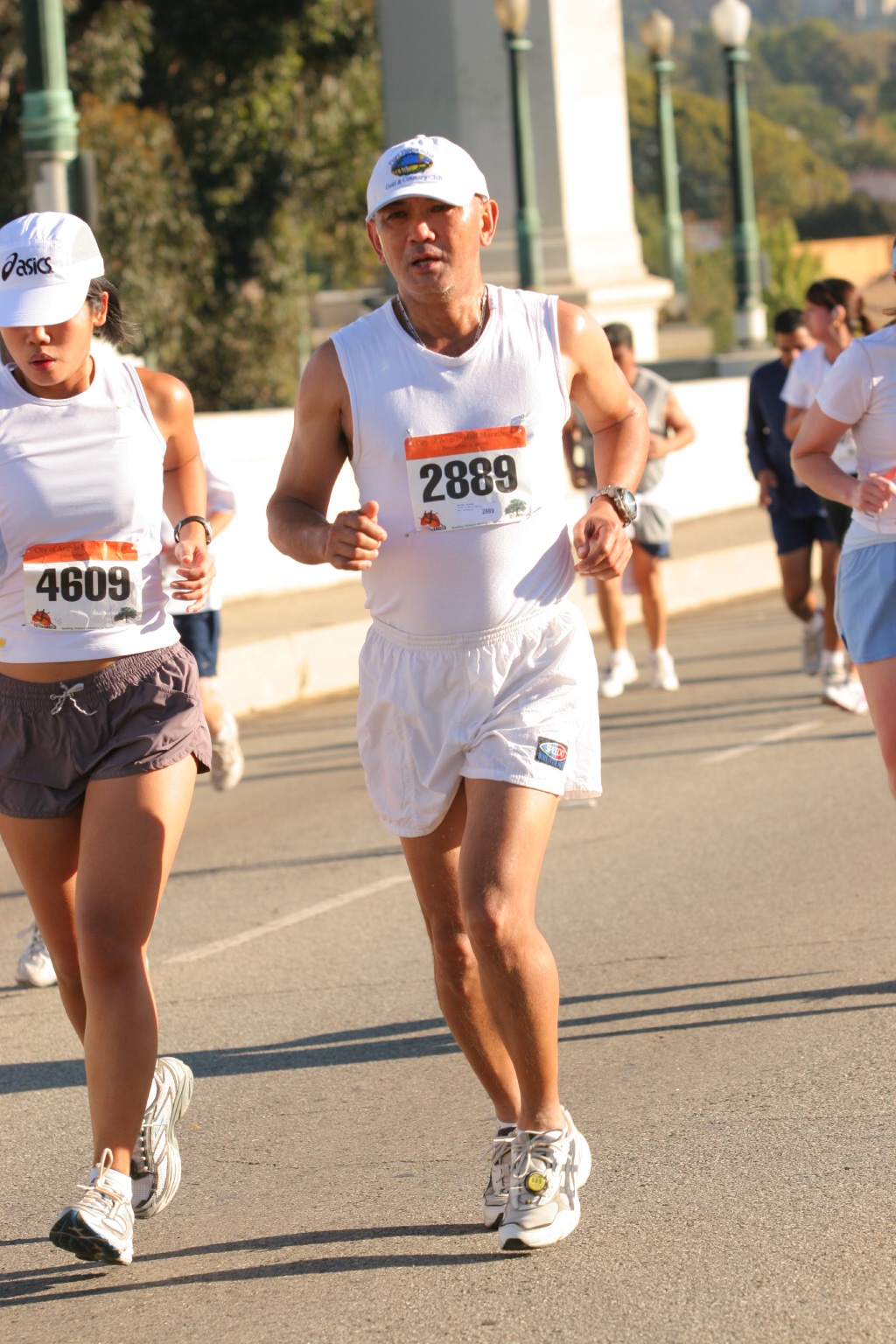
This is a picture taken along the Hyperion/Los Feliz Bridge with my daughter on my right. We just passed by the 7-mile marker at this point. We finished the race in 2 hours & 14+ minutes. My daughter’s PR time for the said distance improved by almost 12 minutes. I was running a pace of 10:15 minutes per mile. I placed/ranked #1,878 out of 3,652 finishers.
How I wish I could race again this year in this event.
 Bald Runner
You must be logged in to post a comment.