Intensity


Few days after the 1st CAMSUR Marathon, I had a conversation with one of the Finishers who finished the race in sub-four hours. The runner had been running his past Marathon Races in 3:35 to 3:50 hours but he would like to be consistent and cross the barrier of less than 3:30 hours. He simply meant that it is hard to master and predict your finish time in a Marathon Race if you are training and running the race here in the country. That’s true!

At the back of the mind of this runner, I could only analyze that he wants to set a record in his PR best time in his Marathon Race. Through my experience in running and being exposed to races here and abroad, I told him that the prevailing weather/climate in the country is the number one factor that prevents us from coming up with our PR best time. It is best to train hard here in the country and then choose/plan for a race in one of the temperate countries like China, Japan, South Korea, Taiwan, Australia, New Zealand, or to the United States. Running a race in a perfect and cool temperature makes wonder to the racing/running body. Aside from a better quality of air and running environment, I never had any problems with muscle cramps on my legs and problems on hydration.

 The second most important factor is the intensity of one’s training. If you want a detailed explanation of this factor, you have to refer to the book, “Jack Daniels’ Running Formula” where you will encounter Vo2Max, VDot, and the different range of average pace depending on the intensity of your workout. Your average pace is categorized into the following types of workout intensity—EASY, Threshold, Marathon, Race, and Interval Paces. Based on your predicted time to finish a certain distance, you have to follow each recommended pace depending on the intensity of your running workout. In my case, I have to maintain an average pace of 5:45 minutes per kilometer in my EASY runs to be able to finish my predicted time of 3:45 hours in a Marathon Race. You can just imagine how I need to be consistent with my training if you will know my average paces in my Threshold, Marathon, Race, and Interval workouts. The bottom line is that, I want you to get hold of the book by Jack Daniels and learn the details from it. Remember that the “devil” is always at the details.

The last thing that I could recommend to people who would want to establish their best PR time is to be able to value the word, RECOVERY. In between these workouts with intensity, you must be able to find time to have your body recover from the stress of such workouts. You must have to follow a standard weekly schedule for your running workouts. In the many journals, books and reading materials, I found out that the best competitive runners follow a 7-day a week schedule that is generally presented like this:

Monday—Easy and Recovery Run

Tuesday—Speed Training/Intervals

Wednesday—Moderate to Easy Run

Thursday—Moderate to Easy Run

Friday—Speed Training/Tempo/Intervals

Saturday—Easy to Moderate Run (minimum of 1 ½ hours)

Sunday—Long Steady Long Run (minimum of 2 ½ hours Easy Run)

You could see in this basic weekly schedule that the body would be able to recover after your Speed Training days and after your weekend/Sunday LSD runs. You could also lessen the intensity of your weekly average runs after 3 weeks, making at least one week as recovery week within a month’s of training schedule.

“Classic” Running Books


 Aside from being “classic” and being sought after, the following books are considered as the best books in running that greatly influenced people from their sedentary life to being active through running. These books contributed in the resurgence of “running boom” in the United States and in other countries.

Few minutes before the start of the 2nd PAU “P2P” 70K Run last Sunday, Paolo Osmena, a PAU member and BDM 102 veteran, gave me these three (3) “classic” running books which I consider as “collectors’ items” for seasoned runners. I was surprised and humbled by the generous gesture of Paolo of giving me these “treasures” among runners. Thank you very much, Paolo!

1st Book That Started The Popularity of Running

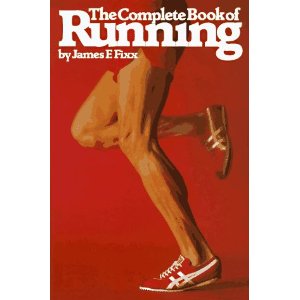
 The Complete Book of Running by James Fixx was published in 1977 and it became as the best selling book for that year. I tried to look for this book in the 70s and 80s in the local bookstores but it was not available. While I was on schooling in Fort Benning, Georgia in the mid-80s and during my stay in Los Angeles after my schooling, I was not able to buy or look for this particular book, to include the other two books. There was no Amazon.com at that time yet. So, when Paolo gave  me this book, it was my first time to actually hold and browse the pages of such book.

The red color of the cover, the running legs of the author, the red running shorts, and the red ASICS racing shoes were properly conceived as a “marketing” ploy for the book and it was a success. Nowadays, you seldom see red running shorts, red ASICS racing shoes, and running without socks!

2nd Running Book By James Fixx

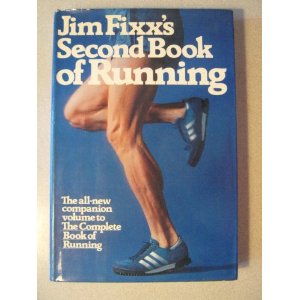
The Second Book of Running by the same author was published in 1980 but it did not create the same magnitude of popularity of the first book. It would be noted that the color of the cover page was in blue—blue running shorts, blue Adidas running shoes, running without socks, and the same running legs of the author. Four years after this book was published, the author died due to heart attack after completing his daily running workout. He was 52 years old. 

One of the Books Written By George Sheehan

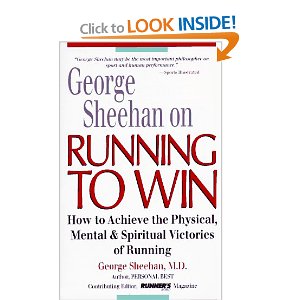
 Dr George Sheehan is considered as the modern day “philosopher of running”. He was a cardiologist in profession but became popular due to his writings about running with an essay he wrote every week in local newspapers and later with the Runner’s World Magazine. He died at the age of 75 due to prostate cancer. This particular book was the second to the last book that was published before he died in 1993. This book is a compilation of the essays he wrote and published in his column/page with the Runner’s World Magazine.

On a personal note, Paolo is sending me a “message” by giving these most treasured books about running. He is telling me to write and publish also a book about my entries in this blog which had been my plan for the past years. It is a dream to write a book as a compilation of all the entries of this blog and it is a matter of organizing them from one general topic to another. I know that this dream will become a reality.

Thanks, Paolo!

 (Note: Photos of the books were taken from Amazon.com)

Weakest Link


My Observations and Insights on Running and Heatstroke:

1. In the summer of 1971, two of my classmates died due to heatstroke after participating in a 10K run in Fort Magsaysay, Palayan City (Nueva Ecija) as a “fun run” with the Special Forces of the Philippine Army where you don’t see any Water Aid Station along the route. The race started late in the morning as most of my classmates finished under the heat of the sun. I saw with my own eyes while two of my classmates convulsed and crawled on the edge of the road, few kilometers from the finish line until they were picked up by the Camp Hospital’s Ambulance. Four of my classmates were evacuated at the Fort Magsaysay Hospital but the two of them were able to recover after a day of rest at the hospital. One of my classmates won the “fun run” as he had been a seasoned runner before he entered the Academy.

2. I saw how my two classmates convulsed and sedated inside the hospital. After a few hours, one of them died. On the following day, the remaining serious patient was transported to V. Luna Medical Center using the Ambulance but after his arrival in Manila, my second classmate died also. The doctors and medical staff at the hospital informed our Tactical Officers that our classmates died due to heatstroke! I don’t have any information if the said incident was fully investigated by the Philippine Military Academy and AFP authorities then. However, my deceased classmates were brought by the PMA authorities in their respective places/towns and they were buried with full military honors and their respective parents received death benefits due to a dead soldier/officer of the AFP. Case closed!

3. Two of my classmates who recovered with the case of heatstroke on that fatal day in the summer of 1971 were very lucky. One of them retired from the PNP two years ago as a two-star General/Police Director while the other one was dismissed when we were on our second year due to failure in Academics but had pursued/finished his College studies, worked in one of the telecommunication firms and now resides in the United States with his family. Both of them had never attempted to train or run in any of the road races since this incident.

4. Fast forward to the last week of January 2009 (last year). Jerry Karundeng, an Indonesian studying in the Philippines, joined the “50K test run” in preparation for the 1st edition of BDM 102. He is a strong runner but he is also a “hard-headed” runner that he did not follow my advise and “tips” while we were running on the course. He was wearing a black shirt, did not drink in every hydration station, was not carrying a hydration belt, and his pace was too fast in relation to the hot condition of the day. His mind was so conditioned to use Pocari Sweat as his sports drinks while my staff was serving Gatorade as I believed, they have the same use for hydration in endurance sports. Jerry finished the “test run” but on his way to Manila while aboard a vehicle, he started to experience “signs & symptoms” of heatstroke. Thus, he was brought immediately to a known Medical Center in Makati. According to my interview with Jerry, the Doctor/Medical Staff who attended to him did not believe that he just finished a 50K run under the heat of the sun! He was given with IV fluids immediately with the thought that he was dehydrated. Jerry was lucky that his body systems stabilized and had undergone some blood test in the said hospital. He was released on the same day that he was brought to the hospital and he was able to commute from Manila to Silang, Cavite. A day later, he consulted their resident doctor in their school and showed him the results of his blood test, the resident doctor explained to him that his blood sodium content was way below the average level. It was a conclusive evidence that Jerry was on the verge of being a victim of heatstroke. (Note: You can read more of the details of Jerry’s experience in his blog at www.highaltitude.wordpress.com)

5. On August 23, 2009 after the CAMSUR 70.3 Ironman’s last athlete reached the Finish Line, the Race Organizer admitted to media reporters that one of the participants, a Senior Executive and Owner of a Corporate entity, died during the triathlon event and he admitted also that a thorough investigation was being conducted. The news was reported on line and in the printed edition of the Philippine Daily Inquirer as soon as possible and it was featured at TV Patrol a day after the event. (Note: This is the exact opposite of Remus case where PDI reported his case on line and its printed edition exactly 14 days after the marathon event!!!). However, up to this time, nothing had been officially published if the casualty was a victim of heatstroke that resulted to a heart attack. 

6. In the 34th MILO Marathon Manila Elimination last July 4th, Remus Fuentes died two days after he was diagnosed as a victim of heatstroke which led him to succumb to a fatal heart and organ failures that resulted to his death. After a few days, Alexander Landera from Cebu City fainted or collapsed in the middle of a road race held in the same City where the race was held in the evening. He was brought immediately to the hospital to be treated. Unfortunately, when he regained consciousness, he started to be incoherent, confused, hallucinating, and thought that he was still in the race. Due to multiple wounds and loss of blood as a result of uncontrollable actions on his part, he died. Both runners were victims on separate road races, belong to different ages and running backgrounds, races held in different locations, different race distances, different weather conditions, and different parts of the day when their respective races were conducted (Remus’ race was in the morning while Alexander’s race was in the evening) and despite such factors, both runners died due to heatstroke! However, in Remus Case, the father was able to document his observations on what the Doctors/Medical Staff had done for his son’s treatment in the Hospitals where his son was admitted.

7.  So, what am I trying to say in this post? With my observations, researches and interviews, I firmly believe that our Doctors/Medical Practitioners could not distinguish if an endurance athlete (runner, ultrarunner, cyclist, triathlete, swimmer or hiker/mountaineer) is a victim of heatstroke or dehydration. Anybody could say that he or she is a “running expert” and say to high heavens and to all the media and Internet outlets/sites all the things and advises as preventive measures from being a victim of heatstroke and dehydration but what should be addressed is on the correct and appropriate treatment of heatstroke. I think, the problem lies on how our Doctors and Medical Practitioners in Hospitals react and treat endurance athletes who are victims of such mentioned heat-related injuries. This is the “weakest link”!!! Correct me if I am wrong, our Doctors (who are not seasoned/competitive runners) do not know how to deal with such cases!

8. In the book “Lore of Running” by Dr Tim Noakes on page 235 states that, “the major factors causing heatstroke during races are: environmental conditions; the speed at which the athlete runs; and individual susceptibility, including whether or not the athlete has preacclimatized to running in the heat. If longer distances races (5K and above) have a prevailing temperature condition of greater than 28 degrees Centigrade, heat injury will occur to a significant number of competitors, regardless how much amount they drink and sponge during the race or how they are dressed. Adequate fluid replacement during racing is only one of the many factors that reduce the risk of heat injury; it is certainly not the only factor and may not even be a very important factor. Aside from “hot and humid” temperature as one of the factors that determine the rate at which an athlete loses heat, clothing is also considered because the more clothing people wear, the less heat they will lose by convection and sweating. The athlete’s state of heat acclimatization (training to heat exposure) and state of hydration (not allowing yourself to be dehydrated) also determine the rate an athlete loses heat from his body.” It could be weird but Dr Noakes believes that only certain people are prone to heatstroke and it could be hereditary, too!

9. In Dr Noakes’ book (which I consider as my “Bible” in Running), a heatstroke victim has a body temperature of more than 40 degrees Centigrade; he/she breathes heavily; and has a rapid pulse rate of 100 or more beats per minute. A heart attack victim has a weak heart beat & pulse rate and the patient does not breath. In a heatstroke patient, a rectal temperature reading should be administered first to find out the exact body temperature of the victim. If the temperature readings indicate a result of 40 degrees and higher, the victim’s torso should be submerged in a tub or container full with ice or ice-water for the duration of 3-6 minutes until the temperature decreases to the normal level of body temperature. After the body temperature has dropped to its normal condition, IV fluids and other blood tests can be administered to check if the victim is dehydrated or if there is kidney damage or organ failure.

10. In simple layman’s term, diagnosing and treating heatstroke is very simple. But according to my favorite author and strategist On War, Carl Von Clausewitz, “The simplest things are the hardest things to do”! And be always safe and careful from the dangers of the sports and way of life that we love and enjoy but always remember that, “Shit Happens” when you least expect it from happening.

Sun Tzu’s “The Art of War” In Running


When I was in the military service, this was my “Bible” and had read this book for a hundred times. This compilation of essays written by Sun Tzu (a Chinese General & Philosopher) was translated by Samuel B Griffith in 1960 and they were written more than 2,400 years ago. It is considered as the oldest writings on the conduct of warfare. In all my military trainings, from a young officer to the generalship, the treatise in this book had been repeatedly discussed and explained to us. Being a former Commander of different units in the Philippine Army, from the squad-level (leading 9-men team) up to a Division-size Command (with almost 10,000 soldiers under me), the “treatise” of this book had been very effective in leadership; winning the “hearts & minds” of the people and at the same time in subduing the enemy.

The Book: Sun Tzu: The Art Of War

Lately, there had been books that were published in adopting the different treatise of Sun Tzu’s “The Art of War”  in relation to Business and Politics but I have yet to read these books.

I have the assumption that some selected “treatise” of the book, “Sun Tzu: The Art Of War” are very useful to all the runners. My favorite passage in this book is the following:

“Know the enemy and know yourself; in a hundred battles you will never be in peril.

When you are ignorant of the enemy but know yourself, your chances of winning or losing are equal.

If ignorant both of your enemy and yourself, you are certain in every battle to be in peril.”

Translating these passages into running, it would be like this:

“Know the race route and train yourself properly; in a hundred races you will always finish the race.

When you are ignorant of the race route but you trained yourself properly, your chances of finishing the race or DNF are equal.

If ignorant both of the race route and proper training, you are certain that in every race you are DNF.”

On a grand scale, of which could be directed and understood by our Sports leaders and authorities in our quest for Sports Excellence and our First Olympic Gold Medal, my favorite passage of Sun Tzu’s “The Art Of War” would be very relevant and appropriate. I guess, there is no need for further explanation on this.

It is no wonder that the Chinese today are on top of the Olympic Medal Standing in the latest 2008 Summer Olympic Games!

Stride Is Everything!


Have you ever tried counting the number of strides/steps or stride cycles to complete one lap on the Oval Track at Lane #1? Or have you counted the number of steps or stride cycle for you to cover a distance of one kilometer? or up to the distance of 3, 5, or 10 kilometers? 

I have never tried counting my stride cycle on Lane #1 at the Oval Track but I’ve tried counting my stride cycle on Lane #8. I was able to count 240 “stride cycles” on my first try, counting every time my left foot strikes the ground. (Note: Stride Cycle is equivalent to two (2) strides/steps). But for my 2nd try, I was able to lessen the number of stride cycle to 210 until I was able to decrease it to 204 on my 3rd up to 5th repetitions.  This means that at my fastest pace, I was able to count 408 steps/strides to complete one lap on the Oval Track at Lane #8.

The problem was that I was not able to get my exact time to finish one lap of the oval track! I can only assume (through my feelings) that I was able to finish one lap at 2:15-2:20 minutes at Lane #8. With this assumption in time, I can say that my stride frequency or leg turn-over on that particular workout was 180-182 strides per minute! Surprised? Of course, I was surprised also because elite runners would generate an average of 180 to 190 strides per minute according to scientific studies based on the performance of elite runners and Olympic Champions. But the problem was that I was not as fast as the world elite runners. It is due to the fact that a have a short stride length, which is the distance between the tip of my rear foot to the tip of my front foot.

I did this workout two weeks ago and since then I was observant on the number of strides or “stride cycles” I can generate in running a particular distance, whether I am in the Oval Track or on the road.

Experts would say that for you to generate a faster pace or faster finish time, a runner must be able to increase his/her stride length and at the same time increase his/her stride frequency or leg turn-over. It is easy to say and comprehend this theory or rule but the implimentation would take a lot of patience, hardwork, & determination. Being an old runner, there is no way I can increase my stride length as I have the tendency to “shuffle” with my feet/legs when I am running. I barely lift my knees when I run and I am more comfortable in letting my feet graze a few inches from the ground as if I am sliding my feet, one foot at a time, barely hitting the ground. This “shuffling” technique had protected my knees for the years that I’ve been running. I never had any injuries or pain in my knees!

The only way I could generate a faster pace and finish time is to be able to increase my stride frequency or stride cycle. I must be able to consistenly count 180 strides per minute or count 90 stride cycles every minute. In counting stride cycle, I count every time my right of left foot touches the ground. Although I’ve been doing this technique in my past races, I only think of doing this technique when I want to sustain my strength in the last kilometers of the race. The counting of the stride cycles becomes my “mantra” when I need more push and extra effort to maintain my average pace in a race.

Last Monday, I tried running at the Oval Track at Lane #1 and I was able to register the following number of stride cycles, time and average pace:

Rep #1—167 stride cycles—1:47 minutes—4:20 mins per km

Rep #2—173 stride cycles—1:53 minutes—4:32 mins per km

Rep #3—173 stride cycles—1:49 minutes—4:25 mins per km

Rep #4—166 stride cycles—1:45 minutes—4:11 mins per km

Rep #5—172 stride cycles—1:48 minutes—4:18 mins per km

In this workout, I was able to generate an average of 170 stride cycles or 340 steps; with an average time of 1:48 minutes; and with an average pace of 4:21 minutes per kilometer. By looking at the results of my experimentation, I can safely say that I can generate a stride frequency of 180 steps or more per minute but the problem is how to sustain such frequency in a half-marathon or marathon distance race. For me to improve on my time in my next marathon race, I should be able to sustain my stride frequency of 180 steps per minute for the whole race.

After my workout at the Oval Track last Monday, I asked one of my elite runners on how to sustain my stride frequency during a race. He answered that I need to do a lot of “drills and plyo” exercises. He also suggested some of the drills I have to do regularly.

This issue on sustaining my stride frequency led me to make some research on the Internet. I was able to browse on an article made by Tony Benson who was the Australian Coach behind our successes in Athletics through Governor Michael Keon’s Project Gintong Alay in the 70s and 80s about a list of “guide” (based from his experience) to maximize ones potential in running by counting the number of strides/steps to cover a certain distance. The following is his “guide” on the number of steps a runner expects to generate depending on his/her average pace:

  • 8 minute kilometre pace (48 seconds per 100m) = 122 to 127 steps per 100m (~1250 per kilometre)
  • 7 minute kilometre pace (42 seconds per 100m) = 109 to 111 steps per 100m (~1100 per kilometre)
  • 6 minute kilometre pace (36 seconds per 100m) = 98 to 102 steps per 100m (~1000 per kilometre)
  • 5 minute kilometre pace (30 seconds per 100m) = 83 to 86 steps per 100m (~850 per kilometre)
  • 4 minute kilometre pace (24 seconds per 100m) = 64 to 67 steps per 100m (~650 per kilometre)
  • 3 minute kilometre pace (18 seconds per 100m) = 55 to 57 steps per 100m (~560 per kilometre)
  • From this “guide”, you can conclude that if you run at a slow pace, the tendency is to run with a shorter stride length. However, if you have a faster pace/average pace, the tendency is to run with a longer stride length. This is due to the fact that a runner with a faster pace has the tendency to generate a bounce/jump that propels the runner to take a longer stride. In my experience, I could only generate an average of 75 to 80 centimeters of stride length during my LSD or easy run but if I am doing my speed and/or tempo runs at the Oval Track, I could generate an average of 115 to 117 centimeters. Yes, I went to the extent of measuring my stride length just to be able to improve on my running.

    In the book, “Brain Training For Runners” by Matt Fitzgerald, I found out that the “drills and plyo” exercises recommended by my elite athlete is a small portion of the whole solution in the pursuit of stride development. The author, for obvious reasons, recommends the “Brain Training Approach”. The first approach is Emulation. I am not saying that I should emulate or try to run like Haile and the other world-class elite runners/Olympic Champions in the Marathon Race as seen on tapes, DVDs, You Tube, and other recordings.

    Observing my elite athletes do their workouts at the Oval Track, I could not find a running form that resembles my style. They have very long stride lengths and faster stride frequency. But, what impressed me most was my observation (with my own eyes) on how the Japanese ultrarunners performed in the Jeju International Ultramarathon 100K Race, that is to include the women runners. They have short strides but their stride frequency was very fast. They land their feet on midfoot and they quickly lift their feet once they get in contact with the ground. Their foot contact with the ground was very quick and light. You could hardly see them lift their thighs so high and see them lift their feet on the backward motion. It was amazing to see their feet “shuffling” and grazing a minimum height from the ground!

    Since Monday of last week, I’ve been counting the number of steps or stride cycle every time I run, trying to emulate those Japanese ultrarunners. I know it will take a lot of practice and patience to count every time I run but I could feel some improvements with my average pace.

    Right now, I am looking for that inexpensive watch with a metronome beat of 180-190 beats per minute which will be my “partner” in my running workout until such time that my body system will be used to the beat. At least, that will save me from counting every step I make in my run. 

    To be continued…

    (References: BENSON’s EPS Step With The Best To Success & “Brain Training For Runners by Matt Fitzgerald)
    “Thanks For Not Inviting”


    1. In a few hours today, Joy Rojas’ “Takbong Pangarap” Run Across USA will hold a Press Conference at the Hotel Intercontinental in Makati City about her 3,000-Mile Run Across USA which she completed on the middle of November 2009.

    2. I knew this Press Con event from a Race Organizer who is close with Joy Rojas and Mat Macabe last week. I asked from the Race Organizer if I can attend the said event since I know that such event needs an invitation letter of e-mail. However, since Monday, I was given a lot of reasons and “alibis” for me not to be able to contact a certain Leila Caringal, the event organizer. And the Race Organizer who informed me about the event is no longer answering my text messages if there is a possibility that I could attend the Press Con. And what is worst, I know that Mat Macabe has my cellphone number.

    3. It is on record in my blog that I tried to locate the location of Joy Rojas after a month or two from the time she started her run from Eagle Rock, California on the 2nd week of May of this year. From the e-mails I received from my ultra running friends and comments in my blog, some problems emerged from the team of “Takbong Pangarap” where one of the members left the team and returned to the Philippines due to some “complaints” and “misunderstanding” with Joy and Mat. Aside from the said “misunderstanding”, one of my readers questioned the integrity of the running event. I tried to get the side of Joy and Mat about such “issues” and it was an opportunity to exchange e-mails with Joy and she was able to send me some of her pictures of which were “grabbed” by other websites. Joy tried to evade to answer the “issues” but she told me that her run will go on. As Joy reached Idaho, I stopped monitoring her running event and since then, I never heard about her whereabouts.

    4. After reading the book of Brian Stark on his experiences of running across the USA through the American Discovery Trail and Trail Roads without any support; watching the DVD film on Dean Karnazes’ 50/50 and Running The Sahara; and browsing the different blogsites and websites of runners who ran the Transcontinental USA for the past years ( pls refer to www.seejohnrun.com), I have my personal doubts about the feat and accomplishment of Joy Rojas. These ultra runners prepared their plans for years and collected at least 500 maps to trace and plan for their routes; they have journals and documents to prove their feat through their websites and blogs, complete with pictures; and they take advantage of the gadgets and devices that the high-technology world has to offer in order to track and recors their runs.

    5. An ultra runner friend of mine, Tess Geddes, a Filipina who finished two editions of the Marathon Des Sable in the Sahara Desert had recommended me to track one of his ultra running friends, Ray Zahab, who was running across Canada with the use of a GPS tracker. By clicking his website at www.impossible2possible.com, I was able to locate him on real-time on what part of Canada he was running! Ray Zahab is the Canadian runner who is one of the team members who was featured in the film “Running The Sahara”.

    5. If you think that this is one of my “crab mentality” stories and insights, this is not so! We are dealing here with the truth and integrity of a runner’s accomplishment and purpose. If I was not invited for this presscon because of the thought that I might “ruin” or question the integrity of Joy Rojas accomplishment, then they are wrong. I will let this blog speaks for itself. You will be the judge.

    (P.S. I never met Joy Rojas in person! The PressCon would have been a nice venue to meet and congratulate her personally)

    “Back To The Slope!”


    1. When I was a cadet at the Philippine Military Academy, I always hear this statement or command from my Tactical Officers if they want the cadets to repeat a practice on our Parades and Ceremonies after doing one or two rounds. The start area of our parade and drills is a sloping/downhill road towards the Borromeo Field, the Parade Ground of the Academy. Figuratively, if this phrase or statement is uttered, it means that you have to repeat from the start what you have done in order to correct a mistake or error.

    2. After five weeks of rest & recovery due to an injury, I am going “back to the slope!” and have started to follow a training program as a guide for my future marathon and ultramarathon races for the year 2010 and beyond.

    3. The first step in my training program is to abide and recall the most basic principle in training for a running event—base training. I always say in my running clinic lectures that preparing for a running event is like constructing a building or a house where you need to have a durable and stable base/foundation. In running, base training  means building a base of aerobic endurance.

    4. So, early this morning, I had my first “base training” at the ULTRA Oval Track completing a distance of 10 kilometers, running along the outer lane. I did my stretching exercises before and after the run. In addition, I did some running-related “drills” during and after the run. I finished my 10-K run in 1:09:13 hours with an average pace of 6:55 minutes per kilometer. I was so happy that I was able to breach the 7:00-minute per kilometer pace. Slowly, but surely, I could run within my base training pace.

    5. To give a full description of the drills I’ve done during/after my run, I am posting the following pictures with the hope that other runners would also adopt them to make them stronger and faster.

    "Running No Arms"
    Front View of "Running No Arms"

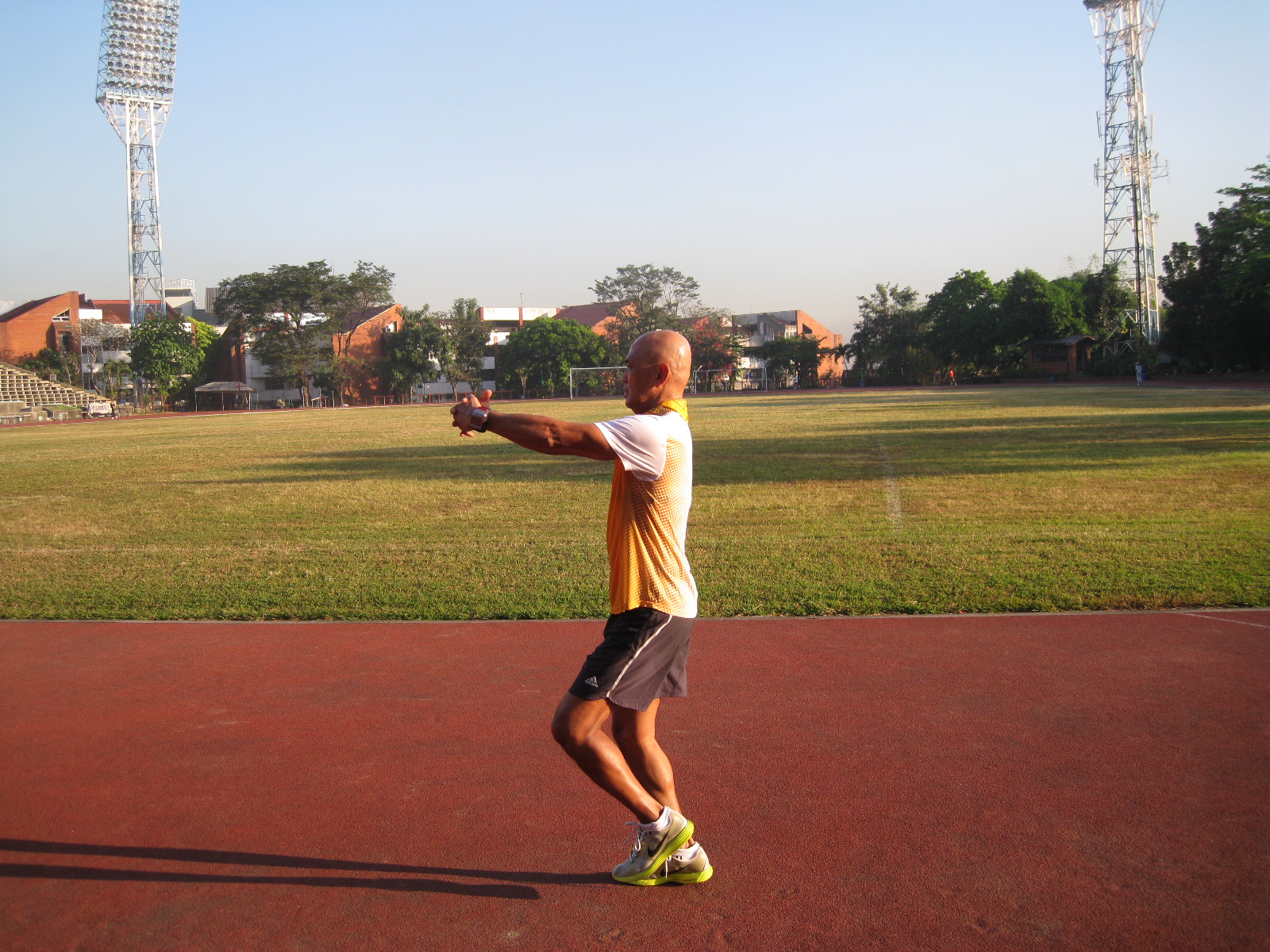
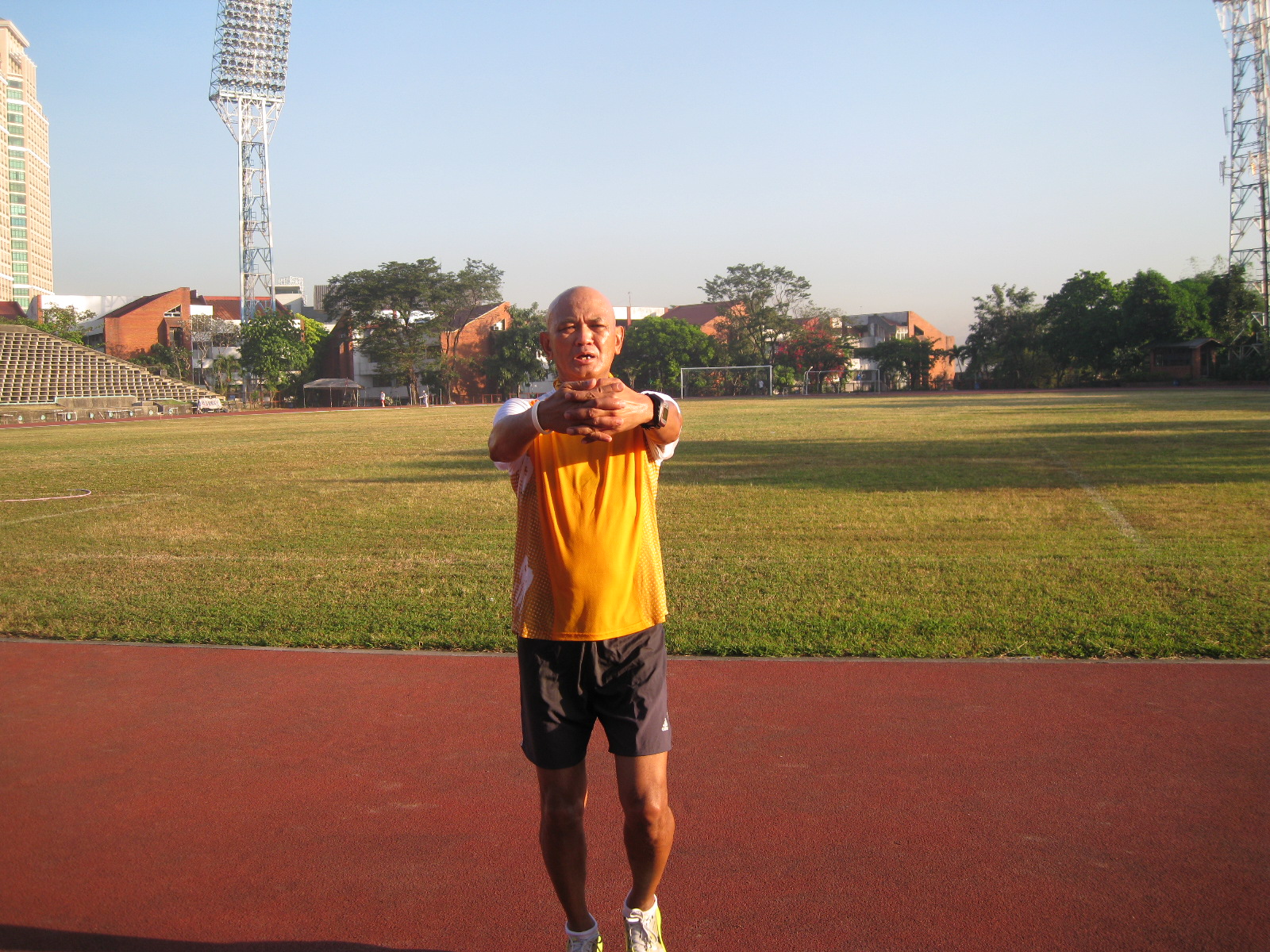
    To do this drill, a runner must lace his fingers and form a big circle with his arms at shoulder level. Run 100 yards at moderate fast pace with arms in this position. Return to your running form after 100 yards and repeat after running another 100 yards. I did 10 times of this drill while I was running around the track.

    This drill forces my inner abdominal muscles to maintain an upright posture and activates such muscles while running. It also eliminates unnecessary swaying or rotation of my shoulders from my waist while running.

    "One-Leg Hop"
    One-Leg At A Time

    To do this drill, one has to run as fast as possible with one leg for 20 seconds or approximately 20 leaps/bounce or more. This drill will increase one’s push-off power of the feet and will enhance the stability of the hips, pelvis, lower spine and knees on impact of the foot to the ground by forcing the muscles to stabilize the joints for a short period of time.

    Lesson #1: In a training cycle, first phase is to develop your aerobic endurance base.

    (Source/Reference: “Brain Training For Runners” by Matt Fitzgerald)

    “50/50” & “Running The Sahara”


    1. I received a very early X’mas gift  from Jay Nacino aka Prometheus Cometh two weeks ago and it was delivered through courier system. The gift was a compilation of running films/movies recorded in two (2) CDs. Thanks, Jay for the gift. God bless.

    2. The following films were recorded in those two CDs: Chariots of Fire; Without Limits; 50/50; and Running The Sahara. Having seen the first two films mentioned in widescreen, I was very interested to watch 50/50 and Running  The Sahara because they deal more on ultramarathon and multi-day stage runs. Both of these running events were filmed sometime in 2006.

    3. I will not deal with the whole story of these films as every reader of this blog could easily browse or “google” the title of the films and they could get the details of these running events. 50/50 was made as a film and at the same time published as a book to document Dean Karnazes’ 50 marathon races, in 50 States in the US, in 50 days. Running The Sahara is a film about three (3) ultrarunners from the USA, Canada, and Taiwan traversing the African continent by passing through the Sahara Desert in 111 days.

    4. What I like to point out and emphasize in these running events is the tremendous PLANNING involved to undertake such feats. Dean Karnazes took at least 3 years to convince The North Face in appreciating his plan to run 50 marathons, in 50 different States, in 50 days and another year to finally coordinate and arrange for the implementation of the said project. It was only when his book “The Ultramarathon Man” became a No. 1 Top Seller and his being a top contender in the 100-Mile Western States and Winner in one of the Badwater Ultramarathon editions that he became popular.

    5. The planning and preparation for the three (3) ultra runners in 3 different countries in the Running The Sahara took also years. Moreso, with the logistics; production/film crew; and other administrative requirements preparations for the event. This film/event also tested the endurance of the support staff and film crew in order to finish the running event.

    Kevin Lin (Taiwan); Ray Zahab (Canada); & Charlie Engle (USA)

    6. These two running epic events were well-planned and documented. These films really inspire other people to seek their endurance limits and at the same time promoting some advocacies/charities to help less-fortunate people. So, if ever you plan to do such endurance run, whether an ultramarathon event or multi-stage/day run, you have to document it so that the INTEGRITY of the event is intact. A simple blog (with pictures) would do or inexpensive tracker/GPS device to record your event should be with you all the time during your run.

    Running Books For Sale!!!


    I am selling two (2) copies of the book “Born To Run” in Hardbound for P 1,000.00 each.

    Born To Run

    I have one (1) copy of Dean Karnazes’ latest book “50/50” for sale for P 850.00 (Hardbound).

    50/50

    The proceeds will go to the training and support of the Elite Team Bald Runner Distance Project.

    First come, first serve! You can leave your comment if you are interested.

    Thanks for your support!

    (Note: These books are highly recommended to ultrarunners!)

    Philippines’ 1st Olympic Games Medalist Was An Ilocano!!!


    While reading the book, “The Olympic Movement in the Philippines” by Celso Limjuco Dayrit, I was surprised to know that the first Filipino to win a medal in the Summer Olympic Games was an Ilocano.

    In the 1928 Amsterdam Olympic Games, which was the second time that the Philippines participated in the O;ympic Games, we won our first Olympic Medal, a Bronze Medal, through swimmer Teofilo Yldefonso who was a native from the Province of Ilocos Norte. He was qualified for the Finals in the 200-meter Breaststroke after registering the fastest time among the third placers in the swimming trials. In the finals, he finished third to give the Philippines its first ever Olympic Medal. Yoshiyuki Tsuruta of Japan and Erich Rudemacher of Germany, got the 1st and 2nd places, respectively.

    After four years, in the 1932 Los Angeles Olympic Games, Teofilo Yldefonso repeated his third place performance in the 200-meter Breaststroke, swimming event, winning his 2nd Olympic Bronze Medal.