“Haters”


Hater is simply defined as someone who hates someone.

It is the nature of a person or any living thing for that matter to love and hate for something or another person. A hater balances your life when you are loved and adored by other people. So, having said this, it is very normal to have “haters” in your life, whether in the family/close relatives, in groups, and in the community.

Seldom that I could see and any comments in this blog that show hatred to what I am doing and writing about my running and adventures. But I know that there are persons who would comment negatively or simply hate me for what I am doing. And if there is somebody who is brave enough to express their hatred, he or she would not tell his or her true identity. This brings me my first impression about them—They are simply cowards and hiding their true identity.

Let us go now to other Social Networks which are very popular and accessible to everybody. Facebook is becoming the “new blog” for everybody and this is where you could see haters on one’s account or Wall or they simply come up with their own personal account using another “name”, thereby, hiding their true identity.

I really don’t know what is the “end game” or “bottom-line” or “purpose” of these haters on Facebook. Do they want attention? Do they want to entertain their “friends”? Do they want to influence others so that “haters” will multiply a thousand fold? Are they applying “psychological operations”(“psy-ops”) to the one that they hate and to their readers? Do they benefit emotionally and financially on those unreliable information that they expose to their readers & followers? There are so many reasons why they do these things and I can name or mention some reasons for their behavior.

I am not a psychologist or a mind-reader but in my exposure to people during my “school days”, in my professional career, and now in my retirement days among: men and women, educated and uneducated, rich and poor, men in uniform and civilians; I have the following conclusions on these haters:

1. Haters simply ENVY you for what you are and for what you are doing in this part of the world.

2. Haters are simply LAZY. They complain/”whine” and criticize but they don’t have any suggestions or solutions to the things they criticize. Worse, they don’t act or do anything. “Talk is Cheap” is the appropriate reply to these haters.

3. Hater’s life is BORING. They are already comfortable on what they are doing in their daily lives and they are afraid to introduce something into their system. They don’t want change and they don’t have the courage (“balls”) to venture on risky and challenging situations or activities. They are 24/7 in front of the Internet/Androids/Cellphones in order to gather information on their “targets” so that they have something to express their hate on their FB Walls or blogs.

4. They are COWARDS. By simply hiding their true identity, you can immediately tell that they afraid of you once they are exposed.

(My 500-word article has already passed its limit!)

My strategy and action for these haters is to IGNORE them. And the best way to ignore them is to BLOCK them (on Facebook) so that you will never “meet” them again and ultimately, they don’t have access to your Wall/FB Account.

On the positive side, I have learned to love these haters as they give me MORE exposure in the Social Network sites. If they are trying to expose my “darker/worse side” of my life and activities, then their actions and their writings about me would give more “mystery” to what I am doing to the community. As the media would always do and adhere to—“the more controversy & exposure for a person, the better for one’s popularity ratings and memory recall”.

Happy New Year, Bitches!

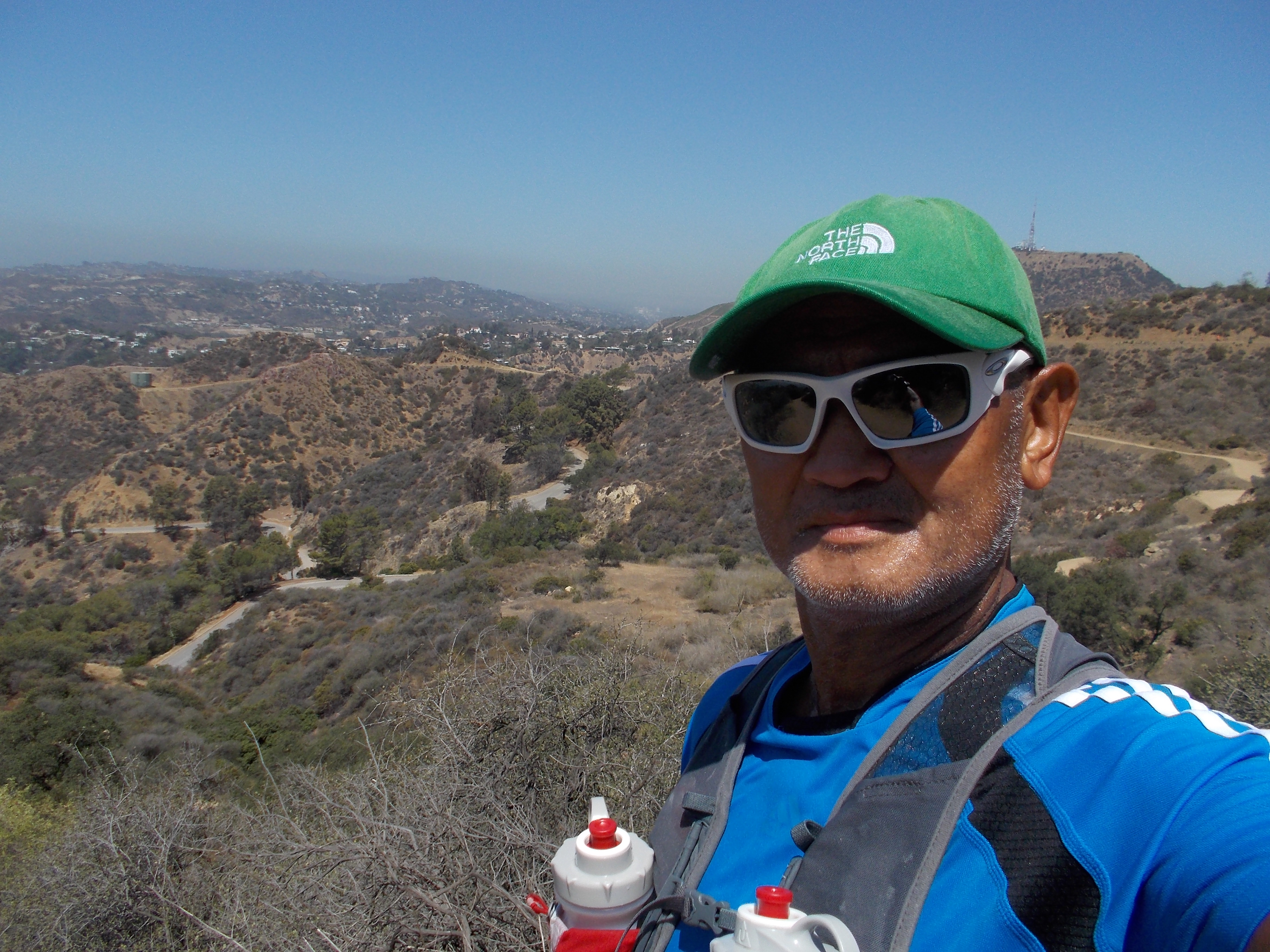
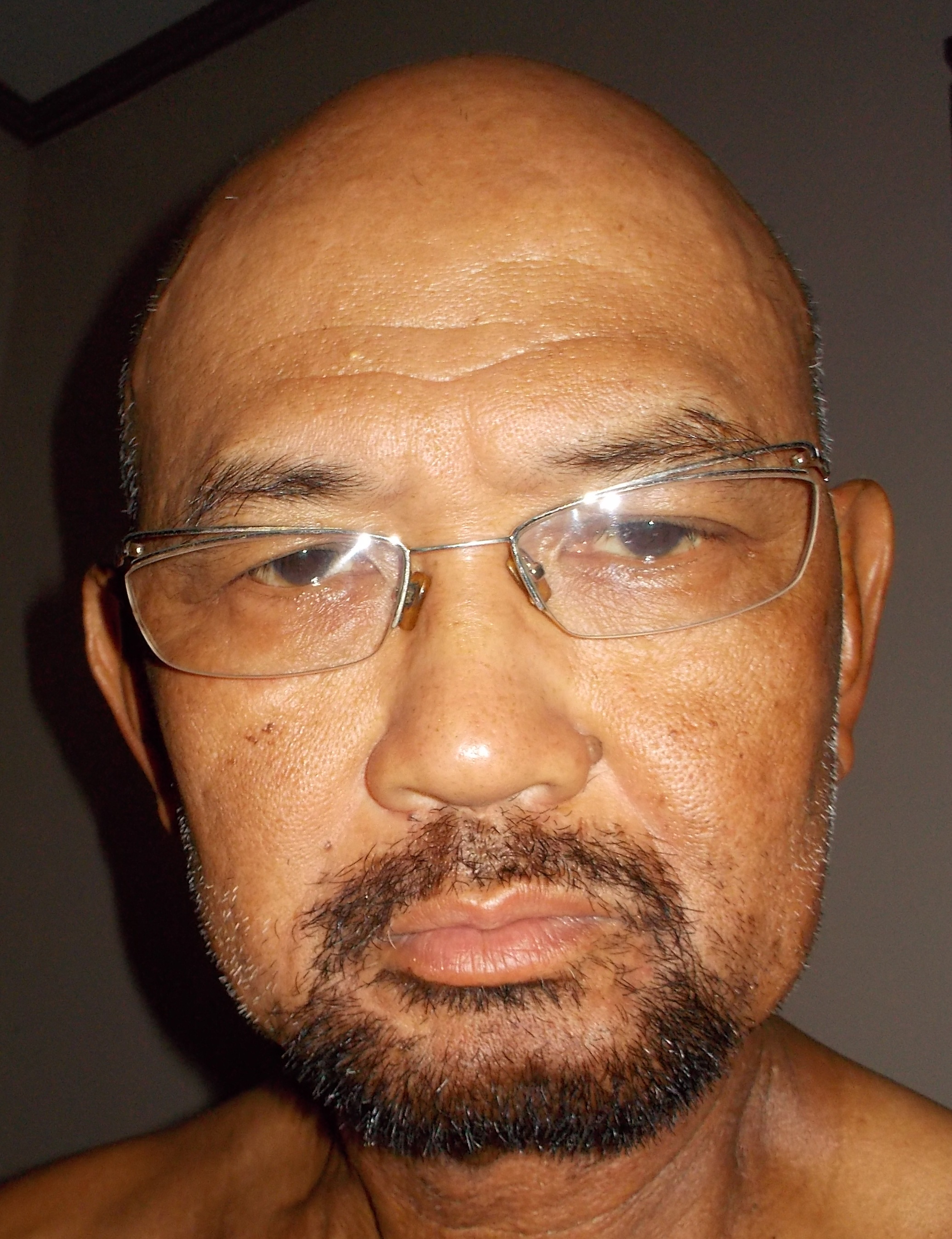
Remember My Face, Bitches!

Medical Check-Up


I had the chance to meet my orthopedic doctor when I requested a Medical Team and Ambulance for the conduct of the latest Tagaytay To Nasugbu 50K Ultra Run on the first week of December 2013, last month. I asked him to make an schedule of an appointment for medical check-up on my knees after my participation in the 3rd Taklang Damulag 100-Mile Endurance Run and after taking a break/leave from running during the Holiday Season. The doctor readily told me that I could see him either on the last day of the year (december 31) or on New Year’s Day.

Fast forward. After the TD 100 where I DNFd at Km 110, I have observed that there was swelling on the upper part of my right knee and felt some pain after I did a recovery hike and run for about two hours two days after the TD 100. It was a good reason to really force myself to go on a rest period on the following weeks & days before my appointment to my orthopedic doctor. So, from December 17 to December 31, I had only two “outings” on the trails which are mostly hiking in nature. But the swelling and pain were still there until before I finally met my doctor.

On the afternoon of December 31st, I went to my orthopedic doctor to have my knees for medical check-up. My meeting had also served as my maintenance check on the results of my bi-monthly rehabilitation on my injured knees on the early part of last year (2013). The doctor immediately made an ocular check on swelling part of my right knee and he recommended me to have my knees to be x-rayed.

I could say that one of the most important benefits of being a retired military officer and a Major General at that, is that I have lifetime free medical service from the Armed Forces of the Philippines. The Philippine Army’s Hospital & Medical Center has all the services and facilities that I need to support my passion in running. With a written slip/order from the doctor, I was brought to the Radiology Department and in 10-15 minutes, my X-Ray was done and the films were developed for the immediate analysis of my orthopedic doctor. Very fast and efficient as there was only ONE soldier-medical technician who did all the works.

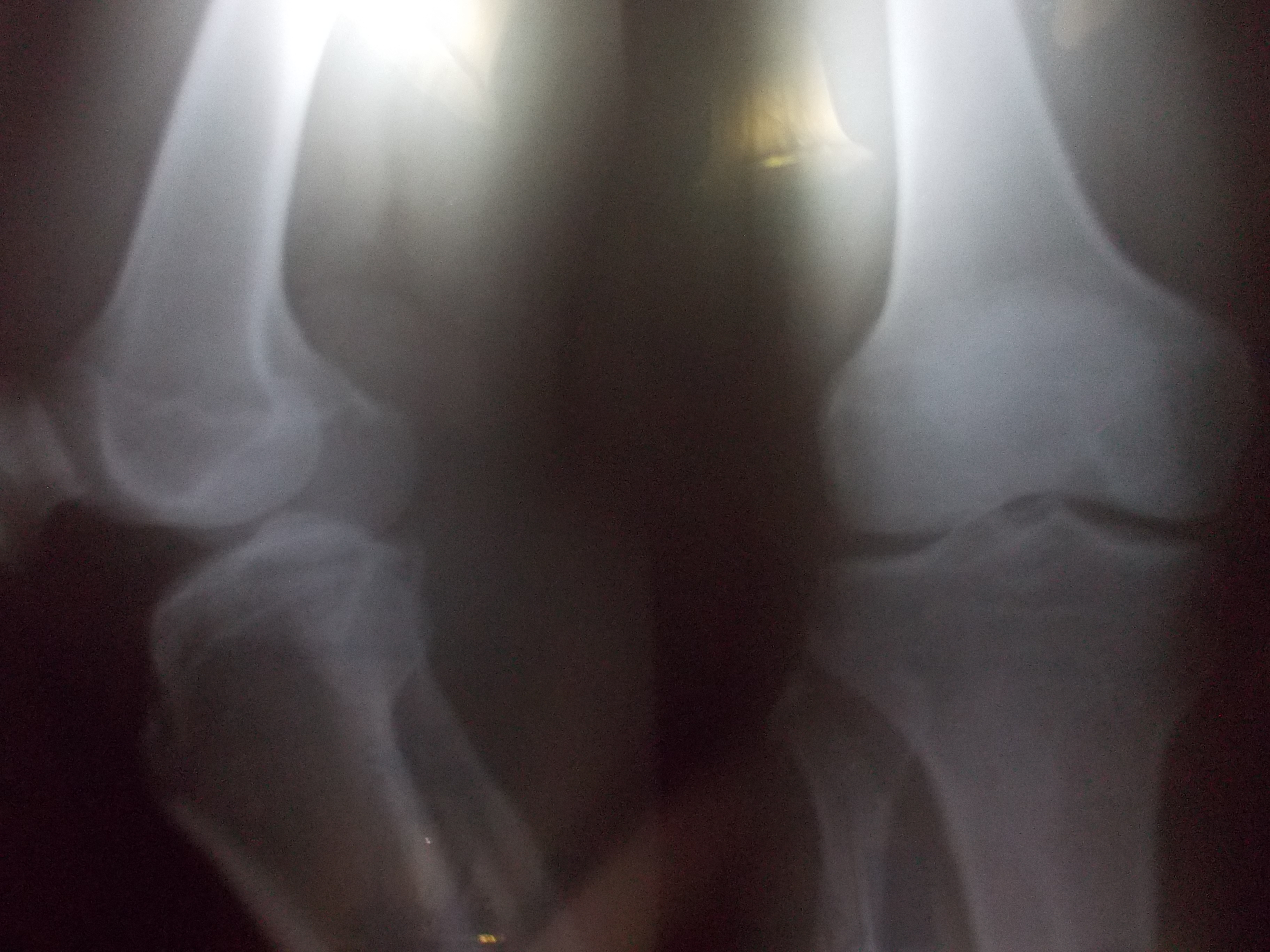
The doctor analyzed and read the films as he flashed the films on a lighted monitor. The following are the findings:

Left Knee: It is healthy, normal, and strong with minimal “spurs”.

Right Knee (Swelling One): There are “pointed spurs” which are causing the pain inside my knee and these “spurs” should be flattened immediately.

X-Ray Of My Right Knee

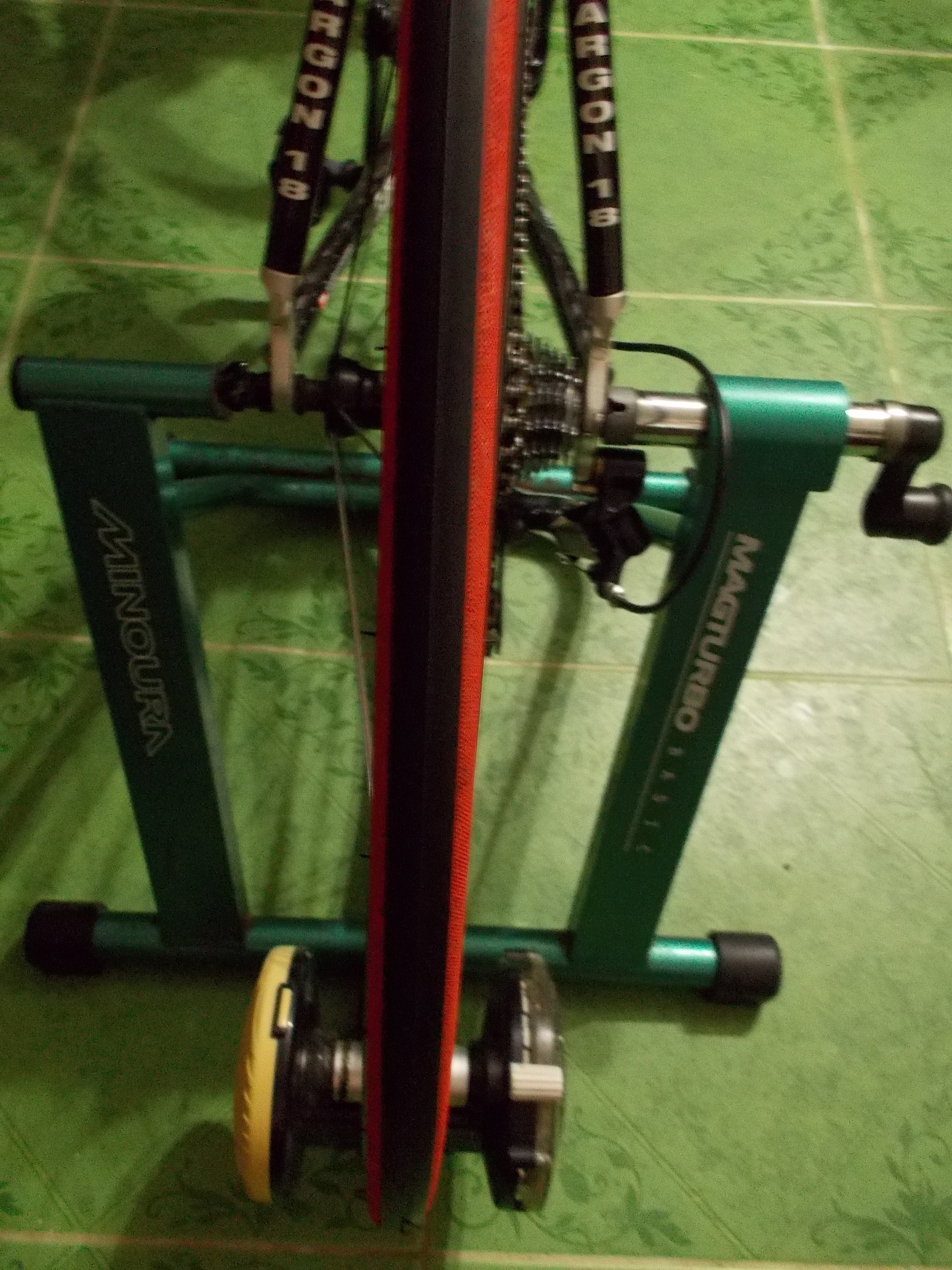
The doctor asked me if I have a stationary bike and I said, yes! He advised me to immediately include a stationary bike workout, at least, 30 minutes every day without any force or weight that would make my leg muscles exert any effort. He said that my legs should be made to move on a circular motion in order to maximize the full movement of my knees. It is due to my running, in quick and small strides, that the full motion of knees were restricted. He made a personal guarantee that the “pointed spurs” will be removed, if not, flattened, if I will do my stationary biking regularly.

On the night after I left the hospital, I was able to manage a 20-minute stationary cycling without any force but I have to cut short with my workout due to my butt being in pain as I am no longer used to using my bike.

Stationary Cycling Without Any Force/Weight

After 4 sessions of 30-minute stationary cycling, I was surprised that the swelling had greatly reduced and I could no longer feel any pain on my right knee.

The doctor’s advise is very good and my orthopedic doctor is the best doctor that I really admire! He deserves to have that wine which I gave him as a present for the Holiday Season.

This is a testimony that any runner, old or young, marathoner or ultra marathoner, needs to have a medical check-up to his/her knees and be able to expose themselves in cross training. As I am getting older and my the full range of motion of my body parts are being shortened and restricted, there is a need to do other forms of exercise which will serve as “cross training” to one’s main sports.

So, lace up, get out of the door and run!

2013 In Review


The WordPress.com stats helper monkeys prepared a 2013 annual report for this blog.

Here’s an excerpt:

The Louvre Museum has 8.5 million visitors per year. This blog was viewed about 270,000 times in 2013. If it were an exhibit at the Louvre Museum, it would take about 12 days for that many people to see it.

Click here to see the complete report.

The 15 Keys To Running A Great Sports Federation


I came through a news article/column on the PDI Sports Page stating that Go Teng Kok, simply called as “GTK” and President of the Philippine Amateur Track & Field Association (PATAFA), as “sick and could hardly walk”. And the rest of the article could be seen here: http://sports.inquirer.net/138017/nothings-final-on-patafa-polls.

Whether he (GTK) will step down from his position and later replaced with a new President of the PATAFA, it will be a big challenge on the part of the new leadership to start and realize a better “Vision and Direction” for a Better Performance among our Elite Track and Field Athletes.

For today’s 500-word post in this blog, I am re-blogging an article written and posted by a Coach/Blogger from Canada who is now a part of the Coaching Staff of the United Kingdom’s Sports Excellence/Elite Program. Stuart McMillan, the owner of the McMillan Speed Website, has posted/published the following article in his blog at www.mcmillanspeed.com last April 17, 2013. Whatever is worth in this article, it gives us a great insight, tips, suggestions, and advise on how to “run and manage” a Sports Federation.

These insights are not only true to our Sports Federation on Track and Field or Ultra Marathon but they are also applicable to any of our National Sports Federations/Associations (NSAs). If we want to improve in our Sports Excellence/Elite Program and ultimately, in our Overall Standing in IOC sanctioned Sports Games & International Meets in relation to our other countries, then it would be wise and smart to consider the following article as a reference.

Having made some suggestions to improve our National Sports Federation through this article, I will post a number of few candidates for the position of President of the PATAFA in my future blogs. I hope you will enjoy reading the following article.
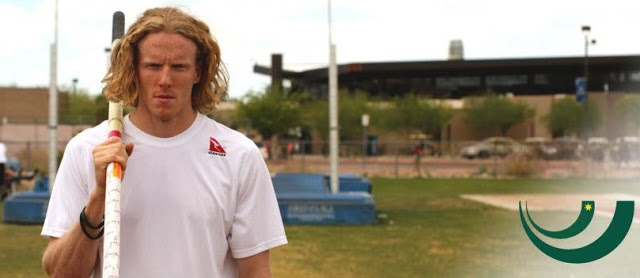
The 15 keys to running a great Sports Federation By Stuart McMillan

2008 Olympic Champion Steve Hooker at the World Athletics Center in Phoenix, AZ
Last week, I posted a question on Twitter that asked what the primary role of an National Governing Body (NGB) should be?  Is it to drive elite performance?  Is it to encourage grassroots participation?  Development of young athletes?
Through Twitter as well as a few email conversations, a few experienced colleagues came up with the following:
  • provide leadership for the sport through the development and implementation of a vision and strategic plan
  • provide the highest quality services on a timely, consistent and regular basis
  • ensure long-term stability with the continued development and progression of not only their athletes but their coaches and service providers as well.
  • exposure and promotion of participation, especially at the grassroots level
  • provide long-term financial security and viability
  • facilitate progression through access to competition, coaching and training support
Pretty good answers, I think.  But where does elite performance come in?  Very few of those whom I polled actually mentioned it at all!  Surprised me – as if you ask the same question of an athlete, I guarantee that performance will be at the top of the list.
So I did…
I asked a bunch of the folk that I am currently working with down here in Arizona…
…representing six countries’ NGBs, and pretty much all to a man voiced elite performance as the number one priority.    The disconnect occurs when asked if they are getting what they need from their NGBs, few are happy.  Most feel that elite performance has little to do with their NGB’s mandates.  My discussion with Donovan Bailey a couple of weeks ago highlighted his feelings on his former NGB – an opinion I know is shared by many!
“The biggest problem in Canada – and I see it all the time – is someone gets a job, and they spend all their time guarding against their job, and doing stupid things and making dumb decisions, because they’re guarding against their job.  Not for the good of the athletes, not for the sport, and not for the good of the country…”
– Donovan Bailey
So I was curious.  If elite performance is not actually the mandate of an NGB, then what is it?  To find out, I went to a few of these organization’s websites, where clearly their Mission Statements spell out their primary responsibilities as:
  • to drive up performance and raise standards
  • to create, nurture and support World and Olympic champions
  • to enable athletes to achieve sustained competitive excellence
  • to drive competitive excellence
  • to ensure world-level performance
  • to foster competitive achievement
Huh??
So what’s the deal?
NGBs’ mandates are clearly all about elite performance.
Athletes’ goals are clearly all about elite performance.
So why the constant friction between athlete and Federation?
I have fought on both sides of the ‘battle’ – as coach of athletes working external to the system, and within the system for the Federation having to deal with disgruntled athletes who feel they have been hard done by.
I have worked with athletes who have competed for over a dozen Federations.  And I have worked for half a dozen Federations myself – in 3 different countries.  And – as usual – I have some thoughts…
So today I present to you –
The top seven things an NGB can do to win back the respect of its athletes, and in the process perhaps help the athletes in achieving their goals, making it a happy and healthy future for all:
1. Understand the meaning of the word ‘performance’
If you are about performance, then you must understand what performance is about.  If it is your primary mandate, then it’s pretty essential you know what it means.  To aid in building an effective performance pathway, hire a sport science statistician to identify trends, and to do an on-going critical analysis of performance.  Understand what performance means not just in words and mission, but in terms of numbers.  To run a profitable company, you need to have a good accountant – to run a successful sport Federation, you need to understand the numbers and statistics of performance.
“In business, words are words; explanations are explanations, promises are promises, but only performance is reality”.
– Harold Geneen
2. Say what you do and do what you say
The basics. Communicate your vision consistently to your members, athletes, coaches, and support staff.  Clarity and consistency is key.
3. Identify key influential athletes – listen to their concerns
Do not direct your attention to the athletes who complain the most.  All this will do is ensure that the rest of the athletes complain more often, in a constant battle for your attention. Involve your athletes in decision-making processes.  Ask.  Discuss.  Don’t demand. Respect their voices.  Their opinions.  Involving the athletes in the decision-making process promotes ‘ownership’.  Bringing them into the fold makes them feel respected.  Needed.
4. Recognise that all athletes are differentThey all have different needs.  Though you cannot please them all, you need to understand that there is no ‘one size fits all’  in elite performance.  They all require different strategies.  In partnership with them, you must be creative in forming these. Often, your best athletes will decide to work ‘external’ to the Federation.  Often preferring their own ‘support teams’, they choose to seek greater control over their own careers.  This is not a bad thing.  Support them through this process, and be inclusive of their teams.  There is still much you can do for them, and much they expect from you.  Be creative.
5. Be an elitist
It is not wrong to be an elitist.  You operate in elite sport.  Don’t hide from this.  And don’t apologize for it.  You want elite performance?  Then cater to your elite athletes.  Not all athletes have equal rights to their opinions.    And not all athletes deserve to be given elite treatment.  It seems that many of you feel that being ‘elite’ gives one an unfair advantage – that all skills, and all opinions are created equal.  They are not.  Being an elite athlete requires tremendous amounts of dedication, discipline, desire, skill, and effort.  Less dedicated and less talented athletes will cry elitism.  They will say its unfair.  Don’t listen to them.  You wouldn’t want a resident med student operating on your mother’s heart.  You don’t want a lazy, untalented, and undisciplined athlete representing your Federation.
6. You can’t please everyone.  Don’t try to
7. It’s not about you
No one goes to the game to watch the referee.  And no one has ever gone to the Olympics to watch the CEO.  Or the Performance Director.  Or the coach.  Or the Chief Medical Officer.  As former athletes yourselves, I know that this instinct is difficult to suppress.  The ex-athlete narcissist in you still expects a crowd to show up and watch you do your job.  This is no longer your reality.  It is their time, it is your job to do all you can to support their dreams right now. They will be forever grateful if you can help deliver this for them.
…and just in case you thought I was totally anti-Federation:
The top seven things athletes can do to help their Federations to fulfill their goals:
1. Get over yourself
Have you ever heard that winning is a habit?  Well, so is losing.  We all know those athletes who circle the drain in perpetual anxiety and stress – consumed by narcissism and self-preoccupation.  Don’t be that athlete.  Focus on winning habits.   Beconsistent in your character.  Your commitment. Your discipline.
“Some things you have to do every day. Eating seven apples on Saturday night instead of one a day just isn’t going to get the job done.” 
-Jim Rohn
2. Your Federation shares the same goal you have
Believe it or not, they do not want you to fail.  In fact, there is a pretty good chance that they want you to succeed.  And will take almost as much pleasure in your success as you do.
3. Help them change
Often, the leaders of NGBs are former athletes.  Comfortable with what they did when they were competing, they can become complacent – relying on ‘what worked for them’.  But the world changes.  The sports world changes with it.  Systems change.  Technique changes.  Nobody is super-comfortable with change.  Especially when things have worked out well in the past, as is often the way with the leaders of your Federation.    Your Federation does recognize this, but they are driving a very large boat…it takes a while to turn course.  So be patient.  And in the meantime, help your Federation be creative in alternative strategies.
4. Be independent
Do not rely on your Federation.  Over-reliance on anyone takes the control out of your hands.  Do not expect everything from your Federation.  Take responsibility for your own career.  Use the expertise of your Federation as a guide, but do not rely on it.  Use your own experience.  Your own thoughts to determine the exact path you travel.   Do not blame your Federation if things don’t go your way.  It is your life.  It is your career.  Own it.
5. Support your Federation commercially
Your Federation relies on sponsors. Help them. Tweet about them, and thank them whenever possible in public.  It takes very little  time and effort for you to do this, and it goes a long way.  Often times it’s not money that goes into YOUR pockets, but the programs and jobs that sponsor’s money goes to support ensure you have more of what you need.
6. Respect EVERYONE
You know that person in your Federation office you are certain doesn’t do anything and should be canned?  Yeh?  Well, he does do something. They all do something.  They do all the things you don’t know need to happen in order to run a Federation.
7. Remember that a majority of the people involved in your sport do so for exactly zero money
Almost all are volunteers.  Your Board of Directors are volunteers.  They sit on your Board because they care about your sport.  They are almost exclusively well-meaning and successful in their own fields.  They often do not know a lot about the elite performance end of your sport – so teach them.  Educate them.  They would enjoy nothing more than to share a meal with you as you shared stories about life in sport.  They may even pay for the dinner!
And my final advice?  To both athletes and to Federations?
8. Suck it up.  You both want the same thing.  Just figure it out and get along.
*thanks to Matt Jordan, Steve Mesler, and my respondents on Twitter for their input*Canadian strength coach Ian Warner, Sr just made a good point to me – the seven things athletes can do?  We can apply these as coaches working outside of a Federation also (or inside for that matter).  Oftentimes, external coaches can serve to enable their athletes in this ‘fight’ against their Federations.  Don’t be that coach.
Be inclusive. Find ways to work together.
If you enjoyed this post, please
share it on Facebook or Twitter…thanks
Sixth


I reached my sixth year of blogging last October 25, 2013 and I am becoming more lazy to write something about my training, running thoughts, and my running races. It could be that I was too busy and focused with my training and/or conducting my ultra races as the Race Director or had been out of the Metro Manila area for the much-needed and more reliable Internet connection.

On the other hand, Facebook could also be the main culprit as I had more time making my daily status or reading other friends’ experiences on their running adventures and training. I am going back again to my bad habit of using my Facebook Wall and FB Group Pages as my mini-blog, thereby, forgetting my principal responsibility to update my blog. This is the very reason why I was not been able to be productive in writing and posting my stories in this blog. The past year, my sixth year, could be my lowest productive year in this blog and I could see it in my blog summaries that it was my “worst” in terms of the number of posts and the number of “hits”. However, I am still happy and satisfied that my followers are still increasing in number.

Accidentally, I was able to browse something in the Internet that motivated me to write again. I was able to see, at a glance, on a website that says or advocates writing “something” at least 500 words every day, without any edits, and by just simply writing anything and posting it in the Internet. So, here I am trying to remember and recall the things that I have to post for the past months of last year and try my best to write and post a 500-word story/essay on running every day.

My blog has now transformed into an ultra marathon site as I don’t write about much on marathon and lesser distance races except for trail running. The focus and concentration of my posts had been on the ultra marathon races that I have organized and directed from the yearly Bataan Death March Races (BDM 102 & BDM 160) and the PAU Ultra Races in the different parts of the country. Clearly, my blog had become a source of information of those runners who are runner-participants in my ultra races, to include registration procedures, rules and regulations of races, and their official results.

I also had the chance to bring two elite ultra runners to the Vibram Hongkong 100K Trail Ultra on the early part of 2013, with the help and support of Andre Blumberg of Hongkong, and they performed well that they are both qualified for the lottery for the prestigious 2014 Western States 100-Mile Endurance Run. But no matter how good my intention and plans for these two local elite ultra runners, there are still people who try to bring you down and derail your plans. It brought myself into reality that no matter how talented and good our runners are, they have also their weaknesses in terms of their behavior and attitude when they are no longer on the road/trail running in a race.

As I go on with my seventh year as a blogger, this blog will go on and on until my race stops. And that race is called LIFE.

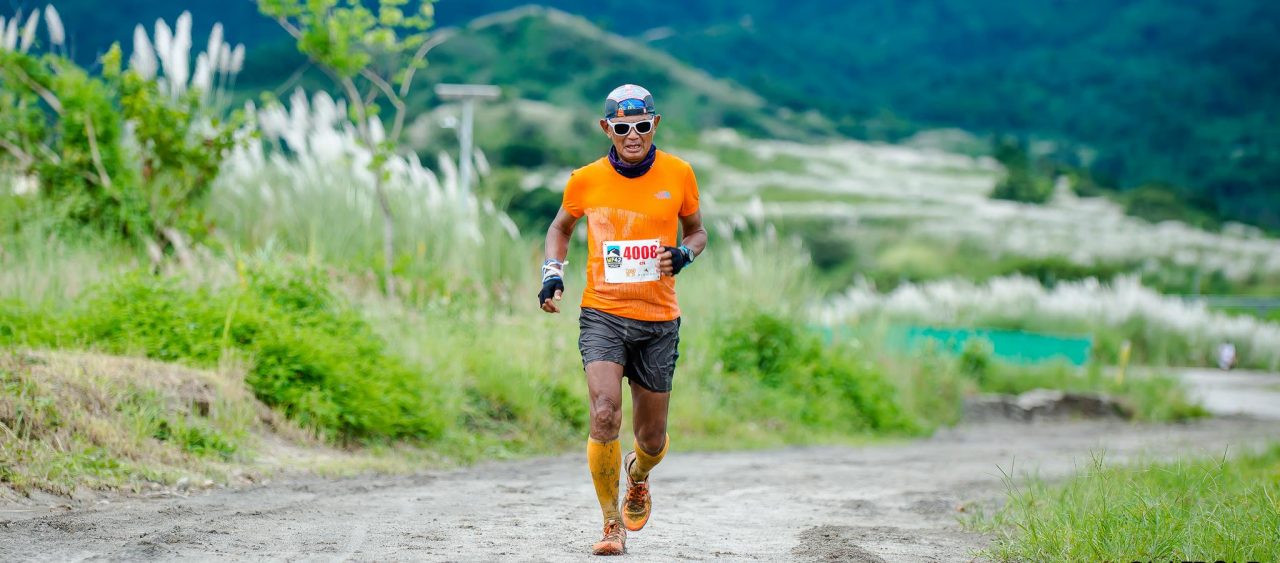
Going Strong To My Seventh Year Of Blogging