Runners’ Alibis


Hereunder are the famous lines or reasons every runner/marathoner says when he/she does not attain his/her goal or DNF in a marathon race:

1. I did not train hard. I ran lesser mileage in practice this time.

2. I had an injury. I was in pain.

3. I should have used my other running shoes.

4. The marathon organizer “sucks”.

5. I did not have time to practice.

6. I had stomach cramps…I have cramps on my legs

7. I did not have much “speed runs” and “fartleks”.

8. I did not have my “second wind”. My “second wind” came very late.

9. I was wearing the wrong runners outfit. My singlet keeps on rubbing my arms. My shorts keeps on rubbing my groin area.

10. I was not able to have my “carbo-loading” yesterday.

11. I was not able to have my bowel movement before the race.

12. I started with a faster pace on the first half of the marathon. I should have started slowly and then picked-up my pace on the second half.

13. The weather is hot. The race should had started earlier than what was scheduled.

14. The air is polluted. I could hardly breath. 

15. The race organizers lacked in the number of water points along the route.

16. I was not able to sleep soundly last night.

17. I joined the race not to compete, but to finish it.

18. I forgot to cut my toe nails before the race. My small toe nails are touching the edge of my shoes’ uppersole and it’s sore!

19. I just recovered from colds/flu/coughing last week/few days before the race.

20. I can’t control myself, I had sex with my wife/girlfriend or husband/boyfriend last night/two nights ago!

21. I should have my body massage two days before the race.

22. My biorythym is low this week.

23. I guess, I overtrained and was able to pass through my peak period.

24. It’s okey..this is just a preparation and part of the training for the next race. I will have a better PR time next time.

25. I need to have more strengthening workouts at the gym.

26. I should drank more energy drinks along the way.

27. My running shoes is heavy. I have to buy a lighter shoes immediately.

28. I used the wrong socks for today’s race. I got blisters on my foot.

29. I should have trained more days in altitude training or in Baguio City.

30. I forgot to use my Ipod! I was listening to a “wrong” list of songs/music.

31. I reached the “wall” too early. I reached the “wall” at mile/km #____and I started to walk.

32. The marshalls could hardly control the traffic at the intersections. I slowed down in every intersection.

33. The food at the “carbo-loading” activity was “garbage”!

34. I forgot to start my stop watch at the starting line. I did not know my exact pace every kilometer.

35. I am still heavy. I need to reduce some more pounds from my weight.

36. I should had warmed-up properly.

37. I need more stretching exercises before the race.

Waldemar Cierpinski & My Second Marathon Race


The first world’s elite marathoner that I’ve seen in person was Waldemar Cierpinski of East Germany and I consider him as my No. 1 Olympic Champion for the Marathon up to this time.


In Montreal Olympics in 1976, he defeated Frank Shorter, the defending Gold Medalist in the Tokyo Olympics Marathon in 1972, in the last three miles of the race with a time of 2:09:55. In the Moscow Olympics in 1980, he won again after outsprinting Europe’s Marathon Champion Gerard Niboer of Netherlands in the last few miles of the race with a lead of 17 seconds. He finished the Moscow Olympics Marathon Race in 2:11:03. He duplicated the feat and record of the legendary Abebe Bikila of Ethopia for winning two consecutive Olympic Marathons. Up to this time, the record wins of these two elite marathoners are not yet erased.


Cierpinski joined the 1982 Manila International Marathon which to my experience and opinion was the “golden age” of marathon running in the country. I really don’t know how much money did the organizers or the government at that time paid for the “fees” for his attendance to the race. But looking at him at the starting line was already a strong motivation for me to run more marathons in the future. At that time, he was 32 years old as he was two years older than me. He is tall with long, lean, muscled legs with thinning hair and smiling face.


After the 1982 Manila International Marathon, I never heard of any Olympic Marathon Champion or World Marathon Champion or any Marathon Champion in any Key Cities of the World’s Marathon Race to have graced or joined/finished our Marathon Race in the country.


On February 1, 1982, I could still vividly recall the smiling face of Cierpinski when I met him alone leading the race along the Guadalupe area in EDSA, to be exact, infront of the Jollibee (now) as he goes back to Ayala Avenue then to the finish line at the Quirino Grandstand. I was then going down towards the Guadalupe Bridge,  towards the turnaround point at Ortigas-EDSA Crossing (at Robinson’s Galleria). That was how fast Cierpinski was and how far he was ahead of me! He was running then as if the race was a 400-meter dash when I saw him at that moment. His knees were kicking high infront of him and his feet/heels were almost touching his buttocks! This guy was not a “shuffler”, but a sprinter in a marathon race! Waldemar Cierpinski, the favorite to win, won easily and finished the race in 2 hours 14 minutes 27 seconds. (I did not remember the prize he received.)


In his preparation for the 1984 Los Angeles Olympics, he had participated in marathon races in Japan and in the European Marathon Races with impressive times. If not for the East Germany boycott in the Los Angeles Olympics, Cierpinski could had a chance to win for his third gold in the Olympic Marathon.


The training strategy of this elite runner is long distance but fast runs. In his training practices, his running pace in his longer but faster runs was 3:20 to 3:40 mins per kilometer with a maximum total distance up to 40 kilometers. His long slow distance runs averaged a running pace of 4:00 mins per kilometer. Well, there had been controversies and complaints against him on “blood doping” but nothing had been proven. His past accomplishments were due to hard work and focused training, pushing himself to the edge of his body’s capabilities.


By the way, I finished my second Manila International Marathon in, a slower time than my first one, 3 hours 28 minutes 49 seconds.


Waldemar Cierpinski is still my “No. 1 Hero” in the Marathon Olympics.


Running Generals


“Running Generals” are rare breed of disciplined, consistent, patient, focused and passionate officers of the Armed Forces of the Philippines and the Philippine National Police who take running seriously and part of their daily scheduled regimen. These Generals should not be misconstrued as Generals “running” away from the enemy or “running” away from the battlefield and take the comfort of their “air-con” offices in the General Headquarters or in Metro Manila. These are the real “marathoners”. Most of them finished marathon races in the past and some of them are still adding more marathon races to their personal records even if they are already retired from the service.

I would like to pay tribute to some of the officers of the Armed Forces of the Philippines who later became Star Rank Officers or Generals who had finished marathon races in the past and in the present. Most of them became my models/idols but always my running competitors in road races in the past and some running events during alumni homecomings of the Philippine Military Academy.

Brig Gen Max Bejar, retired, as the Dean of Corps of Professors and Assistant Superintendent of Philippine Military Academy from 1986-1989. In my recollections, he was the first active General who run two consecutive marathons, 1987 & 1988 Pilipinas International Marathon. He was then a Brigadier General when he ran these two marathons. He is tall and stocky guy and finished his first marathon in 5 hours +. He migrated to the United States after his retirement from the service and he is still actively connected with the corporate world.

Admiral Jorge Necesito of the Philippine Navy, retired, as the The Naval Inspector General. He was the former Chairman of the DND-AFP Gintong Pangarap for Marathon for two years until I replaced him as the Chairman almost two years ago. He is one of the few Naval Officers who started running the marathons in the early ’80s.

Brig Gen Antonio Romero of the Philippine Army, retired, as the Assistant Division Commander of the 7th Infantry Division, Philippine Army based in Fort Magsaysay, Palayan City. He finished marathons in the ’80s and a consistent member of the DND-AFP Team for the annual participation to the International Corporate International Run Competition held in Palo Alto, California in the ’80s.

Brig Gen Samuel Narcise of the Philippine Army, still active in the service, presently The Inspector General of the Philippine Army. He finished a number of marathons in the ’80s and early ’90s together with me. He later shifted to badminton and he is now considered as one of the top active Generals in the sports of Badminton.

Chief Superintendent Samuel Tucay of the Philippine National Police, still active in the service, and presently the Director of the PNP Training Command. He is an active marathoner and acts as a Chairman of one of the Federations of Running Organizations in Metro Manila. 

Lt Gen Alan  Cabalquinto of the Philippine Army, recently retired from the service, and retired as the Commander of the National Capital Region (NCR) Command in May 2006. He was my running colleague/partner in the 2005 Pasig River Heritage Marathon and some of the PAL International Races in the ’90s. We both idolize Dr George Sheehan and exchange notes on running tips, training, and running fashion.

Commodore Vic Agdamag of the Philippine Navy, still active in the service, and presently the Commander of the Philippine Naval Command-North. He finished marathon races in the ’90s and a single-handicapper in golf up to the present.

General Benjamin Defensor, Jr. of the Philipine Air Force, retired, as Four-Star General and former Chief of Staff of the Armed Forces of the Philippines. He finished marathon races in the ’80s and presently holds an Ambassador position for Global & International Counter-Terrorism under the United Nations Organization.

Among these running Generals, only Brigadier General Max Bejar and Lt Gen Alan Cabalquinto were able to run and finish marathon races while they were actively holding the ranks as Generals. Their feat and passion in running marathons were not highlighted by the AFP and the media then but this simple posting on my blogsite will surely put them as part of the history of marathon running among the senior officers of the Armed Forces of the Philippines and the Philippine National Police.

More Pictures Today


dsc03599.jpg

The last 500-meter uphill part of the course!

dsc03601.jpg

The finish line…

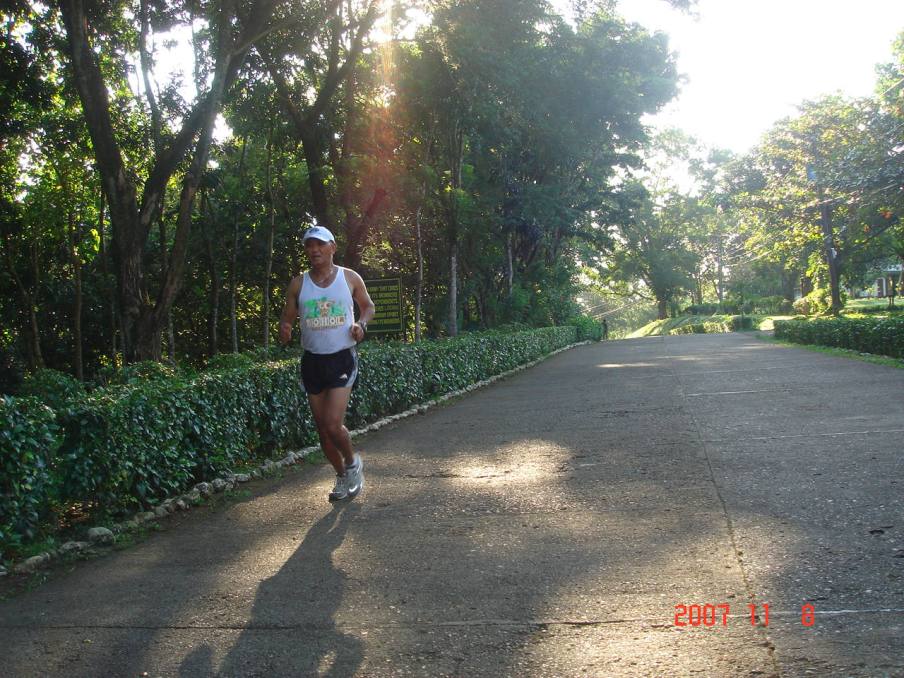
My Pictures Today (08 Nov ’07)


dsc03597.jpg

I started my running at 5:30 AM from my quarters, going outside the camp towards the Poblacion of Jamindan, Capiz. This picture was taken inside the camp on my way back to my quarters. The distance from my quarters to the Brgy Aranda Crossing is 7 1/2 kilometers and I ran it in 40:30 mins. I was running at a pace of 5:24 minutes per kilometer.

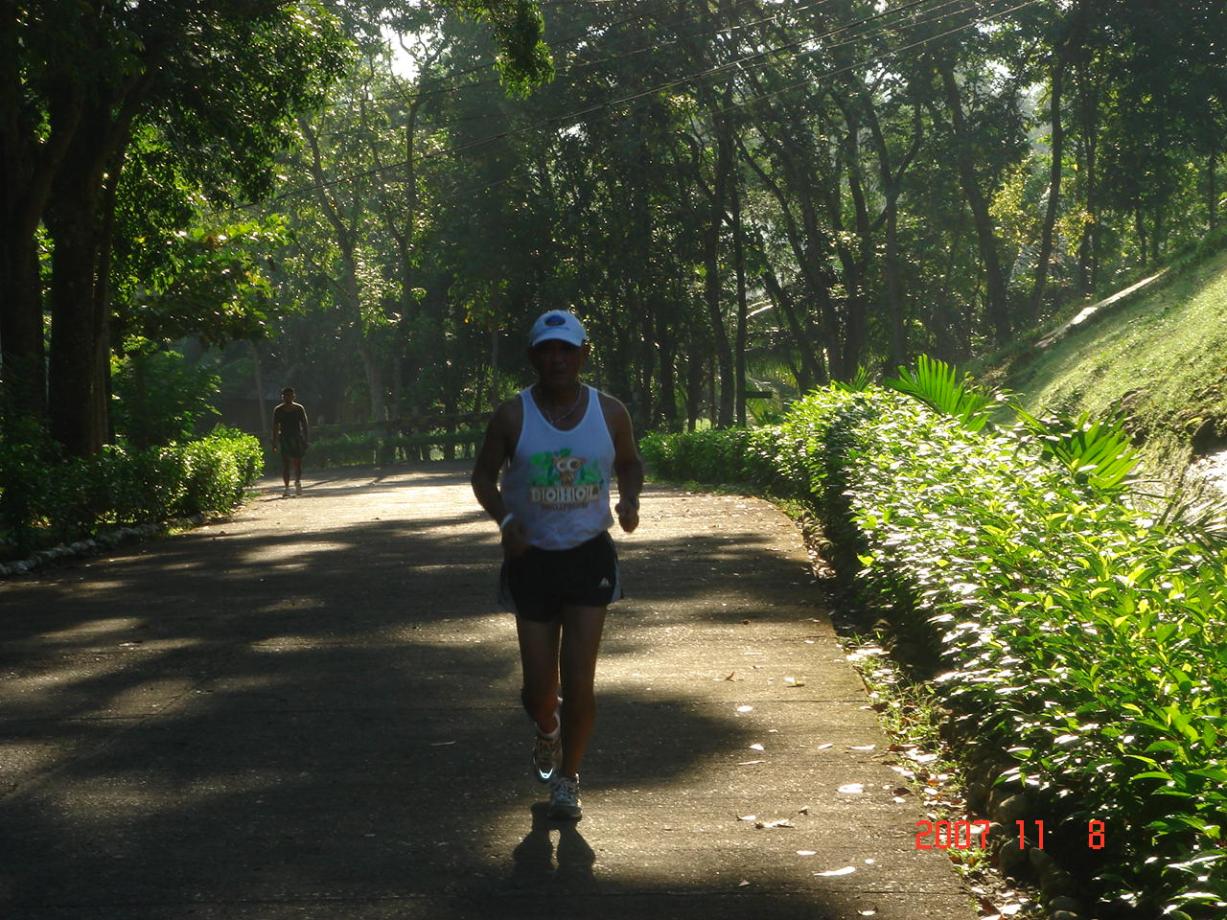
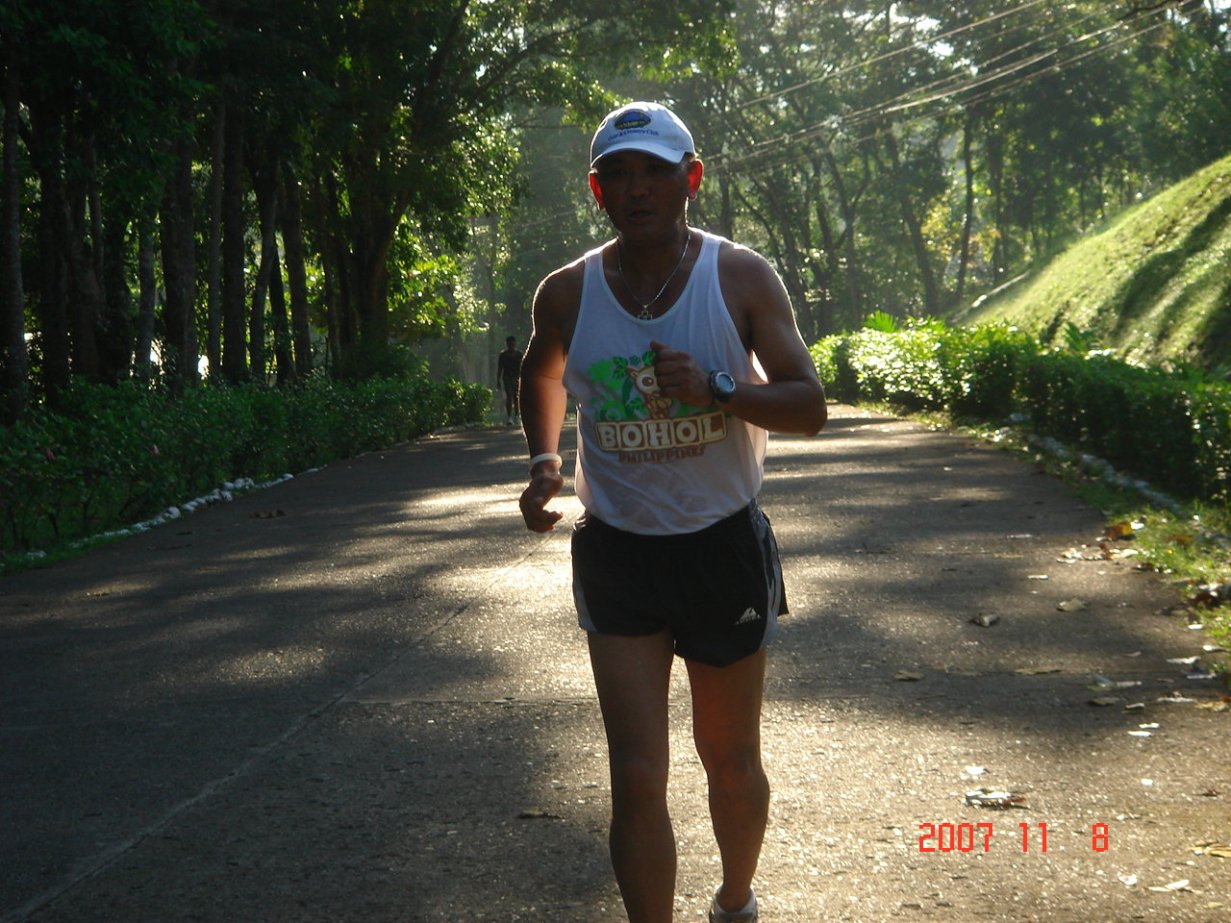
dsc03598.jpg

I am using my brand new Accel Running Shorts, new cotton singlet/sando from Islands Souvenir which I bought at their store in Bohol Chocolate Hills, my reliable Casio “Sea Pathfinder” Titanium Watch, M716 New Balance Running Shoes, “ONE” Wristband, and my old Fort Ilocandia Golf Club Cap. The Accel Shorts costs me P 350+ and my sando costs me P 250+, cheaper and more comfortable than the Nike Running Apparels.

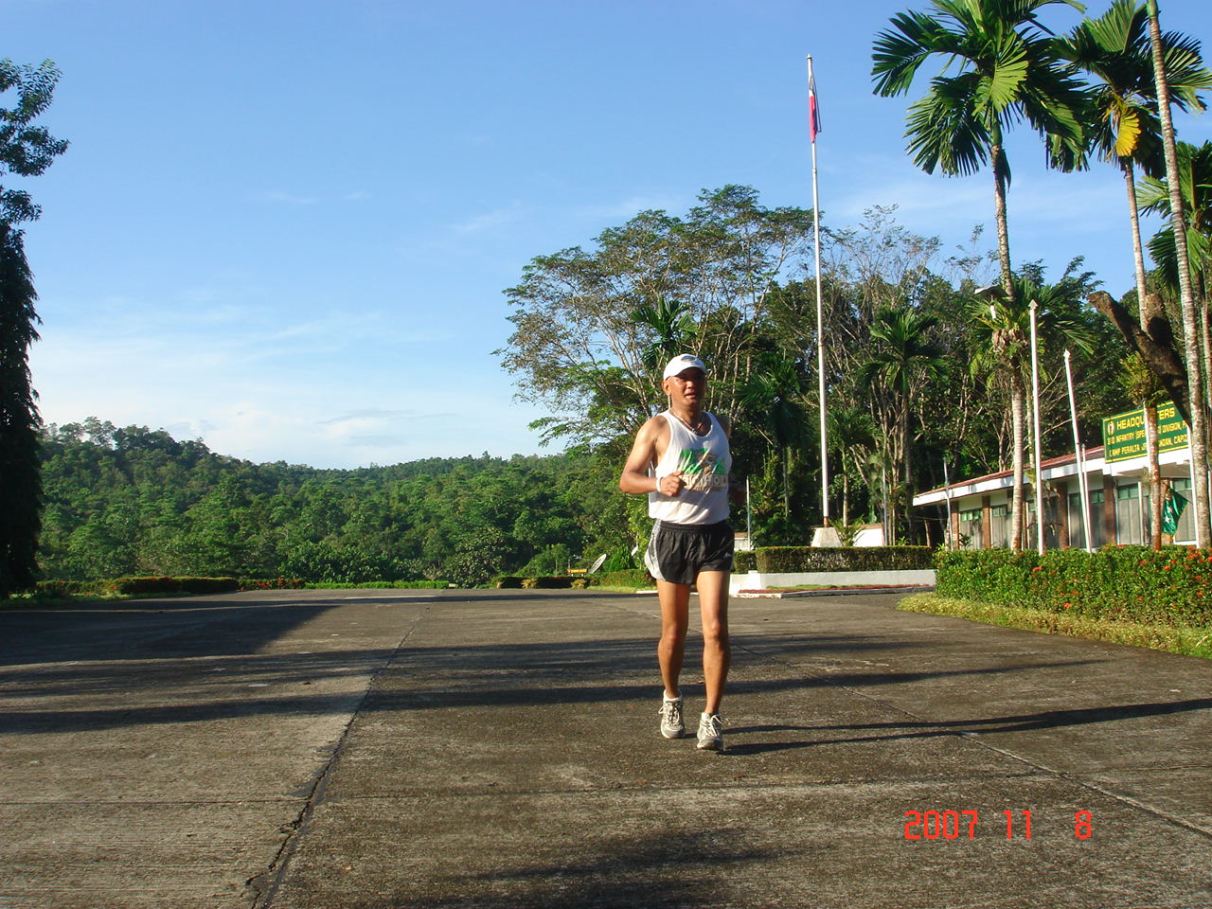
dsc03601.jpg

I finished my morning run infront of my office/Headquarters. From the turnaround point at Brgy Aranda Crossing to this place, I finished in 41:20 mins. The last 1/2 kilometer was a killer due to the steep grade going up the camp. Overall, I ran a total of 15 kilometers for a time of 1:21:50. My average pace was 5:27.3 per kilometer. I did not stop or walk along the way but I had to drink some bottled water while running–when I reached the turnaround point at Brgy Aranda Crossing and at the 2-km marker before reaching the camp.

2005 Pasig River Heritage Marathon: An Experience


Prior to this marathon event, the last marathon race that I finished was the 1997 PAL Manila International Marathon. But in-between these races, I have been joining 10 to 20 K Road Races in Metro Manila.

A collegue of mine who is also a passionate runner and two years older than me, invited and urged me to join the 2005 Pasig River Heritage Marathon seven months before the D-Day (27 February 2005). Because we had been together joining marathons in previous years, I accepted the invitation even if I had a very delicate and sensitive job with hectic schedules to follow. I have to squeeze in at least one hour every day for my running practices in Metro Manila.

My practice runs and schedules were not consistent and I was not making a log/journal of my daily runs. My weekend long runs were limited up to a maximum of 25 kilometers. Basically, I did not follow strictly my past training strategy of building-up strength and resistance by running more distances and logging more miles. I did not had any speed plays/runs. I did not had the chance to run for higher altitude training in Baguio City as my practice runs were limited in Fort Bonifacio, The Fort/Global City area, Camp Aguinaldo and the Libingan ng mga Bayani Grounds.

I had to strengthen my legs and upper body muscles through daily weight training at the Gym by using free weights, Nautilus/Life Fitness Machines, and Yoga sessions. Although I did not had any Personal Trainer, I concentrated my workouts to my buttocks, legs, arms and stomach muscles. I did not use heavy weights as I did not want bulky muscles but I needed my muscles to be toned and stronger. I used lighter weights but with more sets and repetitions. Yoga sessions made me more relaxed and my muscles stretched every after gym workouts.

I know in my mind that I was not after a PR best time for a marathon at this time when I am already old and reaching the age of 53 years old, and after a long lull and absence of serious training and marathon race for the past eight years. I know then that I was courting disaster or encouraging self-inflicted pains to my body after running this marathon. Well, I just simply put in my mind that my goal to run this marathon event is to be able to finish in less than five hours and be able to recover fast without any injuries or encounter any “bad signs/problems” to my body. I just wanted to survive finishing the race with no injuries.

The following are the insights, observations, comments, experiences and recommendations during the said marathon event:

1) The registration fee was P 500.00 and it covered a “carbo-loading” event a day before the race, a Finisher’s T-shirt, and a Certificate of Finishing the Marathon. The “carbo-loading” was done at “The Tent” at The Fort which was scheduled at 5 PM the day before the race day. The “carbo-loading” was not organized and the food was so bad and disgusting that each registered runner was given a small amount of spaghetti in small styrofoam packs. The pasta/spaghetti was not well-cooked. I ended not eating the food as this was my first frustration in the said event. Instead, I went to the nearby Jollibee and ate two (2) orders of Spaghetti w/ Yum Burger Meal.

2) Before the start of the race, a prayer for the runners was led by an “activist-running priest” who was very popular in criticizing the programs and policies/pronouncements of the government and the present administration. I could not see any reason why the organizers would invite this priest to an event which is being fully endorsed and supported by the government through a Presidential Proclamation which was duly signed by the President of the country.

3) The start of the race was delayed by almost 15 minutes. It was scheduled to start at 5:00 AM.

4) The streets/route on the first three kilometers were very dark and could hardly see where your feet were landing on the ground. Some of the street portions near Intramuros were wet and the smell of the surroundings was so bad. I had to run slowly while passing through these places to avoid the slippery ground.

5) Our group and some runners ran an extra two kilometers as we were going to the wrong direction towards the Manila Hotel because we got lost along the way. This was due to the late arrival of road marshalls and no directional signs were seen within the first five kilometers of the course. This really made me angry along the way and it took so much spent energy from me, psychologically and physically. I was cursing the organizers while I was running.

6) Water stations were lacking along the route. I anticipated this problem by bringing some of my staffs to provide me with a handy water jug/s. These jugs are like the ones used by cyclists. They “leap-frogged” from one place to another along the route. There was also this runner who was asking some water from my personal water jug every kilometer that we ran. It really annoyed me while I was at the Makati area.

7) I have observed that most of the “first time” marathoners/runners were wearing belts with small pockets holding small plastic cannisters. Well, I assumed that they were carrying water or energy drinks on their waists. Later, I found out in a Nike Store that this belt is called “Hydration Belt”. I was smiling and wondering why these runners are carrying extra weight on their bodies while most of the experienced runners are trying to be light as possible by buying the lightest running shoes and the lightest running apparel/shorts & singlets..and running socks! These “hydration belts & camelbaks” are highly recommended for long distance practice runs. The weight of the water strengthens the leg muscles and provides immediate replenishment of water loss from the body during practice.

8) I started to have “muscle cramps” on my calves on both legs when I reached the 25 Km marker. I had to walk and jog, alternately from the Guadalupe Bridge going up to EDSA up to Crossing Shaw Boulevard. I reached my “wall” at the 30 Km marker and it was a fight between finishing the race against DNF which I could not accept. From the Bridge along C5 (at the intersection of Shaw & C5) up to the Finish Line at The Fort was the “longest” five kilometers of my life. It took me more than one hour to walk & jog & stretch my leg muscles to finish the last five kilometers of the course. The C5 stretch was the hardest as the heat of the sun was so hot to the skin and body and it was 9:00 AM already. I was glad that I had some members of my staff who provided me with the much needed water to drink and cold shower for my body along this last few kilometers of the course. My dark skin was burned because of the heat of the sun. I should had used and applied a Sun Block before the race.

9) I had to pray, chant, maintain my breathing rythym, think positively that I could finish the marathon, curse the organizers, curse myself for not training so hard and prepared properly as I had done when I was younger, I remember missing my altitude training in Baguio City, thinking of trying to pick up some runners ahead of me whom I could plan as targets to overtake, sometimes think why am I running the marathon…what’s the point?, why am I punishing myself.

10)  I could not remember if I was given a Finisher’s Medal after crossing the finish line. I finished and survived the race in 5 hours & 10 mins +. I was short of getting my goal of running the event in less than five hours but I was able to finish the race and to recover so fast that I could have my practice runs again after two days of rest. I had no injuries and body pains after the race. My collegue finished the race thirty minutes ahead of me.

11) This was my first experience to run and finish the Pasig River Heritage Marathon and because of the bad experiences and observations, I promised myself not to run the next edition of the race. So, for the 2007 Edition, instead of running the marathon, I ran the 10K race just to observe and see the top finishers of the Marathon.

12) I recommend that a professional and prestigious race event organizer should manage and administer the Marathon.

I just hope that for next year’s edition of the Pasig River Heritage Marathon, the overall conduct of the race will improve for the best.
“Shuffle, Don’t Bounce”


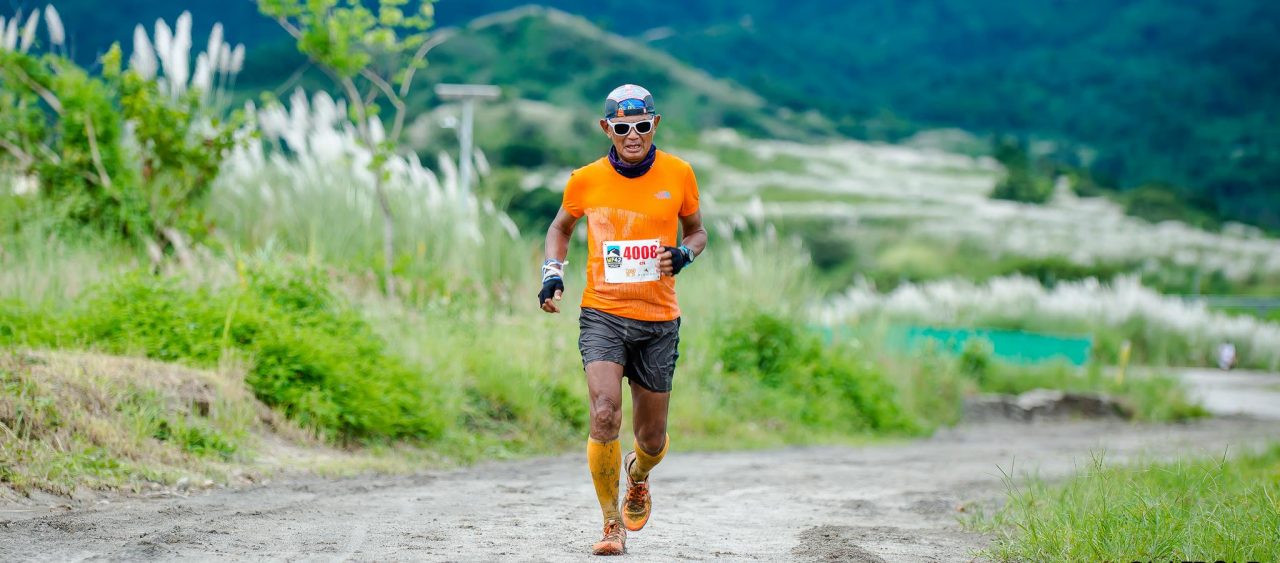
When I joined the 1st City of Angels Half-Marathon Race in Los Angeles last December 4, 2006 with my daughter, I observed that she was “bouncing” during the run. “Bouncing” means that you are pushing much of your legs after your foot hits the ground. In effect, the whole body is bouncing as you run, creating extra effort to your legs, knees and body. Sometimes, bouncing creates a semblance of being suspended on the air for a half of a second before your leading foot strikes the ground. Well, I didn’t mind her style of running while we were on the race but I encouraged her to increase her speed and maintain her cadence and breathing rythym on the last 3-4 miles before the finish line.

Immediately after the race, she was happy that she was able to improve her PR best time for the distance by 12 minutes. I congratulated her for the determination she had shown despite for the reason that she just had her “monthly visitor” (which she told me only after the race!). Anyway, while we were walking back to home (our house is 2-3 miles away from LA City Hall), I told her about her tendency to “bounce” during running.

Of course, she told me that she is not “bouncing” when she runs. I described and demonstrated how she was “bouncing” while running. I also demonstrated to her how to “shuffle” while running. I suggested and recommended to her to adopt the “shuffle” style of running.

Basically, I am a “shuffler”. Shuffling means that a runner does not need to raise his/her knees too much in the air and the foot should not be ahead of the knees while running. It is an exaggerated trotting of the feet with the ball of the feet or heel hitting much of the ground. This is the most relaxing way to run with the knees not being forced to exert extra effort. It takes time to practice and adopt this kind of running. But for me, this is the best running style I recommend for runners training for their first marathon.

My running models in marathon in the ’80s; Bill Rodgers, Alberto Salazar, Robert de Castella, Toshihiko Seko,  Steve Jones, and Waldemar Cierpinski; were all “shufflers”.

My God, I am really that old and bald if you don’t know these famous marathoners in the past!!!

High Altitude Training


I accidentally deleted my previous posting on this topic. I posted this topic while I was in Boracay Island for two days.

Altitude Training or High Altitude Training dates back after the Mexico Olympic Games in 1968 where the city is located 2, 240 meters above sea level. It was at this time when world records on sprints and endurance sports were broken and some of the time records then were not yet surpassed up to this time. Most of the athletes from the high altitude places of Africa, Finland, and New Zealand had excelled in endurance sports events.

Scientific studies showed that when the body is exposed to altitude training, there is less oxygen in the air and due to less oxygen intake, the body tends to develop new red blood cells. New red blood cells means more oxygen in the blood which is translated to more speed, power and endurance.

This is the very reason why it was a part of my planning, practice and strategy to have my practice runs in Baguio City for a minimum of one month up to a maximum of two months. Although Baguio City (1, 530 meters above sea level) is not as high as Mexico City, it was the most accessible place where I can have my altitude training.

I may not be as competetive as the national athletes at that time who were training in Baguio City, but I knew that altitude training gave me more endurance to finish the marathon race without any pains and had faster post recovery than the other runners. In all my marathon practices, I saw to it that Baguio practice runs were part of my training/s.

Simulated altitude training gadgets are already available in the market by elite athletes in other more developed countries but they are expensive. However, I don’t recommend such gadgets/tents to average runners. Actual practice runs in higher elevated places is highly recommended as it is more affordable and economical.

Baguio City is still my best bet to practice altitude running/training. The route from Silang, Cavite to Tagaytay and running within Tagaytay area is also an option. Another option which I tried before is the route from the UP Los Banos Grounds to Mt Makiling peak.

My Running Shoes


When I was a cadet at the Academy, there was only one type of athletic/sports shoes issued to everybody, that was the Converse Rubber Shoes (Hi-cut), colored white, which was basically for Basketball. Yes, that was the running shoes we used in that long distance race where I had my first taste of competetive running.

During my first and second Alumni Homecoming Running Competitions in 1980 & 1981, I was using the cheapest Adidas Running Shoes which was made of soft leather and thin soles. Although it was heavy as compared in today’s running shoes’ technology, this particular shoes endured my long distance runs which made me one of the top runners among my peers.

My wife left for the USA on the later part of 1981 and since then I was getting a regular supply of “state-of-the-art” running shoes. She sent me the latest model of the New Balance Series 300. I guess, she had chosen New Balance because the symbol “N” on the sides of the shoes corresponds to the first letter of our last name. At that time, it was only the New Balance shoes that were exclusively “Made in USA” while Adidas Shoes were made in Germany then. Since 1981, I used at least two models of New Balance Running Shoes in my running practices and was able to finish three (3) Marathon Races up to 1983. I really liked New Balance shoes because it was the lightest running shoe at that time that provides comfort on the heel portion because of its thick soles and it has an integrated anti-pronation system. Up to this time, I am still using a New Balance Shoes for my practice runs. Although my shoes (NB 716) which was bought three years ago is already old, I still feel comfortable with it. This is the shoes I am using here in the mountains of Jamindan.

During the summer of 1983, I ordered from my wife the lightest running shoes in the market and specifically asked her an ASICS Tiger Running Shoes. Since then, I’ve been using ASICS Tiger Shoes for my racing days. Presently, I am using a “Cumulus” Model of ASICS Tiger which my wife bought last December 2006 at the Phidippides  Sports Center, along Ventura Blvd, Encino, CA. I really like and appreciate the staff of this sports store as they made me run for about 50 meters to observe my footwork. This is my fourth ASICS Tiger running shoes since 1983. If my recollection is right, I have been using ASICS Tiger shoes to finish another five (5) Marathon races since then.

So, as an old runner, my running shoes preference is limited to my New Balance shoes which I use for my running practices and my ASICS Tiger shoes which I use only for my competetive races.

The “Basics of Running” by Dr George Sheehan


Important Running Tips For Every Runner to Know by Dr George Sheehan

           This column is for the benefit of those taking up jogging with the coming of favorable weather. Here are a few practical pointers to keep in mind:

           1) Keep a record of your morning pulse. Lie in bed for a few minutes after you awaken and then take your pulse. As your training progresses, it will gradually become slower and after three months or so plateau out. From then on, if you awaken and find a rate of 10 or more beats higher, you have not recovered from your previous day’s runs, races or stresses. Take the day or more off until the pulse returns to normal.
           2) Weigh yourself regularly. Initially you will not lose much weight. What you lose in fat you will put on in muscle. Running consumes 100 calories a mile and there are 3,500 calories to a pound so you can see weight loss will be slow unless you do heavy mileage.
           3) Do your exercises daily. The more you run, the more muscle imbalance occurs. The calf, hamstrings (back thigh) and low back muscles become short, tight and inflexible. They have to be stretched. On the other hand the shins, the quads (front thigh) and the belly muscles become relatively weak. They must be strengthened. Learn the Magic Six: Three strengthening exercises, three stretching exercises.
           4) Eat to run. Eat a good high-protein breakfast, then have a light lunch. Run on an empty stomach at least two, preferably three hours after your last meal. Save the carbohydrates for the meal after the run to replenish the muscle sugar.
           5) Drink plenty of fluids. Take sugar-free drinks up to 15 minutes before running. Then take 12 to 16 ounces of easily tolerated juices, tea with honey or sugar, defizzed Coke, etc. before setting out. In winter that should be all you need.
           6) Run on an empty colon. Running causes increased peristalsis, cramps and even diarrhea. Having a bowel movement before running and particularly before racing prevents these abdominal symptoms.
           7) Wear the right clothes. In winter this means a base of thermal underwear followed by several layers of cotton or wool shirts with at least one being a turtleneck. Wear a ski mask and mittens. Use nylon if necessary to protect against wind and wet. In summer the main enemy is radiant heat. Remember to wear white clothes and use some kind of head covering.
           8) Find your shoes and stick to them. High-arch feet do better with narrow heels. Morton’s Foot (short big toe, long second toe) may need an arch support in the shoe. If a shoe works, train in it, and wear it to work.
           9) The fitness equation is 30 minutes at a comfortable pace four times a week. Your body should be able to tell you that “comfortable” pace. If in doubt use the “talk test”. Run at a speed at which you can carry on a conversation with a companion.
           10) Run economically. Do not bounce or overstride. You should lengthen your stride by pushing off, not by reaching out. Do not let your foot get ahead of your knee. This means your knee will be slightly bent at footstrike. Run from the hips down with the upper body straight up and used only for balance. Relax.
           11) Belly breathe. This is not easy and must be practiced and consciously done just prior to a run or a race. Take air into your belly and exhale against a slight resistance either through pursed lips or by a grunt or a groan. This uses the diaphragm correctly and prevents the “stitch.”
           12) Wait for your second wind. It takes six to 10 minutes and one degree in body temperature to shunt the blood to the working muscles. When that happens you will experience a light warm sweat and know what the “second wind” means. You must run quite slowly until this occurs. Then you can dial yourself to “comfortable,” put yourself on automatic pilot, and enjoy.
           13) Run against traffic. Two heads are better than one in preventing an accident. Turn your back on a driver and you are giving up control of your life. At night wear some reflective material or carry a small flashlight.
           14) Give dogs their territory. Cross to the other side of the road and pick up some object you can brandish at them. Never try to outrun a dog. Face the dog and keep talking until it appears to be safe to go on.
           15) Learn to read your body. Be aware of signs of overtraining. If the second wind brings a cold clammy sweat, head for home. Establish a DEW line that alerts you to impending trouble. Loss of zest, high morning pulse, lightheadedness on standing, scratchy throat, swollen glands, insomnia, palpitation, are some of the frequent harbingers of trouble.
           16) Do not run with a cold. A cold means you are overtrained. You have already run too much. Wait at least three days, preferably longer. Take a nap the hour you would usually spend running.
           17) Do not cheat on your sleep. Add an extra hour when in heavy training. Also arrange for at least one or two naps a week and take a long one after your weekend run.
           18) When injured find a substitute activity to maintain fitness. Swim, cycle or walk for the same time you would normally jog.
           19) Most injuries result from a change in your training. A change in shoes, an increase in mileage (25 miles per week is the dividing line; at 50 miles per week the injury rate is doubled), hill or speed work, or a change in surface. Almost always there is some associated weakness of the foot, muscle strength/flexibility imbalance, or one leg shorter than the other. Use of heel lifts, arch supports, modification of shoes and corrective exercises may be necessary before you are able to return to pain-free running.
           20) Training is a practical application of Hans Selye’s General Adaptation Syndrome. Stress is applied, the organism reacts, a suitable time is given to reestablish equilibrium. Then stress is applied again. Each of us can stand different loads and need different amounts of time to adapt. You are an experiment of one. Establish your own schedule, do not follow anyone else’s.