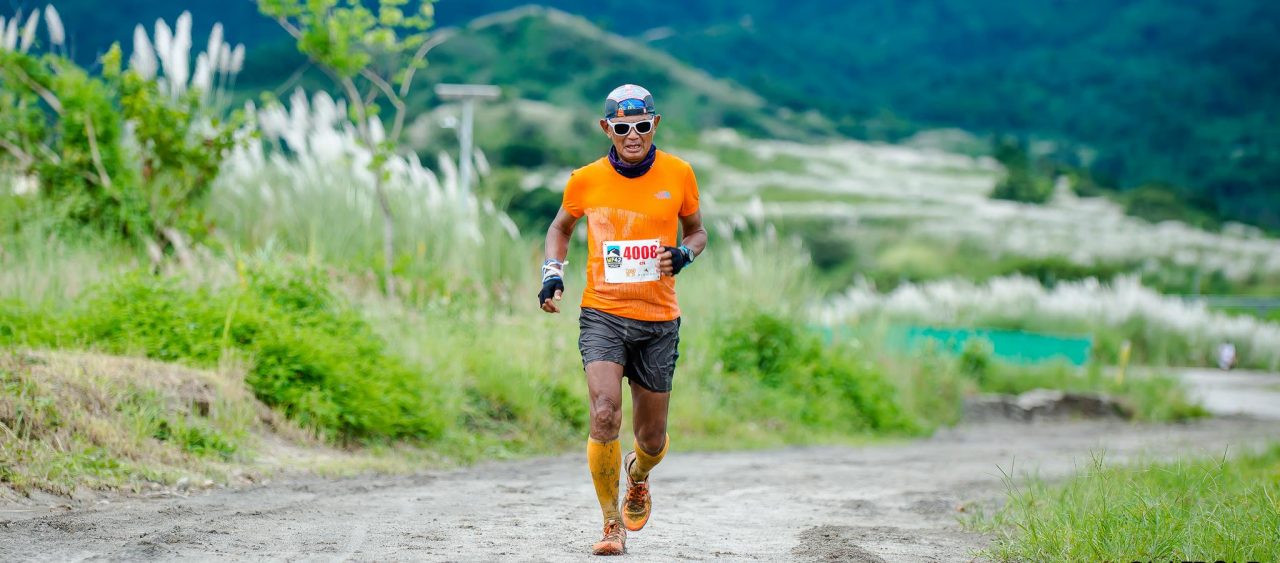
1:47:16 Hours @ 7th DND-AFP Gintong Pangarap Half-Marathon

09 March 2008

That is my unofficial time of finish in this morning’s 7th DND-AFP Gintong Pangarap Half-Marathon which started at 6:00AM at the Grandstand of Villamor Air Base, the Headquarters of the Philippine Air Force. It was supposed to start at 5:30 AM but due to the presence of late registrants, we gave at least 30 minutes delay to accommodate more of the runners for the Half-Marathon Race. After the Opening Prayers and Warm-Up exercises, the Half-Marathon started at eactly 6:00 AM with almost 600 hundred runners. The 5K race started thirty minutes after the 21K race had left the starting area.
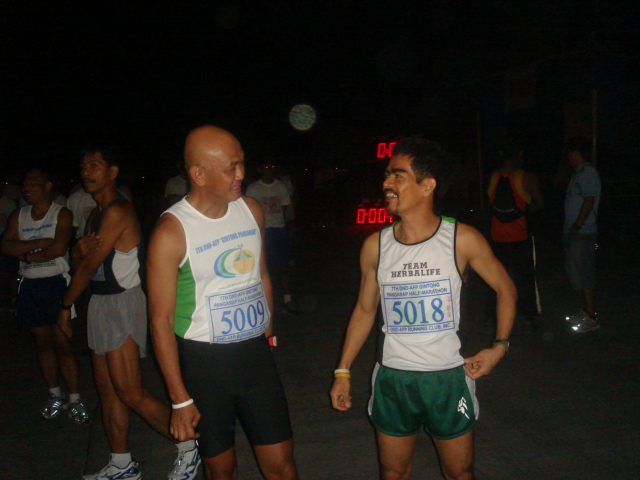
 dsc00754.jpg

I was able to talk to “Totoy” Santos, MiracleCello, and other runners/bloggers at the starting area. I was surprised to see an unprecedented number of runners from the civilian sector to include some foreigners (no Kenyans this time). I’ve seen a lot of runners who ran the 2008 Pasig River Marathon two weeks ago and the Condura 10K Run last week. I consider them as the real weekend “warriors” on road racing/running. 
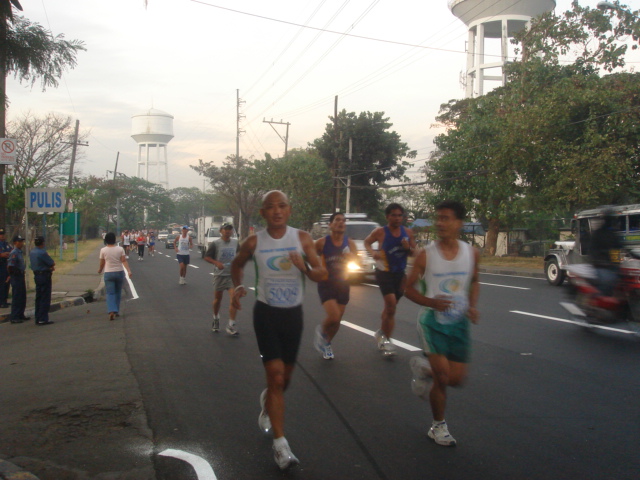
 dsc00762.jpg

Runners would run along the streets inside Villamor Air Base for the first 1.5 kilometers before going out of the camp along Villamor Road leading the runners towards Fort Bonifacio area. I maintained an average pace of 5:15 minutes per kilometer for the first half of the race, drinking much water along the way in every two kilometers. I had to make my “pit (pee) stop” at Lawton Avenue before reaching Essensa in one of the big electric posts at Kilometer # 6. I was glad there were lots of bougainvilla plants to cover me..ha!ha!ha! I have to catch up with the other runners who left me with a good 50-meter distance, finally overtaking them at the uphill portion on the road beside Essensa.
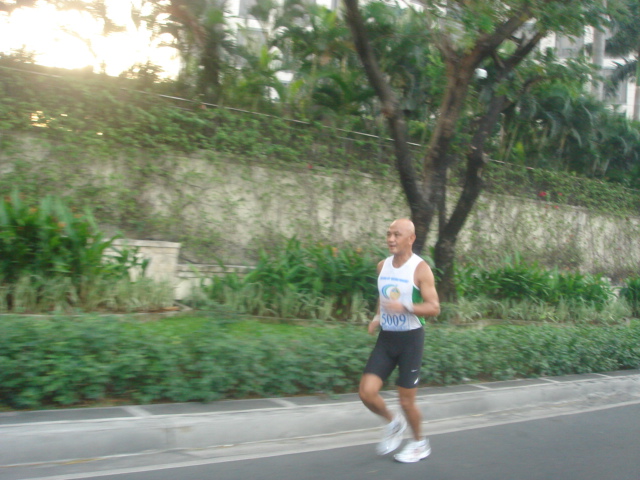
dsc00765.jpg 

Running alone at the vicinity Essensa, which was Kilometer # 6 with a pace of 5:13 minutes per kilometer.
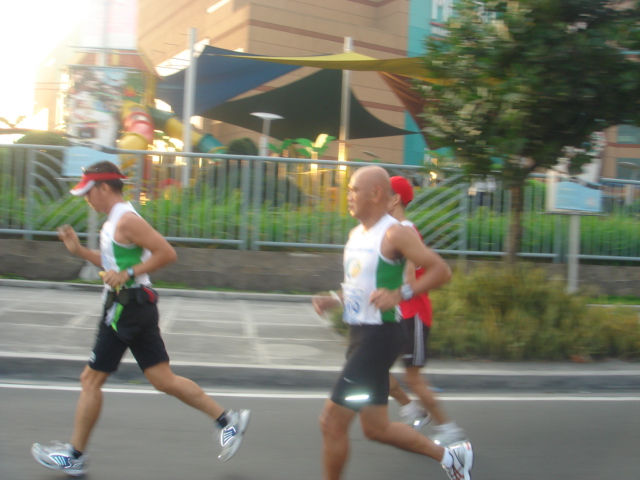
 dsc00768.jpg

Running with some of the participants at vicinity Market! Market on our way to the 10.5K turning-point and the sun was about to shine on us. 

I just maintained my pace all the way to the turning-point at the back of the S & R Store at the The Fort. I was really bit worried about the rising sun that runners could see once we are going back to the Market! Market! area. I thought it would bring more heat and discomfort to the runners but when we reached Lawton Avenue, the sunlight was already on our backs.
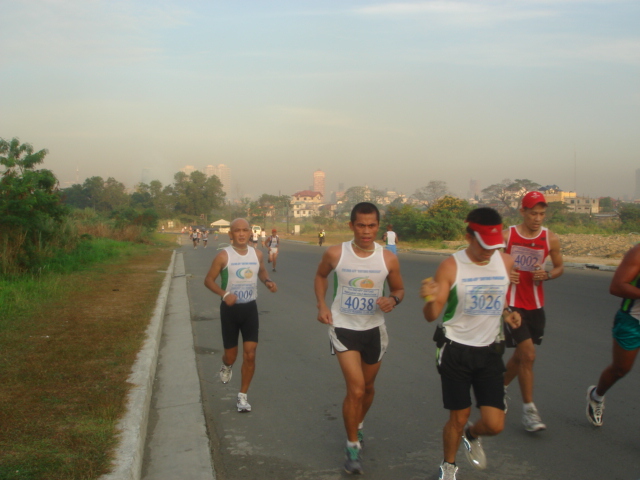
dsc00770.jpg   

I had the chance to pick-up some runners along the way and join them to maintain and later increase my pace. These guys are really good and consistent with their pacing.
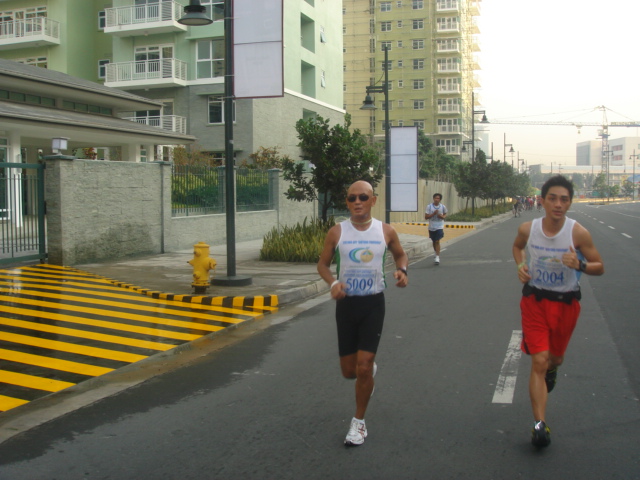
 dsc00773.jpg

On my way back to the finish line at the vicinity Serendra.
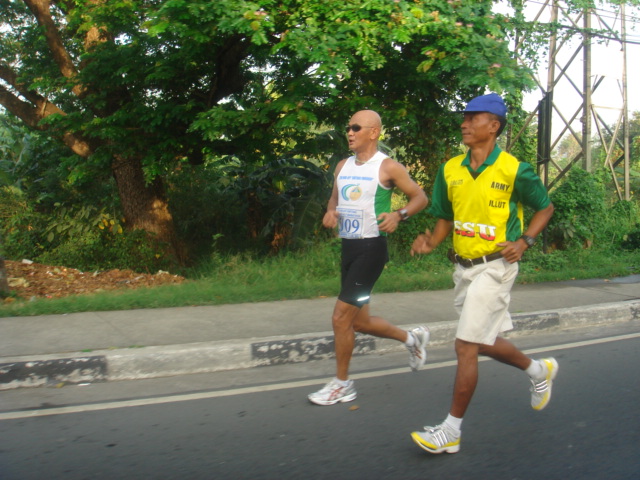
 dsc00779.jpg

Upon reaching the last 4-Km marker, I knew I could break two hours barrier to finish the race. I was accompanied from Essensa by MSgt Illut, a legend of the early marathon races in the ’70s, and Capt Ferdie Espejo, my “lead man” in making sure that the race is well-planned and well-organized, up to the finish line. Thank you, guys! You have done a wonderful job!

dsc00771.jpg 

Finishing the Half-Marathon in 1:47:16 is my best PR time so far.

Congratulations to all the participants and finishers of the Half-Marathon & 5K Race! See you in the next road races.

The following were the data taken from my GF 305:

Total Distance—20.98 kms           Time—1:47:16 Hrs

Average Pace—5:15 mins/km      Average Speed—11.4 kms/hr

Maximum Speed—14.4 kms/hr   Total Calories—1,507 calories

Average HR—167 bpm                   Maximum HR—174 bpm

Total Ascent—592 meters             Total Descent—595 meters

D-1 Day: DND-AFP Gintong Pangarap Half-Marathon

08 March 2008

I arrived in Manila this morning confident that my officers, staff, and the different Special Service Unit representatives of the Major Services of the Armed Forces of the Phuilippnes have prepared the things that are needed in the conduct of the event. In my personal conversations with them, they assured me that there will be enough water stations along the way and water cups & water supply in every station.

As of this writing, we expect a total of 1,200 runners for the half-marathon and 5K run. Out of this, at least 500 runners will be running the half-marathon distance while an estimated of 700 runners will be running the 5K race. The Half-Marathon will start at 5:30 AM while the 5K race will start at 6:00 AM.

Water stations will be positioned at the start/finish line; at the turn-around point for the 5K run (near Bonifacio Naval Station, along Lawton Avenue); at vicinity Essensa, The Fort ; and at vicinity International School (near the 21K turn-around point). The Major Service Bands will be prepositioned at the vicinity of these water stations to provide music to the participants. The famous Philippine Marines Drum and Bugle Corps will display their marching drills while playing their musical instruments before the awarding ceremony.

In the Half-Marathon race, there will be medals awarded to the top five in each age category for the men and ladies and cash awards will be given to the top three overall of the men and ladies. In the 5K race, top three in the men & ladies overall will be awarded with cash prizes.

At the finish line, each finisher will receive their “Certificate of Achievement” and the packed breakfast food (boiled banana, hard-boiled egg, bottled water & pandesal).

I just finished signing 1,200 pieces of “Certificate of Achievement” for the finishers in tomorrow’s race.

My strategy? Stay relaxed and maintain a good running form and be able to finish the race in two hours and ten minutes (2:10:00).

Good luck and see you at the Starting Line.

Lydiard’s Training For Marathon # 2

Excerpts from Arthur Lydiard’s Athletic Training by Arthur Lydiard; A Guide to the Brooks/American Track & Field; & Lydiard Running Lecture Tour in 1999. 

The Actual Schedule

Please note that it is wise to run supplementary miles at an easy pace, as many as you can, in addition to the schedules presented here. This will help you maintain good general condition and allow you to recover from training sessions more easily. Even 15 minutes is of value.Training should be done over all types of surfaces and trial runs over courses similar to that to be raced over. Training should also be applied in volume according to age and condition.Regular running on hills will help you in developing and maintaining your speed. Try to fit in some hill springing, uphill running or bounding with a driving action, and some steep hill or step running whenever you can, but don’t overdo it.

The schedules are only for guidance. They give a balanced method of training for a specific event, but think of them as a flexible guideline, allowing for age and general conditioning. Study your reactions to the training from day to day and if you feel stale or suffer from any soreness, allow time for recovery.Never do speed training when your muscles are sore or you are feeling tired. Just jog easily, regardless of what is on the schedule for that days training. You can never harm yourself by jogging and it will usually help to overcome the soreness or tiredness. 

Fast training can lead to injury and will certainly only make you more tired.Don’t race your training, except when full efforts are called for on the schedule Run strongly and easily ineffort, always keeping something in reserve. As you feel improvement, gradually increase your training tempo, but never use t Continue reading “Lydiard’s Training For Marathon # 2”

Lessons Learned: 2008 Condura 10K Run

1.  Stay Relaxed and Comfortable—A week before the race, I ran the 2008 Pasig River Marathon and the day before this race, I had a recovery run of 10 kilometers or 6.2 miles which I completed in 57 + minutes. My strategy in this race was to stay relaxed and comfortable and improve on my running form, starting slowly on the first 2 kilometers and hopefully, picking up my pace on my way back to the finish line from the turn-around point. I did not think of breaking the 50-minute time before the race, but instead, just for me to enjoy the run. But I started to pick-up my pace at the approach of the Kalayaan Flyover and maintained my 5:30 min/km pace. I guess, I love running on hills! From the 5-Km point, I increased my pace from 4:30-5:00 min/km pace up to the finish line. However, I was overtaken by 3 “triathletes” on the last 2 kilometers who are at least 20 years younger than me. I gave them the pleasure of finishing ahead of me and hope to beat them in my future races.

2.  Inspiration—I was inspired to run this race because I could see signs of an orderly, well-planned, and well-organized road race from the race packet I received days before race day and during the check-in processing of runners. Entry of runners in the starting area were distinct and separated from one another—10K runners were received near the starting line; the 5K runners were received at the middle of the starting area; and the 3K runners were received at the back of the starting area. What inspired me most are the kilometer markings every kilometer, bottled water in water stations in every 2.5 kilometers and the absence of any vehicle along the route of the race.

3.  Running “Boom”—I strongly believe that there is now a running “boom” in the country where all sectors of the society, youths, professionals, and the senior citizens are participating weekend road races. I am happy to see that people are becoming aware of their health and body fitness. I have observed also that there are so many running clubs in Metro Manila and from other provinces in the country.

4.  Corporate Involvement in Physical Fitness and Conservation of the Environment—Business corporations and other private entities greatly contribute in sports and physical fitness awareness to the people. Aside from physical fitness, these corporations have also their corporate social responsibility to help preserve our environment. Condura’s effort is very commendable and I hope that other business entities and private corporations should also take this direction to bring or “payback” something to the society and environment.

5.  Running Celebrity—A lot of people talked and approached me while I was at the starting area, during the race, and after the race. This website/blog is making me a celebrity! Ha! Ha! Ha! Joy Maddela of the 2008 Pasig River Marathon approached me and extended her thanks of the things I wrote about the said race. Joy, if you want to publish my post, you have my approval. By the way, all my posts here are for public consumption. To my co-runners and blog friends, consider me as a private citizen (as I don’t run with my security detail) when you see me in a road race, don’t call me “Sir” or “General”, just simply call me “Bald Runner”.

6.  Running Fashion—“Who says that running is not an expensive sport?” I just bought my singlet and shorts from New Balance at Shangrila Mall two days before race day and it is becoming a habit to buy a new running attire every time I join a road race. Well, that is the price I have to pay for being a celebrity in the running community!..Ha! Ha! Ha!

Note: My overall rating/grade for the conduct of the 2008 Condura Run—97%

“1,000-Kilometer” Club

When I was a student-officer in the Infantry School, Fort Benning, Georgia, USA from Oct 1983 to May 1984, I came across a “500-Mile” Club. Everybody was free to join the club. All you had to do was to follow the rules and regulations/instructions. Every member should be able to run 500 miles by logging on a chart where your name is printed. There were designated routes where the correct distance was measured in miles. “Honor System” was involved in registering the number of miles a member ran for a day.

After the EDSA Revolt in 1986, I was assigned in the Philippine Military Academy as its Intelligence Officer. In order to promote physical fitness to my officers and men who were engaged in smoking, gambling and drinking liquor in their free time, I introduced the “1,000-Kilometer” Club where everybody should be able to run the said distance with corresponding prize/s every time a person finished an increment of 100 kilometers. It was a successful running program that made us a strong running team in road races in the late ’80s.

The prize ranges from athletic socks, headbands, baseball/runner’s caps, running shorts, singlets, T-shirts, sports attire, free tickets to a movie, free food/dinner/lunch, and the ultimate prize for running the target/goal of 1,000K was a brand-new running shoes. Aside from being a strong running team, my “boys” became more healthy, fit, family-centered, and never tempted to smoke, gamble, and drink intoxicating liquor again.

When I visited PMA last month, one of my “boys” who is retired already, reminded me of this running program when he told me that we were running from Baguio City to San Fabian, Pangasinan via Marcos Road and from Bauang, La Union to Baguio City via Naguilian Road on different occassions as part of our “1,000K” Club.

Starting last Saturday, 01 March 2008, I’ve started my membership with my own “1,000K” Club! 

D-4 Day: DND-AFP Gintong Pangarap Half-Marathon

05 March 2008

As of this date, there are already 700 registered runners from the AFP’s Major Services who will participate in the Half-Marathon and 5K run. On the civilian side, there are already 351 registered runners, of which 180 of them will be running the half-marathon and the rest will be running the 5K race. My staff & organizers expect to have at least a total of 1,200 runners with almost 300-400 runners participating the Half-Marathon distance.

It is unfortunate that this Sunday’s Half-Marathon race will be held on the same day with Senator Pia Cayetano’s “Pinay In Action Race” at The Fort and we expect that most of the civilian women runners will be absent in our Half-Marathon & 5K race.

The DND-AFP Gintong Pangarap Half-Marathon race will start at exactly 5:30 AM on Sunday at the Grandstand of the Villamor Air Base and the route goes all the way to the Philipine Public Safety College (near the International School), passing along Lawton Avenue in Fort Bonifacio towards The Fort Complex and back to Villamor Air Base.

I will be joining the runners in the Half-Marathon race. Hope to see you there!

Top 20 Male: 2008 Los Angeles Marathon

50 Laban Moiben Marietta GA KEN 24 M 02:13:50 02:13:50 1
21 Christopher Kiprotich     KEN 26 M 02:14:19 02:14:19 2
14 Khalid Kamal Yaseen Pittsburgh PA BHR 25 M 02:15:23 02:15:24 3
10 Augustus Kavuta Tampa FL KEN 31 M 02:16:01 02:16:01 4
7 Franklin Tonorio Tampa FL KEN 38 M 02:16:29 02:16:29 5
12 Odilion Cuahutle     MEX 37 M 02:16:42 02:16:42 6
11 Benson Mbithi Clusane Di Iseo   KEN 29 M 02:17:00 02:17:01 7
23 Lamech Mokono Santa Fe NM KEN 28 M 02:18:40 02:18:41 8
27 Edward Kiptum     KEN 29 M 02:19:21 02:19:21 10
51 Dmitry Safronov Los Angeles CA USA 27 M 02:19:41 02:19:41 11
29 Mark Batres     USA 23 M 02:20:18 02:20:18 12
33 Cristian Villavicencio     NIC 31 M 02:27:55 02:27:56 13
12150 Roy Vargas Heredia   CRI 28 M 02:29:10 02:29:14 15
30 Erwin Eulogio Oroxom Racancoji     GTM 30 M 02:30:30 02:30:31 16
500 Timothy Scarpinato Champaign IL   24 M 02:33:21 02:33:23 17
24275 Sabino Beltran North Hills CA   31 M 02:34:27 02:35:16 19
917 Fermin Sequen Guatemalteco   GTM 40 M 02:34:33 02:34:34 20

Laban Moiben from Kenya received $ 20,000 and a brand-new Honda Car as his prize as the Men’s Champion.

Top nine runners (there is no # 9, # 14, # 18) were all foreigners—7 are Kenyans; 1 from Bahrain; and 1 from Mexico. US runners were at # 11 & # 12.

Out of the top 17 runners, 10 runners belong to the 20-29 years old category; 6 are from 30-39 years old category; and 1 from the 40-49 years old category.

For more information on the XXIII Los Angeles Marathon last 02 March 2008, click here.

Top 20 Female: 2008 Los Angeles Marathon

F7 Tatiana Aryasova     RUS 28 F 02:29:09 02:29:09 14 1
F50 Yuliya Gromova New York   RUS 33 F 02:34:12 02:34:12 18 2
F3 Jacqueline Nytipei     KEN 24 F 02:37:47 02:37:47 23 3
F12 Albina Gallyamova     RUS 24 F 02:37:50 02:37:50 24 4
F8 Mary Ptikany     KEN 30 F 02:40:12 02:40:12 27 5
F4 Claudia Camargo     ARG 36 F 02:45:17 02:45:17 34 6
F25 Jennifer De Rego     USA 29 F 02:46:24 02:46:24 36 7
F11 Tatiana Titova     RUS 42 F 02:51:32 02:51:32 50 8
12304 Katie Layman Martinez CA   25 F 02:53:44 02:55:02 59 9
24270 Tereso Yanez Los Angeles CA   40 F 02:59:13 02:59:54 89 11
F27 Dina Cruz     GTM 34 F 03:00:04 03:00:04 95 12
23802 Jenn Shelton Bend OR   24 F 03:00:34 03:00:34 96 13
14742 Bari Ramberg Beverly Hills CA   41 F 03:00:49 03:01:05 99 14
23825 Angie Radosevich Eugene OR   32 F 03:03:57 03:04:08 117 15
11041 Corinne Roberts San Francisco CA   22 F 03:07:59 03:09:25 141 16
8245 Teresa Rider Boulder CO   49 F 03:08:27 03:08:34 149 17
561 Linda Rosenthal La Canada CA   42 F 03:10:08 03:10:42 162 18
824 Rossana Robinson Westlake Village CA   45 F 03:10:42 03:10:54 173 19
17869 Jennifer Balentine Lake Tapps WA   33 F 03:12:10 03:12:23 187 20

The LA Marathon organizers introduced the “women challenge format” where the elite women runners were released 20 minutes ahead of the elite men runners and the rest of the runners/particpants. Tatiana Aryasova won a “bonus” prize of $ 100,000 for winning the said race format as nobody from the elite men runners had overtaken her up to the finish line. Tatiana Aryasova from Russia also received $ 20,000 and a brand-new Honda Car as her prize as the Lady Champion.

It should be noted that out of the 19 (there is no # 10 on the list) top female runners, 7 are within the age category of 20-29 years old; 6 are within the 30-39 years old category; and 6 are within the 40-49 years old.

Lydiard’s Training For Marathon # 1

How to set up a training schedule

1.  Count back from the first important race date.

2.  Allow a week to ten days for Freshen-up.

3.  Allow six weeks (including freshen-up) for Co-ordination training.

4.  Allow four weeks for Anaerobic Development.

5.  Allow four weeks for Hill Resistance Training.

6.  Conditioning training is time left, hopefully 10~12 weeks.

7.  Marathon Conditioning Period (10~12 weeks or as long as possible): 

           A) Conditioning starts with only aerobic running (flat and hills). 

            B) Then include a day of easy fartlek and strong runs over 5 and 10k.

8.  Hill Resistance Period (4 weeks): 

                Hill training two or three days a week.  

               One day a long aerobic run.

               Other days for leg-speed or easy running.

9.  Track Training Period (10 weeks): 

           A) First 4 weeks: Anaerobic Development Training:  

               Anaerobic training (i.e.: repetitions, fartlek, etc.) two or three days weekly.  

              One day a long aerobic run.  

              Other days for sprint training or easy running. 

           B) Last 4.5 ~ 5 weeks: Co-ordination Training: 

                Sharpners, development races (under- and over-distances), fast relaxed runs. 

           C) Freshen-up: 1 week to 10 days.

10. Continuation of racing (Race Week / Non-Race Week) 

Note: For the details and understanding of the Lydiard’s Method of Training for a Marathon or Lesser Distance Races, please read this.