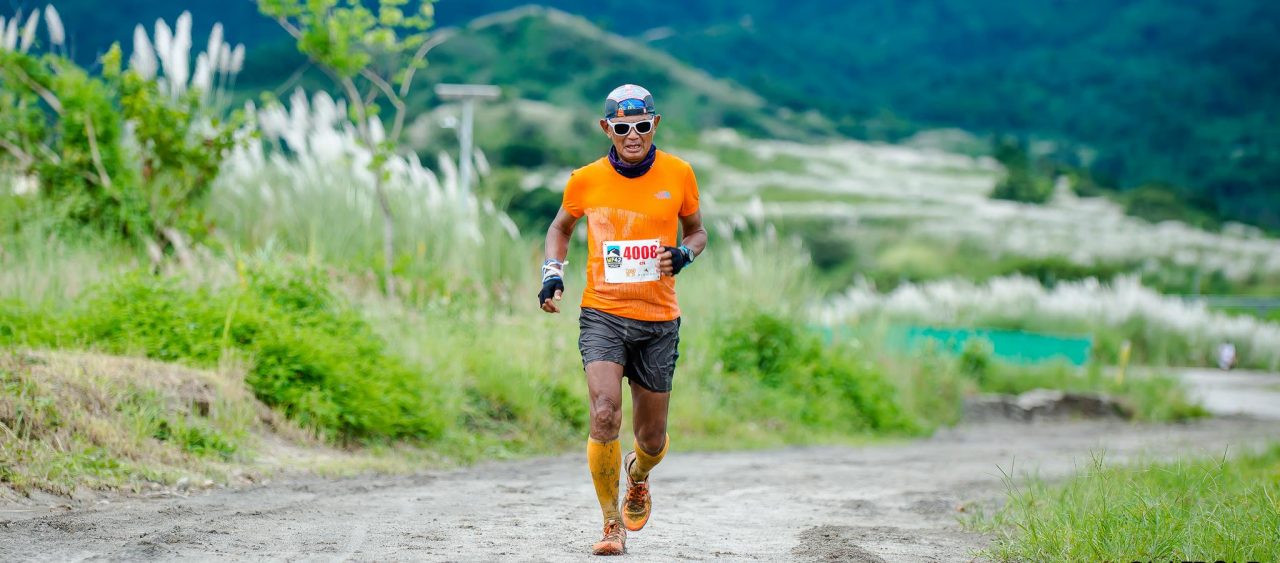
Sand Dunes & 31K Run


My nephew brought me to this place by car at Suba, Paoay, Ilocos Norte in the afternoon of Thursday. This place is almost 14 kilometers away from Laoag City and it is 200 meters away from the South China Sea. He was the one who took my pictures with the sand dunes as my background. This is the same place where the late actor Fernando Poe, Jr would shoot most of the fighting scenes in his “Panday Movie Series”. This is also the place where Tom Cruise’s made a film shooting of the movie “Fourth of July” in 1987 (?).
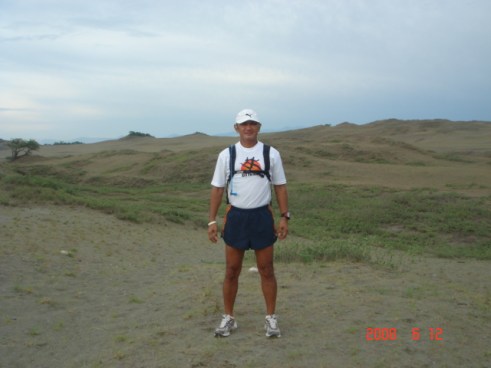
I was using a Puma Runner’s Cap, Inaugural City of Angels Half-Marathon Finisher’s T-shirt, ASICS Gel-1120 shoes, Adidas shorts, Ipod Nano, GF 305, and 2.1-liter CamelBak. 
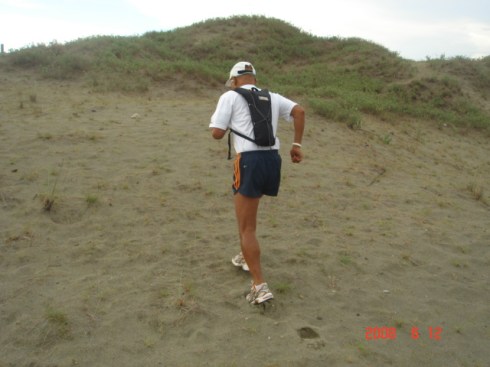
 

I started my run along the sand dunes with a slow pace taking those trails I could see in the middle of the vast land area. Basing from my GF 305, I was able to cover a distance of almost 5 kilometers along these sand dunes.
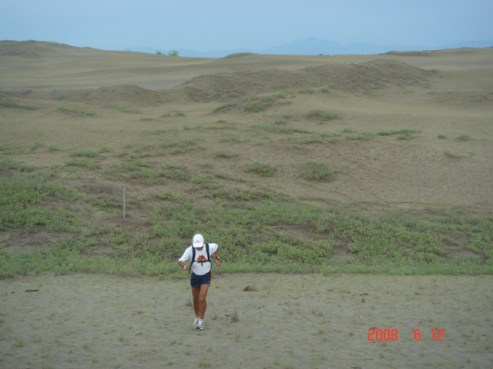
I finished my run along the sand dunes at the same place where I started. From here, I followed the road going back to Laoag City. However, I did not go directly towards Laoag City, instead, I went further south going towards the town of Paoay. I was able to run almost 5 kilometers when I reached Km Post 5 before the town of Paoay. From there, I made my turn-around and proceeded north towards Laoag City.

At Km 12, I started to eat the Protein Power Bar which I bought at GNC while running.  I finished eating the Power Bar after running one kilometer and at the same time taking a sip of water from my CamelBak. It was already getting dark but I maintained my direction of running against the traffic, taking extra careful with the tricycles. Tricycles plying on the road are very deceiving during nighttime. At a distance, you could only see the single headlight of the motorcycle but you could not see any light/s coming from the “side car” attached to the motorcycle. As a rule of thumb, I have to run towards the dirt part of the sidewalk  whenever a vehicle is about 50 meters infront of me.

At the crossing of the road to Gabu Airport and Suba Road, I turned left and proceeded towards the airport and reached the place going to Barangay Bengcag which was a good 1.5-kilometer distance from the crossing. Along this road, I could see group of men drinking “basi” or GSM with pulutan but they seem not to notice me. I’ve been warned by my friends here in Laoag City not to run to places where there are “drinking men” along the road as they might make some harm to “strangers” in their place. But what I do in places where there are people on the road is to smile and wave my hand at them and tell them, “Apo/Ama, lumabasak pay” (“Sir, I am just passing through”) and most of them smile and answer back positively. Hmm..one of these days, I’ll be known as the “old runner” who goes around to the far-flung barangays in Laoag City waving his hands to people along the way with a Nathan Water Belt/CamelBak and a bottle of Propel on my hand.

How I wished I could reach the airport but it was too late already and made my turnaround at Barangay Bengcag and proceeded to Laoag City. After reaching the end of the Padsan Bridge (Laoag Bridge), near the City Hall of Laoag, I was already at Km 26 and my legs were still okey. When I reached Rizal Street going towards Barangay Dibua South, my Ipod Nano stopped and I had to reset it with another artist/album. I had to walk while trying to select the music in my Ipod. I selected Bob Marley’s music for the last leg of my non-stop run. After 200 meters of walking, I resumed my run. Bob Marley’s message in his songs and the beat of reggae made my pacing more consistent. 

On my last 4-kilometer, while about to reach the bus terminal of Partas Bus, I was tempted to take a tricycle to take me back to the house of my sister as it was about 9:00 PM already. I resisted the temptation of those tricycles lined up infront of the bus terminal waiting for arriving passengers as I didn’t feel any pain yet on my legs and body. It might be the slowest 3-4 kilometers in my running workouts but I was able to reach my destination without any severe body pains.

So far, this is the longest run I had in preparation for my next marathon. I ran a distance of 31.34 kms in 4:03:21 hours, a non-stop run (except for the 200-meter walk) to include almost 5-km run along the sand dunes of Paoay. I felt good but tired after the run. I didn’t had any signs of reaching my “wall” up to the very end of my long run.

The Camelbak I had with me during the run was an added weight (4-5 lbs with 2 PowerBars & 2 packs of SkyFlakes inside the zippered pocket) to my run but it gave me the confidence to have enough water & food along the way and be able to run non-stop from start to finish. From time to time, I had to pull the end of the shoulder straps to tighten the CamelBak’s fit to my body to prevent it from swaying from side to side. CamelBak is only advisable to long runs where you want to test your body how far it can go without any stops. The feeling of the pack hugged on my back maintained my erect posture while running (Bugobugo85 knows what I mean with this!). The 2.1 liter capacity of water was enough to hydrate me for the said distance as the air was cooler in the late afternoon and early evening.

This long run was not in preparation for my next race on this Sunday’s Half-Marathon but it was a test how far my physical endurance and mental attitude would go.

I hope to have more long runs like this in the following weeks to come. 
CamelBak (Hands-Free Hydration System)


The first time I saw a CamelBak Water Hydration System was in an advertisement in one of the pages of Bicycle Magazine in the mid-90s. It was featured in a one-page picture of a mountain biker where the said pack was worn on the back of the cyclist. When I went to the United States to visit my family in 1996, Colonel Alan Cabalquinto (later became a 3-star general), then my immediate “boss” requested me to buy him a Camelbak which he intended to use in his running workouts. At that time, Camelbak was only popular to mountain bikers and some road cyclists. Of all the sports stores in Los Angeles area, the only store that had Camelbak was a Cyclist Store in Beverly Hills. I bought one piece which costs me $ 85.00 + tax.

According to its history, the contraption was invented by a cyclist, Michael Edison, who participated in a bike race in Texas during summer and he was bothered with the constant pulling and putting back the water jug on its rack which is screwed to the bike frame and drinking water from his jug with use of his hands. He wanted to be hydrated while riding on his bike without using his hands. So, he got an I.V. bag and its tube and placed the bag in a bike socks and had it stitched at the back of an old t-shirt, wore it and later came up with a nozzle that controls the flow of water from the I.V. bag thru the tube as he placed the nozzle in his mouth. And the rest is history. By August of this year, CamelBak will be 15 years in the business of hands-free hydration system.

In the later part of 2000, I was part of a delegation of the AFP to attend a bilateral talks with the US Armed Forces in Hawaii as preparation for our future training exercises with them. In their PX Commissary, I found out some CamelBak 2.1-Liter Hydrobak Classic with the color-green cloth casing and I bought 20 pieces at a price of $ 35.00 each without any tax. Out of the twenty pieces, I kept one piece for myself; gave one to my brother; and the rest of the 18 pieces were given to the members of the Philippine Army’s Shooting Team to compete in Brunei for the ASEAN Armies Rifle & Pistol Meet in November 2000. I was then the Team Manager of the said Shooting Team. The members of the Shooting Team were happy and surprised to receive such hydration pack from me as I was the one who first introduced such to them instead of using the old World War II vintage-aluminum water canteen which was the issued water container equipment to our soldiers up to the present. This Camelbak hydrobak was very useful to my shooters that they become the envy of other delegations from the other countries as they were the only ones sporting such hydration system during the 2000 Brunei Shooting Competition. Unfortunately, the CamelBak I issued to the shootes became their personal property and some were “traded” as souvenirs from their counterparts from other countries. Such initiative to buy another set of CamelBak Hydration System for the succeeding team members in the next year’s events was not done by the succeeding Shooting Team Managers up to the present.

Two years ago (I was already a two-star general), I had heated argument with a more ranking/senior general at the Headquarters Philippine Army with my suggestion/recommendation to entirely start changing the hydration system of the basic soldier from the WWII vintage aluminum water canteen to CamelBak Hydration System to be at par with the US, UK, and other ASEAN Armed Forces which had been using the CamelBak 5-6 years ago. The ranking general did not buy my idea, instead, he decided to “improve” the water canteen from an aluminum to a stainless steel one but still the same size, carrying almost one-half liter of water/liquid. It is sad to note that until I retired from the military service, I haven’t seen that “improved stainless steel” WWII vintage water canteen being issued/used by the soldiers in the combat areas/battlefield. Presently, the soldiers are still stucked to the “bottled water”/”mineral water” hydration system ( in plastic bottles).

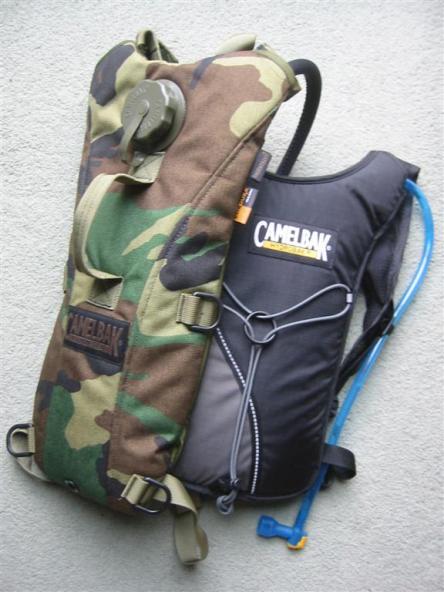
These are two models of the CamelBak Hydration System. The one with black & gray colored Cordura casing is exactly the same later model that I have which I bought at Travel Club Store 5 years ago. It has a capacity of 2.1 liters of water/fluids and a zippered pocket. The other model is for the military but this model had improved lately and it became already as an integrated part of the backpack/rucksack of the soldier.

At present, I have two sets of Camelbak Hydration System–the one that I bought in Hawaii and a newer version of the hydrobak classic which I bought at The Travel Club Store in SM Megamall 5 years ago which I haven’t used. It was the one which I bought in Hawaii that I’ve been using in my biking, hiking with 35-lb backpack, and other military exercises/activities. The difference between the old and the new Camelbak are the following:

1) The old one ( the one I bought in Hawaii) has no pockets in its Cordura cloth casing while the new one has zippered pockets and stretchable straps/strings where additional sports accessories could be strapped or carried.

2) In the old one, the nozzle/water tube is positioned on the left side with the left shoulder straps while the nozzle/water tube in the newer ones is located on the right with the right shoulder straps.

3) The old one has no cross-straps that connect the two shoulder straps on the breast area. The newer models has a cross-straps which make the Camelbak more hugged and stable with the body.

4) The old one has a bite nozzle that goes or connected directly with the water tube. The new one has its bite nozzle 90 degrees angled with the water tube.

Lately, when I was packing my things  to Laoag City, I was able to find my new Camelbak Hydrobak Classic Hydration System which has a pocket enough for two powerbars or 3 packs of Skyflakes and I brought it here in Laoag City for my future long runs on roads, hill/mountain trails, and beach/sand dunes. 

This is the “Rule of Thumb” in Hydration to the human body when involved in running and other endurance sports—drink one liter of water/fluids for every one hour of activity. Which means that my Camelbak is enough for a 2-hour running as my Camelbak can store only 2.1 liters of water/fluids. The military version and other later models have 3-liter capacity.

At present, more outdoor sports brands had copied the Camelbak’s concept of Hydration System. But I still prefer the original one. We will see how my CamelBak will help me in my next long run. I hope to do 33-35K non-stop long run next time.

“CamelBak: Hydrate or Die”