4:08 AM July 4, 2010 Km 0 Roxas Boulevard/President Macapagal Avenue
Brief Background
I did not run the 2008 MILO Marathon Manila Elimination Race but I was able to find a way to join the MILO Marathon FINALS held in November where I registered the fastest time so far after reviving my regular running activities since I retired from the government service. I registered a time of 3:48:32 hours at that time. For that year, it was my third marathon race after finishing the Pasig Marathon in February (4:49+) and the San Francisco Marathon in August (4:36+). I can still recall that I put more mileage in my preparation for this race and lots of “speed” training at the ULTRA Oval Track up to the point that I was able to schedule three (3) “speed” sessions every week. However, since then, I could hardly improve my time with the hope that I would be able to reach the time of 3:45 hours for a Boston Marathon Qualifying Time for my age.
For last year’s MILO Marathon Races, I did not do well as my time was not able to breach below the 4-hour qualifying time. Such performance could be a result for having developed a slower pace to finish ultramarathon races (50-102K) which I joined for last year plus the fact that I was getting one year older! But in last year’s Subic International Marathon, I was able to register a finish time of 3:58+ in the month of October.
For this year, my objective was to qualify for the 4-hour time making my Jeju International 50K Ultramarathon Race last March 27 as the start of my preparation for the Marathon Manila Eliminations. I said to myself that a 10-week preparation for the race would be enough where a gradual increase in mileage towards the last 4-5 weeks before the race shall be attained. As I did not follow a structured training schedule for this race, the guide for my training was to “listen to my body” as I did at least one (1) interval speed run session at the Oval Track; one (1) tempo run; one (1) LSD; and one (1) recovery run almost every week during my strengthening phase. Six weeks before race day, I had my runs to the “Brown Mountain” trails and I was able to increase my weekly mileage up to more than 110 kilometers for two succeeding weeks until I slowly decreased my weekly mileage up to the race day. Aside from proper nutrition and hydration with Gatorade, I had weekly body massage and stretching exercises.
Race Proper
On the day of the race, I woke up 2 hours before the scheduled start time and did the necessary “ritual” that I’ve mastered before in any runnijng event that I competed. Everything was smooth and efficient as I arrived at the race venue at least one hour before the start of the race. After the usual greetings and photo-ops with other runners, friends, and members of the Race Organizers, I was ready to enter the Starting Area.
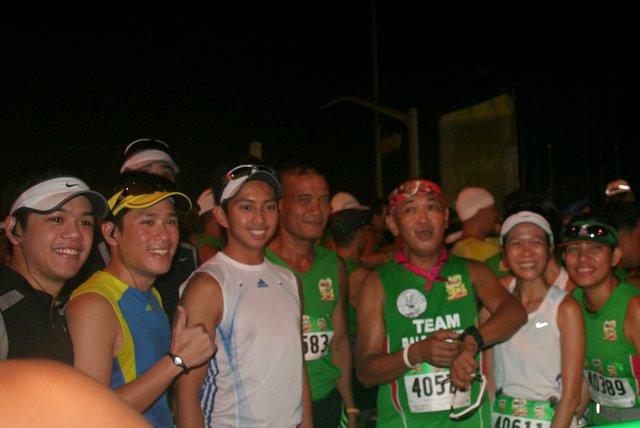
I observed that I started to perspire a lot without even doing the stretching exercises being performed as part of the opening program. It was a sign of the “heat and humidity” of the day. It was a warning also to hydrate properly during the race. Being a “veteran” runner. I already know the “drill” and not to be “hard-headed” during the race. The key to survival is to be able to drink & hydrate in every Aid/Water/Gatorade Station.
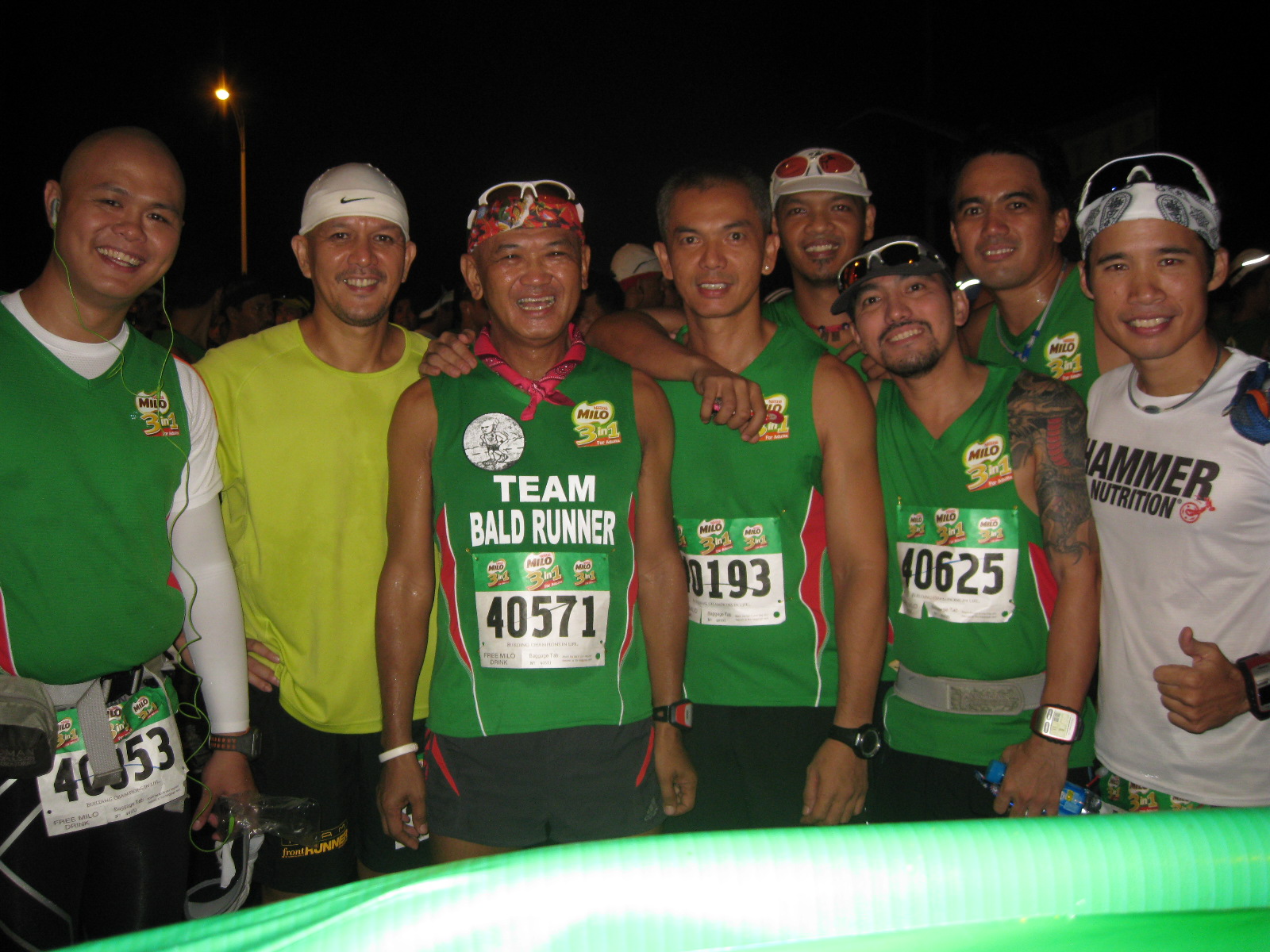
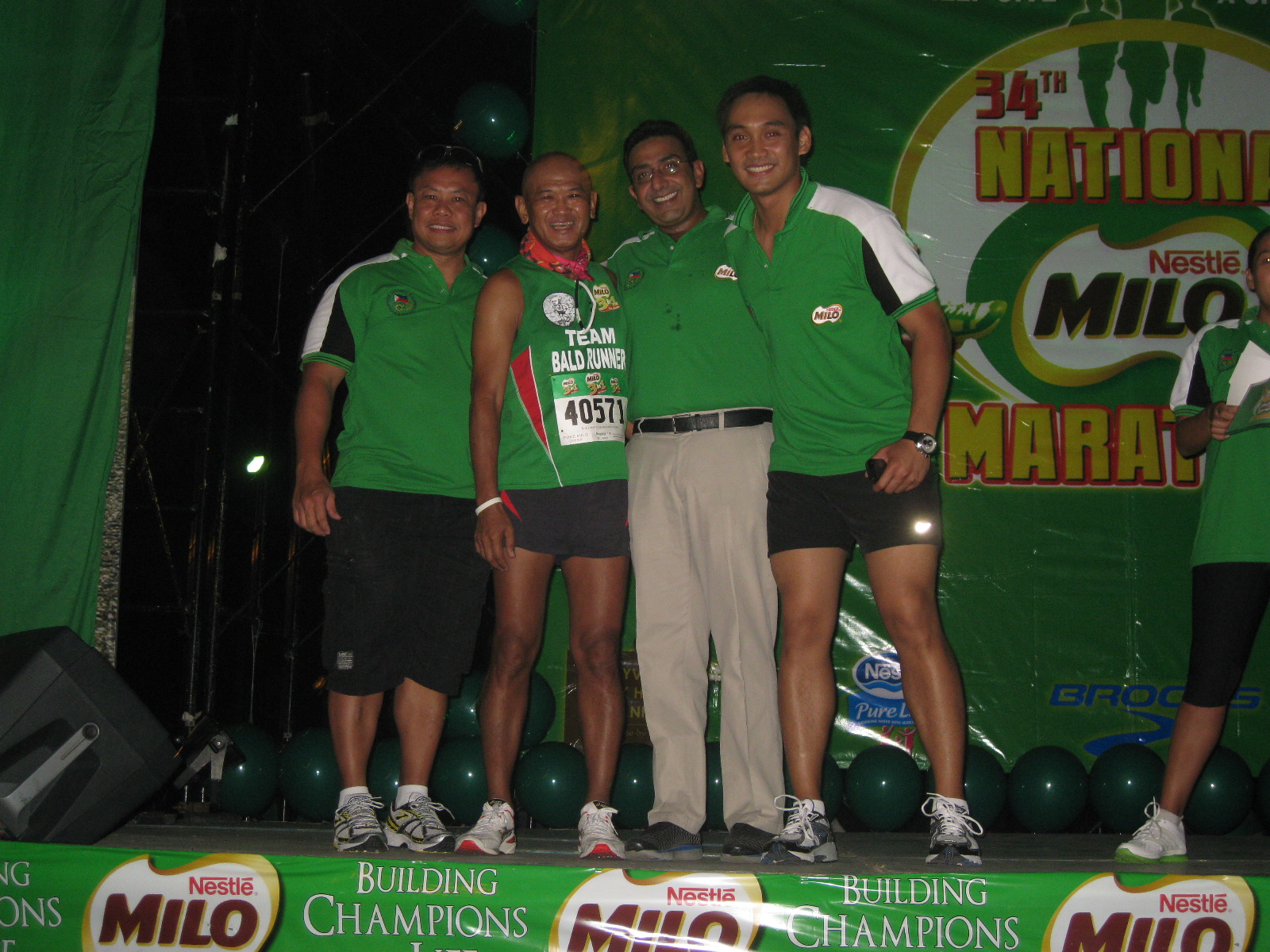
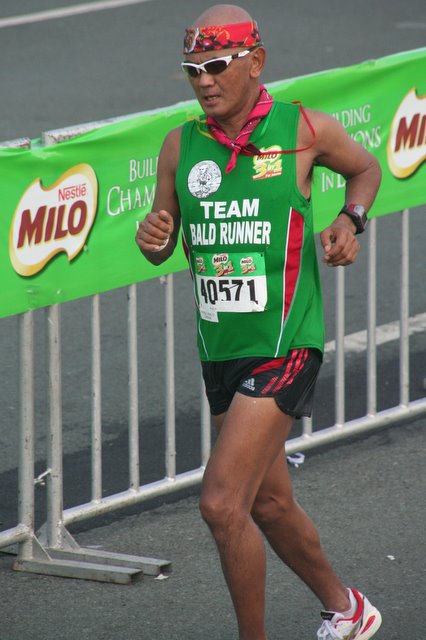
There was a long pause during the opening program where I was able to talk briefly and have photo-ops with other runners and the Team Bald Runner-Professionals (BRP) when all of a sudden the crowd was surprised with the sound of the starting gun without even warning us with a “countdown”! Well, sometimes small or detailed things as practiced are forgotten in major marathon just like this. The crowd’s reaction was to start our run! My GF 305 watch registered the start time at 4:09 AM.
Km 0 to Km 10. The first 3.5K was flat that I was able to register an average pace of 5:56 minutes per km for the first kilometer and I slowly increased my pace up to 5:40 mpk before reaching the 2K mark. Knowing that my support staff had been stationed in critical points along the route to supply me with the needed hydration and solid foods (suman, fruits, boiled eggs, and sports gels) along the route, I purposely passed the first few Aid Stations and continued with my average pace which reached as fast as 5:30 mpk. I was able to finish the 10K distance in 55:26 minutes and I was happy that I was within my goal to finish way faster than the 4:10-hour qualifying time for my age.
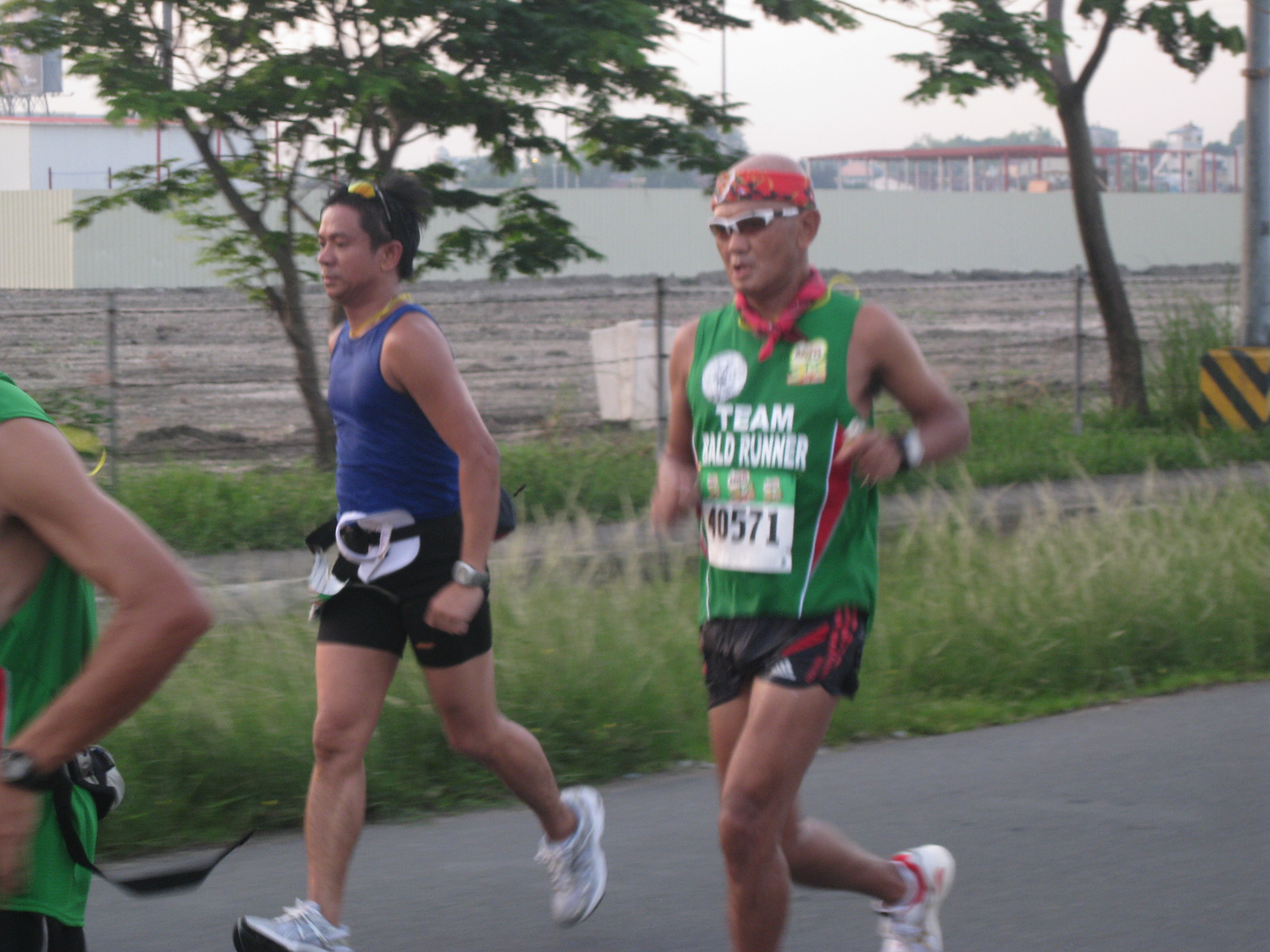
Km 11 to Km 20. On the second loop, my legs were still strong to pass over the two Flyovers along Roxas Blvd and I was still maintaining an average pace of 5:30 mpk and was confident that I can still make my pace much faster one if I wanted it. At this time, I was regularly provided with water and Gatorade by my Elite runners who acted as my pacers and my staff who prepositioned themselves at the President Macapagal Avenue. Aside from being supplied with cups full of water and Gatorade, I had with me on my closed fists additional water placed in small “ice candy” plastig bags. I think I did not have any problems with my hydration at this point. I also ingested the Sports Gels provided by the Race Organizers every time I was able to complete one loop of the 10K route within the route.
Km 21 to Km 30. As I was about to reach Km 26, I felt a jolting sensation on my right hamstrings and I know that if I maintain my pace of 5:30 mpk, the sensation might lead to some pain and then to muscle cramps. I slowed down from this point and tried to observe and listen to my body if the hamstring issue will disappear. For the next kilometers up to Km 30, my average pace was a “see-saw” where alternately after every kilometer, my pace would register the fastest pace from 6:15 mpk up to the slowest pace of 6:57 mpk up to Km 30. I know, I can still manage the slight pain but it made me slower, hoping that the pain will disappear.
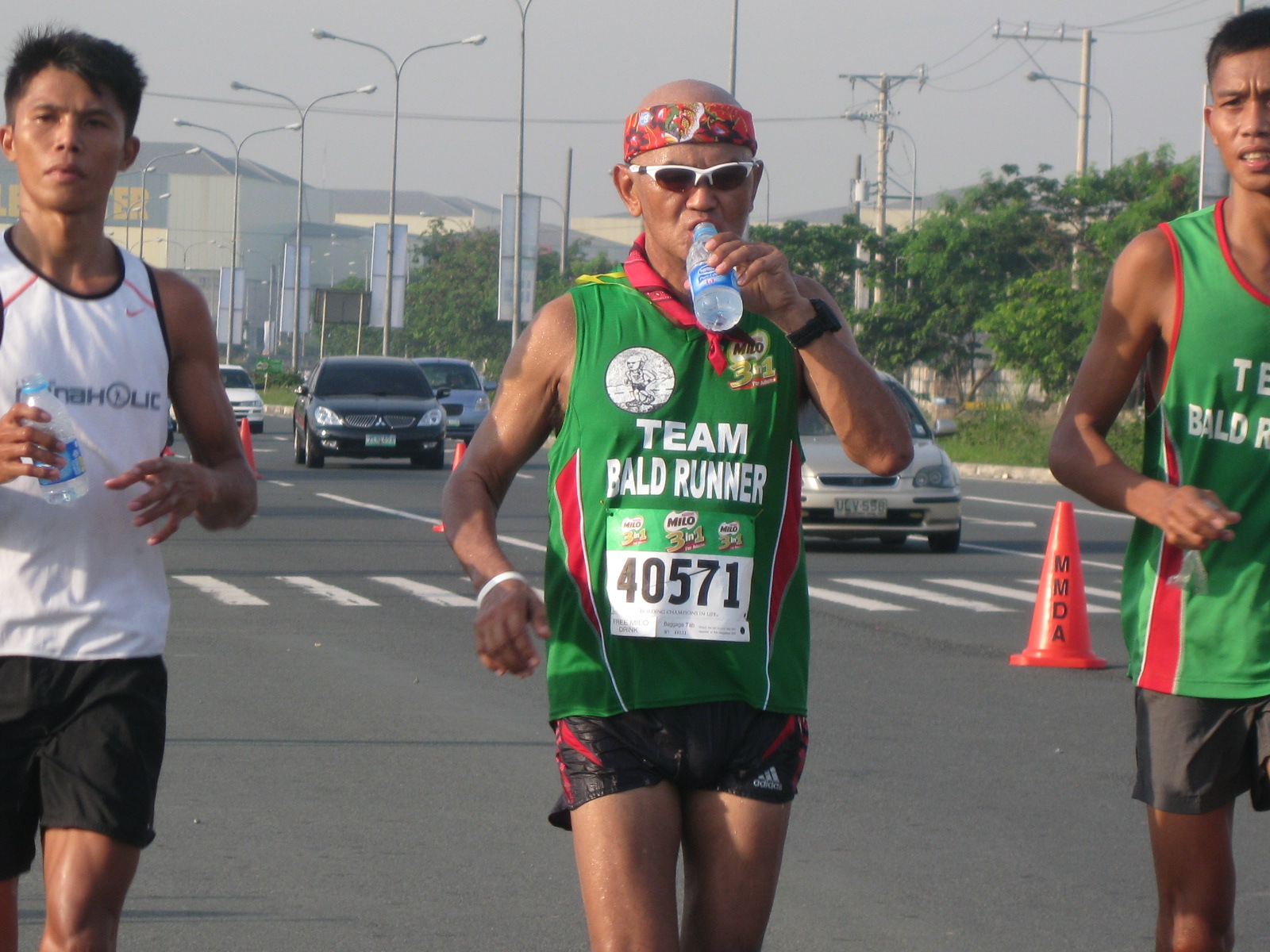
Km 31 to Km 40. From Km 31 to Km 32, I can still manage to control the pain on my right hamstrings but at the middle of Km 32, I started to feel another pain on both of my quadriceps. These signs made me reduce my pace and ultimately started to do some brief brisk walking just to give comfort to my legs. But I tried to manage to go back to running after 10 seconds of brief walking. At this point, my pacers started to regularly douse me with cold water and told me to take small steps just to be able to lift my feet and knees from the ground. Once I reached the last 6K of the race, I was already struggling and trying to fight the pains on my legs. At Km 39, I already knew that I would not be able to qualify for the MILO Finals as my pace registered an average pace of 7:40 mpk. I asked for ice cold bottle of Coke but it gave me a short “boost” to relieve the pain from my legs.
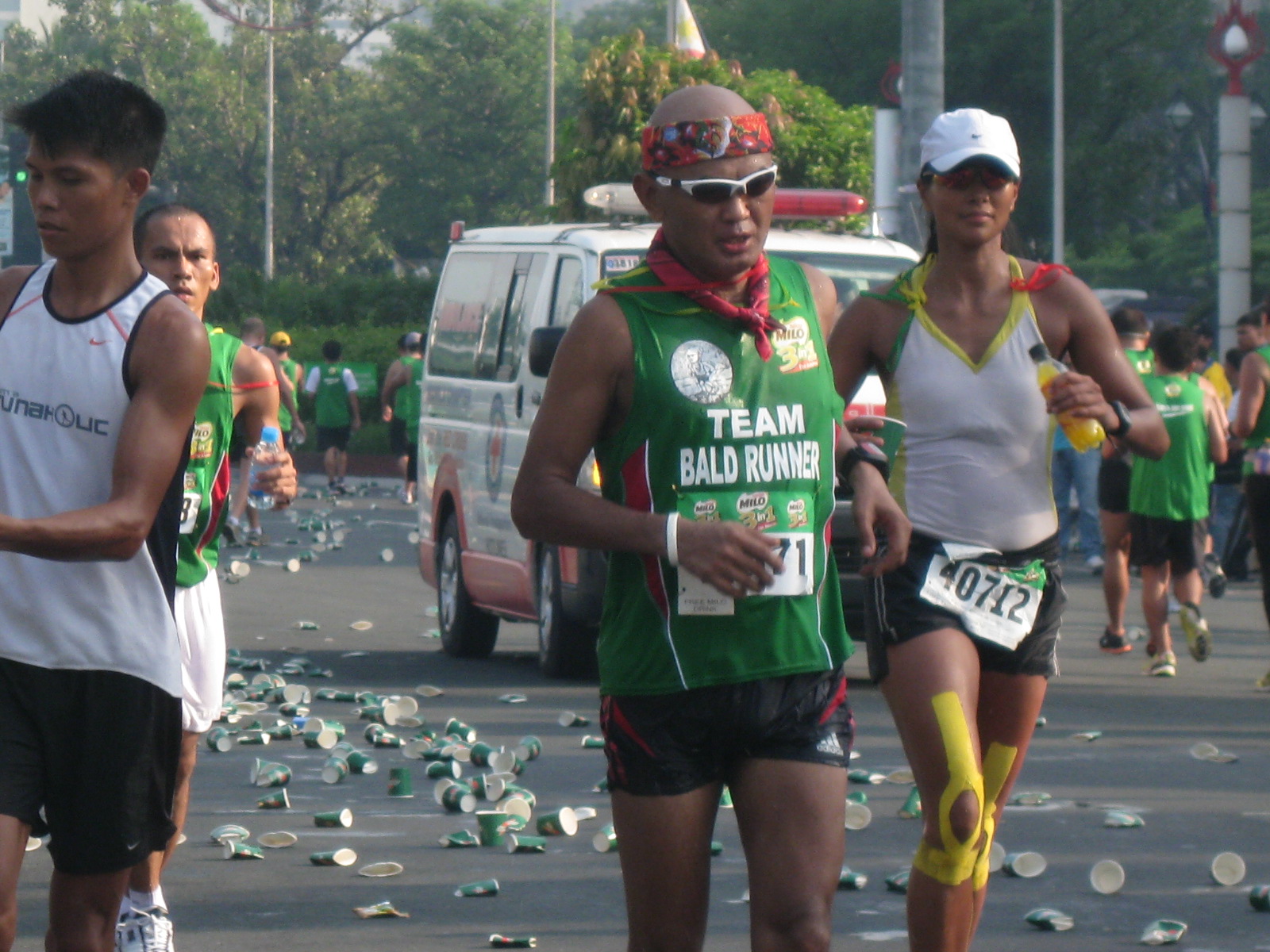
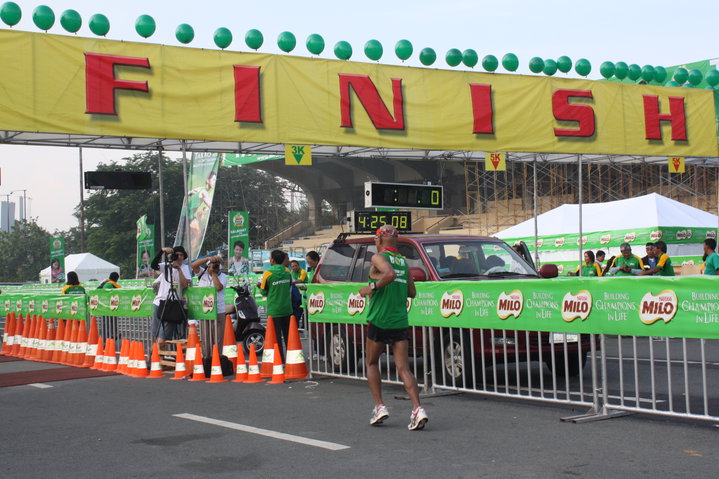
Km 40 to the Finish Line. Despite knowing that I could not qualify for the Finals, I tried my best to increase my pace and I was successful to prevent myself from walking and surrender from thinking of being a failure in this race. I was able to bring back to a faster pace for the last 2 kilometers and reached the Finish Line without any injuries.
I finished the race in 4:25:13 hours (Official Time) with a registered distance in my GF 305 of 42.4 kilometers. My average pace for the entire race was 6:15 minutes per kilometer.
Lesson #1: Heat, Humidity, and the Quality of Air
It is already a fact that the hot weather, very humid condition, and the poor quality of air in Metro Manila are the top “nemesis” for long distance runners. I have predicted that the “all-comer” Marathon Record Time set in Metro Manila in 1982 by Waldemar Cierpinski in 2:14:27 hours will never be broken by a Filipino or international runner because of the warmer average of temperature that we have as compared in the 80s and the worst quality of air that we have at present because of our non-implementation of our Clean Air Act and the proliferation of vehicles in the metropolis. Even the visiting Kenyan runners and the elite athletes were not able to breach below 2:30-hour finish time except for the record set by Ed “Vertek” Buenavista few years ago at 2:18+ hours. During last Sunday’s race, one of my elite athletes complained that the weather was too hot that contributed his unusual experience of having muscle cramps on the last 10K of the course.
Lesson #2: Unsual Race Course
I was surprised to learn during the brief presentation of the route before the race started that the marathon runners had to run along the Flyovers at Buendia and EDSA for the “fourth time” before turning around towards the Finish Line. This surprise part of the route was already considered as “punishment” to all the runners. I had no problem running along these Flyovers for three times but the fourth and last time brought so much pain and torture to my cramping legs. Well, that is what we get when the “thinkers/consultants” and Race Organizers of MILO/Nestle, Phils are not seasoned “marathon runners”. If these people would ask my suggestion and feedback about this race, I would tell them to scrap this route and bring back the original one. However, it would be better for them to ask a selected group of seasoned runners to “test run” their planned route before implementing it to the public and find out the necessary feedback. I think this is “doable” in the next editions to come.
Lesson #3: The “Dumb and Stupid” Runners
I thought the 3-loop course and the presence of RFID Timing Chips would eventually eliminate reports and observations of “cheaters” from taking advantage to those who are honest in the race in past editions of the MILO Marathon Race. I was wrong! The result of the Marathon Race had glaringly showed the absence of “complete” split times of almost 42 runners but were able to register their finish times. It shows and proves that these runners made a “shortcut” and did not pass on two different “sensors” along the route. In addition, I’ve seen discrepancies in the recorded split times wherein a slow runner on the first and/or second splits would register a very fast pace on the third and last splits despite the challenging weather (heat & humidity) condition and the lack of hydration supplies on the last 10K of the course. I just hope also that nobody among the runners registered an “improper” birth date to make them older! In my lectures/clinics, I always emphasize to my audience that running develops good values to each and every individual and the most importantly of them is HONESTY.
Lesson #4: Hill Repeats, Not Hill Running
As I reviewed the journals of Arthur Lydiard, he highly recommends Hill Workouts & Repeats as part of the Sharpening Phase of a Marathon Training. Instead of doing Hill “Repeats”, I did Hill Running or running on top of the “Brown Mountain” on a once or twice a week basis. My workout in going to BM further strengthened my legs and my aerobic capability but it did not improve the “survivability” of my running legs on overcoming those repeated runs over the Flyovers along Roxas Boulevard. My mountain running did not duplicate what I really needed to surpass those “speed bumps”. During the last 8K of the race, these “speed bumps” became “speed obstacles” for me to qualify for the Finals.
Lesson #5: Wrong Choice of Race Strategy
In other words, I was overconfident in this race. I opted for the even-pace strategy with an overall average pace of 5:55 mpk but I registered a faster pace at 5:30-5:40 mpk up to the point that I reached Km 30. I’ve observed that I gave so much pressure to myself when I adopted this kind of race strategy and never taking into consideration the effects of the weather and the realiability of support from the Aid Stations. This kind of race strategy had worked well with me in my Marathon/Ultra Races in the USA and in South Korea. I am sure that the colder weather had greatly helped me well to finish with better times.
In my past good marathon races here in the country, I adopted the “negative-split” race strategy where almost half of the race was done with an easy and slow pace and later slowly increasing my pace on the last half of the race. I applied this strategy in this year’s Condura Marathon, last year’s Subic International Marathon and in the 2008 MILO Marathon Finals. I guess, I’ll have to stick to this kind of race strategy in my future marathon & ultra races.
Lesson #6: Remember the term “Collapse Point”
I discussed the term “Collapse Point” in one of my past posts. It is the point or distance along the marathon course where you hit your “Wall”. To determine your “collapse point”, you have to find out the total of mileage (in miles or kilometers) for the past 60 days prior to race day and divide it with 20. The result is your approximate “collapse” point. In my case, I was able to run a total of 646 kilometers, 60 days before D-Day. After I divided it with 20, the result is 32.3-kilometer point. This was the approximate point where I started to slow down, breaching past the 7:00-mpk pace as my average pace. After this point, I started to “brisk walk” and my goal to qualify for the Finals started to collapse! It shows that my total mileage before the race was inadequate and lacking.
Lesson #7: Age Factor
As I am getting older, I need all the “tricks” in maintaining a competitive level in running. Balance and Moderation are the keys to an injury-free condition for me to be always ready to train to a marathon or ultra race wherein I can compete within my age category or even to the younger age categories. Running will always be an “experiment of one” and there is no such thing as “miracle pill” to make a person into a fast and strong runner within a limited period of time.
Lesson #8: Ultrarunners’ View of a Marathon Race
Eversince I started to join and run ultramarathon races, I’ve considered a Marathon Race as a part of my training in order to find out my endurance level. Do you remember that I started my Manila to Baguio City Multi-Day (5-Day) Run after a day of rest from finishing the Condura Marathon last February of this year? Do you remember that I participated in my first 50K Ultratrail Run at Bulldog Trail Race in Calabasas, California barely two weeks after my San Francisco Marathon? I survived and finished such ultra runs because of my preparations for the Marathon Races that I joined prior to such events. An ultra runner friend of mine would jokingly say that a marathon race is considered as his “tempo run” workout for an ultra running event. And I believe him. In addition, it is not acceptable ( in a blunt term, it’s a shame) when a runner walks in a marathon race, but when a ultrarunner walks in a race, it’s the “smartest” move he can depend on in order to finish the race! After finishing this Sunday’s MILO Marathon Race, I can say that I have the endurance to finish another ultramarathon race/event in the future!
To all the Marathon & Ultra Runners, see you at PAU’s “P2P 65K” and CAMSUR Marathon!!!
 Bald Runner
You must be logged in to post a comment.