Remembering Dr George Sheehan


Old runners like me always talk about this guy who is considered as the “Guru of Runners”. The first time I saw and read his writings was when I got hold of a Runners World Magazine way back in the summer of 1980. Buying at least three editions of the monthly Runners World Magazine in Dau, Angeles City was my solution to gain more information about the science of long distance running.

Few months before that, I joined my first attendance to a long distance running competition among the alumni of the Philippine Military Academy in commemoration of its Founding Anniversary during the mid part of February. I practiced running short runs on staggered basis 2-3 months before the competition and I thought I could compete in this race and finish well. The course starts at the gate of Camp Allen (near Baguio City Hall), passing through Harrison Road, and along the road going to Fort Del Pilar and finishing infront of the Grandstand of PMA Parade Grounds. Well, I was wrong! I did not compete in this race but I barely survived finishing the race.

Surprisingly, my younger brother, who graduated a year after me from the Academy, finished outstandingly and ranked as Number 4 among the top runners. If I can remember right, I finished within the 60+ place among almost 200 runners. After that run, I said to myself to excel and improve in the next edition of this race on the following year.

Reading the articles of Dr Sheehan in those past issues of the Runners World Magazine inspired me to plan, train, and test my capabilities in running. The result? After those LSDs, “fartleks”, lots of mileage, carbo-loading, positive attitude and discipline for almost 9 months, I became the second fastest runner among the alumni for three consecutive annual renditions of this PMA Alumni Race.

Now that I am getting older, Dr George Sheehan will always be my “guiding light” in running, my No. 1 Running Hero.

I highly recommend all runners to visit his website and read his essays at: www.georgesheehan.com/essays.

Dr George Sheehan: Runner & Philosopher


Remembering George Sheehan

Runner, Writer Explored the “Why”

Published November 02, 1998, in The Post-Standard.

By Dr Kamal Jabbour, Contributing Writer

On Thursday, Dr. George Sheehan would have turned 80 years old. However, this week marks the fifth anniversary of Sheehan’s death at his home in Ocean Grove, New Jersey, four days shy of his 75th birthday.

A runner, a cardiologist and a writer, Sheehan was the philosopher of our sport. Although he wrote many books and hundreds of articles on running, Sheehan did not tell us how to run faster or further. Instead, Sheehan told us why we ran. He explained the “why,” not the “how,” of running, and earned the nickname of “running guru.”

Sheehan was born on November 5, 1918 in Brooklyn, New York, the first of George and Loretta Sheehan’s 14 children. He competed in high school and college, but stopped running in 1940 when he started medical school. He joined the US Navy as a physician in 1943. Sheehan married Mary Jane Fleming in 1944, and they had 12 children.

In 1963, Sheehan returned to running and racing. Six years later, he ran a mile in 4:47, setting an age group world record, and running the world’s first sub-five-minute mile by a 50-year old. He competed regularly, and raced often in New York’s Central Park. From 1964 to 1984, he ran 21 consecutive Boston Marathons. He ran his fastest Boston Marathon in 1979 in 3 hours 1 minute at age 60.

In 1968, Sheehan began writing a running column for the Red Bank Register, his hometown newspaper. In 1970, he wrote his first column for Runner’s World. Two years later, he published his first book, “The Encyclopedia of Athletic Medicine,” followed in 1975 by “Dr. Sheehan on Running.” The success of his writing propelled him onto the lecture circuit, and he became a popular speaker at major races.

His 1978 book “Running and Being: the total experience,” was a bestseller. In this book, Sheehan transformed running into poetry. In eighteen chapters with one-word titles, Sheehan preached about living, discovering, understanding, beginning, becoming, playing, learning, excelling, running, training, healing, racing, winning, losing, suffering, meditating, growing and seeing.

Sheehan considered himself an experiment of one. What worked for him, may or may not work for others. He saw racing as the only reason for running. He ran hard in every race, believing that a runner who could walk out of the chute did not try his best.

Philosophically, Sheehan proclaimed that the difference between a jogger and a runner was a race entry form. Therefore, when the fitness craze swept the country in the seventies, he characterized fitness enthusiasts as joggers, and competitive athletes as runners. He went on to claim that health benefits ended where competition began, and that runners raced for a goal higher than fitness.

My mentor raced against Sheehan at various venues, and watched him run and speak. He remembers him as a quiet man, a motivating speaker and a tenacious racer with a strong finishing kick.

While I never met Sheehan, he has had a lasting influence on my running and my writing. He inspired me into racing for self fullfilment, and into writing only following a run. He also gave me the courage to share those inner feelings that made every runner an experiment of one.

On a family vacation on the Jersey shore, my mentor and I ran the board walks past Sheehan’s house, partaking for a few moments in the warm sunrise over his spacious ocean. A public water fountain stood outside the house as a reminder of Sheehan’s unselfish love for fellow runners.

In his last book “Going The Distance,” Sheehan shared his fear, anger and pain, as he prepared for the ultimate peace at the end of his journey. Through life and in death, his “experiment of one” continued to touch and inspire.

Five years from now, we will celebrate the tenth anniversary of Sheehan’s death. Then, it is my hope and belief that we will also commemorate his life with the issuance of a US postal stamp.

Kamal Jabbour escapes in the writings of George Sheehan when life spawns tough challenges. His RUNNING Column appears in The Post-Standard on Mondays. He maintains The Syracuse Running Page and receives email at jabbour@syr.edu.

Practice Run/Speed Run


Yesterday afternoon, I had to wait for the rain to stop before starting my practice run around the camp. While the rain became weaker, I started to have my stetching exercises, from the bigger muscles to the smaller ones, to include my heel tendons which are already prone to pains after long endurance runs. My stretching session lasted for 15 minutes and I was ready to go.

My practice run for the afternoon was a speed workout within the 2-mile course that I personally measured passing through the cemented roads inside the camp. Sixty percent (60%) of the course is uphill and the rest is plain and downhill grade. The reason why it is a must to have a 2-mile course in the camp is because every officer and soldier, regardless of rank and age, must be able to pass the Army Physical Fitness Test every quarter which consists of three events/activities: 2-minute Push-ups; 2-minute Sit-ups; and a 2-mile run. A failure in each event means failure to the whole test. On the average, an officer/soldier must be able to finish the 2-mile run in 21 minutes. 

I finished my first round on the course in 17:26 and timed the second and last round at 17:54. My total time for the distance of four (4) miles was 35:20. Not bad, after having my last run/competitive race last Sunday where I joined the Generals’ Relay (5 x 100 meters) in Camp Aguinaldo.

It appears that I ran a distance of 6.4 kilometers in 35:20. On the average, my pace was 5:21 per kilometer. This is not bad for my age and the terrain where I am having my speed workouts. It was a nice and refreshing speed workout.

Most of the days, I spend my time in my camp situated within the mountains of Jamindan, Capiz. Jamindan is an obscure but large in land area municipality which is located southwest from Roxas City. Its land territory reaches up to the boundaries of Aklan and Antique. The average altitude is 300-350 meters (1,000+ feet) above sea level.

I can safely say that I get my strength and endurance with the clean/unpolluted air around me, high altitude training, fresh & organic foods, restful & quiet nights and the challenging rolling terrain.

My First Road Race


My first experience in running was when I was a “plebe” (first year cadet) in the Philippine Military Academy during the summer of 1970. We had daily morning runs for almost two months in platoon formations. These daily runs as part of the military training made me strong and active but exhausted at the end of the day.

On the 1st semester of that year, I joined the running team (as most of the plebes without any “talents” in other sports) of my Company (“Charlie”) for a 10-K race on the month of November. The race starts at the VOA Gate along the Baguio City-PMA Road, going towards the end of the runway of Baguio Airport and then running practically along the runway towards the trail leading to the back of the PMA Chapel. This trail was the “killer” as it ascends abruptly towards the peak of a hill where the PMA Chapel is located. From the chapel, the road is going down up to the Parade Ground.

Looking on hindsight, the training and coaching advice/tips by our upperclassmen/seniors were all wrong and unscientific at that time. They did not allow us to drink water before the race and along the route because they told us that the water will make us heavier. Stretching exercises were limited to the “Army Dozen” exercises & “Jumping Jacks”. We did not talk about pacing, time splits, and PR best times. Even nutrition and food were not considered as long as the members eat lots of “boodlefights” every after practice runs. “Boodlefights” were practically a mixture of mashed sardines with steamed rice seasoned with salt and fresh hot chili.

On the race day, I placed # 15 among 120 runners. Our Company Marathon Team won the Championship.

Runners’ Fashion & Attire


As they say, “Everything is Perception”. For so many years that I’ve been to running and joining/competing in road races, I can judge the capability and degree of proficiency of a runner by his/her looks and the attire he/she is wearing, to include the running shoes.

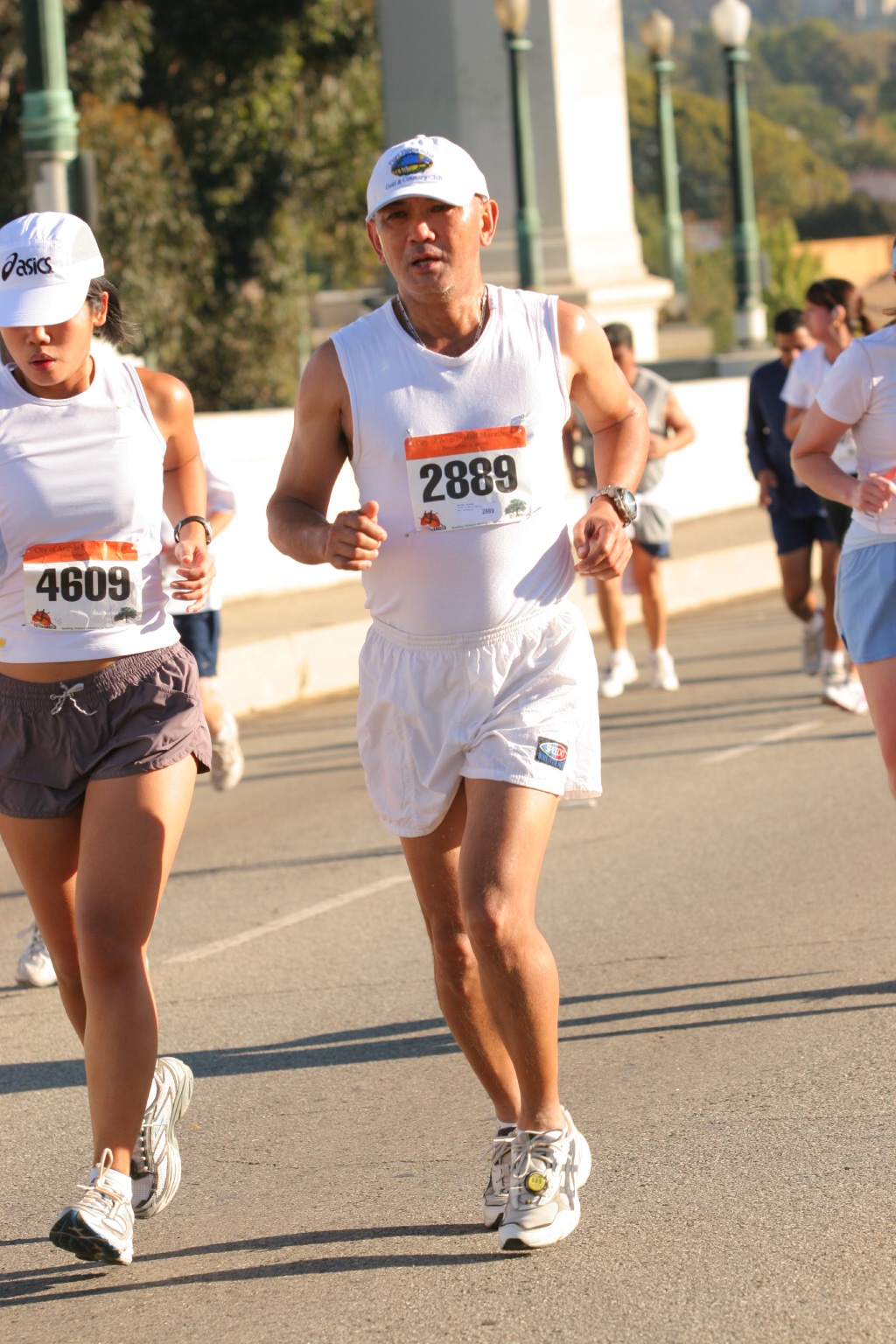
My picture in the 1st City of Angels Half-Marathon Race shows an old, worn-out and determined runner to finish the race. My cap is a golfer’s cap which I bought as a souvenir when I played a round of golf at Fort Ilocandia Golf Course in Paoay, Ilocos Norte in 2002. I have two pieces of this cap which I always use for my practice runs, as well as, during race days, obviously, to cover my bald head and it absorbs the sweat from my head, making it as my dependable “coolant”! My shirt is a “muscle shirt” from Bench which I usually used as my workout shirt in the gym. It is stretchable and cool to the body even if it is wet from my body sweat and I bought two of this one in 2003. My running shorts is Speedo, it’s a loose swimming/running shorts, which I bought with my Bench shirts in 2003 with 30% discount. I have two sets of this shorts and I usually use this  in my gym workouts. My running shoes is an ASICS Tiger shoes which I’ve been using for the past four years. I think I bought this shoes On Sale at Big 5 Store in Glendale, California in December 2002. After the race, I retired this pair of shoes and bought a new one which is an upgraded model of ASICS Tiger. The watch I am wearing is a Casio “Sea Pathfinder” Titanium which is light and water proof. It has a stop watch and timer functions whose digital numbers could be seen without my “reading glasses”. This watch was given to me as a Christmas gift by my younger brother in 1999 and had its battery changed only once. I am still using this watch in my practice runs and races.

The “yellow thing” tied with my shoe laces is what they call “runners’ chip” which activates and registers to the time recorder/computer once it passes the starting and the finish lines. Simply put, it registers your actual time of running from start to finish. In this particular race, it was used for the runners free of charge but for bigger marathon races, each runner pays a fee for using such “chip”. These “chips” are collected by the race organizers after you finish the rack.

At present, my running attire and fashion sense show an old runner whose legs and heart are still strong to finish any road race where he could compete. I consider myself as an average runner.

1st City of Angels Half-Marathon (Los Angeles) 03 December 2006


City of Angels Half-Marathon (Los Angeles) 04 December 2006

This is a picture taken along the Hyperion/Los Feliz Bridge with my daughter on my right. We just passed by the 7-mile marker at this point. We finished the race in 2 hours & 14+ minutes. My daughter’s PR time for the said distance improved by almost 12 minutes. I was running a pace of 10:15 minutes per mile. I placed/ranked #1,878 out of 3,652 finishers.

How I wish I could race again this year in this event.

Runners’ Blog


Little did I know that the Internet is full of runners’ blogsites. Last night, while browsing on my past postings in my other blogsite, I noticed that some “visitors” clicked on my postings regarding my running practices in preparation for a sports activity. This gave me the idea to come up with my blogsite specifically for my running activities.

I have seen blogsites of new, young and old runners in the Philippines as well as in other countries. But, “The Bull Runner” inspired me to make this blog and through my recollections of my past running feats, I could share my insights and experiences for the past so many years that I had been running to other runners and “would-be” runners.

Life, in itself, is a marathon race.