CamelBak (Hands-Free Hydration System)


The first time I saw a CamelBak Water Hydration System was in an advertisement in one of the pages of Bicycle Magazine in the mid-90s. It was featured in a one-page picture of a mountain biker where the said pack was worn on the back of the cyclist. When I went to the United States to visit my family in 1996, Colonel Alan Cabalquinto (later became a 3-star general), then my immediate “boss” requested me to buy him a Camelbak which he intended to use in his running workouts. At that time, Camelbak was only popular to mountain bikers and some road cyclists. Of all the sports stores in Los Angeles area, the only store that had Camelbak was a Cyclist Store in Beverly Hills. I bought one piece which costs me $ 85.00 + tax.

According to its history, the contraption was invented by a cyclist, Michael Edison, who participated in a bike race in Texas during summer and he was bothered with the constant pulling and putting back the water jug on its rack which is screwed to the bike frame and drinking water from his jug with use of his hands. He wanted to be hydrated while riding on his bike without using his hands. So, he got an I.V. bag and its tube and placed the bag in a bike socks and had it stitched at the back of an old t-shirt, wore it and later came up with a nozzle that controls the flow of water from the I.V. bag thru the tube as he placed the nozzle in his mouth. And the rest is history. By August of this year, CamelBak will be 15 years in the business of hands-free hydration system.

In the later part of 2000, I was part of a delegation of the AFP to attend a bilateral talks with the US Armed Forces in Hawaii as preparation for our future training exercises with them. In their PX Commissary, I found out some CamelBak 2.1-Liter Hydrobak Classic with the color-green cloth casing and I bought 20 pieces at a price of $ 35.00 each without any tax. Out of the twenty pieces, I kept one piece for myself; gave one to my brother; and the rest of the 18 pieces were given to the members of the Philippine Army’s Shooting Team to compete in Brunei for the ASEAN Armies Rifle & Pistol Meet in November 2000. I was then the Team Manager of the said Shooting Team. The members of the Shooting Team were happy and surprised to receive such hydration pack from me as I was the one who first introduced such to them instead of using the old World War II vintage-aluminum water canteen which was the issued water container equipment to our soldiers up to the present. This Camelbak hydrobak was very useful to my shooters that they become the envy of other delegations from the other countries as they were the only ones sporting such hydration system during the 2000 Brunei Shooting Competition. Unfortunately, the CamelBak I issued to the shootes became their personal property and some were “traded” as souvenirs from their counterparts from other countries. Such initiative to buy another set of CamelBak Hydration System for the succeeding team members in the next year’s events was not done by the succeeding Shooting Team Managers up to the present.

Two years ago (I was already a two-star general), I had heated argument with a more ranking/senior general at the Headquarters Philippine Army with my suggestion/recommendation to entirely start changing the hydration system of the basic soldier from the WWII vintage aluminum water canteen to CamelBak Hydration System to be at par with the US, UK, and other ASEAN Armed Forces which had been using the CamelBak 5-6 years ago. The ranking general did not buy my idea, instead, he decided to “improve” the water canteen from an aluminum to a stainless steel one but still the same size, carrying almost one-half liter of water/liquid. It is sad to note that until I retired from the military service, I haven’t seen that “improved stainless steel” WWII vintage water canteen being issued/used by the soldiers in the combat areas/battlefield. Presently, the soldiers are still stucked to the “bottled water”/”mineral water” hydration system ( in plastic bottles).
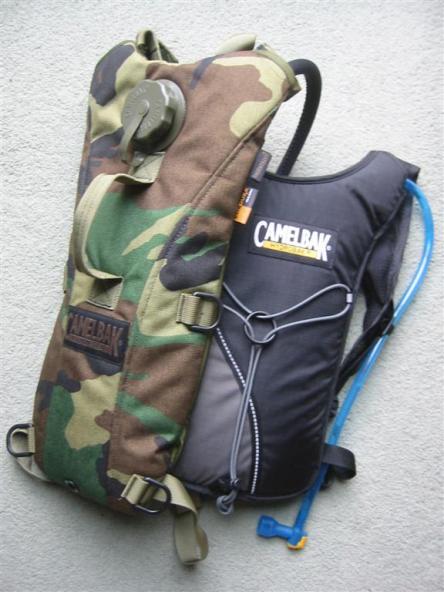
These are two models of the CamelBak Hydration System. The one with black & gray colored Cordura casing is exactly the same later model that I have which I bought at Travel Club Store 5 years ago. It has a capacity of 2.1 liters of water/fluids and a zippered pocket. The other model is for the military but this model had improved lately and it became already as an integrated part of the backpack/rucksack of the soldier.

At present, I have two sets of Camelbak Hydration System–the one that I bought in Hawaii and a newer version of the hydrobak classic which I bought at The Travel Club Store in SM Megamall 5 years ago which I haven’t used. It was the one which I bought in Hawaii that I’ve been using in my biking, hiking with 35-lb backpack, and other military exercises/activities. The difference between the old and the new Camelbak are the following:

1) The old one ( the one I bought in Hawaii) has no pockets in its Cordura cloth casing while the new one has zippered pockets and stretchable straps/strings where additional sports accessories could be strapped or carried.

2) In the old one, the nozzle/water tube is positioned on the left side with the left shoulder straps while the nozzle/water tube in the newer ones is located on the right with the right shoulder straps.

3) The old one has no cross-straps that connect the two shoulder straps on the breast area. The newer models has a cross-straps which make the Camelbak more hugged and stable with the body.

4) The old one has a bite nozzle that goes or connected directly with the water tube. The new one has its bite nozzle 90 degrees angled with the water tube.

Lately, when I was packing my things  to Laoag City, I was able to find my new Camelbak Hydrobak Classic Hydration System which has a pocket enough for two powerbars or 3 packs of Skyflakes and I brought it here in Laoag City for my future long runs on roads, hill/mountain trails, and beach/sand dunes. 

This is the “Rule of Thumb” in Hydration to the human body when involved in running and other endurance sports—drink one liter of water/fluids for every one hour of activity. Which means that my Camelbak is enough for a 2-hour running as my Camelbak can store only 2.1 liters of water/fluids. The military version and other later models have 3-liter capacity.

At present, more outdoor sports brands had copied the Camelbak’s concept of Hydration System. But I still prefer the original one. We will see how my CamelBak will help me in my next long run. I hope to do 33-35K non-stop long run next time.

“CamelBak: Hydrate or Die”
Sunday Run With GF 305


10 February 2008

I had my run in Jamindan and tried to use my GF 305 while running along the 2-mile route inside the camp. Although it was raining the whole morning, I made a decision already to run on this day excited to use the GF 305. So, I waited for the rains to stop before deciding to run. I finally started running at 10:47 AM after doing my stretching exercises.

This is the data registered by my GF 305 after running my three (3) laps of the 2-mile route:

Lap # 1 

Distance—2 miles                                                              

Elapsed Time—17:20 minutes                        Average Pace—8:40 minutes per mile 

Average HR—151 bpm                                              Maximum HR—165 bpm

Average Speed—6.5 miles per hour                        Total Ascent—725 feet

Maximum Speed—10.9 miles per hour                  Total Descent—737 feet

Total Calories—241

Lap # 2

Distance—2 miles                                                  

Elapsed Time—17:36 minutes                     Average Pace—8:49 minutes per mile

Average HR—156 bpm                                          Maximum HR—165 bpm

Average Speed—6.8 miles per hour                    Total Ascent—345 feet

Maximum Speed—8.1 miles per hour                 Total Descent—361 feet

Toatal Calories—234

Lap # 3

Distance—2 miles                                                   

Elapsed Time—16:37 minutes                    Average Pace—8:18 minutes per mile

Average HR—161                                                  Maximum HR—167 bpm

Average Speed—7.2 miles per hour                   Total Ascent—316 feet

Maximum Speed—167 miles per hour               Total Descent—325 feet

Total Calories—234

I finished my run with a one-mile slow and cool-down jog. Total distance covered in my run was 7 miles or 11.2 kilometers.

From the GPS readings of my GF 305, I found out that the 2-mile loop I had been running for the past months in my camp in Jamindan is short by almost 300 meters! I had to run an additional distance for the lacking meters and stopped every lap once the GF 305 registers a distance of 2.0 miles! My “soldiers” will have a lot of explaining to do!

Well, to finally validate the accuracy of my GF 305, I need to run along the Iloilo City Oval Track in the next coming days.

“Garmin Forerunner Club”


At last, I am now a member of what I call as the “Garmin Forerunner Club”. These are the runners, bikers and other sports enthusiasts who wear a “Garmin Forerunner Watch”. My wife bought me a Garmin Forerunner (GF) 305 weeks ago and it was brought by my daughter to Manila who just arrived from Los Angeles last Monday.

After the Clark 10K Run, BenMChan warned me not to buy GF 305 and told me to wait for the availability of GF 405 in the market. But I found out that my wife already ordered “on line” and got the cheapest price for the watch. I found out later that the GF 305 was “on sale” because of the new GF 405 which has a higher price.

So, I have the whole day reading the manual for the watch, “tinkering” the buttons, charging its battery, going out of my quarters to “locate” the satellites, and having it programmed and sync to my laptop computer.

Last night, I made a test run and ran from my quarters to McKinley Hill-C-5 entrance-back to Lawton Avenue-The Fort-3X around Bonifacio High Street loop-Jollibee-McDonalds-Lawton Avenue-Bayani Road and back to my quarters. The GF 305 registered a total distance run of 9.61 miles with a time of 1:32:38 hours; with an average speed of 9:39 minutes per mile and my fastest pace was 6:44 minutes per mile.

The GF 305 is very impressive and I was able to see and track the route I’ve taken through its GPS readings of my location and the graph that indicates the distance, time and speed of my run once I connect/sync the watch to my laptop computer.

The Bald Runner is becoming a “high-tech” runner!

TIMEX Watch


Yesterday, I bought a TIMEX Watch at SM City Iloilo which is called “Zone Trainer Digital Heart Rate Monitor” (Product Code: T5J031) with a Complimentary Free Men’s Watch (Stainless Steel Case & Wristband) which cost me less than Five Thousand Pesos.

I used it during my running workout yesterday afternoon with the Digital Heart Rate Sensor Pads fastened firmly below my sternum using an elastic belt that goes around my body.

Based from my age (Max. HR=220 minus 55), I set my Heart Rate Zone between 135 to 165 (lowest & highest peak Heart Rate). After my running and dumbbell/sit-ups/push-ups workouts, the watch registered the following:

Peak Heart Rate—156

Minimum Heart Rate—114

Average Heart Rate—144

Total Calories—255

Range of Heart Rate During Gym Workout—125-135

Since my running workout was an easy run, I was not able to experience the feeling of reaching the Maximum Heart Rate. I have tried reaching my Max Heart Rate on Cardio machines at Gold’s Gym by grasping on their handle bars but I would like to feel the difference while using this TIMEX Zone Trainer Digital Heart Rate Monitor Watch.

RFID Technology


At last, “running/runner’s chips” are here in the country! I just read an article in one of the daily newspapers  about the conduct of the “New Balance Power Race 2007: The Next Level” held last 11 November 2007 at Clark Freeport where RFID Timing Technology or popularly known as “runner’s chips” were used by the runners.

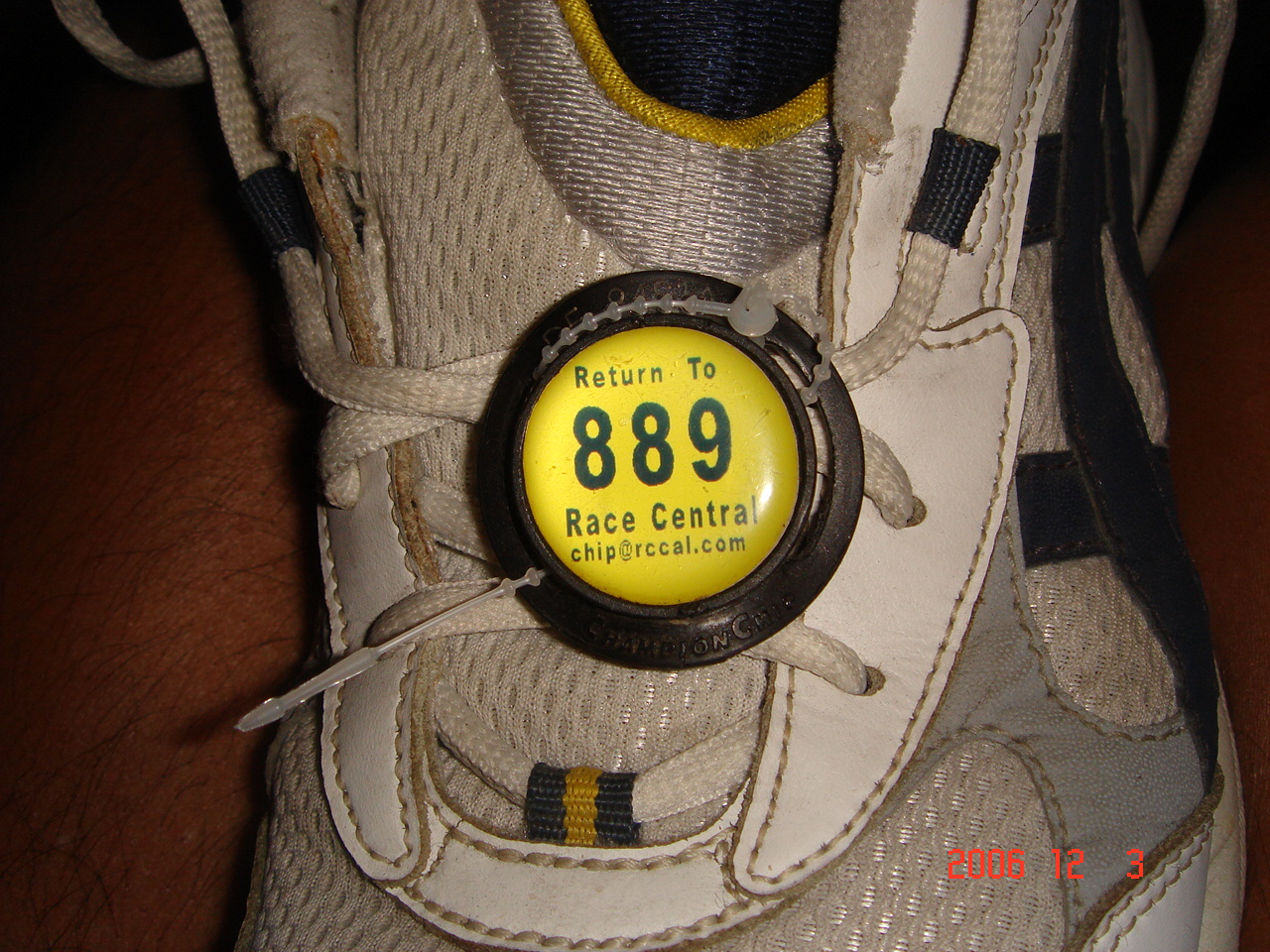
These are three famous systems in the market today on RFID Timing Technology: “ChampionChip”; “Winning Time USA” & “AMB”. 

This “chip” initiates the start of the runners’ time from the start line and registers the lapsed time once a runner passes through the finish line. The start & finish lines are equipped with antenna/transponder which is covered by a mat/rubber carpet. The antenna/transponder activates the “runner’s chip” once it passes through the mat/carpet. It is imperative that each runner should not pass the start line before the firing of the gun! This will discourage runners from “cheating” at the start line or along the route as more transponders could be placed to measure time splits every 10 kms/miles.

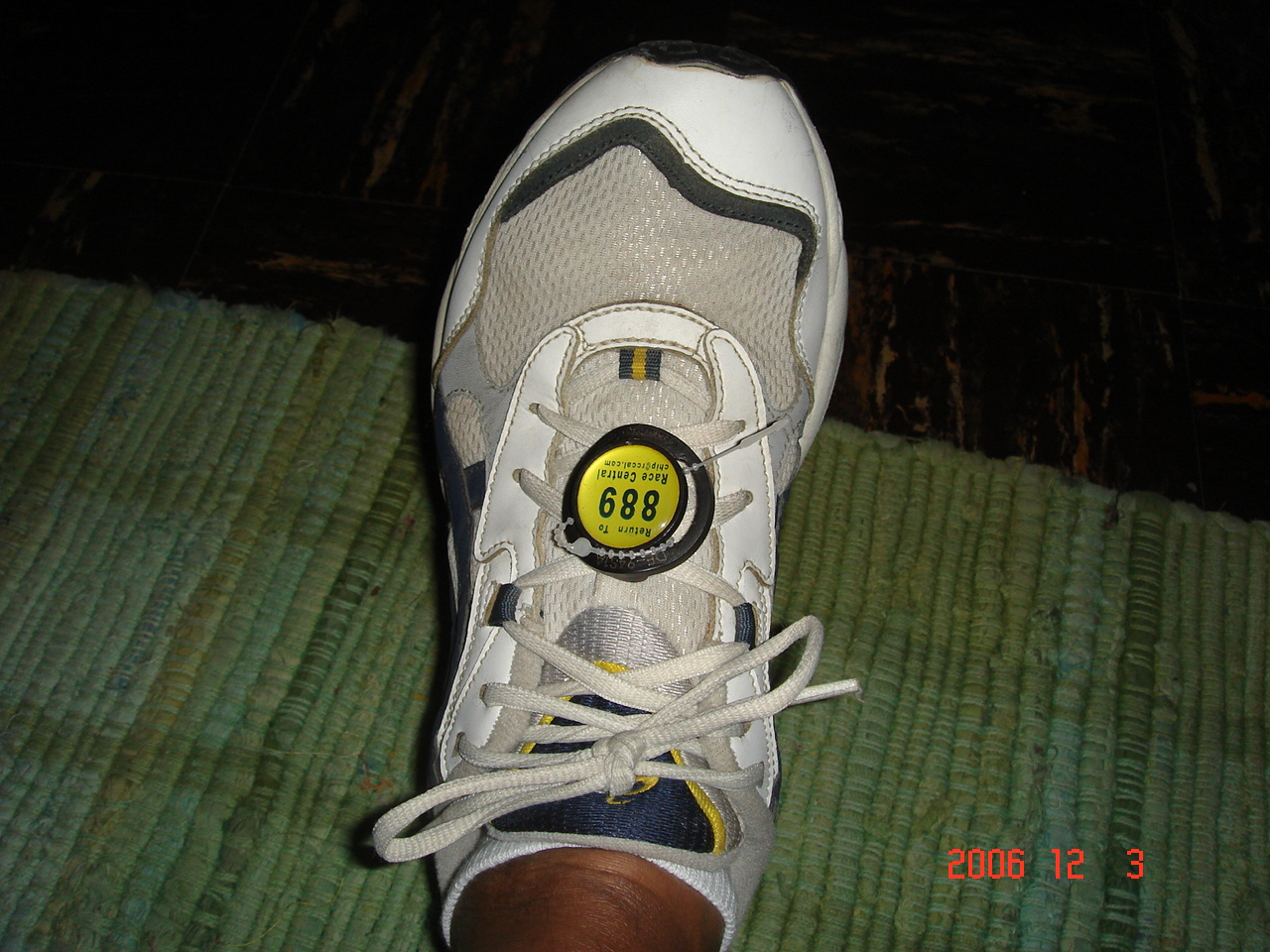
Shown below are the pictures I’ve taken with my runner’s chip I used in the Inaugural City of Angels Half-Marathon last 03 December 2006. This chip is from ChampionChip!

            dsc01145.jpg      dsc01144.jpg

I hope to see these “runner’s chips” in all the local road races and marathon races in Metro Manila/Subic/Clark soon!

Nathan Water Belt


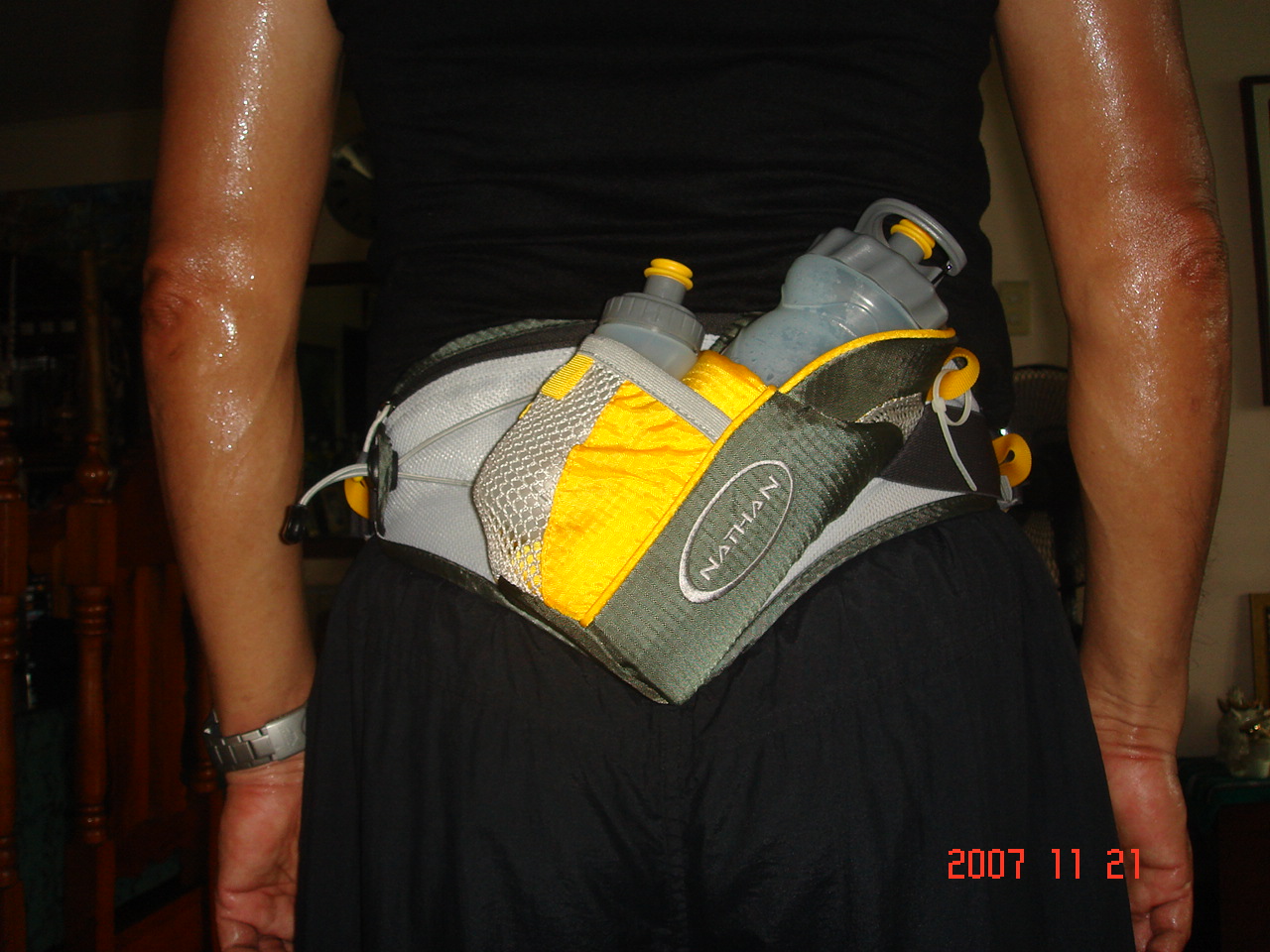
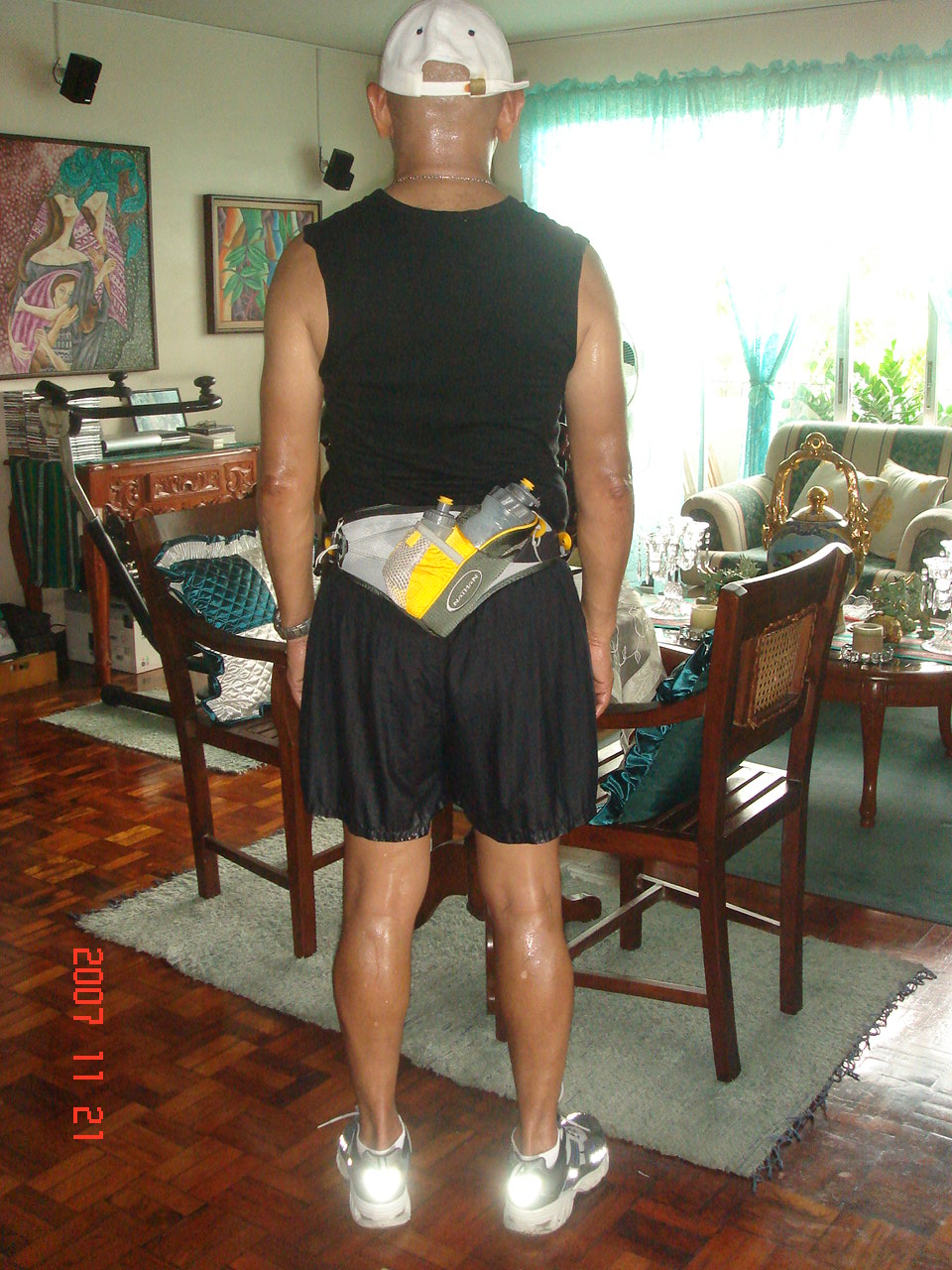
I bought this hip-mounted canted water bottle belt, together with my Asics Tiger “Cumulus” Running Shoes, last December 2006 at Phidippides Store in Ventura Blvd., Encino, California. I was attracted to buy this item after observing and seeing most of the average runners at the 1st City of Angels Half-Marathon Race were wearing this particular water belt. I was not particular with the name of the manufacturer/brand that time but I was after a “new style” of carrying a water jug and a small energy drink container snugged with the body during running practices.

In combat shooting, there is a particular gun holster which is positioned at the back of the body. They call this the “SOB” (Small Of the Back) holster. For this particualr water belt, I would like to call it “SOB” Water Belt! I think my wife paid $ 35.00 for the said item. It has a zippered pocket which can fit my Nokia 9300i phone and my reading glasses!

As I reached home, when I read the “Brochure & Warranty Papers” tied with the Nathan Water Belt, I found out that it was “Made in the Philippines”!!!

Last Wednesday, I used this Nathan “SOB” Water Belt for the second time since I bought it. It was useful as I ran almost 1 hour and 50 minutes for my speed tempo runs.

dsc03723.jpg                       dsc03726.jpg

These pictures were taken inside my quarters in Fort Bonifacio after my speed tempo runs.

I don’t experience any bounce with the water jug as long as the elastic belt is adjusted properly and fitted tight to the waist. The bottle could be easily reached by the right hand. I highly recommend this runner’s accessory for long slow distance running practices, but not in actual road races.