The first time I saw a CamelBak Water Hydration System was in an advertisement in one of the pages of Bicycle Magazine in the mid-90s. It was featured in a one-page picture of a mountain biker where the said pack was worn on the back of the cyclist. When I went to the United States to visit my family in 1996, Colonel Alan Cabalquinto (later became a 3-star general), then my immediate “boss” requested me to buy him a Camelbak which he intended to use in his running workouts. At that time, Camelbak was only popular to mountain bikers and some road cyclists. Of all the sports stores in Los Angeles area, the only store that had Camelbak was a Cyclist Store in Beverly Hills. I bought one piece which costs me $ 85.00 + tax.
According to its history, the contraption was invented by a cyclist, Michael Edison, who participated in a bike race in Texas during summer and he was bothered with the constant pulling and putting back the water jug on its rack which is screwed to the bike frame and drinking water from his jug with use of his hands. He wanted to be hydrated while riding on his bike without using his hands. So, he got an I.V. bag and its tube and placed the bag in a bike socks and had it stitched at the back of an old t-shirt, wore it and later came up with a nozzle that controls the flow of water from the I.V. bag thru the tube as he placed the nozzle in his mouth. And the rest is history. By August of this year, CamelBak will be 15 years in the business of hands-free hydration system.
In the later part of 2000, I was part of a delegation of the AFP to attend a bilateral talks with the US Armed Forces in Hawaii as preparation for our future training exercises with them. In their PX Commissary, I found out some CamelBak 2.1-Liter Hydrobak Classic with the color-green cloth casing and I bought 20 pieces at a price of $ 35.00 each without any tax. Out of the twenty pieces, I kept one piece for myself; gave one to my brother; and the rest of the 18 pieces were given to the members of the Philippine Army’s Shooting Team to compete in Brunei for the ASEAN Armies Rifle & Pistol Meet in November 2000. I was then the Team Manager of the said Shooting Team. The members of the Shooting Team were happy and surprised to receive such hydration pack from me as I was the one who first introduced such to them instead of using the old World War II vintage-aluminum water canteen which was the issued water container equipment to our soldiers up to the present. This Camelbak hydrobak was very useful to my shooters that they become the envy of other delegations from the other countries as they were the only ones sporting such hydration system during the 2000 Brunei Shooting Competition. Unfortunately, the CamelBak I issued to the shootes became their personal property and some were “traded” as souvenirs from their counterparts from other countries. Such initiative to buy another set of CamelBak Hydration System for the succeeding team members in the next year’s events was not done by the succeeding Shooting Team Managers up to the present.
Two years ago (I was already a two-star general), I had heated argument with a more ranking/senior general at the Headquarters Philippine Army with my suggestion/recommendation to entirely start changing the hydration system of the basic soldier from the WWII vintage aluminum water canteen to CamelBak Hydration System to be at par with the US, UK, and other ASEAN Armed Forces which had been using the CamelBak 5-6 years ago. The ranking general did not buy my idea, instead, he decided to “improve” the water canteen from an aluminum to a stainless steel one but still the same size, carrying almost one-half liter of water/liquid. It is sad to note that until I retired from the military service, I haven’t seen that “improved stainless steel” WWII vintage water canteen being issued/used by the soldiers in the combat areas/battlefield. Presently, the soldiers are still stucked to the “bottled water”/”mineral water” hydration system ( in plastic bottles).
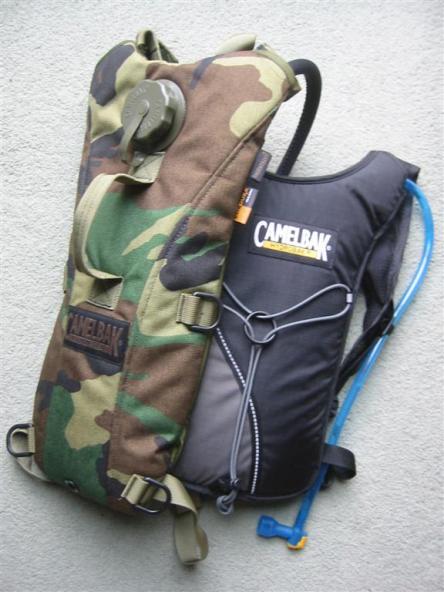
These are two models of the CamelBak Hydration System. The one with black & gray colored Cordura casing is exactly the same later model that I have which I bought at Travel Club Store 5 years ago. It has a capacity of 2.1 liters of water/fluids and a zippered pocket. The other model is for the military but this model had improved lately and it became already as an integrated part of the backpack/rucksack of the soldier.
At present, I have two sets of Camelbak Hydration System–the one that I bought in Hawaii and a newer version of the hydrobak classic which I bought at The Travel Club Store in SM Megamall 5 years ago which I haven’t used. It was the one which I bought in Hawaii that I’ve been using in my biking, hiking with 35-lb backpack, and other military exercises/activities. The difference between the old and the new Camelbak are the following:
1) The old one ( the one I bought in Hawaii) has no pockets in its Cordura cloth casing while the new one has zippered pockets and stretchable straps/strings where additional sports accessories could be strapped or carried.
2) In the old one, the nozzle/water tube is positioned on the left side with the left shoulder straps while the nozzle/water tube in the newer ones is located on the right with the right shoulder straps.
3) The old one has no cross-straps that connect the two shoulder straps on the breast area. The newer models has a cross-straps which make the Camelbak more hugged and stable with the body.
4) The old one has a bite nozzle that goes or connected directly with the water tube. The new one has its bite nozzle 90 degrees angled with the water tube.
Lately, when I was packing my things to Laoag City, I was able to find my new Camelbak Hydrobak Classic Hydration System which has a pocket enough for two powerbars or 3 packs of Skyflakes and I brought it here in Laoag City for my future long runs on roads, hill/mountain trails, and beach/sand dunes.
This is the “Rule of Thumb” in Hydration to the human body when involved in running and other endurance sports—drink one liter of water/fluids for every one hour of activity. Which means that my Camelbak is enough for a 2-hour running as my Camelbak can store only 2.1 liters of water/fluids. The military version and other later models have 3-liter capacity.
At present, more outdoor sports brands had copied the Camelbak’s concept of Hydration System. But I still prefer the original one. We will see how my CamelBak will help me in my next long run. I hope to do 33-35K non-stop long run next time.
“CamelBak: Hydrate or Die”
 Bald Runner
I use the 15 minute rule when running. I sip my fluids whenever my GF 305 alarms so I dont get dehydrated. I’ve used a mixture of camelbak parts (big bite valve, L lock and tube) with my Deuter 2 liter bag. Deuter is the other brand that competes with Camelbak. I use this when I paddle on my surf ski as my PFD has a built in bag for this. It must be very convenient to have this on long runs especially if you can keep it cold. Wow, sarap nun BR!
Care must be taken after use as molds tend to build up inside if not properly cleaned. This is where those special camelbak brush come in to play. Its ok to put juice or water, just clean properly afterwards. You can also use diluted baking soda and let it sit overnight inside. It sanitizes the bag and removes any aftertaste or smell from previous drinks.
Deuter also make back pack type models that “float” on your backso there’s proper ventilation. Camelbak and Deuter products are all available at ROX, check it out.
LikeLike
mark, thanks for the info & suggestions. i’ve been using camelbak since 2000 and the 2.1 liter bag filled with water (without the casing) is always inside my refrigirator just in case i need it for my running/walking. i never used the camelbak for other fluids and used it only for water and didn’t have any problem in its care & maintenance.
People in the gym would strangely look at me when i use my camelbak in my 1-1 1/2-hour treadmill runs few years ago and my sweat would fill the machine and nobody dared to use the treadmills on my sides for fear of being “sprayed” with sweat! ha-ha-ha!
I went to ROX twice already looking for energy bars & GUs (gel) but they are out of stock. instead, i bought a water jug velcro strap which keeps the water jug strapped on the palm of my hand when running.
LikeLike
Energy bars and gels are available at Fitness First and at Health Express. I assume most bike shops carry them as well.
Isnt it difficult to carry a water jug strapped on the palm?
I was able to get some energy bars at GNC in limited numbers and intend for trial only. I am afraid the ingredients might trigger my gout!..hahaha! I’ve seen “ultra runners” using these bottle straps and I tried them this afternoon in my trail run and it works comfortably. I strapped a bottle of Propel on my hand and forgot applying a grip on the bottle as I swing my arms.
LikeLike
available too at healthy options and cash and carry mezzanine area ( new building) where there are tons of health supplements,power bars,etc.
Thanks. I will visit these places soon.
LikeLike
I have a 3L camelbak that I use for mountain biking that I bought in 1999. Then I bought a replacement bladder/hose/valve at Cartmar in 2007. I think I got the military edition since it was olive and the bite valve is black.
Anyway I was wondering how it feels to run with the camelbak? I’m thinking it could be quite bulky and would bounce around when running. I also saw recent models that are like fanny packs but I’m not sure how much is the capacity. That might be a better option for running.
The CamelBak really bounce a lot if used for running, most especially the old model that I have, without a cross-straps on the breast. I had to tighten the shoulder straps for better hugged and tighter contact with my back. The 2.1 liter capacity becomes an additional 4-lb weight when running and just think positively the benefit this additional weight is giving to your training.
I only use Camelbak in my long trips and hikes when I was in the military and I intend to use it again for my long runs to avoid refilling my Nathan water jug in those sari-sari stores along the road. Since I am going to include trail runs in my long runs in the hills and sand dunes in Laoag City, having a Camelbak is my best option for hydration.
LikeLike
Camel back are really great for biking, hiking or practically any kind of endurance activity. For short races though, I’d prefer just the water station. But for long runs, I normally use a hydration belt. I’m not sure how the camel back would feel when your using it during long runs. But if it fits well and your comfortable with it then I guess thats also a good option for long runs.
Camelbak will be my best option for hydration for my long runs lasting for 3-4 hours without any stops along the way. I shorter runs, I will use my Nathan Water belt. In road races, 10K-half-marathon, I will contend myself with a bottle of Propel tucked at the back portion of my waist.
LikeLike
We use similar hydration systems for climbing — with brands like Platypus or MSR — that can be inserted into the backpacks. The 2-3litre bladders ride in a sleeve inside the pack and you bite at the valve at the end of the tube that protrudes atop your shoulder. This should be ideal for jungle patrols as well since, if you take out the munitions, we basically do the same thing, which is walk all day with a load. They should help free up a soldier’s hands for more important tasks.
Thanks, Cecil for the info. I know that mountain climbers must always have their hydration system, too! It’s unfortunate that our military “planners and logisticians” do not see the improtance of hands-free hydration system to our soldiers. I did my part but it was not enough.
LikeLike
Try the bikeshop beside ROX, we got some last night. They have lots of flavors. A bit expensive at Php75each considering GU is only USD24 per pack of 24 … :)you can stock up when you do your marathon.
Bards, thanks for the info. That’s true, they are expensive here. I bought one protein bar at GNC at P 162.00. I guess, I’ll stick with my SkyFlakes for the meantime. In the military, we call them “SF” meal(Special Forces)!
LikeLike
wish i had one for my long runs! although wouldn’t the weight take a toll on your running as well?
Prom, a 2.1-liter capacity Camelbak is an additional weight of 4 lbs (almost 2 kilos) but it will take time for the body to adjust and for all you know this weight will be negligible once you will be having your long runs. The farther you go, the lighter will be your CamelBak, right? Good luck & Happy running
LikeLike
hey BR, how much are those velcro straps? Might go get 1 myself…. thanks! BTW, can I just pick up my race bib for DND on the race day itself? See you there!
loony, i got the last one from R.O.X at Boni High Street and it cost me P 990.00. It is made by lafuma (european brand). maybe, they have at the north face or other outdoor sports stores. you can pick up your race number on the race day but just be sure to arrive early. the race will start at 5:30 AM.
LikeLike
yup, will be arriving early at the run site. thanks for the info! 🙂
LikeLike
All you Camelbak users might want to check out a new device called AquaJoe. It is a powder holder/dispenser for athletes. It weighs about an ounce and clips easily to your Camelbak. There is a video of it on http://www.aquajoe.com.
LikeLike
hydrateme, thanks for the visit and my readers will appreciate the added info you provided. thanks for the comment.
LikeLike
Pingback: Feedbag… camel backs no longer cut it. at Run For Change